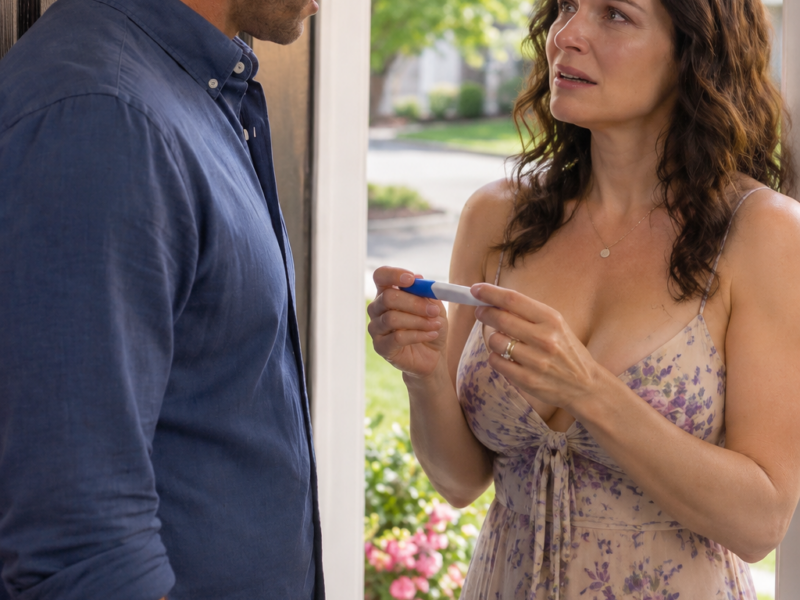
I Thought It Was Just a Drunken Mistake… Until My Ex’s Mom Showed Me the Pregnancy Test
I Thought It Was Just a Drunken Mistake… Until My Ex’s Mom Showed Me the Pregnancy Test
The box was sitting on her kitchen island like it had every right to be there.
“Sit down, Dean,” Fay said.
There was something different about her voice that morning. It wasn’t quite fear, and it wasn’t quite sadness. It was the sound of someone trying desperately to hold together something that had already begun falling apart.
I didn’t sit.
I stood in the middle of her kitchen, still wearing my work boots, my jacket half unzipped, staring at the small white box beside her coffee mug. There was also a little plastic stick lying faceup on the counter, two unmistakable pink lines staring back at me.
For a few seconds, I couldn’t make my brain understand what my eyes were seeing.
Then Fay spoke again.
“Dean, I’m pregnant.”
I looked at the test, then at her.
“Are you sure?”
She gave me a tired little smile.
“I’ve checked three times. Unless all three tests have decided to ruin my morning for entertainment, yes. I’m sure.”
I pulled out the stool opposite her and sat down slowly.
“Okay,” I said.
It was the only word I trusted myself to say.
Fay wrapped both hands around her coffee mug, although the coffee inside had clearly gone cold. She looked at me as if she were waiting for something. Perhaps an explanation. Perhaps a promise. Perhaps the first sign that I was about to run.
I wasn’t going anywhere.
But before I could tell her that, I needed to understand how two people who had spent months pretending they were only fixing furniture and drinking coffee together had somehow arrived at this kitchen island.
Six months earlier, I would have told you that the two most complicated women in my life belonged to two entirely separate chapters.
One was a woman I had loved and lost.
The other was a woman I had barely known until a broken chair brought us together at exactly the wrong moment.
I would have told you that both stories were finished, that the past was behind me, and that I had finally learned how to live a quiet life without expecting anything unexpected to happen.
I would have been wrong about every part of that.
My name is Dean. I’m thirty-four years old, and I restore furniture for a living. Not the kind of furniture you find in glossy catalogs, either. I work on things people have kept for decades, sometimes generations. Old dressers with missing handles, dining tables scarred by family dinners, church pews that have survived more Christmas services than anyone can count, and occasionally a grand piano that someone discovers in a barn and decides is worth saving.
My workshop sits inside a converted feed store on the edge of Mil Haven, a small town tucked into the Vermont hills. It’s the sort of place where the diner waitress knows what you’re ordering before you sit down, where people recognize your truck from half a mile away, and where a new face can become the subject of conversation before they’ve finished unpacking their suitcase.
I liked it that way.
Or at least, I had convinced myself that I did.
For two years, my life had been deliberately small. I worked during the day, came home in the evening, fed my dog, Otis, and spent most nights doing whatever required the least amount of emotional energy.
Otis was a golden retriever with the personality of an elderly farmer. He was friendly to everyone, suspicious of delivery trucks, and completely uninterested in whether my romantic life was going well. He had never asked me to explain my feelings, and I appreciated that.
My life had become predictable enough that I could go several days without having a conversation longer than five minutes.
That suited me.
Eight months before the morning Fay showed me that pregnancy test, my relationship with Callie Whitfield had ended.
We had been together for three years. We’d talked about marriage, looked at houses online, and occasionally made jokes about what kind of parents we might be someday. Nothing had been formally decided, but I had spent enough time imagining a future with her that I never considered the possibility of building one without her.
Then one Tuesday evening, Callie came home and told me she had accepted a design position in Portland.
She didn’t ask me to come.
That was the part that hurt most.
There was no argument, no dramatic announcement, no suitcase thrown down the stairs. She simply explained that she had been offered an opportunity she couldn’t refuse and that she thought it was time for her to do something different.
I remember standing beside the kitchen sink while she spoke. I remember the refrigerator humming behind me and the smell of the dinner I had prepared slowly disappearing into the room.
I also remember asking whether she had already made up her mind.
She said yes.
And somehow, that one word explained everything.
We didn’t hate each other. We didn’t even have a particularly ugly breakup. We divided our belongings, discussed the lease, and said things that sounded reasonable enough to repeat to friends.
But after she left, the house felt enormous.
For months, I couldn’t bring myself to rearrange anything. Her favorite mug remained on the second shelf. The little blanket she used when she watched television stayed folded over the back of the couch. Even the space beside my bed seemed to belong to someone who was simply running late.
I told people I was fine.
Fine became my favorite word because it allowed me to end conversations without having to explain anything.
Eventually, I got used to being alone.
Then, just when I had finally convinced myself that my life was working perfectly well, Callie’s mother called.
Her name was Fay Whitfield.
I had met her only a handful of times during my relationship with Callie. Thanksgiving dinners, a birthday celebration, and one uncomfortable evening in a hospital waiting room when Callie’s father, Roy, had experienced a heart scare.
Fay had always seemed pleasant, independent, and somewhat difficult to read. She was a ceramics teacher who had spent fifteen years working with clay. She lived in a converted barn about twenty minutes outside Mil Haven, where she had built a pottery studio with enormous north-facing windows.
She was also recently divorced from Roy.
I knew the marriage had ended, but I didn’t know the details. Nobody had explained much, and I hadn’t thought it was my place to ask.
As far as I was concerned, Fay was simply Callie’s mother.
Then she called me about a broken chair.
It was a Thursday afternoon when I drove out to her property. The chair was an old oak spindle-back dining chair with a split rear leg. Apparently, it had been in her family for years, and she wanted it repaired before she moved some things into a new studio space.
When I pulled up, Fay was standing in the barn doorway wearing an old apron covered in paint and clay.
She didn’t rush toward me or apologize for making me drive out.
Instead, she pointed toward the chair.
“It’s the third one from the left. I dragged it outside already. You should be able to find it.”
That was her entire greeting.
I appreciated it immediately.
Most people hovered when I worked. They watched every movement, offered unnecessary advice, and apologized repeatedly for asking me to do something I was already being paid to do.
Fay simply returned to her pottery wheel.
I spent the next ten minutes examining the damaged leg before I finally looked up at her properly.
She was in her mid-forties, with dark hair pulled loosely behind her head. One strand kept escaping and falling beside her face. Whenever it happened, she tucked it behind her ear using the back of her wrist because her hands were usually covered in clay.
There was a small smear of robin’s-egg-blue glaze near her collarbone.
I noticed it because the rest of her clothing was remarkably clean for someone who worked with pottery all day.
She had sharp cheekbones, a thoughtful expression, and the kind of smile that appeared slowly, usually when she was amused by something she didn’t intend to admit was funny.
“You’re better at this than my ex-husband thinks you’ll be,” she said without looking up.
“That’s a surprisingly specific compliment.”
“He thinks anyone under forty just glues things together.”
“I do glue things together.”
She glanced at me.
“There’s a difference.”
I smiled.
“Exactly.”
The corner of her mouth lifted.
It wasn’t much, but I remember thinking that she had a very particular way of making ordinary conversations interesting.
I repaired the chair in about forty minutes.
She made coffee afterward, even though I hadn’t asked for any. We talked briefly about the weather, her pottery classes, and the condition of the old barn.
We didn’t discuss Callie.
We didn’t discuss Roy.
We didn’t discuss either of our failed relationships.
When I drove home, I found myself thinking about the way Fay tucked her hair behind her ear.
I told myself it meant nothing.
Two weeks later, a wedding invitation arrived.
It was for Callie’s cousin, and because Mil Haven was small enough that everybody seemed connected to everybody else, I was invited despite no longer being part of the Whitfield family.
I almost declined.
Then I noticed Fay’s name on the RSVP list.
I told myself that had nothing to do with my decision to attend.
The wedding was held at a beautiful old country venue just outside town. By the time I arrived, most of the guests had already gathered around the reception tables.
I could feel people recognizing me.
There was the familiar sympathetic expression, the careful smile, and the occasional question about how I was doing after Callie moved away.
Everyone seemed to know the story.
The hometown couple. The woman who moved to Portland. The man who stayed behind.
People had apparently decided that I was supposed to be sitting alone somewhere, looking quietly heartbroken.
Instead, I spotted Fay at a table near the middle of the room.
There was an empty chair beside her.
I walked straight over.
“Is this seat taken, or is the entire family conspiring to keep me in exile at table nine?”
She looked up, surprised.
Then she laughed.
“Table nine has the good bread. You’re making a terrible mistake.”
“I’ve made several this week. I might as well add another.”
“Sit down, then.”
I pulled out the chair.
A few people nearby noticed immediately. Callie’s aunt looked over from the bar, and somebody at the next table whispered something to another guest.
Fay noticed them, too.
She simply poured me some wine.
“Well,” she murmured, “now they’ve got something to discuss besides the seating arrangement.”
I laughed.
For the first time in months, it was a real laugh. Not the polite kind I offered when someone made a joke out of sympathy.
The evening unfolded more naturally than I expected.
We talked about the food, the music, and the absurdity of small-town gossip. Fay had a dry sense of humor that seemed to become sharper whenever she was uncomfortable.
At one point, she leaned toward me while the wedding speeches were beginning.
“You realize this is going to be the entire family’s favorite topic for the next month.”
“Which part?”
“You sitting here.”
“Should I move?”
“No. The bread is too good.”
I smiled.
She looked at me for a moment before turning back toward the head table.
“You didn’t have to do that,” she said quietly.
“Do what?”
“Sit here. People are going to make it into something.”
“People make everything into something.”
“That’s not an answer.”
“It’s the only one I’ve got tonight.”
She studied me briefly, then poured me another glass of wine.
That was the beginning of something I didn’t understand yet.
Not a romance, not even an attraction I was prepared to admit existed.
Just a small change in the way I felt when I was around her.
Something had become easier.
When I drove home that night, I realized I hadn’t thought about Callie once during the reception.
That fact stayed with me long after I reached my house.
The next few weeks were stranger than I expected.
Fay needed a bookshelf built for her new pottery studio. I happened to be the person she knew who could build one. I also happened to have a collection of badly shaped mugs from a beginner ceramics class I had signed up for on a whim.
Fay offered to glaze them.
It was a perfectly reasonable arrangement.
At least, that’s what we told ourselves.
I delivered the bookshelf in pieces because I had underestimated how much staining it would require. Three days later, she texted me.
Your bookshelf looks like it survived a war. Please come rescue it before I return it to the forest.
I replied:
It’s called character. You should know something about that.
She answered almost immediately.
Careful. I have your home address and a very sharp set of pottery tools.
That became our language.
We joked about everything. Wood grain, pottery temperatures, coffee, the weather, and the questionable quality of the music playing in her studio.
Every conversation seemed to contain two separate conversations.
One was about whatever practical task had brought us together.
The other was about something neither of us was ready to discuss.
For six consecutive Thursdays, I found myself driving out to the barn.
Officially, I was working on the bookshelf.
Unofficially, I had begun looking forward to the smell of wet clay, wood smoke, and the faint mineral scent of pottery glaze.
It was strange how quickly a place could become important.
The barn had enormous windows that faced north, allowing soft afternoon light to spread across the floorboards. There was always something drying on the shelves, and Fay frequently had several unfinished projects scattered across the tables.
She would make coffee while I worked.
We would talk for an hour after the work was finished.
Sometimes we discussed ordinary things. Other times, our conversations drifted into subjects neither of us had expected to share.
I learned that Fay’s divorce had been less about betrayal and more about years of quiet disappointment.
Her marriage to Roy hadn’t ended because of one terrible event.
It had simply stopped feeling like a marriage.
“He didn’t cheat,” she told me one afternoon. “He wasn’t cruel. He didn’t even do anything particularly unforgivable. He just stopped choosing me.”
She was standing beside the pottery wheel, cleaning dried clay from her fingers.
“After a while, I stopped asking him to choose me. I think that’s when I knew it was over.”
I understood more than I wanted to.
“Callie didn’t fight either,” I said. “She just left politely. Efficiently. Like she was returning something to a store.”
Fay looked at me.
“Does it still hurt?”
“No.”
The answer came too quickly.
She noticed.
But she didn’t challenge me.
Instead, she poured more coffee.
That was something I gradually came to appreciate about her. She didn’t force honesty out of people. She simply made it difficult to keep lying to yourself.
One afternoon, she told me that she had spent eleven years becoming so independent that she had forgotten how to ask anyone for help.
“It’s strange,” she said. “You can be married to someone and still learn how to live entirely alone.”
I looked at the bookshelf.
“That’s probably why I built mine so badly.”
She laughed.
It was becoming increasingly difficult to remember why I had ever considered my life more comfortable without conversations like these.
Then the town started noticing.
I was having breakfast at the diner one morning when Marne Cooper, who owned the flower shop and had appointed herself the unofficial mayor of everyone’s private business, slid into the booth opposite me.
“People are saying you’ve been visiting the Whitfield barn quite often.”
I continued cutting my eggs.
“It’s a big bookshelf.”
“I’m sure it is.”
“It needs a lot of work.”
“Of course.”
I looked up.
“What exactly are you asking, Marne?”
She stirred an imaginary spoon through the coffee she hadn’t ordered.
“Nothing. I’m just saying Roy mentioned it to his sister, who mentioned it to Carol, who mentioned it to me.”
“That sounds exhausting.”
“Small towns are very efficient.”
She patted my hand.
“Just be careful, honey. That family has had enough this year.”
Then she left.
I sat there staring at my plate.
For the first time, I understood that whatever Fay and I thought we were keeping private had probably never been private at all.
I didn’t mention it to her for almost a week.
When I finally did, she went quiet.
“So we don’t have as much time as we thought,” she said.
I nodded.
It was true.
People were beginning to form their own conclusions, and eventually those conclusions would reach Callie.
Neither of us wanted her to hear something important about her mother from a stranger.
But neither of us knew how to begin that conversation.
November brought the first serious cold.
One afternoon, I went to help Fay move a pottery kiln. It was too heavy for one person, and she had been trying to shift it herself.
We managed to get it several feet across the studio before she lost her grip.
The kiln dropped.
It landed less than an inch from her foot.
For a moment, neither of us moved.
“Are you okay?” I asked.
“I’m fine.”
She sounded shaken.
I stepped closer and placed my hand against her back, just between her shoulder blades.
It was an instinctive gesture. I had reached out to steady her before she could lose her balance again.
She didn’t move away.
Neither did I.
The kiln sat forgotten beside us.
The barn was silent except for the faint crackle of the wood stove.
“Dean,” she said.
“Yeah?”
“This is the part where one of us says something sensible.”
“I’m fresh out.”
She laughed, but it came out nervous.
Then she stepped away and checked the kiln.
We returned to work as if nothing had happened.
But I drove home that evening with my hands gripping the steering wheel much tighter than necessary.
I told myself it had been nothing.
Two lonely people standing too close after a frightening accident.
Nothing more.
I was becoming very good at inventing explanations for things I didn’t want to understand.
Two weeks later, Fay invited me to Sunday dinner.
She emphasized that it was a thank-you for the bookshelf.
“Just dinner,” she said over the phone. “Nothing to read into. I made too much stew, and I’m tired of eating leftovers.”
“I make no promises about reading into things.”
“Then bring wine and keep your interpretations to yourself.”
I brought wine.
I also brought an awareness of her that I couldn’t quite control.
She moved around her kitchen barefoot, with her sleeves pushed up to her elbows. She hummed while stirring the stew and occasionally tucked the loose strand of hair behind her ear.
The kitchen was warm, comfortable, and filled with the smell of rosemary and garlic.
We ate at the island where, months later, she would show me the pregnancy test.
That evening, however, there was only stew, wine, and a conversation that kept drifting toward things that mattered.
“Tell me about the divorce,” I said eventually.
She looked at me over her glass.
“The real version?”
“The real version.”
She considered it.
“I spent eleven years being very good at not needing anything because I’d stopped believing there was anyone I could ask. Eventually, I forgot how to ask altogether.”
“That sounds lonely.”
“It was. Being alone would probably have been easier.”
She turned the question toward me.
“Was it like that with Callie?”
I stared at my glass.
“No. I think I built a life that fit perfectly around the shape of her. Then she left, and I spent eight months living in a house shaped like someone who wasn’t there anymore.”
I hadn’t planned to say that.
It was the first time I had described my feelings that accurately.
Fay watched me quietly.
“That’s a very honest answer.”
“I don’t know why I told you.”
“Because I asked.”
She tucked her hair behind her ear.
“Apparently, you’re the kind of man who tells the truth when someone bothers to ask.”
“That’s a dangerous quality in a furniture repairman.”
“People might start asking you to fix things that aren’t chairs.”
“Is that a warning?”
“An observation.”
Then she told me to eat my stew.
We both laughed.
But something had shifted again.
By December, our conversations had moved from texting to long telephone calls.
Sometimes she called about pottery.
Sometimes I called about furniture.
Eventually, neither of us bothered inventing an excuse.
One night, around eleven, Fay asked me a question.
“Tell me something true.”
I was lying in bed with Otis asleep beside my legs.
“That’s a big request for a Tuesday.”
“You’ve got Wednesday to recover.”
I stared at the ceiling.
“When Callie told me about Portland, my first thought wasn’t sadness.”
Fay said nothing.
“It was relief. And then I hated myself for feeling relieved. I spent months thinking that made me a terrible person.”
“Were you relieved she was leaving, or relieved you didn’t have to be the one to leave first?”
I closed my eyes.
“Probably both.”
She understood immediately.
That was one of the things that frightened me about her. She could hear the meaning behind my words before I had finished saying them.
Around that same time, Callie posted a photograph online.
She was standing at a rooftop bar in Portland, smiling beside a man whose arm rested casually across her shoulder.
There was nothing wrong with the picture. She was my ex-girlfriend, and she had every right to live her life.
Still, something tightened in my chest.
For two days, I became distant with Fay.
I answered her messages briefly and avoided calling.
On the third evening, she finally confronted me.
“You’ve gone somewhere,” she said.
“I’m fine.”
There was a pause.
“There’s that word again.”
I sighed.
“What?”
“You use it like a door slamming. You know that?”
I eventually told her about the photograph.
She listened without interrupting.
When I finished, she said quietly, “I’m not her replacement fixture, Dean.”
“I know.”
“And you’re allowed to have complicated feelings about someone you spent three years loving. But don’t go quiet on me because of a photograph instead of telling me what’s happening.”
I rubbed my forehead.
“I hate how good you are at this.”
“Twenty years of not saying what I needed to say made me very good at noticing when other people are doing the same thing.”
Then she softened.
“Come by tomorrow. I’ll make stew again.”
I smiled.
“Your turn.”
She was quiet for a moment.
“I called Roy last week.”
“Why?”
“Because I wanted to ask him when exactly I stopped mattering to him.”
I didn’t know what to say.
“He didn’t have an answer,” she continued. “He didn’t even seem to know what I meant. And somehow that was worse.”
“Fay…”
“Don’t.”
I understood.
She wasn’t telling me not to feel something.
She was telling me not to make her say more than she was ready to say.
We changed the subject and spent another hour discussing her ex-husband’s terrible taste in furniture.
But when we finally hung up, I lay awake thinking about the distance between wanting something and being brave enough to admit it.
The week before Christmas, Fay came to my workshop.
She said she had a gift for me.
It was a mug from her kiln, glazed in the exact robin’s-egg blue I remembered seeing on her collarbone the first afternoon I visited her barn.
She handed it to me and sat on the workbench.
Then she stayed for two hours.
At one point, while I was sanding a tabletop, she asked me something.
“Can I ask you a question? And you have to answer honestly.”
“That’s a dangerous request.”
“You’ve got Wednesday to recover.”
I laughed.
She looked down at the mug.
“If Callie had never left, if none of this had happened, would we be sitting here right now?”
I stopped sanding.
“No.”
She looked up.
“I’d have fixed your chair and driven home. I probably wouldn’t have thought about you again.”
Her expression changed slightly.
“But that’s not the question that matters to me anymore,” I continued. “The question that matters is whether I want to keep being here now that I am.”
I set the sander down.
“And the answer is yes.”
For a long moment, she said nothing.
“That’s either the most honest thing anyone has said to me in ten years or the most dangerous.”
“Can it be both?”
“Everything with you seems to be both.”
She reached out and brushed sawdust from my hair.
It was a small gesture.
Unnecessary.
Deliberate.
Then she put on her coat and left.
I watched her drive away, knowing that something important had almost been said.
January arrived with a fresh layer of snow.
And then Callie came home for the holidays.
I ran into her at the hardware store.
We reached for the same box of deck screws.
For a moment, we both laughed.
It was surprisingly normal.
She asked about my workshop, Otis, and whether I had been keeping busy.
Then she mentioned her mother.
“Mom seems happier lately,” she said. “She told me you fixed a chair for her and built a bookshelf. Apparently, you’ve become her personal repairman.”
I smiled.
“She’s got a lot of things that need fixing.”
Callie laughed.
“It’s good to see her happy. After everything with Dad, I think she deserves that.”
I agreed.
Then we said goodbye.
I drove home with my hands shaking slightly on the steering wheel.
She hadn’t accused me of anything.
She hadn’t even asked a difficult question.
She had simply complimented her mother’s happiness.
And I realized how much more painful the truth might become because of that.
I owed Callie honesty.
She deserved to hear anything important from me and Fay, not from a stranger in a grocery store or a rumor passed around town.
That evening, I called Fay.
I told her about the conversation.
She listened quietly.
“She seems happier,” she repeated.
“That’s good, isn’t it?”
“Yes. It is.”
But neither of us could ignore what was coming.
“We need to talk to her,” Fay said.
“I know.”
“I keep telling myself we have time.”
“Neither of us believes that anymore.”
She was quiet.
Then I said something I needed her to hear.
“I don’t regret a single Thursday that got us here.”
“I know,” she whispered.
Four days later, I visited the barn.
Fay was sitting beside the kitchen island, holding a mug.
The winter light came through the windows, turning the room pale gold.
She looked tired.
“Dean, this stopped being about a chair a long time ago.”
“I know.”
“And I’m frightened.”
“Of me?”
She shook her head.
“Of what this means for my daughter. Of what people will say. Of what Roy will think. Of whether I’m making the biggest mistake of my life.”
I stepped closer.
“You’re not a category, Fay.”
She looked at me.
“What?”
“You keep talking about being Callie’s mother, Roy’s ex-wife, and the responsible person in everyone’s life. But you’re not just those things. You’re a person.”
My voice became quieter.
“You’re the first person in eight months I’ve wanted to tell the truth to at midnight. I don’t know what to do with that, but I know I don’t want to pretend it isn’t happening.”
She wrapped her arms around herself.
“Roy called last week. He wanted to know how I was doing. And while I was talking to him, all I could think about was you fixing that stupid chair.”
I smiled despite the tension.
“We could stop,” I said.
I hated the words as soon as they left my mouth.
“We could pretend this was just a very complicated bookshelf.”
“Do you want to?”
“No.”
The answer came immediately.
She looked at me for a long moment.
“Then stop offering me an exit neither of us wants.”
There was something fierce in her voice.
“I’m tired of being the responsible one in every version of my life. Just once, I’d like to be allowed to want something without immediately apologizing for it.”
I stood in front of her.
“Can I kiss you?”
She nodded.
I leaned forward and kissed her.
It was gentle, almost hesitant.
But when we separated, neither of us tried to pretend it hadn’t happened.
“Well,” she whispered.
“That happened.”
“Yes.”
“I’m not sorry.”
She looked down, smiling nervously.
“I want to be sorry.”
“Are you?”
“No.”
For the next three weeks, we tried to behave sensibly.
It didn’t work.
We saw each other more often, not less. We called each other every night. The conversations became longer, and the silences became more comfortable.
We still worried about Callie.
We still understood that what we were doing could hurt people we cared about.
But the kiss had changed something.
There was no longer any honest way to describe our relationship as a friendship built around furniture.
By February, the weather had become unpredictable.
One evening, a storm moved through the county and knocked out electricity across half the area.
I had been visiting Fay when the roads became too dangerous to drive.
The generator was being stubborn, so we lit candles and opened a bottle of wine.
Otis curled up beside the wood stove.
Fay poured two glasses.
“This is either the most cliché situation in human history,” she said, “or the beginning of a terrible romantic comedy.”
“Can it be both?”
“Absolutely.”
I laughed.
“For the record, I didn’t plan the storm.”
“I know.”
She took a sip of wine.
“I checked the forecast three times this morning, hoping it would get worse.”
She immediately looked embarrassed.
“I mean, for scheduling purposes.”
“Of course.”
“Don’t look at me like that.”
“Like what?”
“Like you already know exactly what I meant.”
I did.
We talked for hours.
She told me about the year she nearly abandoned ceramics to become a nurse. She had been accepted into a training program but eventually decided she couldn’t imagine leaving her studio behind.
I told her about the walnut sideboard I had been restoring since Callie left.
It had been sitting unfinished in my workshop for months.
I had sanded it, repaired its joints, replaced damaged veneer, and prepared it for a final coat of finish.
But I had never completed it.
“Why?” Fay asked.
I looked toward the dark windows.
“Finishing it feels like admitting that the old life is really over.”
She considered that.
“Finish it.”
“That’s your advice?”
“Yes.”
“You make it sound simple.”
“It isn’t simple. But you don’t need permission to finish grieving something that already left.”
I looked at her.
“Is that advice for me or for you?”
“Yes,” she said.
We laughed.
Then the laughter faded.
She was sitting close enough that I could see the candlelight reflecting in her eyes.
“Fay…”
“Don’t ask this time.”
I didn’t.
I kissed her.
This time, there was no hesitation.
She reached for me, and I held her as if I had spent months trying to convince myself I didn’t want exactly that.
Outside, the storm continued.
Inside, something finally stopped pretending to be anything other than what it was.
I won’t describe every detail of that night.
Some things belong to the people who experienced them.
But I will tell you that it didn’t feel like a mistake.
In the morning, I woke to gray light coming through the windows.
Fay was asleep beside me, her head resting against my chest.
Otis was stretched out near the stove, looking entirely satisfied with the arrangement.
The storm had passed.
I lay there for a long time, listening to the quiet.
For the first time in months, I didn’t feel like a man trying to avoid something.
I felt like someone who had finally stopped running away from the truth.
Neither of us knew what to call what we had started.
But we both knew it wasn’t going away.
And six weeks later, I found myself standing in her kitchen, staring at two pink lines.
Which brings us back to the morning when everything changed again.
Fay was still sitting across from me.
I had finally managed to understand what the pregnancy test meant.
I was going to be a father.
At thirty-four, after years of assuming my future would involve a small workshop, an old dog, and the occasional romantic disappointment, I was going to have a child with the mother of my ex-girlfriend.
It was an extraordinary sentence.
It was also a terrifying one.
“Say something,” Fay whispered.
I looked at her.
“I was doing the math.”
“Bad math?”
“Terrible math.”
She tried to smile, but her eyes were wet.
I reached across the island and placed my hand on the counter, palm upward.
“I’m not going anywhere.”
She looked at my hand.
“You don’t get to promise that yet. You don’t know what’s coming.”
“I know Callie is going to be furious.”
“She has every right to be.”
“I know we’re going to have difficult conversations. I know people are going to talk. I know none of this is going to be easy.”
I paused.
“But I’m not leaving unless you ask me to.”
She stared at me.
“I’m not asking you to.”
“Then we’ll figure it out.”
She placed her hand in mine.
And for the first time that morning, the kitchen stopped feeling like a courtroom.
It began to feel like the beginning of a family.
Telling Callie was the hardest conversation of my adult life.
Fay insisted that we tell her together.
She didn’t want to call her daughter separately or allow either of us to soften the truth until it became something misleading.
We drove to Portland on a cold morning and met Callie at a coffee shop a few blocks from her apartment.
I had rehearsed what I wanted to say during the entire drive.
None of it helped.
Callie arrived wearing a dark coat, carrying her laptop bag, and looking slightly surprised to see us sitting together.
She greeted her mother first.
Then she looked at me.
“Okay. What’s going on?”
Fay took a breath.
“We need to tell you something.”
Callie’s expression changed immediately.
I could see her trying to understand why we were both there.
Fay reached across the table.
“I’m pregnant.”
Callie blinked.
For a moment, she didn’t react.
Then she looked at her mother.
“What?”
“I’m pregnant.”
Callie’s eyes moved toward me.
Then back to Fay.
“How?”
Nobody spoke.
She understood.
The silence answered the question before either of us could.
“How long?” she asked.
Her voice was quiet.
Fay didn’t look away.
“Since February.”
Callie leaned back.
For several seconds, she simply stared at us.
Then she laughed once, but there was no humor in it.
“February?”
“Yes,” Fay said.
“You and Dean?”
“Yes.”
“My ex-boyfriend?”
Fay nodded.
Callie looked down at the table.
I wanted to explain everything. I wanted to tell her how it had started with a chair, how we had tried to be careful, how neither of us had planned to hurt her.
But I realized that none of those explanations would make the truth easier to hear.
Fay spoke before I could.
“I’m not going to lie to you about the timeline. I’m not going to pretend it started later than it did. You have every right to be angry. I just want you to be angry at the truth, not at some version of it that I made easier to swallow.”
Callie’s eyes filled.
“I need air.”
She stood, picked up her bag, and walked out.
We didn’t follow her.
We sat there for several minutes, listening to the sounds of coffee machines and people talking around us.
I had never felt so helpless.
Callie didn’t contact either of us for six weeks.
Then six weeks became two months.
I don’t blame her.
She had every right to be angry.
Imagine discovering that your mother was having a child with the man you once expected to marry. Imagine realizing that two people you had known for years had been building a relationship without you understanding what was happening.
There was no easy way to process that.
And I couldn’t honestly say I would have reacted differently.
Fay struggled during those weeks.
Sometimes she would sit quietly in the studio, staring at unfinished pottery.
Other times, she would become restless and clean things that were already clean.
She never said she regretted the pregnancy.
But I knew she was hurting.
One evening, I found her standing beside the kiln with tears running down her cheeks.
“Maybe I should have waited,” she said.
“For what?”
“For everything to be easier.”
I stood beside her.
“Would it have been easier?”
She shook her head.
“No.”
“Then waiting wouldn’t have changed what we needed to do.”
She looked at me.
“I don’t want to lose my daughter.”
“You won’t stop being her mother because she needs time to be angry.”
Fay leaned against me.
For a long time, neither of us spoke.
Three months into the pregnancy, she made a decision.
She drove to Portland without telling Callie she was coming.
She parked outside her daughter’s apartment building and waited.
For two hours.
When Callie finally came home from work, Fay approached her.
I wasn’t there, but Fay told me what happened afterward.
She hadn’t prepared a speech.
She hadn’t brought flowers or a gift.
She simply stood outside the building and said, “I’m not asking you to be happy about any of this. I’m asking you to let me still be your mother while I figure out how to also be this.”
Callie stared at her for a long moment.
Then she opened the door.
It wasn’t forgiveness.
It wasn’t acceptance.
But it was a beginning.
Fay stayed for dinner.
They talked about ordinary things, and Callie eventually asked about the pregnancy.
There were difficult moments, but for the first time, they were speaking to each other again.
Another two months passed before Callie agreed to see me.
It happened during a Sunday dinner at our house in Mil Haven.
Roy was there, sitting at the end of the table.
He had been surprisingly quiet about everything. I knew he was still processing the situation, although he had never been unkind to me.
Callie arrived shortly before dinner.
She hugged her mother.
She greeted Roy.
Then she sat across from me.
We exchanged a few awkward sentences.
Eventually, Fay went into the kitchen to bring out the dessert.
Callie leaned forward.
“If you hurt her the way Dad did, I’ll drive back here myself and finish the job you didn’t do properly on that chair.”
I looked at her.
“Understood.”
“I mean it.”
“I know.”
She studied me.
Then her expression softened slightly.
“I’m not okay yet.”
“I understand.”
“I’m trying to be okay eventually. That’s the best I can offer either of you right now.”
I nodded.
“That’s more than we had any right to ask for.”
She looked away.
For a moment, I thought she might smile.
She didn’t quite manage it.
But it was enough.
That evening, Roy eventually asked whether I would consider building him a new porch swing.
I agreed.
It was a small thing, but I understood what it meant.
He was choosing to remain part of our lives.
And in a family that had experienced so much change, that mattered.
The months that followed were ordinary in ways I had never appreciated before.
I went to the twenty-week appointment.
I finished the walnut sideboard.
We cleared out a spare room and turned it into a nursery.
I built a crib from scratch.
I learned how to assemble things that had nothing to do with furniture and discovered that baby equipment was considerably more complicated than most antique dressers.
Fay continued working at her pottery studio until her pregnancy made it difficult.
She still tucked her hair behind her ear whenever her hands were busy.
She still drank coffee from the same mug, although she eventually switched to decaf.
And she still had a habit of pretending she wasn’t tired until she nearly fell asleep sitting upright.
One evening, when she was about seven months pregnant, I found her standing beside the kiln.
The last of the daylight was coming through the windows.
One hand rested against her lower back. The other was spread gently over her stomach.
She looked thoughtful.
“I used to think I understood what it meant to be chosen,” she said.
I walked closer.
“Did you?”
“I thought it meant someone stayed because leaving would be difficult. Because we’d been together too long. Because we had a house, a family, and too many years invested in each other.”
She looked down at her stomach.
“Turns out I had only ever been kept. There’s a difference.”
I stood beside her.
She continued.
“You’re the first person who has ever made me feel that difference.”
I placed my hand over hers.
For a moment, I couldn’t find the right words.
Then I said something that had been on my mind for weeks.
“Every chair I’ve ever repaired, I did because someone asked me to.”
She looked up.
“But I built that crib because I wanted to.”
She went completely still.
I didn’t say the word love.
Neither of us needed it.
She covered my hand with hers and held it against her stomach.
“Twenty years of marriage,” she whispered, “and nobody ever said anything that simple to me.”
I smiled.
“I contain multitudes.”
She laughed softly.
Then she noticed the kiln thermometer.
“Isn’t that supposed to be somewhere else?”
I looked toward the kiln.
“Oh, that’s right.”
“Don’t move yet.”
I stayed where I was.
We stood together in the warm evening light, holding on to each other and the little life growing between us.
Then Otis knocked over a bucket of blue glaze.
It spread across the studio floor.
The entire moment collapsed into chaos.
Fay stared at the mess.
Then she started laughing.
“Well, he’s got timing.”
“Learned it from you.”
We spent the next twenty minutes cleaning glaze off the floorboards.
Neither of us stopped smiling.
Our daughter was born on a rainy morning.
I won’t pretend I was calm.
I had spent years repairing delicate objects, but nothing in my workshop had ever prepared me for the experience of watching Fay bring our child into the world.
When the nurse finally placed our daughter in my arms, I looked down at her tiny face and felt something inside me change permanently.
She had Fay’s dark hair.
Her small fingers curled around mine.
And when she opened her eyes, I found myself thinking that I had never been more grateful for a broken chair.
We named her Lily.
The first months were exhausting.
There were nights when neither of us slept for more than two hours.
There were endless bottles, blankets, laundry, and the strange realization that a person weighing less than ten pounds could completely reorganize an entire household.
But I loved it.
I loved waking up at four in the morning to prepare a bottle.
I loved watching Fay sing quietly to Lily while walking around the living room.
I loved the way Otis had appointed himself the baby’s personal security guard, sleeping beside her crib and looking offended whenever anyone approached too quickly.
And I loved the kitchen.
That same kitchen where Fay had once shown me a pregnancy test.
One night, when Lily was about four months old, Fay woke me at three in the morning.
The baby wasn’t crying.
Fay simply couldn’t sleep.
We went downstairs and sat at the island with two bowls of cereal.
For a while, we didn’t talk.
Then she said, almost casually, “I keep waiting for the part where this starts feeling like a mistake I have to apologize for at parties.”
I looked at her.
“How’s the waiting going?”
She smiled.
“Worse every day. In the best possible way.”
Then she leaned against my shoulder.
We finished our cereal and went back upstairs.
It was one of my favorite memories.
Not because anything extraordinary happened, but because nothing did.
We were simply two people sitting in a kitchen at three in the morning, tired beyond belief, eating cereal and realizing that we had built a life neither of us had imagined.
Years passed.
Our daughter grew.
Fay’s pottery studio became a second home for Lily, who loved playing with clay even though she had absolutely no interest in keeping her clothes clean.
Callie slowly became part of our everyday lives again.
It took time.
There were awkward holidays, difficult conversations, and moments when I could tell she was still working through feelings she didn’t entirely understand.
But she kept showing up.
Eventually, she began visiting more often.
She came to Lily’s first birthday with a gift and stayed for dinner.
She held her half-sister for the first time without looking uncomfortable.
And when Lily was old enough to recognize her, she started calling Callie by her name and demanding that she play with her whenever she visited.
The relationship between Callie and Fay slowly healed.
Not perfectly.
Not all at once.
But honestly.
One afternoon, when Lily was four, I was sitting at the breakfast table when she asked how her parents had met.
Fay was drinking coffee.
She looked over the rim of her mug and raised an eyebrow.
I knew she was handing the question to me.
“Your mother broke a chair,” I said.
Lily looked at Fay.
“Really?”
“Apparently,” Fay replied.
“I fixed it.”
“And then?”
“And then I built her a bookshelf.”
Lily frowned.
“That’s boring.”
Fay burst out laughing.
I pretended to look offended.
“Excuse me. That’s a very important story.”
Lily returned to her cereal.
“It’s still boring.”
I looked at Fay.
She was laughing so hard she had to put down her mug.
And I decided that perhaps the best stories weren’t necessarily the exciting ones.
Sometimes they were the stories that began with something ordinary and somehow changed everything.
Roy became an occasional visitor to the barn.
One autumn afternoon, he arrived without warning.
He stood in the doorway for a moment before clearing his throat.
“Heard you finally finished that sideboard.”
“I did.”
“Mind if I take a look?”
I showed him.
He examined the woodwork carefully, running one hand along the edge.
Then he nodded.
“Good job.”
It wasn’t an elaborate apology or an announcement that everything was forgiven.
It was simply a man choosing to show up.
We invited him inside for coffee.
He stayed for an hour, asked Lily about her latest pottery project, and promised to come back for Thanksgiving.
After his truck disappeared down the road, Fay stood beside me.
“I never thought we’d get here,” she said.
“Neither did I.”
We didn’t need to explain what here meant.
By then, we had all learned that showing up was more important than having the perfect words.
The old spindle-back chair remained in the barn.
It was the first thing I had repaired for Fay, and it was still standing years later.
One evening, when Lily was almost two, I found it beside the window.
I sat down and held her while she fell asleep against my chest.
Fay stood in the doorway, watching us.
Her wrist was resting against her ear.
That familiar gesture.
The same gesture I had noticed the first afternoon I met her.
I looked at the chair, then at our daughter, then at the woman who had somehow become the center of my life.
And I thought about how strange it was that everything had started with something so small.
A broken chair.
A wedding I had nearly skipped.
A bookshelf.
A mug glazed robin’s-egg blue.
A series of conversations that were supposed to be about furniture and somehow became conversations about loneliness, grief, and the possibility of beginning again.
I had spent years believing that my life would be measured by the things I could repair.
But Fay had taught me something different.
Some things weren’t meant to be returned to the way they were before.
Sometimes the most important thing was building something new.
The proposal happened exactly where you would expect.
At the kitchen island.
There were three stools.
The third one from the left had become Fay’s favorite.
I had spent several weeks planning what I wanted to say, although I knew she would probably recognize the ring box before I managed to get through the first sentence.
I hid the ring inside one of her old unfinished mugs.
The same robin’s-egg-blue glaze.
The same little imperfection near the handle.
When she picked it up, she looked inside.
Then she looked at me.
“Dean.”
I stood beside the island.
“I believe this seat is still taken,” I said, “if you’ll have me.”
She stared at me for a moment.
Then her eyes filled.
“You’re asking me to marry you?”
“I thought I’d make it official.”
She laughed through her tears.
“After everything we’ve been through, you’re still making jokes?”
“It’s part of the package.”
She reached for my hand.
“Yes.”
That was all she said.
Yes.
No dramatic speech.
No elaborate promises.
Just one word that meant everything.
We had a small wedding in the barn.
There were flowers, candles, family, and a little too much food.
The pottery shelves were cleaned as thoroughly as Fay could manage, although a little dust remained in the corners.
Callie stood beside her mother.
Roy attended.
And I stood with Fay, looking at the woman who had once asked me to repair a chair and had somehow changed the entire direction of my life.
We had no grand production.
We didn’t need one.
Our daughter was there, happily ignoring the ceremony in favor of playing with a ribbon.
Otis was asleep near the door.
And when Fay took my hand, I realized that I had finally stopped imagining a future in which I might be alone.
Not because I was afraid of being alone anymore.
But because I had found someone I genuinely wanted beside me.
Years later, people still ask how we met.
At a parent-teacher conference, another father once asked Fay the question while we were waiting for our daughter’s teacher.
She looked at me with that familiar mischievous expression.
“He fixed a chair,” she said.
The man nodded.
“Oh, that’s nice.”
Fay smiled.
“He was surprisingly good at it.”
I looked down at my coffee, trying not to laugh.
There was also the time Lily asked why her mother always had blue stains on her clothes.
“Because your mother makes pottery,” I explained.
“Why?”
“Because she likes it.”
Lily considered this.
Then she asked whether I liked fixing chairs.
“I do.”
“Then why don’t you make pottery?”
I looked at Fay.
She shrugged.
“Fair question.”
Our life wasn’t perfect.
We still argued about small things.
Fay still left unfinished pottery projects on every available surface.
I still occasionally forgot where I had put my tools.
Otis eventually grew old, and saying goodbye to him was harder than I expected.
There were difficult financial months, sleepless nights, and moments when the responsibilities of raising a child seemed larger than either of us had anticipated.
But through all of it, we stayed.
And I eventually understood that staying wasn’t simply about remaining in the same house.
It was about choosing each other when the excitement had faded.
It was about making breakfast when someone was tired.
It was about listening when the other person needed to talk.
It was about apologizing when you were wrong.
It was about being present when life became inconvenient.
One evening, years after the pregnancy test, Fay and I were sitting in the studio.
Lily was asleep upstairs.
The kiln had finished firing, and the barn smelled of warm clay.
Fay was working on a small blue bowl.
I was repairing an old cabinet door.
She looked up.
“Do you ever think about how strange our story is?”
“Which part?”
“The entire thing.”
I smiled.
“Sometimes.”
“Do you ever wish we had met differently?”
I thought about it.
I thought about the wedding, the whispers, Callie’s hurt, the difficult conversations, and the months when we weren’t sure whether our relationship would survive the consequences of our choices.
Then I looked at Fay.
“No.”
She tilted her head.
“Not even a little?”
“No. I wouldn’t change the chair.”
She smiled.
“Good. Because I still have it.”
“I know.”
“And the bookshelf.”
“Unfortunately.”
She laughed.
“It’s still standing.”
“Barely.”
“Don’t start.”
I put down my screwdriver and walked over to her.
She rested her hand against mine.
“You know,” she said quietly, “I spent so many years thinking that being loved meant someone tolerating all the difficult parts of me.”
I sat beside her.
“What do you think now?”
She looked toward the pottery shelves.
“I think being loved means someone wants to know those parts. Even the unfinished ones.”
I kissed her forehead.
“That’s a pretty good definition.”
She smiled.
“Coming from a furniture repairman, I’ll take it.”
And that was how our life continued.
Not with some enormous declaration that made everything suddenly perfect.
Just two people in a converted barn, surrounded by wood dust and pottery glaze, choosing one another in a hundred small ways.
Sometimes I still think about that first Thursday.
The broken oak chair.
The cold afternoon.
The woman standing in the doorway wearing an apron and refusing to apologize for asking me to come out and help her.
I remember how she told me where the chair was and went back inside without waiting to see whether I needed anything.
I remember how she made coffee afterward.
I remember the wedding and the empty seat beside her.
And I remember how I once believed my life had become too small to surprise me.
I was wrong.
The most important things rarely arrive in the form you expect.
Sometimes they arrive as a phone call about a broken chair.
Sometimes they sit beside you at a wedding when everyone else assumes you should be sitting alone.
Sometimes they send you a message about a badly built bookshelf and threaten you with pottery tools.
And sometimes, six weeks after a stormy night you never planned, they sit across from you at a kitchen island with a pregnancy test and two pink lines.
I used to think my job was to repair things.
To take something broken, understand why it had failed, and find a way to make it strong again.
But my life with Fay taught me that not everything needs to be repaired.
Some things need to be released.
Some things need to be forgiven.
Some things need time.
And some things need the courage to begin.
That old chair is still standing.
Its repaired leg has held up through years of family dinners, visiting relatives, and one particularly enthusiastic toddler who once climbed onto it while wearing muddy boots.
The bookshelf is still in the studio, holding pottery books and old photographs.
The walnut sideboard I once couldn’t finish now holds our daughter’s clothes and toys.
And the crib I built for Lily is tucked away in the attic, waiting to be passed down someday if she wants it.
Fay still works with robin’s-egg-blue glaze.
She still gets little smudges on her collarbone.
And she still tucks her hair behind her ear with the back of her wrist whenever her hands are covered in clay.
I still notice it.
Every single time.
And when people ask whether I regret how complicated everything became, I think about Callie and the time it took for our family to find its way through the hurt.
I think about the difficult conversations and the mistakes we made.
I think about the people who needed time to understand what had happened.
I don’t pretend our choices were without consequences.
But I also think about the daughter sleeping upstairs, the woman beside me, and the life we built through all those ordinary days.
And I know that I would choose this life again.
Because the real measure of love isn’t how beautifully two people begin.
It’s what they do after the beginning.
It’s whether they keep showing up when things become difficult.
Whether they tell the truth when lying would be easier.
Whether they make room for the people they’ve hurt to heal in their own time.
Whether they can look at the person beside them, years later, and still feel grateful that they walked into that room.
One morning, not long ago, I was sitting at the kitchen island with my coffee when Fay walked in.
She had a little clay on her sleeve and a streak of blue glaze near her wrist.
She placed a mug in front of me.
“Made you something.”
I picked it up.
It was a simple mug, slightly uneven, with a small blue heart near the handle.
“You’re getting better at these,” I said.
“Careful. That’s almost a compliment.”
“Don’t get used to it.”
She sat beside me.
For a moment, we watched the sunlight move across the kitchen counter.
Then she glanced at the old pregnancy test box, which she had kept in a drawer for reasons I still didn’t fully understand.
“You know,” she said, “when I first showed you those two lines, I thought you were going to run.”
I looked at her.
“I was terrified.”
“I know.”
“I had absolutely no idea what I was doing.”
“Neither did I.”
I reached for her hand.
“But I knew I wanted to be there.”
She squeezed my fingers.
“I know that now.”
And perhaps that was the most important part of everything.
Not that we had found a perfect way through an imperfect situation.
Not that everyone had immediately understood.
Not that the years had erased every difficult moment.
But that we had eventually learned how to stand in the same room, tell the truth, and build something that could hold all of us.
I glanced toward the doorway.
The old spindle-back chair was still there, waiting for someone to sit down.
Fay followed my gaze.
“Do you ever think about repairing that chair again?”
I laughed.
“Why? Is something wrong with it?”
“No. I was just wondering.”
I shook my head.
“It’s held up pretty well.”
She smiled.
“Like us?”
I looked at her.
“Better than us, actually. It doesn’t argue about the thermostat.”
She laughed and nudged my shoulder.
And I realized that, somewhere along the way, the life I had once considered wonderfully boring had become the greatest adventure I could have imagined.
A broken chair.
A wedding I almost skipped.
A bookshelf that nearly fell apart.
A storm.
A pregnancy test.
A family that needed time to find its shape.
And a woman who never once apologized for asking me to show up.
If you had told me that the most important relationship of my life would begin with my ex-girlfriend’s mother asking me to repair a dining chair, I would have thought you were joking.
If you had told me that the same woman would eventually become my wife, the mother of my child, and the person I would want beside me at every ordinary breakfast for the rest of my life, I probably would have laughed even harder.
But life doesn’t always ask whether you’re ready for the story it’s about to give you.
Sometimes it simply places a broken thing in front of you and waits to see what you’ll do.
And sometimes, when you think you’re only fixing a chair, you’re actually building the beginning of a home.
THE END