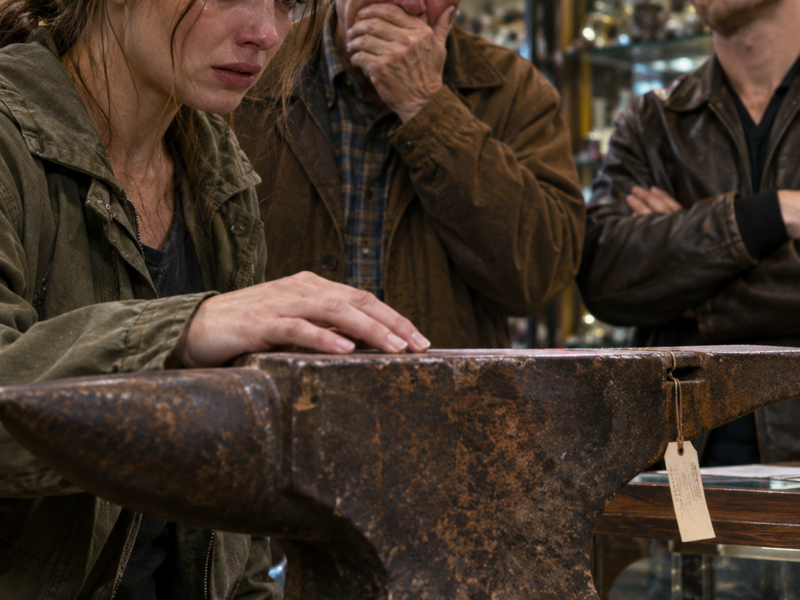
I Spent 20 Years Shoeing Horses Alongside My Grandfather, but at His Funeral, My Dad Gave His Workshop and Beloved Anvil to My Stepbrother, Who Had Only Completed a Two-Week Farrier Course. “Tools Go to the Son Who’ll Use Them,” He Declared in Front of 40 People. Six Weeks Later, Dad Showed Up at My Workplace Demanding $3,800 to Rescue Grandpa’s Tools From a Pawnshop. I Quietly Led Him to My Truck, Pulled Away an Old Feed Sack, and Reached for a Folder That Would Expose Everything…
I Spent 20 Years Shoeing Horses Alongside My Grandfather, but at His Funeral, My Dad Gave His Workshop and Beloved Anvil to My Stepbrother, Who Had Only Completed a Two-Week Farrier Course. “Tools Go to the Son Who’ll Use Them,” He Declared in Front of 40 People. Six Weeks Later, Dad Showed Up at My Workplace Demanding $3,800 to Rescue Grandpa’s Tools From a Pawnshop. I Quietly Led Him to My Truck, Pulled Away an Old Feed Sack, and Reached for a Folder That Would Expose Everything…
Part 1
“Tools go to the son who’ll use them.”
My father made that announcement in front of forty people, less than two hours after we buried my grandfather.
He was standing in the fellowship hall of a Methodist church in Paris, Kentucky, holding a paper plate of ham and deviled eggs. His other hand rested proudly on my stepbrother’s shoulder.
I was thirty-four years old. I had spent twenty years learning my grandfather’s trade, building a business alongside him, and earning the trust of horse owners throughout Bourbon County.
My stepbrother, Jackson, had completed a two-week farrier course.
Apparently, that made him the rightful successor.
Six weeks later, my father would show up at a horse farm where I was working and demand $3,800 to rescue Grandpa’s tools from a pawnshop.
What he didn’t know was that Grandpa’s beloved anvil was already sitting on the back of my truck, forty feet behind him.
And what I was about to show him would expose a lie that cost him considerably more than money.
But to understand why that anvil mattered so much, you need to understand the man who taught me to use it.
My grandfather, Wilford Ashby, spent fifty-five years shoeing horses. He started with mules on tobacco farms and eventually worked on thoroughbreds worth more than most people’s houses.
His workshop was a modest block building with a tin roof on Millersburg Road. Inside stood a coal forge, a wood-burning stove, and a 132-pound Hay-Budden anvil manufactured in Brooklyn long before any of us were born.
Grandpa bought it when he was twenty for forty dollars and a set of horseshoes.
He stamped his initials, W.A., into its base.
Whenever he struck the steel correctly, the anvil produced a beautiful, clear ring.
“A good anvil tells you when you’re doing something right,” he used to say. “A bad one lies to you.”
My father, Kenny, never shared Grandpa’s love of horses. He worked at the Toyota plant in Georgetown for twenty-nine years and avoided anything with four legs that weighed more than he did.
My mother died in a traffic accident when I was seven. Four years later, Dad married Tammy, who brought her four-year-old son, Jackson, into our family.
I welcomed him.
I taught him to ride a bicycle, shared my toys, and defended him when other children picked on him. Dad eventually adopted him, and I never questioned whether he belonged.
But somewhere along the way, being Jackson’s brother began to mean sacrificing things that belonged to me.
When I turned fourteen, Grandpa offered me a summer job.
Twenty dollars a week, unlimited bologna sandwiches, and more sweeping than any teenager should reasonably endure.
I loved every minute of it.
The first important lesson he taught me had nothing to do with tools.
We were working on a gray gelding when Grandpa placed his palm against the horse’s shoulder, slowly moved it down its leg, and quietly asked, “May I?”
Then he waited.
The horse shifted its weight and lifted its foot.
“Never take a foot from a horse,” Grandpa explained. “Ask for it. A horse that gives you something will let you keep it. A horse you take something from will eventually take it back.”
He showed me a scar on his forearm.
“That one taught me the difference.”
I remembered those words for the rest of my life.
At sixteen, I saved $1,240 for a school agricultural convention in Indianapolis. I had earned every dollar trimming ponies and helping Grandpa.
When the trip was canceled, the school mailed the refund to my father.
He kept it.
“The check had my name on it,” he explained. “We needed a water heater.”
Three weeks later, Jackson received a red four-wheeler for his ninth birthday.
Tammy proudly announced that it had cost $1,200.
I didn’t confront them. I told Grandpa instead.
He listened quietly, drove me to a farrier supply store, and bought me a pair of nippers.
I still own them.
On my eighteenth birthday, I opened a private savings account in Cynthiana, where Tammy couldn’t see my transactions.
By twenty-three, I had completed professional training and earned my farrier certification. I had worked under Fletcher Combes, an experienced racehorse farrier, and learned techniques Grandpa wanted me to master.
At twenty-five, I was earning a respectable living.
That was when Jackson stole my equipment.
I had gone to Dad’s house for Sunday dinner. While we ate, Jackson opened the shoeing box on my truck and removed my propane forge and several expensive tools.
He sold everything at a flea market for $300.
Replacing it cost me $2,300.
Dad dismissed the incident.
“He’s just a boy, Luke. You can borrow Grandpa’s equipment.”
Jackson was eighteen.
Old enough to steal, apparently, but not old enough to face consequences.
Afterward, I stamped identification numbers into every tool I owned, photographed them, and stored the records in a fireproof box.
Grandpa watched me work.
“About time,” he said.
Four years later, Dad approached me for an $8,000 loan to replace his leaking roof.
I agreed, but this time, I insisted on a written repayment agreement.
Grandpa witnessed his signature.
Dad made two $200 payments.
The roof was never replaced.
Jackson, however, acquired a beautiful black pickup with oversized tires and a six-inch lift kit.
When I asked Dad about the remaining $7,600, he told me we were even because of everything he had done for me growing up.
I put the agreement in my fireproof box.
Meanwhile, my own life was growing into something I was proud of.
I married Reba, a hardworking woman who managed a local feed store. We had a daughter named Hazel, and by thirty, I was regularly caring for approximately 110 horses.
When Grandpa’s workshop roof started leaking, I spent $6,400 replacing it.
I never asked him to repay me.
That building was more than a workplace. It was where I had learned patience, discipline, and the value of keeping my word.
Then Jackson decided he wanted to become a farrier.
He attended a two-week course, returned with a framed certificate, and launched a business called Ashby Hoof Care.
At a family cookout, he announced that he intended to modernize Grandpa’s business.
Grandpa looked at him over his glasses.
“Pick up that horse’s foot.”
Jackson approached a gelding, grabbed its leg, and pulled.
The horse jerked away and stepped on his expensive new boot.
Grandpa shook his head.
“You took it. He took it back.”
Several months later, Grandpa died peacefully in his chair at eighty-eight.
His will left everything to Dad, his only son.
I already knew that arrangement. Grandpa had explained it years earlier, and I respected his decision.
What I hadn’t anticipated was what Dad would do next.
At the funeral luncheon, he announced that Jackson would inherit the workshop, the equipment, and Grandpa’s anvil.
Then he looked directly at me.
“You’ve got your own equipment, Luke. Jackson’s starting out. Tools go to the son who’ll use them.”
He gave me until the fifteenth to leave.
My wife squeezed my arm. My seventeen-year-old half-sister, Maddie, stared at the floor.
Everyone seemed to be waiting for me to explode.
Instead, I looked at Jackson and said, “I hope he does, Dad.”
That evening, Reba helped me empty the workshop.
I took everything I legally owned and left everything else behind, including the roof I had paid for, Grandpa’s green coffee thermos, and his beloved anvil.
Closing that sliding door felt like losing him all over again.
At nine-thirty that night, Fletcher Combes called.
“My wife says you need somewhere to work.”
He offered me his unused barn outside Millersburg. My rent would be taking care of Pearl, his elderly mare.
I moved in that weekend.
By Monday morning, my business was operating again.
I thought the worst was behind me.
Then, that afternoon, my phone rang while I was working beneath a horse.
“Luke? This is Sunny Bratcher, from Bratcher Gold and Loan.”
I knew the name immediately.
Sunny owned the pawnshop downtown.
“Your stepbrother came in about an hour ago,” he continued. “He brought a truckload of old farrier equipment.”
My stomach tightened.
“There’s a Hay-Budden anvil back here with your grandfather’s initials stamped into it.”
I closed my eyes.
Grandpa had been buried for four days.
Four days.
And Jackson had already gotten rid of the tools Dad insisted he deserved.
But what Sunny told me next was even worse.
Jackson hadn’t pawned them.
He had sold every single piece outright.
For $1,100.
Part 2
I stood beside the horse, gripping my phone so tightly my fingers hurt.
“The whole collection?” I asked.
“Everything,” Sunny replied. “The anvil, hammers, nippers, knives, tongs, even that stall jack your grandfather made himself.”
I couldn’t believe it.
Equipment representing fifty-five years of craftsmanship had been exchanged for barely enough money to cover a single truck payment.
Then Sunny explained why he had called me.
When he was a child, Grandpa had cared for his family’s Shetland pony for eleven years without charging them because his mother was sick.
“I’m not putting Wilford’s anvil in my window for somebody to buy as a garden decoration,” Sunny said. “Once the required holding period is over, you get first refusal.”
“I want it.”
“I figured you would.”
Sixteen days after the funeral, I paid Sunny $1,100 and brought everything home.
He refused to accept an additional $200 for his trouble.
Instead, he gave me a signed bill of sale and a photocopy of Jackson’s original transaction.
I stored both documents carefully.
I didn’t tell Dad.
I didn’t tell Jackson.
I simply returned Grandpa’s anvil to work.
And six weeks after the funeral, those two men arrived demanding $3,800 for something I already owned.
Part 3
The first morning I used Grandpa’s anvil in Fletcher’s barn, I arrived before sunrise.
The concrete floor was cold, and the old building smelled faintly of hay and machine oil. My tools hung neatly on the wall, above an abandoned pool table Fletcher had never managed to sell.
I had mounted Grandpa’s anvil on a solid oak block in the center of the aisle.
For several minutes, I simply stood beside it.
I traced the initials with my thumb, remembering the countless mornings Grandpa had stood in exactly the same position, heating steel and preparing for another day’s work.
Then I lit the forge.
When my hammer struck the hot metal, that familiar ringing sound filled the barn.
For the first time since the funeral, I felt something other than grief.
Fletcher appeared shortly afterward, wearing house slippers and carrying a coffee mug.
He didn’t comment on the anvil.
He found an overturned feed bucket, sat down, and watched me work.
After a while, he pointed toward a horseshoe I had finished.
“Your nails were a little high on that last horse.”
I laughed.
Grandpa would have said exactly the same thing.
I checked my work, made the necessary adjustments, and continued.
Fletcher returned the next morning.
And the morning after that.
We never discussed why.
Some kindnesses don’t require explanations.
Meanwhile, my father’s grand plan was collapsing.
He had assumed that Grandpa’s customers would automatically become Jackson’s customers because Jackson now controlled the workshop.
He misunderstood how a farrier earns a living.
Horse owners don’t care whose name appears above a doorway. They care whether you arrive when promised, whether their horses trust you, and whether those horses remain sound after you leave.
For years, I had built relationships with those animals and their owners.
One of my earliest customers had been an eighty-one-year-old widow named Pauline Shrout.
Her chestnut mare, Dolly, had frightened away three farriers before Grandpa sent me to work on her alone.
Dolly weighed approximately 1,100 pounds and had a reputation for making grown men reconsider their career choices.
I was twenty-one.
I placed my hand against her shoulder, moved it down her leg, and asked, “Dolly, may I?”
She flattened her ears and leaned against me.
I waited.
Mrs. Shrout brought me sweet tea and watched from the fence.
Nineteen minutes passed before Dolly finally sighed, shifted her weight, and offered me her foot.
I cared for her for another eleven years.
She never made me wait nineteen minutes again.
Mrs. Shrout told everyone at church about the young farrier who asked permission instead of fighting her horse.
That single recommendation brought me nine new customers.
My business grew because of moments like that.
Jackson believed a professional-looking hat and a flashy truck could replace them.
He was wrong.
Within a week of Grandpa’s funeral, Dad started sending messages.
“People are calling Jackson asking where you went. Tell them he’s running the Ashby business now.”
I replied, “They know where to find me.”
Tammy sent a much longer message accusing me of stealing family customers.
She claimed Grandpa would be ashamed of my selfishness and demanded that I hand over my customer book.
I answered with one word.
“No.”
Jackson texted late one evening asking where the good rasps were.
I told him mine were with me.
Of the forty-one accounts that had originally belonged to Grandpa, thirty-eight contacted me within two weeks.
The remaining three involved horses that had either died or been sold.
Every active customer followed me to Fletcher’s barn.
One of the most important was Huston Ridge Farm, a large thoroughbred operation managed by Margot Waller.
Margot had known Grandpa for twenty-two years. I had personally cared for her horses for eight.
She was a practical woman who rarely wasted words and never overlooked incompetence.
The morning after the funeral, Jackson drove out to Huston Ridge in his new truck and informed her that he had taken over the family business.
To her credit, Margot gave him a chance.
She arranged a trial involving two yearlings.
Jackson arrived with his new equipment, his embroidered cap, and all the confidence of someone who had never experienced a meaningful professional failure.
The first horse made him struggle.
The second was a young filly.
Instead of allowing her to relax, Jackson grabbed her leg and forced it into position.
Then, while fitting a shoe, he drove a nail into sensitive tissue.
The filly reared in pain.
Margot immediately stopped the session and called the veterinarian.
The horse remained sore for ten days.
Jackson was dismissed that afternoon.
Margot called me and asked whether I could continue handling the farm’s horses.
I agreed.
Two days later, Jackson sold Grandpa’s equipment to Sunny.
At the time, I assumed he had realized farriery was more difficult than he expected and abandoned another business venture.
But the truth was considerably more complicated.
Approximately a month after the funeral, my younger sister called me on a Wednesday evening.
“Luke?”
Her voice sounded strained.
“Are you alone?”
I stepped onto the porch.
“What’s wrong, Maddie?”
She told me she had overheard Dad and Tammy arguing in the living room.
Jackson’s new truck, the one he had purchased before Grandpa died, wasn’t simply another expensive vehicle.
It was a customized three-quarter-ton pickup equipped with an aluminum shoeing body, built-in forge, storage drawers, and a professional anvil mount.
The total price was $61,000.
Jackson couldn’t qualify for the financing independently.
Dad had co-signed the loan in January.
The monthly payment was $1,265.
Suddenly, everything made sense.
Dad hadn’t handed Jackson the business because he believed Jackson was the more deserving son.
He had handed him the business because he needed Jackson to earn enough money to pay for that truck.
Grandpa’s customers were supposed to become the solution to a financial commitment Dad had made before Grandpa was even dead.
But Jackson had already missed two payments.
A third was approaching.
The lender could pursue Dad for the debt.
“He keeps telling Mom that Jackson starts working at Huston Ridge on the thirteenth,” Maddie whispered. “He says everything will be fine once the money starts coming in.”
I looked across my yard toward the dark outline of Fletcher’s barn.
There was no job waiting for Jackson at Huston Ridge.
Margot had dismissed him weeks earlier.
“Did Jackson tell Dad about what happened with the filly?” I asked.
“I don’t think so.”
Maddie began crying.
“He doesn’t even know how to ask the horses for their feet, Luke. He just grabs them.”
“I know, sweetheart.”
She apologized for telling me.
I told her she had nothing to apologize for.
After we hung up, I sat outside for a long time.
Dad had repeatedly expected me to absorb the consequences of Jackson’s mistakes.
My school refund. My stolen tools. The unpaid roof loan.
Now he had attached his retirement security to another one of Jackson’s ambitions.
And I suspected it wouldn’t be long before he came looking for me.
Sure enough, six weeks after Grandpa’s funeral, I was working at Huston Ridge Farm when Dad’s silver Silverado came racing up the gravel lane.
Jackson was sitting beside him.
Dad climbed out and walked directly into the shoeing barn.
“I need $3,800, son.”
He didn’t ask how I was doing.
He didn’t mention Grandpa.
He didn’t even say hello.
“Jackson had to pawn your grandfather’s tools,” he continued. “The ticket expires Friday. If we don’t get them back, the pawnshop is going to sell everything.”
I kept rasping Sister Edith’s hoof.
“Jackson starts working here Monday,” Dad added. “He can’t show up without equipment.”
Margot looked up from her clipboard.
Jackson avoided her eyes.
Dad stepped closer.
“You’ve always got money saved somewhere. It’s your grandfather’s anvil, Luke. You, of all people, should understand.”
I gently lowered the mare’s foot.
Then I removed my leather apron.
For twenty years, Grandpa had taught me never to force anything that should be freely given.
My father had spent nearly as long teaching me what happened when people ignored that principle.
I was finally ready to show him the difference.
Part 4
“There’s no pawn ticket, Dad.”
My father frowned.
“What are you talking about?”
“Which pawnshop?”
He turned toward Jackson.
Jackson shifted his weight and glanced at the barn entrance.
“The one downtown.”
“Sunny Bratcher’s?”
“Yeah. That one.”
I nodded.
“Come outside for a minute.”
I walked toward my truck.
Dad followed immediately. Jackson came more slowly, and Margot followed behind him, carrying her clipboard.
The April morning was gray and chilly. A few horses grazed in the nearby paddocks, completely indifferent to the confrontation unfolding beside the barn.
An empty feed sack covered something on my tailgate.
I pulled it away.
There sat Grandpa’s Hay-Budden anvil.
Beside it lay his old hoof knives, tongs, nippers, hammers, and handmade stall jack.
Dad stopped walking.
His mouth opened slightly.
For the first time in my life, I watched him struggle to find something to say.
Jackson recovered first.
“That’s stolen!”
He pointed at the equipment.
“Dad, those belong to you! Grandpa left everything to you. Luke can’t just take them!”
I said nothing.
“Call the sheriff!” Jackson insisted. “Sunny had no right to sell those to him!”
Dad looked from Jackson to me.
I could see how badly he wanted to believe him.
If I had stolen the tools, Dad wouldn’t have to question the decisions he had made.
He could remain the generous father helping his struggling son, and I could become the ungrateful brother causing trouble.
“Is that what happened, Luke?” he asked. “You went behind my back and bought Daddy’s tools?”
“Yes, sir.”
He stared at me.
“Somebody had to.”
Jackson pulled out his phone.
“I’m calling the sheriff right now.”
“Go ahead.”
He hesitated.
“I mean it.”
“I’ll wait.”
I had waited nineteen minutes for a stubborn mare to lift her foot.
Waiting for Jackson to make a phone call wasn’t going to trouble me.
He stared at his screen.
He never dialed.
I opened my passenger door, retrieved a manila folder from the glove compartment, and returned to the tailgate.
Years of dealing with my family had taught me the importance of documentation.
I handed Dad the first sheet.
“This is the transaction record from Sunny’s shop.”
Dad took it.
“March second. Four days after Grandpa’s funeral. Jackson’s signature is at the bottom, along with his driver’s license information.”
I pointed to the marked box.
“Sold outright. Not pawned.”
Dad’s eyes moved across the page.
“Eleven hundred dollars,” I added.
Jackson started speaking.
“Dad, listen—”
I handed over the second document.
“And this is my bill of sale. I paid Sunny the same $1,100 once the holding period ended.”
Dad read that one, too.
“You gave Jackson those tools in front of forty witnesses,” I reminded him. “He sold them. Sunny sold them to me.”
I rested my hand on Grandpa’s anvil.
“You said tools go to the son who’ll use them. Jackson used them to get eleven hundred dollars.”
The silence was uncomfortable.
Jackson looked furious, but he no longer seemed interested in contacting the sheriff.
Dad slowly lowered the paperwork.
Then he turned toward him.
“Where did you get thirty-eight hundred?”
Jackson didn’t answer.
Dad repeated the question.
“You told me that was what the pawnshop wanted.”
Jackson looked down.
I answered for him.
“His truck payment is $1,265.”
Dad looked at me sharply.
“Three payments come to $3,795. Two he’s already missed, and the next one coming due.”
I let the number settle.
“Round it up, and you get $3,800.”
Dad’s expression changed.
He looked like a man who had just discovered that the ground beneath him wasn’t as solid as he thought.
Jackson opened his mouth.
“It was supposed to be temporary.”
Dad stared at him.
“You told me—”
Before he could finish, Margot spoke.
“Kenny, there’s something else you should know.”
My father turned toward her.
“Jackson isn’t starting here Monday.”
He blinked.
“What?”
“He came out for a trial the Saturday after Wilford’s funeral. I gave him two yearlings. He injured one of them with a nail, and I had to call the veterinarian.”
Jackson shook his head.
“It wasn’t that bad.”
Margot looked directly at him.
“The filly was sore for ten days.”
She turned back toward Dad.
“I dismissed him that afternoon. There was never a job waiting for him here.”
Dad’s face went pale.
“But he said—”
“I don’t know what he told you,” Margot interrupted. “I know what happened on my farm.”
She gestured toward me.
“Luke has been caring for my mares for eight years. He’s scheduled to work on my stallions next week. That arrangement isn’t changing.”
Dad stood beside my truck, holding evidence of two separate lies.
Jackson had lied about pawning the equipment.
He had lied about having a job.
And Dad had believed him so completely that he had driven out to my workplace, expecting me to hand over thousands of dollars without questioning anything.
For a moment, I thought Dad might apologize.
I thought he might acknowledge that he had been wrong at the funeral, wrong about Jackson’s abilities, and wrong to assume I would always rescue them.
Instead, he found another solution that required something from me.
“All right,” he said. “Then you come back to the shop.”
I stared at him.
“You and Jackson can work together. Teach him properly. The customers will come back if they know you’re there.”
He spoke faster as the idea developed.
“You can run the business until he gets better. He’s got that truck, Luke. Sixty-one thousand dollars. My name is on the loan.”
There it was.
Not an apology.
Not recognition.
A business proposal designed to make me responsible for Jackson’s debt.
“I can’t carry those payments on my pension,” he continued. “You know that.”
“No, Dad.”
He stopped.
“What?”
“I’m not coming back.”
His expression hardened.
“Then sell me the anvil. I’ll give you what you paid.”
“No.”
“It’s Daddy’s anvil!”
“It was.”
“It belongs in his shop!”
“It belongs with somebody who uses it.”
Dad stared at me.
Then came the sentence I had heard so many times throughout my life.
“After everything I’ve done for you.”
Something inside me went very still.
I reached into the folder again.
There was one more document inside.
I hadn’t brought it intending to confront him about the loan, but I had kept it with my other important papers.
The yellow legal sheet was several years old.
Dad recognized it immediately.
“You still owe me $7,600,” I said. “For the roof that never got replaced.”
His eyes dropped toward Grandpa’s signature, written beneath his own.
“I’m not demanding repayment today,” I continued. “I’m just telling you that I remember.”
He didn’t take the document.
Jackson stepped forward.
“Dad, don’t you see what he’s doing? He’s been planning this whole thing!”
I looked at him.
“I’ve been shoeing horses, Jackson. You’re the one who’s been planning.”
He fell silent.
Then I gave Dad the only advice I had left to offer.
“Sell the truck.”
He looked away.
“The shoeing body alone is worth a substantial amount to somebody who actually knows how to use it. Take the loss before it gets worse. Get your name off the loan.”
Jackson shook his head angrily.
“You can’t be serious.”
I ignored him.
“Let him learn what a payment feels like, Dad.”
For several seconds, nobody moved.
Finally, Dad folded the documents I had given him and slipped them into his coat pocket.
He walked back to his Silverado.
Jackson remained beside my tailgate, staring at Grandpa’s anvil.
He looked at it as though it had personally betrayed him.
Then he followed Dad.
They drove away much more slowly than they had arrived.
Margot watched the truck disappear down the gravel lane.
Then she turned toward me.
“Sister Edith still needs her right front.”
I smiled.
“Yes, ma’am.”
I returned to the barn, put on my apron, and approached the old mare.
My hand moved gently down her shoulder and along her leg.
“Edith, may I?”
She shifted her weight.
And gave me her foot.
Part 5
A year has passed since that morning.
Sometimes, when I’m driving along Millersburg Road, I pass Grandpa’s old workshop.
The sliding door remains closed.
The tin roof I paid $6,400 to replace still shines whenever the sunlight catches it.
There are weeds growing beside the entrance now.
No smoke rises from the chimney.
No hammer strikes steel inside.
Dad still owns the building, but as far as I know, nobody has worked there since Jackson abandoned his business.
I used to feel a deep sadness whenever I passed it.
Now I understand that Grandpa’s legacy was never confined to those walls.
It was something he had already given me.
Dad eventually sold Jackson’s customized truck in May.
According to Maddie, the transaction left him approximately $14,000 short, which he covered using his retirement savings.
I didn’t celebrate when I heard.
There was nothing satisfying about watching my father suffer financially.
But for once, he had been forced to experience the consequences of a decision he had made.
Jackson moved on.
He’s selling solar panels in Winchester now.
He has another company hat.
I hope he finds something he can commit to, although I no longer consider that my responsibility.
Dad and I rarely speak.
Last fall, he visited the feed store where Reba works and purchased a bag of birdseed.
Before leaving, he asked how Hazel was doing.
Reba told him she was growing fast, enjoying school, and spending every possible minute around horses.
He nodded and left.
He hasn’t apologized.
I haven’t demanded that he does.
For most of my life, I believed that being a good son meant accepting whatever my father asked of me.
I thought that refusing him would make me selfish.
Grandpa taught me otherwise, although it took years for his lesson to reach beyond the barn.
Respect cannot be demanded simply because someone believes they are entitled to it.
Trust is earned.
And love doesn’t require you to keep handing someone the tools they use to hurt you.
I don’t hate my father.
I simply don’t hand him things anymore.
My business, meanwhile, is doing better than ever.
Fletcher and I have been discussing the possibility of purchasing his barn and two surrounding acres.
He keeps offering a price that’s too low.
I keep insisting on paying what the property is worth.
His wife, Neta, says we’ll both be buried before we reach an agreement.
Pearl, Fletcher’s elderly mare, is thirty-two now.
Her feet are in excellent condition, and she still refuses to cooperate with anyone else.
Fletcher claims that makes our rental arrangement perfectly fair.
I disagree.
But I have learned that arguing with an eighty-two-year-old farrier is a particularly inefficient use of time.
Most mornings, he still comes down from the house carrying coffee.
He sits on his overturned bucket and watches me work.
Occasionally, he offers advice.
Occasionally, I pretend not to need it.
Usually, he’s right.
Reba continues managing my books at our kitchen table.
She keeps track of expenses, schedules, and payments, and makes sure I remember that even hardworking people need occasional days off.
Hazel decorates the workshop with drawings of horses.
Her latest pictures have the correct number of legs.
That’s progress.
The biggest surprise, however, has been Maddie.
Shortly after Dad sold the truck, she asked whether she could come work with me on Saturdays.
She was seventeen, the same quiet girl who had stared at the floor during Grandpa’s funeral luncheon.
She had always loved horses.
Unlike Jackson, she wasn’t interested in a professional title or expensive equipment.
She wanted to learn.
I told her she could start by sweeping the barn, organizing supplies, and holding horses while I worked.
Her pay would be fifteen dollars an hour.
She arrived the following Saturday before I did.
For several months, she watched everything.
She asked questions about hoof structure, balance, and how different horses responded to different shoes.
When a horse became nervous, she didn’t get angry.
She stepped back, lowered her voice, and gave it time.
One morning, I decided she was ready to trim her first pony.
It was a small, patient animal belonging to one of Fletcher’s neighbors.
I handed Maddie the tools.
“Remember, don’t rush.”
She nodded.
Then she approached the pony, placed her hand against its shoulder, and slowly moved it down the leg.
“May I?”
The pony lifted its foot.
I turned away for a moment.
There was something in my eye, or at least that’s what I would have told Fletcher if he had asked.
Maddie completed the trim carefully.
It wasn’t perfect.
Nobody’s first trim is.
But the pony remained relaxed, and she listened to every correction I offered.
When she finished, she looked at me.
“How’d I do?”
“Grandpa would have been proud.”
She smiled.
For a second, I could see the little girl who used to press her face against the fence whenever Grandpa and I worked on horses.
I realized that my father’s decision at the funeral had nearly prevented another generation from learning the trade.
He had been so focused on helping Jackson succeed that he had overlooked the daughter who genuinely wanted to follow in Grandpa’s footsteps.
Now she had a chance.
And nobody was going to take it away from her.
Last Sunday, Hazel accompanied me into Fletcher’s pasture while I checked Pearl’s feet.
Neta had recently rescued a small gray Welsh pony.
Hazel adored him.
She talked about him constantly and had already drawn several pictures of him standing beneath enormous purple rainbows.
That morning, while I worked with Pearl, Hazel wandered toward the pony.
I kept a close eye on her.
She approached him slowly.
Then she placed her tiny palm flat against his shoulder.
She moved her hand down his leg as far as her short arm could reach.
And in the sweetest, most serious voice imaginable, she said, “Pony, may I?”
I stopped what I was doing.
The little pony shifted his weight.
He lifted his foot slightly above the grass and held it there.
Hazel looked delighted.
“Daddy! He said yes!”
I laughed.
“Yes, sweetheart. He did.”
She gently touched his leg again before stepping away.
I stood there for a long time, looking at my daughter.
Grandpa had never lived to see her grow old enough to understand his work.
He hadn’t been there when she started asking questions about horseshoes or why some ponies needed their feet trimmed more often than others.
But somehow, he was there anyway.
In the patience of her little hands.
In Maddie’s quiet determination.
In Fletcher’s morning visits.
In the customers who followed me because they remembered how their horses were treated.
And in the ringing sound that filled my workshop whenever my hammer struck Grandpa’s anvil.
My father thought an inheritance was a collection of possessions.
A building.
A business name.
A pile of equipment.
He believed he could transfer fifty-five years of craftsmanship from one son to another simply by making an announcement over a paper plate of funeral food.
But the most valuable things Grandpa left behind couldn’t be signed over in a will.
He left patience.
Integrity.
Knowledge.
A reputation built one horse at a time.
He left the understanding that anything worth having must be earned, cared for, and respected.
Jackson received the equipment without learning any of those lessons.
Four days later, he exchanged it all for $1,100.
I had spent twenty years learning the lessons before I ever became the equipment’s owner.
And when the opportunity came, I paid $1,100 to bring it home.
Grandpa’s anvil sits on a white oak block in the middle of Fletcher’s barn today.
Its surface bears the marks of decades of work.
The initials W.A. remain visible on its base.
Sometimes Hazel traces them with her finger and asks me to tell her another story about her great-grandfather.
I always do.
Then I return to the forge, heat another piece of steel, and raise my hammer.
The anvil rings just as beautifully as it did when I was fourteen.
And whenever I hear that sound, I remember my father standing in the fellowship hall, smiling as he announced his decision to forty people.
“Tools go to the son who’ll use them.”
He was right about that.
He just chose the wrong son.
In the end, Grandpa’s tools found their way back to the person who understood what they were worth.
Not because I fought for an inheritance.
Not because I demanded special treatment.
But because I had spent my life learning how to use them.
They went to the right son after all, Dad.
I use them every day.