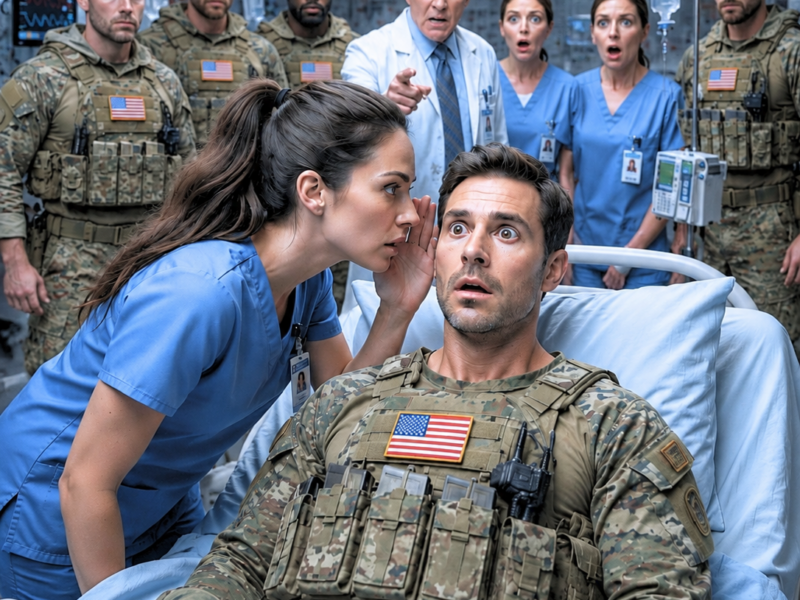
I Spent 11 Weeks Being Ignored and Humiliated as an Ordinary Nurse at a Spokane Hospital, While a Surgeon Dismissed My Warnings and Treated Me Like I Knew Nothing. Then, During a Blinding Snowstorm, a Black Hawk Landed on the Rooftop, and a Colonel Walked Into the Emergency Room, Saluted Me, and Called Me “Ma’am.” When He Revealed Why He Had Come, Everyone Realized They Had No Idea Who I Really Was…
I Spent 11 Weeks Being Ignored and Humiliated as an Ordinary Nurse at a Spokane Hospital, While a Surgeon Dismissed My Warnings and Treated Me Like I Knew Nothing. Then, During a Blinding Snowstorm, a Black Hawk Landed on the Rooftop, and a Colonel Walked Into the Emergency Room, Saluted Me, and Called Me “Ma’am.” When He Revealed Why He Had Come, Everyone Realized They Had No Idea Who I Really Was…
Part 1
The first thing Colonel Nathaniel Brooks noticed when he entered the emergency department was the woman standing at the far end of the hallway.
She wore navy-blue scrubs, a plain gray jacket, and a hospital badge that read Nina Harrow. A dark duffel bag hung from her shoulder. She looked like an ordinary nurse finishing an exhausting overnight shift, someone who wanted nothing more than to leave the hospital and get home.
But Colonel Brooks knew better.
He stopped walking, straightened his back, and raised his right hand in a military salute. The two soldiers behind him immediately followed his example.
The entire emergency department went silent.
Nobody understood what they were witnessing. Nobody understood why a decorated military colonel had just saluted a nurse who had spent the last eleven weeks cleaning medical trays, changing sheets, and being treated as though she barely existed.
Then the colonel spoke.
“Ma’am.”
The woman didn’t return his salute. Instead, she stared at him with an expression so cold that even the soldiers seemed uncomfortable.
“You were told never to find me.”
Those seven words would eventually force everyone at Ridgeway Regional Medical Center to reconsider everything they thought they knew about the quiet woman working among them.
But to understand why a military helicopter had landed on the hospital roof in the middle of a blizzard, and why a colonel was standing in a civilian emergency department addressing a nurse as though she were his commanding officer, it was necessary to go back eleven weeks.
That was when Nina Harrow first walked through the hospital doors.
She arrived on a Tuesday morning in late October, two days before her official starting date. She was in her mid-thirties, with dark hair tied neatly behind her head, an inexpensive watch on her wrist, and an expression that rarely revealed what she was thinking.
Her application was almost painfully ordinary.
She had graduated from a state nursing program in Oregon. Her clinical experience included two small regional medical facilities. Her references were satisfactory, her license was valid, and her background check revealed nothing unusual.
There were no prestigious hospitals, no impressive recommendations, and no evidence of an extraordinary professional history.
Her paperwork was perfect.
Almost too perfect.
Denise Carver, the charge nurse responsible for managing the day shift, reviewed the file that morning. Denise had worked in emergency medicine for fourteen years. She considered herself an excellent judge of character, and she had developed a habit of deciding within the first week whether a new employee was likely to become an asset or a problem.
Nina seemed harmless.
She was polite, punctual, and willing to accept whatever assignment she received. She didn’t ask about promotions, complain about difficult shifts, or challenge the department’s established routines.
Denise decided she would be useful.
Dr. Malcolm Sutter reached a similar conclusion.
Sutter was one of the most influential physicians at Ridgeway Regional. He had worked there for eleven years, and his reputation rested on his ability to take control of complicated emergencies. He was intelligent, experienced, and accustomed to being obeyed.
Unfortunately, he also believed that most nurses existed to support physicians rather than contribute independent clinical judgment.
He barely noticed Nina during her first few days.
She handed him instruments when requested, prepared patients for procedures, and documented instructions without questioning them. When he corrected her in front of other staff members, she simply nodded and continued working.
He interpreted her silence as a lack of confidence.
The other nurses gradually began treating her the same way.
Nina received the overnight shifts nobody wanted. She cleaned rooms after difficult procedures, restocked supplies, and frequently finished tasks abandoned by colleagues who were too busy or too tired to complete them.
She never complained.
What nobody understood was that Nina wasn’t trying to impress anyone.
She was trying to disappear.
For nearly three months, she had carefully constructed a life in which nobody knew her history, nobody expected anything extraordinary from her, and nobody asked questions about where she had been before arriving in Spokane.
She wanted to become ordinary.
And she was willing to accept being underestimated if that was what it took.
There were, however, certain things about her that didn’t quite fit.
Whenever an alarm sounded, Nina was usually the first person looking in the correct direction. She never seemed startled by sudden noises, even when they were loud enough to make experienced nurses jump.
Whenever she entered a room, her eyes briefly moved toward the exits. She knew where the emergency equipment was located without needing to search for it.
When a crash cart was moved during renovations, she found its new location immediately, although nobody remembered telling her where it had gone.
One afternoon, a younger nurse named Jordan accidentally brushed against Nina while reaching into a cabinet in the break room.
Nina had been asleep in a chair.
Within a fraction of a second, her hand closed around Jordan’s wrist. Her grip was controlled, precise, and surprisingly fast.
Then she released her.
“Sorry,” Nina said calmly. “I must have been dreaming.”
Jordan laughed awkwardly and walked away.
She never mentioned it again.
There was another incident during Nina’s fifth week.
An elderly veteran arrived with a piece of shrapnel embedded in his forearm, a souvenir from a deployment more than twenty years earlier.
Nina was assigned to prepare him for imaging.
When she removed the bandage, she studied the wound for a moment longer than necessary.
Something changed in her expression.
It wasn’t disgust or concern. It was recognition.
She understood something about that injury that the chart hadn’t yet explained.
The veteran made a joke about carrying an expensive souvenir in his arm, and Nina laughed politely. She finished preparing him and moved on.
But that evening, she stood alone in the staff restroom for several minutes, staring at the pale scar running along the inside of her left forearm.
It was an old scar, located exactly where a military field-monitoring device would have been secured during extended operations.
She pulled her sleeve down.
Nobody needed to know.
The first person to realize that Nina Harrow might be considerably more capable than her paperwork suggested was Denise Carver.
It happened during a Tuesday night shift in mid-November.
A fifty-nine-year-old man named Gerald arrived with a dangerous cardiac arrhythmia. Dr. Sutter took control of the case and immediately began directing treatment.
Nina stood beside the monitor, assisting with medications and documentation.
While everyone else followed Sutter’s instructions, she watched the electrical pattern on the screen.
Something was changing.
The waveform was developing a subtle alteration that suggested Gerald’s condition was transitioning into a more dangerous rhythm.
“Dr. Sutter,” she said quietly. “The waveform is shifting. I think we’re moving toward a different rhythm.”
Sutter didn’t look at her.
“That’s consistent with what I’ve already diagnosed.”
Nina continued watching.
Fifteen seconds passed.
Then twenty.
She spoke again.
Sutter finally turned toward her.
“I know how to read a monitor, Nurse Harrow. Let me work.”
Seven seconds later, Gerald lost consciousness.
The room erupted into movement.
Sutter immediately adjusted his approach, but Nina was already reaching for the defibrillator. Her voice changed, becoming firm and unmistakably authoritative.
She gave two nurses specific instructions, directed the next steps, and positioned herself beside the patient with an efficiency that seemed completely out of place for someone supposedly inexperienced.
Nobody argued.
Thirty-one seconds after Gerald lost consciousness, his heart rhythm returned.
The immediate crisis passed.
Sutter stood beside the bed, breathing heavily.
Nina stepped backward, lowered her voice, and returned to her usual quiet manner.
“Dr. Sutter recognized the change in time,” she told Denise.
Denise looked at the monitor, then at Nina.
Sutter didn’t correct her.
But something had changed.
And neither of them could explain why.
For Nina, the incident was a warning. She had allowed too much of her former self to become visible.
She went to the restroom, washed her hands, pulled down her sleeves, and returned to work.
She still believed she could remain invisible.
Then the snowstorm arrived.
Part 2
By Friday night, Spokane was buried beneath nearly eight inches of snow. A twenty-four-vehicle collision on an elevated highway sent ambulances rushing toward Ridgeway Regional. Every trauma bay filled within minutes.
Nina was assigned to triage.
At 10:47 p.m., a forty-three-year-old man named Thomas arrived with catastrophic injuries. His blood pressure was dangerously low, his chest had been crushed against the steering column, and a deep wound in his leg was causing massive blood loss.
Dr. Sutter struggled to coordinate the overwhelmed team.
Nina watched the monitors and understood something nobody else had recognized.
Thomas was running out of time.
She knew exactly what needed to happen.
She also knew that stepping forward would destroy the ordinary life she had spent months building.
Then Thomas’s oxygen saturation dropped again.
Nina removed her triage badge, pulled on her gloves, and entered the trauma bay.
“Doctor,” she said.
Sutter turned impatiently.
“Move.”
And for the first time in eleven weeks, Nina Harrow stopped pretending to be someone she wasn’t.
Part 3
Dr. Malcolm Sutter stared at the nurse standing in front of him.
For eleven years, he had controlled the emergency department through experience, confidence, and an authority that rarely required explanation. He wasn’t accustomed to being challenged, especially not by someone he considered a relatively inexperienced nurse.
“Excuse me?” he demanded.
Nina didn’t repeat herself.
She had already moved toward Thomas.
Her shoulders were straight, her expression focused, and her hands were moving with the confidence of someone who had performed similar procedures under far worse conditions.
“Second unit of packed red cells. Now. I need someone maintaining direct compression on the left leg at this angle. Prepare the chest equipment.”
The instructions came quickly, but they weren’t rushed.
Every word had a purpose.
One nurse immediately followed her direction. Another reached for the blood products. Denise, who had arrived at the entrance after noticing the commotion, watched in disbelief.
This was not the same woman she had assigned to triage.
Nina examined Thomas’s chest, checked his breathing, and reassessed the bleeding in his leg. She understood that the injuries were competing for attention, and the team had already lost valuable seconds trying to determine which problem should take priority.
She didn’t waste another moment.
Sutter moved toward the head of the bed, attempting to regain control.
Nina looked at him.
“You can argue with me after he has a pulse.”
Her voice wasn’t angry.
That was what made it so difficult to challenge.
There was no shouting, no panic, and no attempt to embarrass him. She simply spoke as though the next few minutes mattered more than anyone’s professional pride.
For a moment, Sutter remained where he was.
Then he stepped back.
The entire team understood what had happened.
Nina began directing the response with extraordinary precision. She adjusted the compression, called for additional blood, and coordinated the management of Thomas’s chest injury.
She moved from one problem to another without losing sight of the entire situation.
Denise had seen excellent trauma nurses.
She had seen experienced physicians work under pressure.
But she had never watched someone operate with this particular kind of composure.
Nina didn’t look like a person trying to remember what she had learned in training.
She looked like someone returning to familiar territory.
Thirty-eight minutes after Thomas arrived, his blood pressure began climbing.
It was still dangerously low, but it was improving.
When the on-call surgeon arrived from the second floor, he stopped at the entrance and examined the work already underway.
He studied the dressing on Thomas’s leg, the management of the chest injury, and the orderly arrangement of the equipment.
“Who did this?” he asked.
Nina was standing at the documentation station.
“The trauma team,” she answered.
The surgeon looked toward Denise.
Denise said nothing.
Nina had saved Thomas from a situation that could easily have become fatal, yet she was already trying to disappear into the background again.
The emergency department continued working.
There were other patients, other injuries, and other families waiting for information. Nobody had time to demand explanations.
But Malcolm Sutter couldn’t forget what he had witnessed.
At two in the morning, after the worst of the ambulance surge had passed, he sat alone in the attending lounge.
He replayed the incident repeatedly.
The problem wasn’t simply that Nina had outperformed him.
He could accept that another medical professional might have better instincts in a particular situation.
The problem was the way she had done it.
She hadn’t hesitated.
She hadn’t looked around for approval.
She hadn’t needed someone to explain the situation.
And when the patient was stabilized, she had immediately surrendered the credit.
That wasn’t the behavior of someone trying to advance her career.
It was the behavior of someone who had no interest in being recognized at all.
Sutter eventually decided that he needed to know who he was working with.
He went to the administrator’s office before the morning shift change.
Raymond Bell had managed Ridgeway Regional for six years. He was practical, politically cautious, and experienced enough to know that a physician’s complaint could become a serious institutional problem.
Sutter described what had happened.
He spoke about unauthorized clinical interventions, disregarded instructions, and the possibility that Nina had performed procedures beyond her documented qualifications.
Raymond listened carefully.
He promised to investigate.
After Sutter left, he opened the hospital’s employee management system and searched for Nina Harrow.
The file took unusually long to load.
When it finally appeared, several fields were marked with restricted-access symbols.
Employment history.
Education verification.
Previous professional references.
Raymond initially assumed there had been a database error.
He submitted a standard correction request.
Then he contacted the state licensing board independently.
The board confirmed that Nina’s nursing license was legitimate and current.
Everything appeared normal until the response to his correction request arrived.
It didn’t come from the hospital’s information technology department.
It came from a federal records office.
The message contained only one sentence.
“Sir, stop searching that name.”
Raymond read it several times.
He had never encountered anything like it.
He considered ignoring the warning, but his responsibility as an administrator required him to verify the credentials of every employee practicing in his hospital.
He ran one final background check through the third-party service used for new hires.
The results were even stranger.
The Social Security number was valid. The identity was recognized. The documents were authentic.
But the identity had been created just eighty-nine days before Nina applied to Ridgeway Regional.
Eighty-nine days.
A complete professional identity had appeared from nowhere, supported by legitimate records, and protected by a wall that even a hospital administrator couldn’t cross.
Raymond walked back into the attending lounge.
“How long has she worked here?” he asked.
“Eleven weeks,” Sutter answered.
Raymond looked down at his phone.
“Who exactly did we hire?”
Sutter had no answer.
Meanwhile, Nina was standing in the women’s locker room.
She had checked her phone twice in ten minutes.
There were no messages or missed calls.
But a small security symbol had appeared briefly in the corner of the screen.
She recognized it immediately.
It belonged to a system she had helped design years earlier.
The signal meant her assumed identity had been accessed by someone without authorization.
Nina Harrow had been compromised.
She closed her locker and reached behind the spare uniform folded on the shelf.
A dark gray duffel bag was hidden there.
She had prepared it during her first week at Ridgeway, just as she had prepared similar bags in every place she had lived over the previous three years.
Inside were a change of clothes, a few personal necessities, and an old photograph.
The photograph showed a group of military personnel standing in front of a transport vehicle on a stretch of dry, pale ground.
Most of the faces were turned away from the camera.
Nina studied it for a moment before placing it carefully inside the bag.
Then she heard something outside.
At first, it sounded like distant thunder.
But she knew the difference.
The vibration grew stronger, passing through the walls and into the floor.
It was a heavy helicopter.
Not the lightweight medical aircraft that occasionally landed on the hospital roof.
This machine had a deeper, more powerful sound.
Nina closed the duffel.
She already knew what was coming.
The UH-60 Black Hawk settled onto the hospital helipad shortly before three in the morning.
Its rotors sent snow swirling across the rooftop.
Within ninety seconds, three military personnel had entered the building.
The man walking in front was tall, broad-shouldered, and somewhere in his late forties. He wore a uniform beneath a heavy winter jacket.
His name was Colonel Nathaniel Brooks.
He approached the nurses’ station and spoke to the first employee he encountered.
“I need Nina Harrow.”
Raymond Bell was standing nearby.
He stepped forward.
“Who are you?”
The colonel produced an identification document and handed it to him.
Raymond examined it.
His expression changed immediately.
He had expected an explanation.
Instead, he had received confirmation that the situation was far beyond anything the hospital could handle through its ordinary procedures.
At the far end of the corridor, the locker room door opened.
Nina stepped outside wearing dark jeans, ankle boots, and a gray jacket. Her duffel bag hung over one shoulder.
She stopped when she saw the colonel.
For the first time since arriving at Ridgeway, she looked genuinely unhappy.
Not frightened.
Not surprised.
Simply disappointed.
Colonel Brooks turned toward her.
He recognized her immediately.
Then he straightened his back, brought his right hand to his forehead, and delivered a sharp military salute.
The two soldiers behind him did the same.
Nobody in the hallway moved.
Dr. Sutter had emerged from the attending lounge. Denise stood beside the trauma bay entrance. Raymond still held the colonel’s identification document.
And every one of them watched as the colonel addressed the woman they had spent eleven weeks overlooking.
“Ma’am.”
Nina’s expression hardened.
“You were told never to find me.”
Brooks lowered his hand.
“We didn’t come to bring you back.”
Before she could answer, the stairwell door opened again.
Two additional soldiers entered, guiding a stretcher.
The patient was a man in his early thirties. He was pale, barely conscious, and connected to military-grade monitoring equipment.
A field dressing covered his chest.
Colonel Brooks looked directly at Nina.
“We came because he won’t survive without you.”
For a moment, nobody spoke.
Then the colonel revealed the name she had spent three years trying not to hear.
“Major Rebecca Sterling, we need your help.”
Nina Harrow was not simply a nurse with unusual instincts.
She had once been one of the most accomplished trauma surgeons attached to a classified military medical program supporting special operations units.
And the man on the stretcher was carrying an injury that only a handful of surgeons in the world knew how to repair.
Part 4
Rebecca Sterling looked at the injured soldier.
She recognized the military equipment immediately. The monitoring system, the field dressing, and the specialized medical supplies all belonged to a world she had deliberately left behind.
Colonel Brooks approached her.
The soldier’s call sign was Falcon.
A high-velocity fragment had entered through the right side of his chest and damaged his descending aorta. The military medics had managed to keep him alive using temporary measures, but those measures were rapidly losing effectiveness.
The storm had grounded the aircraft that would normally have transported him to a military surgical facility.
Ridgeway Regional was the closest trauma center with the necessary infrastructure.
And Rebecca was the only surgeon they believed could perform the required repair under the circumstances.
She listened without interrupting.
Then she examined Falcon.
His breathing was shallow. His skin had lost much of its color, and the numbers on the field monitor showed that his circulation was deteriorating.
She understood the situation immediately.
She also understood what Colonel Brooks was asking.
If she accepted the case, there would be no hiding afterward.
She couldn’t perform a complicated military procedure and then pretend to be an ordinary nurse again.
Everyone in the hospital would know.
Rebecca looked at the duffel bag resting against her shoulder.
Inside was the photograph she had carried for years. The people in it had once been her team.
Some of them were no longer alive.
Others had disappeared into the same classified world she had abandoned.
She had spent three years trying to separate herself from those memories.
Now they were standing in front of her.
Brooks spoke quietly.
“If you walk away, I understand.”
Rebecca looked down at Falcon.
He was young.
Much younger than the men she remembered treating during her military deployments.
She knew that accepting the case would reopen memories she had worked very hard to contain. She knew that the moment she entered the operating room, she would become the person she had been trying not to be.
But she also knew that a man was dying.
“How long has his circulation been restricted?” she asked.
Brooks gave her the number.
Rebecca studied Falcon’s monitor one more time.
“Get him upstairs.”
The words were simple.
But everyone understood that Nina Harrow was no longer making the decisions.
Major Rebecca Sterling had returned.
Dr. Sutter immediately objected when the group reached the surgical floor.
His concern was not entirely unreasonable.
Rebecca had no surgical privileges at Ridgeway Regional. Her employment file identified her as a nurse, and the hospital had no documented record of her surgical qualifications.
Allowing an uncredentialed person to perform a complicated vascular procedure represented a significant liability risk.
He explained this to Raymond.
Brooks didn’t argue emotionally.
He simply produced a federal emergency authorization.
The document established the legal authority for Rebecca to perform the operation under the specific circumstances.
Raymond contacted the hospital’s legal counsel.
Within ninety seconds, he received confirmation that the authorization was legitimate.
The advice was direct.
Let her operate.
Sutter stood in the corridor, visibly uncomfortable.
Rebecca didn’t acknowledge his objections.
She had no interest in defending herself to a man who had spent eleven weeks treating her as though she were incapable of understanding a medical emergency.
There was only one thing that mattered now.
Falcon needed surgery.
Before entering the operating room, Rebecca noticed Denise standing near the corridor junction.
The charge nurse had followed the group upstairs without being assigned to the case.
She looked uncertain, but she hadn’t left.
Rebecca studied her for a moment.
“I need you with me.”
Denise lowered her arms.
“Me?”
“Yes. I need someone who knows this hospital’s equipment and can anticipate what the team will need.”
Denise stared at her.
For eleven weeks, she had assigned Nina the least desirable tasks. She had decided that the quiet nurse was competent but limited, useful but unremarkable.
Now that same woman was asking her to assist with a procedure that could determine whether a soldier lived or died.
Denise nodded.
“All right.”
She went to scrub in.
At two in the morning, the operating room felt isolated from the rest of the hospital.
The overhead lights were fully illuminated. The surgical instruments were arranged across the tables, and the anesthesiology team was preparing Falcon for the procedure.
Rebecca stood at the scrub sink.
For a brief moment, she closed her eyes.
She remembered another operating room.
Another patient.
Another set of numbers on a monitor.
She remembered the smell of antiseptic mixed with canvas and cold air, the sound of a military radio struggling through interference, and the voices of people who had trusted her with their lives.
She remembered a mission she had never discussed with anyone at Ridgeway.
A mission that had ended with a death she still carried.
Then she opened her eyes.
That room was not here.
This patient was not the person she had failed to save.
And whatever had happened three years earlier could not be changed by refusing to help someone now.
She pushed through the operating room doors.
The transformation was immediate.
Rebecca gave the circulating nurse specific instructions about the instrument trays. She spoke with the anesthesiologist about the parameters she needed monitored and established precise alert thresholds.
Then she turned to Denise.
“The first stage is going to be controlled. I need you watching my hands, not waiting for me to ask for everything.”
Denise nodded.
Rebecca began.
The first forty minutes proceeded with remarkable precision.
She worked through the initial exposure, carefully managing the damaged area and preparing for the repair.
Her movements were economical.
There was nothing theatrical about them.
She didn’t waste time explaining what she was doing, and she didn’t repeat instructions unnecessarily.
Denise found herself anticipating the next instrument before Rebecca asked for it.
The rhythm between them developed naturally.
Then Falcon’s blood pressure dropped.
It wasn’t a gradual decline.
It was a sudden collapse, the kind that occurs when the body’s remaining ability to compensate finally disappears.
The anesthesiologist called out the numbers.
Rebecca was already aware of the change.
Her hands had felt the altered tissue response before the monitor confirmed it.
The temporary measure applied by the military medics was failing.
She had two possible approaches.
The conventional repair would be safer under normal conditions, but it would take too long.
The modified technique she had developed during her military service offered a chance.
It was difficult, demanding, and dependent on extraordinary precision.
But Falcon didn’t have time for anything else.
“Instrument.”
Denise placed it in her hand.
Rebecca adjusted her position and continued.
The room became increasingly tense.
The anesthesiologist announced another drop in pressure.
The monitor alarmed.
Falcon’s cardiac activity weakened.
Rebecca didn’t look up.
She knew the monitor was reporting what had happened several seconds earlier.
She needed to work with the present.
The repair required her to operate within a narrow space while visibility was being compromised by active bleeding.
Every movement mattered.
Every second mattered.
Denise glanced toward the monitor.
“Don’t watch the screen,” Rebecca said.
Her voice was completely steady.
“Watch me.”
Denise turned back toward her.
Rebecca continued.
The graft was a narrow, delicate structure that needed to be positioned with extraordinary accuracy.
For a moment, the room seemed to hold its breath.
The cardiac activity dropped again.
Fourteen seconds passed with almost no meaningful rhythm.
The circulating nurse moved toward the crash cart.
The anesthesiologist began preparing for the worst.
Denise felt her hands tense.
Rebecca did not rush.
She had performed this technique in places with less equipment, poorer visibility, and far fewer people available to help.
She understood the limitations.
She understood the risks.
And she knew exactly how much room she had left.
Her hands completed the final placement.
Then she withdrew.
For several seconds, nothing changed.
The monitor continued sounding.
The anesthesiologist watched the numbers.
Denise stood motionless.
Then Falcon’s heart rhythm returned.
Weak.
Slow.
Irregular.
But present.
His blood pressure began climbing.
The anesthesiologist announced the improvement.
The circulating nurse stepped away from the crash cart.
Rebecca remained beside the operating table, looking at the repair site.
Her hands were still.
She didn’t celebrate.
She didn’t smile.
Instead, she experienced something much more complicated.
For the first time in three years, she had completed a procedure that had once defined her professional life.
She had saved someone.
And yet, beneath the relief, another memory surfaced.
Another patient.
Another operating room.
The same technique.
A different outcome.
A face she had never quite managed to forget.
That was the reason she had left.
That was the reason she had asked the military to erase her identity.
And that was why she had spent eleven weeks in Spokane trying to convince herself that she could live without ever returning to the operating table.
Denise noticed the brief change in her expression.
She didn’t ask questions.
She simply stood beside Rebecca until the anesthesiologist confirmed that Falcon’s condition was stable enough for transfer to postoperative care.
The procedure was over.
But Rebecca knew that the past had not disappeared.
It had simply found its way back into the room.
Part 5
Rebecca Sterling stepped out of the operating room at 4:17 in the morning.
Colonel Brooks was waiting near the window at the end of the corridor.
Two soldiers sat quietly near the stairwell. Raymond Bell stood beside the elevator holding a cup of coffee he hadn’t touched.
Dr. Sutter remained near the nurses’ station.
Nobody spoke when Rebecca appeared.
She removed her surgical cap and looked down the hallway.
Brooks approached her.
“Falcon’s vitals have been relayed to the surgical team at the military facility,” he said. “They’ve confirmed the repair is holding. Once the weather clears, we’ll transfer him for recovery.”
Rebecca nodded.
She wanted the information, not congratulations.
Brooks studied her for a moment.
Then he asked the question he had come to ask.
“Are you coming with us?”
Rebecca looked through the window.
Snow was still falling across Spokane.
The Black Hawk remained on the rooftop, its dark body covered in a thin layer of white. Its presence seemed almost unreal against the ordinary hospital buildings surrounding it.
Three years earlier, she would have answered that question without hesitation.
She would have collected her equipment, returned to the aircraft, and resumed the life she had been trained to live.
But she wasn’t the same person who had left the military medical program.
Or perhaps she was exactly the same person, and that was what she had finally begun to understand.
She had spent three years believing that she needed to destroy one version of herself to protect another.
When she became Nina Harrow, she thought she was leaving Rebecca Sterling behind.
She thought that if she stopped operating, stopped commanding people, stopped receiving classified calls, and stopped hearing the word “Major,” she could finally become someone who belonged to herself.
But the truth was more complicated.
The nurse who cleaned medical trays was not separate from the surgeon who had just repaired Falcon’s aorta.
The woman who changed patient blankets was the same woman who could coordinate a military medical emergency under impossible conditions.
She hadn’t become two different people.
She had simply spent years refusing to acknowledge that both versions belonged to her.
“No,” she finally said.
Brooks didn’t argue.
He nodded once.
There was no disappointment in his expression, only understanding.
He had known Rebecca long enough to recognize that she wasn’t making an impulsive decision.
He straightened his uniform.
Then, slowly, he raised his right hand in another salute.
This one was different.
The first salute had been instinctive, the immediate response of a soldier standing before someone whose rank and history demanded recognition.
The second was personal.
It wasn’t about classified assignments or military authority.
It was about respect.
“Ma’am,” he said.
Rebecca looked at him.
For three years, she had refused the acknowledgment that word represented.
Now, for the first time, she allowed herself to accept it.
She raised her right hand and returned the salute.
Her movement was deliberate.
She wasn’t promising to return to military service.
She wasn’t accepting a new assignment.
She wasn’t giving up the life she had built.
She was simply acknowledging that the person who had earned that respect was still standing in front of him.
Brooks lowered his hand.
Rebecca lowered hers.
He turned toward his soldiers, and they moved toward the stairwell.
The door closed behind them.
Several minutes later, the Black Hawk’s engines began turning again.
The heavy sound of its rotors passed through the hospital windows before fading into the storm.
Rebecca stood in the corridor until it was gone.
Then she picked up her duffel bag.
She didn’t leave.
At 6:30, the morning shift arrived.
The overnight staff gave their reports, but nobody seemed particularly interested in discussing what had happened.
There were too many unanswered questions.
Raymond returned to his office and opened the employee management system.
Nina Harrow’s file was still there.
The badge number was unchanged.
Her employment status remained normal.
But the restricted fields that had caused him so much concern had disappeared.
They hadn’t been completed.
They hadn’t been replaced with new information.
They were simply gone.
Raymond stared at the screen for several minutes.
Then he closed the file.
He understood that some questions were better left unanswered.
Dr. Sutter arrived for his morning shift at seven.
He walked through the department in his usual manner, but something had changed.
He remembered the trauma bay.
He remembered the operating room.
He remembered the woman who had calmly told him he could argue after the patient had a pulse.
For years, he had assumed that authority and competence naturally belonged to the person with the highest position in the room.
The previous night had challenged that assumption.
At 9:43, a junior nurse left a used instrument tray near the supply room and hurried away to answer a call.
Sutter noticed it.
Normally, he would have ignored it and expected someone else to handle the task.
Instead, he picked up the tray himself and carried it to the processing window.
He didn’t look around to see whether anyone had noticed.
He simply returned to work.
At the far end of the corridor, Rebecca was reviewing a patient’s chart.
She was wearing navy-blue scrubs.
Her badge still read Nina Harrow.
Nothing about her appearance suggested that a military colonel had saluted her only a few hours earlier.
She was assisting an elderly patient who had spent the night in the hospital and was expected to go home before noon.
The patient was having trouble getting comfortable.
Rebecca adjusted his blanket and tucked the edges around him.
“That’s better,” he said.
“I hope so,” she replied.
He looked at her and made a small joke about the hospital pillows being designed by people who had never actually slept on one.
Rebecca laughed.
It was a genuine laugh.
Not the polite response she had used during her first weeks at Ridgeway.
The patient smiled, pleased that he had managed to make his nurse laugh.
Denise watched from the nursing station.
She had a clipboard in one hand and several tasks waiting for her attention.
For a moment, she studied Rebecca.
She remembered the quiet employee she had judged within four minutes of reviewing her application.
She remembered assigning her to overnight shifts, expecting her to clean rooms and handle the work nobody else wanted.
She remembered believing that Nina’s willingness to stay in the background meant she had little ambition.
Now Denise understood how wrong that conclusion had been.
She had mistaken humility for weakness.
She had mistaken silence for inexperience.
And she had mistaken an unwillingness to seek recognition for an absence of ability.
But there was something else she understood.
Rebecca didn’t seem diminished by returning to ordinary nursing duties.
She wasn’t standing around waiting for people to acknowledge her military history.
She wasn’t demanding special treatment.
She was simply doing the work.
Denise eventually returned to her clipboard.
She didn’t approach Rebecca with questions.
There would be time for that, perhaps.
Or perhaps there didn’t need to be.
Over the following days, Ridgeway Regional gradually returned to its usual rhythm.
Thomas continued recovering from the injuries sustained in the highway collision.
Falcon was transferred to a military medical facility once the weather permitted it. His condition remained serious, but the repair held.
Raymond never mentioned the federal warning again.
Sutter became noticeably more careful about dismissing nurses’ observations.
And Denise began paying closer attention to the people working around her.
As for Rebecca, she continued using the name Nina Harrow.
She still arrived early.
She still accepted difficult assignments.
She still cleaned rooms, changed sheets, and helped patients who needed someone to listen.
But something had changed inside her.
She no longer treated her ordinary life as a hiding place.
She understood now that invisibility had never been the real goal.
It had simply been the method she had chosen because she couldn’t imagine another way to escape the weight of her past.
She had believed that being recognized as Rebecca Sterling meant being reduced to her military career, her accomplishments, and the tragedy that had driven her away.
But that wasn’t true.
She could be a decorated military surgeon and still enjoy making an elderly patient laugh.
She could have commanded medical teams in dangerous environments and still find satisfaction in changing a hospital bed.
She could carry memories she would never discuss and still build a life that belonged to her.
The two things were not enemies.
They were both part of the same woman.
One afternoon, Denise found Rebecca restocking a supply cabinet.
She stood nearby for a moment.
“You’re very good at this job,” Denise said.
Rebecca looked up.
“Thank you.”
Denise hesitated.
“I should have recognized that sooner.”
Rebecca considered the comment.
“You had a busy department.”
“That’s not an excuse.”
“No,” Rebecca agreed gently. “But we can do better tomorrow.”
Denise nodded.
There was no dramatic reconciliation.
No long apology.
Just two women acknowledging something that should have been understood much earlier.
Later that evening, Rebecca returned to her locker.
She opened the door and looked at the small space where she kept her personal belongings.
The photograph was still there, tucked behind the spare uniform.
She took it out.
For several minutes, she studied the people standing in front of the military transport vehicle.
She remembered their voices, their habits, and the things they had said when they thought nobody important was listening.
She remembered the difficult days.
She remembered the people they had saved.
And she remembered the person they had lost.
For a long time, she had treated the photograph as evidence of a life she could never return to.
Now she saw something different.
It was evidence that the life had happened.
That those people had existed.
That she had loved them.
That she had done difficult things, made painful decisions, and survived experiences that had changed her.
She didn’t need to destroy those memories to move forward.
She carefully returned the photograph to its place.
Then she closed the locker.
The next morning, she arrived at Ridgeway Regional before the sun came up.
A patient needed assistance getting out of bed.
Another needed medication.
A family member was waiting for information.
There was work to do.
Rebecca moved through the department with the same quiet efficiency she had always possessed.
Nobody saluted her.
Nobody announced her military rank.
Nobody needed to.
And perhaps that was the most important thing she had learned.
The salute had not made her extraordinary.
The Black Hawk had not given her value.
Colonel Brooks had not created the respect she deserved.
Those things had existed long before anyone in Spokane knew her name.
What had happened in that hospital was not the discovery of a remarkable woman.
It was the discovery of how easily people overlook someone when they believe they already understand who that person is.
Malcolm Sutter had needed to see a military operation before recognizing that a nurse deserved to be heard.
Denise had needed to witness an extraordinary rescue before reconsidering the assumptions she had made about a quiet employee.
Raymond had needed a federal warning before understanding that some people carry histories far beyond what appears in their personnel files.
But none of them had needed those revelations to treat Rebecca with basic dignity.
That was the lesson that remained after the helicopter disappeared into the snow.
Most extraordinary people will never have a military colonel arrive at their workplace.
Most will never have their hidden history revealed in front of an entire department.
Many will never receive the recognition they deserve.
Some will spend their entire lives doing difficult, important work without anyone noticing.
And that does not make their contributions any less meaningful.
Rebecca Sterling had spent three years trying to become invisible because she believed that being seen would force her to surrender the ordinary life she wanted.
Instead, she discovered that she could be seen without losing herself.
She could be respected without being placed on a pedestal.
She could remember her past without allowing it to determine every part of her future.
And she could remain Nina Harrow without denying that she had once been Major Rebecca Sterling.
That morning, an elderly patient asked her to adjust his blanket one more time.
Rebecca smiled, straightened the fabric, and made sure his water was within reach.
Then she picked up his empty cup and carried it toward the disposal.
It was an ordinary moment.
No applause.
No ceremony.
No salute.
Just a nurse doing her job.
And for the first time in a very long time, Rebecca Sterling didn’t feel the need to be anyone else.