I Secretly Installed 9 Cameras in My Paralyzed 7-Year-Old Son’s Bedroom After a Car Bomb Killed My Wife, Because I Didn’t Trust His New Nurse. Three Days Later, I Watched Her Help Him Move His Arm for the First Time in 6 Months—but at 3 A.M., I Caught Her Crying Over a Mysterious Photograph. Then My Most Trusted Mafia Underboss Saw Her in the Hallway, and Both Went Pale. Two Nights Later, a Masked Killer Entered My Son’s Room With a Syringe… and What My Cameras Captured Next Left Me Speechless.
I Secretly Installed 9 Cameras in My Paralyzed 7-Year-Old Son’s Bedroom After a Car Bomb Killed My Wife, Because I Didn’t Trust His New Nurse. Three Days Later, I Watched Her Help Him Move His Arm for the First Time in 6 Months—but at 3 A.M., I Caught Her Crying Over a Mysterious Photograph. Then My Most Trusted Mafia Underboss Saw Her in the Hallway, and Both Went Pale. Two Nights Later, a Masked Killer Entered My Son’s Room With a Syringe… and What My Cameras Captured Next Left Me Speechless.
PART 1
The first time I saw my seven-year-old son move his arm after six months of paralysis, I was sitting alone in a dark basement, watching him through a hidden camera.
I should have been beside him.
Instead, I was spying on the woman I had hired to take care of him.
My name is Dominic Rossi, and for most of my adult life, I believed there were only two things a man could truly trust: a loaded gun and what he could see with his own eyes.
Everything else could be bought, threatened, or betrayed.
That belief had kept me alive through twenty years of running one of the most feared criminal organizations in Chicago.
But it hadn’t saved my wife.
And it hadn’t protected my little boy.
Six months earlier, my wife Camilla had been driving Luke to his grandmother’s house when a bomb exploded beneath our armored sedan.
The explosion was meant for me.
Camilla died before the ambulance arrived.
Luke survived, but the doctors discovered a devastating spinal injury that left him with extremely limited movement in his arms and almost no voluntary movement below his chest.
They called it an incomplete spinal cord injury.
They explained that recovery was unpredictable. Some functions might return with rehabilitation. Others might never return at all.
I remembered standing in the hospital corridor while a surgeon explained everything in a careful, sympathetic voice.
I could barely hear him.
All I could see was Camilla’s wedding ring inside a clear plastic evidence bag.
And all I could think about was the fact that my son had stopped asking for his mother.
Not because he understood she was dead.
Because he had stopped speaking altogether.
I brought Luke home and transformed the second floor of my estate into a private rehabilitation center.
I hired specialists from New York, Boston, and Switzerland.
I purchased equipment that cost more than most families earned in a lifetime.
Nothing seemed to help.
Luke spent his days staring at the window, refusing therapy, barely responding when someone spoke to him.
Sometimes I would sit beside his bed and tell him stories about his mother.
He never answered.
Sometimes his eyes filled with tears.
Those were the worst moments.
I could face armed enemies without feeling my pulse change.
But watching my son cry without making a sound could bring me to my knees.
The nurses never lasted long.
Some were frightened of me. Others treated Luke like he was already gone.
They whispered around him, called him brave for simply breathing, and congratulated him for movements he hadn’t even attempted.
I knew they meant well.
But I watched the light disappear from my son’s eyes a little more each day.
Then Nissa Hayes arrived.
She was twenty-eight, dressed in a faded gray coat and worn black boots, carrying an old canvas bag.
She looked exhausted.
Not ordinary exhaustion, either.
She had the hollow eyes of someone who had been awake for years.
I interviewed her in my dining room, with two armed guards standing behind me.
Most applicants became visibly nervous.
Nissa didn’t even glance at them.
“You worked in emergency medicine,” I said, studying her résumé. “Three years at Mercy Hospital. Then you suddenly resigned. No employment history afterward.”
“That’s correct.”
“Why?”
She looked directly into my eyes.
“Because I got tired of watching people die.”
I waited for her to elaborate.
She didn’t.
“And you think caring for my son will be easier?”
“No,” she answered. “But your son isn’t dying, Mr. Rossi. He’s injured, traumatized, and angry. Those are different problems.”
Something about her answer irritated me.
Perhaps because it sounded too certain.
“Luke hasn’t spoken in six months.”
“Then I’ll listen until he’s ready.”
“He refuses rehabilitation.”
“Then we’ll find a reason for him to participate.”
I leaned forward.
“My son doesn’t need someone to feel sorry for him.”
“Good,” she replied. “Because I don’t.”
For the first time that morning, I was genuinely interested.
Nissa continued.
“I’ve read his medical records. I know his limitations. I’ll follow his rehabilitation team’s safety guidelines, but I won’t treat him like he’s made of porcelain. If he’s frustrated, I’ll let him be frustrated. If he’s capable of trying something, I’ll encourage him to try.”
She paused.
“And if you hire me, I need you to stay out of the room while I’m working.”
One of my guards shifted behind me.
People didn’t usually give me orders.
Especially people sitting across from me asking for employment.
“You’re telling me I can’t enter my own son’s bedroom?”
“I’m telling you that Luke needs someone who treats him like a child, not like the heir to an empire. If you disagree, don’t hire me.”
I stared at her for several seconds.
Then I smiled.
“You start tomorrow.”
She stood, picked up her bag, and thanked me.
As soon as she disappeared down the hallway, I called my security technician.
“I want cameras installed in Luke’s room,” I said.
“How many?”
“Enough that nobody can hide anything.”
By evening, nine tiny cameras were concealed throughout the room.
One behind the ventilation grille.
Two inside decorative fixtures.
Others positioned around the bookshelves and ceiling.
Every movement could be recorded.
Every conversation could be heard.
I told myself it was for Luke’s protection.
The truth was simpler.
I didn’t trust Nissa.
She had walked into my home with too little fear and too many unanswered questions.
In my world, that combination usually meant trouble.
During her first two days, I watched nearly everything.
She didn’t baby Luke.
She spoke to him normally.
She asked what he wanted for breakfast, even when he refused to answer.
She read him baseball statistics, made sarcastic comments about his favorite team, and complained when he ignored her jokes.
One morning, she placed two shirts on his bed.
“Blue or green?”
Luke stared at the ceiling.
“Fine. Green. Apparently, we’re making terrible fashion decisions today.”
For the first time in weeks, I saw the faintest change in his expression.
Not a smile.
But something close.
On the third afternoon, Nissa helped Luke onto his therapy mat.
She had already reviewed the exercises with his rehabilitation physician.
The goal was modest: attempt to lift his head and engage his stronger arm while properly supported.
Luke hated the exercise.
He turned his face away.
“Ready?” Nissa asked.
No response.
“Okay. We’ll take our time.”
She sat beside him and waited.
A minute passed.
Then another.
I watched from my basement office, growing impatient.
“Come on, buddy,” I whispered at the screen.
Luke began crying.
My hand moved toward the intercom.
I wanted to tell her to stop.
But Nissa leaned closer.
“Hey, Luke. Look at me.”
He didn’t.
“I know this is hard. I’m not going to pretend otherwise.”
She waited until he turned slightly toward her voice.
“But remember what you told me yesterday?”
I froze.
Luke had told her something?
She reached for a baseball card lying on the mat.
“You pointed at this one. Your favorite player. You remember?”
Luke’s eyes followed the card.
“He didn’t become a professional by quitting every time something hurt his pride.”
She placed the card where Luke could see it.
“One try. That’s all I’m asking.”
For a long moment, nothing happened.
Then Luke’s right hand moved.
His fingers curled weakly against the mat.
He attempted to press downward.
His shoulders trembled.
His head lifted barely an inch.
Then he collapsed against the cushion, breathing heavily.
I stood so quickly my chair slammed backward.
“Jesus Christ.”
Nissa supported his head, checked that he was comfortable, and looked into his face.
“That was yours,” she told him.
Luke blinked.
“Nobody did that for you. You did.”
Something broke inside my chest.
I had paid specialists hundreds of thousands of dollars.
I had begged God.
I had threatened doctors.
Yet this young woman, who had been in my house for barely three days, had just helped my son accomplish something meaningful.
I watched her return him to his wheelchair.
She placed the baseball card in his hand.
“Tomorrow,” she said, “we’ll try again.”
That night, I found myself watching Nissa for a different reason.
I wanted to understand her.
At 2:17 a.m., the motion detector in Luke’s room activated.
Nissa was awake.
She checked the bedroom lock.
Then the windows.
Then the hallway.
She wasn’t behaving like a nurse checking on a patient.
She was behaving like a soldier expecting an attack.
At 3:42 a.m., she removed something from her pocket.
A photograph.
She stared at it for several minutes.
Then pressed it against her forehead.
Her shoulders began shaking.
She was crying.
Silently.
I leaned toward the screen.
The same woman who had stared down my armed guards without blinking was falling apart when she believed nobody could see her.
Eventually, she wiped her face.
Then she lowered herself onto the floor and began doing push-ups.
Despite her exhaustion, her movements were controlled and practiced.
She continued until her arms failed.
I watched her lie motionless on the carpet, staring at the ceiling.
Who was Nissa Hayes?
The next morning, I ordered another background investigation.
Everything came back clean.
No criminal history.
No debts.
No known associates connected to organized crime.
Her parents were dead.
Her only listed relative, a younger brother named Tommy Hayes, had died three years earlier.
The death certificate mentioned a homicide.
The investigation had never resulted in an arrest.
Something about that detail bothered me.
But before I could investigate further, my underboss arrived.
Paulie Vane.
We called him the Ghost because he had a talent for making problems disappear.
He had worked beside me for fifteen years.
He knew my business, my enemies, my routines.
And I had trusted him enough to place him in charge while I mourned Camilla.
That afternoon, as Paulie came out of the upstairs guest bathroom, Nissa was pushing Luke’s wheelchair down the hallway.
Their paths crossed.
I happened to be watching the camera feed.
Nissa stopped abruptly.
Her hands tightened around the wheelchair handles.
Paulie stopped too.
His pleasant smile disappeared.
He stared at her.
For three seconds, neither moved.
Then Paulie leaned closer and said something I couldn’t hear.
Nissa’s face went completely white.
She pulled Luke backward, placing herself between him and Paulie.
The moment lasted less than ten seconds.
But I recognized something in it.
Fear.
Not the ordinary fear my employees showed around dangerous men.
This was the fear of someone who had suddenly encountered a nightmare from their past.
When Paulie entered my office, I offered him whiskey.
“Meet the new nurse?” I asked casually.
He smiled.
“Briefly. Strange girl.”
“Strange how?”
“Just doesn’t seem like she belongs here.”
I studied his face.
“She does her job.”
“Well, that’s what matters.”
He raised his glass.
“To family.”
I touched my glass to his.
But I didn’t drink.
Because for the first time in fifteen years, I wondered whether the man sitting across from me had been responsible for the bomb that killed my wife.
And two nights later, while I was twenty-five minutes away from home, my phone showed me something that would change everything.
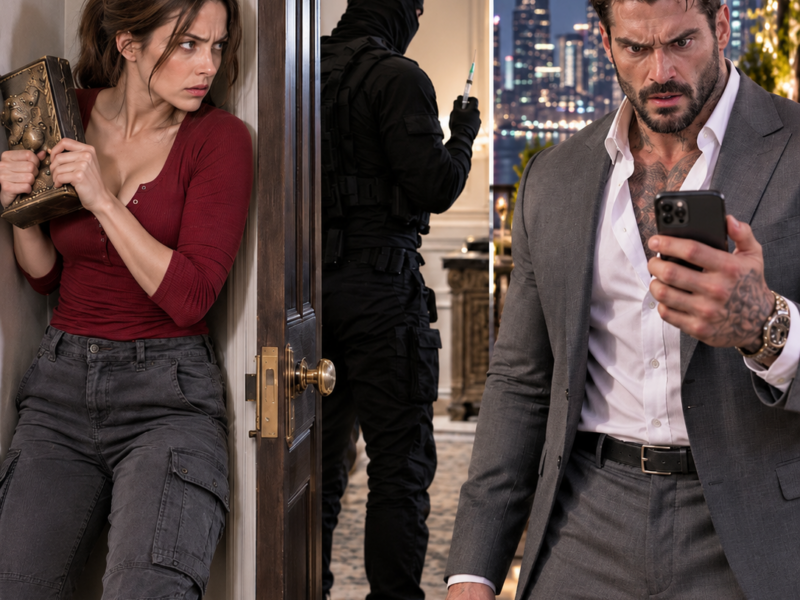
A masked man was unlocking my son’s bedroom door.
And Nissa was waiting behind it with a bronze bookend in her hand.
PART 2
I was standing outside a restaurant when the security alert appeared on my phone.
Luke’s bedroom door was being opened.
Slowly.
A masked man entered, holding a syringe.
My son was asleep.
Nissa stood hidden behind the door, gripping a heavy bronze bookend.
I immediately called the security desk.
Nobody answered.
Then I saw the intruder approach Luke’s bed.
Nissa struck him.
The bookend connected with his head, sending him staggering sideways.
He dropped the syringe and pulled a pistol.
They struggled.
A suppressed gunshot shattered the wall near my sleeping son.
Luke woke in terror.
“Nissa!” I screamed at my phone.
She forced the attacker into the hallway and slammed Luke’s door shut, locking him safely inside.
Then the man shot her in the shoulder.
Blood spread across her shirt.
She collapsed.
I thought I was watching her die.
Suddenly, Bruno, my security captain, tackled the attacker through the upstairs railing.
Both men crashed into the foyer.
Nissa dragged herself back toward Luke’s door.
She pressed her bleeding body against it and pulled a small knife from her boot.
She was still protecting him.
And then I understood.
Whoever Nissa really was, she had just risked her life for my son.
PART 3
By the time my SUV reached the estate, I had already imagined a hundred terrible possibilities.
Luke bleeding in his bed.
Nissa dead in the hallway.
Another explosion.
Another coffin.
I had survived ambushes, assassinations, and years of vicious negotiations with men who would gladly kill me for my territory.
Nothing had ever frightened me like that drive home.
I jumped out before the vehicle fully stopped.
The entrance hall looked like a battlefield.
Broken glass covered the marble floor.
A section of the upstairs railing had collapsed.
Bruno sat against the staircase, pressing a blood-soaked cloth against his injured leg.
The attacker lay several feet away, motionless.
“He’s dead,” Bruno gasped.
“Luke?”
“Safe. Upstairs.”
I ran.
When I reached the second floor, I found Nissa exactly where I had last seen her on the camera.
Sitting against Luke’s bedroom door.
Her skin was pale.
Her shirt was soaked with blood.
And despite everything, she still held that small knife.
When she heard my footsteps, she raised it.
“Nissa.”
Her eyes struggled to focus.
“It’s me.”
She stared at me.
Then recognition appeared.
The knife fell from her hand.
“Luke,” she whispered.
“He’s safe.”
“Don’t let anyone…”
“I won’t.”
Her body began sliding sideways.
I caught her before her head hit the floor.
She weighed almost nothing in my arms.
I had expected to find a hardened fighter.
Instead, I was holding a frightened, badly wounded young woman who had refused to abandon my child.
“Get Stanton!” I shouted.
My private physician arrived twenty minutes later.
He examined Nissa, controlled the bleeding, and arranged for her to receive emergency treatment with appropriate monitoring.
The bullet had passed through soft tissue near her shoulder without striking a major artery, but the wound was serious.
She would need proper follow-up care and time to recover.
I stayed beside her.
I couldn’t explain why.
Perhaps because everyone I had trusted had failed me.
And the woman I had distrusted most had just saved the only family I had left.
Hours later, Nissa opened her eyes.
“Where’s Luke?”
“Sleeping. Stanton checked him.”
She swallowed.
“Good.”
I pulled a chair beside her.
“We need to talk.”
Her expression changed.
She knew exactly what was coming.
“You’re not who you said you were.”
“I’m a nurse.”
“You’re also trained to fight.”
She looked away.
“And Paulie knows you.”
At his name, something hardened in her face.
I leaned forward.
“Tell me the truth.”
For several seconds, she said nothing.
Then she asked a question that caught me completely off guard.
“Do you know what it’s like to watch someone you love die because another man decided their life was worthless?”
I felt my stomach tighten.
“Yes.”
She nodded slowly.
“Then you’ll understand.”
Her younger brother, Tommy, had been twenty-three when he died.
He was reckless, funny, and constantly getting himself into trouble.
Nissa had raised him after their parents passed away.
While she attended nursing school, Tommy worked small jobs around Chicago, trying to contribute whatever money he could.
Eventually, he started running numbers for men connected to Paulie’s organization.
Nissa begged him to quit.
He promised he would.
Then sixty thousand dollars disappeared from one of Paulie’s operations.
Paulie accused Tommy of stealing it.
Tommy denied everything.
Three days later, someone found him in an alley behind Mercy Hospital.
Nissa had been working the emergency department that night.
She was helping another patient when the paramedics brought in an unidentified young man.
He had suffered devastating injuries.
She recognized his shoes before she saw his face.
Her voice became unsteady as she told me.
“I bought him those shoes for his birthday.”
I said nothing.
“They were the only expensive thing he’d ever let me buy him.”
She pressed her lips together.
“He was still conscious when they brought him in. He looked at me, Dominic. He knew it was me.”
Her eyes filled with tears.
“He kept trying to say something.”
“What?”
“That he hadn’t taken the money.”
She looked at her bandaged shoulder.
“He died before I could tell him I believed him.”
For three years, she had carried that memory.
She had gone to the police.
She had given statements.
She had named people connected to Paulie.
Nothing happened.
Eventually, she saw Paulie leaving the police station laughing with a detective.
That was when she realized the investigation would never protect her brother’s memory.
She resigned from the hospital.
She sold most of her belongings.
And she spent the following years learning about the organization responsible for Tommy’s death.
She studied surveillance, self-defense, and firearms under experienced instructors.
She learned which men worked for Paulie.
Where they met.
Who they trusted.
And how she might eventually get close enough to confront him.
Then she discovered I was looking for a caregiver.
“You applied because of Paulie,” I said.
“Yes.”
“You used my son to enter my house.”
Her expression changed immediately.
“At first.”
I stood.
“At first?”
“When I read Luke’s medical records, I thought this would be simple. I’d get the job, wait for Paulie, and find my opportunity.”
She looked toward the door.
“But then I met Luke.”
Her voice softened.
“He reminds me of Tommy when we were kids. That same stubborn look. That same refusal to admit he’s scared.”
I remained silent.
“I didn’t expect to care about him.”
“Yet you do.”
“More than I should.”
I thought of the camera footage.
Her patience.
Her sleepless nights.
The way she had placed herself between my son and an armed killer.
“Did you know Paulie would send someone?”
“No. But when he recognized me in the hallway, I knew I was in danger.”
“Why didn’t you tell me?”
“Because I wasn’t sure you’d believe me.”
She looked straight at me.
“And because Paulie has been your closest friend for fifteen years.”
The words cut deeper than I expected.
Paulie had been there when I married Camilla.
He had held Luke as a baby.
He had stood beside me at my wife’s funeral.
He had hugged me while I stared at her coffin.
And now I was beginning to suspect he had ordered her death.
“Tell me something,” I said.
Nissa waited.
“Did Paulie know my family’s movements?”
“Probably.”
“Did he have access to my vehicles?”
“He controlled men inside your security operation.”
I looked toward the hallway.
The bomb had been attached to my sedan on a morning when I was supposed to travel to a meeting.
Camilla had taken the car instead because hers was being serviced.
Only a handful of people knew that schedule.
Paulie was one of them.
Suddenly, the past six months began to make terrible sense.
While I buried my wife and watched my son struggle to recover, Paulie had been running almost everything.
Money passed through his hands.
Important decisions were delayed.
Several loyal captains had been replaced.
He wasn’t helping me.
He was quietly taking my empire apart.
I walked to the window.
For the first time, I allowed myself to consider the possibility that the greatest threat to my family had been sitting at my dinner table for years.
Behind me, Nissa spoke.
“Dominic?”
I turned.
“If you decide to fire me, I’ll understand.”
I looked at her injured shoulder.
“You think I’m firing you?”
“I lied about why I came here.”
“Yes, you did.”
“And I planned to kill a man you trusted.”
I walked back toward her.
“That man may have murdered my wife.”
Her expression froze.
“I don’t know everything yet,” I continued. “But I’m going to find out.”
I opened the drawer beside the desk and removed a photograph of Camilla holding Luke when he was four.
She was laughing.
Luke had chocolate ice cream all over his face.
For six months, I had kept the photograph hidden.
Looking at it hurt too much.
I placed it beside Nissa’s photograph of Tommy.
“Two families,” I said quietly. “Destroyed by the same man.”
She stared at the pictures.
“What happens now?”
“First, you recover.”
“And then?”
I looked directly into her eyes.
“Then we make sure Paulie can never hurt another person we love.”
The following morning, I went upstairs to see Luke.
He was awake, staring at his bedroom door.
The attack had terrified him.
He wouldn’t allow the replacement nurse to touch him.
He refused breakfast.
When I approached, his eyes filled with tears.
I sat beside him.
“Hey, buddy.”
Nothing.
“I’m sorry I wasn’t here.”
His fingers tightened against the blanket.
I took his right hand.
“I know you’re scared.”
His breathing became uneven.
I wanted to promise him nothing bad would ever happen again.
But I had made too many promises I couldn’t keep.
Instead, I said something I should have said months earlier.
“I’m scared too.”
Luke looked at me.
I swallowed.
“I’ve been scared every day since we lost Mom.”
His eyes changed.
For the first time, I wondered whether my silence had hurt him almost as badly as the accident.
I had spent six months acting like a man who could control everything.
Perhaps my son had needed a father willing to admit he couldn’t.
A soft voice came from the doorway.
“Looks like somebody started the morning without me.”
Nissa stood there, one arm in a sling.
She was pale and visibly exhausted.
I immediately frowned.
“What are you doing out of bed?”
“Visiting my favorite difficult patient.”
Luke stared at her.
His eyes moved to her injured shoulder.
Nissa approached slowly.
“Yeah,” she said, noticing his expression. “It hurts.”
Luke’s lower lip trembled.
“But I’m still here.”
She sat beside his bed.
“And you know what? So are you.”
Tears rolled down his cheeks.
She didn’t tell him to stop.
She didn’t demand that he be brave.
She simply sat beside him until his breathing calmed.
Then she placed the familiar baseball card on his blanket.
“When your doctor says we’re ready, we’ll work on getting stronger again.”
Luke looked at the card.
His fingers moved toward it.
A small, deliberate movement.
I watched without breathing.
Nissa smiled.
“That’s my guy.”
And then something happened that I would remember for the rest of my life.
Luke opened his mouth.
He struggled.
His throat tightened.
A faint, broken sound escaped.
“Nis…”
Nissa went completely still.
Luke tried again.
“Nissa.”
It was barely a whisper.
But it was her name.
The first name my son had spoken in six months.
Nissa covered her mouth.
I turned away because I couldn’t stop crying.
For one impossible moment, the world outside that bedroom disappeared.
There was no mafia.
No betrayal.
No death waiting around the corner.
There was only a little boy who had found his voice.
And a woman who had given him a reason to use it.
PART 4
The moment Luke spoke Nissa’s name, something changed inside me.
Not because his injury had suddenly vanished.
It hadn’t.
He still faced months, perhaps years, of rehabilitation.
The doctors remained cautious about what movement he might eventually recover.
But for the first time since the explosion, I saw hope in his eyes.
And that hope terrified me almost as much as losing him.
Because now I understood what Paulie might take from us if I allowed him another opportunity.
I called Bruno into my office that afternoon.
He arrived leaning on crutches, his injured leg heavily bandaged.
“You should be resting,” I told him.
“So should half the people in this house.”
He lowered himself into a chair.
I turned my computer screen toward him.
It displayed the footage from the night of the attack.
“Watch.”
Bruno remained silent as the masked intruder entered Luke’s room.
He watched Nissa fight.
He watched himself tackle the attacker.
When the recording ended, he stared at the black screen.
“The alarm system was disabled from inside,” he said.
“Exactly.”
“Who had access?”
“You. Me. The technical staff.”
“And Paulie.”
I nodded.
Bruno’s expression darkened.
“Boss, I’ve known that man fifteen years.”
“So have I.”
He looked down.
“You think he ordered the bomb?”
“I think he ordered both attacks.”
Bruno sat motionless.
Then he asked, “What do you want me to do?”
“Find out who helped him.”
Over the next several hours, Bruno’s investigators reviewed access records, financial transactions, security logs, and communications.
By evening, we had answers.
A technician who maintained the estate’s network had received a large payment through a company connected to Paulie.
The payment had been made four days before the attempted murder.
Another transfer went to a former security contractor with connections to the garage where my sedan had been serviced before the explosion.
I stared at the evidence for a long time.
Six months.
For six months, I had slept beneath the same roof as the people my underboss was paying to destroy my family.
Bruno placed another file on my desk.
“There’s more.”
Inside were records showing that Paulie had been moving money out of several shared operations.
Millions of dollars.
Some of the funds had gone through accounts controlled by people on the Commission.
The governing council of the five most powerful criminal families in the city.
Paulie hadn’t acted entirely alone.
He had been buying support.
Preparing for the day I was either killed or declared incapable of leading.
I closed the file.
“Does he know we’re investigating?”
“Not yet.”
“Good.”
Bruno hesitated.
“There’s something else.”
I waited.
“His people have been asking questions about Luke.”
My stomach turned.
“What questions?”
“Whether the boy survived last night’s attack. Whether the woman who protected him is dead.”
I looked toward the ceiling.
Somewhere above us, Luke was having dinner with Nissa.
He had asked for chocolate pudding by pointing at a picture.
A tiny victory.
And somewhere in the city, Paulie was wondering whether he needed to send another killer.
I had never hated anyone so completely.
“Get Luke into the safe room,” I said.
Bruno nodded.
“And quietly bring back every man whose loyalty you’ve personally verified.”
“What are you planning?”
I looked at the surveillance monitors.
“For once, Paulie is going to walk into a house where I know exactly what he’s doing.”
That evening, I visited Nissa.
She was sitting in the guest suite, trying unsuccessfully to button a clean shirt with one hand.
I knocked.
She looked up.
“You’re getting better at that.”
“At what?”
“Knocking instead of entering like you own the planet.”
Despite everything, I smiled.
Then I noticed her face.
She looked worse than she had that morning.
“Stanton needs to check that wound.”
“He already did.”
“And?”
“He told me to rest.”
“Excellent advice.”
“I hate excellent advice.”
I sat opposite her.
“We found evidence connecting Paulie’s people to the attack.”
Nissa stopped moving.
“And the car bomb?”
“Strong connections. Not everything is proven yet.”
She looked at me carefully.
“You’re going after him.”
“Yes.”
“When?”
“Tonight.”
For the first time, she seemed genuinely frightened.
Not for herself.
“For Luke?”
“He’ll be protected. We have a secure room below the house, independent communications, and people I trust.”
“And you?”
I shrugged.
“I’ve dealt with Paulie before.”
“Not when he knew you wanted him dead.”
I leaned forward.
“Nissa, I don’t want you involved. You’re injured.”
She studied my face.
“You don’t trust me?”
“I trust you more than almost anyone.”
“Then don’t pretend this isn’t my fight.”
I looked at the photograph on her nightstand.
Tommy.
A smiling young man with untidy brown hair and his arm draped around his sister’s shoulders.
“Your brother deserves justice,” I said.
“Yes.”
“But you deserve to live.”
She stared at me.
I continued.
“Luke needs you. And whether you believe it or not, I think I do too.”
Her expression softened.
Only slightly.
“That’s a dangerous thing to tell a woman like me.”
“Why?”
“Because I might start believing you.”
For a moment, neither of us spoke.
Then she reached for my hand.
Her fingers were warm.
“Whatever happens tonight,” she said, “don’t make Luke bury another parent.”
I promised I would do everything I could to come home.
It was the only promise I was willing to make.
By sunset, the estate appeared almost deserted.
The broken entrance had been boarded temporarily, and the usual armed patrols were nowhere in sight.
To anyone watching from outside, it looked like a wounded fortress.
In reality, Bruno had positioned loyal security teams throughout the grounds and interior.
Luke was safely downstairs with his physician and four trusted guards.
Nissa had reluctantly agreed to remain away from the fighting.
Or so I thought.
At 10:46 p.m., a message arrived on my phone.
Three vehicles approaching.
I stood in the darkened master bedroom.
My heart beat steadily.
I had experienced this feeling before.
The strange calm that arrived immediately before violence.
Then another message came.
Multiple armed men entering the property.
A minute later, the first distant gunshots echoed through the house.
I heard shouting.
Footsteps.
Glass breaking.
Then silence.
For several seconds, I couldn’t tell who had survived.
My radio crackled.
“Bruno here. Intruders contained. Several wounded. Medical team moving in.”
I released a breath.
Then footsteps sounded outside my bedroom.
Slow.
Uneven.
Someone was approaching.
I stepped away from the doorway.
A familiar voice called from the hallway.
“Dominic!”
Paulie.
“Come out! We need to talk!”
I remained silent.
He laughed nervously.
“You know how this works, Dom. Business gets complicated.”
I could hear him moving closer.
“Nobody wanted Camilla hurt.”
Every muscle in my body tightened.
He had just said the one thing I needed to hear.
I hadn’t mentioned Camilla.
Not once.
Paulie continued.
“That wasn’t supposed to happen. You were supposed to be in that car.”
I felt the room tilt.
For six months, I had imagined the moment I would learn who killed my wife.
I thought I would feel rage.
Instead, I felt something colder.
A terrible certainty.
Paulie pushed open the bedroom door.
He held a revolver.
His expensive suit was torn at the shoulder.
Sweat covered his forehead.
When he saw me standing near the window, he raised the gun.
“Don’t make this difficult.”
I kept my voice calm.
“Put it down.”
“You’re finished, Dom.”
“No. You are.”
He glanced behind him.
Only then did he realize the hallway was silent.
The men he had brought were no longer coming to help him.
His hand trembled.
I spoke again.
“Drop the gun.”
He fired.
The bullet struck the wall beside me.
I returned fire, hitting him in the shoulder.
His revolver fell.
He staggered backward, lost his balance, and collapsed.
I approached cautiously, keeping my weapon trained on him.
Paulie stared up at me.
“Dom. Please.”
I had heard men beg before.
It had never affected me.
But this was the man who had eaten at my table.
The man who had toasted my marriage.
The man who had watched Luke open his birthday presents.
“You killed Camilla.”
His eyes filled with panic.
“It wasn’t supposed to be her.”
“You knew she was in the car?”
“No. I swear.”
“You knew Luke might be there.”
Paulie said nothing.
And that silence told me everything.
I crouched several feet away.
“She trusted you.”
He began crying.
“You don’t understand. The Commission wanted you gone. They thought you were becoming too powerful.”
“So you murdered my family?”
“It was supposed to be quick!”
I stood.
I couldn’t bear to look at him.
Then a quiet voice came from behind me.
“Tommy Hayes.”
Paulie’s head turned.
Nissa stood in the doorway.
She was pale, her injured arm secured in a sling, and Bruno stood just behind her.
I stared at her.
“You were supposed to stay downstairs.”
“I know.”
Paulie’s face drained of color.
He recognized her.
“Nissa…”
She stepped into the room.
“Say his name.”
Paulie swallowed.
“Who?”
“My brother.”
He looked toward me.
“Dom, get her out of here.”
“Say it,” she repeated.
Paulie shut his eyes.
“Tommy Hayes.”
Nissa stood motionless.
“Did he steal your money?”
Paulie hesitated.
Then he shook his head.
“No.”
Her breathing changed.
“What?”
“He didn’t steal it.”
“Then why did you kill him?”
Paulie looked down.
“Someone needed to take the blame.”
Nissa closed her eyes.
Three years of grief seemed to pass across her face.
When she opened them again, there was no anger left.
Only devastation.
“My brother died begging me to believe him.”
Paulie stared at the floor.
“He was innocent.”
I watched Nissa’s hands shake.
I knew what she had wanted for three years.
I knew she had imagined this moment hundreds of times.
But I also remembered Luke speaking her name.
I remembered the way he looked at her.
And I understood that giving Paulie another death would not bring Tommy back.
“Nissa,” I said quietly.
She turned toward me.
“Look at me.”
For a moment, I thought she wouldn’t.
Then our eyes met.
“He’s finished.”
She swallowed.
“He deserves to die.”
“Maybe he does.”
My voice broke.
“But Luke deserves to see us tomorrow.”
Something changed in her expression.
She looked at Paulie.
Then at the photograph of Camilla on my bedside table.
Finally, she stepped backward.
Bruno moved in and secured Paulie while his remaining loyal guards took control of the room.
We had recorded the confession.
We had the financial records.
And for the first time, Paulie Vane was no longer protected by fear.
Nissa turned away before the guards dragged him out.
I followed her into the hallway.
She stopped near the staircase.
Her entire body began shaking.
I reached toward her.
She collapsed against me.
I held her as she cried.
Not the silent tears I had watched through hidden cameras.
This time, she made no effort to hide her grief.
“I thought it would feel different,” she whispered.
“What?”
“Knowing the truth.”
I placed my hand against her hair.
“I know.”
She looked up.
“Does it get easier?”
I thought of Camilla.
Of the wedding ring.
Of all the mornings I still reached across an empty bed.
“Not quickly.”
I held her tighter.
“But maybe we don’t have to carry it alone anymore.”
PART 5
The morning after Paulie’s capture, I woke to a sound I hadn’t heard inside my house for six months.
Laughter.
It was faint.
Almost uncertain.
But unmistakable.
I sat up in bed and listened.
It came from Luke’s room.
For one wonderful second, I forgot everything that had happened.
The bomb.
The funeral.
The betrayal.
The gunfire.
I was simply a father hearing his son laugh.
I pulled on a shirt and walked upstairs.
Nissa was sitting beside Luke’s bed, holding a stuffed dinosaur.
She was making it argue with a toy baseball player.
“That’s ridiculous,” she told the dinosaur. “You can’t play shortstop. Your arms are too small.”
Luke smiled.
The dinosaur apparently disagreed.
“Well, take it up with the coach.”
Luke made a small laughing sound.
My chest tightened.
Neither of them noticed me standing in the doorway.
I watched as Nissa placed the toys beside him.
“Your turn.”
Luke slowly moved his right hand toward the dinosaur.
His fingers curled around its tail.
He lifted it slightly before losing his grip.
It fell onto the blanket.
He frowned.
Nissa didn’t rescue the toy immediately.
Instead, she looked at him.
“Want to try again?”
He considered the question.
Then nodded.
I leaned against the doorway.
Six months earlier, my son had barely responded when anyone spoke to him.
Now he was laughing at ridiculous jokes and choosing to try difficult things.
The recovery was slow.
His spinal cord hadn’t magically healed.
Some days were still filled with pain, frustration, and exhaustion.
But Luke was participating in his life again.
That alone felt miraculous.
When Nissa finally noticed me, she smiled.
“Your son is negotiating a professional baseball contract with a dinosaur.”
“Sounds expensive.”
“Very. He wants unlimited pudding.”
Luke laughed again.
I walked over and kissed his forehead.
“Morning, buddy.”
He looked at me.
“Dad.”
The word was faint but clear.
I stopped breathing.
He hadn’t called me that since before the explosion.
I sat beside him.
“Yeah, buddy. I’m here.”
He looked at my face.
Then slowly reached for my hand.
I held it gently.
And for the first time in months, I didn’t feel the need to hide my tears.
The days that followed were difficult.
Paulie’s confession had exposed years of corruption, hidden payments, and betrayals involving people I had once considered allies.
I handed the evidence of the attempted murder and the bombing to attorneys who arranged for it to reach the appropriate authorities.
There were investigations.
Arrests.
Threats.
Men who had once called me brother suddenly refused to answer their phones.
The Commission demanded explanations.
I gave them one.
Paulie had betrayed me.
He had attacked my family.
And anyone who supported those attacks would have to answer for their involvement.
But something else had changed.
For years, I had convinced myself that protecting my family required maintaining absolute control over the criminal world I had helped build.
Now I understood that the empire itself had made Camilla and Luke targets.
Every favor I had accepted.
Every enemy I had created.
Every secret I had kept.
They had all followed me home.
Camilla had paid for my choices.
Luke had paid for them too.
One evening, I found myself standing in my office, looking at photographs of the men who had worked beneath me for years.
Bruno entered quietly.
“The lawyers called,” he said.
“And?”
“The investigation is expanding.”
I nodded.
He looked at the files scattered across my desk.
“You thinking about stepping away?”
I gave a bitter laugh.
“Can a man like me ever truly step away?”
Bruno considered the question.
“Not easily.”
I looked toward the upstairs hallway.
“But?”
“But maybe difficulty isn’t a good enough reason not to try.”
I stared at him.
Bruno had spent most of his life protecting me.
He had taken a terrible fall defending my son.
His leg would never completely recover.
And he was still the one telling me the truth.
“I want you to retire,” I said.
He blinked.
“Excuse me?”
“You’ve done enough.”
“Boss…”
“Bruno, you’ve earned the right to spend your mornings doing something other than worrying whether somebody wants to kill us.”
He smiled faintly.
“Fishing?”
“Whatever you want.”
He looked toward the door.
“What about security?”
“I’ll find someone.”
Bruno chuckled.
“I think you already have.”
He didn’t need to say her name.
Nissa was recovering slowly.
Her shoulder hurt whenever she moved too quickly, and Stanton repeatedly warned her that ignoring medical advice would only prolong the healing process.
She complained.
Constantly.
But eventually, she listened.
Mostly because Luke started repeating the doctor’s instructions to her.
“Rest,” he would say whenever she tried carrying something heavy.
Nissa would stare at him.
“Since when did you become my doctor?”
“Rest,” he repeated.
And she would surrender with exaggerated annoyance.
Watching them together became the best part of my day.
Nissa never pretended Luke’s rehabilitation was easy.
Some mornings he woke up determined.
Other mornings he refused everything.
Sometimes he cried because he couldn’t move his legs.
Sometimes he became angry when his hands wouldn’t cooperate.
She learned when to challenge him and when to stop.
She celebrated effort without pretending every attempt was a victory.
And she never let him believe his worth depended on whether he would eventually walk.
One afternoon, I overheard Luke ask her a question.
“Will I run?”
Nissa became quiet.
I stood outside the door, unable to move.
For months, I had avoided that question.
I had promised him specialists.
Treatments.
Equipment.
Anything money could buy.
But I had never learned how to tell my son the truth.
Nissa sat beside him.
“I don’t know, kid.”
Luke looked down.
She continued.
“The doctors don’t know exactly how much movement you’ll recover. We’re going to work hard with your therapy team. And whatever happens, we’ll find ways for you to do the things you love.”
His eyes filled with tears.
“What if I can’t?”
She took his hand.
“Then we’ll figure out another way.”
He looked at her.
“Baseball?”
“Absolutely.”
“Even chair?”
“Especially in your chair, if that’s how you want to play.”
He thought about that.
Then smiled.
“Okay.”
I walked away before either of them saw me.
That conversation changed something in me.
I had spent months trying to purchase a future where the accident had never happened.
Nissa was teaching Luke how to live in the future he actually had.
Four months later, spring arrived.
The snow melted from the estate grounds.
The indoor garden filled with sunlight.
And Luke began making progress that even his rehabilitation team found encouraging.
His arm control improved.
His speech became clearer.
With specialized braces, a body-weight support system, and close supervision from his physical therapist, he started practicing supported standing.
It was exhausting.
He could manage only brief periods.
But he loved counting the seconds.
One Tuesday afternoon, I entered the therapy room and found him between two parallel bars.
Nissa stood beside his physical therapist, holding a stopwatch.
Luke wore blue sneakers and custom leg braces.
His face was red from effort.
“Ready?” the therapist asked.
Luke nodded.
“Okay. Shift your weight slowly.”
He tightened his grip on the bars.
His arms trembled.
With guidance and support, he attempted to move his right foot.
It shifted forward.
Barely two inches.
But it moved.
Luke gasped.
Nissa looked at the stopwatch.
“Nice work.”
He looked toward the door and saw me.
“Dad!”
I walked closer.
“Did you see?”
“I saw.”
“I moved it!”
“You sure did.”
He grinned.
Then, with help from his therapist, he attempted the same movement with his other foot.
The effort was enormous.
He managed a small shift before needing to sit down.
Everyone helped him safely return to his chair.
He was exhausted.
But he was smiling.
“Again tomorrow,” he announced.
Nissa raised an eyebrow.
“Tomorrow? I thought you hated physical therapy.”
“I hate you.”
“That’s fair.”
He burst out laughing.
I laughed too.
The sound surprised me.
I couldn’t remember the last time laughter had felt so natural.
Later that afternoon, when Luke was resting, I found Nissa alone in the therapy room.
She was putting equipment away.
Her shoulder had healed enough for ordinary activity, though a scar remained near her collarbone.
“How’s the arm?” I asked.
“Attached.”
“Very reassuring.”
She smiled.
I leaned against the wall.
“I need to tell you something.”
She looked at me cautiously.
“That sounds expensive.”
“I removed the hidden cameras.”
Her smile faded.
She stared at me.
“All of them?”
“Every one inside Luke’s private rooms.”
“When?”
“Three weeks ago.”
She was silent.
Then she said, “I knew they were there.”
I blinked.
“You knew?”
“Dominic, the lens behind the ventilation grille reflected light every afternoon.”
I stared at her.
She laughed.
“You really thought you were subtle?”
I rubbed my forehead.
“Why didn’t you say anything?”
“At first, because I needed the job.”
“And later?”
She looked toward the open doorway.
“Because I understood why you were watching.”
I studied her.
“You should have been angry.”
“I was.”
The answer surprised me.
“You never said anything.”
“Because I knew you weren’t going to trust me just because I demanded it.”
She stepped closer.
“Trust is something you have to choose.”
I nodded slowly.
“That’s why I removed them.”
She looked into my eyes.
“And what made you finally choose?”
I thought about the night she had protected Luke.
About the blood on the hallway floor.
About Tommy’s photograph.
About the countless mornings she had spent helping my son find his way back toward the world.
“Because you’ve given me more reasons to trust you than anyone else ever has.”
For once, Nissa had no sarcastic response.
I continued.
“Bruno is retiring. I need someone to oversee the estate’s protection, coordinate Luke’s medical transportation, and build a security team that doesn’t answer to my old business associates.”
She folded her arms.
“Are you offering me a job?”
“Yes.”
“What happened to being your son’s nurse?”
“You can still be involved in his life. But I want him to have a dedicated medical team, and I want you to have a future beyond caring for someone else’s child.”
She looked down.
“What would the salary be?”
“Name it.”
She tilted her head.
“Double what you paid me before.”
“Done.”
“And I choose the team.”
“Within reason.”
“Dominic.”
“Fine. You choose the team.”
“And no secret cameras.”
I smiled.
“No secret cameras.”
She held out her hand.
“Deal.”
I took it.
But neither of us let go immediately.
Something had been growing between us for months.
Not simply gratitude.
Not obligation.
Something quieter and more complicated.
I had watched her fight for Luke.
She had watched me learn how to become his father again.
We had seen each other frightened, exhausted, grieving, and ashamed.
There were no perfect versions of ourselves left to pretend to be.
“Nissa,” I said softly.
“Yes?”
“I don’t know what my life is going to look like a year from now.”
She studied me.
“I’m working to change things. To separate myself and my family from the people who brought all this violence into our home.”
“That won’t be easy.”
“I know.”
“And some people won’t let you walk away peacefully.”
“I know that too.”
She squeezed my hand.
“Then don’t do it alone.”
I stepped closer.
“Is that an offer?”
“Maybe.”
I smiled.
She smiled back.
And when I kissed her, there was no desperation.
No violence.
No promise that the past could be erased.
Only a quiet understanding that the future might still contain something worth protecting.
We were interrupted by a familiar voice.
“Gross!”
Luke was sitting in his wheelchair at the doorway.
His therapist stood behind him, desperately trying not to laugh.
Nissa immediately stepped away.
“You’re supposed to be resting.”
Luke grinned.
“Kissing!”
I laughed.
She pointed at him.
“One more word and tomorrow’s baseball statistics are canceled.”
He laughed harder.
For the first time in years, the house felt like a home.
That evening, the three of us sat in the garden.
Luke insisted on bringing his favorite baseball cards.
Nissa argued that his team would never win the championship.
I pretended to agree with her just to make him complain.
The sun disappeared behind the trees.
Somewhere beyond the estate walls, the city continued moving.
There were still investigations to face.
Decisions to make.
Consequences I couldn’t escape.
And I knew there would be difficult days ahead.
Luke would have setbacks.
Nissa would carry memories of Tommy.
I would never stop missing Camilla.
Healing wasn’t the same as forgetting.
But as I watched Luke laugh at something Nissa said, I finally understood what I had been missing.
I had spent most of my life believing that love meant controlling every possible danger.
I built walls.
Hired guards.
Bought weapons.
Installed cameras.
I thought that if I watched closely enough, nothing terrible could ever happen again.
But the cameras hadn’t saved Luke.
Nissa had.
Not because she possessed some extraordinary power.
Because when danger entered his bedroom, she chose to protect him.
And afterward, when he was terrified of living, she stayed beside him until he found the courage to try again.
That night, I returned to my basement office one final time.
The nine monitors were dark.
I sat in the same leather chair where I had spent countless nights watching my son through a screen.
Then I reached forward and shut down the surveillance system that had once shown every corner of his bedroom.
For the first time in six months, I didn’t feel afraid of what I might miss.
Upstairs, I could hear Luke laughing.
And Nissa laughing with him.
I stood, turned off the office light, and walked toward their voices.
For years, people had called me Dominic Rossi, the man who feared nothing.
They were wrong.
I was afraid of losing the people I loved.
I always would be.
But I had finally learned that protecting someone didn’t mean keeping them imprisoned behind walls.
Sometimes it meant opening the door.
Trusting another person.
And choosing to live even when the world had given you every reason to hide.
When I reached Luke’s bedroom, he was waiting for me.
“Dad,” he said.
“Yeah, buddy?”
He held out his hand.
“Stay?”
I looked at Nissa.
She smiled.
I sat beside my son and took his hand.
“Of course.”
He leaned against me.
And for the first time since the night the bomb exploded, I believed that the three of us might actually be okay.
Not because the danger was gone.
Not because every wound had healed.
But because we had finally stopped facing the darkness alone.