I Said, “I’m Leaving Tomorrow…” She Asked, “Would You Stay If I Said I Loved You?”
I Said, “I’m Leaving Tomorrow…” She Asked, “Would You Stay If I Said I Loved You?”
PART 1
“Would you stay if I told you I loved you?”
Those eleven words stopped me more effectively than any railroad signal I had ever worked on.
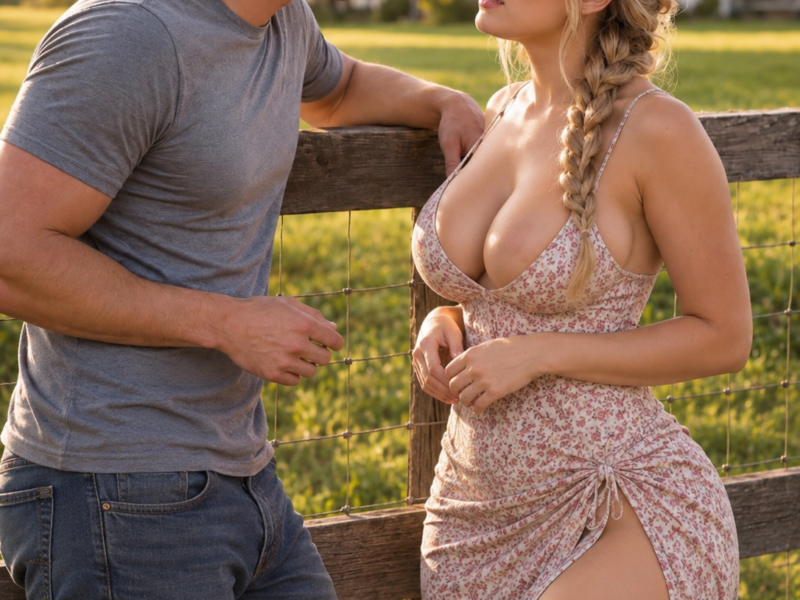
I stood outside a weathered wooden fence in the Finger Lakes region of New York, wearing a gray T-shirt instead of my usual work vest. My truck was parked behind me, packed with everything I had brought for a thirty-day assignment. The project was finished. My paperwork was signed. By sunrise the following morning, I was supposed to be driving away.
On the other side of the fence stood Lynn Christensen.
Her blond hair was braided over one shoulder, and the pale blue flowers on her summer dress moved gently in the afternoon breeze. Behind her, the white farmhouse glowed beneath the lowering sun. It looked like the sort of place people spent their entire lives trying to find.
I had spent twenty-nine days convincing myself it was just another place I would leave.
“Javier?” she whispered.
I couldn’t answer.
Not because I didn’t know what I felt.
Because I knew exactly what answering would mean.
Lynn glanced toward my truck, then lowered her eyes.
“Please don’t stay because you feel sorry for me,” she said. “And don’t stay just because I’ve made leaving uncomfortable. If you stay, I need to know you’re choosing a life here. Not just choosing me because I happened to ask.”
I watched her fingers tighten around the edge of her dress.
She was trying to be brave.
And I realized something that frightened me more than any decision I had made in years.
For the first time in my adult life, the person standing in front of me mattered more than the destination waiting on my schedule.
But there was something Lynn didn’t know.
My supervisor had offered me a chance to stay in the Finger Lakes for another six months.
And I hadn’t given him an answer.
To understand why, you have to know what happened twenty-nine days earlier, when I first arrived at that farmhouse believing I had everything figured out.
I was thirty-six years old, a railroad signal technician, and a man who had become exceptionally good at leaving.
My work took me from one construction project to another, commissioning railway crossing systems before new lines opened to the public. I checked warning lights, tested crossing gates, verified safety circuits, and made sure every piece of equipment functioned exactly as designed.
The work was demanding, but I liked its predictability.
Every assignment began with a schedule.
Every schedule ended with a departure date.
And every departure meant I could start again somewhere else without worrying about the complications of staying.
I had convinced myself this was freedom.
Looking back, I think I was mostly afraid of discovering what would happen if I stopped moving.
My latest assignment was a thirty-day commissioning project for a new scenic excursion railway near Seneca Lake.
On my first morning, I arrived before sunrise, parked my company truck along a gravel shoulder, and reviewed the plans while drinking coffee that had already gone cold.
The crossing sat beside a white farmhouse, a long wooden fence, and a roadside produce stand.
According to the engineering drawings, the property was simply a boundary beside our work zone.
Then I watched a woman carry a heavy wooden crate of peaches toward the stand.
She had blond hair tied back in a braid, faded jeans, and a determined expression that suggested she had already been working for hours.
I considered offering to help.
But before I could approach, she adjusted the crate against her hip, carried it the remaining distance, and placed it exactly where she wanted.
She straightened a stack of paper bags, noticed me approaching, and folded her arms.
“Can I help you?”
“Good morning. I’m Javier Lewis, lead technician for the railway project. I’m looking for the property owner.”
“You found her.”
I glanced toward the farmhouse.
She noticed.
“Yes,” she said, “I own the house, the land, and the driveway. Is that going to be a problem?”
There was no hostility in her voice.
But there was a warning.
“No problem,” I answered. “I’m here to discuss access for our observation equipment.”
Her eyes moved toward the company truck.
“Are your people going to block my driveway?”
“I need to inspect the crossing before I can answer that.”
“Well, I’d appreciate an answer before somebody parks a truck across the entrance.”
“Fair enough.”
She studied me for a moment.
Most people treated my uniform as evidence that I had already made the decisions.
Lynn clearly wasn’t one of them.
“This place might look empty on your maps,” she continued, “but I have customers, suppliers, and people who somehow mistake my driveway for a public turnaround.”
As if to prove her point, a silver sedan slowed near the crossing, turned abruptly into her driveway, reversed, and disappeared toward the lake.
She raised an eyebrow.
“That happens about fifteen times every morning.”
I looked back at the engineering drawings on my tablet.
The driveway was marked.
The traffic wasn’t.
“When does it get worst?” I asked.
“Between nine and ten-thirty. And don’t put anything near the irrigation lines.”
“Where are they?”
She gave me a look.
“That’s why you’re going to walk the property with me.”
I almost smiled.
“What time?”
“Eight.”
“I’ll be here.”
“And don’t be late.”
I looked at my watch.
“I usually aren’t.”
“We’ll see.”
At exactly eight, I stood beside her gate.
Lynn approached carrying a notebook and two bottles of water.
She handed me one without explanation.
We walked the edge of the property while she showed me where irrigation pipes ran underground, where delivery trucks needed turning space, and which patches of ground became unstable after heavy rain.
I took notes.
When we reached the proposed observation point, she stopped.
“You can’t put equipment there.”
I checked my drawing.
“Why?”
“Because that’s where the bakery van turns when he delivers bread on Fridays.”
“The drawing shows clear ground.”
“The drawing doesn’t buy bread.”
I laughed before I could stop myself.
She looked surprised.
Then she smiled.
It was a small smile, but it changed her whole face.
We watched the crossing for another ten minutes.
Three cars used her driveway to turn around. A delivery truck pulled dangerously close to the shoulder. A cyclist crossed the precise location where my crew had planned to place a tripod.
By the time we returned to the gate, I had changed two observation points and moved our morning testing schedule.
Lynn watched me make the adjustments.
“You actually listened.”
“You know this property better than I do.”
“You’d be surprised how many people have trouble admitting that.”
“I’m not paid to win arguments. I’m paid to make the crossing safe.”
She looked at me differently after that.
Not warmly, exactly.
But with curiosity.
Before I left, she said, “I can count the turnaround traffic for you. I’m outside most mornings anyway.”
“I couldn’t ask you to work for my project.”
“I’m offering. There’s a difference.”
I considered it.
“Then I’d appreciate the help.”
“Good. But there’s a fee.”
I reached for my wallet.
“How much?”
“You have to buy breakfast from my stand.”
I stared at her.
She stared back.
“Is that negotiable?” I asked.
“No.”
“Then I accept.”
That was how our arrangement began.
Every morning, I arrived at her gate around eight.
Every morning, Lynn handed me a paper bag containing something warm and a sheet of paper covered in traffic counts.
Sometimes it was a peach muffin.
Sometimes a cinnamon roll.
Once, when I admitted I hadn’t eaten dinner the previous evening, she gave me a breakfast sandwich and told me that coffee wasn’t a complete food group.
I learned she had inherited the farmhouse from her grandmother, who had raised her through much of her childhood.
I learned she had spent three years expanding the produce stand, investing money she could barely afford because she wanted to build something that belonged entirely to her.
And I learned that she wasn’t nearly as intimidating as she pretended to be.
She remembered customers’ names.
She gave bruised peaches to a retired neighbor who made preserves.
And whenever a child couldn’t decide which apple to buy, she quietly added an extra one to the bag.
I began noticing these things without meaning to.
That should have warned me.
Instead, I told myself I was simply becoming familiar with the people around my workplace.
Then, on the seventh morning, something happened that shifted the ground beneath my carefully organized life.
A delivery truck arrived nearly two hours early, blocking our observation area.
I postponed the test and reassigned my crew to another task.
Lynn approached, visibly frustrated.
“I’m sorry. The driver changed his route without telling me.”
“It’s all right.”
“You’ve lost your testing window.”
“I’ve changed my testing window.”
She studied my face.
“Does nothing upset you?”
“Plenty of things.”
“But you never seem angry when plans change.”
“Getting angry at someone who didn’t cause the problem won’t fix it.”
She became quiet.
Then she said something I didn’t expect.
“Do you ever have coffee without looking at your watch?”
I smiled.
“Occasionally.”
“Would you like to try tomorrow?”
I looked at her.
She suddenly seemed nervous.
“Six-thirty,” she added. “At the house. Before I open.”
“Coffee about the project?”
She shook her head.
“No, Javier.”
Her cheeks turned faintly pink.
“Not about the project.”
I should have recognized the moment for what it was.
The beginning of something neither of us could control.
Instead, I simply said, “I’ll be there.”
And for the first time in years, I rearranged my work schedule for something I genuinely wanted rather than something I was required to do.
I had no idea that one cup of coffee would eventually make leaving the Finger Lakes the hardest decision of my life.
PART 2
I arrived at Lynn’s farmhouse seven minutes early.
She opened the back door holding an empty coffee mug.
“You’re early.”
“I know.”
“The coffee isn’t ready.”
“That’s fine.”
She smiled. “You really don’t know how to be late, do you?”
Inside, the kitchen smelled of fresh bread and peaches. Sunlight fell across a wooden table covered with seed catalogs, handwritten receipts, and a vase of wildflowers.
For the first time, she saw me without my safety vest.
“No work armor today?”
“You said this wasn’t work coffee.”
She laughed.
We talked for an hour.
About her grandmother. About the farmhouse. About the years I’d spent moving between temporary assignments.
“You don’t have a home?” she asked.
“I have an apartment.”
“Where?”
“Pennsylvania.”
“When were you last there?”
I hesitated.
“Four months ago.”
She lowered her mug.
“That doesn’t sound like home.”
I had no answer.
When my watch vibrated, I silenced it.
Lynn noticed.
“Your schedule can wait?”
“Apparently.”
She smiled and offered to walk me through the orchard.
We took the long path between the trees.
At one narrow turn, her shoulder brushed mine.
Neither of us moved away.
At the gate, she stopped.
“Same time tomorrow?”
I should have said my mornings were too busy.
Instead, I said, “Six-thirty.”
Her smile stayed with me all day.
And when I returned to my motel that evening, I caught myself doing something unfamiliar.
I was looking forward to tomorrow.
Not because of the railway.
Because of her.
PART 3
By the middle of the second week, my life had developed a second schedule.
The first one was printed on my company tablet, updated whenever a test window changed or a contractor delayed an installation.
The second existed entirely in my head.
Six-thirty meant coffee in Lynn’s kitchen.
Eight meant finding her at the farm stand, often with flour on her sleeve and a pencil tucked behind one ear.
Five-thirty meant looking toward her driveway as I finished my final inspection, hoping she might still be outside.
I never wrote any of those times down.
Somehow, I remembered them better than everything else.
Our morning coffees became a quiet routine. We didn’t manage every day, but when we did, the kitchen seemed warmer, the conversations longer, and leaving for work increasingly inconvenient.
I discovered that Lynn listened to old country music when she baked.
She discovered that I couldn’t cook anything more complicated than scrambled eggs without consulting instructions.
She told me stories about her grandmother, Evelyn, a formidable woman who had taught her that independence meant being capable of standing alone, not refusing every hand offered.
“Grandma used to say pride was useful until it started making decisions for you,” Lynn told me one morning.
“Sounds like a smart woman.”
“She was. Also stubborn enough to argue with a thunderstorm.”
“Runs in the family?”
Lynn threw a dish towel at me.
I caught it.
She laughed so hard she had to put down her coffee.
Those moments did something to me.
They slipped beneath the defenses I hadn’t realized I was maintaining.
For years, I’d been comfortable with people liking me temporarily. I could share meals with coworkers, remember birthdays, and enjoy someone’s company without becoming attached to the place where those things happened.
Lynn was different.
I wanted to know what she’d be doing next month.
I wanted to see how her stand looked in autumn.
I wanted to know whether she preferred quiet winters or found them lonely.
And I was beginning to suspect those questions weren’t casual curiosity.
One Thursday evening, I stayed after work to help her close the stand.
A thunderstorm had passed through earlier, leaving the driveway muddy and the orchard shimmering beneath the setting sun.
Lynn was counting the day’s receipts when I carried the final crate into storage.
“You know,” she said, “I can actually do this myself.”
“I know.”
“Then why are you helping?”
I set the crate down.
“Because I like being here.”
She looked up.
The expression on her face changed so quickly I almost missed it.
“That’s a dangerous thing to tell a woman who owns a farm,” she replied.
“Why?”
“She might find you more work.”
“I’ve noticed.”
She came around the counter.
For a moment, we stood closer than either of us needed to.
Then a voice interrupted us.
“Well, this is interesting.”
An older woman stood in the doorway carrying a casserole dish.
She had silver hair, bright eyes, and the unmistakable confidence of someone who considered everyone else’s private business a community responsibility.
Lynn closed her eyes.
“Aunt Diana.”
Diana looked at my plain shirt, then at Lynn, then at the single crate remaining on the floor.
“Is this the railroad gentleman?”
“I’m Javier Lewis,” I said.
“Of course you are.”
She shook my hand.
“I’m Diana. Lynn’s aunt. I’ve heard about your excellent punctuality.”
Lynn turned red.
“Aunt Diana!”
“What? I’m praising the man.”
Then Diana smiled at me.
“And apparently, the railroad hired someone capable of finding the house without wearing fluorescent clothing.”
I laughed.
Lynn groaned.
Diana placed the casserole on the counter and announced she was leaving before she interrupted anything important.
Naturally, she lingered another five minutes.
After she finally departed, Lynn covered her face.
“I’m never going to hear the end of that.”
“She’s nice.”
“She’s dangerous.”
“She brought dinner.”
“That’s how she gets access to information.”
I laughed again.
And something about that evening stayed with me.
Not the teasing.
Not the casserole.
But the effortless way I had found myself inside Lynn’s everyday life.
A person who belonged there would know her aunt.
A person who belonged there would understand why Lynn kept her grandmother’s old mixing bowls despite having newer ones.
A person who belonged there would know which floorboard creaked near the back door.
For the first time, I wondered what belonging somewhere might feel like.
Then reality arrived in the form of a phone call.
On day fifteen, my supervisor, Kevin Gregory, contacted me while I was checking the crossing control cabinet.
“Good progress,” he said. “If the final verification stays on schedule, you’re out of there on day thirty.”
“Understood.”
“There’s something else.”
I waited.
“The operator wants a local maintenance technician after the excursion service opens. Seasonal contract. Six months, possibly longer if they expand.”
I straightened.
“What kind of maintenance?”
“Routine inspections, crossing diagnostics, emergency response when needed. Less commissioning, more continuity. You’d be based in the region.”
That got my attention.
For nearly two years, I’d been considering a move into maintenance operations.
Commissioning was exciting, but exhausting. You built systems, verified their operation, and departed before seeing how they performed in everyday service.
Maintenance offered something different.
Responsibility that continued beyond opening day.
A reason to care what happened after the ribbon was cut.
“Interested?” Kevin asked.
“Possibly.”
“I thought you might be. I’ll send the details.”
I didn’t mention Lynn.
I told myself that was because the decision was professional.
But when the email arrived, I read it three times.
The salary was reasonable.
The responsibilities suited my experience.
The housing allowance would cover a modest rental.
Everything about the position made sense.
Except that accepting it would mean remaining close to a woman I’d known for only fifteen days.
That evening, I found Lynn sitting on the farmhouse porch.
She had changed into a soft green sweater, and her hair was loose around her shoulders.
“Long day?” she asked.
“Complicated one.”
She moved aside, making room for me on the steps.
I sat down.
We watched the sky deepen over the orchard.
For several minutes, neither of us spoke.
Then she asked, “What happens when your assignment ends?”
“I return to base.”
“And after that?”
“Another project.”
“Where?”
“Not sure.”
“When?”
“Not sure about that either.”
She gave me a thoughtful look.
“You’re very organized for someone who doesn’t know where he’ll be living next month.”
I smiled faintly.
“It’s a specialized talent.”
She didn’t smile back.
“Javier, can I ask you something?”
“Anything.”
“Do you actually like leaving places, or are you just good at it?”
The question settled between us.
I looked toward the orchard.
No one had ever asked me that before.
Most people assumed my travel schedule meant I loved adventure.
Some envied me.
Others complained that they couldn’t live without the stability I seemed willing to sacrifice.
But Lynn had asked something neither group had considered.
“I used to like it,” I admitted.
“What changed?”
I thought about the motel rooms I’d forgotten, the restaurants where I’d eaten alone, and the birthdays I’d celebrated through phone calls.
“Eventually, everything started feeling temporary.”
She wrapped her arms around her knees.
“That sounds lonely.”
“Sometimes.”
“Why didn’t you change it?”
“Because changing it meant admitting I wanted something different.”
She was quiet.
Then I told her about the maintenance position.
Not as a proposal.
Not as a promise.
Simply because I wanted her to know.
She listened carefully.
“Do you want the job?” she asked.
“I think so.”
“Then you should consider it.”
“It’s more complicated now.”
“Why?”
I turned toward her.
“Because I met you.”
She looked down.
For several seconds, she said nothing.
Then she spoke so softly I almost missed it.
“I don’t want to be the reason you make a decision you eventually regret.”
“You wouldn’t be.”
“You don’t know that.”
She was right.
We had known each other barely two weeks.
Attraction could be powerful and unreliable.
A new place could seem magical until its inconveniences became familiar.
Six months was a long time to spend wondering whether a choice had been made for the wrong reason.
“I wanted to move into maintenance before I met you,” I told her. “That’s important.”
She nodded.
“But now I also want to find out what happens between us.”
Lynn drew in a breath.
“What do you mean?”
“I mean I don’t want day thirty to be the last time I see you.”
She turned to face me.
The porch light illuminated her eyes.
“I’m good at telling people where they can’t park,” she whispered. “I’m not particularly good at telling someone I want him to stay.”
“You’re doing fine.”
She gave a nervous laugh.
“That was me trying.”
“I know.”
Then she reached for my hand.
Her fingers were warm.
We sat together as the first stars appeared, neither of us pretending the moment was ordinary.
Finally, Lynn looked up at me.
“Javier?”
“Yes?”
“I want to kiss you.”
There are moments when years of hesitation disappear in a second.
That was one of them.
I leaned toward her.
She met me halfway.
Our first kiss was gentle, almost cautious, as though we were both afraid of damaging something we hadn’t yet learned how to hold.
Her hand rested against my chest.
Mine settled lightly at her waist.
When we separated, she smiled.
“Well,” she whispered.
“Well,” I repeated.
“That probably makes your decision harder.”
“Yes.”
“I’m sorry.”
“I’m not.”
She laughed softly and leaned her forehead against mine.
For the first time in years, I wasn’t wondering how many days remained before I could leave.
I was wondering how I could possibly be ready when they ran out.
PART 4
The following week was the strangest of my professional life.
At work, everything was going remarkably well.
The crossing equipment passed its initial operational checks. The signal timing was consistent. The warning gates lowered exactly as designed, and the backup circuits responded correctly during simulated failures.
Every successful test brought the project closer to completion.
Ordinarily, that would have made me happy.
Instead, each completed checklist felt like another reminder that my reason for being there was disappearing.
My relationship with Lynn, meanwhile, was becoming something neither of us could ignore.
We didn’t suddenly transform into a couple who spent every waking moment together.
She still had her farm stand.
I still had a demanding project.
Some days we managed only ten minutes together.
Other days, she brought coffee to the edge of the work zone, waited until I finished a call, and teased me about the amount of equipment required to make a single crossing function.
Once, when I couldn’t leave the site for lunch, I found a paper bag sitting on the hood of my truck.
Inside was a sandwich, an apple, and a handwritten note.
Even railroad men need lunch. Don’t argue.
I kept the note in my wallet.
I didn’t tell her.
It seemed too sentimental for someone who had once considered keeping a spare toothbrush in his truck an unnecessary commitment.
But the ordinary gestures were changing me.
I started calling my sister more often.
I stopped eating every meal while staring at my phone.
One evening, I drove along the lake without a destination and found myself imagining what it would be like to have a favorite road rather than a preferred route out of town.
Then, on day twenty-six, Kevin called.
His tone told me there was a problem before he explained it.
“We lost the final protected testing window.”
I stopped beside my truck.
“How?”
“Operator scheduling conflict. The slot’s moving two days.”
“That puts us into the weekend.”
“Exactly. Minimum three-day extension.”
I looked across the road toward Lynn’s farmhouse.
Three extra days.
Three more mornings.
Three more chances to drink coffee in her kitchen without having to make a decision.
For a moment, the extension sounded less like a problem and more like a gift.
Kevin continued.
“There’s another option. Your backup sequence. Pre-dawn testing tomorrow, staging that evening, final verification the morning after.”
I already knew the drawback.
The backup procedure required an observation point close to Lynn’s driveway during her busiest delivery hours.
I could arrange the equipment there.
It would be technically straightforward.
But it would disrupt her business.
And after twenty-six days of respecting her property, I couldn’t suddenly decide my deadline mattered more.
“I can make the backup work,” I said.
“You sure?”
“I’ll need to restage the crew and carry equipment in from farther down the right-of-way.”
“That’ll cost you extra hours.”
“I know.”
“You could just extend.”
I looked toward the farmhouse again.
That was the temptation.
Not the easier work.
The easier decision.
If the project lasted longer, I wouldn’t have to admit that I wanted to stay after it ended.
The job could continue making my personal choices for me.
“No extension,” I said. “We’ll finish on schedule.”
Kevin exhaled.
“Send me the revised plan tonight.”
After ending the call, I walked directly to Lynn’s stand.
She was stacking empty baskets beneath the counter.
“You look serious,” she said.
“Schedule problem.”
“Isn’t that your usual expression?”
“Worse than usual.”
I explained the situation.
Her face became attentive.
“How close to my driveway?”
“Closer than I’d like.”
“How much closer?”
I hesitated.
Lynn folded her arms.
“Javier.”
I took her outside and showed her the location.
She immediately shook her head.
“No.”
“I know.”
“My produce truck arrives at six-fifteen. Eggs at six-thirty. If your equipment is there, neither delivery can turn properly.”
“Then we won’t put equipment there.”
She studied me.
“Can you still do the test?”
“Yes. We’ll park farther away and carry everything by hand.”
“That’s more work.”
“It is.”
“How much?”
“Probably two additional hours.”
She stared at the gravel.
“You could accept the extension.”
“I could.”
“Then why aren’t you?”
I considered giving her a technical explanation.
There were several available.
Keeping the original deadline would reduce costs. Avoiding an extension would simplify the handover. The operator wanted service to begin on schedule.
All true.
None of them explained what mattered most.
“Because I need the project to end when it’s supposed to,” I said.
Lynn looked up.
“I don’t understand.”
“I could use three extra workdays as an excuse to stay near you. And I would enjoy every minute.”
Her expression softened.
“But then I still wouldn’t know whether I was staying because I wanted a life here or because I was afraid to make a decision.”
She didn’t answer immediately.
Then she took my hand.
“I won’t let you block the driveway,” she said.
I smiled.
“I know.”
“But there’s a narrow grass strip beside the fence. You can put one observer there between six and seven. No vehicle. No cables across the entrance.”
“That would work.”
“And if a delivery truck needs more space, your observer moves.”
“Agreed.”
She squeezed my hand.
“Then we’re fine.”
Except we weren’t entirely fine.
We had planned to spend the following evening beside Seneca Lake.
Lynn had found a quiet restaurant, and I’d promised I would leave work early enough to watch the sunset with her.
Now the backup testing sequence made that impossible.
I told her.
She looked disappointed.
“I was really looking forward to that.”
“So was I.”
“Can we move it?”
“After the handover.”
She nodded, but her smile was smaller.
For several seconds, we stood in silence.
Then she stepped closer.
“Finish your job, Javier.”
“I will.”
“And when it’s finished…”
She paused.
I waited.
“Come back because you want to.”
Something about that sentence went deeper than any declaration of affection.
She wasn’t asking me to sacrifice my work.
She wasn’t demanding proof of love.
She was telling me that if I wanted a place in her life, I had to choose it when nothing required me to be there.
The next forty-eight hours were exhausting.
My crew arrived before dawn.
We carried monitoring equipment along the right-of-way, established our observation points, and completed the initial tests while the rest of the valley was still dark.
At six-fifteen, the produce truck entered Lynn’s driveway without obstruction.
At six-thirty, the egg supplier arrived.
Nothing was delayed.
No one complained.
The work took longer, but the crossing passed every required check.
By the following evening, I had slept barely four hours and consumed enough coffee to make my hands shake.
I was checking the final measurements when I heard footsteps behind the safety boundary.
Lynn stood there holding a paper cup.
“Permission to approach the exhausted railroad man?”
“Granted.”
She held out the coffee.
“Extra cream. No sugar.”
“You remembered.”
“I’m extremely observant.”
I took a sip.
It was perfect.
She studied my face.
“You look terrible.”
“Thank you.”
“I mean that affectionately.”
“That’s reassuring.”
She smiled, then glanced toward the crossing.
“It’s almost done?”
“Tomorrow afternoon.”
Her smile faded.
“Oh.”
One small word.
That was all.
But suddenly, I understood that she was counting the hours too.
I wanted to tell her everything.
That I had read Kevin’s maintenance offer repeatedly.
That I’d already searched for rental cabins nearby.
That I sometimes imagined waking up on a Saturday with nowhere else I needed to be.
But I hadn’t decided.
And I refused to turn my uncertainty into a promise.
So I simply reached for her hand.
She held it for a moment.
Then she whispered, “Don’t let me distract you.”
“You already do.”
She laughed softly.
“Then at least finish something useful.”
The next afternoon, our final verification was successful.
Kevin arrived to review the results.
He checked the reports, confirmed the handover documentation, and closed the folder.
“That’s it, Lewis.”
I looked toward the crossing.
The warning lights stood silent beneath the afternoon sun.
“That’s it?”
“Pack the temporary gear. We’ll sign everything tomorrow.”
He smiled.
“Another one finished.”
Usually, those words brought relief.
This time, they brought a hollow feeling I couldn’t explain.
After Kevin left, I walked toward Lynn’s gate.
For almost a month, a temporary project lock had allowed authorized crew access during agreed hours.
I removed it.
Coiled the final length of marker tape.
And stepped outside.
When I turned around, Lynn was standing near the farm stand.
She looked at the gate.
Then at me.
“Done?”
“Testing’s done. Handover tomorrow.”
Her eyes moved toward the empty space on the chain.
“So you don’t need my gate anymore?”
“No.”
Something flickered across her face.
Then she took a breath.
“Come to dinner tonight.”
I began to answer, but she raised one finger.
“Not work dinner.”
Despite everything, I smiled.
“No schedules?”
“No schedules.”
“No discussion of signal circuits?”
“Absolutely none.”
“That sounds difficult.”
“You’ll survive.”
That evening, Aunt Diana left a chicken pot pie in the refrigerator with a handwritten note Lynn refused to show me.
We ate at the kitchen table.
No radios.
No tablets.
No deadlines.
For the first time in weeks, I wasn’t mentally calculating what needed to happen the following morning.
Lynn noticed.
“You haven’t checked your watch once.”
“I know.”
“That’s suspicious.”
“Maybe I’m learning.”
She smiled.
Then her expression grew serious.
“Javier, I need to say something.”
I set down my fork.
“My farm stand isn’t changing because of us. This house is my home. I won’t abandon the work I’ve built.”
“I wouldn’t ask you to.”
“And I don’t want you to abandon your career because of me.”
“I know.”
She looked into my eyes.
“If there’s going to be an us after tomorrow, there has to be room for both our lives.”
I reached across the table and took her hand.
“That’s exactly what I want.”
She smiled with unmistakable relief.
After dinner, we washed the dishes together.
I dried.
She washed.
Our shoulders brushed as we moved around the small kitchen.
It felt so ordinary that it frightened me.
Because I could picture doing it again.
And again.
Not during a temporary assignment.
Not because I happened to be nearby.
But because that kitchen might someday become part of my life.
When I left, Lynn kissed me at the back door.
It wasn’t hesitant like our first kiss.
It was warm, lingering, and filled with everything we hadn’t yet said.
“Tomorrow,” she whispered.
“Tomorrow.”
I returned to my motel and packed the last of my belongings.
Then I sat on the bed staring at Kevin’s unanswered email.
The maintenance position was still available.
The deadline for accepting it was the following morning.
I knew what I wanted.
But knowing wasn’t the same as having the courage to choose.
And the next day, I was about to find out whether I had either.
PART 5
On the twenty-ninth morning, I completed the handover shortly after ten.
Kevin signed the final documentation, shook my hand, and handed me a copy of the completion report.
“Good work,” he said. “The operator’s happy.”
“Glad to hear it.”
He studied me.
“You still owe me an answer about the maintenance position.”
“I know.”
“I need it tomorrow morning.”
“You’ll have it.”
He tilted his head.
“You’ve already decided, haven’t you?”
I looked toward the crossing, then at my truck.
“I know what I want,” I said. “I’m still figuring out how to say it.”
Kevin watched me for a moment.
Then something in his expression changed.
“It’s not really about the job anymore, is it?”
I didn’t answer.
He smiled faintly.
“Just remember, Lewis. You don’t have to keep doing something forever simply because you’ve gotten good at it.”
I carried those words with me as I drove away.
When I passed Lynn’s farm stand, she was arranging baskets of peaches near the counter.
She noticed my truck.
Stopped moving.
And watched me pass.
I lifted one hand from the steering wheel.
She didn’t wave.
She just stood there, perfectly still.
I watched her in the rearview mirror until the road curved and she disappeared.
It was the most painful mile I’d driven in years.
Back at the motel, I carried my field bag upstairs, placed it beside the door, and sat on the bed.
Everything was packed.
Everything was ready.
All I had to do was leave.
I’d done it dozens of times.
I’d left cities after projects finished.
I’d left friendships with promises to stay in touch.
I’d left a relationship years earlier because my former girlfriend wanted stability and I couldn’t imagine giving up the road.
I had always found a way to explain why leaving was reasonable.
Now I was searching for one more explanation.
Maybe Lynn deserved someone whose life was already settled.
Maybe staying would mean intruding on the independence she’d worked so hard to build.
Maybe six months would only delay an inevitable goodbye.
Those arguments sounded responsible.
Almost noble.
Then I remembered something Lynn had told me on our first morning.
The drawings don’t live here.
I’d assumed I understood the property because I had a map.
But the map had overlooked everything important.
And now I was doing the same thing with her life.
I was imagining what she needed without asking her.
I was deciding what was best for both of us because avoiding the conversation felt safer than having it.
That wasn’t generosity.
It was fear wearing the appearance of good judgment.
I stood up.
Changed out of my work clothes.
Put on the gray T-shirt I’d worn to our first private coffee.
Then I picked up my phone.
Kevin’s number was on the screen.
One call could settle everything.
I could accept the maintenance position, drive to Lynn’s farmhouse, and announce that I was staying.
But something about that felt wrong.
I didn’t want the job to make the decision for us.
I wanted Lynn to know that whatever happened professionally, my feelings were real.
That I wasn’t choosing her because a convenient opportunity had appeared.
And I wasn’t choosing the opportunity simply because I was afraid to lose her.
I put the phone away.
Then I drove back to the farmhouse.
The afternoon sunlight was turning golden when I parked beside the road.
Lynn was walking across the yard toward the fence.
She wore a pale floral dress, and her blond hair was braided over her shoulder.
When she saw me, she stopped.
I approached the gate but remained outside.
For a moment, neither of us spoke.
Then I rested my arm against the top rail.
“I’m leaving tomorrow.”
The words came out badly.
I knew it as soon as I said them.
Lynn’s face changed.
Not dramatically.
Her expression simply became still.
“Oh.”
I opened my mouth to explain.
But before I could speak, she looked directly into my eyes.
“Would you stay if I told you I loved you?”
Everything around us seemed to stop.
The breeze.
The distant traffic.
The faint sound of birds in the orchard.
I could hear my own heartbeat.
Lynn swallowed.
“I need you to understand something,” she continued. “I’m not asking you to stay because I can’t manage without you.”
“I know.”
“I managed before you came here. I’ll manage if you leave.”
Her voice trembled.
“But these past few weeks have been different.”
She looked toward the farmhouse.
“I’ve spent years protecting this place. My work. My routines. My independence.”
Then she looked back at me.
“And somehow, you became someone I wanted to make room for.”
I couldn’t move.
She took a breath.
“I kept telling myself we barely knew each other. That thirty days wasn’t enough time. That I should be sensible.”
A tear gathered in her eyes.
“But I’ve never felt as comfortable with someone as I feel with you.”
“Lynn…”
“Please. Let me finish.”
I nodded.
She glanced down at her hands.
“Every morning, I started looking for your truck. Every evening, I wondered whether you’d stop by. When something funny happened, you were the person I wanted to tell.”
Her voice broke.
“And when I watched you drive away this morning, I thought I’d lost my chance to tell you.”
I felt something tighten painfully in my chest.
She raised her eyes.
“So I’m telling you now.”
A tear slipped down her cheek.
“I love you, Javier.”
There it was.
No dramatic speech.
No bargaining.
Just the truth.
“I love you,” she repeated. “And I want you to stay. But not if staying would make you unhappy.”
I stepped closer.
“Lynn, there’s something you don’t know.”
She looked frightened.
“What?”
“Kevin offered me the seasonal maintenance position.”
“I know. You told me.”
“I haven’t answered him.”
Her eyebrows drew together.
“You haven’t?”
“No.”
“Why?”
“Because I wanted to talk to you first.”
She stared at me.
I continued.
“The job makes sense for my career. I’ve been wanting to get out of temporary commissioning assignments for a long time.”
She nodded slowly.
“But there’s another reason I want to stay.”
Her lips parted.
“You.”
A fresh tear slipped down her cheek.
“I’ve been leaving places for so long that I forgot staying was something I was allowed to choose.”
I took a breath.
“I don’t know what forever looks like after one month. I can’t promise we’ll never argue or never get frustrated with each other.”
“I wouldn’t believe you if you did.”
I smiled.
“Good.”
She laughed shakily.
“But I can promise that I want to find out what happens next.”
I placed my hand against the top rail.
“I want six months here. I want to watch the railway operate after opening day. I want to do work that doesn’t disappear the moment a project finishes.”
I paused.
“And I want mornings when I come to your house because I want to see you. Not because my crew needs access to your property.”
Lynn covered her mouth.
“I want dinners when neither of us checks the time. I want to take that drive to the lake we missed. I want to find out whether we still like each other when things aren’t new anymore.”
She laughed through her tears.
“And if we don’t?”
“Then at least we’ll know we gave something real a chance.”
She studied me.
“So if I hadn’t said I loved you, would you still have stayed?”
I thought carefully.
“I still would have wanted the job.”
“But?”
“But I might have convinced myself leaving was the responsible thing to do.”
“And now?”
I looked at her.
“Now I realize leaving just because I’m used to leaving is a choice too.”
I reached across the fence.
“Lynn Christensen, I love you.”
She closed her eyes.
“I love you,” I repeated. “And I want to stay.”
For a moment, she simply stood there.
Then she laughed, cried, and wiped her cheeks with the backs of her hands.
“Six months?” she asked.
“Six months to start.”
“Your own place?”
“Yes.”
“My farm stand still closes when I say it closes?”
“Absolutely.”
“And you don’t get to reorganize my kitchen.”
I glanced toward the farmhouse.
“I wasn’t aware that was being considered.”
“I’m making sure.”
I smiled.
“Anything else?”
She looked at the gate.
Then reached down and lifted the latch.
“Just one thing.”
“What?”
“Come inside.”
The gate swung open with the same soft creak I’d heard on my first morning.
Back then, I’d entered because I had a work order.
This time, Lynn opened it because she wanted me there.
I stepped through.
She met me halfway, wrapped her arms around my neck, and kissed me.
I held her close.
There was no urgency in that kiss.
No deadline.
No approaching departure.
When we finally separated, she rested her forehead against mine.
“You still have to call Kevin.”
“Tomorrow morning.”
She leaned back.
“Are you sure?”
“I already know what I’m going to say.”
“Then why wait?”
“Because I wanted this conversation to come first.”
Her expression softened.
She took my hand and led me toward the farmhouse.
That evening, we sat together on the porch long after sunset.
We talked about what six months might look like.
I would rent somewhere nearby.
She would continue running her stand.
We wouldn’t pretend that spending every available minute together was the only way to build a relationship.
We would make room for work, family, personal time, and everything else that already mattered.
At one point, Lynn rested her head against my shoulder.
“I’m scared,” she admitted.
“Me too.”
“That’s not very reassuring.”
“I know.”
She smiled.
Then I said, “But I think being scared of something doesn’t automatically mean it’s wrong.”
She considered that.
“No,” she whispered. “I suppose it doesn’t.”
The following morning, I called Kevin from the motel parking lot.
“I’ll take the maintenance position.”
He didn’t sound surprised.
“Six-month contract?”
“Yes.”
“Starting next week?”
“That’s fine.”
He paused.
“You sound different.”
“Do I?”
“Like someone who’s finally figured out where he wants to be.”
I looked toward the road leading to Lynn’s farmhouse.
“I think I have.”
Six weeks later, I was living in a small rented cabin a few miles from the farm.
It had a narrow porch, a fireplace that needed repair, and a kitchen barely large enough for two people.
I loved it.
The excursion railway had begun operating, bringing visitors through the valley.
My work was quieter than commissioning, but more continuous.
There were routine inspections, occasional emergency calls, and problems that required patience rather than urgency.
For the first time, I saw passengers actually using a system I’d helped prepare.
I watched families wave from the train windows.
I saw children stare wide-eyed as the warning gates lowered.
And each time I drove past the crossing beside Lynn’s property, I felt a quiet satisfaction I’d never experienced after finishing a project.
The work mattered after I left the site.
So did the life waiting for me.
Lynn’s stand became busier with the arrival of tourists.
She hired a part-time assistant for weekends and added homemade peach preserves to her shelves.
But she kept her closing hours.
She didn’t let increased business turn her home into a place where everyone else could demand her attention whenever they pleased.
I admired her for that.
We still had difficult days.
Sometimes I worked late.
Sometimes she was exhausted after dealing with customers.
Once, we argued because I tried to surprise her by rearranging the storage shed while she was away.
It turned out she had a perfectly reasonable system that I had thoroughly destroyed.
She stood in the doorway, stared at my work, and said, “Javier Lewis, what have you done?”
I looked at the shelves.
“Improved accessibility?”
She crossed her arms.
“Where are my empty jars?”
I hesitated.
“Technically accessible.”
She didn’t laugh.
Not immediately.
I spent the next hour putting everything back.
Later that evening, she kissed my cheek and said, “You’re allowed to help. You’re just not allowed to assume.”
I remembered those words.
They were the same lesson she’d taught me on the first morning.
Respect wasn’t about having good intentions.
It was about remembering the other person had a life, a voice, and choices of their own.
Over time, we became better at understanding that.
And I discovered something that surprised me.
Love didn’t always feel dramatic.
Sometimes it was simply knowing which coffee mug someone preferred.
Sometimes it was remembering to close a gate.
Sometimes it was receiving a text message that said, Drive carefully. Dinner’s at seven.
And sometimes it was sitting beside someone in comfortable silence, feeling no need to be anywhere else.
One cool autumn morning, I arrived at Lynn’s farm stand while a delivery truck was unloading the last peaches of the season.
She was standing beside the truck, struggling to shift a heavy wooden crate.
For a moment, I remembered the first day I’d seen her.
The same determined expression.
The same refusal to be defeated by something difficult.
Back then, I had stopped myself from interfering because I didn’t know whether she wanted help.
This time, I walked over.
“Need a hand?”
She looked at me.
Then smiled.
“Take the other end, Lewis.”
I gripped the wooden handle.
She adjusted her hold.
“Ready?”
“Ready.”
We lifted together.
Halfway to the stand, she leaned over and kissed my jaw.
I nearly dropped the crate.
“Careful!” she laughed.
“I’m carrying my end!”
“Barely.”
We both laughed.
The morning air smelled of ripe peaches and cool grass.
Gravel crunched beneath our shoes as we walked toward the stand.
Behind us, the wooden fence stretched along the orchard.
The gate stood open.
Lynn carried one end of the crate.
I carried the other.
And as we passed through that gate together, I finally understood something I’d spent years getting wrong.
Freedom wasn’t always the ability to leave whenever I wanted.
Sometimes freedom was finding a place worth staying.
A person worth choosing.
And a life that didn’t need an ending date to make sense.
I had spent most of my adult life measuring success by completed assignments and miles traveled.
But that morning, walking beside Lynn with a crate of peaches between us, I wasn’t thinking about the next job, the next destination, or the next departure.
I was thinking about breakfast.
About helping her open the stand.
About the ordinary day waiting ahead.
And for the first time in longer than I could remember, tomorrow didn’t feel like somewhere I needed to go.
It felt like somewhere I already belonged.