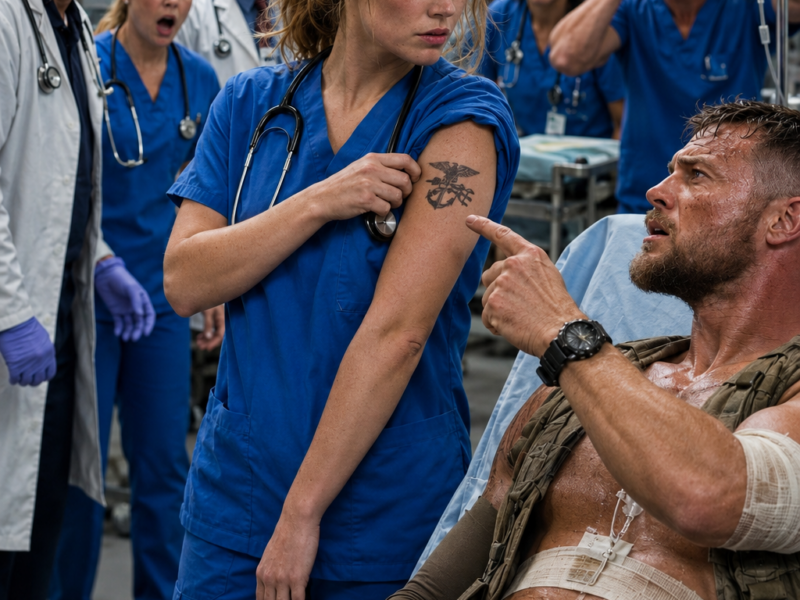
“I Only Accept Operator PHOENIX!” Shouted a Wounded SEAL Commander — The Doctors Froze
“I Only Accept Operator PHOENIX!” Shouted a Wounded SEAL Commander — The Doctors Froze
For two years, no one at Naval Medical Center Portsmouth had any reason to look twice at Nurse Grace Sorenson. She was quiet, reserved, and almost painfully ordinary. She arrived for her shifts on time, kept her uniform immaculate, followed instructions without argument, and rarely participated in the conversations that filled the nurses’ station during the long hours between emergencies. When someone spoke to her, she answered politely. When someone criticized her, she lowered her eyes. And when the surgeons raised their voices, as surgeons sometimes did when their patience ran thin, Grace simply stepped aside and allowed the storm to pass.
There was one thing about her that everyone seemed to notice, however. Her hands trembled.
It was never enough to prevent her from performing her duties, but the slight movement was visible whenever she handled delicate equipment or prepared an intravenous line. Some colleagues assumed she was naturally nervous. Others believed she lacked confidence. Dr. Nathan Holbrook, a senior physician whose arrogance had become nearly as familiar as his white coat, considered it evidence that she had no business working in a serious trauma department.
What none of them understood was that the trembling was largely deliberate.
There had been a time when Grace Sorenson’s hands remained perfectly steady while explosions tore apart buildings around her, when she could transmit targeting coordinates through a damaged radio while bullets struck concrete inches from her head. There had been a time when wounded soldiers stopped screaming simply because they heard her voice, trusting that if Phoenix was still speaking, they still had a chance to survive.
Phoenix.
That name belonged to someone Grace had spent three years trying to forget.
Before she became an inconspicuous nurse in a Virginia hospital, she had been Master Sergeant Grace Sorenson, a decorated Air Force combat controller whose eleven years of military service had placed her in some of the most dangerous environments on earth. She had coordinated air support, directed battlefield evacuations, and provided emergency medical care in places where hospitals were hundreds of miles away and help often arrived too late.
She had earned a Silver Star. She had earned a Purple Heart. And she had earned the respect of hardened combat veterans who had watched her do things they still struggled to describe.
But none of those accomplishments mattered to her anymore.
Not after Raqqa.
Not after the building.
Not after the voices that sometimes returned when she closed her eyes.
On a cold Tuesday night, Grace stood beside an examination table while Dr. Holbrook struggled to establish intravenous access in a young sailor’s arm. The patient had suffered a fractured wrist during a training accident, and although he was uncomfortable, his condition was far from critical.
Holbrook had already made two unsuccessful attempts.
Grace observed the sailor’s pale face, noticed the growing anxiety in his eyes, and quietly reached for a different catheter.
“Get out of my trauma bay, Sorenson.”
Holbrook did not even look up.
Grace stopped.
“Doctor, I thought—”
“I don’t need you thinking. I need you staying out of my way.”
The young sailor glanced between them, visibly embarrassed on her behalf.
Grace placed the equipment down and stepped backward.
“Yes, Doctor.”
“You’re blocking the crash cart.”
She moved it.
“Some of us actually went to medical school,” Holbrook muttered.
Grace offered no reply.
She had heard much worse things in her lifetime. She had heard desperate men begging for helicopters that could not land. She had listened to soldiers calling for mothers they would never see again. Once, inside a shattered building in Syria, she had listened to a radio operator repeat her call sign until the transmission dissolved into static.
Compared with those memories, Holbrook’s insults barely registered.
When the physician finally finished treating the sailor, Grace adjusted the patient’s sling, checked his circulation, and offered him a reassuring smile.
“You’re going to be all right,” she whispered.
The sailor looked at her with an expression of quiet gratitude.
“Thank you, ma’am.”
She nodded and moved away.
That small exchange was enough for her. It was one more person helped, one more injury treated, one more day completed without anyone asking questions about her past.
By three o’clock in the morning, the emergency department had settled into an uneasy calm. The fluorescent lights buzzed overhead. A monitor beeped somewhere down the corridor. Rain tapped against the windows, driven sideways by a cold Atlantic wind.
Grace was restocking medical supplies when the radio at the nurses’ station suddenly crackled.
“Incoming emergency convoy. Estimated arrival three minutes. High-value military casualty. Gunshot wound to the chest, significant blast exposure, unstable vital signs. Trauma team requested immediately.”
Holbrook looked up from his paperwork.
“Convoy? Why aren’t they bringing him by helicopter?”
The dispatcher answered through a burst of static.
“Weather restrictions. Ground extraction authorized. Armored escort.”
Grace’s fingers stopped moving.
Armored escort.
High-value casualty.
Emergency extraction.
Three phrases that belonged to a world she had abandoned.
She forced herself to breathe normally, pulled on a fresh pair of gloves, and secured her braid behind her head.
It was another patient.
Nothing more.
But when the emergency doors burst open, she immediately understood that this was no ordinary arrival.
Two Marines rushed through the entrance pushing a stretcher. A Navy corpsman leaned over the wounded man, pressing a blood-soaked dressing against his upper chest. Blood had seeped through his tactical clothing and stained the mattress beneath him.
“Multiple injuries!” the corpsman shouted. “Blast wave during extraction. Penetrating wound right upper chest. Possible cardiac involvement. Blood pressure falling!”
Holbrook approached the stretcher.
“Get him onto the table! I need oxygen, monitoring, and two large-bore lines!”
The wounded man twisted violently, his face pale beneath a layer of dust and dried blood.
Grace moved toward him.
And stopped breathing.
She recognized the scar above his left eyebrow.
It was a small, pale line, almost invisible unless someone knew where to look. She knew exactly where to look because she had stitched that wound herself inside a canvas medical tent during a miserable night overseas.
She recognized the strong jaw, the dark hair, and the stubborn expression that somehow survived even through unconsciousness.
Commander Marcus Reyes.
For a moment, the hospital disappeared.
She was back on a rooftop in Raqqa, with dust choking the air and distant explosions rolling through the streets. Marcus was lying beneath broken concrete, one leg trapped, his voice urging her to leave before another strike brought the building down.
She remembered refusing.
She remembered dragging him through the debris.
And she remembered the terrible silence afterward.
“Phoenix!”
The name ripped through the trauma bay.
Marcus struggled against the hands holding him down.
“Get Phoenix!”
Holbrook frowned.
“He’s delirious. Prepare sedation.”
“No, sir,” the corpsman said urgently. “He’s been repeating that name since we picked him up. His team said if he asked for Phoenix, we were supposed to listen.”
“He’s suffering from shock and blood loss.”
“Phoenix!” Marcus rasped again.
His voice cracked.
“She’ll know. She always knows.”
Grace felt something collapse inside her chest.
She had spent years teaching herself not to respond to that name. She had buried it beneath civilian paperwork, hospital schedules, and a carefully constructed identity that required nothing more from her than quiet obedience.
But Marcus was dying.
And somewhere beneath the fear, beneath the guilt, beneath three years of silence, the woman who had once answered to Phoenix was still alive.
Grace moved closer to the stretcher.
She examined the monitor, then the commander’s neck, then his chest.
His blood pressure was collapsing. His heart sounds were distant. His neck veins were distended.
The pattern was unmistakable.
Cardiac tamponade.
Blood was collecting in the sac surrounding his heart, compressing it and preventing it from filling properly.
Every second mattered.
Holbrook was still concentrating on controlling the patient’s movements.
“Give him the sedative.”
“Don’t.”
The word came from Grace.
It was not loud, but its sharpness silenced the nearest nurse.
Holbrook turned.
“What did you say?”
Grace raised her eyes.
For the first time in two years, there was nothing hesitant about her expression.
“Don’t sedate him until you address the obstruction. His pressure is sixty over forty. Neck veins distended. Heart sounds muffled. He’s showing classic signs of tamponade.”
Holbrook stared at her.
“I know how to diagnose cardiac tamponade, Sorenson.”
“Then you know he’s running out of time.”
A monitor alarm sounded.
Marcus’s blood pressure dropped further.
Grace continued, her voice calm.
“He needs immediate intervention and definitive surgical treatment.”
Holbrook’s jaw tightened.
“I don’t take orders from nurses.”
“I’m not giving you an order. I’m telling you what the numbers mean.”
The corpsman looked between them.
One of the Marines took a step closer.
Holbrook finally requested the necessary emergency equipment, but as the team prepared for the procedure, his hesitation became painfully obvious. His hands were unsteady, and the room seemed to contract around the increasingly urgent alarms.
Grace watched the monitor.
She could almost hear a different machine, one from years earlier, sounding inside a dusty medical shelter outside Bagram.
She remembered a wounded soldier, a desperate medical team, and a young combat controller forced to make a decision before anyone more experienced could arrive.
She remembered the terrible certainty that had guided her through that moment.
Now that certainty returned.
“Doctor,” she said, “we need someone who can do this immediately.”
Holbrook glared at her.
“Stay out of this.”
Marcus’s body jerked.
The monitor sounded again.
Grace looked at the commander, at the man who had once trusted her with his life, and felt her fear surrender to something stronger.
“Give me the equipment.”
“Absolutely not.”
“He is dying.”
“You’re not authorized to perform that procedure!”
“Then document everything afterward.”
The taller Marine stepped forward.
“Doctor, please. Let her help him.”
Holbrook looked around the room and realized that no one was looking to him for reassurance anymore.
They were looking at Grace.
Finally, with obvious reluctance, he stepped aside.
Grace took her position beside the patient.
Her hands stopped trembling.
Not gradually.
Not after several calming breaths.
They became perfectly still.
She worked with the focused precision of someone who had spent years making critical decisions under impossible conditions. The team assisted her, and the emergency intervention relieved enough pressure around Marcus’s heart to produce an immediate improvement.
“Pressure rising,” the corpsman announced.
The monitor changed.
“Seventy-eight over fifty.”
Another moment passed.
“Eighty-four over fifty-four.”
Marcus’s breathing became less desperate.
Grace continued watching him closely.
“This is temporary,” she said. “He needs surgery now. Alert the operating team and prepare for definitive repair.”
Holbrook stood motionless.
He had watched the quiet nurse he routinely dismissed become the most commanding presence in the room.
Then Marcus opened his eyes.
They moved across the faces surrounding him until they found hers.
His lips trembled.
“Phoenix.”
Grace froze.
A faint smile crossed his bloodless face.
“Knew you’d come.”
She leaned closer.
“Save your strength, Commander.”
His hand found her wrist.
“Grace?”
Her throat tightened.
“It’s me.”
He stared at her as if he were looking at someone who had returned from the dead.
“I looked for you.”
Grace swallowed.
“Later, Marcus. We can talk later.”
He managed a painful breath.
“You saved me again.”
Then the surgical team arrived, and the moment was gone.
Grace stepped aside as they rushed Marcus toward the operating room. The doors swung shut behind them, leaving her standing beneath the fluorescent lights with blood on her gloves and a past that could no longer remain hidden.
For several seconds, nobody spoke.
Then Holbrook asked the question everyone was thinking.
“Who the hell are you?”
Grace removed her gloves.
She looked down at her hands.
They were still steady.
“I’m his nurse,” she said.
And she walked away.
By sunrise, the story had spread through the hospital.
A quiet nurse had taken charge during a critical emergency. A wounded SEAL commander had called her by a mysterious name. A physician who regularly humiliated her had watched her perform under pressure with a confidence that seemed almost impossible to explain.
At six fifteen, Grace stood alone in the staff locker room, resting her forehead against the cold metal door of her locker.
Her breathing was uneven.
The adrenaline had faded, leaving behind exhaustion and a familiar sense of dread.
She had known this moment might come someday.
She had simply hoped it never would.
“Phoenix.”
The whispered word escaped her lips.
For three years, she had avoided speaking it aloud.
Now it seemed to echo through every corner of her mind.
She closed her eyes and saw the rooftop again.
The shattered windows.
The damaged radio.
The grid coordinates.
A building collapsing in a cloud of dust.
And then the report that came afterward.
Civilians.
A family.
People who had been inside a structure military intelligence identified as hostile.
Grace had transmitted the coordinates. She had confirmed the target. The authorization had passed through the appropriate chain of command.
The airstrike had gone ahead.
And afterward, when the smoke cleared, innocent people were dead.
The official investigation had concluded that the intelligence was faulty. Grace had been cleared of wrongdoing, but no document could erase the sound of her own voice confirming the strike.
She had been able to explain what happened to everyone except herself.
The locker-room door opened.
Holbrook stood in the entrance.
For once, he was not shouting.
“Who are you, Sorenson?”
Grace remained facing her locker.
“I’m the nurse who helped save your patient.”
“That procedure required skills you never disclosed.”
“I didn’t think my past was relevant to my duties here.”
“Your past?” Holbrook repeated. “I looked into that name. Phoenix. It’s a military call sign.”
Grace said nothing.
“I also know Commander Reyes specifically requested you after surgery.”
She turned sharply.
“He’s out of surgery?”
“Yes. He’s stable. Recovering.”
Relief nearly took her knees out from under her.
Holbrook studied her face.
“Command is sending someone. A colonel. Apparently, there are questions about what happened.”
Grace looked past him toward the corridor.
“I need to see Marcus.”
Holbrook moved aside.
For the first time since they had worked together, he did not argue.
The recovery room was quiet and dim. Pale morning sunlight filtered through narrow blinds, falling across the white sheets surrounding Marcus Reyes. A chest tube and several monitoring lines reminded Grace just how close he had come to dying.
He was awake.
When she entered, he turned his head.
For several seconds, he simply stared.
Then he smiled.
“You changed your hair.”
Grace almost laughed.
“It’s the same hair.”
“Different braid.”
“You’re supposed to be resting.”
“Hard to rest when a ghost walks into your hospital room.”
She pulled a chair beside his bed.
Marcus watched her sit.
“You disappeared.”
Grace looked down.
“I know.”
“I asked about you. After Raqqa. After the debriefing.”
“I know.”
“Nobody would tell me where you’d gone.”
“I requested separation.”
“They told me that. Nothing else.”
She folded her hands together.
Marcus had changed in the years since they last saw each other. There were deeper lines around his eyes, and a few strands of gray in his dark hair. But the steady gaze was the same.
He had always been able to recognize the things she tried to conceal.
“Grace,” he said quietly, “what happened to you?”
The question hurt more than she expected.
She looked toward the window.
“I couldn’t do it anymore.”
“Because of Raqqa?”
She nodded.
“I hear that radio transmission every night, Marcus. Sometimes when I’m awake. Sometimes when I’m trying to sleep. I hear my own voice confirming the coordinates, and I know what’s going to happen afterward, but I can’t stop myself from saying them.”
Marcus was silent.
Grace continued.
“I remember the intelligence briefing. I remember the target confirmation. I remember knowing there were enemy fighters in that building. And then I remember finding out about the family.”
Her voice trembled.
“I keep wondering what I missed.”
“You didn’t miss anything that was available to you.”
“That doesn’t change what happened.”
“No,” Marcus said gently. “It doesn’t.”
She looked at him.
He continued.
“But you didn’t choose to kill those people. You acted on information we all believed was accurate. Every person in that chain made the same assessment.”
“I was the one on the radio.”
“And I was one of the men you saved that night.”
Grace looked away.
“Don’t.”
“Eleven of us made it out because of you.”
“That doesn’t bring them back.”
“I know.”
His voice softened.
“Nothing I say is going to change what happened. But disappearing doesn’t change it either.”
Grace sat in silence.
For two years, she had believed that humility meant making herself invisible. She had accepted insults she did not deserve, concealed skills that might have helped others, and avoided every opportunity that could reveal who she had once been.
She had convinced herself that living a smaller life was a form of accountability.
But sitting beside Marcus, she began to wonder whether she had simply been punishing herself without helping anyone.
“I didn’t know how to be Phoenix anymore,” she whispered.
Marcus reached for her hand.
“Maybe you don’t have to be the same Phoenix.”
Before she could answer, footsteps approached the doorway.
A woman in a sharply pressed uniform entered, accompanied by an aide carrying a folder.
Colonel Diane Whitfield had the composed bearing of someone accustomed to difficult conversations and immediate decisions. Her eyes moved from Marcus to Grace, studying the scene before her.
“Master Sergeant Sorenson.”
Grace rose instinctively.
“Ma’am.”
Whitfield’s expression barely changed.
“So it is you.”
“Yes, ma’am.”
“I’ve read your service record.”
Grace remained silent.
“Eleven years of distinguished service. Combat controller. Multiple deployments. Silver Star. Purple Heart. Highly advanced battlefield trauma training. And then a voluntary separation with almost no explanation beyond a personal request.”
“I wanted to leave, Colonel.”
“Apparently.”
Whitfield looked toward Marcus.
“Commander Reyes tells me you saved his life twice.”
Marcus nodded.
“At least twice, ma’am. I may have lost count.”
The colonel turned back to Grace.
“I reviewed the emergency report. You recognized a life-threatening condition and participated in a procedure outside your current privileges. That raises serious questions.”
Grace stood straighter.
“I understand.”
“It also raises another question. Why was someone with your experience working in that department for two years without anyone understanding what she was capable of?”
Before Grace could answer, Holbrook appeared at the doorway.
“Colonel, with respect, Nurse Sorenson acted outside established protocol.”
Whitfield faced him.
“Doctor, I am aware of that.”
“Regardless of her military experience, there are regulations governing—”
“And those regulations must be reviewed appropriately,” Whitfield interrupted. “But I would also like to understand why a critical diagnosis wasn’t acted upon sooner, and why concerns from a member of your clinical team were repeatedly dismissed.”
Holbrook’s expression hardened.
“She never told me about her background.”
“Did you ask?”
He said nothing.
Whitfield continued.
“Competence doesn’t always announce itself, Doctor. Sometimes it stands quietly in the same room for years while everyone else is too occupied with their own authority to notice.”
Grace felt uncomfortable hearing someone defend her so directly.
She was accustomed to criticism, not praise.
Holbrook lowered his eyes.
Whitfield looked at Grace again.
“Your record indicates that the Raqqa incident was investigated thoroughly.”
Grace’s chest tightened.
“Yes, ma’am.”
“Three separate reviews found no misconduct on your part. The targeting intelligence was inaccurate.”
“I know what the reports say.”
“Do you believe them?”
Grace hesitated.
“I believe the investigators did their jobs.”
“That wasn’t my question.”
Grace glanced at Marcus.
He watched her without speaking.
Finally, she answered.
“I don’t know how to forgive myself for something I couldn’t have known.”
The colonel’s stern expression softened.
“Forgiveness and responsibility aren’t always the same thing, Sergeant. You can remember what happened without spending the rest of your life pretending your abilities no longer exist.”
Grace looked down at her hands.
Whitfield stepped closer.
“There’s a joint-service combat medicine training program with an instructor vacancy. It involves classroom instruction, simulated battlefield emergencies, and clinical rotations. We need people who understand both medicine and the realities of operating under fire.”
Grace looked up.
“Why are you telling me this?”
“Because I’ve spent months reviewing candidates, and I haven’t found anyone with your combination of experience.”
“I separated from active duty.”
“I know. This would require a formal appointment and whatever credentialing and administrative approvals are appropriate. I’m not offering to erase your separation with a handshake.”
Grace almost smiled at the bluntness.
“But I am offering you an opportunity to teach people who may one day face the same impossible decisions you faced.”
Marcus shifted in bed.
“Colonel, if I may.”
“Go ahead.”
“She’s the best person I’ve ever seen when everything starts falling apart. I’ve served beside extraordinary people, but Grace has something most of them don’t. She makes everyone around her believe survival is still possible.”
Grace lowered her gaze.
Whitfield studied her.
“Think about it, Sergeant. You don’t need to decide now.”
She turned toward the door, paused, and added, “And whatever you decide, don’t make it because you believe you deserve to be forgotten.”
When the colonel left, the room fell silent.
Marcus looked at Grace.
“Well?”
“I haven’t decided.”
“That’s not what I asked.”
She shook her head.
“You nearly die, and you’re still impossible.”
He smiled faintly.
“Good to know some things haven’t changed.”
Neither of them knew that while they were talking, three men were preparing to enter the hospital with forged credentials and instructions that had nothing to do with saving Commander Reyes.
The first sign of trouble came shortly after noon.
Grace was reviewing medication records at the nurses’ station when the main corridor doors opened.
Three men entered wearing civilian clothing.
Their appearance was ordinary enough. Dark jackets. Practical shoes. Short haircuts. The man in front carried a black leather folder and moved with the confident irritation of someone expecting unquestioned cooperation.
But Grace noticed details that most people would have overlooked.
Their eyes moved constantly.
Not with the uncertainty of visitors searching for a room, but with deliberate attention to exits, cameras, and the positions of hospital staff.
The second man kept his right arm unusually close to his side.
The third walked several steps behind the others, maintaining a clear view of the corridor.
Grace felt an old instinct awaken.
The lead man approached the charge nurse.
“We’re here for Commander Marcus Reyes. Federal transfer.”
The nurse glanced at her computer.
“I don’t see any scheduled transfer.”
He opened his folder and flashed an identification card.
“Classified authorization. We need access immediately.”
“Sir, I’ll have to contact the officer in charge.”
“There’s no time.”
The man started walking toward the recovery rooms.
Grace stepped into his path.
“Stop.”
He barely looked at her.
“Move aside.”
“Commander Reyes is recovering from major surgery. He cannot be moved without medical clearance.”
“We have federal authority.”
“Then you’ll have no problem waiting while we verify it.”
The man’s expression changed.
Only slightly.
But Grace saw it.
An impatient flicker. A subtle shift of weight. The brief movement of his companion’s hand toward his jacket.
She recognized the behavior.
These men were not behaving like officials carrying out a legitimate medical transfer.
“Show me the order,” she said.
“You are not authorized to review it.”
“Then you’re not authorized to take my patient.”
The charge nurse looked up nervously.
“Grace?”
“Call security,” Grace said.
The lead man’s voice dropped.
“You’re making a serious mistake.”
Grace held his gaze.
“Then explain why your identification number doesn’t match the issuing format, why your supposed transfer isn’t in our system, and why your friend keeps reaching toward his concealed weapon.”
The hallway became very quiet.
The second man’s eyes widened.
The lead man reached inside his jacket.
Grace moved before he could complete the motion.
She shoved a nearby crash cart between them, sending equipment rattling across the corridor. The sudden obstacle disrupted the man’s movement just long enough for Grace to redirect his weapon-bearing arm away from the nurses’ station.
The handgun struck the floor.
Someone screamed.
The second man charged forward.
Grace turned, using the confined space and his own momentum to force him into the wall. He stumbled backward, disoriented, while the first man struggled to regain his balance.
The third man stopped.
For a fraction of a second, he stared at the nurse in cobalt-blue scrubs.
He had expected frightened hospital employees.
He had not expected someone who moved like a veteran operator.
“Back away,” Grace ordered.
Her voice carried through the corridor with frightening authority.
“Everyone stay clear!”
The third man glanced toward the exit.
Then the hospital alarm sounded.
Security personnel rushed into the hallway, shouting instructions. The third man fled through the far doors, while the other two were restrained and their weapons secured.
Within moments, the corridor was filled with armed security, frightened staff, and the harsh crackle of radios.
Grace stood beside the overturned crash cart, breathing slowly.
Her braid had come loose.
A thin scratch marked the back of her hand.
Otherwise, she looked almost untouched.
Holbrook appeared at the end of the corridor.
He surveyed the scene in disbelief.
“What happened?”
Grace looked at him.
“Someone tried to remove Commander Reyes without authorization.”
Holbrook stared at the restrained men.
“Those are federal agents?”
“No,” Grace said. “I don’t think they are.”
Twenty minutes later, Colonel Whitfield returned.
This time, her expression was colder than before.
Investigators were already questioning the detained men. Hospital security footage was being secured, and Marcus’s recovery room had been placed under armed protection.
Whitfield found Grace standing outside the nurses’ station, calmly retightening her braid.
“Sergeant Sorenson.”
“Ma’am.”
“Are you injured?”
“No, ma’am.”
“I understand you confronted three armed men.”
“They were attempting to access a vulnerable patient with false credentials.”
“And you stopped them.”
“Security completed the response.”
Whitfield studied the damaged crash cart.
“With a little assistance from hospital furniture, apparently.”
Grace said nothing.
The colonel’s expression darkened.
“Commander Reyes’s extraction operation was compromised. We have reason to believe someone with access to operational information leaked the route.”
Grace looked toward Marcus’s room.
“Whoever knew that route knew he might survive the initial attack.”
“That’s our concern.”
“And whoever sent these men knew exactly where he was recovering.”
Whitfield nodded.
“Which means we may have a broader security breach.”
Grace’s jaw tightened.
“Then he isn’t safe yet.”
“No,” Whitfield admitted. “He isn’t.”
For the first time that day, the colonel seemed to see Grace not as a former service member who might return to useful work, but as someone whose instincts remained fully alive.
“You recognized the threat before anyone else.”
“I recognized that something was wrong.”
“Most people wouldn’t have.”
Grace looked away.
“Most people shouldn’t have to.”
By evening, NCIS investigators had established that the identification cards were forged and connected to individuals associated with a private security contracting network. The organization had a history of undertaking questionable assignments through layers of intermediaries.
The two men in custody initially refused to cooperate.
But the evidence suggested that the attempted transfer was not an administrative misunderstanding.
Someone wanted Marcus removed before he could provide a full account of the compromised extraction.
And someone had severely underestimated the woman guarding the corridor.
That night, the hospital felt different.
Armed sailors stood outside Marcus’s room. Security officers patrolled the wing. Every unfamiliar visitor was questioned.
Grace sat beside his bed, watching the steady rise and fall of his chest.
He looked at her for a long time before speaking.
“You know, when I told my team to find Phoenix, I didn’t actually know where you were.”
Grace glanced at him.
“Then why did you say it?”
Marcus smiled weakly.
“Because whenever things went completely wrong, some part of me still expected you to show up.”
She shook her head.
“That’s an unreasonable amount of faith to put in one person.”
“Maybe.”
He paused.
“But you showed up.”
Grace looked toward the door.
“I happened to be working.”
“Grace.”
She met his eyes.
“You saved me this morning. Then you stopped three armed men from taking me away this afternoon. You can’t keep pretending that you’re just some random person who got lucky.”
“I never said I was lucky.”
“No. You just refuse to admit who you are.”
She leaned back in the chair.
For a while, neither spoke.
Then Grace said something she had not admitted to anyone.
“I was afraid that if I let myself become Phoenix again, I’d become the person who made that call in Raqqa.”
Marcus watched her carefully.
“And who is that person?”
“The woman who confirmed the wrong building.”
“She’s also the woman who pulled eleven men out of a disaster.”
“You’re making it sound simple.”
“It isn’t simple.”
Marcus shifted slightly, wincing.
“People are complicated, Grace. Sometimes we save lives. Sometimes we’re part of events that destroy them. Sometimes we do everything we can and still carry the consequences.”
She looked at him.
“You think I can just go back?”
“No. I don’t think you should go back.”
He took a slow breath.
“I think you should move forward.”
Grace stared at the monitor.
It was strange how the truth could be so difficult to accept even when it was spoken plainly.
She had thought the only alternatives were to remain Phoenix forever or bury Phoenix completely.
Now she began to see a third possibility.
She could acknowledge both the courage and the pain.
She could teach what she knew without pretending she had never made difficult decisions.
She could remember Raqqa without allowing Raqqa to become the only thing she remembered about herself.
A knock sounded at the door.
Dr. Holbrook stood outside.
He looked exhausted.
The confident expression Grace had grown accustomed to seeing was gone, replaced by something uncertain and almost vulnerable.
“May I come in?”
Marcus glanced at Grace.
She nodded.
Holbrook entered carrying a folder.
“I completed my incident report.”
Grace waited.
“I wanted you to know what I wrote.”
She folded her hands in her lap.
“I’m listening.”
Holbrook looked down at the folder.
“I documented that you recognized an immediately life-threatening condition, intervened during a rapidly deteriorating emergency, and helped stabilize Commander Reyes before definitive surgical treatment.”
He paused.
“I also documented the concerns about the procedure and the need for an appropriate review.”
“That’s fair,” Grace said.
Holbrook looked surprised.
She continued.
“Saving a patient doesn’t mean we stop examining what happened. There are rules for reasons.”
He nodded slowly.
“There’s something else.”
Grace waited.
“I reviewed your military background.”
Her expression tightened.
“I figured you would.”
“I saw the awards. The deployments. The training. The commendations.”
His voice became quieter.
“And I realized that for two years, I’ve been treating someone with more experience under pressure than I may ever have.”
Grace said nothing.
Holbrook took a slow breath.
“I was wrong about you.”
The words seemed physically difficult for him to say.
“I assumed your silence meant you lacked confidence. I saw your hands shaking and decided you were incompetent. I never asked why. I never tried to understand.”
Grace watched him carefully.
“I wasn’t interested in explaining.”
“That doesn’t excuse my behavior.”
He looked down.
“I’ve spent much of my career afraid of being exposed as inadequate. I thought if I acted certain enough, nobody would notice when I wasn’t. And when you didn’t defend yourself, I made you an easy target.”
The room remained silent.
Finally, he looked directly at her.
“I’m sorry, Grace.”
For the first time, he used her first name without contempt.
She considered him for several seconds.
Then she nodded.
“Apology accepted.”
Holbrook exhaled.
“But there’s something you should remember,” she added.
“What’s that?”
“Being in charge doesn’t mean you have to know everything. It means you have to recognize when someone else knows something you don’t.”
Holbrook lowered his eyes.
“I understand.”
“I hope so. Because next time, the person you ignore might not get a second chance to speak.”
He nodded again.
Then he left.
Marcus watched the doorway close.
“That was remarkably polite.”
Grace smiled faintly.
“I’m trying something new.”
“What’s that?”
“Not making myself disappear every time someone looks at me.”
Marcus smiled.
“Seems to suit you.”
Three days later, Grace stood outside Colonel Whitfield’s office.
She had spent the previous evening in her apartment, sitting on the floor beside a small locked box she had not opened in nearly three years.
Inside was a neatly folded American flag, an old military photograph, several service documents, and a coin bearing the insignia of her former unit.
She had avoided that box because it represented everything she believed she could no longer be.
But that night, she opened it.
The photograph showed a group of exhausted service members standing outside a damaged building. Marcus was near the center, grinning despite a bandage over his forehead. Grace stood beside him, wearing tactical equipment and an expression that looked almost defiantly hopeful.
She barely recognized that version of herself.
Not because she looked younger.
Because she looked unafraid to be seen.
Grace held the photograph for a long time.
She remembered the men. Their voices. Their ridiculous jokes. The way they had shared bad coffee and worse rations while waiting for missions none of them wanted to discuss.
She remembered lives saved.
She remembered mistakes.
She remembered friends who had never come home.
And for the first time, she allowed herself to remember those things together.
Not as evidence that she was a hero.
Not as proof that she was a failure.
Simply as the truth.
The next morning, she arrived at Whitfield’s office carrying a folder of her own.
The colonel looked up.
“Sergeant Sorenson.”
“Ma’am.”
“Have a seat.”
Grace sat.
Whitfield slid a document across the desk.
“Joint Service Combat Medicine Instructor Training Program. The position would be based here, with appropriate clinical rotations and periodic field training assignments. Your appointment and privileges would be subject to the necessary reviews and approvals.”
Grace studied the document.
She had imagined returning to a military environment would feel like walking back into the place where everything had gone wrong.
Instead, she felt something unfamiliar.
Possibility.
“You’d be working with younger medics,” Whitfield continued. “Teaching battlefield assessment, casualty evacuation coordination, emergency response, and decision-making under pressure. Your operational experience would be invaluable.”
Grace looked up.
“I want the position.”
Whitfield nodded.
“Good.”
“But I have a condition.”
The colonel leaned back.
“I’m listening.”
Grace placed her hands flat on the desk.
“No more pretending.”
Whitfield raised an eyebrow.
“Explain.”
“If I’m going to teach, I want to teach the truth. Not just the successful missions or the stories people like hearing. I want to talk about Raqqa. About bad intelligence. About uncertainty. About what happens when you make the best decision you can with information that turns out to be wrong.”
The colonel said nothing.
Grace continued.
“I don’t want students to think that experience makes them infallible. I want them to understand that confidence is important, but questioning assumptions can save lives.”
Whitfield studied her for a long moment.
Then she nodded.
“That’s exactly the kind of instructor we need.”
Grace looked down at the papers.
There was one more thing she wanted to say.
“I also want to keep working with patients. I don’t want this to turn into a position where I only tell stories about what I used to do.”
Whitfield smiled.
“That can be part of the arrangement, subject to your clinical role and privileges.”
Grace picked up the pen.
For a moment, she hesitated.
Not because she was uncertain about the choice.
Because she understood what it meant.
Signing would not erase Raqqa.
It would not bring back the people who had died.
It would not guarantee that she would never be afraid again.
But it would mean that she was no longer willing to waste the rest of her life hiding from something she could not change.
She signed.
Colonel Whitfield extended her hand.
“Welcome back, Sergeant.”
Grace shook it.
“Thank you, ma’am.”
Whitfield held her gaze.
“And Grace?”
“Yes?”
“You don’t have to prove anything to me. Your record already speaks for itself.”
Grace shook her head gently.
“I’m not doing this to prove anything.”
“Then why?”
Grace thought about Marcus.
About the frightened sailor with the broken wrist.
About the young corpsman who had looked at her with desperate hope.
About the family in Raqqa.
And about every medical student who might one day face a decision that seemed impossible.
“Because I still have something useful to give.”
Whitfield smiled.
“Then make it count.”
The following weeks brought changes Grace had never expected.
The hospital conducted its formal reviews, addressed the security breach, and worked through the administrative requirements surrounding her new role.
Investigators continued examining the attack on Marcus’s convoy and the attempted abduction. The two captured men eventually provided information that helped authorities trace the operation through intermediaries, revealing a network of compromised contacts and private contractors. Although the full investigation remained classified, the immediate threat to Marcus was contained.
Grace’s actions became a subject of considerable attention.
Some colleagues approached her with admiration. Others seemed embarrassed by the way they had treated her. A few continued to regard her with suspicion, uncomfortable with how completely their assumptions had been overturned.
Grace did not try to win everyone over.
She simply stopped hiding.
When a younger nurse asked about her military service, she answered honestly.
When a physician requested her opinion, she gave it without apologizing for knowing something.
And when her hands trembled during a difficult conversation about Raqqa, she did not conceal them.
There were moments when the memories still returned.
Some nights, she woke hearing radio static.
Sometimes a particular sound in the emergency department reminded her of a distant explosion.
On difficult mornings, she still looked toward the floor when someone spoke too sharply.
Recovery did not arrive all at once.
It came in small decisions.
One conversation.
One remembered name.
One day in which she chose not to punish herself for surviving.
Eventually, Marcus was cleared to leave the hospital.
He insisted on walking out under his own power, although Grace made him accept help when the effort left him breathless.
The afternoon sunlight was warm when she found him standing beside his truck in the parking lot.
He was wearing jeans and a dark jacket, his movements slower than usual but his expression unmistakably familiar.
“You’re supposed to be resting,” she said.
Marcus looked at her.
“And you’re supposed to be inside doing whatever important thing newly appointed instructors do.”
“My appointment hasn’t officially started yet.”
“Then you’re unemployed for the next five minutes.”
She laughed.
It was a genuine laugh, spontaneous enough to surprise them both.
Marcus smiled.
“There it is.”
“What?”
“That sound.”
Grace shook her head.
“Don’t make it sentimental.”
“Wouldn’t dream of it.”
They stood together for a moment, watching hospital staff move through the parking lot.
Then Marcus nodded toward the building.
“I heard you accepted Whitfield’s offer.”
“I did.”
“Any regrets?”
Grace looked up at the windows.
Somewhere inside, nurses were preparing medication, surgeons were reviewing cases, and patients were waiting for people whose names they might never remember.
For two years, she had walked through those corridors believing that remaining unnoticed was the safest way to live.
Now she understood that safety and peace were not always the same thing.
“Not one,” she said.
Marcus studied her.
“Do you think you’ll ever be comfortable being Phoenix again?”
Grace considered the question.
She thought about the call sign, the missions, the wounded men, and the lives that could not be restored.
Then she thought about the woman who had stood in a trauma bay and refused to let someone die simply because she was afraid of being recognized.
“I don’t know if I’ll ever be completely comfortable with it,” she admitted.
Marcus nodded.
“Fair enough.”
“But I don’t think I need to be.”
He looked at her.
Grace continued.
“For a long time, I thought courage meant being fearless. Then I thought courage meant surviving whatever happened and never talking about it again.”
She smiled faintly.
“Turns out, sometimes courage is just letting people see you as you really are.”
Marcus looked toward the hospital.
“You know what I remember most about that night in Raqqa?”
Grace’s smile faded.
“What?”
“Not the airstrike.”
She looked at him.
“I remember being trapped under concrete. I remember thinking I wasn’t getting out. And then I heard your voice telling me to keep breathing.”
Grace swallowed.
“You told me to leave you.”
“I know.”
“You told me three times.”
“And you ignored me three times.”
She shook her head.
Marcus’s expression softened.
“You kept saying we were going home.”
Grace remembered.
She had repeated those words while pulling broken concrete away from his legs, while trying to keep him conscious, while wondering whether another explosion would kill them both.
We’re going home, Marcus.
Just keep breathing.
We’re going home.
Her eyes filled.
“I wasn’t sure we would.”
“I know.”
He paused.
“But you made me believe it.”
Grace looked toward the horizon.
For years, she had allowed the worst moment of that mission to eclipse everything else that happened.
She had forgotten what it felt like to be trusted.
She had forgotten that the same voice that confirmed a tragic strike had also guided frightened men toward safety.
Neither truth erased the other.
Both belonged to her.
Marcus stepped closer.
“Welcome home, Phoenix.”
Grace closed her eyes.
The name no longer felt like an accusation.
It still carried weight. It always would.
But somewhere beneath that weight was something she had not felt in years.
Pride.
Not pride in being decorated or admired.
Pride in the simple fact that she had not stopped caring, even when caring hurt.
She opened her eyes and smiled.
“Just Grace,” she said.
Marcus raised an eyebrow.
“Just Grace?”
She glanced once more toward the hospital, where her new life was waiting.
Then she shook her head, her smile widening.
“Actually, I’ll answer to both now.”
And for the first time in three years, Grace Sorenson walked forward without feeling the need to leave any part of herself behind.
Months later, during her first major training course, she stood before a room filled with young military medics, nurses, and combat support personnel.
Some knew her service history. Others had heard the story of the wounded SEAL commander who demanded someone called Phoenix. A few had come expecting dramatic stories of battlefield heroism from a decorated veteran.
Grace gave them something different.
She began with a photograph of an ordinary street in Raqqa.
There were damaged buildings, tangled electrical wires, and a gray sky hanging over a neighborhood that looked much like countless others affected by war.
She allowed the image to remain on the screen for several seconds.
Then she turned toward the class.
“Every one of you is going to face a moment when you don’t have enough information,” she said. “You’re going to have to make decisions while people are frightened, injured, or depending on you to know what comes next.”
The room was silent.
“Some of those decisions will go well. Some won’t. And sometimes you’ll do everything according to your training and still end up with an outcome you wish you could change.”
A young medic near the front raised his hand.
“Ma’am, how do you live with that?”
Grace looked at him.
It was a question she had asked herself thousands of times.
She could have offered a polished answer about duty, resilience, or the nature of military service.
Instead, she told him the truth.
“I’m still learning.”
The young man lowered his hand.
Grace continued.
“But I can tell you something. Hiding from what happened doesn’t make you wiser. It doesn’t honor the people who were lost. And it doesn’t help the next person who needs you.”
She looked across the room.
“The point of training isn’t to create people who never feel fear. It’s to prepare people who can think clearly when fear arrives. The point of experience isn’t to make you believe you’re always right. It’s to help you recognize when you might be wrong.”
Several students began taking notes.
Grace looked down at her hands.
They were steady.
“And if you remember only one thing from this course, remember this: never confuse silence with weakness, rank with wisdom, or confidence with competence. The person standing quietly beside you may know something that saves a life. Make sure you’re willing to listen.”
At the back of the classroom, Colonel Whitfield stood with her arms folded.
Beside her, Marcus Reyes watched with a small smile.
Neither interrupted.
Grace turned back toward the photograph.
She told the class what had happened in Raqqa.
Not every classified detail, not every name, but the essential truth about uncertainty, flawed intelligence, responsibility, and the human cost of decisions made under pressure.
Her voice trembled once.
She stopped, took a breath, and continued.
Nobody laughed.
Nobody judged.
Nobody looked away.
When she finished, the classroom remained silent for several long seconds.
Then the young medic who had asked the question raised his hand again.
“Ma’am?”
“Yes?”
“Thank you for telling us.”
Grace felt her throat tighten.
She nodded.
“You’re welcome.”
Outside, the afternoon sun washed the hospital grounds in warm light. Somewhere down the corridor, an emergency announcement sounded, followed by the hurried footsteps of medical personnel responding to another call.
Grace listened to those sounds with a familiar awareness.
There would always be another patient.
Another difficult decision.
Another moment when someone needed help and the outcome was uncertain.
But she no longer saw those moments as punishment.
They were opportunities to use what she had learned, to pass on what experience had taught her, and to honor both the people she had saved and the people she could not.
For two years, Grace Sorenson had believed that becoming invisible was the only way to escape the shadow of her past.
Then a wounded commander had arrived in the middle of the night, calling a name no one recognized.
And the quiet nurse everyone underestimated had remembered who she was.
Not because she had stopped being afraid.
Not because the past had been forgiven or forgotten.
But because someone needed her, and she had finally understood that the ability to help others was not something she had to surrender in order to acknowledge the pain she carried.
Phoenix had never truly disappeared.
She had only been waiting for Grace to discover that surviving the fire did not mean she had to spend the rest of her life hiding from the light.
THE END