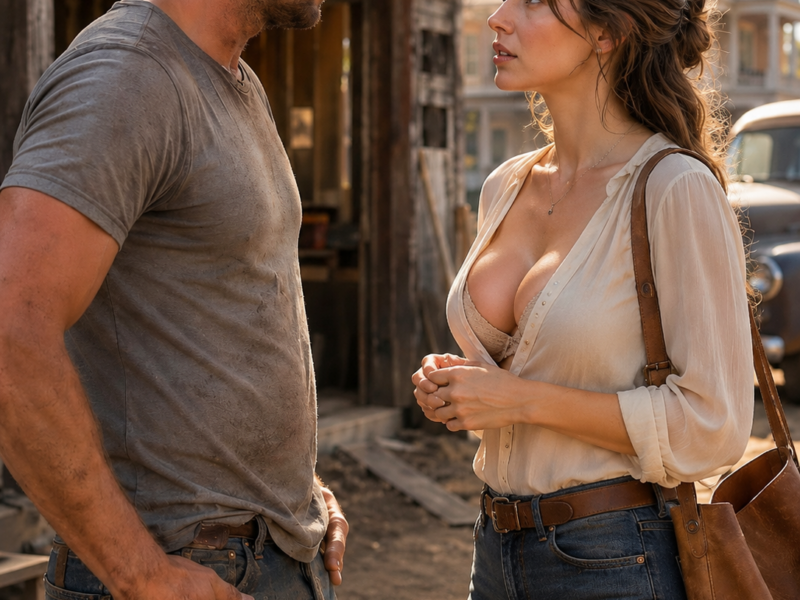
“I Need A Husband By Tomorrow” She Said — I Replied, “Then Pack Your Bags For My Place.”
I Was 32, Running My Small Restoration Business in Charleston, When a Wealthy Heiress Stepped Out of a Black Town Car and Told Me, “I Need a Husband by Tomorrow.” Her Cousin Was About to Seize Her Family’s Historic Hotels and Destroy Everything Her Grandfather Had Built, So I Agreed to Marry a Complete Stranger. But When We Walked Into the Boardroom, Her Cousin Recognized Me—and the Look on His Face Told Me This Was Far Bigger Than I Had Imagined.
PART 1
The day Caroline Langford stepped out of a black town car and walked onto my construction site, I was covered in dust, paint was smeared across both hands, and I was trying to replace a warped window frame before the afternoon rain arrived.
I had no idea that within the next twenty-four hours, I would be legally married to a woman I had never met.
My name is Jack Dalton. I’m thirty-two years old, and I’ve spent the last five years building a small restoration company in Charleston, South Carolina. It wasn’t the kind of business that made headlines or attracted wealthy investors. We repaired old houses, restored historic storefronts, replaced rotting porches, and brought forgotten buildings back to life.
I liked honest work. A damaged window was either fixed or it wasn’t. A leaking roof didn’t care how much money someone had in their bank account. And old wood had a way of reminding people that quality couldn’t always be purchased quickly.
My father had taught me that.
He was a carpenter who believed that restoring something was often more meaningful than replacing it. He used to say that anyone could tear down a house, but it took patience, skill, and respect to preserve what time had nearly destroyed.
He died when I was twenty-four, but I had carried those words into every job since.
My business was doing well. I owned the workshop, had a reliable crew of six employees, and refused to take on projects that required compromising our standards. I wasn’t wealthy, but I had no debts, no investors, and nobody telling me how to run my life.
It was a simple existence.
Until that morning.
I was halfway down a ladder when a black town car pulled up outside the old Harbor House Annex. I barely noticed it. Charleston had plenty of wealthy people, especially around the historic district.
Then the rear door opened.
A tall woman stepped out wearing a cream-colored coat, dark sunglasses, and heels that looked completely unsuitable for a construction site.
Her dark hair was pulled neatly behind her head. Everything about her appearance was precise, from the way she walked to the way she carried her handbag.
She looked like someone who had never needed to raise her voice to get what she wanted.
She walked directly toward me.
I climbed down the ladder, wiping my hands against my work trousers.
“Can I help you?”
She looked at my gloves, my dusty shirt, and the paint on my arms.
“Are you Jack Dalton?”
“Depends who’s asking.”
“My name is Caroline Langford.”
I recognized the surname immediately.
The Langfords were one of Charleston’s oldest and wealthiest families. They owned boutique hotels, historic inns, private event spaces, and several properties that had become landmarks in their own right.
Their flagship property was the Blackwell Hotel, a magnificent building overlooking the harbor that had been standing for more than a century.
I had worked on several restoration projects connected to the Langford properties.
Caroline extended her hand.
I shook it.
Then she said something that made me wonder whether I had misunderstood her.
“I need a husband by tomorrow.”
I stared at her.
For several seconds, I couldn’t think of anything remotely intelligent to say.
“I’m sorry?”
“I need to be legally married by five o’clock tomorrow afternoon.”
I looked behind her, half expecting someone to emerge with a camera and announce that I had become the latest victim of an elaborate prank.
Nobody appeared.
The driver remained beside the car, pretending he couldn’t hear us.
I folded my arms.
“You’ve come to the wrong construction site.”
“I don’t think I have.”
“Ma’am, I restore buildings. I don’t arrange marriages.”
“I know exactly what you do, Mr. Dalton.”
She reached into her handbag and removed a thin leather folder.
Inside were documents containing information about my company, financial records, property ownership details, and even a list of the major contracts I had completed over the previous few years.
I frowned.
“How long have you been researching me?”
“Long enough to know you’re independent.”
“That’s one word for it.”
“Your company is debt-free. You own your workshop outright. You’ve rejected three acquisition offers in the last two years, including one from my cousin. You’ve never accepted outside investors, and your business has an excellent reputation.”
She paused.
“You’re also known for refusing contracts when the conditions aren’t right.”
I looked at her more carefully.
“What does any of that have to do with marriage?”
Caroline took a breath.
“My grandfather’s will contains a control clause tied to my marital status. If I’m unmarried when the board meets tomorrow afternoon, temporary voting control of Langford Heritage will pass to my cousin, Daniel.”
I remembered the name.
Daniel Langford was the man in the navy suit who had approached me three months earlier with an acquisition offer.
He had wanted to purchase my workshop property and bring my company into a major Langford expansion project.
The offer was generous.
Too generous.
Something about his proposal had bothered me. He spoke about historic buildings as though they were empty pieces of land waiting to become profitable investments.
When I refused, he smiled and told me I would eventually regret turning down an opportunity like that.
I hadn’t thought about him since.
Until Caroline mentioned his name.
“What’s wrong with your cousin?” I asked.
Her expression tightened.
“If Daniel gets control, he’ll sell the Blackwell Hotel first. Then the Waterfront Inn. After that, he’ll begin liquidating everything else he considers insufficiently profitable.”
I looked toward the old building behind me.
I knew the Blackwell Hotel. I had studied its architecture, walked through its aging corridors, and spent several weeks inspecting its original wooden staircase.
It wasn’t just another property.
It was part of Charleston’s history.
“Why would your grandfather allow that?”
“He wouldn’t. That’s why he created the trust. He believed marriage represented stability and that a spouse would have a personal interest in protecting the family legacy.”
“Sounds like a man who had some unusual ideas.”
“My grandfather had many unusual ideas.”
She didn’t smile.
I studied her face.
“Why me?”
“Because Daniel already tried to buy you.”
“That doesn’t explain why you want to marry me.”
“Because you refused him.”
She stepped closer.
“Daniel can buy lawyers, bankers, politicians, and almost anyone who has spent their life inside our social circle. He’s spent years surrounding himself with people who owe him favors. But you don’t owe him anything.”
“And you think marrying a stranger is a good solution?”
“No,” she said quietly. “I think it’s the only solution I have left.”
For the first time, I noticed the exhaustion beneath her composure.
She looked as though she hadn’t slept properly in days.
“Why don’t you marry someone from your own world?” I asked.
“Because everyone suitable in my world is either connected to Daniel, frightened of him, or interested in what they could gain by becoming my husband.”
“And I’m not interested in your money?”
“You told my cousin to take his acquisition offer somewhere else.”
“I used different words.”
“I assumed.”
Despite myself, I laughed.
She watched me carefully.
Then she said something that changed the way I saw her.
“I’m not asking you to love me, Mr. Dalton. I’m asking whether you’re the kind of man who can help me hold a door shut while the wolves are already inside the house.”
I looked down at my hands.
I had spent my entire adult life staying away from complicated situations. I worked, paid my employees, maintained my business, and tried to keep my personal life uncomplicated.
This woman was offering me a front-row seat in a family war involving millions of dollars, lawyers, inheritance disputes, and people who probably considered ordinary rules optional.
I should have walked away.
Instead, I asked, “What happens after tomorrow?”
She seemed prepared for that question.
“We have a civil ceremony before noon. My attorney files the marriage license immediately. We attend the board meeting at five. Once my voting control is secured, we negotiate the remaining arrangements.”
“Remaining arrangements?”
“Financial protections, living arrangements, duration. Everything will be legally documented.”
I raised an eyebrow.
“So you’re proposing a marriage with an expiration date.”
“I’m proposing a strategic partnership.”
“That sounds even less romantic.”
“It isn’t supposed to be romantic.”
I looked at her folder.
“How much of my life have you investigated?”
“Enough.”
“That’s not an answer.”
She hesitated.
“I know you pay your employees above the local industry average. I know you helped your mother move to Arizona last winter. I know you refused to charge an elderly homeowner for repairing her porch after her husband died.”
I stared at her.
“That’s a little unsettling.”
“I needed to know what kind of person I was approaching.”
“And what did you discover?”
She closed the folder.
“That I still don’t know whether you’re brave or simply stubborn.”
“Probably both.”
For the first time, the corner of her mouth lifted.
Then I asked the question that mattered most.
“Why do you care so much about these buildings?”
Her expression changed.
She looked toward the street, where the afternoon sunlight was beginning to fall across the old brick buildings.
“My mother grew up in the Blackwell Hotel,” she said. “My grandfather owned it, and she spent most of her childhood there. She knew every staircase, every corridor, every room.”
She paused.
“My grandfather wasn’t a particularly kind man in private. But he believed those buildings deserved to survive. They were the one thing he created that I could still respect.”
Her voice softened.
“If Daniel gets control, he’ll turn every room I loved into a spreadsheet.”
I believed her.
Not because she was wealthy or because she had brought an impressive folder.
I believed her because, for one brief moment, she stopped sounding like a businesswoman negotiating a transaction.
She sounded like someone trying desperately to save a piece of her childhood.
I looked at the damaged window frame beside me.
Then I looked back at Caroline.
“All right.”
She blinked.
“All right?”
“I’ll do it.”
The relief that crossed her face was immediate.
She quickly regained her composure.
“We need to leave in twenty minutes.”
I laughed.
“Of course we do.”
She glanced at my clothes.
“Should I be concerned that I’m marrying a man covered in paint?”
“You should be concerned about several things.”
Her eyes met mine.
“Jack,” she said quietly, “I already am.”
Twenty minutes later, I was sitting in the back of her town car wearing the cleanest shirt I owned.
And I was beginning to realize that the woman beside me had no intention of making this easy.
She opened a tablet and began explaining the legal arrangements.
“There will be a prenuptial agreement. Your business and personal assets remain entirely yours. You’ll have independent legal representation. Any financial compensation will be clearly documented.”
“Very romantic.”
“This isn’t romantic.”
“I noticed.”
She looked at me.
“I won’t allow my family’s problems to damage your life unnecessarily.”
That caught my attention.
“Your family’s problems have already reached my job site.”
“I know.”
“Then let’s make one thing clear. If I do this, I’m not going to pretend to be someone I’m not.”
“What does that mean?”
“It means you don’t get to arrange me like another piece of furniture in your family’s mansion. You get my workshop, my crew, my opinions, and my rules.”
For a moment, she studied me.
Then she nodded.
“That’s exactly why I chose you.”
I wasn’t sure whether that was comforting.
But before I could ask anything else, the car turned toward my workshop.
And the next person to discover that I was getting married would be my foreman.
He wasn’t going to believe a word of it.
PART 2
My foreman, Luis, stared at Caroline, then at the black town car, and finally at me.
“Boss, are we being sued?”
“Worse,” I said. “I’m getting married.”
He blinked.
“To her?”
“Apparently.”
Luis looked at Caroline.
“Are you in trouble?”
She hesitated before answering.
“Yes.”
He nodded.
“Then he’ll help.”
At 11:40 that morning, Caroline Langford and I stood inside a courthouse room and exchanged wedding rings. Her attorney had arranged everything, including independent legal representation for me.
I gave her my father’s plain silver wedding band.
She held it carefully before sliding it onto my finger.
By noon, I was married to a woman I had met four hours earlier.
At 4:30, we walked into the Langford Heritage boardroom.
Daniel was waiting.
His smile disappeared when he saw the ring on Caroline’s hand.
“Caroline,” he said. “This is unexpected.”
She smiled coldly.
“That’s unfortunate. I hate disappointing you.”
The board reviewed the marriage certificate, the trust documents, and the legal filing.
Daniel objected, calling the marriage absurd.
I looked directly at him.
“You’re right about one thing. It is unusual. But apparently, unlike you, I don’t need to own everything I touch.”
The room fell silent.
A few minutes later, the chairwoman confirmed that Caroline’s marriage satisfied the trust clause.
Her voting control remained intact.
Daniel stood abruptly.
“This isn’t over.”
Caroline met his eyes.
“No. But today you lost.”
He walked out.
We had won the first battle.
But when Caroline’s phone buzzed, her expression changed.
Daniel had already contacted the press.
An anonymous source was claiming our marriage was fraudulent, and photographers were expected outside her penthouse.
She looked at me.
“I can’t go home tonight.”
I held out my hand.
“Then pack your bags.”
“Jack?”
“You needed a husband by tomorrow. Fine. Then pack your bags for my place.”
For the first time that day, Caroline Langford completely lost her composure.
She laughed.
And somehow, that was the moment our strange marriage began to feel real.
PART 3
By eleven-thirty that night, Caroline Langford was standing in my kitchen with one suitcase, two garment bags, and an expression that suggested she had begun questioning every decision that had brought her there.
My house was small.
It sat behind my workshop, on a quiet street where most of the neighbors knew one another. The living room had an old leather sofa, a television that occasionally lost its signal, and a wooden coffee table I had built from reclaimed oak.
The kitchen was even less impressive.
The cabinets needed repainting, the refrigerator made an unpleasant noise every few minutes, and the ceiling fan clicked whenever it ran faster than its lowest setting.
Caroline looked around.
“Is this where you live?”
“Usually.”
She glanced at the ceiling.
“That fan sounds dangerous.”
“It’s been doing that for three years.”
“And you haven’t repaired it?”
“I’ve been busy.”
She looked at me.
“You restore historic buildings for a living.”
“Exactly. I’m tired of fixing things when I get home.”
For a moment, she appeared genuinely confused.
Then she laughed softly.
I showed her the guest room.
It wasn’t luxurious, but it was clean. There was a comfortable bed, a dresser, a small desk, and a window overlooking the backyard.
“I’ll get you some fresh towels,” I said.
“Thank you.”
She placed her suitcase beside the bed.
I was about to leave when she spoke again.
“Jack?”
I turned.
“Yes?”
“Thank you for tonight.”
I shrugged.
“We’re married. You’re allowed to have a place to sleep.”
She looked down at her wedding ring.
“That isn’t what I meant.”
I understood.
But I wasn’t sure what to say.
So I simply nodded and left her alone.
The following morning, I woke to the sound of something crashing in the kitchen.
I rushed downstairs expecting to find a broken pipe or an electrical problem.
Instead, I found Caroline standing beside the coffee maker.
She was wearing a white blouse, dark trousers, and my old kitchen towel was draped over one shoulder.
The coffee maker was making a sound like an engine struggling to start.
“What happened?” I asked.
She looked at the machine.
“I believe your coffee maker is dying.”
“It’s been doing that for years.”
“Then perhaps it’s time to replace it.”
“It still makes coffee.”
“It sounds like it needs medical attention.”
I laughed.
She looked surprised.
Then she smiled.
It was the first ordinary morning we had shared, and I realized something uncomfortable.
I liked seeing her in my kitchen.
That was dangerous territory for a man who had entered a marriage with a woman he had known for less than a day.
The first week was difficult.
Our lawyers exchanged documents. Caroline received dozens of calls from board members. Daniel began sending formal complaints about the legitimacy of our marriage.
The press was worse.
A photograph of us leaving the courthouse appeared online with a headline suggesting Caroline had married a construction worker to manipulate her grandfather’s inheritance.
Another article described me as a financially motivated outsider who had suddenly gained access to one of Charleston’s wealthiest families.
I found the second article particularly amusing.
I showed it to Caroline over breakfast.
“Apparently, I’ve become a very ambitious man.”
She read the headline.
“I’m sorry.”
“Don’t be. They also described my company as a small but potentially valuable asset.”
“That’s not funny.”
“It’s a little funny.”
She placed the phone down.
“Daniel is trying to make you look unreliable.”
“Why?”
“Because if the board believes our marriage was arranged purely to satisfy the will, he can challenge the transfer of voting control.”
“Can he actually do that?”
“He can try.”
She rubbed her forehead.
I noticed that she had barely touched her breakfast.
“Have you eaten anything today?”
“Coffee.”
“Coffee isn’t breakfast.”
“I’m not hungry.”
“That’s not the same thing.”
I made two eggs and toast.
She initially refused, then eventually sat down and ate.
It was a small thing.
But I began noticing how rarely anyone in her world seemed to take care of her without expecting something in return.
Over the next few days, Caroline started accompanying me to work.
At first, she seemed uncomfortable around the crew.
The men were loud, occasionally inappropriate, and completely uninterested in the social hierarchy she had spent her life navigating.
Luis, in particular, treated her as though she had always been part of our little operation.
He called her Mrs. Dalton and asked whether she wanted coffee.
She corrected him the first time.
“Caroline is fine.”
Luis nodded.
“Sure, Mrs. Dalton.”
She eventually stopped correcting him.
One afternoon, she arrived at the workshop while I was repairing a damaged wooden door.
She stood nearby, watching me measure the frame.
“What are you doing?” she asked.
“Checking whether the door has warped.”
“Can’t you just replace it?”
I looked at her.
“I could.”
“Then why don’t you?”
“Because the wood is still good. The problem is the hinge alignment and moisture damage along the bottom edge.”
I pointed toward the frame.
“If I replace the entire thing, I’ll destroy part of the original trim. It would be faster, but it wouldn’t be better.”
She studied the door.
“How do you know what can be saved?”
“You learn to recognize the difference between damage and something that’s genuinely beyond repair.”
She was quiet for a moment.
Then she said, “I wish more people understood that.”
I looked at her.
She wasn’t talking about the door.
That weekend, Caroline asked whether I would accompany her to the Blackwell Hotel.
I agreed.
The hotel had been closed for several months while the family debated its future. Its ballroom needed extensive restoration, several guest rooms had water damage, and the original staircase required careful structural reinforcement.
We walked through the entrance together.
Caroline stopped near the reception desk.
“My mother used to stand here and wait for my grandfather,” she said.
She pointed toward a staircase.
“When I was little, I used to run up those steps. My mother would tell me to slow down because the wood was old.”
She smiled faintly.
“She was right.”
We continued down the corridor.
She showed me the room where her mother had once celebrated her birthday, the library where her grandfather kept his private collection, and a small balcony overlooking the harbor.
Then we reached the ballroom.
It was beautiful despite the damage.
Dust covered the floor. Several decorative panels had loosened, and the windows needed attention.
Caroline stood in the center of the room.
“Daniel wants to turn this into private luxury suites.”
“That would be a mistake.”
“He says the ballroom generates too little revenue.”
I looked around.
“Not everything valuable produces money immediately.”
She turned toward me.
“That’s what my grandfather used to say.”
“Sounds like he had at least one good idea.”
She smiled.
Then, unexpectedly, she asked, “Do you think I’m doing the right thing?”
I put my hands in my pockets.
“About saving the hotel?”
“About everything.”
I considered the question.
“I think you’re trying to protect something that matters to you. That’s usually worth doing.”
She looked away.
For a few moments, neither of us spoke.
Then she said, “My grandfather was difficult. He expected everyone to obey him. He rarely apologized, even when he was wrong. But he taught me that buildings were more than investments.”
“Did he teach you anything else?”
“That people who inherit things often become more interested in owning them than understanding them.”
I laughed.
“That’s a surprisingly useful lesson.”
She smiled.
On the way home, she asked about my father.
I told her how he had started as a carpenter, how he had worked on old houses throughout Charleston, and how he had taught me to recognize quality craftsmanship.
I told her about the silver ring.
“He wore it every day,” I said. “My mother gave it to him when they married.”
Caroline looked down at her own hand.
“You trusted me with something important.”
“I didn’t have another ring.”
“Jack.”
I glanced at her.
“I know.”
She reached over and gently touched the band.
“I’ll take care of it.”
I believed her.
By the end of the second week, the house had begun changing.
Caroline’s shoes appeared beside the front door. Her books occupied one corner of the living room. She started keeping her preferred tea in the kitchen, and somehow, without asking, she had reorganized the pantry.
I discovered that she disliked loud thunderstorms, preferred reading printed books, and had a habit of checking the locks twice before going to bed.
She discovered that I couldn’t cook anything more complicated than pasta, hated ironing, and frequently forgot where I put my keys.
We argued about the thermostat.
She preferred the house colder.
I preferred not paying extra electricity bills.
She won.
Mostly because she knew how to change the settings on the air conditioner.
For the first time in years, my house didn’t feel empty when I came home.
And that was precisely why I began worrying.
Because our arrangement had an expiration date.
Caroline had made that clear from the beginning.
We were supposed to be two people protecting separate interests.
But the longer we lived together, the harder it became to pretend that nothing was changing.
Then Daniel made his next move.
It happened on a Tuesday morning.
I was at the workshop when Luis handed me a newspaper.
“Boss, you should probably see this.”
The headline read:
LANGFORD HEIR’S MARRIAGE UNDER INVESTIGATION AS FAMILY POWER STRUGGLE INTENSIFIES.
The article contained several claims about my business.
It suggested that I had secretly negotiated financial benefits before agreeing to marry Caroline.
It also mentioned a supposed private agreement involving the transfer of my workshop property to Langford Heritage.
None of it was true.
But the article included enough accurate personal information to make the lies look convincing.
I called Caroline.
She answered immediately.
“I’ve seen it,” she said.
“Where did they get this information?”
“Daniel’s office.”
“He’s claiming I agreed to sell my workshop?”
“Yes.”
I looked at the newspaper.
“That’s ridiculous.”
“I know.”
“Then what are we going to do?”
There was a pause.
“He’s requesting an emergency board review.”
“When?”
“Next week.”
I exhaled.
“All right.”
“Jack, this time he’ll be prepared.”
“So will we.”
She was quiet.
Then she said, “I don’t want you getting hurt because of me.”
I looked around the workshop.
At the tools my father had left me.
At the men who depended on the business.
At the life I had spent years building.
“Caroline, listen to me. I agreed to this because I believed what you told me. I’m not walking away because your cousin decided to publish a few lies.”
“But your company—”
“My company is fine. And if Daniel wants to fight, he’ll have to do better than inventing paperwork.”
She exhaled slowly.
“Thank you.”
That evening, I found her sitting alone at the kitchen table.
Several legal documents were spread in front of her.
She looked exhausted.
I placed a cup of tea beside her.
“Take a break.”
“I can’t.”
“You can. The documents aren’t going anywhere.”
She rubbed her eyes.
“Sometimes I think Daniel knows exactly how to make everyone around him miserable.”
“Then don’t let him decide how you spend your evenings.”
She looked up.
“You’re very good at making things sound simple.”
“They usually are. People just complicate them.”
For a moment, she studied my face.
Then she closed the folder.
“Would you mind sitting with me?”
I pulled out the chair opposite her.
We stayed there for nearly an hour.
We didn’t discuss lawyers or board votes.
She told me about her mother, who had died several years earlier. She told me how difficult it had been to grow up in a family where affection was often expressed through expensive gifts instead of time.
I told her about losing my father and how I had nearly abandoned the restoration business after his death.
She listened without interrupting.
When I finished, she reached across the table.
Her fingers rested over mine.
Neither of us moved.
And for the first time, I wondered whether our marriage had already become something neither of us had planned.
PART 4
The emergency board review took place two months after Caroline and I were married.
By then, Daniel had made our lives considerably more complicated.
He had contacted several newspapers, questioned the legitimacy of our relationship, and arranged for people connected to the family business to raise concerns about Caroline’s leadership.
He had also attempted to pressure my employees.
One afternoon, a man in an expensive suit visited my workshop and offered Luis a substantial payment in exchange for information about my private conversations with Caroline.
Luis refused.
Then he called me.
“Boss, your wife’s cousin is getting desperate.”
I thanked him and immediately informed Caroline.
She was furious.
Not because Daniel had approached my employee, but because he had crossed a line she had spent years trying to keep him from crossing.
“He thinks he can frighten everyone into obedience,” she said.
“Well, he picked the wrong crew.”
She looked at me.
“You shouldn’t have to deal with this.”
I walked toward her.
“Caroline, we’re married. Whether we planned it or not, we’re facing this together.”
She looked down.
I wasn’t sure whether she believed me.
But I hoped she did.
The night before the hearing, I found her in the living room reading through a stack of old documents.
It was nearly midnight.
“Still working?”
She nodded.
“I found something.”
I sat beside her.
“What?”
She handed me a letter.
It was written by her grandfather several years before his death.
The handwriting was uneven, but the message was clear.
He had written about his concern that the next generation might forget why Langford Heritage existed in the first place.
He described the Blackwell Hotel as the heart of the company and expressed his hope that whoever inherited control would preserve its historic character.
At the bottom of the letter, he had added a sentence.
Some things are worth protecting even when the numbers tell you otherwise.
I read it twice.
“Daniel won’t like this.”
“Daniel doesn’t like anything that can’t be measured in profit.”
She folded the letter carefully.
“I’ve spent years trying to prove I deserve to lead this company. I thought if I worked harder than everyone else, if I knew every contract and every property, my grandfather’s decision would finally make sense to them.”
“And now?”
She looked at me.
“Now I’m beginning to think I shouldn’t have to prove that preserving something matters.”
I nodded.
“You shouldn’t.”
She leaned against the sofa.
For several seconds, she looked completely worn out.
Then she asked, “Jack, do you ever regret agreeing to marry me?”
The question caught me off guard.
I looked at her.
“Sometimes I regret not asking for more details before signing the paperwork.”
She gave a small laugh.
“I’m serious.”
“So am I.”
She lowered her eyes.
“I brought you into a situation you never asked for. You’ve had to deal with journalists, lawyers, threats, and people questioning your character.”
I thought about it.
“Caroline, I had a fairly ordinary life before you showed up. I fixed windows, argued with suppliers, and spent too much money on coffee. It was a good life.”
She nodded.
“But I also spent a lot of evenings eating dinner alone. I didn’t have anyone to tell about my day. Nobody to argue with about the thermostat.”
Her eyes lifted.
“And now?”
“Now I have you.”
She looked at me for a long moment.
Then she whispered, “I don’t know what to do with that.”
“Neither do I.”
She reached for my hand.
We sat together until the rain began tapping against the windows.
The following morning, we arrived at Langford Heritage headquarters shortly before nine.
Daniel was already waiting.
He wore the same navy suit I remembered from the day he had tried to buy my workshop.
His expression was almost pleasant.
“Jack,” he said. “Still enjoying your unexpected promotion?”
I looked at him.
“I’ve been promoted to husband. The benefits are questionable.”
His smile tightened.
Caroline stepped between us.
“Let’s get this over with.”
The boardroom was full.
Margaret Ellison sat at the head of the table, with the other directors arranged on either side.
Caroline’s attorneys were present.
Daniel had brought two additional lawyers.
The meeting began with his representative presenting allegations about the marriage.
They questioned the speed of the ceremony, the absence of a traditional engagement, and the fact that Caroline and I had never been seen together publicly before the wedding.
I almost laughed.
Of course we hadn’t.
I had met her on a construction site less than twenty-four hours before marrying her.
But I kept quiet.
Caroline’s attorney presented the legal documentation.
Then Daniel stood.
“Even if the marriage is technically valid, we must consider whether it was entered into in good faith.”
Margaret looked at him.
“What evidence do you have that it wasn’t?”
Daniel gestured toward me.
“Mr. Dalton has no connection to this family. He suddenly appears, marries Caroline, and gains access to a significant business arrangement. Surely the board can recognize the financial motivation.”
I leaned back.
Caroline’s jaw tightened.
Her attorney began to respond, but I spoke first.
“There’s something I’d like to clarify.”
Margaret nodded.
“Go ahead, Mr. Dalton.”
I looked directly at Daniel.
“I owned my company before I met Caroline. I still own it. I had a workshop before I met her, and I still have it. I had employees who trusted me before I met her, and I still have those employees.”
Daniel crossed his arms.
“That’s not the point.”
“Then what is?”
“You expect us to believe you married Caroline without financial motivation?”
“I didn’t marry her for money.”
Daniel smiled.
“Convenient.”
I leaned forward.
“What’s inconvenient is that you seem unable to understand why someone might care about something without expecting to own it.”
Nobody spoke.
I continued.
“You wanted to buy my workshop because you saw a valuable property. I refused because it was more than a property to me. It was my business, my father’s legacy, and the livelihood of the people who work there.”
I looked around the table.
“Caroline approached me because she wanted to protect buildings that meant something to her. I understood that. That’s why I agreed.”
Daniel shook his head.
“Very touching.”
“Not as touching as watching a grown man throw a tantrum because he couldn’t buy everything he wanted.”
Someone near the far end of the table coughed.
Margaret looked down to hide a smile.
Caroline remained silent.
Then Margaret turned toward her.
“Caroline, the board needs to know whether you intend to remain married to Mr. Dalton beyond the period required by your grandfather’s trust.”
Caroline looked at me.
For a moment, I saw uncertainty in her eyes.
We had discussed this question before.
We both knew the marriage could eventually be dissolved without either of us suffering significant financial consequences.
She could return to her penthouse.
I could return to my workshop.
Our lives could separate as neatly as they had been joined.
But she didn’t answer immediately.
I glanced at her hand.
My father’s ring was still there.
Then I said, “That depends on whether she keeps stealing my side of the kitchen table.”
The room fell silent.
Caroline stared at me.
A few board members laughed.
I shrugged.
“She’s taken over half the table with legal documents, and I’m beginning to think it’s permanent.”
Margaret smiled.
“That doesn’t sound like a particularly serious concern.”
“It’s becoming a significant domestic issue.”
The laughter grew.
But Caroline didn’t laugh.
She was looking at me as though I had just said something far more important than a joke.
Her eyes were bright.
I realized then that I hadn’t been pretending.
I hadn’t been trying to convince the board.
I had simply told the truth.
The hearing continued for another hour.
Daniel’s lawyers questioned our living arrangements, our finances, and the circumstances surrounding the ceremony.
But they couldn’t produce evidence of fraud.
Our documents were legitimate.
Our financial arrangements were transparent.
And the board had no legal reason to invalidate the marriage.
Finally, Margaret announced that the trust’s requirements remained satisfied.
Caroline retained control.
Daniel had lost again.
He gathered his documents with visible frustration.
Before leaving, he stopped beside me.
“You think you’ve won something.”
I looked at him.
“I think you’ve lost something.”
He stepped closer.
“Enjoy it while it lasts.”
Then he walked out.
Caroline waited until the room was empty.
We stood together in the hallway.
She looked at me.
“You didn’t have to make it sound real.”
I frowned.
“I didn’t make it sound anything.”
Her breathing changed.
“Jack…”
I looked at her.
She stepped closer.
And then she kissed me.
It wasn’t a dramatic kiss.
There was no audience, no music, and no reason to pretend.
It was quiet and uncertain at first.
Then she placed one hand against my chest and kissed me again.
When she finally pulled away, she looked almost frightened by what she had done.
I smiled.
“Was that part of the legal strategy?”
She shook her head.
“No.”
“Good.”
I touched her cheek.
“Because I was beginning to think we needed better lawyers.”
She laughed softly.
Then she kissed me once more.
For the first time since our wedding, I understood that something had changed.
We weren’t simply two people protecting an inheritance anymore.
We were becoming two people who wanted to be together.
And that made everything considerably more frightening.
Six months after our wedding, Caroline placed a folder on the kitchen table.
I recognized the legal stationery immediately.
“What’s that?”
“Something we need to discuss.”
I opened it.
Inside were documents outlining the terms of an annulment.
Everything was fair.
My company remained mine.
Her assets remained hers.
There would be no financial claims, no complicated disputes, and no pressure on either side.
She had even arranged for my father’s ring to remain with me.
I looked up.
“You’re giving me an exit?”
She nodded.
“The period required by the trust has passed. My position is secure. Daniel can no longer use the marriage clause against me.”
I closed the folder.
“Okay.”
She looked at me.
“Okay?”
I pushed the documents back toward her.
“No.”
Her expression changed.
“Jack, I thought you might want—”
“I don’t.”
She stared at me.
I stood and walked around the table.
“Caroline, you asked me for the truth the first day we met. So here’s mine. I don’t want out.”
Her eyes filled with tears.
I took her hands.
“I didn’t expect to fall in love with you. I didn’t expect to look forward to hearing you complain about my coffee maker. I didn’t expect to miss you when you’re away for one night. But I do.”
She tried to speak.
Nothing came out.
I smiled.
“And I really don’t want to give up my side of the kitchen table.”
She laughed through her tears.
Then she whispered the words I had been hoping to hear.
“Neither do I.”
PART 5
A year after the day Caroline first walked onto my construction site, we had another wedding.
This time, there were no emergency lawyers, no last-minute courthouse appointments, and no board meetings waiting for us afterward.
There were no reporters outside the building.
No wealthy relatives questioning our intentions.
No one trying to determine whether our relationship satisfied a condition written into an old man’s will.
There was only a small gathering of people who genuinely wanted to see us happy.
We held the ceremony inside the Blackwell Hotel.
The restoration had taken months of careful work.
The ballroom had been brought back to life. The original wooden panels had been repaired, the windows restored, and the decorative ceiling carefully preserved.
The old staircase had regained its original beauty.
When I first walked through the ballroom that morning, I stopped for several seconds.
I remembered the first time Caroline had shown it to me.
Back then, the room had been covered in dust.
She had stood in the middle of it, wondering whether she could save something her grandfather had spent his life building.
Now sunlight poured through the restored windows.
The polished floor reflected the chandeliers.
The room was full of people laughing, talking, and celebrating.
Caroline stood near the entrance.
She wore a simple ivory wedding dress.
Her hair was down, and for once, she wasn’t carrying a tablet, a folder, or a phone full of urgent messages.
She looked peaceful.
When she saw me, she smiled.
I walked toward her.
“You’re beautiful.”
She looked at my suit.
“You’re finally wearing something that fits.”
I glanced down.
“That’s the nicest thing you’ve ever said to me.”
She laughed.
Then she reached for my hand.
My father’s silver ring was already on my finger.
This time, when she took it, there was no uncertainty about what it meant.
We exchanged vows in front of our families, my crew, and the people who had helped preserve the Blackwell.
Luis stood near the front.
He had tears in his eyes, although he denied it later.
Margaret Ellison attended and gave a short speech about the importance of protecting history.
Even some of the older employees from the Langford properties came.
Caroline’s mother wasn’t there, but her memory was everywhere.
In the ballroom she had loved.
In the restored staircase she had once climbed as a child.
And in the smile on Caroline’s face when she realized the building had survived.
After the ceremony, we danced.
I wasn’t particularly good at it.
Caroline was much better.
At one point, she leaned closer.
“Do you remember the first thing you said when I told you I needed a husband?”
“I believe I said you had come to the wrong job site.”
She laughed.
“You also told me I should be concerned about several things.”
“I was right.”
She looked at me.
“Are you concerned now?”
I thought about it.
“No.”
“Not even a little?”
I shook my head.
“Not about marrying you.”
She rested her head against my shoulder.
“Good.”
For the first time, I realized how different our lives had become.
The marriage that began as a desperate legal arrangement had turned into something neither of us could have planned.
And it had happened because two people who came from completely different worlds had recognized something familiar in each other.
We both understood what it meant to protect something valuable.
For me, it was my father’s craft and the small business I had built.
For Caroline, it was the buildings that carried her family’s history.
Neither of us had wanted to lose those things.
And somehow, while trying to save them, we had found something else worth keeping.
Daniel, meanwhile, had not disappeared.
He continued trying to challenge Caroline’s decisions for several months.
But the board had become increasingly uncomfortable with his conduct.
Several directors began questioning his proposed development plans.
His attempts to pressure employees and leak private information had damaged his credibility.
Eventually, he resigned from his position.
He wasn’t removed dramatically.
There was no courtroom confrontation or public confession.
He simply lost the influence he had spent years building.
And Caroline didn’t celebrate.
When I asked why, she said something I never forgot.
“Winning against someone isn’t the same as being happy.”
She was right.
We had spent enough time fighting.
It was time to build something.
Over the next two years, Langford Heritage changed.
Caroline introduced a preservation policy that required every major property decision to undergo an independent historical assessment.
She created a fund for restoring older buildings throughout Charleston.
She also expanded training opportunities for young craftspeople who wanted to learn traditional restoration techniques.
My company became one of the contractors working on several projects.
I refused to give myself special treatment.
Caroline thought that was ridiculous.
“You could at least accept a reasonable contract,” she told me one evening.
“I do accept reasonable contracts.”
“You know what I mean.”
“I don’t want anyone thinking I get work because I’m married to the owner.”
She looked at me.
“You are married to the owner.”
“Exactly why I have to be careful.”
She shook her head.
“You’re impossible.”
I kissed her forehead.
“And yet you married me twice.”
She smiled.
“That was clearly a lapse in judgment.”
Three years after our first wedding, Langford Heritage was stronger than it had been in decades.
The Blackwell Hotel had reopened.
The Waterfront Inn was undergoing restoration rather than demolition.
Several historic properties that Daniel had once planned to sell were now being preserved.
My restoration company had grown, too.
We had more employees, larger projects, and a reputation that extended beyond Charleston.
But I still knew every member of my crew.
I still visited the workshop most mornings.
And I still believed my father’s old lesson.
Restoring something was often more meaningful than replacing it.
One Saturday morning, I was standing in the kitchen making coffee when Caroline walked downstairs wearing one of my old shirts.
Her hair was messy.
She was holding a book in one hand and a cup of tea in the other.
She looked at the coffee machine.
“Is that thing still making that noise?”
“Good morning to you, too.”
“Jack, it sounds worse.”
“It’s developing character.”
“It’s developing a serious mechanical problem.”
I laughed.
She walked over and kissed me.
Then she glanced at the kitchen table.
My tools and paperwork were spread across one side.
Her books and documents occupied the other.
She smiled.
“You’re still taking up too much space.”
“You’re the one who moved in with three suitcases.”
“Two suitcases and a garment bag.”
“That’s not helping your argument.”
She sat down.
For a moment, we simply enjoyed the quiet.
Then she said, “Do you ever think about that morning?”
“Which one?”
“The morning I came to your job site.”
I smiled.
“Every time someone asks how we met.”
“What do you tell them?”
“The truth.”
She raised an eyebrow.
“Which version?”
“The version where a woman in expensive shoes walked through a construction site and announced that she needed a husband by tomorrow.”
Caroline laughed.
“And what did you say?”
“I told her to pack her bags.”
She shook her head.
“You make it sound as though I was completely unreasonable.”
“You were.”
“I was desperate.”
“I know.”
Her expression softened.
Then she reached across the table and took my hand.
“Thank you for saying yes.”
I looked at her.
She continued.
“Not because of the company. Not because of the will. Because you could have walked away. You had a perfectly good life, and I arrived with a problem that wasn’t yours.”
I squeezed her hand.
“You gave me something, too.”
“What?”
“A reason to stop eating dinner over the kitchen sink.”
She laughed.
Then she looked at the ring on my finger.
“My grandfather would probably have hated the way we met.”
“Your grandfather sounds like he would have hated most things.”
“That’s true.”
“But I think he would have liked the result.”
She considered that.
Then she nodded.
“I think so, too.”
A few months later, we attended an anniversary celebration at the Blackwell Hotel.
The ballroom was full.
Guests from across Charleston had gathered to celebrate the reopening and the preservation work that had kept the historic property alive.
Caroline stood beside me near the entrance.
A young reporter approached and asked how we had met.
Caroline smiled.
“I needed a husband by tomorrow.”
The reporter laughed.
“You’re joking.”
Caroline shook her head.
“Not at all.”
She looked at me.
I sighed.
“She walked onto my construction site, interrupted my work, and announced that she needed to get married immediately.”
The reporter looked between us.
“And you agreed?”
I shrugged.
“Apparently, I have poor judgment.”
Caroline slipped her hand into mine.
“Best decision he ever made.”
I looked at her.
“Second best.”
She tilted her head.
“What’s the first?”
“Keeping the ring.”
She smiled.
And I kissed her.
Later that evening, after the guests had left and the staff were preparing to close the ballroom, Caroline and I walked through the restored hotel together.
She stopped near the old staircase.
For a moment, she said nothing.
Then she looked at me.
“My mother would have loved this.”
I wrapped my arm around her.
“I think she would have.”
She leaned against me.
“Sometimes I wish she could have seen it.”
I understood.
There were things money couldn’t repair.
There were people we couldn’t bring back.
And there were moments we could only wish had lasted longer.
But we could preserve what they had left behind.
We could remember them.
We could make sure the places and stories they loved didn’t disappear.
That was what the Blackwell had taught us.
A building could survive years of neglect if someone cared enough to restore it.
A business could survive greed if people stood together.
And sometimes, two people who entered a marriage for completely different reasons could discover that what they had built together was worth far more than anything either had expected.
As we walked toward the exit, Caroline stopped and looked back at the ballroom.
“Jack?”
“Yes?”
“Do you remember what you told me when I asked whether you could help me?”
I smiled.
“I told you I wasn’t sure whether you were brave or crazy.”
She laughed.
“No. You told me to bring my problems into your world.”
I nodded.
“That’s right.”
She took my hand.
“You know, I think that was when I started trusting you.”
I looked at her.
“Not when I agreed to marry you?”
“No.”
“Not when I gave you my father’s ring?”
She shook her head.
“Not even then.”
“Then when?”
She smiled.
“When you introduced me to Luis and let him ask whether I was in trouble.”
I laughed.
“That was a strange introduction.”
“It was honest.”
She squeezed my hand.
“And I think I needed honesty more than anything.”
We stepped outside together.
The Charleston evening was warm.
The harbor lights shimmered in the distance, and the old streets were quiet.
I thought about the man I had been three years earlier, standing on a ladder with paint on his hands, trying to finish a window before the rain arrived.
If someone had told me that morning that I would soon marry a woman from one of Charleston’s wealthiest families, I would have laughed.
If they had told me I would fall in love with her, I would have laughed even harder.
But life doesn’t always announce its most important moments.
Sometimes they arrive in expensive shoes, carrying a leather folder, and asking for something completely unreasonable.
Sometimes the decision that changes everything is the one you make before you’ve had time to understand what you’re getting into.
And sometimes, when someone asks you to help them save what matters most, you discover that you have been looking for something worth saving yourself.
Caroline leaned against my shoulder as we walked toward the car.
“Do you think we would have met if I hadn’t needed a husband?”
I considered the question.
“Probably not.”
“That’s unfortunate.”
I smiled.
“Maybe. But I think we met exactly when we were supposed to.”
She looked up at me.
Then she kissed me.
And I knew that if I could return to that morning, knowing everything that would happen afterward, I would make the same decision again.
I would put down my tools.
I would climb off that ladder.
I would listen to the woman standing in front of me.
And when she told me she needed a husband by tomorrow, I would still say the same thing.
“Then pack your bags for my place.”
Because sometimes the greatest things in life begin with the craziest decisions.
And sometimes, the person who walks into your life asking you to help save their world ends up becoming the person who makes your own world feel complete.