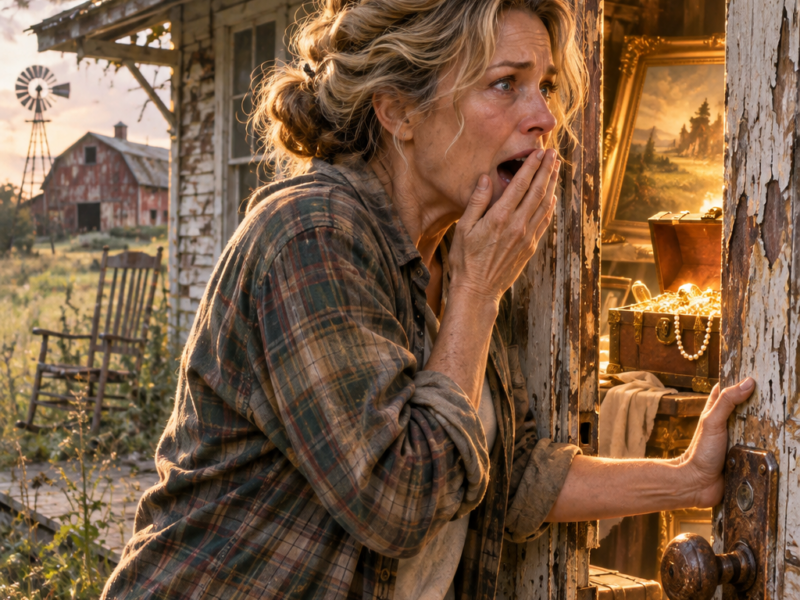
I Inherited a Run-Down Farm While My Son Got a $5M Penthouse — But When I Opened the Door…
I Inherited a Run-Down Farm While My Son Got a $5M Penthouse — But When I Opened the Door…
The first thing my son gave me after my wife died was an eviction notice. The second was an offer to buy the only property she had left me for a fraction of its value. And the third, though I would not discover it until much later, was a reason to question everything I thought I knew about the boy I had raised.
My name is Raymond Whitlock, and I was sixty-eight years old when my entire world collapsed. I had spent almost forty years teaching history, raising a family, and loving a woman who was far more extraordinary than I ever deserved. I believed that after a lifetime of working hard and treating people decently, my retirement would be peaceful. Perhaps there would be mornings spent drinking coffee with my wife, afternoons reading books on the porch, and occasional visits from our son and whatever grandchildren the future might bring.
Instead, seven days after my wife Marlene passed away, I found myself sitting at a mahogany dining table while an attorney explained that our son had inherited nearly twelve million dollars, and I had inherited eight hundred acres of neglected farmland in rural Oklahoma.
The property was appraised at just one hundred eighty thousand dollars. Its farmhouse was supposedly falling apart, its barns were abandoned, and its fields had not been properly maintained in years.
My son Preston laughed when he heard the news.
He actually laughed.
I can still remember the sound. It was sharp, cold, almost relieved, as though he had been waiting for confirmation that I was finally as worthless as he believed me to be.
“A farm?” he said, leaning back in his chair. “Mom left Dad a dirt farm?”
His wife Danielle touched his arm, but she made no serious attempt to stop him.
Preston looked directly at me.
“What exactly are you supposed to do with eight hundred acres? You’re a retired schoolteacher, Dad. You don’t know anything about farming.”
I stared at the polished table, unable to find a response.
Seven days earlier, I had buried the woman I loved. Now I was watching my only child turn her final wishes into a cruel joke.
Across from us sat Adeline Vance, Marlene’s attorney. She was a composed woman in her early sixties, with silver-framed glasses and the sort of calm expression that came from spending decades dealing with difficult families.
She did not laugh.
Instead, she carefully explained that Marlene’s will was legally valid and that the distribution had been intentional.
Preston had received our mansion in Hillcrest Terrace, valued at approximately three and a half million dollars. He had also inherited a six-million-dollar investment portfolio and retirement accounts containing another two and a half million.
I had received the farm.
And a rusty iron key.
Adeline placed the key on the table in front of me, followed by a thick cream-colored envelope.
My name was written across it in Marlene’s handwriting.
Beneath my name were five words.
Open at the farm. Trust me.
I touched the envelope with trembling fingers.
Marlene had written countless notes to me during our marriage. Grocery lists, birthday cards, reminders about doctor appointments, little messages tucked into my lunch bag when I was still teaching.
I knew every curve of her handwriting.
Seeing it now felt like hearing her voice from another room.
“Your wife was very specific about this,” Adeline told me softly. “She wanted you to visit the property before opening the letter.”
“Why?” I asked.
Adeline hesitated.
“Because she believed you needed to see something for yourself.”
Preston rolled his eyes.
“This is ridiculous. Dad can barely manage his online banking. Now he’s supposed to manage a farm?”
Something inside me tightened.
For forty years, I had stood in classrooms teaching teenagers about presidents, wars, revolutions, and the consequences of human decisions. I had helped hundreds of young people find confidence in themselves. I had coached struggling students, stayed late to grade papers, and paid for school supplies out of my own pocket.
Yet my son spoke about me as though I had spent my entire life accomplishing nothing.
I looked toward him.
“Your mother wanted me to have that land,” I said quietly. “So I’ll keep it.”
His expression hardened.
“Fine. Enjoy your collapsing shack.”
He stood, pushed his chair away, and walked out.
Danielle followed without looking at me.
The front door slammed.
For several moments, Adeline and I sat in silence.
Then she removed her glasses.
“Raymond, I need you to understand something,” she said. “Marlene loved you deeply. She spent a great deal of time preparing this estate plan.”
“I know she loved me.”
“Then trust what she left you.”
I looked at the rusty key lying in my palm.
“I don’t even know where the farm is.”
“Nowata County. About two hours from here. The address is in the paperwork.”
I nodded.
It was all I could manage.
That evening, I returned to the mansion where Marlene and I had lived for eighteen years. The house was enormous, with tall windows, marble countertops, and a circular driveway that had once seemed like proof of everything she had accomplished.
Now it felt like a museum after the person it honored had been forgotten.
I walked past the staircase where Preston had once slid down the banister as a boy. I passed the dining room where we had celebrated Christmas dinners. I stopped outside Marlene’s office, where the brass nameplate still read her name.
Marlene Whitlock.
Founder and Chief Executive Officer.
Halcyon Energy Solutions.
I touched the nameplate.
For a moment, I remembered her standing in that doorway years earlier, smiling after securing the largest contract in her company’s history.
“We did it, Ray,” she had said.
I had laughed.
“You did it.”
She had shaken her head.
“No. We did.”
That was Marlene.
She never forgot that while she was traveling to drilling sites, attending negotiations, and building a multimillion-dollar energy company, I was the one preparing Preston’s lunches, helping with his homework, taking him to baseball practice, and making sure there was always someone home when he needed us.
We had been partners.
Not because we earned the same amount of money, but because we believed we were building the same life.
Or at least I thought we were.
Preston found me in the guest bedroom shortly after eight that night.
He did not knock.
He walked inside carrying a folder and placed it on the bed.
“You need to sign for receipt,” he said.
I opened the folder.
It contained a formal notice requiring me to vacate the house by March 29.
Twenty-two days.
I looked up slowly.
“Preston, your mother has been gone for one week.”
“I know.”
“And you’re throwing me out?”
He sighed impatiently.
“Dad, this is my property now. Danielle and I are planning to start a family. We’re renovating. We need the space.”
“This house has six bedrooms.”
“And you’ve got an entire farm.”
He folded his arms.
“You should be grateful Mom left you somewhere to go.”
I read the notice again.
My hands had begun to shake.
Then Preston added something that hurt more than the eviction itself.
“And don’t take anything valuable when you leave. I’ve already had the household contents inventoried. The antiques, jewelry, paintings, silverware—those belong to the estate I inherited.”
I stared at him.
“Your mother’s wedding photograph is in a silver frame.”
“Then take the photograph and leave the frame.”
He turned and walked away.
I sat on the edge of the bed long after he left, holding the eviction notice in one hand and Marlene’s envelope in the other.
Twenty-two days.
That was how long my son believed it should take a man to disappear from his life.
I barely slept.
By six the next morning, contractor trucks were rumbling up the driveway. Men wearing hard hats carried tools through the entrance. A large dumpster scraped across the pavement, and the sound of crowbars echoed through the east wing.
I hurried downstairs and found workers tearing apart Marlene’s office.
Books were being stuffed into black garbage bags. Cabinet doors had been removed. Her desk drawers were being forced open.
One worker was carrying a photograph of Marlene and me from the opening of Halcyon Energy’s first headquarters in 1997.
She was wearing a white hard hat and grinning at the camera.
I was standing beside her, applauding.
“Please,” I said, stepping forward. “Can I have that photograph?”
The worker stopped.
Preston appeared behind me, holding a coffee mug.
“The frame is sterling silver,” he said.
“I don’t care about the frame.”
“Then you can take the picture out later.”
He motioned for the worker to keep moving.
I watched the photograph disappear down the hallway toward the dumpster.
That was the moment I began to understand that Preston wasn’t simply impatient to take possession of the house.
He was erasing his mother.
Every shelf she had filled, every flower she had planted, every photograph that reminded him the mansion had once belonged to someone else—he wanted it gone.
I returned upstairs, found our wedding photograph, and slipped it into my wallet.
We had married on June 18, 1983.
I was twenty-eight, a young history teacher earning barely enough to cover the rent. Marlene was twenty-four, recently graduated with a geology degree and a determination that could frighten businessmen twice her age.
Our wedding took place at a courthouse.
Two witnesses, inexpensive rings, and a weekend honeymoon in Eureka Springs.
We ate sandwiches beside a creek because we couldn’t afford a proper restaurant dinner.
Marlene had leaned against my shoulder and asked, “Do you think we’ll ever be rich?”
I had laughed.
“On a teacher’s salary? Absolutely not.”
She had smiled.
“Then it’s a good thing I have plans.”
And she did.
Two years later, Preston was born.
By 1995, Marlene had founded Halcyon Energy Solutions. She began with borrowed equipment, three employees, and a rented office so small that the copier blocked the bathroom door.
I remember sitting across from her at our kitchen table while she explained her business plan.
“We have a mortgage,” I warned her.
“I know.”
“And a ten-year-old son.”
“I know that too.”
“What if it fails?”
She reached across the table and took my hand.
“Then we’ll figure something else out. But what if it succeeds?”
It succeeded beyond anything either of us imagined.
By 2000, she was a millionaire.
By 2005, we had moved into the Hillcrest Terrace mansion.
Throughout those years, I remained a teacher. Marlene repeatedly offered to let me retire early, but I loved my work.
I loved explaining the American Revolution to students who had never cared about history before. I loved watching a quiet child discover that he could stand in front of a classroom and speak confidently. I loved the ordinary, meaningful rhythm of school life.
Marlene respected that.
Preston did not.
As he grew older, he became increasingly fascinated by money and status.
He wanted expensive watches, luxury cars, prestigious memberships, and friendships with people whose surnames appeared on buildings.
Whenever he learned about a wealthy family, his first question was how much they were worth.
I tried to teach him that money was useful but not a measure of character.
He listened politely.
Then he ignored me.
By the time he reached adulthood, I had begun to wonder whether our comfortable life had given him too much without teaching him what anything cost.
Still, I never imagined what he would eventually do.
In August 2021, Marlene returned from a medical appointment and sat at the kitchen table.
She looked unusually pale.
I asked whether she wanted coffee.
She shook her head.
“Ray, it’s cancer.”
The doctors described it as stage three.
There would be surgery, chemotherapy, difficult months, and no guarantees.
I retired immediately.
For the next eighteen months, my world narrowed to hospital rooms, medication schedules, appointments, and the sound of Marlene breathing beside me at night.
Preston visited occasionally.
He always seemed busy.
Sometimes he stayed fifteen minutes. Sometimes twenty.
He would ask about medical bills, company documents, or whether his mother had updated her financial arrangements.
I told myself he was frightened and didn’t know how to express it.
Parents are skilled at explaining away what they do not want to believe.
During those final months, Marlene became increasingly private.
She made unexplained trips to Nowata County. She held lengthy meetings with Adeline Vance. She kept her office locked.
Once, I asked what she was doing.
“Taking care of loose ends,” she said.
“Do you need help?”
She smiled faintly.
“You’re helping me every day.”
I kissed her forehead.
I never pressed her again.
On the night before she died, she reached for my hand.
Her fingers were cold.
“Ray,” she whispered.
“I’m here.”
“Trust the farm.”
I leaned closer.
“What farm?”
“The one in Nowata County.”
She struggled to breathe.
“Everything you need is there.”
I promised I would trust her.
Then she whispered something else.
“Don’t let Preston take it.”
I remember staring at her in confusion.
But she was exhausted, and the doctors had warned me she might not have much time left.
“I won’t,” I said.
Her fingers relaxed.
“I love you.”
“I love you too.”
She died the following morning.
I thought those words were simply the confused wishes of a dying woman.
I could not have been more mistaken.
By March 14, Preston’s efforts to remove me from the house had become even more aggressive.
He arrived one morning with a thin, carefully dressed man named Gerald Pruitt, who introduced himself as a specialist in elder-care planning.
They invited me into the dining room.
On the table lay a thick blue folder.
Pruitt opened it and presented a document titled General Durable Power of Attorney.
He explained that Preston wanted authority to manage my financial affairs, healthcare decisions, and property.
According to him, the arrangement would protect me from the burdens of retirement and complicated legal responsibilities.
I read the document carefully.
One provision granted Preston extensive control over my real estate.
Including the farm in Nowata County.
Another described the possibility of seeking guardianship if I was considered unable to manage my affairs.
I looked at my son.
“You want control of the farm.”
Preston leaned forward.
“Dad, the county has a tax lien against it. Almost fifteen thousand dollars. You don’t have the money to deal with that.”
“Then I’ll find a way.”
“With your pension?”
He laughed bitterly.
“Be realistic.”
Pruitt explained that signing the documents would allow Preston to handle everything for me.
When I refused, his manner changed.
He began describing how Preston might petition a court for guardianship, arguing that my age, bereavement, and financial circumstances made me vulnerable.
The implication was obvious.
Sign voluntarily, or face a legal battle.
I closed the folder and pushed it back.
“No.”
Preston stared at me.
“Dad—”
“I said no.”
For the first time since Marlene’s death, my voice did not tremble.
“Get out.”
They left, but Preston paused at the doorway.
“You’ve got two weeks to think about it.”
I watched him go.
Then I sat alone at the dining table, feeling as though I had been threatened by a stranger wearing my son’s face.
Five days later, I discovered just how long Preston had been planning my future.
I was carrying boxes to my truck when a folder slipped from the overflowing recycling bin.
The handwritten label read:
Dad — Residential Options.
Inside were brochures for Willow Bend Senior Living, a facility in Clinton, Oklahoma.
There were photographs of narrow rooms, fluorescent-lit corridors, and crowded common areas.
A contract listed me as a prospective resident.
Shared accommodation.
Monthly cost: $2,800.
Security deposit: $5,600.
The proposed move-in date was April 20.
But what stopped my heart was the date on which the paperwork had first been prepared.
January 28, 2023.
One month before Marlene died.
While I was sitting beside her hospice bed, trying to keep her comfortable, our son had already been arranging to move me into a facility more than a hundred miles away.
I searched online for reviews.
They were terrible.
Families complained about neglect, missing belongings, poor sanitation, and indifferent management.
I photographed every page.
Then I hid the folder beneath a blanket in my truck.
I did not confront Preston.
I was beginning to realize that I needed to stop reacting emotionally and start paying attention.
On March 27, a letter arrived from the Nowata County tax office.
The unpaid balance was $18,577.43.
The notice warned of further collection action if the matter was not resolved.
I could barely breathe as I read it.
My pension was just over two thousand dollars a month.
I had savings, but nowhere near enough to comfortably cover the taxes, relocate, and repair an abandoned farmhouse.
When I showed Preston the letter, he barely glanced at it.
Then he made his offer.
“Fifty thousand dollars,” he said. “Cash. I’ll buy the whole farm and handle the taxes.”
I looked at him.
“Why would you buy something you’ve spent weeks telling me is worthless?”
He smiled.
“Because you’re my father. I’m trying to help.”
I said I would think about it.
That evening, Adeline called.
She had learned about Preston’s offer.
“Do not sell the farm,” she told me.
“Adeline, I can’t afford the taxes.”
“We have arrangements in place to protect you.”
“What arrangements?”
“Marlene created a trust. There are resources available, and the property is protected while the estate matters are resolved.”
I rubbed my forehead.
“Why didn’t she tell me any of this?”
Adeline was quiet for a moment.
“Because she believed certain people would act differently if they knew what she had discovered.”
A cold sensation moved down my spine.
“Preston?”
“I can’t explain everything over the phone. But I need you to follow Marlene’s instructions. Go to the farm. Open her letters. And until then, don’t sign anything.”
The following afternoon, Adeline gave me a second envelope.
Marlene had instructed her to deliver it just before I left Hillcrest Terrace.
Inside was a brief message.
Ray, there are things I couldn’t tell you while I was alive. I need you to trust me one last time. The farm is more than it appears. Look in the barn attic. And remember that even now, I’m looking out for you.
I read the message repeatedly.
That same morning, Preston sent a landscaping crew to destroy Marlene’s rose garden.
I heard the bulldozer from upstairs.
By the time I reached the backyard, the machine had already torn through several flower beds.
Twenty years of care were being flattened into mud.
I shouted for the operator to stop.
Preston appeared beside the machine with a clipboard.
“I’m putting in a swimming pool,” he said.
“Those were your mother’s roses.”
“They were. This is my house now.”
He waved the operator forward.
The engine roared.
I stood frozen until I noticed one yellow rosebush still standing at the edge of the garden.
Marlene had planted it on our twenty-fifth wedding anniversary.
She chose yellow because she had been wearing a yellow dress the day we met.
I walked toward it, dropped to my knees, and began digging with my hands.
The soil was cold and wet.
Thorns scratched my wrists.
Preston called after me, but I kept digging.
When the roots finally came loose, I lifted the bush into my arms and carried it to my truck.
It was the only living piece of that house I wanted to save.
I drove to Nowata County that afternoon.
The journey took a little more than two hours.
The mansions and shopping centers gradually gave way to gas stations, wheat fields, cattle fences, and quiet country roads.
Eventually, I reached a gravel driveway beside a weathered mailbox bearing the Whitlock name.
The farmhouse stood a quarter mile from the road.
It was smaller than I had expected.
Its white paint was peeling, its porch sagged, and several windows had torn screens.
Beyond it stood a massive red barn with a rusted roof.
The surrounding land stretched toward the horizon.
Eight hundred acres.
At first glance, it looked like nothing but neglected fields and empty sky.
I planted the yellow rose in an old whiskey barrel on the porch.
Then I sat beside it and looked across the property.
For the first time in weeks, no one was shouting at me.
No contractors were destroying memories.
No one was telling me where I could sleep or what I was allowed to own.
There was only wind, birdsong, and the quiet creaking of old wood.
I slept on a folding cot that night.
The farmhouse had no dependable electricity, and the water system needed repairs.
But despite everything, I felt something I had not experienced since Marlene’s death.
A little peace.
The following morning, I returned to Hillcrest Terrace to collect the last of my belongings.
Preston was waiting on the porch.
He held out a check.
“Twenty-five thousand,” he said. “Final offer.”
I stared at it.
“Yesterday you offered fifty.”
“Circumstances change.”
I took the check.
For a moment, he seemed pleased.
Then I tore it in half.
And tore the halves again.
I handed the pieces back.
“I’ll keep the farm.”
His face reddened.
“You’re making the biggest mistake of your life.”
I picked up my bag.
“No, Preston. I think I’ve finally stopped making one.”
I drove away without looking back.
By midafternoon, I was sitting at the farmhouse table with Marlene’s letters in front of me.
Her instructions led me to the barn.
The interior smelled of hay, dust, and old machinery. Sunlight came through narrow gaps in the wooden walls.
In the northwest corner, behind several stacks of hay, I found a ladder leading into the attic.
My knees complained with every rung.
At the top, the ceiling was low and cobwebs hung between the rafters.
I swept my flashlight across a collection of forgotten boxes.
Then I saw it.
An olive-green metal trunk hidden beneath a canvas sheet.
A heavy padlock secured the lid.
I took out the rusty key Adeline had given me.
It fit.
The lock opened with a metallic click.
Inside were four carefully arranged folders and another envelope.
The folders were labeled Geological Survey, Preston Evidence, Desmond Crowle, and Trust Documents.
I opened the envelope first.
It contained a letter from Marlene.
As I began reading, I felt as though she were sitting beside me.
She explained that she had discovered Preston stealing money from family and company accounts during her illness.
Over eighteen months, he had diverted approximately $370,000 through forged documents, unauthorized withdrawals, and accounts he believed no one would examine.
She had discovered the theft in September 2022.
But she had not confronted him.
Instead, she had quietly collected evidence.
Bank statements.
Transfer records.
Copies of suspicious signatures.
Security photographs.
And records from people who had helped him.
I opened the first folder.
Everything she described was there.
One transaction involved $45,000.
Another involved $85,000.
A third involved $120,000.
The final withdrawal brought the documented total to $370,000.
I stared at the papers until the numbers blurred.
My own son.
While Marlene lay in bed, struggling through chemotherapy and pain, Preston had been taking money from her accounts.
I remembered sitting beside her on those difficult nights, reading aloud because she said my voice helped her sleep.
And somewhere in those same hours, Preston had been forging her signature.
I pressed my hand against my mouth.
I had spent my entire life teaching students that history was shaped by choices.
Now I was looking at the choices of my own child.
And I barely recognized him.
The second folder was worse.
It concerned a man named Desmond Crowle.
I remembered him from Marlene’s funeral.
He was an oil executive and longtime competitor of Halcyon Energy. He had stood at the back of the chapel, watching silently, then left without offering condolences.
According to Marlene’s documents, Desmond had contacted Preston in September 2021.
He knew something about the Nowata County property.
Something Preston and I did not.
Geological surveys suggested that valuable oil reserves lay beneath the farm.
Desmond wanted the mineral rights.
Rather than negotiate openly with Marlene, he had approached our son.
The emails were devastating.
Preston had agreed to provide information from his mother’s company.
He received money disguised as consulting fees.
He helped Desmond obtain confidential geological documents.
Eventually, they began discussing how to acquire the farm after Marlene died.
I found a proposed deal outlining millions of dollars in payments to Preston, an executive position at Desmond’s company, and future royalty interests.
In exchange, Preston would persuade—or force—me to transfer the property.
The guardianship documents suddenly made sense.
So did the Willow Bend contract.
So did the eviction notice.
So did his repeated insistence that the farm was worthless.
He wasn’t trying to help an elderly father.
He was trying to remove an obstacle.
I kept reading.
Marlene had commissioned detailed geological studies years earlier.
The property sat above an oil-bearing formation with estimated recoverable resources valued in the tens of millions.
Those estimates were uncertain, as all such projections were, but the evidence suggested the property could be extraordinarily valuable.
More importantly, Marlene had negotiated a development agreement with Halcyon Energy.
The company would finance exploration and drilling.
I would retain ownership of the farm and receive a substantial share of the net income generated under the agreement.
A separate trust had been established to protect my interests.
There were safeguards against attempts to obtain the property through fraud, coercion, or unauthorized transfers.
Marlene had also preserved evidence for federal investigators.
I lowered the documents into my lap.
For almost twenty minutes, I sat motionless on the attic floor.
My wife had spent her final months fighting two battles.
One against cancer.
The other against people trying to exploit her illness and steal our future.
And one of those people was our son.
I had no idea how to feel.
Anger seemed too small.
Grief seemed too familiar.
Mostly, I felt an enormous sadness for Marlene.
She had carried all this knowledge while trying to remain strong for me.
I wondered how many nights she had lain awake worrying about what would happen after she was gone.
Then I found the final lines of her letter.
Ray, I know you still remember Preston as the little boy who planted roses with me. I remember him too. But you must protect yourself from the man he has become. You gave me forty wonderful years. Now I want you to have a future. Trust Adeline. Trust Otis. And trust the farm.
I read those words three times.
Then I cried.
Not because of the money.
Not because of the oil.
But because even as she was dying, Marlene had been thinking about how to keep me safe.
That evening, someone knocked on the farmhouse door.
I opened it cautiously.
An elderly man stood on the porch holding a toolbox and a brown grocery bag.
His face was deeply lined, his boots covered in dust, and his flannel shirt looked as though it had survived several decades of hard work.
“Ray Whitlock?”
“Yes.”
“Otis Radley. I run the gas station a few miles east.”
He looked past me into the dark farmhouse.
“Marlene figured you might need some help getting settled.”
Before I could respond, he stepped inside and began unpacking his bag.
A thermos of hot coffee.
Two sandwiches.
A battery-powered lantern.
Bottled water.
I stared at him.
“You knew my wife?”
Otis smiled.
“Everybody around here knew Marlene. Not everybody liked arguing with her, though.”
He laughed quietly.
“She paid me to keep an eye on this place. Check fences, watch for trespassers, make sure nobody got curious about the property.”
Then he reached into his jacket and handed me another envelope.
“She told me to give you this if you arrived alone.”
Inside was twenty thousand dollars in cash.
I could barely speak.
Otis shrugged.
“Emergency money. She figured you’d need it before the lawyers and banks got everything sorted.”
I sat down heavily.
Otis studied me for a moment.
“You found the trunk, didn’t you?”
I nodded.
“Then you know why she wanted this place protected.”
He sat opposite me.
For the next hour, he told me stories about Marlene’s visits to the farm.
She had come regularly, even during treatment.
Sometimes she inspected fences.
Sometimes she met surveyors.
Sometimes she simply sat on the porch and drank coffee while looking across the fields.
Once, Otis told me, she had said something that stayed with him.
“Ray spent his whole life taking care of other people. I want the world to take care of him for a change.”
I looked toward the window.
The fields were dark.
Somewhere outside, the yellow rose moved gently in the wind.
Otis also told me about a second metal box hidden in the barn attic.
I found it that night.
It contained duplicates of the evidence, a USB drive, and the business card of an FBI agent named Renata Alvarez.
Marlene had not simply gathered documents.
She had been cooperating with investigators.
The realization made me both proud and heartsick.
She had trusted me with her love.
But she had protected me from dangers I never knew existed.
Two mornings later, Preston arrived at the farm.
He was driving a black Mercedes.
Behind him came a silver Escalade.
The man who stepped out of the second vehicle was Desmond Crowle.
I recognized him immediately.
He approached the porch with a practiced smile.
“Mr. Whitlock,” he said, extending his hand. “I believe we can help one another.”
I did not shake it.
He explained that acquiring and developing rural mineral properties required money, experience, and complicated negotiations.
Then he made an offer.
Ten million dollars.
Cash.
In exchange for the land and its mineral rights.
I looked toward Preston.
Only days earlier, he had offered me twenty-five thousand dollars.
Now he stood beside a man offering ten million.
“Interesting,” I said.
Desmond tilted his head.
“What is?”
“A farm that was worthless last week is suddenly worth ten million dollars.”
Preston shifted uncomfortably.
“Dad, don’t make this difficult.”
I looked at him.
“Did you know about the oil before your mother died?”
His face changed.
Desmond stepped forward.
“Let’s focus on the offer.”
I reached into my pocket and took out my phone.
I had saved copies of messages and conversations that made Preston’s intentions clear, and Marlene had left far more detailed evidence.
“I think we should discuss what you’ve actually been planning,” I said.
Preston went pale when I mentioned Willow Bend.
Desmond stopped smiling when I mentioned the stolen geological reports.
Then I told them about the trunk.
The bank documents.
The correspondence.
The federal investigation.
For the first time since Marlene’s death, Preston seemed genuinely afraid.
“You don’t understand everything,” he said.
“Then explain it.”
He opened his mouth.
Nothing came out.
A white SUV appeared on the gravel driveway.
Adeline stepped out, followed by Nathan Beaumont, Halcyon Energy’s chief executive.
She carried a briefcase.
Her expression was composed, but I could see determination in her eyes.
“Good morning, gentlemen,” she said. “I believe there are some legal matters we need to clarify.”
Desmond’s confidence began to evaporate as she described the trust arrangements and the evidence of attempted fraud.
Nathan explained that Halcyon had already made preparations to develop the property under Marlene’s negotiated agreement.
The company had financing, survey data, and plans for the necessary regulatory approvals.
Desmond’s offer was neither necessary nor welcome.
Adeline advised both men that further coercive efforts would be documented and referred to the appropriate authorities.
Preston looked at me.
For one second, I saw the little boy who had once asked me to teach him how to build a birdhouse.
Then his expression hardened again.
“You’re choosing this farm over your own son?”
I stepped off the porch.
“No, Preston. You chose money over your parents long before I knew there was a choice to make.”
He looked away.
Desmond returned to his Escalade without another word.
Preston stood in the yard a moment longer.
I waited for him to apologize.
He didn’t.
Finally, he got into his Mercedes and drove away.
I watched both vehicles disappear.
When the dust settled, Adeline placed a hand on my shoulder.
“How are you feeling?”
I looked across the fields.
“Like I’ve just buried something twice.”
She understood.
The legal confrontation did not end immediately.
Preston threatened to challenge the will and seek guardianship.
His attorneys argued that I was too old, recently bereaved, and inexperienced to manage valuable mineral interests.
But Adeline had spent months preparing for exactly that argument.
She had records showing my financial competence, medical evidence that there was no basis to question my decision-making capacity, and extensive documentation of Preston’s conflicts of interest.
She also had Marlene’s carefully prepared trust instruments.
When Preston’s attorneys reviewed the evidence and the potential consequences of further litigation, their position changed.
On April 3, Preston withdrew his legal threats.
He sent me a brief email stating that he accepted his mother’s estate arrangements and wanted no further contact.
There was no apology.
No acknowledgment of what he had done.
Only a cold declaration that we were finished.
I read it twice.
Then I closed my laptop.
I did not feel victorious.
I felt old.
For years, I had imagined teaching my son how to be a father. I had pictured grandchildren running through our house, Marlene making pancakes, Preston laughing with me over some shared family joke.
That future was gone.
A person can survive betrayal and still mourn the relationship that betrayal destroyed.
That evening, Otis came by with coffee.
We sat on the farmhouse porch watching the last light fade from the fields.
After a while, he asked, “You ever wonder when things went wrong with your boy?”
“Every day.”
Otis nodded.
“Marlene wondered too.”
I looked at him.
“She talked about it?”
“Sometimes.”
He paused.
“She used to say Preston was always chasing something. Money. Recognition. A bigger house. A better title. She thought if she gave him enough, maybe he’d finally be happy.”
I stared at the horizon.
“And?”
“She realized there wasn’t an enough.”
We sat in silence.
Then Otis said, “You can’t make another person choose decency, Ray. Not even your own child.”
I knew he was right.
It did not make the loss easier.
But it gave me permission to stop searching endlessly for what I might have done differently.
The following month, Halcyon Energy began preparing the drilling site.
The transformation was astonishing.
One morning the fields were silent.
The next, trucks arrived carrying steel beams, pipes, equipment, and portable buildings.
Survey markers appeared across the land.
Workers installed barriers and prepared access roads.
I stood on the porch watching it happen, feeling as though Marlene’s plans were rising out of the earth.
Nathan Beaumont visited regularly.
He explained the drilling process patiently, knowing that my knowledge of oil production was limited to what I had learned from my wife’s stories.
He also explained the financial agreement.
Halcyon would shoulder the agreed development expenses, while the trust and royalty arrangements protected my interests.
There were risks, of course.
Oil prices could fluctuate.
Wells could produce less than expected.
Equipment could fail.
Regulatory approvals could take time.
Marlene had planned carefully, but even she could not command the geology beneath the land.
Still, the projections were promising.
And for the first time in my retirement, I had financial security without depending on Preston.
There was also a separate fund Marlene had established to provide living expenses during development.
When Adeline explained it, I laughed through tears.
“She really thought of everything.”
Adeline smiled.
“Not everything, Ray. But she tried very hard.”
By May 15, the first drilling equipment was being installed.
I met Dale Brunner, the site foreman, a broad-shouldered man who had spent decades working in Oklahoma oil fields.
He pointed toward the survey markers.
“Your wife chose this site herself,” he told me.
“Did she?”
“Came out here with the maps and the geologists. Asked more questions than most engineers.”
I smiled.
“That sounds like Marlene.”
Dale nodded.
“She knew what she was doing.”
I stood beside him looking at the steel framework rising against the sky.
For years, I had watched Marlene walk into boardrooms and industrial sites with complete confidence.
Now I understood that her confidence had never been arrogance.
It was preparation.
She studied.
She listened.
She questioned everything.
And when she finally made a decision, she made it with the certainty of someone who had done the work.
That summer, the first well confirmed commercially promising oil production.
I was repairing a porch railing when I heard men cheering in the distance.
Dale waved me over.
By the time I reached the site, the crew was gathered around the equipment.
The early production results were better than many had expected.
I watched the dark crude move through the collection system.
It looked ordinary.
Almost disappointingly ordinary.
Something so valuable should have glittered.
Instead, it looked like thick black mud.
I laughed suddenly.
Dale looked at me.
“What’s funny?”
“Nothing. I just spent my whole life thinking treasure was supposed to shine.”
He grinned.
“Not this kind.”
As operations expanded, the farm began to change.
Workers repaired access roads.
Old fences were replaced.
The farmhouse received new wiring, plumbing, and a roof that no longer leaked whenever it rained.
Otis helped me find local contractors.
I insisted on preserving the original house rather than replacing it with something enormous.
After living in the Hillcrest Terrace mansion, I had no desire for another palace.
I wanted a kitchen with a good coffee maker.
A comfortable chair.
Bookshelves.
A guest room for friends.
And a porch where I could watch the seasons change.
In July, I planted Marlene’s yellow rose directly into the ground beside the front steps.
It had survived the move.
New leaves appeared.
Then buds.
When the first flower opened, I stood looking at it for a long time.
I thought about the day I had carried the plant away from Preston’s bulldozer.
Its roots had been torn and exposed.
Its branches had lost leaves.
Anyone looking at it then might have assumed it would die.
But given good soil, water, sunlight, and time, it had begun to grow again.
I wondered whether people were so different.
In August, another part of Marlene’s hidden work came to light.
Desmond Crowle was arrested following a federal investigation into fraudulent business activities and the theft of confidential information.
The news report described evidence supplied by a confidential source who had worked with investigators before her death.
That source was Marlene.
I sat on the porch holding Otis’s phone as the reporter explained what investigators had uncovered.
My wife had spent months helping expose Desmond’s activities.
The investigation had involved suspicious financial transfers, confidential geological data, and attempts to manipulate property transactions.
I called Adeline.
“Did you know?”
She was silent for a moment.
“I knew she was cooperating with authorities.”
“Why didn’t she tell me?”
“Ray, she wanted to protect you. She was frightened Preston might discover what she knew.”
I closed my eyes.
Even now, I was learning how much Marlene had carried alone.
The following day, Special Agent Renata Alvarez contacted me.
She visited the farmhouse and explained that Marlene had provided detailed documentation over an extended period.
Investigators had used those records alongside independent evidence to build their case.
Preston had also become part of the investigation.
He eventually agreed to cooperate with prosecutors and testify about Desmond’s activities.
His cooperation protected him from certain criminal charges, but it could not restore his reputation.
His professional career deteriorated.
His name appeared in damaging reports.
Clients disappeared.
The respect he had valued so highly slipped away.
I was asked to provide testimony about the attempts to obtain control of my property.
I agreed.
Not because I wanted revenge.
Because I wanted the truth recorded.
And because Marlene had worked too hard for that truth to disappear.
I traveled to Oklahoma City, met with investigators, and described everything I had experienced.
The power-of-attorney documents.
The threats of guardianship.
The residential-facility paperwork.
The offers to purchase the farm.
The conversation at the farmhouse.
I answered every question carefully.
When the interview ended, Agent Alvarez thanked me.
“Your wife was remarkable,” she said.
I nodded.
“I know.”
Then, after a moment, I added, “I only wish I’d known how much she was doing.”
The months passed.
The oil development continued.
The farm became busier, but my life became quieter.
I learned to wake early, brew coffee, walk the fields, and listen to the birds.
Sometimes I helped Otis repair fences.
Sometimes I sat beside the yellow rose with one of Marlene’s old geology books.
I never became an oil expert.
But I began to understand why she loved the land.
She had always said the earth contained stories.
Layers of ancient oceans.
Pressure.
Heat.
Time.
Things hidden for millions of years, waiting for someone patient enough to discover them.
I had spent my career teaching human history.
Marlene had spent hers reading the history beneath our feet.
Perhaps that was why we had understood each other so well.
We were both fascinated by the past.
We simply studied different parts of it.
In September 2024, the mail carrier delivered a certified envelope from Halcyon Energy.
Inside was a royalty statement and a check.
I opened the statement at the kitchen table.
The figures were far larger than anything I had ever held in my hands.
Production revenue.
Operating costs.
Net proceeds.
My share.
The check was for more than two million dollars.
I read the amount once.
Then again.
Then I placed the paper on the table and walked outside.
For nearly half an hour, I sat on the porch.
The wind moved through the wheat.
The drilling equipment hummed in the distance.
A yellow rose opened beside the steps.
I thought about Marlene lying in our bedroom, whispering that everything I needed was at the farm.
She had not meant only money.
I knew that now.
But the money created a question I had never expected to face.
What was I going to do with it?
I called Adeline.
“The check arrived,” I said.
She laughed softly.
“Congratulations.”
“I don’t know what to do.”
“Have you considered what Marlene would have wanted?”
I looked toward the rose garden.
“Yes,” I said after a moment. “I think I have.”
For nearly forty years, I had worked in public education.
I had watched intelligent students abandon college plans because their families couldn’t afford tuition.
I had watched small businesses fail because banks would not lend to people without enough collateral.
And I had watched Marlene endure cancer treatment surrounded by families whose greatest fear was not just losing a loved one, but losing their homes to medical expenses.
I remembered sitting in hospital waiting rooms beside exhausted parents.
I remembered the woman who slept in her car because she couldn’t afford a hotel near the cancer center.
I remembered the elderly husband who quietly asked the receptionist whether his wife’s medication could be delayed until his next pension payment arrived.
Those memories had stayed with me.
Now I had the means to do something about them.
In November, I met with Adeline and an attorney named Bernadette Roe, who specialized in nonprofit organizations.
We discussed creating a charitable foundation in Marlene’s name.
I wanted three areas of support.
Scholarships for students with financial need.
Grants to help small businesses create local jobs.
And assistance for families struggling with cancer-related expenses.
Bernadette asked how much I wanted to contribute initially.
“One million dollars,” I said.
She looked up from her notes.
“That’s a significant commitment.”
I nodded.
“Then let’s make sure we use it well.”
Over the following months, we established the Marlene Ashcroft Whitlock Foundation.
We recruited people who understood education, community development, healthcare, accounting, and nonprofit oversight.
I insisted that the foundation have strong financial controls.
After everything Preston had done, I knew that good intentions were not enough.
Money needed responsible management.
The foundation began accepting applications.
We offered scholarships for young people planning to study science, engineering, business, education, and other fields.
We developed small-business grants tied to local employment and measurable community benefits.
We partnered with organizations helping cancer patients pay for transportation, lodging, and necessary treatment-related expenses.
I attended meetings, asked questions, and learned.
Sometimes people treated me as though I had suddenly become a brilliant businessman because I controlled a valuable property.
I found that amusing.
I was still the same retired history teacher.
The money had changed my circumstances.
It had not made me wiser.
If anything, the experience taught me how important it was to surround myself with people who understood things I did not.
On April 12, 2025, we held our first scholarship ceremony at the Nowata County Community Center.
Fifty students were selected to receive five thousand dollars each.
The room was packed with parents, teachers, grandparents, and young people dressed in their best clothes.
I stood backstage feeling more nervous than I had during my first day of teaching.
Adeline smiled at me.
“You’ve spoken in front of classrooms for forty years.”
“Classrooms don’t usually have television cameras.”
She laughed.
“You’ll be fine.”
When I walked onto the stage, the room grew quiet.
I looked across the faces.
Some students were smiling.
Others looked terrified.
A few parents were already crying.
I adjusted the microphone.
“My name is Ray Whitlock,” I began. “And for most of my life, I was a high school history teacher.”
A few people smiled.
“My wife Marlene grew up not far from here. She became a geologist, built an energy company, and spent her life believing that hard work and opportunity could change a person’s future.”
I paused.
“She also believed that wealth was most meaningful when it helped someone else build a better life.”
The room remained silent.
“Today, we’re awarding fifty scholarships. Each student will receive five thousand dollars.”
A murmur moved through the crowd.
“I know that won’t cover every college expense. But I hope it makes the road a little easier.”
I looked toward the first row.
“And when you succeed, I ask only one thing. Remember the people who helped you. Then find somebody else who needs a chance.”
The applause began slowly.
Then it filled the room.
I stepped aside as Adeline called the names.
One by one, students crossed the stage.
Some shook my hand.
Some hugged me.
Some could barely speak.
The final recipient was a young woman named Nora Vandever.
She had dark hair pulled into a ponytail and the nervous expression of someone trying very hard not to cry.
When I handed her the scholarship envelope, she whispered, “Thank you, Mr. Whitlock.”
“You’re welcome, Nora.”
She hesitated.
“I want to study petroleum engineering.”
I smiled.
“Do you?”
She nodded.
“Because of your wife. I read about her company. I want to do what she did.”
For a moment, I couldn’t speak.
I saw Marlene standing beside her first drilling rig in a white hard hat, sunlight on her face, smiling as though the entire world were full of possibilities.
Then I looked back at Nora.
“Make your own path,” I told her. “And make it something she’d be proud to see.”
Nora began to cry.
I embraced her.
The audience applauded again.
That evening, after the ceremony, I returned to the farmhouse.
The oil equipment glowed in the distance.
The yellow rose was beginning to bloom.
I sat on the porch and thought about the fifty students who had gone home carrying scholarship envelopes.
Fifty families.
Fifty opportunities.
Fifty young people who might someday build businesses, discover new technologies, teach children, or change communities in ways I would never live long enough to see.
For the first time since Marlene died, I felt that I was doing more than surviving her loss.
I was continuing something she had begun.
The foundation grew.
We helped local entrepreneurs purchase equipment and hire employees.
We assisted cancer patients with transportation to treatment centers.
We awarded more scholarships.
Every success brought its own small story.
There was a mechanic who opened a repair shop and hired three young apprentices.
A single mother who used a grant to expand her bakery.
A student who became the first person in her family to attend college.
A cancer patient who wrote to say that financial assistance had allowed her husband to stay near the hospital during treatment.
I kept those letters.
Not in the metal trunk with Marlene’s legal documents.
In a wooden box beside my desk.
On difficult days, I read them.
They reminded me that money could be converted into something more durable than possessions.
It could become opportunity.
Time.
Dignity.
Hope.
Meanwhile, news about Preston reached me occasionally through Adeline.
His professional reputation never recovered from the investigation.
He lost his position at his consulting firm.
His marriage deteriorated.
Danielle eventually left him.
He made expensive investments that failed, became involved in speculative ventures, and lost much of the wealth he had inherited.
The Hillcrest Terrace mansion was eventually sold.
I heard that he moved to Tucson and found work selling cars.
Once, Otis asked whether I felt sorry for him.
I thought carefully before answering.
“I feel sorry for the boy he used to be.”
Otis nodded.
“And the man?”
“The man knew what he was doing.”
That was all I could say.
There were moments when I wanted to pick up the phone.
Birthdays were especially difficult.
Every year, I remembered the day Preston was born.
I remembered holding him in the hospital, frightened by how small he was.
I remembered teaching him to ride a bicycle.
I remembered his first school play, his graduation, and the first time he called me from college because he was homesick.
Those memories remained real.
His betrayal did not erase them.
But memories were not enough to rebuild trust.
I could not pretend that he had not tried to take my home, my freedom, and the property Marlene had left to protect me.
Eventually, I learned that missing someone and refusing to let them hurt you again could exist at the same time.
I did not need to hate Preston.
I simply needed to keep my distance.
Desmond Crowle’s case proceeded through the courts.
He was ultimately convicted and sentenced to a lengthy federal prison term.
The business empire he had built around intimidation and questionable dealings unraveled.
When I heard the verdict, I felt no satisfaction.
I thought only of Marlene.
She had spent so much of her final life trying to stop him.
I wished she had lived long enough to see that her efforts had mattered.
But perhaps she had already known.
Perhaps that was why she could rest easier when she whispered, “Trust the farm.”
By February 28, 2026, three years had passed since her death.
The farmhouse no longer looked abandoned.
Its roof was new.
The windows had been replaced.
The porch was solid.
The old red barn had been repaired, and the fields were carefully maintained around the areas used for energy production.
There were several active wells on the property, and the royalties continued to provide more than enough income for me to live comfortably and support the foundation.
But the part of the property I loved most was not the drilling site.
It was the rose garden.
Otis and I had planted fifty yellow rosebushes along a stone path beside the farmhouse.
At the center stood a wooden bench.
A small brass plaque read:
Marlene’s Garden.
On the morning of the third anniversary of her death, I walked outside before sunrise.
The air was cold enough to sting my cheeks.
The rosebushes were still dormant, their bare branches dark against the pale sky.
But when I bent down, I could see tiny green buds beginning to form.
Spring was coming.
I sat on the bench.
For a long time, I watched the horizon brighten.
I thought about the man who had arrived here three years earlier.
He had been frightened, exhausted, and almost entirely alone.
He had carried a duffel bag, an eviction notice, a rusty key, and a dead woman’s letters.
He had believed he was approaching the end of his life.
Instead, he had stumbled into a beginning.
Footsteps sounded behind me.
Otis appeared carrying his familiar thermos.
“Morning, Ray.”
“Morning.”
He sat beside me and poured coffee into the thermos cap.
We watched the sunrise together.
After a while, he mentioned Nora Vandever.
She was doing exceptionally well in her engineering studies and had begun mentoring younger students interested in science.
I smiled.
“Marlene would have liked that.”
Otis nodded.
“She’d have liked a lot of what you’ve done.”
I looked across the fields.
“I hope so.”
He gave a quiet laugh.
“Ray, that woman spent her final years making sure you’d have a future. You think she wouldn’t be proud of what you’ve built with it?”
I didn’t answer immediately.
The first sunlight touched the roof of the farmhouse.
Beyond the barn, the drilling equipment stood against the horizon.
I thought about the scholarships, the small businesses, the families facing illness, and the hundreds of people who had benefited from the foundation.
Then I looked at the yellow rosebushes.
“I think she’d tell me there’s still work to do.”
Otis laughed.
“That sounds exactly like her.”
He finished his coffee and stood.
“Come by the station later. My wife’s making pie.”
“I might do that.”
He walked back toward his truck.
I remained on the bench.
In my jacket pocket was a folded sheet of paper.
For a week, I had been trying to write a letter to Marlene.
I had started it several times and torn it up.
How could I explain three years of living without her?
How could I describe the strange mixture of grief, gratitude, anger, and peace that had become my life?
That morning, I finally found the words.
I unfolded the paper and began writing.
I told her the farm was thriving.
I told her the old house was beautiful again.
I told her about the foundation and the students whose lives were changing.
I told her that Nora wanted to become an engineer.
I told her about Otis, who still checked the fences and appeared whenever I needed a friend.
I told her I missed her every day.
Then I wrote something I had been afraid to admit.
You left me more than money, Marlene. You left me a reason to keep going.
I paused.
My eyes filled with tears.
For a long time, I thought our story ended when you died. I thought everything we built together had been taken away. But I understand now that love doesn’t disappear simply because one person is no longer here. Sometimes it becomes work that still needs to be done. Sometimes it becomes a student who can afford college, a family that can pay medical bills, or a small business that gets a second chance.
I looked out across the farm.
The sunlight had become brighter.
I don’t know how much time I have left. I’m getting older, and some mornings my knees remind me of every year I’ve lived. But I’m not afraid anymore. You made sure I would have a place to stand. Now I’m trying to make sure other people have one too.
I signed the letter.
I love you. Always, Ray.
Then I folded it carefully and returned to the farmhouse.
The olive-green trunk stood beside my desk.
I unlocked it with the old rusty key.
Inside were Marlene’s letters, the documents she had preserved, and the notes that had led me to the truth.
I placed my letter on top.
Then I closed the lid.
For a moment, my hand rested on the cold metal.
I remembered the day Adeline had placed that key in front of me.
I had looked at it as though it were a symbol of everything I had lost.
Now it represented something entirely different.
Trust.
Not blind trust in people who demanded obedience.
Not trust that ignored warning signs or excused cruelty.
But trust earned through years of love, sacrifice, and integrity.
Marlene had earned mine.
Preston had destroyed his.
And I had finally learned the difference.
Later that afternoon, I walked to the eastern field where a granite memorial stood near the edge of the rose garden.
The inscription carried Marlene’s name and the dates of her life.
Below them were three words.
Geologist. Visionary. Wife.
I knelt beside the stone and placed a dried yellow rose at its base.
The flower had been pressed between the pages of one of her old geology textbooks.
I brushed a little dust from the granite.
Then I looked toward the distant drilling equipment.
Machines were still working.
Workers were still moving.
The land was still providing opportunities for people Marlene had never met.
And somewhere in Oklahoma, fifty young scholarship recipients were studying for examinations, preparing for careers, and dreaming about futures that might once have seemed impossible.
I smiled.
For many years, I thought wealth was something you accumulated.
Marlene taught me that wealth could also be something you released into the world.
She had built a successful business, but that alone was not what made her extraordinary.
What made her extraordinary was the way she used her strength.
She protected the vulnerable.
She prepared for dangers others refused to see.
She fought for the people she loved.
And when she knew she might not survive, she turned her remaining energy toward making sure her work would continue without her.
The farm was valuable because of the oil beneath it.
But its greatest value was never measured in barrels or dollars.
It was measured in what the land allowed us to do.
I thought about Preston one final time.
He had inherited a mansion, investments, and millions of dollars.
He had received everything he thought mattered.
Yet he had lost his marriage, his reputation, and the trust of his father.
I had inherited what appeared to be a ruined farm.
But through it, I had gained security, friendship, purpose, and a renewed understanding of love.
The difference had never been the size of our inheritances.
It had been what we chose to do with them.
I stood beside Marlene’s memorial until the sun began to lower.
Then I walked home along the stone path.
The rosebushes were beginning to show the earliest signs of spring.
Soon they would bloom.
Otis would probably stop by with another thermos.
Adeline would call about the foundation’s next meeting.
There would be scholarship applications to review, business grants to approve, and families waiting to learn whether we could help them through another difficult month.
There would be work.
Meaningful work.
The kind that made getting out of bed worthwhile.
As I reached the farmhouse steps, a warm breeze moved across the fields.
The yellow rose I had rescued from Hillcrest Terrace stood near the porch, stronger and healthier than it had ever been in the mansion garden.
I stopped to look at it.
Three years earlier, I had pulled it from the ground with trembling hands while my son shouted behind me.
Its roots had been damaged.
Its future uncertain.
Yet somehow it had survived.
Now it was part of a garden.
Part of a home.
Part of a life rebuilt from what remained after everything else had fallen apart.
I reached down and gently touched one of its leaves.
Then I looked toward the fields and whispered the words Marlene had given me on her final night.
“Trust the farm.”
I finally understood.
She had never been telling me simply to trust the land.
She had been telling me to trust that my life still held possibilities I could not yet see.
That betrayal did not have to become bitterness.
That losing the person I loved most did not mean I had lost every reason to live.
And that even at sixty-eight, with a broken heart and nothing but a rusty key in my pocket, it was possible to begin again.
I climbed the porch steps, opened the farmhouse door, and went inside.
Tomorrow morning, I would wake before sunrise.
I would make coffee.
I would walk through Marlene’s garden.
And I would continue building the life she had fought so hard to protect.
Because the greatest inheritance my wife left me was not the land, the oil, or the millions of dollars buried beneath our feet.
It was the chance to turn the years I had left into something that mattered.
And as long as I could still stand on that porch, watch the yellow roses bloom, and help even one more person find a better future, I intended to make every one of those years count.
THE END