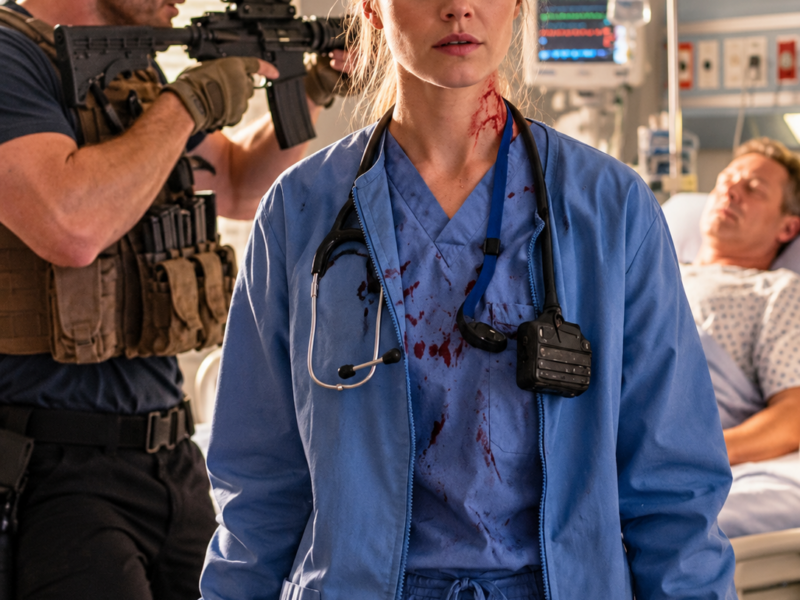
I Had Spent Four Years Hiding My Past as an Ordinary Hospital Nurse, Until Eight Armed Men Stormed the Emergency Department and Threatened to Kill Someone. When the Chief Surgeon Dismissed My Advice, I Told Him, “We Can Discuss Job Titles After He Survives.” Minutes Later, the Armed Leader Watched Me Stabilize His Wounded Friend and Whispered a Name I Hadn’t Heard in Four Years: “Specter.” But When He Revealed Who Was Hiding Upstairs, I Realized the Betrayal That Had Destroyed My Former Life Was Far From Over…
I Had Spent Four Years Hiding My Past as an Ordinary Hospital Nurse, Until Eight Armed Men Stormed the Emergency Department and Threatened to Kill Someone. When the Chief Surgeon Dismissed My Advice, I Told Him, “We Can Discuss Job Titles After He Survives.” Minutes Later, the Armed Leader Watched Me Stabilize His Wounded Friend and Whispered a Name I Hadn’t Heard in Four Years: “Specter.” But When He Revealed Who Was Hiding Upstairs, I Realized the Betrayal That Had Destroyed My Former Life Was Far From Over…
Part 1
The first thing I heard was glass breaking.
The second was a young nurse screaming.
And the third was a man’s voice saying, “You have sixty seconds to tell me where the surgeon is, or somebody in this room is going to die.”
I remember all three sounds perfectly. I remember the fluorescent lights above the emergency department, the smell of disinfectant mixed with fresh coffee, and the way an elderly patient’s heart monitor continued beeping as though nothing unusual was happening.
Most of all, I remember the look on Clara’s face.
She was twenty-six years old, barely eighteen months into her nursing career, and a man dressed in black tactical equipment had just lifted her off the floor by the collar of her scrubs.
Her shoes hung several inches above the broken glass.
She couldn’t breathe properly, let alone answer him.
“Where is Dr. Marcus Thorne?” the man shouted.
Nobody moved.
Nobody spoke.
And standing behind a medication cart, wearing pale blue scrubs and an ordinary hospital identification badge, I realized that the peaceful life I had spent four years building might be coming to an end.
My name was Anna Smith.
At least, that was the name everyone at Metropolitan General Hospital knew.
I was forty-three years old, with brown eyes, gray beginning to show at my temples, and a reputation for being dependable but unremarkable.
I worked as a float nurse.
Some weeks, I helped in pediatrics. Other weeks, I assisted in surgical recovery or covered shortages in the emergency department.
I rarely complained. I never attended hospital parties. I didn’t share photographs of my family because, as far as my colleagues knew, I didn’t have one.
Nobody knew much about my past.
That was intentional.
Four years earlier, I had arrived at Metropolitan General carrying two suitcases, a nursing license, and a determination never to become the woman I had once been.
Before I became Anna Smith, I had served for eight years in the world of special operations, including assignments alongside Delta Force personnel.
My callsign had been Specter.
It wasn’t a name I liked remembering.
Names like that were earned through experiences most people would never understand, and mine had come at a price I was still paying.
I had watched good people die because someone they trusted sold their identities.
I had survived because of a warning that arrived twelve hours before the killing started.
And ever since, I had lived by one rule.
Never become noticeable.
That Tuesday morning, I broke it.
Six armed men had entered through the main corridor. Another two appeared near the ambulance entrance carrying a wounded man between them.
Their movements were coordinated. Their weapons were not toys, and their leader carried himself with the confidence of someone accustomed to giving orders that were immediately obeyed.
He was tall, perhaps forty-five, with a narrow scar running along his jaw.
Unlike his men, he wasn’t wearing a helmet.
I watched him approach the nurses’ station while the others positioned themselves around the exits.
“Nobody needs to get hurt,” he announced. “We need one surgeon and cooperation from the staff.”
The man holding Clara tightened his grip.
“Then tell us where he is!”
“Third floor,” Clara managed. “Dr. Thorne is operating on the third floor.”
The leader nodded.
Two men disappeared toward the stairwell.
I counted the remaining weapons, noted the positions of the frightened patients, and studied the nearest exit.
I hated how naturally those calculations came back.
I hated that, after four years of deliberately forgetting my old life, my mind could still turn a hospital into a map of risks and possibilities.
The wounded man was placed on a gurney in Bay Two.
He was in his thirties, pale and sweating, with blood soaking his clothing.
I could see immediately that he was in serious trouble.
One injury involved his thigh. The other was along the side of his torso, and it concerned me far more.
His breathing was shallow.
His consciousness was fading.
The leader stood beside him.
For a moment, the cold authority disappeared from his face.
What replaced it was fear.
Not fear for himself.
Fear for the man on the gurney.
That told me something important.
This wasn’t merely an assignment.
It was personal.
Dr. Thorne arrived minutes later, escorted by two armed men.
He was the chief of surgery, an exceptionally talented specialist with the unfortunate belief that his position made him more important than everyone else in the hospital.
He had spent years treating nurses like interchangeable equipment.
And now, surrounded by armed strangers, he looked completely lost.
“This is outrageous!” he protested. “I cannot perform surgery here!”
“You’ll save him here,” the leader replied.
“I need an operating room, an anesthesiologist, proper equipment—”
“You have eight minutes before he deteriorates further.”
Thorne approached the gurney.
His hands were trembling.
He examined the patient’s thigh while barely acknowledging the more dangerous injury along his torso.
I watched for perhaps three seconds before understanding what was happening.
He was frightened enough to lose the confidence that normally made him an excellent surgeon.
And the patient was running out of time.
I stepped out from behind the medication cart.
“Dr. Thorne.”
He turned sharply.
“What?”
“The torso injury needs immediate attention. He’s showing signs of significant blood loss, and he needs emergency stabilization before we can move him.”
Thorne stared at me.
“Excuse me?”
“We need to support his circulation and get the trauma team involved.”
“Anna, return to your station.”
I didn’t.
He raised his voice.
“You are a float nurse. I am the chief of surgery.”
“And he’s your patient,” I answered. “We can discuss job titles after he survives.”
The entire room fell silent.
For a moment, I thought Thorne might actually dismiss me despite the circumstances.
Then the armed leader spoke.
“She’s right.”
Thorne looked offended beyond description.
But he moved aside.
I asked Janet, our senior emergency nurse, to bring the emergency equipment and notify the trauma team.
I asked Derek, a young nurse whose hands were shaking, to help prepare the necessary supplies.
Then I leaned toward the wounded man.
“Hey. Can you hear me?”
His eyelids fluttered.
“What’s your name?”
“Reese,” he whispered.
“All right, Reese. I’m Anna. We’re going to take care of you.”
He swallowed.
“Am I dying?”
“You’re seriously injured. But you’re still talking to me, and I need you to keep doing that.”
I coordinated the immediate care while Janet monitored his vital signs and Derek worked beside us.
Reese grimaced in pain.
“Tell me something about yourself,” I said.
He struggled to focus.
“Thirty-four.”
“Good. Anyone waiting for you at home?”
“My sister.”
“Does she have children?”
“Two.”
“Then you’ve got people who need you, Reese.”
He managed the smallest nod.
For the next several minutes, I focused entirely on keeping him alive.
The room, the weapons, the danger surrounding us—everything became secondary to the patient directly in front of me.
When his condition improved enough to buy us additional time, I finally looked up.
The leader was staring at me.
Not with surprise.
With recognition.
“Where did you learn to work like that?” he asked.
“I’ve worked in several departments.”
“That’s not what I asked.”
I removed my gloves.
“Experience.”
He studied my face for a long moment.
Then he said something so quietly that nobody else appeared to hear.
“Specter?”
My heart seemed to stop.
I hadn’t heard that name spoken aloud in four years.
Not once.
The leader noticed the tiny change in my expression.
His eyes narrowed.
I forced myself to remain calm.
“I don’t know what you’re talking about.”
He didn’t argue.
Instead, he glanced at Reese, then back at me.
“Of course you don’t.”
He walked away.
And I stood there realizing that this man hadn’t simply stumbled into the hospital where I worked.
Somehow, he knew who I used to be.
Clara approached me as soon as he was out of earshot.
“Anna?”
I turned.
“How did you do that?”
“Do what?”
“Take control of everything. You weren’t even frightened.”
I almost laughed.
Of course I was frightened.
The difference was that I had learned, a long time ago, how to keep fear from making my decisions.
“Everybody gets scared, Clara.”
She looked toward the armed men.
“Then why does he know you?”
I didn’t answer immediately.
Across the room, the leader was speaking into his radio.
His expression changed as he listened.
Then his eyes moved directly toward me.
And something in that look told me the situation was about to become far worse.
He crossed the emergency department, stopping just a few feet away.
“I need to talk to you,” he said.
“About Reese?”
“About why we’re really here.”
I looked at him carefully.
“Then start talking.”
He lowered his voice.
“The man who was shot isn’t our only problem.”
“I figured that out.”
His eyebrows rose.
“Did you?”
“You don’t storm a civilian hospital with an armed team just to find a surgeon. You could have brought him through the ambulance entrance like any other emergency patient.”
For the first time, he looked faintly amused.
“You’re exactly who I thought you were.”
“Who are you?”
“Major Daniel Kaylen. Former Delta Force.”
The name was unfamiliar, but his manner wasn’t.
I had known men like him.
Good men, sometimes.
Dangerous men, always.
“What do you want, Major?”
He glanced toward the administrative corridor.
“There’s a woman inside this hospital.”
Something about his tone made my skin tighten.
“Her name,” he continued, “is Dr. Elaine Marsh.”
For four years, I had imagined hearing that name again.
I had imagined it in a courtroom, during an intelligence briefing, perhaps even in a telephone call telling me she had finally been arrested.
I had never imagined hearing it in the emergency department where I worked.
“Where is she?” I asked.
Kaylen’s expression hardened.
“Somewhere upstairs.”
I looked toward the corridor.
“What is she doing here?”
“Trying to reach a protected medical records system.”
The room seemed to tilt beneath my feet.
Because suddenly, I understood.
Elaine Marsh hadn’t come to Metropolitan General to find medical information.
She had come to finish something she started ten years earlier.
And the people she intended to destroy were people I had once sworn to protect.
Part 2
Kaylen watched my face as I absorbed the news.
“You know her,” he said.
“Unfortunately.”
“Then you know what she’s capable of.”
I looked toward the patients.
“More than you realize.”
In 2016, Elaine Marsh had sold the identities of a classified intelligence network. Four operatives died. I survived because someone warned me before the assassins arrived.
For years, I believed Marsh had forgotten about me.
I was wrong.
Metropolitan General maintained protected medical records for certain military personnel. Hidden among those files were identifying details connected to survivors of the compromised network.
Marsh wanted those records.
And she was willing to turn an entire hospital into a battlefield to obtain them.
“How many people does she have?” I asked.
“At least three. Possibly five.”
“Then we’re running out of time.”
Kaylen leaned closer.
“What do you suggest?”
I looked at Clara, Janet, Derek, and the frightened patients.
Then I remembered something.
Four years of moving between hospital departments had taught me every forgotten corridor, maintenance entrance, and security access point in the building.
Marsh had weapons and intelligence.
But I knew the hospital.
“Give me twelve minutes,” I said.
Kaylen studied me.
“To do what?”
I removed my identification badge and slipped it into my pocket.
“To remind Elaine Marsh why people used to call me Specter.”
Part 3
The moment I stepped into the service corridor, the sounds of the emergency department disappeared behind me.
No frightened patients.
No heart monitors.
No shouting.
Only the low hum of ventilation and the distant rumble of an elevator moving somewhere above.
I hadn’t felt this kind of silence in four years.
It was the silence that came before something terrible happened.
I looked down at the folded sheet of paper in my hand.
It was an ordinary hospital supply form.
On the back, I had drawn a rough map of the building’s secondary corridors, marking the security office, pharmacy level, administrative wing, and server room.
I knew every route.
The reason was simple.
When you spend four years working wherever a hospital needs you, you discover places the administrators themselves barely remember.
The maintenance staircase on the east side.
The corridor behind the pharmacy.
The service passage connecting the second floor to the administrative offices.
And the security room that controlled the cameras monitoring nearly every public hallway.
I had told Clara to stay with Janet and Derek.
I had also given her a separate copy of the map.
If anything happened to me, they knew where to go for help.
But there was something I hadn’t told Clara.
I wasn’t certain I would return.
When I reached the second-floor maintenance junction, I stopped.
Two sets of footsteps were approaching.
Controlled.
Unhurried.
One heavier than the other.
I recognized that particular rhythm.
I stepped into the corridor.
The woman walking toward me stopped immediately.
She was fifty-three years old, slender, with neatly cut dark hair and glasses that made her look like a hospital administrator.
Behind her stood a younger man wearing a dark jacket.
His hand moved slightly toward his waist.
“Don’t,” I said.
He froze.
The woman stared at me.
For the first time in years, I watched Elaine Marsh lose control of her expression.
Disbelief came first.
Then recognition.
Then fear.
“Anna?”
“Hello, Elaine.”
She studied me.
“I thought you were dead.”
“I know.”
A small smile crossed her face.
“Well. This is unexpected.”
“I imagine it is.”
She glanced at my scrubs.
“A nurse?”
“Yes.”
“After everything you were?”
“People change.”
She laughed quietly.
“Not people like us.”
I looked directly at her.
“You’re right about one thing. Some people don’t change.”
The smile disappeared.
“You have no idea why I’m here.”
“You’re trying to reach the protected medical records server.”
Her silence answered for her.
I continued.
“You’ve been trying to identify the remaining people from Operation Ironside. You sold their names ten years ago, but you never got the complete list.”
“That’s an interesting accusation.”
“Four people died.”
“That operation was complicated.”
I felt something cold settle inside my chest.
It was the same phrase she had used years ago.
Complicated.
As though the lives she destroyed were merely unfortunate details in a professional disagreement.
“Marcus Webb died twenty-two hours after his identity was compromised,” I said. “Diane Solis lasted another day. Thomas Park tried to escape with his family.”
Marsh looked away.
I remembered Thomas’s wife calling me after she learned what happened.
I remembered the sound she made when she asked whether her husband had suffered.
There are some questions you never forget answering.
“You know what I remember most?” I asked.
Marsh said nothing.
“His daughter was six. She kept asking why her father wasn’t coming home.”
“Anna—”
“Don’t.”
My voice was quiet.
But she stopped speaking.
For years, I had imagined what I would say if I ever stood in front of her again.
I had imagined anger.
Accusations.
Demanding explanations.
But now that the moment had arrived, none of those things mattered as much as the patients downstairs.
“Your people need to leave the building,” I said.
Marsh adjusted her glasses.
“You’re giving me orders?”
“I’m giving you an opportunity.”
Her associate shifted.
“You don’t have a weapon,” he said.
I looked at him.
“No.”
He smiled.
“Then perhaps you should be more careful.”
I glanced toward Marsh.
“Tell him not to make this worse.”
She considered me for several seconds.
Then she raised one hand.
The man stopped moving.
“You’re bluffing,” she said.
“About what?”
“About being able to stop us.”
I glanced toward the security office.
“The cameras are being restored. Police are surrounding the hospital. Kaylen’s people already know you’re inside.”
“Kaylen?”
“Daniel Kaylen.”
Her expression changed.
That was useful information.
She hadn’t expected him to survive the morning either.
“Reese is alive,” I added.
Marsh went very still.
“Impossible.”
“He was injured. Not dead.”
For the first time, I saw real panic flicker behind her eyes.
“Then he can talk.”
“Yes.”
She looked toward her associate.
I understood the danger immediately.
If she believed Reese could expose her operation, she might decide that reaching the server room was no longer her most important objective.
Someone downstairs could become a target.
“Elaine,” I said firmly, “listen to me.”
She turned.
“Your operation is finished.”
“You have no authority to make that declaration.”
“Maybe not. But I know what happens if you continue.”
For several seconds, neither of us moved.
Then she asked, “What do you want?”
“Your people stand down. You come downstairs with me. Nobody else gets hurt.”
“And if I refuse?”
I looked at her, remembering the person I used to be.
The woman who had survived firefights, evacuations, interrogations, and a betrayal that destroyed almost everyone she trusted.
Then I thought about Clara.
And Janet.
And Derek.
And Gerald, the seventy-one-year-old cardiac patient who had asked me whether anyone would come rescue them.
“Then you force me to protect those people another way,” I answered.
Marsh studied my face.
Whatever she saw there changed her decision.
She slowly raised both hands.
Her associate looked confused.
“Ma’am?”
“Do as she says.”
He hesitated.
“Now.”
The man moved his hand away from his jacket.
I felt no triumph.
No satisfaction.
Only relief that two people had made the correct choice before anyone else suffered.
“Walk,” I told them.
Marsh obeyed.
But as we approached the stairwell, I stopped.
“How many people are still inside?”
“Three.”
“Where?”
“One upstairs. Two in the basement.”
My heart tightened.
“Why the basement?”
She hesitated.
“Generator access.”
I stared at her.
Metropolitan General wasn’t just an office building.
It was a hospital.
Ventilators.
Life-support systems.
Operating rooms.
Patients whose survival depended on continuous care.
The building had backup systems, but an intentional disruption could still create dangerous confusion.
“You placed armed men near the generators?”
“It’s a contingency.”
“A contingency for what?”
She didn’t answer.
I thought of the critically ill patients upstairs.
Then I thought of Reese, lying on a gurney, his survival depending on the hospital continuing to function.
“You need to call them,” I said.
Marsh removed a radio.
She spoke two words.
“Firefly abort.”
I watched her carefully.
Something about the phrase bothered me.
It sounded rehearsed.
Not like a genuine instruction.
“Was that a real stand-down order?”
“Of course.”
I didn’t believe her.
And when we entered the emergency department, I immediately understood why.
Kaylen was waiting beside the nurses’ station.
He saw Marsh.
Then he saw me.
For a second, his expression was almost impossible to describe.
“You found her.”
“She decided to cooperate.”
Marsh gave a thin smile.
“That’s one interpretation.”
Kaylen ignored her.
“Anna, we have a problem.”
I looked toward Reese.
He was still breathing.
Clara stood beside him.
Janet was checking Gerald’s vital signs.
For one precious second, everyone appeared safe.
Then Kaylen’s radio crackled.
A voice came through.
“Basement team located. Two armed subjects. They’re refusing to stand down.”
I turned toward Marsh.
“The code.”
She lowered her eyes.
“It indicates the sender may be under duress.”
Kaylen stepped forward angrily.
“You deliberately gave them the wrong instruction?”
“They’re following protocol.”
I stared at her.
“You knew they’d ignore it.”
She didn’t answer.
Kaylen’s radio crackled again.
“Possible interference with generator controls. Requesting instructions.”
I glanced toward the ceiling.
Somewhere above us, hundreds of patients were depending on equipment that couldn’t simply stop working.
And the woman who had betrayed my former team had just created a new threat.
This time, the people at risk weren’t soldiers.
They were mothers.
Children.
Grandparents.
Patients who had done absolutely nothing wrong.
I looked at Marsh.
“You’re coming with us.”
Her face tightened.
“To the basement?”
“Yes.”
“You’re asking me to walk into a room with two armed men who might believe I’ve been captured.”
“I’m asking you to prevent them from making a decision they’ll regret.”
She studied me.
“You’re risking your life for strangers.”
I looked toward Clara.
“They’re not strangers.”
Then I walked toward the basement staircase.
And for the second time that morning, I stepped into danger with nothing more than my hospital scrubs and the knowledge that somebody had to go first.
Part 4
The basement door was cold beneath my hand.
I remember that detail because, strangely, it was the only thing I could concentrate on for a moment.
Not the weapons waiting on the other side.
Not Elaine Marsh standing two steps ahead of me.
Not Kaylen behind us, carrying the exhaustion of a man who had spent hours wondering whether his friend would survive.
Just the cold metal.
I looked at Marsh.
“Open it.”
She hesitated.
“Anna, you don’t understand how these men operate.”
I almost smiled.
“Elaine, you trained half your people using material written by men I served with.”
Her expression hardened.
“That was another lifetime.”
“Then let’s make sure nobody dies because of it.”
She pushed the door open.
Two armed men immediately turned toward us.
Their weapons came up.
Kaylen froze in the doorway.
Marsh raised her hands.
“Stand down!”
Neither man moved.
“Dr. Marsh?” one asked.
“Operational abort. Confirmed in person. Weapons down.”
The man on the left glanced at his partner.
For a terrifying moment, I thought they would refuse.
Then the first weapon lowered.
The second followed.
I released a breath I hadn’t realized I was holding.
“Step away from the equipment,” Kaylen ordered.
They complied.
But as the younger man turned, his eyes settled on my face.
He stared.
Then he whispered one word.
“Specter?”
My body went cold.
I looked at him.
“Who are you?”
He didn’t answer immediately.
Instead, he looked toward Marsh.
“You said she was dead.”
Marsh’s expression changed.
“Keep quiet.”
I stepped closer.
“Who are you?”
The young man slowly reached into his jacket.
Kaylen stiffened.
“Easy,” I warned.
The man withdrew a small identification wallet.
He opened it.
Defense Intelligence Agency.
I stared at the credential.
Then I looked at the name.
Nathan Cole.
I didn’t recognize it.
But the unit designation printed beneath it was painfully familiar.
Colonel Marcus Webb’s old network.
The network Elaine Marsh had betrayed.
“You worked for Webb?” I asked.
Nathan nodded.
“Not directly. I joined later.”
“Why are you here?”
“I’ve been embedded inside Marsh’s organization for eleven months.”
The basement became completely silent.
Marsh slowly turned toward him.
“What?”
Nathan didn’t look at her.
“We’ve been tracking her attempts to recover protected identities. We expected her to reach the medical records system today.”
Kaylen stared at him.
“You’re telling me this entire operation was under federal surveillance?”
“Parts of it,” Nathan answered. “My team didn’t authorize your armed hospital entry. We were preparing to intervene.”
“Then why didn’t you?”
“Because we needed enough evidence to connect Marsh personally to the records operation.”
I looked toward the generator equipment.
“And you were willing to let her people threaten a hospital?”
Nathan’s expression tightened.
“We intended to prevent any actual disruption.”
“Intentions are wonderful,” I said. “They’re not much use to someone who stops breathing.”
He looked away.
I didn’t need another explanation.
I understood the situation.
An intelligence investigation had been unfolding around Elaine Marsh for nearly a year.
Kaylen and his team had independently pursued her after Reese was wounded.
And I, a woman who had spent four years hiding behind a nursing badge, had interrupted both plans by refusing to let innocent people become collateral damage.
“Do you have enough evidence to arrest her?” I asked.
Nathan hesitated.
“We have surveillance, communications records, financial transfers, and testimony. Accessing the server would have strengthened the case.”
“Then use what you have.”
“It isn’t that simple.”
“Nothing about this has been simple.”
He held my gaze.
I continued.
“She’s inside a hospital under a false identity. Her people were found beside critical infrastructure. Reese can testify about the shooting. You’ve been embedded for eleven months.”
Nathan lowered his eyes.
“You’re right.”
Marsh made a bitter sound.
“You’ve ruined everything.”
I turned toward her.
“No, Elaine. You ruined everything when you started selling people who trusted you.”
Her face became pale.
I expected another argument.
Another excuse.
Another claim that the past had been complicated.
Instead, she looked exhausted.
“You were always supposed to be different,” she whispered.
I frowned.
“What?”
She shook her head.
“Nothing.”
But something in her expression bothered me.
I knew Elaine Marsh.
She never said anything without a reason.
And she had just suggested that my survival had been more than luck.
I stepped closer.
“What did you mean?”
She looked at me.
“Ask yourself why your name wasn’t on the list.”
I stared.
For ten years, I had believed I escaped because someone warned me.
But what if my name had never been sold in the first place?
What if Marsh had deliberately kept me alive?
“Why?” I asked.
She looked away.
“Because certain people were worth more alive than dead.”
A terrible feeling spread through me.
I thought of the years I had spent looking over my shoulder.
The nights I woke convinced someone was outside my apartment.
The friendships I refused to develop because I feared bringing danger into other people’s lives.
Had all of it been part of someone else’s calculation?
“Who wanted me alive?”
Marsh didn’t answer.
Nathan stepped forward.
“We can address that during questioning.”
I turned toward him.
“No. She knows something.”
He nodded slowly.
“I believe she does.”
Kaylen’s radio crackled.
“Major, medical emergency. Reese’s blood pressure is falling. They need him in surgery immediately.”
Everything else disappeared.
Elaine Marsh.
Operation Ironside.
My old callsign.
The mystery surrounding my survival.
None of it mattered at that moment.
“Get your people to secure this room,” I told Nathan.
Then I turned toward Kaylen.
“We’re going upstairs.”
We moved quickly through the stairwell.
Kaylen stayed beside me.
For the first time since entering the hospital, he looked genuinely frightened.
“He’s been holding on for hours,” he said.
“I know.”
“He’s like my brother.”
I glanced at him.
His jaw tightened.
“We served together for years. He pulled me out of a bad situation overseas. Twice.”
“Then we owe him a chance.”
When we reached the emergency department, Clara was beside Reese’s gurney.
She looked up the moment she saw us.
“Anna, his pressure dropped again.”
I moved immediately to his side.
Reese opened his eyes.
Barely.
“Still here?” I asked.
His lips moved.
“Unfortunately.”
I smiled despite everything.
“Good. Sarcasm means you’re still fighting.”
His breathing was weak.
The temporary measures had bought him time, but the underlying injury needed definitive surgical care.
I turned toward Dr. Thorne.
“He needs the operating room now.”
Thorne approached the gurney.
For once, he didn’t argue about authority.
He examined Reese carefully.
Then he looked at me.
“OR Three is available.”
“How quickly can your team prepare?”
“Five minutes.”
“Make it four.”
His mouth tightened.
For a moment, I thought the old Thorne would return.
Then he nodded.
“Four minutes.”
He walked away and began coordinating the team.
Kaylen stood beside Reese.
The wounded man opened his eyes again.
“Daniel?”
“I’m here.”
“If I don’t make it—”
“Don’t finish that sentence.”
Reese tried to smile.
“My sister. The kids.”
Kaylen’s expression broke.
“I’ll take care of them.”
Reese shook his head weakly.
“No. Tell them I tried.”
I leaned closer.
“Reese, listen to me.”
His eyes found mine.
“You’re not saying goodbye in my emergency department. Your sister and those kids are waiting for you.”
He swallowed.
“Bossy nurse.”
“The worst kind.”
A faint smile appeared.
Then the surgical team arrived.
They moved the gurney toward the operating corridor.
Kaylen followed until the doors prevented him from going farther.
He stood there long after Reese disappeared.
I watched his shoulders rise and fall.
For the first time, he looked less like a special operations officer and more like an ordinary man who might lose someone he loved.
“He has a chance,” I said.
Kaylen looked at me.
“Because of you.”
“Because everyone did their job.”
He shook his head.
“That’s not the whole truth.”
I didn’t answer.
Behind us, the emergency department was slowly returning to something resembling normal.
The armed men had lowered their weapons.
The hospital security system had been restored.
Police were establishing contact with administrators.
The immediate threat had ended.
But the consequences were only beginning.
An officer approached me near the nurses’ station.
“Are you Anna Smith?”
“Yes.”
“I’m Lieutenant Harris. We need your statement.”
I looked toward the operating room.
“Of course.”
He opened a notebook.
“Can you explain what happened here today?”
I considered the question.
The honest answer began ten years earlier, with Colonel Marcus Webb and a betrayal that had cost four lives.
It continued through years of hiding, nightmares, and careful preparation.
It ended with a woman who was supposed to be dead standing in a hospital corridor, facing the person responsible for destroying her former life.
I looked at the lieutenant.
“You’re going to need a bigger notebook.”
He blinked.
Then, unexpectedly, he smiled.
“I’ve got another one.”
I almost laughed.
It was the first moment that day when laughter felt possible.
But as he began writing, I noticed Nathan Cole standing near the far entrance.
He was speaking into his phone.
His expression was serious.
When our eyes met, he ended the call.
Then he walked directly toward me.
“Anna,” he said quietly, “there’s something you need to know about the person who warned you in 2016.”
My heart tightened.
For ten years, I had carried one unanswered question.
Who had given me the twelve hours that saved my life?
And now, looking into Nathan’s eyes, I realized I might finally hear the answer.
Part 5
I had spent ten years wondering who saved my life.
Not a day passed during those first few months after Operation Ironside when I didn’t think about the anonymous warning.
It had arrived on a secure communication device shortly before midnight.
Twelve hours.
That was all it said at first.
Then came a location, a list of compromised identities, and one final instruction.
Disappear before sunrise.
I had obeyed.
By the time the men sent to kill me reached my former apartment, I was already gone.
Four people weren’t as fortunate.
And for years, I believed the person who warned me had either died or disappeared so completely that I would never know their name.
Now Nathan Cole was standing in front of me, holding a sealed envelope.
“Where did you get that?” I asked.
“From a file we recovered during our investigation.”
He glanced toward Lieutenant Harris.
“Some of this will need to be handled through federal channels.”
I looked at the envelope.
“Does it contain a name?”
Nathan nodded.
“Yes.”
“Then tell me.”
He hesitated.
“The warning came from Colonel Marcus Webb.”
For a moment, I couldn’t hear anything.
Marcus Webb.
My commanding officer.
My mentor.
The man who had taught me that survival was not the same as victory, and that the most important people in any operation were often the ones who never received recognition.
Marcus had died during the first twenty-four hours after the betrayal.
At least, that was what the official report said.
“He knew?” I whispered.
Nathan nodded.
“He discovered Marsh’s betrayal before the assassinations began. He couldn’t stop the entire operation, but he managed to warn you.”
I stared at the envelope.
“Why only me?”
Nathan’s expression changed.
“Because he believed you could protect the remaining survivors.”
My throat tightened.
I remembered Marcus standing beside a military transport aircraft years earlier.
I remembered him telling me that my greatest strength wasn’t my ability to fight.
It was my refusal to abandon people.
At the time, I thought he was making a joke.
Now I wasn’t so sure.
Nathan handed me the envelope.
Inside was a copy of a letter.
The original had been written shortly before Marcus disappeared.
I recognized his handwriting immediately.
My hands, steady throughout the entire hostage crisis, began to tremble.
The letter was short.
Anna, if you’re reading this, then the people I trusted failed us.
I don’t know how much time you have. I don’t know how many of us will survive.
But I know you.
You will want revenge. You will want answers. You will blame yourself for the people you couldn’t save.
Don’t.
Live.
Find something worth protecting that doesn’t require a weapon.
And when the time comes, remember that saving one innocent life is worth more than winning a hundred battles.
I stopped reading.
The words blurred.
For years, I had tried to believe that becoming a nurse meant I had abandoned the person I used to be.
I thought I was hiding.
Running away.
Pretending.
But Marcus had understood something I hadn’t.
He knew that if I survived, I would eventually find my way toward helping people again.
Even if I had to become someone else to do it.
I folded the letter carefully.
Nathan watched without speaking.
“Was he alive when he wrote this?” I asked.
“Yes.”
“Did he know what was coming?”
“We believe he suspected.”
I closed my eyes.
For the first time in ten years, I allowed myself to remember him without immediately pushing the memory away.
Marcus had been fifty-two when he died.
He had a wife who loved gardening, a son studying engineering, and a habit of drinking terrible coffee because he claimed expensive coffee was a waste of money.
He had once told me that every mission should end with everyone getting home.
Not every mission did.
But he never stopped trying.
I slipped the letter into my pocket.
“Thank you,” I told Nathan.
He nodded.
Then his expression became serious.
“There’s something else. Marsh didn’t sell your identity because Webb had already removed you from the primary compromised list. He suspected her before anyone else.”
I frowned.
“So she wasn’t protecting me.”
“No.”
I let out a breath.
Somehow, that was a relief.
For years, the idea that Elaine Marsh might have spared me deliberately had felt like another betrayal.
Another invisible string connecting my life to someone who had destroyed so much.
But Marcus had been the reason I survived.
His final decision had given me ten more years.
Four of them had been spent in this hospital.
I looked around the emergency department.
Clara was speaking to a patient’s family.
Janet was helping Derek complete the backlog of medical records.
Gerald, our elderly cardiac patient, was watching the activity with obvious curiosity.
Everything looked ordinary again.
And ordinary had never seemed so extraordinary.
Lieutenant Harris approached.
“We’ll need you to accompany us for additional questioning.”
“I understand.”
He glanced at the envelope in my hand.
“You all right?”
I considered the question.
“No,” I answered softly. “But I think I will be.”
He nodded.
Sometimes, that was all anyone needed to say.
The following hours passed in a blur of statements, interviews, identification checks, and phone calls.
Federal investigators arrived.
Hospital administrators demanded explanations.
Kaylen and his men were taken for questioning about their armed entry.
Elaine Marsh was placed in custody.
Nathan’s intelligence operation became the subject of an urgent review.
And I learned that being unnoticed for four years was very different from being forgotten.
By evening, my name was moving through conversations I had spent years avoiding.
People wanted to know who Anna Smith really was.
Some knew the name Specter.
Others knew about the military assignments.
A few recognized the connection to Operation Ironside.
But the nurses who had worked beside me all those years seemed interested in something else entirely.
Clara found me in a quiet consultation room.
Her eyes were red.
“Are they taking you away?” she asked.
“I’m giving statements. That’s all I know right now.”
“Will you come back?”
I looked at her.
“I hope so.”
She stepped closer.
“You saved my life.”
“Clara—”
“No. Please listen.”
I stopped.
Her voice trembled.
“When that man grabbed me, I thought I was going to die. I couldn’t breathe. I couldn’t think. And then you walked into the middle of everything like you weren’t afraid of anything.”
“I was afraid.”
She stared.
“You were?”
“Very.”
“Then how did you do it?”
I thought about Marcus’s letter.
I thought about the injured man on the gurney.
The frightened patients.
The nurses who had kept working despite the weapons.
“Because courage isn’t the absence of fear,” I told her. “Sometimes it’s being terrified and deciding that someone else needs your help more than you need to feel safe.”
Clara wiped her eyes.
“Do you think I could ever be like that?”
I smiled.
“You already were.”
She shook her head.
“I barely did anything.”
“You cared for Reese when I wasn’t there. You helped Janet. You followed instructions when everything around you was falling apart.”
“Anybody could have done that.”
“No,” I answered. “Not everybody does.”
She looked at me for a long time.
Then she hugged me.
I hadn’t expected it.
For a moment, I stood completely still.
Physical affection had become something unfamiliar during the years I spent protecting myself from attachment.
Then I wrapped my arms around her.
And for a few seconds, I allowed myself to be exactly what I was.
A tired woman who had survived a terrible day.
Not Specter.
Not an operator.
Just Anna.
The call from the operating room came shortly afterward.
Dr. Thorne had completed Reese’s surgery.
The injuries had been serious, but the repairs were successful.
Reese was stable and being transferred to recovery.
I stood at the nurses’ station as the news came through.
For a moment, I couldn’t speak.
Janet reached over and squeezed my hand.
“He’s going to make it,” she whispered.
I nodded.
Then I cried.
Not loudly.
Not dramatically.
Just a few tears that I couldn’t stop.
Four years earlier, I had walked into Metropolitan General with a suitcase and a new identity, convinced that being alone was the only way to remain safe.
Now I was surrounded by people who cared whether I stayed.
And somewhere upstairs, a man I had met only that morning was alive because an entire group of people had refused to give up on him.
Two days later, I visited Reese in recovery.
He was sitting slightly upright, looking pale but very much alive.
When he saw me, he smiled.
“Bossy nurse.”
I laughed.
“Troublesome patient.”
He pointed toward the chair.
“Sit down.”
“I only have a minute.”
“Good. I only have about thirty seconds of energy.”
I sat.
He studied my face.
“Daniel told me everything.”
“Then he talks too much.”
Reese smiled.
“He said you used to be Delta.”
“I worked alongside some of their people.”
“He also said you saved everyone downstairs.”
I shook my head.
“Your friends caused quite a lot of trouble.”
His expression became serious.
“I know.”
“They frightened innocent people.”
“I know that too.”
I looked at him.
“People will have questions for Daniel.”
“He understands.”
For several seconds, we were quiet.
Then Reese said, “My sister called.”
I smiled.
“How is she?”
“Angry.”
“That sounds reasonable.”
“She cried for twenty minutes. Then she told me if I ever scared her like that again, she’d kill me herself.”
I laughed.
“She sounds wonderful.”
“She is.”
He looked toward the window.
“My niece and nephew made cards.”
I followed his gaze.
Two brightly colored drawings were sitting on the bedside table.
One showed a man holding hands with two children beneath a giant yellow sun.
The other had three words written in uneven letters.
COME HOME UNCLE.
I stared at the cards.
Then I remembered Marcus’s letter.
Live.
Find something worth protecting.
Reese turned toward me.
“Thank you, Anna.”
I shook my head.
“You don’t owe me anything.”
He smiled.
“Maybe not. But I’m grateful anyway.”
When I left his room, I stood in the hallway for a moment.
The hospital sounded exactly as it always had.
Footsteps.
Rolling equipment.
Quiet conversations.
Elevator doors opening and closing.
Life continuing.
A week later, Dr. Thorne approached me during an afternoon shift.
He was carrying a patient chart.
For a moment, I expected another lecture about professional boundaries.
Instead, he stopped beside the nurses’ station.
“Anna.”
“Doctor.”
He looked uncomfortable.
It was unusual enough that I paid attention.
“I reviewed the documentation from that morning.”
I waited.
“Your assessment was correct.”
“Thank you.”
He cleared his throat.
“And I was wrong to dismiss you.”
I stared at him.
After four years working in the same hospital, I had never heard Marcus Thorne admit that he was wrong.
“I appreciate that,” I said.
He nodded.
Then he hesitated.
“Whatever your previous experience, you demonstrated remarkable judgment.”
I smiled faintly.
“So did you in the operating room.”
He looked surprised.
“Thank you.”
We stood in awkward silence.
Then he walked away.
Janet appeared beside me.
“Did Marcus Thorne just apologize?”
“Apparently.”
She looked toward the corridor.
“Well, now I’ve seen everything.”
We laughed together.
And for the first time in years, laughter came easily.
The investigations continued.
My former identity was reviewed.
My security status became complicated.
There were meetings and legal questions and decisions that wouldn’t be resolved quickly.
But one thing remained clear.
I didn’t want to disappear again.
I didn’t want another name.
Another apartment.
Another life spent avoiding friendship because it might someday become a vulnerability.
I wanted to remain Anna Smith.
I wanted to work in the emergency department.
I wanted to complain about the coffee, argue with Janet about scheduling, and watch Clara become the kind of nurse who could steady a frightened room simply by walking into it.
Three weeks after the attack, I received a message from Kaylen.
He had been released from federal questioning while the investigation continued.
His message contained only a few sentences.
Reese is recovering.
Marsh will face charges.
And for what it’s worth, Marcus Webb would have been proud of you.
I read it three times.
Then I put my phone away.
That evening, after my shift ended, I walked outside Metropolitan General.
The sun was setting.
Cars moved along the street.
People hurried home carrying groceries, talking on phones, and thinking about dinner.
Nobody recognized me.
Nobody knew what had happened inside that hospital weeks earlier.
And for once, being unnoticed didn’t feel like hiding.
It felt like peace.
I reached into my pocket and unfolded Marcus’s letter one last time.
The paper had become soft along its creases.
I read the final sentence again.
Saving one innocent life is worth more than winning a hundred battles.
For years, I had believed my greatest accomplishment was surviving the betrayal that destroyed my old life.
But I understood something different now.
Survival had only given me another chance.
What mattered was what I chose to do with it.
I had spent eight years learning how to fight.
Four years learning how to heal.
And on one terrifying Tuesday morning, I discovered that the two parts of my life had never been enemies.
They had always been leading me toward the same purpose.
To protect people who couldn’t protect themselves.
I folded the letter, placed it close to my heart, and started walking home.
Behind me, the hospital lights glowed against the darkening sky.
Tomorrow, there would be more patients.
More emergencies.
More frightened families waiting for answers.
And I would be there.
Not because I had a classified callsign.
Not because I had once worked alongside one of the most elite military units in the world.
Not because anyone needed a hero.
But because somewhere inside that building, somebody would need a nurse.
And after everything I had survived, everything I had lost, and everything I had finally learned to let go of, I knew one thing with absolute certainty.
My name was Anna Smith.
I was a nurse.
And that was more than enough.