I Got Back From Overseas Two Weeks Early… My Roommate Ran Into My Arms and Wouldn’t Let Me Go
I Got Back From Overseas Two Weeks Early… My Roommate Ran Into My Arms and Wouldn’t Let Me Go
I got back from overseas two weeks earlier than anyone expected, and at 2:13 in the morning, I discovered that the person I had spent six months trying not to fall in love with was waiting for me in ways I had never imagined.
The moment my key turned in the lock, I heard footsteps rushing down the hallway. Before I could even push the door completely open, someone came flying around the corner in bare feet.
“Caleb!”
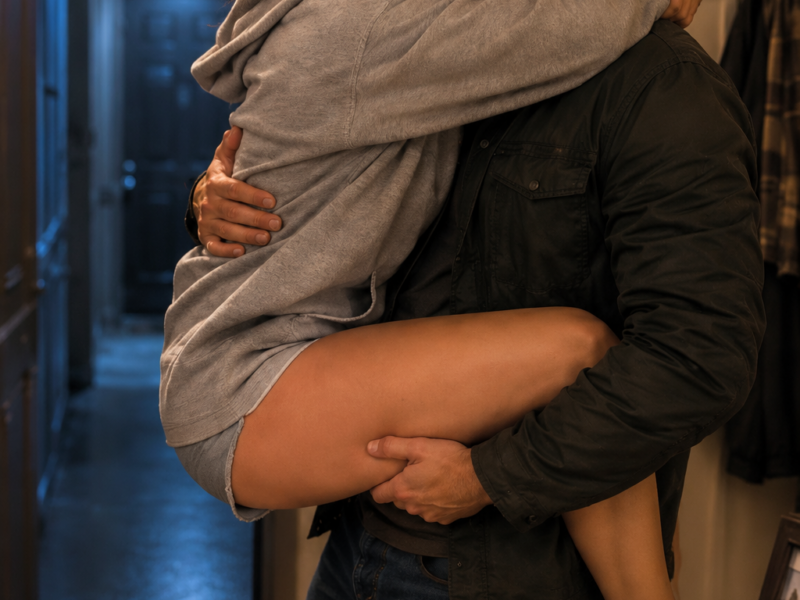
I barely had time to recognize her before Sophie Bennett crashed into me.
Her arms wrapped around my neck, her body pressed against mine, and the force of her embrace sent my duffel bag tumbling onto the floor. I stumbled backward, catching her instinctively as she clung to me with a desperation that made my heart skip.
For several seconds, neither of us spoke.
She simply held me.
Her face was buried against my shoulder, her fingers gripping the back of my shirt as though she was afraid I might disappear if she loosened them. I could feel her trembling, and when she finally whispered something against my neck, her voice was so quiet that I almost missed it.
“You’re here.”
I closed my eyes.
“I’m here.”
Her arms tightened.
I had imagined this moment dozens of times during my deployment. Sometimes I pictured Sophie opening the door with a sleepy smile. Other times, I imagined her making some sarcastic comment about how I looked like I had spent six months living inside a toolbox. I had even imagined her complaining that I hadn’t warned her before arriving and that she needed at least twenty minutes to make the apartment look presentable.
What I hadn’t imagined was being welcomed home like someone she had been afraid of losing forever.
My name is Caleb Hart. I was twenty-six years old, an aircraft mechanic in the United States Air Force, and until that night, I had spent nearly six months stationed in Qatar.
My return date was supposed to be the twenty-eighth. However, our replacement crew arrived earlier than expected, and an unexpected opening appeared on a transport flight heading home. After twenty-one hours of travel, several uncomfortable airport layovers, and enough terrible coffee to make me question every decision I had ever made, I finally found myself standing outside my own apartment.
It was June fourteenth.
Two weeks early.
I had decided not to tell anyone.
I wanted to surprise Sophie.
Looking back, that decision might have been the best and worst thing I had ever done.
Sophie and I had been roommates for almost two years. We had met through my cousin, who thought we would get along because we were both relatively responsible adults who could pay rent on time.
That assessment had been questionable from the beginning.
We signed a lease because neither of us could comfortably afford the apartment alone. It was a decent two-bedroom place in Virginia, close enough to the base that my commute wasn’t terrible and close enough to Sophie’s advertising agency that she could avoid spending half her life in traffic.
We established three rules when we moved in.
First, no leaving dirty dishes in the sink overnight.
Second, no bringing dates home without warning the other person.
Third, absolutely no making things weird.
The third rule had been my suggestion.
At the time, I thought it was sensible. Sophie was attractive, funny, intelligent, and occasionally impossible to live with, but we were friends. Good friends. I didn’t want to complicate something that worked.
Unfortunately, the longer we lived together, the harder it became to pretend I didn’t notice her.
Sophie was twenty-five and worked as a graphic designer for a small advertising agency. She had dark brown hair that she usually twisted into a messy bun, brown eyes that seemed to become brighter whenever she was amused, and a small scar near her chin from falling off a bicycle when she was nine.
She had told me that story during a power outage one evening while we sat on the kitchen floor drinking cheap wine and eating ice cream that was slowly melting.
She could turn grocery shopping into a competition, treated leftovers as if they were evidence in a criminal investigation, and sang terribly whenever she cooked.
She also had a strange habit of sitting on the kitchen counter despite the fact that we owned perfectly good chairs.
I had grown accustomed to all of it.
More than accustomed, actually.
I had started looking forward to coming home because I knew she would probably be there.
Before my deployment, something had begun changing between us. It was subtle at first. We started watching movies together more often. Sometimes she would fall asleep with her head resting against my shoulder, and I would remain perfectly still because I didn’t want to disturb her.
There were moments in the kitchen when we would stand closer than necessary. Her hand would brush mine while reaching for something, and neither of us would immediately move away.
Sometimes I caught her looking at me.
Whenever I asked what was wrong, she would smile and say nothing.
I did the same thing.
We were circling something neither of us had the courage to name.
Then my deployment orders arrived.
Suddenly, there was a perfectly reasonable explanation for why nothing was happening. I was leaving for six months. She had her career. We were roommates. It was complicated.
So we pretended everything was normal.
I was particularly good at pretending.
My previous serious relationship had ended badly. My girlfriend had eventually told me she couldn’t keep building a life around my absences. I didn’t blame her. Military life wasn’t easy, and I understood that asking someone to wait for you wasn’t a small request.
But after that relationship ended, I developed a habit of keeping people at a comfortable distance.
It was easier not to ask someone to stay than to watch them decide they couldn’t.
Sophie had never asked me to promise anything.
And somehow, that made leaving even harder.
Now, standing in the hallway with her arms around my neck, I realized how much I had missed her.
I lowered my hands to her waist, intending to gently move her back so I could look at her properly.
Instead, I found myself holding her closer.
She felt warm beneath the oversized gray hoodie she was wearing. Her cheek rested against my shoulder, and I could smell the familiar vanilla candles she liked burning in the apartment.
“Do you know,” I murmured, “most people say welcome home before attempting a standing chokehold?”
She laughed against my neck.
But the sound broke halfway through, becoming something dangerously close to a sob.
That changed everything.
“Hey,” I whispered. “I’m fine.”
She didn’t move.
“You’re crying on government property.”
“You’re not government property.”
“Debatable.”
That finally earned a proper laugh.
She leaned back just enough to look at me, but her hands remained locked behind my neck.
Her eyes were wet. Her dark hair was loose and tangled from sleep, and there was a faint pillow crease on her cheek.
I had watched sunsets over the desert that made entire groups of exhausted airmen stop talking.
None of them had affected me the way she did standing in that hallway.
“You said the twenty-eighth,” she whispered.
“I know.”
“It’s the fourteenth.”
“I’ve recently learned how calendars work.”
She gave my shoulder a weak shove.
“You couldn’t text?”
“I wanted to surprise you.”
“Well, congratulations. I almost attacked you with a lamp.”
I glanced down the hallway.
A brass table lamp was lying on its side near her bedroom door.
“That would’ve been embarrassing paperwork.”
Her mouth curved, but her smile didn’t quite reach her eyes.
She studied my face carefully, almost as if she needed to confirm that I was actually standing in front of her.
Then her fingers touched the edge of my jaw.
“You look tired.”
“Twenty-one hours on planes will do that.”
“You look thinner, too.”
“Military cuisine is an ongoing international tragedy.”
She smiled faintly.
Then her expression became serious again.
“I watched the news too much.”
I knew exactly what she meant.
“Sophie…”
“You told me your base was safe. You said aircraft maintenance wasn’t exactly hand-to-hand combat. And I know that. I really do. But every time something happened anywhere in the region, I checked my phone.”
I swallowed.
“And when you didn’t answer for three days last month…”
“We had a communications blackout,” I reminded her gently.
“I know. You explained it afterward.”
There was no accusation in her voice.
That somehow made it worse.
I had spent months trying to protect her from worrying. During our calls, I talked about terrible coffee, sand getting into equipment, and the ridiculous things my fellow mechanics did when they were bored.
I told her funny stories.
I avoided the difficult ones.
I never mentioned how lonely the evenings could become or how often I thought about home.
More specifically, I avoided telling her how often I imagined coming home to her.
“I’m sorry,” I said.
She looked down.
“You don’t owe your roommate hourly proof of life.”
“No, but I owed you more than I gave you.”
Her eyes returned to mine.
For a moment, the apartment became completely quiet except for the refrigerator humming in the kitchen and the rain tapping against the living room windows.
Then I noticed the hoodie.
“Is that mine?”
She glanced down at the embroidered name above her chest.
“No.”
“Sophie.”
“It could belong to anyone.”
“Anyone named Hart who happens to be in the Air Force?”
“It was cold.”
“It’s June.”
“Air conditioning is unpredictable.”
I smiled.
“You missed me.”
She started to make a joke. I could practically see it forming behind her eyes, ready to rescue both of us from an uncomfortable moment.
But this time, she didn’t use it.
“Yes,” she said quietly. “I missed you.”
The words landed harder than her running embrace.
I had spent six months convincing myself that what I missed was simply the familiarity of home. Anyone would miss their own bed, their own kitchen, and having someone to talk to after work.
But no one else’s voice made a metal bunk in a crowded building feel less lonely.
No one else made me check time zones before making a phone call.
And no one else wore my old hoodie like it belonged to her.
I drew her slightly closer.
“If you keep holding me like this, I’m going to misunderstand.”
A blush spread across her cheeks.
She didn’t step away.
“What if you don’t?”
I stared at her.
For the first time that night, I genuinely had no idea what to say.
“Sophie…”
She looked toward my bedroom.
Only then did I notice the light underneath the door.
“There’s something in your room,” she said.
I frowned.
“What?”
“I was going to get rid of it before you came home.”
My hands loosened slightly around her waist.
“Should I be worried?”
“Probably.”
She took my hand and led me down the hallway.
My bedroom door stood slightly open. Through the gap, I could see dozens of folded pages scattered across my desk.
Some were stacked neatly.
Others had been placed beside my lamp.
A few had fallen onto the floor.
Sophie stopped with her fingers on the doorknob.
“I wrote to you every night,” she said.
I looked at her.
“What?”
“Letters. I wrote letters to you while you were gone. I just never sent any of them.”
She swallowed.
Then she looked directly into my eyes.
“Caleb, before you read them, I need to know something.”
Her fingers tightened around mine.
“Did you come home early because you missed this apartment, or because you missed me?”
I didn’t have to think about it.
“You.”
The answer came so quickly that even I was surprised.
Her lips parted.
“What?”
“I missed you.”
Her eyes searched mine, almost suspiciously, as though she expected me to take the words back.
“I missed the apartment, too,” I continued. “I missed my bed. I missed coffee that didn’t taste like it had been filtered through a work boot. I missed having someone argue with cooking videos in the kitchen.”
She gave a small laugh.
“But when they told me there was an open seat home, you were the first person I wanted to tell.”
“Then why didn’t you?”
“Because I wanted to see your face.”
A tear slipped down her cheek.
I caught it with my thumb.
“This face?” she asked.
“Exactly that one.”
“It’s two in the morning. This face has pillow lines.”
“I missed those, too.”
She laughed softly.
Then she looked at the letters.
“You should read one.”
“Are you sure?”
“No,” she admitted. “But do it anyway.”
I stepped into my bedroom.
Everything looked almost exactly as I had left it. My bed was made, my books were arranged on the dresser, and my spare boots were tucked beneath the desk.
There was one difference.
A framed photograph sat beside my lamp.
It showed Sophie and me on the apartment balcony the previous summer. She was laughing at something outside the frame while I was looking directly at her instead of the fireworks behind us.
I hadn’t known anyone had taken that picture.
I picked it up.
“You put this here?”
She folded her arms.
“Your room looked empty.”
I studied the photograph for another moment.
Then I placed it carefully back on the desk and picked up one of the letters.
The date at the top read May nineteenth.
“Not that one,” she said immediately.
I raised an eyebrow.
“Actually, maybe not any of them.”
“You’ve changed the rules in under ten seconds.”
“I’m under emotional stress.”
I held the letter toward her.
“You choose.”
She hesitated before selecting a page from the middle of the desk.
“This one is only moderately humiliating.”
“Comforting.”
I sat on the edge of the bed.
Sophie remained near the doorway until I patted the mattress beside me. After a moment, she came over and sat close enough that our knees touched.
I unfolded the page.
Her handwriting was familiar, although there was something different about seeing it written for me.
I began reading.
May 19.
You called today and spent six minutes describing a camel that stole somebody’s lunch. I laughed because you wanted me to, but I could tell you were exhausted.
I almost told you I love you.
My breath stopped.
Beside me, Sophie became completely still.
I continued.
Not in the casual way I say I love the Thai place downstairs or how I love when you remember to buy my tea. I mean, I think I’ve been falling in love with you for months.
And somehow it took you being thousands of miles away for me to stop lying to myself.
I didn’t tell you because you sounded so far away. Because you’ve made it clear that waiting is too much to ask of anyone.
But you never asked me.
Maybe that’s what hurts the most. You decided for me.
I lowered the letter.
For a moment, neither of us spoke.
Sophie stared at her hands.
“Moderately humiliating may have been an inaccurate rating,” I said.
She let out a nervous breath.
“You love me?”
She flinched.
“That’s what I wrote.”
“That isn’t what I asked.”
Her head came up.
“You don’t get to interrogate me like this.”
“I’m not interrogating you.”
“You have your serious sergeant voice.”
“I have one voice.”
“You have at least twelve. There’s the polite voice you use with neighbors, the annoyed voice you use when I move your tools, and the terrifyingly calm one you used when I backed into the mailbox.”
“You told me the mailbox moved.”
“It was dark.”
“It was concrete.”
She tried to glare at me, but her mouth betrayed her.
I placed the letter on the bed.
“This isn’t my sergeant voice,” I said. “This is me trying not to hope for something I have no right to expect.”
Her amusement disappeared.
“Why wouldn’t you have the right?”
“Because I left.”
“You were deployed, Caleb. You didn’t abandon me to join a traveling circus.”
“I’ll leave again.”
The words fell between us.
I couldn’t promise her a life without military orders, training exercises, temporary assignments, or missed holidays. I couldn’t guarantee that every phone call would arrive on time.
My father had worn a uniform, too.
Growing up, I watched my mother eat anniversary dinners alone because my father was stationed somewhere far away. I remembered the way she smiled whenever he called, even when she had clearly been crying before answering.
I had promised myself I would never ask someone to build a life around an empty chair.
Sophie turned toward me completely.
“You keep doing that.”
“Doing what?”
“Rejecting yourself for me.”
I looked away.
She reached up, caught my chin, and gently turned my face toward hers.
“You decide I’ll resent you. You decide I can’t handle the distance. You decide it’s kinder not to ask what I want.”
Her eyes were shining, but her voice remained steady.
“You don’t get to choose both sides of this.”
I stared at her.
“What do you want?”
She leaned closer until her forehead touched mine.
“You.”
The word was barely louder than a whisper.
“Even when you’re irritating. Even when you fold towels like they’re reporting for inspection. Even when you’re far away.”
My hand found her waist.
“And when I’m home?”
She smiled.
“Especially then.”
I wanted to kiss her.
The realization wasn’t new. I had imagined doing it countless times, usually at moments when I knew I shouldn’t.
But now, for once, I wasn’t going to bury the feeling beneath an excuse.
I touched my thumb gently to her lower lip.
“Sophie, if I kiss you, I’m not doing it because I’m tired or because I’ve been away.”
“Good.”
“I’m doing it because I’ve thought about it for months.”
“Only months?”
“Possibly longer.”
“That’s better.”
Her hand slid behind my neck.
“Caleb?”
“Yeah?”
“You talk too much when you’re nervous.”
Then she kissed me.
For one stunned second, I didn’t move.
Her lips were soft, and the kiss was careful, almost hesitant. When she started to pull away, instinct finally caught up with me.
I drew her back, cupping her face as our lips met again.
This time, there was no hesitation.
Six months of restraint seemed to disappear in a single moment. Her fingers slipped into my hair, and my arm circled her waist as she moved closer.
When we finally separated, she kept her forehead against mine.
“Welcome home,” she whispered.
I smiled.
“That was worth the flight.”
She kissed the corner of my mouth.
“You smell terrible.”
“There she is.”
We spent the next couple of hours sitting together on my bed, reading pieces of her letters.
Some were funny. Others were painfully honest.
One described how she had made dinner for two without thinking and only realized what she had done when she set an extra plate on the table.
Another described a night when she couldn’t sleep because a storm reminded her of the evening we had watched lightning from the balcony.
There were letters about missing my ridiculous jokes, my terrible singing, and the way I always checked the apartment locks before going to bed.
There were also several pages where she admitted she had almost called me just to hear my voice, even though she knew I was probably asleep.
At four in the morning, we finally made tea and carried two mugs to the balcony.
The rain had stopped.
The city was quiet, and the sky was beginning to lighten over the neighboring buildings.
Sophie rested her head on my shoulder beneath the blanket we had taken from the couch.
“So,” she asked, “what happens now?”
“I take you to dinner.”
“We’ve had dinner hundreds of times.”
“Not like this.”
“Will there be rules?”
“One.”
She tilted her face toward mine.
“Which is?”
“I’m allowed to kiss you at the end.”
“That sounds less like a rule and more like a request.”
“Is it approved?”
She kissed me slowly.
“Conditionally.”
I laughed and pulled her closer.
Then I noticed something behind the balcony door.
Three cardboard boxes were stacked near the wall.
Each had a label written in Sophie’s handwriting.
Kitchen.
Books.
Denver.
My smile disappeared.
“Sophie?”
She followed my gaze.
The warmth slowly left her expression.
“I was going to tell you after you got some sleep.”
“Tell me what?”
She sat up, drawing the blanket tightly around herself.
“The day after you left, my company offered me a promotion.”
I looked at the boxes again.
“In Denver?”
She nodded.
“Creative director. Almost twice my current salary. My own team. Bigger clients.”
“When do they need an answer?”
Her eyes met mine.
“Tomorrow.”
I stared at her.
“When were you going to tell me?”
She looked at the boxes instead of answering.
“Before you came home.”
“That clears up nothing.”
“I thought I had two more weeks.”
“So you planned to move out while I was gone?”
Her expression tightened.
“I planned to make a decision while you were gone.”
“There are three boxes labeled Denver.”
“People can own boxes without crossing state lines.”
“Interesting theory.”
“I like an organized hypothetical.”
I stood, letting the blanket slip from my shoulders.
An hour earlier, I had kissed the woman I loved and believed the hardest part was over.
Now I felt as though I had returned home just in time to watch her leave.
“It’s a major promotion,” she said. “I should take it.”
“You should.”
The answer came automatically.
It was the correct response. Supportive, mature, unselfish.
But Sophie stared at me as though I had just slapped her.
“That was fast.”
“It sounds like a great opportunity.”
“I know what it is.”
“Then what do you want me to say?”
She stood and began folding the blanket with angry, uneven movements.
“I don’t know, Caleb. Maybe take longer than four seconds before encouraging me to move seventeen hundred miles away.”
“You want me to tell you to give up your career?”
“No!”
“Then help me understand.”
“I want you to care.”
“I do care.”
“You’re doing it again.”
She threw the blanket onto a chair.
“You’re deciding what the noble response should be without saying what you actually feel.”
I opened my mouth, but she raised a finger.
“No sergeant voice. No self-sacrificing speech. Just the truth.”
The truth was ugly and selfish.
I wanted to carry those boxes downstairs and throw them into the recycling bin.
I wanted her clothes in the laundry room, her tea beside the stove, and her ridiculous collection of decorative pillows taking up most of our couch.
I wanted to wake up the next morning knowing I could kiss her again.
“I don’t want you to go,” I said.
Her anger softened.
I crossed the balcony and stopped in front of her.
“I don’t want to come home to an apartment without you in it. I don’t want to watch movies alone or cook for one or pretend that someone else stealing my hoodie would feel the same.”
A trembling smile touched her mouth.
“And I really don’t want our first kiss to become something we discuss over scheduled video calls.”
She looked at me for a long moment.
Then she whispered something that changed everything.
“Then ask me to stay.”
My heart thudded.
“Stay.”
Her eyes closed briefly.
I took both her hands.
“Stay because I want a chance to do this properly. Stay because I’m in love with you, too.”
Her eyes opened.
“You’re in love with me?”
“Apparently, deployment made me reckless.”
She laughed through fresh tears.
“You picked a strange time to develop courage.”
“I work slowly. Glacially, apparently.”
I forced myself to continue.
“I’m not asking you to turn down the job. I’m asking you not to decide out of fear. Not fear of losing me, and not fear that staying means you weren’t brave enough to leave.”
She studied me for a long moment.
Then she admitted something I hadn’t expected.
“I applied for it because of you.”
The words hurt more than I expected.
“Because you wanted to get away from me?”
“Because I wanted to get away from loving you.”
She pressed her lips together.
“The apartment felt empty after you left. Every room reminded me of something I couldn’t have. I kept thinking about the things I should have told you before you deployed.”
She looked toward the boxes.
“Then the Denver position opened, and I thought maybe distance would fix me.”
“Did it?”
She gave a small, sad laugh.
“You’ve seen the letters.”
I reached for her waist and pulled her closer.
“No more deciding for each other,” she whispered.
“No more pretending.”
“And if you say something noble and emotionally repressed, I’m allowed to throw a decorative pillow at you.”
“You own too many.”
“That gives me an unfair tactical advantage.”
I smiled.
“You love my pillows.”
“I tolerate them because I love you.”
She laughed, and the sound made something inside my chest finally relax.
Then she kissed me again.
This kiss was different.
There was nothing tentative about it. She rose onto her toes, wrapped both arms around my neck, and chose me with an assurance that made six months of loneliness feel suddenly worth surviving.
When we separated, she whispered, “Say it again.”
“I love you.”
“Better.”
“Your turn.”
She pretended to think.
“I’m moderately fond of you.”
“I read the letters. You wrote it down forty-three times.”
“Some were drafts.”
I kissed her before she could invent another excuse.
Eventually, we agreed that no life-changing decision should be made at dawn by two people running on airline coffee, cinnamon tea, and almost no sleep.
I slept for five hours.
When I woke, I found a note tucked beneath my pillow.
Shower. Civilian clothes. Kitchen at noon. This is a date.
Underneath, she had added:
Being late will be noted in your permanent record.
I found her in the kitchen wearing a blue sundress and attempting to make pancakes.
“You cooked?”
“Don’t sound terrified.”
“I’m assessing risk.”
She pointed a spatula toward a small stack on the table.
“I watched three tutorials.”
“That explains the fire extinguisher.”
“It’s called preparedness. I learned it from you.”
I stepped behind her, slipped my arms around her waist, and kissed her shoulder.
She relaxed against me.
“This is distracting,” she murmured.
“That’s the objective.”
“You’re going to burn lunch.”
“Worth it.”
She turned in my arms.
“You’re different today.”
“Different how?”
“More open.”
I knew what she meant.
I kissed her forehead.
“I’m trying.”
“I know.”
We ate misshapen pancakes and talked about Denver.
For the first time, we discussed the job as a real opportunity rather than an enemy threatening to take her away from me.
Sophie showed me the job description, the salary, and photographs of the office. She explained the responsibilities, the clients, and the people she would manage.
I could see how excited she was.
She had worked incredibly hard to become a designer. She deserved the opportunity.
My assignment in Virginia still had at least eighteen months remaining. I couldn’t simply follow her across the country, and neither of us wanted to begin our relationship by demanding that the other abandon everything.
“What if I ask them about remote work?” she suggested.
“Would you be happy doing that?”
“Maybe. But I need to see the office first.”
“When?”
She glanced at the clock.
“That’s the problem.”
Before I could answer, her phone rang.
A Denver number appeared on the screen.
She looked at me before answering.
“Hello?”
A woman introduced herself as Dana Walsh, the company’s vice president. Sophie put the call on speaker.
Dana explained that the final candidate had withdrawn, leaving the position open again. The company still wanted Sophie, but the board needed her answer by the following evening.
Then came an unexpected offer.
“We’d like to fly you to Denver this afternoon,” Dana said. “You can tour the office, meet the team, and make sure the opportunity feels right. We can cover a second ticket if you’d like to bring someone whose opinion you trust.”
Sophie looked at me.
The question was already written across her face.
I had twelve days of post-deployment leave, an unpacked duffel bag, and absolutely no idea whether flying to Denver would make things easier or harder.
But we had made a promise.
We would stop making decisions for each other.
So I reached across the counter and took her hand.
“What time’s the flight?” I asked.
Six hours later, Sophie and I were flying west.
She had the window seat. I had the middle seat, trapped between her and a businessman who appeared to believe that armrests were personal property.
Sophie glanced at me.
“You’re glaring.”
“I’m establishing boundaries with my face.”
“It’s an effective face.”
She smiled and slipped her hand into mine beneath the airline blanket.
The simple contact softened me instantly.
“Very intimidating, Sergeant Hart.”
“Don’t expose tactical weaknesses in public.”
She rested her head on my shoulder.
“Your secret is safe.”
We spent most of the flight discussing everything except the reason we were there.
She showed me design ideas on her tablet. I told her more stories about the camel incident she had written about. We compared terrible airport food and argued about whether airplane pretzels were actually edible.
But as we descended over Colorado, I felt her fingers tighten around mine.
“Nervous?” I asked.
She nodded.
“What if I love it?”
There it was.
She wasn’t worried about being rejected.
She was worried she might actually want the life waiting for her in Denver.
I lifted her hand and kissed her knuckles.
“Then we deal with that.”
“And if you hate it?”
“I won’t hate something just because it wants you, too.”
She turned toward me.
“That was almost disgustingly romantic.”
“I can ruin it.”
“I’m sure you can.”
“Your elbow has been in my ribs since Baltimore.”
She laughed and kissed my cheek.
The company had booked us separate hotel rooms downtown.
When the receptionist handed us two key cards, Sophie raised an eyebrow.
“Very respectable.”
“I can march back and complain.”
“On what grounds?”
“Emotional inconvenience.”
She laughed as we stepped into the elevator.
The doors opened on her floor.
“Meet me downstairs in twenty minutes,” she said.
“I’ll be there in fifteen.”
“Overachiever.”
She kissed me quickly and disappeared into her room.
The office occupied several upper floors of a glass building overlooking the city.
The moment we walked inside, I noticed a change in Sophie.
She was still the woman who stole my hoodies, sang terribly while cooking, and threatened pancakes with open flames.
But there was another side of her that I hadn’t fully appreciated before.
She was confident.
She asked sharp questions, remembered everyone’s names, and listened carefully when the team explained their projects.
During a presentation, they showed her an advertising campaign that wasn’t performing as expected.
Sophie studied the designs for less than a minute before identifying the problem.
She explained that the visuals were attractive but lacked a clear emotional direction. The message was competing with the product instead of supporting it.
The room changed.
People leaned forward.
One designer began taking notes.
Another asked her how she would approach the redesign.
I watched from the far end of the conference table, feeling a strange mixture of pride and fear.
She belonged there.
Not because someone had offered her a better salary or a bigger title.
Because she was genuinely talented.
During a break, Dana Walsh approached me near the windows.
“You must be important,” she said.
“I’m the roommate.”
Dana glanced across the office.
“I don’t think that’s how she introduced you.”
I looked at Sophie, who was laughing with two designers.
She caught me watching and smiled.
“No,” I admitted. “I guess it isn’t.”
Dana explained that the position would give Sophie responsibility for the company’s largest account. She would build a new creative team, lead client meetings, and oversee projects that could significantly influence the agency’s future.
It wasn’t simply a promotion.
It was the kind of opportunity that could redirect her entire career.
When the tour ended, Sophie asked whether remote work from Virginia would be possible.
Dana was kind but firm.
They could allow occasional remote weeks after the first year, but the creative director needed to be physically present during the initial stages.
Sophie nodded professionally.
I saw the disappointment anyway.
They gave her until noon the following day.
Outside, evening had settled over Denver.
The mountains stood dark against a pink sky, and the streets were filling with people heading toward restaurants and train stations.
Sophie walked beside me in silence.
“Well?” she finally asked.
“You were incredible.”
She searched my face.
“And?”
“And you know you want it.”
She stopped walking.
“That isn’t fair.”
“What isn’t?”
“You were supposed to point out problems.”
“The office coffee looked questionable.”
“Caleb.”
“The man in accounting wore running shoes with a suit.”
She folded her arms.
“I’m serious.”
“So am I.”
“You don’t have one real criticism.”
“I have several.”
“Such as?”
I shoved my hands into my pockets.
“They’re all selfish.”
People moved around us, hurrying toward their destinations.
Sophie stood perfectly still.
“Tell me.”
I looked down at the sidewalk.
“I hate that they’re here. I hate that the view is beautiful. I hate that your face lit up when they showed you your office.”
Her expression softened.
“And I hate that I can’t ask for a transfer tomorrow and follow you.”
She took a small step closer.
“I never asked you to.”
“I know.”
I looked at her.
“But that doesn’t make it easier.”
Her eyes grew wet.
“I finally told you how I feel, and twenty-four hours later, I’m considering leaving.”
“You were considering it before I came home.”
“That doesn’t make it better.”
“It makes it honest.”
She looked toward the mountains.
“What if distance ruins this?”
I thought about the letters on my desk.
All those things she had written because she was afraid to say them aloud.
“Distance didn’t ruin us,” I said. “Not talking nearly did.”
She turned toward me.
I moved closer.
“If you take this job, I’ll probably hate Denver every time I miss you. I’ll complain about flights. I’ll make schedules you’ll find deeply unromantic.”
“You definitely will.”
“But I won’t disappear when things get difficult.”
“What are you saying?”
“I’m saying I want you to take the job.”
Pain flashed across her face.
Before she could step away, I gently cupped her cheeks.
“And I’m asking you to stay with me.”
She stared at me.
“Not in Virginia,” I continued. “In this. With me.”
A tear escaped, and I brushed it away.
“I don’t need you to choose between loving me and becoming who you want to be. Choose both. Let me choose both, too.”
Her hands closed around the front of my shirt.
“Seventeen hundred miles,” she whispered.
“About twenty-six hundred by road.”
“That isn’t helpful.”
“I checked during the flight.”
“Of course you did.”
“I also checked ticket prices, direct flight schedules, and how many weekends of leave I should have.”
She narrowed her eyes.
“You made a spreadsheet, didn’t you?”
“It’s color-coded.”
She laughed through her tears.
Then she pulled me down into a kiss.
We stood on a crowded Denver sidewalk, kissing as though we had already wasted enough time pretending we didn’t belong together.
When we finally separated, Sophie rested her forehead against my chest.
“I love you,” she whispered. “I’m scared, but I love you.”
“I love you, too.”
“And I hate your spreadsheet.”
“You haven’t seen it.”
“I know you. There are formulas.”
“Very good formulas.”
She shook her head, smiling.
That night, we ate at a small restaurant near the hotel.
Sophie insisted it was our first official date because, apparently, pancakes didn’t qualify.
We shared dessert, stole strawberries from each other’s plates, and talked about the practical details of a long-distance relationship.
We discussed visits, holidays, video calls, and the importance of being honest when things became difficult.
We established three new rules.
No disappearing during arguments.
No pretending everything was fine when it wasn’t.
And no making sacrifices secretly, expecting the other person to appreciate them later.
Back at the hotel, Sophie followed me into my room.
“Separate rooms were a waste of money,” she announced.
“Should we inform accounting tomorrow?”
She slipped her arms around my neck.
There was still fear beneath her smile, but there was something else, too.
Choice.
I kissed her slowly, and later, we lay together in the darkness, her head resting over my heart.
“Promise me something,” she whispered.
“Anything.”
“If this becomes too hard, you tell me. You don’t decide you’re setting me free.”
“I promise.”
“And if I get scared, I tell you. I don’t start packing hypothetical boxes.”
“Agreed.”
She lifted her head.
“You know those boxes weren’t hypothetical.”
“I know.”
“I had already signed a lease application in Denver.”
That startled me.
“How far did it go?”
“It was approved yesterday.”
I absorbed the information.
She had been much closer to leaving than I had understood.
“What time is move-in?”
Her eyes widened.
“You’re not angry?”
“I’m terrified. There’s a difference.”
She kissed my chest and settled against me again.
The following morning, Sophie dressed for her meeting while I buttoned my shirt.
She stood in front of the mirror for a long time, adjusting her hair and checking her appearance.
“Have you decided?” I asked.
She turned.
“Yes.”
My stomach tightened.
She crossed the room, wrapped her arms around my neck, and kissed me.
“I’m accepting the job.”
The words hurt, even though I had encouraged her to say them.
I kissed her back anyway.
“Then I’m proud of you.”
At 12:07, we left the office together.
Sophie had signed the contract.
Her start date was six weeks away.
We had barely reached the corner when her phone rang.
Dana’s name appeared on the screen.
Sophie answered.
She listened without speaking, and gradually, all the color drained from her face.
When the call ended, she stared at the phone.
“What happened?” I asked.
She swallowed.
“The company that owns our Virginia apartment building just contacted Dana for employment verification.”
I frowned.
“Why would they need that?”
“For the lease application. There’s been a mistake.”
“What kind of mistake?”
She looked at me.
“They approved the Denver lease starting Monday, not six weeks from now.”
I blinked.
“And?”
She took a shaky breath.
“They’ve already rented our Virginia apartment to someone else.”
For several seconds, neither of us spoke.
Then Sophie looked at me with growing panic.
“I can fix this.”
“How?”
“I’ll reject the job. Dana hasn’t filed everything yet. I’ll call the Denver landlord and cancel.”
“No.”
She blinked.
“Caleb…”
“We made rules last night.”
“This is different.”
“It isn’t.”
“Our home is gone!”
“Not yet. We don’t even know exactly what happened.”
I took her phone and called the property manager.
The situation was bad, but not quite as catastrophic as Sophie believed.
Our lease was due for renewal at the end of the month. When Sophie submitted her Denver application, the screening service contacted the same national property company that owned our Virginia building.
Someone had seen her relocation date, incorrectly marked our current lease as non-renewing, and offered the apartment to a waiting tenant.
The new tenant wasn’t moving in Monday.
However, our apartment would no longer be available after the end of the month.
We had thirty days.
Sophie listened as I explained everything.
When I finished the call, she covered her face.
“I’m so sorry.”
“I must have checked the wrong box.”
“Probably the one labeled create maximum emotional chaos.”
“This isn’t funny.”
“No, but you look like you’re about to volunteer for prison.”
“I gave away our apartment.”
“You made a mistake.”
“A huge one.”
I stepped closer.
“Do you want the Denver job?”
She stared at me.
“That’s still your question?”
“It’s the question.”
“Yes,” she whispered.
“Do you want us?”
Her expression crumpled.
“More than anything.”
“Then we solve the rest.”
She shook her head.
“How are you so calm?”
“I repair aircraft. Panicking usually makes the problem worse.”
“You weren’t this calm five minutes ago.”
“Five minutes ago, I was imagining living in my car.”
That earned a small laugh.
I touched her cheek.
“The apartment was where we lived. It wasn’t what made us us.”
Her arms went around my waist.
“What did?”
“You stealing my clothes. Obviously.”
She laughed against my chest.
“Forty-three love letters.”
“Some were drafts.”
“And you running at me hard enough to bruise a rib.”
“I thought you were a burglar.”
“You shouted my name.”
“A very convincing burglar.”
I kissed the top of her head.
“We have thirty days. I’ll help you move. Then I’ll find a smaller place near base.”
Her hold tightened.
“I hate that you’ll go back to an empty apartment.”
“It won’t be empty.”
“Caleb…”
“I’ll have your decorative pillows.”
She laughed.
I lifted her chin.
“And this isn’t goodbye.”
“No?”
“No. It’s going to be difficult, expensive, and occasionally miserable. But I choose you.”
Her eyes filled.
“I choose you, too.”
Then she kissed me in the middle of the Denver sidewalk, one hand gripping my shirt as though distance had already started trying to pull us apart.
We flew home that night.
The following month passed faster than either of us expected.
Our apartment slowly disappeared into cardboard boxes.
Sophie packed the kitchen. I repacked everything correctly.
She accused me of destroying her organizational system.
I pointed out that one box labeled bathroom contained a frying pan, two novels, and a shoe.
“It’s a transitional box,” she insisted.
“It’s a cry for help.”
“You’re impossible.”
“You love me.”
“Unfortunately.”
I caught her around the waist and kissed her until she forgot what she was complaining about.
We spent evenings sorting through belongings, deciding what Sophie would take to Denver and what I would keep in Virginia.
The letters were packed carefully in my carry-on because I refused to trust them to the movers.
The photograph from my bedroom went with them.
So did the hoodie she had been wearing when I came home.
On our final night in the apartment, we ordered Thai food and sat on the living room floor because the table had already been taken apart.
The room echoed whenever we laughed.
Sophie sat between my legs, leaning back against my chest.
The boxes were stacked around us, and the apartment looked strangely unfamiliar.
“It’s going to be weird,” she said.
“What is?”
“Not having you in the kitchen.”
“I thought you were excited to get your own kitchen.”
“I am.”
She rested her head against me.
“I’m going to miss you.”
I brushed her hair away from her neck.
“I’m going to miss you, too.”
She turned slightly.
“Do you remember our first night here?”
“Of course.”
“You burned pasta.”
“The stove was defective.”
“You forgot to add water.”
“That was a design flaw.”
She laughed.
I kissed the skin beneath her ear.
“You’re doing it again,” she murmured.
“Doing what?”
“Distracting me.”
“Still reckless.”
“Extremely.”
She turned in my arms and kissed me slowly.
When she pulled away, I reached into my pocket.
Her eyes widened.
“Caleb, it isn’t a ring.”
“Thank God.”
She laughed.
“Not because I don’t want one eventually. I do. But if you proposed after three official dates, I’d question whether you suffered a head injury overseas.”
“Good recovery.”
I opened my hand.
A new key rested in my palm.
She looked at it.
“What’s that?”
“The studio I rented near base.”
Her smile faded into confusion.
“Why are you giving me a key?”
“Because it’s still your home, too.”
She stared at me.
“Even from Denver?”
“Especially from Denver.”
She closed her fingers around the key and kissed me with tears on her cheeks.
The following morning, I drove west with her.
We decided to make a small road trip out of it rather than put her on another flight.
The journey took three days.
Sophie insisted on stopping at several roadside attractions that she claimed were culturally important. I questioned the cultural importance of a giant metal dinosaur beside a highway, but she refused to listen.
We argued about music across four states.
She wanted pop songs. I wanted classic rock.
Eventually, we compromised by playing a playlist that seemed to contain absolutely everything.
At every hotel, she fell asleep with her hand resting against my chest.
Sometimes I woke during the night and found myself watching her sleep, wondering how a person could become so important without either of you noticing when it happened.
When we finally reached Denver, I helped her unpack.
Her new apartment was bright and spacious, with large windows overlooking the city.
She had already chosen where her desk would go, where the couch would sit, and which wall would hold the photographs.
The first thing she unpacked was the picture of us on the balcony.
She placed it on the kitchen counter.
The second thing was my old hoodie.
“Seriously?” I asked.
“What?”
“You brought that?”
She slipped it on.
“It’s comfortable.”
“It’s mine.”
“Not anymore.”
I shook my head.
She smiled.
Then it was time for me to leave.
At the airport security line, Sophie tried very hard not to cry.
I held her hands.
“Six weeks,” I reminded her. “Until your next visit.”
“Unless you can trade a weekend.”
“I’ll check.”
“You already checked.”
“I have a spreadsheet.”
She laughed through her tears.
Then she wrapped her arms around my neck.
This time, I was the one who didn’t want to let go.
I held her tightly, breathing in the familiar scent of her shampoo, trying to memorize the feeling of having her close.
“I love you,” she whispered.
“I love you, too.”
She kissed me once more before stepping back.
I watched her walk away.
For the first time in my life, I understood that missing someone wasn’t necessarily a sign that something was wrong.
Sometimes it was simply the price of having someone worth missing.
The next eighteen months tested every promise we had made.
There were delayed flights, missed calls, exhausting workdays, and one argument that lasted across two time zones.
Sophie hated when I went quiet after difficult shifts. I hated when she said she was fine in the exact tone that meant she absolutely wasn’t.
Sometimes our schedules refused to cooperate.
There were evenings when I was getting ready for bed while she was preparing for an important presentation. Other times, she called during my lunch break only to discover that I had been pulled into an unexpected maintenance task.
We learned quickly that love didn’t automatically make distance easy.
It simply gave us a reason to keep trying.
We scheduled video dates.
We mailed handwritten letters, even though texting was faster.
Sophie sent me photographs of her office, her new projects, and the ridiculous things she saw around Denver.
I sent her pictures of sunsets over the base, terrible cafeteria meals, and the occasional aircraft component that she insisted looked like modern art.
She flew to Virginia for my promotion ceremony.
I spent Christmas in Denver and burned dinner so badly that she banned me from criticizing her pancakes for the next six months.
We argued sometimes.
We missed each other constantly.
But we stopped pretending.
Whenever something hurt, we talked about it.
Whenever one of us became frightened, we said so.
And slowly, the distance became something we managed rather than something we feared.
As my active-duty commitment approached its end, I began thinking seriously about the future.
For years, I had assumed that my career and a lasting relationship would always be competing with each other.
I thought I would eventually have to choose between serving and building a home with someone.
But Sophie had never asked me to stop being who I was.
She had simply asked me to let her be part of the decisions.
So I began researching opportunities closer to Denver.
Eventually, I applied for a full-time Air National Guard aircraft maintenance position at Buckley.
I didn’t tell Sophie immediately.
Not because I wanted to surprise her, but because I wanted to be certain I wasn’t making another decision on her behalf.
Once I received an interview invitation, I called her.
We talked for hours.
We discussed money, careers, housing, our plans for the next five years, and what we both wanted our lives to look like.
For the first time, planning a future with someone didn’t feel like surrendering part of myself.
It felt like choosing where I belonged.
I got the position.
A year and nine months after Sophie had run into my arms in Virginia, I arrived at her Denver apartment with another military duffel bag and a one-way ticket.
I didn’t tell her I was coming three days early.
Some surprises were worth keeping.
I knocked.
There was movement inside.
Then the door opened.
Sophie stood there wearing one of my old hoodies.
She stared at me.
For a moment, she didn’t seem to understand what she was seeing.
Then her eyes widened.
“Caleb?”
“Hey.”
She ran.
I dropped my duffel and caught her around the waist as she jumped into my arms.
Her legs wrapped around me, and she buried her face against my neck.
“You’re early,” she whispered.
“Only three days this time.”
She laughed and kissed me.
I carried her inside and set her down among the boxes she had packed for our new place.
One box sat apart from the others.
Its label was written in her familiar handwriting.
Letters. Photos. Our life.
I looked at it.
Then I looked at her.
“What’s in there?”
“Things I don’t trust movers with.”
I opened the box.
Inside were the forty-three letters, the photograph from our old balcony, several pictures from our road trip, and a few small objects that had somehow become important to both of us.
At the bottom was a small velvet case.
I picked it up.
Sophie covered her mouth.
I looked at her, then lowered myself to one knee.
“I know this is more than three dates,” I said.
She laughed through her tears.
“And I’m done pretending I can plan my life without asking what you want.”
Her hands trembled.
“Sophie Bennett, I spent years thinking that loving someone meant eventually asking them to wait while I went somewhere else. I thought the safest thing I could do was never ask anyone to stay.”
I opened the velvet case.
“But you taught me that love isn’t about keeping someone from leaving. It’s about choosing each other, even when life gives you difficult choices.”
Her eyes filled completely.
“I want the ordinary things with you. I want terrible pancakes, stolen hoodies, arguments about decorative pillows, and every ridiculous Tuesday that comes after the exciting days are over.”
I took a breath.
“I want to come home to you. I want to build a life with you, wherever that life takes us.”
My voice became quieter.
“Will you stay in this with me?”
Sophie dropped to her knees, too.
“Yes.”
I laughed.
“You’re supposed to let me finish.”
“You talk too much when you’re nervous.”
Then she kissed me before I could put the ring on.
When I finally managed to slide it onto her finger, she held up her hand and stared at it.
“Oh my God.”
“Good reaction?”
“I’m deciding.”
“Take your time.”
She looked at me.
Then she kissed me again.
By the following spring, we were married.
We chose a mountain overlook outside Denver, with the mountains stretching into the distance and the afternoon sunlight falling across the small gathering of family and friends.
My parents were there.
Her family was there.
Several of my military friends had traveled to attend.
Dana came, too, and Sophie joked that the entire relationship might have been impossible without her company accidentally arranging the apartment disaster.
We laughed about the old days.
About the brass lamp that nearly became a weapon.
About the disastrous pancakes.
About the boxes labeled Denver.
And about the night I came home two weeks early and found a woman wearing my hoodie waiting in the hallway.
On a small table beside our wedding photograph sat forty-three letters tied together with a blue ribbon.
I had asked Sophie why she wanted to display them.
She told me they were the most honest things she had ever written.
I told her they were the reason I finally understood what home meant.
We still had separate closets because Sophie refused to stop stealing my hoodies.
I still made schedules.
She still ignored them.
She continued sitting on kitchen counters even though we owned perfectly good chairs.
I continued folding towels as though they were being inspected.
Some things never changed.
But whenever I came home after a long shift, she met me at the door.
Sometimes she was cooking. Sometimes she was working on a design. Sometimes she was sitting on the couch with her laptop and a blanket covering her legs.
And sometimes, just like that first night, she came running.
She would wrap both arms around my neck, press her face against my shoulder, and hold on.
I no longer mistook that embrace for fear that I might leave.
It wasn’t desperation.
It wasn’t uncertainty.
It was simply Sophie reminding me that I had somewhere to come home to and someone who was happy I had returned.
One evening, several months after our wedding, I found her sitting on the kitchen counter again.
She was wearing another one of my hoodies.
I stopped in the doorway.
“Is that mine?”
She looked down.
“No.”
“Sophie.”
“It could belong to anyone.”
“Anyone named Hart?”
“Common surname.”
I walked toward her, placed my hands on her waist, and kissed her.
She smiled against my lips.
“You know,” she said, “I was really angry with you when you came home early.”
“Because I didn’t text?”
“Because you almost made me think you were going to leave again.”
I looked at her.
“I’m sorry.”
She touched my cheek.
“You don’t have to apologize for coming home.”
I smiled.
“Good. Because I plan to keep doing it.”
She wrapped her arms around my neck.
“That’s my favorite plan.”
I kissed her forehead.
And for the first time in my life, I no longer felt the need to prepare myself for the moment someone decided that my life was too difficult to share.
I had spent years believing that the people I loved deserved something easier than me.
Sophie had taught me that I didn’t get to make that decision for them.
Love wasn’t a promise that nothing would ever change. It wasn’t a guarantee that there would never be distance, missed flights, difficult assignments, or nights spent sleeping alone.
Love was the decision to be honest when things became difficult.
It was asking instead of assuming.
It was listening instead of deciding what was best for someone else.
And sometimes, it was simply finding the courage to say three words before another opportunity, another deployment, or another thousand miles separated you from the person standing in front of you.
I had returned from overseas two weeks early expecting a quiet apartment, a warm shower, and perhaps a sarcastic comment from my roommate.
Instead, I found forty-three unsent letters, a woman who had been fighting the same feelings I had been hiding, and a future I had never thought I was allowed to want.
That night changed everything.
And every time Sophie runs into my arms when I come home, I remember the moment I opened that apartment door.
I remember the hoodie.
The fallen lamp.
The trembling voice against my neck.
And the simple sentence that started the rest of our lives.
“You’re here.”
I always give her the same answer.
“I’m here.”
THE END