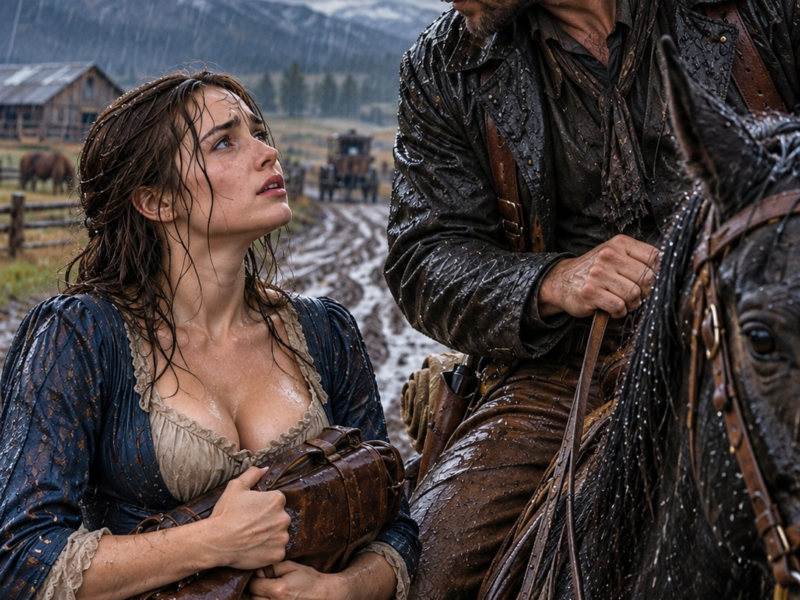
I Found a 24-Year-Old Mail-Order Bride Collapsing in a Montana Storm After the Man Who Promised to Marry Her Abandoned Her With Just 7 Cents. When I Took Her Into My Cabin, She Whispered, “I Don’t Believe in Nothing Anymore,” and I Discovered Her Fiancé Was Already Married With Two Children. But When $3,000 Vanished From the Town Bank, Everyone Accused Her of Helping the Robbers—and Even the Sheriff Came Knocking at My Door. What Happened Next Changed Everything…
I Found a 24-Year-Old Mail-Order Bride Collapsing in a Montana Storm After the Man Who Promised to Marry Her Abandoned Her With Just 7 Cents. When I Took Her Into My Cabin, She Whispered, “I Don’t Believe in Nothing Anymore,” and I Discovered Her Fiancé Was Already Married With Two Children. But When $3,000 Vanished From the Town Bank, Everyone Accused Her of Helping the Robbers—and Even the Sheriff Came Knocking at My Door. What Happened Next Changed Everything…
Part 1
The night I found Faith Bennett standing alone beside a cottonwood tree, the rain was coming down so hard I could barely see twenty yards ahead of my horse.
I almost rode past her.
At first, I thought the dark shape beside the road was a broken fence post. Then lightning tore across the Montana sky, and I saw a woman leaning against the tree, one hand pressed against its trunk as though it was the only thing keeping her upright.
Her dress was soaked through. Mud covered her skirts nearly to her knees. One of her shoes had split open, and even through the rain, I could see blood on her exposed toes.
But what struck me most was the little leather valise she held against her chest.
She clung to it like a drowning person holding on to a piece of driftwood.
I pulled my horse to a stop.
“Miss, where are you headed?”
She lifted her face.
I guessed she was about twenty-four. Her brown hair hung in wet strands around her cheeks, and her skin had turned an unhealthy shade of white. She looked exhausted beyond anything I had ever seen.
For several seconds, she simply stared.
Then she whispered, “I don’t know anymore.”
Something about those words stayed with me.
I had lived alone in that valley for twelve years. I minded my cattle, repaired my fences, and kept my distance from Willow Creek whenever possible. I had learned that other people’s troubles had a way of becoming your own if you weren’t careful.
Yet there I sat, watching a stranger shiver in the rain, knowing she wouldn’t survive another night out there.
“My cabin’s less than two miles away,” I told her. “You can get warm there.”
She looked at me suspiciously.
“You don’t know me.”
“No, ma’am.”
“How do I know you’re safe?”
I considered that.
“You don’t.”
A faint expression crossed her face. It might have been surprise, or perhaps she simply hadn’t expected an honest answer.
I reached down.
“Take my hand.”
She hesitated.
Lightning flashed again, illuminating the empty road stretching behind her. Whatever she’d left back there seemed to frighten her more than the stranger sitting on horseback.
Finally, she reached up.
Her fingers were colder than the rain.
By the time we reached my cabin, she could barely stay awake.
I carried her inside, set her in the chair closest to the stove, and hurried to build a fire.
That’s when I noticed how miserable my place looked.
Dirty plates sat beside the washbasin. Two shirts hung over the backs of chairs. Dust covered the windowsills, and an old coffee cup had been sitting beside the stove so long I couldn’t remember when I’d last used it.
For twelve years, none of that had mattered.
Suddenly, I felt embarrassed.
I found a wool blanket in my mother’s old chest and handed it to her.
“Wrap yourself in this.”
She obeyed without speaking.
I poured coffee into a tin cup and watched her hold it between trembling hands.
“What’s your name?”
“Faith Bennett.”
“Silas Mercer.”
She nodded.
For a while, the storm did all the talking.
Then I noticed a bundle of letters tied to the handle of her valise.
“You come from far away?”
“Ohio.”
“Didn’t walk all the way, I hope.”
The smallest smile touched her mouth.
“No.”
It disappeared almost immediately.
She stared into the fire.
“My parents died when I was seventeen. Fever took them both before winter.”
I said nothing.
“I went to work in a sewing mill outside Cincinnati. Twelve hours a day, sometimes longer. I saved what I could, but it was never enough to make a real life.”
Her fingers tightened around the cup.
“Then I saw an advertisement.”
I knew the sort she meant.
Out west, newspapers were full of notices from men looking for wives. Farmers, ranchers, widowers, lonely men with more land than companionship.
Back east, women answered those advertisements because sometimes a promise was the only thing standing between them and a lifetime of hardship.
“His name was James Hollister,” she said.
My stomach tightened.
I knew that name.
Everyone in Willow Creek knew it.
“He said he owned cattle east of town,” Faith continued. “He told me he had a fine house, but it felt empty without someone to share it.”
She looked almost ashamed.
“We wrote for four months.”
She untied the bundle and opened one of the letters.
“He said he wanted a wife who wasn’t afraid of hard work. He said he wasn’t looking for beauty or money. Just someone honest.”
Her voice grew quieter.
“He promised I would never be alone again.”
I stared into the flames.
James Hollister.
A man I had seen laughing outside the mercantile only two weeks earlier.
A man with a wife and two children.
Faith continued, unaware of what was happening inside my chest.
“He told me to take the train to Willow Creek. Said he’d meet me at the depot wearing a blue neckerchief.”
“What happened?”
She swallowed.
“Nobody came.”
The fire popped.
“I waited until dark. Then I waited the next day. On the third morning, the stationmaster told me nobody had been asking about a woman from Cincinnati.”
“How much money did you have?”
“Seven cents.”
I looked at her ruined shoes.
“So you started walking?”
She nodded.
“I thought maybe his ranch was outside town. Maybe there had been an accident. Maybe he’d fallen sick.”
“How far did you walk?”
“Thirty-five miles. Maybe forty. I lost track.”
I could hardly imagine it.
Forty miles in shoes meant for city streets, carrying everything she owned, searching for a man who had never intended to meet her.
Then she asked the question I had been dreading.
“Do you know him?”
I wanted to lie.
Not because I wished to protect Hollister, but because she looked like one more disappointment might finish what the storm had started.
Instead, I told her the truth.
“Yes.”
Her eyes widened.
“He owns the mercantile in Willow Creek. He doesn’t have a cattle ranch.”
Her face went still.
“And he’s married, Faith.”
She didn’t move.
“He has two children.”
For a long time, she stared at me without blinking.
I expected her to cry.
I expected anger, disbelief, perhaps a demand that I take her into town and confront the man who’d deceived her.
Instead, she slowly set down her coffee.
She untied the bundle of letters and walked toward the stove.
The first letter went into the flames.
Then the second.
Then the third.
I sat there watching four months of promises turn into ash.
When she reached the last letter, she hesitated.
I could see one sentence written across the page.
I promise you will never be alone again.
Her hand shook as she pushed it into the fire.
I had seen men lose cattle, homes, fortunes, and families. But there was something particularly terrible about watching a woman destroy the only future she had allowed herself to believe in.
“You can stay here,” I said.
She turned.
“Until you decide what comes next.”
Her expression hardened.
“What do you want in return?”
“Nothing.”
“I don’t believe in nothing anymore.”
I couldn’t blame her.
“Then call it shelter for tonight.”
She looked toward the storm outside.
Finally, she nodded.
I gave her the spare bedroom and slept in the chair beside the stove.
When morning came, she was still asleep.
She slept through breakfast, noon, and most of the afternoon.
I checked on her twice, quietly enough not to wake her.
The following morning, I went outside to repair a corral rail.
When I came back near noon, I stopped in the doorway.
My cabin looked like somebody else’s home.
The dishes had been washed. The table was scrubbed. My shirts were folded neatly beside the stove.
And Faith stood at the kitchen counter making cornbread.
She wore my mother’s old apron.
I hadn’t seen anyone wear it in fifteen years.
“What are you doing?” I asked.
She glanced over her shoulder.
“Earning my meals.”
“You should be resting.”
“I’ve rested.”
“Not enough.”
She turned toward me.
“Mr. Mercer, I’ve spent seven years working because I had no choice. I’d rather work now because I do.”
I didn’t know what to say to that.
So I sat down.
The cornbread was better than anything I’d eaten in years.
Over the following week, Faith refused to behave like a guest.
She mended my shirts, cleaned the windows, made soup from the dried beans in the cellar, and discovered that my kitchen contained enough neglected supplies to feed a small army.
One afternoon, I returned from the barn and found her sitting beside the window.
She had a needle in one hand and my oldest work shirt in the other.
Sunlight touched her hair.
For one painful moment, she looked so much like my mother in that same chair that I had to turn around and walk outside.
I stood behind the barn longer than necessary.
The memories came without warning.
My mother singing while she mended clothes.
My father laughing at supper.
My older brother promising he’d never abandon me.
And the silence that followed when every one of them was gone.
I had spent years convincing myself silence was easier.
Now I wasn’t certain.
Three days later, Faith asked me a strange question.
“Would you mind if I planted flowers?”
I looked up from my coffee.
“Flowers?”
“Beside the porch.”
“Why?”
She glanced toward the bare dirt outside.
“Because nothing’s grown there in a long time.”
I looked at her.
Somehow, I knew she wasn’t talking only about the dirt.
“Plant whatever you want.”
That afternoon, I spent nearly an hour pretending to repair a fence rail that wasn’t broken.
Faith knelt beside the porch, turning the soil with a little hand shovel.
When she caught me watching, I quickly hammered another nail into the perfectly sound rail.
She smiled.
A real smile this time.
That evening, she carried her leather valise out of the spare bedroom and placed it in the corner of the main room.
Until then, she’d kept it beside her bed.
I noticed immediately.
“You moving somewhere?”
She shook her head.
“I’m tired of carrying it.”
That was all.
But I understood what she meant.
For the first time, she had put down something she’d been afraid to release.
And for the first time in twelve years, my cabin felt like a place where somebody might still be waiting when I came home.
A few mornings later, Faith asked if we could ride into Willow Creek.
She wanted to mail a letter to an old friend in Cincinnati.
I agreed, although I wasn’t entirely comfortable with the idea.
Willow Creek was a small town.
Small towns remembered everything and forgave very little.
The moment we stepped inside Martha Perkins’s general store, every conversation stopped.
Three women standing near the counter looked at Faith, then at me.
Martha smiled without warmth.
“And who might this be, Silas?”
“Faith Bennett.”
She waited for an explanation.
I offered none.
Faith stepped forward.
“I’d like to mail a letter to Cincinnati, please.”
Martha accepted the envelope, but her eyes moved slowly over Faith’s clothes.
Then she looked at me again.
Faith paid the postage.
I bought grain and kerosene.
We were nearly outside when a woman’s voice drifted through the open window.
“That’s the mail-order bride.”
Faith stopped.
Another woman whispered, “The one abandoned at the depot?”
Then came laughter.
“And now she’s living with Silas Mercer.”
A third voice lowered.
“You know what that means.”
I turned toward the store.
Faith caught my wrist.
“Don’t.”
Her voice was quiet but firm.
I looked down at her hand.
She was trembling.
Yet her chin remained lifted.
So I kept walking.
We rode home in silence.
Several miles outside town, she finally spoke.
“They think I’m ruined.”
I kept my eyes on the road.
“They can think whatever they please.”
“They’ll think badly of you, too.”
“Already do.”
She studied me for a long moment.
Then she looked away.
I thought the worst of it had passed.
I didn’t know that within a week, the entire town would be accusing Faith of something far worse than living under my roof.
And the trouble began with a bank robbery.
Part 2
Seven mornings later, Wilbur Hayes rode up to my fence with news that made my blood run cold.
The bank in Willow Creek had been robbed.
More than three thousand dollars was missing, and Sheriff Harlon Pierce was questioning everyone who had recently arrived in the county.
Wilbur glanced toward Faith, who was sweeping the porch.
That single glance told me everything.
By afternoon, I rode into town for medicine for an injured horse. Outside the saloon, Pete Tucker caught my arm.
“Silas, there’s something you need to know.”
Inside, he lowered his voice.
“Ezra Jenkins claims he saw Faith talking to two strangers near the south road the evening before the robbery.”
“That’s impossible. She was at my cabin.”
“I know. But Martha Perkins is spreading the story.”
I stared at him.
Pete looked uncomfortable.
“People are frightened, Silas. They want somebody to blame.”
I rode home furious.
Faith had supper waiting, and I couldn’t bring myself to tell her what was happening.
She had already been betrayed by one man and humiliated by an entire town.
Now those same people wanted to make her a criminal.
But I knew rumors could turn dangerous faster than any wildfire.
And by Sunday morning, Faith would discover just how cruel Willow Creek could be.
Part 3
On Sunday morning, Faith came out of her bedroom wearing a dark blue calico dress.
Her hair was pinned neatly behind her head, and she’d polished her old shoes until the cracked leather almost looked respectable.
I was sitting at the kitchen table when she announced that she wanted to go to church.
I put down my coffee.
“Are you certain?”
“Yes.”
“Faith, those people—”
“I know what they think.”
She straightened her cuffs.
“But I’m tired of hiding from people who’ve done nothing to deserve my fear.”
I wanted to argue.
Instead, I reached for my hat.
The church stood at the edge of Willow Creek, a little white building with a bell that could be heard clear across town.
Wagons crowded the yard when we arrived. Children ran between the horses, and women gathered on the steps in their Sunday dresses.
Then somebody noticed us.
A conversation stopped.
Another followed.
By the time we reached the church doors, nearly everyone was staring.
Faith held her head high.
I walked beside her.
Inside, the congregation was singing.
The moment we entered, the hymn faltered and stopped.
Not gradually.
All at once.
I felt Faith’s fingers tighten around the little prayer book she carried.
For half a second, I thought she might turn around.
Instead, she walked down the center aisle and sat in the last pew.
I sat beside her.
The singing resumed, but the voices sounded strained.
Throughout the service, I watched the congregation more than I listened to Reverend Hollis.
The same women who whispered about Faith bowed their heads when the preacher spoke of mercy.
The same men who believed an accusation without evidence nodded solemnly when he warned against judgment.
I wondered whether any of them heard the words they were supposedly there to honor.
When the service ended, people hurried past our pew.
Nobody welcomed Faith.
Nobody introduced themselves.
A mother pulled her young daughter away when the child smiled at her.
Near the entrance, Martha Perkins stood speaking with two women.
Faith approached her.
“Good morning, Mrs. Perkins.”
Martha turned her back.
Deliberately.
I saw the exact moment Faith understood that the insult was intentional.
Her face went pale.
But she said nothing.
She simply walked outside.
We climbed into the wagon and left.
For the first several miles, neither of us spoke.
Then Faith broke the silence.
“There’s something you haven’t told me.”
I stared at the road.
She continued.
“I heard two women whispering about the bank robbery.”
My hands tightened on the reins.
“Faith—”
“They were saying my name.”
I knew then that keeping the rumors from her had been a mistake.
“Ezra Jenkins says he saw a woman speaking with two strangers near the south road.”
“When?”
“The evening before the robbery.”
Her brow furrowed.
“But I was at your cabin.”
“I know.”
“I haven’t even been into town except when we mailed my letter.”
“I know that, too.”
She turned toward me.
“Then why would he say it was me?”
“Because he saw somebody with brown hair, and somebody decided that was enough.”
She went quiet.
The wagon wheels rattled over the dry road.
Finally, she asked, “Do you believe him?”
“No.”
“Silas.”
I turned.
Her eyes were shining.
“Do you believe me?”
“I do.”
I didn’t hesitate.
Didn’t need to consider it.
She looked away so quickly that I barely saw her expression change.
But I noticed her hands relax in her lap.
That evening, Faith sat alone on the porch.
She hadn’t eaten much supper, and she hadn’t spoken since we’d returned.
I watched through the kitchen window until I couldn’t bear it any longer.
I took my mother’s old wool blanket outside and placed it around her shoulders.
She didn’t look up.
I started back toward the door.
“Silas?”
I stopped.
“Why do you believe me?”
I thought about giving her some grand answer.
Instead, I said the first thing that came to mind.
“Because people who plan bank robberies don’t spend their afternoons fixing another man’s socks.”
She made a strange little sound.
Half a laugh.
Half a sob.
I went back inside to give her privacy.
Through the window, I watched her shoulders begin to shake.
She hadn’t cried when Hollister abandoned her.
She hadn’t cried when those women mocked her.
She hadn’t even cried when the entire church treated her like something unclean.
But now she sat beneath my mother’s blanket, crying because one person believed her.
I stood there feeling something shift inside me.
I’d spent twelve years protecting myself from other people’s pain.
Suddenly, her pain mattered more than my own comfort.
Tuesday morning, Sheriff Harlon Pierce rode into my yard.
I was working near the barn when I heard the horse.
Faith came out onto the porch with flour on her hands.
The sheriff removed his hat.
“Miss Bennett, I need to ask you some questions.”
She nodded.
“Go ahead.”
He opened his notebook.
“When did you arrive in Willow Creek?”
“September sixteenth.”
“Where were you before that?”
“Cincinnati, Ohio.”
“Do you have anyone here who can verify your movements?”
Her face tightened.
“Mr. Mercer can.”
The sheriff glanced toward me.
“Anyone else?”
Faith lowered her eyes.
“No.”
He asked about the letters from Hollister.
She brought him the few she had saved after burning the others.
He examined them, then handed them back.
“These prove someone wrote to you. They don’t establish where you were the night before the robbery.”
“I was here,” she said.
I stepped forward.
“She was.”
The sheriff studied me.
“Are you certain?”
I felt anger rising.
“Sheriff, I’ve known you twenty years. Have you ever known me to lie to you?”
“No.”
“Then why start doubting me now?”
He closed his notebook.
“I’m doing my job, Silas.”
“Then do it properly.”
His expression hardened.
For a moment, neither of us moved.
Finally, he replaced his hat.
“I haven’t accused anybody. But I suggest you both stay in the county until this matter is settled.”
He mounted his horse.
Then he looked down at Faith.
“And keep your doors locked.”
He rode away without explaining the warning.
I watched him disappear down the road.
Faith stood beside me.
“Do you think somebody might come here?”
I didn’t answer immediately.
That frightened her more than anything I could have said.
That night, I checked every window, loaded my rifle, and made sure the barn doors were secured.
I told myself I was being careful.
But I had begun to understand what fear could do to an entire town.
A bank robbery had become a story about a stranger.
A stranger had become a suspect.
And a suspect could become a target long before anyone bothered to find the truth.
Near midnight, I woke to the sound of footsteps.
I reached for the lamp and walked into the kitchen.
Faith was kneeling beside her open valise.
Her clothes were scattered across the floor.
“What are you doing?”
She didn’t look up.
“Packing.”
“Why?”
“I’m leaving.”
I stared at her.
“Where will you go?”
“I don’t know.”
“Then you’re not leaving.”
She stood suddenly.
“You don’t get to decide that.”
She was right.
I stepped away from the doorway.
“Then tell me why.”
Her eyes were red.
“Because they’re going to destroy you because of me.”
“Let them try.”
“You have land, Silas. A reputation. A life you’ve worked for.”
“And?”
“And I have nothing!”
Her voice broke.
She pressed both hands against the table.
“I came here because a man lied to me. I had nowhere to go. You gave me shelter, and now people are treating you like a criminal just because you helped me.”
I approached slowly.
“Faith—”
“I’m not worth losing everything for.”
Those words hit me harder than anything she’d said.
For a moment, I saw a seventeen-year-old girl burying her parents.
A young woman working twelve-hour shifts to survive.
A frightened traveler waiting at a railway depot for a man who never came.
And now she believed that all those disappointments had somehow made her worthless.
I pulled out a chair.
“Sit down.”
She blinked.
“What?”
“I’m making coffee.”
“Silas, it’s midnight.”
“Then it’s a fine time for coffee.”
She stared at me.
Finally, she sat.
I filled the pot, stirred the ashes in the stove, and built up the fire.
We remained at that table for hours.
At first, she spoke about Ohio.
About her mother, who believed every hardship could lead to something good.
About the sewing mill, where the machinery never stopped long enough for a woman to hear herself think.
About the letters she’d waited for so eagerly.
Then she looked at me.
“I used to believe everything happened for a reason.”
I said nothing.
“But what reason could there be for this?”
Her voice trembled.
“A man lied to me. I crossed half the country for nothing. A whole town decided I was guilty because I was easy to hate.”
She wiped her eyes.
“Where is the good in that?”
I had no easy answer.
For years, I’d avoided telling anyone about my family.
That night, I told Faith everything.
My mother died when I was fourteen.
My father followed less than a year later.
My older brother inherited most of the cattle and sold them.
Then he sold the equipment, took the money, and went east.
He left me the cabin because nobody wanted it.
I was sixteen when I realized I had become the last Mercer in the valley.
“I spent years telling myself I didn’t need anybody,” I admitted.
Faith listened without interrupting.
“People can’t leave you if you never let them close.”
I looked around the kitchen.
“It worked for a while.”
“What changed?”
I met her eyes.
“You showed up in the rain.”
Her expression softened.
I leaned forward.
“Maybe terrible things don’t always happen for a reason. Maybe some people simply choose to be cruel.”
I paused.
“But I know what happened after you came here.”
She waited.
“You made this place feel like a home again.”
Tears gathered in her eyes.
I continued.
“You can leave whenever you want, Faith. I’ll never stop you.”
I nodded toward the door.
“But don’t leave because a frightened town tells you what you’re worth.”
She covered her mouth.
“Because they’re wrong.”
I stood and carried my cup to the sink.
Then I went to my room.
I lay awake listening.
For several minutes, there was silence.
Then I heard Faith moving through the kitchen.
Her valise scraped across the floor.
I held my breath.
Footsteps crossed the hallway.
They stopped outside the spare bedroom.
The door opened.
Then closed.
She had stayed.
I closed my eyes, feeling relief so powerful it almost hurt.
But while our cabin settled into silence, somewhere beyond the valley, four men were riding toward another town.
And what they were about to do would change everything.
Part 4
The next several weeks were the longest of my life.
Nothing happened quickly enough to satisfy me.
Sheriff Pierce continued his investigation. The stolen money remained missing, and the town’s suspicions seemed to grow stronger each time another lead failed.
Faith tried to behave as though life continued normally.
She made breakfast, tended her flowers, and worked on the little vegetable patch behind the cabin.
But I noticed the changes.
She no longer asked to visit Willow Creek.
When a rider approached the property, she stopped whatever she was doing and watched until she recognized him.
Sometimes I found her standing at the window, staring toward the road where I’d first discovered her.
Once, I heard her crying quietly in the spare bedroom.
I stood outside the door for several moments, wanting to comfort her but uncertain whether she’d welcome me.
In the end, I walked back to the kitchen.
The next morning, I repaired the loose board beside her flower bed.
It was a small thing.
But I couldn’t repair what the town had broken inside her.
One afternoon, Pete Tucker rode out to see me.
We stood near the barn while Faith worked in the garden.
“People are starting to question Jenkins’s story,” Pete said.
“About time.”
“He’s changed it twice.”
I looked up.
“What do you mean?”
“First, he claimed he saw a woman speaking with two men. Then he said there might have been three. Yesterday, he admitted he couldn’t remember what color dress she wore.”
I shook my head.
“Yet they’re still blaming Faith.”
Pete sighed.
“People don’t like admitting they’ve made fools of themselves.”
“Especially when they’ve hurt somebody innocent.”
He glanced toward the porch.
“She seems like a decent woman.”
“She is.”
“Then you’ve got nothing to be ashamed of.”
I looked at him sharply.
“Never said I did.”
Pete smiled faintly.
“No. Reckon you didn’t.”
After he left, I found Faith kneeling beside the porch.
She was pressing little seeds into the dirt.
“Who was that?” she asked.
“Pete Tucker.”
“More news?”
“Nothing worth troubling you with.”
She sat back on her heels.
“Silas, I’m tired of being protected from conversations about my own life.”
I knew she was right.
So I told her everything Pete had said.
She listened quietly.
Then she looked down at her hands.
“Do you think they’ll apologize when they realize they’re wrong?”
I considered the question.
“Some might.”
“And the others?”
“They’ll pretend they never said anything.”
She nodded slowly.
“That might be worse.”
I sat on the porch step.
“Maybe.”
She worked another seed into the ground.
“Do you know what I miss most about Ohio?”
“What?”
“Being ordinary.”
I looked at her.
She gave a sad smile.
“At the mill, I was just another woman working too many hours. Nobody cared where I slept or whom I talked to. Nobody watched me walk down the street.”
She brushed soil from her palms.
“Here, every little thing I do seems to mean something.”
I had no answer that could make it better.
So I stayed with her while she worked.
As September gave way to October, the nights grew colder.
The mountains turned silver in the early mornings, and wind swept down through the valley carrying the smell of approaching winter.
I began preparing the ranch for snow.
Faith insisted on helping.
She gathered kindling, stacked firewood, and stitched patches into the thick blankets we’d need during the cold months.
One afternoon, she discovered my mother’s old recipe book behind a row of forgotten jars.
She brought it to the table, carefully turning its yellowed pages.
“Your mother wrote all this?”
I nodded.
“Every word.”
Faith traced a line of faded handwriting.
“She must have loved cooking.”
“She loved feeding people.”
She smiled.
“I think I would’ve liked her.”
I looked at the book.
“She would’ve liked you, too.”
Faith went quiet.
Then she turned another page.
The following morning, I woke to the smell of cinnamon.
Faith had made a small apple cake using my mother’s recipe.
She set it on the table and watched nervously while I tasted it.
I closed my eyes.
For an instant, I was fourteen again.
My mother was humming beside the stove.
My father was coming through the door.
The house was full of voices.
I swallowed.
“Is it terrible?” Faith asked.
I shook my head.
“No.”
I cleared my throat.
“It’s just like she used to make.”
Faith’s eyes softened.
She didn’t say anything.
She simply cut me another slice.
That was one of the things I came to love about her before I was brave enough to call it love.
She never demanded an explanation for every quiet moment.
She seemed to understand that sometimes memories needed room.
And I was beginning to understand the same thing about her.
One evening, while we sat by the fire, Faith asked about James Hollister.
“Have you seen him lately?”
I stiffened.
“Not since all this started.”
“Do you suppose he knows what happened to me?”
“Likely.”
She looked into the flames.
“I wonder whether he’s ashamed.”
I almost laughed.
“Hollister? I doubt it.”
She was silent for a while.
Then she said, “I used to think I’d ask him why.”
“Why he wrote those letters?”
“Yes.”
“What would it change?”
“Nothing.”
She folded her hands.
“But perhaps I’d know whether he ever meant any of it.”
I studied her face.
She wasn’t looking for an excuse to forgive him.
She was still trying to understand how a person could write such tender words without meaning them.
Finally, I said, “Some men enjoy being admired more than they care about the people admiring them.”
She considered that.
“Then I suppose I loved someone who never existed.”
I couldn’t think of anything sadder.
A few days later, an early frost arrived.
Faith rushed outside before breakfast, worried about her flowers.
I found her covering the youngest plants with old cloth.
“You’ll freeze yourself,” I told her.
“They’re not ready for winter.”
“Neither are we.”
She looked up.
“Then we’d better get ready.”
I knelt beside her.
Together, we covered the flower beds.
When our hands brushed beneath the cloth, she looked at me.
For a moment, neither of us moved.
Then she smiled.
It was the kind of smile I had begun looking forward to more than sunrise.
I spent the rest of that morning thinking about it.
Seven weeks after Faith arrived, the truth finally came.
Sheriff Pierce rode into our yard just after sunrise.
I was coming from the barn when I saw him dismount.
Faith stood on the porch with a watering can.
Small golden flowers had opened beside the steps.
The sheriff removed his hat.
“We caught them.”
I stopped.
“Who?”
“The bank robbers.”
Faith’s watering can tilted slightly.
The sheriff continued.
“Four men. Sheriff down in Ridgewater caught them attempting another robbery. They confessed to Willow Creek.”
I felt something loosen inside my chest.
For weeks, I’d carried an anger so constant I’d almost stopped noticing its weight.
Now, suddenly, I could breathe.
Pierce looked toward Faith.
“There was no woman working with them.”
She stood perfectly still.
He shifted his hat.
“Jenkins did see a woman that evening. Turns out she was the wife of one of those men. Blond hair. Nothing like you.”
Faith said nothing.
The sheriff cleared his throat.
“Miss Bennett, I owe you an apology.”
I watched him carefully.
“I was wrong to let those rumors influence my investigation. Jenkins was wrong. And plenty of other people were wrong, too.”
Faith looked toward the road.
For seven weeks, those rumors had followed her everywhere.
They had taken away her freedom to walk into town without being watched.
They had turned church into a place of humiliation.
They had made her question whether helping hands could ever be trusted.
And now the sheriff stood on our porch hoping a few words might somehow erase it all.
Finally, she nodded.
“I appreciate you coming, Sheriff.”
Nothing more.
He seemed to understand.
Before leaving, he turned toward me.
“You trusted her when nobody else did.”
I glanced at Faith.
“Wasn’t difficult.”
After he rode away, we stood side by side.
The morning sun had begun warming the porch.
Faith looked down at the watering can.
“So it’s over?”
“The robbery investigation is.”
She nodded.
Then she whispered, “Will they stop looking at me that way?”
I wanted to promise they would.
But I’d learned something about promises.
They were easy to make when you weren’t the one who had to live with the consequences.
“I don’t know,” I admitted.
She closed her eyes.
I reached out and touched her elbow.
Just briefly.
She didn’t move away.
Three days later, Martha Perkins arrived carrying an apple pie.
I saw the wagon from the barn and nearly laughed when I recognized her.
Faith stepped onto the porch.
Martha climbed down wearing her finest Sunday dress.
She held the pie in front of her like a peace offering.
“I thought you might enjoy this.”
Faith accepted it.
“Thank you.”
Martha shifted uncomfortably.
“I suppose I should say something.”
Faith waited.
Martha looked everywhere except at her.
“We may have acted a little too quickly.”
Faith’s expression remained calm.
“You did.”
Martha’s cheeks reddened.
“I never meant for things to become so unpleasant.”
Faith looked down at the pie.
“Yet they did.”
For the first time since I’d known her, Martha Perkins seemed to have nothing to say.
Faith nodded politely.
“I’ll return your plate.”
Martha climbed back into her wagon and departed.
That evening, Faith cut two slices of pie.
I took a bite.
“Good pie.”
Faith tasted hers.
“Still don’t like her.”
I nearly choked on my coffee.
Then I laughed.
Actually laughed.
Faith stared.
“I didn’t know you could do that.”
“Neither did I.”
She started laughing, too.
And for the first time since the sheriff’s visit, the cabin seemed entirely free of fear.
But the town wasn’t finished trying to make amends.
Reverend Hollis came two days later.
He stood near Faith’s flowers, holding his Bible beneath one arm.
“The congregation would be pleased to welcome you back on Sunday,” he told her.
Faith looked at him.
“Would they?”
He shifted.
“I believe people recognize now that they judged you unfairly.”
She glanced toward the road.
“I’ll think about it.”
Sunday came.
Faith didn’t go.
Instead, she spent the morning planting more flowers.
I didn’t question her decision.
Forgiveness was something she would have to choose for herself.
And I had begun to realize that the most important thing I could offer her wasn’t protection.
It was the freedom to decide what happened next.
Part 5
The first real snow didn’t arrive until late November, but by then, the valley had already changed.
The grass turned gold, the trees lost their leaves, and the cold morning air carried the sharp scent of pine from the mountains.
Our cabin changed, too.
New curtains hung over the windows.
The old rocking chair had been repaired.
My mother’s recipe book sat on the kitchen shelf, where Faith could reach it whenever she pleased.
There were flowers beside the porch and fresh bread cooling on the table most afternoons.
But the greatest difference wasn’t anything I could point to.
It was the way I felt when I rode home at sunset.
For twelve years, I’d returned to a dark cabin, built a fire, eaten whatever happened to be available, and gone to bed without speaking more than a few words aloud.
Now I found myself hurrying through my chores because I wanted to hear Faith’s voice.
Sometimes she met me at the door.
Sometimes she was busy cooking or sewing.
Sometimes she sat beside the window reading one of the few books I’d kept from childhood.
But she was there.
And that simple fact changed the entire shape of my days.
One morning, a letter arrived from Ezra Jenkins.
Wilbur Hayes handed it to me at the fence, looking unusually uncomfortable.
“It’s for Miss Bennett.”
I carried it inside.
Faith was kneading bread.
When I placed the envelope on the table, she wiped her hands and examined the writing.
“Who’s it from?”
“Ezra Jenkins.”
She looked at me.
“The man who accused me?”
I nodded.
She sat down slowly and opened it.
The letter was short.
Jenkins admitted his eyesight had been failing for years. He wrote that he’d convinced himself he recognized Faith because everybody else was already talking about her.
He had wanted to be useful to the investigation.
Instead, he’d nearly ruined an innocent woman’s life.
At the bottom, in trembling handwriting, were three words.
I am sorry.
Faith read the letter twice.
Then she folded it.
“Are you going to burn it?” I asked.
She shook her head.
“No.”
She opened a little wooden chest and placed the letter inside.
“Do you forgive him?”
She thought for a moment.
“Not today.”
I nodded.
“Fair enough.”
She closed the chest.
“Maybe someday. But I want to remember that I don’t have to forgive someone simply because they’ve finally decided to apologize.”
I looked at her with a feeling I couldn’t quite name.
Respect, certainly.
Admiration, too.
But something deeper had been growing between us for weeks.
I was beginning to love her.
And the realization frightened me more than any storm I’d ever ridden through.
I had spent most of my adult life believing love was another word for loss.
Everyone I’d ever depended upon had either died or gone away.
My mother’s death had left a silence in the kitchen.
My father’s death had left an empty chair.
My brother’s departure had taught me that even blood didn’t guarantee loyalty.
So I’d built my life around never needing anybody.
Then Faith appeared beside the road with ruined shoes, seven cents, and a little leather valise.
She hadn’t asked me to love her.
She hadn’t even asked me to rescue her.
She’d simply accepted a place beside my fire.
And somehow, without either of us realizing it, she had become the reason I wanted to keep that fire burning.
One evening, we sat together on the porch watching the sunset.
The valley stretched before us in shades of copper and gold.
Faith had taken down her hair.
It fell over her shoulders in soft brown waves, catching the last sunlight.
She sat close enough that our shoulders almost touched.
“Silas?”
“Hmm?”
“I’ve been thinking about James Hollister.”
My jaw tightened.
She noticed.
“You still want to hit him?”
“Sometimes.”
“Only sometimes?”
I glanced at her.
“Depends on the day.”
She laughed softly.
Then her expression grew thoughtful.
“For a long time, I wondered why he did it.”
I waited.
“I thought if I understood, maybe it wouldn’t hurt so much.”
“Did it help?”
“No.”
She folded her hands in her lap.
“But I don’t wonder anymore.”
I looked at her.
“Why not?”
“Because I’ve finally realized something.”
The wind moved through the dried grass.
“If Hollister had been waiting at that depot, I might have married a man who lied to me before he ever touched my hand.”
I said nothing.
“I would’ve spent years wondering which of his words were true.”
She looked toward the cabin.
“And I never would’ve walked down that road in the rain.”
Something tightened in my chest.
“No,” I said.
She turned toward me.
“I never would’ve met you.”
I looked toward the distant mountains because I didn’t trust myself to meet her eyes.
Faith smiled.
“I think I got the better ending.”
For a long moment, the only sound was the wind moving through the valley.
Then I said, “I reckon I did, too.”
She turned toward me.
I kept my gaze fixed on the horizon.
I had faced cattle stampedes, violent storms, and winters cold enough to kill a man before morning.
But sitting beside Faith Bennett and admitting what she meant to me seemed harder than all of them.
Finally, she spoke.
“Silas, you know I won’t stay here forever just because you’ve been kind to me.”
I felt my stomach tighten.
“I know.”
“I need you to understand that.”
“I do.”
She looked down.
“I came west believing marriage would save me. I don’t want to spend the rest of my life thinking I need somebody else to give me a future.”
I turned toward her.
“Then don’t.”
She searched my face.
“What?”
“Don’t build your future around owing anybody something. Not Hollister. Not Willow Creek. Not me.”
Her eyes filled.
“You gave me everything when I had nothing.”
I shook my head.
“I gave you a room and a few meals.”
“You gave me somewhere to belong.”
I looked toward the flower beds.
“You did most of that yourself.”
She was quiet.
Then she said, “Do you ever think about getting married?”
My heart seemed to stop.
I stared straight ahead.
“Used to.”
“When?”
“Before I convinced myself it was a foolish idea.”
She smiled.
“And now?”
I took a long breath.
“Now I’m beginning to reconsider.”
Faith looked away, but I caught the color rising into her cheeks.
Neither of us spoke for several minutes.
Then she rested her hand on the bench between us.
Close to mine.
I looked at it.
Slowly, I moved my fingers across the wood.
When they touched hers, she didn’t pull away.
Instead, she turned her hand over.
Our fingers joined.
I had never believed such a small movement could mean so much.
But sitting there beneath the Montana sky, holding Faith’s hand, I felt something inside me finally surrender.
Not to fear.
To hope.
Later that evening, Faith carried her leather valise into the kitchen.
I stood beside the stove while she opened it.
Inside were the last letters from James Hollister.
She’d kept them because the sheriff had wanted proof of how she’d come to Willow Creek.
Now the investigation was over.
She lifted the bundle.
For a moment, she simply looked at it.
Then she opened the stove.
One by one, she fed the letters into the flames.
Paper curled.
Ink blackened.
Promises disappeared.
I remembered the first night she’d done the same thing.
Back then, she had burned those letters with trembling hands and a face so empty it frightened me.
Now her expression was calm.
When the final page vanished, she closed the stove door.
Then she reached into her apron pocket.
She brought out three small things.
A worn handkerchief I’d given her during the first week.
A pressed yellow flower from the little garden beside the porch.
And a folded piece of paper.
She placed them inside the valise.
“What’s that last one?” I asked.
She opened the paper.
Across it, in careful handwriting, was a single word.
Home.
I stared at it.
Faith smiled.
“I thought it was time I started filling this with things worth remembering.”
I looked at the valise.
When she’d first arrived, she’d held it against her chest as though everything left in her world was inside.
Now it held almost nothing.
Yet she seemed richer than the day we’d met.
That night, we sat beneath a sky filled with stars.
The air was cold, but neither of us wanted to go inside.
Faith leaned against my shoulder.
“My mother used to say people sometimes enter our lives exactly when they’re supposed to.”
I smiled faintly.
“Sounds like something mothers say.”
“She would’ve liked you.”
I looked down at her.
“How do you know?”
“Because you don’t make promises you can’t keep.”
I considered that.
“I can’t promise life will always be easy, Faith.”
“I know.”
“I can’t promise there won’t be more storms.”
She looked toward the mountains.
“I’ve survived storms before.”
I squeezed her hand.
“I can promise that if another one comes, you won’t have to face it alone unless you choose to.”
She lifted her face.
“That sounds like enough.”
We sat together until the stars were bright enough to cast faint shadows across the porch.
Then Faith looked toward the ridge.
“It’s going to rain tomorrow.”
I followed her gaze.
Dark clouds were gathering beyond the mountains.
“Reckon it will.”
She smiled.
“Good.”
“Good?”
“The flowers need it.”
I laughed quietly.
She stood, but before walking inside, she leaned down and pressed a gentle kiss against my cheek.
I sat frozen.
Faith stepped back, looking almost as surprised as I felt.
“Good night, Silas.”
I swallowed.
“Good night, Faith.”
She disappeared into the cabin.
The door closed softly behind her.
I remained on the porch for a long time.
A few months earlier, silence had been the only companion I knew.
Now silence meant something different.
It meant Faith was sleeping safely in the next room.
It meant breakfast together in the morning.
It meant flowers beside the porch, laughter in the kitchen, and somebody who noticed when I came home late.
It meant tomorrow.
And for the first time in twelve years, tomorrow was something I looked forward to.
Winter arrived hard that year.
The first serious storm buried the road beneath nearly two feet of snow.
We spent three days inside, feeding the stove and watching the wind sweep across the valley.
Faith baked bread.
I repaired an old wooden shelf.
In the evenings, we played cards, read aloud, and told stories from our childhoods.
One night, while the snow pressed against the windows, she asked me something.
“Do you think you’ll ever regret stopping for me that night?”
I lowered my cards.
“Why would I?”
“Because everything was quiet before I came.”
I smiled.
“Faith, quiet isn’t always the same as peaceful.”
She thought about that.
Then she reached across the table and took my hand.
By Christmas, we had made plans for spring.
Faith wanted a larger garden.
I promised to build a new fence around it.
She also wanted to take in sewing work from nearby families so she could earn money of her own.
I helped her clear a space beside the kitchen window for her sewing table.
When I told her I was proud of her, she laughed.
“For sewing?”
“For knowing what you want.”
She looked at me for a long time.
Then she said, “I’m learning.”
So was I.
We didn’t rush to name what was growing between us.
There was no grand declaration made in front of the town.
No hurried marriage meant to silence gossip.
We simply kept choosing to share another day.
And somehow that choice became more meaningful than anything either of us could have promised in a letter.
When spring finally returned, the snow melted from the valley.
The creek filled with clear water, and the cottonwood trees began showing their first green leaves.
Faith’s flowers emerged from the soil.
Not all of them had survived.
Some had been damaged by frost.
Others had disappeared beneath the winter snow.
But enough remained to fill the porch with color.
One morning, I found Faith standing beside the garden.
She held a small yellow flower between her fingers.
“Look,” she said.
I stepped beside her.
“First one?”
She nodded.
“It survived.”
I studied the flower.
It was small, a little crooked, and missing part of one petal.
But it stood upright in the sunlight.
Faith smiled.
“Funny, isn’t it?”
“What is?”
“How something can look completely dead for months and still find a way to grow again.”
I looked at her.
She was no longer the frightened young woman I’d found beside the road.
Her cheeks had color.
Her eyes were bright.
And the smile she gave me was full of a confidence I knew she’d earned through suffering.
I took her hand.
“Not so funny,” I said. “Seems pretty natural to me now.”
She leaned against my shoulder.
We stood there watching the morning light spread across the valley.
I thought about James Hollister, the false promises, the robbery, and the people who had tried to make Faith ashamed of surviving.
I thought about the night I’d found her with bleeding feet and a valise she refused to put down.
And I realized that if I had ridden past that cottonwood tree, I might never have known how empty my life had become.
Faith hadn’t simply needed somebody to save her from the storm.
In ways I hadn’t understood then, I had needed saving, too.
Not from the rain.
Not from hunger or poverty.
But from the loneliness I’d mistaken for safety.
That spring, I began repairing the old fence along the road.
The same fence I’d neglected for years.
Faith planted more flowers beside the gate.
And every evening, when I came home from the pasture, she stood on the porch waiting for me.
Sometimes I remembered the first words she’d spoken that rainy night.
I don’t know anymore.
She’d been asked where she was going.
Now, whenever I looked at her standing before our little cabin, I knew the answer.
She had been coming home.
And somehow, so had I.
The storm that nearly took her life had brought two lonely strangers together.
A cruel lie had led her west.
A frightened town had almost driven her away.
But neither betrayal nor judgment had been strong enough to destroy the quiet life we were building.
Years later, I would still remember that night whenever the rain struck our roof.
I would remember the lightning, the broken shoe, and the trembling hand reaching toward mine.
And I would remember that the greatest change in my life began with the simplest decision I’d ever made.
I stopped my horse.
I offered my hand.
And I brought her home.
What neither of us knew that night was that somewhere between the storm and the flowers, two people who had lost almost everything would find something neither believed they deserved anymore.
A place to belong.
Someone to trust.
And a reason to believe that even after the cruelest winter, life could still begin again.