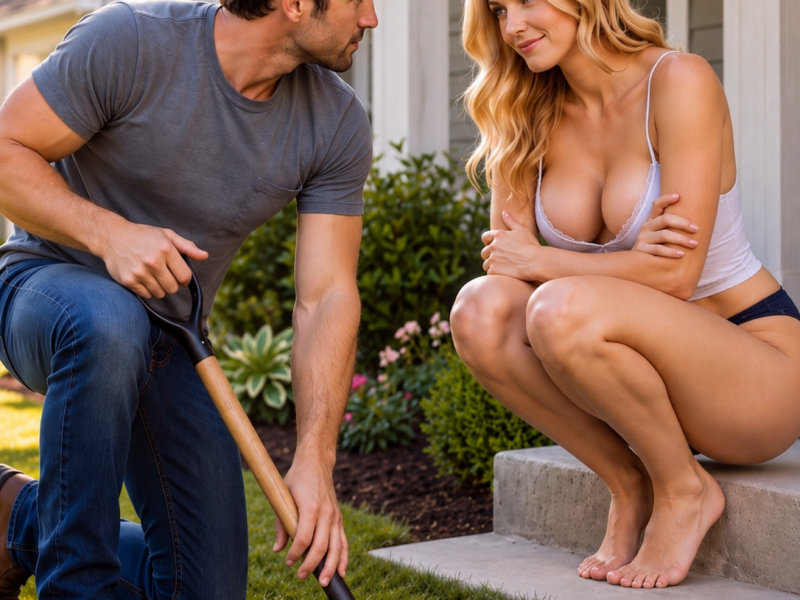
I Filled The Sinkhole In Her Yard… She Whispered, There’s Another That Needs Filling Too.
I Filled The Sinkhole In Her Yard… She Whispered, There’s Another That Needs Filling Too.
PART 1
The first time Jessica Ryan told me there was another hole that needed filling, I was kneeling in her backyard with mud on my jeans, sweat running down my neck, and absolutely no idea that she was talking about something other than the ground.
“There’s another one,” she whispered.
I stopped pressing the shovel into the freshly packed soil.
“Another sinkhole?”
She stood barefoot on her back porch, wearing dark shorts and a pale summer shirt. Her blonde hair fell loosely around her shoulders, and there was a strange little smile on her face.
“Something like that.”
I looked around the yard.
“Jessica, I’m serious. If there’s another depression, I need to inspect it before somebody gets hurt.”
“I know you’re serious, Jeff.”
“Then where is it?”
She pointed at the chipped limestone paver I had pulled from the collapsed section earlier that morning.
“Come back Saturday.”
I stared at her.
“That’s not an answer.”
Her smile widened.
“It’s the only one you’re getting today.”
I should have recognized that something unusual was happening.
Instead, I checked my equipment one more time.
My name is Jeff Miller. I was thirty-four years old, a senior field technician for Juniper Bend Public Works, and the kind of man who believed almost every problem had a solution if you identified its cause and worked hard enough.
Broken water main? Find the leak.
Collapsed drainage pipe? Replace the damaged section.
Unstable ground? Locate the source of erosion, eliminate the danger, and restore the surface.
People were more complicated.
That was probably why I had spent most of my adult life avoiding situations where feelings mattered more than measurements.
Jessica lived two blocks from me in an old Craftsman bungalow surrounded by enormous oak trees.
I had known who she was for years.
Everyone in Juniper Bend knew Jessica Ryan.
She owned a nursery just outside town, supplied plants for several county landscaping projects, and seemed to remember the names of every customer who walked through her gate.
She was thirty-two, independent, intelligent, and possessed an unsettling ability to make people feel as though she could see straight through their excuses.
Until that Monday, our relationship had consisted of occasional waves from our driveways and brief conversations at community events.
Then her backyard started sinking.
She had called the public works office after noticing that a section of grass near her porch had dropped several inches overnight.
The dispatcher sent me because I was already working nearby.
When I arrived, Jessica was standing beside the depression, holding a garden hose.
“I thought I’d better call someone before I started investigating,” she said.
“Good decision.”
“Most people tell me that after I’ve already made a mistake.”
I smiled.
“Then you’ve met the wrong people.”
The depression looked harmless at first glance.
Maybe three feet across, with a shallow ring of cracked soil and a limestone paver tilted toward the center.
But when I tested the surrounding ground, my probe sank farther than it should have.
That changed everything.
I immediately asked Jessica to move away.
She did.
No arguing.
No insisting she knew her own property.
She simply stepped onto the porch and watched while I investigated.
I discovered that runoff from an old drainage connection had gradually washed material from beneath the yard. There was no active water-main leak, but the ground had lost enough support to collapse.
I isolated the affected area, documented the damaged connection, and arranged for the necessary repair.
Once the drainage problem was addressed, I filled and compacted the shallow cavity, carefully restoring the grade.
Jessica helped by moving flowerpots and carrying clean material until I asked her to stay clear of the unstable edge.
She listened to every explanation.
Not because she was frightened.
Because she genuinely wanted to understand.
When I finished, she handed me a cold bottle of water.
“You always this thorough?”
“When somebody could fall through their own backyard? Yes.”
“And when nobody’s in danger?”
I shrugged.
“Depends on the problem.”
She studied me for a moment.
Then came that mysterious sentence about another hole.
I left her property confused.
By Tuesday morning, I had already handled two drainage complaints, inspected a culvert, and reviewed repair reports.
But for some reason, Jessica’s smile kept returning to my thoughts.
That afternoon, I drove past her nursery.
I told myself it was the quickest route back to the maintenance yard.
It wasn’t.
Jessica was directing a delivery truck beside one of her shade houses.
The driver had started unloading pallets in the wrong place.
Instead of raising her voice, she calmly redirected him, helped adjust the delivery, and somehow left the man smiling.
She noticed my pickup.
I raised two fingers from the steering wheel.
She waved back.
I kept driving.
Five minutes later, I realized I was smiling.
That evening, my phone buzzed.
It was a message from Jessica.
Saturday. Two o’clock. Bring your boots. I don’t want you to fix anything. I want you to teach me how you knew the ground was hollow.
I read it three times.
Then I answered.
I’ll be there.
Saturday arrived more slowly than it should have.
I walked to her bungalow carrying a soil probe and two bottles of water.
Jessica was waiting in the side yard, wearing work pants and an old green T-shirt.
“You brought equipment,” she said.
“You asked for a lesson.”
“I asked you to bring your boots.”
“Consider this a professional bonus.”
She laughed.
Then she handed me a bottle of water.
Before we started, her phone rang.
The screen displayed a name.
Karen.
Jessica declined the call.
“Everything okay?” I asked.
“My sister.”
Something changed in her expression.
I knew that Jessica and her older sister had inherited the bungalow after their parents died.
Karen lived in San Antonio now.
Beyond that, I knew very little.
“She wants an answer by next Sunday,” Jessica said.
“About what?”
“The house.”
I waited.
Jessica looked toward the porch.
“Karen wants to sell. Not because she’s greedy or anything. She has her own life, and her half of the property could help her move forward.”
“And you?”
“I can buy her out.”
“Then what’s stopping you?”
She looked at me.
“I haven’t figured out whether I want the house or whether I just feel guilty about letting it go.”
I had no answer for that.
It wasn’t a drainage problem.
There was no instrument I could use to measure obligation against desire.
Jessica took the soil probe from my hand.
“Anyway, teach me what I’m buying.”
For the next hour, we walked across her property.
I showed her how different soil textures responded to pressure, how hidden voids could sometimes reveal themselves through subtle changes in surface compaction, and why certain depressions required professional investigation rather than digging.
She listened carefully.
Then she surprised me.
We reached a section beneath a large oak tree where water naturally collected after heavy rain.
I pointed toward a possible drainage route.
“If you wanted to redirect runoff, we could create a shallow swale through here.”
“No.”
The word came so quickly that I stopped speaking.
Jessica crouched beside the tree.
“Look.”
She brushed away dry leaves, exposing a thick structural root near the surface.
“You cut through this section, and you could damage the tree. The smaller roots spread throughout this whole area.”
I crouched beside her.
She was right.
I had been watching the slope.
She had been watching the living system beneath it.
“I missed that,” I admitted.
Jessica raised an eyebrow.
“You’re not going to argue?”
“Why would I?”
“Because you’re the expert.”
“Not on trees.”
Something softened in her expression.
“Well,” she said, “that’s refreshing.”
We spent another thirty minutes discussing alternatives.
Instead of forcing water through a narrow channel, Jessica suggested slowing it with native grasses and sedges.
I suggested a wider, shallower contour.
Together, we found a solution neither of us had considered alone.
When we finished, she leaned against the porch railing.
“You know what your problem is, Jeff?”
I nearly laughed.
“I have a feeling you’re going to tell me.”
“You take responsibility for everything.”
“That’s usually considered a good quality.”
“Until you leave nobody else room to contribute.”
Her words struck closer than I wanted to admit.
At work, I had been training a younger technician named Adam Wood.
He was capable, hardworking, and eager to learn.
But whenever he hesitated, I stepped in.
Whenever a situation became complicated, I took control.
I had convinced myself I was helping him.
Jessica seemed to understand something I hadn’t considered.
Maybe I was preventing him from growing.
She noticed my silence.
“Did I offend you?”
“No.”
“Then what?”
I looked at the soil probe.
“I think you might be right.”
She smiled.
“That’s twice today.”
“Don’t get used to it.”
“Too late.”
The afternoon sun had begun slipping behind the oak trees.
Jessica put the probe beside the porch.
“Tomorrow,” she said, “come to the nursery.”
“What for?”
“My turn to teach.”
I looked at her.
She folded her arms.
“You understand drainage. I understand plants. Fair is fair.”
I should have simply agreed.
Instead, I asked a question that had been sitting in my chest since Monday.
“Jessica, are these lessons really about the yard?”
She went very still.
For one brief moment, I thought she was going to tell me what she had meant by that second hole.
Instead, she stepped closer.
“Maybe,” she said quietly, “you should stop trying to figure everything out before it happens.”
Then she smiled, turned toward the house, and left me standing beneath the oak tree with a question I couldn’t solve.
For the first time in years, I wasn’t certain I wanted an immediate answer.
PART 2
Sunday afternoon, Jessica opened the nursery gate just for me.
For an hour, she made me examine soil, inspect leaves, and identify plants suffering from improper watering.
I failed more tests than I passed.
She seemed delighted.
“You’re very confident for somebody who just confused dry roots with overwatering.”
“The surface looked wet.”
“The surface lies.”
I shook my head.
“You enjoy this.”
“Immensely.”
But when the lesson ended, neither of us moved toward the gate.
Her phone lit up.
Karen again.
Jessica turned it facedown.
“One week,” she murmured. “That’s all I have to decide.”
“What do you want?”
She looked at me.
“I’m trying to figure that out without worrying about what everyone else needs first.”
I could have offered advice.
Instead, I stayed quiet.
Then I said something that surprised us both.
“Would you like to get coffee?”
She blinked.
“We just spent an hour together.”
“I know.”
“And you want more?”
“Yes.”
She looked down, smiling.
“Jeff Miller, are you asking me on a date?”
“I think I am.”
She stepped closer.
“Then stop sounding like you’re requesting a permit.”
At the coffee shop, we talked until the staff began stacking chairs.
When I walked her home, she stopped beneath her porch light.
“You know,” she whispered, “you still haven’t figured out the other hole.”
“No.”
“Good.”
And before I could ask another question, she squeezed my hand.
PART 3
I had spent fourteen years working for Juniper Bend Public Works, and in that time, I had learned that water rarely behaved the way people expected.
It found weaknesses.
It followed pressure.
It slipped through cracks that seemed too small to matter.
And sometimes, long before anyone noticed a problem on the surface, something important had already disappeared underneath.
What I hadn’t understood was how much that described my own life.
The Monday after coffee with Jessica, Adam Wood stood beside my truck, studying photographs of a washed-out road shoulder.
“What do you think caused it?” I asked.
He examined the images.
“Surface erosion.”
“Maybe.”
He enlarged one photograph.
“Water velocity could explain the cut.”
“Could.”
He looked at me, waiting.
I knew that expression.
He wanted the answer.
Or perhaps I had trained him to expect me to provide one.
My fingers moved toward the tablet.
I could have explained the damaged culvert connection, described exactly where to test, and sent him off with a solution.
Instead, I remembered Jessica standing beneath her oak tree.
You leave nobody else room to contribute.
“Run a dye test on the upper pipe,” I said. “Check whether that seam is feeding the washout.”
Adam nodded.
“Want me to wait for you?”
“No. You run it.”
He looked surprised.
“By myself?”
“You know the procedure.”
“What if I miss something?”
“Then we’ll review what you found.”
He hesitated.
Then he smiled.
“Okay.”
Watching him drive away felt strangely uncomfortable.
I had always believed leadership meant being the person everyone depended on.
Now I was beginning to wonder whether real leadership meant helping people reach the point where they no longer needed you standing over their shoulders.
That evening, Jessica called.
“I have a drainage problem.”
I sat up.
“Where?”
“At the nursery.”
“Is there standing water? Ground movement? A leak?”
“Jeff.”
“What?”
“I was going to ask whether you wanted to come look at a planting design.”
I closed my eyes.
She laughed.
“You really are impossible.”
“Occupational hazard.”
“Wednesday. After closing.”
“Should I bring equipment?”
“Bring yourself.”
I looked down at the work gloves sitting beside my kitchen sink.
For some reason, those two words felt more difficult than any repair job I had ever accepted.
Wednesday evening, I arrived at the nursery fifteen minutes early.
Jessica was still helping a customer choose shrubs.
I watched from beside the gate as she asked questions about sunlight, watering habits, soil conditions, and how much maintenance the customer actually wanted.
She never rushed.
She never made the woman feel foolish.
And when the customer finally left, Jessica turned toward me.
“You’ve been watching.”
“Your customer service is impressive.”
“That’s a very professional compliment.”
“I could make it less professional.”
Her expression changed.
“Go ahead.”
I swallowed.
“I like seeing you happy.”
For once, Jessica had no immediate response.
Then she tucked a loose strand of hair behind her ear.
“That’s better.”
We walked toward the rear shade house.
A low strip of ground stayed damp longer than the rest of the nursery after rain.
Jessica wanted to establish native plants that would slow runoff without interfering with the delivery lane or nearby planting beds.
I examined the grade.
My first instinct was to create a narrow, efficient drainage channel.
Jessica shook her head.
“You’re trying to get the water off my property as quickly as possible.”
“That’s generally the objective.”
“Not always. Sometimes I want the water to stay long enough for the plants to use it.”
She pointed to a row of marked planting locations.
“If you compact that strip, I’ll spend the next three summers fighting poor root growth.”
I looked at the stakes.
She was right again.
We spent forty minutes adjusting the design.
I checked slopes and runoff direction.
She considered root development, plant spacing, and how the area would look after several growing seasons.
It was the kind of collaboration I rarely experienced.
Neither of us was trying to win.
We simply wanted something that worked.
At one point, Jessica knelt beside a planting bed and began explaining why three varieties of sedge would tolerate different amounts of moisture.
I stopped checking my level.
Instead, I watched her.
She looked up.
“What?”
“Nothing.”
“Jeff.”
I smiled.
“I like watching you when you’re doing something you love.”
Her hands became still.
“Do you?”
“Yes.”
She held my gaze.
“I was hoping you’d notice.”
There were several things I could have said.
Most of them sounded foolish.
So I said nothing.
Jessica stood.
For a moment, we were close enough that I could see a tiny smear of soil on her cheek.
I nearly reached out to wipe it away.
But then her phone rang.
Karen.
The moment disappeared.
Jessica glanced at the screen and sighed.
“I should take this.”
“Of course.”
She stepped toward the greenhouse.
I walked to the loading platform and sat down.
From where I was sitting, I could hear only pieces of the conversation.
“No, Karen. I understand.”
A pause.
“I know you’re not trying to pressure me.”
Another pause.
“I just need a little more time.”
I stared at my boots.
I had lost my parents years earlier, and I knew what it meant to watch a familiar place become tied to memories you weren’t ready to release.
But I also knew that keeping a house out of guilt could turn a beautiful inheritance into a burden.
When Jessica returned, she looked tired.
“Everything okay?”
“She’s already found a potential buyer.”
My stomach tightened.
“For the house?”
Jessica nodded.
“Someone who wants to renovate it.”
“Does she know you’re considering buying her half?”
“Yes. She just wants certainty.”
I wanted to tell Jessica to keep the bungalow.
I wanted to remind her how much she loved the oak trees, the porch, the yard.
And, if I was being selfish, I wanted to know she would remain two blocks away.
But I remembered what she had said on Saturday.
She needed to decide what she wanted.
Not what would make everyone else comfortable.
So I asked, “What would you do if nobody expected anything from you?”
Jessica looked toward the trees.
“I think I’d stay.”
“Then why are you hesitating?”
“Because staying means committing to a future I haven’t completely figured out.”
I nodded.
“Most futures work that way.”
She gave me a small smile.
“Look at you. Giving emotional advice instead of drainage advice.”
“Don’t tell anyone.”
We sat together on the loading platform until the sun disappeared behind the nursery fence.
Nothing dramatic happened.
No declaration.
No kiss.
Just two people sitting close enough that our shoulders occasionally touched.
Yet I drove home feeling as though something important had begun.
Thursday morning, Jessica arrived at the county maintenance yard carrying several flats of native sedge for a landscaping project.
Adam was helping unload them.
I watched him struggle to adjust a laser tripod beside the planting area.
My immediate instinct was to intervene.
I had already taken two steps when Jessica caught my forearm.
“Did he ask for help?”
I stopped.
“No.”
“Then let him figure it out.”
“He’s been working on that thing for five minutes.”
“And?”
“I can fix it in ten seconds.”
She looked directly at me.
“I know you can.”
There was no accusation in her voice.
Somehow, that made it harder.
A moment later, the laser chirped.
Adam straightened.
“Got it!”
Jessica released my arm.
I stared at the young technician.
He hadn’t needed me.
Or perhaps he had needed me to leave him alone.
“He’s supposed to lead a rainfall response tomorrow,” I admitted.
Jessica tilted her head.
“Is he ready?”
“I’ve postponed it twice.”
“Why?”
“I wasn’t sure he could handle it.”
She looked at Adam, who was now explaining the setup to another crew member.
“Or were you afraid to let him try?”
I didn’t answer.
Because I already knew.
That afternoon, I received a message from Jessica.
The repaired ground is still holding.
I replied.
As expected.
She answered immediately.
You sound disappointed.
I stared at the screen.
She wasn’t wrong.
The sinkhole had been repaired.
The job was finished.
And every day that passed made it harder to pretend I needed another professional reason to visit her.
That evening, I walked past her bungalow.
She was on the porch with two glasses of iced tea.
“Convenient timing,” she said.
“I was checking the repair.”
“Of course.”
She handed me a glass.
I examined the limestone paver.
It hadn’t moved.
Jessica watched me.
“Well?”
“Stable.”
“And the other one?”
I looked at her.
“You still haven’t told me where it is.”
She took a slow drink.
“Maybe you aren’t looking in the right place.”
I studied her face.
“Are you ever going to give me a straight answer?”
“Yes.”
“When?”
She glanced toward the darkening sky.
“When I’m certain you won’t try to fix it before you understand it.”
At that moment, thunder rolled in the distance.
The weather forecast called for heavy rain on Friday.
Jessica looked toward the oak trees.
“Tomorrow should be interesting.”
I looked at the ground beneath our feet.
I had no idea how right she was.
PART 4
The rain began at 4:17 Friday morning.
I remember the exact time because my phone rang three minutes later.
A residential culvert was overflowing on the north side of town.
Water had begun cutting beneath the asphalt shoulder, and the dispatcher wanted a technician on-site before the road became unsafe.
I was already pulling on my boots when Adam called.
“I’ve got the assignment.”
“Okay.”
There was a pause.
“Are you coming?”
“I’m coming to support you.”
Another pause.
“Support?”
“You’re leading this one.”
I could almost hear him sit up straighter.
“Seriously?”
“Seriously.”
By the time we reached the site, rain was pounding against the road hard enough to blur the lane markings.
Brown water rushed through the ditch.
A section of asphalt had begun separating near the culvert entrance.
Adam stood several feet from the edge, studying the flow.
I stood beside him.
Everything inside me wanted to take control.
I could see the problem.
A restriction inside the pipe was forcing water backward, increasing pressure against the already weakened shoulder.
We needed a lane closure, an appropriate safety perimeter, and equipment to clear the obstruction.
I knew the sequence.
I knew the risks.
But this was Adam’s call.
“What do you see?” I asked.
He watched the water.
“It’s backing up at the entrance.”
“Keep going.”
“Something’s blocking the pipe.”
He moved cautiously along the safe side of the ditch.
“The shoulder’s being undermined.”
“What needs to happen?”
He studied the road.
“We close this lane immediately.”
I nodded.
“And?”
“Get the vacuum truck. Clear the obstruction before we attempt the shoulder repair.”
I looked at him.
“Then make the calls.”
Adam reached for his radio.
His voice shook slightly during the first transmission.
By the third, it was steady.
For the next forty minutes, I stayed close enough to intervene if conditions became dangerous, but I let him direct the operation.
He corrected an improperly placed traffic cone.
He reassigned a crew member when the runoff shifted.
He recognized an unsafe area before anyone stepped into it.
And when the obstruction was finally removed, he supervised the stabilization work.
I was proud of him.
But I was also ashamed of how long I had made him wait for that opportunity.
Back in the truck, rain drummed against the roof.
Adam removed his gloves.
“I thought you were going to take over.”
“I thought about it.”
He laughed.
“I could tell.”
I looked at him.
“You handled it.”
He stared through the windshield.
“Thanks.”
Then he said something I would remember for a long time.
“I guess I needed to know you believed I could.”
I had no answer.
Because until recently, I hadn’t understood how much my constant supervision might have communicated the opposite.
By late afternoon, the rain finally weakened.
I returned to the maintenance yard, filed the reports, and changed out of my wet jacket.
Then I walked to Jessica’s house.
The limestone paver was still level.
The repaired soil had held.
No erosion.
No movement.
Nothing requiring another visit.
I stood there for a moment, looking down at my work.
I should have felt completely satisfied.
Instead, I felt something closer to disappointment.
“There goes your excuse.”
Jessica’s voice came from the porch.
I looked up.
She was holding a clean towel.
“How did you know what I was thinking?”
“Because you’ve inspected that stone four times this week.”
“Three.”
“Jeff.”
“Fine. Four.”
She walked down the steps and draped the towel around my shoulders.
“Sit down.”
“I’m muddy.”
“The chairs are washable.”
“I should probably—”
“Sit.”
I sat.
For several minutes, neither of us spoke.
Rainwater dripped from the oak leaves.
Somewhere nearby, a bird called from beneath the eaves.
Jessica settled into the chair beside me.
Her bare foot rested against the porch railing.
“How was your day?” she asked.
“Busy.”
“Anyone hurt?”
“No.”
“Then that’s a good start.”
I told her about Adam.
How he had led the response.
How difficult it had been to stay back.
And how well he had performed.
Jessica listened with a small smile.
“You sound proud.”
“I am.”
“Of him?”
“Mostly.”
She laughed.
“That’s progress.”
I leaned back.
“How was the nursery?”
“Flooded.”
I straightened immediately.
“Where?”
“The delivery lane.”
“How bad?”
“Bad enough that I rerouted the trucks and moved inventory.”
“Did you check for subsurface erosion?”
“Yes.”
“Did you dig?”
“No, Jeff.”
She raised an eyebrow.
“I remembered your lesson.”
I relaxed.
“Good.”
“And I handled it.”
“I know.”
“No, I mean I handled my part. I didn’t need you to come rescue the nursery.”
I looked at her.
“I wasn’t suggesting you did.”
“You were thinking about it.”
She was right.
Again.
Jessica leaned back.
“Tomorrow, I’m coming to your house.”
I blinked.
“Why?”
“Those grass plugs you bought from me three weeks ago.”
I glanced away.
“What about them?”
“They’re still sitting in trays beside your garage.”
“I’ve been busy.”
“You’re planting them tomorrow.”
“Is that an order?”
“A lesson.”
I smiled.
“Fair enough.”
Saturday afternoon, Jessica arrived at my house carrying gardening gloves and a bag of compost.
I had already arranged the grass plugs in straight lines.
Each one sat eighteen inches from the next.
I had measured carefully.
Jessica stopped halfway up the driveway.
“Oh, no.”
I looked at her.
“What?”
She pointed toward the lawn.
“Why do your plants look like they’re waiting for military inspection?”
“They’re evenly spaced.”
“They’re terrifying.”
I stared at the pattern.
“It’s efficient.”
“It’s a lawn, Jeff. Not a detention facility.”
Before I could object, she walked across the yard and moved several plugs out of alignment.
I felt an almost physical urge to put them back.
Jessica noticed.
“Don’t.”
“I didn’t say anything.”
“Your face did.”
She showed me how to stagger the plants naturally while maintaining proper spacing.
Then she instructed me to loosen the soil and work compost into selected areas.
For once, I followed directions without arguing.
About halfway through, she sat back on her heels.
“You kept today open.”
“Yes.”
“For grass?”
I looked at her.
“No.”
Her hands stopped moving.
“Then what?”
I rinsed dirt from my fingers.
“I kept it open before you asked.”
Jessica watched me.
I continued.
“I was hoping you’d want to spend the day together.”
For a moment, the only sound was water trickling from the hose.
Then she smiled.
“I did.”
When we finished, the grass curved naturally along the front yard.
It looked nothing like my original design.
I liked it better.
Jessica wiped her hands on a towel.
“Walk me home?”
“Of course.”
I headed toward the garage.
She stopped me.
“No tools.”
“I was getting my boots.”
“You were thinking about tools.”
I grinned.
“Maybe.”
We walked the two blocks to her bungalow under a sky still heavy with clouds.
When we reached her sidewalk, Jessica stopped.
For the first time all day, she looked nervous.
“Karen’s coming tomorrow morning.”
I nodded.
“The deadline.”
“Yes.”
“Have you decided?”
She studied the house.
The deep porch.
The wide windows.
The enormous oak trees that had watched generations come and go.
Then she took a breath.
“I’m keeping it.”
I looked at her.
“Are you sure?”
“Yes.”
She turned toward me.
“I want to buy Karen’s half. And I want to turn the side yard into a consultation garden for the nursery.”
“A consultation garden?”
“Somewhere customers can actually see how native plants work together. A place where they can bring photographs, ask questions, and learn without feeling pressured to buy something.”
I could picture it.
The shaded path.
The planted drainage route.
A small table beneath the oak.
Jessica explaining soil and sunlight to a family who had never planted anything before.
“That sounds like you,” I said.
She smiled faintly.
“I think so.”
Then she looked at me more seriously.
“Jeff, I need you to understand something.”
“Okay.”
“I’m not keeping this house because you’re nearby.”
I felt my chest tighten.
“I know.”
“I don’t want you thinking you’re responsible for maintaining it. I don’t want you to feel trapped into being useful to me.”
I shook my head.
“Jessica, if you were making this decision because you needed somebody to fix things, I’d tell you to wait.”
She watched me.
“But you’re not,” I continued. “You’re keeping it because you can imagine a future here.”
Her eyes softened.
“Yes.”
“Then it’s your decision.”
For several seconds, she said nothing.
Then she reached for my hand.
“Come over tomorrow,” she whispered.
“What time?”
“Noon.”
“Should I bring—”
“Jeff.”
I laughed.
“Right. No tools.”
She stepped closer.
“Clean shirt. Empty hands.”
I nodded.
“I can manage that.”
She smiled.
But there was something else in her expression.
Something vulnerable.
Something I hadn’t seen before.
And when she finally released my hand and walked toward the porch, I realized Sunday might change far more than who owned the house.
I just didn’t know whether I was ready for what she might say.
PART 5
Sunday morning was the longest morning of my life.
I woke at six, made coffee, and spent twenty minutes staring at the grass plugs Jessica had helped me plant.
One of them was slightly out of alignment.
I wanted to move it.
I didn’t.
Instead, I sat on my porch and tried to convince myself that I wasn’t nervous.
At nine, Karen’s car pulled into Jessica’s driveway.
I watched from my kitchen window.
That was embarrassing enough.
What made it worse was realizing I had no legitimate reason to be watching at all.
This wasn’t my conversation.
It wasn’t my family.
And whatever happened inside that house belonged to Jessica.
At eleven forty-eight, Karen’s car was still there.
I checked my phone.
Nothing.
At eleven fifty-four, I typed a message.
Everything okay?
My thumb hovered over the screen.
Then I deleted it.
I had spent most of my adult life believing that checking on something meant caring about it.
But sometimes checking was simply another way of trying to control the outcome.
I set the phone facedown.
At noon, Karen’s car pulled away.
I didn’t rush over.
I showered.
Put on clean jeans and a navy T-shirt.
Left my work boots beside the door.
And, for the first time I could remember, walked out of my house without a single tool.
Jessica was sitting on her porch when I arrived.
She looked tired.
But she was smiling.
Her eyes went immediately to my empty hands.
“Well,” she said, “you listened.”
“I usually do eventually.”
She laughed softly and gestured toward the chair beside her.
“Sit.”
I sat.
For a moment, we simply listened to the wind moving through the oak leaves.
Then she turned toward me.
“Karen and I settled everything.”
My heart began beating faster.
“Okay.”
“I’m buying her half.”
I let out a breath I hadn’t realized I was holding.
“Congratulations.”
Jessica looked toward the yard.
“She asked me the same question twice.”
“What question?”
“Whether I wanted this house because I loved it, or because I felt responsible for keeping what our parents left behind.”
I stayed quiet.
“The first time, I gave her a complicated answer. I talked about the property’s value, the nursery, the cost of moving, and all the practical reasons staying made sense.”
“And the second time?”
Jessica smiled.
“I told her I wanted it.”
I nodded.
“That sounds like the right answer.”
“She thought so, too.”
Jessica folded her hands in her lap.
“Then she asked about you.”
My stomach tightened.
“Me?”
“The helpful man who keeps finding reasons to walk past my house.”
I looked toward the repaired yard.
“I do live nearby.”
“That’s what I told her.”
I turned back.
“Really?”
“No.”
She laughed at my expression.
“I told her I was making one decision at a time.”
Something shifted between us.
Jessica looked down at the chipped limestone paver beside the porch.
Then she reached over and touched its broken corner.
“Do you remember what I said when you finished repairing the sinkhole?”
I smiled.
“How could I forget?”
“What did I say?”
“That there was another hole needing to be filled.”
She nodded.
“And you kept asking where it was.”
“Because I thought there was another sinkhole.”
“I know.”
She looked at me.
“I wasn’t talking about the yard.”
I stopped breathing for a moment.
Jessica continued before I could speak.
“When my parents died, everything changed. Karen moved away. I took over the nursery. I kept the house running. And somewhere along the way, I became the person everybody relied on.”
I watched her carefully.
“I was always busy. Always solving somebody else’s problem. Employees needed schedules. Customers needed advice. Karen needed help sorting the estate. There was always something.”
She paused.
“And I liked being needed. It gave me a reason to keep moving.”
Her fingers tightened around the chair arm.
“But when everything was finished at night, I came home to a quiet house.”
I glanced toward the empty chair beside me.
Jessica noticed.
“That,” she whispered.
I looked back at her.
“That’s what I meant.”
For a long moment, neither of us spoke.
Then she smiled sadly.
“I wasn’t asking you to repair another hole in the ground, Jeff. I was trying to tell you there was an empty space in my life.”
My throat tightened.
She continued.
“I didn’t know how to say it without sounding foolish.”
“You could never sound foolish to me.”
Jessica shook her head.
“You say that now.”
“I mean it.”
She looked directly into my eyes.
“I’m good at helping other people. I’m good at keeping things alive. But I’m terrible at telling somebody when I want them to stay.”
I leaned forward slightly.
“Jessica—”
“Let me finish.”
I stopped.
She took a deep breath.
“I don’t need you to fix this house. I don’t need you to rescue my nursery. And I don’t want to invent emergencies just so you’ll come over.”
Her voice trembled.
“I want you here when nothing is wrong.”
I felt something open inside my chest.
She looked at the chair beside her.
“I want you sitting there on an ordinary Sunday. I want to hear about your day even when nothing exciting happened. I want to argue about your ridiculous obsession with straight lines.”
I laughed softly.
“And I want to know whether we could build something together without either of us having to become responsible for the other person’s happiness.”
She swallowed.
Then she said it.
“Jeff, I want to date you.”
Everything inside me went still.
For months, perhaps years, I had lived a life organized around responsibility.
Work.
Bills.
Repairs.
Routine.
I had treated free time like something that needed to be justified.
If I wasn’t solving a problem, I wasn’t accomplishing anything.
And now this woman was looking at me, asking for something I couldn’t fix, measure, or guarantee.
She wanted my time.
My attention.
My presence.
Not my usefulness.
I stood.
Jessica’s expression changed.
For one terrible second, she looked afraid.
Then I stepped closer.
“I want that, too.”
She stared up at me.
“You do?”
“Yes.”
Her eyes filled with sudden emotion.
I took her hand.
“I want to come over when your pipes are working perfectly. When the yard is boring. When you don’t need anything repaired.”
She laughed through a shaky breath.
“And?”
“I want you at my house, too. Even if you keep moving my grass.”
“That grass needed moving.”
“I know.”
“And your planting pattern was terrible.”
“Jessica.”
She laughed again.
I squeezed her hand.
“I want the ordinary days with you.”
Her smile faded into something softer.
Something I had never seen directed toward me before.
Then I asked, “Can I kiss you?”
She looked at my mouth.
“Yes.”
I leaned down.
Our first kiss was gentle.
Almost cautious.
Her fingers tightened around mine, and her other hand rested lightly against my chest.
For one heartbeat, I felt how close we had come to missing this entirely.
If I had ignored her first invitation.
If I had insisted on treating every conversation like another repair.
If she had decided that wanting someone was a weakness.
We might still have been two neighbors waving from opposite sides of the street.
But we weren’t.
When I pulled back, Jessica rested her forehead against mine.
“That,” she whispered, “was considerably better than checking the limestone paver.”
I smiled.
“Much better.”
We sat together for most of the afternoon.
At some point, Jessica leaned her head against my shoulder.
I put my arm around her.
Neither of us felt the need to fill the silence.
Eventually, she lifted her head.
“I have a rule.”
“Only one?”
“One important one.”
“Okay.”
“No shovels unless I ask.”
I laughed.
“That sounds suspiciously specific.”
“It is.”
“Fair.”
“And one evening every week when we don’t talk about drainage, plants, county maintenance, nursery deliveries, or this house.”
I raised an eyebrow.
“That’s more than one rule.”
“It’s one long rule.”
I considered correcting her.
Then I decided I was learning.
“Thursday?” I suggested.
Jessica smiled.
“Thursday.”
Three weeks later, the summer heat settled hard over Juniper Bend.
At the maintenance yard, I was finishing paperwork when my radio crackled.
“Dispatch, this is Wood. Residential leak isolated. Main secure. Returning to base.”
It was Adam.
Running his own call.
Without me.
I reached for the microphone.
For a moment, the old questions crowded my mind.
Had he checked the pressure drop?
Had he photographed the repair?
Had he inspected the meter box?
Then I stopped.
Adam knew his job.
And he knew when to ask for help.
I pressed the button.
“Copy, Wood. Good work. See you back here.”
That was all.
Twenty minutes later, he returned to the maintenance yard with a confidence I hadn’t seen before.
He no longer looked toward me for approval after every decision.
He explained what he had done, submitted his report, and started preparing for the next assignment.
Watching him, I realized that trusting somebody wasn’t the same as abandoning responsibility.
Sometimes it was the highest form of respect you could offer.
I clocked out on time.
That alone would have surprised half the maintenance department.
When I reached home, I looked at the grass strip Jessica had designed.
The plugs were filling in.
The staggered pattern no longer looked random.
It looked natural.
Healthy.
Alive.
I noticed one small cluster that still wasn’t perfectly aligned.
I smiled.
And left it alone.
Then I walked to Jessica’s bungalow.
The old sinkhole had disappeared beneath new grass.
Her side yard was changing, too.
The shallow drainage route we had designed together was now planted with native sedges and grasses.
Instead of a bare channel, it had become a beautiful curve through the garden.
A small seating area stood beneath the oak tree.
Jessica had added a table where customers could spread out photographs and sketch their landscaping ideas.
There were new stepping stones leading from the driveway.
And at the beginning of the path sat the old chipped limestone paver.
I stopped.
She had set it into the walkway, broken corner and all.
I stepped onto it.
Solid.
Level.
Unmoving.
Jessica appeared on the porch.
“You’re inspecting my work again.”
I looked up.
“Just appreciating the engineering.”
She laughed.
“Come here.”
I walked toward her.
She was sitting in her favorite chair, a nursery catalog resting across her knees.
Beside her sat an empty chair.
Not abandoned.
Not forgotten.
Simply waiting.
I sat down.
Jessica closed the catalog and leaned against me.
I put my arm around her shoulders.
For a while, we watched the afternoon sunlight move across the garden.
Then she said something that made me smile.
“You know, Jeff, I think the second hole is finally filled.”
I turned toward her.
“Are you sure?”
She nodded.
“Pretty sure.”
I pretended to consider the matter.
“Might need periodic inspections.”
Jessica laughed and tapped my chest.
“Don’t push your luck.”
I kissed the top of her head.
Then I looked toward the garden.
For years, I had believed my greatest value came from being the man who could solve whatever went wrong.
The man who always knew what to do.
The man everyone called when things began falling apart.
But Jessica had taught me something I hadn’t learned from fourteen years of repairing damaged ground.
Love wasn’t about becoming indispensable.
It wasn’t about filling every silence, controlling every outcome, or proving how much someone needed you.
It was about making room.
Letting another person stand beside you rather than behind you.
Choosing to stay even when there was nothing to repair.
And understanding that the strongest relationships weren’t built by one person carrying everything.
They were built by two people choosing, day after day, to share the weight.
Jessica slipped her fingers between mine.
“Penny for your thoughts?”
I looked down at her.
“Just thinking about that first day.”
“The sinkhole?”
“Yeah.”
She smiled.
“What about it?”
I looked toward the limestone paver.
“I thought I was coming here to fix your yard.”
“And?”
I pulled her a little closer.
“Turns out, I was the one who needed to learn how to stop fixing everything.”
Jessica rested her head against my shoulder.
“Good thing I was patient.”
I laughed.
“You were anything but patient.”
“True.”
She kissed my cheek.
“But I knew something you didn’t.”
“What’s that?”
She looked toward the garden, then back at me.
“Sometimes the most beautiful things grow in places where the ground has been broken.”
I didn’t answer.
I didn’t need to.
The evening breeze moved through the oak leaves.
The garden was thriving.
The house was quiet.
And the chair beside Jessica was no longer empty.
For the first time in my life, I wasn’t staying because somebody needed me to solve a problem.
I was staying because we had chosen each other.
And that was more than enough.