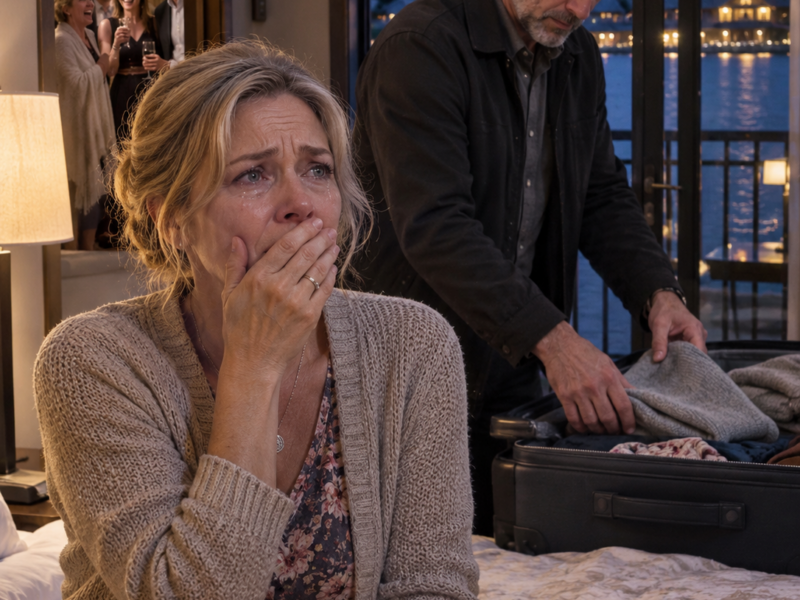
I Drove Six Hours and Brought $380 Worth of Groceries to My Brother’s Lake House for Thanksgiving, Only to Discover That Everyone Had a Beautiful Bedroom Except My Husband and Me. My Mother Told Me to “Stop Being Overly Sensitive” When I Complained About Sleeping Beside the Dryer. At 11:45 PM, My Husband Returned From Upstairs, Quietly Packed Our Bags, and Whispered, “We’re Leaving Right Now.” Once We Were Safely Inside the Car, He Handed Me His Phone—and What I Heard Made Me Realize the Laundry Room Was No Accident…
I Drove Six Hours and Brought $380 Worth of Groceries to My Brother’s Lake House for Thanksgiving, Only to Discover That Everyone Had a Beautiful Bedroom Except My Husband and Me. My Mother Told Me to “Stop Being Overly Sensitive” When I Complained About Sleeping Beside the Dryer. At 11:45 PM, My Husband Returned From Upstairs, Quietly Packed Our Bags, and Whispered, “We’re Leaving Right Now.” Once We Were Safely Inside the Car, He Handed Me His Phone—and What I Heard Made Me Realize the Laundry Room Was No Accident…
At 11:45 on the night before Thanksgiving, my husband quietly packed our bags and told me we were leaving my brother’s lake house immediately.
He didn’t raise his voice. He didn’t explain himself. He simply placed my car keys in my hand, looked me straight in the eyes, and said, “Clara, put your shoes on. We’re going home.”
I was lying on a half-deflated air mattress between a Whirlpool dryer and a utility sink, with a bottle of fabric softener six inches from my face. My lower back was throbbing, my knees were stiff from the six-hour drive, and the water heater kept clicking every few minutes.
I thought Sam had gone upstairs to get me some ibuprofen.
Instead, he came back with something that would change my relationship with my entire family forever.
But to understand why my husband decided we needed to leave in the middle of the night, you need to know what happened four hours earlier—and why the house everyone believed belonged to my younger brother was actually seventy percent mine.
My name is Clara Miller. I was forty-nine years old that Thanksgiving, and I had been married to Sam for twenty-two years.
We lived in Worthington, Ohio, where I worked as a senior commercial risk analyst. Sam was a structural engineer who spent his days inspecting bridges, commercial foundations, and buildings that other people assumed were perfectly safe.
We were not wealthy in the extravagant sense. We didn’t own vacation homes in Aspen or fly first class to Europe. We drove a Subaru Outback, paid our credit cards in full, and saved for retirement.
We had built a comfortable life through twenty years of careful decisions.
My younger brother, Kevin, had spent those same years making decisions that usually ended with somebody else writing a check.
Kevin was four years younger than me, charming when he wanted something, and extraordinarily talented at making his financial emergencies sound like opportunities that had simply arrived a little too early.
My mother called him ambitious.
My father used to call him optimistic.
Sam called him expensive.
I usually called him my brother and reached for my checkbook.
That Thanksgiving, Kevin and his wife, Brooke, had invited the family to our late father’s lake house on Lake Charlevoix in northern Michigan.
Brooke had been planning the holiday for weeks.
By planning, I mean she had been sending me detailed shopping lists while telling everyone else how exhausting it was to host Thanksgiving.
The messages began on Monday morning.
“Clara, can you grab the smoked turkey breast from that specialty butcher in Columbus? The stores up here never have the good ones.”
Then came the shrimp.
Then the imported cheese.
Then the organic cranberry relish.
Then two harvest-gold linen tablecloths because, according to Brooke, every store north of Grand Rapids apparently sold nothing but plaid.
By Wednesday morning, I had spent $380 on groceries and supplies.
That didn’t include the three pies I had baked myself.
I started at 5:30 that morning, rolling out dough while Sam packed the car and the coffee machine sputtered on the counter.
Two pecan pies and one pumpkin.
By eight, I was at my office finishing a report. By noon, Sam and I were driving north through cold November rain.
The traffic around Flint was miserable. We crawled through construction zones, waited behind tractor-trailers, and watched the daylight disappear somewhere beyond Gaylord.
By the time we turned into the lake house driveway at 7:45 that evening, I wanted three things.
A hot shower.
A comfortable bed.
And the opportunity to sit down without anyone asking me to do something.
The house looked beautiful.
Warm light glowed through the tall windows. Smoke rose from the stone chimney, and floodlights illuminated the dock stretching into the dark water.
My father had built that house in stages, beginning in 1988. The cedar siding had weathered beautifully, and the stone fireplace had been assembled from rocks he collected around the property.
I knew every board and every uneven step.
I had helped him stain the deck when I was sixteen.
I had painted the downstairs bathroom during my first summer home from college.
And five years earlier, I had paid contractors to replace the kitchen, rebuild the damaged seawall, and install the stainless-steel appliances that now gleamed behind the windows.
Still, when we arrived that evening, I walked through the door feeling like a guest.
Kevin was standing at the kitchen island pouring wine.
Brooke’s parents, Neil and Pam Walker, were settled comfortably near the fireplace.
Brooke’s younger brother, Tyler, was leaning against the refrigerator with his arm around a blonde woman named Kendra, whom I had never met.
My mother, Evelyn, sat at the breakfast nook arranging napkins.
“Look who finally showed up!” Kevin announced.
He lifted his wineglass but made no attempt to help with the boxes in my arms.
“Traffic was terrible,” Sam said, setting our cooler beside the pantry.
Brooke hurried over, smiling.
“There you are! Clara, thank goodness. Did you bring the shrimp?”
“Hello to you too, Brooke.”
She laughed as though I had made a delightful joke.
“Of course, hello! I just need to get everything organized before tomorrow.”
I placed the pies on the counter.
My mother glanced at me.
“You look exhausted, sweetheart.”
“I am. We’re going to take our bags upstairs and wash up.”
I looked toward the staircase.
“Sam, let’s use the east bedroom like last year.”
Something changed.
It was subtle at first.
Kevin lowered his glass.
Brooke stopped rearranging cheese on a wooden board.
My mother suddenly became fascinated by the napkin in her hands.
Then Brooke gave me a smile I recognized immediately.
It was the smile she used when she had already made a decision that inconvenienced me and expected me to be gracious about it.
“Oh, Clara. About the bedrooms.”
I looked at her.
“What about them?”
“Well, with Mom and Dad coming all the way from Chicago, and Tyler bringing Kendra for her first Thanksgiving with us, we’re a little tight on sleeping arrangements.”
I glanced toward the stairs.
The house had four upstairs bedrooms with lake views.
“Okay,” I said carefully.
“Neil and Pam are in the primary guest suite because of Dad’s hip. Your mother has the east room. And Tyler and Kendra are using the corner bedroom.”
Sam frowned.
“Doesn’t Tyler usually sleep on the sectional in the den?”
“He brought a guest,” Brooke replied.
“Right,” Sam said. “And we didn’t?”
Brooke ignored him.
“So Kevin and I made a really cozy space for you two downstairs.”
“Downstairs where?” I asked.
“The utility room.”
For a moment, I genuinely thought she was joking.
Then I walked down the hallway and opened the louvered door beside the garage entrance.
There, on the linoleum floor, was a dark-green Coleman air mattress.
It had been wedged between the washer and dryer on one side and the utility sink on the other.
An old pillow lay against the wall.
The sheet barely covered the mattress.
The room smelled of detergent, damp concrete, and something metallic coming from the water heater.
There was no window.
No dresser.
Not even enough floor space to walk around the bed without stepping sideways.
I stared at it for several seconds.
Then I returned to the kitchen.
“Brooke,” I said, “that’s the laundry room.”
She sighed dramatically.
“I honestly thought you’d be more understanding.”
“Understanding about what?”
“We have elderly parents here, Clara. What was I supposed to do? Put my sixty-six-year-old father on an air mattress?”
I looked toward Tyler.
He was twenty-eight, healthy, and had known his girlfriend for approximately three weeks.
But before I could say anything, my mother interrupted.
“Clara, please don’t start.”
“Mom, I’m not starting anything.”
“You’ve been driving all day. You’re tired and overly sensitive. It’s only for sleeping. Nobody spends Thanksgiving in their bedroom.”
Kevin finally joined the conversation.
“Come on, sis. We’re packed this year. Take one for the team.”
I remember looking at Sam.
He hadn’t moved.
But his expression told me exactly what he thought.
If I had said one word, he would have carried our bags back to the Subaru.
Instead, I did what I had done for most of my life.
I swallowed my frustration.
I told myself the holiday was more important than my comfort.
And I said, “Fine. It’s only two nights.”
Brooke immediately brightened.
“See? I knew you’d understand.”
Not one person offered to exchange rooms.
Not one person suggested finding a hotel.
And nobody seemed particularly concerned that the woman who had supplied half the Thanksgiving meal would be sleeping next to a dryer.
That was the first moment I should have realized something was terribly wrong.
But I didn’t.
At least, not yet.
We carried our bags downstairs.
Sam tested the air mattress with his hand.
It hissed softly.
“Kevin didn’t inflate this properly,” he muttered.
“I noticed.”
“We could leave.”
I sat on the edge of the mattress.
“It’s Thanksgiving, Sam.”
“And?”
“And my mother’s here. Everybody’s already upset. I don’t want to turn this into some enormous family fight.”
He looked at me for a long moment.
Then he sat beside me.
The mattress sank so badly that we nearly rolled into each other.
“Clara,” he said quietly, “you know you don’t have to earn the right to be treated decently.”
I looked away.
“I know.”
But I didn’t really know.
Not then.
We went upstairs for a late dinner, during which Brooke talked endlessly about how much work she had done preparing the house.
She thanked Tyler for bringing wine.
She thanked her parents for driving from Chicago.
She thanked Kevin for arranging the firewood.
She did not mention the groceries I had bought, the pies I had baked, or the repairs I had paid for.
By eleven, my back had become so painful that I could barely sit comfortably.
I excused myself and went downstairs.
Sam followed a few minutes later.
We changed into sweatshirts and settled onto the mattress.
Every movement caused the vinyl to squeak.
After ten minutes, I gave up trying to get comfortable.
“Could you get me some ibuprofen?” I asked.
“Of course.”
“And maybe some water?”
Sam kissed my forehead.
“Be right back.”
He left at approximately 11:35.
Ten minutes later, he returned without either.
His face looked different.
Not angry.
Not frightened.
Focused.
That was something I had learned about my husband over two decades of marriage.
When Sam got truly concerned, he became very quiet.
He walked to the corner, zipped our duffel bags, and picked up my keys.
“Put your shoes on,” he whispered.
I sat up.
“Sam?”
“We’re leaving.”
“Why?”
He looked toward the hallway.
“I’ll explain in the car.”
Something in his voice stopped me from arguing.
I pulled on my boots and coat.
As we slipped through the mudroom, I noticed our white cooler sitting on the auxiliary pantry counter.
Inside were four pounds of jumbo shrimp, still packed in ice.
Beside it sat the two pecan pies I had baked.
I stopped.
Sam looked at me.
I picked up the pies.
He smiled faintly, lifted the cooler, and carried everything into the garage.
“What about the pumpkin pie?” he whispered.
I thought about the slightly overbrowned crust.
“They can keep that one.”
We loaded the Subaru without turning on the garage lights.
Sam released the garage door manually so the motor wouldn’t wake anybody upstairs.
Then he let the car roll quietly down the driveway before starting the engine near the road.
For the first few miles, neither of us spoke.
The lake disappeared behind dark trees, and freezing mist tapped against the windshield.
Finally, Sam said, “I booked us a room at the Hampton Inn in Petoskey.”
“Okay.”
He reached into the center console.
“There’s something you need to hear.”
He handed me his phone.
On the screen was a forty-four-second audio recording.
“When I went upstairs,” he explained, “I heard Brooke say your name.”
I pressed play.
Brooke’s voice filled the car.
“Putting her down by the dryer was the smartest move we made all week.”
I froze.
Tyler laughed in the background.
Then Brooke continued.
“Let her sleep next to the lint trap for one night. By tomorrow morning, her back will be so stiff she’ll sign Kevin’s county paperwork without even putting her glasses on.”
My stomach dropped.
Tyler spoke next.
“You’re sure she’ll sign? Northshore needs that resolution uploaded by Monday, or my marina deposit is gone.”
Then came Kevin’s voice.
Relaxed.
Amused.
Almost bored.
“Relax, Tyler. It’s Clara. She’s been doing the family paperwork since Dad died. I’ll tell her it’s an annual tax verification, put the yellow tab in front of her, and she’ll sign before the turkey comes out.”
The recording ended.
For several seconds, I couldn’t speak.
I had expected Sam to tell me they were mocking us.
I hadn’t expected to hear my brother plotting to obtain my signature on something I knew nothing about.
“What paperwork?” I asked.
Sam glanced at me.
“That’s why we’re leaving.”
He opened the photo gallery on his phone.
There were six photographs.
“After they went out onto the porch, I saw a folder on the kitchen island. I took pictures.”
“Did they see you?”
“No.”
“What was in it?”
“I think Kevin is trying to mortgage the lake house.”
I stared at him.
“That isn’t possible.”
“I know.”
He paused.
“Which is why I think he’s trying to make it possible.”
By the time we reached the hotel shortly after midnight, my mind had shifted from confusion to something colder.
I wasn’t thinking about the laundry room anymore.
I was thinking about the property my father had left behind and the six years of money I had poured into saving it.
My father, Walter Porter, bought the land in 1988.
He built the house gradually, working evenings and weekends whenever he could escape his regular job.
For thirty years, it was the center of our family.
My earliest memories were of summer mornings on the dock, my father teaching me to cast a fishing line while Kevin complained that the fish weren’t biting quickly enough.
When Dad died from a stroke six years earlier, the lake house was in serious financial trouble.
He had borrowed against it to help Kevin start a marine equipment brokerage.
The remaining loan balance was $112,000.
The seawall needed major repairs.
The septic system had failed inspection.
Kevin couldn’t qualify for refinancing because his business had already defaulted on two credit lines.
My mother couldn’t afford to keep the property.
Selling seemed inevitable.
But I couldn’t stand the thought.
I called Helen Price, an attorney Sam and I trusted, and asked whether there was a way to preserve the house without making myself personally responsible for Kevin’s financial problems.
Helen established Birchwater Point LLC.
I contributed $184,000 from my investments to clear the bank debt and cover immediate repairs.
The operating agreement gave me seventy percent ownership and sole managing authority.
Kevin received thirty percent nonvoting ownership based on his remaining inheritance interest.
He had no authority to sell the property, mortgage it, or enter into major contracts without my approval.
He also contributed nothing toward the annual expenses.
I paid the property taxes.
I paid the insurance.
I funded repairs and maintenance.
The only thing Kevin was supposed to do was keep an eye on the place during the winter.
Somewhere along the way, he began telling people he owned it.
Brooke ordered personalized towels and introduced herself to neighbors as the owner of the lake house.
Her parents believed Kevin had purchased the property from our father’s estate.
I knew he exaggerated.
But I allowed it because I thought correcting him publicly would humiliate him.
Sitting in that hotel room, I realized how expensive my silence might become.
Sam placed his phone beside my laptop.
I opened the photographs.
The first page was exactly what Kevin had intended me to see: a routine county tax-address authorization.
The next pages told a very different story.
They outlined a $215,000 commercial bridge loan from Northshore Capital Partners, a private lending company based in Traverse City.
The borrower was a newly formed business called Porter and Walker Marine Ventures.
Its owners were Kevin and Tyler.
The interest rate was 11.5 percent.
The term was twelve months.
And the collateral was the lake house.
My lake house.
I moved to the final photograph.
There was a yellow signature tab attached to a document titled:
“Unanimous Written Consent and Resolution of Birchwater Point LLC.”
The first paragraph authorized a mortgage against the property.
The second named Kevin the new sole managing member.
The third stated that I was voluntarily resigning from management.
All I had to do was sign.
With one signature, I would have surrendered control of the company and allowed my brother to place a $215,000 debt against the property I had spent my savings protecting.
I took off my glasses.
“He wasn’t asking me to update the county tax records.”
“No,” Sam said.
“He was trying to take control of the LLC.”
“Yes.”
“And if his business failed—”
“The lender could foreclose on the house.”
I sat silently.
Then I reached for my phone.
“I need to call Kevin.”
Sam gently covered my hand.
“Not tonight.”
“Sam, he tried to steal our property.”
“I know. But if you call him now, he’ll destroy the documents, invent a story, and convince your mother that you’re accusing him because you’re upset about the bedroom.”
I hated that he was right.
Kevin had been explaining away broken promises since he was nineteen.
He could turn almost any confrontation into an argument about somebody else’s attitude.
And my mother would support him.
She always had.
So instead of calling, I uploaded the photographs and audio recording to my laptop.
At 1:32 in the morning, I emailed everything to Helen Price.
The subject line read:
“URGENT — Birchwater Point LLC Unauthorized Encumbrance Attempt.”
Then I lay beside Sam on a real mattress and stared into the darkness.
I had spent decades believing my family simply depended on me.
Now I wondered whether they had been calculating exactly how much they could take.
Thanksgiving morning began with my phone vibrating against the nightstand.
At 7:52, I had nine missed calls and fourteen text messages.
Brooke wanted to know where the shrimp had gone.
Kevin demanded to know why we had left.
My mother accused me of embarrassing the family.
Her message began with my full name, which was never a good sign.
“CLARA MARIE. I CANNOT BELIEVE YOU WOULD HUMILIATE YOUR BROTHER OVER A SLEEPING ARRANGEMENT.”
I read the messages while Sam made coffee.
Then Kevin sent another.
“I’m sorry the air mattress wasn’t comfortable. Come back for breakfast. We can talk and get that county paperwork signed before everybody wakes up.”
I showed Sam.
He shook his head.
“He’s still trying.”
At 8:15, Helen called.
Her first words were, “Clara, I charge double on Thanksgiving.”
Despite everything, I almost laughed.
“I know.”
“I’ve reviewed your documents. Tell Sam he did exactly the right thing.”
“What did you find?”
Helen became serious.
“The good news is Kevin hasn’t successfully recorded anything against the property. The operating agreement we filed six years ago clearly identifies you as sole managing member.”
I closed my eyes.
For the first time since midnight, I could breathe.
“But,” Helen continued, “there’s something else.”
That word changed everything.
She directed me to a section of the loan commitment labeled verified escrow reserves.
According to the application, Kevin’s business had deposited $38,500 into an escrow account.
The source was listed as a family gift from Evelyn Porter.
My mother.
I stared at the number.
“Thirty-eight thousand five hundred?”
“Yes.”
I remembered a phone call from July.
My mother had called me at work, crying.
She said her condominium association had imposed an emergency assessment for structural roof repairs.
She also claimed her air conditioner had failed during a heat wave.
She needed money immediately.
She begged me not to tell Kevin.
“Your brother has enough worries,” she had said. “I don’t want him to feel guilty because he can’t help his own mother.”
I had wired her $38,500 that afternoon.
I opened my banking records.
July 16.
Outgoing wire transfer to Evelyn M. Porter.
$38,500.
According to Kevin’s loan application, my mother had deposited that exact amount into his escrow account two days later.
I felt physically sick.
“Clara?” Helen asked.
“My mother got that money from me.”
Silence.
Then Helen said, “Explain.”
I told her about the roof.
The air conditioner.
The tears.
The secrecy.
She listened without interrupting.
When I finished, she said, “There’s another document.”
I braced myself.
“Your mother signed an affidavit stating that your father always intended the lake house to belong to Kevin and that your managing interest was merely an administrative arrangement.”
I stared through the hotel window.
My mother hadn’t simply given Kevin money she claimed she needed.
She had helped him challenge the very ownership structure that protected my property.
It was difficult to describe what I felt in that moment.
Anger would have been simpler.
Instead, I felt an awful clarity.
For forty-nine years, I had interpreted my mother’s favoritism as concern for the child who struggled.
Kevin needed more help because he made less money.
Kevin deserved more patience because his business was uncertain.
Kevin should be excused because he was under pressure.
And I should understand because I was capable.
But suddenly, I saw a different pattern.
My mother wasn’t merely protecting Kevin from hardship.
She was teaching him that my resources belonged to him whenever he needed them.
Helen told me not to contact either of them.
She would notify the lender and schedule a meeting with us in Columbus.
We were preparing to drive home when I noticed one more detail in the loan documents.
On the asset schedule, beneath Kevin’s leased pickup truck, was an entry for a 1979 Chris-Craft mahogany runabout.
Estimated value: $26,000.
Status: under contract for private sale.
I felt my throat tighten.
That boat had belonged to my father.
He had left it specifically to me.
The title was in my name.
Kevin had absolutely no right to sell it.
“Sam,” I said, “we need to make one stop.”
The boat was stored at Lindström Marine Storage near Boyne City.
Pete Lindström, the owner, was seventy-two and had known my father for decades.
When we arrived, the main gate was locked, but smoke rose from the office stove.
Pete opened the door holding a thermos.
“Well, I’ll be damned. Clara.”
“Morning, Pete.”
He looked between Sam and me.
“Kevin said you weren’t coming up anymore.”
My stomach sank.
“When did he say that?”
“Last Tuesday.”
Pete explained that Kevin had arrived with Tyler and a prospective buyer from Chicago.
They had inspected the boat, reviewed its engine records, and agreed on a sale price.
Kevin had signed a bill of sale describing himself as an authorized representative of my father’s estate.
The buyer had already paid a $5,000 deposit.
The remaining $21,000 was due the following morning.
I showed Pete my title.
Then I showed him the storage receipt paid with my personal credit card.
He stared at the documents.
“Clara, did you authorize this?”
“No.”
His expression hardened.
He walked into the storage shed without another word.
My father’s boat sat near the front door, already positioned for removal.
The mahogany gleamed beneath the overhead lights.
I remembered spending summer afternoons beside Dad, sanding and varnishing that same hull.
I remembered how proud he had been when he handed me the spare ignition key before his final illness.
“Take care of her,” he’d said. “Your brother likes driving boats. You understand keeping them alive.”
Seeing it prepared for a stranger’s trailer nearly broke me.
Pete took a steel chain, wrapped it through the trailer tongue and around a support beam, and secured it with a heavy padlock.
Then he handed me the keys.
“Nobody’s taking Walter’s boat without your permission.”
He wrote a statement describing Kevin’s attempted sale and gave me copies of the paperwork.
I thanked him, but my voice shook.
Pete rested a hand on my shoulder.
“Your dad would be proud you came.”
I turned away before he could see me cry.
That Thanksgiving, Sam and I ate at a roadside restaurant on our way south.
We ordered turkey, dressing, mashed potatoes, and coffee.
The waitress called us honey.
Nobody criticized our seating arrangements.
Nobody expected me to cook.
Nobody placed a document under my plate and asked me to sign it.
We got home that afternoon and made turkey sandwiches for dinner.
For the first time in years, I was grateful to spend Thanksgiving away from my family.
The messages continued.
Brooke posted photographs of the lake house dining room, including the tablecloths I had purchased and the pumpkin pie I had baked.
Her caption praised family members who showed grace and criticized people who supposedly valued luxury accommodations over togetherness.
She called the property “our beautiful lake home.”
I looked at those words for a long time.
Then I put the phone away.
I had finally understood that defending myself on social media would accomplish nothing.
Evidence mattered.
Arguments did not.
Friday brought another development.
Pete called shortly after two in the afternoon.
Kevin and the buyer had arrived that morning to collect the boat.
When Pete showed the buyer my title and explained that Kevin had no authority to sell it, the man became furious.
He demanded his deposit back by five o’clock and threatened to report the transaction as fraud.
Kevin had apparently tried to insist the estate paperwork was confused.
Pete told him there was nothing confusing about a title bearing one owner’s name.
I thanked Pete again.
Then I sat quietly at the kitchen island, considering the situation.
Kevin’s boat sale had collapsed.
His bridge loan was in jeopardy.
Tyler’s marina purchase was approaching a deadline.
And Kevin still believed he could obtain my signature.
At 4:38, a message arrived.
“Clara, I’ve been thinking about everything. I’m willing to forgive what happened on Thanksgiving. We’ll be passing through Worthington Sunday evening with Mom and Tyler. Let’s have dinner and clear the air. I’ll bring the county tax paperwork too.”
I read it twice.
He was willing to forgive me.
For leaving a laundry room.
After trying to mortgage my property and sell my boat.
Something about the sheer arrogance of that message made me laugh.
Sam came over.
“What are you going to say?”
I typed my reply.
“Sunday at five. Bring your paperwork.”
Sam read it.
Then he looked at me.
“Are you sure?”
“Yes.”
For the first time in my life, I wasn’t afraid of a confrontation with Kevin.
I was afraid of what would happen if I kept avoiding one.
Saturday morning, Sam and I met Helen in her downtown Columbus office.
She had prepared a thick binder containing the LLC operating agreement, corporate filings, financial records, the lender correspondence, and the documents concerning the attempted boat sale.
She began by explaining that Northshore Capital had already terminated Kevin’s loan commitment after receiving notice of his lack of authority.
The lender had frozen the application.
No mortgage would be recorded.
The $215,000 was gone.
Kevin simply hadn’t received the formal notification yet.
Then Helen handed me another document.
It was a vacation rental management agreement.
Brooke had signed a contract with Pine Ridge Luxury Vacation Rentals to list the lake house for summer rentals.
The advertised rate was $4,200 per week.
The rental proceeds were to be deposited into Brooke and Kevin’s personal bank account.
I stared at her signature.
“She was going to rent out the house?”
“Yes.”
“And keep the money?”
“Apparently.”
“While I paid the taxes, insurance, and maintenance?”
Helen nodded.
She had already notified the rental company that Brooke was not authorized to enter into the agreement.
The listing had been canceled.
I leaned back in my chair.
The laundry room suddenly looked different in my memory.
It wasn’t simply a careless insult.
It had been a deliberate attempt to make me uncomfortable enough to sign documents without examining them.
And once I surrendered control, Kevin could borrow against the property, Brooke could rent it out, and I would be left carrying the consequences.
Helen turned to the final section of her binder.
Under the LLC operating agreement, Kevin’s attempt to encumber the property without authorization constituted a material breach.
That breach allowed me to terminate his personal use privileges and initiate a mandatory redemption of his thirty-percent interest, subject to a fair valuation and contractual deductions.
Helen had prepared the initial resolution.
I signed it.
Then I looked at her.
“I don’t want to hurt him unnecessarily.”
Helen removed her glasses.
“Clara, enforcing an agreement is not the same thing as hurting someone. Your brother had six years to honor his obligations. He chose to violate them.”
That sentence stayed with me.
I had spent so long equating boundaries with cruelty that I had forgotten agreements were supposed to mean something.
Before we left, Helen gave us instructions for Sunday.
Let Kevin present the paperwork.
Ask him to explain what it is.
Don’t argue.
Don’t threaten.
Don’t interrupt.
Allow him to state his claims clearly.
Then show the evidence.
“Above all,” she said, “don’t let him turn this into another discussion about your feelings.”
On the way home, Sam and I stopped at an Italian market.
I bought prepared baked ziti, bagged salad, and frozen garlic bread.
For once, I wasn’t going to spend an entire day cooking for people who had never appreciated it.
That afternoon, I opened the smart-lock application on my phone.
I deleted Kevin’s access code.
Then Brooke’s.
Then my mother’s.
Finally, I changed the master code.
It took less than three minutes.
I stared at the confirmation screen.
Six years of paying for a house while behaving like a guest, and three minutes to reclaim control of its doors.
Sunday arrived cold and gray.
At 5:12, Kevin’s Tahoe pulled into our driveway.
I watched through the window as he stepped out wearing a camel-colored coat, carrying his leather briefcase.
Brooke followed.
Then Tyler.
Then my mother.
She walked into the house without hugging me.
“Well, Clara,” she said, “I’m glad you’ve finally decided to be reasonable.”
I smiled politely.
“Dinner’s ready.”
Brooke glanced around our living room.
“It must be nice having so much space all to yourselves.”
I didn’t respond.
We sat at the dining table.
I served baked ziti in aluminum trays.
My mother looked offended.
“You didn’t cook?”
“I heated dinner.”
“Your brother drove six hours.”
“So did we on Wednesday,” Sam said.
Nobody responded to that.
For twenty-five minutes, we discussed traffic, weather, and holiday plans.
Kevin talked about expanding the lake house dock.
Brooke mentioned that the kitchen would look beautiful with different pendant lights.
Tyler barely spoke.
He kept checking his watch.
At 6:10, he finally leaned forward.
“Kevin, shouldn’t we get that paperwork done?”
Kevin smiled.
“Right. Let’s take care of it.”
He opened his briefcase.
Out came the same leather folder Sam had photographed on Wednesday night.
The county form was clipped to the front.
The yellow signature tab protruded from beneath it.
Kevin slid the folder toward me.
“Clara, I think we should put Thanksgiving behind us. Brooke and I understand you were tired. Nobody’s holding a grudge.”
My mother nodded.
“That’s very generous of your brother.”
Kevin placed a pen on the folder.
“Just sign the yellow tab. It’s the standard county tax and insurance verification. Nothing complicated.”
I looked at the pen.
Then at him.
“Kevin, I want to make sure I understand.”
He sighed.
“Clara, please.”
“Are you telling me that the document under that yellow tab is only a routine county tax form?”
“Yes.”
“No commercial financing?”
His smile tightened.
“What?”
“No mortgage authorization? No changes to the LLC’s managing member?”
He stared at me.
I continued.
“Because I have a question about the $215,000 bridge loan you applied for through Northshore Capital Partners.”
Tyler’s fork fell onto his plate.
Kevin’s face changed.
It was as though somebody had pulled a curtain away from a window he had assumed was completely covered.
“What are you talking about?” he demanded.
I turned toward my mother.
“And while we’re discussing financial arrangements, Mom, did your condominium roof actually need emergency repairs in July?”
Her hand froze around her glass.
“Clara—”
“Or did you give Kevin the $38,500 I wired you?”
Nobody moved.
The grandfather clock ticked in the hallway.
Kevin shoved his chair backward.
“You went through my private papers?”
I kept my voice calm.
“Your papers were left on the kitchen island.”
“You had no right!”
“Kevin, you were trying to obtain my signature through deception.”
“That’s ridiculous.”
“Then explain the loan.”
He looked toward Tyler.
“She’s misunderstanding everything.”
Tyler leaned forward.
“Kevin, what does she mean you don’t have authority?”
I opened Helen’s blue folder.
“Tyler, before you invested in this marina project, what did Kevin tell you about the lake house?”
Tyler hesitated.
“He told me he owned it.”
I nodded.
“Kevin owns thirty percent of Birchwater Point LLC. Those are nonvoting units. I own seventy percent and have sole managing authority.”
Tyler stared at Kevin.
“That’s not what you told me.”
Kevin raised his hands.
“Technically, Clara handles the paperwork, but—”
“No,” I interrupted quietly. “I own the controlling interest. And you’ve known that for six years.”
I slid the operating agreement across the table.
Tyler began reading.
His face grew pale.
Then I placed the Northshore termination letter beside it.
“Your loan application was canceled Friday afternoon.”
Tyler looked up.
“What?”
“The lender confirmed Kevin had no authority to pledge the property.”
He grabbed the letter.
His eyes moved rapidly across the page.
Then he stood so abruptly that his chair scraped across the floor.
“Kevin, I put thirty thousand dollars down on that marina because you promised the financing was approved!”
Kevin jumped up too.
“It was approved! We just needed Clara’s signature!”
“You told me the house was yours!”
“It practically is!”
I looked at my brother.
“No, Kevin. It isn’t.”
Brooke suddenly spoke.
“Clara, you’re making this sound much worse than it is.”
I turned toward her.
“Then perhaps you can explain the vacation rental agreement.”
Her expression changed.
I placed her signed contract on the table.
“Forty-two hundred dollars a week. All proceeds going into your personal account. Did you intend to tell me you were renting out the property?”
Brooke’s lips parted.
Kevin turned toward her.
“You signed the contract already?”
“You told me to prepare everything!”
“I told you to wait!”
She slammed her napkin down.
“Don’t you dare blame me! You told everybody that house belonged to us!”
Tyler looked between them.
“Are you two insane?”
Kevin pointed at me.
“This is all because Clara couldn’t handle sleeping in the laundry room!”
Sam finally moved.
He took his phone from his pocket and placed it on the table.
Then he played the recording.
Brooke’s voice emerged clearly.
“Putting her down by the dryer was the smartest move we made all week.”
Nobody spoke.
Then came Kevin’s voice, explaining that I would sign the paperwork without examining it.
Sam stopped the recording.
The silence was unbearable.
I looked around the table at the people I had spent years trying to please.
My brother, who had treated my financial stability as an emergency fund.
My sister-in-law, who had planned to profit from property she didn’t own.
Tyler, who had believed Kevin’s lies because believing them was convenient.
And my mother.
My mother, who had taken $38,500 from me under false pretenses and helped fund a scheme against my property.
She was the first to speak.
“Clara, your brother was trying to build a business.”
I stared at her.
“You knew?”
She looked away.
“He needed an opportunity.”
“You told me your roof was failing.”
“Your brother needed help.”
I felt something inside me settle.
For years, I had expected that if I explained myself clearly enough, she would finally understand.
But she understood perfectly.
She simply didn’t agree that my needs mattered as much as Kevin’s.
“You lied to me,” I said.
She looked offended.
“I did what I thought was best for the family.”
“Which family, Mom?”
She opened her mouth.
No answer came.
I took the final document from Helen’s folder and placed it in front of Kevin.
“Under section 9C of the operating agreement, your unauthorized attempt to mortgage the property constitutes a material breach.”
Kevin stared at the paper.
“What does that mean?”
“It means your personal use privileges are terminated. You and Brooke no longer have permission to occupy the lake house.”
Brooke gasped.
“You can’t do that!”
“I already have.”
I continued.
“The access codes were changed yesterday. And I’ve initiated the mandatory redemption of your thirty-percent membership interest.”
Kevin looked stunned.
“You’re kicking me out of Dad’s house?”
I held his gaze.
“Dad’s house was about to be sold six years ago. I spent $184,000 saving it. I’ve paid the taxes, insurance, and repairs ever since.”
His expression twisted.
“So this is about money?”
“No, Kevin. It became about money when you tried to borrow $215,000 against property you didn’t control.”
Tyler picked up his phone.
He began calling his father.
Brooke stood and demanded that Kevin explain why he had lied to her about the ownership.
My mother began crying.
It was the kind of crying that had once made me abandon whatever boundary I was trying to establish.
But this time, I didn’t move.
Sam walked into the hallway and opened the front door.
“Dinner’s over,” he said.
Nobody argued with him.
One by one, they collected their coats.
Tyler refused to ride with Kevin.
Brooke climbed into the back of the Tahoe without speaking to her husband.
My mother paused on the porch.
For a moment, she looked at me as though she expected me to follow her outside and apologize.
I didn’t.
I closed the door after they left.
Then I stood in the hallway listening to the engine start.
Sam came beside me.
“You okay?”
I thought carefully before answering.
“I don’t know.”
He put his arm around me.
“That’s okay.”
We stood there until the taillights disappeared.
I wish I could say everything ended that night.
But real life doesn’t resolve itself as neatly as a dinner-table confrontation.
The following Monday, Northshore’s formal termination notice reached Kevin and Tyler.
Their marina financing collapsed.
The sellers retained a substantial portion of Tyler’s earnest-money deposit, and Tyler’s father had to hire an attorney to negotiate the remainder.
Neil Walker was a retired banking executive.
Once he learned Kevin had misrepresented his ownership of the lake house, his attitude toward his son-in-law changed dramatically.
He withdrew his financial support from Kevin’s business and stopped guaranteeing several of his obligations.
Brooke moved temporarily into her parents’ guest house outside Chicago.
Kevin’s expensive vehicle disappeared.
His business struggled.
The stories he had told people for years could no longer survive contact with documented facts.
Meanwhile, Helen handled the redemption of Kevin’s interest.
She insisted on doing everything carefully.
“We’re not taking his ownership for nothing,” she reminded me. “We follow the agreement and use an independent valuation. That’s how we make the result defensible.”
An appraiser valued the property at $410,000.
Under our operating agreement, my original $184,000 capital contribution received priority before calculating the remaining shared equity.
That left $226,000.
Kevin’s thirty-percent share amounted to $67,800 before deductions.
Helen then applied the documented expenses and contractual adjustments.
Kevin owed $39,240 for his share of unpaid property expenses and capital obligations.
Additional legal fees and damages amounted to $9,160.
His resulting redemption payment was $19,400.
When Kevin’s attorney initially demanded $120,000, Helen responded with the operating agreement, corporate records, Northshore’s termination letter, and evidence of the unauthorized boat sale.
Four days later, Kevin agreed to the settlement.
By February 20, the necessary filings had been completed.
I was the sole owner of Birchwater Point LLC.
For the first time since my father died, there was no confusion about who controlled the lake house.
But my mother remained the hardest part.
I decided not to sue her over the $38,500.
It wasn’t forgiveness.
I simply didn’t want to spend another year entangled with her through lawyers and court proceedings.
Instead, I reviewed the financial assistance I had provided since Dad’s death.
Every month, I had been paying approximately $400 toward various expenses.
Insurance supplements.
Condominium costs.
Phone service.
Property tax escrow.
Pharmacy bills.
Almost $4,800 a year.
I had never announced those payments.
I had simply made them.
And over time, my mother had stopped seeing them as gifts.
They had become expectations.
So I canceled the recurring payments, while arranging a short transition period for her phone service and notifying her that she would need to take responsibility for her accounts.
Then I mailed her a ledger.
At the bottom, I wrote:
“The $38,500 I transferred to you in July represents approximately eight years of the annual assistance I have been providing. I will not continue those payments. When you need financial help in the future, please contact Kevin.”
She called repeatedly.
I didn’t answer.
Eventually, she stopped.
The first several months were strange.
I had expected to feel liberated.
Sometimes I did.
Other times, I felt deeply sad.
I would see something at the grocery store my mother liked and reach for my phone before remembering that we no longer spoke regularly.
I would hear news about Kevin through relatives and wonder whether he was okay.
I never stopped caring about them.
But caring no longer meant surrendering everything they demanded.
Sam understood the difference before I did.
One evening, when I told him I worried that I had become selfish, he asked me a question.
“If Kevin had treated a stranger the way he treated you, would you call that stranger selfish for refusing to help him again?”
“No.”
“Then why should sharing his last name change the answer?”
I had no response.
Because for most of my life, sharing that last name had changed everything.
By the following summer, something remarkable happened.
I began looking forward to visiting the lake house again.
For six years, every trip had involved some new request from Kevin or Brooke.
A repair that needed paying for.
Guests I was expected to accommodate.
Groceries I was supposed to buy.
Plans I was expected to rearrange.
I had almost forgotten what it felt like to go there simply because I loved the place.
In late June, Sam and I packed the Subaru.
This time, there were no linen tablecloths.
No elaborate grocery lists.
No coolers full of food for people who couldn’t be bothered to thank us.
We brought two duffel bags, some Ohio peaches, a few books, and the keys to my father’s boat.
The drive north took six hours.
When we reached the property, the driveway was empty.
No expensive SUVs.
No oversized pickup truck blocking the turnaround.
No unfamiliar guests expecting to be entertained.
I entered the new access code and opened the door.
The house was quiet.
Sunlight poured through the windows.
The lake shimmered beyond the deck.
For a long moment, I stood inside the kitchen and listened.
There was no music.
No television.
No Brooke calling instructions from another room.
Only the faint hum of the refrigerator.
Sam carried our bags upstairs.
“Which bedroom?” he called.
I looked toward the staircase.
“The one with the best view.”
He smiled.
“Excellent choice.”
That weekend, we cleared out belongings Kevin and Brooke had left behind.
We packed decorative items, old clothing, and several sets of monogrammed towels.
Then we went downstairs to the utility room.
The green Coleman air mattress was still there, folded badly behind the chest freezer.
I stared at it.
Seven months earlier, I had lain on that mattress believing I needed to accept humiliation to preserve family peace.
Now it looked like what it had always been.
A cheap piece of vinyl taking up space.
Sam picked it up.
“Keep it?”
I shook my head.
He carried it outside and dropped it into the trash.
The sound it made was surprisingly small.
A hollow thud.
That was all.
Over the following days, we hired a local carpenter to renovate the utility room.
He removed the rusty wall hooks, repainted the cinder blocks, and installed cedar shelves.
We filled the shelves with my father’s old fishing equipment, folded blankets, and life jackets.
The room that had once been used to humiliate me became a storage space for things I genuinely loved.
A few days later, Pete Lindström delivered Dad’s restored Chris-Craft to the dock.
I heard the engine before I saw the boat.
That familiar low rumble traveled across the water.
Sam and I walked outside as Pete guided the mahogany runabout alongside the dock.
The varnish shone in the afternoon sunlight.
For a moment, I could almost see my father standing behind the wheel.
Pete handed Sam the bow line.
Then he stepped onto the dock and looked at me.
“Your dad would be happy to see her back here.”
I ran my fingers along the polished wood.
“I think so too.”
Pete stayed for dinner.
We grilled steaks, ate peaches, and watched the sun sink behind the trees.
Nobody complained about the food.
Nobody demanded the primary bedroom.
Nobody asked me to sign anything.
It was one of the happiest evenings I could remember spending at the lake.
The following afternoon, my mother called.
It was the first time I had heard her voice in months.
I was sitting at the breakfast nook shelling peas when her name appeared on my screen.
I considered letting the call go unanswered.
Then I picked up.
“Hello, Mom.”
Her voice sounded smaller than I remembered.
We talked briefly about the weather.
Then she mentioned Kevin.
He and Brooke had moved into a smaller rental near Grand Rapids.
Brooke was working full-time at a dental office.
Kevin was still struggling financially.
My mother sighed.
“It’s been a difficult year for everyone.”
I said nothing.
After another pause, she continued.
“It’s supposed to be very hot in Toledo this weekend. Kevin was saying how nice the breeze always is at the lake.”
I looked toward the window.
The water was perfectly calm.
“Was he?”
“Yes. And I thought perhaps enough time had passed.”
I waited.
“Maybe Kevin and Brooke and I could come up for a couple of nights. We wouldn’t be any trouble. We’d bring our own food.”
There it was.
Not an apology.
Not an acknowledgment of what they had done.
Just another request.
Another attempt to return to the familiar arrangement, with me making space and everybody else enjoying it.
I looked down the hallway toward the newly renovated utility room.
The cedar shelves were visible through the open door.
“No, Mom,” I said.
She seemed surprised.
“Clara, it’s only two nights.”
“I understand.”
“We wouldn’t expect you to do anything.”
“I’m not hosting family at the lake anymore.”
Silence.
Then she spoke in the disappointed tone I had known since childhood.
“You’ve become very hard.”
I thought about that.
I thought about the money.
The lies.
The boat.
The mortgage papers.
The air mattress.
And my husband standing in the darkness, holding my car keys.
“No, Mom,” I answered quietly. “I’ve just learned to read the pages underneath the cover sheet.”
She didn’t reply.
I wished her a pleasant holiday and ended the call.
Then I sat there for several minutes, listening to the sounds of summer coming through the open window.
A bird called from the trees.
A boat passed somewhere across the bay.
And for the first time in years, the silence didn’t feel like something I needed to fix.
That evening, Sam and I sat on the deck with coffee.
The sky turned orange over the water, and the old wooden dock creaked softly with the movement of the lake.
I told him I had been thinking about Thanksgiving.
He looked at me.
“Regretting anything?”
I considered the question.
“I regret how long it took me.”
He set down his mug.
“To do what?”
“To realize that being a good daughter and sister didn’t require me to disappear.”
Sam reached for my hand.
For forty-nine years, I had believed keeping a family together meant absorbing whatever discomfort nobody else wanted.
It meant paying the bills quietly.
It meant baking pies before dawn.
It meant helping the person who needed help, even when that person had never once asked whether I needed anything.
It meant giving up the comfortable bedroom.
It meant smiling when I was hurt.
And sometimes, apparently, it meant sleeping beside a dryer in a house I had paid to save.
I had confused generosity with obligation.
I had confused silence with peace.
And I had mistaken people’s dependence on me for love.
The hardest part wasn’t discovering that Kevin had tried to take my property.
It wasn’t even discovering that my mother had helped him.
The hardest part was accepting that I could do everything right, give everything I was asked to give, and still be treated as though I owed them more.
That realization hurt.
But it also freed me.
Because once I stopped believing that their approval was something I had to earn, I could finally decide what kind of life I wanted.
I wanted a marriage in which kindness went both ways.
I wanted a home where I felt welcome.
I wanted holidays that didn’t leave me physically exhausted and emotionally empty.
And I wanted to remember my father without allowing my brother to use his legacy as another excuse to take advantage of me.
I leaned my head against Sam’s shoulder.
The lake was almost completely still.
“You know,” I said, “I keep thinking about that night.”
“The laundry room?”
I nodded.
“You could have just told me what you overheard. We could have confronted them right there.”
“We could have.”
“Why didn’t you?”
He thought for a moment.
“Because I knew they’d turn it into a fight. And I knew you’d spend the entire night trying to convince them you weren’t being unreasonable.”
He looked at me.
“I wanted to get you somewhere you could think without them telling you what to think.”
I squeezed his hand.
That was when I understood something I hadn’t fully appreciated before.
The most important moment in the entire ordeal wasn’t the confrontation at our dining table.
It wasn’t the lender canceling Kevin’s loan.
It wasn’t becoming the sole owner of the lake house.
It wasn’t even the day we threw away the air mattress.
It was 11:45 that Wednesday night.
The moment my husband stood in the darkness with our bags packed and reminded me, without making a speech or demanding an explanation, that I had the right to leave a place where I was being mistreated.
Even if it was Thanksgiving.
Even if it was family.
Even if other people became angry.
For so many years, I had made myself smaller to keep everyone else comfortable.
I had folded my needs into whatever space remained after everybody else’s desires had been accommodated.
And the more space I gave them, the more they expected.
Nobody ever thanked me for fitting into the laundry room.
They simply assumed I would keep fitting into smaller and smaller places.
Until one night, I stopped.
The sun disappeared behind the trees, and lights began appearing along the opposite shore.
Sam stood to refill our coffee.
I stayed where I was, looking out over the water my father had loved.
The house behind me was peaceful.
The boat was safely tied to the dock.
And upstairs, waiting for me, was a beautiful bedroom overlooking the lake.
For once, I didn’t have to ask anyone whether I was allowed to sleep there.
I already knew the answer.