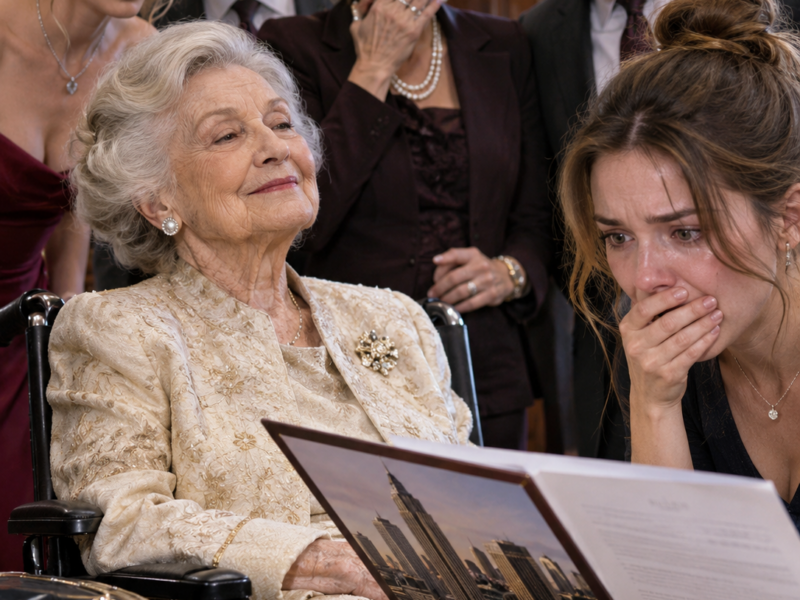
I Called My 89-Year-Old Grandma Every Night at 8 P.M., While the Rest of My Family Barely Visited Her. At Her Funeral, I Discovered She Had Secretly Built an $800 Million Fortune—and Left Most of It to Me. But My Aunt Suddenly Produced a New Will Leaving Everything to Herself, Then Warned Me, “Walk Away While It’s Still Cheap.” I Was About to Lose Everything Until I Checked the Date on Her Will and Remembered Grandma’s Frightened Words During One Particular Phone Call… Do you like this personality?
I Called My 89-Year-Old Grandma Every Night at 8 P.M., While the Rest of My Family Barely Visited Her. At Her Funeral, I Discovered She Had Secretly Built an $800 Million Fortune—and Left Most of It to Me. But My Aunt Suddenly Produced a New Will Leaving Everything to Herself, Then Warned Me, “Walk Away While It’s Still Cheap.” I Was About to Lose Everything Until I Checked the Date on Her Will and Remembered Grandma’s Frightened Words During One Particular Phone Call…
The night my grandmother died, I had no idea she was one of the wealthiest women in North Carolina. I didn’t know she owned a controlling interest in a company worth hundreds of millions of dollars. I didn’t know that the little brick house where I’d spent my childhood summers belonged to a woman whose signature could influence an entire industry.
And I certainly didn’t know that, while I was calling her every evening just to hear her voice, members of my own family were quietly preparing to steal everything she had built.
All I knew was that my grandmother, Margaret Hail, was eighty-nine years old, lived alone in Asheville, North Carolina, and had a habit of calling me “Claire Bear” even though I was thirty-four.
She wore an ancient gray cardigan, saved rubber bands in a kitchen drawer, and washed plastic sandwich bags so she could use them again. She grew tomatoes in five-gallon buckets behind her house and thought buying coffee from a café was a ridiculous waste of money.
To me, she was simply Grandma Maggie.
And for six years, she had been the one person I could count on.
My name is Claire Bennett. At the time, I was teaching third grade at a public elementary school in Columbus, Ohio. My life wasn’t particularly glamorous. I lived in a one-bedroom apartment with unreliable heating, drove a twelve-year-old Honda, and spent most Sunday afternoons grading spelling tests while wondering whether I could afford to replace my winter boots.
I earned fifty-eight thousand dollars a year before taxes. After rent, student loans, insurance, groceries, and everything else, there wasn’t much left.
But I liked my life.
I loved my students. I loved watching a child who had struggled with reading suddenly finish an entire book without help. I loved the ridiculous questions eight-year-olds asked and the way they could turn a terrible morning into a good afternoon with one unexpected hug.
The hardest part of my life wasn’t money.
It was losing my mother.
She died of cancer six years earlier, after a long, exhausting battle that seemed to take something from all of us. My father had disappeared from our lives when I was little, so when Mom died, it felt as though the last person who truly knew me had gone with her.
Except Grandma Maggie.
Every evening at exactly eight o’clock, I called her.
Sometimes we talked for forty minutes. Sometimes only ten. We discussed her neighbor’s cat, the weather, my students, her garden, and the recipes she insisted I would never learn to cook properly.
If I complained about something at school, she listened.
If I cried about my mother, she didn’t rush me.
And every single night, before hanging up, she said the same thing.
“Good night, Claire Bear. Don’t let the world make you hard.”
I never imagined how much I would need those words.
The first sign that something was wrong appeared in early March.
Grandma had been coughing for several days. Her voice sounded weaker than usual, and I could hear her struggling to catch her breath between sentences.
I begged her to see a doctor.
“I’m old, sweetheart,” she said. “Old people make noises.”
“Grandma, this isn’t funny.”
“Neither is your cooking, but we both survive it.”
That was Maggie. Even when she was miserable, she could make me laugh.
Then, during one of our evening calls, she mentioned something unusual.
“Your aunt Diane came by today. Brought Vanessa with her.”
I stopped folding laundry.
“Aunt Diane? Really?”
“Apparently I’ve become popular.”
My aunt Diane was my mother’s younger sister. She lived in Charlotte with her husband, Rick, in a large house in an expensive neighborhood. Diane had always been polished, demanding, and extraordinarily concerned with appearances.
She was the kind of woman who sent Christmas cards featuring professional family portraits but rarely remembered anyone’s birthday unless there was a party worth attending.
Her daughter Vanessa, my cousin, was thirty-six and worked in real estate. Vanessa’s social media pages were full of luxury listings, expensive restaurants, vacations, and motivational quotes about success.
Neither of them visited Grandma very often.
“That’s nice,” I said cautiously. “What did they want?”
Grandma was quiet for a moment.
“Diane says she’s worried about my affairs. She thinks I need help organizing my paperwork.”
“Your paperwork?”
“Apparently I’m too old to know where I keep my socks, much less my important documents.”
She laughed, but the laughter turned into a painful cough.
Then she said something that stayed with me.
“Everything important has been taken care of for years, Claire. Your aunt just doesn’t like that she isn’t in charge.”
I asked what she meant.
“Nothing you need to worry about, sweetheart.”
I wish I had pushed harder.
On March 13, Grandma didn’t answer my eight o’clock call.
At first, I assumed she’d fallen asleep watching television. I called again at eight-thirty, then nine.
Nothing.
Finally, I telephoned her neighbor, Mrs. Lane, who lived two houses down.
“Oh, honey,” she said immediately. “I thought somebody had told you. They took Maggie to Mission Hospital this afternoon.”
My heart dropped.
She had pneumonia.
I called the hospital and begged the nurse to let me speak to her. Eventually, someone carried a telephone into her room.
Grandma sounded frightened.
She asked what day it was twice.
I wanted to get in my car and drive to Asheville immediately, but the hospital staff told me she was stable, receiving antibiotics, and being monitored closely.
I called every evening.
On March 15, something happened that I would later replay in my head hundreds of times.
Grandma sounded particularly tired that night.
“Diane came today,” she murmured.
“Was she visiting you?”
“She brought a man. There were papers.”
I sat upright on my couch.
“What kind of papers?”
“I don’t know. They wanted me to sign something.”
“Did you?”
“No, sweetheart. I told them to leave me alone. Couldn’t even see the words properly.”
There was a long pause.
Then she whispered, “I don’t like what they’re doing.”
I asked her what she meant, but she was exhausted. A nurse came into the room, and our conversation ended.
Afterward, I wrote down what Grandma had said on the back of a grocery receipt.
I didn’t understand why I did it.
Something about her voice frightened me.
Two days later, Grandma was discharged from the hospital.
Diane arranged for a caregiver named Rosa Alvarez to help her recover at home. At first, I felt relieved. Maybe my aunt had finally realized Grandma needed support.
But the changes started almost immediately.
Sometimes when I called at eight, Rosa answered and explained that Diane wanted Grandma resting after seven.
Other evenings, Grandma picked up and spoke in a whisper.
Once, I heard a door closing in the background.
“Are you alone?” I asked.
“Not always,” she said.
“Grandma, is something happening?”
“Your aunt has opinions about everything.”
She changed the subject.
By June, Rosa had been dismissed.
Diane told me there wasn’t enough money to keep paying for a caregiver.
That confused me. Grandma wasn’t wealthy as far as I knew, but she owned her house, received Social Security, and lived modestly. She had never complained about money.
In July, Diane redirected Grandma’s mail to a post office box.
“Too many scams targeting elderly people,” she explained.
When I offered to drive down for a weekend, Diane told me Grandma wasn’t feeling well enough for visitors.
I called Grandma directly.
“Of course I want to see you, sweetheart,” she said. “But come when the leaves turn. The mountains are beautiful then.”
“Are you sure?”
“Positive. And Claire?”
“Yes?”
“There are things I want to tell you.”
I remember smiling.
“Like the secret ingredient in your pound cake?”
She laughed softly.
“Something a little bigger than that.”
I never got the chance to ask what she meant.
Grandma died in her sleep on September 26.
Diane called the following morning.
Her voice was controlled, almost businesslike.
“Your grandmother passed away last night. The funeral is Saturday. We’re keeping it small.”
I gripped the phone so tightly my fingers hurt.
I asked whether Grandma had suffered.
Diane said no.
Then she added, “Honestly, Claire, you don’t need to drive all the way down. She wouldn’t want you missing work.”
I couldn’t believe what I was hearing.
“She’s my grandmother.”
“I know, but the arrangements are already handled.”
“I’ll be there.”
I hung up before she could object.
The drive to Asheville took almost nine hours because I stopped twice to cry.
I kept thinking about our last conversation.
Grandma had asked about a student in my class who struggled with reading. She remembered his name, remembered that he’d finally completed his first chapter book, and told me to buy him another one.
Then she’d said good night.
I’d told her I loved her.
She’d said she loved me more.
That was the last time I heard her voice.
The funeral took place in a little Methodist church on the outskirts of Asheville.
Diane sat in the front pew wearing an elegant black dress and pearl earrings. Vanessa wore oversized sunglasses, even inside the church. Rick kept checking his phone.
There was no room beside them.
Not one of them moved to make space for me.
I sat three rows back among Grandma’s church friends.
Several women hugged me before the service began.
“You’re Maggie’s Claire,” one whispered.
Another squeezed my hand.
“She talked about you all the time, sweetheart.”
Those words meant more to me than anything said during the ceremony.
Afterward, while people gathered in the parking lot, an elderly gentleman approached me.
He was tall and thin, with a cane and a face lined by decades of laughter and grief.
“Claire Bennett?”
“Yes?”
“I’m Walter Briggs.”
The name sounded vaguely familiar.
He looked at me kindly.
“Your grandmother loved you very much.”
“Thank you.”
“She was always telling me about your classroom. Said you had the patience of a saint and the salary of a criminally underpaid public servant.”
I laughed through my tears.
“That sounds like her.”
Walter smiled.
Then he said, “I suppose you’ve been told about the company.”
I frowned.
“What company?”
His smile disappeared.
“Hail and Briggs Packaging.”
I recognized the name.
It was a major packaging manufacturer. I’d seen its logo on shipping boxes and warehouse trucks.
“Did Grandma work there?”
Walter stared at me.
“Sweetheart, your grandmother founded that company with me in 1971.”
For several seconds, I couldn’t understand what he was saying.
“Founded it?”
“Yes. We started with one warehouse, two trucks, and a mountain of debt. Your grandmother was the brains behind most of it.”
I looked toward the church.
My grandmother?
The woman who reused aluminum foil?
Walter continued.
“When the company went public, Maggie kept most of her shares through a trust. She never sold them. Never wanted the attention.”
“How much are they worth?”
The question escaped before I could stop it.
Walter hesitated.
“The last valuation I saw put her holdings a little above eight hundred million dollars.”
I actually laughed.
Not because it was funny.
Because my mind rejected the number.
Eight hundred million dollars.
I thought I’d misheard him.
“That can’t be right.”
Walter’s expression was gentle.
“Maggie was many things, Claire. Poor wasn’t one of them.”
Across the parking lot, I noticed Diane watching us.
Vanessa stood beside her.
Neither looked surprised.
That was when I realized they had known.
They had known all along.
I spent the rest of that afternoon in a strange fog.
Every childhood memory suddenly felt different.
Grandma counting coins at the grocery store.
Grandma refusing to replace her old kitchen cabinets.
Grandma telling me that expensive things didn’t make someone important.
Had she been hiding an enormous fortune from everyone?
Or just from me?
The next morning, while I was sitting on the edge of my motel bed, my phone rang.
An Asheville number.
“Miss Bennett? My name is Thomas Reed. I was Margaret Hail’s estate attorney.”
He asked whether we could speak privately.
I said yes.
Then he delivered the sentence that changed my life.
“Your grandmother left you the majority of her estate, including her controlling interest in Hail and Briggs Packaging.”
I couldn’t speak.
Thomas continued.
“Unfortunately, there’s a complication.”
My stomach tightened.
“Your aunt Diane has submitted another will to the probate court. It leaves the entire estate to her.”
I remember staring at the faded motel curtains.
“What?”
“The document is dated March 15 of this year.”
March 15.
I knew that date.
I knew exactly where Grandma had been.
She’d been lying in a hospital bed with pneumonia, telling me that Diane had brought a man and some papers.
Thomas asked if I could come to his office.
I was there the next morning.
His office occupied the second floor of an old building above a bakery. The hallway smelled like cinnamon, and the furniture looked as though it had been purchased decades earlier.
Thomas was in his sixties, with silver hair and tired eyes.
He laid two documents on his desk.
The first was Grandma’s will from 2019.
It left Diane five hundred thousand dollars, established a charitable gift supporting future teachers, and transferred the remainder of the estate to me.
The second document was dated March 15.
It revoked the earlier will and left everything to Diane.
According to its notarization certificate, Grandma had signed it at her house on Kimberly Avenue.
I stared at the address.
“That’s impossible.”
Thomas leaned forward.
“Why?”
“She was in Mission Hospital.”
“Are you certain?”
“Absolutely.”
I told him about the pneumonia, the telephone calls, and the conversation about the papers.
I showed him the grocery receipt where I’d written down Grandma’s words.
He studied it carefully.
Then he removed his glasses.
“Claire, if what you’re telling me is accurate, we may be dealing with fraud.”
The word frightened me more than the amount of money.
Fraud.
My own aunt.
My cousin.
People who had sat around Grandma’s Thanksgiving table.
Thomas explained that a contested inheritance could become expensive and painful. Diane’s document had been formally submitted, and challenging it would require legal proceedings.
He warned that the other side would probably attack my motives.
They would claim I wanted money.
They would question my relationship with Grandma.
They might even try to embarrass me publicly.
That evening, back at the motel, I opened my notebook.
I wrote down everything I could lose.
My savings amounted to eleven thousand dollars.
My job was in Columbus.
I couldn’t afford to spend months living in Asheville.
And even if I succeeded, what would happen to the few relatives I had left?
Then I thought about Grandma’s house.
Diane had already changed the locks.
Mrs. Lane told me she’d seen Rick loading boxes into his SUV the day after Grandma died.
Those boxes could contain Grandma’s photographs, letters, and the wooden recipe box filled with handwritten cards.
My mother’s handwriting was on some of those cards.
Suddenly, the money felt less important than the possibility that Diane could take the last physical pieces of my mother away from me.
At eleven that night, I called my best friend, Jenna.
Jenna taught fifth grade at my school. We had known each other for years, and she possessed the kind of loyalty that didn’t require explanation.
I told her everything.
She listened without interrupting.
When I finished, she said, “Claire, your aunt isolated your grandmother, interfered with her phone calls, fired her caregiver, changed her mail, and produced a will dated when your grandmother was in a hospital bed.”
I stared at the wall.
“When you say it like that…”
“How else am I supposed to say it?”
I didn’t answer.
“Listen to me,” Jenna continued. “You don’t have to fight for the money. But you do need to decide whether you’re willing to let them rewrite what happened to your grandmother.”
That night, I barely slept.
I kept hearing Maggie’s voice.
Don’t let the world make you hard.
For years, I’d understood that as a lesson about kindness.
But kindness wasn’t the same as surrender.
The next morning, I returned to Thomas Reed’s office.
“I want to challenge the will.”
He nodded.
“I thought you might.”
He recommended a litigation attorney named Andrea Pruitt.
Before I left, I opened my notebook and made a plan.
I needed phone records proving I’d called the hospital.
I needed Grandma’s medical records.
I needed to find Rosa Alvarez.
And I needed to learn who had notarized the March document.
I didn’t know anything about probate litigation.
But I knew how to organize a classroom full of third graders.
I figured that was a start.
On the drive back to Ohio, I stopped at a gas station and opened my phone carrier’s website.
I searched through months of billing records.
Then I found them.
March 13, 9:42 p.m.
Mission Hospital.
March 14, 8:03 p.m.
Mission Hospital.
March 15, 8:01 p.m.
Mission Hospital.
March 16, 8:05 p.m.
Mission Hospital.
Four calls.
Four ordinary telephone calls that suddenly felt more valuable than anything I’d ever owned.
I saved screenshots, downloaded the records, and sent copies to Thomas.
Then I searched the name of the notary listed on the suspicious will.
Brittany Cole.
Her professional page appeared immediately.
The next search result was a photograph from a bachelorette party in Nashville.
Brittany stood among a group of smiling women.
At the center, wearing a plastic tiara, was my cousin Vanessa.
I stared at the picture for a long time.
They were friends.
Not casual acquaintances.
Close enough to celebrate Vanessa’s wedding together.
A cold sensation spread through my stomach.
I sent the photograph to Thomas.
Then I called Jenna.
“I think this is worse than we thought.”
Andrea Pruitt agreed.
When I met her the following week, she sat behind a desk cluttered with legal folders and a jar of almonds.
She was younger than I’d expected, wore sneakers with her suit, and had a directness that made me feel both intimidated and reassured.
She studied everything I’d brought.
Then she looked at me.
“Your grandmother was in the hospital on the day this document says she appeared at home before a notary?”
“Yes.”
“And the notary is your cousin’s friend?”
“Yes.”
Andrea leaned back.
“All right. We have somewhere to start.”
She explained that in North Carolina, challenging a will involved filing a legal proceeding called a caveat.
Once the challenge was properly underway, distribution of the disputed estate could be restricted while the court determined which document was valid.
The case could eventually be decided by a jury.
“A jury?” I repeated.
“Ordinary people. They’ll hear evidence and determine whether the March document is legitimate.”
She paused.
“But understand something, Claire. The moment we file, your aunt will know you’re challenging her.”
I signed the engagement agreement.
On October 9, the caveat was filed.
Two days later, my family’s public campaign against me began.
Vanessa posted a black-and-white photograph of Grandma holding a teacup.
Her caption said grief had a way of revealing people’s true intentions.
She wrote about relatives who appeared only when money was involved.
Dozens of people responded with sympathy.
Some were people I’d known since childhood.
I read the comments once.
Then I closed the app.
Diane texted me that evening.
“Your grandmother made her wishes clear. I’m disappointed that you’re choosing to dishonor her memory.”
Rick’s message arrived twenty minutes later.
“You have no idea what you’re getting into. Walk away while it’s still cheap.”
Andrea had warned me not to argue.
So I didn’t.
Instead, I concentrated on finding Rosa.
It took weeks.
The staffing agency refused to provide her contact information, and Diane wouldn’t tell me where she had gone.
Finally, a woman from Grandma’s church remembered that Rosa had taken a night-shift position at an assisted living facility near Asheville.
I drove down after school one Friday.
I slept in my car for a few uncomfortable hours and waited outside the facility until seven the following morning.
When Rosa emerged wearing purple scrubs, she recognized me immediately.
“Mrs. Maggie’s Claire?”
I nodded.
Her expression changed.
“Oh, sweetheart.”
We went to a nearby diner.
Rosa sat across from me, stirring her coffee long after the sugar had dissolved.
At first, she seemed frightened.
Then she began talking.
“Diane told me not to let your grandmother speak to you after seven,” she said. “She claimed your calls upset her.”
I felt my throat tighten.
“Did they?”
Rosa shook her head.
“No. Your calls were the best part of her day.”
She told me Grandma would sometimes sit beside the telephone twenty minutes before eight, waiting.
She’d straighten her cardigan, put on her glasses, and ask Rosa whether the clock was running slow.
I pressed a napkin against my mouth.
Rosa continued.
“In May, Diane brought some papers to the house. A power of attorney. She wanted your grandmother to sign.”
“What happened?”
“Mrs. Maggie read it with her magnifying glass. Then she said no.”
Rosa paused.
“Diane became very angry. She said your grandmother had already signed important papers in the hospital, so this shouldn’t be a problem.”
I felt my pulse quicken.
“What did Grandma say?”
Rosa looked directly at me.
“She said, ‘I didn’t sign anything in that hospital, and you know it.'”
For a moment, neither of us spoke.
Then Rosa explained that she’d been dismissed a few weeks later.
Diane claimed the family could no longer afford her services.
“Would you testify?” I asked.
Rosa looked down at her hands.
“I have a daughter in college. I can’t afford trouble.”
“I understand.”
She sat quietly.
Then her eyes filled with tears.
“Your grandmother helped pay for my daughter’s textbooks. She made me promise not to tell anyone.”
I swallowed.
“That sounds like her.”
Rosa nodded.
“I’ll testify.”
The medical records arrived the following Monday.
Andrea called while I was eating lunch in the teachers’ lounge.
“Claire, I need you to listen carefully.”
I put my sandwich down.
Grandma had been admitted to Mission Hospital on March 13 at 3:47 p.m.
She remained there until March 17.
On March 15, she was receiving oxygen and intravenous antibiotics.
The nursing notes documented periods of confusion.
Most importantly, the hospital records confirmed that she had not left the facility.
Yet the notarized will stated that she personally appeared before Brittany Cole at her private residence that same day.
“She wasn’t there,” I whispered.
“No,” Andrea said. “She wasn’t.”
Then she told me about the visitor log.
Diane and Vanessa had signed in to Grandma’s room that afternoon.
No notary was listed.
No witnesses were listed.
I thought about Grandma telling me that a man had come with papers. The visitor records didn’t establish who that man was, or whether he’d entered the room by another route.
But the contradiction was unmistakable.
The will described an event that could not have happened as written.
Andrea warned me not to become overconfident.
An incorrect address might be presented as a clerical mistake. The opposing lawyers could argue Grandma signed the document at the hospital and the notary made an error.
We needed more evidence.
So Andrea began formal discovery.
She requested communications, drafts, witness information, and documents connected with the March will.
She arranged depositions.
She hired a forensic document examiner named Harold Fenn to compare Grandma’s signature with genuine samples collected over the years.
I supplied twenty years of birthday cards.
I remember spreading them across my kitchen table.
Every card contained the same familiar handwriting.
Sometimes Grandma had drawn tiny flowers in the corners.
Sometimes she’d underlined a joke.
One card from my twenty-fifth birthday said, “You’re getting older, Claire Bear, but I was old before it became fashionable.”
I cried as I packed them into a box.
Those cards had once been little pieces of love.
Now they were evidence.
By December, the situation had become ugly.
One afternoon, my principal, Dr. Ellen Hayes, asked me to come to her office.
She closed the door behind me.
There was a printed email on her desk.
“Claire, I need you to read this.”
It was from Diane.
She had contacted my school district and the Ohio Department of Education, claiming I had manipulated a vulnerable elderly woman for financial gain.
She accused me of exploiting Grandma through our nightly telephone calls.
She suggested that someone with my character shouldn’t be trusted around children.
I read the email twice.
Then I felt physically sick.
My classroom was my safe place.
I had spent seven years building a reputation as a dependable teacher. I knew my students’ families. I attended weekend school events and bought extra supplies with my own money.
And now my aunt was trying to destroy that.
“It’s false,” I said.
Dr. Hayes studied me.
“I believe you’re entitled to respond. But I have to document the complaint.”
I explained the will contest and promised to provide the court documents.
Andrea sent a detailed response that afternoon.
She also investigated Diane’s claim that she’d reported me to Adult Protective Services.
A report had indeed been made.
But the allegations were unsupported.
I had never controlled Grandma’s bank accounts, received money from her investments, or handled her financial affairs.
The complaint was closed after review.
I thought that might end the harassment.
It didn’t.
A few days later, Rick called from an unfamiliar number.
He didn’t bother with hello.
“Withdraw the case by New Year’s.”
I stood in my kitchen, holding a dish towel.
“Why?”
“Because we can make this much uglier.”
“Rick, you already have.”
He laughed.
“Your mother borrowed forty thousand dollars from Maggie and never paid it back. Think about how that will sound in court.”
My stomach dropped.
I knew what he was talking about.
When Mom was dying, Grandma had paid for treatment that insurance wouldn’t cover.
It hadn’t been a loan.
Grandma had paid the clinic directly.
“That money was for cancer treatment,” I said.
“Call it whatever you want. We can make it look like your family has been living off Maggie for years.”
Something inside me went very still.
“Are you seriously threatening to attack my dead mother because we’re challenging a forged will?”
He didn’t answer immediately.
I continued.
“If you want to explain that in court, go ahead. And I’ll be sending the details of this conversation to my attorney.”
He hung up.
My hands shook afterward.
Andrea told me to write down every word I remembered.
She warned Diane’s lawyer that further intimidation or improper contact would be brought to the court’s attention.
For a while, the messages stopped.
But the damage had already been done.
I was exhausted.
I couldn’t sleep properly.
I lost weight without trying.
Every time an unfamiliar number appeared on my phone, my heart started racing.
During winter break, Jenna insisted that I take several days away.
Her parents owned a small cabin near Hocking Hills.
I went there alone.
There was no reliable phone signal, just trees, snow, a wood stove, and silence.
On the third evening, I found a deck of cards in a kitchen drawer.
I sat beside the fire and played solitaire, the way Grandma used to while talking to me on speakerphone.
Halfway through the game, I began crying.
Not delicately.
Not quietly.
I cried until my chest hurt.
I cried for my mother, for Grandma, for the family I’d thought I had, and for the terrible realization that people could sit beside you at Christmas dinner while secretly resenting everything about you.
Then I remembered Grandma’s voice.
Don’t let the world make you hard.
I wiped my face.
“I won’t,” I whispered.
“But I’m not giving up, either.”
The settlement offer arrived in January.
Five million dollars.
That was the amount Diane offered if I withdrew the challenge.
Her lawyers presented it as a family resolution.
I would receive the money after the March will was accepted, and in exchange, I would sign agreements preventing me from speaking publicly about the dispute or discussing the circumstances surrounding the will except where legally required.
I read the letter at my kitchen table.
Five million dollars.
I had never seen that much money in my life.
I calculated how long it would take to earn that amount on my teaching salary.
More than eighty years.
With five million dollars, I could pay off my student loans, purchase a house, help struggling students, and never again wonder whether I could afford a car repair.
For one brief, humiliating moment, I considered accepting.
I called Andrea.
She didn’t pressure me.
“Claire, this is a serious offer. Litigation carries risk. I need you to understand that.”
“I do.”
“You don’t have to decide immediately.”
I looked at the settlement language again.
Then I remembered Grandma in room 418, telling me she couldn’t see the papers someone wanted her to sign.
“They’re not paying me because they care about me,” I said.
Andrea was quiet.
“They’re paying me to stop asking questions.”
“That’s a reasonable concern.”
I closed the letter.
“If I take this money, I’ll spend the rest of my life wondering whether I helped them get away with what they did to her.”
Andrea waited.
“I’m rejecting it.”
“Are you certain?”
“Yes.”
The response was brief.
My client declines.
After that, everything grew quieter.
But the silence felt threatening rather than peaceful.
The trial was scheduled for April.
I kept teaching, kept grading homework, and kept driving between Ohio and North Carolina whenever my attorney needed me.
On some days, I almost convinced myself life was normal.
Then I’d see an email from Andrea or discover another old photograph of Grandma, and the grief returned.
There were moments when I wondered whether I had made a terrible mistake.
But support arrived from places I hadn’t expected.
Walter Briggs sent me a handwritten letter.
He promised to testify.
He also included a photograph of himself and Grandma standing outside their first warehouse in 1974.
Grandma looked young, determined, and impossibly happy.
She was holding a cardboard box above her head like a trophy.
I had never seen that version of her.
Not the elderly woman in the gray cardigan.
Not the grandmother clipping coupons.
A young entrepreneur who had built something enormous from almost nothing.
Walter told me that Maggie had negotiated contracts with businessmen who refused to take her seriously because she was a woman.
He said she could calculate shipping costs faster than most people could find a calculator.
He told me she’d once made a supplier apologize for calling her “honey” during a meeting.
I laughed so hard I cried.
That was my grandmother.
The more I learned about her, the more I understood why she had kept her wealth private.
She had spent her life watching money transform people’s behavior.
And she had decided it would never be allowed to transform hers.
In March, almost a year after Grandma’s hospitalization, Diane and Vanessa appeared at my apartment.
It was a Saturday afternoon.
I was grading reading assignments when the intercom buzzed.
“Claire, honey, it’s Aunt Diane. Vanessa’s with me. Can we talk?”
I nearly said no.
Instead, I called Andrea.
She advised me not to sign anything, agree to anything, or discuss settlement terms without counsel. She also explained the rules governing recordings in Ohio.
I turned on the recording function on my phone and placed it on the coffee table.
Then I let them upstairs.
Diane arrived carrying white lilies.
Grandma’s favorite flowers.
Vanessa carried a green photo album.
They looked tired, almost vulnerable.
For one brief moment, I wanted to believe they had come to apologize.
Diane looked around my apartment.
“Oh, Claire. Your mother would have loved this place.”
The comment caught me off guard.
She knew exactly how to reach me.
We sat in the living room.
I told them I was recording the conversation.
Diane smiled.
“That’s fine. We have nothing to hide.”
Vanessa opened the album.
There were photographs of Grandma at Christmas, my mother and Diane as teenagers, and Vanessa and me playing in Grandma’s backyard.
One picture showed us covered in mud, holding a cardboard castle we’d constructed ourselves.
Vanessa smiled sadly.
“Remember how close we were?”
I nodded.
“Of course.”
“When did we become enemies?”
I looked at her.
“When your mother submitted a will that says Grandma signed papers at home while she was in the hospital.”
The room went quiet.
Diane sighed.
“Claire, mistakes happen. A notary can write down the wrong address.”
“Then why hasn’t anyone explained what actually happened?”
“Your grandmother was confused. She was on medication.”
“She told me she refused to sign anything.”
“She said all kinds of things while she was ill.”
Diane leaned forward.
“Think about what you’re doing. You’re going to stand in court and portray your grandmother as a confused old woman who didn’t understand her own decisions.”
I stared at her.
She was trying to make me feel guilty for questioning a suspicious document.
Grandma’s dignity had become another weapon.
“I’m not questioning her intelligence,” I said. “I’m questioning why someone claims she was in two places at once.”
Vanessa shut the album.
Diane reached into her purse and removed a folded document.
“This can all end today. The five million is still available. Just sign the withdrawal, and we can move on.”
I didn’t touch it.
“No.”
Diane’s expression hardened slightly.
“Claire, be reasonable.”
“I am being reasonable.”
Vanessa suddenly laughed.
It wasn’t a pleasant sound.
“You really think Grandma loved you more than us?”
I turned toward her.
“What?”
“She felt sorry for you. That’s why she took your calls. Poor Claire, with her dead mother and her miserable little teaching job.”
The words hit me harder than I wanted to admit.
I remembered Vanessa saying cruel things when we were children, then laughing whenever I cried.
For a moment, I felt nine years old again.
Then I thought about Grandma waiting beside the telephone every evening.
I thought about the cards she’d sent, the birthday messages, the recipes she’d taught me.
And I thought about Walter saying she never stopped talking about me.
“If that’s true,” I asked quietly, “why did she leave me the company?”
Diane’s face changed.
The sadness disappeared.
Her cheeks reddened, and she leaned forward.
“Because you manipulated her.”
I said nothing.
“You called every night like some kind of sales representative, making sure she remembered you. Meanwhile, I was the one dealing with her doctors. I was the one driving two hours whenever she needed something.”
Her voice rose.
“I gave that woman thirty years of my life. Thirty years! And what did you give her? Phone calls?”
I could hardly believe what I was hearing.
Diane pointed toward me.
“That money belongs to me. I earned it.”
The words hung between us.
I looked directly at her.
“Then why did you need a forged will to get it?”
Silence.
For several seconds, nobody moved.
Vanessa’s eyes darted toward my phone.
“Mom,” she whispered sharply. “Stop talking.”
Diane stood so suddenly that the lilies slipped from the couch and fell onto the floor.
“You’ll regret this.”
I remained seated.
“Maybe.”
“When this is over, you’ll have no family left. You’ll be alone in this sad little apartment with your pathetic lesson plans.”
I felt something inside me settle.
“I’ll take that chance.”
They stormed out.
I heard Vanessa arguing with Diane in the stairwell.
Then the door slammed.
I sat motionless for several minutes.
Finally, I stopped the recording.
Forty-one minutes and sixteen seconds.
I replayed the last part.
Diane’s voice sounded furious.
“That money belongs to me. I earned it.”
Then my question.
“Then why did you need a forged will to get it?”
And the silence.
Vanessa telling her mother to stop talking.
It wasn’t a direct confession. Andrea would later make that clear. But it revealed Diane’s attitude, her refusal to answer a crucial question, and the pressure they’d placed on me.
I emailed the recording to Andrea.
She called almost immediately.
“Claire, are you safe?”
“Yes.”
“Good. Don’t delete anything.”
That evening, Jenna came over and stayed the night.
She found the lilies scattered on the floor.
Without saying much, she picked them up, trimmed the stems, and placed them in a glass vase.
I looked at her.
“Why would you keep those?”
“Because they’re Maggie’s favorite flowers,” she said. “Diane doesn’t get to ruin everything.”
The trial began on April 20.
I arrived at the Buncombe County Courthouse with Jenna beside me and a nervousness so intense I could barely swallow breakfast.
Walter came in a wheelchair, pushed by his grandson.
Rosa sat behind our table wearing a navy dress.
Several women from Grandma’s church attended.
When I looked around, I realized how many people had loved Maggie.
Diane sat across the courtroom beside her attorney, Gregory Haskins.
She wore a cream-colored suit and looked perfectly composed.
Vanessa sat behind her, staring at her hands.
Rick was absent.
Andrea leaned toward me.
“Remember, no matter what they say, stay calm.”
I nodded.
The first witnesses established Grandma’s history and the circumstances surrounding the two wills.
Thomas Reed explained how the 2019 document had been prepared and executed.
He described Grandma as precise, independent, and fully aware of her financial arrangements.
Then the hospital records were introduced.
The jury saw the dates.
They saw the admission records.
They saw the nursing notes describing pneumonia, oxygen support, and periods of disorientation.
And they saw the visitor log.
Diane Whitaker.
Vanessa Low.
The opposing attorney argued that the address on the notary certificate could have been a mistake.
He suggested the document might have been signed in the hospital and notarized improperly afterward.
It frightened me how plausible he made it sound.
I watched jurors listening carefully.
For the first time, I understood that being right and proving you were right were different things.
Rosa testified next.
She described Grandma’s telephone calls, Diane’s instructions, and the attempted power of attorney.
She repeated Grandma’s words.
“I didn’t sign anything in that hospital, and you know it.”
Haskins questioned whether Rosa resented being dismissed.
Rosa looked at him steadily.
“I was sad to leave Mrs. Maggie,” she said. “That’s different from being bitter.”
Walter followed.
He described their decades in business and the conversation he’d had with Grandma shortly after she left the hospital.
He told the jury that she had specifically asked whether Diane was trying to interfere with the company.
He smiled faintly.
“Margaret Hail could be stubborn enough to move a mountain if she decided it was in her way.”
Several jurors smiled.
Then came Harold Fenn, the handwriting examiner.
He displayed enlarged signatures from Grandma’s genuine documents.
Birthday cards.
Bank records.
The 2019 will.
Next to them appeared the signature on the March document.
At first, they looked similar.
But Harold explained the differences.
Grandma’s authentic signature had a natural rhythm. The questionable signature contained hesitations, unnatural pen movements, and signs that someone had carefully drawn the letters rather than written them.
Then he pointed to a small mark beneath the final letter of her surname.
Grandma had made that mark consistently for years.
The suspicious signature contained a similar mark.
But it was positioned incorrectly.
“Someone appears to have copied the signature from an example,” Harold explained.
Andrea asked whether he believed Grandma herself had written it.
“In my professional opinion, she did not.”
I felt Jenna grip my hand beneath the table.
But the most important testimony came the following morning.
Brittany Cole entered the courtroom looking frightened.
She wore a black dress and kept glancing toward Vanessa.
Her own lawyer sat behind her.
Andrea began with straightforward questions.
Brittany confirmed she had known Vanessa since high school.
She confirmed they’d been friends for years.
She confirmed she’d attended Vanessa’s wedding.
Then Andrea displayed the notarization certificate.
“Ms. Cole, this document states that Margaret Hail personally appeared before you at her home on March 15. Is that true?”
Brittany stared at the paper.
Her eyes filled with tears.
“No.”
The courtroom became completely silent.
Andrea waited.
“Did you meet Margaret Hail that day?”
“No.”
“Did you ever meet her?”
Brittany shook her head.
“No.”
My heart was pounding so hard I could hear it.
“Then how did your notary seal appear on this will?”
Brittany began crying.
She explained that Vanessa had contacted her the day after the document was supposedly signed.
Vanessa claimed Grandma had signed a new will in the hospital, but circumstances had prevented proper notarization.
She described it as a harmless technical problem.
Brittany said Vanessa brought the document to her already bearing signatures.
She asked Brittany to notarize it as though the execution had occurred at Grandma’s house.
“She told me her grandmother wanted it,” Brittany whispered.
Andrea asked whether she’d received money.
“Two hundred dollars.”
“Did you know what you were doing was improper?”
“Yes.”
The word echoed through the room.
Brittany wiped her cheeks.
“I knew. I did it anyway.”
She explained that the listed witnesses were connected to Vanessa.
One was Vanessa’s brother-in-law.
The other worked at her real estate office.
Neither had been present when Grandma supposedly signed the document.
I looked toward Vanessa.
Her face was pale.
Diane remained motionless.
Haskins tried to challenge Brittany’s credibility. He pointed out that she faced possible legal consequences and had consulted prosecutors.
Brittany acknowledged it.
Then she said something I will never forget.
“I’m telling the truth because I finally understand what happens when you don’t.”
When she stepped down, Andrea introduced the recording from my apartment.
Only a short portion was played for the jury.
They heard Diane offering the settlement.
They heard her arguing that she’d earned Grandma’s money.
They heard me ask why a forged will had been necessary.
Then came that awful silence.
And Vanessa’s frightened warning.
“Mom, stop talking.”
Diane suddenly stood.
“That’s completely out of context!”
The judge, Patricia Langford, looked toward her.
“Mrs. Whitaker, sit down.”
“She deliberately provoked me!”
“Sit down, or you will be removed.”
Diane lowered herself into her chair.
Then, while the attorneys approached the bench, she turned toward Vanessa.
Her whisper was loud enough for people nearby to hear.
“You told me Brittany would keep her mouth shut.”
Vanessa stared at her mother.
“You told me Grandma agreed.”
I remember that moment more clearly than almost anything else about the trial.
Two women who had presented themselves as devoted family members were suddenly turning on each other.
Neither seemed concerned about Grandma anymore.
They were concerned about who would be blamed.
Haskins requested a recess.
The judge granted it.
I remained seated.
Andrea glanced at me.
“You’re doing fine.”
I looked at the empty witness stand.
“I just wish Grandma didn’t have to be part of this.”
Andrea’s expression softened.
“She would have wanted the truth known.”
When court resumed, Diane did not testify.
The remaining arguments centered on the evidence already presented.
The hospital records.
The false notarization.
The handwriting analysis.
The witnesses connected to Vanessa.
Rosa’s account.
Walter’s recollections.
And the recording.
During closing arguments, Andrea spoke calmly.
She reminded the jury that this case wasn’t about deciding which relative deserved more money.
It was about determining whether a particular document represented Margaret Hail’s genuine wishes.
She held up my telephone records.
“These calls were made to a hospital room,” she said. “That’s where Margaret Hail was. The opposing document places her somewhere else. The evidence tells us which account is true.”
The jury deliberated for one hour and forty minutes.
It felt like forty years.
I waited in the courthouse hallway.
Jenna sat beside me.
Rosa held a tissue in her lap.
Walter’s grandson brought coffee from a vending machine.
Nobody knew what to say.
Finally, Walter reached over and patted my hand.
“If Maggie were here,” he said, “she’d be telling everyone exactly how to do their jobs.”
I laughed unexpectedly.
“She absolutely would.”
“Then she’d complain that the coffee cost too much.”
That made me laugh harder.
When we were called back inside, I could barely stand.
The jury foreperson rose.
The court asked whether the March 15 document was Margaret Hail’s valid last will.
The answer was no.
I stopped breathing.
The next question concerned the 2019 will.
Was it valid?
Yes.
Jenna began crying.
Rosa grabbed my hand.
Behind us, someone whispered a prayer.
I sat completely still.
I had imagined that moment for months.
I thought I’d feel triumphant.
Instead, I felt overwhelmingly tired.
The judge entered judgment rejecting the March document and recognizing the earlier will.
Then she announced that the trial record would be referred to the district attorney for review.
I looked toward Diane.
She was staring straight ahead.
Vanessa had already left the courtroom.
And suddenly, after months of threats and insults, neither of them seemed powerful anymore.
They just seemed small.
The consequences unfolded over the following months.
Andrea pursued recovery of Grandma’s property and legal expenses connected with the fraudulent document.
The court ordered Diane to pay hundreds of thousands of dollars in attorney’s fees and expert costs.
The estate also demanded the return of items removed from Grandma’s house.
Eventually, six large crates arrived at Thomas Reed’s office.
They contained jewelry, silverware, photographs, papers, and personal possessions.
Some valuable items had already been sold and could not be recovered.
But one thing came back.
Grandma’s recipe box.
I found it wrapped in an old dish towel.
The wood was scratched and faded.
Inside were dozens of index cards.
I pulled out the first one.
It was a pound cake recipe.
My mother’s handwriting filled the front.
At the bottom, she had written a note reminding Diane not to leave out the sour cream.
I sat on the floor of Thomas’s office and cried.
For months, I’d been told this case was about money.
But holding that little wooden box, I knew exactly what I’d been fighting for.
Not eight hundred million dollars.
Not company shares.
Not a beautiful house.
I had been fighting for the right to remember my grandmother as the woman she actually was.
And for the right to keep the pieces of my mother that still existed.
By June, the district attorney’s investigation had produced criminal charges.
Diane faced charges connected with submitting the forged document.
Vanessa faced forgery-related charges and conspiracy allegations.
The witnesses who had signed without seeing Grandma execute the document cooperated with investigators.
Brittany admitted her role in the false notarization and eventually lost her notary commission.
I didn’t celebrate.
The entire situation made me sad.
I thought about how many opportunities those people had been given to tell the truth.
They could have stopped before the document was created.
They could have refused to sign it.
They could have admitted what happened when the first questions were raised.
Instead, they kept making choices that drew them deeper into the deception.
Vanessa eventually admitted she had copied Grandma’s signature using an old birthday card as a model.
When Andrea told me, I felt physically ill.
A birthday card.
Something Grandma had written to express love.
They had used it to imitate her handwriting.
I stared at the ceiling after hearing that detail.
It was one of the cruelest things I’d learned.
The criminal proceedings continued.
Diane eventually pleaded guilty to a felony conspiracy charge related to the forged document. She received a suspended sentence, supervised probation, community service, and a permanent criminal record.
Vanessa pleaded guilty to forgery and received eight months of jail time followed by probation.
Her real estate career collapsed.
Her brokerage ended its relationship with her, and her professional license was lost.
Her marriage also fell apart.
Diane faced enormous legal bills and financial difficulties.
She and Rick sold their expensive Charlotte home.
Rick eventually filed for divorce.
By the time everything settled, Diane was living in a rented condominium, and Vanessa’s life looked nothing like the polished photographs she once posted online.
I heard that Vanessa eventually moved in with her mother.
Two women who had tried to take everything were now depending on each other to manage what remained.
People occasionally asked whether I felt satisfied.
I didn’t know how to answer.
I was relieved that the truth had been established.
I was grateful Grandma’s wishes had been honored.
But happiness over my relatives’ suffering wasn’t something I wanted to carry.
The day Diane was sentenced, I didn’t go to court.
I was in Columbus teaching third grade.
That afternoon, we practiced writing friendly letters.
One student, a shy girl named Amara, decided to write to her grandmother in Ghana.
She raised her hand.
“Miss Bennett, how do you spell ‘I miss you’?”
I wrote the words on the board.
I MISS YOU.
For a moment, I couldn’t turn around because my eyes had filled with tears.
That evening, I almost reached for my phone at eight.
Almost.
The habit was so deeply rooted that even after all those months, some part of me still expected Grandma to answer.
The wealth didn’t arrive as a giant check.
There were trusts, company shares, tax considerations, estate responsibilities, and countless legal and financial decisions.
Thomas helped me assemble a team of experienced professionals.
I learned more about corporate governance in six months than I had ever wanted to know.
Hail and Briggs Packaging was enormous.
Thousands of employees.
Manufacturing facilities.
Distribution networks.
Long-term supplier relationships.
A history that stretched back to one stubborn young woman and her business partner standing outside a warehouse with a cardboard box.
The controlling interest Grandma left me was worth approximately eight hundred million dollars at the valuation Walter had mentioned.
For several weeks, the number didn’t feel real.
I continued driving my old Honda.
I continued shopping at the same grocery store.
I continued checking price tags.
Then Thomas called me into his office one afternoon.
He had something Grandma had instructed him to give me after the estate matter was resolved.
A letter.
It had been sealed in 2019.
My hands trembled as I opened it.
“Claire Bear,” it began.
The familiar handwriting brought tears to my eyes immediately.
Grandma explained that she had kept her fortune private because she had watched money change people.
She’d seen friendships become transactions and family relationships become competitions.
She’d watched Diane grow increasingly interested in the company’s value while becoming less interested in the woman who owned it.
She told me that she had never wanted me to measure love in dollars.
Then came the sentence that broke me.
“You never asked me for anything, sweetheart. You just called.”
I covered my mouth.
The letter continued.
She advised me not to attempt to run the company myself.
She wanted me to appoint good people, listen to experienced leaders, and remember that the employees and their families mattered more than any figure on a balance sheet.
She told me to use the opportunities the inheritance provided to do something meaningful.
And she ended exactly as she always had.
“Don’t let the world make you hard. Love, Mama Maggie.”
I folded the letter carefully.
Then I sat quietly for a long time.
I finally understood why she’d chosen me.
It wasn’t because I had called her every night with some expectation of being rewarded.
It was because she knew I would have called even if she had nothing.
I followed her advice.
I kept the company shares in the trust and joined the board as a non-executive director.
The company’s chief executive officer, Renee Okafor, remained responsible for day-to-day leadership.
Renee was intelligent, experienced, and deeply respected by the employees.
At our first meeting, I told her something that made her smile.
“I know how to teach eight-year-olds to multiply. I don’t know how to operate a national packaging company.”
She laughed.
“Then we’re already starting with a useful level of honesty.”
I listened.
I learned.
And I resisted the temptation to interfere with decisions better left to professionals.
One of the first major things I established was the Margaret Hail Teaching Fellowship.
It provided financial support, mentoring, and professional development opportunities for future teachers committed to working in underfunded schools.
I wanted the program to address a problem I understood personally.
Too many talented people loved teaching but couldn’t afford the training or the financial sacrifices required to enter the profession.
The first year, we funded twelve fellows.
Rosa’s daughter applied.
I asked that her application receive the same independent evaluation as everyone else’s.
She earned a place on her academic record and qualifications.
When Rosa called to tell me, she was crying.
“Mrs. Maggie would be so proud,” she said.
I looked at Grandma’s photograph on my desk.
“She would.”
I also purchased Grandma’s house from the estate through the appropriate process.
The brick walls were the same.
The wooden porch creaked in the same places.
The kitchen still had the old cabinets Grandma refused to replace.
I could have bought a mansion.
Instead, I chose the house where I’d learned to make biscuits, where my mother had laughed, where Vanessa and I had once built cardboard forts before money turned our family against itself.
I planted tomatoes in Grandma’s old buckets.
I restored the garden fence.
And I put the recipe box back on the kitchen shelf.
Some of the furniture needed replacing, but I kept her kitchen table.
It was scratched and ordinary.
There were faint marks where she had played solitaire over the years.
I couldn’t imagine the house without it.
Walter visited frequently.
Sometimes he sat on the porch and told stories about the early days of the company.
He described Grandma driving trucks when they couldn’t afford enough workers.
He remembered arguments over suppliers, late-night meetings, and the time Maggie refused a lucrative contract because the buyer treated employees terribly.
“She could have made even more money,” he told me once.
“Why didn’t she?”
Walter looked toward the garden.
“Because she knew the difference between making money and making a life.”
That sentence stayed with me.
Through the fellowship, I met a middle school science teacher named Daniel.
He was funny, thoughtful, and completely unimpressed by wealth.
We met at a fundraiser, where he spent most of the evening explaining why his students needed better laboratory equipment.
I liked that.
On our third date, he learned about my inheritance.
He stared at me for a moment.
Then he said, “So, does this mean you’re buying the pizza?”
I laughed harder than I had in months.
We split the bill anyway.
Our relationship developed slowly.
He never asked for expensive gifts or special favors.
He asked about my students, my mother, and Grandma’s garden.
Sometimes he helped me carry bags of soil into the backyard.
Once, I caught him sitting at the kitchen table carefully reading Grandma’s handwritten recipes.
He wanted to learn how to make her pound cake.
I realized then that wealth hadn’t given me the thing I wanted most.
It had simply made room for me to recognize it.
I wanted a life filled with people who loved me without needing anything from me.
Eventually, I moved to Asheville permanently and accepted another third-grade teaching position.
Some people thought that was ridiculous.
They asked why someone with hundreds of millions of dollars would continue working in a classroom.
But the answer was simple.
I loved teaching before I had money.
Why would money make that love less real?
There were practical adjustments, of course.
I had better financial security.
I could purchase school supplies without worrying about my checking account.
I could support educational programs and help students whose families were struggling.
But I still loved the moment when a child finally understood long division.
I still loved reading stories aloud.
I still enjoyed decorating classroom bulletin boards.
And I still felt proud when a student wrote me a thank-you note in crooked handwriting.
I never wanted to become someone who believed those moments were beneath me.
For a long time, I thought about contacting Diane.
Not to argue.
Not to demand an apology.
Just to ask whether she understood what she’d lost.
Grandma had left her five hundred thousand dollars in the legitimate will.
She had offered her daughter substantial financial security even though their relationship was strained.
But Diane had wanted all of it.
After the court judgments and recovery claims were accounted for, the money she would otherwise have received was exhausted, and she remained responsible for additional losses.
She had sacrificed her inheritance, her reputation, and much of her family life chasing something that had never belonged to her.
Sometimes I wondered whether she’d ever recognized the cruel irony.
But I never called.
Not because I hated her.
Because I had finally learned that forgiveness didn’t require me to reopen a door that someone had repeatedly used to hurt me.
Vanessa sent one letter after she was released from jail.
It was short.
She said she was sorry.
She said she had spent years believing that money was proof of success and that Grandma’s fortune should have belonged to her side of the family.
She admitted she’d convinced herself I was undeserving because my life looked smaller than hers.
Then she wrote something that surprised me.
“I think I hated how happy Grandma sounded when she talked about you. I thought it meant she loved us less.”
I read that line several times.
It was the first thing she’d ever said that sounded like a genuine explanation rather than an excuse.
I didn’t know whether she was truly sorry.
I hoped she was.
But I also knew that rebuilding trust required more than one letter.
I wrote back.
I told her I appreciated her apology and hoped she would build a better life.
I did not invite her into mine.
That was enough.
One year after the jury’s verdict, I decided to spend the evening alone at Grandma’s house.
It was a warm spring night.
The tomatoes had begun growing, and the air smelled like damp soil and flowers.
I took the wooden recipe box down from the shelf.
Inside, I found my mother’s pound cake recipe.
I read the instructions carefully.
Three sticks of butter.
Sugar.
Eggs.
Flour.
Vanilla.
And sour cream.
“Don’t skip it,” my mother had written at the bottom.
I smiled.
For the first time, I followed the recipe exactly.
While the cake baked, I wandered through the house.
I passed the old photographs in the hallway.
Grandma and Walter outside their first warehouse.
My mother holding me as a baby.
Vanessa and me building our cardboard castle in the backyard.
I had decided to keep that photograph.
It reminded me that even painful relationships could contain real, happy memories.
And I didn’t want bitterness to erase the truth of those moments.
When the cake was ready, I cut two slices.
One for myself.
One I placed on a small plate beside Grandma’s photograph.
It was sentimental and probably a little silly.
But I liked imagining she’d appreciate the gesture.
At seven fifty-five, I carried my plate onto the porch.
The sky was turning dark blue over the mountains.
Somewhere nearby, a dog barked.
A car passed slowly along Kimberly Avenue.
The neighborhood was settling into its familiar evening quiet.
I looked at my phone.
Seven fifty-eight.
For years, this had been the time when I finished whatever I was doing, found a comfortable chair, and prepared to call Grandma.
I used to worry that those calls were too ordinary.
That I should have asked deeper questions.
That I should have visited more.
That I should have known about the company, the trust, the danger surrounding her.
I had spent so much time replaying what I could have done differently.
But that evening, sitting on her porch, I remembered something Walter had told me.
“Your grandmother had people who wanted her money, people who wanted her influence, and people who wanted something from the company. But when she talked about you, she never mentioned what you wanted from her. She only talked about how happy she was after you called.”
The clock on my phone changed.
Eight o’clock.
I stared at the screen.
For a moment, my fingers moved automatically toward her old telephone number.
Then I stopped.
The house was quiet.
The chair beside me was empty.
I could almost hear her shuffling her cards at the kitchen table.
Almost hear the gentle irritation in her voice when I told her I’d burned dinner again.
Almost hear her laughing as she insisted that proper pound cake required patience.
I looked toward the stars.
“Good night, Grandma,” I whispered.
My eyes filled with tears.
“I hope I made you proud.”
A breeze moved through the tomato plants.
Somewhere in the garden, leaves rustled against the fence.
Of course, there was no answer.
But I didn’t feel alone.
I thought about the company she’d built, the employees whose livelihoods depended on it, the teachers whose education her fellowship now supported, and the people who had stepped forward when my own family turned against me.
I thought about Rosa, Walter, Jenna, Daniel, and all the ordinary kindness that had carried me through the worst year of my life.
Grandma had left me extraordinary wealth.
But the most valuable thing she’d given me was something no lawyer could place in a trust.
She had taught me that love wasn’t measured by money, grand gestures, or public declarations.
It was measured by the choices people made when there was nothing to gain.
By showing up.
By listening.
By remembering the little things.
By calling someone every night just because hearing their voice made the world feel less lonely.
My aunt had believed that thirty years of family obligation entitled her to everything Grandma owned.
Vanessa had believed that having more money would finally make her more important than everyone else.
They had spent months lying, threatening, forging documents, and destroying relationships to acquire a fortune they thought would solve everything.
And in the end, they lost far more than money.
I had entered that courtroom terrified that I would lose my entire family.
Instead, I discovered the difference between people who shared my blood and people who truly stood beside me.
My grandmother had known that difference long before I did.
Perhaps that was why she’d kept her fortune hidden.
Perhaps she’d wanted to know who would still love her when all they could see was an elderly woman in a faded cardigan, sitting alone in a small brick house.
And perhaps, every evening at eight o’clock, she had found her answer.
I finished my cake and carried the empty plate inside.
Before turning off the kitchen light, I looked at the little photograph beside the telephone.
Grandma was smiling, her gray cardigan buttoned crookedly, a basket of tomatoes in her lap.
Nothing about her looked extraordinary.
But I knew better now.
I touched the edge of the frame.
Then I smiled through my tears.
“I won’t let the world make me hard, Grandma.”
I paused.
“But you were right about one thing.”
The kitchen was silent.
“Your pound cake really is better than mine.”
And for the first time since her death, the memory of my grandmother made me laugh before it made me cry.
That was when I finally understood.
The real inheritance wasn’t the eight hundred million dollars.
It was knowing that, long before I understood what she owned, my grandmother had already given me everything that mattered.