Ghost Doesn’t Miss, Whispered the Colonel—Then Every Nurse in the Room Turned to Her
Ghost Doesn’t Miss, Whispered the Colonel—Then Every Nurse in the Room Turned to Her
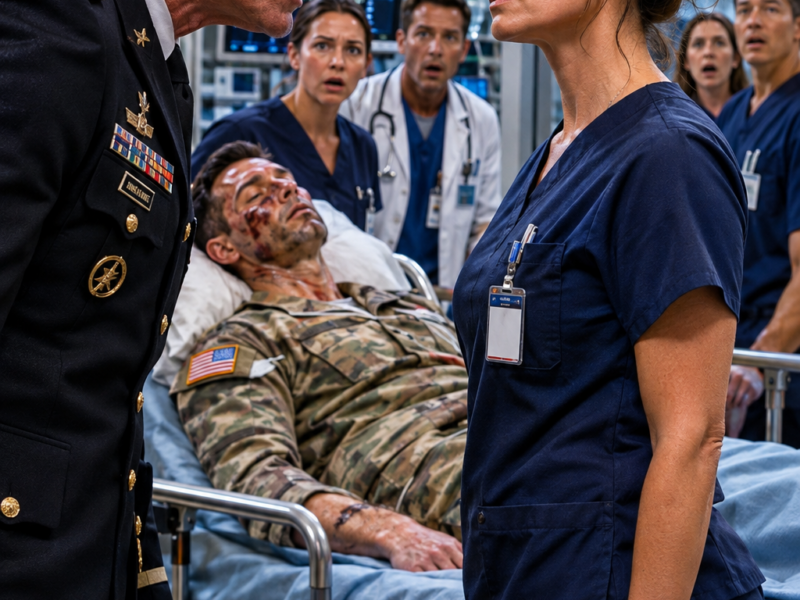
The moment Colonel Grant Wexford whispered the words “Ghost doesn’t miss,” something extraordinary happened inside the trauma bay at Meridian General Hospital. Six nurses stopped what they were doing. A respiratory therapist slowly lifted his head from the ventilator. A young surgical resident stood motionless with a medical tray in his hands. And Dr. Marcus Reyes, a physician who had spent the previous eleven weeks humiliating one particular nurse, suddenly found himself unable to speak.
Every eye in the room turned toward Elena Ashford.
She was standing beside a critically injured soldier, her pale blue scrubs stained with blood, her gloved hands moving with a precision that seemed almost impossible under the circumstances. Just moments earlier, the soldier had been dying. His oxygen levels had been collapsing, his blood pressure had fallen dangerously low, and the attending physician had insisted on waiting for diagnostic imaging before taking action.
Elena had refused to wait.
Against the doctor’s furious objections, she had recognized an immediately life-threatening condition and performed an emergency intervention that allowed the soldier to breathe again. Now, as the monitors began displaying numbers that suggested he might survive, the colonel was staring at her with an expression that belonged somewhere between astonishment and grief.
He knew those hands.
He knew the unusual scar along her left thumb. He recognized the way she tilted her head when concentrating, the stillness of her shoulders, and the absence of hesitation in her movements. More importantly, he remembered another place, thousands of miles away, where a woman with those same hands had repeatedly stood between wounded soldiers and certain death.
For four years, Colonel Wexford had believed that woman was dead.
And now she was standing in front of him, wearing a hospital identification badge that described her as nothing more remarkable than a registered nurse.
But to understand why those three words transformed an entire emergency department, it is necessary to understand the life Elena Ashford had spent years trying to leave behind.
Four months before that extraordinary night, Elena had arrived at Meridian General with a modest résumé, excellent references, and an almost unsettling lack of interest in impressing anyone.
She was thirty-four years old, with dark hair she usually pulled into a practical bun and gray eyes that seemed to notice things before anyone else realized there was something worth noticing. She spoke softly, walked without rushing, and approached even the most chaotic situations with a deliberate calm that some colleagues interpreted as confidence and others mistook for uncertainty.
Her nursing license was relatively new. On paper, she had completed her qualifications only two years earlier. Before that, her employment history mentioned overseas logistics work for a defense contractor, though the details were frustratingly vague.
When colleagues asked where she had worked, she usually offered the same simple answer.
“Different places overseas. Mostly support operations.”
It was not exactly a lie.
It was simply the smallest version of the truth she could give without reopening doors she wanted permanently closed.
Elena had deliberately chosen Meridian General because it was ordinary. Located on the outskirts of a midsized American city, the hospital served families, commuters, retirees, and occasional military personnel from Fort Calder, an Army installation about forty minutes away.
It was close enough to provide the kind of trauma work she understood, but far enough from the military community that she hoped nobody would recognize her.
She rented a small house eleven minutes from the hospital, on a quiet street where neighbors exchanged polite waves without asking many questions. There was a narrow backyard, a weathered wooden fence, and a little garden where she planted tomatoes, herbs, and flowers she rarely had time to enjoy in daylight.
Most mornings, when she returned from her overnight shifts, she made coffee, stood beside the kitchen window, and watched sunlight move slowly across the grass.
Those moments had become important to her.
Nobody gave orders. Nobody called over a radio. Nobody needed her to calculate distances or decide which wounded person had the best chance of survival.
There was only the sound of birds outside and the reassuringly ordinary responsibility of watering a few plants.
She had worked hard to build that life.
Unfortunately, the hospital was not entirely free from the kind of people she had hoped to leave behind.
Dr. Marcus Reyes had joined Meridian General eleven weeks before the night that would change everything. At thirty-nine, he was already considered an accomplished physician, having transferred from a larger trauma center with a reputation for handling complicated emergencies.
His résumé was impressive. His confidence was absolute. His professional manner, however, depended heavily on whether the person speaking to him possessed a title he considered worthy of respect.
Reyes was intelligent, ambitious, and technically skilled, but he had developed a dangerous habit of confusing authority with infallibility.
He spoke loudly during emergencies, issued instructions with theatrical urgency, and reacted badly whenever someone questioned his judgment.
To the hospital administrators who had recruited him, he initially appeared to be exactly the kind of decisive leader a busy emergency department needed.
To the nurses who worked under him, the reality became apparent almost immediately.
He frequently interrupted them during patient reports. He rewrote their documentation without explanation. He insisted on being addressed as Doctor Reyes while casually addressing experienced nurses by their first names.
When a respiratory therapist once questioned a ventilator setting, Reyes responded by filing a formal complaint rather than considering the concern.
Within a month, two senior nurses had requested transfers away from his regular shifts.
Elena, however, neither complained nor requested reassignment.
That puzzled him.
He had decided almost immediately that her quietness reflected a lack of confidence. When she double-checked medications, he interpreted it as uncertainty. When she moved methodically during emergencies, he assumed she could not keep up.
He never considered the possibility that Elena moved slowly only because she never wasted motion.
Their first confrontation occurred during a routine wound repair.
A teenage boy had arrived with a deep laceration on his forearm after an accident involving broken glass. Reyes was closing the wound while the boy’s mother watched anxiously from beside the examination bed.
Elena noticed that the physician’s chosen technique might leave more visible scarring than necessary.
She waited until he paused.
“Doctor, an alternative closure pattern might reduce tension along that edge,” she suggested quietly.
Reyes slowly lowered his instrument.
He turned toward her with an expression of exaggerated patience.
“Did you attend medical school without telling me, Elena?”
“No, Doctor.”
“Then I suggest you allow the person who did attend medical school to make the medical decisions.”
The boy’s mother looked embarrassed. The young patient stared at the ceiling. Another nurse pretended to organize supplies.
Elena simply nodded.
“Of course.”
She handed him the next instrument and continued assisting.
The incident should have ended there.
Instead, Reyes interpreted her lack of reaction as proof that he had successfully established his authority.
From that point forward, his treatment of her became increasingly dismissive.
He criticized her for checking medication labels twice, even though the practice prevented errors. He accused her of moving too slowly during emergencies, even when her tasks were completed before anyone else’s. He occasionally assigned her to paperwork while less experienced nurses handled critical patients.
Elena accepted the assignments without protest.
But that did not mean she failed to notice.
She noticed everything.
She noticed when a medication dosage on a physician’s order did not match the patient’s weight. She noticed when equipment maintenance had been postponed too long. She noticed the nearly invisible changes in a patient’s breathing that often preceded a crisis.
And she remembered, with painful clarity, what happened when people in positions of authority refused to listen.
Three weeks before the night of the military emergency, an elderly man arrived complaining of chest discomfort.
Reyes performed an initial examination and suggested that anxiety might explain the symptoms.
Elena, standing several feet away, noticed an irregularity on the cardiac monitor.
She studied the tracing for another moment before speaking.
“Doctor, I’m concerned about the rhythm changes.”
Reyes did not look at the screen.
“I have evaluated the patient.”
“I understand, but the pattern could suggest—”
“Elena.”
His voice carried across the room.
“I went to medical school so that nurses wouldn’t have to practice medicine for me.”
Several people heard him. The patient’s daughter looked away uncomfortably.
Elena said nothing further.
Instead, she printed the cardiac tracing, placed it in the chart, and documented her observations.
Forty minutes later, a cardiology consultation confirmed that the patient was experiencing a serious cardiac condition requiring urgent treatment.
Elena had been correct.
Reyes never acknowledged it.
Later that evening, Sophia Reina, a veteran nurse with nine years of emergency department experience, found Elena reorganizing supplies near the medication room.
“How do you put up with him?” Sophia asked.
Elena glanced up.
“With whom?”
Sophia folded her arms.
“You know exactly who.”
Elena returned a box of sterile dressings to its shelf.
“He can believe whatever he wants about me.”
“That’s not the point.”
“No,” Elena agreed. “It isn’t.”
Sophia waited.
Elena continued, “The point is making sure the patient gets what he needs.”
Sophia studied her for several seconds.
“You know, most people would have reported him by now.”
“Maybe.”
“And you haven’t?”
“Not yet.”
“Why?”
Elena looked toward the emergency department, where another patient had just arrived.
“Because I have learned that being underestimated can be useful.”
Sophia did not understand what she meant.
Not then.
Five days before the incident involving Staff Sergeant Cole Dempsey, Reyes publicly criticized Elena during a staff meeting.
He described a previous emergency response as an example of unacceptable hesitation, clearly referring to Elena’s decision to verify a medication dosage before administration.
Sophia interrupted.
“Wasn’t that the case where the original dosage was incorrect?”
Reyes frowned.
“That is not relevant to the point I’m making.”
“It seems relevant if the delay prevented a medication error.”
Several nurses exchanged glances.
Reyes promised to review the documentation.
He never corrected his presentation.
By then, the night shift had begun recognizing a pattern. Elena was regularly subjected to criticism that seemed disconnected from her actual performance.
Yet she remained professional.
She arrived early, completed her work, helped colleagues, and left without participating in complaints.
The more Reyes tried to diminish her, the less interested she seemed in defending herself.
What nobody realized was that Elena had survived situations in which humiliation was the least dangerous thing a powerful man could inflict.
She had learned to distinguish between threats to her pride and threats to human life.
And she knew exactly which ones deserved her attention.
On the night everything changed, rain began falling shortly after sunset.
By seven o’clock, the streets around Meridian General were shining beneath traffic lights, and water was streaming down the emergency department windows.
Elena arrived ten minutes before her shift, changed into clean scrubs, secured her hair, and checked the assignments posted beside the nurses’ station.
The first few hours were unremarkable.
A construction worker arrived with a fractured wrist. Two patients required treatment for respiratory infections. An elderly gentleman with a urinary tract infection repeatedly apologized for taking up everyone’s time.
Elena reassured him that receiving care was not an inconvenience.
At nine o’clock, she checked the crash cart.
At ten, she inspected the defibrillator supplies.
Shortly afterward, she discovered that one of the trauma bay’s suction lines was leaking slightly.
She documented the problem and prepared a backup.
Nobody asked her to do that.
Nobody even noticed.
But Elena had once learned, in a place where medical supplies arrived irregularly and equipment failure could become a death sentence, that preparing for emergencies before they occurred was often the most important part of surviving them.
Meanwhile, Dr. Reyes was enjoying an unusually pleasant shift.
A medical journal had accepted a paper he had coauthored, and he mentioned the achievement repeatedly.
At one point, he approached Elena while she was reviewing discharge instructions.
“Did you hear about the publication?”
“Yes, Doctor. Congratulations.”
“It’s a significant journal.”
“That’s good.”
He waited for further admiration.
Elena looked up.
“Would you prefer the discharge prescription to be completed before the patient leaves, or should I contact the pharmacy first?”
Reyes stared at her.
Then he walked away.
Sophia, who had witnessed the exchange, suppressed a smile.
Everything continued normally until 11:40 p.m.
That was when the radio at the nurses’ station crackled.
“Meridian General, incoming priority-one trauma from Fort Calder. Twenty-six-year-old male, penetrating gunshot injury to the right chest. Significant respiratory distress, falling blood pressure. Estimated arrival eighteen minutes.”
The dispatcher paused.
“Patient is Staff Sergeant Cole Dempsey. Injury sustained during live-fire training. Commanding officer accompanying transport.”
The atmosphere changed instantly.
Reyes straightened.
“Trauma bay one. Prepare blood products. Notify surgery. I want respiratory standing by.”
He began distributing assignments.
Sophia would oversee primary nursing support.
Another nurse would assist with medications.
A resident would prepare for possible chest intervention.
Elena was assigned to laboratory transport and secondary supplies.
“Stay out of the primary team’s way,” Reyes told her. “I need people who can move quickly.”
Elena nodded.
“Understood.”
She walked into the trauma bay and immediately began preparing equipment.
She checked the oxygen connections, arranged additional supplies, ensured the backup suction system functioned, and positioned an emergency chest drainage kit within easy reach.
Then she examined the room.
Not casually.
She studied it with the same attention she had once given to abandoned buildings and improvised field clinics.
She identified the clearest path between the ambulance doors and the trauma bed. She checked where equipment carts could obstruct movement. She noted which colleagues were experienced and which might need additional direction.
Finally, she looked toward the doors.
Outside, the rain intensified.
At 11:58 p.m., the ambulance arrived.
The doors opened with a metallic crash.
Two paramedics rushed through the entrance, pushing a gurney carrying a young soldier whose uniform had been cut open across his chest.
Blood darkened the dressings along his right side.
His face was pale. His breathing was rapid and increasingly ineffective.
Behind the paramedics walked a tall man in his fifties, wearing a plain field jacket over civilian clothing.
His silver hair was damp from the rain. His expression was controlled, but his eyes remained fixed on the young soldier.
Colonel Grant Wexford had commanded troops through deployments, disasters, and missions that never appeared in public records.
He understood the difference between danger and catastrophe.
Watching Staff Sergeant Dempsey struggle to breathe, he knew the situation was approaching the second category.
Dempsey was not merely another soldier under his command.
The young man had served with distinction. He had recently married his longtime girlfriend, and his first child was expected the following spring.
Earlier that evening, before the training accident, he had shown Wexford a photograph from an ultrasound appointment.
“Sir, my wife thinks the baby has my nose.”
Wexford had laughed.
“Poor child.”
Now, less than three hours later, that same young man was fighting for every breath.
The medical team transferred him onto the trauma bed.
Reyes began issuing orders.
“Get another blood pressure. Prepare imaging. Respiratory, stay close.”
The monitor sounded an urgent alarm.
Elena stood several feet away, watching.
She noticed the abnormal movement of Dempsey’s chest.
She noticed his neck veins becoming prominent.
And she noticed the subtle deviation of his trachea.
The pieces assembled in her mind almost instantly.
She had seen this combination before.
Not in a classroom.
Not in a medical textbook.
She had seen it beneath collapsed roofs, inside damaged vehicles, and on dusty floors where wounded soldiers waited for helicopters that sometimes never arrived.
Dempsey was developing a tension pneumothorax.
Pressure was building inside his chest, compromising his breathing and circulation. Without immediate intervention, his heart could stop.
Elena stepped forward.
“Doctor Reyes, I believe he has a right-sided tension pneumothorax. He needs immediate decompression.”
Reyes continued examining the patient.
“We’ll confirm with imaging.”
“His blood pressure is deteriorating.”
“I can see that.”
“The tracheal deviation is becoming more apparent.”
Reyes turned.
“Elena, I assigned you to secondary support.”
“Yes, Doctor, but he may arrest before the imaging is completed.”
“I am aware of the patient’s condition.”
She looked at the monitor.
The numbers were worsening.
“Doctor, we cannot afford to wait.”
Reyes raised his voice.
“Enough. I will not have a nurse attempting to dictate treatment in my trauma bay.”
The room grew tense.
Sophia looked from Elena to the monitor.
She had learned to trust Elena’s observations, and what she was seeing frightened her.
“Doctor,” Sophia began, “perhaps we should reassess—”
“I said we are getting imaging!”
At the foot of the bed, Colonel Wexford watched silently.
He was accustomed to command structures. He understood why roles existed and why uncontrolled interventions could create additional danger.
But he also understood what happened when a leader became so determined to protect his authority that he stopped recognizing reality.
Elena looked at Dempsey.
The soldier’s lips were turning blue.
His eyes moved weakly beneath half-closed lids.
For one moment, the fluorescent trauma bay disappeared from Elena’s awareness.
She remembered a different soldier.
A different chest wound.
A young man lying beneath the broken concrete of a collapsed stairwell while mortar rounds struck the surrounding neighborhood.
She remembered the sound of his breathing becoming weaker.
She remembered the terrible certainty that nobody else would reach him in time.
And she remembered the promise she had made herself after that deployment.
Never again would she allow fear of someone’s authority to delay a decision when a life was visibly slipping away.
“Elena, step back,” Reyes ordered.
She did not.
Instead, she announced clearly what she believed was happening and what emergency action was required.
Then, with the precision of someone performing a familiar movement under extraordinary pressure, she intervened.
A brief, sharp sound of escaping air cut through the alarm tones.
For several seconds, nobody spoke.
Then Dempsey’s monitor began changing.
His oxygen saturation started rising.
The desperate effort of his breathing eased.
Color slowly returned to his face.
Sophia stared at the numbers.
“His saturation is improving.”
The respiratory therapist checked the patient again.
“Breath sounds are coming back.”
Elena was already coordinating the next stage of care, preparing for definitive treatment by the trauma team.
She did not celebrate.
She did not look toward Reyes.
She simply continued working.
But Reyes had turned red with anger.
“What you just did was completely unauthorized!”
Elena glanced at him.
“The patient was decompensating.”
“You acted outside your assigned responsibilities!”
“He was about to arrest.”
“You could lose your license for this!”
Elena checked the monitor.
“Then we should document everything accurately.”
The response was so calm that it seemed to intensify his fury.
“You do not get to ignore my orders because you think you know better!”
Before Elena could answer, another voice spoke from the foot of the bed.
It was quiet.
Almost a whisper.
But the words carried enough weight to silence the entire room.
“Ghost doesn’t miss.”
Colonel Wexford had not intended to speak aloud.
The sentence escaped him as a memory suddenly became certainty.
For the past minute, he had been studying Elena’s movements.
He had seen that unusual stillness before.
He had watched those hands perform impossible work while explosions shook the ground around them.
Now he saw the scar near the base of her left thumb.
A narrow, pale mark extending toward her wrist.
He remembered exactly how she had received it.
A piece of shattered metal had torn through her glove during an extraction operation outside Kestrel Hollow. She had ignored the injury until three wounded soldiers were stabilized.
Later, in a building without electricity, a medic had stitched the wound by candlelight while she calmly explained that he was wasting valuable antiseptic.
Wexford had been there.
He had watched.
And the memory was now staring back at him from inside a civilian hospital.
Elena’s hands became still.
Slowly, she raised her head.
For the first time since the ambulance arrived, she looked directly at the colonel.
Recognition flickered across her face.
Then something else.
Something that resembled resignation.
“Colonel Wexford.”
His breath caught.
“Elena?”
She gave a small nod.
“It has been a long time.”
Wexford took a step toward her.
For a man who had spent thirty years learning how to maintain composure in front of his soldiers, the expression on his face was extraordinary.
“I thought you were dead.”
Elena looked toward Dempsey.
“I’m not.”
“I searched for you.”
“I know.”
“No, you don’t understand. After Kestrel Hollow, I submitted requests through three different channels. Every response came back classified. Eventually, they told me to stop asking.”
Elena said nothing.
“I thought we’d lost you.”
Her voice softened.
“You lost contact with me, Colonel. That’s different.”
Wexford stared at her.
Then, almost involuntarily, he laughed once.
It was not amusement.
It was the sound of a man discovering that a grief he had carried for four years had been built around an incomplete truth.
Dr. Reyes stepped forward.
“Excuse me. What exactly is going on here?”
Wexford turned toward him.
For several seconds, the colonel studied the physician without speaking.
Then he asked a question.
“Doctor, do you have any idea who this woman is?”
Reyes looked irritated.
“She’s a nurse employed by this hospital.”
“Yes,” Wexford replied. “She is.”
He glanced back at Elena.
“And before that?”
Elena’s expression tightened slightly.
“Colonel.”
He understood the warning.
There were things she had no intention of discussing.
But he had also watched a physician nearly allow one of his soldiers to die because he refused to listen to the woman standing in front of him.
Wexford was not prepared to let that pass.
He faced the room.
“This woman is retired Master Sergeant Elena Ashford. During her military service, she was assigned to a special operations element whose operational details remain classified.”
Nobody moved.
“She served for six years in roles combining advanced battlefield medical support and designated marksman responsibilities.”
The surgical resident slowly lowered the tray he was holding.
Wexford continued.
“Her call sign was Ghost.”
Sophia looked at Elena.
“Ghost?”
Elena closed her eyes for a brief moment.
The colonel’s voice grew steadier.
“During three deployments, she participated in the recovery of eleven wounded service members under direct enemy fire. She operated in conditions where medical evacuation was uncertain, supplies were limited, and the next decision often determined whether someone lived long enough to see a surgeon.”
Reyes opened his mouth.
Wexford raised one hand.
“I’m not finished.”
The physician fell silent.
“Four years ago, at a location called Kestrel Hollow, my unit became trapped during an operation that went catastrophically wrong. Communications were disrupted. Our evacuation route was destroyed. Several men were critically injured.”
The colonel paused.
“I was one of them.”
Elena looked away.
Wexford continued more quietly.
“I had lost enough blood that the medics believed I might not survive the night. Ghost refused to accept that assessment as the final word. She helped establish a makeshift treatment area inside a damaged building and kept people alive until evacuation became possible.”
He looked directly at Reyes.
“I am standing here because she did not give up on me.”
The room was completely silent.
“And tonight, Sergeant Dempsey is alive because she recognized a life-threatening emergency and acted while the rest of you were still debating what you were seeing.”
Elena finally spoke.
“Colonel, the entire team contributed.”
Wexford turned toward her.
“I know they did.”
“Then they deserve recognition too.”
A faint smile crossed his face.
“There she is.”
Sophia felt a strange pressure building behind her eyes.
For four months, she had watched Elena endure criticism without complaint.
She had seen the careful way Elena worked, the quiet competence, the mysterious flashes of expertise.
Now she understood that the woman standing beside her had once spent years doing the same work in circumstances more terrible than Sophia could imagine.
And Elena had never mentioned any of it.
Not once.
The trauma surgeon arrived moments later and immediately assumed responsibility for Dempsey’s continuing treatment.
After reviewing the patient’s condition and the team’s account, the surgeon confirmed that the emergency intervention had addressed an immediately dangerous problem.
But the incident had also created serious questions about judgment, communication, and professional boundaries.
Those questions could not be resolved simply because the outcome had improved.
When Reyes attempted to argue that Elena should be removed from the department, the surgeon replied evenly, “We need a complete review of what happened, including the decisions made before the intervention. Right now, our priority is the patient.”
Reyes looked as though he wanted to continue.
Then he noticed that nobody was supporting him.
For the first time since arriving at Meridian General, his professional title could not end an argument.
The soldier’s survival had made the underlying failure impossible to ignore.
By one o’clock in the morning, the hospital’s medical director had been called in.
Dr. Helen Mercer arrived wearing a coat over clothes that suggested she had been preparing for bed when the telephone rang.
She listened carefully to the initial reports.
Then she requested the clinical documentation, monitoring records, and individual accounts from everyone involved.
Wexford insisted on providing his own statement.
He described what he had observed without exaggeration.
He explained that Elena had identified the emergency repeatedly.
He explained that Reyes had dismissed her concerns.
And he described how the patient’s condition had continued deteriorating while the team waited for imaging.
Then Sophia spoke.
At first, she limited her statement to the events of that night.
But when Mercer asked whether previous conflicts had affected communication within the department, Sophia hesitated.
She looked at Elena.
Elena gave a small nod.
That was enough.
Sophia described the previous eleven weeks.
She told the medical director about the public criticism, the ignored clinical observations, the staff meeting, and the repeated reassignment of Elena away from critical-care responsibilities.
Other nurses confirmed portions of her account.
A respiratory therapist described his own experience with Reyes.
The pattern began becoming clear.
Dr. Mercer listened without interrupting.
When everyone had finished, she turned toward Reyes.
“Doctor, did Nurse Ashford clearly communicate her concern?”
“Yes, but—”
“Did you reassess the patient in response?”
“I was following standard diagnostic procedure.”
“Did you consider that her assessment might be correct?”
Reyes paused.
“The decision required appropriate confirmation.”
Mercer studied him.
“That was not my question.”
For several uncomfortable seconds, he said nothing.
The medical director eventually announced that Reyes would be temporarily removed from independent trauma leadership duties pending formal review.
The decision did not mean the hospital had already reached a final conclusion about every aspect of the incident.
Elena’s emergency action would also be examined under applicable professional standards and institutional policies.
But the hospital could no longer ignore evidence that its communication culture had placed a patient in danger.
Reyes left the meeting visibly shaken.
For weeks, he had regarded Elena as someone whose silence proved weakness.
Now he was confronting the possibility that his own inability to listen might end his career at Meridian General.
Elena, meanwhile, returned to work.
She helped transfer a patient, checked medication documentation, and assisted a junior nurse with an intravenous line.
By three in the morning, her scrubs had been changed and most of the visible traces of the emergency were gone.
Only the exhaustion in her eyes revealed that the night had been anything other than routine.
At 3:40 a.m., Elena entered the recovery unit to check on Staff Sergeant Dempsey.
He was sedated but stable.
Colonel Wexford sat beside the bed, his field jacket draped over the back of a chair.
He looked up when she entered.
“You’re still here.”
“My shift doesn’t end until seven.”
He shook his head.
“Of course it doesn’t.”
Elena checked the monitor and reviewed the latest observations.
When she finished, Wexford gestured toward the empty chair.
“Sit with me for a minute.”
She hesitated.
Then she sat.
For a while, neither spoke.
The steady mechanical sounds of the recovery unit filled the silence.
Finally, Wexford said, “You could have told me.”
Elena looked at him.
“That I was alive?”
“That you were here. That you were safe.”
She folded her hands.
“I didn’t know whether I wanted anyone from that life to find me.”
The colonel absorbed the answer.
“Was it that bad?”
She smiled faintly.
“You were there.”
Wexford looked toward Dempsey.
He remembered Kestrel Hollow.
He remembered a ruined village, a broken evacuation plan, and an endless sequence of decisions made with incomplete information.
He remembered Elena carrying a wounded soldier through a narrow passage while gunfire struck the walls around them.
He remembered how she had returned for another man after being ordered to withdraw.
And he remembered the final operation, the one after which her name had disappeared from accessible records.
“What happened after you left?” he asked.
Elena considered the question.
“I went home.”
“Just like that?”
“Not exactly.”
She looked down at her hands.
“For a while, I didn’t know what to do with myself. I knew how to function when everyone needed something immediately. I knew how to make decisions when there wasn’t time to think about whether they were fair.”
Her voice remained quiet.
“But when I came home, everything felt strange. People were upset about traffic. They argued about restaurant reservations. They complained when a package arrived late.”
Wexford said nothing.
“I wanted to be angry at them for caring about things that seemed so small. Then I realized that being able to care about small things was exactly what I had been fighting for.”
She paused.
“So I decided to try it.”
“Try what?”
“An ordinary life.”
Wexford looked around the hospital room.
“And you chose emergency medicine?”
Elena gave a small smile.
“I said ordinary. I didn’t say boring.”
He laughed softly.
Then his expression became serious again.
“Why nursing?”
“Because I still wanted to help people. I just didn’t want anyone handing me a weapon and telling me that the person on the other side deserved to die.”
The answer stayed between them.
Wexford understood more than she had said.
“You were good at what you did.”
“I know.”
“You saved lives.”
“I know that too.”
“Then why does it sound like you’re trying to forget?”
Elena looked at the sleeping soldier.
“Because I also remember the people I couldn’t save.”
There was no accusation in her voice.
No dramatic confession.
Just a simple statement carrying years of accumulated grief.
Wexford leaned back.
For the first time, he saw her retirement not as an inexplicable disappearance but as a decision she had earned at a cost he could only partly understand.
“I shouldn’t have said so much in front of everyone,” he admitted.
Elena turned toward him.
“No, you probably shouldn’t have.”
“I was angry.”
“I noticed.”
“That doctor was going to let Dempsey die rather than admit you might know something he didn’t.”
Elena was silent for a moment.
“Maybe. But now the hospital has to deal with that. I don’t want my old rank to become the reason people listen to me.”
“Why not?”
“Because the next nurse who notices something important might not have an old colonel standing nearby.”
Wexford stared at her.
Then he nodded slowly.
“You always did see the part everyone else missed.”
Elena stood.
“I should get back.”
“Ghost.”
She stopped at the door.
He seemed to reconsider what he wanted to say.
Finally, he spoke more gently.
“Elena. I’m glad you’re alive.”
For the first time that night, her expression softened completely.
“I’m glad you are too, Colonel.”
Nine days later, a formal hearing took place on the hospital’s administrative floor.
Reyes arrived accompanied by legal counsel.
The reviewing panel included senior physicians, nursing leadership, hospital administrators, and representatives responsible for clinical quality and patient safety.
The discussion lasted several hours.
Reyes defended his decision-making by emphasizing the need for clear authority and adherence to professional responsibilities.
His attorney raised legitimate questions concerning scope of practice, institutional policy, and the risks associated with unauthorized invasive interventions.
Those concerns were not dismissed.
But neither could they erase the clinical evidence, the communication failures, or the repeated warnings documented by the staff.
Sophia testified about the atmosphere Reyes had created.
Two other nurses provided independent accounts.
The respiratory therapist described prior incidents in which concerns had been dismissed.
Elena gave her own statement without attempting to dramatize the event.
She explained what she had observed, why she believed Dempsey was in immediate danger, and why she had acted.
When asked whether she believed her military experience placed her above civilian medical regulations, she answered firmly.
“No.”
When asked whether she understood the seriousness of acting outside an assigned clinical role, she replied, “Yes.”
Then she added something that stayed with the panel.
“But a system that makes staff afraid to communicate an urgent concern is already unsafe before anyone reaches for an instrument.”
There was a long silence.
The committee eventually concluded that substantial changes were necessary.
Reyes’s conduct and leadership judgment remained under formal scrutiny.
Elena’s actions were separately assessed within the hospital’s clinical governance process, with attention to emergency circumstances and professional standards.
No single person’s heroism was allowed to substitute for a proper examination of what had occurred.
Two weeks later, Reyes resigned rather than continue through additional proceedings.
He never offered Elena a direct apology.
She did not ask for one.
What mattered to her was what happened afterward.
Meridian General introduced a clearer escalation procedure allowing nurses and other clinical staff to raise urgent patient-safety concerns without fear of retaliation.
The department also began reviewing prior complaints and performance reports to identify whether staff had been unfairly disciplined for questioning medical decisions.
Several earlier complaints were eventually closed after review.
Sophia began jokingly referring to the new escalation procedure as the Ashford Protocol.
At first, Elena objected.
“Please don’t call it that.”
Sophia grinned.
“Too late.”
“It’s a hospital policy, Sophia.”
“An excellent hospital policy.”
“It doesn’t need my name.”
“Then stop doing things worth naming.”
Elena shook her head and returned to her paperwork.
But privately, she felt something unexpected.
Relief.
Not because Reyes had resigned.
Not because people finally knew who she had been.
But because perhaps the next quiet nurse who recognized a dangerous situation would be heard before the emergency became irreversible.
That possibility mattered more to her than any medal or recognition she had received during her military service.
In the weeks that followed, Elena discovered that anonymity was much harder to recover than she had expected.
News of her military background spread rapidly through the hospital.
Some colleagues approached her with admiration.
Others asked questions about special operations, classified missions, and combat experience.
A few seemed fascinated by the possibility that the quiet nurse who restocked their supplies had once been a highly trained marksman.
Elena answered very little.
When asked whether she had really carried a rifle during medical evacuations, she replied, “Sometimes.”
When someone wanted to know how many confirmed targets she had engaged, she said, “That’s not a conversation I have at work.”
When a young nurse asked whether she missed being called Ghost, Elena considered the question.
“Not particularly.”
The young woman seemed disappointed.
“Why?”
“Because my name is Elena.”
Eventually, people began understanding.
Her past was not a performance.
It was not entertainment.
And whatever accomplishments she carried from those years belonged to her, including the right not to explain them.
Sophia adapted more quickly than anyone.
She stopped asking questions and started bringing an extra coffee on the nights they worked together.
Sometimes they talked about patients.
Sometimes about the weather.
Sometimes about the stubborn tomatoes in Elena’s garden.
The friendship grew in the quiet spaces between emergencies.
One night, while they were restocking a supply cart, Sophia noticed Elena staring at a packet of sterile dressings.
“Where’d you go?”
Elena blinked.
“Nowhere.”
“That’s not true.”
Elena placed the packet into its drawer.
“Just remembering something.”
Sophia waited without pressing.
After a while, Elena said, “There was a clinic. A village. We were supposed to be there for two hours.”
“How long were you there?”
“Nineteen.”
Sophia slowly closed the supply drawer.
“Was that Kestrel Hollow?”
Elena nodded.
“Was it terrible?”
Elena thought for a moment.
“Parts of it.”
“And the rest?”
“There was a little boy who kept bringing us water in a cracked blue cup. Every time someone drank, he’d run away and fill it again.”
Sophia smiled faintly.
“That’s what you remember?”
“One of the things.”
“What happened to him?”
“I don’t know.”
The words hung in the air.
Elena reached for another box.
“That’s the part people don’t usually ask about.”
Sophia said nothing.
She simply passed her the next packet.
Several weeks later, Meridian General welcomed a new trauma physician.
Dr. Priya Malhotra had spent years working at a severely understaffed county hospital and had developed a reputation for remaining composed during emergencies.
She also believed that the most dangerous phrase in medicine was “I don’t need your opinion.”
During her first week, a difficult airway emergency required rapid coordination.
Malhotra looked toward Elena.
“Elena, what are you seeing?”
The question was ordinary.
There was no ceremony.
No reference to military service.
No fascination with the call sign Ghost.
Just a physician asking a nurse for her clinical observations.
Elena offered her assessment.
Malhotra listened, incorporated the information, and continued directing care.
The patient stabilized.
Afterward, Elena stood beside the supply counter for several seconds longer than necessary.
Sophia noticed.
“What?”
“Nothing.”
Sophia raised an eyebrow.
Elena glanced toward the treatment bay.
“It’s nice.”
“What is?”
“Being asked.”
Sophia smiled.
“Welcome to how a hospital is supposed to work.”
Elena returned to her charting.
But the small exchange stayed with her.
For years, she had lived in environments where trust could determine survival.
Now she was discovering that trust did not have to be forged through gunfire or extraordinary sacrifice.
Sometimes it began with one person asking another what they thought.
Staff Sergeant Cole Dempsey recovered steadily.
The first few weeks were difficult, but his condition improved with rehabilitation and follow-up treatment.
His wife, Hannah, visited whenever she could, often carrying photographs of the nursery they had begun preparing before the accident.
Dempsey later told his wife that he remembered very little from the ambulance ride.
He remembered pressure in his chest.
He remembered voices.
And he remembered a woman speaking with such calm certainty that, even through his confusion, he had believed she knew exactly what was happening.
Two months after the accident, he returned to Meridian General on a Tuesday afternoon.
He wore jeans, a dark jacket, and a slightly nervous expression.
Elena was reviewing a medication chart at the nurses’ station when he approached.
“Ma’am?”
She looked up.
For a second, she did not recognize him.
Then she smiled.
“Sergeant Dempsey.”
“Cole, please.”
“How are you feeling?”
“Like someone who owes you a very large thank-you.”
“You don’t owe me anything.”
He laughed.
“Colonel Wexford said you’d say that.”
Elena glanced down at the small velvet box in his hand.
Cole held it out.
“I wanted you to have this.”
Inside was a challenge coin from his unit.
The metal was worn along the edges, polished smooth from years of handling. It was clearly not something purchased recently for the occasion.
“This belonged to my grandfather,” Cole explained. “He served before I did. I’ve carried it for years.”
Elena immediately shook her head.
“Cole, you should keep it.”
“I thought about that.”
“Then you should think about it again.”
He smiled.
“My grandfather told me that certain things only matter because you’re willing to give them away when the moment comes.”
Elena looked at the coin.
“He sounds like a wise man.”
“He was.”
Cole’s smile faded slightly.
“My wife is going to have our baby in four months.”
“I heard.”
“We’re having a girl.”
“Congratulations.”
He swallowed.
“I almost wasn’t going to meet her.”
Elena said nothing.
“And I don’t know how to explain what that means. Knowing there’s going to be a day when I hold my daughter because somebody refused to give up on me.”
His voice became unsteady.
Elena closed the box gently.
“You should go home and hold your wife today,” she said. “And when your daughter arrives, hold her too. That’s enough.”
Cole looked at her for a long moment.
Then he nodded.
“Yes, ma’am.”
He left the coin with her.
This time, she accepted it.
Not as a trophy.
As a reminder that a life saved continued long after the people involved left the emergency room.
Several months later, a handwritten letter arrived at the hospital addressed to the nurse who had saved Staff Sergeant Dempsey.
It came from Cole’s mother.
The letter described the night she received the telephone call about her son’s accident.
She wrote about the drive to the hospital, the helplessness of waiting for news, and the unbearable thought that her family might never gather around the dinner table in quite the same way again.
Then she described something much simpler.
A Sunday afternoon.
Cole standing in her kitchen, laughing while attempting to repair a cabinet door.
His wife sitting at the table, smiling as he complained about the screws.
The baby moving beneath Hannah’s hand.
Ordinary sounds.
Ordinary life.
All the things that had nearly disappeared.
Near the end, Cole’s mother wrote that she did not know what Elena’s life had been before nursing, and she did not need to know.
She hoped only that Elena had found something in her present life that brought her the same peace she had helped restore to another family.
Elena read the final paragraph twice.
Then she folded the letter carefully and placed it in a drawer beside Cole’s challenge coin.
That evening, she sat outside her rented house with a cup of tea.
The garden needed watering.
A neighbor’s dog was barking.
Somewhere nearby, a family was preparing dinner, and the smell of cooking drifted through the warm air.
For the first time in years, Elena allowed herself to think about the possibility that her past and present did not have to compete with each other.
She could remember the people she had lost without returning to the life in which she had lost them.
She could honor the soldiers she had saved without allowing their gratitude to determine who she had to become.
And she could accept that a quiet life did not need to be empty of meaning.
Colonel Wexford visited twice more before his unit rotated overseas for another training assignment.
During his final visit, he brought a sealed folder.
They met in a small conference room near the hospital’s administrative offices.
Elena looked at the folder.
“What is it?”
“An administrative correction.”
“To what?”
“Your records.”
She hesitated.
Wexford placed the folder on the table.
“There were things about your separation that should have been handled differently. Some of the language in the original documentation left questions that never should have existed.”
Elena stared at him.
“I thought those files were sealed.”
“Some still are. Some always will be.”
He leaned forward.
“But there are now records that clearly acknowledge your honorable service and confirm that you left by your own decision.”
Elena ran her fingers along the edge of the folder.
For a moment, she was no longer the unshakable nurse who could work through emergencies without changing her expression.
She looked tired.
Young, somehow.
“You didn’t have to do that.”
Wexford shook his head.
“Yes, I did.”
“Why?”
“Because you spent six years making sure the people under my command came home. The least I could do was make sure the record acknowledged what you gave.”
Elena looked down.
For several seconds, she could not find an answer.
Finally, she said, “Thank you.”
Wexford stood.
At the door, he paused.
“You know, I used to think Ghost was the best soldier I’d ever known.”
Elena gave him a faint smile.
“And now?”
“Now I think Elena Ashford might be the braver of the two.”
She laughed softly.
“That’s a strange thing to say to someone who spends most nights checking medication drawers.”
“Maybe.”
He opened the door.
“Take care of yourself, Elena.”
“You too, Colonel.”
“And one more thing.”
She raised an eyebrow.
“Try not to disappear again.”
For a moment, she considered giving him the familiar evasive answer.
Instead, she smiled.
“I’ll do my best.”
Nine months after the night Colonel Wexford had walked into Meridian General, rain was once again falling against the emergency department windows.
A newly hired nurse named Rachel was working her third overnight shift.
She was young, eager, and still learning the complicated rhythms of the department.
At approximately ten o’clock, she noticed Elena restocking the crash cart.
There was something unusual about the way the older nurse worked.
She did not appear hurried.
Yet every drawer was organized, every label checked, and every missing supply identified before Rachel had finished reviewing her own assignment sheet.
Rachel approached Sophia.
“Can I ask you something?”
“Of course.”
“Who’s the nurse over there?”
Sophia followed her gaze.
“Elena Ashford.”
“She’s incredibly organized.”
Sophia smiled.
“She is.”
“Was she always like that?”
“For as long as I’ve known her.”
Rachel watched Elena quietly close the supply cart.
“It’s strange. She moves like she already knows exactly what’s going to happen before it happens.”
Sophia considered the observation.
Then she remembered a rainy November night.
A dying soldier.
A furious doctor.
And a silver-haired colonel whispering three words that had changed how everyone in the department saw the quiet woman they had once underestimated.
“She has a lot of experience,” Sophia said.
Rachel nodded thoughtfully.
“Military?”
Sophia looked at her.
“What makes you ask?”
“My brother served. Some people just carry themselves differently.”
Sophia smiled again.
“You’re observant.”
“Is that a yes?”
Sophia glanced toward Elena.
The older nurse had already turned away from the crash cart and was moving toward another patient’s room.
“That’s her story to tell.”
Rachel watched her go.
“Fair enough.”
A moment later, Elena entered the treatment bay of an elderly woman who had arrived frightened and alone.
The patient looked up anxiously.
“Am I going to be all right?”
Elena pulled a chair close to the bed.
“We’re going to take good care of you.”
The woman reached for her hand.
Elena allowed her to hold it.
There were no helicopters overhead.
No explosions shaking the walls.
No classified orders or soldiers calling for assistance through broken radios.
Just a frightened patient, a hospital room, and a nurse who knew that sometimes the most important thing she could offer was the assurance that someone would stay.
Across the department, Sophia returned to her paperwork.
She thought about how easily people confused silence with weakness, humility with ignorance, and authority with wisdom.
She thought about the extraordinary stories hidden behind ordinary faces.
And she thought about Elena, who had once carried the name Ghost through places few people would ever know existed, yet had chosen to build a different life where success was measured not in missions completed or enemies defeated, but in patients returning home.
The legend had never mattered much to Elena.
The people had.
That had been true when she was a soldier.
It remained true when she became a nurse.
Near midnight, a monitor sounded from another room.
Elena looked up immediately.
She rose, adjusted the identification badge hanging from her scrubs, and walked toward the sound.
Her movements were calm.
Precise.
Unhurried.
Exactly as they had always been.
Somewhere in a drawer at her small rented house lay a challenge coin, a handwritten letter, and a folder containing the official recognition of a military career she no longer wished to relive.
Outside, rain washed the streets clean beneath the orange glow of the ambulance bay lights.
Inside, another patient needed help.
And Elena Ashford, the woman once known as Ghost, simply went where she was needed.
Because after everything she had survived, everything she had witnessed, and every life she had fought to protect, she had finally discovered something that mattered more than being remembered for extraordinary deeds.
She had discovered the quiet freedom of doing good without needing anyone to know who she used to be.
And perhaps that was the most remarkable thing about her.
Not that she had once been a legendary soldier.
Not that a colonel had recognized her after four years.
Not even that she had saved a dying young man’s life when others hesitated.
It was that, after the applause faded, after the questions stopped, and after the hospital returned to its familiar routine, she was still the same woman who checked every medication twice, listened when patients were afraid, and prepared for emergencies nobody else had considered.
She never needed a room full of people to turn and recognize her.
She only needed to know that when someone reached for help, she would be ready.
And as the doors to the next treatment room opened, she stepped inside without hesitation, carrying nothing of her former reputation except the one quality that had followed her through every chapter of her life.
When it truly mattered, Elena Ashford did not look away.
THE END