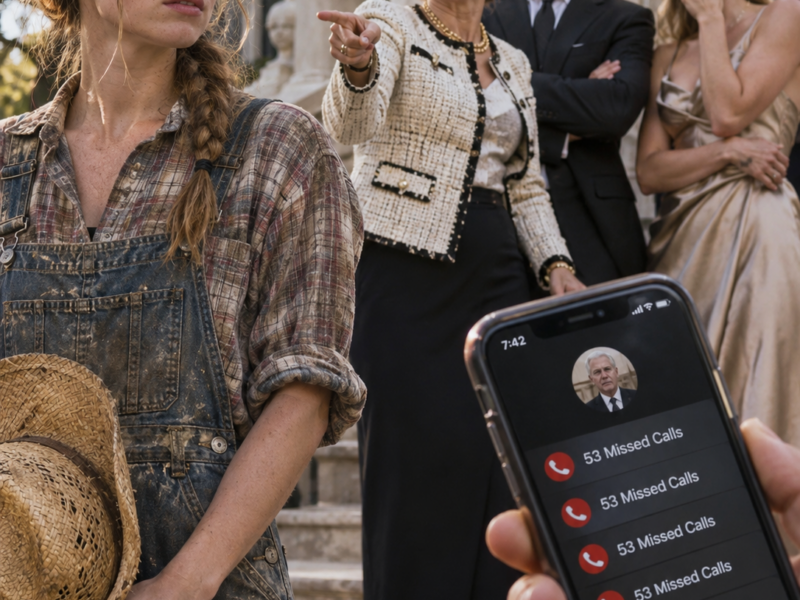
For Five Years, My Millionaire Husband’s Family Made Me Eat Thanksgiving Dinner Alone in the Hallway While They Enjoyed a Luxury Feast. When My Mother-in-Law Laughed, “Farm Girls Don’t Belong at a Proper Table,” My Husband Just Kept Eating, So I Quietly Left and Took the Train Home. Three Days Later, I Had 53 Missed Calls, and My Husband Was Desperately Begging Me to Call Him About a $95 Million Deal. But He Had No Idea What My Father Had Just Shown Me…
For Five Years, My Millionaire Husband’s Family Made Me Eat Thanksgiving Dinner Alone in the Hallway While They Enjoyed a Luxury Feast. When My Mother-in-Law Laughed, “Farm Girls Don’t Belong at a Proper Table,” My Husband Just Kept Eating, So I Quietly Left and Took the Train Home. Three Days Later, I Had 53 Missed Calls, and My Husband Was Desperately Begging Me to Call Him About a $95 Million Deal. But He Had No Idea What My Father Had Just Shown Me…
PART 1
The first time my mother-in-law made me eat Thanksgiving dinner in a hallway, I convinced myself it was an unfortunate misunderstanding.
The fifth time, I realized it had never been a misunderstanding at all.
My name is Cassandra West Morland. I’m thirty-four years old, and for five years, I was the woman my husband’s wealthy family refused to seat at their dining table.
Not because there wasn’t enough room.
Their Westchester mansion had a formal dining room large enough for sixteen guests, a breakfast room overlooking manicured gardens, and a sunroom with furniture that probably cost more than my first car.
There was plenty of space.
They simply didn’t believe I deserved any of it.
My mother-in-law, Constance Hartwell, had a favorite saying.
“Farm girls don’t belong at a proper table.”
She delivered those words with the effortless confidence of a woman who had never experienced consequences for anything she said.
Sometimes she whispered them to her friends. Sometimes she announced them across the dining room. Once, she said them directly in front of a caterer while instructing him to put my dinner in the hallway.
Everyone laughed.
And my husband, Everett Hartwell, never defended me.
That was the part that eventually destroyed our marriage. Not the insults themselves, but the quiet acceptance of the man who had promised to stand beside me.
For years, I believed Everett was simply afraid of confronting his mother.
I would eventually discover that his silence had a much uglier explanation.
But on that final Thanksgiving, I knew none of it.
All I knew was that I was tired.
The Hartwell estate sat on three beautifully landscaped acres in Westchester County, surrounded by iron gates, stone walls, and enough perfectly trimmed hedges to make the entire property look like something from an architectural magazine.
The family had money, influence, and an extraordinary talent for making ordinary people feel insignificant.
Their business, Hartwell Fine Foods, operated eleven upscale specialty markets throughout New York, Connecticut, and New Jersey.
They sold expensive cheeses, imported chocolates, artisan bread, premium meats, and carefully packaged products that promised customers a connection to traditional farming.
Their most successful product line was called Hartwell Reserve.
Its centerpiece was a cultured butter so rich and distinctive that food critics had written entire articles praising its flavor.
Customers sometimes lined up outside their stores when limited batches arrived.
Restaurants competed for wholesale access.
And according to Everett, the Reserve collection represented the future of the family empire.
I knew that butter better than anyone in the Hartwell household.
But nobody there had ever bothered to ask me why.
That Thanksgiving, Constance had invited several important business associates. Among them were a restaurant investor, two regional distributors, and a couple who owned a celebrated vineyard.
Everything had been arranged to perfection.
White roses filled crystal vases. Silver cutlery gleamed beneath enormous chandeliers. A professional catering team moved silently between rooms.
The dining table was covered in embroidered linen, with sixteen matching chairs arranged beneath an enormous painting of Everett’s grandfather.
I counted those chairs while standing in the doorway.
Fourteen were occupied.
Two remained empty.
And yet Constance had instructed the staff to set up a folding card table for me in the hallway.
A cheap folding card table.
The sort of thing someone might use for a garage sale.
On it sat a mismatched plate, a paper napkin, and a water glass from the family’s everyday kitchen collection.
The contrast was so deliberate that I almost admired the effort.
When Constance noticed me looking toward the dining room, she smiled.
“Cassandra, darling, I hope you understand. We have important guests tonight, and I simply can’t have the seating arrangement looking unbalanced.”
I glanced at the two empty chairs.
“There’s room at the table.”
Her smile tightened.
“Technically, yes. But appearances matter.”
Then she leaned closer.
“And you know how uncomfortable some people become when they don’t have much in common with the other guests.”
I looked directly at her.
“Are you saying I would make them uncomfortable?”
She laughed softly.
“Oh, don’t be sensitive. You’re wonderful in your own way. But these people discuss investments, international markets, and acquisitions. You’d be bored to tears.”
I could have told her that I had spent the previous week negotiating a seven-figure agricultural distribution agreement.
I could have mentioned my Cornell degree.
Or explained that I managed a six-hundred-acre dairy operation employing dozens of people.
Instead, I said nothing.
Because silence had become my habit.
And Constance had learned to mistake it for ignorance.
Dinner began shortly afterward.
Through the open doorway, I watched the guests admire the elaborate spread.
There were roasted vegetables, glazed carrots, several kinds of potatoes, expensive wines, and a golden turkey presented on a silver platter.
Near the center of the table sat a crystal dish filled with pale yellow cultured butter.
Hartwell Reserve.
Everett picked up a piece of bread, spread the butter across it, and continued discussing a major business opportunity with one of the investors.
I recognized the careful excitement in his voice.
Something significant was happening behind the scenes.
For several months, he had been taking unusually late business calls, traveling more frequently, and insisting that the company’s next financial announcement would change everything.
Whenever I asked what was happening, he dismissed my curiosity.
“Don’t worry about it, Cass. It’s complicated.”
I had stopped asking.
Halfway through dinner, one of the vineyard owners noticed me sitting outside the dining room.
She was a pleasant woman named Margaret, perhaps in her fifties, with an intelligent expression and the uncomfortable look of someone realizing the seating arrangements weren’t accidental.
“Excuse me,” she said. “Isn’t that Everett’s wife?”
Constance turned toward the hallway.
“Oh, yes. That’s Cassandra.”
Margaret frowned.
“Why isn’t she sitting with us?”
For one wonderful second, I thought someone might finally challenge the absurdity of the situation.
But Constance was ready.
“Oh, Cassandra comes from a very different background. She’s a farm girl, you see. Farm girls don’t really belong at a proper table, but we do our best to make her feel included.”
A few guests laughed awkwardly.
Others looked down at their plates.
Constance continued smiling.
Then Margaret asked me a question that changed the direction of my life.
“What do you do, Cassandra?”
I opened my mouth.
But before I could speak, Constance answered.
“She helps her parents with their little farm. It’s rather sweet, actually.”
Little farm.
Six hundred acres.
Three generations of agricultural innovation.
A sophisticated dairy operation supplying some of the most exclusive food companies in the Northeast.
And on the Hartwell dining table, the very cream produced by that so-called little farm had been transformed into the family’s most profitable luxury product.
I looked at the butter dish.
Then at Constance.
Then at my husband.
Everett was laughing at something his father had said.
He had heard everything.
I knew because his eyes briefly flickered toward me before returning to his plate.
He wasn’t embarrassed by his mother’s behavior.
He was embarrassed that someone had noticed.
Something inside me went completely still.
For five years, I had believed that if I behaved graciously enough, they might eventually accept me.
I attended their parties.
I bought thoughtful birthday presents.
I remembered anniversaries and sent flowers.
Every Thanksgiving, I brought a handmade jar of butter from my family’s creamery.
Every year, Constance returned it to me unopened.
I told myself she simply preferred store-bought products.
The irony was almost unbearable now.
She adored Hartwell Reserve.
She just didn’t understand where it came from.
Or perhaps she didn’t care enough to ask.
I folded my paper napkin into a neat square.
Set it beside my plate.
And stood.
Nobody noticed until I walked past the dining room on my way to the coat closet.
Everett finally looked up.
“Cass? Where are you going?”
“Home.”
He frowned.
“What are you talking about? We are home.”
“No,” I said quietly. “We’re at your parents’ house.”
His expression hardened.
“It’s Thanksgiving. Don’t start something.”
I slipped my coat over my shoulders.
“I’m not starting anything.”
Constance turned in her chair.
“Is there a problem, Cassandra?”
I looked at her, then at the empty chairs beside her.
“No problem at all.”
And I walked out.
I didn’t slam the door.
I didn’t throw my plate.
I didn’t give a dramatic speech about dignity or respect.
I simply closed the door behind me and stepped into the cold November evening.
The nearest train station was ten minutes away.
I walked the entire distance without once looking back.
My phone vibrated before I reached the platform.
A message from Everett.
You’re embarrassing me.
Three words.
Not Are you safe?
Not Where are you going?
Not even Please come back.
Just an accusation about how my departure reflected on him.
I stared at the message until the train arrived.
Then I turned my phone facedown.
The northbound train carried me away from Westchester, along the Hudson River, toward the farm where I had grown up.
As the city lights disappeared behind me, I thought about the early days of my marriage.
Everett and I had met in 2017.
Not at a party.
Not through mutual friends.
And certainly not in the romantic circumstances he later described to people.
We met across a conference table.
He was representing Hartwell Fine Foods.
I was representing West Morland Farm.
His company wanted an exclusive contract for our cream, which had become famous among artisan food producers for its unusual richness and flavor.
Our herd grazed on carefully maintained Hudson Valley pastures, and my grandfather had spent decades refining our dairy operation.
The quality was difficult to reproduce.
Hartwell knew it.
Their representatives had already spent two years searching for another supplier capable of matching our standards.
They failed.
So Everett came to us.
He was thirty then, charming, ambitious, beautifully dressed, and surprisingly knowledgeable about agricultural logistics.
He listened closely when I explained our production cycles.
He asked intelligent questions about temperature-controlled transportation, pasture management, and seasonal variations in milk fat.
He seemed genuinely fascinated by my work.
After months of negotiations, we signed a seven-year exclusive supply agreement in early 2018.
Only afterward did Everett begin pursuing me romantically.
He drove to the farm on weekends.
He brought flowers.
He helped my father repair an old fence, although he clearly had no experience with tools.
He praised my dedication and told me he had never met anyone who understood food production as deeply as I did.
For the first time in years, I felt seen.
Eight months later, he proposed at my parents’ kitchen table.
My father seemed strangely reserved afterward.
“That young man is very interested in this farm,” he told me.
I laughed.
“He’s interested in me, Dad.”
My father studied me for a moment.
Then he nodded.
I thought he was being overprotective.
Years later, I would understand that he had been trying to warn me.
Everett and I married in early 2020.
The first Thanksgiving after our wedding, Constance seated me in the sunroom.
The second year, I ate at the kitchen island.
By the third, I was in the hallway.
And every year, Everett promised things would improve.
“Just give Mom more time.”
I gave her five years.
Five years of smaller chairs.
Five years of smaller spaces.
Five years of making myself smaller so other people could feel important.
By the time the train reached my hometown, I had made a decision.
I wasn’t going back.
Not that night.
Not the next morning.
Not until I remembered what it felt like to belong somewhere.
My mother opened the farmhouse door before I knocked.
She looked at my coat, my tired eyes, and the small handbag hanging from my shoulder.
Then she pulled me into her arms.
She didn’t ask why I had come.
She simply said, “There’s still dinner in the kitchen.”
And for the first time in five Thanksgiving holidays, I sat at a table where nobody questioned whether I deserved a chair.
I thought that was the end of the evening.
I had no idea that my father was about to show me a thirty-page document that would change my marriage, my business, and the future of the entire Hartwell fortune.
Because the people who had spent five years treating me like a worthless farm girl had forgotten one crucial detail.
Their most valuable business asset had my signature on it.
PART 2
My father waited until my mother went upstairs before bringing a worn manila folder to the kitchen table.
“Hartwell Supply Agreement,” the label read.
I recognized the contract immediately. I had signed it myself in 2018.
“Why are you showing me this?” I asked.
Dad opened the folder and pointed to a paragraph halfway through.
“Because I think you’ve forgotten whose business this really is.”
The agreement granted Hartwell exclusive access to our premium cream through December 31, 2025. But renewal required written approval from West Morland Farm by December 1.
My approval.
Without it, Hartwell couldn’t extend the arrangement.
I checked the calendar.
November 28.
Three days remained.
Then Dad placed another document beside it.
A competing food retailer, Bellweather Market Group, had been offering us a better contract for two years. Higher prices. Greater independence. Even an ownership stake.
“Why didn’t you tell me?” I whispered.
“Because you married Everett. I didn’t want business to destroy your marriage.”
I stared at the two documents.
For five years, I’d begged for a place at the Hartwell table.
Now I understood something extraordinary.
They needed my signature far more than I needed their approval.
PART 3
I didn’t sleep much that night.
Long after my father went upstairs, I remained at the kitchen table surrounded by contracts, financial statements, and memories I suddenly understood differently.
Outside, the farm was silent except for the occasional sound of machinery from the dairy barns.
The old grandfather clock in the hallway marked the passing hours.
I barely noticed.
I had spent years managing West Morland Farm with the precision required to keep a complicated agricultural business profitable.
I understood our costs down to the smallest details.
Feed prices. Veterinary expenses. Equipment depreciation. Transportation rates. Seasonal production fluctuations.
What I hadn’t done was look carefully at how much power our family business held over Hartwell Fine Foods.
That night, I finally did.
West Morland supplied the premium cream used in Hartwell Reserve cultured butter, fresh cheeses, and several specialty dairy products.
Those products generated nearly one-third of the company’s premium-category revenue.
Their margins were exceptional.
And more importantly, they represented the heart of Hartwell’s carefully cultivated identity.
The company’s advertisements showed rolling green fields, old wooden barns, and happy dairy cattle grazing beneath blue skies.
Customers believed they were purchasing something authentic.
They were.
But the authenticity came from my family.
Not Everett’s.
Our farm had existed since 1946, when my great-grandfather acquired the first parcel of land with little more than borrowed money, stubborn determination, and a willingness to work from sunrise until darkness.
My grandfather expanded the operation.
My father modernized it.
And I had returned from Cornell in 2017 to build the logistical systems that allowed our products to compete in a premium regional market.
I helped develop quality-control procedures, improve cold-chain distribution, and establish reliable production forecasts.
Those weren’t glamorous accomplishments.
Nobody photographed me standing beside a tractor with my sleeves attractively rolled up.
Most days, I wore rubber boots and spent more time studying spreadsheets than watching sunsets.
But those systems made the farm profitable.
They made our cream reliable.
And without them, Hartwell Reserve would never have become the success it was.
I opened the renewal agreement again.
The language was unmistakable.
The exclusive arrangement would continue only if the supplier provided written notice before the specified deadline.
The supplier was West Morland Farm.
And I was its authorized representative.
Everett couldn’t sign for us.
His father couldn’t sign.
Constance couldn’t make a phone call and demand an extension.
For all their wealth and social influence, they had no authority to make that decision.
Only I did.
The thought should have made me triumphant.
Instead, it made me sad.
Because I remembered the woman I had been when Everett first began visiting the farm.
I remembered how excited I felt every time his car appeared at the end of our driveway.
How I changed out of my work clothes before meeting him.
How I secretly hoped he’d stay for dinner.
I remembered his proposal.
He had looked nervous, almost boyish, when he opened the velvet ring box.
“I want to build something with you,” he’d said.
At the time, I thought he meant a life.
Now, staring at the contract, I wondered whether he’d meant something else.
The next morning, my mother found me asleep over the paperwork.
She set a cup of coffee beside my elbow.
“You’re going to make yourself sick worrying.”
“I’m not worrying.”
She raised an eyebrow.
“Then what are you doing?”
I looked at the contract.
“Remembering who I was before I married him.”
My mother sat opposite me.
For several minutes, neither of us spoke.
Then she said something that stayed with me.
“You never stopped being that woman, Cassandra. You just let people convince you she wasn’t important.”
I began crying.
Not loudly.
Not dramatically.
Just a few quiet tears that slipped down my cheeks before I could stop them.
My mother reached across the table and took my hand.
“You don’t have to prove you’re worthy of respect. You only have to stop accepting disrespect.”
I looked down at my wedding ring.
For five years, it had represented my determination to make the marriage work.
Suddenly, it felt heavy.
My phone vibrated.
Everett.
I ignored it.
A minute later, another message arrived.
Mom says you owe everyone an apology.
I almost laughed.
An apology.
Apparently, walking away from public humiliation was considered more offensive than the humiliation itself.
A third message appeared.
Call me before you make this worse.
I typed a response.
Deleted it.
Typed another.
Deleted that one too.
Finally, I switched the phone to silent.
If Everett wanted to talk about our marriage, he could come to the farm and speak to me as an equal.
But something told me he wouldn’t.
At least, not until business became involved.
By the following morning, I was back in my office reviewing production schedules when an unexpected message arrived.
It came from Delia Marsh, a sourcing coordinator at Hartwell Fine Foods.
Delia had worked with me for several years.
She was competent, straightforward, and one of the few people connected to the Hartwell organization who treated me with genuine professional respect.
Unlike Everett, she never assumed I needed business terminology explained to me.
She understood that agricultural production required expertise.
Her message was unusually short.
Cassandra, you need to see something. Please keep my name out of it.
Attached was an internal memorandum.
I opened it.
At first, it looked like an ordinary corporate document.
There were references to due diligence, revenue projections, operational continuity, and an impending investment transaction.
Then I reached a highlighted paragraph.
I read it once.
Then again.
Then a third time.
Hartwell Fine Foods was negotiating a $95 million equity investment with Calder Equity Partners.
The agreement required Hartwell to demonstrate that its premium supply chain would remain secure through 2032.
Specifically, it required continued exclusive access to West Morland cream.
My cream.
Our cream.
The cream produced by the farm Constance dismissed as insignificant.
I leaned back in my chair.
The significance was overwhelming.
Everett wasn’t merely hoping to renew a profitable supply agreement.
He needed that renewal to complete a massive financial transaction.
Without it, Calder’s valuation assumptions could collapse.
Without guaranteed access to our cream, Hartwell couldn’t promise investors that its signature products would remain available.
The entire transaction depended on a contract requiring my approval.
And neither Everett nor his family had mentioned a word of it to me.
I called Delia.
She answered immediately.
“Did you read it?”
“Yes.”
“Then you understand.”
“How long has this been happening?”
She hesitated.
“Months. Maybe longer.”
“And Everett knows the renewal requires my signature?”
“Of course he knows.”
I felt something cold settle in my chest.
“Then why hasn’t he asked me?”
Delia was silent.
Finally, she said, “I think he assumed he wouldn’t have to.”
I looked toward the window.
Beyond the glass, our cattle were moving slowly across the lower pasture.
Workers were checking equipment near the creamery.
The entire operation continued as it had for generations, independent of the Hartwells and their opinions.
“He assumed I’d renew because I’m his wife,” I said.
“That’s what it looks like.”
“And if I don’t?”
“Cassandra, I’m not supposed to advise you.”
“I’m not asking for advice.”
She exhaled.
“Then I’ll say this. People in that building are acting as though the money is already guaranteed. They’ve made commitments based on that assumption.”
I closed my eyes.
Ninety-five million dollars.
And they had spent Thanksgiving making me eat in a hallway.
“Thank you, Delia.”
“Whatever you decide, make sure it’s your decision.”
After the call ended, I remained seated for a long time.
For the first time, I could see my marriage and the business arrangement as two separate things.
I had every right to leave an unhappy marriage.
And West Morland Farm had every right to evaluate its commercial options.
Neither decision required revenge.
Neither required a public confrontation.
The original agreement was approaching its end.
We had fulfilled our obligations.
Now we could decide whether to renew.
I asked my father to join me that afternoon.
Together, we reviewed Bellweather Market Group’s proposal.
The offer was attractive, but I refused to make a decision based solely on anger.
We examined pricing structures, logistics, minimum purchase commitments, quality standards, and ownership provisions.
There were questions we needed answered.
I contacted our attorney and asked him to review both agreements.
Then I arranged a confidential meeting with Bellweather’s senior procurement team.
Their chief commercial officer, a woman named Rebecca Stone, seemed genuinely surprised to hear from me.
“Cassandra West Morland,” she said. “I’ve been hoping you’d call for years.”
“I understand you’ve been speaking with my father.”
“Every few months. He kept telling us the timing wasn’t right.”
“The timing may be changing.”
Rebecca paused.
“Does that mean you’re considering our offer?”
“It means I’m willing to discuss it.”
She laughed.
“That’s more progress than we’ve made in two years.”
For nearly an hour, we spoke about what Bellweather could offer beyond money.
I wanted our farm’s identity protected.
I wanted transparent sourcing.
I wanted long-term stability for our employees.
And I wanted our family name displayed prominently instead of hidden in tiny print beneath another company’s branding.
Rebecca listened.
Then she said something remarkable.
“We don’t want to pretend we invented your butter, Cassandra. We want customers to know who actually produces it.”
I had been married to Everett for almost six years.
He had never once expressed that idea so clearly.
The conversation ended with an agreement to continue negotiations after our legal review.
Nothing was signed.
Nothing was promised.
But when I put down the phone, I felt something unfamiliar.
Possibility.
That evening, Everett called again.
This time, I answered.
“Cass, finally.”
His relief was immediate, but it quickly turned to irritation.
“What exactly are you trying to accomplish?”
I looked at the family photographs above my parents’ fireplace.
“I left because I was tired of being humiliated.”
He sighed.
“You’re exaggerating.”
“Your mother made me eat in a hallway.”
“She’s old-fashioned.”
“She told your guests I didn’t belong at the table.”
“You know how she is.”
“Yes, Everett. I do.”
Silence.
Then he changed the subject.
“Listen, we need to discuss some business documents.”
There it was.
Not an apology.
Not concern about our marriage.
Business documents.
“What documents?”
“The farm agreement. We’re approaching renewal, and there are some routine matters to handle.”
“Routine?”
“Yes. Nothing complicated.”
I almost smiled.
He was explaining my own contract to me.
“Then I’m sure you can manage it.”
His voice sharpened.
“Cassandra, don’t be difficult.”
“Good night, Everett.”
I ended the call.
Two days later, the renewal deadline arrived.
I sent no notice.
West Morland Farm’s exclusivity would expire at the end of the contract term.
Hartwell had no automatic right to extend it.
I expected Everett to be angry.
I did not expect what happened next.
The following morning, my phone began ringing before breakfast.
First Everett.
Then his office.
Then a number I didn’t recognize.
Then Everett again.
By noon, I had twelve missed calls.
By evening, the number had climbed past thirty.
A voicemail appeared.
I didn’t play it.
Another arrived.
Then a text from Everett.
Cass, please call me. This is urgent.
A second message followed.
You’re putting the company in a terrible position.
And finally:
Do you understand how much money is at stake?
I stared at that last sentence.
For five years, Everett had watched me eat alone.
He had never once asked how much dignity was at stake.
Now that money was involved, he suddenly remembered how to beg.
By the third day, there were fifty-three missed calls on my phone.
Fifty-three.
From Everett, his office, his father, company attorneys, and numbers I didn’t recognize.
Then Constance sent me a message.
For the first time in our marriage, she addressed me with affection.
Cassandra, dear, I think we should sit down and discuss this as a family.
I read it twice.
Family.
The same woman who wouldn’t let me sit at her dining table now wanted a family meeting.
I didn’t reply.
Instead, I placed the phone beside my coffee cup and continued reviewing the Bellweather proposal.
I thought the fifty-three missed calls were the clearest evidence of how little the Hartwells had valued me.
I was wrong.
Because that evening, Delia sent me another message.
And this one had nothing to do with contracts.
There’s an old email from 2019. Before your wedding. Everett forwarded it to you by accident. You need to read the entire thread.
I felt an uneasy sensation in my stomach.
What email?
Delia sent the subject line.
Re: The Wedding.
I searched my inbox.
There it was.
An old forwarded conversation buried beneath years of business correspondence.
I remembered answering Everett’s question about creamery production capacity.
I had never scrolled through the messages beneath it.
Now I did.
And what I found changed every memory I had of falling in love with my husband.
The email exchange was between Everett and Constance.
His mother had been concerned about our engagement.
She thought marrying someone from a dairy farm would damage the family’s social standing.
She questioned why he was rushing.
Everett’s response was brutally practical.
Stop worrying about where she’s from. Locking West Morland is the point.
My fingers went numb.
I continued reading.
Walter still takes Bellweather’s calls every quarter. Once we’re family, that stops. Family doesn’t shop contracts to competitors.
Then came the sentence that shattered everything.
We keep the cream, we keep the story, and we secure the supply permanently. It’s the cheapest acquisition we’ll ever make.
I read those words again.
And again.
The cheapest acquisition.
I wasn’t the woman Everett had fallen in love with.
I was a business opportunity he had decided to acquire.
Our marriage hadn’t simply benefited his company.
According to his own words, securing the company had been the point.
Suddenly, I remembered his weekend visits.
His questions about our processing capacity.
His fascination with our transportation network.
The way he always seemed to end up examining the cold-storage equipment.
Even his proposal began to look different.
“I want to build something with you.”
He had meant it.
Just not in the way I believed.
I looked at my wedding ring.
Slowly, I pulled it off.
For a moment, I held it between my fingers, remembering the day he had placed it there.
Then I set it beside the open contract.
I didn’t scream.
I didn’t break anything.
I simply sat in silence while six years of memories rearranged themselves into a truth I could no longer ignore.
My father entered the kitchen a few minutes later.
He stopped when he saw my face.
“Cass?”
I turned the laptop toward him.
He read the email.
His expression darkened.
“I’m sorry,” he whispered.
I shook my head.
“Don’t be.”
He sat beside me.
“Nobody deserves that.”
“I know.”
And that was the extraordinary thing.
For the first time, I genuinely knew.
I had spent years wondering whether I was too sensitive, too demanding, too different.
Now I understood.
The problem had never been my background.
The problem was that Everett and his family believed some people existed to be used.
They had valued my family’s products while despising the people who produced them.
Everett had valued my signature while dismissing my voice.
He had wanted ownership without partnership.
He had wanted loyalty without respect.
And he had married a woman he considered an asset.
I closed the laptop.
Then I looked at my father.
“Call our attorney tomorrow.”
He nodded.
“About the supply agreement?”
“About that,” I said, “and about my divorce.”
He took my hand.
“Whatever you need.”
I was about to go upstairs when I noticed an unopened envelope lying on the counter.
It was thick, cream-colored, and engraved with elegant lettering.
The return address belonged to the American Farmstead Foundation.
Inside was an invitation to the Golden Harvest Awards, an annual black-tie ceremony honoring excellence in American food production.
Hartwell Fine Foods would be receiving an award for farm-to-table leadership.
And the foundation had invited West Morland Farm’s principal representative to attend.
Me.
I stared at the invitation.
The Hartwells were about to receive an award celebrating a partnership they had already lost.
And the person they had spent years hiding in a hallway had been invited to sit at the head table.
I turned the invitation over.
Then I smiled for the first time in days.
I wasn’t going to hide anymore.
PART 4
The morning after I received the invitation, I woke before sunrise.
For years, my mornings had begun in an apartment overlooking the city, where I drank coffee beside a husband who checked financial reports before asking whether I had slept well.
Now I stood on my parents’ back porch watching mist rise above the pastures.
The farm looked exactly as it had when I was a child.
But I felt different.
I had always believed strength meant enduring difficult things without complaining.
My mother had taught me patience.
My father had taught me discipline.
My grandparents had taught me that dignity came from honest work.
Somewhere along the way, I had confused those lessons with the idea that I should tolerate disrespect indefinitely.
I had been wrong.
Real strength sometimes meant walking away.
And sometimes it meant returning to a room where people had decided you didn’t belong.
I called Genevieve Ashby that afternoon.
Genevieve was chairing the American Farmstead Foundation that year.
She had known my family long before Hartwell Fine Foods entered our lives.
Years earlier, she organized agricultural education programs that brought schoolchildren to working farms throughout the Hudson Valley.
West Morland had hosted dozens of those visits.
Genevieve knew our land, our cattle, and the work required to produce exceptional dairy products.
Most importantly, she knew me.
Not Cassandra Hartwell.
Cassandra West Morland.
She answered after the second ring.
“Cassandra! What a lovely surprise.”
“Hello, Genevieve.”
“I was hoping you’d contact me. Did you receive the invitation?”
“I did.”
“Wonderful. I hope you’ll attend. Your family has contributed so much to regional agriculture.”
I hesitated.
“There’s something you should know.”
“Of course.”
“I’m married to Everett Hartwell.”
Silence.
Then Genevieve laughed.
“You’re joking.”
“I’m afraid not.”
“Everett Hartwell? From Hartwell Fine Foods?”
“Yes.”
“My goodness. I had absolutely no idea.”
That didn’t surprise me.
Everett rarely introduced me to industry colleagues.
When he did, it was usually as his wife, never as the person managing the farm behind his company’s most successful product line.
Genevieve seemed delighted by the connection.
“Well, that makes the evening even more special. We’re honoring Hartwell’s achievements, and now we’ll have the farm’s principal representative there too.”
I looked down at the invitation.
“Genevieve, I think there are some details about that partnership you may not have heard.”
Her tone changed.
“Is something wrong?”
“The exclusive arrangement won’t be continuing.”
There was a long pause.
“Are you certain?”
“Yes.”
“But the award materials describe it as an ongoing partnership.”
“I know.”
I told her the relevant business facts.
Not about my marriage.
Not about Constance.
Not about the hallway.
Just that West Morland had declined to renew the exclusive arrangement and was negotiating a new distribution relationship.
Genevieve listened carefully.
When I finished, she said, “Thank you for telling me. We’ll make sure the program accurately reflects the situation.”
I expected her to withdraw my invitation.
Instead, she said, “I hope you’ll still come.”
“Even after what I’ve told you?”
“Especially after what you’ve told me.”
I felt my throat tighten.
“Why?”
“Because we’re supposed to celebrate the people who actually produce the food, Cassandra. That includes you.”
After we ended the call, I sat quietly for several minutes.
I had forgotten what it felt like to be respected without having to ask.
Over the next few days, negotiations with Bellweather progressed.
Our attorney confirmed that the Hartwell exclusive agreement could expire according to its stated terms and reviewed the restrictions governing future supply.
The existing deliveries would be honored through the end of the contract.
There would be no breach.
No sudden disruption of agreed shipments.
We would simply begin a new relationship when our obligations allowed.
Rebecca Stone visited the farm with two executives.
I met them in our conference room, the same room where Everett had first negotiated with my father and me.
That coincidence wasn’t lost on me.
Rebecca arrived wearing practical boots and carrying a thick folder.
She asked to tour the operation before discussing pricing.
I took her through the milking facilities, processing areas, storage rooms, and loading docks.
She asked thoughtful questions.
Not performative questions designed to impress me.
Real questions about quality, capacity, animal welfare, and employee training.
By the time we returned to the conference room, she had a detailed understanding of what we produced and how.
“I see why Hartwell has been reluctant to give this up,” she said.
I smiled faintly.
“They haven’t exactly been eager to.”
Rebecca studied me.
“Then why are you considering changing partners?”
I could have told her everything.
I could have explained the Thanksgiving dinner, the card table, and the marriage that had apparently been engineered like a corporate transaction.
Instead, I gave her the business answer.
“Because a partnership should benefit both parties, and our company deserves to maintain control of its own future.”
She nodded.
“That sounds reasonable.”
We spent the afternoon negotiating.
Bellweather offered improved pricing, a longer commercial arrangement, and a minority ownership stake in a new premium dairy venture.
Our products would be marketed prominently under the West Morland name.
We would retain control over farm operations and production standards.
Nothing about the agreement required me to marry anyone.
That alone felt revolutionary.
By the end of the meeting, we had reached agreement on the major terms, subject to final documentation.
Rebecca extended her hand.
“I’m looking forward to building something successful together.”
I shook it.
“So am I.”
As she left, I thought about the first time Everett had used almost those exact words.
The difference was that Rebecca had discussed ownership, responsibilities, pricing, and expectations openly.
There was no hidden agenda disguised as affection.
Just a business arrangement between people who respected one another.
That evening, Everett arrived at the farm without warning.
I saw his black SUV coming up the driveway while I was helping my father organize equipment records.
My stomach tightened, but I didn’t hide.
Everett stepped out wearing a tailored overcoat and the exhausted expression of a man who hadn’t slept properly in days.
He looked around the property as though he expected something to have changed.
Then he approached me.
“Cass.”
“Everett.”
He stopped a few feet away.
“Can we talk?”
“We can.”
He glanced toward the farmhouse.
“Privately.”
I led him into the small office beside the creamery.
He sat across from me and immediately began speaking.
“This has gone far enough.”
I waited.
“The Calder transaction is in serious trouble. Their attorneys are demanding proof of the supply extension, and we need to resolve this immediately.”
“Then you should have arranged the extension before the deadline.”
His jaw tightened.
“Don’t do that.”
“Do what?”
“Act like you don’t understand what’s happening.”
I looked at him calmly.
“I understand perfectly.”
He leaned forward.
“Cass, we’re talking about ninety-five million dollars.”
“You’re talking about ninety-five million dollars.”
“That money affects our future.”
“Our future?”
“Yes. Yours and mine.”
I studied his face.
For years, those words would have softened me.
Now they sounded rehearsed.
“Tell me something, Everett.”
“What?”
“When you proposed to me, did you love me?”
He blinked.
“Of course I did.”
“Did you?”
“What kind of question is that?”
“A straightforward one.”
He shifted in his chair.
“Cassandra, I didn’t come here to discuss our entire marriage.”
“Then you came to the wrong place.”
His expression hardened.
“This is exactly what my mother warned me about. You’re taking a personal disagreement and turning it into a business crisis.”
I almost laughed.
“A personal disagreement?”
“Yes.”
“Your mother made me eat Thanksgiving dinner in a hallway.”
“Oh, for God’s sake.”
“She publicly humiliated me.”
“She didn’t mean anything by it.”
“Then why did she do it every year?”
He rubbed his forehead.
“Because you’re different from her friends. You know that.”
“Different how?”
He didn’t answer.
I leaned back.
“Because I grew up on a farm?”
“That’s not what I said.”
“It’s what your entire family has been saying for years.”
He looked toward the door.
“Can we please focus on the contract?”
There it was again.
The contract.
Always the contract.
I thought about the email sitting in my inbox.
I could have confronted him then.
I could have quoted his words and watched him attempt to explain them.
But I wanted to understand something first.
“Everett, if I had no connection to West Morland Farm, would you still have married me?”
He stared at me.
“That’s ridiculous.”
“Answer the question.”
He stood abruptly.
“I don’t have time for this.”
I remained seated.
“Then we’re finished.”
He turned.
“What?”
“This conversation.”
His face reddened.
“You can’t just destroy everything because you’re angry.”
“I’m not destroying anything. The agreement is expiring under the terms your company negotiated.”
“You know exactly what that means.”
“Yes.”
He took a step closer.
“Are you deliberately trying to ruin us?”
I looked at him for a long moment.
“No, Everett. I’m choosing not to keep sacrificing myself to protect you.”
His expression changed.
For the first time, I saw uncertainty.
He had expected me to surrender.
He had expected an argument he could manage, a few tears he could dismiss, and eventually the same familiar obedience.
Instead, I was calm.
And that frightened him.
“You’ll regret this,” he said quietly.
“Perhaps.”
He waited.
I added, “But I already regret the last five years. I’m willing to risk something different.”
He left without another word.
I watched his SUV disappear down the driveway.
Then I called my attorney and confirmed that I wanted to proceed with divorce preparations.
The Golden Harvest Awards took place several days later at an elegant hotel in Manhattan.
That morning, I stood in my childhood bedroom looking at the dress I’d selected.
It was dark navy, simple, beautifully fitted, and completely unlike the expensive outfits Constance had once insisted I wear to family events.
I chose it because I liked it.
Not because I wanted her approval.
My mother helped fasten a delicate necklace that had belonged to my grandmother.
She watched my reflection in the mirror.
“You look beautiful.”
“Thank you.”
“Are you nervous?”
“A little.”
She smiled.
“Good. That means it matters.”
Before leaving, I went to the creamery.
One of our workers had just finished preparing a small batch of fresh cultured butter.
I filled a glass jar, sealed it with wax, and placed it carefully in my handbag.
Every Thanksgiving, I had brought Constance a jar just like it.
Every year, she returned it unopened.
This one wasn’t for her.
It was for me.
A reminder of where I came from.
The ballroom was already crowded when I arrived.
Golden chandeliers hung above beautifully decorated tables.
Waiters carried trays of champagne.
Executives, journalists, restaurateurs, investors, and food producers moved through the room exchanging business cards and congratulations.
At the front, an enormous screen displayed the Hartwell Reserve logo.
Beneath it was a photograph of golden butter resting in a crystal dish.
The caption read:
Exclusive West Morland sourcing. Hudson Valley, New York.
I stopped walking.
There was my family’s name.
Larger than I had ever seen it displayed at a Hartwell event.
And somewhere near the front of the ballroom, Everett was preparing to accept an award for the very product our farm had made possible.
I moved toward the head table.
There were place cards arranged beside polished silverware.
Constance Hartwell.
Winston Hartwell.
Everett Hartwell.
Several foundation executives.
And one additional card.
West Morland Farm — Principal Representative.
I stared at it.
A chair.
A real chair.
At the head table.
Not because I was Everett’s wife.
Because I was Cassandra West Morland.
Constance noticed me first.
Her smile disappeared.
She leaned toward Everett and whispered something urgently.
Everett turned.
His face went pale.
I could practically see the panic traveling through him.
His mother grabbed his sleeve.
“Everett, what is she doing here?”
He didn’t answer.
“Get her out,” Constance hissed.
He looked at the place card.
Then at me.
And for the first time in our marriage, he seemed completely powerless.
A foundation coordinator approached.
“Miss West Morland?”
“Yes.”
“We’re delighted you’re here. Your seat is ready.”
She gestured toward the chair beside Everett.
Constance opened her mouth.
Then closed it.
There were too many important people watching.
Too many witnesses.
Too many consequences.
I sat down.
Everett leaned toward me.
“Cass, what are you doing?”
“Attending an awards ceremony.”
“You should have told me.”
“Why?”
His eyes darted toward the stage.
“Because this is complicated.”
I looked directly at him.
“No, Everett. It’s actually very simple.”
Before he could respond, the lights dimmed.
Genevieve Ashby stepped onto the stage.
She began speaking about American agriculture, family-run businesses, and the importance of authentic relationships between producers and retailers.
Then she introduced the Hartwell Fine Foods award.
A video appeared on the screen.
There were images of beautiful retail displays, expensive cheese counters, and customers selecting Hartwell Reserve products.
Then came footage of grazing cattle.
Not our cattle.
A generic promotional image.
Followed by Everett standing in front of a rustic barn, smiling as though he had personally built the entire agricultural supply chain.
I almost laughed.
Genevieve continued.
“Hartwell Fine Foods has demonstrated how strong relationships with regional agricultural producers can create extraordinary products.”
She paused.
“But tonight, I want to acknowledge something that doesn’t always receive enough attention.”
She looked toward our table.
“The producer behind the product.”
Everett stiffened beside me.
Genevieve smiled.
“Many of you know Hartwell Reserve. Fewer know the extraordinary family farm responsible for its signature cream.”
The room grew quieter.
“For generations, West Morland Farm has represented the very best of Hudson Valley dairy production.”
She extended her hand toward me.
“And tonight, we are fortunate to have its principal representative with us.”
My heart began pounding.
“Cassandra West Morland, would you please stand?”
I stood.
Applause filled the ballroom.
For a brief moment, I couldn’t move.
Hundreds of people were looking at me.
Not because I was embarrassing someone.
Not because I didn’t belong.
But because they recognized the work my family had spent generations building.
Genevieve gestured toward the stage.
“Please join me.”
I walked forward.
Behind me, I heard Constance whisper something furious.
Everett said nothing.
Onstage, Genevieve embraced me.
Then she stepped aside and offered me the microphone.
I looked out at the audience.
I could see journalists, business executives, buyers, and distributors.
People who understood exactly how valuable reliable sourcing relationships were.
I thought about the five Thanksgiving dinners.
The paper napkins.
The empty chairs.
The little farm.
Then I spoke.
“Thank you for recognizing West Morland Farm. My family has dedicated nearly eighty years to producing food we’re proud of.”
The applause softened.
“We’ve valued our relationship with Hartwell Fine Foods, and we’re grateful that our products have reached so many customers through their markets.”
I paused.
“However, I should clarify one important detail about that partnership.”
Everett’s head lifted.
I could see the alarm in his expression.
“Our exclusive agreement is reaching its conclusion, and West Morland has chosen not to renew it.”
The entire ballroom seemed to hold its breath.
Then I continued.
“We’re excited to begin a new chapter with a different distribution partner, one that will allow our farm’s name and identity to be represented more directly.”
A low murmur moved through the audience.
Several people reached for their phones.
Someone near the stage whispered, “Hartwell lost the exclusive?”
Another voice answered, “But that’s their signature product.”
I kept my expression composed.
“Thank you again for recognizing the farmers, workers, and families whose labor makes these products possible.”
Then I handed the microphone back to Genevieve.
She thanked me warmly and continued the program.
But the atmosphere had changed.
Hartwell Fine Foods was about to receive an award celebrating a partnership that was ending.
And every major buyer in the room knew it.
Everett eventually walked onto the stage to accept the trophy.
He smiled.
He shook hands.
He delivered a brief speech.
But his hands trembled as he held the glass award.
For six years, Everett Hartwell had controlled every conversation we shared.
That evening, for the first time, he couldn’t control the story.
And the worst part for him hadn’t even happened yet.
Because when he found me outside the ballroom, I was finally going to tell him exactly what I knew about our marriage.
PART 5
Everett found me in the hallway outside the ballroom.
The irony was impossible to miss.
For five years, his family had put me in hallways because they believed I wasn’t worthy of sitting beside them.
Now he had followed me into one because he was terrified of what I might say next.
He approached quickly, his expensive dress shoes striking the marble floor.
“Cass.”
I turned.
He glanced over his shoulder to make sure nobody was close enough to hear.
“Okay. Let’s not make this worse.”
I studied him.
His face was pale, and the usual confidence in his expression had been replaced by something close to desperation.
“We can fix this,” he continued.
“Can we?”
“Yes. Of course. We just need to sit down and talk rationally.”
I almost smiled.
“That’s what your mother said.”
He ignored the remark.
“The Calder transaction isn’t necessarily dead. We can negotiate an amendment, discuss revised terms, maybe provide additional compensation to the farm.”
“Everett.”
He kept talking.
“I know you’re upset about Thanksgiving. We can address that. Mom can apologize. We can establish boundaries. Whatever you want.”
“Everett.”
“We could even give West Morland a better revenue-sharing arrangement. I should have discussed that with you earlier.”
“Everett, stop.”
He finally fell silent.
I looked directly at him.
“Do you remember what you wrote to your mother in 2019?”
His expression changed.
“What?”
“Before our wedding.”
He blinked.
“I don’t know what you’re talking about.”
I spoke slowly.
“Locking West Morland is the point.”
He stopped breathing for a moment.
I continued.
“Once we’re family, Walter stops taking Bellweather’s calls.”
His face drained of color.
“And then there was my favorite sentence.”
I stepped closer.
“The cheapest acquisition we’ll ever make.”
For several seconds, neither of us spoke.
The sounds from the ballroom seemed strangely distant.
Finally, Everett whispered, “Where did you get that?”
“From an email you forwarded to me.”
His eyes widened.
“It was buried in an old business thread. Apparently, you forgot to remove the earlier conversation.”
“Cass, listen—”
“No. You listen.”
My voice remained quiet.
I didn’t need to shout.
“For six years, I believed you married me because you loved me. I defended you when my father questioned your intentions. I defended you when your mother insulted me. I told myself you were simply uncomfortable confronting your family.”
I swallowed.
“But you weren’t uncomfortable, were you?”
He looked away.
“You knew exactly what they were doing.”
“That’s not fair.”
“Isn’t it?”
He ran a hand through his hair.
“That email was business language. You can’t take it literally.”
“Business language?”
“Yes.”
“You called our marriage an acquisition.”
“I was trying to convince my mother the relationship made sense.”
I stared at him.
“Did you ever consider telling her you loved me?”
He opened his mouth.
Nothing came out.
That silence answered more than any explanation could have.
I continued.
“You watched your mother humiliate me for years because you believed my loyalty was already guaranteed. You didn’t need to defend me because you thought I would never leave.”
“That’s not true.”
“Then why didn’t you?”
He looked exhausted.
“Cass, my mother is difficult. You know that.”
“No, Everett. Your mother is cruel. And you allowed her to be cruel because protecting me wasn’t worth making her uncomfortable.”
He stepped closer.
“I did love you.”
I wanted to believe him.
Some small, wounded part of me still wanted the man I had married to be real.
But wanting something doesn’t make it true.
“Maybe you loved having me,” I said. “Maybe you loved what I brought into your life. But you never treated me like a partner.”
He looked down.
“I made mistakes.”
“Yes.”
“We all did.”
“Yes.”
“Then let me make them right.”
I shook my head.
“Some things can’t be repaired with another agreement.”
He seemed to struggle with that.
As though every problem he had ever faced could be solved by negotiating harder, offering more money, or finding a clause that gave him leverage.
But marriage wasn’t a transaction.
At least, it wasn’t supposed to be.
Before he could respond, Constance emerged from the ballroom.
She hurried toward us, holding the hem of her expensive evening gown.
“Cassandra.”
I turned.
For the first time since I’d known her, she looked genuinely uncertain.
The woman who had controlled every Thanksgiving seating arrangement, every family conversation, and every social gathering was suddenly searching for words.
“We need to talk,” she said.
“We already are.”
She glanced at Everett.
“Whatever has happened, surely we can resolve it privately.”
I looked at her.
“Privately?”
“Yes. There’s no need to involve the entire industry.”
“The industry was already involved. Your company was receiving an award for a supply relationship that is ending.”
Her lips tightened.
“You’ve embarrassed this family.”
The words were so familiar that I nearly laughed.
Five years of humiliation.
Five years of exclusion.
And still, her greatest concern was embarrassment.
“Constance,” I said, “do you remember what you told your guests at Thanksgiving?”
She looked confused.
“That was days ago.”
“Do you remember?”
She hesitated.
“I may have made an unfortunate comment.”
“You said farm girls don’t belong at a proper table.”
Her expression hardened.
“Oh, Cassandra, you know I didn’t mean it that way.”
“Then what did you mean?”
She looked toward Everett.
He said nothing.
I waited.
Finally, she sighed.
“Perhaps I haven’t always been as welcoming as I should have been.”
I nodded.
“That’s one way of putting it.”
“But surely we can move past this. You’re part of the family.”
I held her gaze.
“Am I?”
“Of course.”
“Then why did you spend five years making sure I never sat with you?”
She looked away.
I continued.
“Why did you return every gift I brought? Why did you introduce me as a farm girl instead of your daughter-in-law? Why did you never ask about my work?”
Her eyes moved toward the ballroom.
“Those things aren’t important right now.”
There it was.
The truth.
My dignity still wasn’t important.
Only the contract.
Only the money.
Only the damage to their reputation.
I reached into my handbag and removed the small jar of butter I had brought from the farm.
Constance stared at it.
“What’s that?”
“Something I used to bring you every Thanksgiving.”
She looked uncomfortable.
“Our butter,” I said. “Freshly churned at West Morland.”
I held it up.
“You returned it every year without opening it. But inside that ballroom, your family is accepting an award because customers love this exact product.”
Constance looked at the jar.
Then at me.
For once, she had nothing clever to say.
“Do you know what I finally realized?” I asked.
Neither answered.
“I spent years trying to earn a place at your table. But the only reason your table was so impressive was that people like my family supplied what you served on it.”
I placed the jar back in my bag.
“You were so busy deciding where I belonged that you never considered what would happen if I decided to leave.”
Everett’s phone vibrated.
He glanced at the screen.
I watched his expression change.
“What is it?” Constance asked.
He didn’t answer immediately.
Then he looked at me.
“Calder’s legal team wants an emergency meeting tomorrow.”
I nodded.
“That makes sense.”
“Cass, please. There has to be something we can do.”
“There is.”
Hope flashed across his face.
“What?”
“You can tell them the truth.”
His expression collapsed.
“Tell them the exclusive arrangement is ending. Tell them you don’t have guaranteed access to West Morland cream through 2032. And tell them your financial projections need to reflect that.”
He stared at me.
“You know what that will do to the deal.”
“Yes.”
“Ninety-five million dollars.”
I looked at him calmly.
“That’s an extraordinary amount of money, Everett.”
He nodded rapidly.
“Exactly.”
“Then perhaps you shouldn’t have built the entire transaction around a contract you didn’t control.”
He said nothing.
My phone vibrated.
A message from Rebecca Stone.
The final Bellweather agreement had been approved and countersigned, with the new supply relationship scheduled to begin after Hartwell’s existing contractual term ended.
I read it carefully.
Then I looked up.
“West Morland has signed its new agreement.”
Everett went completely still.
Constance gripped his arm.
“With Bellweather?” he asked.
“Yes.”
“For how long?”
“Long enough.”
He swallowed.
“And the equity arrangement?”
“Agreed.”
His eyes closed.
I knew he was calculating.
That was Everett’s greatest talent.
He could calculate margins, valuations, supply costs, and market risks faster than most people I had ever met.
Now he was calculating the consequences of losing the one supplier his company couldn’t easily replace.
I felt no satisfaction watching him struggle.
Only relief that the decision was finally made.
Constance spoke again.
“Cassandra, surely you understand that this affects more than Everett. There are employees, stores, and families depending on this company.”
I nodded.
“I do understand.”
“Then how can you do this?”
“Because West Morland has employees and families depending on us too.”
She blinked.
“Our workers deserve fair contracts. Our business deserves stability. And our family’s name deserves respect.”
“But we’ve worked together for years.”
“Yes. And we honored every obligation.”
Everett looked at me.
“Are you really willing to throw away our marriage over this?”
I felt a final sharp ache in my chest.
For all his intelligence, he still didn’t understand.
“The contract didn’t destroy our marriage,” I said.
He looked confused.
“Your choices did.”
I reached into my handbag and removed a small envelope.
Inside was a printed copy of the email.
I had brought it because I knew there was a chance he would deny its existence.
I handed it to him.
He unfolded the paper.
Constance leaned over his shoulder.
I watched her read the words her own son had written years earlier.
Her face changed.
She remembered the conversation.
Of course she did.
She had participated in it.
Neither of them spoke.
I looked at Everett.
“I could show that email to every journalist in the ballroom.”
He raised his head.
“Cass—”
“I could tell the entire industry that you married me to prevent my father from negotiating with competitors.”
“Please don’t.”
“I could make your own words the headline of every article written about Hartwell Fine Foods.”
He stared at me.
“But I won’t.”
Constance looked surprised.
“Why?”
“Because I’ve spent enough years around people who think humiliation is a form of power.”
I took a breath.
“I don’t want to become one of them.”
Everett’s eyes filled with something I had never seen before.
Perhaps shame.
Perhaps fear.
Perhaps simply the realization that no amount of money could undo what he had done.
I didn’t try to decide which.
“I’ll let you explain your business decisions,” I told him. “But our marriage is over.”
He opened his mouth.
I shook my head.
“Don’t.”
Then I walked away.
No shouting.
No dramatic confrontation.
No final attempt to convince either of them that I deserved respect.
I had finally accepted that people who refuse to recognize your worth are not necessarily persuaded by explanations.
Sometimes, the only answer is to stop offering them access to you.
The following week, my attorney filed the divorce petition.
Everett called several times.
Eventually, the calls stopped.
The legal process wasn’t painless.
There were documents to review, financial disclosures, difficult conversations, and moments when memories caught me off guard.
Sometimes I remembered the early days when Everett had brought flowers to the farm.
Sometimes I remembered his excitement when we first moved into our apartment.
Sometimes I wondered whether there had been any genuine affection beneath his ambition.
But the old email always brought me back to reality.
Whatever feelings he may have developed, he had built our relationship on a deception.
And when I needed him to defend my dignity, he chose silence.
That was enough.
Meanwhile, the Bellweather partnership moved forward.
Their team worked with us to develop new packaging that prominently displayed our family name.
West Morland.
Not a hidden source beneath a larger corporate logo.
Not an anonymous farm somewhere in the Hudson Valley.
Our name.
Our history.
Our product.
Our standards.
Rebecca personally attended the first production planning meeting.
She brought marketing executives, distribution specialists, and financial analysts.
For the first time in years, I sat at a business table where everyone understood exactly what I contributed.
Nobody asked whether I was comfortable discussing finance.
Nobody explained basic business concepts as though I’d never encountered them.
Nobody treated me as an extension of my husband.
When I disagreed with a proposal, people listened.
When I identified a logistical problem, they asked how to solve it.
When I suggested improvements, my ideas were evaluated on their merits.
It was such an ordinary professional experience that I almost cried afterward.
One afternoon, Rebecca noticed me standing alone beside the loading dock.
“Everything okay?” she asked.
I smiled.
“Better than okay.”
She looked toward the workers preparing our first shipments.
“You’ve built something impressive here.”
I shook my head.
“My family built it. I’m just making sure it has a future.”
Rebecca smiled.
“That’s what good leadership looks like.”
Her words stayed with me.
Because for years, Everett had convinced me that my work was somehow less sophisticated than his.
He attended investor meetings.
I managed cattle, crops, and production.
He wore expensive suits.
I wore work boots.
He discussed valuations.
I discussed milk quality and transportation schedules.
In his world, those differences made him superior.
But without producers like my family, his business had nothing extraordinary to sell.
That realization changed the way I saw myself.
I stopped apologizing for being a farmer.
I stopped minimizing my accomplishments.
I began introducing myself simply as Cassandra West Morland, principal operator of West Morland Farm.
And people listened.
The Hartwell situation unfolded over the following weeks.
Calder Equity Partners suspended the proposed investment while reviewing the loss of exclusive supply.
Eventually, the transaction collapsed.
Hartwell’s financial problems became the subject of industry discussion.
They still operated their markets.
They still sold expensive food.
But their most recognizable premium product line could no longer rely on our cream.
They searched for replacement suppliers.
Some could provide adequate dairy products.
None could immediately reproduce the precise qualities customers associated with Hartwell Reserve.
The company’s reputation suffered.
Several restaurant accounts moved their business elsewhere.
And the Hartwell family’s carefully constructed image of exclusive farm-to-table excellence began to look less convincing.
I didn’t celebrate.
Those stores employed people who had nothing to do with Constance’s cruelty or Everett’s deception.
I hoped the company would survive and its employees would be treated fairly.
But I no longer believed that protecting Hartwell was my responsibility.
For years, I had confused loyalty with sacrifice.
Now I understood the difference.
Loyalty requires mutual respect.
Sacrifice without respect eventually becomes surrender.
By Christmas, I was living permanently at the farmhouse.
The divorce proceedings were continuing, and although there were still practical matters to resolve, I had finally stopped feeling like I was living between two worlds.
I belonged where I had always belonged.
At home.
That Christmas, my parents hosted a large dinner.
My cousins arrived with their children.
Neighbors brought pies and homemade bread.
Several farm employees joined us with their families.
And Delia Marsh, who had since left Hartwell Fine Foods, drove up from the city.
She arrived carrying flowers and a bottle of sparkling cider.
My mother welcomed her as though she’d known her for years.
We crowded around the long farmhouse table, pulling extra chairs from the kitchen whenever someone new arrived.
Nobody worried about whether the seating arrangement looked perfectly balanced.
Nobody measured another person’s worth by their clothing, education, bank account, or family background.
People simply made room.
During dinner, my father reached for the butter dish.
“Cass, would you pass that down?”
I handed it to him.
“There’s another jar in the kitchen if we run out.”
He laughed.
“We always run out.”
Everyone continued talking.
The children argued cheerfully about dessert.
My mother reminded a cousin to take leftovers home.
Someone spilled a little cider.
A neighbor told an embarrassing story about my father’s younger years.
And I sat there watching it all, feeling a warmth I hadn’t experienced in a very long time.
Delia leaned toward me.
“Do you know what people in the industry are calling you now?”
I laughed.
“Should I be worried?”
“No.”
She smiled.
“The West Morland principal.”
I raised an eyebrow.
“That’s not very creative.”
“Maybe not. But everyone knows who it means.”
I looked around the table.
For six years, I had been Everett Hartwell’s wife.
The farm girl.
The arrangement.
The woman who didn’t belong.
Now I was simply West Morland.
And it felt right.
Later that evening, after the guests began leaving, my mother found me standing in the kitchen doorway.
I was watching my father laugh with the remaining relatives.
She came beside me.
“You look different.”
“Do I?”
She nodded.
“You look like yourself again.”
I smiled.
“I think I am.”
She rested her hand on my shoulder.
“Are you happy?”
I considered the question.
The marriage I had fought so hard to preserve was ending.
There were still difficult conversations ahead.
I had lost years trying to earn affection from people who never intended to give it.
But I had also recovered something I hadn’t realized was missing.
My confidence.
My independence.
My sense of belonging.
“Yes, Mom,” I said. “I think I finally am.”
She kissed my cheek and returned to the table.
I stayed in the doorway a little longer.
The room was crowded.
The chairs didn’t match.
The tablecloth was slightly crooked.
Someone had placed a serving bowl on a stack of old cookbooks because we’d run out of space.
It was completely imperfect.
And it was the most beautiful dining room I had ever seen.
Sometimes people ask whether I ever listened to those fifty-three missed calls.
I didn’t.
Not one.
I didn’t need to hear Everett explain why his money mattered.
I didn’t need Constance suddenly calling me family.
And I didn’t need another lawyer reminding me how valuable our cream was to the Hartwell empire.
I already knew.
The strange thing is that the Hartwells had known my financial worth all along.
Everett had calculated it before he proposed.
His father had built an entire product line around it.
His mother had served it proudly to important guests.
They knew what our farm produced.
They knew what our name could sell.
They knew what our signature could secure.
But they never understood the person behind any of it.
That was their mistake.
Not losing the contract.
Not the failed investment.
Not even the public embarrassment at the awards ceremony.
Their greatest mistake was believing that someone they treated as insignificant would always remain available when they needed her.
For five years, they served the best of my family at their beautiful dining table while making me eat alone in the hallway.
Then, when I finally walked away, they discovered that the woman they refused to give a chair to was the woman holding up the very business they were celebrating.
I didn’t need to destroy their empire.
I simply stopped supporting it.
And the life I built afterward was worth more than any financial victory.
Every Thanksgiving now, I host dinner at West Morland Farm.
There are always extra chairs.
Sometimes more people arrive than expected.
When that happens, we bring out folding tables, set them beside the main table, and push everything together so nobody has to eat alone.
There is always fresh bread.
There is always homemade butter.
And there is always a place for anyone who enters our home with kindness.
I still have a folding card table in the storage room.
Sometimes I look at it and remember the woman I used to be.
The woman who sat quietly while others laughed.
The woman who believed patience could eventually purchase love.
The woman who didn’t realize she was allowed to stand up and leave.
I don’t hate that woman.
She was doing her best with what she understood.
But I wish I could tell her something.
You don’t have to wait for people to invite you into a life where you are respected.
You can build that life yourself.
And sometimes the moment you stop begging for a seat at someone else’s table is the moment you discover you were meant to own one all along.
The Hartwells finally learned my name.
By then, I no longer needed them to say it.
Because I had remembered something far more important.
I was never the woman who didn’t belong at their table. I was the woman who had forgotten she could walk away from it.