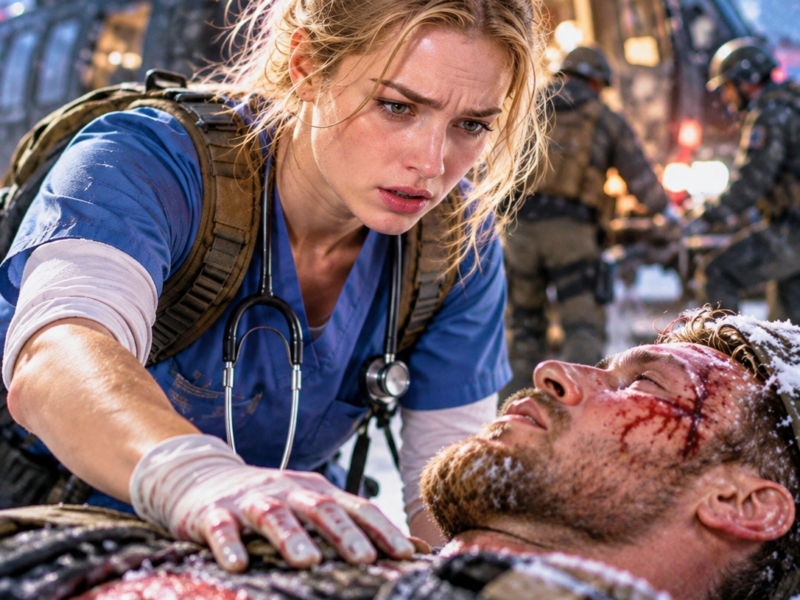
For eight months, my coworkers at a small Wyoming hospital mocked me as “Ghost Girl,” believing I was nothing more than a timid, incompetent nurse. But at 3:12 a.m., during a brutal ice storm, a critically wounded Navy SEAL whispered two words over the emergency radio: “Iron Dove.” I dropped my medication tray, and when his commanding officer rushed through the hospital doors, he froze at the sight of me. What he said next made everyone question who they had been humiliating all those months…
For eight months, my coworkers at a small Wyoming hospital mocked me as “Ghost Girl,” believing I was nothing more than a timid, incompetent nurse. But at 3:12 a.m., during a brutal ice storm, a critically wounded Navy SEAL whispered two words over the emergency radio: “Iron Dove.” I dropped my medication tray, and when his commanding officer rushed through the hospital doors, he froze at the sight of me. What he said next made everyone question who they had been humiliating all those months…
Part 1
At 3:12 a.m., in the middle of a violent Wyoming ice storm, a wounded Navy SEAL whispered two words over an emergency radio that made a quiet hospital nurse drop everything she was holding.
“Iron Dove.”
For eight months, nobody at Pineridge Valley Medical Center had known what those words meant. Nobody knew why Nora Callahan always kept her sleeves pulled down, why she never spoke about her past, or why she could remain perfectly calm when everyone around her was panicking.
They knew her only as “Ghost Girl.”
And they had made certain she never forgot it.
Nora was thirty-six years old, quiet, painfully private, and seemingly incapable of defending herself against even the smallest insult.
Amber Voss, a twenty-six-year-old nurse who considered herself the unofficial queen of the overnight shift, had invented the nickname during Nora’s third week.
It began with a tiny plastic ghost left beside Nora’s workstation. Then came another in her locker. Soon there were ghost drawings taped to her charts, whispered jokes behind her back, and laughter whenever she entered the break room.
“Careful,” Amber would announce whenever Nora walked past. “You might walk right through her.”
The others laughed.
Nora never did.
She simply continued working, checking medications, comforting patients, and disappearing into the background whenever possible.
To her coworkers, her silence meant weakness.
To Nora, silence was something entirely different.
It was protection.
The Thursday night everything changed began like dozens of others.
Outside, freezing rain was accumulating on the roads. The mountains surrounding Deer Hollow had vanished behind sheets of ice, and emergency dispatchers were already warning that the highway connecting Pineridge to the nearest major trauma center might close before morning.
Inside the hospital, Dr. Evan Hartley was complaining.
Hartley was forty-one, an experienced physician with a reputation for arrogance and a habit of making nurses feel smaller than they were.
He stopped behind Nora as she reviewed a patient’s IV chart.
“Whitmore,” he said impatiently. “That infusion rate is wrong.”
“My name is Callahan,” Nora replied.
He ignored the correction.
“Did you hear what I said?”
“The rate was adjusted six minutes ago. It’s within protocol.”
Hartley stared at her for a moment.
“Try paying attention.”
Then he walked away.
Amber, standing nearby, smiled into her coffee.
Nora said nothing.
She had learned that correcting people rarely changed what they wanted to believe.
At 1:30 a.m., Nora checked the ambulance entrance and noticed ice forming across the pavement. She immediately inspected the emergency trauma supplies, confirmed the available blood products, and checked the surgical equipment.
Nobody asked her to do it.
Nobody even noticed.
By 3:00 a.m., the hospital was nearly silent.
Nora stood beside a medication cart, reviewing inventory, when a small plastic object skidded across the floor.
Another ghost figurine.
Amber laughed from the supply room doorway.
“Hey, Ghost Girl. You dropped your friend.”
Nora looked at the toy.
Then she returned to her paperwork.
“You know,” Amber continued, “sometimes I wonder if you even have a personality.”
Nora did not answer.
Amber rolled her eyes and walked away.
Nine minutes later, the emergency radio crackled.
At first, the transmission was barely understandable.
“Pineridge Valley… this is Osprey Two… critical operator… seven minutes out…”
Nora froze.
The voice belonged to someone using a military communications format she had not heard in years.
Static swallowed the next words.
Then the signal returned.
“Severe penetrating trauma… possible internal hemorrhage… requesting immediate assistance…”
Nora slowly lifted her head.
Another burst of interference.
Then came the sentence that would destroy the quiet life she had spent eight months building.
“Tell Iron Dove… we found her.”
The medication tray slipped from Nora’s hands.
Metal struck the floor.
Bottles scattered.
Amber turned sharply.
Dex, another overnight nurse, looked up from his computer.
Hartley emerged from the physician’s lounge.
“Callahan!” he snapped. “What the hell are you doing?”
But Nora wasn’t looking at him.
She was staring at the radio.
The timid, withdrawn woman they had mocked for months had vanished from her posture.
Her shoulders straightened.
Her expression sharpened.
And when she reached for the handset, her voice changed completely.
“Osprey Two, Pineridge Valley receiving. Confirm patient count, injuries, and current condition.”
Dex stared.
Amber’s smile disappeared.
The reply came immediately.
“One critical casualty. Blast fragmentation to chest. Possible abdominal involvement. Severe blood loss. Patient deteriorating.”
“Understood,” Nora answered. “Prepare to transfer directly into trauma bay one.”
She replaced the handset.
Then she turned toward the nurses.
“Dex, activate the massive transfusion protocol through Dr. Hartley. Contact the blood bank and prepare emergency-release blood. Amber, get the thoracic equipment and airway cart into trauma one. Alert the operating room and surgical team.”
Nobody moved.
They were too shocked by her voice.
“Now,” Nora said.
Amber practically ran.
Hartley stepped forward.
“Excuse me?”
Nora was already moving toward the trauma bay.
“Callahan, you do not give orders in my emergency department.”
She stopped.
“We have a critically injured patient arriving in minutes. The road south is closing, and we may not have time for a transfer.”
“I am the physician here.”
“Then we need you ready to act.”
Hartley’s face reddened.
“Don’t lecture me about my responsibilities.”
Nora looked directly at him.
For the first time in eight months, she held his gaze without lowering her eyes.
“I’m not questioning your title, Doctor. I’m asking you to help save a life.”
The ambulance doors burst open at 3:16 a.m.
Freezing wind flooded the corridor.
Four heavily equipped military operators rushed inside, surrounding a stretcher carrying a critically wounded man.
His uniform was torn.
His chest was soaked with blood.
His skin had turned a frightening shade of gray.
Behind them came a Belgian Malinois, trembling with agitation and pulling desperately against his leash.
The dog refused to look anywhere except the injured man.
“Senior Chief Tommy Briggs,” one operator announced. “Multiple fragmentation wounds. Blood pressure falling. Respiratory distress.”
Nora approached the stretcher.
Before she could speak, one of the operators looked up.
He was tall, broad-shouldered, and carried himself with unmistakable authority.
The moment he saw her, his face drained of color.
He stopped walking.
For several seconds, he simply stared.
Then he whispered:
“Iron Dove?”
Nora’s expression did not change.
“Get him connected to the monitor.”
The man stepped closer.
“Nora?”
She looked at him.
“Victor. We can talk later.”
Victor Lane, a seasoned special operations officer who had once commanded men through some of the most dangerous missions imaginable, stood absolutely motionless.
Because the woman wearing ordinary hospital scrubs was someone he had spent three years trying to find.
Someone his unit had believed they might never see again.
And someone whose name had once meant the difference between coming home alive and being carried home in a flag-covered coffin.
Briggs groaned.
Nora immediately examined him.
His breathing was shallow and uneven. His oxygen saturation continued to fall.
Dex read the monitor.
“Blood pressure sixty-eight over forty.”
Hartley approached.
“We need the trauma surgeon.”
“Where is Dr. Marsh?” Nora asked.
“Highway fourteen,” Dex answered. “She’s trapped behind the closure.”
“How long?”
“At least an hour.”
Nora looked at Briggs.
Then at the instruments.
Then at Hartley.
“Doctor, his condition suggests life-threatening pressure around his left lung. We need immediate intervention.”
Hartley hesitated.
“We can’t proceed without proper—”
“Then assess him now.”
The monitor sounded another warning.
Briggs struggled desperately for air.
Nora leaned toward him.
“Tommy, listen to me. You’re in a hospital. We’re going to do everything we can.”
His eyes opened slightly.
He recognized her.
Even through the pain, his lips moved.
“Dove…?”
“Yes,” she whispered. “I’m here.”
Hartley looked between them.
“You know this man?”
Nora didn’t answer.
Victor Lane stepped beside the stretcher.
“Doctor,” he said quietly, “you need to listen to her.”
Hartley turned.
“And who exactly are you?”
Lane’s expression remained perfectly calm.
“Someone who has seen her keep men alive when every other medic thought they were already dead.”
For a moment, nobody spoke.
Then Briggs’s oxygen level dropped again.
Nora looked at Hartley.
“Make your decision, Doctor. We are running out of time.”
Hartley finally authorized emergency treatment.
Under his supervision, Nora worked with astonishing precision.
Every movement was controlled.
Every instruction was clear.
The team relieved the pressure compromising Briggs’s breathing and began managing the blood accumulating around his injured lung.
Within moments, his oxygen levels started improving.
Dex stared at the monitor.
“Eighty-two… eighty-five… eighty-eight.”
Amber watched Nora’s hands.
They weren’t shaking.
Not even slightly.
But before anyone could celebrate, the military dog suddenly began whining.
Kodiak, Briggs’s loyal Malinois, pushed insistently toward the right side of the stretcher.
He wasn’t looking at the chest injury.
He was staring at Briggs’s abdomen.
Nora noticed immediately.
“How long has he been doing that?”
“Since the extraction,” one operator answered.
“Did anyone complete a full secondary examination?”
Silence.
Nora reached for the ultrasound.
The screen revealed something that made her blood run cold.
Fluid was collecting inside Briggs’s abdomen.
A second injury.
One nobody had detected.
“He’s bleeding internally,” she announced. “We have another source of hemorrhage.”
Then the heart monitor screamed.
Briggs had lost his pulse.
Hartley stood frozen.
Amber gasped.
Victor took a step forward.
And Nora Callahan, the woman they had called Ghost Girl, turned toward the doctor and delivered an order so sharp that every person in the room moved.
“Start compressions!”
The next few minutes would determine whether Senior Chief Tommy Briggs lived.
But they would also reveal the terrifying truth about the quiet nurse everyone had underestimated.
Because Iron Dove wasn’t simply a nickname.
It was a name that had once appeared in classified military reports.
And the last time Nora Callahan had answered to it, somebody had died.
Part 2
Hartley began chest compressions while Nora coordinated the resuscitation.
The monitors flickered.
Briggs’s pulse disappeared, returned faintly, then threatened to vanish again.
“Come on, Tommy,” Nora whispered. “Not tonight.”
Finally, Dex felt a weak heartbeat.
“He’s back!”
Relief lasted only seconds.
The abdominal hemorrhage remained uncontrolled, and the surgical team was still assembling.
At 3:34 a.m., hospital administrator Paul Steck entered the trauma bay.
“What is happening here?”
He saw Nora directing the team and immediately became furious.
“Callahan, step away from that patient!”
“He’s dying,” she answered.
“You have exceeded your authority. I will have your license investigated!”
Nora looked straight at him.
“Then investigate me after he survives.”
Steck threatened to call security.
To everyone’s astonishment, Hartley interrupted.
“She’s right. I authorized the emergency treatment, and I need her assistance.”
Forty minutes later, Briggs was finally stable enough for emergency surgery.
As the stretcher disappeared through the operating room doors, Victor approached Nora.
“You saved him.”
“Not yet,” she replied.
Steck appeared behind them.
“My office. Immediately.”
By 4:23 a.m., Nora was sitting across from the administrator, who had already prepared suspension documents.
Steck placed a folder on the desk.
“Your clinical privileges are suspended pending investigation.”
Nora remained silent.
Then Hartley, standing near the window, spoke.
“I authorized her actions. If you’re reporting her, you’ll need to report me as well.”
Steck’s expression changed.
But the damage was already done.
He had contacted the nursing board.
And as Nora left his office, Victor stopped her in the corridor.
“There’s something you should know.”
“What?”
“I called someone.”
Nora’s eyes narrowed.
“Who?”
Victor hesitated.
“Harlan Voss.”
The name struck her harder than any threat Steck had made.
“Why would you do that?”
“Because he’s been looking for Iron Dove for two years.”
Part 3
Nora stared at Victor Lane as though he had just opened a door she had spent years keeping locked.
“Harlan Voss?” she repeated.
Victor nodded.
“He’s overseeing a federal medical readiness initiative. He wants to speak with you.”
“About what?”
“A directorship. Rural trauma training. Civilian hospitals working with military medical teams.”
Nora looked toward the operating room doors.
“Tell him I’m not interested.”
“You haven’t heard the proposal.”
“I don’t need to.”
Victor’s expression softened.
“Nora, nobody is asking you to return to combat.”
She turned away.
That was precisely what frightened her.
Not the possibility of returning to dangerous missions, but the possibility that someone might convince her she belonged somewhere important again.
For nearly three years, she had worked desperately to forget what it felt like to carry other people’s lives in her hands.
And now, within a single night, everything she had buried was resurfacing.
The operating room doors finally opened shortly after five-thirty.
A young surgical resident stepped into the waiting area, exhausted but smiling faintly.
“Senior Chief Briggs survived surgery.”
Victor closed his eyes.
One of the other operators covered his mouth.
Even Kodiak lifted his head as though he understood the words.
“The abdominal injury was significant,” the resident continued. “We controlled the bleeding. He’ll require intensive care, but he’s alive.”
Nora lowered herself into a chair.
For the first time all night, her shoulders relaxed.
Only slightly.
Victor noticed.
“You can breathe now.”
She looked at him.
“I was breathing.”
He almost smiled.
“Same old Nora.”
But she wasn’t the same.
And they both knew it.
Six years earlier, Nora Callahan had been serving as a special operations medical specialist during a classified mission known as Operation Karshi.
She had spent nine years supporting dangerous military assignments, working alongside elite teams in places where evacuation could be impossible and medical assistance might be hours away.
Her reputation was extraordinary.
While others panicked, Nora became calmer.
While others saw chaos, she saw sequences.
She could organize wounded men, limited equipment, and impossible decisions into a plan that gave people the best possible chance of survival.
Her call sign, Iron Dove, had originated from that contradiction.
She was compassionate enough to refuse to abandon a wounded teammate.
And relentless enough to continue working when exhaustion, fear, and danger made every movement difficult.
But Karshi had changed everything.
During that operation, an intelligence error exposed their team to an unexpected attack.
Petty Officer Joel Crane was critically wounded.
Nora worked desperately to save him.
For forty minutes, she exhausted every option available.
Crane died anyway.
The official explanation described his death as a training accident.
His family never learned the complete circumstances.
Nora knew the truth.
And although she understood that the mission’s intelligence failure had placed the team in danger, she couldn’t stop remembering the moment Crane stopped breathing.
She remembered his face.
The blood on her gloves.
The horrible silence after she realized there was nothing left to do.
She had made the right medical decisions.
But the right decisions had not been enough.
After Karshi, uncertainty began creeping into places where confidence had once lived.
She second-guessed herself.
She replayed procedures she had performed correctly.
She wondered whether she was becoming someone who could no longer trust her own judgment.
Eventually, she requested separation.
Her commanders tried to persuade her to reconsider.
Victor had personally asked her to stay.
Briggs had told her the unit would never be the same without her.
She left anyway.
And then she disappeared.
Nora moved to Wyoming, accepted a nursing position at a small rural hospital, and deliberately avoided discussing her military background.
She wasn’t trying to deceive anyone for personal advantage.
She wanted an ordinary life.
An opportunity to practice medicine without classified missions, command structures, or the crushing responsibility of keeping an entire team alive under fire.
She wanted to become certain again.
For eight months, she accepted every small humiliation because fighting those battles would have required revealing a version of herself she wasn’t prepared to confront.
Now Victor sat beside her and watched the woman he remembered slowly emerge.
“Tommy asked about you,” he said.
Nora looked down.
“When?”
“Every time we came home.”
She said nothing.
“He wanted to know whether you were safe. Whether you were happy. Whether somebody was looking after you.”
A small, painful smile crossed her face.
“Tommy always worried about everybody.”
“Especially you.”
The silence stretched.
Then Victor asked the question she had been avoiding.
“Why did you really leave?”
Nora stared at the floor.
“Because I wasn’t certain anymore.”
“Certain about what?”
“My judgment. My timing. Whether I could still make the right decisions when everything depended on them.”
Victor leaned forward.
“Nora, what happened to Crane wasn’t your mistake.”
“I know.”
“Do you?”
She looked at him.
“I know exactly what happened. That doesn’t mean I stopped seeing it.”
He had no answer.
She continued quietly.
“After Karshi, I was afraid that hesitation would get someone else killed. So I stepped away before that happened.”
Victor considered her words.
“And tonight?”
Nora looked toward the operating room.
“Tonight I didn’t hesitate.”
Victor nodded.
“Then maybe you found what you came here looking for.”
Before Nora could answer, her phone rang.
An unfamiliar local number appeared.
She answered.
“Callahan.”
“Ms. Callahan, this is Dr. Raymond Pruitt with the Wyoming State Board of Nursing.”
Her expression hardened.
“I’ve received a serious complaint concerning your conduct during an emergency procedure.”
Nora stood and walked into the hallway.
“I’m listening.”
Pruitt read the allegations.
Unauthorized medical procedures.
Improper exercise of clinical judgment.
Violations of professional practice standards.
The accusations were serious enough to threaten her career.
“Would you like to respond?” he asked.
“Yes. First, did Mr. Steck tell you the attending physician authorized the emergency interventions?”
A pause.
“He indicated there were questions about that.”
“And did he mention the patient had no immediate access to a trauma surgeon because of the storm?”
Another pause.
“Not in those terms.”
Nora closed her eyes briefly.
Steck had not simply reported a concern.
He had constructed a version of the night designed to destroy her credibility.
“I have timestamped documentation,” she said. “And Dr. Hartley can corroborate the authorization.”
“Then I strongly recommend submitting everything promptly.”
When the call ended, Nora immediately contacted Hartley.
“He filed against me before the patient was out of surgery.”
Hartley remained silent for several seconds.
Then he spoke.
“Send me everything you need documented.”
“Your authorization. The timing. Your account of the procedures.”
“You’ll have it.”
Nora hesitated.
“Evan, this could put your own position at risk.”
“I understand.”
“Steck doesn’t forgive people who challenge him.”
Hartley’s answer surprised her.
“Then perhaps someone should have challenged him years ago.”
For the first time, Nora heard something other than arrogance in his voice.
Responsibility.
By nine-fifteen that morning, Pruitt called again.
He had reviewed Hartley’s statement and the available medical records.
“The allegations appear substantially weaker than originally represented,” he explained. “The investigation must continue, but you will receive a fair review.”
Nora thanked him.
Then she learned something unexpected.
The surgical team had independently submitted statements supporting her actions.
She hadn’t asked them.
They had simply decided the truth deserved to be documented.
At ten-twenty, Amber approached the nursing station.
Nora was completing her notes when the younger nurse stopped beside her.
“Can I talk to you?”
Nora looked up.
“Of course.”
Amber twisted her fingers together.
“About the ghost jokes.”
Nora waited.
“I started them.”
“I know.”
Amber’s eyes filled with embarrassment.
“I thought it was funny. Then everybody joined in, and I kept doing it because it made people laugh.”
Her voice cracked.
“I treated you like you didn’t matter.”
Nora said nothing.
Amber swallowed.
“Last night, when I saw you working on that man, I realized I knew absolutely nothing about you. And I had spent eight months pretending I knew enough to judge you.”
Nora studied her face.
For once, Amber wasn’t performing confidence.
She was struggling to tell the truth.
“I’m sorry,” Amber whispered.
Nora nodded.
“Apology accepted.”
Amber blinked.
“Just like that?”
“You acknowledged what you did. That’s where change begins.”
Amber wiped her eyes.
Nora returned to her charting.
“Go get some sleep. You’ve been here all night.”
Amber walked away carrying something she hadn’t brought into that conversation.
Respect.
And perhaps the beginning of shame she could turn into better behavior.
But Nora’s own challenges were far from over.
At eleven-fifty, Victor called.
“Harlan Voss landed early. He’s coming to the hospital.”
Nora stared at the clock.
“How soon?”
“Forty minutes.”
She looked toward the mountains beyond the window.
The storm was finally beginning to weaken.
But another kind of storm was approaching.
And this time, it was coming specifically for her.
Part 4
Harlan Voss arrived shortly after noon.
He wasn’t wearing a military uniform.
There were no armed escorts, no dramatic introductions, and no impressive display of authority.
He was a lean man in his mid-fifties wearing a dark civilian jacket, carrying nothing but a small folder.
Nora waited inside the second-floor family consultation room.
Voss entered quietly.
“Ms. Callahan.”
“Mr. Voss.”
He sat opposite her.
For a moment, neither spoke.
Then Voss said something she had not expected.
“Before I discuss why I’m here, I owe you an apology.”
Nora’s expression became guarded.
“An apology for what?”
“Operation Karshi.”
The name made her entire body stiffen.
Voss continued.
“The intelligence assessment that placed your team in danger was my responsibility.”
Nora looked directly at him.
He did not look away.
“I approved the extraction window. I believed the threat had been contained. I was wrong.”
Her throat tightened.
“Crane died because the team encountered resistance we weren’t told to expect.”
“Yes.”
“And the official report called it a training accident.”
“Yes.”
Nora’s hands curled slowly against her knees.
Voss lowered his voice.
“Two years ago, I corrected that record. The complete report now identifies the intelligence failure and the circumstances surrounding his death.”
She stared at him.
“Why didn’t anybody tell me?”
“Because I couldn’t reach you through the official channels available to me. By the time the corrections were completed, you had withdrawn from the professional network through which we might have contacted you.”
Nora looked toward the window.
For six years, Joel Crane’s death had lived inside her like an unfinished sentence.
Now someone was telling her that the truth had finally been written down.
“There is something else,” Voss continued.
She turned back.
“Crane’s family received the corrected information.”
Nora felt her chest tighten.
“They know?”
“They know you worked for forty minutes trying to save their son. They know you made the medically appropriate decisions available to you.”
He paused.
“They know you didn’t abandon him.”
Nora closed her eyes.
She hadn’t realized how deeply those words would affect her.
When she opened them, Voss was still waiting.
“Now,” he said, “I’d like to explain why I came.”
The program was called Rural Trauma Readiness.
Twelve hospitals across five states had been selected for a joint initiative designed to improve emergency response in isolated communities.
These hospitals faced a dangerous problem.
They were often staffed by capable clinicians who rarely encountered battlefield-level trauma but could suddenly face devastating injuries during highway accidents, industrial disasters, training incidents, or severe storms.
When those emergencies occurred, access to larger trauma centers could disappear.
Exactly as it had during Briggs’s arrival.
The program needed someone who understood both civilian medicine and military emergency response.
Someone who could train teams to work together under extreme pressure.
Someone who knew the difference between possessing the right equipment and knowing how to use limited resources when minutes mattered.
“We want you to direct the program,” Voss said.
Nora stared at him.
“You’ve never worked with me.”
“I’ve reviewed your service record.”
“That’s not the same.”
“No,” he admitted. “It isn’t.”
He opened the folder.
“Fourteen months ago, you participated in a civilian-military mass casualty simulation in Montana.”
Nora remembered it.
Her hospital had sent two nurses to assist with a regional disaster exercise.
She had volunteered because nobody else wanted the additional shift.
“You were evaluated during that exercise,” Voss explained.
“I wasn’t informed.”
“It wasn’t an individual certification examination. The observers were assessing how participants coordinated during simulated emergencies.”
He slid a document toward her.
“Your performance was exceptional.”
Nora read the assessment.
It described her ability to prioritize casualties, coordinate personnel, recognize changing threats, and keep a team functioning when conditions deteriorated.
But one paragraph caught her attention.
The evaluator had noted that Nora consistently redirected praise toward others and deliberately avoided drawing attention to her own expertise.
The final recommendation was simple.
She possessed precisely the professional temperament required to lead the proposed program.
Nora slowly lowered the paper.
“You’ve had my name for fourteen months?”
“Yes.”
“Then why approach me now?”
Voss folded his hands.
“Because you deliberately stepped away from your former career. I wanted you to have the opportunity to choose when you were ready.”
She remained silent.
“Last night wasn’t your first demonstration of competence,” he continued. “It was simply the moment your readiness became impossible to overlook.”
Nora looked at her scarred forearm.
For years, those scars had felt like evidence of something she wanted to leave behind.
Now she wondered whether they could represent something else.
Experience.
Survival.
A responsibility she could carry without surrendering herself to it.
“What would the job require?” she asked.
Voss explained the training responsibilities, travel schedule, clinical requirements, and administrative expectations.
She would be able to remain in Wyoming.
She could continue nursing shifts.
And she would have the opportunity to strengthen emergency care in hospitals that otherwise had few resources.
Then he told her the greatest cost.
“You couldn’t remain invisible.”
Nora looked up.
“Your background would be part of the credentialing process. People would know your experience. Your name would appear on program documents.”
He waited.
“It’s your decision.”
Nora took several minutes before answering.
“I need time.”
“You have it.”
She stood.
“And my nursing board investigation?”
“It should be decided on the evidence. Not on who knows whom.”
Voss’s expression sharpened.
“However, what happened last night has raised additional concerns about the administrator who filed the complaint.”
Nora frowned.
“What concerns?”
“Previous staff complaints. Physician grievances. Reports of administrative interference. They appear to deserve independent examination.”
She looked down.
Steck had always seemed untouchable.
He controlled staff evaluations, disciplinary records, and the way complaints moved through hospital leadership.
For years, nurses had whispered about his intimidation.
Now those whispers were becoming documented evidence.
Later that afternoon, Victor approached Nora holding an official communication.
It acknowledged the medical staff who had preserved Briggs’s life and requested accurate documentation of their involvement.
Steck saw the document.
For the first time, his confidence faltered.
He tried to dismiss it.
“This doesn’t override hospital policy.”
“No,” Victor replied. “It doesn’t.”
He folded the paper.
“But it means there is an independent record of what happened.”
Steck looked toward Nora.
His face was pale.
“This isn’t finished.”
Nora met his eyes.
“No,” she said. “But now people are going to hear more than your version.”
By evening, the hospital’s board had opened an independent review of Steck’s conduct.
He was placed on administrative leave.
Nora’s suspension remained subject to formal review, but the hospital’s legal team had already submitted documentation acknowledging physician-supervised emergency intervention rather than the unsupported account originally presented.
A few hours earlier, Nora might have felt triumphant.
Instead, she felt exhausted.
She hadn’t wanted to defeat anybody.
She had wanted to save a patient.
And somehow, doing that had forced an entire institution to confront the way it treated people.
Shortly before six o’clock, her phone rang.
“Is this Nora Callahan?”
“Yes.”
“My name is Diane Crane.”
Nora stopped breathing for a moment.
“I’m Joel Crane’s mother.”
The noise of the hospital seemed to disappear.
Diane spoke slowly.
“I hope you don’t mind me calling.”
“No,” Nora whispered. “Of course not.”
“I read the corrected report about my son.”
Nora’s eyes filled with tears.
She could barely answer.
Diane continued.
“Joel talked about you before his last deployment. He said you were the one person he trusted to think clearly when everything went wrong.”
Nora covered her mouth.
“I know you tried to save him,” Diane said.
A tear slipped down Nora’s cheek.
“Mrs. Crane, I—”
“Please. Let me finish.”
Nora remained silent.
“I am not calling because I want an explanation. I am calling because my family knows the truth now.”
Diane’s voice trembled.
“My son trusted you. And after reading what happened, I understand why.”
Nora closed her eyes.
For six years, she had imagined what Crane’s family might say if they ever learned the truth.
She had imagined anger.
Blame.
Questions she couldn’t answer.
She had never imagined gratitude.
“I couldn’t bring him home,” Nora whispered.
“I know, sweetheart.”
Diane paused.
“But you stayed with him. When he was hurt and frightened, you stayed.”
Nora began crying quietly.
Not loudly.
Not dramatically.
Just the exhausted tears of someone who had carried an impossible memory for far too long.
Diane allowed her the silence.
Then she said, “I’m glad you’re still helping people.”
When the call ended, Nora remained seated for several minutes.
She had spent years believing she needed to become stronger before she could face her past.
Now she understood that healing didn’t always mean becoming stronger.
Sometimes it meant allowing another person to see the pain.
Her radio suddenly crackled.
“Callahan, ICU bay six is asking for you.”
Nora wiped her face.
Briggs wanted to see her again.
She stood and started toward the stairs.
But before she reached them, the ambulance bay doors burst open.
A paramedic rushed inside pushing a stretcher.
A small child lay motionless beneath emergency blankets.
Behind the stretcher ran a terrified woman with blood on her forehead.
“Eight-year-old female!” the paramedic shouted. “Motor vehicle collision! Severe head injury! Level of consciousness falling!”
Nora froze for less than a second.
Then she moved.
Because whatever decision she eventually made about her future, one truth had become undeniable.
Someone needed her now.
And Iron Dove had never learned how to walk away from someone who needed help.
Part 5
The little girl’s name was Maya Sorenson.
She was eight years old, with dark hair and a small purple backpack still caught beneath the straps of the emergency stretcher.
Her mother’s car had been struck at an intersection on an icy county road.
Maya had suffered a severe head injury.
By the time paramedics reached Pineridge Valley, she was barely responsive.
Her mother, Rachel, followed the stretcher into the emergency department despite a broken wrist and a deep cut above her eyebrow.
“Please!” Rachel cried. “Somebody help my baby!”
Nora was already beside the child.
She checked Maya’s breathing, examined her pupils, and watched the monitor as the emergency team assessed the severity of her injuries.
The girl’s condition was deteriorating.
Her heart rate was slowing.
The neurological examination raised concern for dangerous pressure inside her skull.
“Contact the on-call physician,” Nora instructed. “We need immediate airway assessment, urgent imaging, and neurosurgical consultation.”
Dex was already moving.
Patricia Rudd, the experienced charge nurse who had worked at Pineridge for twenty-two years, arrived moments later.
She took one look at the situation.
“What do you need?”
Nora gave her the priorities.
Patricia nodded.
No questions.
No arguments.
The difference from the previous night was unmistakable.
The team moved together.
Nobody laughed.
Nobody challenged instructions simply to establish authority.
Nobody wasted valuable seconds trying to prove who mattered most.
They focused on Maya.
Rachel stood trembling near the doorway.
“Is she going to die?”
Nora turned toward her.
“I can’t promise you an outcome,” she said gently. “But we’re acting quickly, and we’re going to give her every possible chance.”
Rachel began sobbing.
“She’s only eight.”
“I know.”
Nora placed a hand briefly on her shoulder.
“Let us work.”
Under the arriving physician Dr. Lim’s direction, the team provided emergency treatment to stabilize Maya and arranged urgent imaging.
The scans revealed bleeding around the brain.
It was serious.
But there was still an opportunity to intervene.
A neurosurgical team at a larger hospital agreed to accept her.
The weather had improved enough for air transport.
Just after seven that evening, Nora stood near the ambulance entrance and watched a medical helicopter prepare to leave.
Rachel was allowed to accompany her daughter.
Before boarding, she turned toward Nora.
“I don’t even know your name.”
“Nora.”
Rachel reached for her hand.
“Thank you, Nora.”
Then the helicopter lifted into the night.
Nora watched until its lights disappeared.
She had now helped two critically injured patients survive long enough to reach the advanced care they needed.
One was a Navy SEAL whose arrival had exposed her hidden past.
The other was a little girl whose mother had reminded her why she had entered medicine in the first place.
Neither knew about the nickname Ghost Girl.
Neither cared about the rumors, the hospital politics, or the accusations against her.
They needed someone willing to help.
And that was the only part of Nora’s history that mattered in those moments.
The following morning, Nora attended an emergency meeting with the hospital’s board of directors.
Harlan Voss sat beside her.
Victor Lane stood near the back of the room.
Dr. Hartley was present, along with legal counsel and several senior medical staff members.
Paul Steck was absent.
His administrative leave had been formalized earlier that morning.
Board chairman Dr. Willis Crane, a retired physician with white hair and a stern expression, opened the meeting.
“Ms. Callahan,” he began, “before discussing the proposed program, this board needs to acknowledge what happened here.”
Nora waited.
Crane looked at the documents before him.
“The clinical review confirms that you played a critical role in stabilizing Senior Chief Briggs and that the attending physician supported the emergency interventions.”
He looked directly at her.
“The hospital’s disciplinary action against you is being rescinded.”
Nora nodded.
“Thank you.”
Crane continued.
“Furthermore, the hospital should never have allowed a workplace culture where an employee could be routinely belittled without intervention.”
The room became uncomfortable.
Hartley lowered his eyes.
Several board members exchanged glances.
Crane turned a page.
“We failed to recognize the expertise of someone working in our own emergency department. But more importantly, we failed to recognize that every employee deserves professional respect, regardless of background.”
Nora appreciated the words.
But she knew words alone would not change the hospital.
She had learned that the hard way.
The meeting then turned to the Rural Trauma Readiness program.
Voss explained how participating hospitals would receive specialized training, assistance coordinating emergency responses, and opportunities to practice handling major trauma cases.
The goal wasn’t to turn small emergency departments into military hospitals.
It was to help ordinary medical professionals prepare for extraordinary circumstances.
He described the previous night’s emergency.
A winter storm.
Closed highways.
Limited surgical availability.
A patient whose injuries could not wait.
“That situation,” Voss explained, “is precisely why this program exists.”
One board member asked why Pineridge should serve as the program’s central location.
Voss looked toward Nora.
“Because the most vulnerable facilities are often the ones farthest from advanced trauma care.”
He paused.
“And because we already have someone here who understands both the problem and what it takes to improve the response.”
Every eye turned toward Nora.
She looked uncomfortable.
Not because she doubted her ability.
Because she had never enjoyed being the center of attention.
Crane asked, “Ms. Callahan, would you be willing to serve as director?”
Nora remained quiet for a moment.
Then she spoke.
“I would want the training to include everyone who responds to emergencies. Nurses, physicians, paramedics, technicians. Not just people with impressive titles.”
Voss nodded.
“That is the intention.”
“I would also want realistic simulations. Honest evaluations. And a culture where somebody can admit they don’t know something without being humiliated.”
Hartley looked up.
Nora continued.
“Because when a patient is dying, the team can’t afford to be afraid of asking questions.”
The room fell silent.
Crane leaned back.
“I think that’s an excellent foundation.”
The board approved the partnership unanimously.
But there was still one unresolved question.
Nora had not formally accepted the directorship.
After the meeting, Voss found her standing beside a window overlooking the snow-covered mountains.
He handed her the evaluation report from the Montana training exercise.
“There’s something I wanted you to see again.”
Nora opened it.
The report praised her technical abilities.
But Voss pointed to its final paragraph.
It described how Nora had repeatedly given credit to other participants, encouraged less experienced staff, and helped the group solve problems without demanding recognition.
The evaluator believed these qualities made her a particularly strong candidate for leadership.
Nora read the paragraph twice.
Then she smiled faintly.
“All that time, I thought nobody noticed me.”
Voss shook his head.
“People noticed. They simply didn’t all understand what they were seeing.”
She closed the folder.
“What happens if I accept?”
“You build the program. You help hospitals prepare. You continue practicing medicine. And you decide what kind of future you want.”
“And if I refuse?”
“You continue living your life. Nobody is entitled to your service.”
Nora looked through the window.
For years, she had believed that disappearing was the only way to survive the memories she carried.
But perhaps disappearing had served its purpose.
Perhaps she no longer needed to hide.
She turned toward Voss.
“I’ll do it.”
He nodded.
“Welcome aboard, Ms. Callahan.”
“There is one condition.”
“What’s that?”
“I stay here.”
Voss smiled.
“We were hoping you would.”
Later that morning, Nora visited Briggs in the ICU.
He looked substantially better.
His color had improved, and he was alert enough to complain about the hospital food.
Kodiak lay beside his bed, having been granted a temporary exception to the normal visitor rules.
The dog lifted his head when Nora entered.
Then, apparently satisfied, he went back to sleep.
Briggs smiled.
“I heard you took the job.”
“Victor talks too much.”
“He always has.”
Nora pulled a chair beside the bed.
Briggs watched her carefully.
“You look different.”
“I’m still wearing the same scrubs.”
“That’s not what I mean.”
She waited.
“After Karshi,” Briggs said, “we all wondered whether we’d done something to make you leave.”
Nora looked down.
“No.”
He studied her face.
“Not even a little?”
She thought about the question.
Then she answered honestly.
“I loved the team. That’s part of why leaving was so hard.”
Briggs remained silent.
“When Joel died, I couldn’t separate the grief from the work anymore. Every time I picked up medical equipment, I remembered him.”
She swallowed.
“I needed distance.”
Briggs nodded slowly.
“I wish you’d told us.”
“I didn’t know how.”
He looked toward Kodiak.
“Sometimes the people who know how to handle everything for everybody else don’t know what to do when they’re the ones hurting.”
Nora gave a small smile.
“That sounds suspiciously wise.”
“Almost dying improved my perspective.”
She laughed.
It was a quiet laugh, but genuine.
Briggs watched her with obvious relief.
“There’s the Nora I remember.”
She shook her head.
“I don’t think she’s exactly the same anymore.”
“Good,” he replied. “Neither am I.”
Eleven days after his arrival, Briggs was discharged.
He walked slowly through the hospital corridor with Victor beside him and Kodiak pressed protectively against his leg.
At the nursing station, several staff members had gathered to see him leave.
Dex was there.
Patricia stood beside him.
Even Amber waited quietly near the doorway.
Briggs stopped in front of Nora.
“When that training program needs field instructors, call me.”
“You’re supposed to recover first.”
“I will.”
“Properly.”
He grinned.
“Yes, ma’am.”
Then he leaned closer.
“By the way, I heard what they used to call you.”
Nora raised an eyebrow.
“Did you?”
“Ghost Girl.”
She sighed.
“Victor really does talk too much.”
Briggs smiled.
“Funny thing about ghosts.”
“What?”
“People only believe in them because they don’t understand what they’re seeing.”
Nora looked at him.
For a moment, neither spoke.
Then Briggs straightened.
“Well, I guess they understand now.”
He walked toward the exit.
Before stepping outside, he turned back.
“Take care of yourself, Iron Dove.”
Nora smiled.
“You too, Tommy.”
The doors closed behind him.
And for the first time in eight months, Nora stood in the corridor without feeling the need to disappear.
Over the following days, the hospital continued changing.
The independent investigation into Paul Steck uncovered a long-standing pattern of intimidation and interference with staff complaints.
Several nurses finally felt safe enough to describe incidents they had previously kept silent about.
Physicians submitted statements.
Paramedics provided accounts of difficult encounters.
The review concluded that Steck’s management practices had repeatedly undermined trust between administrators and clinical staff.
His employment ended shortly afterward.
Patricia Rudd was appointed interim administrator.
One of her first acts was surprisingly small.
She opened a supply drawer at the nursing station and found a bag of plastic ghost figurines.
There were twelve left.
She looked at them for a moment.
Then she threw them away.
Nobody objected.
Three weeks later, Nora stood at the front of a conference room filled with nurses, paramedics, doctors, and military medical personnel.
It was the first official training session of the Rural Trauma Readiness program.
Her identification badge displayed her full name.
Nora Callahan, RN.
Beneath it appeared her new title.
Program Director.
She wore no medals.
She displayed no photographs from her military career.
And she made no attempt to impress anyone with stories about classified missions.
Instead, she began with a question.
“What is the worst emergency your hospital has ever faced?”
The participants exchanged uncertain glances.
Nora waited.
Then a young paramedic raised his hand.
He described a highway collision involving several injured passengers and only one available ambulance.
Another nurse spoke about a patient who deteriorated during a blizzard.
A physician described making difficult decisions while waiting for a helicopter that couldn’t land.
Soon the room was filled with practical questions.
Nora listened carefully.
She offered guidance when it was useful.
She acknowledged when another participant had a better idea.
And when someone admitted they had made a mistake during an emergency, she didn’t humiliate them.
She helped them understand what could be done differently.
By the end of the session, the participants were exchanging phone numbers and discussing future training scenarios.
As Nora packed her materials, Dr. Hartley approached.
“Good session,” he said.
“Thank you.”
He stood awkwardly beside her.
“There is something I should have said months ago.”
Nora stopped gathering her papers.
Hartley looked embarrassed.
“I treated you badly. I didn’t learn your name properly. I questioned your competence without making any effort to understand your experience.”
He paused.
“And I allowed other people to treat you like a joke.”
Nora studied him.
He continued.
“I’m sorry.”
She nodded.
“Thank you for saying that.”
Hartley exhaled.
“I don’t expect you to forget it.”
“I won’t.”
His face tightened.
“But,” she continued, “I don’t intend to spend the rest of my life holding it against you, either.”
He nodded.
For several seconds, they stood quietly.
Then Hartley extended his hand.
“Evan.”
Nora looked at it.
“What?”
“My name. Evan.”
A smile slowly appeared on her face.
“I know.”
She shook his hand.
That evening, Nora drove home beneath a clear Wyoming sky.
The mountains stood dark against the horizon, their snow-covered peaks illuminated by the last light of sunset.
The road was quiet.
For once, she didn’t fill the silence with memories of Karshi.
She thought about Briggs recovering.
About Maya Sorenson, whose transfer team had reported that she was receiving specialist care and showing encouraging signs.
About Diane Crane’s phone call.
About Amber’s apology.
About the people who would receive better emergency training because of the program.
And about the strange way one terrible night had reopened a door she thought she had permanently closed.
She had spent six years believing her past was something she needed to escape.
Then eight months pretending to be someone small enough that nobody would ask questions.
But she understood something now.
Her silence had never erased her courage.
Her grief had never erased her compassion.
And her decision to step away had not made everything she had accomplished before meaningless.
She had simply needed time.
Time to recover.
Time to trust herself.
Time to discover that a person could leave one life behind without abandoning everything valuable they had learned from it.
As she approached the lights of Pineridge, the emergency radio in her car crackled.
A dispatcher reported an ambulance responding to an accident several miles away.
Nora listened automatically.
Then she smiled.
Tomorrow she would return to the hospital.
Not because anyone demanded it.
Not because she needed to prove something.
But because she had finally chosen her future for herself.
The woman they had called Ghost Girl was gone.
Not because she had become someone new.
But because she no longer needed to hide the woman she had always been.
And somewhere, perhaps, Joel Crane would have been proud to know that Iron Dove was still doing what she had always done best.
Helping people find their way home.