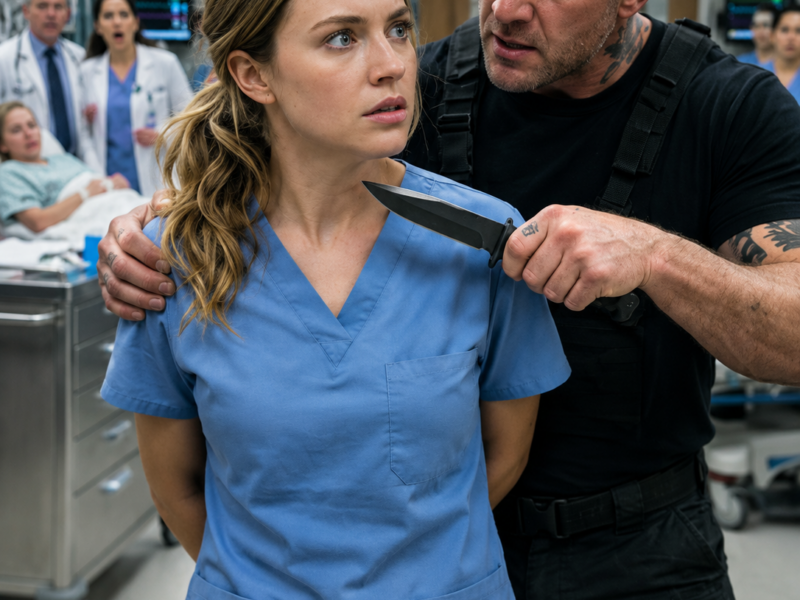
For 11 Months, My Chief of Emergency Medicine Treated Me Like an Ordinary, Incompetent Nurse—Until Four Armed Men Stormed Our Hospital at Midnight, Demanding a Wounded Federal Witness. When Their Leader Pointed His Gun at Me and Asked, “Who the Hell Are You?” I Calmly Replied, “Mara Voss. Registered Nurse.” Minutes Later, Federal Agents Discovered the Military Past I Had Hidden for Four Years, but When My Former Commanding Officer Arrived With News About an Unidentified Patient, Nothing Could Have Prepared Me for What He Said Next…
For 11 Months, My Chief of Emergency Medicine Treated Me Like an Ordinary, Incompetent Nurse—Until Four Armed Men Stormed Our Hospital at Midnight, Demanding a Wounded Federal Witness. When Their Leader Pointed His Gun at Me and Asked, “Who the Hell Are You?” I Calmly Replied, “Mara Voss. Registered Nurse.” Minutes Later, Federal Agents Discovered the Military Past I Had Hidden for Four Years, but When My Former Commanding Officer Arrived With News About an Unidentified Patient, Nothing Could Have Prepared Me for What He Said Next…
Part 1
The first thing I noticed was the silence.
Not the ordinary silence that sometimes settles over a hospital at three in the morning, when exhausted nurses finally catch a moment between emergencies. This was different. It was the kind of silence that arrives when everyone in a room realizes, at exactly the same time, that they might be about to die.
Four armed men had just walked into the emergency department of Callaway General Hospital in Salt Lake City.
One of them raised a handgun and shouted, “Nobody moves! Phones on the floor! Hands where I can see them!”
A young resident dropped his clipboard. Someone screamed near the nurses’ station. A security guard slowly raised both hands, his face turning pale beneath the fluorescent lights.
And me?
I was standing beside a wounded patient in trauma bay two, adjusting his IV.
My name is Mara Voss. I was thirty-four years old, and for the previous eleven months, everyone at Callaway General had known me as the quiet nurse who never argued.
They were wrong about almost everything else.
But they were right about one thing.
I didn’t argue unless there was a reason.
And that night, I had four very good reasons.
Before I explain what happened, you need to understand why nobody in that hospital expected anything extraordinary from me.
I wasn’t especially tall or physically imposing. I wore ordinary navy-blue scrubs, kept my dark hair clipped behind my head, and rarely participated in conversations that didn’t involve patients.
I arrived early, completed my assignments, and left without attracting attention.
Some coworkers thought I was shy. Others believed I lacked confidence.
Dr. Russell Hatch, our fifty-one-year-old chief of emergency medicine, had a less generous opinion.
He considered me competent but unremarkable.
During my first year, he had dismissed several of my clinical assessments, sometimes in front of patients.
Once, after I questioned his interpretation of a deteriorating patient’s condition, he looked directly at me and said, “There’s a reason nursing school and medical school are different institutions, Voss.”
Everyone heard him.
I simply nodded and documented my concerns.
What Hatch didn’t know was that I had spent seven years serving with a classified military medical support unit known as Meridian Company.
I had treated casualties under fire, evacuated wounded personnel from hostile territory, and learned skills that had absolutely nothing to do with a conventional nursing career.
Four years earlier, I had walked away from that life.
Not because I couldn’t handle it anymore.
Because I was tired of discovering how much a human being could survive and still be expected to function normally afterward.
I wanted something ordinary.
A hospital job. A modest apartment. Predictable responsibilities.
And, most importantly, a life where nobody knew what I had once been capable of.
For eleven months, I almost succeeded.
Then came the night everything changed.
It began shortly before midnight.
Two ambulances had already arrived following a highway collision. The waiting room was overflowing with patients, and I was assisting with the treatment of a forty-seven-year-old man suffering from septic shock.
The emergency radio suddenly crackled.
“Two incoming gunshot victims. Both male. One critical. ETA ninety seconds. Possible hostile individuals following transport.”
I heard every word.
So did Dr. Hatch.
“Prepare trauma one and two,” he ordered. “I want blood ready.”
The ambulance doors opened ninety seconds later.
The first patient was a man in his late twenties with a gunshot wound through his left shoulder. He was conscious but pale.
The second was younger, perhaps twenty-five, with a severe abdominal wound.
His blood pressure was dangerously low.
I approached the second gurney and immediately noticed his breathing.
Something was wrong.
“Absent breath sounds on the right,” I reported. “Possible tension pneumothorax. We need immediate decompression.”
Hatch barely glanced at me.
“I’ll make that assessment, Nurse Voss.”
I stepped aside.
Thirty-five seconds passed while he examined the patient.
Then the oxygen saturation dropped further.
“Needle decompression,” Hatch announced.
I already had the equipment ready for the authorized clinician.
Nobody commented on the fact that I had identified the problem first.
I didn’t expect them to.
Once the patient was stabilized for further treatment, I moved to the man with the shoulder wound.
He grabbed my wrist.
His grip was surprisingly strong.
“Listen to me,” he whispered. “You have to hide me.”
“What’s your name?”
“Darren Oay.”
“Darren, you’re losing blood. I need you to stay still.”
“You don’t understand.”
His eyes darted toward the entrance.
“They followed us.”
“Who did?”
“Four men. We were ambushed. I’m a federal witness against Draven Vance.”
I kept my expression neutral.
The name meant nothing to me at that moment.
But the fear in his eyes did.
“They’re going to kill me,” he whispered. “And they’ll kill anyone standing between us.”
Before I could answer, the public doors opened.
Four men entered.
Not running. Not shouting.
Walking with the confidence of people who had already decided how the next ten minutes would unfold.
I saw the outline of a concealed weapon beneath the first man’s jacket.
Then another.
The third man was younger, visibly nervous.
The fourth positioned himself near the entrance.
I knew immediately that this wasn’t a random act of violence.
It was an operation.
And whoever had planned it had made one enormous mistake.
They assumed everyone inside was helpless.
The leader drew his weapon.
“Everybody down!”
The emergency department froze.
I remained beside Darren, my hands resting lightly on his bed rail.
“Keep breathing normally,” I whispered.
He stared at me.
“Lady, you need to run.”
“I’m not leaving you.”
“You’re going to get killed.”
“Possibly. But not because I abandoned a patient.”
The leader approached Dr. Hatch.
“We’re looking for a man who arrived with a gunshot wound. Left shoulder. Where is he?”
Hatch straightened.
“This is a hospital. You cannot—”
The gunman pointed his weapon directly at his chest.
“Where is he?”
Hatch stopped speaking.
The leader’s gaze traveled across the room.
Then he noticed me.
“You. Nurse.”
I looked up.
“Which bay?”
“What?”
“The shoulder wound. Where is he?”
I glanced toward the far end of the department.
“Bay six.”
Darren was in bay two.
Bay six held an elderly woman recovering from a fractured hip.
I had lied deliberately.
“Take me there,” the man ordered.
I looked once at Darren.
His expression said everything.
He believed I had betrayed him.
I didn’t explain.
Instead, I walked toward bay six with the gunman following.
The elderly patient, Mrs. Eleanor Price, was awake when we entered.
Her eyes widened at the sight of the weapon.
“Please,” she whispered.
“It’s all right,” I told her. “Just stay still.”
The gunman looked around.
There was no wounded witness.
He turned toward me.
“Where is he?”
I faced him calmly.
“Not here.”
His expression hardened.
“You lied.”
“Yes.”
He raised his gun.
“Give me one reason I shouldn’t shoot you.”
I studied his face.
An old scar crossed his jaw. His right leg carried slightly less weight than his left. He kept checking the doorway, expecting support from his men.
“You have an old knee injury,” I said.
He blinked.
“What?”
“Right knee. You compensate when you turn. And you keep checking your right side because you’re accustomed to having someone cover that angle.”
He stared at me.
I continued.
“Your youngest man is nervous. Your third man is too close to the medication station. And your fourth man is guarding an entrance that hospital security can isolate.”
His gun remained pointed toward my chest.
But his expression had changed.
“Who the hell are you?”
I touched the identification badge clipped to my scrubs.
“Mara Voss. Registered nurse.”
He stepped closer.
“Don’t play games with me.”
“Then stop pointing a gun at an elderly patient.”
For one second, neither of us moved.
Then an alarm sounded from the next trauma bay.
A patient was experiencing a sudden cardiovascular emergency.
I recognized the alarm.
“Someone needs me,” I said.
“You’re not going anywhere.”
“That patient could die.”
“Not my problem.”
I looked straight into his eyes.
“It becomes your problem if you prevent me from saving him.”
He hesitated.
And for the first time since entering the hospital, the man who had terrorized an entire emergency department seemed uncertain.
Finally, he lowered his weapon slightly.
“Move. Slowly.”
I walked into bay four.
A sixty-eight-year-old cardiac patient named Harold Briggs was struggling to breathe.
I called for clinical assistance and began the emergency response, checking his monitor, reassessing his condition, and administering treatment under the standing emergency protocols.
The gunman watched from the doorway.
Harold’s condition gradually improved.
His breathing steadied.
He looked toward the armed stranger.
“What’s going on?”
“Something temporary,” I said. “Keep your eyes on me.”
The gunman was watching me differently now.
Not like a frightened nurse.
Like a question he couldn’t answer.
“You moved too fast,” he said.
I adjusted Harold’s monitor.
“People tend to appreciate that in an emergency.”
“Who trained you?”
I said nothing.
He moved closer.
Then, without warning, every overhead light in the emergency department went out.
For three seconds, the room disappeared into darkness.
The backup lights flickered on.
And in that dim amber glow, I made a decision I had spent four years praying I would never have to make again.
I stopped being invisible.
Part 2
When the emergency lights came on, the gunman was looking toward the doorway.
That was his mistake.
Before he could turn back, I moved.
There was a brief struggle, a metallic crash, and suddenly his weapon was sliding across the hospital floor.
I pinned him against the wall.
He was larger and stronger, but he hadn’t expected resistance from a nurse.
“Who are you?” he demanded.
“Someone trying to keep her patients alive.”
I restrained him temporarily and recovered his weapon.
Then I heard voices outside.
One attacker had taken Dr. Priya Anand hostage. Another was speaking into a phone.
Before I could intervene, the ambulance doors burst open.
Armed federal agents entered.
Within seconds, the remaining attackers surrendered.
A man wearing a tactical vest approached me.
“Are you Nurse Voss?”
“Yes.”
“Darren Oay said you’d still be standing.”
I handed over the weapon.
“Your suspect is behind me.”
The agent looked astonished.
And then he said something unexpected.
“We’ve already checked your background.”
My stomach tightened.
“What background?”
He lowered his voice.
“Meridian Company.”
Four years of hiding my past had ended in a single night.
But the worst surprise was still waiting.
Because someone else had been watching me long before those gunmen arrived.
Part 3
I had imagined what it would feel like if someone at Callaway General discovered my military background.
I expected questions.
Perhaps disbelief.
Maybe a few uncomfortable conversations explaining why I had never mentioned it.
What I didn’t expect was a federal agent telling me that my name had been flagged in a classified database before the gunmen entered the hospital.
The agent who spoke to me was Paul Kellerman, Darren Oay’s federal protection contact.
He was around forty, with short hair and the permanently exhausted expression of a man accustomed to operating on very little sleep.
“We need a statement,” he said.
“You’ll have one. First, my patients need reassessment.”
He glanced toward the trauma bays.
“You just disarmed an armed attacker.”
“And I’m still responsible for the people lying in those beds.”
For a moment, Kellerman seemed unsure how to respond.
Then he nodded.
“Fair enough.”
When I returned to Darren, his eyes followed me with something resembling disbelief.
“All four?” he asked.
“In custody.”
He exhaled slowly.
“Callaway Vance?”
I paused.
“Who?”
“The man who led them. Callaway Vance. Draven’s younger brother.”
I had spent several minutes alone with one of the most dangerous men associated with a major federal investigation.
And he had spent those minutes trying to determine why a nurse wasn’t afraid of him.
“His brother runs the organization?” I asked.
Darren nodded.
“Draven built an information network across four western states. He doesn’t just steal money. He buys secrets. Judges, executives, contractors, government employees. He finds what they want hidden and uses it.”
“Why are you involved?”
“I worked for him. Three years.”
He stared at the ceiling.
“Then I witnessed something I wasn’t supposed to see. People died. I kept records.”
“And now you’re testifying.”
“In six weeks.”
I checked his shoulder dressing.
He looked back at me.
“Draven’s going to know about you.”
“He doesn’t know me.”
“He will.”
I didn’t answer.
Because he was right.
A few minutes later, Priya appeared beside the curtain.
“Mara, we need you.”
Her tone told me this wasn’t another question about the gunmen.
“What’s wrong?”
“The second gunshot victim. He’s crashing.”
I ran.
The younger man with the abdominal wound had deteriorated while the department was under attack.
His heart had gone into a dangerous rhythm.
Dr. Toby Park, the third-year surgical resident, was attempting resuscitation.
“What’s his status?” I asked.
“Severe hemorrhage. He’s arrested. Surgery is coming.”
I moved beside the bed, assessed the monitor, and worked with Park according to the emergency resuscitation protocol.
The team delivered a shock for a shockable rhythm.
For a terrifying moment, nothing changed.
Then the monitor registered organized electrical activity.
A pulse returned.
Weak.
Unstable.
But present.
“Get the surgical attending down here now,” I said.
Park was already calling.
Eleven minutes later, Dr. Sasha Orin arrived.
She examined the patient, reviewed the emergency interventions, and ordered immediate transfer to surgery.
Before leaving, she stopped beside me.
“Good work, Voss.”
I nodded.
But something about the patient’s face had unsettled me.
Even through the blood loss and swelling, there was something familiar.
I couldn’t explain it.
I pushed the thought away.
There wasn’t time.
At approximately 2:30 in the morning, Special Agent Dana Rice arrived.
She was a composed woman in her late thirties who seemed to know far more than she initially revealed.
She asked to speak with me privately.
We went into the empty staff lounge.
“Tell me about Meridian Company,” she said.
I looked at her.
“That information isn’t relevant to my employment here.”
“It became relevant when four armed criminals entered your department and you disabled their leader without firing a shot.”
I folded my arms.
“What exactly do you know?”
Rice opened a file on her tablet.
“Seven years. Medical specialist. Later cross-trained for field operations. Multiple overseas deployments. Voluntary separation four years ago.”
I felt an unpleasant familiarity.
The sensation of having another person read a version of my life that I had deliberately put away.
“How did you access that?”
“Your name came up during our emergency assessment of hospital personnel.”
She paused.
“There’s a commendation in your file signed by Colonel Arlland Pace.”
My chest tightened.
Pace.
I hadn’t heard that name spoken aloud in years.
“He’s involved in this case?” I asked.
“For six months.”
“Does he know I’m here?”
“He does now.”
Rice leaned forward.
“And he’s coming to the hospital.”
I looked away.
Colonel Pace had been my commanding officer during some of the most difficult years of my military career.
He was disciplined, intelligent, and almost impossible to surprise.
He was also connected to the most painful memory of my life.
Four years earlier, my younger brother Jonas had been declared killed in action during a classified overseas operation.
I received the official report after leaving Meridian.
The report carried Pace’s signature.
I had never forgiven him for how little he could tell me about Jonas’s death.
And now he was coming to Callaway General.
Before I could ask anything else, Rice’s radio crackled.
“Agent Rice, we have a problem.”
She picked it up.
“Go ahead.”
“Callaway Vance made an eighteen-second phone call before we secured his device.”
“To whom?”
“Unknown. Burner phone.”
“Location?”
There was a pause.
“Two blocks west of the hospital.”
Rice stood.
I followed.
At the nurses’ station, Kellerman was already coordinating additional security.
“The recipient’s phone pinged near Halden and Fifth,” he explained.
I knew the intersection immediately.
“That’s the parking structure.”
Rice turned toward me.
“What?”
“The third-floor skybridge connects directly to level two of that garage.”
Kellerman grabbed his radio.
“Cover the skybridge.”
But I was already thinking about another possibility.
Callaway hadn’t appeared panicked during our confrontation.
He had acted like someone expecting backup.
And experienced operators didn’t usually rely on a single access route.
“There’s another entrance,” I said.
Kellerman looked up.
“Where?”
“Maintenance access near the pharmacy. The upper utility shaft connects to the storage corridor.”
“How do you know?”
“Eleven months of working nights.”
He dispatched agents.
I should have remained behind them.
Instead, I walked toward the pharmacy corridor.
I knew what waiting might cost.
The hallway was almost completely empty.
Fluorescent lights hummed overhead.
At the far end, a storage-room door stood slightly open.
I stopped.
Something moved behind it.
A shadow crossed the narrow strip of light beneath the door.
Then a man stepped into the hallway.
Dark clothing.
Weapon at his side.
He spotted me.
“Stay where you are.”
I didn’t.
I shoved a supply cart between us.
The collision threw him off balance, and I moved to prevent him from raising the weapon.
We struck the wall hard.
Pain flashed through my left shoulder.
He recovered faster than I expected.
Then a second armed man appeared.
For the first time that night, I understood I had miscalculated.
Two opponents.
Confined space.
No safe escape.
And one of them had already raised his weapon.
“Don’t move!” he shouted.
Then federal agents appeared at the far end of the corridor.
Their commands echoed through the hallway.
In the confusion, I forced the nearest weapon downward and dropped to the floor with its owner.
Moments later, both men were restrained.
Kellerman arrived, breathing heavily.
He looked at the suspects.
Then at me.
“Are you injured?”
“Nothing serious.”
“You should have waited.”
“They were already inside.”
He didn’t argue.
Rice arrived seconds later.
She studied the two men.
“Find out who sent them.”
I pressed my hand against my aching shoulder.
For the first time that evening, I wanted nothing more than to sit down.
But Rice’s expression told me something was wrong.
The suspects weren’t reacting like ordinary criminals.
They were remarkably calm.
As if being arrested had been included among the possible outcomes of their assignment.
And there was something else.
The shorter man had looked directly at my face before being taken away.
Not with hatred.
With recognition.
I couldn’t shake the feeling that he had known who I was before entering the corridor.
At 3:22 a.m., Colonel Arlland Pace arrived.
I recognized him immediately.
He was sixty-three now, with close-cropped gray hair and the same steady gaze I remembered from years of military service.
He approached me across the emergency department.
“Mara.”
“Colonel.”
“You can stop calling me that.”
“Old habits.”
He looked at my shoulder.
“You’re hurt.”
“It’s fine.”
“You always say that.”
For a moment, we stood in silence.
Then he said, “We need to talk about the two men you stopped.”
“Rice is investigating them.”
“We’ve already identified them.”
His expression grew serious.
“They’re connected to Meridian.”
I stared at him.
“That doesn’t make sense.”
“No,” he agreed. “It doesn’t.”
He guided me back toward the staff lounge.
Once inside, he closed the door.
“Mara, those men were part of a private protection contract.”
“Protection for whom?”
He looked directly at me.
“You.”
The room seemed to grow smaller.
“Someone hired them six weeks ago,” Pace continued. “Their assignment was to monitor your safety and intervene if necessary.”
“Who authorized that?”
“We’re still determining the full chain.”
I felt a cold pressure building behind my ribs.
“Why would anyone arrange protection for me without telling me?”
Pace hesitated.
“Because whoever arranged it knew you wouldn’t agree.”
I looked at him.
“What aren’t you telling me?”
Instead of answering immediately, he placed a document on the table.
It contained information about my employment at Callaway General.
My application.
My hiring date.
The original vacancy announcement.
“The position you applied for eleven months ago,” he said, “may have been created specifically to bring you here.”
I stared at the document.
I had found that job myself.
Or so I believed.
The listing had appeared on an ordinary clinical placement website.
I applied.
Received an interview.
Accepted an offer.
Every decision had felt entirely my own.
“Who would know me well enough to predict where I’d apply?” I whispered.
Pace didn’t answer.
Then his phone rang.
He listened for several seconds.
His expression changed.
“Mara,” he said quietly, “the unidentified gunshot patient has come out of surgery.”
“Is he alive?”
“Yes.”
“Then why do you look like that?”
Pace swallowed.
“He’s asking for you.”
I frowned.
“Why?”
“He says his name is Jonas Voss.”
For the first time in four years, I forgot how to breathe.
Because Jonas Voss was my brother.
And my brother was dead.
At least, that was what the report signed by the man sitting across from me had said.
Part 4
I remember looking at Colonel Pace and waiting for him to correct himself.
People share names.
Records get mixed up.
Mistakes happen during chaotic medical emergencies.
There had to be an explanation.
“Say that again,” I whispered.
Pace didn’t look away.
“The patient in postoperative recovery identified himself as Jonas Voss. His credentials have been verified.”
“No.”
“Mara—”
“No. My brother died four years ago.”
“I know what you were told.”
I stood so suddenly that my chair scraped against the floor.
“What I was told?”
Pace remained seated.
“Let me explain.”
“You signed his death report.”
“Yes.”
“You told me his remains couldn’t be recovered because the operation was classified.”
“Yes.”
I stared at him.
“Was he alive when you signed that report?”
For several seconds, he said nothing.
That silence hurt more than anything he could have said.
Finally, Pace answered.
“At the time, we believed he was dead. The extraction team reported no vital signs, and the mission area was no longer accessible.”
“But he survived.”
“Yes.”
“And you knew?”
“We learned later that he had been recovered by another group. He suffered catastrophic injuries and spent a long time receiving treatment under an assumed identity.”
“How long have you known?”
He hesitated again.
“Long enough that I should have handled this differently.”
I couldn’t speak.
For four years, I had lived with the belief that my little brother was buried somewhere I could never visit.
I had packed away his belongings.
Kept his photographs in a wooden box beneath my bed.
Written letters to him that I never intended anyone to read.
There had been nights when I sat alone in my apartment and wondered whether leaving Meridian had somehow contributed to his death.
And now someone was telling me he had been alive the entire time.
“Why didn’t he contact me?”
Pace lowered his voice.
“Severe spinal trauma. Traumatic brain injury. Cardiac complications. For a long time, he couldn’t function independently. When he recovered, he became involved in an operation that required his identity to remain concealed.”
I shook my head.
“Don’t tell me this was about national security.”
“It wasn’t only that.”
“What else?”
“He was afraid.”
“Of what?”
“Coming back into your life after you’d already mourned him.”
I felt anger rising through the shock.
“That’s not a reason.”
“No,” Pace said. “It isn’t a good enough reason.”
I left the lounge without another word.
The elevator ride to the fourth floor felt endless.
I stared at the numbers above the doors, trying to organize my thoughts.
But for once, they wouldn’t organize.
When I reached room 412, a federal agent checked my badge and stepped aside.
I entered.
The man lying in the hospital bed was thinner than I remembered.
There was a scar along his temple.
His cheeks were hollow, and his complexion had the fragile pallor of someone who had spent years recovering from serious injuries.
But I knew him.
I knew the shape of his face.
The slightly crooked nose.
The small scar above his eyebrow from falling off his bicycle when he was nine.
Most of all, I knew his eyes.
He opened them.
“Mara.”
One word.
Four years of grief collapsed beneath it.
I gripped the bed rail.
“You’re alive.”
His mouth trembled.
“Yeah.”
I wanted to embrace him.
I wanted to scream.
I wanted to ask a thousand questions.
Instead, I said the most ridiculous thing imaginable.
“You have a repaired liver injury. Don’t try to sit up.”
He smiled faintly.
“Still bossy.”
And suddenly, I was seventeen again, standing in our childhood kitchen telling my younger brother to stop climbing onto the roof.
I pulled a chair beside his bed.
“Why, Jonas?”
He looked down.
“There’s a lot to explain.”
“Start with why you let me bury you.”
His expression changed.
“I didn’t plan for it to happen that way.”
“You had four years.”
“For fourteen months, I barely understood what was happening to me. The brain injury was worse than anyone initially knew.”
He took a careful breath.
“When I recovered enough to make decisions, I was working inside an intelligence operation involving Draven Vance.”
I stared at him.
“Draven?”
He nodded.
“His organization isn’t just a criminal enterprise. It’s an information brokerage. They collect private records, financial transactions, communications, and leverage material.”
“I know.”
“You know the surface.”
“Then explain the rest.”
Jonas described an operation that had taken years to develop.
Darren Oay had witnessed one exchange involving Draven’s network.
Jonas had discovered the infrastructure behind those exchanges.
The servers.
The shell corporations.
The secret payment channels.
The people paid to make evidence disappear.
He had been working under another identity to identify the network’s most important members.
And he believed someone inside federal witness protection was compromised.
“That’s why I needed you here,” he said.
I stared at him.
“What?”
“The job opening.”
My throat tightened.
“No.”
“I arranged it.”
He looked ashamed.
“I knew you’d never return voluntarily. You wanted a quiet life, so I created an opportunity that looked like exactly that.”
“You manipulated my career?”
“I positioned you somewhere I could reach you if the protection system failed.”
I stood.
“You let me think I was choosing my own future.”
“I know.”
“You let me mourn you.”
“I know.”
“And you used me in an operation without telling me?”
He closed his eyes.
“Yes.”
I turned toward the window.
Outside, Salt Lake City lay beneath the earliest hint of morning.
For four years, I had told myself the worst thing that could happen was losing Jonas.
Now I understood there was another kind of pain.
Finding him alive and realizing he had become someone who believed protecting me justified lying to me.
“Those men in the pharmacy corridor,” I said. “Were they yours?”
Jonas nodded.
“They were supposed to protect you. Not confront you. They had instructions to intercept any additional threat before it reached the emergency department.”
“They drew weapons on me.”
“They didn’t recognize the situation. It went wrong.”
“That could have gotten somebody killed.”
“I know.”
He looked directly at me.
“I’m sorry.”
I studied his face.
There was no excuse left in his expression.
Only regret.
But regret didn’t erase four years.
“Tell me everything about Draven,” I said.
For the next twenty minutes, Jonas explained what he knew.
According to him, Draven preferred controlling information over using direct violence.
His brother Callaway was different.
Callaway handled intimidation, abductions, and operations requiring force.
“Tonight wasn’t supposed to happen this early,” Jonas said. “Callaway moved ahead of Draven’s schedule.”
“Why?”
“Something frightened him.”
“What?”
“I don’t know.”
I thought about the gunmen.
The hospital attack.
The unexplained phone call.
And the two men sent to protect me.
Suddenly, I understood.
“We’re looking in the wrong direction.”
Jonas frowned.
“What do you mean?”
“Callaway’s attack drew every federal agent in Salt Lake City toward this hospital.”
Jonas stared at me.
I continued.
“What if the attack wasn’t the real operation?”
His expression changed.
“The evidence.”
“What evidence?”
“Darren’s financial documentation. There’s a secure device being held in federal custody.”
I was already reaching for my phone.
Within minutes, I was back downstairs speaking with Rice and Kellerman.
“Check the evidence device,” I demanded.
Kellerman frowned.
“It’s secured downtown.”
“Verify it.”
He called the federal evidence facility.
I watched his expression while he spoke.
At first, he appeared annoyed.
Then confused.
Finally, alarmed.
He ended the call.
“The device was transferred yesterday afternoon.”
Rice stepped closer.
“Transferred where?”
“That’s the problem. The paperwork appears legitimate, but nobody can confirm the destination.”
I looked at her.
“The hospital attack was a distraction.”
Rice’s face tightened.
“Draven wanted our attention here while someone moved the evidence.”
Kellerman grabbed his radio.
I returned to Darren’s bay.
He was awake, watching the ceiling.
“Who handles evidence logging for your prosecution team?” I asked.
He frowned.
“Why?”
“Someone authorized a transfer of your documentation device.”
His face drained.
“There was a paralegal.”
“Name?”
“Artis Septan.”
“What do you know about him?”
“He joined the team eight months ago. He asked too many questions about the evidence.”
“Did you report it?”
“Twice. They said he was vetted.”
I found Rice near the nurses’ station.
“Artis Septan,” I said. “Check his financial records.”
She immediately passed the name to her investigators.
At 4:38 a.m., the first results came back.
Septan had received a suspicious payment fourteen months earlier from a corporation connected through several intermediaries to the Vance organization.
He had been planted.
And he had waited more than a year for the right moment.
Rice left with an investigative team to recover the missing device.
I finally sat down in an empty supply room.
My shoulder was throbbing.
My clothes smelled of disinfectant, blood, and exhaustion.
I hadn’t eaten properly in hours.
But I couldn’t stop thinking about the timing.
Eleven months earlier, Jonas had placed me in Callaway General.
Fourteen months earlier, Draven had placed Septan inside the prosecution team.
Both men had been positioning people like pieces on a chessboard.
And neither had fully anticipated what would happen when those pieces started making decisions of their own.
A few minutes later, Pace found me.
He handed me water.
“Rice has recovered the device,” he said.
I looked up.
“Where?”
“A courier transfer point. The device is intact. Septan is in custody.”
I felt some of the tension leave my shoulders.
But only some.
“Draven still has another option.”
Pace studied me.
“Which one?”
“Darren isn’t the only witness.”
He went still.
“There is a financial analyst,” he admitted. “Protected in Nevada.”
I stood.
“Where?”
“Reno.”
Before he could say anything else, Kellerman appeared in the doorway.
His face was pale.
“We just lost contact with her handler.”
I felt the room turn cold.
“What’s her name?”
“Petra Solless.”
“When was the last check-in?”
“Four-thirty. He missed it.”
I looked at Pace.
“Get somebody to Reno.”
“We already have agents moving.”
“Then get me in contact with them.”
Pace hesitated.
“You’ve been awake almost twenty-two hours.”
“I know.”
“You’re injured.”
“I know.”
He watched me for another moment.
Then nodded.
“There’s a vehicle downstairs.”
I grabbed my jacket.
And as I walked toward the ambulance exit, I realized something terrible.
Draven Vance had been preparing for this night for more than a year.
The hospital attack had failed.
The evidence theft had failed.
But his final target was still alive.
And somewhere in Reno, a woman who had risked everything to expose him was about to discover just how far a desperate man would go.
Part 5
By the time I reached Reno, I had been awake long enough that the world seemed to move a fraction slower than it should.
The Nevada desert had stretched endlessly beyond the windows during the drive.
I had spent most of those hours speaking with federal investigators, reviewing what we knew about Draven Vance, and worrying about a woman I had never met.
Her name was Petra Solless.
She was thirty-six years old, a former accountant who had helped manage financial transactions for companies secretly connected to Draven’s information network.
Eighteen months earlier, she had discovered evidence that several supposedly unrelated deaths were linked to illegal financial operations.
Instead of accepting money to remain silent, she had gone to federal investigators.
Since then, she had lived under protection.
Now her safe house had been compromised.
Fortunately, Agent Derek Foss and his team reached the property before I arrived.
At 6:14 that morning, they entered.
I was on the phone when Foss called out, “We found her!”
For the first time in hours, I closed my eyes.
“Is she injured?”
“No. She’s hiding behind a laundry room access panel. Scared, dehydrated, but alive.”
“And her handler?”
“In the basement. Head injury. Someone restrained him.”
I looked out at the highway.
“Whoever came for her knew the address.”
“Yes.”
“And they left when they couldn’t find her.”
“That’s what it looks like.”
I understood the implication.
Draven had authorized another attempt.
He had reached Petra’s safe house.
But she had hidden before his people could take her.
When I finally arrived, the neighborhood looked almost insultingly peaceful.
Small houses.
Trimmed lawns.
Cars parked along the street.
Nothing suggested that a federal witness had spent several hours hiding in terror.
Inside, Petra sat on a couch wrapped in a blanket.
She was small, with dark hair and tired eyes.
A coffee cup rested between her hands.
She looked up when I entered.
“You’re the nurse from Salt Lake City.”
I nodded.
“Mara Voss.”
“Foss told me about you.”
“Then he’s probably exaggerated.”
She almost smiled.
“He said you stopped six armed men.”
“Federal agents helped.”
“Still.”
I sat across from her.
For a moment, neither of us spoke.
Then I asked, “Are you going to testify?”
Her expression hardened.
“I’ve been preparing for that courtroom for eighteen months.”
“I know.”
“I’ve lost my career. My home. Most of my friends. I’ve spent more than a year living behind locked doors because I refused to lie.”
She leaned forward.
“Three hours in a crawl space won’t change my mind.”
I looked at her.
There was something extraordinary about the certainty in her voice.
Not arrogance.
Not recklessness.
A decision made so completely that fear could no longer change it.
“Good,” I said.
She studied me.
“Why did you come all the way here?”
I thought about Jonas.
Darren.
The gunmen.
The stolen evidence.
And every person Draven had tried to silence.
“Because people like him survive when good people decide standing up is too dangerous.”
Petra looked down at her coffee.
Then she nodded.
I remained at the safe house long enough to make sure her injured handler received medical attention and that Foss’s team had arranged a secure relocation.
Afterward, I returned to the car.
Only then did exhaustion finally catch me.
I slept deeply for part of the journey back.
When I woke, the sunlight had risen above the desert.
My shoulder hurt.
My neck was stiff.
But for the first time since midnight, nobody was pointing a gun at me.
I called Pace.
“Jonas?”
“Stable. Recovering well.”
“Darren?”
“Transferred to a secure federal medical facility.”
“Petra’s protection?”
“Being reorganized.”
I paused.
“And Draven?”
Pace was silent for a moment.
Then he said, “We have him.”
I sat upright.
“What?”
“He was detained attempting to leave the country using false identification. He’s now in federal custody.”
I stared at the passing landscape.
Draven Vance.
The man who had spent years building an organization around secrecy, manipulation, and fear.
The man responsible for so much suffering.
Had tried to run.
And failed.
“Callaway?” I asked.
“His brother has requested discussions with prosecutors. Apparently, learning Draven was arrested changed his willingness to cooperate.”
I leaned back.
For some reason, I didn’t feel victorious.
I felt tired.
More than tired.
I felt as though a weight I had carried without noticing was finally beginning to lift.
“Will the trial happen?” I asked.
“Yes. With the device recovered and both witnesses alive, the prosecution is stronger than ever.”
I closed my eyes.
“Good.”
When I returned to Callaway General, daylight filled the emergency department.
The staff had resumed their normal routines.
Patients were arriving.
Phones were ringing.
Monitors were beeping.
It almost looked as if nothing had happened.
Priya met me near the ambulance bay.
She examined my face.
“You look terrible.”
“Thank you.”
“Go home, Mara.”
“I need to check on Jonas.”
“His numbers are stable. Dr. Orin reviewed him this morning.”
“Harold Briggs?”
“Cardiology evaluated him. He’s doing well.”
“Mrs. Price?”
“Comfortable and scheduled for orthopedic follow-up.”
I nodded.
“Good.”
Priya folded her arms.
“And now you need to sleep.”
“After I speak with Hatch.”
Her expression changed.
“His office.”
I found Dr. Russell Hatch sitting behind his desk.
He looked older than he had the previous evening.
For the first time in eleven months, he didn’t immediately tell me what I had done wrong.
Instead, he gestured toward the chair across from him.
“Sit down, Voss.”
I sat.
He looked at a document on his desk.
“I’ve reviewed the records from last night.”
I waited.
“The patient with the chest injury. You identified the emergency before I did.”
“Yes.”
“And I dismissed your assessment.”
“Yes.”
He rubbed his forehead.
“I wasted time.”
I said nothing.
He continued.
“I’ve reviewed other cases too. Situations where you raised concerns and I overruled you without sufficient consideration.”
I looked at him steadily.
“I documented those situations.”
“I know.”
He took a breath.
“I was wrong.”
For eleven months, I had imagined hearing those words.
I thought they would feel satisfying.
Instead, they sounded smaller than I had expected.
Because an apology couldn’t return lost time.
And being right wasn’t something I had wanted to win.
It was something patients had needed.
“You need to listen to your nurses,” I told him.
He nodded slowly.
“I intend to.”
“Not just me. All of them.”
“I understand.”
I stood.
“Mara,” he said.
I stopped.
He looked uncomfortable.
“What you did last night… I don’t know how to describe it.”
“Neither do I.”
“I know people are alive because of you.”
I looked at him.
“People are alive because a lot of professionals did their jobs.”
He nodded.
Then, quietly, he said, “I’m glad you were here.”
I left his office without another word.
Upstairs, Jonas was awake.
He looked at me as I entered.
“Reno?”
“Petra’s safe.”
“Draven?”
“Caught.”
He exhaled.
“Then it’s over.”
“No,” I said. “The criminal case is moving forward. That’s different.”
He smiled faintly.
“You always were particular about words.”
I sat beside his bed.
For several minutes, we spoke about the investigation.
His recovery.
The upcoming trial.
Then he became quiet.
“Mara?”
“Yes?”
“I need you to be angry with me.”
I looked at him.
“What?”
“You’ve been treating me like a patient since you found out.”
“You are a patient.”
“I’m also your brother.”
I said nothing.
He swallowed.
“You haven’t told me how much I hurt you.”
I looked at his hands.
The same hands that had helped me fix my bicycle as a teenager.
The same hands that had held our mother’s coffin when we buried her.
The same hands I had believed were cold and lifeless somewhere across an ocean.
“You let me grieve you,” I whispered.
He closed his eyes.
“I know.”
“For four years, Jonas.”
“I know.”
“I went through your belongings. I kept your clothes because they still smelled like you. I spent months in therapy trying to accept that I would never see you again.”
A tear landed on my hand.
I hadn’t realized I was crying.
“I blamed myself for leaving Meridian.”
His eyes opened.
“Mara, no.”
“I thought if I’d stayed, maybe I could have protected you.”
“You couldn’t have changed what happened.”
“Maybe not. But I spent four years believing I should have.”
He reached toward me.
I took his hand.
“And you were alive.”
His voice broke.
“I’m sorry.”
I shook my head.
“You should have called the moment you could.”
“I know.”
“We could have figured everything out together.”
“I know.”
For a long time, neither of us spoke.
Then he whispered, “Can you forgive me?”
I looked at his face.
Forgiveness wasn’t simple.
It couldn’t erase four years.
It couldn’t undo the deliberate manipulation that had brought me to Callaway General.
But he was here.
Alive.
Breathing.
Holding my hand.
“I don’t know yet,” I admitted.
He nodded.
“That’s fair.”
“But we have time to figure it out.”
He smiled through tears.
“Yeah.”
And for the first time in four years, I let myself believe that we did.
The following six weeks changed more than I expected.
The federal investigation continued.
Callaway Vance agreed to cooperate, providing information about his brother’s organization.
Artis Septan, the paralegal who had helped move the evidence device, pleaded guilty to conspiracy and evidence-related charges.
The financial records Darren had preserved exposed illegal transactions across multiple states.
Petra’s testimony connected those transactions to people who had been threatened, blackmailed, and killed.
The courtroom proceedings lasted weeks.
I attended part of the trial.
Darren testified with his left arm still recovering from the gunshot wound.
He looked nervous when he entered the witness stand.
But when the prosecutor began asking questions, his voice steadied.
He told the truth.
All of it.
Petra testified several days later.
She wore a dark blazer and kept her hands folded in front of her.
When the defense attorney tried to question her credibility, she didn’t become angry.
She answered carefully.
Patiently.
With the same determination I had seen in that safe house.
Eventually, the jury returned its verdict against Draven.
Guilty on twenty-one of twenty-three counts.
He received a forty-four-year prison sentence.
Callaway received eighteen years following his guilty plea and cooperation.
Septan received seven.
The organization that had spent years manipulating institutions was substantially dismantled.
Not everything disappeared overnight.
Networks like that leave behind people, debts, secrets, and consequences.
But Draven’s control was broken.
And the witnesses he had tried to silence were alive to see it.
I learned about the final verdict while working another night shift.
Priya sent me a message.
Twenty-one counts. Guilty.
I read it.
Then put my phone away.
A woman in trauma bay three needed help breathing.
I went to her.
Because whatever happened in a courtroom, the hospital didn’t stop needing nurses.
Jonas recovered slowly.
Some days were easier than others.
There were conversations between us that ended in silence.
Others ended in arguments.
Sometimes we laughed about childhood memories.
Sometimes I cried over the years we had lost.
But we kept talking.
That was what mattered.
He eventually found an apartment near mine.
We started having dinner together once a week.
At first, the meetings were awkward.
Then gradually they became ordinary.
And ordinary was something I had once wanted more than anything.
Meanwhile, things at Callaway General began changing.
Hatch stopped humiliating nurses during rounds.
He reviewed clinical notes more carefully.
He asked questions instead of assuming answers.
The changes weren’t dramatic.
But they were real.
One afternoon, a young resident dismissed a nurse’s concern about a patient’s deteriorating condition.
Hatch stopped him.
“Listen to her assessment,” he said.
The resident looked surprised.
Hatch continued.
“She spends more time with that patient than either of us. We need to understand what she’s seeing.”
I overheard the conversation from across the department.
For the first time, I thought perhaps the events of that night had accomplished something beyond stopping a group of criminals.
Perhaps they had changed the way people listened.
Three weeks after the verdict, I received an unexpected request to attend a meeting in the hospital’s administrative conference room.
When I arrived, Priya was there.
So was Hatch.
Several hospital administrators sat around the table.
Agent Rice attended alongside a senior federal official.
I immediately became suspicious.
“What happened?” I asked.
The chief administrator smiled.
“Nothing’s wrong, Nurse Voss.”
That alone made me more suspicious.
She explained that the hospital board had reviewed the emergency department attack.
My medical decisions.
My actions during the evacuation.
My involvement in protecting patients and assisting law enforcement.
The review concluded that my work had significantly contributed to preventing further injuries and deaths.
Then she slid a document across the table.
It was a formal commendation.
I looked at it.
“Thank you.”
Hatch cleared his throat.
“There’s something else.”
I turned toward him.
“We’re offering you the emergency department charge nurse position.”
I blinked.
“What?”
“Effective next month.”
He paused.
“You should have received this promotion earlier. I blocked a previous recommendation.”
The room became quiet.
Hatch met my eyes.
“That was my mistake.”
I studied him.
There were many things I could have said.
But I had already told him what I needed him to understand.
So I simply answered, “I’ll accept.”
Priya smiled.
Rice looked amused.
And for the first time in years, I allowed myself to feel proud without immediately questioning whether I deserved it.
After the meeting, Rice stopped me in the hallway.
“Something you should know,” she said.
“What?”
“The official incident report describes your intervention in the pharmacy corridor.”
I raised an eyebrow.
“And?”
“It identifies the person who secured the situation as unknown civilian personnel.”
I laughed softly.
“Unknown civilian personnel?”
“Apparently, your previous affiliations were considered irrelevant to the public report.”
I thought about that.
For years, I had worked to become invisible.
I had wanted to leave behind the person I once was.
Now, after everything, the official record barely acknowledged who had actually stood in that corridor.
Strangely, I didn’t mind.
“That’s fine,” I told her.
Rice looked at me carefully.
“You sure?”
I nodded.
“I know what happened.”
She smiled.
“Good enough.”
I returned to the emergency department.
The morning shift was busy.
A construction worker had arrived with a suspected broken arm.
An elderly woman was waiting for test results.
A young father sat beside his feverish daughter, looking more frightened than the little girl herself.
The department was noisy.
Messy.
Ordinary.
Exactly what I had wanted.
I pulled up the next patient’s chart.
Thirty-eight-year-old male.
Construction injury.
Suspected forearm fracture.
I walked into his bay.
“Good morning,” I said. “I’m Nurse Voss. Tell me what happened.”
He began explaining.
I listened.
Really listened.
Because if my years in Meridian had taught me anything, it was that the most important information often comes from people nobody else thinks to hear.
I had listened to wounded soldiers.
Frightened civilians.
Patients whose concerns were dismissed.
And on one extraordinary night, I had listened closely enough to recognize danger before anyone else understood what was happening.
My military training had saved lives.
But so had something far simpler.
The decision not to look away.
People eventually learned about my past.
Some treated me differently.
Others asked questions I couldn’t answer.
A few suddenly decided I had become remarkable.
But I hadn’t changed.
I was still the woman who arrived early.
Who checked every monitor.
Who remembered her patients’ names.
Who documented concerns even when powerful people dismissed them.
The only difference was that others had finally begun to recognize the person who had been standing in front of them all along.
I used to believe that peace meant leaving my old life completely behind.
Now I understood that peace wasn’t the absence of everything that had hurt me.
It was learning to live without allowing those experiences to decide every part of my future.
Jonas was alive.
Darren and Petra could begin rebuilding their lives.
Draven Vance was no longer free to destroy people from behind a network of secrets.
And the hospital where I had spent eleven months being overlooked had finally learned that quiet people could carry extraordinary strength.
I finished examining the construction worker’s arm and adjusted his position to make him more comfortable.
He smiled.
“Thanks, Nurse.”
“You’re welcome.”
Then I turned toward the next patient.
There were no cameras.
No medals.
No armed agents waiting outside.
Just another hospital shift and people who needed help.
And as I walked across the emergency department, I realized something I wished I had understood years earlier.
I never needed the world to recognize my strength in order for that strength to matter.
I only needed to keep using it when someone needed me.
Because the woman everyone had underestimated had never been ordinary in the way they imagined.
She had simply chosen to live quietly.
And when the moment came, she had chosen to stand her ground.
Not for recognition.
Not for revenge.
Not because she wanted to become a hero.
But because there were people in that room who deserved to survive.
And she refused to leave them behind.