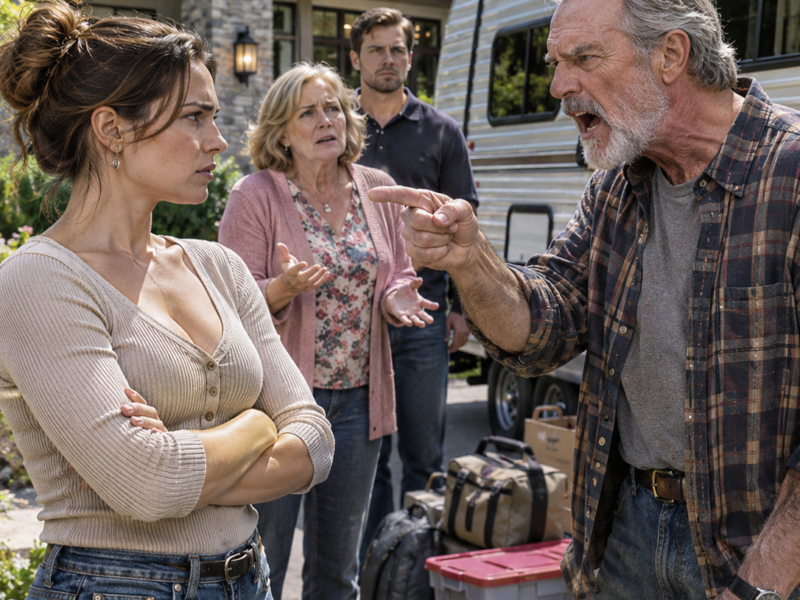
Eleven Years After My Father Kicked Me Out at 18 for Refusing to Give My Brother the $7,400 Truck I Bought Myself, He Showed Up at My Montana Home With a 16-Foot Trailer Full of Furniture. “Your Mother and I Will Be Staying in That Little House,” He Announced, Pointing to the Home I’d Spent Two Years Building. I Calmly Said, “No, You Won’t,” Then Placed an Old Yellow Receipt on the Table. But When I Told Him Who Was Actually Moving In the Next Morning, His Face Went Pale…
Eleven Years After My Father Kicked Me Out at 18 for Refusing to Give My Brother the $7,400 Truck I Bought Myself, He Showed Up at My Montana Home With a 16-Foot Trailer Full of Furniture. “Your Mother and I Will Be Staying in That Little House,” He Announced, Pointing to the Home I’d Spent Two Years Building. I Calmly Said, “No, You Won’t,” Then Placed an Old Yellow Receipt on the Table. But When I Told Him Who Was Actually Moving In the Next Morning, His Face Went Pale…
Part 1
The last time my father told me what to do, I was eighteen years old, sitting at our kitchen table in Fargo, North Dakota. Eleven years later, he arrived at my house in Montana with a sixteen-foot trailer full of furniture, expecting to move into a home I had built with my own hands.
What he didn’t know was that the house already belonged to someone else.
My name is Brady Dolgren. I’m twenty-nine, a locomotive engineer, a husband, and a father. But growing up, I was simply the quiet son—the one everyone expected to sacrifice for his older brother, Jud.
Jud could do no wrong. When he lost a job, my parents found excuses. When he needed money, they somehow found it. Meanwhile, I worked from the age of fourteen, bagging groceries and spending freezing autumn nights operating machinery during the sugar beet harvest.
By eighteen, I had saved over $8,000. I spent $7,400 on a used white Chevrolet Silverado, paying cash to an elderly man named Selmer Fossum. Before handing me the keys, he wrote a bill of sale on yellow paper.
“Keep this somewhere safe,” he warned. “People have a way of forgetting what they paid for.”
I tucked it behind my sun visor.
Three months later, that piece of paper became more important than I could have imagined.
One Friday night, Jud wrecked the pickup our father had bought him. The insurance wouldn’t cover the damage, and Jud desperately needed transportation for his new construction job.
At Sunday dinner, Dad announced his solution.
“Your brother needs your truck.”
I stared at him. “I bought that truck with my own money.”
“Money you earned while living under my roof,” he replied.
For the first time in my life, I refused.
Dad’s face darkened.
“Then get your own place,” he snapped. “Like a grown man.”
He expected me to apologize. Instead, I stood up.
“Okay.”
Forty minutes later, everything I owned was packed into my Silverado. Nobody stopped me. Nobody even said goodbye.
What my parents didn’t know was that I’d secretly accepted a railroad training position in Havre, Montana, seven hundred miles away.
I drove west through the night, checking my phone at every rest stop.
Not one message came.
When I reached Havre, I had approximately $700 remaining and nowhere to sleep.
That’s when I met Palmer Thune, a railroad supervisor who handed me an address written on a yellow sticky note.
“Retired engineer named Orlin Novotny,” he explained. “He’s got a room. His wife will probably feed you whether you want it or not.”
Orlin rented me a tiny room behind his garage for $150 monthly and allowed me to delay payment until my first paycheck.
His wife, Velma, welcomed me to dinner that evening.
For the first time, I sat at a table where someone had prepared a plate specifically for me.
Over the following years, those two people became the family I had always needed.
When I returned exhausted from railroad shifts in temperatures forty degrees below zero, Velma left hot meals waiting in the oven.
When I considered quitting, Orlin gave me expensive work gloves with three words written on the cuff: “For not quitting.”
And on Christmas Eve, I met their daughter, Britta.
She was studying nursing, had a sharp sense of humor, and immediately stole my seat at dinner.
Eventually, she stole my heart.
We married in 2019. I became a locomotive engineer, and together we purchased an old farmhouse on eight acres of Montana land.
I spent three years renovating it.
In 2023, our daughter Tilly was born.
My parents never called.
Not for my wedding. Not for my birthdays. Not even after the birth of their granddaughter.
Then, one afternoon in 2024, I watched Velma struggling to carry laundry down fourteen steep basement stairs.
Orlin’s knees were deteriorating, too.
That evening, I began drawing plans for a small, single-story house behind ours.
It would have wide doorways, a walk-in shower, accessible laundry facilities, and a blue porch facing the railroad tracks.
I wanted Orlin and Velma to spend their remaining years without worrying about stairs or repairs.
After considerable persuasion, they agreed.
We finished construction the following spring.
Britta posted photographs online, writing, “Finished. Can’t wait for moving day.”
A week later, my mother contacted her.
Eleven years of silence ended with one question.
“Can I have Brady’s phone number?”
When Mom finally called, I thought she might apologize.
Instead, she asked how many bedrooms the new house contained.
Soon afterward, I discovered she had posted photographs of that blue house, announcing that she and Dad had sold their home and were moving to Montana.
They had never asked my permission.
And they had absolutely no idea who was supposed to move in.
Part 2
On July Fourth, my father’s pickup arrived pulling an enormous trailer.
Mom, Dad, and Jud climbed out as though eleven years hadn’t passed.
During dinner, Dad repeatedly glanced toward the blue house.
Finally, he announced, “Your mother and I will be staying there.”
“No,” I replied.
His expression hardened.
“We drove seven hundred miles!”
“I invited you to dinner. I never invited you to move in.”
Then he accused me of leaving home eleven years earlier in what he called the “family truck.”
Without raising my voice, I walked to my old Silverado, retrieved the yellow bill of sale, and placed it before him.
The document proved I had purchased it myself for $7,400.
Dad went silent.
Then I asked why they had sold their home.
The truth emerged slowly.
They had received $210,000, paid off their mortgage, and given Jud $90,000 toward a house.
Jud had promised them a finished basement apartment.
But his wife, Mallory, had never agreed.
After two months of arguments, she ordered them to leave.
Instead of admitting their mistake, my parents simply assumed they could move into my house.
I offered them a place to sleep that night.
Dad refused.
He wanted the blue house.
“It’s already spoken for,” I told him.
“By whom?”
“You’ll meet them tomorrow.”
Part 3
The following morning, Orlin and Velma arrived with their furniture.
My father watched in disbelief as Tilly ran across the yard shouting, “Grandpa!”
She jumped into Orlin’s arms.
I explained everything: the garage room, the warm meals, the gloves, and the years of kindness my biological family had never offered.
“That house is for them,” I said, pointing toward the blue porch.
Dad protested that he was my father.
“I know,” I answered. “But being family doesn’t give you ownership of something you never helped build.”
Then I repeated his words from eleven years earlier.
“Get your own place, Dad. Like a grown man.”
He said nothing.
Later, I learned something unexpected from his sister.
When Dad was seventeen, his own father had thrown him out using those exact words.
Suddenly, I understood where his cruelty had begun.
But understanding wasn’t the same as forgiveness.
I chose not to continue that cycle.
Months later, while driving a freight train past our property, I spotted Orlin, Velma, Britta, and Tilly waving from the blue porch.
I sounded the locomotive horn.
That night, I returned home to find a warm plate waiting in the oven.
Beside it was a handwritten note.
“Eat.”
And I finally understood something.
Family isn’t always the people who give you life.
Sometimes, it’s the people who make sure you have a home to return to.