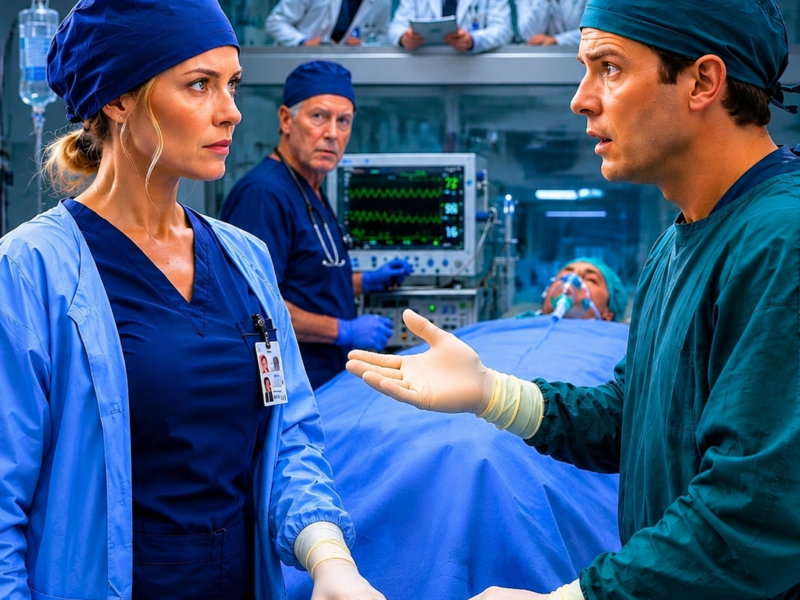
During a Life-or-Death Brain Surgery, I Watched My Brilliant Neurosurgeon Reach for the Wrong Instrument—and When I Refused His Order, He Snapped, “You’re Just a Scrub Nurse. You Don’t Know What You’re Talking About.” I Looked Him in the Eyes and Whispered, “I Helped Write That Classified Procedure 11 Years Ago.” Suddenly, the Man Who Had Ignored Me for Six Years Went Completely Silent, and Everyone in the Operating Room Realized Something Wasn’t Right…
During a Life-or-Death Brain Surgery, I Watched My Brilliant Neurosurgeon Reach for the Wrong Instrument—and When I Refused His Order, He Snapped, “You’re Just a Scrub Nurse. You Don’t Know What You’re Talking About.” I Looked Him in the Eyes and Whispered, “I Helped Write That Classified Procedure 11 Years Ago.” Suddenly, the Man Who Had Ignored Me for Six Years Went Completely Silent, and Everyone in the Operating Room Realized Something Wasn’t Right…
PART 1
“That procedure is classified. You’re a scrub nurse. Give me the clip.”
Dr. Nolan Mercer’s voice cut through the operating room like a blade.
Claire Vanden didn’t move.
Blood was spreading across the surgical field. The delicate artery near the base of the patient’s brain was tearing open, and every second that passed brought the man on the operating table closer to death. Monitors were sounding. The anesthesiologist was calling out rapidly changing blood pressure readings. Above the operating room, several surgeons and medical residents watched through the observation glass, unaware that the most important decision of the entire procedure was about to come from the quietest person in the room.
Mercer extended his hand again.
“The permanent clip. Now.”
Claire looked at his hand, then at the temporary micro shunt waiting on her instrument tray.
“Temporary shunt first,” she said.
Mercer turned toward her, his expression tightening.
“I gave you an order.”
“If you occlude the vessel before pressure equalization, the proximal pressure will spike. The tissue won’t survive.”
For a moment, nobody moved.
Then Mercer spoke again, his voice low and dangerous.
“That procedure is classified. You’re a scrub nurse. You don’t know what you’re talking about.”
Claire finally looked directly into his eyes.
“I helped write it.”
And suddenly, the surgeon who had spent six years treating her like another piece of operating room equipment had absolutely no idea who was standing in front of him.
But to understand why those six words changed everything, you have to understand who Claire Vanden had been before she became the woman nobody noticed.
Mercy Ridge Medical Center had built its reputation through something far less glamorous than publicity. It had earned trust through consistency. Patients came because their doctors recommended it, surgeons stayed because the operating rooms worked, and families returned because the people inside the building understood that medicine was not about appearances. It was about getting people home alive.
The surgical suites on the fourth floor reflected that philosophy. Everything had its place. Instruments were prepared in a particular order, conversations were brief, and every member of the team understood that even the smallest mistake could become something irreversible.
Claire had worked there for nine years.
At forty-six, she was one of the most experienced scrub nurses on the fourth floor. She arrived early, usually before the first surgeons and sometimes before the cleaning staff had finished preparing the corridors. Her instruments were arranged with almost mathematical precision. She remembered surgeons’ preferences, anticipated unusual requirements, and rarely needed to be told twice.
She wasn’t particularly social. She didn’t participate in hospital gossip or discuss her personal life during breaks. Her colleagues knew almost nothing about her past. They knew she had been married once, although she never mentioned it, and that she had a father who lived somewhere near Boston. Beyond that, her history was largely a blank.
Her personnel file was equally ordinary.
Nursing credentials, employment history, professional references, and years of reliable service. Nothing suggested that Claire had once worked on a government research program whose existence was unknown to most medical professionals.
Eleven years earlier, before joining Mercy Ridge, Claire had been part of a specialized research team in Bethesda.
Her official title was senior clinical systems specialist. It was deliberately broad because the work she performed was unusually sensitive.
The program focused on catastrophic vascular injuries, particularly those involving damaged arteries that continued to supply blood to vital organs even as the vessels themselves began to fail. Military surgeons had encountered these injuries in situations where conventional repair methods frequently resulted in death.
The research team was trying to solve a problem that conventional surgical training could not fully address.
Claire wasn’t a surgeon. She had never wanted to become one. But she possessed an extraordinary understanding of hemodynamics, the relationship between blood flow, pressure, damaged tissue, and the mechanical forces acting inside the human body.
She developed models that predicted how compromised vessels would respond to different surgical interventions. She identified situations where standard clipping techniques could create pressure changes severe enough to destroy tissue that surgeons were attempting to save.
Her most important contribution involved calculating the exact sequence required to stabilize certain catastrophic vascular injuries.
A temporary diversion had to be established first. Pressure had to equalize across the damaged region. Only after the system reached a specific threshold could a permanent clip safely isolate the affected vessel.
The timing was critical.
A few seconds too early could create a sudden pressure surge. A few seconds too late could allow the damage to become irreversible.
The protocol eventually became known as Veyron Pike, named after two of the senior researchers who first developed its theoretical framework.
Malcolm Veyron and Roland Pike had designed the original concept. Claire had helped transform it into a working procedure.
She conducted more than four hundred simulations, tested variable pressure profiles, and established the twelve-second equalization window that became one of the protocol’s most important safeguards.
Twelve seconds was not an estimate.
It was the minimum period required for the relevant pressure systems to reach a stable relationship under the conditions defined by the model.
Claire had documented the calculations herself.
Then her father suffered a devastating stroke.
He lost most of his speech and significant mobility on one side of his body. Claire returned to Boston, arranged his rehabilitation, and began reconsidering the direction of her life.
The research program had offered prestige, security, and opportunities that most medical specialists could only imagine. But it also demanded constant institutional involvement, long periods away from home, and a life organized around work that rarely allowed room for anything else.
Claire wanted something different.
She wanted to work directly with patients. She wanted to be present when someone woke up after surgery, when families received good news, and when a frightened person discovered that their life was not over.
Nursing offered that possibility.
So she stepped away from Bethesda, allowed her previous professional identity to disappear into classified records, and accepted a position at Mercy Ridge.
She never expected to use the Veyron Pike protocol again.
For years, she didn’t.
Then Nolan Mercer arrived.
Mercer was thirty-seven when he joined Mercy Ridge, three years after Claire. He had completed an elite neurosurgery fellowship in Philadelphia and quickly developed a reputation as one of the most technically gifted young surgeons in the region.
His hands were remarkably steady. His surgical movements were precise, economical, and confident. He could navigate difficult tissue planes that other surgeons approached cautiously, and his complication rates were low enough to attract interest from larger hospitals.
People admired him.
Some residents even treated his presence as an opportunity to witness the future of neurosurgery.
Unfortunately, Mercer had begun confusing exceptional technical ability with exceptional judgment.
He disliked interruptions, unnecessary questions, and suggestions from people he believed were outside the primary decision-making structure.
In his operating rooms, authority flowed in one direction.
He made decisions. Everyone else executed them.
He knew Claire existed, of course. He knew she was reliable, efficient, and unusually good at anticipating instruments. But he had never considered that her knowledge might extend beyond the responsibilities assigned to her position.
Once, after watching her quietly correct a junior resident’s instrument count, he had offered what he considered a compliment.
“You anticipate instruments,” he told her. “I make decisions.”
Claire had simply nodded.
Mercer interpreted her silence as agreement.
He had no idea that the woman standing beside his instrument tray understood certain surgical calculations better than he did.
Everything changed on a Tuesday morning in early autumn.
An ambulance brought Daniel Keane to Mercy Ridge after he collapsed at a construction site.
Daniel was forty-three, a civil engineer, and the father of two daughters. He had been reviewing drainage plans for a highway expansion when an explosive headache struck without warning.
He had been speaking to his older daughter’s school when it happened. The phone fell from his hand, and within minutes he was struggling to remain conscious.
The emergency imaging revealed a complex basilar artery aneurysm located deep near the brain stem. Worse, the aneurysm was already leaking.
The basilar artery supplied blood to structures responsible for consciousness, breathing, and essential neurological functions. An injury in that location could become fatal within minutes.
Conventional clipping was considered too dangerous because reaching the aneurysm would require passing through delicate structures that could not tolerate the necessary manipulation.
An endovascular approach was also unsuitable. The aneurysm’s irregular shape and unusually wide neck made conventional coiling unreliable.
The remaining options were limited.
Dr. Mercer reviewed the scans for several minutes before calling a surgical conference.
He studied the images, explained the anatomical challenges, and finally announced his proposed approach.
“The Veyron Pike temporary flow diversion protocol.”
Several residents looked up.
A vascular fellow from Massachusetts General Hospital leaned forward.
Mercer continued.
“It was developed for catastrophic posterior circulation aneurysms where conventional access has failed. This is exactly the presentation it was designed to address.”
The residents nodded.
Dr. Owen Reik, the attending anesthesiologist, requested time to review the hemodynamic parameters.
Claire stood near the back wall, where scrub nurses usually positioned themselves during case conferences.
When she heard the name Veyron Pike, her expression changed.
She recognized the protocol immediately.
She also recognized something else.
Mercer knew what the procedure was supposed to accomplish, but she suspected he didn’t understand every condition required to make it work safely.
She considered raising an objection before the operation.
But Daniel’s aneurysm was already leaking. Delaying surgery could be fatal, and a formal challenge from a scrub nurse would almost certainly trigger an administrative process rather than an immediate clinical discussion.
She had another option.
She could prepare the room, watch every step, and intervene only if the procedure moved toward a dangerous sequence.
Claire understood what that decision might cost her.
She made it anyway.
PART 2
At 5:45 the following morning, Claire entered surgical suite four and began preparing the instruments.
She placed the temporary micro shunt at the front of the tray, exactly where she could reach it without hesitation.
The surgery began at 7:23.
For nearly two hours, Mercer was magnificent. His movements were precise, his exposure technique was excellent, and the observation gallery watched with growing admiration.
Then the aneurysm shifted.
A thin line of blood appeared across the surgical field, followed almost immediately by another.
“Pressure is falling,” Reik announced.
Mercer extended his hand.
“Activating Veyron Pike. Permanent clip.”
Claire looked at his palm.
He wasn’t reaching for the temporary shunt.
He was reaching for the instrument that could kill Daniel if used too early.
“Temporary shunt first,” she said.
Mercer didn’t turn around.
“Give me the clip.”
“If you close the vessel before pressure equalization, you’ll create a pressure surge.”
His voice hardened.
“That procedure is classified. You’re a scrub nurse. You don’t know what you’re talking about.”
Claire met his eyes.
“I helped write it.”
The operating room fell silent.
PART 3
For several seconds, Nolan Mercer simply stared at Claire.
The monitors continued sounding. Blood continued spreading across the surgical field. Dr. Reik was watching the pressure readings, and the circulating nurse had stopped moving altogether.
Above them, the observation gallery had become completely still.
Mercer had expected resistance from a frightened resident or perhaps a cautious anesthesiologist. He had not expected the woman who had spent six years handing him instruments without offering an opinion.
“What did you just say?” he asked.
“I helped develop the Veyron Pike protocol.”
Mercer looked at her as though he were trying to determine whether she had lost her mind.
“That isn’t possible.”
“It’s documented.”
“You’re a scrub nurse.”
“I know what my position is.”
“Then you should understand that this isn’t the time to make claims you can’t support.”
Claire glanced briefly at the surgical field.
Daniel Keane’s condition was deteriorating. She could see the changing behavior of the damaged vessel, the way the bleeding had begun to accelerate, and the subtle pressure variations that told her the window for intervention was narrowing.
She had no interest in winning an argument.
“Dr. Mercer, the shunt goes in first. Twelve seconds of equalization. Then the permanent clip.”
Mercer turned toward Reik.
“What’s the pressure?”
Reik read the monitor.
“Still falling.”
“How quickly?”
“Faster than thirty seconds ago.”
Mercer looked back at Claire.
“You’re telling me that the protocol requires a twelve-second delay before clipping?”
“I’m telling you the protocol requires twelve seconds of pressure equalization after temporary flow diversion. The clip comes afterward.”
“I reviewed the procedure.”
“You reviewed a briefing.”
His expression changed.
It was a small change, but everyone close enough to see him recognized it. For the first time that morning, Mercer looked uncertain.
Claire continued.
“The equalization threshold was calculated through more than four hundred simulations. We tested variable pressure profiles, different degrees of vessel compromise, and several possible sequences. The twelve-second window was the minimum interval that consistently produced a survivable pressure relationship under the defined conditions.”
Mercer stared at her.
“And you’re saying the permanent clip before that interval would be fatal?”
“Yes.”
“Based on what?”
“Based on the calculations I performed.”
Reik interrupted.
“We need to make a decision now.”
His voice had become sharper. The patient’s blood pressure was still falling, and the bleeding was becoming increasingly difficult to control.
Mercer looked toward the instrument tray.
Claire didn’t wait for him to ask again.
She lifted the temporary micro shunt and placed it in his hand.
“Use it.”
Something in her tone was different now. It wasn’t disrespectful, but it carried the certainty of someone who understood exactly what the next action needed to accomplish.
Mercer accepted the instrument.
His hands were still steady.
Whatever doubts were forming in his mind had not reached his fingers. He positioned the shunt carefully, adjusted its angle, and established temporary diversion around the damaged section.
The placement was clean.
“Hold,” Claire said.
Mercer stopped.
Reik called out another reading.
“Pressure is still falling, but the rate has slowed.”
Claire watched the monitors.
The shunt was doing what it had been designed to do. It was redirecting flow around the compromised area, reducing the immediate stress on the damaged segment and allowing the pressure systems on either side to approach a more stable relationship.
The next twelve seconds would determine whether the permanent repair could be completed safely.
Eight seconds passed.
Mercer shifted his shoulders.
His right hand began moving toward the permanent clip tray.
“Not yet,” Claire said.
He stopped.
The gallery remained silent.
Nobody had ever seen Mercer wait for a scrub nurse’s instruction. Nobody had ever seen Claire take control of a surgical sequence while an attending surgeon stood at the table.
But the patient was still alive, and the numbers were still moving.
Nine seconds.
Ten.
Eleven.
Claire watched the pressure readings converge.
Then, at the exact threshold, she reached for the permanent clip.
“Now.”
She placed it in Mercer’s hand.
He positioned it with extraordinary precision. Four seconds after receiving the instrument, he confirmed that the clip was seated correctly.
The bleeding stopped.
The damaged aneurysm was isolated from the circulation, and Daniel’s blood pressure began returning toward a range Reik could manage.
The anesthesiologist read the new numbers aloud.
For the first time in several minutes, the room seemed to breathe again.
Mercer looked down at the surgical field.
The repair had held.
Daniel Keane was going to survive the operation.
But the surgeon said nothing.
Neither did Claire.
The remaining stages of the procedure continued without incident. Mercer completed the closure, and the team performed the final instrument count.
When the patient was transferred toward intensive care, the observation gallery began emptying.
The visiting vascular fellow from Massachusetts General Hospital remained near the glass for a moment longer than the others. He had witnessed an unusual surgical event, but he wasn’t entirely sure how to interpret what he had seen.
A scrub nurse had corrected an attending surgeon during an experimental procedure.
The surgeon had listened.
And a man who had been moments away from dying had survived.
By the time the final instrument count was complete, Dr. Everett Sloan, Mercy Ridge’s chief of surgery, had already been informed.
Sloan had occupied the position for eleven years. He understood the hospital’s culture, its procedures, and the delicate balance between individual expertise and institutional authority.
He had also learned that unusual operating room incidents rarely remained isolated.
Three residents and an outside fellow had witnessed what happened. Their accounts were already circulating through the department.
Sloan scheduled a meeting for four that afternoon.
Claire arrived first.
She carried a thin folder containing the documentation she had prepared after the operation. Her expression was calm, but she knew the meeting would not be easy.
Mercer arrived two minutes later.
He looked exhausted, although he had not said a word to anyone about the procedure.
Reik entered last and closed the door.
Sloan looked at the three of them.
Then he turned toward Claire.
“You refused a direct instrument request from the attending surgeon.”
“Yes.”
“You issued verbal directives during an active procedure without being asked.”
“Yes.”
“Do you understand what you did?”
Claire met his eyes.
“I understand exactly what I did.”
Sloan paused.
“Were you aware that the protocol being performed was classified?”
“Yes.”
“Were you authorized to intervene?”
Claire considered the question.
“Under ordinary circumstances, I would have raised my concerns through the appropriate channels before the procedure. But the patient was actively deteriorating. There wasn’t time to wait for an administrative review.”
Sloan didn’t immediately respond.
He turned toward Mercer.
“Were you certified to perform Veyron Pike?”
Mercer looked down at the table briefly.
“No.”
“Had you completed supervised application training?”
“No. I received a confidential briefing during my fellowship.”
“Then what led you to select the procedure?”
“Based on the imaging and the available treatment options, I believed it was the best approach.”
“That wasn’t my question.”
Mercer raised his eyes.
“I believed I understood the sequence.”
Reik finally spoke.
“You understood the general sequence. But you were moving toward permanent occlusion before the required equalization interval. Claire stopped you.”
Sloan looked at him.
“Are you certain?”
“Yes.”
“Could the sequence have been adjusted?”
“No,” Reik answered. “Not under those conditions.”
The room became quiet.
Sloan turned back to Claire.
“How did you know the precise timing?”
She opened her folder and removed a single document.
It was a supplementary development record from the original Veyron Pike research program.
She placed it in front of Sloan.
At the top of the page was her name.
Claire Vanden.
Clinical Hemodynamics Specialist.
Below it were the details of her contribution to the protocol, including the pressure sequencing model and the calculations establishing the twelve-second equalization window.
Sloan read the page twice.
Mercer leaned forward.
For six years, he had worked alongside this woman. He had watched her prepare instruments, correct small mistakes, and anticipate his movements. He had assumed her quietness reflected the limits of her position.
Now he was looking at documentation proving that she had helped engineer the procedure he had nearly performed incorrectly.
The woman he had treated as an extension of his instrument tray had understood the most dangerous part of his operation better than he did.
“How long have you had this documentation?” Sloan asked.
“Since I left the program.”
“And you never disclosed it?”
“I didn’t believe it was relevant to my position here.”
Sloan leaned back.
“Apparently, it was.”
He studied the document again, then looked at Mercer.
“Your surgical schedule will be suspended pending a formal review. We will determine what training and authorization are required before you can perform another non-standard procedure.”
Mercer nodded.
Sloan turned toward Claire.
“You will receive a formal written warning for failing to follow operating room protocol regarding instrument disputes and issuing directives outside your assigned role.”
Reik looked uncomfortable.
“She prevented a fatality.”
“I am aware of that,” Sloan replied.
“Then surely that should matter.”
“It does matter. But we cannot build a surgical department around the assumption that anyone who believes they know better can disregard established procedures. There must be a reliable way to raise concerns, and those concerns must be evaluated appropriately.”
Claire listened without interrupting.
She understood the institutional argument, even if she disagreed with the way it was being applied.
Sloan continued.
“You made a decision under extraordinary circumstances. The outcome was good. But the hospital still has to examine the process.”
Claire nodded.
“I understand.”
Mercer picked up his copy of the meeting summary.
He looked as though he wanted to say something, but he didn’t.
He left first.
Claire remained seated for another moment before gathering her folder and walking into the corridor.
The hospital continued operating around her.
Patients arrived. Nurses changed shifts. Families waited for updates. Somewhere on the sixth floor, Daniel Keane was beginning the long process of recovering from an operation he might not have survived.
Claire returned to work the following morning.
She did not tell anyone what had happened.
She simply checked the instruments, prepared the next surgical suite, and continued doing the work she had chosen to do.
But the suspension had given Nolan Mercer something he had never voluntarily allowed himself.
Time.
And for the first time in his career, he had no operating room in which to hide from his own decisions.
PART 4
The first two days of Mercer’s suspension were filled with activity.
He reviewed medical literature, prepared written responses for the hospital committee, and reorganized several research files he had neglected during his busy surgical schedule.
He went to the gym earlier than usual and stayed longer than necessary.
He answered emails immediately.
He attended meetings that could easily have been handled by someone else.
From the outside, he appeared productive.
Inside, however, something was bothering him that had nothing to do with the investigation.
He kept thinking about Claire.
Not the version of Claire he had known for six years, the quiet nurse who anticipated instruments and never challenged his decisions.
He was thinking about the woman who had stood across from him during the operation and refused to give him what he demanded.
On the third day, he requested access to the operating room footage.
The hospital maintained recordings for selected surgical reviews, particularly when unusual procedures or safety incidents occurred. Mercer was given permission to view the relevant footage in one of the department’s small review offices.
He closed the door, sat down, and began watching.
For the first hour and forty minutes, he examined his own performance with professional detachment.
His technique was good.
He had known it was good while performing the operation, and the recording confirmed that assessment. His exposure was clean, his instrument movements were efficient, and he had avoided unnecessary tissue damage.
He had every reason to be confident about that portion of the procedure.
Then the aneurysm shifted.
Mercer watched the blood appear.
He watched Reik call out the falling pressure.
And then he watched himself extend his hand.
The permanent clip.
He paused the footage.
There was his hand, extended toward the tray, fingers slightly spread in the familiar posture of a surgeon waiting for an instrument.
He knew exactly what he had intended to do.
He resumed the recording.
Claire’s hand was already resting near the temporary shunt.
She saw what he was reaching for before he had even spoken.
She did not move.
Mercer watched the two seconds between his gesture and his request.
He watched Claire make a decision that would almost certainly cost her professionally.
Then he heard his own voice.
“That procedure is classified. You’re a scrub nurse. You don’t know what you’re talking about.”
He stopped the footage again.
For a long time, he stared at the screen.
He had remembered saying those words, but he had not remembered how they sounded from outside himself.
There was something deeply uncomfortable about watching a recording of your own certainty when you now understood that certainty had been misplaced.
He continued.
“I helped write it,” Claire said.
Mercer watched himself freeze.
He watched the expression on his face change as the information reached him.
Then he watched the sequence.
Shunt.
Hold.
Twelve seconds.
Clip.
The bleeding stopped.
Daniel’s pressure recovered.
The patient survived.
Mercer leaned back.
The question he had been avoiding finally presented itself.
If Claire hadn’t been there, would he have stopped?
Would he have recognized that the briefing he had received during fellowship was not equivalent to the training required to perform the procedure safely?
Would he have remembered the importance of the equalization interval while blood was filling the surgical field and the observation gallery was watching his every movement?
He replayed the moment.
He knew the answer.
No.
He would have placed the permanent clip.
He was almost certain of it.
The pressure surge would have followed, and the damaged tissue would not have survived.
Daniel Keane would have died on the operating table.
And Mercer would have spent the rest of his career knowing exactly what had happened, understanding every technical detail of his mistake, and being unable to change the outcome.
He had been good enough to recognize how close he had come.
That was what made it difficult to move on.
Meanwhile, Daniel Keane was recovering faster than expected.
Four days after surgery, he was transferred from intensive care to a step-down room on the sixth floor.
His neurological assessments were encouraging. His doctors described his condition as close to a best-case outcome, an especially meaningful description for a patient who had suffered a catastrophic basilar artery aneurysm.
His wife visited every morning.
On the second morning after the transfer, Daniel recognized her immediately.
He said her name, then asked about their daughters.
He remembered both girls and mentioned them in the order he always used when introducing them to people.
His left hand had recovered full motor function. His right hand was progressing more slowly, but the medical team was optimistic.
Claire heard about the transfer from the charge nurse.
“That’s good news,” she said.
Then she continued preparing for the next case.
During her lunch break, however, she took the elevator to the sixth floor.
She stopped outside Daniel’s room and looked through the narrow window in the door.
Inside, Daniel was sitting partially upright. His wife was beside him, holding a tablet. They were looking at something together, their heads leaning toward one another.
It was an ordinary scene.
That was what made it so powerful.
A man who had nearly died was looking at photographs with his wife. Somewhere on that screen were probably pictures of two little girls who had almost lost their father.
Claire watched for approximately ten seconds.
Then she returned to the fourth floor.
She didn’t tell anyone she had visited.
She didn’t need recognition.
She only needed to know that Daniel was still there.
On the seventh day of his suspension, Mercer went looking for Claire.
He knew she usually conducted supply inventories during quiet periods between scheduled procedures, and he found her in the sterile supply room on the fourth floor.
The room was empty.
Claire was checking the contents of an endoscopic supply cabinet, marking quantities on a tablet.
She noticed Mercer enter but continued working until she reached a natural stopping point.
Then she turned.
“Dr. Mercer.”
“Claire.”
He stood near the doorway for a moment.
There was no observation gallery here, no surgical team, and no patient waiting beneath his hands.
There was only a room filled with sealed medical packages and two people who had spent six years working together without ever having a meaningful conversation.
“I’ve been watching the footage,” Mercer said.
Claire waited.
“I know exactly what happened.”
He paused.
“And I know exactly what would have happened if you’d given me what I asked for.”
Claire placed the tablet on the counter.
Mercer continued.
“I knew enough to be dangerous. That’s a different thing from knowing enough to help someone.”
He sounded different.
Not defeated, exactly. More like someone who had finally reached a conclusion after spending several days trying to avoid it.
“I’ve spent a week asking myself whether there was a version of that operation where I would have stopped on my own. Whether I would have recognized that the briefing wasn’t enough.”
He looked at her.
“There wasn’t. I would have placed the clip.”
Claire didn’t respond immediately.
“Daniel Keane would have died,” Mercer continued. “And I would have believed I’d done everything correctly.”
He swallowed.
“You didn’t just prevent a technical mistake. You stopped me from becoming a surgeon who kills patients without ever understanding why. I needed to say that to you directly.”
Claire looked at him for several seconds.
Then she spoke.
“Being the surgeon doesn’t make you the smartest person in the room.”
Mercer lowered his eyes slightly.
“It makes you responsible for listening to everyone who might know something you don’t. That’s not a smaller version of authority. That’s what authority actually requires.”
She let the words settle.
“The information in the room has to matter more than the hierarchy in the room.”
Mercer nodded.
“I understand that now.”
“I hope you do.”
He took a breath.
“Why didn’t you tell anyone about your work in Bethesda?”
Claire considered the question.
“Because I didn’t come here to continue that life. My father needed me. I wanted to work with patients, not spend the rest of my career inside an institution. Nursing gave me that opportunity.”
“But you knew the protocol might be used.”
“I knew it existed. I didn’t expect to encounter it here.”
“Were you worried that I would make the wrong decision?”
Claire looked at him directly.
“I was worried that you understood the procedure’s purpose without understanding its limitations.”
Mercer accepted the distinction.
“You have a habit of deciding who is worth listening to,” she continued. “You don’t ask Reik what concerns him because you’ve already decided what needs to be done. You don’t ask the surgical tech about equipment configuration because you’ve already decided that the technical details belong to someone else.”
She spoke without anger.
That somehow made it more difficult for Mercer to dismiss what she was saying.
“You’ve been using other people’s size to confirm your own,” she added. “You don’t have to do that.”
He looked at her.
“You’re an extraordinarily talented surgeon. Nobody is questioning that. But if you want to become great in the way that actually lasts, stop needing everyone else to be smaller.”
For a long moment, Mercer said nothing.
Then he finally spoke.
“I’m sorry.”
Claire waited.
“For what I said in the operating room. And for six years of treating you like a function in the room instead of a person.”
She nodded once.
She didn’t tell him it was fine.
It hadn’t been fine.
And they were both capable of understanding that without her having to explain it.
But she accepted the apology.
For Mercer, that conversation became the beginning of something he had not expected to discover during a professional suspension.
He began to understand that the best surgeons were not necessarily the ones who could perform the most difficult operations alone.
They were the ones who could recognize the knowledge surrounding them and use it before a mistake became irreversible.
Six weeks after Daniel’s surgery, the hospital review committee reached its conclusion.
Mercer was cleared to return to surgical practice under a structured reintegration plan.
He would perform supervised cases for ninety days, complete formal credentialing for non-standard procedures, and consult the patient safety office before attempting any operation involving experimental techniques.
He accepted every condition.
There was no appeal.
No attempt to use his reputation to avoid the requirements.
For the first time in years, he understood that being exceptional did not exempt him from learning.
PART 5
On his first morning back, Mercer arrived at the surgical suite at 6:45.
He stood in front of the assignment board and read every name.
It was a small gesture, almost meaningless to anyone who didn’t know him. But the people who had worked with him for years noticed the difference immediately.
Before the first operation, he approached Dr. Reik.
“I wanted to ask about the anesthetic plan. What concerns do you have?”
Reik looked at him for a moment.
It was not a hostile expression. It was the look of someone trying to determine whether a familiar person had genuinely changed or was simply behaving differently because he was being watched.
Then Reik answered.
He explained the pressure considerations, the patient’s medical history, and the adjustments he believed would reduce risk during the procedure.
Mercer listened.
He asked two questions, considered the answers, and incorporated Reik’s recommendations into the plan.
Later, he approached the surgical technician assigned to the second case.
“Have you considered a different backup instrument configuration?”
The technician described an arrangement that Mercer had not previously used.
Mercer examined it and recognized that two elements would make the procedure more efficient.
“Let’s use that,” he said.
He didn’t make a speech about teamwork.
He simply accepted a better idea.
Before the third case, a complex posterior fossa procedure, Mercer stood beside the operating table and reviewed the instruments.
Claire was at the tray.
Her movements were as precise as ever. She checked the primary instruments, verified the secondary set, and positioned several items according to the approach she expected Mercer to take.
He looked across the room.
“Anything I’m missing?”
Claire reviewed the tray.
She checked the instruments against the surgical plan and considered the areas where the procedure might require an adjustment.
“Not yet,” she said.
Mercer nodded.
“Then tell me when I do.”
Claire handed him the scalpel.
He accepted it.
The procedure began.
Above them, two residents watched from the observation gallery.
One was a first-year resident who had heard about the Veyron Pike incident through department discussions. She had not been present during the original operation, but she had watched the recording as part of her surgical safety training.
She leaned toward the second-year resident standing beside her.
“Is that the same surgeon?”
“Yes.”
“He seems different.”
The second-year resident looked down.
Below them, Mercer was speaking quietly with Reik. Claire was preparing the next instrument, while the surgical technician checked the equipment configuration.
Nobody was competing for attention.
Nobody was trying to demonstrate that their role mattered more than someone else’s.
They were simply working.
The first-year resident watched for another minute.
Then she understood something she had not fully appreciated during her training.
An operating room wasn’t supposed to be a place where one person knew everything and everyone else followed instructions.
It was a place where different kinds of expertise came together around a single responsibility.
The surgeon had the responsibility of making decisions.
The anesthesiologist understood the patient’s physiological stability.
The nurses understood the instruments, the sequence, the sterile environment, and the practical realities of what was happening around the table.
The technicians understood equipment in ways that even experienced surgeons sometimes overlooked.
Each person held information that could become essential at the right moment.
And the person with the most authority was not necessarily the person with the most complete understanding of every problem.
Mercer learned that lesson slowly.
Over the following months, he continued his supervised cases. He became more deliberate about asking questions before operations, more willing to discuss uncertainty, and more careful about distinguishing familiarity with a technique from genuine competency.
He did not become a less confident surgeon.
He became a more thoughtful one.
His hands remained extraordinary.
His technical ability remained among the best in the department.
But he stopped treating disagreement as a challenge to his authority.
One afternoon, several months after the operation, Daniel Keane returned to Mercy Ridge for a follow-up appointment.
He walked into the neurological clinic with his wife beside him.
His recovery had continued to exceed expectations. He still experienced occasional fatigue, and his right hand required additional rehabilitation, but he had returned to many of his ordinary activities.
His daughters were doing well.
His wife told the nurse that the girls had become convinced their father was invincible.
Daniel laughed when he heard that.
“I’m going to have to disappoint them eventually,” he said.
The nurse smiled.
During the appointment, Daniel asked whether he could meet the surgeon who had operated on him.
Mercer was informed of the request.
He agreed.
When he entered the examination room, Daniel stood carefully and extended his hand.
“Doctor,” he said. “I wanted to thank you.”
Mercer shook his hand.
Daniel continued.
“My wife told me how serious things were. She said there was a point when they weren’t sure I’d make it.”
Mercer glanced briefly at his wife.
“Your recovery has been excellent.”
“I know. And I’m grateful.”
Daniel paused.
“Apparently, there were several people who worked very hard to get me here.”
Mercer understood what he meant.
“Yes,” he said. “There were.”
He thought about Claire.
He thought about the twelve seconds that had separated a successful operation from a fatal mistake.
He thought about the woman who had placed the temporary shunt in his hand when he was too certain to recognize what he needed.
“Your surgical team was exceptional,” he added.
Daniel nodded.
“I’d like to thank them.”
Mercer told him he would pass along the message.
Later that afternoon, he found Claire preparing a room for another case.
“Daniel Keane came back today,” he said.
She looked up.
“How is he?”
“Doing very well. He’s recovering faster than expected.”
“That’s good.”
“He wanted to thank the people who worked on him.”
Claire smiled faintly.
“Then tell him we’re glad he’s doing well.”
Mercer studied her for a moment.
“You know, I never asked you why you stayed.”
“Stayed where?”
“Here. After everything that happened. You could have left.”
Claire returned her attention to the instrument tray.
“I like the work.”
“Even after the warning?”
“Especially after the work.”
He smiled slightly.
Then he asked something that had been on his mind for weeks.
“Would you consider helping us review the training material for Veyron Pike? The committee wants to make sure anyone who may encounter the protocol understands the limitations. Your contribution would be invaluable.”
Claire paused.
For years, she had deliberately kept that part of her life separate from her work at Mercy Ridge.
She had not wanted to return to the institutional world she had left behind.
But this was different.
The protocol existed. Surgeons might encounter it again. And if a person could prevent someone else from making the same mistake Mercer had nearly made, perhaps the knowledge deserved a place where it could be used safely.
“I’ll review the proposal,” she said.
Mercer nodded.
“Thank you.”
He started to leave.
“Dr. Mercer?”
He turned.
“Make sure the training includes the failure conditions, not just the procedure itself.”
He smiled.
“I will.”
Then he left.
Claire continued arranging the instruments.
Nothing about her appearance suggested that she had once helped develop a classified military surgical protocol. She wore the same scrubs, carried the same tablet, and worked with the same quiet precision she had demonstrated for years.
But something had changed.
People had begun asking questions.
Residents who previously looked only toward the attending surgeon now watched the entire team. Surgical technicians were invited to discuss equipment decisions before difficult procedures. Anesthesiologists were given more room to raise concerns without being interrupted.
And Claire was no longer invisible.
Not because she demanded recognition, but because people had finally begun understanding that experience and expertise did not always announce themselves.
Some of the most valuable knowledge in a hospital came from people who never stood at the center of the room.
A few months later, a new resident asked Claire how she had known Mercer was reaching for the wrong instrument during the Veyron Pike operation.
Claire considered the question.
“Because I knew what he was about to do,” she answered.
“But how could you tell before he asked?”
She glanced toward the surgical table.
“People develop habits. If you pay attention long enough, you can recognize what someone is going to do before they do it.”
The resident nodded.
“Were you scared to challenge him?”
Claire looked at her.
“Yes.”
The answer surprised the young doctor.
“You were?”
“Of course.”
“But you still did it.”
Claire returned to her work.
“The patient needed someone to speak.”
The resident remained quiet for a moment.
Then she asked, “Do you think Dr. Mercer changed because of what happened?”
Claire considered that, too.
“I think he finally understood something he should have understood much earlier.”
“What?”
“That being responsible doesn’t mean being right about everything.”
The resident nodded slowly.
Claire placed the final instrument on the tray.
Then she added something she hoped the young doctor would remember long after she left Mercy Ridge.
“The most dangerous person in any room isn’t always the person who doesn’t know. Sometimes it’s the person who doesn’t know, but is absolutely certain that they do.”
Years earlier, Nolan Mercer had believed that his title made him the most important person in every operating room he entered.
He had believed that technical brilliance gave him the right to dismiss questions, that experience gave him the final word, and that people outside his specialty had little to contribute beyond carrying out his instructions.
Claire had never needed to defeat him.
She had never wanted his position, his reputation, or his recognition.
She had simply wanted Daniel Keane to survive.
And when the moment came, she chose the patient over her own professional security.
She knew she might be reprimanded. She knew her colleagues might question her judgment. She knew that refusing an attending surgeon in front of an observation gallery could permanently damage her career.
But she also knew that a twelve-second interval mattered more than any of those things.
Daniel Keane went home to his wife and daughters.
Mercer returned to surgery with a better understanding of what leadership required.
And Claire continued working at Mercy Ridge, quietly doing what she had always done: preparing the instruments, watching the room, anticipating problems, and making sure that every person around the operating table had what they needed to do their job safely.
She had helped write a procedure that could save lives.
But perhaps her greatest contribution had been something that couldn’t be measured in simulations or recorded in a classified development document.
She had reminded an extraordinarily talented surgeon that knowledge could come from anyone, that authority carried the responsibility to listen, and that the most important voice in a room was sometimes the one nobody had thought to hear.
Because in the end, a great surgeon isn’t simply someone whose hands never shake.
A great surgeon is someone who understands that the life beneath those hands is more important than the pride inside their own.
And sometimes, the person who saves that life isn’t the one standing at the head of the table.
Sometimes, it’s the quiet woman beside the instrument tray who knows exactly when to say no.