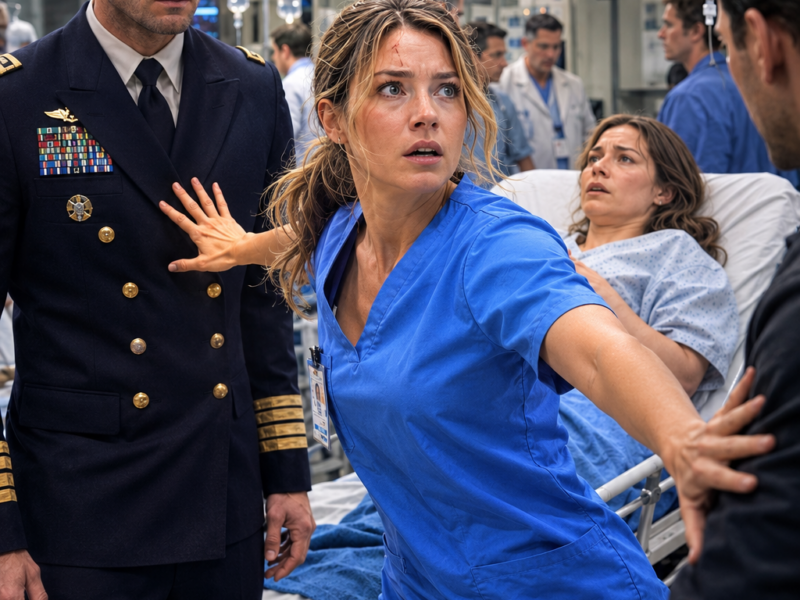
“Don’t Be Afraid… I’m Here,” the New Nurse Said — She Took a Bullet for the SEAL Admiral’s Sister
“Don’t Be Afraid… I’m Here,” the New Nurse Said — She Took a Bullet for the SEAL Admiral’s Sister
The first thing people noticed about Delaney Marsh was how little there seemed to be to notice. She was not particularly tall, did not speak loudly, and never seemed interested in attracting attention. Her faded blue scrubs hung loosely from her narrow shoulders, her dirty-blonde hair was usually pulled into a plain ponytail, and her gray-blue eyes rarely remained on anyone long enough to invite a personal question. At Tidewater Naval Medical Center, where military officers, experienced surgeons, and exhausted nurses moved through crowded corridors with the practiced urgency of people accustomed to important work, Delaney was simply the new nurse who sometimes took the wrong hallway, quietly corrected paperwork, and apologized even when she had done nothing wrong.
Nobody knew that she had spent years learning exactly how to become invisible.
Nobody knew that beneath her left sleeve was a faded tattoo containing coordinates that only eleven people had ever understood.
And nobody could have imagined that before the night was over, the same woman they barely noticed would stand between an assassin and the sister of a Navy admiral, take a bullet meant for someone else, and reveal a past that had been buried so carefully that even government databases seemed to have forgotten it existed.
On the morning everything changed, Delaney arrived at the hospital shortly before six. The corridors smelled of antiseptic, overbrewed coffee, and the faint sterile scent of freshly washed linen. Somewhere near the emergency department, a monitor beeped rhythmically. A tired orderly pushed a cart filled with medical supplies past the elevators, while two residents discussed a patient without looking up from their tablets.
It was an ordinary morning, which was precisely what Delaney wanted.
She had been working at Tidewater for three months. Three quiet months of early shifts, late-night charting, routine medication checks, and the comforting predictability of hospital life. She rented a small apartment fifteen minutes away, drove an aging sedan, and owned so little furniture that the living room still looked as though she had moved in the previous weekend.
She had deliberately built a life without complications.
That life was tested before she had even finished her first cup of coffee.
“Marsh!”
Dr. Preston Hail’s voice traveled across the nurses’ station with enough force to make two nearby conversations stop.
Delaney looked up.
Hail, Tidewater’s chief of surgery, stood several feet away with a tablet in his hand and an expression that suggested someone had personally insulted his professional standards. He was tall, immaculate, and accustomed to receiving immediate attention whenever he entered a room.
“The Callahan chart,” he said. “Room 214. Explain why the intake vitals are missing.”
Delaney already knew what had happened.
“The system divided the record into two entries during the overnight update, Doctor. I entered the vitals at 4:11. They’re under the second entry.”
Hail looked at his tablet.
Then he looked at her.
“I don’t have time to search through improperly maintained records because a nurse cannot manage basic documentation.”
Several people turned their heads.
Delaney kept her expression neutral.
“The information is there, sir. I’ll merge the entries.”
“That’s not the point.”
His voice rose.
“Do you understand what happens when medical personnel become careless? People die. Sloppiness is not something I tolerate in my department.”
The words hung in the air.
A young resident standing behind him lowered his eyes. An older woman waiting near the vending machines pretended to examine the buttons on the coffee dispenser.
Delaney felt the familiar weight of being watched.
For a brief moment, her fingers tightened against the counter.
Then they relaxed.
“I understand, Doctor.”
Hail gave a dissatisfied nod and walked away.
Delaney waited until the attention had shifted elsewhere before returning to the computer.
She opened the patient’s chart, corrected the system error, and completed the remaining documentation in less than two minutes.
Her pulse never changed.
It was not that she enjoyed being humiliated. She simply understood that there were battles worth fighting and battles that only wasted energy.
She had fought enough of the first kind to recognize the second.
Twenty minutes later, Priya Nair found her in the supply room.
Priya had been at Tidewater for six years, possessed an extraordinary talent for discovering gossip before anyone else, and treated Delaney’s reluctance to socialize as a personal challenge.
“Seven minutes and forty-two seconds,” Priya announced.
Delaney looked up from the shelves.
“What?”
“That little performance Hail gave you this morning. Seven minutes and forty-two seconds. I timed it.”
Despite herself, Delaney smiled.
“You timed him?”
“Of course. I’m collecting evidence for the day I finally prove that man’s ego requires its own hospital wing.”
Delaney returned a package of dressings to the correct shelf.
“He was frustrated.”
“He was being a bully.”
Priya crossed her arms.
“And you just stood there letting him do it. Again.”
“He’s the chief of surgery.”
“And you’re a human being.”
Delaney said nothing.
Priya studied her.
“You know what bothers me about you?”
“Only one thing?”
“That you’re never angry. Not really. You get blamed for things you didn’t do, people talk over you, and somehow you remain completely calm.”
“Maybe I have a peaceful personality.”
Priya laughed.
“No. I’ve met peaceful people. You’re different. Sometimes you look at the world like you’ve already seen the worst thing it can do.”
Delaney’s hand stopped moving.
Only for a fraction of a second.
Priya noticed.
But before she could ask another question, Delaney picked up a fresh box of bandages.
“I’d better finish my rounds.”
Priya sighed.
“Fine. Keep your mysterious past. But if Hail ever fires you, I’m organizing a mutiny.”
“I’ll keep that in mind.”
“And I’m serious.”
“I know.”
Delaney left the supply room with the smallest smile.
The smile disappeared when she reached the next corridor.
Priya had come closer to the truth than she realized.
There were nights when Delaney still woke to the sound of gunfire that did not exist. Sometimes she smelled burning rubber while standing in an empty kitchen. Other times, she found herself counting exits in restaurants or positioning her chair so she could see every entrance.
She had learned to sleep lightly, speak carefully, and never explain the scars on her hands.
Most people accepted the story about a kitchen accident.
Nobody asked why a kitchen accident had left marks resembling injuries from broken stone and shattered metal.
Nobody asked about the pale scar above her eyebrow.
And nobody asked why her hands became strangely steady whenever someone else was frightened.
Around nine that morning, she visited an eight-year-old boy named Milo.
He had arrived with a complicated wrist fracture after falling from playground equipment. His mother had spent the previous night beside his bed, and the boy was exhausted, frightened, and convinced that the splint on his arm would hurt forever.
Delaney approached quietly.
“Good morning, Milo.”
He looked at her suspiciously.
“Are you going to give me another needle?”
“Not unless somebody forgot to tell me something very important.”
His eyes widened.
“Did they?”
“No.”
He relaxed slightly.
Delaney crouched beside his bed.
“I heard something interesting about you.”
“What?”
“Apparently, you’ve got the bravest wrist in the entire hospital.”
Milo stared at his bandaged arm.
“It doesn’t feel brave.”
“That’s the funny thing about courage,” Delaney said. “It usually doesn’t feel very impressive while you’re doing it.”
He considered that.
“Were you ever scared?”
Delaney glanced toward the window.
For a second, she saw another room, another injured person, another pair of frightened eyes.
“Yes,” she answered.
“A lot?”
“More times than I can count.”
“What did you do?”
She looked back at him.
“I did the next thing that needed doing.”
Milo thought about that before nodding solemnly.
Delaney adjusted his blanket and checked the circulation in his fingers.
“Here’s a secret,” she added. “You can be scared and brave at the same time.”
“Really?”
“Absolutely.”
When she handed him a sticker shaped like a silver star, his face brightened.
He immediately placed it on the paw of the stuffed rabbit sitting beside his pillow.
“His name is Captain Carrots,” Milo explained.
“Sounds like a very important officer.”
“He’s in charge.”
“Then I’d better make a good impression.”
Milo laughed.
His mother, who had been watching silently, smiled with tired gratitude.
At the doorway, she gently touched Delaney’s arm.
“Thank you. He’s barely spoken to anyone since yesterday.”
Delaney glanced back at the boy, now explaining his medical condition to Captain Carrots with great seriousness.
“He just needed someone to listen.”
That was what she loved about nursing.
There was no mission briefing, no encrypted radio, no command structure that demanded absolute obedience.
There was simply someone who needed help.
And sometimes, for a few minutes, helping was enough.
By early afternoon, Tidewater had settled into its familiar rhythm.
Delaney stood near the medication station eating a granola bar when she noticed a black SUV on the security monitor.
It was parked near the visitor entrance.
The engine remained running.
Eleven minutes passed.
No one entered or exited.
Delaney watched without appearing to watch.
Then the vehicle pulled away.
She made a mental note.
A few minutes later, she noticed that a maintenance worker had left a service door propped open on an upper floor.
Another note.
Neither observation meant anything by itself.
But Delaney had learned that danger rarely announced itself through one dramatic sign. More often, it appeared as several small irregularities that only became obvious after something terrible happened.
At 2:47 p.m., the emergency radio crackled.
“Multiple gunshot wounds. Civilian female. Critical condition. Security escort inbound. Estimated arrival four minutes.”
The entire department changed.
Doctors hurried toward the trauma bays. Nurses prepared supplies. A resident nearly dropped a tray of instruments while trying to clear a treatment room.
Dr. Hail emerged from a consultation room, already pulling on gloves.
“Trauma Bay Two,” he ordered. “Prepare for immediate imaging and surgical assessment.”
Delaney moved toward the bay without being asked.
Something inside her had already shifted.
Her shoulders straightened.
Her breathing slowed.
Her mind began working through possibilities before the ambulance arrived.
At 2:51, the emergency doors burst open.
A gurney came through first, pushed by two paramedics shouting rapidly over the sound of alarms.
Behind them entered four men dressed in dark tactical clothing.
Their movements were disciplined, their eyes constantly searching the room.
The woman on the gurney was in her early forties. Her dark hair was damp with sweat, her face unnaturally pale, and blood soaked through the pressure dressing covering her lower abdomen.
“Grace Whitam, forty-one,” a paramedic reported. “Gunshot wound to the abdomen, secondary injury near the shoulder. Blood pressure falling. Significant blood loss.”
One of the security men spoke sharply.
“She’s Admiral James Whitam’s sister.”
That name changed several faces in the room.
Delaney barely registered it.
She was looking at the patient.
Grace’s breathing was shallow. Her lips were losing color. Her eyes struggled to focus.
“Blood pressure?” Delaney asked.
The paramedic gave the latest reading.
It was worse than she had hoped.
Hail stepped closer.
“We need a complete scan before we determine the extent of internal damage.”
Delaney looked at the blood spreading beneath the dressing.
There was no time.
She moved to Grace’s side.
“Ma’am, can you hear me?”
Grace’s eyelids fluttered.
“My… brother…”
“He’s going to hear from you,” Delaney said. “But right now I need you to listen to me.”
She applied firm pressure to the bleeding wound and called for blood products, additional assistance, and immediate surgical preparation.
“Marsh,” Hail snapped. “Step aside. You’re interfering with my assessment.”
Delaney did not move.
“Doctor, she is deteriorating. We need to control the bleeding and prepare her for surgery now.”
“I gave you an order.”
“And I’m telling you we are running out of time.”
The room fell into an uncomfortable silence.
Delaney’s voice had changed.
There was nothing uncertain about it. Nothing apologetic.
It was the voice of someone who had once given orders while bullets struck the ground around her.
“Priya, I need you on the shoulder wound. Owen, get the blood bank moving. Somebody notify the operating team that this patient cannot wait for a routine imaging sequence.”
People moved.
Not because she shouted.
Because her certainty made hesitation impossible.
Hail stared at her.
For a moment, he seemed unable to understand that the quiet nurse he had criticized that morning was directing the room.
Delaney leaned closer to Grace.
“Stay with me.”
Grace’s eyes found hers.
“I’m… scared.”
“I know.”
“Am I dying?”
Delaney felt something cold pass through her chest.
Another voice.
Another wounded body.
Another person asking a question she had once been unable to answer.
She pushed the memory away.
“Don’t be afraid,” she whispered. “I’m here. We’re not giving up on you.”
Grace’s fingers caught her sleeve.
Delaney held her gaze as the medical team worked.
The bleeding was controlled as much as possible for transport, emergency transfusion began, and within minutes the surgical team was ready.
Grace was still critically injured, but she had a chance.
And then, just as the gurney was being repositioned toward the operating corridor, Delaney noticed something through the narrow window beside the ambulance entrance.
A figure stood beyond the glass.
A man in dark clothing.
His posture was wrong.
His attention was fixed not on the chaos around him but on the woman lying helplessly on the gurney.
Delaney’s instincts reacted before her thoughts could form.
She saw his arm rise.
A flash of metal.
“DOWN!”
The command exploded from her throat.
She shoved Grace’s gurney farther from the doorway and threw herself across the exposed side of the patient.
A gunshot cracked through the entrance.
Glass shattered.
A sharp, violent impact struck Delaney high in the left shoulder.
For an instant, there was no pain.
Only the sensation of being hit by something enormous.
Her body twisted.
Blood sprayed across her blue scrubs.
Somebody screamed.
The security men reacted immediately, pulling their weapons and rushing toward cover as more shots sounded outside.
Delaney barely heard them.
She was still leaning over Grace.
Still shielding her.
Still pressing her functioning hand against the wound dressing.
“Move her!” she shouted. “Get her into surgery!”
Priya stared at her.
“Delaney, you’ve been shot!”
“I know.”
“Your shoulder—”
“Priya, move the patient!”
The urgency in her voice broke through everyone’s shock.
The gurney rolled.
Two nurses and a resident hurried Grace toward the secured operating corridor.
Only when the doors closed did Delaney allow herself to turn.
Her left arm felt heavy.
Warm blood ran beneath her sleeve.
She took one step, then another.
The floor seemed strangely distant.
Priya caught her before she fell.
“Don’t you dare,” Priya whispered.
Delaney tried to smile.
“I’m not planning on it.”
A security officer called that the shooter had fled.
Another shouted for hospital lockdown.
Dr. Hail approached, his face drained of color.
For the first time that day, he looked at Delaney without irritation.
“Get her into a treatment bay,” he ordered.
Delaney shook her head weakly.
“Grace first.”
“She’s already in surgery.”
“Good.”
Then her knees buckled.
The next several minutes came to Delaney in fragments.
A ceiling light passing overhead.
Priya’s voice.
Scissors cutting through her scrub sleeve.
A doctor saying that the bullet had passed through soft tissue near her shoulder without damaging the major blood vessels.
Someone asking whether she could move her fingers.
She could.
Someone asking her name.
She told them.
When she finally opened her eyes properly, she was lying on an examination bed with her shoulder bandaged and her left arm supported.
Priya sat beside her.
“You are,” Priya said slowly, “the most infuriating woman I have ever met.”
Delaney blinked.
“That’s a competitive category in this hospital.”
Priya gave a short, disbelieving laugh.
Then her eyes filled with tears.
“You took a bullet.”
“Yes.”
“For a woman you’d known about fifteen minutes.”
Delaney stared at the ceiling.
“She couldn’t move.”
“That doesn’t mean you had to become a human shield.”
Delaney turned her head.
For a moment, something old and exhausted showed through her expression.
“Yes,” she said quietly. “It did.”
Priya did not understand.
Not yet.
Outside the treatment room, the hospital was under heightened security. The shooter had escaped, and investigators believed the attack was targeted.
The four men who had arrived with Grace were reorganizing the protective detail.
Their leader approached Delaney’s room shortly after she was cleared to sit up.
He was broad-shouldered, with dark hair, a severe expression, and the unmistakable bearing of someone who had spent much of his adult life in dangerous places.
“I’m Knox,” he said.
Delaney studied him.
“Should I know you?”
“No, ma’am. But I’m beginning to think I should.”
She said nothing.
Knox glanced at her bandaged shoulder.
“The doctor says you’re lucky.”
“I’ve heard that.”
“Bullet missed anything important by a narrow margin.”
“Then I suppose he’s right.”
Knox pulled a chair closer.
“I’ve seen people react to gunfire before. Soldiers. Marines. Special operators. Most people duck. Some freeze. You recognized the threat before anyone else, moved the target, and took the impact without losing control of the medical situation.”
“Adrenaline.”
“That’s not what adrenaline looks like.”
Delaney held his gaze.
He leaned forward slightly.
“Where did you train?”
“Nursing school.”
“Before that?”
She looked away.
Knox noticed the faded mark near her wrist, just visible beneath the edge of her sleeve.
His expression changed.
Not dramatically.
But enough.
He recognized the style of the tattoo.
Coordinates.
Small.
Deliberately faded.
He had seen something similar only twice before.
Both times on personnel whose assignments were classified beyond his clearance.
“Interesting,” he murmured.
Delaney pulled her sleeve down.
“Is there something else you need?”
Knox stood.
“For now, no.”
At the doorway, he paused.
“Admiral Whitam’s sister is alive because of you.”
Delaney looked at the bandage on her shoulder.
“She still has to get through surgery.”
“She has a better chance because you were there.”
He studied her for another moment.
“Whoever sent that shooter may try again. My team will be staying.”
“Then check your service entrances,” Delaney said.
Knox stopped.
“Why?”
“Because anyone serious enough to attack a protected patient outside a naval hospital isn’t likely to walk back through the main entrance wearing the same face.”
A faint expression of respect crossed his features.
“Noted.”
After he left, Delaney closed her eyes.
She had spent two years trying to forget what it felt like to be useful in the middle of gunfire.
Now the memories were returning faster than she could stop them.
She saw another wounded man.
A ruined building.
Dust floating through sunlight.
Blood soaking into her gloves.
A voice calling her by a name nobody at Tidewater knew.
Wraith.
And then another voice, weaker.
“Tell my mother…”
Delaney opened her eyes sharply.
Her breathing had quickened.
She pressed her good hand against her sternum.
Bishop.
Even after all this time, his name could still destroy the quietest moment.
He had been her teammate.
Her friend.
The person who always saved the last packet of instant coffee for her because he knew she hated going without it.
He had been injured during an extraction operation that went catastrophically wrong.
She had reached him.
She had treated him.
She had done everything she had been trained to do.
And he had died anyway.
For years, Delaney had replayed the final minutes, searching for a decision she could have changed.
A different route.
A faster evacuation.
Another technique.
Some impossible adjustment that might have kept his heart beating long enough for help to arrive.
There had been no such adjustment.
But knowing that had never made the guilt easier to carry.
In a drawer at her apartment lay an unfinished letter addressed to Bishop’s mother.
Three years of attempts.
Three years without finding the right words.
She had promised herself she would finish it someday.
But someday had become a convenient place to hide things she was afraid to face.
By eight that evening, Grace had survived surgery and been transferred to a secured recovery room.
Delaney, despite objections from several nurses, insisted on walking to the corridor outside.
Her shoulder hurt with every step.
She stopped at the narrow window.
Grace lay pale against white pillows, an oxygen line beneath her nose.
When she saw Delaney, she lifted two fingers weakly from the blanket.
A small gesture.
Almost a salute.
Delaney returned it.
Neither woman spoke.
There was nothing that needed saying.
At 9:40 p.m., everything changed again.
A man in a gray suit approached the main reception desk.
He carried a leather folder and displayed identification identifying him as a federal liaison.
The young clerk behind the desk looked exhausted.
The stranger spoke with brisk authority.
“I’m here regarding Grace Whitam. I need her room number.”
Delaney was passing the reception area when she heard the name.
She slowed.
The man’s credentials looked plausible.
His suit was expensive.
His hair was neatly combed.
But there was something wrong about him.
He never looked at the clerk while speaking.
Instead, his eyes traveled toward the elevators, the security cameras, and the corridors beyond.
Delaney had seen that kind of attention before.
It belonged to people searching for obstacles.
Not answers.
She approached with a polite expression.
“Good evening. Can I help you?”
The man glanced at her badge.
“I’ve already explained what I need.”
“Of course. Which federal office sent you?”
“That’s confidential.”
“I understand. We still need to verify access before releasing patient information.”
His jaw tightened.
“I have authorization.”
“Then verification shouldn’t take long.”
The clerk looked between them nervously.
Delaney maintained her gentle smile.
“Can I have the case reference number?”
The stranger’s eyes narrowed.
“I don’t answer to nurses.”
Something behind Delaney’s expression went completely still.
She had heard that tone before.
Not from federal agents.
From men who believed authority came from frightening everyone around them.
She reached beneath the desk.
Her fingers found the security telephone.
“I’m sure we can clear everything up,” she said.
The man watched her hand.
For one brief second, their eyes met.
He knew.
She knew.
And both understood that the conversation was finished.
He turned toward the exit.
Delaney immediately activated the security alert.
“Possible hostile operative at main reception. Gray suit, male, approximately forty-five. Moving toward the ambulance entrance. Lock down the patient floors and notify the Whitam protection detail.”
She paused.
Then, without meaning to, she added one more sentence.
“Tell them Wraith says secure the exits.”
The word escaped before she could stop it.
Wraith.
A name she had not spoken aloud in years.
The security officer nearby looked at her.
Across the corridor, one of Knox’s men turned sharply.
Delaney felt her stomach tighten.
She had made a mistake.
Not a medical mistake.
A personal one.
She had opened a door to a past that was supposed to remain closed.
The lockdown alarms sounded moments later.
Heavy doors sealed.
Staff members moved patients away from windows.
Security teams rushed toward the lower floors.
Knox arrived at reception almost immediately.
“Say that name again.”
Delaney stared at him.
“What name?”
“Wraith.”
She hesitated.
“It’s just something I heard once.”
Knox looked at her bandaged shoulder.
Then at her hands.
Then at the tattoo concealed beneath her sleeve.
“I served alongside men who whispered that name like it belonged to a ghost,” he said quietly.
Delaney did not answer.
He stepped closer.
“Those stories were about a combat medic attached to a special operations team. Someone who could keep people alive in conditions where survival should have been impossible.”
“Stories become exaggerated.”
“Apparently.”
His radio crackled.
An armed intruder had breached a loading-dock entrance.
Another possible suspect was moving toward the radiology stairwell.
Knox’s expression hardened.
“We can discuss your history later. Right now, I need help.”
Delaney looked toward the elevators.
“How many patients are still on the upper floors?”
“Too many.”
“Then we need to move quickly.”
The transformation was immediate.
Delaney straightened fully.
Her quiet uncertainty vanished.
Pain still radiated through her injured shoulder, but her voice remained controlled.
“The service corridor below central supply connects to radiology. If they’re trying to avoid the elevators, that’s where they’ll go. Seal the stairwell above the second landing and keep civilians out of the western corridor.”
Knox relayed the information.
His men moved.
A woman in a gray blazer came hurrying down the hallway, holding two phones and looking furious.
Deborah Crane, the hospital’s vice president of patient affairs, stopped in front of them.
“Nurse Marsh, I’ve been informed that you issued unauthorized instructions over our security system.”
Delaney looked at her.
“There are armed men in the building.”
“I am aware of the situation. But we have procedures for exactly this kind of emergency.”
“Then your procedures need to get people away from the west stairwell.”
Crane’s expression tightened.
“You are already under medical observation because of your injury. You should not be participating in security decisions.”
Knox stepped between them.
“Ma’am, she’s helping us prevent further casualties.”
“This hospital has a chain of command.”
“And I have civilians in danger,” Knox replied. “We can discuss paperwork when they’re safe.”
Crane looked as though she wanted to argue.
Before she could, Priya appeared.
She was breathless.
“Delaney!”
Something in her voice made Delaney turn immediately.
“Milo,” Priya said.
Delaney froze.
“What about him?”
“His mother called the front desk. They were supposed to leave hours ago, but he needed another assessment. They got stuck upstairs when the lockdown started.”
“Where?”
“The pediatric family lounge.”
Delaney looked toward Knox.
“The western stairwell connects directly to that floor.”
Knox’s radio crackled again.
Another possible hostile sighting.
Delaney felt a familiar cold clarity settle over her thoughts.
An eight-year-old boy.
A terrified mother.
Armed men moving through a hospital.
She had seen what happened when innocent people became trapped between violence and an escape route.
She refused to watch it happen again.
“I need someone to get them out.”
Knox studied her.
“You’re injured.”
“Then send someone who isn’t.”
He spoke into his radio.
“Torres, report to the service stairwell. Escort Nurse Marsh to pediatrics and bring out the remaining civilians.”
Delaney was already moving.
Knox caught her arm gently.
“You don’t have to do this.”
She looked at him.
“Yes,” she said. “I do.”
The stairwell was dim and smelled of concrete dust.
Emergency lighting cast long shadows across the steps.
Torres, a compact, serious man wearing tactical equipment, followed Delaney as they climbed.
He glanced at her shoulder.
“Are you sure you’re cleared to run up stairs after getting shot?”
“I’m not running.”
“You’re moving faster than most people run.”
“Then you should probably keep up.”
Despite the circumstances, Torres almost laughed.
They reached the pediatric floor and entered through a service door.
The corridor was nearly silent.
Children’s drawings decorated the walls.
A cartoon whale smiled from a brightly painted mural beside the nurses’ station.
Somewhere behind a closed door, a child was crying softly.
The contrast between the cheerful decorations and the danger below made Delaney’s chest ache.
She found Milo and his mother inside the family lounge.
The boy sat pressed against his mother’s side, clutching Captain Carrots with his uninjured arm.
His face lit up when he saw her.
“Nurse Delaney?”
She crouched carefully, ignoring the pain in her shoulder.
“Hello, Captain.”
Milo looked at her bandage.
“Did you get hurt?”
“A little.”
“Does it hurt?”
“A little more than I’d like.”
His eyes filled with concern.
Delaney smiled.
“Nothing I can’t handle. But I need your help.”
“My help?”
“Remember what we talked about this morning?”
He nodded.
“Being brave.”
“Exactly. I need the bravest wrist in the building to help me get everyone downstairs.”
Milo swallowed.
“Are there bad people here?”
Delaney could have lied.
She chose not to.
“There are people who might hurt someone. But we’re going to be careful, and Mr. Torres is going to help us.”
Torres gave the boy a reassuring nod.
Milo hugged his rabbit.
“Okay.”
His mother stood, trembling.
“Thank God you came.”
Delaney guided them toward the door.
“Stay close. We’re going to use the other stairwell.”
They moved down the corridor.
Torres led.
Delaney remained behind the family, watching every doorway.
They were halfway to safety when a heavy door at the far end slammed open.
A man stepped into the hall.
Dark clothing.
Weapon in hand.
For one terrible instant, everything seemed to slow.
Torres shouted a warning.
The armed man raised his weapon.
Two gunshots shattered the silence.
Torres returned fire.
The attacker fell against the wall.
Milo screamed.
His mother pulled him against her chest.
Delaney pushed them behind a supply cart and crouched beside them.
“Look at me, Milo.”
The boy was sobbing.
“Look at me.”
His eyes found hers.
“You’re okay. Stay with your mom. Keep holding Captain Carrots.”
He nodded frantically.
Torres checked the corridor and radioed for assistance.
“One hostile down. Possible additional threat. Civilians moving toward east exit.”
Delaney heard footsteps somewhere beyond the distant doors.
They were not safe yet.
She looked at Milo’s mother.
“We have to move now.”
The woman nodded.
Delaney helped Milo stand.
He looked at her shoulder.
There was fresh blood seeping through the edge of the dressing.
“You’re bleeding.”
“I know.”
“Are you scared?”
The question struck her harder than the gunshot had.
She looked into his frightened eyes.
“Yes,” she said.
Milo stared.
“Really?”
“Really.”
“But you’re still helping us.”
Delaney smiled faintly.
“That’s what brave people do, remember?”
He nodded.
Then he took his mother’s hand.
They followed Torres toward the eastern stairwell.
At the ground-floor exit, two Norfolk police officers took custody of the family.
Milo turned before leaving.
“Nurse Delaney!”
She looked back.
He lifted Captain Carrots into the air.
The rabbit’s paw still wore the silver star sticker.
“You’re brave too!”
Delaney felt her throat tighten.
She raised her good hand.
“Take care of your captain.”
The boy disappeared through the doors.
Only then did Delaney let herself lean briefly against the wall.
Torres noticed.
“You need a doctor.”
“I work with several.”
“Not funny.”
“It was a little funny.”
He shook his head.
Then his radio crackled.
The remaining intruder had been intercepted near radiology.
The threat was being contained.
No additional civilians had been injured.
Torres looked at Delaney with an expression she had not seen from many people in a very long time.
Respect without suspicion.
“You saved that kid.”
“We saved him.”
“You know what I mean.”
She looked toward the stairwell.
“Then let’s make sure everyone else is safe.”
By the time they returned to the main floor, hospital security had begun clearing the remaining corridors.
Delaney was exhausted.
Her injured shoulder throbbed.
The adrenaline that had kept her moving was fading, leaving a deep ache behind.
Dr. Hail met her near the nurses’ station.
When he saw the blood on her bandage, his face changed.
“Marsh, what on earth have you been doing?”
“Helping evacuate pediatrics.”
“You were shot this afternoon.”
“I’m aware.”
“Sit down.”
For once, she obeyed without argument.
Hail examined the dressing, then called for another physician to reassess the wound.
He worked in silence for several minutes.
Finally, he said, “You should never have been in that corridor.”
Delaney looked at him.
“There was a child trapped upstairs.”
“We have security personnel for that.”
“They were busy.”
Hail opened his mouth.
Then closed it.
He had no answer.
An hour later, Admiral James Whitam arrived at Tidewater.
He wore a plain gray suit instead of his uniform, but there was no mistaking the authority he carried.
He was a broad-shouldered man in his early sixties, with silver hair and the same steady eyes as his sister.
He had spent decades making decisions that affected military operations around the world.
Yet when he entered the hospital, he looked like any frightened brother.
His first question was about Grace.
She was stable.
The surgery had succeeded.
She remained under close observation, but her doctors believed she would recover.
Only after hearing that did the admiral ask to meet the nurse who had saved her life.
Knox told him there was more he needed to know.
A private meeting was arranged in a conference room on the third floor.
Delaney arrived with her left arm supported in a sling.
Priya sat beside her.
Knox stood near the door.
Dr. Hail and Deborah Crane took seats across the table.
The admiral entered last.
He looked at Delaney for several moments.
“Miss Marsh.”
“Admiral.”
“My sister is alive because you refused to abandon her.”
Delaney lowered her eyes.
“She had a good surgical team.”
“She also had someone willing to stand in front of a bullet.”
He sat down.
“I’m told you continued directing treatment after being wounded. Then you helped protect civilians during a second attack.”
Delaney remained silent.
The admiral leaned forward.
“Knox also tells me you used a call sign.”
A pause.
“Wraith.”
Priya glanced at Delaney.
Hail looked confused.
Deborah Crane stopped writing.
The admiral continued.
“I have heard that name before.”
Delaney’s fingers tightened together.
“Then you probably know there are things I cannot discuss.”
“I understand classified service.”
She looked up.
He held her gaze.
“But I would like to know who I’m thanking.”
For a long moment, Delaney listened to the quiet hum of the ventilation system.
She had imagined this possibility for years.
Someone discovering her past.
Someone asking her to explain.
She had always assumed she would deny everything.
Leave.
Disappear again.
Find another hospital, another small apartment, another place where nobody knew her name.
But then Priya reached beneath the table and gently squeezed her hand.
Delaney looked at her friend.
Priya did not speak.
She simply stayed.
And somehow that made the decision easier.
“My name really is Delaney Marsh,” she began. “I was trained as a military medic before becoming a civilian nurse. Four years ago, I was attached to a joint special operations task force. For eighteen months, I worked alongside a naval special warfare unit during deployments that were never publicly documented.”
Knox remained completely still.
“My call sign was Wraith.”
The words settled over the room.
Hail stared.
Crane’s pen stopped moving.
Priya squeezed Delaney’s hand again.
Delaney continued.
“I wasn’t a commander. I wasn’t some legendary soldier. I was a medic. My job was to keep people alive long enough to get them home.”
She paused.
“Sometimes I succeeded.”
Her eyes lowered.
“Sometimes I didn’t.”
The admiral’s expression softened.
“What happened?”
Delaney took a breath.
“We lost someone during an extraction.”
She stared at her hands.
“His name was Daniel Bishop. Everyone called him Bishop. He was funny, irritating, and completely incapable of making coffee that didn’t taste like engine oil.”
A faint smile appeared and vanished.
“He had a mother who sent him care packages even when he told her not to. He saved the best snacks for everyone else. And he had this habit of calling me Ghost Girl because I could move around a camp without anyone hearing me.”
Her voice became quieter.
“The day he died, we were evacuating wounded personnel under fire. He was hit. I reached him. I treated him. I did everything I knew how to do.”
She stopped.
No one interrupted.
“I remember telling him not to be afraid. I remember promising him I was there.”
Her eyes filled.
“And I remember watching him realize he wasn’t going to make it.”
Priya covered her mouth.
Delaney swallowed.
“He asked me to tell his mother something. I told him he’d be able to tell her himself.”
She looked away.
“He wasn’t.”
Silence filled the room.
“I spent years believing I should have done something differently. Moved faster. Made a better decision. Found some way to change what happened.”
The admiral spoke gently.
“Sometimes there isn’t another way.”
“I know.”
Delaney gave a small, painful smile.
“Knowing isn’t the same as believing.”
She looked toward the dark window.
“After I left the service, I couldn’t stand the idea of being responsible for someone dying again. But I couldn’t stop wanting to help people either.”
“So you became a nurse,” the admiral said.
“Yes.”
“At Tidewater.”
“Because I thought it would be quiet.”
Knox almost smiled.
“That didn’t work out.”
“No,” Delaney replied. “It really didn’t.”
The admiral studied her.
“Miss Marsh, what you did today was extraordinary.”
She shook her head.
“It was necessary.”
“You took a bullet for my sister.”
“She couldn’t protect herself.”
“You rescued a child while injured.”
“He was scared.”
“You directed a security response that may have prevented additional deaths.”
Delaney looked down.
“I knew the building.”
The admiral leaned back.
“Do you realize that every answer you’ve given me is an explanation of why somebody needed help, rather than why you deserved recognition?”
Delaney said nothing.
“Perhaps that’s something you should think about.”
Across the table, Dr. Hail cleared his throat.
His face was pale.
“Miss Marsh.”
She turned toward him.
He looked at her bandaged shoulder, then at the hands resting quietly in her lap.
“I owe you an apology.”
Delaney waited.
“This morning, I accused you of being careless. I humiliated you in front of the staff over a documentation error you did not cause.”
“Yes,” she said.
Hail swallowed.
“Then I watched you recognize a life-threatening emergency faster than I did. I watched you save a patient. And later, I watched the hospital rely on your judgment during a crisis none of us were prepared for.”
He paused.
“I was wrong about you.”
Delaney looked at him for a long time.
Finally, she spoke.
“You were wrong about more than me, Doctor.”
Hail’s expression changed.
“You’ve got good nurses in this hospital,” she continued. “Experienced people who notice things, who know their patients, who understand problems before they become emergencies. But some of them are so afraid of being humiliated that they hesitate to speak.”
He lowered his eyes.
“That’s dangerous.”
“I know.”
“No,” Delaney said gently. “I don’t think you did. Not until today.”
Hail sat in silence.
Then he nodded.
“You’re right.”
Deborah Crane shifted uncomfortably.
“Admiral, I think it’s important to recognize that hospital administration acted according to established—”
“Ms. Crane,” the admiral interrupted.
She stopped.
“My sister was nearly murdered twice today. Armed men entered this hospital. A child and his mother were trapped on a floor that should have been secured. And the nurse who helped prevent further casualties was questioned about following administrative procedure.”
Crane stared at him.
“I would suggest,” he continued, “that your institution devote less energy to defending its existing policies and more energy to improving them.”
She lowered her pen.
“Yes, Admiral.”
Knox stepped forward.
“Our preliminary investigation indicates that the attack on Grace was deliberate. She may have witnessed an illicit financial transaction involving a defense contractor and a procurement official. The people responsible appear to have hired private operatives to silence her.”
The admiral’s jaw tightened.
“Do we know who ordered it?”
“Not yet. The financial trail runs through several intermediary companies. Federal investigators are working on it.”
“Then Grace remains under protection.”
“Yes, sir.”
Delaney looked toward the door.
Knox noticed.
“You’re thinking about something.”
“The black SUV,” she said.
Everyone turned toward her.
“What SUV?” Knox asked.
“There was a black vehicle outside the visitor entrance around one-thirty this afternoon. It stayed for eleven minutes, then left.”
Knox took out his phone.
“Did you get a plate?”
“No. But the exterior camera should have captured it.”
He immediately relayed the information to the investigators.
The admiral looked at Delaney.
“You noticed that before the shooting?”
“Yes.”
“And remembered it?”
“Yes.”
Knox shook his head slightly.
“Of course you did.”
The admiral’s expression became thoughtful.
“Miss Marsh, I owe you more than gratitude. If there’s something you need, something within my authority to help with, I would like to hear it.”
Delaney hesitated.
She could have asked for protection from publicity.
A transfer.
A guarantee that her military record would remain sealed.
Part of her wanted all those things.
But another part had begun to understand something important.
She had spent years trying to make her life smaller.
The danger had found her anyway.
Perhaps disappearing had never been the same as healing.
“I don’t want a medal,” she said.
“That’s not what I’m offering.”
“I don’t want a ceremony either.”
The admiral smiled faintly.
“Understood.”
She looked around the room.
“I want to keep working here. As a nurse. Not as Wraith. Just Delaney.”
Priya smiled.
“And I want to help improve our trauma response and emergency preparedness. Today, people hesitated because they weren’t properly trained for what happened. We need realistic drills, clear communication, and a better way to coordinate medical staff with security.”
Hail leaned forward.
“I would support that.”
Delaney looked at him.
“Even if it means nurses correcting physicians during simulations?”
He managed an embarrassed smile.
“Especially then.”
She studied him for a moment.
“Then perhaps we can make something good out of this.”
The admiral nodded.
“I’ll support the proposal through the appropriate channels. The hospital leadership can work with you to build it.”
Delaney felt something unfamiliar.
Not triumph.
Not relief exactly.
Possibility.
For the first time in years, she could imagine a future that did not depend on hiding.
The meeting ended after midnight.
Grace was awake and asking for her brother.
The admiral left immediately to see her.
Dr. Hail remained behind briefly.
“Delaney,” he said.
She turned.
It was the first time he had used her first name.
“I hope you’ll allow me to attend the first training session.”
She considered him.
“Are you willing to be a student?”
He nodded.
“Apparently, I need the practice.”
“Then bring comfortable shoes.”
He smiled.
“I will.”
As he left, Priya turned toward Delaney.
For several seconds, she said nothing.
Then she folded her arms.
“Wraith?”
Delaney sighed.
“Priya—”
“No. Absolutely not. You do not get to tell me you’ve been secretly working with special operations teams and expect me to behave normally.”
Delaney laughed.
“I wasn’t expecting normal.”
“You let me complain about hospital coffee for three months while you were carrying around some classified military history?”
“The coffee is still terrible.”
“That’s not the point!”
Priya stared at her.
Then her expression softened.
“You could have told me.”
Delaney looked down.
“I wasn’t ready.”
Priya’s anger disappeared.
She stepped forward and hugged her carefully, avoiding the injured shoulder.
“Well,” she whispered, “I’m glad you’re still here.”
Delaney closed her eyes.
For a moment, she did not know what to do with the kindness.
Then she hugged her friend back.
“Me too.”
Priya pulled away and wiped her eyes.
“And for the record, I’m never letting Dr. Hail forget that he spent three months lecturing a woman who could probably organize an evacuation with a paperclip and a coffee cup.”
“Please don’t.”
“Oh, absolutely.”
Delaney smiled.
A real smile this time.
When Priya finally went to finish her shift, Delaney remained alone in the corridor.
The hospital had begun returning to normal.
A cleaner pushed a cart past the elevators.
A nurse carried blankets toward a recovery room.
Somewhere in pediatrics, a sleepy child asked for water.
The familiar sounds surrounded her.
She had always loved the way hospitals continued moving after terrible things happened.
There was something deeply human about it.
People were hurt.
People were frightened.
Sometimes people died.
And still, someone had to change the sheets, check the monitors, make the coffee, and answer the next call for help.
“Miss Marsh.”
She turned.
Knox stood several feet away.
He had removed his tactical vest and now wore a dark shirt with the sleeves rolled to his forearms.
Without the equipment, he looked less intimidating.
Almost ordinary.
Almost.
“Knox.”
“How’s the shoulder?”
“Sore.”
“That’s a medical diagnosis?”
“A very expensive one.”
He smiled.
It changed his face more than she expected.
“I wanted to say something before I leave.”
She waited.
“When I first saw you in the trauma bay, I knew something was unusual. But I still underestimated you.”
“You weren’t the only one.”
“No. But I’d like to think I learn faster than Dr. Hail.”
“That’s a low bar.”
He laughed.
Then his expression grew serious.
“I’ve spent most of my career around people who were trained to do difficult things under pressure. Some of them were exceptional. Some were just good at looking exceptional.”
“And?”
“You didn’t look impressive until the moment it mattered.”
Delaney raised an eyebrow.
“Careful.”
“I mean that as a compliment.”
“I hoped you did.”
Knox glanced at her sling.
“You know, when you went upstairs for that boy, I thought you were making a reckless decision.”
“I probably was.”
“Then Torres reported what happened. And I realized something.”
“What?”
“You weren’t trying to prove anything.”
Delaney looked away.
“No.”
“You just couldn’t leave him there.”
She nodded.
Knox was silent for a moment.
“That’s rare.”
“Not as rare as you think.”
“Maybe.”
He shifted his weight.
“My detail will remain until Grace is transferred to a secure recovery facility. After that, I may have a little time off.”
Delaney looked at him.
“Good for you.”
“I was thinking about coffee.”
She smiled faintly.
“Coffee?”
“With you.”
The words surprised her more than the gunfire had.
For a moment, she searched for an excuse.
She had spent years avoiding invitations.
Too busy.
Too tired.
Another shift.
Maybe next time.
The excuses were familiar and easy.
But something about tonight made them feel unnecessary.
“I’m told I’m difficult to get coffee with,” she said.
Knox shrugged.
“I’ve been shot at twice today. I think I can survive a conversation.”
She laughed.
“That’s a dangerous assumption.”
“I’ve made worse.”
Delaney studied him.
Then she nodded.
“Coffee sounds nice.”
His smile returned.
“I’ll take that as a yes.”
“It is.”
He hesitated before leaving.
“Delaney?”
“Yes?”
“You don’t have to disappear anymore.”
The words landed somewhere deep inside her.
For several seconds, she could not answer.
Then she whispered, “I’m starting to understand that.”
Knox nodded and walked away.
Delaney watched him disappear around the corner.
For the first time in a very long time, she caught herself looking forward to something that had nothing to do with work.
The following morning, she went home.
Her apartment was exactly as she had left it.
A coffee mug stood beside the sink.
A folded blanket lay across the couch.
The curtains were still half drawn.
Everything was quiet.
She walked into the bedroom, opened the bottom drawer of her dresser, and removed a small envelope.
Inside were several unfinished letters.
Each one began differently.
Dear Mrs. Bishop.
I hope this letter finds you well.
I have wanted to write for a long time.
I’m sorry it has taken me so long.
Every attempt had ended before she could explain what mattered.
Delaney sat at her kitchen table.
Her injured shoulder made writing difficult, so she opened her laptop and began typing with her right hand.
She did not try to describe the classified operation.
She did not explain the tactical decisions.
She did not search for a heroic version of events that would make the loss easier to understand.
Instead, she wrote about Daniel.
She wrote about his terrible coffee.
His laughter.
The ridiculous songs he sang when everyone else was exhausted.
The way he remembered birthdays.
The way he made frightened people feel less alone.
She wrote that he had been loved.
She wrote that he had not died abandoned.
And finally, she wrote the words she had been avoiding for three years.
She had done everything she could.
It had not been enough to save him.
But that did not mean she had failed him.
Tears blurred the screen.
Delaney wiped them away.
Then she continued writing.
By the time she finished, sunlight had filled the kitchen.
She read the letter once.
Then again.
It was not perfect.
It did not erase the past.
It did not make Bishop’s death fair.
But for the first time, the words felt honest.
She printed the letter, folded it carefully, and placed it inside an envelope.
Then she wrote his mother’s address.
A week later, Tidewater Naval Medical Center held its first emergency-response planning session.
Dr. Hail arrived early.
He wore comfortable shoes.
Priya nearly fell out of her chair laughing when she noticed.
Delaney stood at the front of the training room with her injured arm still supported and a presentation on the screen behind her.
There were doctors, nurses, technicians, security officers, and administrators in attendance.
Some had been present during the attack.
Others had only heard the stories.
Everyone knew who she was now.
Or thought they did.
Delaney looked at the room.
She could feel the attention.
Months earlier, it would have made her uncomfortable.
Today, she simply took a breath.
“Before we begin,” she said, “I want everyone to understand something.”
The room became quiet.
“What happened last week wasn’t a victory because one person knew what to do. It was a warning about what happens when people are unprepared, communication breaks down, and fear prevents someone from speaking.”
She looked toward Hail.
He nodded.
“Today, we’re going to practice making decisions together. And we’re going to practice listening to the person who notices the problem first, regardless of their job title.”
Priya smiled from the front row.
Delaney continued.
“Because when someone is dying, the most important question isn’t who has the highest rank.”
She paused.
“It’s who can help.”
The training began.
It was difficult.
There were mistakes.
Hail was corrected twice by a junior nurse.
To everyone’s surprise, he thanked her.
By the end of the session, Delaney was exhausted but strangely happy.
Outside, the hospital continued its ordinary work.
Patients arrived.
Families waited.
Coffee burned in the break room.
Nothing about the building looked different.
Yet everything felt different.
Three days later, Grace Whitam asked to see her.
Delaney entered the recovery room quietly.
Grace was sitting up in bed, pale but smiling.
Her brother had already told her what happened.
So had Knox.
And apparently Priya, who had visited earlier and supplied what Grace described as an unnecessarily dramatic version of the story.
Grace looked at Delaney’s sling.
“I hear you got that protecting me.”
Delaney smiled.
“I’ve had better afternoons.”
Grace laughed softly, then became serious.
“I remember your voice.”
Delaney pulled a chair closer.
“Do you?”
“Not everything. There was so much noise. But I remember someone telling me not to be afraid.”
Delaney felt her throat tighten.
Grace reached for her hand.
“You said you were there.”
“Yes.”
“And you stayed.”
Delaney looked at their joined hands.
“Yes.”
Grace’s eyes filled with tears.
“I don’t know how to thank you for that.”
“You don’t have to.”
“I want to.”
Delaney was quiet.
Then Grace said something that stayed with her long after the visit ended.
“My brother told me about your teammate. The one you lost.”
Delaney looked up sharply.
“Only what you shared in the meeting,” Grace added. “He thought I should understand why this was difficult for you.”
Delaney nodded slowly.
Grace squeezed her hand.
“I can’t imagine what that felt like. But I hope you know that when I was lying there, I wasn’t thinking about whether you could save me.”
“What were you thinking?”
“That I wasn’t alone.”
Delaney closed her eyes.
For years, she had measured herself against the impossible standard of saving everyone.
She had forgotten that sometimes the person dying needed something no medical procedure could provide.
Someone to stay.
Someone to hold their hand.
Someone to say they were not alone.
Bishop had not survived.
But he had not died alone.
She had been there.
She had stayed.
And perhaps that mattered more than she had ever allowed herself to believe.
When Delaney left Grace’s room, she walked slowly through the hospital corridor.
Her scrubs were still a size too big.
Her hair was still pulled into a simple ponytail.
The old scars were still there.
The tattoo remained beneath her sleeve.
But her shoulders no longer curved inward.
She did not lower her eyes when people greeted her.
She did not pretend to be smaller than she was.
Near the nurses’ station, Priya waved.
“Coffee?”
Delaney smiled.
“Is it still terrible?”
“Absolutely.”
“Then yes.”
They walked toward the break room together.
At the doorway, Delaney’s phone vibrated.
A message from Knox.
He had found a coffee shop overlooking the water and wanted to know whether Saturday afternoon would work.
She read it twice.
Then she typed a reply.
Saturday sounds good.
She put the phone away.
Priya watched her suspiciously.
“Why are you smiling like that?”
“No reason.”
“Delaney Marsh, do not start keeping new secrets.”
Delaney laughed.
“Some secrets are harmless.”
Priya narrowed her eyes.
“It’s Knox, isn’t it?”
Delaney kept walking.
Priya gasped.
“It is!”
Her laughter followed them down the corridor.
And for once, Delaney did not mind being noticed.
That evening, after her shift, she stopped at a mailbox near her apartment.
The envelope addressed to Daniel Bishop’s mother rested in her hand.
For a long moment, she stood beneath the fading sunlight, feeling the familiar fear of letting go.
Then she slipped the letter into the mailbox.
She heard it fall.
A small sound.
Almost nothing.
Yet it felt as though something enormous had finally been set down.
Delaney remained there for a moment, looking at the dark opening.
She thought about Bishop.
About Grace.
About Milo and Captain Carrots.
About Priya’s relentless friendship.
About Knox’s quiet invitation.
About the hospital where she had arrived hoping to disappear and somehow found a reason to become visible again.
She understood now that courage did not always mean running toward danger.
Sometimes it meant telling the truth.
Sometimes it meant asking for help.
Sometimes it meant allowing someone to care about you.
And sometimes, after years of carrying grief like a punishment, it meant finally accepting that surviving was not a betrayal of those who had not.
Delaney turned toward home.
The evening air was cool against her face.
Her shoulder still ached.
There would be difficult days ahead, and memories that returned without warning. She knew healing would not happen simply because one extraordinary night had changed the way people saw her.
But she no longer believed that healing required her to disappear.
For years, she had thought of herself as the woman who failed to save Daniel Bishop.
Now she was beginning to remember the woman Daniel had known.
The one who laughed at his terrible jokes.
The one who stayed calm when everyone else was afraid.
The one who never left anyone behind if she could help it.
The one who had never stopped caring, even when caring hurt.
The name Wraith would always belong to part of her past.
But Delaney Marsh belonged to her future.
And for the first time in years, she was ready to live it.
Somewhere inside Tidewater Naval Medical Center, a frightened patient was probably asking whether everything would be all right. A nurse was pulling up a chair, checking a monitor, and offering a reassuring hand. There would be no applause for that moment, no medal, no admiral standing nearby to witness it.
There would only be one person needing someone else.
And that, Delaney finally understood, was where the real courage had always been.
She had never been the fragile woman people imagined when they saw her quiet eyes and oversized scrubs.
She had been the one holding everything together.
But she had learned something even more important than that.
She no longer had to hold everything together alone.
THE END