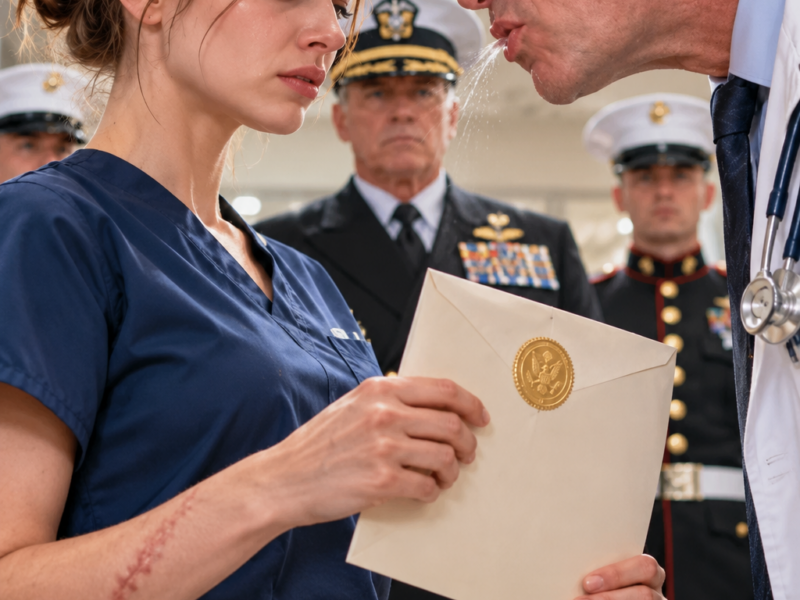
Doctor Spat on a Nurse’s Military Envelope—Then the Vice Admiral Revealed Who She Really Was
Doctor Spat on a Nurse’s Military Envelope—Then the Vice Admiral Revealed Who She Really Was
The first thing Dr. Raymond Pell noticed was the gold seal on the envelope. The second was the name of the woman it was addressed to. What he failed to notice, until it was far too late, was the sixty-one-year-old vice admiral approaching from behind him, accompanied by two Marines whose expressions had already hardened into something dangerously close to disbelief.
By the time Pell deliberately spat across the seal, the corridor of Beaumont Naval Medical Center had fallen silent.
And the woman standing in front of him, a quiet night-shift nurse named Mara Solis, did not even flinch.
That was what everyone remembered afterward. Not the insult itself, although it was shocking enough. Not the doctor’s arrogant smile or the young petty officer’s horrified expression. They remembered how still Mara had remained, how she had watched the saliva spread across the cream-colored paper without raising her voice, and how she had asked a single question.
“Are you finished?”
Pell laughed because he believed he had won.
He had absolutely no idea that, before the day was over, the woman he had spent nearly three years humiliating would save the lives of young service members he could not save himself, expose failures that would endanger his career, and be offered command of a military medical training center.
More importantly, he had no idea why a vice admiral had personally traveled to the hospital to find her.
To understand how that morning unfolded, one had to understand the life Mara Solis had carefully built around herself.
For two years and eight months, she had worked the night shift at Beaumont Naval Medical Center. She was thirty-four years old, with ash-brown hair she usually secured using inexpensive elastic bands and a wardrobe of oversized navy-blue scrubs. She rented a modest apartment, drove an aging sedan, and spoke so little about her personal life that most of her coworkers knew almost nothing about her beyond her preference for black coffee and her willingness to cover difficult shifts.
Her colleagues regarded her as dependable but unremarkable.
She arrived early, completed her assigned duties, rarely complained, and avoided confrontation whenever possible. She knew which medication cart had a squeaking wheel, which storage cabinet required a firm push to close, and which monitors tended to malfunction during the overnight hours.
She also knew precisely where every exit was located.
That last detail might have seemed unusual to anyone who paid close attention. Mara never consciously searched for escape routes. Her eyes simply registered them, along with the location of emergency equipment, the number of people occupying a room, and the changes in breathing that sometimes appeared before a patient’s monitor sounded an alarm.
Those habits had been learned somewhere very different from Beaumont.
But nobody asked about them.
Nobody asked why the pale scar along her forearm looked more like a shrapnel injury than an ordinary accident, either. Whenever her sleeve slipped upward, she casually pulled it back into place.
She had become very good at making herself invisible.
In many ways, invisibility was the only thing she had wanted when she arrived.
Dr. Raymond Pell, the hospital’s chief medical officer, had made that existence considerably more difficult.
At forty-seven, Pell possessed the confidence of someone who had grown accustomed to having his judgments accepted without challenge. He was intelligent, professionally accomplished, and highly conscious of his position. Unfortunately, he also believed that authority and competence were nearly interchangeable qualities.
He expected nurses to follow his instructions. He expected junior physicians to acknowledge his superiority. And he regarded disagreement from someone he considered beneath him as a personal insult.
Mara had learned to navigate around his moods.
When he dismissed her observations, she documented them. When he assigned her menial tasks that could have been handled by less experienced personnel, she completed them. When he made sarcastic comments about her lack of ambition, she said nothing.
Her silence was not agreement.
It was a choice.
And until that morning, it had been one she believed she could continue making.
At approximately six o’clock, while restocking a supply cart on the third floor, Mara heard the elevator doors slide open.
A young Navy petty officer stepped into the corridor carrying a sealed envelope.
His pressed khaki uniform contrasted sharply with the exhausted hospital staff moving around him. He checked a small note, glanced at the nearby nursing station, and approached Mara.
“Excuse me, ma’am. I’m looking for Mara Solis.”
She lowered the saline bags in her hands.
“That’s me.”
The petty officer checked the name printed on the envelope.
“I have a personal military communication requiring delivery.”
Mara’s eyes settled on the gold embossed seal.
Something shifted inside her chest.
She recognized the seal immediately.
For nearly three years, she had worked to place an entire chapter of her life behind her. The uniform, the commands, the casualties, the voices on radios, the unbearable sound of someone calling for help from somewhere she could not reach—all of it belonged to a world she had deliberately left.
Yet there it was, contained inside a single envelope.
Before she could accept it, a familiar voice interrupted.
“Well, what have we here?”
Dr. Pell rounded the corner, his white coat hanging open and his stethoscope draped around his neck.
The petty officer straightened.
“Sir, this is a private delivery for—”
Pell took the envelope from his hand.
“Let’s see.”
The young sailor froze.
Mara’s expression tightened almost imperceptibly.
“Give that back, Doctor.”
Pell studied the seal, then looked at her.
“Official Navy correspondence? For you?”
His amusement was unmistakable.
“Someone must have made a clerical mistake.”
“It is addressed to me.”
“Of course it is.”
He turned toward two residents who had stopped nearby.
“Perhaps they’re finally offering her a promotion in the supply department.”
Neither resident laughed.
Mara extended her hand.
“Dr. Pell. Return the envelope.”
Something about her tone irritated him. It was not loud or disrespectful, but it lacked the nervous deference he expected.
His smile hardened.
Then, deliberately and in full view of the others, he spat onto the gold seal.
The petty officer inhaled sharply.
Pell wiped his hand against Mara’s sleeve and held the envelope out between two fingers.
“There. Now you can have it.”
Mara looked at the paper.
She looked at him.
“Are you finished?”
His laugh was brief and ugly.
Then a voice spoke from behind him.
“Doctor, I suggest you answer that question carefully.”
Pell turned.
Vice Admiral Carter Wynn stood several feet away, accompanied by two Marines in immaculate dress uniforms.
The admiral was sixty-one, broad-shouldered, gray-haired, and possessed of the kind of bearing that required no dramatic gestures to establish authority.
His eyes moved from Pell’s face to the envelope.
Then to the damp seal.
“Petty Officer Tran,” he said quietly.
“Yes, Admiral.”
“Is that the correspondence I instructed you to deliver?”
“Yes, sir.”
“And was it delivered according to my instructions?”
The young sailor swallowed.
“No, sir. The physician intercepted it.”
Wynn examined Pell with a calmness that was considerably more unsettling than anger.
“Do you understand what you’re holding?”
Pell’s smile vanished.
“Admiral, I wasn’t aware—”
“Clearly.”
The word landed like a door closing.
Pell immediately returned the envelope to Mara.
She accepted it without comment.
For a brief moment, she and Wynn looked at each other.
There was recognition in the admiral’s eyes, but also something deeper. Something that resembled regret.
Before either could speak, the hospital’s emergency announcement system activated.
“All available trauma personnel report to the emergency department. Mass casualty incident at Camp Bracken. Eleven service members inbound. Multiple critical patients.”
The corridor erupted into motion.
Pell hurried toward the elevators, already issuing instructions.
The residents followed.
Mara tucked the envelope securely into her pocket.
Then she ran.
The emergency department was already filling with noise when she arrived.
Charge Nurse Franklin, a veteran of twenty years in emergency medicine, was coordinating assignments while ambulance crews transmitted updates over the radio.
The patients were recruits who had participated in an endurance march under extreme heat conditions.
Temperatures outside had climbed into the mid-nineties. Humidity was oppressive. Several recruits had collapsed. Others were confused, vomiting, or unable to stand.
Three were unconscious.
One was experiencing seizures.
Franklin spotted Mara.
“Bays six through ten. Initial assessments, monitoring, laboratory coordination. We’re going to need every experienced hand.”
She nodded.
Then Pell’s voice cut across the room.
“Solis!”
She turned.
“Storage room B. Bring me two cooling blankets and an additional infusion kit.”
“Franklin assigned me to patient care.”
“I’m reassigning you.”
His expression left no room for argument.
“And afterward, you can manage the fluid documentation.”
Several nurses looked up.
Franklin hesitated, but the department was too overwhelmed for a confrontation.
Mara turned toward storage.
She had taken only a few steps when the doors burst open and the first critical patient arrived.
Private Tyler Vance was eighteen years old.
His face was deeply flushed, his breathing was labored, and he seemed unable to understand the questions being directed at him.
Mara stopped.
She recognized the pattern immediately.
Pell moved beside the stretcher.
“Temperature.”
A nurse reached for a conventional oral thermometer.
“Core temperature,” Mara said.
Pell ignored her.
“Oral is sufficient for now.”
“No. His mental status is severely altered. We need an accurate core measurement immediately.”
Pell glanced at her.
“Storage room B, Nurse Solis.”
The thermometer displayed 103.4 degrees Fahrenheit.
Pell began discussing routine fever management.
Mara stepped closer.
“Tori,” she said to a young nurse at the bedside, “please get the core temperature equipment.”
Tori looked uncertainly at Pell.
Then she looked at Vance.
Something in Mara’s expression settled the matter.
She retrieved the equipment.
The accurate reading came back at 107.4 degrees.
For a heartbeat, nobody spoke.
Then Mara moved.
“Severe exertional heatstroke. We need immediate active cooling, continuous monitoring, and a coordinated critical-care response.”
Her instructions were short, specific, and controlled.
Franklin began moving personnel.
Tori called for additional equipment.
Pell stared at the reading.
The admiral, who had followed the emergency response downstairs, watched from near the entrance.
He said nothing.
Within minutes, the team had established an emergency cooling arrangement, and Vance’s temperature began moving downward.
Mara remained focused on the monitor until another sound caught her attention.
A sharp, rhythmic disturbance from a patient in Bay Nine.
Private Derek Osei was convulsing.
A resident called for additional fluids.
Mara hurried over.
Something about his presentation was wrong.
His skin was pale and clammy rather than intensely flushed. His history also did not fit neatly with the assumption that every recruit arriving from the march was simply dehydrated.
She turned toward another recruit seated nearby.
“How much water did he drink?”
The young man blinked.
“A lot.”
“How much?”
“He kept refilling his canteen. Five times, maybe more. He was worried about the heat.”
Mara turned immediately.
“We need an urgent electrolyte assessment. He may have severe exercise-associated hyponatremia.”
Pell approached with an IV fluid bag.
“Standard resuscitation protocol,” he said.
“Wait.”
He stopped.
Mara looked directly at him.
“He drank excessive water during prolonged exertion. His sodium may be dangerously low. We need to assess that before choosing treatment.”
“You don’t know that.”
“No,” she replied. “That’s why we check.”
The laboratory result arrived moments later.
Sodium: 121.
The room seemed to narrow around the number.
Osei was suffering from severe hyponatremia, a dangerous imbalance capable of producing seizures and life-threatening neurological complications.
Mara immediately called for the appropriate emergency treatment pathway and close neurological monitoring.
Pell slowly lowered the fluid bag.
For the first time that morning, he had nothing to say.
Mara stayed beside Osei while the team stabilized him.
When his seizures finally subsided, she checked his breathing, examined his pupils, and reviewed the next laboratory schedule.
Then she moved to the next patient.
No celebration.
No demand for acknowledgment.
There were still nine other young people who needed help.
Over the next hour, Beaumont’s emergency department transformed into a battlefield of medical decisions.
One recruit showed signs of serious muscle breakdown and possible kidney injury.
Another developed respiratory distress.
A third became increasingly confused despite an apparently improving temperature.
A young resident struggled to coordinate two simultaneous emergencies.
At one point, a nurse began crying quietly beside the medication station, overwhelmed by the distance between classroom simulations and the frightening reality of patients deteriorating in front of her.
Mara stopped beside her.
“Look at me.”
The nurse lifted her eyes.
“One patient at a time. Tell me what the monitor shows.”
The young woman answered.
“Good. Now tell me what the patient looks like.”
Another answer.
“Exactly. You’re still thinking. Keep doing that.”
The nurse wiped her face and returned to work.
Mara continued through the department.
She was not the loudest person in the room.
She was simply the person who seemed to understand where the danger would appear next.
Without consciously intending it, she began coordinating the response.
Franklin recognized the change before anyone else.
He placed a tablet in her hands and started relaying clinical information to her.
Nurses followed her instructions within their professional roles, while physicians evaluated and authorized the urgent interventions she identified.
The room began to function around her assessment of priorities.
Even the residents stopped looking automatically toward Pell whenever something changed.
Then the cardiac monitor in Bay Eight began alarming.
Private Marcus Yeoh, twenty years old, had gone into cardiac arrest.
A moment earlier, he had seemed stable enough to respond to questions.
Now he was unresponsive.
The emergency team rushed to his bedside.
Mara was already there.
“Activate the resuscitation team!”
She began coordinated resuscitation with the team, maintaining clear communication as personnel assembled around the bed.
Pell stood nearby, visibly unsettled by how quickly she had assumed an organizing role.
The first minutes were brutal.
The monitor continued showing a rhythm incompatible with effective circulation.
A corpsman counted compressions.
A resident coordinated medication administration.
Mara managed the handoffs and anticipated the equipment the team would need.
Her sleeve slid upward during the effort.
That was when Corporal Jesse Mack noticed the tattoo.
It was small, angular, and faded almost to blue-gray on the inside of her wrist.
He had seen that symbol before.
Not in a medical textbook.
Not on an ordinary military insignia.
He had seen it in a photograph hanging in his uncle’s living room.
His uncle, retired Warrant Officer Daniel Mack, had served in Afghanistan and rarely discussed his deployments.
But Jesse remembered one photograph in particular.
It showed a group of military personnel standing outside a temporary medical station. Several faces were obscured. Their equipment was unconventional, and one patch bore the same geometric symbol now visible on Mara’s wrist.
When Jesse had asked about it years earlier, his uncle had grown unusually quiet.
“Those people,” Daniel Mack had said, “were the reason some of us came home.”
He had refused to explain further.
Now Jesse watched Mara work.
He saw the certainty of her movements, the way she processed information, the effortless coordination that seemed to emerge from somewhere far beyond routine hospital experience.
He looked toward Vice Admiral Wynn.
The admiral was already watching him.
Then the monitor changed.
A heartbeat appeared.
Another followed.
The team confirmed that Marcus Yeoh had regained a pulse.
Mara immediately directed attention toward post-resuscitation care.
Jesse barely noticed.
He was staring at her wrist.
For the first time, he began to suspect that the quiet nurse was someone his uncle had spoken about with reverence.
Later, when the immediate crisis had eased, he found her near a supply alcove.
“Nurse Solis?”
She looked up from a clipboard.
“Yes?”
“May I ask you something personal?”
“That depends.”
He hesitated.
“The tattoo on your wrist. I recognized the symbol.”
Her pen stopped moving.
“My uncle served in Afghanistan,” Jesse continued. “Warrant Officer Daniel Mack. He had a photograph of a medical unit. They wore that symbol.”
Mara slowly raised her eyes.
“Daniel Mack?”
“Yes, ma’am. He goes by Danny.”
For a brief instant, her expression changed.
Jesse saw it.
Recognition.
Then it disappeared.
“You must be mistaken,” she said.
“Perhaps. But my uncle told me stories about a medical officer who operated far beyond conventional evacuation lines. Someone who saved wounded Marines under conditions that should have made survival impossible.”
Mara closed the clipboard.
“Take care of yourself, Corporal.”
She walked away.
But Jesse was no longer wondering whether his suspicion was correct.
He was wondering why she wanted it hidden.
The next crisis came shortly after midday.
Marcus Yeoh, whose heart had restarted earlier, began deteriorating again.
His blood pressure fell.
His breathing changed.
He became increasingly unresponsive.
Dr. Okafor, the resident overseeing him, called for immediate assistance.
Mara reached the bedside as another alarm sounded.
She examined Yeoh and reviewed his initial injury history.
There had been a complaint of chest pain on arrival, attributed to muscle strain after the march.
Now his condition suggested something much more serious.
She immediately raised concern about a life-threatening chest complication.
Pell arrived.
“Get imaging and request thoracic surgery,” he ordered.
“His circulation is collapsing,” Mara replied. “We need bedside emergency assessment and intervention without delay.”
“I’m not approving an invasive procedure without confirmation.”
The monitor sounded again.
Yeoh’s blood pressure continued falling.
Okafor looked between them.
Mara’s voice became very quiet.
“Doctor, we are losing him.”
The silence was terrible.
For the first time, Pell seemed to understand that his position as chief medical officer did not automatically provide him with the answer.
The emergency team moved through its assessment, identified an immediately treatable chest emergency, and initiated life-saving intervention while surgical support was summoned.
Mara assisted with the practiced steadiness of someone who had encountered comparable injuries many times before.
The patient began responding.
His circulation improved.
The crash had been interrupted.
Yeoh was still dangerously ill, but the team had created enough time for definitive surgical treatment.
Mara removed her gloves.
“Get him to the surgeons. Every minute matters.”
Nobody challenged her.
Then Jesse Mack spoke from just inside the bay.
“Commander?”
The word was barely louder than a whisper.
But it reached everyone.
Mara stopped.
Jesse swallowed.
“My uncle told me about someone called Harbinger.”
Vice Admiral Wynn began walking toward them.
Jesse continued, his voice stronger now.
“He said Harbinger led a forward medical team. He said there were four wounded Marines trapped under fire, and that the officer in charge refused evacuation until every one of them had been stabilized.”
Mara remained motionless.
“He told me that one of those Marines was him.”
Wynn stopped behind her.
The room had become silent again.
Then the admiral spoke.
“Lieutenant Commander Mara Solis.”
Nobody moved.
“United States Navy Nurse Corps. Former commanding officer of an advanced forward resuscitation detachment.”
Pell stared at her.
The admiral continued.
“Twelve years of distinguished operational medical service. Multiple combat deployments. Recipient of the Bronze Star. And one of the most accomplished field trauma specialists I’ve ever served alongside.”
The words seemed to strip the room of air.
Franklin slowly lowered the tablet in his hands.
Tori covered her mouth.
Okafor looked at Mara with an expression of complete astonishment.
And Pell, who had ordered her to fetch blankets that morning, appeared unable to decide where to look.
Wynn extended his hand toward the envelope.
“Lieutenant Commander, I believe we have unfinished business.”
Mara took the envelope from her pocket.
The stain on its seal had dried.
She looked at it for several seconds before opening it.
Inside was an official offer of reinstatement and a proposed assignment to command a new joint combat casualty training center.
The facility would prepare Navy and Marine Corps medical personnel for difficult emergencies in austere conditions.
Mara would design its curriculum.
Select its instructors.
Establish its standards.
And report directly to Wynn.
She read the document without speaking.
For nearly three years, she had believed that part of her life was finished.
Now it was being placed back into her hands.
“Why?” she asked quietly.
Wynn understood the question.
“Because we’re losing people who should be coming home.”
He glanced around the department.
“And because I refuse to keep your experience buried where nobody can learn from it.”
Mara looked at him.
Before she could respond, a security officer hurried into the room.
“Admiral, there’s a problem at Camp Bracken.”
Wynn turned.
“What problem?”
“The casualty roster was incomplete. Four recruits are still unaccounted for.”
Mara folded the document.
The officer continued.
“One is a medic trainee named Eliza Drummond. Her last radio contact was over forty minutes ago. She reported multiple heat casualties and requested extraction.”
The room went still.
Mara slipped the envelope into her pocket.
“Do you have vehicles?” she asked.
Wynn nodded.
“Two.”
“Then we’re going.”
Pell stepped forward.
“Lieutenant Commander, surely the base rescue personnel—”
Mara walked past him.
She did not even look at his face.
For the first time in nearly three years, his opinion had no influence on where she went.
Outside, the afternoon heat struck her like an open furnace.
The air was thick with humidity. Sunlight reflected from the pavement, and the distant training grounds shimmered beneath a pale, unforgiving sky.
Two military vehicles waited near the rear entrance.
Corporal Mack climbed into one.
Another Marine, Corporal Delacroix, spread a terrain map across the hood.
“The missing group was last located near the eastern training corridor,” he explained. “Limestone ridges, heavy scrub, limited shade. There’s a creek drainage through the lower section.”
Mara studied the map.
“Where was Drummond’s last transmission?”
“Between markers seven and twelve.”
“Where would a trainee take heat casualties if she couldn’t move them far?”
Delacroix pointed toward the creek.
“The drainage offers shade.”
“That’s where we start.”
They drove until the broken limestone made further travel impossible.
Then they continued on foot.
Mara exchanged her hospital clogs for a pair of oversized spare boots and carried a trauma bag over one shoulder.
Wynn insisted on accompanying them.
At sixty-one, he could no longer move as quickly as the younger Marines, but his determination was unmistakable.
They crossed the exposed terrain under the punishing sun.
Dust rose around their boots.
The ground seemed to radiate heat from every direction.
Mara scanned the ridgeline, tracking terrain features, possible shelter, and routes through the brush.
These were not habits she had learned in hospital corridors.
They belonged to Afghanistan, to remote medical stations and emergency evacuations, to a world where a wrong turn could cost a life.
After several minutes, Jesse spotted a flash of orange near the drainage.
“There!”
They hurried toward it.
Eliza Drummond was sitting beneath a limestone shelf beside two injured recruits.
She had removed her training vest and used it to shade a young woman lying beside her. Her undershirt had become a makeshift dressing around another recruit’s injured arm.
Her face was flushed.
Her lips were dry.
But she was still alert.
“Two patients,” she said as Mara approached. “Johnson is confused and getting worse. Reeves has a deep arm injury and may have a fracture. I used what supplies I had.”
Mara knelt beside her.
“What’s your name?”
“Eliza Drummond.”
“I know. I’m Mara.”
She checked the young trainee’s condition.
“When did you last drink?”
Eliza hesitated.
“I gave my water to Johnson.”
Mara handed her a bottle.
“Drink. You’re a patient too, whether you like it or not.”
Then she turned toward Johnson.
The young recruit was dangerously overheated, barely responsive, and in urgent need of cooling.
Mara coordinated immediate care using the limited resources available while Wynn requested emergency air extraction.
The nearby drainage provided a source of water that could support cooling until a properly equipped rescue team arrived.
Jesse and Delacroix helped move the casualties to a safer position.
Eliza continued assisting despite her exhaustion.
At one point, Mara placed a hand on her shoulder.
“You kept them alive.”
Eliza looked at her.
“I thought I was doing everything wrong.”
“You recognized the danger. You protected them from further heat. You asked for help. And you stayed.”
The trainee’s eyes filled.
“I couldn’t leave them.”
Mara nodded.
“I know.”
For a moment, something old and painful moved across her expression.
Then Wynn received another radio transmission.
He walked several steps away to listen.
When he returned, his face had changed.
“Mara.”
She looked up.
“The roster was wrong.”
She stood.
“What do you mean?”
“There was a last-minute addition to the exercise. Private Daniel Seo. Eighteen years old. He fell behind the group earlier in the march.”
“Where is he?”
“Nobody knows.”
Eliza looked horrified.
“I remember him. He was struggling near the midpoint. One of the instructors told him to keep moving.”
Mara stared toward the western ridge.
“How long ago?”
“Hours.”
A heavy silence followed.
Three kilometers away, somewhere among the exposed limestone and scrub, an eighteen-year-old recruit might be lying unconscious beneath the afternoon sun.
Mara looked toward the helicopter’s expected approach.
Then toward the ridge.
“He would have searched for shade,” she said.
Jesse followed her gaze.
“There’s an overhang west of here.”
“I saw it on the way in.”
Wynn shook his head slightly.
“That’s a large area to search.”
“It’s the most likely place.”
“You could be wrong.”
“Yes.”
She tightened the straps of the trauma bag.
“But standing here guarantees we won’t find him.”
Wynn held her gaze.
Then he nodded.
“Go.”
Jesse followed her.
They moved west through increasingly difficult terrain.
Limestone shifted under their feet. Thorny brush caught at Mara’s sleeves. Heat pressed against them with every step.
They searched for disturbed soil, discarded equipment, anything that suggested someone had passed through recently.
After several minutes, Jesse crouched beside a narrow strip of dust.
“Footprints.”
Mara examined them.
The spacing was irregular.
Someone had been stumbling.
They followed the trail toward the overhang.
Four minutes later, they found Daniel Seo.
He was lying on his side in the shade, unconscious, his uniform marked with white salt stains.
His breathing was shallow and irregular.
Mara dropped beside him.
His core temperature was dangerously elevated.
“Jesse, radio the helicopter. Critical heatstroke. We need immediate evacuation.”
Jesse began transmitting.
Mara initiated emergency supportive care and cooling with the resources they carried.
Seo’s condition was catastrophic.
His body had been overwhelmed by heat for far too long.
His breathing faltered.
Then stopped.
“Jesse!”
The corporal turned.
Mara immediately assessed his circulation and began assisted ventilation while coordinating further resuscitation.
The distant sound of helicopter rotors reached them across the ridge.
Jesse moved beside her.
“Let me help.”
She gave him the next task.
They worked together on the scorching limestone, surrounded by dust and scrub, fighting for the life of a recruit neither had known an hour earlier.
When the aircraft finally approached, the flight medics rushed toward them with emergency equipment.
Mara delivered a rapid handoff.
The team continued resuscitation and advanced treatment.
Seo’s heart developed a dangerous rhythm.
The medics followed their resuscitation protocols, working relentlessly as Mara assisted and communicated the sequence of events.
For several terrible moments, the monitor showed no meaningful improvement.
Then a pulse returned.
The senior flight medic looked up.
“We’ve got circulation.”
Mara closed her eyes for the briefest instant.
Then she opened them.
“Get him aboard.”
They loaded Seo into the helicopter.
The flight medic looked at her.
“Are you coming?”
“Yes.”
Jesse stood beside the aircraft, breathing hard.
Mara turned toward him.
“Tell the admiral I’m going back to finish the job.”
He nodded.
Then she added something unexpected.
“And tell him I remember what he said about the envelope.”
Jesse frowned.
“What does that mean?”
“He’ll understand.”
The helicopter lifted away.
Far below, the limestone ridge shrank beneath the aircraft.
Mara watched Seo’s monitor.
The fight for his life was far from over.
By the time the helicopter reached Beaumont, the recruit had stabilized enough for transfer to intensive care.
Dr. Sandra Coe, the senior intensivist, was waiting with her team.
Mara delivered the handoff, then stepped aside as they wheeled Seo through the rooftop entrance.
Only then did she notice the blood staining both knees of her scrubs.
The limestone had cut through the fabric while she worked.
She had not felt it.
She stood beneath the afternoon sun for several seconds, exhausted beyond anything she cared to acknowledge.
Then she went downstairs.
Two dark government sedans were parked near the administrative entrance.
Mara recognized the vehicles immediately.
The Naval Inspector General’s Office had arrived.
Someone had requested an investigation.
She found Franklin in the emergency department.
He looked at her torn scrubs and borrowed boots.
“Good Lord, Solis.”
“Seo is alive.”
Franklin nodded.
“That’s what I heard.”
“The other casualties?”
“Stable. All eleven from the original group. The missing recruits are being brought in now.”
She exhaled.
“And the inspectors?”
“Conference room. They arrived about forty minutes ago.”
“Pell?”
“In there with them.”
Franklin hesitated.
“They asked for your personnel file. And they asked about everything that happened in the emergency department.”
Mara understood.
The emergency procedures.
The treatment decisions.
The conflict with Pell.
Her hidden military history.
All of it.
She thanked Franklin and walked toward the administrative wing.
Through the narrow conference-room window, she saw Pell seated across from two investigators.
His white coat was gone.
Without it, he looked strangely ordinary.
He was talking while an officer took notes.
Mara did not stop.
Wynn was waiting in a smaller room farther down the corridor.
When she entered, he was ending a telephone conversation.
He looked at her injuries.
“You should be in medical.”
“I’m fine.”
“You always say that.”
“So do you.”
For the first time that day, he almost smiled.
Then she asked the question that had been weighing on her.
“What happens now?”
He gestured toward a chair.
Mara sat.
“The inspectors are reviewing the emergency response. They are also investigating Pell’s conduct and the larger management failures that permitted it.”
“And my actions?”
“Your operational status and the applicable authority are being reviewed by legal counsel. We’ll document the timeline properly. No assumptions, no shortcuts.”
She nodded.
Then her eyes moved toward the envelope in her pocket.
“The training center.”
Wynn waited.
“Why now?”
He took a long breath.
“Because it’s overdue.”
“That isn’t the whole answer.”
“No.”
Silence settled between them.
Finally, Mara spoke a name neither had mentioned that day.
“Caleb.”
Wynn looked away.
Caleb Rourke had been his son.
Three years earlier, Caleb had arrived at Mara’s forward medical station after a devastating attack.
His injuries had been severe beyond reasonable hope.
Yet Mara had worked to keep him alive.
For forty minutes, she had fought against catastrophic trauma while evacuation arrangements collapsed around her.
Forty minutes of relentless effort.
Forty minutes during which Caleb remained conscious long enough to speak to his father by radio.
He had died shortly afterward.
Mara had carried that death ever since.
She had been decorated for her service.
Commended by senior officers.
Praised for extraordinary courage and medical expertise.
None of it had mattered to her.
The only fact she could see was that Caleb had died.
“I kept him alive for forty minutes,” she said quietly. “Then I lost him.”
Wynn sat opposite her.
“You didn’t lose him, Mara.”
She looked at him.
“He was brought to you with injuries that no medical team could have reversed.”
“I should have done more.”
“You did everything there was to do.”
Her jaw tightened.
Wynn continued carefully.
“He called me while you were working. Do you remember?”
She nodded.
“He told me he wasn’t afraid.”
Mara looked down.
“He was lying.”
“Perhaps. But he also told me someone was staying with him.”
Her eyes closed.
Wynn’s voice became rougher.
“He said you wouldn’t leave.”
For several seconds, neither spoke.
Then Wynn continued.
“I had forty minutes with my son that I would not otherwise have had. I heard his voice. I told him I loved him. And he heard me.”
Mara pressed her lips together.
“I couldn’t save him.”
“No,” Wynn said. “But you gave him something I will never be able to repay.”
She turned toward the window.
For nearly three years, she had remembered those forty minutes as a failure.
Now, for the first time, she allowed herself to consider that they might have meant something else.
Not victory.
Not redemption.
But something real.
Wynn waited until she was ready to speak again.
Then he explained the training center.
It would consolidate advanced instruction in battlefield trauma, heat emergencies, difficult evacuations, mass casualty response, and medical decision-making under pressure.
It would not exist to celebrate her service.
It would exist to prevent avoidable deaths.
“Recruits are being injured during training exercises that should be survivable,” he said. “Field medics are sent into conditions they haven’t been adequately prepared for. Hospitals are receiving casualties without complete information. We keep discovering the same failures after someone has already paid for them.”
Mara thought of Daniel Seo lying alone beneath the limestone overhang.
Of Eliza Drummond giving away her last water.
Of the incorrect roster.
Of eleven young patients arriving simultaneously while the chief medical officer argued about who had authority to speak.
“I want control over the curriculum,” she said.
“You’ll have it.”
“Instructor selection.”
“Yes.”
“Field exercises.”
“Yes.”
“And I want the focus on outcomes. Not how impressive the paperwork looks.”
Wynn nodded.
“That is exactly why I came for you.”
She was silent for a moment.
Then she asked, “What about Pell?”
Wynn’s expression hardened.
“That’s being handled.”
The investigation was already revealing serious problems.
The inspectors examined documentation from the emergency department and interviewed witnesses.
They reviewed the treatment delays, the disputes over clinical decisions, and the treatment of nursing staff.
They also reviewed the envelope incident.
Pell initially attempted to characterize it as a misunderstanding.
But the young petty officer’s statement was clear.
So were those of the residents and nurses who had witnessed it.
The hospital’s security footage provided further corroboration.
Captain Alvarez, Beaumont’s commanding officer, was forced to confront a larger question.
How had the behavior of a senior physician gone unchallenged for so long?
When Mara met Alvarez later that afternoon, he looked exhausted.
“I reviewed your employment record,” he told her. “I had no idea about your military history.”
“I didn’t disclose most of it.”
“May I ask why?”
She considered the question.
“I came here because I needed somewhere quiet.”
“Quiet?”
“Somewhere nobody expected me to save everyone.”
Alvarez looked down at the folder in front of him.
“I see.”
“No,” she said gently. “I don’t think you do. But that’s all right.”
He sat with that.
Then he straightened.
“Whatever your background, you deserved professional respect. Every member of this staff does. And I failed to ensure that.”
Mara studied him.
It was the first time that day she had heard a senior officer accept responsibility without immediately offering an excuse.
“Preserve the original clinical records,” she said.
Alvarez looked up.
“All of them?”
“Yes. Before anyone decides the documentation should be more flattering.”
He nodded.
“I’ll issue the instruction.”
“And Eliza Drummond needs a commendation.”
“The medic trainee?”
“She kept two injured recruits alive with almost no equipment. She stayed despite becoming ill herself. She deserves recognition.”
Alvarez picked up a pen.
“I’ll see to it.”
When Mara left the office, she encountered Pell beside a water dispenser.
He was holding a paper cup.
He looked at her without his usual expression of superiority.
“I didn’t know,” he said.
She stopped.
“I know.”
“I didn’t know who you were.”
“Would it have mattered?”
He hesitated.
The silence answered for him.
Mara looked at the cup in his hands.
“That’s the problem, Doctor.”
He lowered his eyes.
“I want to apologize.”
She waited.
“The envelope. The way I spoke to you. Everything.”
He struggled for words.
“I understand that saying I’m sorry isn’t enough.”
“No,” she replied. “It isn’t.”
He looked at her helplessly.
“What do you want me to do?”
“Listen.”
He blinked.
“When a nurse tells you a patient is deteriorating, listen. When someone questions your assumption, consider that they may have a reason. When a person doesn’t have a title you respect, remember that their observations can still be right.”
Pell said nothing.
“Today, young men nearly died because you were more concerned about being challenged than understanding what was happening in front of you.”
His face tightened.
“You don’t know what it’s like to carry responsibility for—”
She raised one hand.
“Don’t.”
He stopped.
“I know exactly what responsibility feels like.”
There was no anger in her voice.
That made the words harder to escape.
“Start by listening better.”
She walked away.
By late afternoon, the preliminary investigation had resulted in Pell’s removal from clinical leadership duties pending further review.
His hospital privileges were subsequently suspended while the inquiry continued.
The decision did not come from Mara.
She did not request revenge.
She did not celebrate.
The consequences belonged to his actions.
Meanwhile, legal officers completed the necessary review of Mara’s reinstatement, professional credentials, and emergency responsibilities.
Wynn’s original correspondence had initiated a process that could not be reduced to a simple change of uniform. The military reviewed the relevant orders and clinical records, ensuring that both the facts and applicable professional standards were properly documented.
When the formal paperwork arrived, Mara received it with the same composure she had shown throughout the day.
Then Wynn gathered the people who had been part of the emergency response.
Franklin.
Dr. Coe.
Okafor.
Petty Officer Tran.
Corporal Mack.
Captain Alvarez.
Several of the nurses and corpsmen.
Eliza Drummond, now recovering from heat exhaustion, was there as well.
And near the window sat Marcus Yeoh, awake and recovering, accompanied by medical staff.
He looked pale.
But he was alive.
Mara stopped in the doorway when she saw him.
Their eyes met.
Yeoh gave her a small, uncertain smile.
She nodded.
It was enough.
Wynn stood at the front of the room.
“Today demonstrated both extraordinary competence and serious institutional failures,” he began.
Nobody interrupted.
“We saw medical personnel respond with courage under exceptional pressure. We also saw what happens when poor communication, inadequate preparation, and failures of leadership place patients at risk.”
He looked toward Drummond.
“Trainee Eliza Drummond.”
She straightened.
“Your actions in the field have been formally recommended for commendation. You recognized serious illness, protected your patients, and continued providing aid despite dangerous conditions.”
Eliza’s eyes widened.
“Thank you, Admiral.”
“You earned it.”
Then Wynn turned toward Mara.
“Lieutenant Commander Solis, the Navy is prepared to place you in command of the new Beaumont Combat Casualty Training Center, subject to completion of your formal transfer.”
He placed the document on the table.
“The mission is to ensure that the lessons of today are learned before the next emergency, rather than afterward.”
Mara looked around the room.
She saw Franklin, who had treated her with quiet respect even when he knew nothing of her past.
She saw Okafor, whose hesitation had troubled him enough that he had already asked for additional emergency training.
She saw Jesse Mack, whose uncle had survived because of a medical team operating thousands of miles away.
She saw Eliza Drummond, young and exhausted, but possessing the determination that could make an exceptional medic.
And she saw Marcus Yeoh.
Twenty years old.
Alive.
Mara stepped forward.
She picked up the pen.
Then she signed.
The room remained quiet until Wynn nodded.
“Welcome back, Commander.”
Only then did the applause begin.
Mara did not smile broadly.
She looked down at the document.
For a moment, she saw another room, another uniform, and another young man whose life she had fought to preserve.
Then she looked up.
“Thank you,” she said.
And because she was still Mara Solis, she added, “Now we have work to do.”
During the following seventy-two hours, the transfer was completed.
The patients from Camp Bracken continued recovering.
Tyler Vance regained normal cognition and was eventually discharged.
Derek Osei’s sodium imbalance resolved under careful medical supervision.
Marcus Yeoh progressed through his recovery after intensive treatment.
Daniel Seo, whose condition had been especially critical, survived the emergency and began the long process of rehabilitation.
When he was well enough to speak, he asked about the nurse who had found him beneath the limestone.
He did not know her name.
One of the staff told him she had become commander of a military medical training center.
Seo was quiet for a while.
Then he asked whether he could send her a letter.
The answer was yes.
At Beaumont, Franklin discovered a handwritten note left by Tyler Vance.
It contained only a few sentences.
He had written that he could not remember much of his first hours in the emergency department, but he remembered someone telling him he was going to be all right.
He wanted to thank that person.
Franklin placed the note somewhere safe.
He understood that Mara would never ask to see it.
He intended to give it to her anyway.
The new training center occupied a two-story building on the northeast side of the base.
It had been used for administrative storage and smelled faintly of old paper, cardboard, and dust when Mara first entered.
The classrooms were empty.
The equipment rooms needed refurbishment.
The central training space was large enough to support complex simulations, but little had been done to prepare it.
Mara walked through the building alone on her first morning.
She examined the exits.
Checked the available power outlets.
Studied the room dimensions.
And began imagining how everything could work.
Within days, she had outlined a demanding curriculum.
Heat emergencies would receive extensive attention.
So would severe electrolyte disturbances, trauma assessment, delayed evacuation, and mass casualty coordination.
But technical knowledge alone would not be sufficient.
She wanted trainees to practice speaking up when something was wrong.
She wanted physicians to hear nurses.
She wanted junior medics to recognize the limits of their authority without becoming helpless inside those limits.
She wanted every student to understand that confidence was not the same as arrogance, and that good judgment included knowing when to ask for help.
Above all, she wanted them to recognize a deteriorating patient before a monitor made the danger impossible to ignore.
On the fourth morning, Eliza Drummond arrived for her accelerated medic training.
She was twelve minutes early.
She carried a notebook already filled with handwritten observations from the events at Camp Bracken.
Mara noticed.
“Drummond.”
“Yes, ma’am?”
“When you finish your certification, I want to discuss a possible instructor position.”
Eliza stared at her.
“An instructor?”
“Eventually.”
“But I haven’t even finished training.”
“No.”
Mara glanced at the notebook.
“But you’ve already learned something important that many experienced people forget.”
Eliza waited.
“You don’t stop thinking just because you’re frightened.”
The younger woman looked down.
“I was terrified.”
“I know.”
“I thought they were going to die.”
“So did I, at times.”
Eliza looked up.
Mara continued.
“Courage isn’t the absence of fear. It’s doing the work correctly even while you’re afraid. The rest comes with training.”
Eliza nodded slowly.
Then she opened her notebook.
Six days after the emergency, Wynn visited the center.
He arrived without an escort.
Mara was standing beside a whiteboard covered in diagrams, training objectives, and evaluation criteria.
Four staff members were unpacking equipment nearby.
Wynn surveyed the room.
“You’ve been busy.”
“There’s a lot to do.”
“The first cohort isn’t scheduled for another three weeks.”
“Then we’re already behind.”
He almost laughed.
For several minutes, they walked through the facility.
Mara explained the proposed curriculum, the simulation stations, and her plan to involve experienced field medics in scenario development.
Wynn listened carefully.
Then he asked, “What about Camp Bracken?”
She stopped.
“What about it?”
“The roster system has been overhauled. New verification requirements are being implemented before field exercises. Medical support planning is being revised.”
“Good.”
“Training leadership is also reviewing the decisions that allowed those recruits to remain unaccounted for.”
Mara nodded.
“That matters more than finding someone to blame.”
Wynn looked at her.
“Both can matter.”
She considered that.
“Yes,” she said finally. “They can.”
They continued toward the central classroom.
Then Wynn stopped.
“There’s something I should have said to you three years ago.”
Mara turned.
“I knew where you went after you resigned your commission,” he said.
She said nothing.
“I knew you were working at Beaumont. I believed you needed time, and I didn’t want to interfere.”
“You were right about that.”
“Perhaps. But I also knew you were struggling. And I let too much time pass without checking whether you were all right.”
Mara studied him.
Wynn’s eyes settled on the training equipment.
“I told myself I was respecting your wishes. Some of that was true. Some of it was because I didn’t know how to speak to you after Caleb.”
The name no longer struck her with the same unbearable force.
It still hurt.
She suspected it always would.
But the pain had begun changing shape.
“You’re here now,” she said.
Wynn nodded.
It was neither forgiveness nor condemnation.
It was simply a place from which they could move forward.
He looked at the whiteboard.
“Have you decided what to call the first field heat management protocol?”
Mara answered without hesitation.
“The Drummond Protocol.”
Wynn raised an eyebrow.
“Not the Solis Protocol?”
“No.”
“Why Drummond?”
“Because she did the work before anyone told her she was capable of it.”
Wynn smiled faintly.
“I think that’s a good name.”
On the ninth morning, Mara arrived at the Beaumont Combat Casualty Training Center at six o’clock.
This time, she was not wearing oversized scrubs.
She wore her Navy service uniform.
The rank insignia rested at her collar.
Her decorations were arranged precisely.
The uniform had been kept carefully in storage for three years, preserved not because she expected to wear it again, but because some part of her had never been able to let it go.
She stood outside the entrance beneath the pale morning sky.
The air was already warm.
A breeze moved faintly through the trees bordering the compound.
She thought about Beaumont’s third-floor corridor.
About the envelope.
About the doctor who had spat on its seal because he believed the person receiving it was beneath his respect.
For nearly three years, Mara had allowed herself to become smaller than she was.
She had believed that hiding her abilities might also quiet the memories attached to them.
But a person’s experiences did not disappear simply because nobody else could see them.
The knowledge remained.
The scars remained.
So did the responsibility.
She thought about Caleb Rourke and the forty minutes that had haunted her.
She thought about Tyler Vance, Derek Osei, Marcus Yeoh, Daniel Seo, and the other young service members who had survived the terrible day at Camp Bracken.
She thought about Eliza Drummond, who had given away her water and refused to abandon the recruits depending on her.
She thought about Jesse Mack’s uncle, who had returned from Afghanistan because someone had refused to stop working under fire.
And she understood something she had resisted for years.
She could not control every outcome.
No medic could.
No physician could.
No commander could.
There would always be circumstances beyond training, courage, or determination.
But there were also mistakes that could be prevented, skills that could be taught, and lives that could be saved because someone had prepared for the moment before it arrived.
That was what she could give.
Not perfection.
Preparation.
Not the promise that nobody would ever die.
The determination to make every preventable death harder to accept.
Inside the building, the lights were already on.
Four instructors were preparing their stations.
Eliza sat in the front row, notebook open, pen ready.
Mara entered.
The room came to attention.
She paused beside the doorway.
For a fleeting instant, she remembered the silence in the hospital corridor when Pell had returned the stained envelope to her.
Back then, everyone had been waiting to see whether she would defend herself.
Now, nobody needed her to prove who she was.
And she no longer needed to hide.
She approached the whiteboard and placed her bag on the desk.
“Good morning.”
“Good morning, Commander,” the trainees answered.
She looked across the room.
Some were young.
Some had served for years.
Some had already experienced emergencies they could not forget.
Others had yet to learn how frightening a real crisis could become.
They had come here expecting medical instruction.
Mara intended to give them something more enduring.
She uncapped a red marker.
“Before we begin,” she said, “I want every one of you to remember something.”
The room fell quiet.
“You will meet people who outrank you. People who know more than you. People who speak louder than you. Sometimes those people will be right.”
She paused.
“And sometimes they won’t.”
Eliza leaned forward slightly.
Mara continued.
“Your responsibility is to the patient. That means learning your skills, respecting your limits, recognizing danger, communicating clearly, and refusing to let pride interfere with good decisions.”
She looked from face to face.
“Never confuse someone’s silence with ignorance. Never confuse a title with infallibility. And never assume the person standing beside you has nothing to teach you.”
Then she turned toward the board.
Outside, the morning sunlight spread across the training grounds.
Somewhere nearby, young recruits were beginning another day of preparation for military service.
Most of them would never know the story of a nurse whose military envelope had been deliberately humiliated in a hospital corridor.
They would never know how close several patients had come to death that day.
They would never know that an admiral had arrived intending to restore a remarkable officer to service and had instead watched her demonstrate precisely why she was needed.
And perhaps that was exactly how Mara wanted it.
Because the purpose of the center was not to make her famous.
It was to make the people who trained there better.
Better prepared.
Better listeners.
Better decision-makers.
Better able to keep someone alive long enough to reach the next level of care.
The irony was that Dr. Pell had spent years believing he could determine Mara’s worth by the clothes she wore and the position she occupied.
He had seen inexpensive scrubs and assumed limited ability.
He had seen quiet obedience and assumed weakness.
He had seen a scar and never considered the history behind it.
But her value had never depended on his recognition.
It had existed long before he met her.
And it would continue long after he was gone.
Mara wrote the day’s first training objective across the whiteboard.
Then she stepped aside so everyone could read it.
Her eyes settled briefly on the words.
For the first time in nearly three years, she felt neither the need to disappear nor the burden of proving she deserved to be seen.
She was simply where she belonged.
She turned back toward the trainees.
“Let’s begin,” she said.
And they did.
THE END