Doctor Ripped the Patch Off Her Scrubs — Then the Admiral Ordered the Entire Ward to Stand
Doctor Ripped the Patch Off Her Scrubs — Then the Admiral Ordered the Entire Ward to Stand
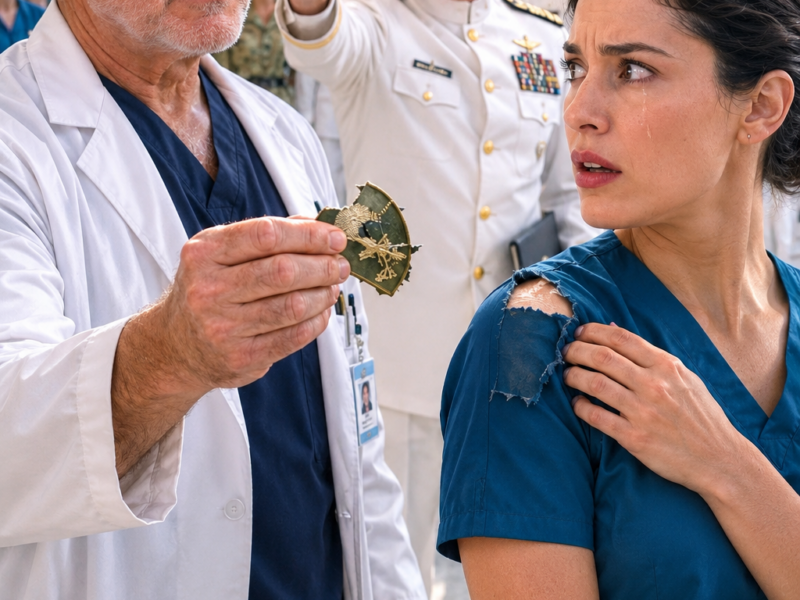
The first thing Dr. Alister Evans did was grab the sleeve of the quiet, middle-aged nurse standing beside his dying patient. The second thing he did was tear a small embroidered patch from her scrubs and throw it onto the bloodstained floor.
“You are nothing more than a nurse,” he shouted, his face flushed with anger. “And you will remember your place in my emergency room.”
The woman did not raise her voice. She did not argue. She simply looked at the patch lying near her shoes, then returned her attention to the unconscious man on the hospital bed.
Less than twenty minutes later, a four-star admiral would walk into that same emergency room, recognize the woman Evans had humiliated, and issue an order that would leave every doctor, nurse, and military officer standing at attention.
But the most extraordinary part of that night was not the admiral’s arrival, the doctor’s disgrace, or even the revelation of the nurse’s hidden identity.
It was the fact that a man who should have died was still breathing because one woman had refused to obey an order she knew was wrong.
To understand what happened, you have to go back to the beginning of that November night, when the fourth floor of St. Jude’s Metropolitan Hospital seemed almost peaceful.
It was shortly after midnight. Rain tapped against the dark windows, and the lights of the city shimmered through the wet glass. Inside the hospital, fluorescent fixtures cast a pale glow over polished floors, while the familiar sounds of medical equipment filled the corridors.
For most people, the emergency department after midnight was a place of uncertainty. For Anya Sharma, it was simply another shift.
At forty-eight, Anya had worked at St. Jude’s for nearly eleven years. She was neither particularly sociable nor unfriendly. She arrived early, completed her duties without complaint, and rarely participated in the gossip that passed between nurses during quieter hours.
Her dark hair, streaked with silver, was always pulled into a tight bun. Her blue scrubs were immaculate, her shoes practical, and her expression almost impossibly composed.
The younger nurses respected her, although few could claim to know her.
She never talked about her family. She never mentioned a husband or children. She never posted photographs from vacations or discussed her plans for the holidays. When someone asked about her past, she answered politely but vaguely.
She had worked in emergency medicine before coming to St. Jude’s. That was all anyone knew.
Chloe Bennett, a twenty-four-year-old nurse who had joined the department six months earlier, once asked Anya why she never seemed frightened during emergencies.
Anya had been changing a dressing at the time.
“Fear is useful,” she replied. “But only if you don’t let it make your decisions.”
Chloe had laughed, assuming it was a piece of wisdom gathered from years of nursing.
She had no idea how much blood, loss, and suffering stood behind those words.
Because Anya Sharma had not always been the quiet woman who checked IV lines and comforted frightened patients.
There had been another life.
A life she had spent more than a decade trying to forget.
In that life, she had not answered to Nurse Sharma.
She had answered to a different name.
Kali.
And in certain military circles, that name was still spoken with the kind of reverence reserved for people who had walked into situations no one else expected them to survive.
But on this particular night, the woman called Kali was buried beneath years of ordinary hospital routines.
Or so Anya believed.
At 12:17 a.m., she was checking the vital signs of a man recovering from abdominal surgery when she heard hurried footsteps approaching from the corridor.
She recognized Chloe’s footsteps before the young nurse appeared.
“Anya,” Chloe said breathlessly, “we’ve got a priority-one trauma coming in. They’re saying it’s someone important.”
Anya finished adjusting the patient’s monitor.
“How important?”
“Military. Some kind of admiral. There are security officers downstairs already.”
Anya’s fingers paused for the briefest moment.
“What’s the mechanism of injury?”
“Fall down a staircase. That’s what dispatch said.”
“Anything else?”
“Not yet.”
Anya nodded.
“Prepare trauma bay one. Make sure the airway equipment is ready, and ask the blood bank to stand by.”
Chloe hesitated.
“Dr. Evans already gave us instructions.”
Anya looked at her.
“Then make sure they’re carried out. And check the equipment anyway.”
Chloe hurried away.
Anya remained still for a moment, listening.
Something about the situation troubled her.
An admiral. A supposedly accidental fall. Security officers arriving before the ambulance.
The details did not fit comfortably together.
She had learned long ago that official explanations were sometimes less informative than the things people chose not to say.
And the presence of armed security around an injured military officer suggested that the circumstances might be considerably more serious than a staircase accident.
Anya pushed the thought aside.
She was a nurse now.
Her job was to care for the injured, not uncover the secrets that brought them through the doors.
She walked toward the trauma bay.
Dr. Alister Evans was already there.
At thirty-nine, Evans was considered one of the hospital’s promising emergency physicians. He had excellent academic credentials, a prestigious residency, and a talent for making senior administrators believe he was indispensable.
His colleagues had a less flattering view.
Evans was intelligent, but his intelligence came wrapped in an arrogance that made collaboration difficult. He disliked being questioned, especially by nurses. He considered disagreement an attack on his authority.
And for reasons Anya had never understood, he seemed to regard her quiet competence as a personal irritation.
“Sharma,” he called as she entered. “I want you handling the basic nursing duties. Nothing beyond that.”
“Understood, Doctor.”
“And don’t start offering your theories tonight. This is a high-profile patient.”
Anya said nothing.
He studied her expression, apparently disappointed that he had failed to provoke a reaction.
“Do you understand?”
“Yes, Doctor.”
“Good.”
He returned to his tablet.
Anya checked the equipment.
The resuscitation cart was stocked. The oxygen system was functioning. Suction was ready. She confirmed that the appropriate emergency supplies were within reach.
Then she waited.
At 12:24 a.m., the ambulance doors opened.
The patient arrived surrounded by paramedics and two men wearing dark suits.
He was a distinguished-looking man in his late sixties, with silver hair and a deeply lined face. His torn tuxedo was soaked with sweat and stained with blood. His left leg was twisted unnaturally beneath the blanket covering him.
His breathing was shallow.
His skin had the gray, waxen appearance Anya knew too well.
The appearance of a body struggling to remain alive.
“Admiral William Hayes, sixty-eight,” the lead paramedic reported as they transferred him to the trauma bed. “Reported fall down a staircase at a diplomatic reception. Brief loss of consciousness. Blood pressure ninety over fifty, heart rate one-thirty, worsening respiratory distress. He’s deteriorating rapidly.”
Evans moved to the head of the bed.
“Likely internal hemorrhage,” he announced. “Get the ultrasound. Prepare blood. Call surgery.”
Anya stepped closer.
The admiral’s forehead was cut. His left thigh appeared fractured. But neither injury explained everything she was seeing.
She placed two fingers against his wrist.
The pulse was rapid and weak.
She watched his chest rise.
Something was wrong.
The right side moved less than the left.
She listened carefully with her stethoscope.
The difference was unmistakable.
Then she looked at his neck.
The veins were unusually prominent.
A cold certainty began forming in her mind.
She knew this pattern.
She had seen it before in Afghanistan, where explosions could injure people without leaving an obvious wound on the outside.
She had seen strong men collapse after walking away from a blast.
She had seen victims who appeared relatively stable for several minutes before suddenly losing consciousness.
And she had learned that the most dangerous injury was not always the most visible one.
“Doctor,” she said.
Evans was concentrating on the ultrasound.
“Not now.”
“His breathing is asymmetrical.”
“We’re assessing him.”
“His neck veins are distended, and his right-sided breath sounds are severely reduced.”
Evans gave an irritated sigh.
“Sharma, I’m aware that the patient is critically ill.”
“I think he has a tension pneumothorax.”
Evans stopped moving.
He looked up slowly.
“What?”
“Air may be trapped under pressure in the right side of his chest. It’s compromising his circulation.”
Evans stared at her.
“His injury was caused by a fall.”
“That doesn’t exclude chest trauma.”
“There is no penetrating wound.”
“There doesn’t have to be.”
His expression hardened.
“Are you seriously trying to lecture me on trauma medicine?”
“No, Doctor. I’m asking you to reassess his chest immediately.”
The monitor alarm grew louder.
Chloe looked up from the blood pressure cuff.
“Seventy-eight over forty-two.”
Anya’s eyes remained on the patient.
“Doctor, he’s losing time.”
Evans turned back to the ultrasound.
“I don’t need a nurse telling me how to manage shock. Get another pressure reading.”
Anya obeyed, but she did not abandon what she knew.
The admiral’s breathing deteriorated further. His lips developed a bluish tint. His pulse grew weaker.
Then the man in the dark suit near the doorway moved forward.
He was tall, broad-shouldered, and carried himself with the unmistakable discipline of a military officer. A scar cut diagonally through his left eyebrow.
“Doctor,” he said, “is the admiral going to survive?”
“We are doing everything medically indicated,” Evans replied sharply.
“That’s not what I asked.”
Evans turned toward him.
“And who are you?”
“Commander Daniel Thorne. Naval Special Warfare. I’m responsible for Admiral Hayes’s security.”
Evans frowned.
“Then I suggest you let me handle the medicine.”
Thorne’s jaw tightened, but he stepped back.
Anya noticed that he watched the admiral with the controlled tension of someone familiar with battlefield casualties.
Their eyes met briefly.
For a moment, something unreadable passed between them.
Then the admiral’s monitor sounded another alarm.
His blood pressure had fallen again.
Chloe’s voice trembled.
“Doctor, he’s crashing.”
Evans ordered additional resuscitation measures.
Anya looked at the admiral’s face.
The man was slipping away.
And suddenly she was no longer standing in a modern American hospital.
For one terrible instant, she was back in the Korengal Valley.
She could almost smell burning fuel.
Hear the thunder of helicopter rotors.
See a young soldier lying in the sand with blood bubbling at his lips while the world around them exploded into gunfire.
She remembered shouting for supplies.
Remembered the awful pressure of knowing that every lost second mattered.
Remembered making a decision when the senior medic beside her had been too badly wounded to continue.
She had saved that soldier.
And two others.
But not everyone.
Never everyone.
The memories came and went in a heartbeat.
Anya returned to the present.
“Dr. Evans,” she said firmly, “we need immediate intervention for a suspected tension pneumothorax.”
“Enough!”
His shout silenced the room.
“I’ve tolerated your interference for years, Sharma. You are not a physician. You will not diagnose my patient, and you will not undermine me in front of my staff.”
“His life is more important than either of our titles.”
The words were quiet.
But they landed like a slap.
Evans stepped toward her.
“Get away from the bed.”
Anya didn’t move.
“Doctor—”
“I said move!”
He seized her upper arm.
His fingers caught the edge of a small dark-blue patch stitched beneath the hospital emblem on her sleeve.
Anya had worn that patch for years, mostly concealed. It was old, faded, and carefully positioned where few people noticed it.
A remnant of something she could never quite bring herself to discard.
Evans pulled her backward.
The fabric tore.
The patch came loose in his hand.
He glanced at the embroidered symbol: a coiled cobra, its hood spread wide, with a single red drop beneath one fang.
“What is this supposed to be?” he demanded. “Some ridiculous military costume?”
Anya’s face changed.
Not dramatically.
Her expression simply became very still.
“Give that back.”
Evans laughed bitterly.
“Worry about your job.”
He threw the patch onto the floor.
“Now step aside.”
For a moment, no one spoke.
Chloe stared at the torn sleeve.
Commander Thorne stared at the patch.
And something extraordinary happened.
The commander’s face lost its color.
He recognized the symbol.
He had seen it once before.
Not in a hospital.
Not on a uniform displayed behind museum glass.
He had seen it in a burning helicopter, stitched onto the shoulder of the woman who had pulled him out of a nightmare he still dreamed about.
But before he could speak, the admiral’s condition collapsed.
The monitor sounded.
The medical team called out the change in rhythm.
The admiral lost consciousness completely.
His heart could no longer maintain effective circulation.
“Cardiac arrest!” Chloe shouted.
Evans froze for an instant.
It was only a second.
But in a resuscitation, a second can feel impossibly long.
Anya moved.
“Start compressions,” she ordered. “Call the resuscitation team. Get the emergency physician from the next bay. We need the chest assessed and decompressed immediately.”
Her voice had changed.
There was no trace of hesitation.
No anger.
No need to prove herself.
It was the voice of someone who had given orders while mortars struck the ground around her.
Chloe reacted instantly.
Another nurse began compressions while the team prepared emergency equipment.
Evans reached for Anya again.
“I am the attending physician!”
Anya turned toward him.
“Then act like one.”
He stopped.
The room went silent except for the alarms and the rhythm of resuscitation.
“You can argue with me after he’s alive,” she continued. “Right now, every second you spend protecting your pride is another second this man doesn’t have.”
Evans opened his mouth.
No words came.
Anya turned to the team.
“His findings are consistent with a tension pneumothorax. We need a clinician to relieve the pressure now.”
Dr. Elena Morris, another emergency physician who had been summoned from the adjoining trauma bay, rushed into the room.
She listened to Anya’s assessment, checked the patient, and immediately understood the danger.
“Agreed,” Morris said. “Prepare for emergency decompression.”
Evans stared at her.
“You’re going to listen to a nurse?”
Morris didn’t look up.
“I’m going to treat a dying patient.”
Anya handed her the equipment.
For the first time since the admiral’s arrival, everyone in the room was focused on the same problem.
Morris performed the emergency intervention while Anya assisted, monitoring the patient’s condition and coordinating the team.
There was a sharp release of trapped air.
The effect was not magical or instantaneous, but the change was unmistakable.
The obstruction to circulation began to ease.
The resuscitation continued.
A pulse returned.
“Pulse present!” Chloe cried.
“Pressure improving,” another nurse reported.
Anya watched the monitor.
The numbers slowly moved in the right direction.
The admiral’s color began to improve as the team supported his breathing.
“Eighty-eight over fifty-four.”
A pause.
“Ninety-six over sixty.”
Dr. Morris glanced at Anya.
“Good catch.”
Anya barely acknowledged the words.
“Keep monitoring him. He’s not out of danger.”
But she knew.
They had pulled him back.
For a few seconds, the entire room seemed to breathe again.
Chloe pressed a hand to her mouth.
Commander Thorne closed his eyes briefly, as if offering a silent prayer.
And Evans stood near the foot of the bed, looking at the monitors with a disbelief that slowly transformed into humiliation.
He had been wrong.
Not merely mistaken about a detail.
He had ignored a life-threatening diagnosis because it came from someone he considered beneath him.
And everyone had witnessed it.
“Security!” he suddenly shouted.
The word cut through the room.
Two hospital guards appeared at the doorway.
Evans pointed at Anya.
“Remove her from this department immediately!”
Chloe stared at him.
“Doctor, she just—”
“I said remove her!”
Dr. Morris stepped forward.
“Alister, this is neither the time nor the place.”
“She interfered with my patient. She disobeyed direct instructions. She threatened my authority.”
Thorne moved away from the doorway.
“Your authority?” he repeated.
There was something in his voice that made Evans hesitate.
“You nearly lost the admiral because you refused to listen.”
Evans straightened.
“I will not be lectured by security personnel.”
Thorne stared at him.
“Then perhaps you should have listened to your nurse.”
Evans laughed sharply.
“This woman has some ridiculous patch on her uniform and suddenly everyone thinks she’s a combat surgeon?”
He pointed toward Anya’s torn sleeve.
“She is a nurse. Nothing more.”
Thorne bent down.
He picked up the embroidered patch.
For several seconds, he studied it.
His fingers trembled slightly.
Then he turned toward Anya.
“Where did you get this?”
Anya looked at the patch.
“It’s mine.”
“Where did you serve?”
She said nothing.
Thorne took a slow breath.
“Korengal Valley?”
The room became quiet.
Anya’s eyes lifted to his face.
“How do you know about Korengal?”
Thorne swallowed.
“Because I was there.”
She studied him more closely.
The scar above his eyebrow.
The shape of his face.
The way he held his shoulders.
Something stirred deep in her memory.
A helicopter interior filled with smoke and noise.
Three wounded soldiers.
One young lieutenant with blood running into his left eye, refusing to lose consciousness because he was trying to keep the man beside him awake.
Anya’s lips parted.
“Lieutenant Thorne?”
The commander went completely still.
“You remember me?”
She glanced at his scar.
“I stitched your forehead on the helicopter.”
Thorne gave a disbelieving laugh.
It was barely audible.
Then his expression changed.
A mixture of gratitude, astonishment, and grief crossed his face.
“My God,” he whispered.
He took another step toward her.
“Kali?”
Chloe looked between them.
“Kali?”
Thorne did not answer.
He was staring at the woman who had disappeared from military records more than a decade earlier.
The woman whose name had become part of the unofficial history of combat medicine.
The woman who had saved his life.
Anya lowered her gaze.
“Don’t call me that.”
Thorne’s voice softened.
“I thought you were dead.”
“No.”
“After that last mission, nobody could find you. Your records were sealed.”
“I wanted them sealed.”
He looked at the patch again.
“You kept it.”
Anya hesitated.
Then she nodded.
“There are some things you can’t throw away.”
Before Thorne could respond, the doors at the far end of the department opened.
A group of hospital administrators and security personnel hurried inside.
At their center was Martin Davies, St. Jude’s chief administrator, a nervous man who usually seemed more comfortable discussing budgets than standing near critically ill patients.
Tonight, he looked terrified.
Behind him walked two military officers in formal uniforms.
And behind them came a tall, silver-haired man wearing the dress uniform of a four-star admiral.
Every conversation stopped.
Even Evans seemed to recognize the significance of the visitor.
Admiral Richard Thompson was one of the most powerful senior officers in the United States military. He was known for his demanding standards, his formidable memory, and his absolute intolerance for negligence involving the lives of the people under his command.
He had known William Hayes for more than thirty years.
They had served together.
Fought through difficult operations together.
Buried friends together.
And when Thompson received word that Hayes had been critically injured in an explosion at a diplomatic event, he had ordered immediate updates and traveled directly to the hospital.
He entered the trauma bay without ceremony.
“Where is Admiral Hayes?”
Dr. Morris stepped forward.
“He’s stabilized for the moment, sir. He suffered a serious chest injury with tension pneumothorax, along with other trauma. We’re arranging critical care and further evaluation.”
Thompson looked at the man on the bed.
For the briefest moment, his stern expression softened.
“Will he live?”
“We’ve restored his circulation,” Morris replied. “He’s still critically ill, but his chances are much better than they were.”
Thompson nodded once.
“Who identified the chest injury?”
Morris turned toward Anya.
“Nurse Sharma.”
The admiral followed her gaze.
He saw a woman in torn blue scrubs standing beside the resuscitation equipment, her hands stained by the work of saving his friend’s life.
Then he noticed Commander Thorne.
And the patch in his hand.
“Commander,” Thompson said.
Thorne immediately straightened.
“Sir.”
“Report.”
Thorne’s answer was precise.
He described the admiral’s arrival, the rapidly worsening condition, the initial focus on internal bleeding, and Anya’s repeated warnings that pressure inside the chest was preventing effective circulation.
He explained how she had recognized the injury pattern and helped direct the team toward the intervention that saved Hayes.
Then he paused.
“Sir, there’s something else.”
Thompson looked at him.
Thorne held up the patch.
The admiral’s expression changed.
He took the embroidered insignia.
He studied the coiled cobra.
And for the first time since entering the department, he appeared genuinely surprised.
“Where did you find this?”
“On Nurse Sharma’s uniform, sir.”
Thompson looked at Anya again.
Not casually this time.
He studied her face.
Her posture.
The faded mark near her wrist where an old tattoo was partially concealed beneath her sleeve.
Then he stepped forward.
“What is your name?”
“Anya Sharma, sir.”
“Full name.”
“Anya Meera Sharma.”
The admiral’s eyes narrowed.
“Sergeant First Class Anya Sharma?”
Anya remained silent.
Thompson took another step.
“Special operations medical support. Afghanistan. Korengal Valley. Kandahar. Two Silver Stars. Bronze Star with Valor. Purple Heart.”
The room seemed to stop breathing.
Chloe’s eyes widened.
Dr. Morris looked at Anya in astonishment.
Evans stared openly.
Thompson’s voice grew quieter.
“Call sign Kali.”
Anya closed her eyes briefly.
Eleven years.
For eleven years, she had avoided this moment.
She had worked ordinary shifts, paid ordinary bills, bought groceries, and lived in a small apartment where no one knew her past.
She had tried to become a woman whose greatest worry was whether she would have enough time to do laundry before another night shift.
But the admiral had just spoken the name she thought she had buried forever.
“Yes, sir,” she whispered.
Thompson stood motionless.
Then something remarkable happened.
He straightened to his full height.
His heels came together.
And he saluted her.
It was a deliberate gesture of respect, not a salute demanded by rank.
Anya looked genuinely shaken.
“Sir, please.”
The admiral did not lower his hand immediately.
“I remember the report,” he said. “Three men pulled from a burning transport under enemy fire. A medical specialist who refused extraction until every casualty had been accounted for.”
Anya’s jaw tightened.
“Not every casualty, sir.”
Thompson understood.
He lowered his hand.
“No,” he said softly. “Not every casualty.”
For a moment, neither spoke.
Then Thompson turned toward the assembled staff.
His expression hardened.
“Everyone, stand.”
The order came with such authority that the room responded instinctively.
Hospital administrators straightened.
Military personnel came to attention.
Even the security guards froze where they stood.
Evans looked confused, but he rose upright along with everyone else.
Thompson held the patch where they could see it.
“This insignia belonged to a classified medical support unit whose members operated in places where conventional evacuation was often impossible. They treated casualties under fire. They carried wounded men through hostile territory. They saved lives at extraordinary personal risk.”
He looked toward Anya.
“Many of their names never appeared in public commendations. Their missions were often known only to a handful of people. But the men and women they saved remember them.”
Thorne’s expression was solemn.
Thompson continued.
“This woman has been working in your hospital for eleven years. And tonight, she recognized a life-threatening injury that other members of this team overlooked.”
Evans shifted uncomfortably.
The admiral noticed.
“Are you Dr. Evans?”
“Yes, Admiral.”
“Were you the attending physician?”
“Yes, sir.”
“Did Nurse Sharma warn you about the possibility of tension pneumothorax?”
Evans hesitated.
“She offered an opinion, Admiral, but the initial report indicated—”
“That’s not what I asked.”
Evans swallowed.
“Yes.”
“More than once?”
“Yes.”
“And you dismissed her assessment?”
“I was following the available clinical information.”
Thompson regarded him coldly.
“Was that information complete?”
Evans said nothing.
“Because the security briefing sent to your hospital specifically stated that Admiral Hayes had been exposed to an explosive device at close range.”
Davies turned pale.
Evans blinked.
“An explosive device?”
Thorne spoke.
“The attack occurred during a diplomatic reception. The staircase fall happened after the blast. We withheld details from public communications for security reasons, but the medical briefing included the mechanism of injury.”
Thompson looked at Davies.
“Was that briefing delivered?”
“Yes, Admiral,” Davies whispered.
“Was it made available to the treating physician?”
Davies looked toward Evans.
“Yes.”
Thompson turned back.
“Did you read it?”
Evans stared at the floor.
The answer was obvious.
“No, sir.”
A heavy silence followed.
“You ignored a relevant medical history,” Thompson said. “You dismissed a nurse who recognized the danger. And I understand you attempted to remove her from the room while my friend was dying.”
Evans tried to recover.
“Admiral, with respect, the chain of command in a hospital—”
“Is meant to protect patients, Doctor. Not your pride.”
No one moved.
Then Thompson noticed the damage to Anya’s sleeve.
“What happened to her uniform?”
Thorne answered.
“Dr. Evans tore off the patch during the confrontation.”
The admiral’s expression darkened.
“Is that true?”
Evans looked helplessly toward Davies.
“I was trying to maintain control of the situation.”
“You tore a military insignia from a nurse’s uniform because she questioned you?”
“She was being insubordinate.”
Thompson looked at him for a long moment.
“Doctor, medical competence does not depend on volume, and authority does not excuse contempt.”
He turned to the administrator.
“Mr. Davies, this incident requires a formal investigation. I expect preservation of all records, witness statements, and relevant security footage. I also expect Dr. Evans to be removed from direct patient care pending a proper review.”
Davies nodded rapidly.
“Of course, Admiral.”
“And I want to know why critical information about a blast injury did not reach the treating team in a usable way.”
“Yes, sir.”
Evans attempted to protest.
“This is completely unfair. I’ve spent years building my career.”
Anya finally looked at him.
And when she spoke, her voice was so quiet that the room had to strain to hear it.
“Admiral Hayes spent his life serving other people. Tonight he needed us to serve him. That was the only thing that mattered.”
Evans had no answer.
For a moment, the man who had spent years belittling her looked smaller than anyone had ever seen him.
Hospital security escorted him out of the trauma bay after Davies formally relieved him of his duties for the night.
His medical career was not ended by a single command from an admiral. There would be hearings, interviews, professional reviews, and legal questions concerning everything that had happened.
But the effortless authority he had enjoyed at St. Jude’s was gone.
And he knew it.
When the doors closed behind him, the atmosphere changed.
It was as though the room had been holding its breath for the entire night.
Dr. Morris returned to managing the admiral’s care.
Chloe began gathering supplies, although she kept looking toward Anya as if she expected her to vanish.
Thompson remained beside the nurse.
“Sergeant Sharma,” he said.
“I’m retired, sir.”
“I know.”
“Then Anya is fine.”
The admiral smiled faintly.
“Very well, Anya.”
He handed her the patch.
She took it carefully.
The edges were frayed where the stitching had torn.
For a long moment, she ran her thumb over the faded cobra.
“Why did you leave?” Thompson asked.
The question came gently.
Anya looked toward the windows.
Outside, rain continued falling over the city.
“I got tired,” she said.
“Of the work?”
“Of remembering.”
Thompson waited.
She folded the patch in her hand.
“When I came home, I couldn’t sleep without hearing helicopters. Every sudden noise sounded like incoming fire. I would walk into a grocery store and catch myself looking for exits before I noticed the food.”
Her voice remained controlled, but the words carried a weight no one in the room could ignore.
“I didn’t want anyone calling me a hero. I didn’t want medals. I didn’t want speeches about sacrifice.”
She paused.
“I wanted to be ordinary.”
Thompson nodded.
“And did you find that?”
“For a while.”
“Only for a while?”
She looked back at the admiral on the bed.
“People still needed help. So I came here.”
Thompson followed her gaze.
“And you’ve been helping them for eleven years.”
“It’s my job.”
“No,” he said. “It’s more than that.”
Anya shook her head.
“Please don’t turn tonight into something it isn’t. I’m a nurse. I noticed something important. Dr. Morris treated it. The whole team helped bring him back.”
Thompson studied her.
“You haven’t changed.”
She gave a tired smile.
“I’ve changed more than you know, sir.”
“Perhaps. But not where it matters.”
Before she could respond, Chloe approached.
“Anya?”
“Yes?”
The young nurse stood awkwardly, holding a roll of clean bandaging material.
“I wanted to say I’m sorry.”
Anya frowned.
“For what?”
“For not speaking up earlier. When Dr. Evans was yelling at you.”
Anya softened.
“Chloe, you helped save a man’s life tonight.”
“But I was scared.”
“Of course you were.”
“I thought if I challenged him, I’d lose my job.”
Anya considered that.
Then she placed a hand on Chloe’s shoulder.
“Courage doesn’t mean you stop being afraid. It means you understand what matters more than the fear.”
Chloe’s eyes filled with tears.
“I wish I’d known who you were.”
Anya smiled sadly.
“You did.”
Chloe looked confused.
“You knew the nurse who covered your shifts when your mother was sick. You knew the woman who stayed late to help you learn procedures. You knew the person who reminded you that every patient deserves dignity.”
She squeezed Chloe’s shoulder.
“That woman is real, too.”
Chloe nodded.
And for the first time that night, Anya felt that perhaps the truth about her past did not have to erase the life she had built.
The transfer team arrived to move Admiral Hayes to intensive care.
As they prepared the bed, the injured admiral briefly opened his eyes.
He was exhausted, confused, and still under close medical supervision, but he managed to focus on the silver-haired officer standing beside him.
“Richard?” he whispered.
Thompson leaned closer.
“I’m here, Bill.”
Hayes attempted a weak smile.
“Did I ruin the reception?”
Thompson laughed softly.
“You’ve always had terrible timing.”
Hayes shifted his gaze.
His eyes found Anya.
For several seconds, he studied her.
Then he whispered, “You.”
Anya stepped closer.
“Try not to speak, Admiral. You need to rest.”
His hand moved slightly against the blanket.
She took it.
“Thank you,” he murmured.
Two simple words.
Anya had received medals in front of generals, citations signed by presidents, and handshakes from people whose names appeared in history books.
But those two words affected her more deeply than any ceremony.
Because in the end, everything she had ever done had been about this.
One person still alive.
One family spared a funeral.
One more chance for a husband, father, brother, or friend to come home.
She squeezed Hayes’s hand.
“You’re welcome, sir.”
The team moved him toward the elevators.
Thompson watched until the doors closed.
Then he turned back to Anya.
“I have a proposition.”
She looked wary.
“Sir, I just told you I’m retired.”
“I heard you.”
“And I intend to remain that way.”
“From combat, perhaps.”
She folded her arms.
Thompson smiled.
“There’s a specialized medical program being expanded to support high-risk government operations and emergency response. It’s not a combat assignment. It involves training, medical planning, crisis coordination, and working with civilian and military teams.”
Anya’s expression became unreadable.
“We need people who understand what happens when a carefully written emergency plan meets reality,” he continued. “People with judgment. Experience. And the ability to recognize danger before everyone else notices it.”
“There are plenty of qualified doctors.”
“Yes. And we need them. We also need experienced nurses and former combat medics who can teach teams how to function under extreme pressure.”
Anya looked down at the patch in her hand.
“I left that world for a reason.”
“I know.”
“I buried friends in that world.”
“So did I.”
“And every time someone tells me my country needs me, I remember all the people I couldn’t save.”
Thompson’s voice softened.
“Anya, nobody can save everyone.”
She looked away.
He continued.
“But the people you did save had lives afterward. Some became parents. Some came home to families. Some spent years doing good in the world because you gave them the chance.”
She said nothing.
“Daniel Thorne is standing here because of you,” Thompson said. “William Hayes is alive because you refused to ignore what you saw. Imagine how many more people could benefit from everything you’ve learned.”
Anya studied the man before her.
For years, she had believed that returning to anything connected with the military would mean surrendering the peace she had fought to create.
Yet standing in that hospital, she realized that perhaps peace did not require pretending her past had never happened.
Perhaps it required finding a way to live with it.
“What would the position involve?” she asked.
Thompson smiled.
“Training emergency teams. Developing medical response plans. Supporting complex cases. Helping bridge the gap between civilian emergency care and the realities of dangerous operational environments.”
“And no combat deployments?”
“Not unless you voluntarily agree to an assignment that requires travel. Your role and limitations would be established clearly.”
She raised an eyebrow.
“That’s a very polished recruitment speech.”
“I’ve had years of practice.”
For the first time that night, she laughed.
It was a small sound, but Chloe heard it from across the room and looked up in surprise.
Anya rarely laughed.
Thompson offered his hand.
“Think about it. You don’t owe me an answer tonight.”
Anya shook it.
“Thank you, Admiral.”
He nodded.
“And Anya?”
“Yes?”
“Whatever you decide, don’t let anyone convince you that being a nurse makes you less than you are.”
Her expression softened.
“I won’t.”
Several hours later, the hospital had returned to something resembling normality.
Admiral Hayes was receiving intensive care.
The incident had been reported to hospital leadership.
Dr. Evans had been placed on administrative leave pending investigation, and the security footage from the trauma bay had been secured.
Chloe had finally gone home.
The rain had stopped.
Anya remained behind.
She stood alone in the empty trauma bay, looking at the place where Admiral Hayes had nearly died.
The bloodstained sheets were gone.
The equipment had been cleaned.
The floor had been mopped.
There was no visible trace of the desperate struggle that had filled the room only hours before.
Hospitals were like that.
They swallowed moments of extraordinary human drama and returned to ordinary routines.
A room where someone died at midnight might hold a recovering patient by morning.
A bed where a family said goodbye could become the place where another family welcomed someone back to life.
Anya had always found something both cruel and comforting in that truth.
She sat on a stool.
Then she unfolded the small patch Evans had torn from her sleeve.
The cobra was faded.
One edge was badly frayed.
The red drop beneath its fang had nearly disappeared.
She remembered the day she had received it.
A dusty compound in Afghanistan.
A small group of exhausted medics gathered around a wooden table.
A commander placing the insignia in her palm and telling her she had earned the right to wear it.
She remembered laughing because the patch seemed absurdly small compared with the things it was supposed to represent.
She remembered the faces of the men and women beside her.
Some had survived.
Some had not.
For years, she had believed the patch carried only pain.
Now she wasn’t so sure.
“Thought I’d find you here.”
She looked up.
Commander Thorne stood in the doorway carrying two paper cups of coffee.
He had removed his suit jacket and rolled up his sleeves.
Without the intimidating posture of a security officer, he looked older, more tired, and more human.
“Coffee?” he asked.
“Is it from the machine on this floor?”
“Unfortunately.”
“Then I should probably refuse.”
He smiled.
“I survived twelve months in Afghanistan on instant coffee. I think we can survive this.”
Anya accepted the cup.
He sat beside her.
For a while, they said nothing.
The quiet was comfortable.
Finally, Thorne glanced at the patch.
“I remember that symbol.”
“I know.”
“I remember you wearing it.”
She looked at him.
“You were barely conscious when we met.”
“Not the whole time.”
“You had a concussion.”
“And a very memorable nurse shouting at me not to close my eyes.”
Anya smiled.
“You kept trying to sleep.”
“I’d been awake for thirty-six hours.”
“You picked a bad time for a nap.”
He laughed.
Then his expression grew serious.
“I never thanked you properly.”
“You already did.”
“No. Not really.”
He looked down at his coffee.
“I had a wife back then. We were expecting our first child.”
Anya listened.
“My daughter was born four months after you saved me. She’s fifteen now.”
He reached into his pocket and took out his phone.
A photograph appeared on the screen.
A teenage girl with dark hair stood beside a younger boy, both laughing on a sunny beach.
“My daughter, Emily, and my son, Jacob.”
Anya studied the photograph.
“They’re beautiful.”
“Emily wants to be an engineer. Jacob thinks he’ll play professional baseball, although his batting average suggests otherwise.”
Anya laughed softly.
Thorne put the phone away.
“If you hadn’t been there, I never would have met them.”
The words settled between them.
Anya stared into her coffee.
“That mission wasn’t a success,” she said.
“I know.”
“We lost two men.”
“I know.”
“One of them was nineteen.”
Thorne’s face tightened.
“Private Mercer.”
She nodded.
“He kept asking me whether his mother would be proud of him.”
Thorne closed his eyes.
“I remember.”
“I told him she would.”
“She would have been.”
Anya swallowed.
For more than a decade, the memory had remained lodged inside her like a piece of shrapnel that no surgeon could remove.
“I couldn’t save him.”
Thorne turned toward her.
“No. You couldn’t.”
She blinked, surprised by the directness of his answer.
He continued.
“But you stayed with him. He wasn’t alone. And while you were doing everything possible for him, you were still fighting to keep the rest of us alive.”
Anya’s eyes glistened.
Thorne spoke quietly.
“I’ve spent fifteen years remembering that day. And I’ve never once blamed you for the people we lost.”
She looked at him.
“Sometimes I think I stayed alive because I kept moving. As long as I had another patient, another wound, another emergency, I didn’t have time to think.”
“And when you came home?”
“There was nothing to keep the memories away.”
Thorne nodded slowly.
He understood more than she needed to explain.
For a long time, they sat in silence.
Then he glanced toward the patch again.
“Are you going to put it back?”
Anya studied the frayed fabric.
“I don’t know.”
“You should.”
“Why?”
“Because you earned it.”
She shook her head.
“That’s not enough.”
He considered her answer.
Then he said, “Maybe not. But you don’t have to wear it for the people you lost. You can wear it for the people you saved. And for the person you still are.”
Anya looked at the faded cobra.
A lifetime seemed to pass in the silence that followed.
Finally, she folded the patch and slipped it into her pocket.
“I’ll think about it.”
Thorne smiled.
“That’s all I’m asking.”
The sun was rising when Anya finally walked out of St. Jude’s.
The sky above the city had turned a pale gray-blue. Traffic was beginning to gather on the streets, and office workers hurried toward buses and train stations with paper cups of coffee in their hands.
Life continued.
As it always did.
Anya paused outside the hospital entrance.
For eleven years, she had walked through those doors believing that survival meant keeping her past hidden.
She had thought that the woman called Kali and the woman called Nurse Sharma could never exist in the same world.
One belonged to fire, violence, and grief.
The other belonged to healing, routine, and quiet compassion.
But that night had shown her something different.
They had never been two separate women.
They were simply different parts of the same person.
And perhaps she no longer needed to spend her life running from either one.
Three days later, Admiral Hayes was awake and recovering steadily.
He sent a handwritten note to the nursing staff of St. Jude’s.
It thanked the entire medical team for their work and asked that special recognition be given to Nurse Anya Sharma and Dr. Elena Morris for their decisive actions during his resuscitation.
Chloe photocopied the note and pinned it to the staff bulletin board.
Anya pretended not to notice.
A week later, the hospital’s investigation resulted in formal disciplinary proceedings against Dr. Evans. His failures in communication, clinical reassessment, and professional conduct became the subject of an extensive review. Hospital leadership also introduced new procedures to ensure that critical injury information reached emergency teams without delay.
Evans eventually left St. Jude’s.
Whether he rebuilt his career elsewhere was something Anya never followed.
She had no desire to celebrate his downfall.
She only hoped the experience taught him to listen.
Two weeks after that, Anya received a letter.
It carried an official government seal.
Inside was a formal invitation to interview for the specialized medical response program Admiral Thompson had described.
She read it three times.
Then she placed it on the kitchen table.
For the rest of the evening, she moved around her apartment, making tea, folding laundry, and staring occasionally at the envelope.
By midnight, she had made her decision.
She picked up her phone and dialed the number printed at the bottom of the letter.
When the call connected, she spoke calmly.
“This is Anya Sharma. I’m calling about the position.”
The voice on the other end thanked her.
“Would you like to arrange an interview, Ms. Sharma?”
“Yes,” she replied.
Then she smiled.
“I believe I would.”
Six months later, Anya stood at the front of a training room filled with emergency physicians, nurses, paramedics, and military medical personnel.
On the screen behind her was a photograph of a crowded emergency department.
Her assignment was to teach recognition of unusual trauma patterns, communication under pressure, and the importance of questioning assumptions when a patient’s condition did not match the initial diagnosis.
She no longer wore the blue scrubs of St. Jude’s.
Her new uniform was simple, practical, and unremarkable.
But on her sleeve, carefully repaired and sewn into place, was a small embroidered cobra.
A young doctor in the front row raised his hand.
“Ma’am, can I ask you something?”
“Of course.”
“What’s the most important lesson you’ve learned from emergency medicine?”
Anya considered the question.
She thought about the deserts of Afghanistan.
The men she had carried to helicopters.
The soldiers whose names she would never forget.
She thought about a dying admiral on a hospital bed and a young nurse trembling with fear.
She thought about Dr. Evans, who had believed his title made him infallible.
And she thought about the millions of quiet, ordinary acts of courage that occurred every day in hospitals around the world, performed by people whose names would never appear in newspapers or history books.
Then she answered.
“Never let your position become more important than the person who needs your help.”
The room fell silent.
She continued.
“A patient doesn’t care who has the most impressive diploma, the highest rank, or the biggest office. A patient needs people who will pay attention, think clearly, work together, and act when action is necessary.”
She paused.
“And never assume that the quietest person in the room has the least to contribute. Sometimes the person who speaks the fewest words has survived experiences you can’t begin to imagine.”
The young doctor nodded thoughtfully.
Anya smiled.
“Now, let’s begin.”
She turned toward the screen.
For the first time in many years, she felt no need to hide who she had once been.
She was still Anya Sharma.
Still a nurse.
Still a survivor.
And somewhere beneath the old scars, the grief, and the memories, Kali remained part of her.
Not as a weapon.
Not as a ghost.
But as a reminder that courage was not the absence of fear, that healing did not require forgetting, and that the worth of a human being could never be measured by the title printed on a badge.
Years later, the people who had witnessed that November night at St. Jude’s would still tell the story.
They would remember the arrogant doctor who tore a patch from a nurse’s uniform.
They would remember the dying admiral whose life hung in the balance.
They would remember the four-star officer who entered the trauma bay and ordered everyone to stand.
But most of all, they would remember the woman who never asked to be recognized.
The woman who endured humiliation without allowing it to distract her from a patient in danger.
The woman who had spent eleven years doing an ordinary job with extraordinary dedication.
And the woman who proved that true greatness rarely announces itself.
Sometimes it stands quietly at the back of a room.
Sometimes it speaks in a calm voice when everyone else is shouting.
Sometimes it wears a faded uniform, works through the night, and goes home without expecting applause.
And sometimes, when a life hangs in the balance and everyone else is too distracted by pride or fear to recognize the truth, that quiet person becomes the reason someone gets to see another sunrise.
That was the lesson Anya Sharma carried with her long after the hospital corridors, military ceremonies, and public recognition had faded into memory.
She had once believed that her past was a burden she had to escape.
Instead, she discovered that the best parts of it had never truly left her.
They lived in her patience.
In her steady hands.
In her willingness to listen.
And in her refusal to abandon someone who still had a chance to survive.
Because heroes do not always carry weapons.
They do not always wear medals.
They do not always stand beneath flags while crowds applaud their courage.
Sometimes, they wear blue scrubs.
Sometimes, they work the night shift.
And sometimes, the only evidence of their greatest battle is the sound of a heart that keeps beating when, without them, it might have stopped forever.
THE END