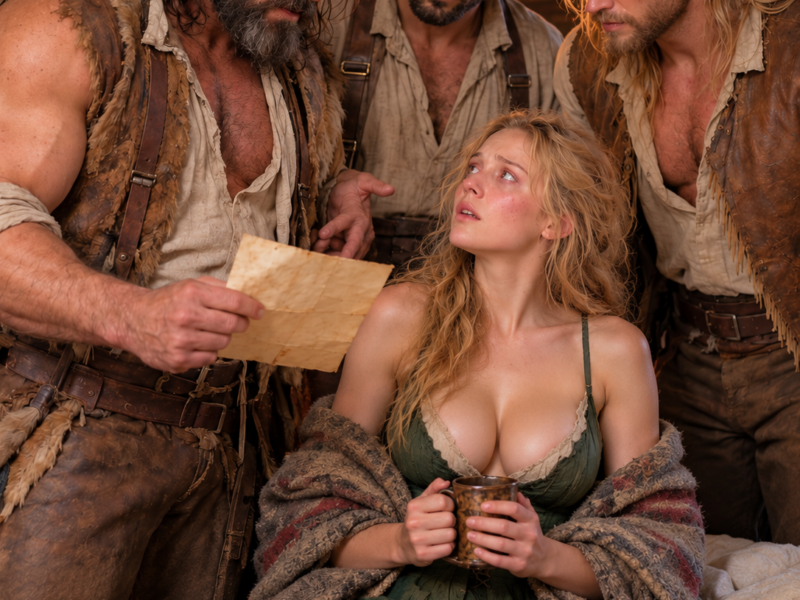
“By Spring You’ll Birth Us Three Sons,” They Said — 3 Mountain Men Found More Than a Frozen Stranger
“By Spring You’ll Birth Us Three Sons,” They Said — 3 Mountain Men Found More Than a Frozen Stranger
PART 1
The winter of 1882 arrived early in the Wyoming Territory, bringing with it a storm so fierce that even the oldest mountain men feared what it might leave behind. Snow buried the narrow trails, wind tore through the pine forests, and the mountains disappeared beneath a wall of white. Somewhere in that frozen wilderness, a young woman was fighting to stay alive. She had no idea that three men were searching for her, or that the promise their family had guarded for more than twenty years was about to come true.
Her name was Miriam Zuk. She was twenty-four years old, and until a few months earlier, she had believed her entire life would be spent in a small religious settlement called New Bethlehem.
Miriam had never been a rebellious girl. She believed in honest work, quiet prayers, freshly baked bread, and the comfort of familiar voices. Since losing her parents in a spring flood when she was fifteen, she had lived with her grandparents. Her grandmother, Adeline, had become her closest companion, teaching her everything from baking to sewing, while her grandfather, Elder Zuk, gave her the kind of protection that only a man who has already lost too much can offer.
But their peaceful existence began to collapse when Bishop Obadiah Krauss turned his attention toward Miriam.
Krauss was seventy years old, a powerful religious leader who had buried three wives and believed that every woman in his community existed to serve the order he controlled. He had already arranged three potential marriages for Miriam. She had refused all three. She wanted a life of her own, and she had never believed that being unmarried at twenty-four made her worthless.
Unfortunately, Krauss disagreed.
One morning, while Miriam was removing fresh loaves from the stone oven, the meetinghouse bell rang seven times. In New Bethlehem, seven rings meant the bishop had summoned someone.
Her grandmother looked up from the butter churn. Their eyes met, and neither needed to ask why.
Miriam removed her apron, straightened her lavender dress, kissed Adeline’s forehead, and walked toward the meetinghouse.
Inside, the congregation waited in uncomfortable silence. Krauss stood behind the pulpit, dressed in his familiar black coat. He spoke about Miriam’s refusal to accept three suitable marriage offers, her age, and the responsibility of a woman who had no father to arrange her future.
Then he announced his decision.
He intended to make Miriam his fourth wife.
The room went silent.
Miriam stared at him, unable to believe that the man who had baptized her, preached at her parents’ funeral, and claimed to guide their community could speak about her future as though she were a piece of property.
Krauss gave her thirty days to accept. If she refused, she would be expelled from New Bethlehem forever.
She walked home alone through the snow.
Adeline was waiting at the door. She held her granddaughter tightly, and for the first time in weeks, Miriam saw genuine fear in the old woman’s eyes.
That evening, Adeline promised to tell her a secret. There was a box hidden beneath the pantry floorboards, placed there years earlier by Miriam’s mother. Inside was the truth about their family, the reason Krauss had become interested in Miriam, and the story of a woman who had escaped him long before.
But Adeline never got the chance to explain.
The following morning, Miriam found her grandmother dead in bed. A cup of tea sat beside her, only half empty. It had been brought to the house the previous evening by a servant from Krauss’s residence.
Nobody accused the bishop. Nobody dared.
At the funeral, Krauss preached about obedience and the importance of accepting God’s will. Miriam sat beside her grandfather, holding his trembling hand, and understood that the community she had once considered home had become a place where even grief could be controlled.
That night, after her grandfather had fallen asleep, she searched beneath the pantry floor.
There she discovered a small cedar box containing a pressed flower and a letter written in her mother’s careful handwriting.
The letter began with words that made Miriam’s heart tighten.
My Miriam, if you are reading this, then I am gone, and your grandmother has finally been unable to keep the truth from you.
Her mother explained that Miriam’s maternal aunt, Hanalore, had disappeared when she was nineteen. The family had been told that she died in the mountains, but the truth was different. Hanalore had escaped west to avoid becoming another victim of Bishop Krauss.
She had married a mountain man named Bram and built a new life far beyond New Bethlehem. She had sent occasional letters home, assuring her family that she was safe.
Then those letters had stopped.
Miriam’s mother had never forgotten her sister. She had kept the secret because she feared Krauss would eventually come for Miriam as well.
The final paragraph contained a warning.
If the bishop ever tried to claim her, Miriam must refuse him. She must leave New Bethlehem, travel west, and find Hanalore’s family. They would recognize her by her blood.
Her mother also mentioned something unusual about the women in their family, something that had been misunderstood for generations.
Miriam folded the letter and pressed it against her chest.
For the first time since her grandmother’s death, she knew exactly what she had to do.
Before dawn, she packed two dresses, stockings, a wool cloak, a small knife, a tinderbox, some cheese, three biscuits, and the last loaf of bread she had baked with Adeline. She tucked the letters and pressed flower into her bag, kissed her sleeping grandfather on the forehead, and whispered an apology.
Then she walked into the darkness.
For three days, Miriam traveled west, following the mountain star her father had once taught her to recognize. She hid whenever she heard horses and slept wherever she could find shelter. The biscuits disappeared quickly, and the cold became increasingly difficult to endure.
On the third day, a terrible storm swallowed the trail.
The wind pushed her sideways. Snow covered her footprints almost immediately. Her feet became numb, and her fingers could barely hold the strap of her bag.
She fell once, then forced herself up.
She fell a second time.
The third time, near a frozen creek, she could not rise again.
As the cold slowly stole her strength, she thought about her grandmother, her mother, and the life she had left behind.
At least, she thought, she had chosen her own path.
Then everything went dark.
When Miriam regained awareness, she felt enormous hands lifting her from the snow. Someone wrapped her in blankets. Another person was removing her frozen boots while a third prepared a fire.
A deep voice spoke close to her ear.
“Stay with us, little dove. You’re not finished yet.”
She wanted to answer, but she could not.
For four days, Miriam burned with fever in a remote mountain cabin. Three men took turns watching over her. They warmed her body, treated her frostbitten toes, and refused to let her slip away.
On the fourth morning, she finally opened her eyes.
Above her was a ceiling of thick wooden beams. A large fireplace illuminated the room, and she was lying in a real bed beneath several heavy quilts.
Beside her sat an enormous man with shoulder-length chestnut hair, a thick beard, and storm-gray eyes. He was reading an old book, but the moment she moved, he closed it.
“My name is Fletcher Hargrove,” he said gently. “You’re in my home. You’ve been very ill, but you’re safe now.”
Miriam tried to speak, but her throat was painfully dry.
Fletcher told her not to force herself. Then he stood and called down the hallway.
“She’s awake. Come.”
Two other men appeared in the doorway.
The first was Devlin Marchwood, a tall, broad-shouldered man with dark hair, spectacles, and intelligent eyes. He had some medical training and had been responsible for treating Miriam’s frostbite and fever.
The second was Renard Pike, a younger man with golden-blond hair and bright green eyes. He wore a leather vest and carried an easy smile that seemed strangely out of place in such a serious room.
“Well,” Renard said, “you certainly gave us a fright.”
Fletcher gave him a warning look.
Renard ignored it and told Miriam that she had been unconscious for four days. He also confessed that he had attempted to bake bread for her because she had murmured the word while suffering from fever.
“It isn’t very good,” he admitted. “But I tried.”
Miriam managed a faint smile.
She thanked them, and for the first time in months, she felt no immediate fear when a man entered the room.
The following evening, the three brothers returned with a small leather envelope.
Fletcher explained that they had found a letter among her belongings. Devlin had carefully dried it after discovering that the paper was damp. They had read enough to understand that Miriam was connected to someone they had loved very dearly.
Her aunt Hanalore.
Miriam whispered the name.
Fletcher explained that Hanalore had arrived at their cabin twenty-five years earlier. She had married their uncle Bram and helped raise the three brothers after their mothers died. She had been the heart of their household for two decades.
She had also spoken about Miriam many times, even though she had never met her.
Before dying five years earlier, Hanalore had left them a letter and made them promise something.
If a woman from her sister’s family ever arrived at their door, especially during a storm, they were to protect her and honor the promise written in that letter.
Fletcher unfolded the old paper.
His voice became unusually solemn.
Then he read the sentence aloud.
“By spring, you’ll birth us three sons.”
Miriam stared at him.
The cup in her hands trembled.
“That’s impossible,” she whispered.
Fletcher carefully folded the paper.
“Perhaps,” he answered. “But Aunt Hanalore was never wrong about the things that mattered.”
He did not ask Miriam to believe anything. He simply placed the letter beside her bed, where she could reach it or destroy it whenever she wished.
And somehow, that small gesture made her cry.
For the first time in months, she was surrounded by people who wanted nothing from her.
Outside, the storm continued to rage. Far away in New Bethlehem, Bishop Krauss was already making plans to find the woman he believed had disappeared forever.
He had no idea that Miriam had found the one place where his authority meant absolutely nothing.
And he certainly did not know that the three men who had rescued her were about to become the greatest obstacle he had ever faced.
PART 2
Eighteen days passed, and Miriam slowly recovered. She learned that Fletcher was quiet but fiercely protective, Devlin was a thoughtful man who loved books and medicine, and Renard was a cheerful soul who hid his pain behind laughter.
They taught her to ride, shoot, and navigate the mountain trails. She helped restore Hanalore’s kitchen, baked bread, and filled the cabin with laughter again.
One evening, Fletcher told her about a young woman he had once loved. Bishop Krauss had claimed her for himself, and she had taken her own life rather than submit.
Miriam finally understood why Fletcher hated the bishop.
She also understood that she was no longer merely a rescued stranger.
She was becoming part of their family.
PART 3
Winter settled over the Wyoming mountains with a determination that made the entire world seem frozen in time. Snow covered the cabin roof, buried the trails, and transformed the surrounding forest into a kingdom of white silence.
Yet inside Fletcher Hargrove’s home, life had never felt warmer.
Miriam had been living with the three brothers for several weeks, and the differences between them had become familiar comforts.
Fletcher was the first to rise each morning. He checked the animals, inspected the woodpile, and rode out to examine the traps. He rarely spoke unnecessarily, but Miriam discovered that his silence was never empty. He noticed everything.
Devlin spent much of his time in the workshop behind the cabin. He kept medical books, herb collections, and handwritten notes organized with almost unreasonable precision. He had a habit of forgetting meals when absorbed in his work, so Miriam began leaving food beside his books.
Renard, meanwhile, seemed determined to make every ordinary day an adventure. He talked constantly, teased his brothers, and somehow managed to turn even a broken fence into a reason for laughter.
Miriam found herself learning their habits as naturally as she had once learned the rhythm of her grandmother’s kitchen.
On the nineteenth day, Fletcher took her riding.
He brought out a strong chestnut mare named Kestrel, explaining that the animal had belonged to Hanalore. Miriam already knew how to ride, having grown up around horses, but mountain riding was different from traveling along the flat roads near New Bethlehem.
Fletcher showed her how to handle the steep paths and loose stones.
At the top of a ridge, they stopped to look across the valley. The mountains stretched endlessly beneath the winter sky.
“Are you grieving?” Fletcher asked.
Miriam turned toward him.
He explained that she had lost her parents, grandmother, home, and nearly her own life before reaching twenty-five.
She did not answer immediately.
Then she admitted that she had been grieving for so long that she had almost forgotten what it felt like to be happy.
Fletcher nodded.
“You don’t have to stop grieving to begin living again.”
Those words stayed with her.
The following day, Devlin attempted to teach her Latin. He placed a book on the kitchen table and pointed to a familiar word.
“Amor,” he explained. “Love.”
Miriam admitted she had heard the word before.
Devlin questioned her knowledge until she accused him of showing off. For once, he laughed.
Fletcher, carrying firewood through the room, stopped in surprise.
“Devlin laughed,” he announced.
Renard came running from the hallway, demanding to hear it again.
The brothers began arguing about whether Devlin had actually laughed, and Miriam eventually collapsed against the table, laughing harder than she had in years.
That evening, she realized something extraordinary.
She no longer felt like a guest.
She felt at home.
On the twenty-first day, Renard taught her to shoot. She missed several bottles before finally hitting one. After that, her accuracy improved quickly.
Renard was impressed.
He also told her that Hanalore had always insisted people deserved kindness simply because they existed. She had treated him that way when he arrived at the cabin as a frightened twelve-year-old orphan.
Miriam asked why he was so determined to make her feel welcome.
“Because Aunt Hanalore was kind to me,” he replied. “She’s not here to do it for you, so I suppose someone has to.”
Miriam turned away before he could see the tears in her eyes.
That evening, Fletcher finally told her about the woman he had once intended to marry.
He had been twenty-two when he met her. She was seventeen, and they had fallen in love. He had asked her father for permission to marry her, and she had accepted because she believed Fletcher offered her a chance to escape the control of her religious community.
But Bishop Krauss had already decided that the girl would become his fourth wife.
Her father refused Fletcher’s request.
The young woman eventually died by suicide in her father’s barn, two nights before the wedding.
Fletcher had received the news weeks later.
He never forgot her.
Miriam listened without interrupting. When he finished, she reached across the space between them and placed her hand over his enormous one.
He allowed her to hold it.
For a long time, neither spoke.
By the twenty-third day, Miriam understood that her feelings for the three brothers had changed.
She loved Fletcher’s strength and quiet loyalty. She loved Devlin’s intelligence and the gentleness he tried so hard to conceal. She loved Renard’s laughter and the kindness beneath it.
She did not love them in identical ways.
She loved each of them as an individual.
And for the first time, she allowed herself to imagine a future that did not resemble anything she had been taught.
When the new year arrived, Miriam called the three men into the main room.
She stood beside the fireplace and told them she had made a decision.
She would never return to the church that had taken her grandmother, destroyed Fletcher’s first love, and treated women as possessions.
But she was not leaving the cabin either.
She wanted to remain with them.
Not as a dependent relative or a temporary guest, but as someone who had chosen them.
She proposed making a mountain vow beneath the great pine tree, just as Hanalore and Bram had once done.
Fletcher warned her that she did not need to marry anyone to remain their family.
She understood.
That was precisely why she wanted to choose.
Devlin admitted that he was not an easy man. He could be distant, obsessive about his work, and difficult to reach emotionally. He had once loved a woman at seminary, but she had died of an illness he could neither identify nor cure.
He had not allowed himself to love anyone again for eleven years.
Until Miriam.
Renard was already crying.
He promised to make her bread every morning, even if the crumb remained uneven.
Fletcher finally agreed.
That night, beneath the stars, the four of them stood together beneath the pine tree.
Miriam placed her hand over Fletcher’s heart.
“I see you. I choose you. I will not be moved.”
She repeated the words for Devlin and Renard.
Each man answered with the same promise.
Then Fletcher took a braided leather cord and tied it around their wrists. He cut the cord into four separate pieces so that each would carry part of the same bond.
Miriam looked down at the leather around her wrist.
For the first time, she understood that love could be a choice rather than an obligation.
The following weeks brought another surprise.
Devlin noticed that Miriam was unusually tired and had begun avoiding certain foods. He watched her carefully before finally sitting her down at the kitchen table.
He explained that the women in Hanalore’s family appeared to carry a rare inherited reproductive pattern called hyperovulation. It could cause the release of multiple eggs during one cycle, increasing the possibility of fraternal twins or triplets.
Hanalore had experienced it. Miriam’s mother had mentioned similar symptoms, and now Devlin believed Miriam might carry the same trait.
The letter had not necessarily been a supernatural prophecy.
It could have been an observation made by a woman who understood her family’s unusual biology long before modern medicine could explain it.
Miriam listened, then began to laugh through her tears.
“So I am not cursed?”
“No,” Devlin answered gently. “You are simply a woman with a rare body.”
She placed a hand over her stomach.
Then she asked him to tell the others.
Fletcher responded by quietly building a cradle in the workshop. A few days later, another appeared. Then a third.
He insisted the extra two were merely spares.
Renard found this extremely amusing.
But their happiness did not last uninterrupted.
One afternoon, Renard returned from a distant valley looking unusually pale.
He had seen a traveling peddler speaking with a man dressed in black. The stranger was one of Krauss’s associates.
Worse, the peddler had mentioned the cabin.
He had revealed that a young woman was living there.
Renard confessed that he had spoken carelessly to the peddler several weeks earlier, before realizing how dangerous the information might be.
Fletcher’s expression hardened.
How long before Krauss’s men arrived?
Two or three days, Renard estimated.
Then came the worst news.
The peddler had also revealed that Miriam’s grandfather was still alive.
Krauss had imprisoned Elder Zuk in a locked room inside the elders’ residence, feeding him barely enough to survive. The bishop had told the community that Miriam had frozen to death in the mountains and that her grandfather was too grief-stricken to appear in public.
Miriam felt the room tilt.
Her grandfather was alive.
And he was waiting for her.
She immediately began explaining the layout of New Bethlehem, the hidden passages, and the location of the room where Krauss had imprisoned him.
Fletcher tried to remind her that she was carrying three children.
She told him she was not going to ride into the village.
They were.
She would give them every detail necessary to rescue her grandfather.
The brothers exchanged glances.
Then Fletcher gave his orders.
Devlin would prepare the wagon. Renard would ready the horses. Fletcher would lead the rescue.
Before leaving, he placed one enormous hand over Miriam’s stomach.
He told her that he had already lost someone because of Krauss, and he could not bear to lose her too.
Miriam covered his hand with hers.
“Come home,” she whispered.
The three men rode into the darkness.
Miriam returned to the cabin, loaded the rifle Renard had taught her to use, and sat in Fletcher’s chair facing the door.
She had survived the mountains.
She had escaped the bishop.
Now she was waiting for the people she loved to return.
PART 4
At three o’clock in the morning, the three brothers reached New Bethlehem.
The village was asleep beneath a thick blanket of snow. From the trees above the settlement, Fletcher could see the meetinghouse, the elders’ residence, and the faint light of a window on the ground floor.
Miriam had described it perfectly.
That was where her grandfather was being held.
Fletcher reviewed the plan.
Renard would disable the horses in Krauss’s stable. Devlin would enter through the rear door and locate the prisoner. Fletcher would approach the front entrance and draw attention away from them.
Before separating, Renard looked at his eldest brother.
“Don’t die tonight, Fletch.”
Fletcher placed a large hand against his younger brother’s cheek.
“Move.”
The three men disappeared into the darkness.
Fletcher reached the elders’ residence first. Two guards were sleeping near the entrance. He dealt with them quickly, entered the building, and found the locked room Miriam had described.
The padlock was new, but the wooden frame was old.
Fletcher tore the lock from its fittings.
Inside, an elderly man lay on a narrow cot.
His beard was untrimmed, his clothes hung loosely from his weakened body, and his hands rested on his chest as though he had already prepared himself for death.
He opened his eyes.
“Are you the answer?” he whispered.
Fletcher knelt beside him.
“My name is Fletcher Hargrove. Your granddaughter sent me.”
The old man’s eyes filled with tears.
“Kind? Is she alive?”
“She’s alive. She’s safe. She’s waiting for you.”
Elder Zuk closed his eyes and whispered a prayer of gratitude.
Fletcher lifted him carefully and carried him outside, where Devlin was waiting with a prepared wagon, warm broth, blankets, and a coat.
Devlin took responsibility for the old man’s care.
But before they could leave, a rifle shot rang out from the direction of the barn.
Renard.
Fletcher immediately mounted his horse.
He ordered Devlin to take Elder Zuk home and not turn back.
Then he rode toward the sound.
He found Renard lying in the snow. A young man stood nearby with a smoking rifle, his hands trembling.
Six horses wandered loose around the yard.
Renard had succeeded in disabling the tack, but one of Krauss’s men had caught him.
Fletcher rode the frightened attacker down and jumped from his horse.
Renard was conscious, but blood was spreading beneath his hand.
“Fletch,” he whispered. “Did we get him?”
“We got him.”
“Then that’s fine.”
Fletcher pressed his coat against the wound and lifted his brother into his arms.
He refused to let Renard speak another word.
The journey back was brutal.
Fletcher carried his injured brother while Devlin drove the wagon with Elder Zuk wrapped in blankets. They traveled through the remaining darkness and continued long after sunrise.
When the cabin finally appeared through the pines, Miriam was already outside.
She had heard the horses approaching.
Then she saw Renard.
For one terrible moment, she could not move.
But she did not scream.
Instead, she immediately began giving instructions.
Devlin was to prepare the kitchen table. Fletcher would boil water. Her grandfather needed to be placed beside the fire.
Renard was carried inside.
Devlin cut away his clothing and examined the wound. The bullet was still lodged inside.
He admitted that he had never performed such an operation on a living person.
Miriam looked directly into his eyes.
“You are the best chance he has.”
Devlin gathered his instruments.
Fletcher held Renard’s shoulders while Miriam held his hand.
The operation lasted one hour and twelve minutes.
Devlin finally removed the bullet. It had lodged near a rib without damaging Renard’s abdominal organs.
He stitched the wound, applied medicinal herbs, and wrapped it tightly.
When he stepped back, his hands were shaking.
“He’s going to live,” he whispered. “If the fever doesn’t take him.”
Miriam leaned over Renard and pressed her forehead against his.
“You promised me bread every morning.”
Renard barely opened his eyes.
“Uneven crumb,” he murmured.
She laughed and cried at the same time.
Three days later, his fever broke.
Elder Zuk was also recovering. He could sit upright, eat without assistance, and speak for longer periods.
On the fourth day, he asked Miriam to sit beside him.
There was something he needed to tell her.
Something about Krauss.
He revealed that the bishop had never been the rightful leader of New Bethlehem.
Decades earlier, a man named Bishop Minhard had been the legitimate religious authority. Krauss had arrived claiming to have official papers from Ohio, but something about his appointment had been questionable.
Minhard had confronted him privately.
He never returned.
The community claimed that his horse had thrown him into a creek. But Elder Zuk, who had been a young man at the time, had helped recover the body.
He remembered marks that could not have been caused by a fall.
He had remained silent out of fear.
There had been other witnesses. Two elders had eventually signed a confession describing what Krauss had done, but the document had disappeared.
Adeline had known where it was hidden.
She had placed it inside a jar behind the pear preserves in the family’s old fruit cellar.
If the document still existed, it could finally bring Krauss down.
Miriam listened carefully.
Then she looked toward Fletcher.
“We have to get it.”
Renard protested from his bed that he wanted to come, but Devlin ordered him to remain where he was.
The next morning, Fletcher and Devlin prepared the wagon. Miriam insisted on accompanying them, despite their concerns about her pregnancy.
They reached New Bethlehem near dusk.
But something was wrong.
Smoke was rising above the village.
Miriam stood in the wagon and recognized the house immediately.
Her old home was burning.
Fletcher started forward, but Devlin caught his arm.
“Look.”
Down in the village, the residents were forming a line between the well and the burning house. Women, men, and children were carrying buckets together.
They were trying to save it.
And for the first time, Miriam saw that the people of New Bethlehem were no longer standing quietly behind Krauss.
When the three travelers entered the village, the crowd stopped.
A woman dropped her bucket.
“Miriam?”
It was Ruth Yoast, the baker’s wife who had taught Miriam to braid bread when she was a child.
Ruth stared at her as though she were seeing a ghost.
The bishop had told everyone Miriam was dead.
But there she stood.
Alive.
Pregnant, though her cloak concealed it, and accompanied by two enormous mountain men.
Other villagers stepped forward. Some admitted that they had suspected Krauss was lying. Others had seen the locked door of the elders’ residence but had been too frightened to ask questions.
Miriam did not waste time accusing them.
She explained where the document was hidden.
Ruth immediately turned toward her husband.
The two of them ran toward the burning house.
Minutes later, Ruth returned carrying a stone jar blackened with soot.
Inside, beneath the old preserves, was a folded letter.
Miriam opened it carefully.
The document contained the names of the men who had witnessed Krauss’s crime. It described Bishop Minhard’s murder, identified the location, and bore the signatures of two elders who had risked their lives to record the truth.
The crowd gathered around her.
Miriam read every word aloud.
When she finished, an elderly woman stepped forward.
She was Bishop Minhard’s widow.
For decades, she had been told that her husband had died in an accident. Now, hearing the truth, she began to weep uncontrollably.
The crowd changed.
People who had once been afraid to speak began moving toward the bishop’s residence.
Miriam walked with them.
Fletcher remained at her side.
Krauss stood on his front steps, watching the gathering crowd approach. At first, he appeared merely irritated.
Then he saw the letter in Miriam’s hands.
His expression changed.
He understood.
For the first time in forty years, the man who had controlled New Bethlehem was standing before people who were no longer willing to obey him.
He attempted to explain that there had been a misunderstanding.
Miriam stepped forward.
“My name is Miriam Zuk Hargrove,” she said. “My grandfather is alive. My grandmother is dead. And you will answer for what you have done.”
Krauss looked at her coldly.
“You have always been trouble,” he said.
Miriam held his gaze.
“You should have seen this coming.”
Fletcher stood between them, while Devlin remained close enough to prevent Krauss from reaching for anything hidden in his coat.
The elders finally acted.
They restrained Krauss with rope taken from his own barn and locked him inside his study. Messengers were dispatched to the nearest legitimate bishop and territorial authorities.
The truth had survived.
And Miriam had brought it home.
PART 5
That night, Miriam slept in her grandmother’s old bed for the first time since leaving New Bethlehem.
She did not dream of the bishop.
In the morning, the villagers gathered to say goodbye. Ruth Yoast brought three fresh loaves of bread, insisting they were for the young man who had been injured protecting Miriam’s grandfather.
She also offered to send her daughter, an experienced midwife, whenever the babies were ready to arrive.
Miriam accepted.
Then she returned to the mountains with Fletcher and Devlin.
At the cabin, Renard was already sitting beside the fireplace, pale but smiling. He tried to stand when he saw her, but Fletcher immediately pushed him back into his chair.
Miriam kissed his forehead and handed him the bread.
Renard looked at it with the happiness of a starving man who had just discovered a treasure.
“See?” he whispered. “You always bring me something good.”
The months that followed were filled with a happiness Miriam had never imagined possible.
Bishop Krauss was eventually stripped of his religious authority and handed over to the territorial authorities for the murder of Bishop Minhard. His trial exposed years of abuse, intimidation, and manipulation.
Three young women testified about what he had attempted to do to them when they were fifteen, sixteen, and seventeen.
The community finally heard their stories.
Krauss was found guilty and died in prison two years later.
New Bethlehem appointed a new bishop, a younger man who believed that faith should never be used to control another human being.
Miriam never returned to the meetinghouse.
She had built a different kind of home.
Her grandfather, Elder Zuk, decided to remain in the mountains permanently. He built a rocking chair for the porch and spent his days reading his Bible, watching the children of the household, and telling stories about the woman he had once feared he would never see again.
Renard recovered slowly.
Fletcher refused to let him lift anything heavier than a loaf of bread for several weeks, which Renard considered a personal insult.
Devlin monitored his recovery carefully and eventually returned to his medical work.
Meanwhile, Miriam’s pregnancy progressed.
She grew rounder each month, and Fletcher built a special chair beside the fireplace so she could sit comfortably.
Renard joked that she resembled a beautiful loaf of bread rising in the oven.
Even Devlin laughed.
The three cradles Fletcher had built were no longer a secret.
He still insisted that two were spares, but nobody believed him.
When spring finally arrived, the snow began melting along the mountain trails. Streams reopened, wildflowers appeared in the meadows, and birds returned to the pine trees.
Then, one afternoon, Miriam went into labor.
Ruth Yoast arrived the previous week and worked alongside Devlin throughout the delivery. Fletcher held Miriam’s left hand. Renard held her right and sang the old mountain songs Hanalore had taught him when he was twelve.
Elder Zuk sat nearby with his Bible open, quietly reciting German prayers.
The labor lasted eleven hours.
The first child arrived at sunset.
A boy with dark chestnut hair and storm-gray eyes.
Miriam looked toward Fletcher.
His face was wet with tears.
“Wilder,” she whispered.
Fletcher carefully lifted his son and held him against his chest.
The second boy arrived half an hour later. He had dark hair and an unusually thoughtful expression, even in his first moments.
Miriam named him Ashen.
Devlin, who had remained composed throughout the delivery, finally broke down. He placed his instruments aside, pressed his forehead against the wall, and wept.
For eleven years, he had believed that happiness was something he could never experience again.
Now he was holding his own son.
The third baby arrived almost an hour later.
He was smaller than his brothers, but he had the loudest voice and the strongest lungs. His hair was golden blond, just like Renard’s.
Miriam named him Sunder.
Renard kissed her forehead, then carefully held the tiny boy.
“Three sons,” he whispered. “Just like the letter said.”
Miriam smiled.
“Just like the letter said.”
Outside, the first true thaw of spring was beginning. Water dripped from the roof, and a robin sang from the pine tree beside the cabin.
Three enormous men stood around the bed, each holding a newborn son.
Miriam looked at them and finally understood what Hanalore had meant.
The prophecy had never really been about three babies.
It had been about creating a family.
Miriam had arrived at their cabin half frozen, frightened, and convinced that her life was over. Instead, she had brought something into that house that none of them knew they had been missing.
She had brought hope.
She had helped Fletcher learn that loving again did not mean forgetting the woman he had lost.
She had helped Devlin understand that his knowledge could save lives, not merely remind him of the ones he had failed to save.
She had helped Renard discover that his laughter could become something more than protection against loneliness.
She had brought her grandfather back from a prison where he might otherwise have died.
And she had helped an entire village find the courage to challenge a man who had controlled it for forty years.
By spring, she had given birth to three sons.
But she had also given birth to a new life for everyone who had welcomed her.
The years passed.
The boys grew quickly. Wilder walked first, Ashen spoke first, and Sunder laughed first. Their personalities were different, but each carried something of the three men who had raised them.
Elder Zuk lived another four years in the mountains. He spent his final days watching his great-grandchildren play outside and reading his Bible on the porch.
When he died, Miriam held his hand.
His final words were that her mother, grandmother, and aunt would have been proud.
Miriam never forgot them.
Ruth Yoast continued visiting every spring, bringing bread and stories from New Bethlehem. The boys adored her, and she became another grandmother in their lives.
Fletcher remained the steady heart of the household. He loved Miriam every day, not because a letter had predicted it, but because he continued choosing her.
Devlin eventually published a medical pamphlet about hyperovulation and inherited patterns of multiple births. He used his initials and a different surname to protect his family’s privacy.
His dedication was simple:
For the women who came before the science.
He wanted other women to understand that unusual bodies were not curses, signs of witchcraft, or supernatural warnings.
They were simply human.
Renard became one of the finest bakers in the western mountains. He sold bread at the Steinsburg market twice each month, and every loaf carried a small arrowhead pressed into its crust, the symbol of the scar on his shoulder.
He never quite mastered perfectly even bread.
But Miriam always told him it tasted better that way.
The cabin eventually expanded. More rooms were added, the kitchen grew larger, and the property became home to children, grandchildren, and generations of people who had chosen to remain close.
Miriam lived to be eighty-one.
She raised her three sons to understand that family was not something another person could force upon them. It was something built through loyalty, kindness, and daily choices.
She taught them that faith was not a building or a title. It was the way people treated one another when nobody was watching.
She kept Adeline’s recipes in a small leather book and stored her mother’s letter beside Hanalore’s in the cedar box.
Sometimes, she took the letters out and read them again.
She remembered the girl who had walked away from New Bethlehem with a small bag, three biscuits, and a desperate hope that somewhere beyond the mountains there might be a life worth living.
She remembered falling beside the frozen creek.
She remembered the enormous hands that had lifted her from the snow.
And she remembered the sentence Fletcher had read aloud beside the fireplace.
“By spring, you’ll birth us three sons.”
The bishop had believed Miriam was nothing more than a woman whose future he could purchase with religious authority.
He had called her disobedient.
He had called her a burden.
He had believed she would disappear quietly into the mountains and never trouble him again.
But he had been wrong.
Miriam had become a mother, a wife, a healer, and the keeper of a family that would outlive him by generations.
On the final morning of her life, she woke before sunrise.
She wrapped Adeline’s old wool shawl around her shoulders and slowly walked onto the porch.
The sun was beginning to rise over the ridge. The pines moved gently in the morning wind, and somewhere in the meadow, her great-grandchildren were laughing.
She lowered herself into her grandfather’s old rocking chair.
For a moment, she closed her eyes.
Then she whispered the names of the women who had brought her there.
“Grandmother Adeline. Mama. Aunt Hanalore.”
Her voice was weak, but her smile remained.
“I did it. I chose.”
The wind moved through the trees.
She thought of the three men who had once stood beside her bed, of the three little boys who had arrived in the spring, and of the generations that had followed.
She had spent her youth being told that a woman’s purpose was to obey.
But her life had taught her something entirely different.
A woman’s life belonged to her.
Her heart belonged to her.
And her family was hers to choose.
Miriam Zuk Hargrove smiled as the sunlight reached the porch.
Then, peacefully, she went home.