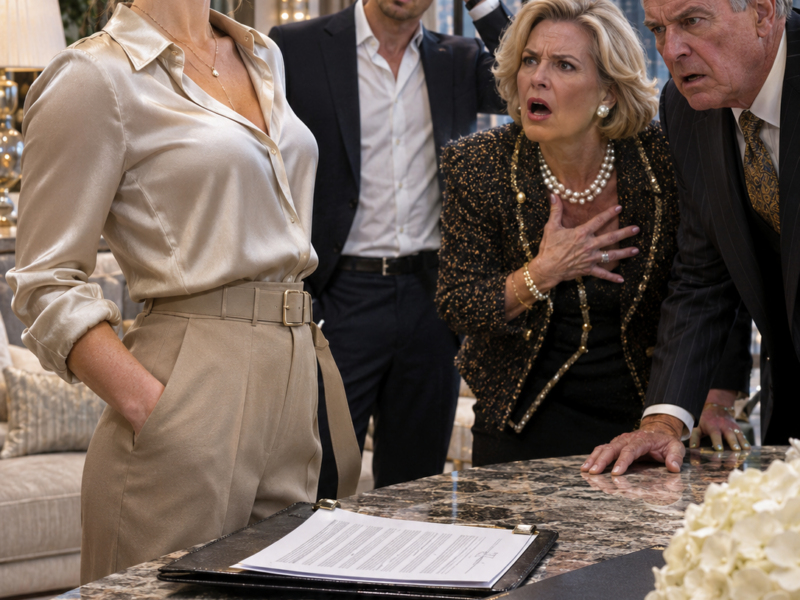
At Thanksgiving, My Wealthy In-Laws Humiliated Me, Called Me a Gold Digger, and Slid a 41-Page Postnuptial Agreement Across the Table, Demanding I Sign Away Any Claim to Their Family Fortune. My Husband Was Furious, but I Calmly Placed a Thin Blue Folder in Front of His Mother. When She Saw the $9.7 Billion Company Listed Inside, Her Face Went White. But That Was Only the Beginning—Because My Brother-in-Law Had Just Made a Terrible Mistake, and I Was About to Discover Why He Was So Desperate for My Husband’s Signature.
At Thanksgiving, My Wealthy In-Laws Humiliated Me, Called Me a Gold Digger, and Slid a 41-Page Postnuptial Agreement Across the Table, Demanding I Sign Away Any Claim to Their Family Fortune. My Husband Was Furious, but I Calmly Placed a Thin Blue Folder in Front of His Mother. When She Saw the $9.7 Billion Company Listed Inside, Her Face Went White. But That Was Only the Beginning—Because My Brother-in-Law Had Just Made a Terrible Mistake, and I Was About to Discover Why He Was So Desperate for My Husband’s Signature.
PART 1
On Thanksgiving, my mother-in-law slid a 41-page postnuptial agreement across her dining room table and told me to sign it if I wanted to prove I wasn’t a gold digger.
Her family lawyer was sitting three seats away, eating turkey as though this were an ordinary family dinner. My brother-in-law laughed. My father-in-law threatened to throw me out of the house. And my husband’s former girlfriend sat beside him, smiling like she had already won something.
My husband, Graham, went completely pale.
I didn’t argue. I didn’t cry. I didn’t even raise my voice.
Instead, I reached into my brown leather tote bag, pulled out a thin blue folder, and slid it across the table toward my mother-in-law.
Because what the Whitcomb family didn’t know was that the woman they had spent five years treating like an insignificant nobody actually owned 64% of a company valued at $9.7 billion.
And the contents of that blue folder were about to expose something far more disturbing than their prejudice.
My name is Tessa Marlo. I’m 34 years old, and I live in Stamford, Connecticut, with my husband, Graham. I run a company most people have never heard of, even though millions of people have probably eaten food that passed through one of our refrigerated warehouses.
My company is called Howiard Cold Chain. We operate more than 140 facilities across the country and employ approximately 21,000 people.
But if you asked my in-laws what I did for a living, they would tell you I handled shipping paperwork.
I had never bothered correcting them.
My husband’s family lived on Roundhill Road in Greenwich, Connecticut, in a magnificent white Georgian house with black shutters, a circular driveway, and four acres of perfectly maintained lawn. A crew of six men came every Thursday from April through November to keep the property looking like something from a luxury real estate magazine.
Preston Whitcomb, my father-in-law, was 67. His wife, Constance, was 64. Their family had been established in Greenwich since the 1940s, and they took enormous pride in their history.
They owned Whitcomb Provisions, a seafood and produce distribution business founded in 1926. For nearly a century, the company had supplied restaurants throughout New England.
Their older son, Hollis, was 40 and ran the business.
Their younger son, Graham, was 36 and taught American history to sophomores at Stamford High School.
In his parents’ eyes, Graham was the disappointment.
He had inherited a substantial trust, owned a significant interest in the family company, and yet had chosen to become a public school teacher instead of joining the family business.
I loved that about him.
We had been married for three years, and our relationship was one of the few things in my life that had never felt like a negotiation.
We met five years earlier in a coffee shop in downtown Minneapolis.
I was working on a spreadsheet about cooling capacity in our Dallas warehouses when a tall man wearing a corduroy jacket and a conference lanyard tripped over my laptop bag.
He managed to spill an entire large dark roast across my keyboard.
His name was Graham.
He looked horrified. He apologized at least twenty times and insisted on buying me a replacement laptop that afternoon.
It cost him $1,400, which I later discovered was most of what he had saved that year.
On our third date, I told him about my company.
He listened quietly, then looked at me and said, “Okay, so you can pay for dinner.”
I laughed so hard I nearly knocked over my water.
That was when I knew I had found someone different.
I never hid my company from Graham. But I also never introduced myself to his family as a billionaire.
I simply told them I worked in operations for a logistics company.
That was true.
They heard what they wanted to hear.
My father had been a truck driver in Duluth, Minnesota. He spent most of his life transporting frozen food across the Midwest. When I was young, he sometimes let me ride along during school breaks.
He taught me everything I knew about refrigerated transportation.
He also taught me something that became the foundation of my business.
“The cold doesn’t lie, Tess,” he used to say. “People do. So write everything down.”
He kept a small spiral notebook in his truck, recording temperature readings every hour. When he died of a heart attack at 58, I kept those notebooks.
Years later, they would become more important than I could ever have imagined.
But first, I had to survive Thanksgiving with the Whitcombs.
We arrived at their house at 2:55 p.m. in my nine-year-old Volvo station wagon.
Hollis’s black Range Rover was already parked beside Preston’s Mercedes. A silver Porsche sat near the front steps.
Graham noticed it immediately.
“Whose Porsche is that?” he asked.
“I don’t know,” I replied.
He stared at the car for a moment.
“I have a bad feeling.”
Graham always had a bad feeling at his parents’ house. Usually, he was right.
When we walked inside, we discovered that the Porsche belonged to Sloan Ashby, Graham’s former girlfriend from college.
She was standing in the entrance hall wearing a cream cashmere sweater and diamond earrings. Constance had one arm around her waist, looking as though she had just welcomed home a beloved daughter.
“Graham, darling!” Constance exclaimed.
Then she turned toward me.
“Oh, hello. It’s Tess, right?”
We had met six times.
Sloan kissed Graham on the cheek and smiled at me.
Dinner was scheduled for four.
There were eleven people around the formal dining table. Preston sat at the head, Constance at the opposite end, and Hollis occupied the place beside his wife, Camille.
Camille was 38 and worked as a hospital administrator. She had been married to Hollis for eleven years.
She and I had developed an understanding over the years.
We passed each other the dinner rolls, exchanged sympathetic glances, and waited until we were alone in the kitchen to say what we really thought.
Constance had seated me at the children’s end of the table, beside Hollis’s nine-year-old twins.
Hollis noticed and laughed.
“Mom, you put Tessa at the kids’ table.”
Camille gave me a tired little smile.
She knew exactly how it felt.
During dinner, Constance asked whether I was still doing my little shipping paperwork.
“Still at it,” I answered.
She mentioned that Graham had told her I traveled to Minnesota frequently.
“That must be difficult for him,” she said. “Being married to someone who is away so much.”
Sloan immediately joined in.
“I could never be away from my husband that much if I had one.”
Then she looked directly at Graham.
I continued eating.
Over the previous five years, I had heard plenty of comments from this family.
At our wedding dinner, Constance had told a friend that Graham had found himself a nice girl from Minnesota whose father drove trucks.
When we purchased our $890,000 home in Stamford, Preston privately asked Graham how much trust money he had needed to put down.
At Easter, Hollis suggested that I probably couldn’t afford the membership fees at their country club.
I let it all pass.
I had learned that some people reveal themselves more clearly when you don’t interrupt them.
At 5:35, the pumpkin, pecan, and apple pies were served.
Constance tapped her fork against her water glass.
“Before everyone slips into a food coma, Preston and I have something we’d like to discuss as a family.”
She turned toward an older man wearing a tweed jacket.
“Lionel, would you?”
Lionel Hargrove was their family lawyer. He reached beside his chair, lifted a leather briefcase, and removed a thick document bound with a black spine and a clear plastic cover.
The document traveled down the table until Constance placed it directly in front of me.
A typed label read:
POSTNUPTIAL AGREEMENT BETWEEN GRAHAM P. WHITCOMB AND TESSA A. MARLO.
Graham immediately pushed his chair back.
“Mom, what is this?”
Constance smiled.
“It’s protection, darling. For you and for the family. Your grandfather would have insisted.”
Then she turned toward me.
“Tessa, I want you to understand that this isn’t personal. Graham has a significant trust. He owns 20% of a company that’s been in this family for a hundred years. And you came into this marriage with, well…”
She spread her hands.
“A station wagon and a job in Minnesota.”
Preston nodded.
“We’ve seen too many families lose everything because of the wrong marriage.”
I opened the agreement.
It was 41 pages long.
The first section claimed I had entered the marriage with no significant assets or income beyond my employment salary.
Another section required me to waive every possible claim to Graham’s family trust and his 20% interest in Whitcomb Provisions.
I would also surrender any right to alimony.
If we divorced, I would receive a single payment of $50,000.
There was also a confidentiality clause.
But page 34 caught my attention.
It stated that I would consent in advance to any future pledge, transfer, or encumbrance of Graham’s separate property and agree not to challenge such an action in court.
I read that paragraph twice.
It was an unusual provision.
The kind of provision someone included when they already had plans for another person’s money.
Underneath the agreement was another document, stapled separately, with a yellow sticky note pointing toward Graham’s name.
Constance quickly pulled it away.
“That’s for Graham. Just family business paperwork.”
She handed it to Hollis.
He folded it and slipped it into his blazer pocket.
I noticed Camille staring at that pocket.
Her expression had changed.
Graham was furious.
“This is insane. Tessa is my wife. You don’t get to ambush her at Thanksgiving with a lawyer.”
Preston’s voice remained calm.
“Sit down, Graham. Your mother and I have been more than patient.”
Hollis laughed.
“Come on, Gray. It’s just a piece of paper. If she loves you, it shouldn’t matter. Unless it matters.”
Even Sloan joined in.
“Honestly, Tess, it would make everyone feel better.”
Constance folded her hands.
“We all know why you married him, Tessa. A teacher with a trust fund is very appealing to a girl who grew up in a truck. I don’t blame you. I’d just like you to be honest about it.”
She leaned forward.
“Sign the agreement and prove you’re not a gold digger.”
Preston added that if I refused, I would no longer be welcome in their home.
I looked at Graham.
He was standing now, his face flushed with anger, his napkin clenched in one hand.
I gently touched his arm.
“Sit down, honey. It’s okay.”
He stared at me.
“Let them finish,” I whispered.
Then I turned back to Constance.
“Is there anything else?”
She seemed surprised by my calmness.
“No. That’s all.”
Lionel uncapped his fountain pen and placed it beside my coffee cup.
I closed the agreement, aligned it neatly with the edge of the table, and rested my hands on top.
Then I reached into my tote bag.
For three years, I had carried a thin blue folder to every major Whitcomb family gathering.
I had never needed to use it.
Until that evening.
I placed it on the table and slid it toward my mother-in-law.
Constance stared at it.
“What is this?”
“You asked me to prove something,” I said. “That’s the proof.”
She opened it.
The first page was titled:
PREMARITAL AGREEMENT BETWEEN TESSA A. MARLO AND GRAHAM P. WHITCOMB.
Constance looked up.
“A prenup?”
Graham finally spoke.
“I insisted on it, Mom. It was my idea.”
She turned the pages.
Then she reached the financial disclosure section.
Her eyes stopped moving.
The document listed my assets on the day we signed the agreement three years earlier.
A checking account. A savings account. A condominium in Minneapolis. Retirement accounts.
And then one line that occupied nearly the entire page.
One hundred percent ownership of Tamarak Harbor, a Minnesota holding company, which held 64% of the outstanding shares of Howiard Cold Chain Incorporated.
Estimated value at the time: $2.8 billion.
Behind the agreement was a recent letter from my general counsel.
It confirmed that Howiard Cold Chain had been valued at approximately $9.7 billion following a major investment by a public pension fund.
My holding company’s interest was now worth approximately $6.2 billion.
Constance’s face went completely blank.
“Halliard…” she whispered.
Hollis suddenly leaned forward.
“Howiard?”
He grabbed the letter and read it.
Then he pulled out his phone and searched the company’s name.
I watched his expression change.
He looked at me.
Then at the document.
Then back at me.
“We store with Howiard,” he said quietly. “Our Bridgeport freezers…”
“I know, Hollis.”
His company had been a customer of mine for six years.
He had been storing seafood in my warehouses long before I ever met his brother.
Lionel Hargrove asked to examine the agreement.
He read it carefully, removed his glasses, and placed them on the table.
“Constance, this is a valid premarital agreement under Connecticut law. Both parties had independent legal representation and full financial disclosure.”
Graham looked at his mother.
“Why do you think I signed it?”
She couldn’t answer.
“Because I didn’t marry her for her money,” he continued. “And I wanted her to never have to wonder whether I did.”
For several seconds, nobody spoke.
I turned toward Constance.
“You asked me to prove I’m not a gold digger. Your son proved that three years ago.”
Then I placed my hand on the black-bound postnuptial agreement.
“I’m happy to discuss your agreement. But before I sign anything, I’ll need complete financial disclosure from Graham, including the current statements for his family trust.”
I looked at Hollis.
“And I’d like my lawyer to examine the document you just slipped into your jacket.”
Hollis immediately covered his pocket.
“That’s company business.”
“You placed it beneath an agreement you wanted me to sign. That makes it my concern.”
For the first time, Preston looked nervous.
I stood up.
Graham stood beside me.
“Thank you for dinner,” I said. “The turkey was lovely.”
We were almost at the front door when Camille hurried after us.
She grabbed my wrist.
“Tessa, I don’t know what’s in that document Hollis has. But he’s been sleeping at the warehouse for two weeks. He says it’s the anniversary. It isn’t. He’s frightened of something.”
She looked toward the dining room.
“I’ve been married to him eleven years. I’ve never seen him this scared.”
Then she whispered something that changed the way I understood the entire evening.
“Please be careful. I think something much bigger is happening.”
PART 2
That night, Graham found his trust statements. His account held $14.1 million, but the family office had transferred it to Sabbrook Commercial Bank without his knowledge.
Meanwhile, Hollis invited me to lunch and requested $75 million from Howiard in exchange for 30% of Whitcomb Provisions.
He also casually asked me to keep future inventory verification requests simple.
I refused.
Two days later, my warehouse manager discovered 31 forged warehouse receipts claiming Whitcomb stored $48 million in seafood at my Bridgeport facility.
The actual inventory was worth only $6.2 million.
Someone had borrowed tens of millions against seafood that never existed.
And every forged receipt carried the signature of a man who swore he had never signed them.
PART 3
The first person I called after Ray told me about the forged receipts was my general counsel, Enz Delacqua.
She had worked for Howiard for eight years. She was 50, exceptionally thorough, and had a habit of folding her hands whenever she was about to deliver news that would make my day considerably worse.
She arrived at the Bridgeport facility the following morning with two members of our internal audit team and a forensic document examiner from Boston.
We spent the entire day examining the 31 receipts.
They were convincing.
Whoever created them had used genuine Howiard receipt numbers, numbers that had actually been issued to Whitcomb Provisions over several years. But the quantities had been altered dramatically.
Two hundred cases of scallops had become two thousand.
Real inventory descriptions had been replaced with much larger quantities of expensive seafood.
The signatures were scanned images copied from older documents.
The examiner also discovered something important.
Four years earlier, Howiard had changed its receipt format. Every new document contained a verification code that allowed banks to confirm the inventory directly through our system.
The forged receipts used the old format.
Someone had kept a collection of outdated receipts and used them as templates.
Enz closed the conference room door.
“Somebody has borrowed approximately $48 million against inventory that doesn’t exist,” she said. “And if we don’t respond properly, the bank may try to recover the money from us.”
I knew what she meant.
Howiard’s reputation depended on accuracy. If a bank couldn’t trust our warehouse receipts, our entire business would be damaged.
I immediately disclosed my family relationship to the board and recused myself from every decision involving Whitcomb Provisions.
Our CEO and independent directors handled the response.
On December 7, Howiard officially informed Sabbrook Commercial Bank that the receipts were fraudulent.
The company confirmed that only $6.2 million of Whitcomb inventory was actually stored in Bridgeport.
Within hours, Hollis learned what had happened.
He called me.
“You destroyed a hundred years of my family over a paperwork mistake!”
“A paperwork mistake doesn’t put someone’s forged signature on 31 receipts,” I replied.
He called me a gold digger and accused me of marrying Graham to gain access to his company.
I reminded him that I had never known about his warehouse account when I met his brother.
Then I told him to hire a good lawyer.
Constance called shortly afterward.
She threatened to destroy my reputation in Greenwich and make sure everyone knew what kind of woman I really was.
I wrote down the time.
My father had taught me never to rely on memory when something important happened.
The following morning, a gossip website published a photograph of me from my wedding dinner.
The headline accused me of hiding my fortune from my in-laws before attempting to destroy their century-old business.
The story had been carefully written to avoid making claims that could easily be challenged in court.
But the implication was clear.
I was a secret billionaire seeking revenge.
The photograph had been taken by Constance herself.
Within hours, national business publications picked up the story.
Television vans appeared outside our home.
Graham’s school received complaints from parents who believed a man married to a billionaire had no business teaching public school.
Two students filmed him in the hallway and posted the video online.
He came home that evening looking exhausted.
“I’ve taught there for eleven years, Tess. Eleven years. And my mother took it away from me in one morning.”
I held him while he stood in our kitchen.
I didn’t know what to say.
Then another problem appeared.
Our independent director, Karen Halverson, called me.
A pension fund investor had requested a special board meeting. Preston had contacted one of its trustees, claiming I was using Howiard to settle a personal dispute.
The board would have to examine whether I should temporarily step aside as executive chair.
I agreed.
I could have used my 64% ownership to force the issue, but doing so would have made the accusations against me look believable.
So I voluntarily stepped aside while an independent law firm investigated everything.
I had nothing to hide.
Still, the pressure was taking its toll.
Constance began telling people that Graham would eventually leave me.
Then she contacted my mother in Minnesota, pretending to be concerned about my mental health.
My mother, a retired school nurse, immediately recognized the manipulation.
She told Constance that I had never needed help from the Whitcomb family and that she would contact a lawyer if they continued asking inappropriate questions.
I laughed when my mother told me.
But the next attack was more serious.
On December 18, Whitcomb Provisions filed a $41.8 million lawsuit against Howiard.
Hollis claimed that a refrigeration failure in freezer room four had destroyed millions of dollars’ worth of seafood in August.
He attached temperature records allegedly showing that the freezer had remained above freezing for 51 hours.
The lawsuit claimed Howiard had concealed the failure and disposed of the spoiled seafood.
It was a clever strategy.
The original fraud had suddenly become a story about my company destroying the very inventory it claimed never existed.
Enz called me immediately.
“He’s turned his fraud into our alleged negligence,” she said.
Then she discovered something.
There had been a real compressor alarm in freezer room four in August.
A technician from Arctic Mechanical had reset it within 40 minutes.
The room had never warmed above six degrees below zero.
But someone had obtained the genuine maintenance report and used its details to manufacture false temperature records.
That someone had contacted the refrigeration contractor using Lydia Brandt’s name.
Lydia was my chief of staff.
She managed my calendar, travel, board documents, and confidential correspondence.
She had worked for me for six years.
I asked our security director, Niels Lindall, to examine her company devices.
The results were devastating.
Lydia had forwarded my travel schedule to a personal email account. She had also sent the pension fund’s confidential investment committee roster to someone outside the company.
Her phone records showed fourteen calls to Hollis.
When we confronted her, she cried.
She admitted that Hollis had approached her after Thanksgiving, claiming he wanted to help his brother.
He had promised her a $280,000 executive position through Ashby Capital and paid her $15,000 in consulting fees.
She had provided information about my travel schedule and introduced Hollis to the refrigeration contractor.
Then she told us something else.
Hollis had specifically requested the August freezer maintenance records.
He wanted the original report and the contractor’s contact information.
We terminated Lydia’s employment and preserved every record.
But the real breakthrough came on Christmas Eve.
I was at my mother’s house in Duluth, sitting on the floor of my childhood bedroom, looking through my father’s old spiral notebooks.
For years, those notebooks had reminded me of the man who taught me everything.
They had also inspired the technology that made Howiard different.
When I was 24, I had built a temperature monitoring system that recorded readings from independent sensors every 60 seconds.
The data was stored on an external secure ledger.
No employee could edit it.
Not even me.
Every customer could log into their own account and monitor the temperature of their stored inventory.
Suddenly, I remembered something.
Hollis had access to that system.
He was a customer.
He had a login.
I called Enz immediately.
She checked the records for freezer room four between August 9 and August 11.
The temperature had remained around ten degrees below zero.
On August 10, the compressor alarm had briefly raised the temperature to six degrees below zero for 38 minutes.
Then it returned to normal.
The seafood had never thawed.
But there was something even more important.
At 2:14 p.m. that day, a user had logged into the Whitcomb Provisions account.
The username was HW Whitcomb.
That user had viewed the live temperature data for freezer room four for eleven minutes.
Twenty-two minutes after the compressor alarm.
Hollis had personally watched the freezer remain cold.
Then he had created documents claiming the opposite.
Enz was silent for several seconds.
“He knew,” she finally said.
“Yes,” I replied.
“And he knew we could prove it.”
That Christmas, I finally understood why the family had been so desperate to get Graham to sign the documents.
The $48 million fraud was only part of their problem.
They needed someone else’s money to survive it.
And Graham’s $14.1 million trust was sitting in the perfect place.
Sabbrook Commercial Bank.
The same bank that had financed Whitcomb Provisions.
On December 28, Constance called.
She sounded cheerful.
She invited us to the company’s 100th anniversary gala on January 16.
She explained that Ashby Capital would announce a $60 million investment.
She also said Howiard would settle the lawsuit for $41.8 million.
In exchange, I would sign the postnuptial agreement in front of the guests.
Then she mentioned Graham.
“He’ll be making a little announcement of his own,” she said.
I knew exactly what she meant.
She expected my husband to announce that he was leaving me.
I agreed to attend.
Graham looked horrified.
“You want me to pretend I’m leaving you?”
“No,” I said. “I want you to say nothing.”
He stared at me.
“Tess, I’m a history teacher. I talk for a living.”
“I know. That’s why it’ll be convincing.”
Over the next two weeks, we prepared quietly.
The FBI opened an investigation into the forged receipts.
Agent Monica Tran interviewed Ray, our legal team, and the refrigeration contractor.
The investigators also obtained the original temperature records.
Meanwhile, the independent review of my conduct was progressing.
The board found no evidence that I had interfered with the investigation.
On January 13, Preston came to my Manhattan office.
He offered me a deal.
Howiard would pay Whitcomb Provisions $20 million, withdraw its original response to the bank, and issue a statement suggesting that the warehouse receipts had been under review.
In exchange, I would resign permanently.
I listened without interrupting.
When he finished, I said, “You’re asking me to pay you $20 million and lie to a bank.”
He stood up.
“You’re going to make this much worse.”
I wrote down everything he had said and sent it to Enz.
She replied immediately.
“He just offered a bribe to change a bank verification. Agent Tran will want to know.”
Meanwhile, Graham was fighting his own battle.
He had requested complete records of his trust account.
His father refused.
Then Sabbrook informed him that his account was subject to a pending collateral arrangement.
Graham had never authorized one.
Margaret Oay, the lawyer who had helped us prepare our prenup, immediately recognized the danger.
“They need your signature,” she told him. “Whatever they’re planning, they need you to sign something before the end of the week.”
Graham already suspected where it would happen.
At the gala.
On January 13, Sloan Ashby approached him outside Stamford High School.
She offered him coffee and suggested they could start over.
Then she casually mentioned that her father expected Graham to join the Whitcomb board.
She also said the bank wanted more family involvement before Ashby Capital invested.
“Something about family skin in the game,” she explained.
Graham understood immediately.
He was the family skin.
On January 14, Camille called me late at night.
She had found something in Hollis’s office.
She refused to discuss it over the phone.
But she promised to bring it to the gala.
The next morning, she sent me a message.
“Whatever happens, do not let Graham sign anything. Not one page, not one line.”
Then she added:
“Bring the blue folder.”
PART 4
The Ashcroft Club had transformed its ballroom into a celebration of a hundred years of Whitcomb Provisions.
White flowers decorated the walls. Navy ribbons hung from the ceiling. Near the entrance stood a three-foot ice sculpture bearing the company’s logo.
Approximately 300 guests attended.
Restaurant owners, bankers, country club members, investors, and people who had known the Whitcomb family for decades.
I wore a dark green gown.
Graham wore the tuxedo he had worn at our wedding.
Ray Pilaski came with us in a rented tuxedo that was slightly too large in the sleeves. He wore his favorite brown tie decorated with tiny anchors.
He had requested to attend because he wanted to look Hollis in the eye after being threatened and falsely accused.
I had told him he was welcome.
Enz arrived with her husband. Niels and two members of our security team positioned themselves quietly near the ballroom doors.
Constance approached us almost immediately.
She wore a silver gown and enough diamonds to illuminate the entire room.
“Tessa, dear. How lovely.”
Then she noticed Ray.
“And who is this?”
“This is Ray Pilaski. He runs Howiard’s Bridgeport facility. Your company’s seafood has been stored in his building for six years.”
Her smile tightened.
“How nice.”
She informed us that we had been seated at the head table.
“Front and center, dear. Where everyone can see you.”
I thanked her.
Across the ballroom, Hollis was speaking with Pierce Ashby.
Sloan stood beside her father.
Preston was greeting guests near the stage.
Sabbrook Commercial Bank had its own reserved table.
I recognized its senior credit officer, G. Wendell.
He had been involved in the original inventory verification.
Then Camille arrived.
She was wearing a bright red dress instead of the pale lavender gown Constance had chosen for her.
Beside her walked her father, Judge Everett Bishop, a retired Connecticut Superior Court judge.
Camille carried a slim black clutch and a manila envelope.
She sat beside me.
“Did you bring it?” she whispered.
I touched the brown tote bag at my feet.
She nodded.
Dinner was served.
Preston gave a speech about his grandfather, the first delivery truck, and the century of hard work that had built the company.
He spoke about family tradition and responsibility.
He didn’t mention Graham.
Then Hollis took the stage.
He thanked the customers and described the difficulties of the previous year.
He referred to the lawsuit against Howiard as a misunderstanding that would soon be resolved.
Then he introduced Pierce Ashby.
Pierce announced that Ashby Capital had agreed to invest $60 million in Whitcomb Provisions, subject to closing the following week.
The room applauded.
He described the investment as the beginning of a second century for the company.
Then Constance walked onto the stage.
She took the microphone.
“I have two family announcements that mean more to me than anything.”
She smiled toward me.
“First, I’m delighted to announce that my daughter-in-law Tessa has agreed to sign a family agreement tonight. Howiard has also agreed to settle our little dispute.”
Lionel Hargrove stood up.
He approached our table carrying the black-bound postnuptial agreement.
He placed it in front of me.
Beside it was another document titled Settlement Agreement and Release.
Then he turned toward Graham.
“And second,” Constance continued, “my son Graham will be joining the board of Whitcomb Provisions and coming home to his family where he belongs.”
There was scattered applause.
Lionel placed another document in front of my husband.
A yellow sticky note pointed toward the signature line.
SIGN HERE.
Constance smiled at Graham.
“Darling, you just have a few pages to sign.”
I stood up.
I picked up my tote bag and walked toward the stage.
Before anyone could stop me, I held out my hand for the microphone.
“Before anyone signs anything, may I say a few words?”
Constance hesitated.
There were 300 guests watching.
A local television crew was recording the event.
She couldn’t refuse without making herself look unreasonable.
“Of course, dear,” she said. “Keep it short.”
I turned toward the audience.
“Good evening. My name is Tessa Marlo.”
I began by talking about the hundred-year-old company and the first delivery truck.
Then I mentioned my father.
“He drove trucks in Duluth, Minnesota. He kept a notebook in his cup holder and recorded the temperature of every load every hour. He used to tell me that the cold doesn’t lie. People do.”
I paused.
“Whitcomb Provisions stores its seafood in a Howiard freezer in Bridgeport. Its bank has lent approximately $48 million against warehouse receipts claiming that $48 million of frozen seafood is sitting in that building.”
I looked toward the Sabbrook table.
“There has never been more than $6.2 million of Whitcomb product in that facility.”
The room became silent.
Ray stood up.
He buttoned his rented jacket, adjusted his sleeves, and spoke.
“My name is Ray Pilaski. I run that building. My signature appears on 31 warehouse receipts. I never signed one of them.”
He looked directly at Hollis.
“Somebody copied my signature from an old receipt.”
Hollis jumped to his feet.
“That’s a lie!”
He pointed toward me.
“She’s trying to destroy our company because her own business failed to protect our inventory.”
I remained calm.
“All right, Hollis. Let’s talk about August.”
I removed a sheet of paper from my folder.
“On August 10, one of the three compressors in freezer room four triggered an alarm at 1:52 p.m. A technician reset it. The temperature rose to six degrees below zero for 38 minutes, then returned to ten degrees below zero.”
I explained that our independent sensors recorded readings every 60 seconds.
The data was stored in a secure system that nobody could edit.
“Every customer can also monitor its own inventory in real time.”
I held up another document.
“On August 10, at 2:14 p.m., someone logged into the Whitcomb Provisions account and watched the temperature readings for freezer room four for eleven minutes.”
I looked directly at Hollis.
“The username was HW Whitcomb.”
Nobody moved.
“You watched that freezer remain cold, Hollis. Then you created temperature records claiming the seafood had melted.”
Hollis opened his mouth.
Nothing came out.
Pierce Ashby stood up from his chair and walked toward Preston.
“Preston, is this true?”
Preston didn’t answer.
Pierce looked at him for several seconds.
Then he turned toward the ballroom.
“Ashby Capital is withdrawing its investment effective immediately.”
He walked out.
Sloan followed him.
At the bank’s table, G. Wendell stood and approached Preston.
He whispered something into my father-in-law’s ear.
Preston closed his eyes.
Then Constance moved toward me.
Her hands were shaking.
“You came here to destroy us!”
Her voice echoed through the ballroom.
“You hid your money, married my son, and waited for the opportunity to ruin our family. You’re a gold digger!”
I looked at her.
“At Thanksgiving, you asked me to prove I didn’t marry your son for money. You never let me finish.”
I reached into my tote bag.
Then I took out the same thin blue folder.
I walked to the head table and placed it in front of Constance.
Inside was our original premarital agreement, my financial disclosure, and one additional document.
A three-page reaffirmation of our agreement.
It had been notarized in New Haven on December 15.
I explained that Graham had signed it voluntarily after learning the current value of my company.
He had reaffirmed that he wanted no ownership claim to my business, regardless of how much it might be worth.
“He signed it after Lionel’s letter suggested he could divorce me and potentially claim more than a billion dollars.”
I looked at Constance.
“Your son didn’t marry me for money. He’s the only person in this family who has never wanted anyone else’s money.”
That was when Camille stood up.
PART 5
Camille picked up the document in front of Graham.
She held it high enough for the entire head table to see.
“Before Graham signs anything, everyone should know what this document actually means.”
She read the title.
JOINER AND GUARANTEE AGREEMENT.
Then she explained that Sabbrook’s loan to Whitcomb Provisions had come due the previous day.
The bank wanted another guarantor before renewing the credit facility.
Someone with substantial personal assets.
Someone whose money could be reached if the company defaulted.
She turned another page.
“This agreement makes Graham personally responsible for every dollar Whitcomb Provisions owes Sabbrook Commercial Bank. His entire $14.1 million trust account would be pledged as collateral.”
She looked at Preston.
“The money his father’s office moved to Sabbrook in September would be sitting right there, waiting.”
The room was completely silent.
Then Camille opened the manila envelope.
Inside was a printed email.
She explained that she had found it in Hollis’s office two nights earlier.
It was dated November 19, one week before Thanksgiving.
She read it aloud.
“If Sabbrook calls the loan, G’s account covers the first 14. He never reads anything he signs. Get T to sign the postnup first so she can’t object. She’ll be gone by spring anyway.”
Camille placed the email beside the agreement.
Then she turned toward me.
“The postnup was never really about you, Tessa. They wanted to make sure nobody would be standing beside Graham when they handed him the bill for everything Hollis had done.”
I felt Graham’s hand tighten around mine.
For three years, I had wondered why Constance hated me so much.
Now I understood.
They didn’t want to protect Graham from me.
They wanted to protect themselves from his wife.
They needed him to sign away his money, and they wanted to remove the one person who might recognize what was happening.
Graham slowly stood.
He looked at Hollis.
Then at his father.
“Dad, is it true?”
Preston looked at him.
His expression was completely emotionless.
“Somebody had to pay for this family, Graham. Your grandfather’s money was always meant for the company. You never gave this family anything. You teach children. You left. It was time you contributed.”
Graham stood perfectly still.
Then he picked up the agreement.
He tore it in half.
Then he tore it again.
He placed the pieces on his father’s plate, directly on top of the lobster shells.
“I’m not your collateral, Dad. I’m your son. You just never noticed the difference.”
Nobody spoke.
Camille turned toward Hollis.
“My father has found me a lawyer. Don’t come home tonight. Don’t come home at all.”
Judge Bishop placed a hand on his daughter’s shoulder.
Hollis sat motionless.
Then Ray walked around the table and stopped in front of him.
“Look at me, son.”
Hollis slowly raised his eyes.
Ray waited.
Then he said quietly, “I’ve been sober for 22 years. That’s all I came to say.”
He returned to his chair.
His hands were perfectly steady.
Graham reached for my hand.
I picked up the blue folder and placed it back in my tote bag.
The postnuptial agreement remained unsigned.
Lionel was already putting his documents away.
Before leaving, I stopped in front of Constance.
She was standing on the stage in her silver gown, surrounded by 300 people who had just watched her family unravel.
“At Thanksgiving, you told me I would be welcome in your house when I signed,” I said.
I looked directly at her.
“I’m not signing, and I won’t be coming back.”
Then I smiled.
“Happy anniversary.”
We walked out into the cold January night.
Graham, Ray, Enz, Camille, and her father followed us.
Nobody tried to stop us.
At 10:40 that night, we ended up at a 24-hour diner in Port Chester.
Six people in black tie sat together in a corner booth beneath a neon sign advertising breakfast all day.
Ray ordered a cheeseburger and a chocolate milkshake.
Judge Bishop ordered pancakes and announced that he hadn’t eaten pancakes after ten at night since law school.
Enz and her husband shared a plate of disco fries.
Camille initially ordered nothing.
Then she asked for a slice of pecan pie.
She took one bite and started laughing.
A moment later, she was crying and laughing simultaneously, her head resting against her father’s shoulder.
Graham held my hand beneath the table.
Around midnight, he leaned toward me.
“Thank you for not letting me sign that.”
I smiled.
“You tore it up yourself.”
He looked at me.
“I needed you standing there when I did.”
On January 18, federal agents executed search warrants at Whitcomb Provisions headquarters and the family’s office above a bank on Greenwich Avenue.
They seized computers, phones, financial records, and a box of old Howiard warehouse receipts from Hollis’s desk.
On his laptop, they discovered a folder containing everything needed to manufacture the forged documents.
There were scanned images of Ray’s signature, receipt templates, and three drafts of the false refrigeration reports.
They also found four years of borrowing base certificates.
Each one had been signed by Hollis.
Each one had also been countersigned by Preston.
The investigation revealed that the fraud had been going on for years.
On January 19, Howiard filed a motion to dismiss the lawsuit and a counterclaim.
The company attached the original temperature records and the customer portal access logs proving that Hollis had personally monitored the freezer.
Nine days later, Whitcomb Provisions withdrew its lawsuit.
The business press published the truth.
The freezer had never failed.
The seafood had never melted.
The documents were fabricated.
On January 20, the independent law firm completed its investigation into my conduct.
The board voted unanimously to reinstate me as executive chair.
Bart Ellery, the pension fund trustee who had initially questioned my integrity, sent me a handwritten apology.
I framed it and placed it in my office beside one of my father’s old notebooks.
Meanwhile, Graham’s $14.1 million trust was transferred to an independent custodian in New Haven.
Without his signature on the guarantee agreement, Sabbrook had no right to pledge his money.
On February 1, the bank called its loan.
Without Ashby Capital’s investment, without a renewal, and without another guarantor, Whitcomb Provisions could no longer survive.
The company filed for Chapter 11 bankruptcy protection on February 9.
In May, the bankruptcy court approved the sale of its trucks, equipment, and customer contracts to a family-owned seafood distributor from New Bedford, Massachusetts.
The buyer retained 290 of Whitcomb’s 340 employees.
Howiard did not bid.
People later asked me why I hadn’t purchased the company.
I told them the truth.
My company had been a creditor in the bankruptcy and a witness in the criminal investigation. I was also married into the family.
There were some things money couldn’t make right.
The Whitcomb name disappeared from the trucks in June.
After a hundred years, the family had lost the company they had always loved more than their own son.
In March, a federal grand jury indicted Hollis on charges of bank fraud, wire fraud, and witness tampering.
He eventually pleaded guilty.
The judge sentenced him to seven years in federal prison and ordered him to repay $41.8 million to Sabbrook Commercial Bank.
Preston was also indicted for his role in the scheme.
He pleaded guilty and received a sentence of 30 months.
Constance was never criminally charged. Investigators found no evidence that she had participated in the forged receipts.
But she and Preston had personally guaranteed the company’s loans.
The bank pursued those guarantees.
In October, their magnificent Georgian house on Roundhill Road sold for $11.4 million.
The proceeds went toward the outstanding debt.
Constance moved into a rented two-bedroom condominium in Old Greenwich.
She resigned from the country club.
The women’s committee didn’t organize a farewell lunch.
Lionel Hargrove retired the following spring.
Lydia repaid the $15,000 Hollis had paid her and testified before the grand jury about everything he had asked her to do.
I hoped she would eventually rebuild her life.
Graham did something that made me fall in love with him all over again.
He donated $2 million from his trust to establish a scholarship fund at Stamford High School for graduating seniors who wanted to become public school teachers.
He named it the Ray Pilaski Scholarship.
When Ray heard about it, he cried.
Then he told Graham to make sure they spelled his name correctly.
Graham returned to his classroom in February.
He still drove his Honda Civic.
He still taught American history.
And he still refused to let me pay for pizza.
That was his one rule.
Camille’s divorce became final in August.
She kept the twins, her career, and the house in Riverside.
She eventually joined Howiard’s board as an independent director, bringing her experience in hospital administration to our growing healthcare logistics division.
At her first board meeting, Bart Ellery shook her hand and called her Ms. Bishop.
She told me afterward that it was the first time in eleven years someone at a long table had gotten her name right.
Ray was promoted to vice president of facilities for Howiard’s Northeast region.
He still ran the Bridgeport building, but now he supervised eleven additional facilities.
He continued cooking Thanksgiving dinner for the night shifts.
And Constance?
She wrote Graham four letters.
He read them but answered only one, saying he hoped she was well but wasn’t ready to see her.
She also wrote to me.
It arrived almost a year after the Thanksgiving dinner that had started everything.
The envelope was cream-colored, with her return address written in the elegant handwriting I remembered from those place cards.
Inside was a single sentence.
“I set the table wrong.”
I read it several times.
I haven’t answered.
Maybe someday I will.
Graham still visits his father once a year on Preston’s birthday. They mostly talk about baseball.
He says somebody in the family should do the decent thing, and it might as well be the person who teaches it.
And last Thanksgiving, Graham and I hosted dinner for the first time in our home.
We borrowed an extra table from Ray’s church and another from our neighbors, pushing them together so everyone could sit at one long table.
My mother flew in from Duluth with three pies.
Camille arrived with Miles and Nina and her parents.
Ray came wearing his anchor tie.
Enz and her husband came.
Margaret Oay came and spent half the evening telling embarrassing stories about Graham when he was nineteen.
Anel arrived with Felix, who demanded to know who had cropped him out of the photographs Constance had sent to Graham.
Nina made the place cards.
She was ten years old and wrote everyone’s names in purple marker.
When I asked her where I was sitting, she pointed to a chair at the head of the table between herself and Miles.
“Because Aunt Tessa liked sitting with the kids,” she explained.
She was right.
There was no lawyer at our table.
Nobody slid a contract across it.
Nobody questioned anyone’s background, income, or family history.
The only things moving across the table were the gravy boat, the rolls, and the plates of food.
After dessert, Miles asked me whether it was true that I owned a lot of freezers.
I told him about 140 buildings.
He thought about that very seriously.
“Do any of them have ice cream?”
“Quite a few,” I replied.
He nodded.
“Then you’re the richest person I know.”
Everyone laughed.
I laughed, too.
Because by his way of measuring wealth, he was absolutely right.
I still carry the blue folder in my tote bag.
It no longer contains our prenup or my financial disclosure. Those documents are safely stored in Enz’s office.
Now, it contains just one thing.
A single page torn from one of my father’s old spiral notebooks.
It was from a winter night when I was fourteen.
The page showed his usual temperature readings:
10 below zero. 2:00 a.m.
10 below zero. 3:00 a.m.
Mile 201.
But in the margin, beneath the readings, he had written something I had never noticed before.
“Tess asleep in the passenger seat. Good kid. Keep her warm.”
I take that page out sometimes when I’m sitting in a meeting with people who think they’re the most important people in the room.
I read it.
Then I put it back.
Because my father taught me that wealth wasn’t about the size of your bank account.
It was about the things you protected, the promises you kept, and the people you refused to abandon when doing the right thing became expensive.
My in-laws looked at a woman with an old station wagon and a truck driver’s daughter for a father and decided they knew everything about her.
They were wrong.
But the greatest lesson wasn’t that I had billions of dollars or that I could have bought their company ten times over.
It was that I never needed to prove my worth to people who had already decided I was worthless.
I learned that sometimes the strongest response is silence.
I learned that keeping records matters.
I learned that the truth doesn’t need to shout when the evidence is strong enough.
And most importantly, I learned that the right person will never ask you to prove you aren’t using them.
The right person will protect your independence even when doing so means walking away from a billion dollars.
Graham signed that agreement three years before his family ever knew what I owned.
He reaffirmed it when they offered him a fortune to abandon me.
And when his own father tried to turn him into collateral, he tore the document apart in front of three hundred people.
That is the man I married.
And I would choose him again, even if we had nothing but an old Volvo and two cups of coffee.
Because the people who truly love you don’t measure your value by what you can give them.
They simply make room for you at the table.
And this time, nobody was sitting at the children’s end.