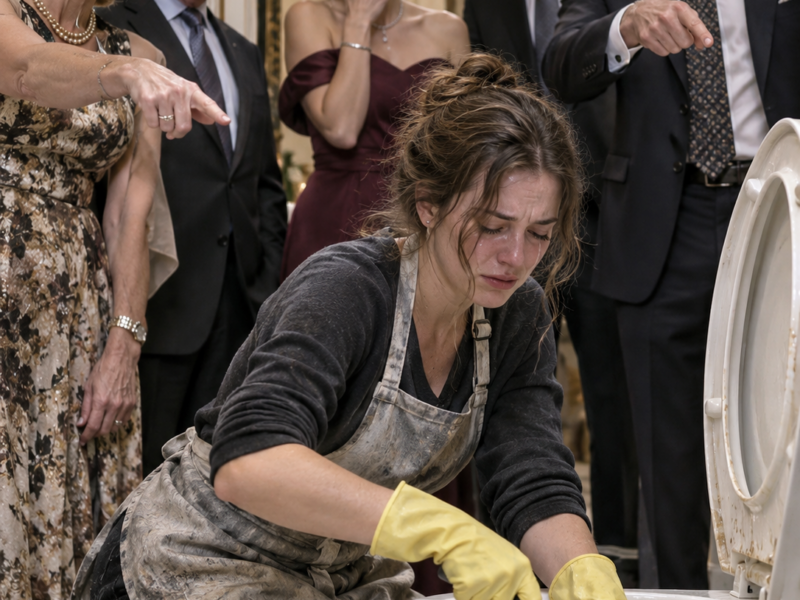
At My Sister’s Engagement Dinner, Her Wealthy Future Father-in-Law Ordered Me to Clean His Bathroom While My Parents Laughed and My Mother Said, “Liv Won’t Mind—She Used to Clean Houses.” I Quietly Obeyed, Even Though I Had Personally Bought 60% of His Furniture Company for $5 Million. He Had No Idea Who I Really Was, and I Didn’t Correct Him. But When He Walked Into His Crucial $3 Million Board Meeting Two Days Later, He Stopped Cold the Moment He Saw Who Was Sitting at the Head of the Table…
At My Sister’s Engagement Dinner, Her Wealthy Future Father-in-Law Ordered Me to Clean His Bathroom While My Parents Laughed and My Mother Said, “Liv Won’t Mind—She Used to Clean Houses.” I Quietly Obeyed, Even Though I Had Personally Bought 60% of His Furniture Company for $5 Million. He Had No Idea Who I Really Was, and I Didn’t Correct Him. But When He Walked Into His Crucial $3 Million Board Meeting Two Days Later, He Stopped Cold the Moment He Saw Who Was Sitting at the Head of the Table…
Part 1
The moment my sister’s future father-in-law told me to get up from his dinner table and clean his bathroom, I knew something was about to change. Not because I was offended by the idea of cleaning a bathroom. I had spent too many years doing exactly that to consider honest work beneath me. What changed everything was the laughter that followed.
My mother laughed. My father chuckled. My sister stared at her plate. And the man who had just ordered me out of my chair returned to eating his expensive dinner as though humiliating someone were no more significant than asking for another glass of wine.
“Go help the staff,” he had said. “You’ve eaten enough.”
His wife barely looked up before adding, “Start with the bathroom. It’s a mess.”
I remember looking around that beautifully decorated dining room, studying the faces of eleven people who apparently found my humiliation entertaining.
Then I folded my napkin, placed it carefully beside my plate, and stood.
“Good idea,” I said.
They thought I was surrendering.
What none of them knew was that I owned sixty percent of the furniture company that paid for their lifestyle.
And two days later, the man laughing at me would be sitting across a conference table, waiting for a mysterious majority shareholder to approve a three-million-dollar investment.
He had absolutely no idea that the woman he had sent to scrub his toilet was the person he needed most.
My name is Olivia Doherty. I was thirty-nine years old when that dinner happened, but the story really began when I was thirteen, in Gastonia, North Carolina.
My father worked at a textile mill, a place that had supported our family for years. In the summer of 2000, the mill reduced his hours. Suddenly, the small comforts we had taken for granted began disappearing. My mother started buying cheaper groceries. Bills remained unopened on the kitchen counter. My father became quieter every evening.
My grandmother, Dorothy Faulkner, noticed what was happening before anyone admitted it.
Everyone called her Grandma Dot.
She was sixty-four, drove an aging Buick, and cleaned houses in Charlotte’s wealthier neighborhoods. One Saturday, she invited me to accompany her.
She paid me forty dollars for a full day’s work.
I handed the money to my mother when I returned home.
Nobody had asked me to do that. Even at thirteen, I understood that forty dollars could mean groceries for several days.
Grandma Dot taught me how to clean windows without leaving streaks, how to remove stubborn stains without damaging furniture, and how to make an ordinary bathroom look as polished as a hotel suite.
But her most important lessons had nothing to do with cleaning.
“Never rush because somebody thinks you’re beneath them, Livvy,” she would say. “Do your work properly. Leave everything better than you found it.”
She also taught me something I would spend decades trying to understand.
“People with money can buy your time,” she said, “but they don’t get to decide your worth.”
At fourteen, I thought she was talking about our wealthy clients.
I didn’t realize she was also warning me about my own family.
When my father’s mill permanently closed in 2001, I started working with Grandma Dot more frequently.
One afternoon, we were cleaning the home of a girl named Kristen, who attended my school.
She walked into an upstairs bathroom and found me holding a toilet brush.
She stared.
Then she smiled.
By Monday morning, half my classmates knew I cleaned houses.
Some laughed. Others called me a maid whenever I walked through the hallways.
The worst part came when I got home.
My mother was waiting in the kitchen.
“You embarrassed this family,” she said.
I remember being genuinely confused.
“I was working, Mom.”
“That isn’t the point. People don’t need to know our business.”
She insisted I continue earning money but keep the work secret.
Then she glanced toward my younger sister, Megan, who was sitting nearby with her crayons.
“Megan is going to have a different life.”
Those words stayed with me.
Apparently, my sister deserved a life she could proudly discuss, while mine was something our family needed to hide.
But I loved Megan.
She was nine years younger, bright, funny, and completely unaware of how differently our parents treated us.
As the years passed, I became the daughter who solved problems without asking questions.
When the car broke down, I helped pay for repairs.
When our parents needed groceries, I bought them.
When Megan needed school supplies, I found the money.
And whenever I did something generous, my mother would smile and say, “That’s our Liv. She never minds.”
I convinced myself that being useful meant being loved.
I would eventually discover how dangerous that belief could become.
At nineteen, I landed a receptionist job in the commercial lending department at Carolina Piedmont Bank in Charlotte.
I had no prestigious degree, no professional connections, and no wealthy relatives opening doors for me.
What I did have was an extraordinary tolerance for hard work.
My responsibilities were simple: answer telephones, organize files, greet visitors, and keep the office running smoothly.
But during quiet afternoons, I began studying the loan applications passing through our department.
I wanted to know why some businesses received funding while others were rejected.
I examined balance sheets, cash-flow projections, and financial statements. When I encountered something unfamiliar, I searched for explanations in textbooks borrowed from the library.
Eventually, I enrolled in accounting classes at UNC Charlotte.
I studied at night and worked during the day.
It took five exhausting years to complete my degree.
The woman who changed my career was Fran Mabry, a senior credit analyst.
One afternoon, she found me examining a rejected loan application for a small furniture manufacturer.
I had written several observations in the margins, explaining why I believed the bank had misunderstood the company’s financial position.
Fran read everything.
Then she looked at me.
“Who taught you to analyze these statements?”
“Nobody,” I admitted.
She studied my notes again.
“Well, Olivia, perhaps somebody should start paying you to do it.”
When I graduated in 2012, Fran helped me move into credit analysis.
For the first time, someone introduced me as a professional rather than a convenient pair of hands.
I worked harder than ever.
In 2013, I married a financial planner named Evan Hart and took his surname.
Two years later, I joined a private investment firm, where I met Nolan Reese.
Nolan was confident, charismatic, and exceptionally good at convincing wealthy investors to trust him.
I was quieter.
I preferred studying businesses, visiting factories, investigating risks, and figuring out whether companies were worth saving.
We made an excellent team.
In 2018, we started our own investment firm, Juniper Ridge Partners.
The following year, we raised a twenty-six-million-dollar fund.
Nolan became the public face of our business.
I became the person making many of its most important investment decisions.
Our success was remarkable, but it created problems in my marriage.
Evan disliked how much time I spent working. Our conversations became arguments, and our arguments eventually became silence.
Meanwhile, my parents remained almost completely uninterested in my career.
At Christmas in 2019, my mother introduced me to relatives as someone who “does paperwork at a bank.”
I was thirty-two years old, managing significant investments, and sitting at a folding card table beside the kitchen while my younger cousins occupied the main dining room.
I could have corrected her.
Instead, I remained quiet.
I had learned that discussing my achievements usually led to requests for money, favors, or explanations my family did not really want to hear.
So I let them believe whatever they wanted.
Then, in 2020, a furniture company in Hickory appeared on our investment radar.
Whitlock Furniture Company had operated since 1972.
Its founder, Harlan Whitlock, had built the business from a tiny workshop into a respected manufacturer employing 280 people.
After Harlan died, his son Bradley continued running the company.
But when the pandemic disrupted manufacturing, Whitlock Furniture faced serious financial trouble.
The plant had closed temporarily, orders were suspended, and the bank was demanding answers.
I spent three weeks reviewing the company’s financial records.
What I discovered was important.
The company wasn’t fundamentally failing.
It was experiencing a crisis that could be survived with the right investment.
I remembered my father losing his job when the mill closed.
I remembered families struggling because nobody had been willing to save their workplace.
I refused to watch history repeat itself if I could prevent it.
Nolan and I traveled to Hickory to meet Bradley Whitlock.
Bradley barely acknowledged me.
He assumed Nolan was the person making every decision.
When I poured coffee for the room, Bradley snapped his fingers.
“Two creamers, sweetheart.”
Later, when I questioned his financial projections, he laughed.
“Your coffee girl asks an awful lot of questions, Nolan.”
I remember Nolan looking furious.
But I remained professional.
I wasn’t there to earn Bradley’s respect.
I was there to decide whether 280 employees deserved another chance.
On July 31, 2020, Juniper Ridge invested $4.2 million in Whitlock Furniture and acquired sixty percent ownership.
Bradley retained forty percent and continued serving as CEO.
The company survived.
Four years later, when our investment fund needed to return capital to its investors, I personally purchased that sixty-percent stake for five million dollars, using my savings and a bank loan.
I placed the shares inside a company I named Faulkner Holdings, honoring Grandma Dot.
By then, my divorce from Evan was approaching its final stages. For personal and legal reasons, my ownership remained confidential, with Nolan representing my interests on the board.
Bradley signed the ownership-transfer documents.
He never bothered investigating who controlled Faulkner Holdings.
He simply assumed its owner was a wealthy man.
He even asked Nolan whether “Mr. Faulkner” enjoyed playing golf.
That detail would become almost painfully ironic.
Because in April 2026, my sister Megan called with wonderful news.
Her boyfriend, Chase, had proposed.
Then she casually mentioned his father’s name.
Bradley Whitlock.
The man who had called me a coffee girl was about to become my sister’s father-in-law.
And when our families finally met that August, I was carrying a brown folder that could change everything.
Part 2
The dinner was scheduled for August 22 at the Whitlocks’ lake house.
Before I arrived, my mother called with instructions.
“Bradley is paying ninety thousand dollars toward Megan’s wedding,” she warned. “Don’t embarrass us.”
I wore navy trousers and a cream blouse. I brought Grandma Dot’s homemade peach cobbler.
Lorraine Whitlock took one look at my dessert and handed it to the caterer.
“We already have dessert.”
At dinner, my place card misspelled my name. My mother introduced me as someone who performed office work.
Bradley laughed.
“Somebody has to answer the phones.”
Later, he boasted about saving Whitlock Furniture and mocked the “coffee girl” who had visited his factory six years earlier.
That coffee girl was me.
Then I noticed the exhausted servers and helped refill several glasses.
Bradley watched me.
“You’ve eaten enough. Go help the staff.”
Lorraine added, “Start with the bathroom.”
My mother laughed.
“Liv won’t mind. She used to clean houses.”
I stood, entered the bathroom, and cleaned it perfectly.
But while helping the caterers afterward, I spotted something extraordinary.
Their $6,800 invoice was billed to Whitlock Furniture as a corporate client appreciation event.
My company was paying for the dinner where I had been humiliated.
And suddenly, Saturday’s cruelty was no longer the biggest problem.
Part 3
I have replayed the drive home from that dinner more times than I care to admit.
The road from Lake Hickory toward Charlotte was dark, and the headlights of passing vehicles briefly illuminated the brown folder resting on my passenger seat.
Inside was a letter I had written months earlier.
It explained that I was the majority owner of Whitlock Furniture, that Faulkner Holdings belonged entirely to me, and that I had voluntarily removed myself from decisions affecting Chase’s employment because he was engaged to my sister.
I had intended to give Bradley that letter privately.
My original plan was simple.
After dinner, I would ask for five minutes in his study, explain everything, and allow him the dignity of learning the truth without an audience.
Instead, he had turned me into entertainment.
And I had discovered that his expensive family gathering might have been charged to the business.
I pulled into a roadside parking area and called Nolan.
He answered immediately.
“Liv? Everything okay?”
“No.”
I told him what happened.
I described Bradley’s comments, Lorraine’s instructions, the laughter, my mother’s reaction, and the catering invoice.
For once, Nolan had absolutely nothing sarcastic to say.
When I finished, he remained silent.
Finally, he asked, “Do you want me to call Bradley tonight?”
“No.”
“He should know who’s coming to Monday’s meeting.”
“He will.”
“Olivia…”
“Nolan, that meeting has been scheduled for months. He knows he needs majority-owner approval. He should have been preparing to defend his proposals instead of entertaining his friends with stories about his coffee girl.”
Nolan exhaled.
“Fair enough.”
Then I asked him to contact Joyce Hammond, the independent board chair.
I wanted the complete financial records ready Monday morning.
Not summaries.
Not Bradley’s preferred presentation.
Everything.
The next morning, my father called.
Dad rarely called me unless something needed fixing.
“Bradley is very upset,” he began.
I almost laughed.
“He’s upset?”
“He said you walked out without properly thanking Lorraine.”
“Dad, Lorraine ordered me to clean her bathroom.”
“It was a joke, Liv. Everybody was joking.”
I looked at the coffee sitting untouched beside my bed.
“Did you think it was funny?”
He hesitated.
“That’s not the point.”
“It is to me.”
My father lowered his voice.
“Listen. I need you to call Bradley and apologize before Monday.”
Something about his urgency made me stop.
“Why Monday?”
“Because… because your father owes that man money.”
I sat upright.
“How much?”
Another pause.
“Twenty-five thousand dollars.”
He explained that credit-card debt had accumulated and Bradley had privately loaned him money in June.
My father had apparently agreed to repayment terms he could barely manage.
“Your mother doesn’t know,” he whispered.
Suddenly, his weak little laugh at dinner made sense.
He had been sitting at a wealthy man’s table, terrified of offending someone who could demand his money back.
I felt sympathy.
I also felt anger.
A debt explained his silence.
It didn’t excuse it.
“I’ll see Bradley on Monday,” I said.
Dad sounded confused.
“Why would you see Bradley?”
I didn’t explain.
After hanging up, I sat quietly, remembering Grandma Dot.
She used to tell me that when people became financially dependent on someone who enjoyed feeling powerful, the money eventually stopped being just money.
It became a leash.
By noon, Carol Benning had sent the financial documentation Nolan and Joyce requested.
Carol was Whitlock Furniture’s chief financial officer.
She had worked there for more than twenty years, and unlike Bradley, she understood that uncomfortable questions were sometimes the only thing protecting a business.
Her email contained several attachments.
The first was the proposed lease for a new showroom in High Point.
Bradley wanted three million dollars in additional investment to expand into a prestigious location near the center of North Carolina’s furniture industry.
At first glance, the proposal looked ambitious but reasonable.
Then I examined the landlord.
Pruitt Commercial Properties.
The name struck me immediately.
Dale Pruitt had been sitting at Bradley’s dinner table.
He was the first person to laugh when I was ordered to clean the bathroom.
I opened the company’s publicly available registration records.
Two members were listed.
Dale Pruitt.
And Bradley Whitlock.
I stared at those names.
Bradley had proposed that Whitlock Furniture lease property from a business he partially owned.
The rent was approximately thirty percent higher than comparable properties.
That alone raised serious concerns.
But the second proposal made the situation considerably worse.
Bradley wanted the option to purchase fifteen percent of the furniture company from Faulkner Holdings at the price established in 2024.
He proposed financing the purchase through executive bonuses linked to the showroom’s performance.
If approved, his ownership would increase from forty percent to fifty-five percent.
He would regain majority control.
In other words, he wanted me to provide fresh capital to support a showroom that would pay rent to his own property company, while a compensation arrangement helped him purchase control of Whitlock Furniture.
I checked the documents again.
There was no clear disclosure of his ownership interest in the landlord.
My heart started beating faster.
This was no longer about humiliation.
It was about potential misuse of corporate resources and a serious undisclosed conflict of interest.
Then I opened Carol’s preliminary expense review.
Corporate entertainment spending had tripled over eighteen months.
The questionable charges included expensive dinners, recreational expenses, repairs connected to Bradley’s lake property, and purchases that appeared to have little business purpose.
There was also a twelve-thousand-dollar deposit at Lakeside Point Country Club.
The same club where Bradley was supposedly contributing ninety thousand dollars toward Megan and Chase’s wedding.
And there it was.
August 22.
Blue Ridge Table Catering.
$6,800.
Client Appreciation Event.
I stared at that line for a long time.
I remembered Tommy, the young server whose shirt sleeves had been soaked from washing glasses.
I remembered Denise, the catering owner, telling me that the Whitlocks hosted dinners like this regularly and never tipped.
I remembered leaving two hundred dollars for the staff because I couldn’t bear watching them work so hard while being treated as invisible.
Bradley had used company money to pay for a family dinner and then treated one of the company’s owners like unpaid household labor.
I had been willing to overlook his arrogance in 2020 because I believed the workers deserved protection.
But arrogance was one thing.
Misusing company funds was another.
At four o’clock that afternoon, Megan called.
She was crying.
“Liv, I need to tell you something.”
I asked where she was.
“In my car outside Mom and Dad’s house.”
She had been helping our mother review wedding expenses on an iPad when a synchronized text conversation appeared.
The messages were between our mother and Lorraine.
Megan read one aloud.
Lorraine had asked whether the older daughter would cause problems.
Our mother had replied:
“Don’t worry about Olivia. She’s nobody. She won’t embarrass you.”
For several seconds, I couldn’t speak.
I had heard dismissive comments from my mother my entire life.
But something about seeing my worth reduced to the word nobody was different.
She hadn’t been careless in conversation.
She had deliberately reassured a wealthy woman that her own daughter wasn’t important enough to matter.
Megan was sobbing.
“Liv, how could Mom say that about you?”
I looked at the financial reports scattered across my kitchen table.
“Come over,” I told her. “There’s something I need to explain.”
Forty minutes later, Megan arrived.
She sat opposite me, still holding her car keys.
Before I could begin, she showed me another document.
The country club deposit had been paid using a Whitlock Furniture corporate card.
“I’m an accountant,” she said. “That’s not a normal wedding payment.”
“No,” I agreed. “It isn’t.”
Then she looked at me carefully.
“Liv, what do you actually do for work?”
It was such a simple question.
Yet nobody in my family had ever asked it with genuine interest.
So I told her everything.
I explained my career, the investment firm, the 2020 rescue financing, and the company I named after Grandma Dot.
Then I showed her the ownership documents.
She read them twice.
Her eyes widened.
“You own sixty percent of Whitlock Furniture?”
“Yes.”
“Chase’s father’s company?”
“Yes.”
She stared at me, then covered her mouth.
“Oh my God.”
A moment later, another realization struck her.
“The coffee girl…”
I nodded.
“That was me.”
Megan began crying again.
This time, she apologized for laughing at dinner.
I told her I had noticed.
She asked why I had kept my success secret.
I thought about our childhood, about always being expected to sacrifice, and about the way our mother dismissed every accomplishment that didn’t belong to Megan.
“Because being invisible became easier than constantly proving I mattered,” I answered.
Megan sat quietly for a long time.
Then she reached across the table and held my hand.
For the first time in years, I felt like someone in my family actually saw me.
But Monday was coming.
And I still had to decide what kind of person I wanted to be when Bradley finally saw me, too.
Part 4
After Megan left that Sunday night, I remained at the kitchen table with a yellow legal pad.
I divided the page into two columns.
On the left, I wrote CAN.
On the right, I wrote WON’T.
I needed to separate what I was legally entitled to do from what my anger wanted me to do.
As the majority shareholder, I could reject the proposed three-million-dollar investment.
I could refuse Bradley’s request to buy back fifteen percent of the company.
I could ask the board to investigate the questionable expenses and undisclosed transactions.
But I would not interfere with Chase’s employment.
I would not use the company to punish Bradley for humiliating me.
I would not turn a legitimate corporate investigation into a personal revenge campaign.
And I would not forget the 280 employees who depended on Whitlock Furniture for their livelihoods.
Near the bottom of the page, I wrote one sentence:
Tell Bradley he’s fired.
I stared at it.
Then I crossed it out.
I wasn’t the board.
My ownership didn’t give me unlimited authority to make every operational decision.
Besides, I had seen what happened when someone treated a business as a personal possession.
I refused to become another version of Bradley.
Instead, I rewrote the letter inside my brown folder.
This time, there were no apologies or explanations requesting understanding.
I stated my identity, ownership position, and recusal from matters involving Chase.
I recorded my opposition to the investment and buyback proposals.
Finally, I added:
Whitlock Furniture employs 280 people. My decisions must protect their interests.
Then I signed my full name.
Olivia Doherty.
Monday morning arrived with clear skies.
I left Charlotte before eight, dressed professionally, and stopped for black coffee just outside Hickory.
While sitting in the parking lot, I received a message from Nolan.
Bradley wants to know whether Mr. Faulkner takes cream.
I burst out laughing.
The irony was almost unbelievable.
For years, Bradley had assumed that the owner of Faulkner Holdings must be an older, wealthy gentleman.
He had never imagined that the person controlling his company was a woman he had ordered around like a servant.
I arrived at Whitlock Furniture shortly before nine.
The building looked almost exactly as it had in 2020.
The lobby had wooden paneling, framed photographs of the original factory, and a reception desk near the stairs.
A woman named Brenda greeted me.
“Good morning. Can I help you?”
“I’m here for the board meeting.”
Before she could respond, the entrance doors opened.
Bradley walked in carrying a bakery box.
Chase followed in his gray suit with two takeaway coffees.
Bradley spotted me.
His expression shifted from surprise to irritation.
“Olivia? What are you doing here?”
“Good morning, Bradley.”
He frowned.
“If you’re here about Saturday, this really isn’t the time. I have an extremely important meeting.”
Chase smirked.
Then Bradley added, “The bathroom’s down the hallway if that’s what you’re looking for.”
I looked directly at him.
“I know where it is. I’ve been here before.”
He shook his head and headed upstairs.
“Come on, Chase. We need to prepare before Mr. Faulkner arrives.”
Brenda looked embarrassed.
Then she handed me the visitor badge Nolan had arranged.
FAULKNER HOLDINGS.
OLIVIA DOHERTY.
I fastened it to my blouse.
A few minutes later, Nolan came downstairs.
He greeted me warmly and escorted me to the conference room.
The familiar oak table still occupied the center of the room.
I remembered sitting there six years earlier, asking difficult questions while Bradley pretended I wasn’t present.
Joyce Hammond was already waiting.
Carol Benning sat beside her with several binders.
When Joyce saw me, she stood.
“Olivia. Your seat is ready.”
She gestured toward the head of the table.
I sat down.
For several moments, nobody spoke.
Then Bradley entered.
He was carrying pastries and speaking confidently.
“Nolan, has your principal arrived? Because I’d really like to—”
He stopped.
His eyes landed on me.
“What is she doing here?”
Joyce remained calm.
“Bradley, please sit down.”
He ignored her.
“Why is my son’s fiancée’s sister sitting in my boardroom?”
Nolan folded his hands.
“Because Olivia Doherty is the sole owner of Faulkner Holdings.”
Bradley stared.
Nolan continued.
“Faulkner Holdings owns sixty percent of Whitlock Furniture.”
Bradley laughed.
It was the same dismissive laugh I remembered from dinner.
“Very funny, Nolan. Her mother told me she does office work in Charlotte.”
Carol opened a binder.
She turned the shareholder register toward him.
Then she placed a signed copy of the ownership-transfer acknowledgment beside it.
Bradley’s own signature was visible at the bottom.
His laughter stopped.
He examined the documents.
“Faulkner Holdings…” he whispered.
Then he looked at me.
“Who exactly is Faulkner?”
“My grandmother,” I answered.
“She cleaned houses.”
Silence settled over the room.
I stood, walked to the side table, and poured myself a black coffee.
Then I prepared another cup.
I added two creamers.
I stirred it carefully and placed it in front of Bradley.
“Two creamers,” I said. “That’s how you like it, isn’t it?”
His face changed.
I could almost see him remembering that conference room in June 2020.
The woman pouring coffee.
The fingers snapping.
The insulting remark about Nolan’s coffee girl.
“That was you?” he whispered.
“Yes.”
He looked completely stunned.
I continued.
“You told everyone that story on Saturday night. There was just one detail you got wrong.”
He swallowed.
“I didn’t spill your coffee.”
Nobody laughed.
Bradley turned angrily toward Nolan.
“You knew?”
“Of course,” Nolan answered.
“And you never told me?”
“You never asked.”
Joyce explained that the ownership arrangement had been properly documented and that confidentiality had been maintained for legitimate personal reasons.
Bradley slowly sat down.
Then his expression softened into something almost friendly.
“Olivia,” he began, “if I’d known who you really were on Saturday, I never would have treated you that way.”
I looked at him for several seconds.
“I know.”
He seemed relieved.
Then I finished.
“That’s exactly the problem.”
The room went quiet again.
Because he had accidentally admitted something much bigger than poor manners.
He was only embarrassed because he had discovered I possessed power.
If I had actually been a cleaner, he would have considered his behavior perfectly acceptable.
Joyce opened the agenda.
“We have business to conduct.”
Bradley began presenting his High Point showroom proposal.
He spoke about expansion, reputation, increased sales, and opportunities to attract prestigious buyers.
Chase followed with projected revenues and growth estimates.
They had prepared an impressive presentation.
But when Joyce invited my questions, I asked only three.
“Who owns the showroom property?”
Bradley shifted.
“A local real estate company.”
“Which one?”
“Pruitt Commercial Properties.”
“And why is its proposed rent approximately thirty percent above comparable properties?”
He began explaining the location’s advantages.
I waited until he finished.
Then I asked my final question.
“Who are the owners of Pruitt Commercial Properties?”
Bradley stopped speaking.
Carol slid the public registration records across the table.
“Dale Pruitt and Bradley Whitlock,” she said.
Chase turned toward his father.
Even he looked surprised.
Joyce removed her glasses.
“Bradley, did you disclose your interest in this property company when submitting the lease proposal?”
“It’s a minor arrangement,” he protested.
“That doesn’t answer the question.”
He said nothing.
I leaned forward.
“Bradley, you were asking us to invest three million dollars in a showroom that would pay rent to a business you partially own. At the same time, you wanted a bonus arrangement to help you buy back majority control of Whitlock Furniture.”
His face darkened.
“It’s more complicated than that.”
“Then explain the missing disclosure.”
He couldn’t.
Joyce moved to the expense review.
Carol calmly presented records showing approximately $118,000 in questionable personal charges over eighteen months.
The transactions included family entertainment, leisure expenses, property-related costs, and wedding payments.
Then she reached the catering bill.
“August twenty-second. Blue Ridge Table Catering. Six thousand eight hundred dollars. Classified as client appreciation.”
I spoke before Bradley could respond.
“I attended that event.”
His eyes widened.
“Nobody told me I was the client.”
Bradley slammed his palm against the table.
“So that’s what this is about! You’re getting revenge because Lorraine made a joke!”
I remained seated.
“Saturday showed me how you treat people, Bradley. These financial records show how you’ve treated company money.”
He opened his mouth.
I continued.
“Only one of those matters belongs in this boardroom.”
Joyce called for the formal decisions.
I rejected the proposed three-million-dollar investment and the share buyback.
Then the independent directors voted to place Bradley on paid administrative leave pending an outside financial investigation.
Joyce would temporarily oversee executive responsibilities.
Carol would manage daily operations.
Bradley was excluded from the vote because of his conflict of interest.
The motion passed.
Two votes to zero.
Bradley stood so abruptly that his chair scraped against the floor.
“You can’t do this to my father’s company!”
I looked at him.
“Your father’s company employs 280 people. Those are the people I’m protecting.”
For several moments, he simply stared.
Then he asked, “Does Megan know?”
“Yes,” I said.
“She knew before you did.”
Bradley walked out.
Chase followed him.
And just like that, the meeting was over.
But the consequences had only begun.
Part 5
By six o’clock Monday evening, Lorraine Whitlock had found my telephone number.
She didn’t bother greeting me.
“You’ve destroyed our family over a joke!”
I sat on my couch and listened.
She accused me of planning Bradley’s humiliation, hiding my identity to trap him, and deliberately sabotaging her son’s wedding.
Finally, I interrupted.
“Lorraine, your husband still owns forty percent of Whitlock Furniture. He’s on paid leave while independent accountants review the company’s financial records.”
“You knew what would happen!”
“No,” I answered. “I knew what was on Monday’s agenda. Saturday didn’t create those transactions.”
She insisted that I could stop the investigation.
I explained that I wouldn’t.
Then she hung up.
Two hours later, Bradley demanded repayment of the twenty-five thousand dollars he had loaned my father.
My parents arrived at my house the following evening.
My mother entered without waiting to be invited into the living room.
“Bradley wants his money by September,” she announced.
My father stood silently behind her.
“You caused this, Olivia,” she continued. “So you’re going to pay him.”
It was an astonishing sentence.
My father had borrowed the money.
Bradley had chosen to demand repayment.
Yet somehow, the responsibility had landed on me.
I looked at my mother.
“No.”
She blinked.
“What?”
“I said no.”
Her expression hardened.
“After everything we’ve done for you?”
I had heard that accusation throughout my life.
This time, I didn’t retreat.
“Name one thing, Mom.”
She stared at me.
“Excuse me?”
“Name one time you celebrated something I accomplished without turning the conversation toward Megan. Name one time you defended me when somebody treated me badly. Name one time you asked about my career and actually listened to the answer.”
She opened her mouth.
Nothing came out.
Then the doorbell rang.
It was Megan.
I had asked her to come because I knew my parents would try to pressure me.
She entered, pulled out her telephone, and read the message our mother had sent Lorraine.
“Don’t worry about Olivia. She’s nobody. She won’t embarrass you.”
My mother went pale.
“Megan, sweetheart, you don’t understand.”
“What don’t I understand?” Megan asked.
“I was protecting you! Those people are important. You have a future with Chase.”
Megan shook her head.
“They humiliated my sister, Mom. And you helped them.”
My mother tried to argue.
Then my father finally spoke.
“Karen, tell her about school.”
Mom turned sharply.
“Phil, don’t.”
He looked exhausted.
“Tell Megan.”
Our mother remained silent.
So Dad told the truth.
Years earlier, when Megan’s financial aid had fallen short, I had quietly paid twenty-two thousand dollars toward her remaining university expenses.
My mother had insisted the money appear to come from Grandma Dot.
I had agreed because I believed Megan deserved to finish school without carrying the burden of gratitude or family conflict.
Grandma had reluctantly helped transfer the payments.
Megan had never known.
Now she stared at me.
“Liv… you paid for my education?”
I nodded.
Her face crumpled.
“I thanked Grandma at her funeral,” she whispered.
“I know.”
“I stood beside her casket and thanked her for sending me to school.”
Tears spilled down her cheeks.
I remembered that funeral.
I had stood toward the back, watching Megan say goodbye to the woman we both loved.
Grandma Dot deserved every expression of gratitude she received.
But something about hearing my sister thank the wrong person for those particular payments had hurt more than I wanted to admit.
Megan crossed the room and hugged me.
“Why didn’t you tell me?”
“Because I didn’t want you to feel indebted to me.”
She cried harder.
“I’ve spent years thinking Mom did everything for me.”
I held her.
“Grandma helped us both, Meg. Don’t forget that.”
Then my mother picked up her purse.
She left without apologizing.
My father remained by the doorway.
“I should have defended you at dinner,” he said quietly.
“Yes,” I answered.
“You should have.”
He lowered his head.
Then he looked up.
“I’ll handle Bradley’s loan myself.”
For once, I didn’t rush to help him.
He needed the opportunity to take responsibility.
Over the following days, the situation became increasingly complicated for everyone involved.
The accounting investigation continued.
Whitlock Furniture’s board assured employees that operations would proceed normally and that the company wasn’t being sold or closed.
I stayed away from decisions involving Chase, exactly as I had promised.
Meanwhile, Megan began reconsidering her engagement.
Chase visited her apartment carrying flowers.
He told her that his father had simply made a joke and that my reaction had been wildly disproportionate.
Then he made a request that revealed how little he understood.
“Get Olivia to stop the investigation, and we can still have the wedding.”
Megan looked at him.
“Your father charged our wedding deposit to the company.”
Chase shrugged.
“That’s family business.”
“No,” she answered. “It’s company business.”
He tried to convince her that everything would eventually settle down if she could persuade me to cooperate.
But Megan was no longer willing to ignore what she had witnessed.
“You laughed at my sister,” she reminded him.
“So did you.”
“Yes,” Megan admitted. “And I’ve been ashamed of it ever since.”
Chase grew frustrated.
“It was one dinner.”
Megan shook her head.
“No. It was the first dinner where I got to see how your family treats people they think are beneath them.”
She removed her engagement ring.
Chase stared at it.
“Are you seriously choosing your sister over me?”
“I’m choosing not to marry someone who thinks cruelty becomes acceptable when everyone calls it a joke.”
She handed him the ring.
Their engagement ended that evening.
When she called me afterward, I expected her to sound devastated.
Instead, she sounded strangely peaceful.
“I thought giving it back would feel heavier,” she told me.
“Does it?”
“No. I feel like I can breathe.”
I didn’t celebrate her breakup.
I knew she loved Chase.
But I was proud that she had made her own decision rather than following the path everyone had arranged for her.
On September 4, the independent accounting firm completed its review.
The confirmed questionable expenditures totaled approximately $118,000.
Bradley’s attorney negotiated a repayment arrangement under which the money would be recovered from his future distributions.
Several days later, Bradley resigned as CEO and gave up his board seat as part of the agreement.
He retained his forty-percent ownership stake.
Nobody confiscated his home.
Nobody seized his personal savings.
He simply lost the authority to run a company whose resources he had been treating as though they belonged entirely to him.
Chase resigned shortly afterward.
Carol Benning became interim president while the board began searching for a permanent chief executive.
The High Point lease option expired without being exercised.
I remember feeling enormous relief when Carol called to confirm that production schedules were uninterrupted.
The workers were still employed.
The orders were still being fulfilled.
The company was still standing.
That mattered far more than Bradley’s embarrassment.
A few days later, I received an email from him.
It contained only one sentence.
You could have told me at dinner.
I read it several times.
Then I replied.
I was going to. You sent me to the bathroom instead.
I never received another response.
But I kept a copy.
Not because I wanted to treasure his humiliation.
Because it reminded me how easily people destroy opportunities when they mistake kindness for weakness.
On September 17, I returned to the furniture plant.
This time, Carol walked beside me as we toured the factory floor.
I met employees in the upholstery department, the cutting area, the frame workshop, and the loading dock.
Some had worked there since Harlan Whitlock was alive.
Others had joined only recently.
Many knew there had been changes in management, but few understood who I was.
Carol introduced me to each department.
“This is Olivia Doherty,” she said. “She’s our majority owner.”
The words felt strange.
For decades, I had avoided drawing attention to myself.
Now I was shaking hands with people whose work I had spent years trying to protect.
One older worker asked whether I intended to sell the company.
I looked around the workshop, listening to the steady movement of machinery.
“No,” I told him. “That’s not why I’m here.”
His shoulders relaxed.
He thanked me and returned to his work.
During lunch, I noticed five members of the cleaning crew sitting together in a break room.
I asked whether I could join them.
Their supervisor, Loretta Sims, moved her lunch bag aside to make room.
Loretta was fifty-eight and had spent twenty-two years cleaning that building.
We talked about the factory, her family, and the changes she had witnessed over the decades.
Eventually, I learned that the cleaning crew wasn’t directly employed by Whitlock Furniture.
They worked for an outside contractor.
Despite years of dedicated service, they received low wages and had no employer-sponsored health insurance or paid sick leave.
One woman told me she sometimes came to work sick because missing a shift meant losing money she couldn’t afford to lose.
I thought about Grandma Dot.
I thought about her blue bucket, her neatly folded rags, and the pride she took in work other people barely noticed.
Then I thought about Lorraine Whitlock sending me to the bathroom as though cleaning were a punishment.
I asked Loretta how long she had worked in the building.
“Twenty-two years,” she repeated.
“Has any owner ever sat down and eaten lunch with you?”
She smiled sadly.
“Not that I remember.”
After lunch, I spoke with Carol and Joyce.
I wanted the board to evaluate bringing the cleaning crew into the company as direct employees, with proper benefits and the same dignity afforded to other workers.
The financial impact was manageable.
The board approved the change the following week.
When Carol told Loretta, she reportedly asked three times whether the offer was real.
It was.
I wished Grandma Dot had been alive to see it.
She would have been delighted.
Not because I had become wealthy.
Because I had finally learned how to use my position to improve someone else’s life without pretending I had no power at all.
The following day, my father called.
“I sold the boat,” he announced.
For eleven years, Dad had owned a bass boat he loved.
Even when our family struggled, he had managed to keep it.
He used to take it onto Lake Wylie early on summer mornings.
That boat had always represented freedom to him.
He told me he had sold it for nineteen thousand dollars and added another six thousand from his savings.
Then he drove to Hickory and handed Bradley a cashier’s check.
Twenty-five thousand dollars.
Paid in full.
I didn’t know what to say.
“Dad…”
“I didn’t want you to pay my debt, Liv,” he interrupted.
“I wanted you to see me take responsibility for it.”
My eyes filled with tears.
For years, I had been the person fixing everybody’s problems.
Now my father had solved one of his own.
And he had done it without asking me for anything.
“I see you, Dad,” I whispered.
He was silent for a moment.
Then he thanked me.
Not for money.
Not for a favor.
Simply for giving him the chance to make things right.
My mother remained distant.
Eventually, she sent a short message.
I’m sorry you felt hurt.
I studied those words.
It wasn’t an acknowledgment of what she had done.
It was an apology for my reaction.
I wrote back:
When you’re ready to tell me what you did wrong, rather than how I felt about it, we can talk.
She didn’t respond.
I wasn’t surprised.
But for the first time, I didn’t sit beside my telephone waiting for her approval.
Toward the end of September, I invited a few people to dinner at my townhouse.
Megan came.
Dad came.
Nolan came, too.
I had recently purchased a beautiful solid-wood dining table.
It wasn’t extravagant, but I loved it.
For most of my life, I had been assigned the folding table, the extra chair, or the seat closest to the kitchen.
That evening, nobody told me where to sit.
I sat at the head of my own table.
I had invited my mother as well.
She replied that she had other plans.
I left her place empty without making a scene.
Before dinner, Nolan lifted his glass.
“To the owner,” he said with a grin.
Megan smiled and raised hers.
Dad followed.
But I shook my head.
“No,” I said.
I lifted my glass higher.
“To Dorothy Faulkner, who cleaned other people’s houses for forty years and taught me that hard work never makes a person small.”
Nobody laughed.
We drank to Grandma Dot.
Dinner was pot roast, roasted vegetables, and homemade bread.
For dessert, I served the peach cobbler I had learned to make from her handwritten recipe.
It was the same dessert Lorraine had dismissed without tasting at the engagement dinner.
Megan finished her first serving and hesitated.
“Can I have another piece?”
I smiled.
“Of course. There’s plenty.”
She laughed and held out her bowl.
Afterward, my father insisted on making coffee.
I watched him move around my kitchen, opening cabinets until he found the mugs.
He poured four cups.
Then he stood beside my chair with a small carton of cream.
“Cream, Liv?”
“Black, Dad.”
He looked surprised.
“Really?”
“I’ve always taken it black.”
He studied me for a moment.
“I didn’t know that.”
I smiled gently.
“I know.”
He set the cup down in front of me.
“Black,” he repeated.
Then he sat beside me and asked a question I had waited nearly forty years to hear.
“So, Olivia, how was your week at work?”
I looked at him.
For a second, I wondered whether he was simply being polite.
But he leaned forward, genuinely interested.
And I told him.
I described meeting the workers, speaking with Carol, and helping improve conditions for the cleaning crew.
He listened without interrupting.
He asked questions.
He remembered the answers.
Megan joined the conversation, and Nolan shared stories about how we had started our investment business.
For the first time, I was sitting at a family dinner where nobody expected me to disappear into the kitchen.
I was simply allowed to exist as myself.
Sometimes I think about that August evening at the Whitlocks’ lake house.
I remember the expensive silverware, the carefully arranged flowers, and the laughter when Bradley ordered me to clean his bathroom.
I remember standing alone in that marble bathroom, folding hand towels into perfect squares while my hands trembled.
And I remember looking into the mirror afterward.
At the time, I believed that silence meant I was being strong.
But silence had been my hiding place for decades.
I had allowed my mother to define me.
I had allowed Bradley to overlook me.
I had allowed my family to believe that my value depended on how much I could do for them.
What happened that Monday didn’t magically erase those years.
It didn’t repair every relationship.
It didn’t make my mother suddenly understand me or transform Bradley into a better man.
But it changed something inside me.
I finally understood that humility doesn’t require invisibility.
Kindness doesn’t demand submission.
And being generous doesn’t mean accepting humiliation.
I still believe in helping people.
I still believe every job deserves respect.
I still remember how to scrub a bathroom until the fixtures shine.
In fact, I still clean my own bathroom.
The difference is that I no longer allow anyone to order me there as a reminder of where they think I belong.
Grandma Dot once told me to leave every place better than I found it.
For most of my life, I thought she meant houses.
Now I understand she meant something much bigger.
She meant the people we encounter, the workplaces we influence, and the lives we have an opportunity to change.
And perhaps most importantly, she meant our own lives.
Because sometimes the greatest thing you can clean out of your life isn’t dirt, disappointment, or even betrayal.
It’s the belief that you must remain small to make everybody else comfortable.
Bradley Whitlock thought he was sending a nobody to clean his bathroom.
What he didn’t realize was that the woman walking away from his table had spent her entire life learning how to recognize what was broken, how to repair what could be saved, and when to stop protecting the people responsible for the damage.
He forgot to ask my name.
But I will never forget the day I finally learned to say it proudly.
Olivia Doherty.
Not somebody’s servant.
Not somebody’s backup plan.
Not the invisible daughter.
Just Olivia.
And for the first time in my life, that was more than enough.