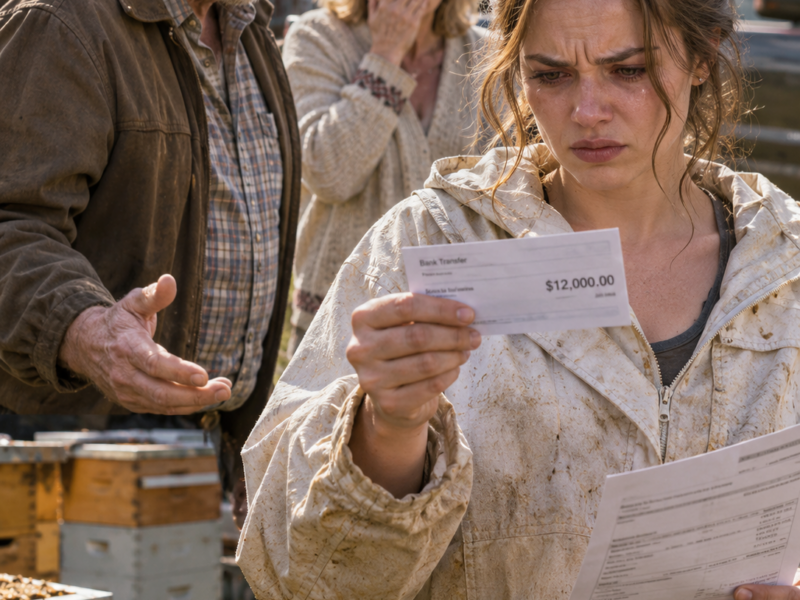
At My College Graduation Dinner, My Father Demanded the $12,000 I’d Spent Ten Years Saving From My Beekeeping Business to Fund My Older Brother’s Latest Venture. “Bees Aren’t a Business. Hand It Over,” He Said, Humiliating Me in Front of Everyone. I Refused and Removed My Hives From His Blueberry Farm, but a Year Later, He Mailed Me a Bank Deposit Slip Demanding the Same Amount. When He Showed Up Threatening to Call the Sheriff, I Pulled Out a Metal Box Containing Records He Never Knew Existed…
At My College Graduation Dinner, My Father Demanded the $12,000 I’d Spent Ten Years Saving From My Beekeeping Business to Fund My Older Brother’s Latest Venture. “Bees Aren’t a Business. Hand It Over,” He Said, Humiliating Me in Front of Everyone. I Refused and Removed My Hives From His Blueberry Farm, but a Year Later, He Mailed Me a Bank Deposit Slip Demanding the Same Amount. When He Showed Up Threatening to Call the Sheriff, I Pulled Out a Metal Box Containing Records He Never Knew Existed…
Part 1
“Bees aren’t a business. Hand it over.”
My father said those words across a plate of fried catfish on the night I graduated from college. He spoke loudly enough that the people at the next table stopped eating.
I was twenty-four years old, with a business degree, 226 beehives, and $12,000 in savings that had taken me ten years to accumulate.
My father wanted every penny.
A year later, three days before Christmas, I received a card at my post office box in Seminary, Mississippi. There was a red cardinal on the front, surrounded by glitter that stuck to my fingers.
Inside, beneath the printed Christmas greeting, my father had written:
“Counted it twice. Twelve even by the 31st. Dad.”
A bank deposit slip was tucked inside. His account number was already filled in, along with the amount he expected me to deposit.
$12,000.
I stood in the post office lobby and laughed.
Not because it was funny, but because after everything that had happened, my father still believed he could reach into my life and take whatever he wanted.
Six days later, he showed up at my honey house with my older brother, Trevor. He came prepared to threaten me, accuse me of stealing, and demand that I surrender the money.
What he didn’t know was that a man named Marlin Pitts was sitting at my table.
And what neither of them knew was that I had spent years documenting every dollar my father had taken from me.
By the time that morning ended, my father’s $12,000 demand would be replaced by a number that left him speechless.
$46,740.
But to understand how we got there, you have to understand what it was like growing up in my family.
My name is Davey Roundtree. I grew up on my grandfather’s thirty-acre blueberry farm outside Seminary, Mississippi. There was a white farmhouse, a tin barn, a pond full of turtles, and long rows of blueberry bushes that my grandfather, Pawpaw Zeb, had planted the year I was born.
My father, Wendell, drove a propane truck for twenty-two years. My mother, Sharla, kept books for a car dealership in Hattiesburg.
My brother Trevor was five years older than me.
Trevor was everything my father admired. He was outgoing, athletic, charming, and always talking about his next big opportunity.
Unfortunately, most of those opportunities required somebody else’s money.
I was different. I mowed the grass, fed the dog, helped Pawpaw prune the blueberries, and stayed out of trouble.
My father called Trevor ambitious.
He called me handy.
When I was thirteen, a swarm of bees appeared outside our church one Sunday morning. Thousands of them clustered beneath the church sign, forming something that looked like a giant brown football.
Several men wanted to spray them.
Instead, someone called Yates Ainsworth, a retired highway department worker who had kept bees for forty years.
Mr. Yates arrived in an old green Ford carrying a cardboard box, a bedsheet, and pruning shears.
While everyone else stood back, I moved closer.
“You afraid of them?” he asked.
“A little.”
“Good. Means you’ll pay attention.”
He showed me how to collect the swarm, explaining that the bees weren’t attacking anyone. They were simply looking for a new home.
When the queen dropped into the box, thousands of workers followed her.
I had never seen anything so remarkable.
Before he left, Mr. Yates gave me the swarm, an old hive box, and ten used frames.
My father frowned.
“How much is this going to cost me?”
“Nothing,” Mr. Yates replied. “Might cost the boy some sleep, though.”
That was how my first colony came home.
I named it Miss Odalis, after the church secretary who had called Mr. Yates. He taught me to name every captured swarm after the person who reported it.
“People take care of things when they feel connected to them,” he explained.
I started recording every swarm in a green ledger I found in Pawpaw’s desk.
By fourteen, I had six colonies.
That summer, I harvested my first honey using Mr. Yates’s hand-cranked extractor in my mother’s kitchen. I made a terrible mess, but eventually filled thirty-four pint jars.
I sold them for ten dollars each.
Nine days later, I had $340.
I spread the bills across my bed and counted them repeatedly. It was the first substantial amount of money I had ever earned.
Then my father walked in.
He picked up the bills, licked his thumb, and counted them twice.
“Three hundred forty. That’s about right.”
“About right for what?”
“Rent.”
I stared at him.
“Those boxes sit on my property. Your bees drink from my pond. Every business pays rent, son.”
He folded the money and slipped it into his shirt pocket.
“Forty dollars a month from now on.”
I was fourteen.
I didn’t know enough to argue that my bees were already helping pollinate his blueberry bushes. I only knew that the money I had worked so hard to earn was gone.
So I earned more.
Over the following years, I caught swarms, bought used equipment, studied everything I could find about beekeeping, and learned from Mr. Yates.
By sixteen, I had forty colonies and was expanding rapidly. I eventually supplied sixty colonies to pollinate the family’s thirty acres of blueberries.
The harvest increased dramatically.
My father told everyone at church that his new fertilizer deserved the credit.
Meanwhile, I continued paying him forty dollars every month.
At seventeen, I had saved $2,600 in a joint bank account my father had opened with me.
I was planning to buy a truck.
Trevor got one instead.
It was a used pickup with oversized mud tires, a suspension lift, and shiny chrome wheels.
I discovered where the money had come from when I visited the bank to deposit another $120 from the farmers market.
My balance was $120.14.
That evening, I confronted my father in the carport.
“Your brother needed reliable transportation to find work,” he said without looking away from the grill.
“That was my money.”
“You’ll make more. Your bees aren’t going anywhere.”
Trevor’s truck spent most of that autumn parked outside a bar in Hattiesburg.
On my eighteenth birthday, I opened a private account at a credit union. I rented a post office box and bought a gray metal filing box.
Inside, I began keeping index cards.
The first recorded the $340 my father had taken.
The second documented the monthly rent.
The third recorded the $2,600 that had disappeared into Trevor’s truck.
My mother had always said that if something wasn’t written down, it might as well never have happened.
I decided to follow her advice.
I attended community college, then transferred to Southern Mississippi, studying whenever my bees allowed it. I moved into a twenty-two-foot camper behind the family barn.
My father charged me another hundred dollars a month.
I wrote that down, too.
By twenty-one, I had 150 colonies, a flatbed truck, and my first commercial pollination customers.
One of them was Marlin Pitts, a retired paper mill worker who owned forty acres of blueberries.
He agreed to pay me $4,800 for eighty colonies.
When the season ended, he paid my father.
My father had told him that he handled the financial side of my business.
I never received the money.
“Trevor needed it for his crawfish trailer,” Dad explained. “Consider it an investment.”
The trailer failed within months.
I added another card to the file.
Then I registered Okatoma Bee Company, branded my equipment, and required written contracts with payments made directly to my business.
At twenty-three, I met Kizzy Castille, a county extension agent who understood agriculture better than most people twice her age.
She looked through my business figures one evening and told me something nobody in my family had ever said.
“Davey, you’ve built a real company. It’s time you started acting like it.”
By graduation, I had 226 colonies and $12,000 saved toward buying land of my own.
Then came the celebration dinner.
Halfway through dessert, my father announced that Trevor had an opportunity to buy a bait-and-tackle shop.
“He needs twelve thousand dollars,” Dad said.
My stomach tightened.
“How do you know how much I’ve saved?”
“Your mother keeps an eye on things.”
Mom immediately began gathering plates.
I realized she had been searching through my financial papers.
“That money is for my land,” I said.
Dad shook his head.
“You’ve played with bugs long enough. You’ve got a degree now. Get yourself a real job and give your brother a chance.”
“This is a real job.”
He leaned across the table.
“Bees aren’t a business. Hand it over.”
Kizzy quietly placed her hand on my wrist.
Trevor stared at his cake.
For the first time in my life, I didn’t feel the slightest desire to explain myself.
“No, sir,” I answered. “The money stays with me. And my bees are leaving your farm Saturday.”
My father laughed.
Then he saw my expression.
“If you walk out that door, you’re off my property. You, your camper, and every one of those boxes. Don’t come crawling back.”
I paid for my dinner, collected my graduation gown, and walked into the rain with Kizzy.
My father thought he had just punished me.
He had no idea that he had also destroyed the arrangement keeping his blueberry farm alive.
And the real reason he needed my $12,000 was far worse than anything I could have imagined.
Part 2
The following morning, I called Mr. Yates.
Before I could ask whether I could move my equipment onto his property, he interrupted.
“How many truckloads?”
“Eight. Maybe nine.”
“Miss Jewel wants to know if you eat pork chops.”
For four freezing nights, Kizzy and I transported my bees and equipment to his sixty-three-acre property.
I left my father $140 for December’s rent and drove away before midnight.
Mr. Yates charged me one jar of honey a month and Sunday dinner with him and his wife.
That spring, my father’s blueberry harvest collapsed.
Mine flourished.
I doubled my honey production, expanded my customer base, and stopped worrying about anyone stealing my payments.
Then, one August morning, Trevor’s wife, Destiny, approached my farmers market table.
She waited until her daughter wandered toward another stall.
“Davey, there was never a bait shop.”
I stared at her.
“Your father borrowed thirty thousand dollars against the blueberry farm. Most of it went to Trevor. He’s twelve thousand behind on the payments.”
Suddenly, everything made sense.
But Destiny wasn’t finished.
“When the bank asked about pollination, your father told them your bees came with the farm.”
My father hadn’t merely been stealing my money.
He had been building his financial future around property he didn’t own.
Part 3
I stood behind my honey table for several seconds, holding a jar I had been about to hand to a customer.
Destiny watched my face carefully.
“I’m sorry,” she whispered. “I should’ve told you sooner.”
I wanted to ask a dozen questions at once, but the first one that came out was simple.
“How long?”
“Four years. That’s when your daddy took out the loan.”
The money had paid for Trevor’s crawfish trailer, a boat, and expenses Destiny hadn’t discovered until much later.
When the crawfish business failed, my father had fallen behind on the loan.
By the previous December, he needed $12,000 to keep the bank from calling the entire note.
Trevor had invented the bait shop story because they believed I would be more willing to help him start a business than rescue my father from debt.
They had planned the whole thing before my graduation.
My celebration dinner had been an ambush.
“Why tell me now?” I asked.
Destiny glanced toward Kinsley, who was admiring some goats at another stall.
“Because they’re going to ask you again. And I can’t keep watching them do this.”
She explained that my father had persuaded the bank to extend the loan for another year.
The deadline was approaching.
Without my bees, his harvest had fallen to roughly half its previous size. His financial situation was now considerably worse.
“He still thinks you’ll come back,” Destiny said. “He thinks you’ll get tired of proving your point.”
I almost laughed at that.
My father believed I had left to prove something.
He couldn’t understand that I had left because I was finally finished proving anything to him.
Kinsley returned, excitedly describing the goats. Destiny bought two jars of honey and a piece of honeycomb, paid full price, and refused her change.
I watched them disappear into the crowd.
That afternoon, I drove north along Highway 49 without turning on the radio.
I remembered every occasion my father had insisted that family came first.
Family had come first when Trevor needed a truck.
Family had come first when Trevor wanted a crawfish trailer.
Family had come first when my father collected money that belonged to my company.
But when I needed something, family suddenly became a business arrangement.
I paid rent. I bought my own equipment. I paid my tuition. I supplied the farm with bees.
And somehow, I was still the one accused of receiving charity.
The following afternoon, I told Mr. Yates everything over Sunday dinner.
He listened without interrupting, occasionally cutting another piece of pork chop.
When I finished, he wiped his mustache.
“Well,” he said, “now you know what kind of house that swarm was living in.”
I understood exactly what he meant.
When bees swarm, they leave an old home to establish a new one. They carry what they need, search for shelter, and begin building again.
Sometimes leaving isn’t destruction.
Sometimes it’s survival.
My life at Mr. Yates’s property had already begun to feel like something I had never experienced before.
I could work without wondering whether someone was searching through my papers.
I could deposit a check without worrying about who might take it.
When I brought home good news, people celebrated instead of calculating what they could get from it.
That spring, I had placed my sixty former family-farm colonies with two new growers in Jefferson Davis County.
Both signed contracts. Both paid deposits.
Mr. Pitts increased his order from eighty colonies to one hundred.
For the first time, my work was being valued at the same rate as everyone else’s.
I also began expanding my colonies aggressively.
During April and May, I divided strong hives, introduced new queens, and caught forty-one swarms across the surrounding counties.
Mr. Yates helped me restore the twenty-frame honey extractor he had abandoned when his back problems forced him to retire.
We spent hours on the concrete floor of his honey house, cleaning bearings, replacing a belt, and checking every moving part.
When we finally switched it on, the old machine hummed beautifully.
Mr. Yates sat on an overturned bucket, watching it spin.
He didn’t say much.
Later, Miss Jewel told me he had cried in his truck.
He had spent decades building something he loved, and for four years he had believed that part of his life was over.
Now his honey house was alive again.
That summer, I harvested nearly 19,000 pounds of honey.
More than twice my previous record.
I hired help, purchased supplies in larger quantities, and started planning for the next pollination season.
Every improvement made me think about the graduation dinner.
If I had surrendered that $12,000, I would have remained behind my father’s barn, paying rent and waiting for the next emergency involving Trevor.
Instead, my business was becoming stronger than I had ever imagined.
In October, Kizzy and I got married beneath the enormous oak tree in Mr. Yates’s yard.
Forty-two people attended.
There were blueberry growers, beekeepers, farmers market customers, and people whose names appeared in my swarm ledger.
Miss Odalis, the church secretary who had called about my first swarm, arrived at ninety-one years old with a walker and a corsage.
Mr. Pitts wore a tie.
Miss Jewel cried before the ceremony even started.
I had invited my parents and Trevor.
None of them came.
Destiny sent a card containing twenty dollars and a drawing Kinsley had made of a bee wearing a protective veil.
I kept that drawing.
There was an empty place in the gathering where my immediate family should have been. I noticed it, but I refused to let it become the most important thing about my wedding.
Kizzy deserved a husband who was present, not someone spending his happiest day looking toward the driveway.
By November, Okatoma Bee Company had grown to 410 colonies across fourteen bee yards.
Every colony was committed under written pollination contracts for the following spring.
I had purchased a used three-quarter-ton truck with a proper flatbed. I had a part-time employee and enough business to keep both of us busy.
My savings were growing again.
Meanwhile, my father was running out of options.
He had managed to rent forty colonies from another beekeeper the previous spring, but they arrived after the early bloom.
He had paid eighty-five dollars per colony, considerably more than I charged.
The bees he had dismissed as worthless were suddenly expensive, scarce, and essential.
Still, he never called to ask for a proper contract.
He expected me to return voluntarily.
Three days before Christmas, I stopped at the Seminary post office and found his card.
The red cardinal.
The glitter.
The handwritten demand.
“Counted it twice. Twelve even by the 31st.”
I unfolded the deposit slip and looked at the account number.
After everything that had happened, he was still ordering me to pay him.
There was no apology.
No acknowledgment of my wedding.
No question about my business.
Not even a sentence asking how I was doing.
Just an amount and a deadline.
I sent him a text.
“Got your card.”
Then I drove home and placed the deposit slip beside my gray filing box.
After Destiny’s revelation in August, I had added one final index card.
It documented nine seasons of pollination on Pawpaw’s blueberry farm.
Sixty colonies each season, valued at fifty dollars per colony, below the prevailing rate.
$27,000.
I added the figure to the money my father had taken and the rent he had collected.
The total came to $46,740.
I checked it twice.
Just like my father always did.
I wasn’t planning to sue him. I wasn’t preparing a public confrontation.
I simply wanted a complete record of what our supposedly charitable family arrangement had actually cost me.
When I told Kizzy about the Christmas card, she studied the deposit slip.
“What are you going to do?”
“Nothing.”
“You know he’s going to show up.”
“I know.”
She handed the slip back.
“Then make sure you remember whose business this is.”
Six days later, on the Saturday after Christmas, Mr. Pitts arrived shortly after eight in the morning.
He had expanded his blueberry operation by fifteen acres and wanted 110 colonies for the coming season.
We sat at my folding table with fresh coffee and tea cakes Miss Jewel had brought over.
I handed him the contract.
He had just picked up the pen when tires crunched across the gravel outside.
I looked through the window.
My father’s truck was approaching.
Trevor was sitting in the passenger seat.
My father stepped out, adjusted his jacket, and walked toward the honey house without hesitation.
I reached into my jacket pocket and touched the folded deposit slip.
For years, my father had controlled the conversations about money.
That morning, for the first time, he was about to have one on my terms.
Part 4
My father entered the honey house without knocking.
He looked older than I remembered.
His face had become thinner, and the jacket that once fit him tightly now hung loosely around his shoulders.
Trevor followed him inside and leaned against the doorframe.
Dad barely acknowledged Mr. Pitts.
“You got my card?”
“Yes, sir.”
“Then you know what I need.”
He spoke as though we were discussing an overdue household chore.
“I’ve got a meeting with the bank on January fifteenth. If I bring twelve thousand dollars, they’ll renew the note.”
I waited.
“And I need sixty colonies on the blueberries by February tenth.”
“At what rate?”
“The family rate.”
“What’s that?”
His eyebrows drew together.
“Free. Same as always.”
Across the table, Mr. Pitts carefully set down his pen.
“No, sir,” I said.
My father exhaled sharply.
“Don’t start this again, Davey.”
“I’m not starting anything.”
“You know what’s at stake. That farm belonged to your grandfather.”
“I know.”
“You’re willing to let it go over some money?”
I looked at him.
“You borrowed against it, Dad. I didn’t.”
His expression changed.
For a moment, I wondered whether he realized that I knew about the loan.
Then he turned toward the window and pointed at the nearest bee yard.
Rows of white hive boxes stood beneath the pine trees.
“Those bees were raised on my land,” he said. “They drank my water. They fed on my blueberries. You built this whole operation using my property.”
I remained silent.
“By any fair accounting, half of those boxes belong to me.”
Mr. Pitts looked from my father to me.
Dad continued.
“I’ve talked to people. I can call the sheriff and report that you hauled property off my farm in the middle of the night.”
Trevor shifted uncomfortably.
“Dad,” he murmured.
My father ignored him.
“You’ve got yourself a little company now, don’t you? Imagine what people would think if they found out you stole your own father’s equipment.”
There it was.
The threat he had come prepared to deliver.
If guilt didn’t work, he would attack the reputation I had spent more than a decade building.
I stood up.
My father watched me walk toward the shelves near the door.
I retrieved a wooden hive lid I had been repairing and the gray metal filing box.
I placed the lid on the table.
Burned into its corner were the letters identifying my equipment.
“Every box, lid, and frame rest I own carries this brand,” I explained. “Every bee yard is registered with the state. The colonies that used to sit on your farm have been registered in my name since I was eighteen.”
My father looked at the lid.
“Nothing I removed belonged to you. If you’d like to call the sheriff, I’ll give you the registration information.”
He opened his mouth.
I didn’t give him time to speak.
“And since you mentioned fair accounting, there’s something else you should see.”
I opened the filing box.
The cards were arranged chronologically, each marked in my handwriting.
I removed the first one and placed it on the table facing him.
“Age fourteen. First honey harvest. Three hundred forty dollars taken as yard rent.”
He frowned.
“Davey—”
I placed the second card beside it.
“Forty dollars a month for ten years. Four thousand eight hundred.”
The third followed.
“Two thousand six hundred dollars withdrawn from my savings account for Trevor’s truck.”
Trevor stopped leaning against the doorway.
I laid down another card.
“Camper rent. One hundred dollars a month for six years. Seven thousand two hundred.”
My father shook his head.
“You lived on my property.”
“Yes, sir. And I paid you for it.”
Then I placed the fifth card on the table.
“Pitts pollination contract. Four thousand eight hundred dollars collected by Dad and never transferred to me.”
Mr. Pitts leaned forward.
His eyes moved across the card.
“Wendell?”
My father turned toward him.
For the first time since entering the honey house, he seemed to recognize exactly who was sitting there.
Mr. Pitts spoke slowly.
“I paid you that money in your driveway. You told me Davey was busy with college and you’d make sure he received it.”
Dad swallowed.
“It went to family.”
Mr. Pitts stared at him.
“That wasn’t what I paid you for.”
The room became completely silent.
Outside, the wind moved through the pine trees.
Then Trevor spoke.
“It went to the crawfish trailer.”
My father turned sharply.
“Trevor.”
“You told me Davey loaned it to me.”
Nobody moved.
Trevor looked at the floor.
“You said he wanted to help me get started. You said the truck money came from him, too.”
I studied my brother.
For years, I had believed he knew exactly what my father was doing.
Perhaps he had suspected. Perhaps he had simply chosen not to ask.
But hearing him contradict our father was something I had never expected.
“I should’ve asked you,” Trevor said quietly. “I didn’t.”
Dad looked furious, but for once, he couldn’t find the words to control the conversation.
I placed the final card on the table.
“Nine seasons of pollination on Pawpaw’s blueberries. Sixty colonies per season. Fifty dollars per colony.”
I pointed to the total.
“Twenty-seven thousand dollars.”
My father stared at the card.
“That was family.”
“Then why did you charge me rent?”
He didn’t answer.
“You told me every business pays rent. I paid it. You told the bank my bees came with the farm. They didn’t. You collected money from my customer and gave it to Trevor.”
I removed the last card from the file.
It contained one figure.
$46,740.
I laid it beneath the others.
“This is what our arrangement was worth, Dad.”
He looked down at the cards.
For the first time in my life, my father seemed unable to argue with a number.
I reached into my jacket and removed the deposit slip he had mailed me.
Using Mr. Pitts’s pen, I crossed out my father’s account number and wrote Okatoma Bee Company.
Then I crossed out $12,000.
In its place, I wrote $46,740.
I slid the slip toward him.
He stared at it.
“What’s this supposed to mean?”
“It means I’m finished pretending that everything you’ve taken from me amounts to nothing.”
“You expect me to pay that?”
“No.”
He looked up.
“I’m not sending you a bill. I’m not taking you to court. But you don’t get to threaten me, claim my equipment, or demand my savings anymore.”
I paused.
“If you need bees, I’ll rent them to you.”
My father said nothing.
“Sixty colonies. Sixty dollars each. Thirty-six hundred for the season. Half upfront, with a signed contract.”
“You’d charge your own father?”
“The same price I charge everybody.”
His face tightened.
“I don’t have eighteen hundred dollars.”
“I know.”
I meant what I said next.
“I’m sorry about that.”
For all the resentment I had carried, I didn’t enjoy watching him stand there defeated.
I didn’t want him to lose Pawpaw’s farm.
I didn’t want my mother to suffer because of his decisions.
But I couldn’t keep rescuing them by sacrificing the life I had built.
My father folded the deposit slip and placed it in his shirt pocket.
The same pocket where he had put my first $340.
Then he turned and walked outside.
Trevor followed.
At the doorway, my brother stopped.
He looked at me as though he wanted to say something more.
Instead, he nodded once.
I nodded back.
When the truck disappeared down the driveway, I began gathering the cards.
Mr. Pitts picked up his pen and signed the contract for 110 colonies.
Then he leaned back in his chair.
“Davey, I’m going to make your daddy an offer.”
I stopped.
“What kind of offer?”
“I’m going to lease those blueberries.”
I stared at him.
“Five years,” he continued. “Enough money to settle things with the bank. I’ll operate his rows alongside mine.”
He tapped the signed contract.
“And I’ll need another sixty colonies.”
I didn’t know what to say.
“Full price,” he added.
I looked through the window toward the road where my father’s truck had disappeared.
After all those years, somebody was finally offering a way to save Pawpaw’s blueberries without demanding that I pay the price.
Part 5
My father accepted Mr. Pitts’s offer during the second week of January.
He and my mother signed the five-year lease at Mr. Pitts’s kitchen table.
The arrangement provided enough money to satisfy the bank and renew the remaining loan.
Pawpaw’s blueberry bushes would stay where they had always been.
My parents would keep their home.
And my father would no longer be responsible for operating the crop.
It wasn’t the outcome he had wanted.
He had wanted $12,000 from me, free pollination, and the freedom to continue running things exactly as he always had.
Instead, he had to surrender control of the farm’s production to someone who understood what the work actually required.
Mr. Pitts called me shortly after the papers were signed.
“Everything’s settled,” he said. “I’ll send your deposit this afternoon.”
“Thank you, sir.”
“Don’t thank me. I need good bees.”
That simple sentence meant more to me than he probably realized.
In early February, I loaded sixty colonies onto my flatbed and drove toward the property where I had grown up.
It was still dark when I arrived.
The pond reflected the moonlight. The tin barn stood beside the same gravel driveway. The blueberry rows stretched across the field, waiting for spring.
For a moment, I felt thirteen again.
I remembered walking behind Pawpaw as he examined the bushes, explaining how to prune them and recognize healthy growth.
He had never been a man who needed to talk constantly.
Sometimes he would hand me a pair of pruning shears, demonstrate something once, and trust me to figure out the rest.
I wondered what he would have thought about everything that had happened.
Then I began unloading the bees.
Mr. Pitts helped direct the truck into position.
We placed the colonies throughout the thirty acres, distributing them where they could reach the flowering bushes efficiently.
By sunrise, sixty white boxes stood among Pawpaw’s rows.
The same land.
The same kind of bees.
But this time, I had a signed contract and a check made payable to Okatoma Bee Company.
I didn’t see my father that morning.
His truck was parked beneath the carport, and the curtains were closed.
I didn’t knock on the door.
There was nothing I needed to say.
Over the following weeks, the bushes came into bloom.
Mr. Pitts called periodically to tell me how the crop was progressing.
By April, he said the fruit set looked better than it had in three years.
I was glad.
Not because it proved my father wrong, although it certainly did.
I was glad because Pawpaw’s bushes were thriving.
Some things deserved to survive the mistakes people made around them.
Trevor began working second shift at a chicken processing plant in Collins.
Destiny told me he hadn’t missed a day since starting in February.
That surprised me.
My brother had spent years moving from one opportunity to another, always convinced the next venture would make him successful without requiring him to endure the ordinary difficulties of a job.
Now he was getting up, putting on his work clothes, and earning a paycheck.
Occasionally, he sent me text messages.
Most were about fishing or the weather.
We didn’t discuss the money.
Not at first.
Then one afternoon, he asked whether I needed help moving bees.
I read the message twice.
“Bring gloves,” I replied.
He arrived that evening wearing old jeans and work boots.
I showed him how to secure the hive boxes and position them on the truck.
He listened.
When a bee stung him on the ear, he shouted a word that would have made our mother reach for a bar of soap.
Then he laughed.
“Guess they don’t like me much.”
“They don’t know you yet.”
He grinned and returned to work.
He didn’t complain about the weight, the cold, or the late hour.
When we finished, I paid him for his time.
He looked at the money.
“You don’t have to do that.”
“Yes, I do.”
He hesitated before accepting it.
That was the first time money had passed between us without somebody else deciding what it meant.
I wasn’t ready to forget everything.
But I was willing to recognize a beginning.
My mother visited my honey table at the farmers market in March.
I noticed her standing several feet away, watching me finish a transaction with another customer.
When the customer left, she approached.
“Hello, Davey.”
“Hey, Mama.”
She looked over the jars.
I wondered whether she was going to apologize.
Instead, she picked up a pint of gallberry honey.
“How much?”
“Ten dollars.”
She placed a ten-dollar bill on the table.
I handed her the jar.
For a moment, neither of us spoke.
Then she smiled faintly.
“It’s good honey, Davey.”
“Thank you, Mama.”
She walked away carrying the jar.
It wasn’t a confession or an apology.
But she had come to my table, asked my price, and paid it.
Considering our history, that was something.
My father and I still haven’t spoken.
Sometimes I see his truck passing the farmers market.
He never stops.
I don’t chase him.
If he ever decides to walk up to my table, I’ll greet him. I’ll sell him honey at the same price I charge everybody else.
And if he wants to talk, I’ll listen.
But I won’t pay for the conversation with another piece of my future.
Meanwhile, Kizzy and I have been preparing for the arrival of our first child.
She’s due during the first week of May, right in the middle of swarm season.
Mr. Yates insists that’s a wonderful sign.
Miss Jewel has already knitted a tiny yellow-and-black hat with little antennae.
Whenever I see it, I imagine teaching our child the things Mr. Yates taught me.
How to approach a hive calmly.
How to recognize the sound of a healthy colony.
How to respect creatures that can accomplish extraordinary things through patient, collective work.
And perhaps most importantly, how to recognize the value of something before someone else decides what it’s worth.
Two Sundays ago, my phone rang at seven in the morning.
It was Kinsley, calling from Destiny’s phone.
“Uncle Davey! There’s a whole bunch of bees on my swing set!”
“Are you standing near them?”
“I’m looking through the window. Mama says you’re the person to call.”
“She’s right. I’ll be there soon.”
I collected a cardboard box, a bedsheet, and pruning shears.
When I arrived, a beautiful swarm was hanging from the swing set’s crossbar.
Perhaps twelve thousand bees.
Kinsley stood nearby, fascinated.
Destiny watched from the back porch.
“Are they going to sting you?” Kinsley asked.
“Not if we treat them properly.”
“Can I help?”
I smiled.
“Of course.”
I spread the sheet beneath the swarm and showed her where to hold it.
She watched as I collected the bees into the box.
Within minutes, the remaining workers began moving toward the entrance, following the scent of their queen.
Kinsley crouched beside me.
“Why are they doing that?”
“They’re telling the other bees where their new home is.”
“Are they lost?”
“Not anymore.”
When the swarm had settled, I secured the box and poked ventilation holes in the top.
Then I asked her the question Mr. Yates had asked outside Mount Zion Church all those years ago.
“Who called this swarm in?”
Kinsley raised her hand proudly.
“I did!”
“Then we know what to name it.”
That evening, I opened the old green ledger.
I turned past pages filled with names, dates, churches, mailboxes, barns, and backyards.
On line 353, I wrote:
Queen Kinsley. Swing set. Collins, Mississippi.
I prepared a new hive body with ten frames and a sturdy lid.
My company’s brand was burned into the corner.
Then I took the colony back to Destiny’s house and positioned it near the backyard fence, where Kinsley could watch it from her bedroom window.
“Are these my bees?” she asked.
“They sure are.”
“How much do they cost?”
I looked at her.
She was seven years old, standing barefoot in the grass, staring at the hive with the same wonder I had felt when I was thirteen.
“Nothing, sweetheart.”
She smiled.
I promised to help her care for them.
When the colony became strong enough to produce surplus honey, I would teach her how to harvest it, bottle it, and sell it if she wanted.
Whatever she earned would belong to her.
Every dollar.
Nobody would take it for a truck.
Nobody would demand rent because the bees drank from a pond.
Nobody would tell her that her work wasn’t real simply because they couldn’t understand it.
She would learn responsibility, certainly.
But she would also learn that responsibility and exploitation are not the same thing.
That evening, I drove home beneath a sky turning pink over the Mississippi pinewoods.
Kizzy was waiting for me at the honey house.
Mr. Yates sat outside on his bucket, watching the last bees return to their colonies.
I told him about Kinsley.
He smiled beneath his white mustache.
“Good,” he said. “That’s how it keeps going.”
I thought about my father.
About the graduation dinner.
About the Christmas card and the deposit slip.
He had believed the most valuable thing I possessed was twelve thousand dollars.
He had never understood that my real wealth was the knowledge I had accumulated, the relationships I had built, and the ability to create something with my own hands.
Money could disappear.
Equipment could break.
Colonies could die during winter.
But what I had learned belonged to me.
And nobody could withdraw it from a bank account.
My father once told me that bees weren’t a business.
Then he nearly lost his farm because he couldn’t get enough of them.
He told me that I owed him everything because I had grown up on his land.
But when we finally counted everything, the truth was sitting on a folding table in six handwritten cards.
$46,740.
I never collected that money.
I didn’t need to.
The most important thing I recovered was the right to decide what happened to the next dollar I earned.
And the next.
And every dollar after that.
As darkness settled over the honey house, I could hear the quiet hum of thousands of bees returning home.
I understood something then that had taken me twelve years to learn.
Family isn’t supposed to be a place where your hard work becomes somebody else’s entitlement.
It’s supposed to be a place where someone hands you a box of bees, teaches you how to care for them, and celebrates when you make something extraordinary out of what they gave you.
Mr. Yates had done that for me.
Now I had done it for Kinsley.
At my graduation dinner, my father leaned across the table and demanded that I hand everything over.
In the end, I did hand something over.
Not my savings.
Not my company.
Not the future I had spent years building.
I handed a little girl her first colony of bees.
And when she asked me whether the honey would belong to her, I gave her the answer I had waited my entire childhood to hear.
“Yes, sweetheart. Everything you earn is yours.”