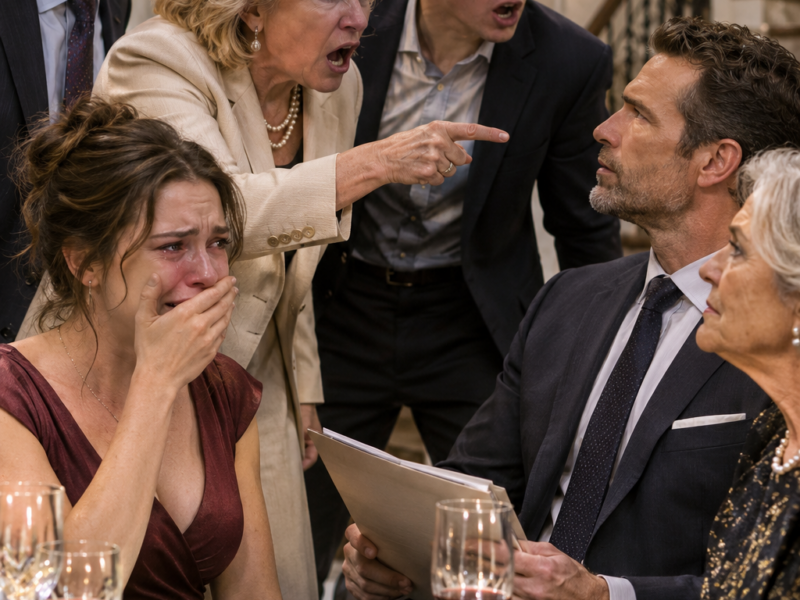
At Dinner in My New Home, My Parents Came to Take It for My Brother — Then They Saw Who Sat Inside
At Dinner in My New Home, My Parents Came to Take It for My Brother — Then They Saw Who Sat Inside
The first time my parents came to my home in more than five years, they weren’t there to celebrate my success, congratulate me on surviving cancer, or even ask how I was doing. They came because my mother had decided my new house belonged to my younger brother.
And what happened when they walked into my dining room that Friday evening would expose a secret that had been buried for nearly five years—a secret involving $38,600, a handmade quilt, more than a hundred unopened letters, and a betrayal so deliberate that even now, I sometimes struggle to understand how a mother could do it to her own daughter.
My name is Virginia Perez. Most people call me Jenny. I’m thirty-nine years old, and I teach high school chemistry in Grand Rapids, Michigan.
For most of my life, I believed I understood my place in our family. My brother Shane was the one who needed help. He needed second chances, financial support, encouragement, forgiveness, and endless patience. I was the dependable daughter, the responsible one, the woman who could handle whatever life threw at her.
My mother called me her strong girl.
It took me thirty-nine years to understand that, in our family, being strong didn’t mean anyone admired me. It meant they felt entitled to leave me carrying everything alone.
I learned that lesson during cancer treatment. But I didn’t fully understand how cruel it could become until the day I bought my dream home.
It was a Tuesday afternoon in August 2026 when the real estate agent placed a small silver key ring in my palm.
The house was a brick bungalow built in 1941, tucked into a quiet street in Alger Heights on the southeast side of Grand Rapids. It wasn’t extravagant. The kitchen cabinets had been painted sage green decades earlier, the upstairs bedrooms were small, and the wooden floors carried scratches from generations of people who had lived there before me.
But the house had something I had wanted for as long as I could remember.
A real dining room.
Not a folding table squeezed against a wall or a narrow counter where I ate dinner standing up. A proper dining room with a wide bay window, golden afternoon light, and a built-in china cabinet with old, slightly wavy glass doors.
I stood there on closing day, holding my keys, imagining people gathered around a table. I imagined coffee cups, birthday cakes, laughter, Thanksgiving dinners, and conversations that lasted long after the plates were cleared.
It was a strange dream for someone who had spent years feeling unwanted by her own family.
But I had purchased an oak dining table with six chairs the week before closing. I found it in a secondhand furniture store on Division Avenue. The finish was worn in places, and one chair had a small scratch along its backrest.
I bought it anyway.
I didn’t have six people to invite.
I simply wanted to believe that one day I might.
That evening, I placed my keys on the dining room windowsill and photographed them against the empty room. Then I uploaded the picture to Facebook with a simple caption.
“Five years ago this week, a doctor told me my tumor was malignant. Today, someone handed me keys.”
By morning, forty-one people had liked the post. Several colleagues congratulated me. Former students sent messages. My best friend Jenna Collins commented that she was bringing champagne and refusing to leave until every cardboard box was unpacked.
There wasn’t a single reaction from my parents or my brother.
I told myself I wasn’t disappointed.
After all, I had learned not to expect much from them.
But two days later, I sent my mother three photographs of the kitchen.
I didn’t include a message. I didn’t write that I missed her or ask her to visit.
I simply sent the pictures.
Part of me was curious whether good news might bring out a different version of my mother than the one who had abandoned me during the worst years of my life.
She didn’t reply to the photographs.
Instead, she called that evening.
“Jenny, sweetheart!” she said brightly. “Congratulations on the house. It’s a cute little place.”
“Thank you, Mom.”
I heard my brother laughing somewhere behind her. My father was there too; I recognized the familiar creaking of his recliner.
Then my mother said something that made me wonder whether I had misunderstood her.
“So listen, honey. We’ve talked everything over as a family, and we’ve decided Shane is going to take the house.”
I stood motionless in my new kitchen.
“I’m sorry. What?”
“Shane needs a proper home for Harper. A yard, a bedroom, somewhere she can feel comfortable when she visits. And you’ve got all that space just sitting there.”
I stared at the wall.
“Mom, I bought this house.”
“Of course you did, sweetheart. Nobody’s saying otherwise.”
“Then what do you mean Shane is taking it?”
She sighed, as though I were making something unnecessarily complicated.
“He’s going to move in on September first. You’ll keep the mortgage in your name, naturally, because getting financing right now would be difficult for him. He can give you six hundred dollars a month when he’s able. You can find yourself a nice little apartment nearby.”
I couldn’t speak.
Every dollar I had saved over four exhausting years had gone into that house.
I had sold my old condominium at the end of July, walking away with forty-three thousand dollars after the mortgage and selling expenses. Another fifteen thousand had come from tutoring students after school and working through summer vacations.
Fifty-eight thousand dollars.
My entire financial safety net.
The house itself cost $335,000, and I had committed to thirty years of mortgage payments.
Yet my mother was discussing it as though it were an old sofa she had decided my brother needed more than I did.
“Mom, that’s not happening.”
“Don’t be selfish, Jenny. You’re one person. Shane has a daughter.”
My niece Harper was six years old, a sweet little girl who had nothing to do with her father’s problems. Shane had been living in my parents’ basement for fourteen months after his marriage collapsed and his house in DeWitt was sold under financial pressure.
His former wife, Kristen, had apparently been raising concerns about whether my parents’ basement was an appropriate place for Harper to spend weekends.
I understood why a father would want a proper home for his daughter.
What I didn’t understand was why my mother believed the solution involved stealing mine.
“Shane needs a yard,” she continued. “Besides, you’ve always been happy in small places.”
Then her voice softened into the familiar, carefully controlled tone she used when she wanted me to feel guilty.
“After everything this family did for you when you were sick, I would think you’d want to help your brother.”
I nearly laughed.
Everything they did for me.
Those words were so far removed from reality that I felt a strange coldness spread through my chest.
Before I could answer, Shane leaned toward the phone.
“Come on, Jenny. You don’t even have a real family. What are you going to do with a whole dining room? Sit there with your houseplants?”
He laughed.
My mother laughed with him.
My father said nothing.
And suddenly, instead of defending myself, I realized something important.
They believed I was alone.
They believed I had nobody to protect me, nobody to question them, and nobody who would care if they pushed me out of my own house.
For the first time, I decided not to correct their assumptions.
“Come tomorrow,” I said quietly. “Six o’clock. All three of you. I’ll make dinner.”
My mother sounded delighted.
“Now that’s my sensible girl.”
When the call ended, I stood in the dining room for a long time.
Then I picked up my phone and called a seventy-one-year-old woman named Ruth Ann Whitaker.
To understand why I called her, you need to understand what had happened five years earlier.
The last time my parents visited my home before that August evening was July 4, 2021.
I was thirty-four then, living in a modest one-bedroom condominium in Wyoming, just south of Grand Rapids. My parents stopped by on their way to a family cookout in Holland.
They stayed forty minutes.
My mother inspected the condo, commented that my dining table was too small for entertaining, and complained that the living room didn’t get enough sunlight.
My father asked about my car.
Shane called twice during their visit because he couldn’t find the cooler they were supposed to bring to the cookout.
They left before finishing their coffee.
Five weeks later, on August 10, I sat alone in an examination room while a doctor explained that I had stage two breast cancer.
I remember seeing the doctor’s lips move and hearing words like treatment, chemotherapy, surgery, and prognosis.
But the word that remained lodged in my mind was malignant.
I was thirty-four years old.
I had spent years working toward financial stability, and suddenly I was wondering whether I would live long enough to enjoy any of it.
I called my mother from the hospital parking garage.
She cried immediately.
“Oh, Jenny. My poor baby. We’ll be there. Whatever you need, we’re going to get through this together.”
For one brief moment, I believed her.
A week later, when I asked whether she could come for my first chemotherapy appointment, she explained that her sciatica had become unbearable.
“I can’t possibly sit in a car for seventy minutes, honey. You understand.”
I did understand.
Or at least I said I did.
My treatment began September 13. I had chemotherapy scheduled every other Monday for sixteen weeks.
I printed the dates and taped them to my refrigerator. I photographed the schedule and sent it to my mother.
She reacted with a heart emoji.
Then she wrote, “Praying for you.”
That became her entire contribution to my cancer treatment.
My father stopped asking about appointments. Shane never offered to visit. My mother always had some reason she couldn’t make the drive.
Sometimes it was her back.
Sometimes it was a church responsibility.
Sometimes Shane needed her.
The person who came to every appointment was Jenna Collins, the art teacher whose classroom was down the hall from mine.
Jenna drove a battered blue SUV, listened to music that sounded as though it had been deliberately selected to annoy people, and possessed an extraordinary talent for making terrible situations feel survivable.
She arrived at my condo at 7:15 every treatment morning with ginger ale, crackers, and a new playlist.
She sat beside my infusion chair for hours, sketching flowers, making sarcastic comments about reality television, or simply holding my hand when I was too frightened to speak.
When my hair began falling out, Jenna came over with electric clippers.
I cried in my bathroom while clumps of brown hair gathered around the sink.
She stood behind me, looked at our reflections, and said, “We’re doing this together.”
Before I could protest, she ran the clippers through a section of her own hair.
I started laughing through my tears.
“You look ridiculous.”
“So do you,” she replied. “Now we’re a team.”
That was Jenna.
She never called herself family.
She simply behaved like it.
My mother continued sending hearts and prayers.
In November, I received an envelope from Lansing containing a two-hundred-dollar Target gift card.
There was a note in my mother’s handwriting.
“Some ladies at church wanted you to have this. Don’t make a fuss.”
I was touched.
Cedar Hill Community Church had been a big part of my childhood, although I hadn’t attended in nearly twenty years. I remembered Sunday school, church picnics, Christmas programs, and elderly women who always seemed to have hard candy tucked into their purses.
I bought a box of thank-you cards decorated with daisies.
My hands were trembling from treatment when I wrote a message thanking the women for remembering me.
I mailed it to my mother, asking her to deliver it to the church.
I never heard whether she did.
By January 2022, my savings had disappeared.
My sick days had run out months earlier. My medical costs were mounting, and I had lost thousands in income.
I had spent roughly sixteen thousand dollars in five months.
Two overdue mortgage notices sat on my kitchen table beneath a salt shaker, each showing a missed payment of $1,150.
On January 9, I finally swallowed my pride and asked my mother for help.
“Mom, I hate asking, but could you lend me three thousand dollars until March? I’m behind on the condo, and I’m scared.”
Twenty minutes later, she replied.
“Things are really tight right now, honey. Maybe ask Jenna?”
I read her message repeatedly.
Then I put the phone down and cried.
I had paid $2,400 toward Shane’s wedding photographer in 2019 because my mother told me he was struggling. I had helped with birthdays, emergencies, car repairs, and more small loans than I could remember.
But when I needed help, my mother directed me toward a coworker.
Jenna wrote me a check that afternoon.
She refused to accept interest.
She refused to let me apologize.
And when I tried to thank her, she said, “Jenny, one day you’re going to learn that you don’t have to earn the right to be helped.”
I finished chemotherapy in January, underwent surgery in February, and endured radiation through April.
In May, my scans came back clear.
I had survived.
Neither of my parents had visited me once.
Around the same time, I learned that Shane had purchased a three-bedroom house in DeWitt.
The price was $245,000.
My mother posted photographs of him, Kristen, and little Harper standing proudly on the front lawn.
Her caption read, “So proud of our boy. Dad and I helped a little. That’s what family does.”
I saw the post while sitting in the cancer center waiting room.
Two months earlier, things had supposedly been too tight for my parents to lend me three thousand dollars.
Yet somehow, they had enough money to help Shane buy a house.
I wrote “Congratulations” beneath the photograph.
Then I turned off my phone.
I told myself I had no right to be angry. It was their money. They could spend it however they wanted.
What I didn’t know was that it wasn’t their money at all.
For another two years, I kept trying to maintain a relationship with my family.
I drove to Lansing for holidays. I brought gifts. I called on birthdays. I pretended not to notice the way conversations stopped whenever I entered a room.
Christmas 2023 was the final breaking point.
We were eating dinner at Shane’s house when he leaned back in his chair and made a joke about my illness.
“Must be nice,” he said. “Six months off on a cancer vacation, and you still got paid.”
I stared at him.
I hadn’t been paid.
I had nearly lost my home.
I had spent months frightened that treatment might fail.
And he was calling it a vacation.
But what hurt more than his comment was my mother’s reaction.
She laughed.
Just a little breath of amusement, as though he had made a clever observation.
My father looked down at his plate.
I stood, collected my coat, kissed Harper goodbye, and left.
I drove seventy minutes home in darkness without turning on the radio.
After that Christmas, I stopped visiting.
My family didn’t come looking for me.
Then, on a snowy January afternoon in 2024, my mother sent me a photograph.
She was sitting in her sewing room under a beautiful blue-and-yellow patchwork quilt decorated with eight-pointed stars.
One corner was slightly frayed.
Her message said, “Snow day. Cozy under my quilt. Wish you’d call your mother.”
I didn’t respond.
I also didn’t delete the photograph.
At the time, I had no idea that it would eventually become one of the most important pieces of evidence in my life.
Instead of waiting for my parents to change, I started rebuilding my world.
I tutored chemistry three evenings a week. I worked through school breaks. I saved carefully, repaired my credit, and paid Jenna back every cent.
Gradually, the fear of losing my home faded.
By spring 2026, I was ready for something new.
Shane, meanwhile, was moving in the opposite direction.
His marriage had deteriorated. He had developed a serious online sports betting problem, and financial pressure had become unbearable.
Kristen filed for divorce in early 2025.
That summer, Shane sold his house for barely enough to cover what he owed and moved into our parents’ basement.
My mother sent one message that year.
“Pray for your brother. He’s had a terrible year.”
She didn’t ask about my health.
She didn’t ask whether I was happy.
She didn’t know I was saving for a house.
And that was exactly how I wanted it.
Then, in early July 2026, while I was packing textbooks into boxes, a message appeared from someone I hadn’t spoken to in almost twenty years.
Ruth Ann Whitaker.
Mrs. Whitaker had taught my Sunday school class when I was eight. She gave children butterscotch candies for memorizing Bible verses. Her husband Walter had served as church treasurer for decades.
Her message was friendly, warm, and completely unexpected.
“Virginia, honey, it’s Ruth Whitaker from Cedar Hill. I’ve thought about you so often. Did the fund help with your treatment? And did you ever like the quilt?”
I read those words three times.
The fund?
The quilt?
I typed, “What fund?”
She didn’t answer immediately.
The next evening, she called.
Her voice shook as she explained something that turned my understanding of the past five years upside down.
When my mother announced my cancer diagnosis to the church in 2021, the congregation had organized a fundraiser called Prayers for Virginia.
They held a spaghetti dinner, arranged a bake sale, and collected special offerings on two Sundays.
Ninety families donated.
The total was $38,600.
Walter Whitaker had counted the money twice and purchased a cashier’s check.
Because my mother had told everyone she was managing my medical bills, Walter made the check payable to Darlene Perez.
Ruth personally handed it to my mother on December 19, 2021.
There had also been 112 cards and a handmade quilt, sewn by the women’s ministry over six weeks.
I sat on the floor among my moving boxes, unable to breathe properly.
“Mrs. Whitaker,” I whispered, “I never received any of that.”
She was silent.
Then she said, “Your mother told us she was with you every weekend.”
My stomach tightened.
“She never came.”
“She told us she sat beside you during chemotherapy.”
“That was Jenna.”
Ruth began crying.
Then she sent me a photograph.
Eleven women stood in the church fellowship hall holding a blue-and-yellow quilt decorated with eight-pointed stars.
I recognized it immediately.
I found my mother’s photograph from January 2024.
The same quilt.
The same pattern.
The same frayed corner.
My mother had been using a quilt that strangers lovingly made for her daughter while that daughter sat alone recovering from cancer.
And she’d been confident enough to send me a photograph of herself wrapped in it.
Ruth explained that Walter had died earlier that year. While sorting through his papers, she discovered a folder labeled “Virginia P. Fund.”
Inside was a photocopy of the check and a handwritten note confirming its delivery to my mother.
Walter had added a yellow sticky note.
“Never got a thank you. Asked D.”
I thought about the daisy thank-you card I had mailed in November.
Had my mother delivered it?
Apparently not.
Ruth began investigating carefully.
My mother had been her friend for more than thirty years. Ruth didn’t want to believe she could have done something so terrible.
At a church potluck, she casually asked whether I had liked the quilt.
My mother answered without hesitation.
“Oh, she sleeps under it every night.”
That was when Ruth knew something was wrong.
She worked with the church treasurer to obtain an image of the deposited check.
The bank records showed my mother’s endorsement and a deposit on December 20, 2021, into an account ending in 4410.
We still didn’t know where the money had gone.
But we knew it had reached my mother.
And we knew it had never reached me.
That was the information I was carrying when my mother called and announced that Shane would be taking my new house.
After that phone conversation, I called Ruth and told her everything.
Then I invited her to dinner.
“Tomorrow. Six o’clock. I’d like you to sit at my table when they arrive.”
She hesitated.
“Darlene was the person who stayed with me after Walter died,” she said quietly. “She brought soup. She held my hand.”
I could hear the heartbreak in her voice.
My mother had comforted Ruth through grief while concealing something that would shatter their friendship.
“I know what I’m asking,” I told her. “But I need someone who knows the truth.”
Ruth said she would think about it.
I gave her the keypad code for my back door and explained that she could park behind the garage if she decided to come.
That night, I barely slept.
I printed my hospital statements, insurance records, overdue mortgage notices, text messages, and everything Ruth had sent.
I arranged the documents in a blue folder.
Then I set my dining table for five.
Five plates.
Five glasses.
Five folded napkins.
My parents, Shane, Ruth, and me.
The following morning, I started making my grandmother’s pot roast.
Beef, carrots, onions, potatoes, and a little red wine, all cooking slowly until the house smelled like the Sunday dinners I used to dream about having with a loving family.
At 4:45, Ruth sent a message.
“I’m sorry, honey. I can’t do this to her.”
I stood in the kitchen holding an oven mitt, feeling as though someone had opened a trapdoor beneath my feet.
I understood her decision.
But I was disappointed.
I went into the dining room to remove her plate.
Then I stopped.
I looked at the empty chair in front of the bay window.
And for reasons I couldn’t entirely explain, I left it there.
Maybe I needed to remind myself that an empty seat wasn’t proof that nobody cared.
Maybe I simply wanted to believe somebody would eventually be brave enough to sit in it.
At exactly six o’clock, a silver Buick pulled into my driveway.
My mother entered without knocking.
She wore pearl earrings, a cardigan despite the August heat, and plum-colored lipstick.
She looked around the house with the confident expression of a woman inspecting something she had already purchased.
“Oh, this china cabinet will be perfect for Harper’s art supplies.”
Shane immediately walked through the kitchen and into the backyard.
“Mom! We can fit a swing set right here!”
My father remained near the entrance, twisting his Detroit Tigers cap between his hands.
He barely looked at me.
When Shane noticed the dining table, he counted the settings.
“Five plates? Who’s the extra one for, Jenny? Your imaginary boyfriend?”
I smiled faintly.
“I like being prepared for company.”
My mother reached into her purse and produced a folded sheet of lined paper.
At the top, she had written “Family Plan.”
Underneath were her instructions.
Shane would move in September 1.
He would pay me six hundred dollars a month when possible.
I would continue paying the mortgage.
Harper would have the bedroom with blue wallpaper.
There wasn’t a single line explaining where I was supposed to live.
I laid the paper on the table.
“Mom, can I ask you something first?”
“Of course, sweetheart.”
“When I was sick, did anyone from Cedar Hill try to help me?”
She didn’t pause.
“People prayed, Jenny. That’s what a church does.”
She patted my arm.
“Now, show me the bedrooms.”
I watched her walk upstairs, assigning rooms as though she were a real estate agent working on Shane’s behalf.
Harper would have the blue bedroom.
Shane would have my bedroom.
The little room under the slanted roof would become a guest room for my parents.
“For when we visit,” my mother explained.
I stood in the doorway.
For when they visited.
For five years, seventy minutes had been too far to travel for their sick daughter.
But apparently they would happily make that drive to visit my brother in her house.
As we stood upstairs, I thought I heard a quiet click from somewhere below.
I assumed it was an old door settling.
At half past six, I announced that dinner was ready.
I walked downstairs first.
And stopped in the dining room entrance.
Ruth Whitaker was sitting at the head of my table.
She wore a navy dress and a small gold cross necklace. Her silver hair was neatly brushed, and her hands rested on a thick brown accordion folder.
She looked up at me.
Her eyes were filled with tears.
“I got as far as the Portland exit,” she said softly. “I turned around twice. But then I remembered Walter’s note.”
I didn’t have time to answer.
My mother entered behind me.
She stopped so abruptly that Shane nearly collided with her.
For a moment, nobody moved.
Then my mother whispered, “Ruth?”
Ruth looked directly at her.
“Sit down, Darlene. Your daughter made dinner.”
My mother’s expression changed several times in the space of a few seconds.
Shock.
Fear.
Calculation.
Then the familiar warm smile appeared.
“Ruth, honey, I don’t know what Jenny has been telling you, but she’s had such a difficult time since her illness.”
Ruth opened her folder.
“Virginia hasn’t told me anything about the fund, Darlene. I told her.”
The silence that followed was extraordinary.
Ruth placed the original church fundraising announcement on the table.
Then Walter’s ledger, recording donations from ninety families.
Then she looked at me.
“Virginia, did you ever receive any of the $38,600 raised for your treatment?”
“No.”
My mother straightened in her chair.
“I used it to pay her hospital bills directly. I didn’t want her worrying about finances.”
I opened my blue folder.
Without raising my voice, I laid out the insurance statements showing that I had personally paid $6,800 in 2021 and another $6,800 in 2022.
Then the two overdue mortgage notices.
Then the bank records showing my payments.
“Every statement has my name on it, Mom.”
She barely glanced at them.
“Hospital billing systems make mistakes.”
“Then you can show us the payments you made,” Ruth said.
My mother folded her hands.
“Well, I gave Jenny cash when she needed it.”
I stared at her.
I had imagined this conversation so many times.
I had wondered whether she would apologize, cry, or tell me something I didn’t know.
Instead, she simply invented another explanation.
Ruth placed the cashier’s check on the table.
$38,600.
Payable to Darlene Perez.
Then the image showing my mother’s endorsement and the deposit into account 4410.
I placed my phone beside it, displaying the January 9 message in which my mother had refused to lend me three thousand dollars.
“You deposited the church money in December,” I said. “Twenty days later, you told me you couldn’t help me keep my home.”
My father reached for his reading glasses.
He leaned over the check.
Then he stared at the account number.
“That’s our account, Darlene.”
My mother didn’t answer.
“Our joint account,” he repeated.
Ruth brought out the photograph of the quilt.
I opened my mother’s snow-day picture.
Two photographs.
The same quilt.
My father looked from one to the other.
“That’s in your sewing room,” he said slowly. “It’s been there for years.”
“I was keeping it safe,” my mother snapped.
“For five years?” Ruth asked. “While Virginia didn’t even know it existed?”
My mother stood abruptly.
“You set me up!”
She pointed at me.
“In front of my best friend! In your little house!”
I looked at the table, then at her.
“You asked who would sit in my dining room,” I answered. “Someone did.”
She turned toward Ruth.
“You don’t understand what we were going through! Shane and Kristen had a baby. They needed a home. Jenny had insurance, a good job, and a pension. She was going to be fine.”
Shane shifted in his chair.
Then, with the casual impatience of someone who had grown tired of an argument, he said the words that changed everything.
“Mom, just tell them it was for my house.”
Nobody spoke.
I turned toward him.
“What?”
He shrugged.
“Mom and Dad helped with the down payment. Parents do that.”
“Did you know where the money came from?”
He looked at our mother.
Then back at me.
“Mom said you had insurance. She said you didn’t need it.”
I felt physically sick.
My brother had known that money intended for my cancer treatment had helped him buy his house.
He had known when he laughed about my “cancer vacation.”
He had known when I sat at his Christmas table.
He had known when he told me I didn’t have a real family.
“It’s not like you were dying,” he muttered.
My father stood so quickly that his chair scraped across the floor.
“Darlene, you told me Jenny got that money.”
My mother turned on him.
“Glenn, don’t start.”
“You told me you’d given it to her. When she asked for three thousand dollars in January, you said she was asking for more after we’d already helped her.”
I looked at him.
For the first time, I began to understand why his Sunday phone calls had stopped.
He had believed I was ungrateful.
He had believed I was taking advantage.
And there was something else.
“You told me she didn’t want visitors during treatment,” he continued. “You said she was embarrassed. You said she’d asked us to stay away.”
I opened my old messages.
Sixteen unanswered invitations.
Sixteen weeks of asking whether my parents could visit.
I handed him the phone.
“I wanted you there, Dad. Every week.”
He read the messages slowly.
When he looked up, his eyes were red.
My mother grabbed her purse.
“You have no idea what you’re doing. I’ve given thirty years to Cedar Hill. Who do you think those women will believe? Me, or a bitter daughter who has always needed attention?”
Ruth’s face drained of color.
My mother continued.
“And don’t think I won’t tell them you’re confused since Walter died.”
That was when I finally stopped feeling afraid of disappointing her.
For my entire life, I had tried to be good enough, patient enough, successful enough, and generous enough to earn her approval.
Now I understood that approval had always come with one condition.
I had to accept whatever she decided to take.
Shane stood up, looking irritated.
“So am I still moving in September first or not?”
I looked directly at him.
“No.”
One word.
It was the easiest word I had ever spoken.
My mother stormed out.
Shane followed.
My father lingered at the doorway, holding his cap.
He looked as though he wanted to say something, but no words came.
Then he left too.
A moment later, car doors slammed.
Ruth and I sat alone at a dining table set for five.
The pot roast was overcooked.
The carrots were soft.
We ate anyway.
As the evening settled around us, Ruth told me about the fundraiser.
She told me about Walter recording every donation carefully, including $11.40 from a first-grade boy who had emptied his piggy bank.
She told me about the women sewing the quilt together, discussing colors and patterns, imagining how warm it would keep me during treatment.
Then she reached across the table and held my hand.
“Virginia, sweetheart, you were never alone. You were just never told how many people cared.”
And I cried.
Not the restrained tears I had learned to shed quietly during chemotherapy.
I cried until I couldn’t speak.
For five years, I had believed that nobody came because nobody cared.
Now I knew the truth was far more complicated.
People had wanted to come.
They had wanted to help.
My mother had stood between us and made sure we never found one another.
I thought the dinner had been the end of it.
I was wrong.
By Saturday afternoon, my mother had already begun telling her own version of events.
She called Pastor Nathan Brooks and explained that Ruth was struggling with grief and that I had never been emotionally stable since cancer.
She contacted women from the church ministry, warning them that I was making accusations because I resented Shane.
On Saturday night, Shane posted a message on Facebook.
“Some people will use cancer for anything. Pray for my mom. She doesn’t deserve this.”
By Sunday afternoon, women I barely remembered were messaging me.
One asked how I could treat my mother so terribly after everything she had done.
Another said I should be ashamed.
Ruth called me in tears.
Pastor Nathan had questioned whether grief might be affecting her memory.
For a terrible moment, she sounded uncertain.
“Maybe I am getting confused, Virginia.”
“You’re not,” I told her. “You have Walter’s records.”
“But the check only proves your mother received the money. It doesn’t prove where she spent it.”
She was right.
We needed something more.
That Sunday night, at nine o’clock, my phone rang.
It was my father.
He hadn’t called me independently in years.
His voice sounded exhausted.
“Jenny, I need you to tell me something. And I need you to tell me the truth.”
“Okay.”
“Did you ever receive that money? Any of it?”
“No, Dad. Not one dollar.”
He was silent for a long time.
Then he asked me to send him every document I had.
I sent the hospital statements, overdue notices, messages, and photographs.
He explained that my mother had managed their finances since 1986.
He had trusted her with every bill, bank statement, and account.
He had never questioned where money came from or where it went.
“I’m going to the bank tomorrow,” he said. “I’m going to look at everything myself.”
Late Monday morning, he called from the bank parking lot.
His voice was shaking.
“I found it.”
The $38,600 had been deposited on December 20, 2021.
It had remained in their joint account for nearly three months.
There were no corresponding cash withdrawals.
No payments to hospitals.
No transfers to me.
Then, on March 18, 2022, the entire amount had been wired to Mid-Michigan Title.
The company that handled Shane’s house closing.
Exactly $38,600.
The same amount raised for my chemotherapy.
My father repeated the numbers slowly, as though saying them aloud might make the truth easier to understand.
“One deposit. One wire. Same amount.”
He had attended Shane’s closing.
He had watched his son become a homeowner.
And he had never realized that the money helping him buy that house had been donated by strangers to help his daughter survive cancer.
The next morning, we met at Cedar Hill Community Church.
Pastor Nathan sat behind his desk.
Ruth sat beside me.
My father sat near the door.
My mother arrived wearing her pearl earrings and best cardigan.
She greeted the pastor warmly.
Then she immediately repeated her latest explanation.
“I gave Virginia cash every month for a year.”
My father stood.
He unfolded the bank statements and laid them on the desk.
Two lines were highlighted in yellow.
The December deposit.
The March wire.
“There’s no cash, Darlene,” he said. “I read every statement.”
My mother’s face went pale.
She said his name sharply, the way she always did when she wanted him to stop talking.
“Glenn.”
He didn’t stop.
“The money was deposited into our account and wired to Shane’s closing. You told me you gave it to Jenny.”
Pastor Nathan examined the documents.
Then Ruth placed Walter’s note beside them.
The evidence formed a sequence nobody could reasonably explain away.
My mother stared at the papers.
Finally, she whispered, “It was a loan.”
Nobody answered immediately.
“Shane needed a start. He was going to pay it back.”
Ruth looked at her former friend.
“It wasn’t yours to lend.”
My mother turned toward me, almost bewildered.
“You were always going to be fine, Jenny. You’ve been fine since you were five years old. Shane was the one who needed help. He always has been.”
And for the first time, I heard something beneath all her lies.
The belief that had governed our family for decades.
Shane’s needs were emergencies.
Mine were inconveniences.
Shane deserved rescuing.
I was expected to survive.
I thought about Jenna holding ginger ale beside my infusion chair.
I thought about my trembling hands writing thank-you cards, about the overdue mortgage notices, about shaving my head in the bathroom while my mother told people she was holding my hand through treatment.
“I was fine,” I told her, “because nobody gave me another choice.”
She lowered her eyes.
Pastor Nathan explained that the church would need to address the misuse of donated funds. He said the board could consider reporting the matter to law enforcement.
Then he asked what I wanted.
I had spent the entire drive thinking about that question.
“I don’t want the money for myself,” I said. “And I don’t want this to become a public fight about punishment.”
I looked at Ruth.
“I want the truth told to the people who donated. And I want every dollar returned to the church.”
Pastor Nathan nodded.
“For what purpose?”
“For people going through cancer treatment who need transportation or someone to sit with them. I want a fund that makes sure nobody has to go to those appointments alone.”
I could almost hear Jenna’s terrible music.
“Call it the Ride Fund.”
We agreed that the $38,600 should be restored by the end of September.
The pastor said the congregation would be informed the following Sunday.
My mother refused to address them.
Then my father spoke.
“I’ll do it.”
The following Sunday, I walked into Cedar Hill Community Church for the first time in almost twenty years.
Ruth met me in the lobby and linked her arm through mine.
Some women smiled.
Others looked away.
My mother’s usual seat in the third row was empty.
After the final hymn, my father walked to the front.
He had spent his working life repairing boilers and heating systems. Public speaking was something he avoided whenever possible.
His hands shook as he held a piece of paper.
Then he folded it and put it in his pocket.
“Five years ago,” he began, “many of you gave money to help my daughter Virginia when she had cancer.”
The sanctuary became very quiet.
He told them about the $38,600.
He told them about the quilt and the cards.
He explained that none of it had reached me.
He admitted that his wife had used the money to help purchase their son’s home.
Then he said something I never expected to hear.
“Virginia went through cancer treatment without her parents. My wife lied about being there. And I believed her without asking my daughter what she needed.”
His voice cracked.
“That’s on us. Not on Jenny.”
He promised that the money would be restored to a new fund helping patients reach their treatments.
Then he looked toward me.
“I’m sorry, Jenny. I should have driven up there. I should have asked.”
I cried quietly as he returned to his seat.
Nobody applauded.
Nobody seemed to know what to do.
Then an elderly woman rose from a pew across the aisle.
She was small, with white hair and swollen knuckles.
Bev Larkin.
She walked toward me and wrapped her arms around my shoulders.
“We made you a quilt, honey,” she whispered. “Blue and yellow stars. I hope you’ll let us give it to you properly.”
Then others came.
Women who had baked cakes.
Women who had made spaghetti.
Women who had written cards.
Some apologized for believing my mother.
One woman told me she had offered to bring chicken soup to Grand Rapids three times during my treatment.
Each time, my mother told her that only family members were allowed to visit.
Another had asked for my mailing address.
My mother promised to deliver any letters herself.
By the time everyone finished speaking, I was trembling.
But for once, it wasn’t from illness or fear.
It was from the realization that an entire community had cared about me during a time when I believed I was forgotten.
Before leaving, I invited them to my housewarming.
“Saturday, September fifth,” I said. “Four o’clock. I’d love to have you.”
My father began arranging repayment immediately.
He sold his bass boat for fourteen thousand dollars.
I remembered that boat from childhood. He used to take me fishing on Lake Lansing, pretending not to help while secretly guiding my hands whenever I struggled with the rod.
Shane was made to sell his truck.
It brought $12,500.
My father contributed the final $12,100 from his savings.
By September 4, the full $38,600 had been deposited into the Cedar Hill Ride Fund.
Every dollar.
My brother moved into a small one-bedroom apartment on September 1, the same day he had planned to move into my house.
He sent me a message.
“Happy now?”
I stared at it for several minutes.
Then I answered.
“No. But I’m finished.”
My mother resigned from the women’s ministry and stopped attending church.
She sent me one final angry message.
“I hope that house keeps you warm because nobody in this family ever will.”
I stood in my sage-green kitchen looking at those words.
For years, I would have tried to explain myself. I would have written paragraphs about how much I loved her, how deeply she had hurt me, and how desperately I wanted her to understand.
This time, I typed only three words.
“It’s warm, Mom.”
Then I muted the conversation.
The day before my housewarming, my father called.
He sounded nervous.
“Ruth told me you’re having people over tomorrow.”
“That’s right.”
“Would it be all right if I came? Just me?”
I thought about all the times I had invited him to visit during chemotherapy.
I thought about the sixteen unanswered messages.
I thought about the five years in which he had accepted my mother’s version of events without asking for mine.
But I also thought about him standing in church, trembling as he admitted the truth.
“Come at four, Dad.”
He arrived ten minutes early.
I was arranging deviled eggs when the doorbell rang.
The sound stopped me.
Not because it was loud, but because someone had actually knocked.
For years, my family had either refused to visit or entered as though they owned the place.
Now my father was standing on the porch, waiting for permission.
When I opened the door, I saw something in his arms.
A folded blue-and-yellow quilt.
One corner was frayed.
Resting on top was a cedar box with a little brass latch.
“I found these in your mother’s sewing room,” he said. “Under her winter sweaters.”
He looked at me helplessly.
“She kept everything, Jenny. She just never let any of it reach you.”
I took the quilt.
It was heavier than I expected.
The fabric was soft from years of handling, but the stitching was beautiful. I could see where different women had used slightly different techniques to make each star.
Then I looked at the cedar box.
“Come inside, Dad.”
We sat at my dining table.
I opened the latch.
Inside were letters.
Dozens of them.
Most had never been opened.
I picked up the first envelope and unfolded a drawing made by children from the church’s Sunday school.
It showed a woman standing beneath a rainbow with long yellow hair.
Underneath, in uneven letters, someone had written:
“Get Better Virginia.”
One of the letters was backward.
I laughed and cried at the same time.
Another card came from a man I had never met.
He wrote that he had survived cancer himself and wanted me to know it was all right to let other people carry me when I was tired.
There were cards from teachers, retired nurses, neighbors I barely remembered, women who had taught me Bible stories, and strangers who only knew that someone in their community was suffering.
One hundred and twelve cards.
For almost an hour, my father and I sat quietly opening them.
He handed me another whenever I finished reading one.
Soon the dining table was covered with messages.
Words of encouragement.
Prayers.
Little drawings.
Offers of help.
Evidence that I had been loved during the loneliest season of my life.
Then, at the bottom of the box, I found a small envelope with a daisy on the flap.
I recognized the handwriting immediately.
Mine.
The postmark was November 29, 2021.
It was the thank-you card I had written during chemotherapy.
Still sealed.
I turned it over slowly.
Walter’s note had said the church never received a thank-you.
Now I knew why.
If that card had reached the women at Cedar Hill, someone might have contacted me. Someone might have asked whether I had received the donations.
My mother had kept it because gratitude would have exposed her deception.
She had stolen not only the money and the quilt.
She had stolen my ability to thank people who cared.
I held the envelope against my chest.
My father looked down at the table.
“I don’t know how to make up for this,” he whispered.
I didn’t pretend to have an answer.
Some things cannot be repaired with a single apology.
Some absences leave marks that remain even after the truth comes out.
But I knew something else.
My father had come.
He had knocked.
And he was sitting beside me, opening letters that should have reached me years ago.
For that afternoon, it was enough.
The doorbell rang again.
Through the front window, I saw Ruth standing on the porch.
Behind her, several women were carrying casserole dishes, covered trays, and grocery bags.
I walked to the door with the daisy envelope in my hand.
When Ruth stepped inside, I placed it in her palm.
“This is for you,” I told her. “And all the women from Cedar Hill. It’s about five years late.”
She opened it there on the porch.
As she read my simple thank-you message, her face crumpled.
Then she laughed through her tears and hugged me.
Inside, she immediately noticed the cards spread across my table.
She walked slowly along them, touching envelopes, recognizing handwriting, occasionally smiling at names.
Then she stopped.
A small white card lay near the china cabinet.
She picked it up.
It was from Walter.
His handwriting was neat and square.
He had written that I was the only child in Sunday school who actually read the assigned lessons before class.
Then he told me to get well and come back so we could argue about Jonah again.
I burst out laughing.
When I was nine, I had insisted that a person couldn’t survive inside a whale because there wouldn’t be enough oxygen.
Walter had spent an entire Sunday pretending to take my argument seriously.
Ruth pressed the card to her heart.
“He would have loved this house,” she whispered.
By 4:30, I had run out of chairs.
Jenna arrived carrying two folding chairs from her SUV.
Pastor Nathan and his wife brought kitchen stools.
Bev insisted on helping arrange the food, despite my protests.
The dining table I had purchased for six people was surrounded by fourteen.
There were casserole dishes on the counters, salads on the windowsill, plates balanced on laps, and laughter echoing through the rooms.
Someone spilled lemonade.
Someone told a terrible joke.
Jenna started arguing with Ruth about the best kind of apple pie.
Bev told stories about my childhood that made me hide my face in embarrassment.
My father sat quietly at the far end of the table, his baseball cap resting on his knee.
At one point, he laughed.
A real laugh.
I realized I hadn’t heard that sound from him in years.
And somewhere during that noisy, crowded, imperfect afternoon, something changed inside me.
For the first time, I didn’t feel responsible for making sure everyone else was comfortable.
When someone offered to wash dishes, I let them.
When Jenna told me to sit down and eat, I sat down.
When Bev tucked the quilt around my shoulders because she thought the room was chilly, I didn’t insist that I was fine.
I simply said thank you.
It felt unfamiliar.
It also felt wonderful.
Near the end of the evening, my father found me alone in the kitchen.
He stood by the counter for a moment, looking uncomfortable.
“Jenny?”
“Yeah, Dad?”
“Could I come back sometime? Maybe we could have dinner. Or I could help you fix that loose railing out front.”
I considered the question carefully.
I loved my father.
But love didn’t erase five years of silence.
And forgiveness wasn’t the same as pretending nothing had happened.
“You can visit,” I said. “Just call first.”
He nodded.
“Of course.”
“That’s how we start.”
He looked at me for a long moment.
Then he smiled.
A small, tired smile.
But a genuine one.
The last guests left just before ten o’clock.
After Jenna helped me clear the final plates, she hugged me and promised to come back the next weekend.
I stood at the front door watching her taillights disappear.
Then I turned around.
The house was quiet.
There were dishes waiting in the sink, crumbs scattered beneath the table, and a forgotten napkin on one of the chairs.
The blue-and-yellow quilt was draped across the back of Ruth’s seat.
The cedar box sat on the china cabinet.
Everything looked wonderfully lived in.
For the first time, my house didn’t feel like a dream I had purchased for myself.
It felt like a home.
The following morning, I made coffee and carried it into the dining room.
Sunlight poured through the bay window, spreading gold across the old wooden floorboards just as it had on closing day.
I sat down with the quilt over my lap.
The same blue fabric.
The same yellow stars.
The same frayed corner.
I remembered the photograph my mother had sent on that snowy afternoon more than two years earlier.
She had been sitting beneath this quilt, telling me she wished I would call.
Back then, I thought it belonged to her.
Now it was resting in the home I had fought so hard to build.
On the table beside my coffee was the volunteer signup sheet for the new Ride Fund.
Pastor Nathan had explained that the program would help anyone needing transportation to cancer treatment, whether they attended Cedar Hill or not.
My name was first on the list of volunteer drivers.
My first assignment was scheduled for Thursday afternoon.
A retired school bus driver from Kentwood was beginning chemotherapy at the same cancer center where I had spent so many Mondays.
He lived alone, and his daughter worked out of state.
When Ruth asked whether I would be comfortable returning to that building, I thought carefully before answering.
The memories were painful.
The waiting room.
The antiseptic smell.
The infusion chairs.
The fear.
But I also remembered Jenna opening the passenger door of her SUV and handing me ginger ale.
I remembered how much it mattered to have someone sitting beside me.
“I’ll drive him,” I said.
I had already purchased the ginger ale.
As I sat in my dining room that Sunday morning, I thought about the woman I had been five years earlier.
She had believed that surviving meant enduring everything without complaint.
She thought love had to be earned by being useful.
She thought asking for help was evidence of weakness.
And when her own family abandoned her, she concluded that she must not have been important enough to deserve their presence.
I wished I could go back and sit beside that woman.
I wished I could tell her that people were raising money, baking cakes, writing letters, and sewing a quilt while she sat alone in her condominium.
I wished I could tell her that her mother’s silence wasn’t proof that nobody loved her.
But I couldn’t change what had happened.
I couldn’t recover the years when I believed I was forgotten.
I couldn’t force Shane to understand what he had done or make my mother become someone who could love both of her children without sacrificing one for the other.
What I could do was stop allowing their choices to determine the value of my life.
My home was still mine.
The mortgage was still in my name.
The kitchen was still painted sage green.
The old china cabinet still caught the morning light.
And the dining room I once imagined would remain empty had been so crowded the night before that people had to borrow chairs.
I remembered Shane laughing on the phone, asking who would ever sit in my dining room.
At the time, his words had hurt because they echoed something I secretly feared.
That perhaps I really was alone.
That perhaps no matter how hard I worked, how much I survived, or how beautiful a home I created, there would never be anyone who wanted to share it with me.
But now I knew better.
Family was not simply the people whose names appeared beside mine on a birth certificate.
Family was Jenna driving me to chemotherapy before sunrise.
It was Walter carefully recording a little boy’s $11.40 donation.
It was Bev sewing yellow stars into a quilt.
It was Ruth turning her car around twice before finding the courage to sit at my table.
It was a father who finally learned to knock.
And it was the strangers who had cared about a sick woman even though someone had prevented their kindness from reaching her.
I took another sip of coffee and looked at the volunteer signup sheet.
On Thursday, I would drive seventy minutes if I had to.
I would drive farther.
Because I knew what it felt like to watch a doorway and wonder whether anyone was going to walk through it.
And I knew what it meant when someone finally did.
My brother once asked who would ever sit in my dining room.
Last night, we ran out of chairs.
And for the first time in my life, I understood that I had never needed to surrender my home, my happiness, or my dignity to prove that I belonged to a family.
I only needed to open my door to the people who were willing to show up.
The sunlight moved slowly across the table.
I pulled the quilt a little closer around my shoulders.
Then I reached for my phone and sent Jenna a message.
“Thursday’s my first ride. I’ve got the ginger ale. Any terrible music recommendations?”
Her answer arrived almost immediately.
“Jenny, I’ve been preparing a playlist for this moment for five years.”
I laughed so loudly that the sound filled the empty house.
Except it wasn’t empty anymore.
It was full of memories, friendship, forgiveness that would have to be earned, and love that had finally found its way home.
And when I looked at the six oak chairs around my table, I didn’t wonder whether anyone would fill them.
I wondered whether I should buy a few more.
THE END