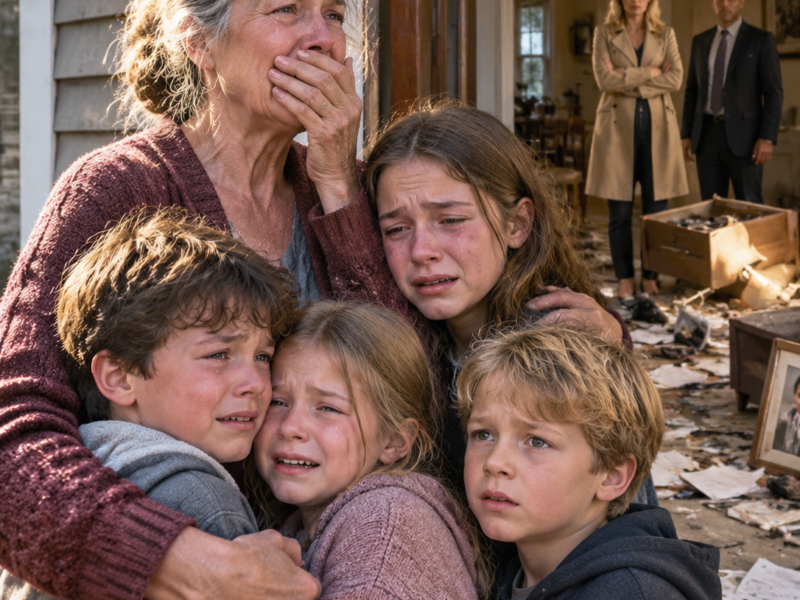
At 71, I Took In My Four Orphaned Grandchildren After My Son and His Wife Died in a Horrific Car Crash, but My Wealthy Daughter Refused to Help, Saying, “We Cannot Turn Our Home Into an Orphanage.” Four Months Later, While I Was Working Night Shifts to Feed Them, She Demanded I Sell Their $850,000 Home for Just $410,000. I Refused and Discovered a Hidden Vault Behind My Son’s Garage Wall. But When I Played the Security Footage He Had Secretly Saved, My Blood Ran Cold…
At 71, I Took In My Four Orphaned Grandchildren After My Son and His Wife Died in a Horrific Car Crash, but My Wealthy Daughter Refused to Help, Saying, “We Cannot Turn Our Home Into an Orphanage.” Four Months Later, While I Was Working Night Shifts to Feed Them, She Demanded I Sell Their $850,000 Home for Just $410,000. I Refused and Discovered a Hidden Vault Behind My Son’s Garage Wall. But When I Played the Security Footage He Had Secretly Saved, My Blood Ran Cold…
The first time my daughter tried to steal my grandchildren’s future, she sat across from me at my own kitchen table, placed a silver pen beside a stack of legal documents, and smiled as though she were doing me a favor.
“Dad, we’re trying to help you,” Theodora said gently. “You’re seventy-one years old. You can’t possibly handle all this responsibility forever.”
Her husband, Pascal, pushed the paperwork closer.
“Four hundred and ten thousand dollars,” he announced. “Cash. We handle the debt, take the house off your hands, and you walk away with enough money to look after the children. It’s the best offer you’re going to get.”
I looked down at the document.
The house they wanted me to surrender had belonged to my dead son. His four children had grown up there. His wife had decorated its walls, and his hands had built the shelves in its garage.
And that property was worth at least $850,000.
What none of them knew was that I had already discovered something inside that house that made their generous offer look less like kindness and more like desperation.
They were not trying to save me from financial ruin.
They were trying to prevent me from finding out what they had done.
A year later, I would encounter my daughter again, this time on her knees in a supermarket aisle, wearing a faded cleaning uniform and scrubbing someone else’s spilled milk from the floor.
By then, her luxurious home would be gone, her marriage would be destroyed, and the people who had helped her betray our family would be sitting in prison.
But what she told me that night would reveal a truth about our family that I had failed to see for almost forty years.
My name is Hyram Naylor, and for most of my life, I believed I understood how things fell apart.
I spent four decades working as a structural building inspector in Ohio. I inspected bridges, parking garages, hospitals, office towers, and construction sites where millions of dollars depended on one man’s willingness to tell the truth.
People imagine that buildings collapse because of dramatic failures: a massive crack, a broken column, or a foundation splitting open.
Sometimes they do.
But the failures that frightened me most were the ones nobody noticed.
A bolt installed two inches deep when it should have been six. A beautiful weld hiding a weak connection underneath. A support beam carrying more weight than anyone realized.
Those mistakes can remain hidden for years.
The building stands. People move in. Children grow up inside it. Everyone assumes it is safe.
Until the wrong pressure arrives.
Then everything collapses.
It took me seventy-one years to realize that families can fail in exactly the same way.
I was married to a wonderful woman named Estella for forty-three years.
She was a fourth-grade teacher with a sharp mind, a gentle heart, and absolutely no patience for foolishness. She kept butterscotch candies in her classroom desk for children who arrived at school after difficult mornings.
At home, she made sure I ate vegetables, replaced my work boots before their soles wore through, and remembered the birthdays of people I barely knew.
When pancreatic cancer entered our lives, she faced it with the same practical courage she brought to everything else.
“Hyram,” she told me after the diagnosis, “I know you want to fix this. But you can’t. So put the kettle on and sit with me.”
Seven months later, she was gone.
I had already retired, and without Estella, the house became painfully quiet.
We had raised two children together.
Our son, Emory, was four years older than his sister. He inherited my fascination with machinery and his mother’s patience.
By twelve, he could rebuild a lawn mower engine. By sixteen, he could weld better than men twice his age.
He eventually became a supply-chain engineer, earning a comfortable salary and raising a beautiful family with his wife, Aninsley.
They had four children: Saurin, twelve; Xavier, nine; and six-year-old twin girls, Audene and Rosman, whom everyone called Audi and Rosie.
Those children were the center of Emory’s universe.
My daughter, Theodora, whom we called Thea, was different.
She was quiet, organized, ambitious, and determined to make something impressive of herself.
She married Pascal Cosgrove, a commercial real-estate broker with expensive suits, polished shoes, and a talent for making questionable opportunities sound like guaranteed investments.
They lived in a large house in an exclusive development called Aldermir.
Five bedrooms. White columns. A three-car garage.
Whenever I visited, Thea seemed perfectly happy.
At least, that was what I told myself.
She was successful. She had money. She had a husband and a beautiful home.
She was fine.
That word would eventually haunt me.
On Thursday, June 12, my life changed forever.
I was sitting at my kitchen table, drinking coffee and reading the newspaper, when someone knocked on my front door.
Not a cheerful knock.
Not the impatient knocking of a delivery driver.
Three slow, deliberate knocks.
When I opened the door, a state trooper stood on my porch holding his hat.
I knew what had happened before he spoke.
There are certain expressions a man never forgets, and the face of someone preparing to deliver terrible news is one of them.
The trooper introduced himself as Officer Umbberger.
He asked whether he could come inside.
We sat at my kitchen table, the same table where I had eaten breakfast with Estella for decades.
Then he told me that Emory and Aninsley had been involved in a serious collision on the Eastmere Beltway.
Their vehicle had left the road after an apparent braking-system failure.
Neither had survived.
The four children were already at school.
Someone needed to tell them.
I remember looking at the coffee cup beside my hand.
Steam was still rising from it.
I remember thinking that a cup of coffee should not be allowed to remain warm when the entire world had just turned cold.
I asked what caused the crash.
“Mechanical failure, most likely,” the trooper said. “The investigators will confirm it.”
Without thinking, I wrote those words on the back of an electric bill.
Mechanical failure. Brakes. Exit nine.
Forty years of professional habit had taken control of my hand.
That morning, I drove to Thistledown Elementary School and collected my grandchildren.
I sat with them on the library carpet while a school counselor waited near the door.
I told them their parents were not coming home.
I have lived through many painful moments, but I will never describe every detail of that conversation.
Some memories deserve to remain private, even when they have shaped everything that follows.
I remember only that Saurin did not cry.
He looked at me with his father’s dark eyes, put one arm around Xavier, and asked whether his little sisters were going to be all right.
He was twelve years old.
And already he was trying to become the man of the family.
Five days later, we buried Emory and Aninsley.
The funeral took place on a gray Tuesday afternoon. Rain tapped against the chapel windows, and a small fountain in the lobby made a continuous, cheerful sound that seemed almost cruel.
The four children sat in the front row.
The twins wore black dresses. Xavier held Saurin’s hand.
I stood near the entrance afterward, barely able to breathe.
That was when Thea approached me.
“Dad, we need to talk about the children.”
I turned toward her.
She was wearing an elegant black dress and a gold wristwatch.
Pascal stood beside her, checking his phone.
“We have a major property closing next week,” she continued. “And we’re traveling constantly. We really can’t take four children into our house.”
I stared at her.
“Thea, they’re your brother’s children.”
“I know, Dad. But you have to be practical.”
Pascal finally looked up.
“Four extra mouths would completely change our lifestyle, Hyram. You have to understand that.”
I looked toward the chapel, where my grandchildren were sitting beside two caskets.
Then I looked back at my daughter.
“You have three empty bedrooms.”
Thea’s expression hardened.
“We cannot turn our home into an orphanage.”
Those words struck me harder than I expected.
Not because she had refused.
Because she had said it so easily.
Aninsley’s mother, Temperance Brennick, was standing nearby. When Pascal suggested that her side of the family might help, she immediately pressed a handkerchief to her cheek.
“Oh, I simply couldn’t,” she whispered. “My nerves have been terrible. And my condominium is so small.”
Her son, Finnegan, had arrived late and was standing near the back of the lobby.
He said nothing.
I looked at all of them.
Five adults, dressed for a funeral, discussing four grieving children as though they were unwanted furniture.
Then I noticed Saurin.
He stood near the chapel doors.
He had heard everything.
His face was motionless, but his eyes told me he understood precisely what his relatives thought of him.
I walked past the adults, knelt in front of the children, and opened my arms.
“Come here,” I said. “All four of you.”
Audi climbed into my lap.
“Are we having a sleepover, Grandpa?”
I swallowed.
“Yes, sweetheart. A very long sleepover.”
Rosie wrapped her arms around my neck.
Xavier pressed his face into my shoulder.
Saurin hesitated before placing one hand on my back.
I looked at each of them.
“You’re coming home with me. And nobody in my house is ever going to make you feel unwanted.”
That afternoon, four children moved into my little two-bedroom bungalow on Sedwick Lane.
The twins slept in my bedroom. The boys shared an old bunk bed that had once belonged to Emory.
His initials were still scratched into the wooden rail.
I slept on the sofa.
I thought the arrangement would last a few weeks.
I was wrong.
The next four months nearly destroyed me.
My pension and Social Security paid approximately $2,450 a month.
That money had been enough for one elderly man who owned his modest home and rarely needed anything beyond groceries, medication, and gasoline.
It was nowhere near enough for five people.
Four growing children needed clothes, shoes, school supplies, food, medical appointments, transportation, and countless little things that adults forget children require.
The refrigerator emptied faster than I could refill it.
The washing machine ran constantly.
I learned that twin girls could somehow lose eight socks in a single afternoon.
By August, my savings were disappearing.
I withdrew the $18,400 Estella and I had spent decades putting aside.
It was supposed to carry me through retirement.
Instead, I used it to buy groceries, keep the electricity running, and make sure four children never went to bed hungry.
Emory had left considerable assets behind, including investments and life insurance.
Unfortunately, probate complications and missing estate documents prevented immediate access to much of it.
Our attorney, Bridgette Sultenstall, explained that Emory had been working on a new estate plan before his death.
She could not locate the signed original.
Without it, everything became more complicated.
“Find anything your son left,” she told me. “Anything with my name on it. Bring it directly to me.”
I promised I would.
Then I did something I never imagined doing at seventy-one.
I found a job.
Renfield Building Supply hired me to work the night shift, from eleven in the evening until five in the morning, loading construction materials.
Fourteen dollars an hour.
Five nights a week.
I carried sacks of concrete, stacked plywood, and moved bundles of lumber while men young enough to be my grandchildren watched me struggle to straighten my back.
My neighbor, Hetta Strickler, a retired nurse and one of Estella’s closest friends, stayed with the children while I worked.
She refused payment.
“If you offer me money again,” she warned, “I’ll tell Estella when I see her.”
I laughed.
It was the first time I had laughed in weeks.
But Saurin noticed what was happening.
One September morning, I came home with a swollen wrist and a limp.
He was sitting at the kitchen table eating cereal.
“Grandpa,” he asked quietly, “are we poor?”
I told him we were fine.
He looked at my wrist.
“You’re hurt.”
“Just a little sore.”
“You’ve been sore every day.”
I sat down.
He stared into his cereal bowl.
“I could get a job. Maybe mow lawns. I could help.”
Something inside me broke.
I took his hand.
“Saurin, your job is to be twelve years old. Your job is to do your homework, play with your brother, and help your sisters remember how to laugh. Leave the rest to me.”
He nodded.
But the next morning, I found all four school lunches already packed.
During those months, I kept waiting for Thea to call.
She lived fifteen minutes away.
She knew I was struggling.
She knew I was working nights.
She knew that her brother’s four children had lost both parents.
Yet the telephone never rang.
Not once did she ask whether they had enough food.
Not once did Pascal offer help.
Temperance never brought groceries.
Finnegan never visited.
When Xavier asked why Aunt Thea never came around, I told him she was busy.
He stopped asking.
On October 14, Bridgette finally called with news.
The probate court had released Emory’s real property for administration.
I could enter the family home in Larkmore.
I had been waiting for that day.
The house stood on a valuable double lot in an excellent school district. Even if I couldn’t move the children back immediately, renting it could produce enough income for us to survive comfortably.
For the first time in months, I felt hopeful.
I collected the keys and drove to 14 Oral Court.
Autumn leaves covered the driveway.
The brass house numbers Emory had installed himself still shone beside the front door.
I unlocked it and stepped inside.
Immediately, something felt wrong.
The house was silent.
Not merely empty.
Stripped.
The eleven family photographs that had once decorated the staircase were gone.
The dining table was missing.
The rugs, appliances, furniture, and light fixtures had disappeared.
Someone had even removed cabinet handles.
The place looked as though a demolition crew had carefully removed everything worth selling.
I stood in the dining room, staring at four dents in the hardwood where Emory’s heavy oak table had stood.
I remembered carrying that table into the house with him.
We had argued for twenty minutes about whether it would fit through the hallway.
Now it was gone.
On the kitchen island lay a crimson envelope.
My name was printed on the front.
Inside was a foreclosure notice.
According to Greystone Savings Bank, the house carried a $380,000 home-equity loan.
The account was delinquent.
Foreclosure proceedings were approaching.
I read the number three times.
Three hundred and eighty thousand dollars.
That made no sense.
Emory was careful with money. He recorded household expenses in a leather ledger and avoided unnecessary debt.
He had told me the original mortgage was nearly paid off.
There was no reason for him to borrow such an enormous sum.
I went upstairs.
His office door had been forced open.
Bookshelves lay overturned. Floorboards had been ripped up. A small wall safe had been cut apart with a torch.
Whoever had searched that room had been looking for something specific.
I knelt beside the damaged flooring and shone my flashlight into the narrow opening beneath the wall.
Something pale caught the light.
A small, scorched piece of paper.
I eased it out.
Part of the document referred to a college savings withdrawal.
Another section contained a metal security label.
SF900.
Serial number 44892C.
Those characters made me stop breathing.
I recognized the model.
An SF900 was a heavy industrial vault designed to be anchored to structural steel.
The cheap wall safe in front of me was nothing like it.
Which meant someone had destroyed a decoy.
And somewhere in that house, there might be another safe.
Before I could investigate further, I heard footsteps downstairs.
I descended slowly and found Finnegan standing in the kitchen with a locksmith.
He looked shocked to see me.
Then he smiled.
“Hyram. You really shouldn’t be wandering around here alone.”
I looked at the new locks in the locksmith’s hands.
“What are you doing?”
“Securing family property.”
“This property belongs to Emory’s estate.”
Finnegan shrugged.
“Temperance and I are handling Aninsley’s affairs. Somebody has to. You’re obviously overwhelmed.”
He glanced at my work clothes.
“Sleeping on a sofa, working in a lumberyard at your age. People are starting to worry about your judgment.”
I took out my phone.
“Then perhaps the police can help me understand who emptied this house and destroyed that safe.”
For one brief instant, his smile vanished.
Fear flashed across his face.
Then he put on his sunglasses.
“Go ahead, old man. Make your call. By tomorrow, you’ll be begging us to take this property away from you.”
He left.
The locksmith hurried after him.
I stood in that ruined kitchen holding two pieces of paper.
One told me my grandchildren were about to lose their house.
The other suggested someone had stolen their college savings.
I drove home without calling the police.
Not because I wasn’t angry.
Because something deeper than anger had begun to awaken.
Suspicion.
That evening, a black sedan appeared in my driveway.
Thea climbed out with Pascal and Temperance.
She carried a plastic bag containing four bruised apples.
“We brought something for the children,” she said.
It was the first gift she had brought them since their parents died.
I let them inside.
After Saurin took the younger children into the bedroom, I placed the foreclosure notice on the kitchen table.
“Tell me about the $380,000 loan.”
Temperance immediately began crying.
She claimed Emory had secretly lost money through risky investments.
According to her, Aninsley had borrowed against the house to rescue him.
Finnegan and Temperance had supposedly sold the furniture to reduce the debt.
I listened.
Every word contradicted the son I had known for thirty-nine years.
Then Pascal opened his briefcase.
He produced a property-sale agreement and a silver pen.
“My investors will pay $410,000 immediately,” he said. “The bank gets its money. You get thirty thousand for the children. Everyone moves on.”
Thea placed her hand over mine.
“Just sign, Dad. Please don’t make this difficult.”
I looked at the agreement.
Then I looked at her.
“The house is worth at least $850,000.”
Pascal sighed.
“Not in its present condition.”
“And I’d like to see the original loan documents.”
His expression changed.
“That could take weeks.”
“Then I’ll wait.”
Thea’s hand withdrew.
“You stubborn old fool,” she snapped. “Do you have any idea how embarrassing this is? You’re hauling lumber at seventy-one while we’re trying to protect you from yourself!”
I slid the papers back.
“I won’t sign.”
Temperance stood.
Pascal closed his briefcase.
Before leaving, he warned me that their offer would expire the following afternoon.
Once they were gone, I examined the burned paper more carefully under a magnifying glass.
It contained four names.
Saurin. Xavier. Audene. Rosman.
And a transaction totaling $142,000.
All four college accounts had been emptied shortly before their parents died.
On the reverse side, beneath the vault serial number, was a handwritten note.
I recognized Emory’s handwriting immediately.
“Anchor at subframe. Four-inch offset. Mom’s birthday.”
My heart began pounding.
Emory had hidden something inside his house.
And he had left instructions using the technical language I had taught him.
That night, I lay awake on the sofa, trying to piece everything together.
Shortly after midnight, I heard crying.
I followed the sound to the hallway closet.
Saurin was sitting inside, wearing Emory’s old engineering jacket.
It was three sizes too large.
He had buried his face in the collar.
I lowered myself onto the floor beside him.
“Son, what’s troubling you?”
He stared at me.
“Grandpa, please don’t send us to Aunt Thea.”
“I won’t.”
“And don’t let Grandma Temperance or Uncle Finn take us.”
His voice began shaking.
I moved closer.
“Why would you say that?”
He started crying harder.
Then he told me something that changed the meaning of everything I had discovered.
The night before his parents died, he had overheard an argument.
Emory had been shouting in his office.
Aninsley was crying.
Temperance and Finnegan were there.
His father had accused them of stealing the children’s college money and forging documents to borrow against the family home.
He had specifically mentioned Pascal.
Saurin remembered hearing the number $380,000.
He remembered Emory saying that everyone involved would be reported to the authorities.
And he remembered his father announcing that he had an appointment with Bridgette at nine the following morning.
Then Saurin said something that made my blood turn cold.
“Mom came into my bedroom before school. She told me never to repeat what I heard. She said Grandma and Uncle Finn would go to prison, and it would be my fault.”
He started trembling.
“And then Mom and Dad died. I thought maybe God punished us because I listened.”
I pulled him against me.
“No, Saurin. None of this was your fault. Not one second of it.”
He cried against my shoulder.
I held him until he could breathe normally.
Then I asked about the morning of the crash.
He remembered his father leaving in the truck.
His mother had run outside in her slippers and climbed into the passenger seat.
They had driven away arguing.
That was the last time he saw them.
I sat awake until sunrise.
For four months, I had believed the accident was a random tragedy.
Now I wasn’t certain.
At nine that morning, I walked into Greystone Savings Bank.
I carried my court appointment as estate administrator and requested the original documents supporting the home-equity loan.
The vice president, Mrs. Ruskin, initially told me those records would require a formal review.
I informed her that I intended to contact financial regulators and the county prosecutor.
Within minutes, she returned with a folder.
The loan had been issued shortly before Emory’s death.
The entire $380,000 had been transferred immediately.
I examined the signature.
It looked convincing.
But it wasn’t my son’s.
Emory was left-handed. His handwriting leaned backward, and he always drew a distinctive horizontal stroke beneath the capital E in his signature.
This signature leaned right.
The familiar stroke was missing.
Under magnification, I could see tiny pauses where someone had carefully traced the letters.
Then I turned the page.
The originating broker was Pascal Cosgrove.
His company had collected an $11,400 commission.
And the notarization carried a name that made me feel physically sick.
Theodora Naylor Cosgrove.
My daughter.
She had certified that her brother personally appeared before her and signed the document.
I knew that was a lie.
I left the bank with certified copies and sat in my truck for nearly half an hour.
I wanted to scream.
I wanted to drive to Aldermir and demand that my daughter explain herself.
Instead, I looked at the burned scrap of paper again.
Four-inch offset.
Mom’s birthday.
My professional instincts took over.
Emory’s garage had a steel support beam running behind the workbench.
I remembered inspecting it when he first purchased the house.
I also remembered that he had given me the original building plans.
They were still in a cardboard tube in my shed.
I retrieved them.
The garage was supposed to measure twenty-four feet six inches deep.
If Emory had constructed a false wall four inches in front of the structural frame, the hidden space would be directly behind his workbench.
That afternoon, I bought small security cameras and new locks.
I asked Hetta to stay with the children that night.
Then I drove to Larkmore.
The house was dark.
I let myself inside and secured the doors.
After installing the cameras, I moved into the garage.
I measured the interior.
Twenty-four feet two inches.
Exactly four inches short.
I shifted the workbench away from the rear wall and tapped the drywall.
Hollow.
I tapped again.
Still hollow.
Then, near the steel support column, I heard a muted metallic sound.
I carefully removed part of the false wall.
Behind it stood a gray industrial vault.
SF900.
Serial number 44892C.
I shone my flashlight across the welds anchoring it to the beam.
And for the first time since my son’s funeral, I started crying.
The welds were beautiful.
Small, overlapping beads arranged in a familiar left-handed pattern.
I had taught Emory that pattern when he was sixteen.
He had welded the vault himself.
I placed my hand against the cold steel.
For a moment, I could almost hear his voice.
“Dad, everything’s your job.”
The lock used a mechanical combination.
Mom’s birthday.
Estella had been born August 14, 1952.
I entered the numbers.
The lock clicked.
Inside were three things: a leather ledger, a sealed envelope, and a black hard-drive case.
I opened the envelope first.
It contained an executed family trust and guardianship directive.
Emory had arranged to protect a $1.5 million insurance benefit and a $1.3 million investment portfolio for his children.
The trust named me as successor trustee.
It specifically restricted access by anyone implicated in the financial misconduct he had documented.
The children were beneficiaries.
The total was $2.8 million.
I turned another page.
It contained a purchase proposal from Stonelay Medical Group, which wanted to expand a hospital campus onto land behind Emory’s property.
The offer was $1,350,000.
Pascal had offered me $410,000 for the entire property.
I finally understood why he had been so desperate for my signature.
But the most devastating discovery waited inside the hard-drive case.
A handwritten note was taped to its lid.
“Dad.”
I carried everything home.
After the children were asleep, I connected the drive to my laptop.
Emory had stored copies of financial records, suspicious transactions, bank correspondence, and security footage.
One recording was taken in the garage during the early hours before the crash.
I opened it.
The screen showed Temperance standing near the door.
Finnegan was underneath Emory’s truck.
He was working near the braking system.
I heard the sound of a tool.
Then Temperance asked whether it would stop Emory from reaching his attorney.
Finnegan laughed.
He said the brakes would fail when Emory attempted to leave, causing a minor accident that would delay him long enough for Pascal to move money and destroy documents.
They believed they were arranging a small collision.
They had tampered with a vehicle that would soon enter highway traffic.
I opened the next video.
It came from Emory’s dashboard camera.
I watched my son back out of his garage.
I watched Aninsley run outside in her slippers and climb into the passenger seat.
They argued.
Emory accused her family of stealing $522,000 from their own children.
Then came the highway.
The traffic.
The sudden braking ahead.
And my son’s voice.
“The brakes are out!”
The screen went black.
I sat motionless.
I had inspected the aftermath of fatal construction accidents.
I had seen photographs that would haunt other men for the rest of their lives.
Nothing had prepared me to hear my own son’s final words.
The next morning, I called two people.
Bridgette Sultenstall.
And Dermot Pellegrino, a retired financial-crimes investigator I had known for decades.
We met in Bridgette’s office.
I laid everything on the table.
The loan documents.
The trust.
The college account statements.
The hospital proposal.
And the videos.
When the footage ended, Bridgette was crying.
Dermot sat perfectly still.
Finally, he spoke.
“This wasn’t an accident, Hyram.”
I nodded.
“I know.”
He looked at the financial records.
“And this wasn’t just one desperate family member stealing money. This was organized fraud.”
Bridgette examined the trust.
With the executed original recovered, she could begin obtaining formal recognition of its terms and arranging access to funds for the children’s care.
She also authorized an emergency distribution from funds legally available for their immediate needs.
For the first time in months, I could buy groceries without checking my bank balance first.
I went straight to the store.
I bought milk, fresh vegetables, meat, cereal, fruit, and four proper winter coats.
I stood holding those coats for a long time.
Then I called Renfield Building Supply.
I resigned.
But the investigation was only beginning.
Dermot traced the money.
Pascal’s real-estate company was collapsing under enormous debts and delinquent taxes.
Of the fraudulent $380,000 loan, half had been used to cover his business losses.
The other half had funded a condominium transferred to Temperance.
Meanwhile, Aninsley had withdrawn $142,000 from the children’s college accounts and sent it to Finnegan.
He had used much of it to repay gambling debts and purchase expensive personal items.
Every person involved had found a different way to profit.
And when Emory discovered the theft, they tried to stop him.
We gave the evidence to the authorities, but Dermot warned me that premature confrontation could destroy the broader financial investigation.
He wanted the suspects’ communications preserved and their accounts traced before they realized how much we knew.
Then my newly installed cameras captured something unexpected.
Pascal, Finnegan, Temperance, and Thea entered Emory’s house through a laundry-room window.
They searched the destroyed office.
While standing inside it, Pascal discussed the trust.
He knew about the $2.8 million.
He also knew about the hospital offer.
Then Thea revealed another plan.
She would report me to Child Protective Services.
She would claim I was mentally declining, financially unstable, and unable to care for the children.
Once the children were removed, she hoped to obtain control over their guardianship and estate.
Watching my daughter describe that plan almost hurt more than seeing her signature on the fraudulent loan.
For months, I had believed Pascal was manipulating her.
But there she was, calmly planning to separate four grieving children from the only home they had left.
She wasn’t a frightened wife following her husband.
She was an active participant.
That afternoon, a social worker arrived at my house.
Thea and Pascal followed her, accompanied by Temperance.
They claimed I was starving the children.
They said I locked them inside.
They suggested I was confused and dangerous.
I invited the social worker inside.
She found a clean home, a stocked refrigerator, four well-cared-for children, and organized records documenting their education, medical care, and daily needs.
I provided my financial statements and the relevant guardianship paperwork.
Then Saurin walked into the room.
He stood in front of his brother and sisters.
“We’re not going with Aunt Thea,” he said firmly. “She didn’t want us when Mom and Dad died. Grandpa did.”
Xavier nodded.
The twins clung to my trousers.
The social worker found no basis for immediate removal.
Thea left furious.
The following morning, I received a summons.
She, Pascal, and Temperance had petitioned the family court to revoke my guardianship and appoint Pascal to control the children’s financial affairs.
The hearing was scheduled for Tuesday.
On Sunday, Thea called.
Her voice sounded soft and apologetic.
“Dad, I’m sorry. Can we have dinner? Just talk, without lawyers?”
I agreed.
But I wasn’t going alone.
Dermot arranged for our conversation to be recorded in accordance with the law.
At the Brierwood Chop House, Thea and Pascal greeted me warmly.
For several minutes, they asked about the children.
Then Pascal produced another document.
He offered me $20,000 to surrender my guardianship and trustee rights.
If I refused, he warned, they would present medical affidavits suggesting I was mentally incompetent.
Thea supported him.
I asked her directly whether she understood what she was doing.
She looked at me with cold contempt.
“You’ve always had a poor man’s mentality, Dad. You spent your life worrying about principles while other people became rich. I promised myself I would never live like you.”
I felt the words enter my chest.
Then I lowered my eyes.
“I can’t sign the children away.”
Pascal smiled.
“Then the judge can decide.”
I left.
Outside, Dermot confirmed the recording was clear.
The next morning, Bridgette, Dermot, and I met with the prosecutor’s office.
The financial evidence, recordings, and vehicle footage were reviewed.
Investigators reopened the fatal crash inquiry.
Forensic analysis of the braking components supported intentional tampering.
The authorities prepared arrest warrants and coordinated the next steps while preserving the children’s safety.
Tuesday morning, I entered the family courthouse wearing an old gray suit Estella had chosen for me years earlier.
I carried Emory’s leather briefcase.
Thea was sitting beside Pascal and their attorney.
Temperance sat behind them.
Finnegan was nearby, chewing gum.
They looked confident.
Their petition described me as a frail elderly man with serious cognitive problems, insufficient money, and no ability to raise children.
They had carefully omitted my forty-year career as a chief structural inspector.
When Judge Alance Mandeville entered the courtroom, he began reading the documents.
Then he looked up at me.
His expression changed.
“Chief Inspector Naylor?”
I stood.
“Yes, Your Honor.”
He stared for a moment.
Twenty-five years earlier, I had investigated a scaffold collapse that injured several workers.
A powerful developer had attempted to blame the failure on an innocent bricklayer.
I had refused an enormous bribe and produced the physical evidence that exposed falsified construction records.
That bricklayer was Judge Mandeville’s father.
The judge remembered me.
He explained our connection to the courtroom and addressed the potential conflict.
The matter proceeded under the court’s required procedures, with the evidence subjected to scrutiny rather than accepted merely because of our history.
Thea looked increasingly uncomfortable.
The hearing began.
Temperance repeated her story about Emory’s supposed gambling.
Pascal defended the loan.
Thea claimed she had only been trying to protect her aging father and the children.
Then Bridgette introduced the verified financial records.
The forged signature.
The improper notarization.
The transfers of the children’s savings.
The suspicious property transactions.
Next came the recording from our restaurant dinner.
My daughter’s voice filled the courtroom.
“You’ve always had a poor man’s mentality, Dad.”
Then Pascal’s threats followed.
Their attorney stopped taking notes.
Thea lowered her head.
Finally, Bridgette presented the garage security footage and the supporting investigative findings.
The courtroom grew silent.
Finnegan stopped chewing gum.
Temperance stared at the screen.
The video showed her standing watch while her son interfered with Emory’s truck.
When the recorded conversation revealed their plan to disable the brakes, she began shaking.
Then the dashboard footage played.
Emory’s voice echoed through the courtroom.
“The brakes are out!”
The screen went dark.
Temperance started sobbing.
Finnegan looked toward the exits.
Pascal immediately insisted he had nothing to do with the vehicle.
Thea turned toward her husband and Temperance in horror.
“You touched my brother’s truck?”
No one answered her.
Law enforcement officers intervened as the criminal proceedings moved forward.
The family court rejected the attempt to remove the children from my care, and my role as their guardian and trustee remained protected.
The financial documents were referred to the appropriate authorities.
Outside the courtroom, I was walking toward the elevator when someone grabbed my sleeve.
It was Thea.
Her face was wet with tears.
“Dad, please,” she begged. “Pascal made me do it. I didn’t know they touched Emory’s brakes.”
I looked down at her.
I believed she might not have known about the sabotage.
But she had known about the forged loan.
She had known about the stolen money.
She had tried to seize control of four orphaned children’s inheritance.
And when I refused to cooperate, she had attempted to take them away from me.
“I remember your brother’s funeral,” I told her. “I remember you looking at your watch while those children sat beside their parents’ coffins.”
She cried harder.
“I made a mistake.”
“One mistake doesn’t last four months, Thea. One mistake doesn’t forge a signature, file false accusations, and threaten children.”
She begged me to pay for her defense.
I shook my head.
“Emory’s money belongs to his children. Not one dollar will be used to protect you from the consequences of what you did.”
The authorities took her into custody.
I walked out of the courthouse carrying my son’s briefcase.
For the first time since June, I felt I could breathe.
The criminal cases took months.
Finnegan received a twenty-year prison sentence for offenses connected to the vehicle sabotage and theft.
Temperance received twelve years for her role in the scheme and related crimes.
Pascal was sentenced to ten years in federal prison after investigators uncovered additional fraudulent property transactions.
The $380,000 loan against Emory’s home was voided.
The foreclosure was canceled.
Much of the stolen money was recovered through financial judgments and asset seizures.
The children’s college savings were restored.
Thea’s involvement in the financial fraud was established, but investigators found no proof that she knew about the brake tampering before the fatal collision.
She pleaded guilty to offenses involving the forged notarization, false statements, and false report.
Before sentencing, the prosecutor asked whether I wanted to submit a victim-impact statement.
I spent an entire night writing it.
I described the harm my daughter had caused.
I described the children sleeping in my cramped bungalow.
I described the nights I carried concrete at seventy-one because the family members who should have helped had been stealing from them.
But I did not ask for the harshest possible sentence.
Thea had committed serious crimes.
She had not, according to the evidence, participated in the sabotage that killed her brother.
I wanted that distinction respected.
She ultimately received three years of felony probation, six hundred hours of community service, and permanent loss of her notary commission.
Her marriage collapsed.
The family mansion was lost through the financial proceedings.
She was dismissed from her job.
Friends who once admired her expensive lifestyle stopped returning her calls.
She moved into a small apartment above a laundromat and began working overnight cleaning shifts at a supermarket.
I heard these details from Hetta.
I never contacted Thea.
There were still four children who needed me.
With Bridgette’s help, we repaired Emory’s home and moved back to Larkmore.
The hospital network eventually agreed to purchase only the rear acreage for $750,000, leaving the house and family yard intact.
A professional fiduciary manager helped administer the trust through diversified investments and carefully documented distributions.
The children would have financial security.
More importantly, they had their home again.
The staircase photographs were returned.
The oak dining table was recovered from an estate liquidator.
Emory’s tools went back on their hooks.
But none of those things erased what had happened.
Saurin still had nightmares.
Xavier became frightened whenever I was late collecting him from school.
Audi sometimes asked whether Heaven had visiting hours.
Rosie, who rarely spoke about her feelings, began drawing houses with five people standing outside.
There were always five.
Never six.
Never seven.
Our family was healing, but healing was not the same as forgetting.
I arranged counseling for all four children.
We worked on routines.
We celebrated birthdays.
We talked about their parents whenever they wanted to.
One Saturday, while cleaning the garage, I discovered something beneath an old canvas tarp.
A dollhouse.
Not a cheap plastic toy.
A beautiful miniature home made from wood, carefully framed with tiny studs and a hand-built staircase.
Emory had been constructing it for the twins.
Beside it lay a box of shingles and a handwritten reminder.
“Girls’ seventh birthday.”
The roof was unfinished.
Saurin stood beside me for a long time.
Then he asked, “Can we finish it?”
I looked at the little house.
The unfinished rafters.
The careful joints.
The pencil marks his father had left behind.
“I think we can,” I said.
For weeks, we worked on it together.
Saurin measured the wood.
I showed him how to cut and fit the pieces.
Sometimes he wore Emory’s old engineering jacket, the sleeves rolled above his elbows.
Once, I noticed him holding a pencil in his left hand.
He was naturally right-handed.
“Why are you doing that?” I asked.
He shrugged.
“Just wanted to see what Dad saw.”
I turned away before he could see my eyes filling.
Almost a year after discovering the hidden vault, I drove to a twenty-four-hour supermarket shortly before midnight.
The twins’ birthday was the next morning.
I needed ice cream and candles.
Hetta was staying with the children.
I walked through the nearly empty store, passing shelves of cereal and bottled water, until I reached the dairy section.
A cleaning cart blocked part of the aisle.
Beside it, a woman was kneeling on the floor, scrubbing a spill.
She wore a faded navy uniform and rubber gloves.
Her hair was streaked with gray.
She was thin, exhausted, and moving carefully as though her back hurt.
At first, I barely looked at her.
Then she raised her head.
“Dad?”
I stopped.
It was Thea.
For several seconds, neither of us moved.
I had imagined seeing her again many times.
Sometimes I pictured myself walking away.
Sometimes I imagined confronting her with everything she had done.
Occasionally, during particularly lonely evenings, I wondered whether she would ever become the daughter I remembered.
But standing there in the supermarket, looking at her chapped hands and tired eyes, I couldn’t remember a single one of those imagined conversations.
“Hello, Thea,” I said.
Her eyes filled.
She asked whether I could wait outside during her break.
I agreed.
Ten minutes later, she came out carrying a paper cup of coffee.
We sat on a bench beneath the parking-lot lights.
She kept several feet between us.
“I don’t want money,” she said immediately. “And I’m not asking you to forgive me.”
I nodded.
She told me about her life.
She had divorced Pascal.
She worked forty-five hours a week.
She spent Saturdays completing community service at a food pantry.
Her apartment was small and cold in winter.
She had sold nearly everything she owned.
Then she looked down at her hands.
“Every night when I’m pushing a cleaning cart, I think about you working in that lumberyard. I think about how I laughed at you.”
I said nothing.
“And I think about the children.”
Her voice broke.
“Are they okay, Dad?”
I took out my phone.
My wallpaper showed all four grandchildren standing outside the garage in matching sweatshirts.
They were smiling.
Saurin had his arm around Xavier.
The twins were making ridiculous faces.
Thea stared at the photograph.
Then she covered her mouth.
For several moments, she cried without making a sound.
“Thank God,” she whispered. “Thank God they’re safe.”
I let her look.
Eventually, she handed the phone back.
Then she asked a question I wasn’t expecting.
“Do you know when I started resenting this family?”
I looked at her.
“No.”
“When Mom was dying.”
The words hit me strangely.
She continued.
“You were working on that bridge contract. Emory visited on weekends. But I was there every day.”
I remembered those months.
The hospital room.
The medication schedules.
Estella becoming weaker.
Thea’s voice shook.
“I took leave from work. I slept beside her bed. I changed her sheets. I helped her eat. I was there when she stopped being able to swallow.”
She wiped her eyes.
“And at her funeral, you stood in front of everyone and thanked Emory for coming home to be with her.”
I felt something tighten in my chest.
“You never thanked me,” she said. “Not once.”
I opened my mouth.
Then closed it.
Because she was right.
I had thanked my son publicly.
I had praised the doctors and nurses.
I had spoken about Estella’s strength.
But I had never acknowledged the daughter who had quietly carried the heaviest burden.
I remembered how often I had said Thea was fine.
How often I had assumed that because she never complained, she never suffered.
How proudly I had admired her big house without asking what she had sacrificed to build that life.
She looked toward the supermarket doors.
“I decided I was never going to be the person everyone depended on again. I wanted money. I wanted security. I wanted people to notice me.”
She gave a bitter little laugh.
“And when Pascal started making promises about investments, I believed him. Even when I knew things weren’t right.”
I sat with her words.
They did not excuse what she had done.
Nothing could excuse stealing from four children or trying to separate them from their grandfather.
But I finally understood something about the distance that had grown between us.
I had helped create part of it.
Not the crimes.
Not the greed.
But the silence.
“Thea,” I said quietly, “you’re right about your mother.”
She turned toward me.
“I should have thanked you. You gave up months of your life to care for Estella. You did things I couldn’t do. And I never told you how much that mattered.”
Tears slipped down her cheeks.
“Thank you,” I said. “I’m sorry I waited six years to say it.”
She pressed her fingers against her mouth.
Then I continued.
“But understanding your pain doesn’t erase what you did to Emory’s children.”
“I know.”
“And my failure to recognize your sacrifice did not make you forge your brother’s signature.”
“I know, Dad.”
“You made those choices.”
She nodded.
For the first time since the funeral, I believed she understood.
Not because she was crying.
She had cried in court.
Not because she had lost her wealth.
Poverty doesn’t automatically make someone honest.
I believed her because she was no longer asking me to rescue her.
She was accepting responsibility for what she had done.
I reached into my coat pocket.
For nearly a year, I had carried a small flash drive containing the recording of our restaurant conversation.
The one where she had mocked my principles and threatened to take the children.
I placed it in her hand.
“What is this?” she asked.
“The recording from Brierwood.”
She stared at it.
“I’ve carried it with me since that night,” I said. “I don’t need to carry it anymore.”
She closed her fingers around it.
I stood.
“Finish your probation. Keep working. Pay your own bills. Don’t contact the children or come to their school.”
She nodded.
“And someday, if you’ve truly changed, perhaps we can sit together for half an hour and drink tea.”
She began crying again.
“Thank you, Dad.”
I looked at her for a long moment.
Then I said goodbye.
She returned to her cleaning cart.
I went home with a carton of melting vanilla ice cream and birthday candles.
The following morning, Saurin and I completed the dollhouse roof.
He placed the final tiny shingle with careful fingers.
Then we carried the finished dollhouse into the living room.
When Audi and Rosie saw it, they screamed with delight.
Rosie ran her fingertips over the miniature porch.
“Daddy made this?”
“Most of it,” I said. “Your brother and I finished it.”
Audi looked up at Saurin.
“Does that mean Daddy helped us from Heaven?”
Saurin swallowed.
Then he smiled.
“I think so.”
That was the first birthday since the accident when all four children laughed without guilt.
Months later, we established the Emory and Aninsley Naylor Kinship Foundation.
The idea came from Saurin.
One evening, while we were discussing how fortunate we had become, he asked whether other grandparents were working nights to keep their grandchildren safe.
I told him there were many.
“Then why don’t we help them?” he asked.
So we did.
With Bridgette’s guidance and a carefully structured charitable fund, we began helping grandparents navigate guardianship proceedings, probate problems, emergency housing expenses, and financial exploitation.
Dermot helped investigate suspicious property transfers.
Volunteer attorneys offered their time.
Social workers referred families who needed immediate assistance.
Within months, the foundation was helping people I had never met.
People who reminded me of the man I had been when I worked through the night with a ruined back and four hungry children waiting at home.
At the opening ceremony, Saurin stood beside me as we cut the ribbon.
I looked at the brass plaque bearing his parents’ names.
I thought about Emory’s careful handwriting.
His welded vault.
His unfinished dollhouse.
And the extraordinary lengths he had gone to protect his children.
He had known the family around him was breaking apart.
He had prepared for the worst.
But even Emory could not have imagined what followed.
That evening, I returned to the house in Larkmore.
The children were playing in the backyard.
Xavier and Saurin were repairing a bicycle.
The twins were racing across the grass.
I sat in the wooden rocking chair that had once belonged to Estella and watched the autumn sunlight settle across the trees.
Saurin eventually joined me.
He had grease on his fingers.
“Grandpa?”
“Yes, son?”
“Do you ever get tired of taking care of us?”
I looked at him.
He was thirteen now, taller than the year before, with his father’s eyes and a seriousness no child should have been forced to develop so young.
“Why would you ask that?”
He shrugged.
“It’s just a lot of work.”
I thought about the night shifts.
The empty savings account.
The courtroom.
The betrayal.
The fear of losing them.
Then I thought about everything those children had given me.
A reason to wake up.
A reason to keep fighting.
A reason to discover that being needed was not a burden when love was holding the weight.
I smiled.
“Saurin, I’ve got nothing but time.”
He looked at me.
Those were the words Thea had once used to dismiss me at her brother’s funeral.
Back then, they had sounded like an insult.
Now they meant something entirely different.
“And every bit of that time,” I told him, “belongs to you and your brother and your sisters.”
He leaned his head against my knee.
We sat there together, watching the evening settle over the house.
I thought about my daughter.
I did not know whether she would ever fully earn back my trust.
I hoped she would.
But hope was not the same as permission.
Forgiveness did not require me to surrender the children’s safety.
And love did not mean pretending that terrible choices had never happened.
I had spent forty years inspecting buildings, searching for the hidden weaknesses that could bring everything down.
Yet I had overlooked the most important structure in my life.
My own family.
I had mistaken silence for strength.
I had mistaken wealth for happiness.
I had mistaken a daughter’s willingness to carry everyone else’s burdens for proof that she had none of her own.
And I had nearly missed the courage of a twelve-year-old boy who had been holding a terrible secret because he feared telling the truth would destroy the people he loved.
In the end, that boy helped save us all.
As darkness settled, I reached into my pocket and took out a worn photograph holder.
One picture showed Estella standing in our old kitchen, smiling beneath a flour-covered apron.
The other showed Emory in a white hard hat, holding blueprints and grinning at the camera.
I touched both photographs.
Then I looked toward the yard.
Four children were laughing beneath the maple trees.
They were safe.
They were home.
And for the first time in a very long while, I believed they would have the childhood their parents had wanted for them.
“It’s all right now,” I whispered to the photographs. “I’ve got them.”
The evening breeze moved through the branches.
Somewhere behind me, Audi shouted that Xavier had cheated during their game.
Rosie demanded a rematch.
Saurin laughed.
And I sat there listening to those beautiful, ordinary sounds.
A house doesn’t remain standing simply because its foundations are strong.
It survives because the people responsible for it inspect the connections, repair the damage, and refuse to abandon the structure when carrying the weight becomes difficult.
Families are no different.
Sometimes the people who appear strongest are carrying burdens nobody bothered to notice.
Sometimes the people who speak most loudly about love are the first to disappear when love becomes inconvenient.
And sometimes the person everyone dismisses as too old, too poor, or too ordinary becomes the one who holds everything together.
I was seventy-one when my son died.
I thought the most important work of my life was already behind me.
I was wrong.
My most important work was waiting at the end of a school hallway, holding hands with three other frightened children.
And when I remember that terrible June morning now, I no longer think first about the trooper standing on my porch or the cup of coffee I never finished.
I think about Saurin looking at me with his father’s eyes and asking whether his little sisters would be all right.
I think about how young he was.
How frightened.
How much he had already lost.
And I think about the promise I made before I knew what keeping it would cost.
Nobody was going to treat those children like a burden.
Not in my house.
Not while I was alive.
Not ever.
That promise was worth more than the house, the trust, or every dollar my son had left behind.
It was the one thing in our broken family that had never needed repairing.
And as the stars appeared above the roof Emory once called home, I knew that the four most precious people in my world would never again have to wonder whether someone wanted them.
Because I did.
With every remaining day of my life.