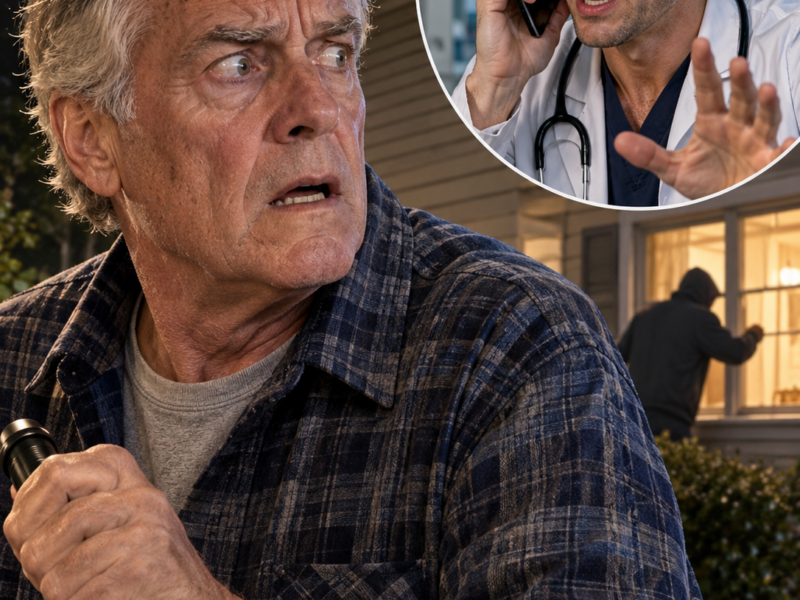
At 69, Just Nine Days After Knee Surgery, I Received a Terrifying Call From My Son at 2:13 A.M. “Dad, Get Out Through the Back Door, and If Mom Calls Your Name, Don’t Answer Her!” I Escaped to My Neighbor’s House, Where I Watched My Wife of 34 Years Welcome Investigators Into Our Home. But When My Neighbor Handed Me a Letter Written by My Daughter Before Her Fatal Car Accident 11 Years Earlier, I Discovered Something That Made Me Question Everything…
At 69, Just Nine Days After Knee Surgery, I Received a Terrifying Call From My Son at 2:13 A.M. “Dad, Get Out Through the Back Door, and If Mom Calls Your Name, Don’t Answer Her!” I Escaped to My Neighbor’s House, Where I Watched My Wife of 34 Years Welcome Investigators Into Our Home. But When My Neighbor Handed Me a Letter Written by My Daughter Before Her Fatal Car Accident 11 Years Earlier, I Discovered Something That Made Me Question Everything…
Part 1
At 2:13 in the morning, my son called and told me not to turn on a single light in my house.
“Dad, get out through the back door. Go straight to Mrs. Pell’s house. Now!”
I blinked at the glowing numbers on my alarm clock, struggling to shake off the effects of sleep and pain medication.
“Barrett? What’s happening?”
“Please, Dad. You have about six minutes. Just trust me.”
My son was thirty-nine years old and worked as an emergency room physician. He had spent years treating gunshot wounds, accident victims, and patients whose hearts stopped beating without warning. Very little frightened him.
But that night, his voice was trembling.
I reached across the bed for my wife, Cordelia, and found nothing but cold sheets.
“Your mother isn’t here,” I whispered.
There was a terrible silence.
Then Barrett said something I would remember for the rest of my life.
“Dad, if Mom calls your name, don’t answer her.”
My name is Garrick Whitmore. Before that November morning, I believed I understood the world around me. I was a retired county water inspector, a husband, a father, and a man who had spent most of his life believing that honesty and hard work would eventually protect him from trouble.
I had been married to Cordelia for decades. We had raised two children together, buried one of them, and survived hardships that I thought had made our marriage stronger.
Nine days earlier, I had undergone knee surgery. Cordelia had been bringing me medication, preparing my meals, and making sure I drank a cup of chamomile tea before bed.
There had been nothing unusual about that evening.
Or so I thought.
I grabbed my cane and struggled to my feet. Pain shot through my recently operated knee as I moved toward the bedroom door.
“Barrett, tell me what you’re afraid of.”
“I will. But you need to get somewhere safe first.”
I moved through the dark hallway, using the furniture to steady myself. Every familiar object suddenly seemed threatening. The grandfather clock, the framed photographs, even the coat hanging beside the kitchen door looked different in the darkness.
When I reached the back door, I glanced through the curtain.
Our elderly neighbor, Eudora Pell, was standing beside the low fence separating our properties. She wore a thick coat over her nightgown and clutched her keys in one hand.
Barrett had called her before calling me.
That frightened me more than anything.
I stepped outside into the freezing air. Eudora hurried forward, slipping an arm beneath my shoulder.
“Come on, Garrick. Don’t look back.”
“What is happening?”
“Your boy said we need to get you inside.”
We had barely reached her porch when headlights appeared at the far end of the street.
Eudora pulled me through her door and switched off the hallway lamp.
From behind her living room curtains, I watched a vehicle approach my house. It slowed near the driveway.
Then I saw movement.
People were approaching the home where I had lived for thirty-four years, where my children had grown up, where I had celebrated birthdays, Christmas mornings, and anniversaries.
And somewhere in the middle of it all was my wife.
I could not understand why Cordelia wasn’t beside me, asking whether I was safe.
I could not understand why my son had warned me against answering her.
Then my phone vibrated again.
“Are you inside?” Barrett asked.
“Yes.”
“Thank God.”
“Now tell me the truth.”
He took a long, unsteady breath.
Earlier that night, a badly burned man had been brought into his hospital. The circumstances surrounding the man’s injuries were suspicious, and among the information connected to the patient was my name.
My full name.
Garrick Whitmore.
The injured man had no obvious connection to me, yet somehow I had become part of an investigation involving a fire, missing records, and a company called North Basin.
Barrett had discovered enough disturbing information to believe I might be in immediate danger.
He didn’t know the entire story.
Neither did I.
But someone had gone to considerable trouble to make my name appear where it had no business being.
“Dad,” he said, “has Mom asked you to sign anything recently?”
The question struck me like a physical blow.
A few weeks earlier, Cordelia had brought several documents to the kitchen table. She told me they concerned routine financial arrangements and paperwork related to our property.
I had been distracted by my upcoming surgery.
I signed where she pointed.
I didn’t read every page.
Why would I?
She was my wife.
The following morning, Deputy Royce Hollander arrived to speak with me. I had known Royce for years. He was a decent man, the kind who remembered birthdays and stopped to help elderly residents shovel snow.
But when he entered Eudora’s kitchen, he looked uncomfortable.
There were questions about my vehicle, my professional history, and my relationship with North Basin.
I explained that I had inspected properties associated with industrial operations during my career, but I had never worked privately for the company.
Royce listened carefully.
“Garrick, somebody’s using your name.”
“Then find out who.”
“We’re trying.”
I wanted to go home. I wanted to confront Cordelia and demand an explanation.
Instead, I called Winifred, an attorney who understood property law and had known my family for years.
She arrived carrying a leather briefcase and wearing the expression of someone who had already discovered something unpleasant.
“Tell me about your lake property,” she said.
The land had belonged to my family for generations. It wasn’t particularly valuable to me in financial terms, although developers had occasionally expressed interest in it.
Its real value was something no buyer could understand.
My daughter, Tamsin, had loved that lake.
Eleven years earlier, at twenty-two years old, she had died when her car went off the lake road during a rainstorm.
The police ruled her death an accident.
I had never recovered completely.
On the night she died, Tamsin had called me. I missed the call. For eleven years, I had tortured myself with the possibility that answering it might have saved her life.
I still kept her photograph beside my bed.
Winifred opened her briefcase.
“Garrick, there’s an arrangement underway to acquire your land.”
“That’s impossible. I haven’t agreed to sell.”
“Someone appears to have agreed on your behalf.”
She placed copies of several documents before me.
My signature appeared on paperwork I barely recognized. A company had been established using my identity. Financial transactions were connected to it, and the property arrangements were far more complicated than anything Cordelia had described.
I stared at the signatures.
Some looked authentic.
Others looked close enough to fool a stranger.
“Who would do this?”
Winifred didn’t answer immediately.
She turned another page.
There was Cordelia’s name.
I felt something inside me collapse.
Before I could absorb what I was seeing, Winifred’s telephone rang. She listened for several seconds, then stood and walked toward the window.
When she returned, her face had changed.
“Garrick, your wife has gone to court.”
“For what?”
“She’s requesting an emergency protection order against you.”
I laughed because the alternative was screaming.
“Protection from me? I can barely walk.”
Winifred sat down.
“She’s alleging that you threatened her with a rifle.”
The room became completely silent.
Eudora stopped pouring coffee.
I stared at the attorney, waiting for her to tell me there had been some misunderstanding.
There hadn’t.
By the following morning, a judge had signed the temporary order. I was prohibited from contacting Cordelia and forbidden from living in my own home.
Royce escorted me there to collect medication and clothing.
I walked through rooms I had painted myself, past photographs of the family I thought I knew, carrying a small bag containing what remained of my ordinary life.
When we reached the basement, I showed Royce where my father’s rifle had been stored.
I hadn’t touched it in years.
Cordelia had claimed I pointed it at her on a night when I could barely get out of bed.
But her sworn statement was now part of an official record.
My denial was merely a denial.
As Royce drove me away, I looked back at my house.
In less than forty-eight hours, I had gone from being a retired husband recovering from surgery to a man suspected of crimes he didn’t understand, accused of threatening his wife, and legally barred from his own front door.
I thought that was the worst betrayal I would ever experience.
Then Winifred discovered an $84,000 transaction connected to my name.
And the people behind it were connected to something that had happened eleven years earlier.
Something involving my daughter.
Something that would make me question everything I believed about the night she died.
Part 2
At 6:10 on Monday morning, three heavy knocks shook the door of my rented room.
Deputy Hollander stood outside, holding a warrant.
“Garrick Whitmore, you’re under arrest for forgery and dealing in unlawful proceeds.”
My wife had told prosecutors that I personally arranged the suspicious $84,000 transaction.
I was handcuffed and taken away.
By afternoon, my photograph was circulating around town. People who had known me for decades began treating me like a criminal.
But Winifred refused to surrender.
She traced the company attempting to purchase my seventeen acres of inherited land to an organization called Black Creek Development.
When Eudora saw the name, her face turned white.
“Tamsin,” she whispered.
I nearly fell out of my chair.
“What did you say?”
“Your daughter told me about that company three days before she died.”
Eudora began crying.
Then she confessed that Tamsin had given her something to keep safe eleven years earlier.
A faded blue cookie tin.
“She told me to give it to you if anyone ever tried to buy your lake property.”
That evening, Winifred opened the tin while recording everything.
Inside was a photograph of my daughter, an envelope addressed to me, and evidence of a secret someone had spent eleven years trying to bury.
Part 3
The envelope had yellowed with age, but I recognized the handwriting immediately.
Dad.
One word, written by a girl who had been gone for eleven years.
My fingers trembled as I unfolded the letter.
“Dad, if Mrs. Pell is giving you this, somebody has come around asking about the lake land, and I was right to worry.”
I stopped reading.
For a moment, I could almost hear Tamsin’s voice.
She had always been curious. As a little girl, she would follow me along the creek, asking why the water changed color after heavy rain or why certain birds nested in particular trees.
As a young woman, she carried her grandfather’s old camera everywhere.
Apparently, that curiosity had led her somewhere dangerous.
For three weeks before her death, Tamsin had been visiting the lake at night. She had noticed trucks entering the abandoned foundry property after midnight, often with their headlights turned off.
Some carried heavy loads when they entered and appeared considerably lighter when they left.
She had photographed license plates, the foundry gate, and a rusted pipe near the water that smelled strongly of chemical solvent.
The property belonged to Black Creek Development.
Then came the sentence that destroyed me.
“Dad, if something happens to me, please don’t be quick to believe I was just a careless driver. I think somebody saw me taking pictures.”
I couldn’t continue.
Eudora wrapped her arms around me as I broke down at her kitchen table.
For eleven years, I had blamed myself for missing three telephone calls from my daughter.
I had been working on a broken water main that night. My telephone was in my locker. By the time I finished, Tamsin was dead.
Cordelia had held me while I cried.
She had told me that accidents happened, that blaming myself wouldn’t bring our daughter back.
Now I wondered how much she had known.
Winifred reminded me that the letter wasn’t proof of murder. We needed independent evidence, authenticated documents, and witnesses.
But it was enough to reopen questions that had remained unanswered for more than a decade.
Special Agent Beatrice Lyle, from the state attorney general’s office, began examining the connections between North Basin, Black Creek Development, and the financial transactions associated with my name.
The more she uncovered, the more frightening the picture became.
The company attempting to acquire my land had been dormant for years before suddenly becoming active again.
The proposed purchase price was $1.85 million.
That was an extraordinary amount of money for seventeen acres that had supposedly been wanted for ordinary commercial development.
There was also a connection between the proposed sale and Thaddeus Granger, a powerful businessman associated with North Basin.
Another man, Ambrose Kettering, appeared repeatedly in the records.
And Cordelia’s involvement was becoming impossible to dismiss.
Winifred discovered documents connecting her to the company established in my name. Bank records and electronic information suggested that transactions attributed to me had actually been arranged by other people.
Meanwhile, investigators were examining the night Barrett had warned me to leave my house.
My old blue Ford pickup had been found covered in fresh red mud, despite the fact that I hadn’t driven it since my surgery.
Someone had changed its license plate.
There were indications that the vehicle had been connected to the fire at North Basin.
And laboratory testing revealed something even more disturbing.
A sedative that wasn’t part of my prescribed medication had been found in my system.
I thought about the chamomile tea Cordelia had brought me before bed.
I thought about how unusually difficult it had been to wake up when Barrett called.
The implications were horrifying.
Someone wanted me asleep while evidence was planted around me.
Someone wanted investigators to discover a confused, heavily medicated old man surrounded by circumstances that appeared to establish his guilt.
And my wife had been standing at the front door, ready to welcome them inside.
While Winifred and Lyle worked to establish the truth, I remained under restrictive release conditions.
An electronic monitor was attached to my ankle.
I couldn’t go wherever I wanted. I couldn’t return home. Even ordinary activities required careful planning.
People who had once greeted me warmly began crossing the street to avoid me.
One afternoon, my bank card was declined at a grocery store. I stood beside the checkout counter, humiliated, while the cashier tried it again.
It didn’t work.
I left my groceries behind.
I had spent thirty-eight years earning an honest living, and suddenly I couldn’t even buy my own dinner.
Eudora continued feeding me every evening.
Barrett offered to cover my expenses.
Winifred kept fighting.
Without those three people, I don’t know how I would have survived.
Then the hospital called.
The severely burned man whose arrival had started everything was finally awake.
His name was Linwood Pickett.
He had driven trucks for North Basin for fourteen years before losing his job after questioning irregularities in the company’s disposal records.
When I entered his hospital room under Agent Lyle’s supervision, his arms and neck were wrapped in bandages.
He looked at me with exhausted eyes.
“Mister Whitmore?”
“Yes.”
“I had your name in my pocket. I’m sorry for what they did with it.”
He explained that he had returned to North Basin on the night of the fire after hearing that company records were being destroyed.
While hiding inside an office, he overheard Thaddeus Granger speaking with another man named Cyrus Tibbets.
Granger wanted the manifests and disposal logs burned.
He also wanted someone blamed for the fire.
“Who?” Cyrus had asked.
“The old water inspector. Whitmore. His name’s on the authorization. Put it all on him.”
Hearing those words felt like being struck in the chest.
Linwood had been discovered before he could escape. A struggle followed, and he barely made it out of the burning building alive.
But he had kept copies of company records.
For years, he had been collecting information because he suspected something was wrong.
Then he admitted that he had personally transported unlisted drums to the old foundry property.
And there was something else.
Years earlier, he had discovered a discarded green canvas camera bag near the foundry dump.
It had brass buckles and a damaged strap.
Inside were several rolls of film.
I gripped the arms of my chair.
“Was one of the buckles shaped like an oval?”
“Yes.”
I closed my eyes.
That camera bag had belonged to my father before he gave it to Tamsin.
She had been carrying it the night she died.
Linwood had kept it hidden with his other records.
“I was a coward,” he whispered. “I should have told somebody.”
I looked at the man lying before me, his body covered in burns.
“You’re telling us now.”
Agent Lyle immediately arranged to recover the evidence.
For the first time in eleven years, we had a chance to see the photographs Tamsin had taken during the final days of her life.
I returned to my rented room that evening feeling something I hadn’t experienced in weeks.
Hope.
But the people responsible for destroying my reputation were becoming desperate.
They knew Linwood had survived.
They knew someone was investigating the old foundry.
And they knew Barrett had been the person who saved me.
One rainy evening, while I was sitting beside an electrical outlet charging my ankle monitor, my prepaid telephone rang.
“Dad,” Barrett said. “Are you at the lake?”
“No. Why?”
“Because you just sent me a message.”
My stomach tightened.
“What message?”
He read it aloud.
“I’m at Black Creek. I’m hurt. Please come.”
I jumped to my feet.
“Barrett, I never sent that!”
The message had come from my old telephone number.
The telephone that was still inside the house I shared with Cordelia.
“Where are you?” I demanded.
There was a long silence.
Then I heard the sound of rain against his windshield.
“I’m on the lake road, Dad. Almost at the gate.”
My blood turned cold.
The same road where his sister had died eleven years earlier.
“Barrett, turn around. Right now.”
“Dad?”
“Get away from there!”
Before he could answer, I heard him draw a sharp breath.
Then he whispered something that made my heart nearly stop.
“There’s a truck behind me.”
Part 4
“Can you see the driver?” I asked.
“No. His headlights were off until a moment ago.”
I could hear Barrett breathing rapidly.
Outside my rented room, rain struck the windows. Somewhere across town, my son was driving along the same wet road where his sister had lost her life.
And I couldn’t reach him.
I couldn’t even leave the room without violating the conditions of my release.
“Barrett, listen to me. Stay on the phone.”
The truck was getting closer.
He described its headlights filling his rearview mirror.
Then came a terrible noise.
Metal striking metal.
Barrett shouted.
I heard tires screaming, something crashing, and then several seconds of silence.
“Barrett!”
Nothing.
“BARRETT!”
I pulled against the charging cable attached to my ankle monitor, nearly falling.
Then his voice returned.
“I’m okay, Dad. I’m in the grass. The car’s tilted.”
I began crying so hard I could barely speak.
The truck had rammed him, forcing his vehicle off the road.
But unlike Tamsin, Barrett had survived the impact.
“Don’t get out,” I told him. “Lock your doors. Call emergency services.”
The truck had stopped a short distance ahead.
Its driver was still there.
Barrett connected us to an emergency dispatcher, who immediately sent deputies toward his location.
I stayed on the line as my son described the dark green pickup and the man approaching his vehicle.
Every passing second felt unbearable.
The driver was Cyrus Tibbets.
The same man Linwood had identified as being present on the night of the North Basin fire.
He approached Barrett’s car carrying a tire iron.
Fortunately, law enforcement arrived before he could finish what he had started.
When I finally learned that Barrett was receiving medical attention, I sat on the floor and cried.
Eleven years earlier, I had missed Tamsin’s calls.
This time, I had answered.
This time, my child was coming home.
But the attack exposed something that would prove even more devastating than the crash itself.
Cordelia left Barrett a voicemail.
Agent Lyle obtained it and later read the transcript to us.
“Barrett? Please pick up. Please, honey, please. They said nobody would be hurt. They promised me they wouldn’t touch you.”
I watched my son’s expression change.
Then Lyle continued.
“They told me the truck business from eleven years ago was over. Finished. Buried.”
Barrett covered his face.
I stared at the floor.
The truck business.
Eleven years ago.
Our daughter’s death.
Cordelia knew.
Perhaps she hadn’t known every detail. Perhaps she hadn’t understood the full extent of what had happened when Tamsin died.
But she knew there was more to the story than an unfortunate accident on a rainy road.
And she had kept that knowledge from me.
Barrett was devastated.
“How could she do that, Dad?”
I had no answer.
How could a mother keep silent about circumstances surrounding her own daughter’s death?
How could a wife watch her husband blame himself for eleven years when she knew there was another explanation?
And how could she trust the same people enough to put her surviving child in danger?
The voicemail wasn’t the only evidence.
Investigators discovered an email exchange from August 2016 between Cordelia and Ambrose Kettering.
Kettering had asked whether I knew anything about what happened in 2012 or what Tamsin might have discovered.
Cordelia’s reply was unmistakable.
“Garrick does not know and must never know.”
She explained that if I learned what Tamsin had discovered about North Basin, I would never agree to sell the land.
I would never stop investigating.
Then she wrote the cruelest sentence I had ever read.
“He believes it was an accident and a missed phone call. Let him keep believing it.”
I read that sentence three times.
For seven years after writing that email, she had celebrated Christmas with me, shared meals with me, and slept beside me.
She had watched me visit Tamsin’s grave.
She had heard me apologize to our dead daughter for failing to answer the telephone.
And every time, she had allowed me to believe that my own absence might have caused her death.
I wanted to hate Cordelia.
Instead, I felt hollow.
There was no satisfaction in discovering that the woman I loved had betrayed me so completely.
There was only grief.
Meanwhile, Barrett faced his own problems at the hospital.
Suspicious alterations appeared in medical records, threatening his professional reputation and that of a nurse named Bernadette, who had helped him.
Someone was trying to make their involvement in the investigation look like misconduct.
But security footage and electronic records revealed inconsistencies.
A young hospital employee named Nolan Peck eventually came forward.
His mother’s rent was several months overdue. A well-dressed man had approached him with an envelope containing $5,000.
In exchange, Nolan had been instructed to make eleven alterations to hospital records.
He had been told that Barrett was already going to lose his medical license and that nobody would be harmed.
Nolan accepted the money.
Then guilt overwhelmed him.
He hadn’t spent any of it. He had hidden the cash inside a coffee can in his freezer.
When Agent Lyle showed him photographs of potential suspects, he identified the man who had paid him.
Another connection emerged in the conspiracy surrounding North Basin.
The people involved had tried to control everything: property documents, financial records, police suspicions, hospital files, and even the reputation of anyone who threatened their plans.
But their greatest mistake was believing that every person could be frightened or purchased into silence.
Linwood had survived.
Nolan had confessed.
Barrett had escaped.
And Tamsin’s photographs had been recovered.
When the film was carefully processed, images began emerging from the darkness of eleven years earlier.
There were trucks entering the old foundry.
There were photographs of the company property, the drainage pipe, and suspicious industrial activity.
One truck appeared repeatedly.
Number seventeen.
Investigators followed the records until they found a retired mechanic named Alvin Crowe.
He had operated a repair garage for forty years and had kept meticulous business records.
Shortly after Tamsin’s death, North Basin had paid his garage $12,000 for emergency repairs.
The vehicle was truck number seventeen.
It needed a new front bumper, grille, and fog lamp.
A silver-haired man had brought it in, claiming he had struck a deer.
Alvin had never believed that explanation.
When he saw Tamsin’s photographs, he immediately recognized the vehicle.
“That’s the same truck,” he said.
For the first time, investigators had a physical connection between the vehicle Tamsin photographed and suspicious repairs performed immediately after her fatal crash.
Cyrus Tibbets eventually agreed to cooperate with prosecutors.
He had been inside truck seventeen on the night my daughter died.
He remembered seeing her car on the lake road.
He remembered Granger becoming furious because she had been taking photographs.
And he remembered what Granger said.
“We need that camera.”
Cyrus described the truck pursuing Tamsin along the wet road.
Then he described watching her taillights disappear down the embankment.
Granger didn’t stop to help.
Instead, he called Ambrose Kettering and told him there had been an accident.
“The girl won’t be a problem anymore.”
I sat motionless while Cyrus spoke.
He admitted returning to the crash site and recovering Tamsin’s camera bag from the roadside.
He had thrown it away near the foundry, believing the evidence would disappear forever.
That was where Linwood eventually found it.
Eleven years of lies were finally unraveling.
But there was still one person I needed to hear from.
The man who had been driving truck seventeen.
The man who had spent years protecting his company, his money, and his freedom at the expense of my family.
Thaddeus Granger.
When prosecutors informed me that he was prepared to plead guilty and wanted to speak to me personally, I agreed to meet him.
I had waited eleven years.
I needed to look into his eyes and ask the question that had haunted me since opening Tamsin’s letter.
Had my daughter been alive when he drove away?
Part 5
Thaddeus Granger entered the conference room wearing a gray prison jumpsuit.
Without his expensive coat, polished shoes, and powerful associates surrounding him, he looked smaller than I remembered.
Older, too.
His silver hair was uncombed. His hands rested on the table, and his attorney sat beside him.
Winifred was on my right. Agent Lyle and the prosecutor sat across from us.
Granger looked at me.
“Mister Whitmore, I asked to see you.”
“Why?”
“Because there’s something I need to say.”
The prosecutor explained that Granger had agreed to plead guilty to third-degree murder, conspiracy, and obstruction.
His statement would form part of the agreement.
I tightened my grip on my cane.
“Go ahead.”
He took a breath.
“On the night of October eighteenth, 2012, I forced your daughter’s car off the lake road.”
There it was.
Eleven years of uncertainty ended in a single sentence.
He admitted pursuing Tamsin because he wanted her camera and the photographs she had taken.
He had driven up behind her on the wet curve and pushed against her bumper, intending to force her to stop.
Instead, her vehicle lost control and went down the embankment.
“I watched it go,” he said. “I didn’t get out. I didn’t call anyone.”
I felt sick.
“Was she alive when you left?”
Granger lowered his eyes.
“I don’t know.”
“You don’t know?”
“I didn’t look.”
I stared at him.
My daughter had been twenty-two years old.
She had been frightened, alone, and possibly injured after being deliberately forced off the road.
And this man had simply driven away.
He had considered his business interests more valuable than her life.
“Why did you keep quiet for eleven years?” I asked.
“At first, I told myself it was an accident. Then I told myself it was over.”
He swallowed.
“Then I told myself you’d stop asking questions.”
I remembered the photographs in the blue cookie tin.
The letter.
The three missed telephone calls.
The truck pursuing Barrett.
The false accusations against me.
The thousands of dollars used to manipulate documents and people.
All of it had grown from a decision made on a rainy night eleven years earlier.
Granger admitted knowing Tamsin was my daughter. He had recognized her from county hearings, where she sometimes sat in the back row with her camera.
He also acknowledged responsibility for the instructions that eventually led to Barrett being attacked.
“I won’t ask you to forgive me,” he said.
“Good.”
I wasn’t ready to offer forgiveness.
Perhaps I never would be.
But I wanted him to understand something.
“My daughter was a person,” I told him. “She wasn’t a problem for your company. She wasn’t a threat that needed to disappear. She was my little girl.”
Granger lowered his head.
“She deserved to grow old. She deserved to fall in love, have a family if she wanted one, and wake up every morning without being afraid of men like you.”
My voice cracked.
“You took every one of those mornings away from her.”
Nobody spoke.
Finally, I stood.
“Thank you for telling the truth.”
That was all I could give him.
The criminal cases against me collapsed as the evidence exposed the conspiracy.
The financial transactions had not been arranged by me. The company created using my identity, the manipulated paperwork, the suspicious use of my truck, and the allegations surrounding my conduct were part of an effort to destroy my credibility.
The man who had been presented to the public as a criminal was finally recognized as a victim.
But clearing my name didn’t restore everything I had lost.
I couldn’t recover the months of humiliation.
I couldn’t erase the memory of handcuffs closing around my wrists.
And no legal ruling could return my daughter.
What the investigation could do, however, was expose the environmental crimes Tamsin had discovered.
Excavation began near the old foundry.
An environmental engineer named Wendell Ames contacted me after workers uncovered a buried valve.
It carried a red triangle.
When I saw it, I immediately recognized the marking.
For thirty-eight years, my inspection crews had used red triangles to indicate equipment that had failed inspection.
Blue meant approved.
Red meant it was unacceptable.
Someone had buried equipment that should never have been permitted to operate.
The discovery helped establish the need for extensive environmental testing and cleanup.
Nearby wells needed to be examined.
Contaminated material would have to be removed and treated.
The work could take years and cost millions of dollars.
But the companies responsible would finally have to answer for the damage.
Tamsin had been right.
The girl with the camera had seen what powerful adults had chosen to ignore.
Over the following months, the people responsible for the conspiracy faced their consequences.
Ambrose Kettering received a sentence of four and a half to nine years.
Lowell Fenwick received three to six years and lost his law license.
Cyrus Tibbets received five to ten years.
Marlene Dockery lost her notary commission and received probation.
Nolan Peck received probation and was required to make restitution. His decision to confess and cooperate had been taken into consideration.
Thaddeus Granger received twelve to twenty-four years.
And then came Cordelia’s sentencing.
I almost didn’t attend.
Barrett told me I didn’t owe anyone my presence.
Winifred said I could leave whenever I wanted.
But I decided to go.
I had spent thirty-four years married to that woman.
I needed to see the ending.
Cordelia entered the courtroom wearing a navy dress. Her hair was gray at the roots, and she looked older than the woman who had brought me chamomile tea on the night everything began.
She had pleaded guilty to forgery, conspiracy, and obstruction.
When the judge asked whether she wished to speak, she stood.
“I’m sorry,” she said.
Her voice trembled.
“I’m sorry to this court. I’m sorry to my children. I’m sorry for what I did, and what I didn’t say.”
I looked down at my hands.
What she didn’t say.
Such a small phrase for eleven years of silence.
The judge sentenced her to three to six years in state prison.
As a deputy prepared to escort her away, Cordelia turned toward me.
“Garrick,” she whispered. “I never wanted it to turn out like this.”
For a moment, I saw the young woman I had married.
I remembered dancing with her, bringing our children home from the hospital, and sitting beside her during Tamsin’s funeral.
Then I remembered the email.
Let him keep believing it.
“Goodbye, Cordelia.”
She began crying.
I didn’t follow her.
I didn’t call her name.
I simply watched the courtroom door close.
Our divorce was finalized in July.
The seventeen acres remained mine, although other assets were used to settle the financial arrangements associated with the marriage.
The house on Sycamore Street was sold.
I didn’t fight to keep it.
There were too many memories inside those walls.
I didn’t want to wake up every morning looking at the doorway where Cordelia had called my name while I was trying to escape.
I wanted somewhere I could sleep without wondering whether the person beside me was telling the truth.
Eudora remained a constant presence in my life.
She still insisted I eat more than I wanted. She still complained whenever I attempted something my knee wasn’t ready for.
And she still apologized occasionally for keeping Tamsin’s tin hidden for so long.
I always gave her the same answer.
“You kept your promise.”
Without her, I might never have discovered what happened to my daughter.
One September morning, Barrett took me to the lake.
A new wooden sign stood near Black Creek.
He asked me to read it.
“Tamsin Whitmore. She Saw What the Grown-Ups Would Not.”
I couldn’t speak.
Barrett handed me a small velvet box.
Inside was a scratched brass keychain engraved with the initials T.W.
It had been recovered from Tamsin’s camera bag.
My father had given it to her years earlier.
I held it in my palm, remembering the little girl who had followed me through the woods with muddy shoes and endless questions.
Then Barrett told me something he had carried in silence for eleven years.
The night Tamsin died, she had called him before calling me.
He had been studying for an examination.
She told him about the trucks entering the foundry property.
He told her to go home and promised they would speak to me the following morning.
He had never forgiven himself for not driving out to meet her.
“Dad, if I’d gone to get her—”
I placed my hand on his shoulder.
“Neither of us caused that truck to hit her.”
His eyes filled with tears.
“I should have gone.”
“And I should have answered my telephone. I’ve told myself that for eleven years.”
I pulled him closer.
“But the people responsible were the people who chose to hurt her. Not the people who loved her.”
We stood beside the water for a long time.
Eventually, we began remembering happier things.
Tamsin’s first fishing trip.
The little bluegill she caught and immediately insisted we release.
The way she announced that she would photograph fish instead of catching them because she didn’t want to hurt another one.
When the creek was finally clean, I wanted children to be able to fish there again.
Barrett smiled.
“We’ll need one rule.”
“What’s that?”
“Every fish goes back.”
I laughed through my tears.
“She’d approve.”
Later that evening, Eudora brought me a letter that had arrived from the state prison.
I recognized Cordelia’s handwriting.
“Do you want to read it?” she asked.
“Not today.”
I placed it in a drawer.
Perhaps someday I would open it.
Perhaps someday I would discover what Cordelia wanted to tell me.
But forgiveness doesn’t follow a prison schedule, a court order, or the wishes of the person who caused the harm.
It comes when it comes.
And sometimes, moving forward doesn’t require reopening every wound.
That night, before going to bed, I placed Tamsin’s keychain beside my telephone.
I turned the ringer up as loud as it would go.
For years, I had dreaded the memory of those three missed calls.
Now I thought about another call.
The one at 2:13 in the morning.
The one that saved my life.
My son had been frightened, confused, and uncertain about what would happen next.
But he had called anyway.
He had trusted his instincts.
He had refused to remain silent.
And because of him, the people who had spent eleven years burying the truth were finally exposed.
I switched off the lamp and looked toward the window.
“Goodnight, Tamsin,” I whispered.
“Goodnight, Barrett.”
I closed my hand around the little brass keychain.
“If the telephone rings, I’ll answer.”
My name is Garrick Whitmore.
I was sixty-nine years old when I learned that the deepest betrayals can come from the people who know us best.
I signed documents without reading them because I trusted my wife.
I accepted explanations because questioning them seemed too painful.
And I carried guilt that belonged to someone else for eleven years.
If my story teaches you anything, remember this: loving someone doesn’t mean surrendering your right to ask questions.
Read what you sign.
Pay attention when something feels wrong.
Listen when someone you love is afraid.
And never confuse silence with peace.
The truth cost me my marriage, my home, and the life I thought I understood.
But it gave my daughter back her voice.
And that was worth everything.