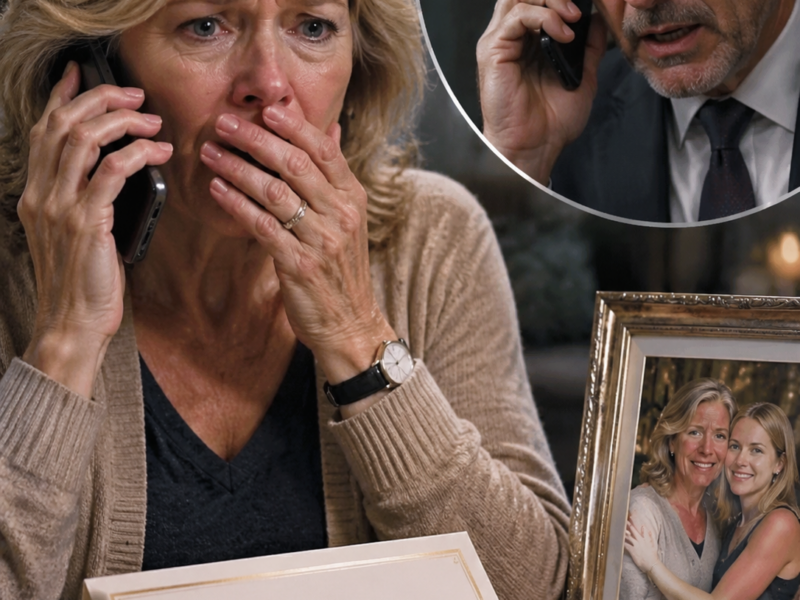
At 68, My Daughter Invited Me to Dinner After Two Years of Silence, Promising to Make My Late Wife’s Favorite Recipe. Fifteen Minutes Before I Arrived, My Lawyer Called and Warned, “If You Value Your Freedom, Stay Away From That House.” I Parked Nearby and Watched a Doctor and a Notary Enter Her Home, Then Received a Disturbing Photo of My Grandson Holding a Sign That Read, “Grandpa, Don’t Come. You’re Sick.” When My Lawyer Showed Me an Email Concerning My $2.4 Million Trust, I Finally Understood Why She Wanted Me There…
At 68, My Daughter Invited Me to Dinner After Two Years of Silence, Promising to Make My Late Wife’s Favorite Recipe. Fifteen Minutes Before I Arrived, My Lawyer Called and Warned, “If You Value Your Freedom, Stay Away From That House.” I Parked Nearby and Watched a Doctor and a Notary Enter Her Home, Then Received a Disturbing Photo of My Grandson Holding a Sign That Read, “Grandpa, Don’t Come. You’re Sick.” When My Lawyer Showed Me an Email Concerning My $2.4 Million Trust, I Finally Understood Why She Wanted Me There…
The night my daughter invited me to dinner after two years of silence, I bought an apple pie, put on my dead wife’s favorite sweater, and convinced myself that the worst chapter of my life was finally coming to an end.
Fifteen minutes before I was supposed to arrive, my lawyer called.
“Arthur, where are you?”
“About ten minutes from Clara’s house. Why?”
“Turn around.”
I laughed nervously. “Marcus, this isn’t a good time for one of your jokes.”
“I’m not joking. Whatever you do, don’t go inside that house.”
Something in his voice made my fingers tighten around the steering wheel.
“What’s happened?”
“I can’t explain everything over the phone. Just promise me you won’t walk through that door.”
“Marcus, my daughter hasn’t spoken to me in two years. Tonight she’s finally willing to make peace.”
“I know. That’s exactly why I’m calling.”
Then he said something I would never forget.
“Arthur, if you value your freedom, stay away from that house.”
The call ended before I could ask another question.
I was sixty-eight years old, a retired forensic auditor who had spent thirty-four years investigating financial crimes for the federal government. I had stared down corrupt executives, exposed elaborate fraud schemes, and helped prosecutors send men to prison.
Yet nothing in my professional life had prepared me for the possibility that my own daughter might be planning something terrible.
I pulled onto a quiet residential street in Ashburn, Virginia, parked beneath a maple tree, and watched Clara’s house from a distance.
Her white Honda was in the driveway. David’s pickup was beside it.
And behind them sat a black Cadillac.
I recognized that Cadillac immediately.
It belonged to Richard Mercer, David’s father.
The same man whose financial dealings had destroyed my relationship with my daughter two years earlier.
I stared at the house, suddenly aware of how carefully Clara had chosen her words during our afternoon phone call.
“Dad, I’ve been thinking about everything. I was wrong. David and I want to fix things.”
She had been crying.
She had told me that my grandson Leo missed me and that little Mia still kept pictures of us together.
Then she had invited me to dinner, promising to make her mother’s famous baked ziti.
My wife Eleanor had died five years earlier. Her baked ziti had been my favorite dish for nearly four decades.
Clara knew that.
She also knew something else.
She was severely allergic to ricotta cheese.
Eleanor had always prepared Clara’s portion separately, using a different sauce. My daughter had never made that particular family recipe herself.
At the time, I had considered the gesture extraordinary.
Now, sitting outside her house, I wondered whether it had been designed to make me stop asking questions.
Fifteen minutes passed.
A white sedan turned into the street.
A woman wearing a navy blazer stepped out carrying a leather portfolio and a small black case.
I recognized the equipment immediately.
She was a mobile notary.
Then the passenger door opened.
A thin, gray-haired man emerged holding a medical bag.
He moved awkwardly, swinging his left leg outward as though his knee had never healed properly.
My stomach tightened.
I knew that walk.
I couldn’t remember where I had seen it, but something deep in my memory recognized the movement.
Clara opened the door before either visitor knocked.
She hugged the woman, shook the man’s hand, and glanced nervously along the street.
Then all three disappeared inside.
The porch light went out.
My phone vibrated.
It was a message from Clara.
“Dad, everyone’s here. Where are you?”
Everyone.
She had promised that tonight would be about the two of us.
I stared at the message for several seconds before replying.
“Sorry, sweetheart. I think I took the wrong exit. I’m getting confused and can’t remember where I am.”
I wanted to see how she would respond.
Her answer arrived almost immediately.
“Just keep driving straight, Dad.”
I read those five words three times.
My daughter believed her elderly father was lost, confused, and driving alone in the dark.
She had not asked where I was.
She had not offered to come find me.
She simply told me to keep driving.
A second message followed.
It was a photograph of Leo holding a handmade sign.
“Grandpa, don’t come. You’re sick.”
The words were written in large red letters.
My grandson was only nine.
He stood stiffly in the photograph, looking toward someone outside the frame.
I felt sick.
Someone had instructed that little boy to write those words.
Someone had turned my grandson into a prop.
I started the engine and drove directly to Marcus Bell’s office in Fairfax.
Marcus had been my lawyer for decades and my closest friend for even longer.
When I arrived, he was waiting upstairs with two cups of coffee and a printed email.
He didn’t waste time.
“Your daughter made a mistake,” he said.
“What kind of mistake?”
“She copied your old consulting email address on a message she sent this afternoon. That account still forwards to me.”
He pushed the paper across the desk.
I put on my reading glasses.
The subject line read:
“Patient Arthur Sterling — Tonight.”
The message was addressed to Dr. Nathan Cole and Dana Whitfield.
Clara had written that I would arrive at six-thirty and that a medical capacity assessment should begin fifteen minutes later.
The notary was instructed to witness three documents: a durable power of attorney, my resignation as trustee, and a voluntary care agreement.
The final instruction was unmistakable.
“Do not inform him in advance.”
I looked up slowly.
“They’re going to declare me incompetent?”
Marcus leaned forward.
“They’re trying to create the paperwork that would allow them to argue you’re incapable of managing your own affairs.”
I stared at him.
“Why?”
He tapped another document.
“Your retirement trust.”
The trust held approximately $2.4 million.
I had established it after retiring, intending to provide for my later years and eventually leave something meaningful to Clara and her children.
I was its sole acting trustee.
Under the original arrangement, Marcus would succeed me if I died or genuinely lost the ability to manage it.
But a forged resignation, combined with a questionable medical report and a power of attorney, could create a dangerous legal battle over control.
For a long moment, I could not speak.
My daughter had called me crying.
She had mentioned Eleanor.
She had promised family reconciliation.
All while arranging for strangers to take control of my life.
I pressed my hands against my eyes.
“Marcus, she’s my little girl.”
“I know.”
“I taught her to ride a bicycle. I sat beside her hospital bed when she broke her arm. I walked her down the aisle.”
His voice softened.
“Arthur, the fact that you love her doesn’t mean you should sign away your rights.”
I looked at the email again.
“Who is Nathan Cole?”
Marcus shook his head.
“We’re going to find out.”
That night, I went home and slept barely an hour.
At four in the morning, I woke with the image of the limping man burning in my mind.
Then I remembered.
Walter Pruitt.
Fifteen years earlier, I had helped federal investigators unravel a Medicare fraud operation involving a physician named Walter Pruitt.
He had submitted fraudulent claims for medical equipment, tests, and services that had never been provided.
The scheme had involved nearly $1.9 million.
I had followed the money through business accounts and false invoices until the evidence was overwhelming.
Pruitt had gone to prison.
His medical license had subsequently been revoked.
I remembered his face.
I remembered his limp.
And I remembered what he had whispered when he passed me in the courthouse after his conviction.
“You’ll get old too, Sterling.”
At the time, I thought it was the bitter remark of a defeated criminal.
Now, fifteen years later, he had apparently returned to my life wearing another physician’s name.
Marcus arrived at my house just after eight.
We searched the public licensing records.
Nathan Cole had been a real physician, but his registration was no longer active.
Further investigation would eventually reveal that the actual Dr. Cole had died in Ohio years earlier.
Someone was using his identity.
And I knew exactly who.
Marcus studied the old case photograph beside the dashboard-camera footage I had recovered from my car.
The man entering Clara’s house was unmistakably Walter Pruitt.
“Arthur,” Marcus said quietly, “this is no longer just a family dispute.”
I agreed.
But I still didn’t understand how far the conspiracy extended.
That became clearer on Monday morning when I tried to buy my blood pressure medication.
Both my debit cards were declined.
I had enough money to live comfortably for the rest of my life, yet I stood at a pharmacy counter unable to pay for a routine prescription.
The pharmacist, a kind young woman named Kayla, quietly helped me obtain enough medication to get through the next two weeks.
I thanked her and drove directly to my bank.
The branch manager, Carol Hutchins, looked deeply uncomfortable when I entered her office.
“Mr. Sterling, your checking account has been placed under a protective hold.”
“On whose authority?”
She hesitated.
“A report concerning possible financial exploitation and cognitive decline.”
I asked to see the documents supporting it.
The first was a letter from an organization calling itself the Northern Virginia Senior Safety Initiative.
The second was a physician’s statement signed by Nathan Cole.
It described a supposed visit to my home during which I had failed to recognize my daughter, confused the current year, and left a stove burner running.
The report was dated August 14.
I almost laughed.
At the exact time of that supposed visit, I had been at a cardiology appointment.
My physician’s records would establish it.
Carol looked increasingly distressed as I explained.
“Who submitted these documents?” I asked.
She lowered her eyes.
“Your daughter. She came here with the doctor.”
“Did he have gray hair?”
“Yes.”
“Did he limp?”
She nodded.
“His left leg.”
I sat back.
So the dinner invitation had not been the beginning of their plan.
It had been another step in a scheme already underway.
My bank accounts had been restricted before Clara ever called to apologize.
Someone wanted me financially isolated.
Someone wanted me frightened.
And someone wanted me to believe I needed my family’s help.
That afternoon, I opened the safe hidden behind the bookcase in my study.
Inside were Eleanor’s wedding ring, emergency cash, and my original trust documents.
Or at least what I had always believed were the original documents.
The pages felt wrong.
I had handled legal papers for most of my adult life. The texture, printing, and arrangement bothered me immediately.
Then I reached page six.
The successor trustee had been changed.
Instead of Marcus Bell, the document named David Mercer.
An amendment supposedly executed in September 2022 authorized the change.
It bore my signature and Dana Whitfield’s notarial seal.
I had never signed it.
There was another alteration.
The original trust required two independent physicians to establish incapacity.
This version required only one.
I called Marcus immediately.
“They changed everything that mattered.”
His answer was grim.
“Then we need the authentic documents before they try to use these.”
The following morning, we visited Meridian Trust, where the official trust records had been maintained since 2016.
Gloria Benning, the trust officer, retrieved the original agreement.
There was no valid amendment.
Marcus remained the successor trustee.
Two medical opinions were required.
And the bank had never received any authorized change.
For the first time since the dinner invitation, I felt something resembling hope.
The conspirators had made a fundamental mistake.
They assumed that replacing the papers in my personal safe would be enough to rewrite the truth.
But the originals existed elsewhere.
Still, another question haunted me.
How had someone accessed my safe?
Only a handful of people had keys to my home.
One was Judith, Eleanor’s sister, who lived in Arizona.
Another was my neighbor, Martha Greer.
Martha had lived next door for years.
She brought me lemon cake every Wednesday.
She watered my plants when I traveled.
She had held Eleanor’s hand during the final months of her illness.
I could not imagine her betraying me.
That belief lasted until Wednesday afternoon.
I visited Martha to return a plate.
She invited me into her sunroom while she made coffee.
On a small table beside her reading glasses lay a manila folder.
The label said, “Arthur Notes.”
I should have looked away.
Instead, I opened it.
Inside was a carefully maintained calendar documenting incidents of alleged memory loss.
According to Martha, I had forgotten Clara’s name at a Fourth of July gathering.
I had supposedly been involved in a car accident in June and appeared disoriented afterward.
She claimed to have discovered my stove burning unattended on several occasions.
Every entry was false.
I had spent the Fourth of July alone.
My Buick had been in a repair shop during the alleged accident.
And Martha had never found my stove unattended.
Behind the calendar lay a police report describing the fabricated collision.
The other driver was listed as Troy Marsh, an employee of Mercer Builders.
David’s company.
I photographed the documents and returned everything to its original position before Martha came back.
She set down my coffee and smiled.
“Arthur, you look tired. Are you feeling all right?”
“Just getting older, Martha.”
She reached across the table and squeezed my hand.
“You know Eleanor asked me to look after you.”
I nodded.
“I remember.”
“I’ve kept that promise every day.”
I looked at the woman who had comforted me after my wife’s funeral.
For the first time, I understood that a person could offer genuine warmth while participating in something unforgivable.
I drank my coffee.
I complimented her cake.
Then I went home and cried.
That evening, Marcus advised me not to confront anyone.
Instead, we began documenting everything.
We obtained the repair records proving my car had been in the shop during the alleged collision.
We preserved the bank’s paperwork and the forged trust documents.
We installed security cameras at my house.
Within days, those cameras showed Martha entering my property and removing selected pieces of mail from my mailbox.
The betrayal was systematic.
She wasn’t merely spreading rumors.
She was helping construct an entire false history of mental decline.
And she was doing it while bringing me cake.
The next revelation came from the court records.
I had spent two years wondering why Richard Mercer hated me so much.
The answer began with a financial filing involving David’s construction business.
Mercer Builders owed $800,000 to a company called Allegany Basin Capital.
The company was connected through corporate registrations to the same network associated with Richard’s real estate investment fund.
Two years earlier, David had asked me to review that fund.
Richard had presented Keystone Heritage Land Partners as a stable investment opportunity.
He claimed it generated substantial returns from land acquisitions and development projects.
But when I reviewed the financial statements, the numbers didn’t reconcile.
New investor deposits appeared to be funding distributions to earlier investors.
There was insufficient evidence of the real estate income Richard claimed to be generating.
I had confronted him during a family dinner.
“Richard, this isn’t a sustainable investment model.”
He smiled coldly.
“Arthur, you’ve been retired too long. You see fraud everywhere.”
“I see numbers. And these numbers don’t work.”
David became angry.
Clara accused me of embarrassing her family.
The evening ended with my daughter asking me to leave.
A week later, she told me not to call again.
Within a month, she had blocked my number and stopped me from seeing my grandchildren.
I had spent two years believing our estrangement was the result of that argument.
Now I realized Richard might have had a financial reason to keep me away.
His fund was approaching a major redemption deadline.
Investors would soon be entitled to request their money.
If too many demanded repayment, the operation might collapse.
And David’s $800,000 debt appeared to place additional pressure on the family.
My $2.4 million trust could provide the money Richard desperately needed.
Suddenly, the forged documents made sense.
Richard wasn’t trying to protect an elderly relative.
He was trying to gain access to the one substantial pool of money he could still reach.
I contacted Ruth Delgado, a former federal investigator I had known for decades.
She listened carefully as I explained the fund, the forged documents, the false medical reports, and Richard’s financial connections.
When I finished, she was silent.
Then she said, “Arthur, don’t confront him.”
“I wasn’t planning to.”
“Yes, you were. I know you.”
I almost smiled.
“Bring me copies of everything,” she continued. “And don’t sign anything.”
Her final instruction was even more serious.
“From this point forward, assume they’re watching you.”
I had no trouble believing that.
What I didn’t know was that the worst discovery was still waiting inside my own home.
It happened when I climbed into the attic looking for old investment records.
I found the box I needed beside several cartons of Eleanor’s belongings.
One carton contained recipe cards, photographs, and seven narrow notebooks tied together with a faded blue ribbon.
Eleanor had been a schoolteacher.
She kept meticulous household accounts.
I opened the first notebook and immediately recognized her handwriting.
Between ordinary expenses were unusual payments marked with a single letter.
C.
The entries went back years.
Four thousand dollars.
Six thousand.
Nine thousand.
Sometimes more.
Beside one entry, Eleanor had written, “She cried on the phone.”
Beside another, “C promised this was the last time.”
The payments were connected to gambling debts.
My hands began trembling.
I spent hours totaling the entries.
Over seven years, Eleanor had quietly paid approximately $187,400 to cover Clara’s gambling losses.
She had used money from her personal savings.
She had sold jewelry.
She had concealed the payments from me.
At the bottom of one page, in the faint pencil writing I knew so well, were the words:
“Don’t tell A. He’ll audit her.”
I stared at that sentence until tears blurred the page.
For years, I had believed Eleanor kept no secrets from me.
But she had been carrying our daughter’s financial problems almost entirely alone.
And she had hidden them because she feared my reaction.
I remembered Clara coming to us at twenty-six, asking for help with rent.
I had demanded bank statements before agreeing.
She accused me of treating her like a criminal.
Eleanor told me to be gentle.
I insisted that honesty mattered.
Clara stormed out.
At the time, I believed I had handled the situation correctly.
Now I understood that my daughter had been drowning while I stood on the shore demanding receipts.
That did not excuse what she was doing to me.
But it forced me to confront a painful truth about myself.
I had been an excellent investigator.
I had not always been an understanding father.
When I called Judith in Arizona, she confirmed what I had discovered.
“Eleanor made me promise not to tell you,” she whispered.
“Why?”
“Because she loved you both. She thought she could save Clara without destroying your relationship.”
I closed my eyes.
“She should have told me.”
“Perhaps. But Arthur, she was afraid you’d see Clara as another case to solve.”
That sentence stayed with me long after the call ended.
I remembered Eleanor’s final days in hospice.
She had been terribly weak.
One evening, she gripped my hand and made me promise something.
“Whatever happens with Clara, don’t close the door.”
I promised.
For five years, I had tried to honor those words.
Now I was facing a terrible question.
How could I keep the door open without allowing my daughter to destroy me?
The answer came gradually, through evidence rather than emotion.
Clara invited me to meet a physician named Dr. Cole.
I insisted the appointment take place at Marcus’s office.
Walter Pruitt arrived wearing the identity of a dead man.
He administered a brief cognitive screening.
I deliberately appeared uncertain about a few simple details while answering financial questions clearly and insisting that my lawyer review every document.
Pruitt seemed satisfied.
He produced a voluntary care agreement and encouraged me to sign.
When I discovered language referencing my trust, I refused.
His smile vanished.
“You understand this is only to help you, Mr. Sterling.”
“Then my lawyer should have no difficulty approving it.”
He left without my signature.
Later, we confirmed the real Nathan Cole had died years earlier.
The false physician was building a medical record against me.
But we now had direct evidence of the impersonation.
Soon afterward, another woman entered the case.
Dana Whitfield, the notary.
She met me at a coffee shop and presented a packet of documents supposedly concerning my medical wishes.
Buried among them were a durable power of attorney and a resignation as trustee.
She urged me to sign immediately.
I refused again.
By then, Evelyn Hart, a brilliant young attorney working with Marcus, had uncovered Dana’s family connection.
Dana was Richard Mercer’s daughter from an earlier relationship.
She was David’s half-sister.
The woman supposedly serving as an independent witness had a deeply personal connection to the people who would benefit from my lost control.
And Richard had concealed that relationship for decades.
At the same time, Clara continued contacting me.
Sometimes she sounded loving.
Sometimes frightened.
Sometimes desperate.
She came to my home one Sunday carrying Eleanor’s brownies.
She claimed David had become violent and showed me what appeared to be a bruise.
Then she asked me to sign a power of attorney so she could access money from my trust.
She insisted it would help her escape the marriage and protect the children.
I offered to hire an attorney, arrange safe housing, and help her directly.
She rejected those alternatives.
What she wanted was authority over my assets.
When I left the room to make tea, a camera in my living room captured her checking her makeup and smearing the substance she had applied to imitate a bruise.
Then she began crying again.
I watched the recording afterward.
For a long time, I sat without moving.
It wasn’t merely that my daughter had lied.
It was the precision with which she had learned to use my love against me.
Soon another financial loss surfaced.
The college savings accounts I had established for Leo and Mia had been emptied.
More than $150,000 was gone.
The withdrawal documents carried a forged version of my signature.
The money had been transferred to an account belonging to Clara.
The signature was not merely an imitation.
It appeared to have been copied from the marriage certificate I had signed at her wedding.
I remembered standing beside her in that church, watching her smile as David slipped a ring onto her finger.
I remembered the pride I felt signing as a witness.
Now that same signature had apparently been used to steal the money I saved for her children.
It was a cruelty I struggled to comprehend.
I wanted to confront her immediately.
Marcus and Evelyn persuaded me to preserve the records and proceed carefully.
Then Clara and David filed an emergency petition seeking guardianship and conservatorship over me.
Their filing claimed I could no longer manage my personal affairs or finances.
The supporting exhibits included Pruitt’s false medical report, Martha’s fabricated observations, and the nonexistent car accident.
They even claimed I had been living temporarily at David’s business address rather than in the home where I had lived for more than thirty years.
The petition was scheduled before Judge Harlon Boyd, a longtime acquaintance of Richard Mercer.
When Evelyn reviewed the filing, she noticed another falsified document.
A process server named Troy Marsh claimed to have personally delivered the legal papers to me.
I had been elsewhere at the stated time.
We had photographs and records proving it.
The same man who appeared in the invented accident was now appearing in the questionable court paperwork.
The conspiracy had become almost absurd in its arrogance.
Every lie required another lie.
Every forged document demanded another signature.
And every person Richard recruited created another potential witness.
But just as our case strengthened, Richard struck at Marcus.
My oldest friend received an envelope containing damaging photographs connected to an old private matter.
Richard threatened to expose them if Marcus continued representing me.
Marcus was devastated.
He met me at our usual diner one Monday morning and told me he had to withdraw because the blackmail created a conflict he could not safely ignore.
For thirty-one years, we had eaten breakfast together at that table.
Now he could barely look at me.
“Arthur, Evelyn has the files. She’s ready.”
“You’re leaving me?”
His eyes filled.
“I’m trying not to destroy your case.”
He stood, squeezed my shoulder, and walked out.
His coffee remained untouched.
I sat staring at the empty chair.
At sixty-eight, I had lost my wife, nearly lost my daughter, been separated from my grandchildren, and now watched my closest friend walk away under threat.
For the first time, I wondered whether Richard would win simply because he was willing to hurt everyone around me.
Evelyn refused to let me surrender.
She had once been my student in a financial investigation seminar.
I remembered giving her the only perfect score in the course.
She had written a paper about shell companies and concealed ownership.
Now she was using those skills to help uncover the machinery behind Richard’s plan.
“Professor,” she told me, “you taught me that people who fabricate a story eventually forget which parts are real.”
“What if they don’t?”
“Then we make them explain every document.”
Her confidence steadied me.
And when she discovered four previous guardianship cases involving the same false physician, the same notary, and the same judge, the situation changed completely.
Four elderly people had been placed under guardianship through remarkably similar proceedings.
Their homes or savings had subsequently been redirected into financial arrangements connected to Richard’s investment network.
One of those people was Dorothy Hale.
She was eighty-two and living in a care facility.
When Evelyn and I visited her, Dorothy sat beside a window with a notebook on her lap.
Her voice was clear.
Her memory was extraordinary.
And her anger was unmistakable.
“My nephew invited me to dinner,” she said.
I felt a chill.
“A doctor was there. A thin man with a limp. He asked me questions and wanted me to sign papers.”
“Did you?”
“No. I asked to see my lawyer.”
Two days later, a court order had removed her control over her affairs.
Her home was eventually sold.
The proceeds had been invested without her meaningful consent.
When she showed us a statement identifying Keystone Heritage Land Partners, I understood how the scheme worked.
Richard was using vulnerable older adults as sources of capital.
Their money helped sustain a failing investment operation.
My own trust was simply the next target.
Dorothy gripped my hand.
“I want to testify, Mr. Sterling.”
I looked at her.
“Are you sure?”
She smiled bitterly.
“I’m eighty-two. I’ve spent two years being told I don’t know what’s good for me. I’m quite certain.”
Her courage changed something inside me.
Until then, I had thought almost entirely about saving myself and my family.
Now I understood that defeating Richard might also help people who had no family member willing to fight for them.
The first court hearing was a disaster.
Judge Boyd appeared impatient with Evelyn from the beginning.
He repeatedly interrupted her questions.
He allowed questionable testimony.
He treated the allegations against me as though they had already been established.
Clara testified that I had forgotten family members, wandered confused, and created dangerous situations at home.
I listened to her describe visits that had never happened.
She cried at carefully chosen moments.
Richard sat in the gallery looking solemn.
David kept his eyes on the table.
I was furious.
But Evelyn had warned me not to react.
We needed the court record to capture the inconsistencies.
And we needed the matter reviewed by someone who was not connected to Richard.
Behind the scenes, Ruth Delgado’s investigation was beginning to produce results.
Financial records, corporate documents, and communication histories were revealing links between Richard’s investment operation and the guardianship cases.
The evidence also showed that Richard’s associates had attempted to gain unauthorized access to financial accounts.
A monitored account established with the cooperation of investigators had been targeted using credentials deliberately left where Martha’s unauthorized activity could expose them.
The attempted access was preserved.
The location associated with the attempt led investigators toward another office connected to the operation.
Piece by piece, the financial scheme was becoming visible.
Then the investigation reached beyond Richard’s personal circle.
Questions emerged concerning Judge Boyd’s relationships and his handling of prior cases.
The original proceedings were interrupted, and my case was reassigned to Judge Helen Aguilar.
A new hearing was scheduled for November 24.
Richard had lost the advantage he believed was guaranteed.
But the most important change came from an unexpected place.
My grandson Leo.
I had gone to watch one of his soccer games from behind a fence at a public park.
I hadn’t seen him in person for two years.
When he spotted my old hat, he ran straight toward me.
“Grandpa!”
I knelt beside the fence.
“Hello, buddy.”
His eyes filled.
“Are you really sick?”
“No, Leo. I’m not.”
“I knew it.”
He pushed a small drawing through the fence, followed by a toy recorder.
He whispered that he had recorded things at home because the grown-ups kept asking him to say words he didn’t understand.
I promised not to blame him for any of it.
That night, I listened to the recordings.
Clara was teaching Leo to repeat that his grandfather was sick.
She corrected his expression.
She instructed him to hold the sign higher.
In another recording, Leo asked whether the authorities would take me away if he made a mistake.
I put my fist against my mouth to stop myself from sobbing.
My daughter was frightened and desperate.
But she had made our little boy frightened too.
That was the moment I understood the conspiracy could not continue for another day.
The night before the final hearing, Clara called from a convenience store.
Her voice sounded different from the rehearsed tears I had grown accustomed to hearing.
This time, she was almost incoherent.
“Dad, Richard says if I don’t testify tomorrow, he’ll take the children.”
I sat upright.
“What do you mean?”
“He knows about the gambling. He has the bank records. He says he’ll prove I’m unfit.”
I closed my eyes.
“Clara, listen to me. You need to tell the truth.”
“I can’t. You don’t understand.”
“Then help me understand.”
She began crying harder.
“I couldn’t stop, Dad. It started years ago. Mom helped me, and I promised I’d quit. But then I lost more, and Richard said he could make it all go away if I helped him.”
I held the telephone tightly.
For years, I had wanted my daughter to admit she needed help.
Now she was finally telling me.
But she was telling me from inside a conspiracy that could destroy us both.
“Sweetheart, look at what this has done. You have to stop.”
“He’ll ruin me.”
“Then let him be the one who tries. Tell the truth, and we’ll deal with what follows.”
The line suddenly disconnected.
I tried calling back.
The store clerk told me Clara had left.
I spent the rest of the night awake.
I did not know whether she would appear in court.
I did not know whether she would tell the truth.
And I did not know whether I would ever be able to forgive her.
On the morning of November 24, I entered a smaller courtroom wearing my gray suit and Eleanor’s favorite blue tie.
Marcus was sitting in the gallery.
He was no longer representing me, but he had come anyway.
When our eyes met, he nodded.
Dorothy Hale waited in her wheelchair near the entrance.
Ruth Delgado sat quietly toward the back.
Evelyn stood beside me with a thin folder.
She no longer pretended to be clumsy.
Her expression was calm and focused.
Judge Helen Aguilar entered precisely at nine.
She adjusted her glasses and announced that she had reviewed the entire record.
Then she invited the petitioners to present their evidence.
Their first witness was Dr. Nathan Cole.
Walter Pruitt walked to the stand carrying his black medical bag.
He swore to tell the truth.
The irony almost made me laugh.
Richard’s attorney, Gordon Strand, guided him through his supposed qualifications.
Pruitt testified that he was a licensed physician who had evaluated me and found significant cognitive impairment.
He described my confused answers and poor performance on memory screening questions.
When he finished, Evelyn rose.
“Doctor, would you please state your full legal name?”
“Nathan Cole.”
“And where did you attend medical school?”
“Ohio State.”
She asked several more questions.
Then she approached the clerk with certified documents.
“Your Honor, I offer the death certificate of Dr. Nathan Cole, who died in Dayton, Ohio, in March 2022.”
The courtroom fell silent.
Pruitt’s face tightened.
Evelyn continued.
“I also offer records identifying the witness as Walter Pruitt, a former physician whose license was revoked following his criminal conviction.”
Strand immediately stood.
Judge Aguilar raised one hand.
“Sit down, Mr. Strand. I want to hear the answer.”
Evelyn turned back to the witness.
“Mr. Pruitt, are you Nathan Cole?”
He swallowed.
“I believe there’s been a misunderstanding.”
“Are you Nathan Cole?”
His jaw trembled.
“I decline to answer.”
Evelyn did not raise her voice.
She produced evidence of the supposed August home visit.
My cardiology records showed I had been examined elsewhere at the time.
Other records contradicted the physician’s account.
And footage from Marcus’s office captured Pruitt introducing himself under the false name.
The judge studied the documents for several minutes.
Then she looked at him.
“Sir, you may wish to consult criminal defense counsel before answering additional questions.”
Pruitt invoked his right against self-incrimination.
The silence afterward felt enormous.
For weeks, that man had used a dead physician’s identity to make me appear mentally incompetent.
Now he would not answer the simplest question about himself.
Evelyn’s next witnesses dismantled the remaining accusations.
The original trust documents established that the purported amendment was not part of the institution’s records.
The repair shop confirmed my Buick had been in its possession during the alleged accident.
The medical records disproved another fabricated incident.
Security footage showed Martha removing my mail.
A review of the previous guardianship cases revealed troubling similarities involving the same individuals.
Dorothy Hale testified about the dinner invitation that had led to her loss of independence.
Her voice was steady.
“I knew what year it was. I knew where I lived. I knew I wanted a lawyer. Nobody listened.”
Judge Aguilar listened.
And when Dorothy finished, the judge thanked her for coming.
Then Evelyn introduced the financial evidence.
The court examined records showing that Clara’s accounts had received money from the children’s college savings.
Further transactions showed substantial gambling-related payments.
The forged withdrawal request was placed beside the marriage certificate bearing my original signature.
The identical reproduced marks supported the allegation that the signature had been copied rather than signed anew.
Strand objected repeatedly.
The judge considered each objection and allowed the relevant evidence to proceed.
Finally, Evelyn called Clara.
My daughter approached the witness stand wearing a black dress and a pearl necklace that had belonged to Eleanor.
She looked exhausted.
For a moment, I saw the girl who used to wait at the front window for me to come home.
Then she raised her hand and swore to tell the truth.
Evelyn began gently.
“Mrs. Mercer, did you tell your father you were inviting him to dinner to reconcile after two years?”
“Yes.”
“Had you arranged for a medical examiner and notary to attend?”
Clara hesitated.
“Yes.”
“Did you tell your father beforehand?”
“No.”
“Why not?”
She glanced toward Richard.
“Because I was worried he wouldn’t cooperate.”
“With what?”
She said nothing.
Evelyn placed the email on the screen.
Then the forged trust amendment.
Then the college savings withdrawal.
One after another, the documents appeared.
Clara’s face became pale.
Finally, Evelyn played the recording from my living room.
The courtroom watched my daughter sitting alone in the armchair, adjusting her makeup and smearing the substance on her arm before resuming her tears.
When the video ended, nobody spoke.
Evelyn turned toward her.
“Mrs. Mercer, were you attempting to persuade your father that you needed access to his trust?”
Clara lowered her head.
“Yes.”
“Did you know he was mentally competent?”
Her shoulders began shaking.
“Yes.”
“Did you know the physician was not Nathan Cole?”
For several seconds, she remained silent.
Then she whispered, “Richard told me not to ask questions.”
From the back of the courtroom, a chair scraped.
David had entered.
His collar was disheveled, and his face looked as though he had not slept.
He approached the front and asked the judge for permission to speak.
After being advised to obtain independent legal advice, he made his position clear.
“I withdraw my support for the petition.”
Strand stood abruptly.
David continued.
“My father-in-law is not incompetent. I knew that. I let my father convince me otherwise.”
His voice broke.
“I was afraid of losing my company.”
He looked toward Richard.
“And I didn’t know how much money my wife had lost until someone sent me the bank statements.”
Clara covered her face.
David turned toward her.
“Why didn’t you tell me?”
She began sobbing.
“Because I was ashamed.”
“Clara, we could have gotten help.”
“You don’t understand. Every time I lost, I thought I could win it back.”
She looked at me.
“Mom understood.”
My breath caught.
“She knew, Dad. She kept helping me. She said not to tell you because you’d audit me.”
I remembered Eleanor’s notebook.
The line written in pencil.
“Don’t tell A. He’ll audit her.”
The same words had crossed from my wife’s handwriting into my daughter’s life.
Clara wiped her face.
“I was so afraid of disappointing you. And when Richard found out, he said he could fix everything. He said all we needed was access to the trust.”
She struggled to continue.
“I copied your signature from my marriage certificate. Dana helped prepare the papers. I took the children’s college money. I told Leo what to say.”
Her voice collapsed.
“I’m sorry, Dad. I’m so sorry.”
For the first time in weeks, there was no performance in her crying.
No carefully chosen pause.
No practiced expression.
She was simply my daughter, exhausted and terrified, finally confronted with the consequences of what she had done.
I wanted to reach for her.
I also wanted to ask how she could have looked at her own children and chosen to involve them.
Both feelings existed at once.
Judge Aguilar allowed a long silence before speaking.
She had heard enough.
The petition for guardianship and conservatorship was denied.
The court found no persuasive evidence that I lacked the capacity to manage my affairs.
Instead, the record reflected a coordinated effort involving false statements, altered documents, and fraudulent representations.
The restrictions on my accounts were ordered addressed through the appropriate institutions.
Costs and attorney’s fees were awarded.
And the evidence was referred to prosecutors and investigators for further review.
Richard Mercer sat motionless as the decision was announced.
The confident smile he had worn for two years was gone.
He had spent months treating the legal system as another asset he could manipulate.
Now the documents he had used to attack me were being examined as evidence against him.
The wider financial investigation would continue beyond that courtroom.
The previous guardianship cases would require their own legal proceedings.
The people who had lost homes and savings would need representation and difficult efforts to recover what had been taken.
There was no single court order capable of repairing everything.
But the central lie had finally collapsed.
I was not incompetent.
I had not wandered confused through my neighborhood.
I had not forgotten my family.
And I had not willingly surrendered my money.
For two months, I had been forced to prove that I was still myself.
Now a judge had finally acknowledged what should never have been in doubt.
When the hearing ended, Marcus approached me in the corridor.
His eyes were wet.
“You did it, Arthur.”
I shook my head.
“We did.”
He gripped my hand.
“I should have been there beside you.”
“You were,” I told him. “For thirty-one years before today.”
Evelyn stood nearby, smiling through tears.
Dorothy Hale was speaking excitedly with Ruth about what could happen next in her own case.
For a few moments, I allowed myself to feel relief.
Then I saw Clara standing near the courtroom doors.
Her pearls hung crookedly around her neck.
Her mascara had run.
She looked older than thirty-eight.
David stood several steps away, staring at the floor.
Clara approached me slowly.
“Dad?”
I turned toward her.
“Can you look at me?”
“I am looking at you, sweetheart.”
Her face crumpled.
“Do you hate me?”
It was the one question I had dreaded more than any legal hearing.
I thought about the forged documents.
The stolen college savings.
The lies.
The way she had used Eleanor’s memory to lure me into danger.
I thought about Leo holding that red sign.
I thought about Mia keeping my picture beneath her pillow.
And I thought about a little girl sitting on my lap during a thunderstorm, asking whether I would always love her.
“No,” I said finally.
Clara began crying harder.
“But I don’t know how to trust you right now.”
She nodded.
“I understand.”
“I’m not sure you do.”
I let the words settle.
“Loving someone doesn’t mean pretending they haven’t hurt you. And forgiving someone doesn’t mean protecting them from every consequence.”
She lowered her eyes.
“I know.”
“You’re going to need help, Clara. Real help. Not another loan. Not another secret. Not another person promising to make the numbers disappear.”
“I’ll get it.”
“I hope you do.”
I wanted to embrace her.
Instead, I placed one hand briefly on her shoulder.
It was all I could manage.
Over the following weeks, the investigation into Richard’s financial dealings widened.
The evidence uncovered in my case raised serious questions about the treatment of other elderly people whose property had been transferred under questionable guardianship arrangements.
Ruth and her colleagues continued tracing the money through corporate accounts and investment entities.
The truth did not emerge all at once.
It came through records, testimony, and the painstaking work of people who refused to accept convenient explanations.
That was how I had spent my professional life uncovering fraud.
But now I knew the difference between exposing a crime and repairing the damage it left behind.
Dorothy’s house could not simply be returned by wishing it so.
My grandchildren’s savings would take time to recover, if they could be recovered in full.
David’s business faced financial uncertainty.
Clara faced the consequences of her own actions and the painful work of confronting her gambling problem.
And Martha’s empty Wednesday visits became a silence I felt every time I walked past the kitchen window.
Some mornings, I still expected to see her crossing the lawn carrying lemon cake.
Then I remembered the folder labeled “Arthur Notes.”
There are betrayals that anger you.
And there are betrayals that permanently change how you understand kindness.
Martha had been part of both my happiest and saddest years.
She had loved Eleanor.
She had helped me after the funeral.
And she had betrayed me.
I eventually learned that human beings could contain contradictions I once would have rejected as impossible.
Someone could care about you and still choose to hurt you.
Someone could be frightened and still commit a terrible wrong.
Someone could love their children and still fail to protect them.
Understanding those contradictions did not make the consequences disappear.
But it helped me stop searching for a simple explanation that would make everything painless.
As winter approached, I began seeing Leo and Mia again.
The first time Mia ran into my arms, she nearly knocked me backward.
“Grandpa, are you staying?”
I held her close.
“For a little while, sweetheart.”
“Are you sick?”
“No.”
She leaned back and studied my face.
“Then why did everyone say you were?”
I looked toward David, who stood quietly near the doorway.
He lowered his eyes.
“Sometimes grown-ups make mistakes,” I told her. “Sometimes very serious ones.”
Mia considered this.
“Like when I broke Leo’s trophy?”
I almost laughed.
“A little bigger than that.”
“Did they say sorry?”
“Some of them have.”
“Then you have to decide whether you believe them.”
I stared at her.
She had said something remarkably wise for a little girl.
“Yes,” I whispered. “I suppose I do.”
Leo showed me his soccer trophies and the recorder he had used to preserve those terrible conversations.
I thanked him for being brave.
Then I told him something I should have said much earlier.
“It was never your job to protect me from the grown-ups.”
He shrugged.
“But you always protected me.”
I felt my eyes fill.
“That’s what grandfathers are supposed to do.”
He leaned against me.
“Then maybe we can protect each other sometimes.”
I kissed the top of his head.
For the first time in two years, I began to believe my family might have a future that wasn’t entirely defined by what had happened.
It would not be the old future.
The easy trust was gone.
There would be boundaries, legal arrangements, therapy, and conversations none of us wanted to have.
There would be days when Clara and I could barely speak.
There would be moments when the anger returned unexpectedly.
But there would also be birthdays.
Soccer games.
School plays.
Ordinary afternoons.
And I had learned to value ordinary afternoons more than I ever had before.
One Sunday, I opened Eleanor’s recipe box.
Inside was the card for her baked ziti.
Her handwriting slanted across the paper, neat and familiar.
At the bottom, she had written a note.
“Burn the edges a little for Art.”
I sat at the kitchen table with the card in my hands.
Then I laughed and cried at the same time.
Eleanor had always known which parts of life mattered.
She understood that love was not an audit.
But she had also believed too deeply that love could shield someone from the consequences of their choices.
We had both made mistakes.
Mine had been demanding proof when my daughter needed compassion.
Hers had been offering protection when our daughter needed accountability.
And somewhere between those two extremes, Clara had learned to hide.
I wish I could say that realizing this made everything easier.
It didn’t.
Sometimes the truth only tells you where the pain comes from.
It doesn’t remove it.
A few days later, Clara called.
Her voice was quiet.
“Dad, I started treatment.”
I sat down.
“That’s good, sweetheart.”
“They told me recovery isn’t just about stopping the gambling. It’s about telling the truth even when I’m ashamed.”
I looked toward Eleanor’s photograph on the mantel.
“That sounds right.”
There was a long pause.
“Do you think Mom would forgive me?”
I swallowed.
“Your mother loved you very much.”
“I know.”
“But I think she’d also want you to understand how much damage you’ve caused.”
Clara began to cry softly.
“I do.”
“Then keep doing the work.”
We spoke for another twenty minutes.
Not about money.
Not about lawyers.
Not about who had been right.
We talked about Leo’s schoolwork, Mia’s drawings, and an old family vacation when Clara had insisted on feeding every duck at a lakeside park.
For the first time in years, I heard my daughter laugh without wondering what she wanted from me.
When we hung up, I sat in the quiet kitchen.
The house still felt too large without Eleanor.
I missed her voice.
I missed her patience.
I even missed the way she used to scold me for reading financial reports at the dinner table.
But for the first time since her death, I felt I understood something she had been trying to teach me throughout our marriage.
A family cannot survive on justice alone.
It also cannot survive without honesty.
You need both.
I had spent thirty-four years following money through lies.
The greatest lesson of my life came when the trail led back to my own front door.
I discovered that some people will exploit your love because they know exactly where it makes you vulnerable.
I discovered that money can turn relatives into enemies and fear can turn decent people into accomplices.
I learned that being right is not always the same as being wise.
And I learned that forgiveness is not an obligation to surrender your safety.
The night Clara invited me to dinner, I believed the greatest gift I could receive was simply hearing my daughter say she missed me.
Instead, I nearly lost my independence, my savings, and the right to make decisions about my own life.
My lawyer’s warning saved me from walking into that trap.
But the truth saved something even more important.
It saved me from believing that loving my daughter meant allowing her to destroy us both.
Today, the apple pie I bought that Friday still comes to mind whenever I pass the little bakery in Vienna.
I remember the young cashier tying a ribbon around the box and telling me that nobody stays angry at apples.
I remember how foolishly happy I felt.
For a long time, I hated that memory.
I hated the hopeful old man who had driven toward his daughter’s house without questioning why she had suddenly changed her mind.
Now I feel differently.
There was nothing shameful about hoping to be loved.
The mistake would have been allowing that hope to blind me after the warning signs appeared.
I still love Clara.
I always will.
But I no longer confuse love with unquestioning trust.
Trust must be rebuilt through actions, one day at a time.
And some doors should remain closed until the people standing outside are ready to enter honestly.
On Eleanor’s birthday, I made her baked ziti.
I followed the recipe carefully, leaving the edges in the oven just long enough to turn brown.
Then I set four places at the dining table.
One for me.
One for Leo.
One for Mia.
And one for Clara.
She arrived carrying flowers.
When she stepped into the kitchen, she stopped.
“Dad,” she whispered, “is that Mom’s recipe?”
I nodded.
“Almost.”
“Almost?”
“I made your portion without ricotta.”
Her eyes filled with tears.
For several seconds, she simply stood there.
Then she crossed the kitchen and embraced me.
I held her carefully.
Not because I had forgotten what happened.
Not because everything had been forgiven.
But because healing, I was beginning to understand, sometimes starts with a small, honest act that asks for nothing in return.
That evening, we ate together.
Leo talked about soccer.
Mia told us a story about her teacher.
Clara listened more than she spoke.
And when I looked across the table, I could almost imagine Eleanor sitting there, smiling at the slightly burned cheese.
I did not know what the future held for my daughter.
I could not promise that our family would ever be what it had once been.
But I knew this much.
My grandchildren were safe that evening.
My daughter was telling the truth.
And I was sitting at my own table, in my own home, making my own choices.
After everything we had survived, that was enough.
Because the greatest victory was never the $2.4 million I managed to protect.
It wasn’t the courtroom decision or the exposure of Richard’s conspiracy.
It was the realization that I could defend myself without surrendering my humanity.
I could hold people accountable without becoming cruel.
And I could keep the promise I had made to my dying wife without allowing that promise to become a weapon against me.
Eleanor had asked me not to close the door.
I finally understood what she meant.
She had never asked me to leave it unlocked.
And as I watched my daughter help her children clear the dinner plates, I thought about the two years we had lost, the secrets we had uncovered, and all the ordinary moments we might still have ahead of us.
I could not change the past.
I could not make every wrong right.
But I could choose what kind of father and grandfather I would be from that evening forward.
For once in my life, I put away the ledger.
I stopped counting what everyone owed.
And I listened to my family laugh.