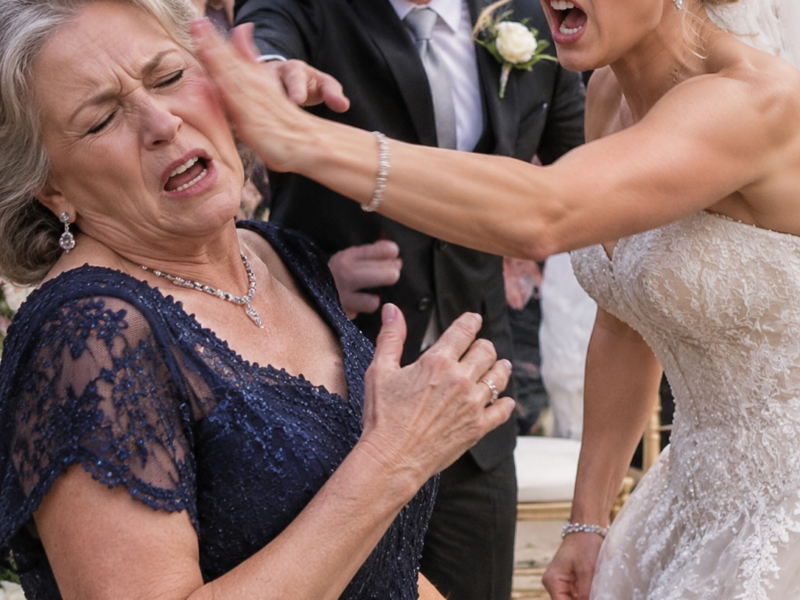
At 68, I Was Slapped by My Daughter-in-Law in Front of 400 Guests at My Son’s $153,500 Wedding, Leaving Blood Running Down My Cheek. “Get Out, You Crazy Beggar!” She Screamed, While My Only Son Stared Silently at His Shoes. Instead of Crying, I Took Out My Phone and Said, “Activate Clause Nine. Shut Everything Down.” She Burst Out Laughing—Until the Music Stopped, the Chandeliers Went Dark, and a Billionaire Entered the Ballroom With Four Security Officers, Heading Straight Toward Me…
At 68, I Was Slapped by My Daughter-in-Law in Front of 400 Guests at My Son’s $153,500 Wedding, Leaving Blood Running Down My Cheek. “Get Out, You Crazy Beggar!” She Screamed, While My Only Son Stared Silently at His Shoes. Instead of Crying, I Took Out My Phone and Said, “Activate Clause Nine. Shut Everything Down.” She Burst Out Laughing—Until the Music Stopped, the Chandeliers Went Dark, and a Billionaire Entered the Ballroom With Four Security Officers, Heading Straight Toward Me…
The moment my daughter-in-law slapped me across the face in front of four hundred wedding guests, I realized something that would have broken my heart just a few years earlier.
My only son was not going to defend me.
He stood less than three feet away, wearing a custom-made tuxedo that probably cost more than some families spent on groceries in six months. His beautiful new wife had just struck his sixty-eight-year-old mother so violently that the diamond on her finger sliced open my cheek. Blood was running down my face, dripping onto the white linen tablecloth, and every person in that magnificent ballroom was watching.
Yet Kevin did not move.
He did not tell his wife to stop. He did not ask whether I was hurt. He did not even reach for a napkin.
He simply lowered his head and stared at his polished black shoes.
“Get out of here, old woman!” Khloe screamed, pointing toward the doors. “Security! Somebody throw this crazy beggar out!”
There was a time when those words would have devastated me. There was a time when I would have swallowed the humiliation, apologized for upsetting everyone, and quietly disappeared because I was terrified of losing the only family I had left.
But that woman no longer existed.
I pressed a folded napkin against my bleeding cheek, opened my silver clutch, and took out my phone.
Then I called the one man who could end the evening with a single instruction.
“Marcus,” I said calmly, “activate Clause Nine. Shut everything down.”
Khloe threw back her head and laughed.
“Oh, this is priceless!” she announced to the guests surrounding the head table. “The poor old woman thinks she can cancel my wedding with a phone call!”
She was still laughing when the string quartet stopped playing.
One second later, the golden light from six enormous crystal chandeliers disappeared, replaced by the harsh white glare of the ballroom’s overhead maintenance lights.
The music died. The champagne service stopped. The kitchen doors closed.
And at the far end of the ballroom, a billionaire was walking directly toward me with four security officers behind him.
What Khloe did not understand was that the woman she had just assaulted was not a helpless widow living on a tiny pension.
I was the person whose money had made her entire wedding possible.
And the truth about my finances was only the beginning of what my son and his new family were about to discover.
My name is Diane Mercer. I am sixty-eight years old, and until that Saturday, I believed the greatest responsibility of a mother was to keep her family together, even when doing so meant sacrificing pieces of herself.
I had spent thirty years working in commercial banking in Charleston, South Carolina, eventually becoming a senior credit and risk controller. It was not a glamorous profession. I did not attend cocktail parties to discuss my achievements or buy expensive jewelry to advertise my income. I spent my working life studying contracts, examining financial statements, identifying fraud, and deciding whether businesses deserved the trust they were asking banks to extend.
My husband, Paul, operated a successful medical supply distribution company. Together, we built our savings slowly, carefully, and without drawing attention to ourselves.
We lived in the same comfortable brick house for thirty years. I drove a practical Subaru. I grew flowers in our backyard, clipped coupons when they were useful, and preferred homemade dinners to expensive restaurants.
To strangers, we looked like an ordinary middle-class couple preparing for a modest retirement.
That was exactly how we wanted it.
Paul used to tell me that real financial security was not about convincing other people that you were wealthy.
It was about having enough freedom that you no longer cared what strangers thought.
He died four years before Kevin’s wedding after suffering a devastating stroke at his office.
I can still remember the hospital room, the smell of antiseptic, and the terrible weight of his hand resting in mine.
Kevin was there when his father passed away.
He was thirty years old then, and as we stood beside Paul’s hospital bed, my son promised he would always look after me.
“Don’t worry, Mom,” he whispered. “You’re never going to be alone.”
For a long time, I believed him.
After Paul’s funeral, Kevin visited every Sunday. He helped with repairs around the house, brought groceries when the weather was bad, and called to ask how I was doing.
Then he met Khloe Vance.
Khloe came from a prominent Charleston family with an impressive historic home, expensive clothes, and connections throughout the city’s social circles. Her father, Victor Vance, spoke constantly about his family’s heritage, while her mother, Lydia, seemed to measure every person she encountered by the size of their house and the brand of their car.
Khloe was beautiful, polished, and exceptionally skilled at making people feel important when she wanted something from them.
At first, I was happy Kevin had found someone he loved.
But over the following months, my son began changing.
He stopped visiting on Sundays. When I called, he often sounded impatient. He began criticizing my house, my clothes, and my car.
One afternoon, while we were having coffee in my kitchen, he looked through the window at my Subaru and shook his head.
“Mom, you really need to upgrade that thing. It makes people think we’re struggling.”
I laughed because I thought he was joking.
“Kevin, the car runs perfectly well. Why should I replace it?”
“Because appearances matter,” he replied. “Especially now that I’m moving into executive circles.”
He had recently become vice president of business development at Vanguard Logistics, and he was desperate to impress the company’s senior leadership.
What he never realized was that I had quietly helped him obtain the opportunity in the first place.
Years earlier, during my banking career, I had helped a businessman named Richard Sterling navigate a serious financial crisis. His hospitality company had been threatened by lenders preparing to withdraw crucial financing, and my work helped demonstrate that the business remained fundamentally sound.
Richard never forgot that.
Over time, he became a trusted family friend, and after Paul’s death, we established a private commercial investment partnership.
Mercer Holdings, the company Paul and I had built to manage our assets, committed $4.5 million to the venture.
Kevin knew almost nothing about it.
I had never hidden the fact that his father and I were financially comfortable. But I had deliberately avoided discussing the exact size of our holdings because Paul and I agreed that Kevin needed to learn how to build a meaningful life rather than wait for an inheritance.
Unfortunately, my silence allowed him to construct an entirely different story.
In his mind, I was an aging widow living on a limited pension, and the occasional money I gave him came from the final remnants of his father’s life insurance.
I did not realize how dangerous that misunderstanding had become until the morning of his wedding.
At five thirty, I woke up excited and nervous.
The ceremony was scheduled for two o’clock at Magnolia Creek Estate, an extraordinary property outside Charleston, with ancient oak trees, sweeping lawns, and a ballroom famous for hosting extravagant society events.
Kevin had promised that a limousine would collect me at seven thirty so I could join the family photographs and bridal preparations.
I had selected a navy silk dress, had it professionally altered, and placed a silver clutch beside the front door.
At seven fifteen, I was ready.
At seven thirty, I was waiting.
At eight, I was still waiting.
By eight fifteen, I had called Kevin twice.
Both calls went to voicemail.
At eight twenty-five, I tried again.
Nothing.
Finally, I called Khloe.
She answered with laughter and music in the background.
“Diane? What is it? We’re getting ready.”
“Good morning, Khloe. I’m still at home waiting for the limousine Kevin arranged.”
She sighed as though I had interrupted something terribly important.
“Oh, didn’t he tell you? We had to change the plans.”
My heart sank.
“What plans?”
“The bridal suite is completely full. My bridesmaids, my mother, my aunts, the makeup artists—there’s simply no room for another person.”
“I understand,” I said carefully. “But Kevin told me I was supposed to be there for the family photographs.”
There was a pause.
Then Khloe laughed softly.
“Well, the photographer is doing a lifestyle magazine feature, and he wants the morning pictures to look young and elegant. We can probably take a quick photo with you later if there’s time.”
For several seconds, I could not speak.
I was the groom’s mother.
Yet apparently, I was too old to appear in his wedding photographs.
Khloe continued before I could respond.
“Just drive yourself over around two. And Diane, please use the service parking lot behind the catering barn. We’re filming luxury arrivals at the front entrance, and my father doesn’t want older cars showing up in the footage.”
I looked at the silver clutch resting in my lap.
The dress I had chosen so carefully suddenly felt ridiculous.
“May I speak to Kevin?”
“He’s busy networking with my father and some important executives. Please don’t bother him.”
Then she hung up.
I sat in my silent hallway, staring at the framed photograph of Paul on our twenty-fifth anniversary.
I wanted to believe this was simply wedding stress.
I wanted to tell myself Kevin had forgotten to call because he was overwhelmed.
But before I could convince myself, my phone chimed again.
This time, it was an alert from my commercial banking account.
A transaction had been processed at Magnolia Creek Estate at 8:24 that morning.
The amount was $18,500.
I stared at the screen.
Three weeks earlier, Khloe had asked whether I could provide a temporary supplementary card for emergency floral expenses.
The florist, she explained, needed a payment method available in case additional flowers had to be ordered at the last minute.
I had agreed to authorize up to $2,000 for that specific purpose.
Now someone had charged more than nine times that amount.
I went straight into Paul’s study, opened my computer, and downloaded the invoice.
The purchase had nothing to do with flowers.
It covered twenty-four bottles of expensive French champagne and forty customized leather gift bags for the Vance family’s VIP guests.
Khloe had authorized the transaction.
Kevin had signed as a witness.
My son had deliberately ignored my calls while approving thousands of dollars in luxury purchases on my account.
I sat back in my chair and stared at the receipt.
It was not the money that hurt most.
I could afford the charge.
What I could not understand was how my son had become comfortable treating my kindness as permission to steal.
I opened a drawer and removed the wedding contract.
Six months earlier, Kevin and Khloe had asked me to help secure Magnolia Creek Estate because the venue required substantial financial backing.
They claimed Victor’s money was tied up in complicated real estate investments and that they needed temporary assistance.
I had agreed to guarantee the $135,000 event contract.
But I had not simply handed over a check.
Instead, I arranged a formal commercial guarantee through Mercer Holdings, carefully reviewed by my attorney, Warren Miller.
And on page four was a provision I had specifically insisted upon.
Clause Nine.
It gave me the contractual right to withdraw my financial guarantee and demand an immediate suspension of service if the event involved substantial unauthorized charges or serious mistreatment directed at me.
I had included it because decades in commercial banking taught me a simple truth: generosity without protection can become an invitation to exploitation.
At the time, I never imagined I would need to use that provision against my own family.
I printed the unauthorized receipt, placed it inside the contract folder, and put everything in my leather tote.
Then I picked up my car keys.
Khloe had told me not to arrive until two.
I decided to go early.
The drive to Magnolia Creek took approximately thirty-five minutes.
As I approached the estate, enormous live oaks stretched over the driveway, their branches forming a green canopy above the road.
White luxury cars lined the entrance.
A young valet approached my Subaru and directed me toward the service road.
“Deliveries are behind the barn, ma’am.”
“I’m not making a delivery,” I replied. “I’m Diane Mercer, the groom’s mother.”
The young man looked embarrassed.
He checked his clipboard.
“I’m very sorry, Mrs. Mercer, but your vehicle isn’t on the approved family parking list.”
I could see the Rolls-Royce waiting beside the fountain.
There were photographers everywhere.
I smiled at the valet.
“That’s all right. I’ll park with the other guests.”
I drove to the western lawn and walked toward the estate.
Inside the entrance, an assistant coordinator handed me a beautiful wedding program printed on cream-colored paper with gold lettering.
I opened it.
And immediately noticed something missing.
My name.
Two weeks earlier, Kevin had shown me the final design, which identified me as the groom’s mother and included a short memorial tribute to Paul.
Now both names were gone.
The Vance family appeared prominently as the hosts.
Paul and I had been erased entirely.
I approached the coordinator and politely asked why the program had changed.
Her expression became uncomfortable.
“Mrs. Mercer, I’m so sorry. Miss Vance requested a replacement printing last night.”
“Did she give a reason?”
The young woman hesitated.
Then she admitted that Khloe wanted the printed materials to emphasize the Vance family’s social standing.
According to the revised design instructions, including an elderly widow among the hosts would not fit the image they wanted to present.
I felt something tighten inside my chest.
“And Kevin approved this?”
The coordinator nodded reluctantly.
I thanked her and asked where I would be seated.
She checked the list.
“Table forty-two.”
I remembered the original seating chart.
I had been assigned to the head table.
“Where is table forty-two?”
Her face turned red.
“Near the rear service corridor.”
I found it after the ceremony.
It was not even a proper guest table.
It was a small table tucked behind a stone pillar beside the swinging kitchen doors.
There were no flowers, no elegant place settings, and no view of the stage.
My name had been written on a plain paper card and placed beside the names of several event technicians.
Every few seconds, the kitchen doors opened, filling the corner with steam, noise, and the smell of cooking oil.
I stood there staring at my chair.
Thirty years of work.
A lifetime of saving.
A $135,000 financial guarantee.
And my reward was a seat beside the catering entrance.
“Diane!”
I turned to see Lydia Vance approaching with three women carrying champagne glasses.
She wore a magnificent pearl-covered gown.
“Oh, there you are,” she said brightly. “I hope you don’t mind sitting back here. We thought it would be quieter for someone your age.”
Her friends smiled politely.
Then Lydia began telling them how generous her husband had been.
“Victor insisted on paying for the entire wedding,” she announced. “We couldn’t possibly expect poor Diane to contribute. She’s living on a modest pension, you know.”
One woman actually touched my arm.
“How wonderful that your son is marrying into such a generous family.”
I looked at the champagne in her glass.
I had paid for it that morning.
I could have opened my folder and exposed Lydia immediately.
But I wanted one final conversation with Kevin.
I found him in a quiet hallway adjusting his tuxedo in a mirror.
“Kevin.”
He turned, and his expression immediately hardened.
“Mom, what are you doing here? You should be at your table.”
“Is that the table behind the kitchen?”
He sighed.
“Please don’t start.”
“Why was I removed from the head table?”
“We had important guests to accommodate.”
“And why did you remove your father’s memorial from the wedding program?”
His jaw tightened.
“Khloe thought it looked depressing.”
I stared at him.
“Your father worked his entire life to give you opportunities he never had. Three lines remembering him were too depressing?”
“Mom, this is a wedding, not a funeral.”
I felt the words strike harder than I expected.
Then I asked about the money.
“Did you approve the eighteen-thousand-five-hundred-dollar charge on my card this morning?”
Kevin rolled his eyes.
“Yes. Victor’s accounts are temporarily restricted. We’ll sort it out later.”
“You knew the card was only for flowers.”
“It’s one night, Mom. Stop acting like a penny-pinching accountant.”
I looked at him silently.
He stepped closer.
“Do you understand what tonight means for my career? These executives own multimillion-dollar houses. They attend the best clubs. I need them to see me as one of them.”
“And being seen with your mother would prevent that?”
He looked at my dress.
Then he glanced toward the ballroom.
“Look, you live in an old brick house and drive a six-year-old Subaru. You’re a retired bank employee. I’m trying to build something important, and I need you to stop embarrassing me.”
For a moment, I could see him as a little boy again, standing in our kitchen with scraped knees, asking me to kiss the pain away.
Then that memory disappeared.
“Go sit down,” Kevin said. “And please, don’t make a scene.”
He walked away.
I remained in the hallway, feeling the last pieces of an old illusion beginning to crumble.
But the worst discovery was still ahead.
As I walked toward the powder room, I passed the Rosewood Parlor.
The door was partially open.
Inside, I heard Khloe laughing.
“See? I told you she’d back down. Kevin just has to tell her what to do, and she obeys.”
Lydia joined in.
“She’s so desperate to keep her son that she’ll tolerate anything.”
Then Victor spoke.
“What about Monday’s house closing?”
I stopped.
Khloe answered immediately.
“Everything is ready. Diane’s guarantee will secure the mortgage. Once we close on the $1.4 million house in Mount Pleasant, we won’t need her approval anymore.”
My stomach tightened.
Kevin had told me he was purchasing a modest starter home.
He had asked Mercer Holdings to provide temporary financial verification while he arranged his own down payment.
Now I was hearing an entirely different plan.
But Khloe was not finished.
“After the honeymoon, Kevin will convince Diane that her house is too large for her. We’ll sell it, use the equity to pay Daddy’s tax debts, and move her into that affordable senior apartment in North Charleston.”
Lydia laughed.
“She’ll probably think we’re doing her a favor.”
“Of course,” Khloe replied. “Kevin knows how to handle her.”
I stood perfectly still.
They were planning to take the home Paul and I had built together.
The house where we had raised our son.
The house where my husband had planted camellias, repaired broken windows, and spent his final peaceful years.
They intended to use its value to rescue Victor from financial trouble.
And then they planned to move me somewhere cheap so I would no longer inconvenience them.
For the first time that day, I felt no sadness.
Only clarity.
I had spent years defending my son to myself.
Now I was hearing exactly what he had become involved in.
Then Victor lifted his wrist.
“And I must say,” he remarked, “Kevin certainly knows how to impress his father-in-law. This watch he gave me is exquisite.”
Through the gap in the doorway, I saw the gold watch.
I recognized it instantly.
Paul’s vintage Patek Philippe Calatrava.
It had belonged to my husband for decades.
After his death, I kept it locked in our floor safe with a handwritten note explaining that it should eventually pass to Kevin’s first child.
There was only one way Victor could have obtained it.
Kevin had entered my house while I was away, opened the safe, and taken his father’s watch.
I remembered showing him the safe combination earlier that week while retrieving documents.
He had been watching.
My son had stolen a precious family heirloom to impress a man who was planning to exploit me.
I took two photographs through the doorway.
Then I stepped away and sent a message to Marcus Hail, the estate’s operations director.
I asked him to retrieve my original contract and position his senior staff near the ballroom.
He responded almost immediately.
Everything would be ready when I gave the instruction.
I returned to table forty-two.
For the next half hour, I watched my son’s wedding reception unfold like a carefully staged performance.
Victor stood at the podium and praised his family for generously financing the celebration.
He described Kevin as a young man fortunate to escape his humble origins.
Then Khloe took the microphone.
She thanked her parents for their extraordinary generosity.
And finally, she turned her attention to me.
“Of course, we should also acknowledge Kevin’s mother, Diane, who is sitting somewhere near the service entrance.”
Several people turned.
Khloe smiled.
“She’s had a difficult time accepting that Kevin has a new family now. Poor thing. She’s been rather controlling about the wedding arrangements.”
Laughter spread through the room.
“She even tried to give us advice about the budget,” Khloe continued. “Which is adorable, considering she still lives in her old house and drives a station wagon.”
More laughter.
I looked at Kevin.
He was smiling with the executives beside him.
His wife was humiliating his mother before four hundred people, and he appeared delighted to be part of the joke.
Khloe lifted her glass.
“So let’s give Diane a little applause for showing up in her favorite old navy dress!”
The ballroom erupted.
I remained seated until the laughter faded.
Then I stood.
I picked up my bag and walked slowly toward the head table.
As I moved through the room, conversations began to quiet.
Kevin saw me approaching.
“Mom,” he whispered angrily, “go back to your seat.”
I ignored him.
I stopped directly in front of Victor.
“That watch on your wrist belongs to my late husband.”
Victor’s smile vanished.
“What?”
“Paul Mercer owned that watch. It was taken from my safe without my permission. I want it returned.”
Kevin immediately interrupted.
“Mom, stop making accusations!”
I turned to him.
“You removed your father’s name from your wedding program, and then you stole his watch to give to your father-in-law. Is that really the man you’ve become?”
Lydia rose from her chair.
“How dare you come here and insult my family!”
Khloe moved toward me, her face twisted with fury.
“You jealous old hag! You couldn’t stand being left out of the photographs, so you decided to ruin everything!”
I raised one hand instinctively as she approached.
Then she struck me.
The slap was so powerful that my head snapped sideways.
Her diamond ring cut into my cheekbone.
I tasted blood.
The room fell silent.
“Get out!” Khloe screamed. “Get out of my wedding!”
I looked at Kevin.
He stared at his shoes.
That was the moment I stopped trying to save him from the consequences of his choices.
I took out my phone and called Marcus.
“Activate Clause Nine.”
Seconds later, the music stopped.
The ballroom lights changed.
Servers halted their work.
And Marcus Hail entered with several security officers and Richard Sterling.
Victor immediately stepped forward, smiling with relief.
“Richard! Thank goodness you’re here. This woman has been causing trouble.”
Kevin extended his hand.
“Mr. Sterling, I’m terribly sorry. My mother has been emotionally unstable since my father died.”
Richard walked straight past him.
He approached me and looked at my bleeding cheek.
“Diane,” he said quietly, “are you all right?”
I nodded.
“I’ll be fine.”
Richard removed a clean linen handkerchief from his pocket and handed it to me.
Then he turned toward Kevin.
“Your mother is one of the most respected financial professionals I have ever worked with. And she’s a founding capital partner in my investment business.”
Kevin stared at him.
“What?”
Richard’s voice hardened.
“Twenty-two years ago, your mother helped save my company when other people were prepared to abandon it. I am standing in this ballroom today because I respect Diane Mercer and her late husband.”
The silence became absolute.
Marcus opened the contract folder.
He explained that I was the sole financial guarantor of the wedding.
He confirmed the $135,000 base agreement and the unauthorized $18,500 transaction.
Then he read Clause Nine.
Because the conditions allowing withdrawal had been triggered, my financial guarantee was being revoked.
Unless the Vance family arranged acceptable replacement funding, the reception could not continue.
Khloe began shouting.
“My father paid for everything!”
Marcus looked directly at Victor.
“Then, Mr. Vance, you may settle the outstanding balance now.”
He placed a payment terminal on the table.
Victor reached for his wallet.
His first card was declined.
He tried another.
Declined.
Lydia offered hers.
Declined.
Khloe produced a business card.
That failed too.
Four hundred guests watched as the family that had spent the entire evening boasting about its wealth discovered it could not pay for the celebration.
Victor began sweating.
Lydia looked as though she might faint.
Khloe turned pale beneath her makeup.
I felt no satisfaction watching them unravel.
What I felt was exhaustion.
The truth had finally emerged, but it had cost me the last illusion I held about my son.
“There’s something else,” I said.
I looked at Victor’s wrist.
“Return Paul’s watch.”
Victor hesitated.
Then, under the scrutiny of Richard, the venue’s security staff, and the watching guests, he removed it.
When he placed it in my hand, I felt the familiar weight of the gold case.
For a moment, I remembered Paul wearing it while working in his study.
I remembered how he would take it off before gardening and place it carefully beside his coffee cup.
I closed my fingers around it.
That mattered more than any amount of money.
The disputed diamond ring Khloe had used to injure me was also surrendered for safekeeping while its ownership and the associated financial agreements were reviewed.
By then, guests were beginning to leave.
But Kevin was not finished.
He stepped toward me, his eyes full of anger.
“You’ve ruined everything,” he whispered. “Our wedding, our reputation, our future.”
I looked at the bloodstained handkerchief in my hand.
“Kevin, your wife assaulted me, and you stood there.”
He ignored the observation.
“It doesn’t matter. We’re still closing on our house Monday. I still have my job. You can’t control my life.”
I studied his face.
Even now, he was thinking about money.
Not his mother.
Not the theft.
Not the cruelty.
Just the things he believed belonged to him.
“Your house,” I said quietly, “is being purchased using a conditional guarantee from my company.”
He froze.
“What?”
“The guarantee requires my final authorization before the lender releases the funds.”
I took out my phone and opened the commercial account.
Kevin stepped forward.
“Mom, don’t.”
I revoked the authorization and submitted the notification to the lender.
The pending transaction was flagged for cancellation.
Kevin looked at me as though he had never seen me before.
Then Richard addressed him.
There would also be an investigation into Kevin’s conduct at Vanguard Logistics.
The company had recently come under the control of Richard’s investment group, and the revelations about unauthorized financial transactions and the missing watch raised serious concerns about Kevin’s integrity.
By Monday, Kevin would be suspended pending a formal review.
He stood speechless.
The company title he had used to justify humiliating me was no longer secure.
I turned to Marcus.
“My part here is finished.”
Richard offered his arm.
“Come on, Diane. Let’s get that cheek examined.”
I left the ballroom without looking back.
Outside, the Charleston night was cool and fragrant with jasmine.
A black SUV waited near the fountain.
As I stepped into the vehicle, I saw guests leaving the estate in small groups, whispering about what they had witnessed.
I knew that by morning, the story would be circulating throughout the city.
But for the first time in years, I did not care what anyone thought.
I had spent too long allowing other people’s opinions to determine how much disrespect I was willing to accept.
At a private clinic, a physician cleaned the cut and closed it with three stitches.
The injury was photographed and documented.
Afterward, I returned home.
My Subaru was waiting in the carport, exactly where it belonged.
Inside Paul’s study, I placed his watch back in its velvet box and secured it in the safe.
Then I changed the combination.
Before going upstairs, I remembered one final financial arrangement.
Kevin and Khloe had booked their luxury honeymoon through my corporate travel account.
First-class flights.
Expensive hotels.
Two weeks in Italy.
They had promised to reimburse me after the wedding.
I opened the account, reviewed the bookings, and canceled the reservations I was still authorized to cancel.
I had spent years paying for things that were supposedly temporary favors.
That evening, I decided the favors were over.
Then I went to bed.
And I slept more peacefully than I had in four years.
The following afternoon, Marcus called with an update.
The reception had ended early, and the estate’s legal representatives had reviewed the remaining charges with Kevin and the Vances.
Although the unused portions of the event were no longer being provided, substantial expenses had already been incurred.
Flowers had been installed.
Staff had worked all day.
Food had been prepared.
Champagne had been opened and consumed.
The parties eventually signed agreements addressing approximately $62,000 in outstanding costs.
Kevin accepted responsibility for a significant portion, exhausting most of his available savings.
Victor accepted responsibility for the remainder.
By the time the matter was settled, the family that had arrived at Magnolia Creek expecting one of Charleston’s most glamorous celebrations departed under the weight of debt, embarrassment, and mutual resentment.
Kevin and Khloe went back to his apartment.
Victor and Lydia returned to their historic house.
And I stayed home.
On Sunday afternoon, Kevin and Khloe went to the airport, apparently believing their honeymoon arrangements would somehow survive the events of the previous evening.
At the check-in counter, they discovered the reservations had been canceled.
They could still purchase new tickets, but they would have to pay for them themselves.
Kevin had no money left.
Khloe’s cards were nearly exhausted.
According to what I later heard, she became furious, accused him of ruining her life, and walked away from him in the terminal.
Their marriage had lasted less than twenty-four hours before its carefully polished appearance began to crack.
Meanwhile, I was sitting on my back porch, drinking chamomile tea and watching a Carolina wren move through the camellia bushes Paul had planted.
For years, I had imagined that losing Kevin’s affection would leave me unbearably lonely.
Instead, I discovered a strange and unfamiliar feeling.
Peace.
On Monday morning, I hired a locksmith.
Every exterior lock was replaced.
I installed security cameras, updated my legal documents, and removed Kevin’s access to my accounts.
I also contacted my attorney to review every outstanding guarantee, family arrangement, and asset that might be vulnerable to misuse.
The process was exhausting.
But it was necessary.
For four years after Paul died, I had kept Kevin’s childhood house key active because I wanted him to know he would always have a home with me.
When he used that privilege to enter his father’s study and take the watch, he crossed a boundary I could no longer ignore.
Five days after the wedding, he came to my front door with Khloe.
I watched them through the security camera.
Kevin wore a wrinkled blue shirt.
Khloe carried a bouquet of grocery-store lilies.
Before ringing the bell, she whispered instructions to him.
“Just apologize. Get us inside. Once she starts feeling sorry for us, we can talk about the house and the money.”
I heard every word.
Kevin tried his old key first.
It no longer worked.
He stared at the new lock in disbelief.
Then he rang the bell.
“Mom,” he said through the intercom, “please let us in. We need to talk.”
Khloe stepped toward the camera.
“Diane, I’m so sorry. I wasn’t myself at the wedding. We should sit down as a family.”
I looked at the flowers.
Then I remembered the blood running down my face while my son stared at his shoes.
“If you have anything to discuss,” I replied, “please contact Warren Miller, my attorney.”
Kevin’s voice changed immediately.
“Mom, you can’t shut me out. I’m your only son!”
“You need to leave my property, Kevin.”
“Please! I lost my job. The house purchase fell through. We’re in serious trouble.”
I closed my eyes briefly.
Part of me still wanted to help him.
I had spent thirty-four years responding to his problems as though they were my own.
But I knew what would happen if I opened that door.
The apologies would continue only until the next request for money.
Then the manipulation would begin again.
“I hope you find a way to rebuild,” I told him. “But it won’t happen by taking anything else from me.”
I ended the call.
On the camera, Khloe’s sorrowful expression vanished.
She threw the lilies onto my front steps.
Then she stormed away.
Two days later, Warren called.
Kevin, Khloe, and Victor had retained an attorney.
They were demanding $200,000 in compensation for alleged reputational damage, along with financial assistance to settle the estate’s remaining claims.
I listened without interrupting.
Then I told Warren I would attend a settlement meeting.
He sounded surprised.
“Diane, you don’t have to entertain this.”
“I know,” I replied. “But I want this finished.”
The following Monday, I walked into Warren’s conference room carrying a red folder.
Victor sat at the far end of the table.
Khloe sat beside him.
Kevin barely looked at me.
Their attorney began by describing the emotional and financial consequences of my actions at Magnolia Creek.
He claimed they had relied on my promises and that withdrawing support had caused catastrophic damage.
When he finished, he pushed a settlement proposal across the table.
I did not touch it.
Instead, I opened my folder.
For several days, I had been examining public records associated with Victor’s business dealings.
What I discovered was deeply troubling.
The Vance family’s financial position was far worse than they had admitted.
Their historic Charleston residence had accumulated serious unpaid obligations.
Victor’s companies had borrowed heavily.
And certain financial disclosures appeared to identify assets that public property records indicated he no longer owned.
I placed those documents in front of their attorney.
“I spent thirty years reviewing commercial risk,” I said. “I know the difference between someone experiencing financial difficulty and someone making questionable representations to obtain credit.”
Victor’s face reddened.
“You have no right to investigate my affairs!”
“When your family attempted to use my assets to cover your obligations, your affairs became relevant to mine.”
Their attorney began reading.
As he turned the pages, his confidence visibly faded.
Warren then produced the estate’s security footage of Khloe striking me, the medical documentation of my injury, and the recording from my front porch.
The attorney watched in silence.
When he finally looked up, he asked for a private conversation with his clients.
I agreed.
Twenty minutes later, they returned.
The demand for $200,000 was withdrawn.
The parties agreed to stop seeking further money from me and to address their own remaining obligations.
Warren handled the appropriate written agreements and preserved the evidence should any further legal or financial action become necessary.
I signed only after he had explained every provision.
As the meeting ended, Kevin finally spoke.
“Mom.”
I looked at him.
He seemed smaller than I remembered.
“I didn’t know things would get this bad.”
I studied his face.
“No, Kevin,” I replied. “You didn’t think I would ever say no.”
He had no answer.
I left the building and walked into the sunlight.
The following months brought consequences none of them could hide behind expensive clothing or impressive family names.
Victor’s financial difficulties became increasingly difficult to manage.
His creditors demanded answers.
His property obligations remained unresolved, and his once-celebrated reputation suffered as information about his finances circulated through Charleston’s business community.
Khloe’s public image also deteriorated.
Videos from the wedding had spread beyond the guests who attended.
Her attempts to present herself as the victim convinced fewer people as the footage of the assault became widely known.
The glamorous lifestyle she had spent years displaying online was becoming impossible to maintain.
Her relationship with Kevin deteriorated rapidly.
Without his executive salary, access to my financial support, or the promised luxury house, their marriage no longer resembled the life Khloe had expected.
Eventually, they separated.
Their divorce proceedings followed.
Kevin lost his position at Vanguard after the company’s review.
For a while, he struggled to find employment at the level he had become accustomed to.
The executive salary disappeared.
The leased luxury car was gone.
The prestigious professional connections he had worked so hard to cultivate offered little assistance.
He eventually found work at a freight terminal.
It was difficult, practical work.
The hours were long.
The pay was substantially lower than his former salary.
For the first time in years, he had to calculate what he could actually afford instead of assuming someone else would cover the difference.
I learned these details through Warren, who continued handling the remaining legal communications.
I did not call Kevin.
I did not send money.
And I did not ask anyone to intervene on his behalf.
Several months later, he requested a meeting.
Warren informed me that Kevin wanted to speak without Khloe or her family present.
After some consideration, I agreed to meet him at a small café.
When he arrived, I almost failed to recognize him.
He was thinner.
His clothes were clean but inexpensive.
There was no expensive watch on his wrist, no polished executive arrogance, and none of the restless impatience that had once colored every conversation.
He sat opposite me and folded his hands.
“Mom,” he said, “I owe you an apology.”
I waited.
He took a long breath.
“I was ashamed of the wrong things.”
His voice trembled slightly.
“I thought having money and being around important people meant I was becoming successful. I treated you like you were beneath me because I was desperate to impress people who didn’t care about me.”
I looked into his eyes.
For once, he was not asking me to admire him.
“I know I can’t undo what happened at the wedding,” he continued. “And I know I should have stopped Khloe.”
His eyes filled with tears.
“When she hit you, I just stood there. I’ve thought about that every day.”
I believed him.
But belief was not the same as trust.
Kevin told me about his work at the freight terminal.
He was earning approximately twenty-four dollars an hour.
He had begun paying down his obligations.
His marriage was ending.
And he had discovered that rebuilding a reputation required more than telling people he was sorry.
For several minutes, we talked like two people meeting after years apart.
Then he lowered his eyes.
“Mom, there’s something I wanted to ask.”
I knew what was coming.
“My rent is taking almost everything I earn,” he said. “Would you consider letting me move into my old bedroom for six months? Maybe a year? I could pay rent and help with the house.”
There it was.
The familiar request.
A problem.
A proposed solution involving my resources.
And an assumption that motherhood required me to accept.
I looked at him for a long moment.
Then I said, “No, Kevin.”
He blinked.
I continued gently.
“I’m glad you’re working. I’m glad you’re taking responsibility. And I hope you continue becoming someone you can respect. But moving back into my house would undo the independence you’re beginning to develop.”
His shoulders dropped.
“I wouldn’t ask you for money.”
“I understand. But you would still be asking me to absorb the consequences of your decisions.”
He looked down at his hands.
I felt the old instinct rising inside me.
The desire to protect my child.
To make his life easier.
To erase his pain.
But I remembered another version of Kevin.
The man in the tuxedo.
The man who had watched his mother bleed.
The man who had threatened to have her removed from a wedding she had financed.
“I love you,” I told him. “That hasn’t disappeared. But loving you does not mean giving you unlimited access to my life.”
He nodded slowly.
For the first time, he did not argue.
When we stood to leave, he looked as though he wanted to hug me.
I was not ready.
I simply wished him well.
Then I walked away.
The months that followed were quieter than any I could remember.
I returned to gardening.
I began visiting friends I had neglected while trying to remain involved in Kevin’s life.
I spent afternoons reading in the study and evenings listening to music Paul had loved.
And slowly, I realized how much of my life had been shaped by the fear that I might disappoint my son.
Every major purchase had been evaluated according to whether Kevin might need the money someday.
Every holiday had been arranged around his schedule.
Every personal ambition had been postponed because I wanted to remain available to him.
I had mistaken endless availability for love.
Once I stopped doing that, the world began opening again.
I renovated the old screened porch at the back of the house into a bright conservatory.
For years, Paul and I had talked about creating a room filled with sunlight, comfortable chairs, and books.
After his death, I kept postponing the project.
There was always some expense Kevin might need help covering.
This time, I hired the contractors.
We installed tall windows, glass skylights, and shelves along the walls.
The room overlooked the camellias Paul had planted.
On the first morning after the renovation was completed, I sat in the conservatory with a cup of coffee and watched sunlight move across the floor.
I cried.
Not because I was sad.
But because I finally understood how much time I had spent denying myself simple happiness.
Richard Sterling became a frequent visitor.
We had known each other for decades, but our friendship deepened during that year.
He never treated me as someone who needed rescuing.
He respected my judgment, challenged my ideas, and understood why financial independence mattered so deeply to me.
Together, we began discussing ways to use my professional experience to help older people who were vulnerable to financial exploitation.
During my banking career, I had seen too many elderly homeowners pressured into signing confusing documents.
Some had trusted adult children who wanted access to their property.
Others had been manipulated by relatives claiming to act in their best interests.
Many had worked their entire lives to own a home, only to lose it because they believed refusing family members made them selfish.
I knew that story intimately now.
And I wanted to do something useful with what I had learned.
With Warren’s legal guidance, I began establishing a charitable foundation.
Its purpose was to provide financial education, independent legal assistance, and practical support for vulnerable older homeowners, especially those facing pressure from relatives or caregivers.
A second program would offer carefully evaluated grants to hardworking individuals trying to build stable small businesses.
Paul had always believed that opportunity was most valuable when it helped people become independent.
I wanted the foundation to reflect that belief.
During the planning process, Warren asked whether I intended to reconsider Kevin’s inheritance.
Originally, Paul and I had arranged for most of our estate to pass to our only child.
It had seemed natural.
We loved him.
We wanted to protect his future.
But as I examined the documents, I realized that leaving him unrestricted access to the fortune we had built could destroy the fragile progress he was making.
A large inheritance would allow him to avoid the difficult work of rebuilding his character.
And it could attract the same kind of people who had encouraged his worst behavior.
I decided to redirect the overwhelming majority of my estate into the Paul and Diane Mercer Financial Independence Foundation.
Warren helped me establish a separate, limited medical contingency trust for Kevin.
It would provide assistance only for certain serious, verified medical emergencies, with funds paid directly to appropriate providers rather than given to him as cash.
He would not be able to borrow against it.
He would not be able to use it to finance a lifestyle he could not afford.
And he would not inherit control of Mercer Holdings merely because he was my son.
When Warren asked whether I was certain, I looked at Paul’s photograph on the corner of the desk.
“Yes,” I said. “This is what I want.”
I signed the documents.
And I felt something settle inside me.
I was no longer arranging my entire future around someone else’s expectations.
Kevin respected the distance I had established.
Over the following year, he sent two greeting cards through Warren’s office.
One arrived at Christmas.
The other arrived on my birthday.
Neither contained a request for money.
He wrote about his work.
He said he had been promoted to a daytime supervisory position at the freight terminal.
He was continuing to repay his debts.
And he wished me good health.
I kept the cards in a drawer.
I did not respond.
Some people might consider that harsh.
Perhaps, under different circumstances, I would have felt the same.
But I had learned that forgiveness did not require restoring access.
I could hope my son became a better person without allowing him to return to the role he once occupied in my life.
I could love him without trusting him.
I could wish him peace without sacrificing my own.
A year after the wedding, on a warm October afternoon, Richard came to visit.
He arrived wearing a linen jacket and carrying a wooden crate of fresh Georgia peaches.
The foundation’s first grants had recently been approved, and we spent an hour discussing the families and business owners who would benefit.
One recipient was an older widow who had nearly signed away her home after being pressured by relatives.
Another was a woman seeking to establish a small business after years of financial hardship.
A third was a hardworking man whose company needed modest financing to expand without falling into predatory debt.
The money Paul and I had spent decades accumulating was beginning to create opportunities beyond our own family.
And that meant more to me than any luxury car or prestigious social invitation ever could.
Later, Richard and I walked through Paul’s study.
The afternoon sunlight fell across the familiar oak desk.
On the mantelpiece, beside a framed photograph of my husband, stood a glass display case lined with green velvet.
Inside rested Paul’s gold watch.
I had taken it to a specialist months earlier to have the movement cleaned and restored.
It was running beautifully.
I opened the case and listened to its quiet ticking.
Richard stood beside me.
“Paul would be proud of what you’ve built, Diane,” he said.
I smiled faintly.
“I hope so.”
He looked around the study, then toward the conservatory beyond.
“You could have let everything that happened make you bitter. Instead, you’ve created something meaningful.”
I looked at Paul’s photograph.
His smile was exactly as I remembered.
For a moment, I imagined what he would have said if he could see the life I had built after losing him.
He would probably have asked whether I was taking enough time to enjoy it.
That had always been his favorite reminder.
I closed the display case.
Then I touched the faint scar along my left cheekbone.
It was barely visible now.
A thin silver line that disappeared beneath the natural contours of my face.
But I knew it was there.
And I remembered exactly how I received it.
I remembered Khloe’s furious expression.
The sound of her hand striking my cheek.
The blood falling onto the white tablecloth.
The four hundred guests staring.
And Kevin, standing just a few feet away, looking down at his shoes.
For a long time, I believed that moment would remain the worst memory of my life.
Now I understood it differently.
It was the moment I finally stopped confusing sacrifice with love.
I had spent decades believing that a good mother should give endlessly, forgive automatically, and tolerate almost anything to preserve a relationship with her child.
But love without boundaries had not made Kevin grateful.
It had helped him become entitled.
My willingness to protect him from discomfort had allowed him to believe he was entitled to protection from consequences.
And my fear of losing him had taught him that he could treat me however he pleased without risking the benefits I provided.
That was not the future Paul and I had imagined for our son.
It was not the life I wanted for myself.
I did not know whether Kevin and I would ever have a close relationship again.
Perhaps one day, after years of genuine change, we might sit together and speak without resentment or expectation.
Perhaps we would never reach that point.
I had finally accepted that I could not control the answer.
What I could control was the way I lived the years remaining to me.
I would protect the home Paul and I had built.
I would use our financial resources according to our values.
I would help people who genuinely needed an opportunity.
I would spend time with friends who respected me.
And I would never again purchase another person’s affection at the cost of my dignity.
Richard and I stepped into the conservatory.
The afternoon sun warmed the glass.
Outside, the camellias moved gently in the breeze, their red blossoms brilliant against the green leaves.
I poured two glasses of sweet tea and placed a bowl of fresh peaches on the table.
For the first time in years, my home felt entirely like my own.
There was no tension about an unexpected phone call.
No anxiety about another demand for money.
No fear that saying the wrong thing might cause my son to disappear.
Only sunlight, flowers, friendship, and the comforting sound of a house filled with memories.
I thought about the wedding one final time.
Khloe had told me to get out because she believed I was powerless.
Kevin had stood silently because he believed my love would protect him from every consequence.
Victor and Lydia had used my generosity while pretending to be the wealthy benefactors responsible for their daughter’s happiness.
Every one of them had confused kindness with weakness.
They believed that because I lived modestly, I had nothing.
Because I rarely argued, I had no strength.
Because I loved my son, I would never say no.
But they had misunderstood the most important thing about me.
My silence had always been a choice.
My generosity had always been a choice.
And when the moment came, withdrawing both was a choice as well.
At sixty-eight years old, I learned that self-respect does not expire.
You do not become less deserving of dignity because your hair turns gray.
You do not lose ownership of your life because your children become adults.
And you are not obligated to surrender everything you have built simply because someone calls you family.
Family should be where kindness is returned, not where exploitation is excused.
It should be a place of protection, not a place where someone can watch you bleed and worry more about their reputation than your pain.
I still love my son.
I probably always will.
But the version of love I carry for him now no longer requires me to disappear.
I can love him from a distance.
I can hope he finds happiness.
I can forgive the past without financing another mistake.
And I can let him learn the hard lessons that no amount of money could ever teach him while I kept rescuing him.
That afternoon, as Richard and I sat watching the sunlight fade over the garden, I realized that my greatest victory had never been shutting down a $153,500 wedding.
It was not exposing the Vance family’s false wealth.
It was not recovering Paul’s watch, canceling the mortgage guarantee, or discovering that the fortune my husband and I had accumulated could change other people’s lives.
Those things mattered.
But they were not the true ending of my story.
The real victory was waking up each morning without feeling that I had to earn a place in my own family.
It was learning to enjoy the home I had worked so hard to keep.
It was discovering that there were people who valued my experience, my friendship, and my company without expecting access to my bank accounts.
And it was finally understanding something Paul had tried to teach me throughout our marriage.
Wealth is not the number written on a financial statement.
It is the freedom to live without fear.
The freedom to say no.
The freedom to walk away from people who refuse to respect you.
And the freedom to spend your remaining years surrounded by peace instead of obligations disguised as affection.
I glanced once more toward the glass case in Paul’s study.
His watch was still ticking.
Steady.
Faithful.
Unbroken.
Just as it had through the happiest years of our marriage.
I smiled, lifted my glass of tea, and turned back toward the garden.
There was nothing left for me to prove.
And for the first time in a very long time, there was nothing left for me to fear.
Because the day my daughter-in-law slapped me in front of four hundred people was not the day my family destroyed my life.
It was the day I finally took my life back.
And I have never regretted it.