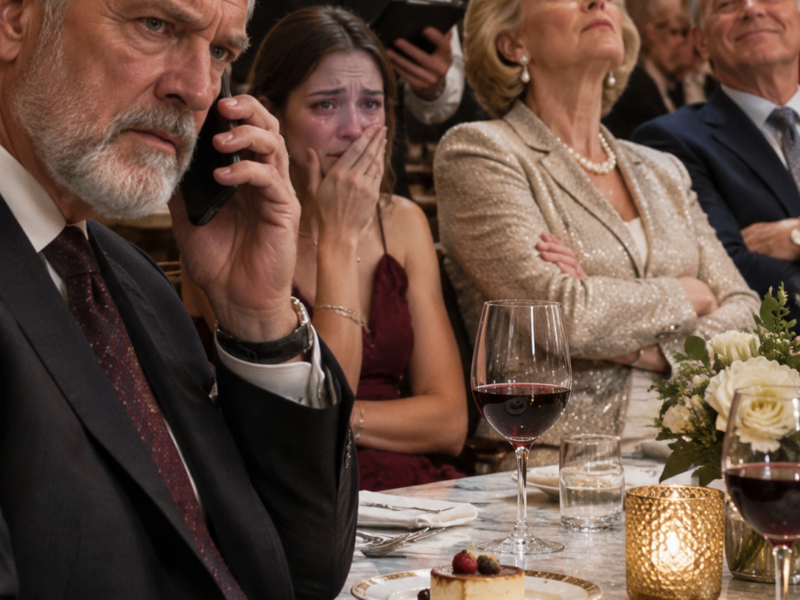
“Separate his check. We’re not paying for him.”
Those were the words my future son-in-law spoke to a waiter in one of the most expensive steakhouses in Dallas, while his wealthy parents sat beside him, looking at me as though I were an unwanted stranger who had somehow wandered into their private celebration.
He didn’t even have the courtesy to look me in the eye.
Instead, he pointed his fork in my direction, smiled, and continued cutting into a steak that cost more than some families spent on groceries in a week.
My daughter sat next to him.
And she nodded.
That was the part I would remember long after the expensive dinner, the humiliation, the lawsuits, and the astonishing events that followed. Not the arrogance of the young man who believed money made him superior. Not the contempt of his parents, who owned companies worth millions. It was that small, almost invisible nod from the little girl I had raised, protected, and loved for thirty-four years.
My wife, Beverly, stopped eating.
I gently touched her wrist beneath the table.
“Keep eating, Bev,” I whispered. “It’s good steak.”
Nobody at that table knew what I knew.
Nobody suspected that the supposedly poor old feed-store owner sitting across from them controlled the day-to-day operations of the land beneath their most valuable distribution center.
And nobody realized that their family business owed that land partnership more than $700,000 in unpaid rent.
My name is Norman Haskell. I was sixty-seven years old that October evening, and for thirty-eight years, I had owned a feed-and-seed store in McGregor, Texas.
I sold chicken feed, fence posts, ranch supplies, and hardware. I wore ordinary work clothes, drove a 2009 Buick LaCrosse, and lived with my wife in a white farmhouse on Old Moody Road.
To people who judged success by luxury cars and expensive suits, I looked like a man who had accomplished very little.
I never bothered correcting them.
But on that particular Saturday night, the people who had spent two hours laughing at my modest life were about to discover something that would turn their entire world upside down.
It began with a text message from my daughter, Meredith.
“Dinner at seven, Dad. Please dress nicely. And maybe don’t wear the bolo tie.”
I smiled when I read it.
Meredith had been particular about appearances ever since she started working in Dallas. She was thirty-four, divorced, and raising my twelve-year-old grandson, Wyatt. A year earlier, she had met Logan Whitmore, a handsome vice president at his father’s freight company.
They were getting married in seven weeks.
My wife and I had already contributed $85,000 toward the wedding, money we had saved and invested carefully over many years. We believed we were helping our daughter begin a happier chapter of her life.
What we didn’t know was that the Whitmore family had very different plans.
That evening, I wore my navy suit, the same one I had worn to Beverly’s mother’s funeral years earlier. Beverly put on her favorite blue dress and the pearls her father had given her.
We drove north toward Dallas in my Buick.
When we arrived at the restaurant on McKinney Avenue, the valet looked at my car with an expression normally reserved for an abandoned refrigerator.
I handed him twenty dollars.
“Take good care of her,” I said. “She’s gotten me everywhere I needed to go.”
He managed a polite smile.
Inside, the restaurant was magnificent. Crystal chandeliers hung over polished tables. Waiters moved silently across thick carpeting. Wealthy customers spoke softly while examining wine lists that probably contained bottles worth more than my first pickup truck.
The Whitmores were already seated beneath a chandelier in the center of the dining room.
Conrad Whitmore, sixty-four, was the founder and chief executive of Whitmore Freight and Logistics. His company operated trucking terminals and warehouses across four states.
His wife, Celeste, owned a luxury interior-design firm serving wealthy families in Dallas and Aspen.
They lived behind iron gates in Highland Park.
Their son, Logan, was thirty-six, handsome, polished, and endlessly impressed with himself.
Conrad offered me a brief handshake.
Celeste extended two fingers toward Beverly without standing.
Logan greeted us with a smile that suggested he was disappointed we had actually come.
For the first hour, I listened.
Conrad discussed fuel prices, trucks, and expansion plans. Celeste described a multimillion-dollar home she was decorating in Aspen.
They spoke constantly about their achievements.
Not once did either ask Beverly about her life.
Eventually, Celeste turned toward her.
“So, Beverly, what exactly does Norman do?”
“Feed and seed,” Beverly answered pleasantly. “Hardware, ranch supplies. We ran the store for thirty-eight years.”
Celeste gave a little smile.
“How charming.”
Logan laughed.
“Like one of those old-fashioned country stores in the movies?”
“Something like that,” I replied.
“You still run it?”
“Sold it in 2021.”
“To what?” Logan asked. “A bigger feed store?”
Conrad laughed.
Celeste joined him.
And Meredith, my own daughter, covered her mouth and laughed too.
I looked at her for a moment before returning my attention to the menu.
Most people mistake silence for weakness.
But running a business in a small Texas town teaches you something important: you learn more about people by listening to what they say than by telling them what they ought to think.
When the waiter arrived, Conrad ordered a massive dry-aged ribeye and an expensive bottle of Cabernet.
Logan chose Wagyu filet and a seafood tower.
Celeste ordered Dover sole.
Meredith selected an expensive steak.
Beverly examined the prices carefully before choosing the petite filet.
I ordered the same.
Our waiter was a polite young man named Raphael. He treated us with the same courtesy he showed everyone else.
I liked him immediately.
While we waited for our food, Logan leaned back in his chair.
“We should probably discuss the wedding budget.”
Celeste straightened.
“The Turtle Creek Club is the only acceptable venue.”
Logan nodded.
“We’re expecting around $240,000. Traditionally, of course, the bride’s family handles the expenses.”
Beverly placed her water glass on the table.
“We’ve already given Meredith eighty-five thousand dollars.”
Logan looked startled.
“Eighty-five thousand?”
“Yes.”
He glanced at his mother.
“That won’t even cover the flowers and arrangements.”
Meredith shifted uncomfortably.
“Logan, I told you about the money.”
“You said your parents had savings.”
Then he turned toward me.
“Look, Mr. Haskell, I don’t want to embarrass you. Not everyone can afford to celebrate properly. My parents can handle the difference. We just need to make sure you won’t create an awkward situation.”
Celeste smiled.
“And naturally, if we’re paying, we’ll control the guest list.”
I set down my glass.
“Logan, I don’t make scenes.”
“Good,” he replied.
Conrad laughed heartily.
“Norman, I like you. You know your place.”
Beverly’s knee pressed gently against mine.
I said nothing.
The evening continued.
Wine flowed. Logan drank generously. His parents grew more comfortable making jokes at my expense.
They mocked my hometown, my feed store, and eventually my Buick.
“You’re still driving the same car Meredith rode in during college?” Logan asked.
“It runs.”
He shook his head.
“That’s the thing about people like you. Everything just runs. Nothing ever improves.”
I glanced at Meredith.
She was looking at her plate.
When Raphael returned to ask about dessert, Logan waved him away.
Then he called him back.
“One more thing. When you bring the check, separate his bill. We’re not paying for him.”
The table fell silent.
Raphael looked embarrassed.
My wife froze.
And Meredith nodded.
A small, obedient gesture.
But it struck me harder than anything Logan had said.
I remembered Meredith at six years old, learning to ride her bicycle behind our feed store. I remembered carrying her on my shoulders through the Heart of Texas Fair. I remembered helping her pack for college and holding her while she cried after her divorce.
And now she was silently agreeing that her father should be humiliated at a dinner she had invited him to attend.
I put my hand over Beverly’s wrist.
“Keep eating,” I whispered.
She looked at me, then picked up her fork.
When the checks arrived, Raphael placed one folder before Conrad and another before me.
Mine totaled a little more than two hundred dollars.
I opened my wallet and placed three hundred dollars inside.
Then I looked directly at Conrad.
“That’s perfectly fine. I’ll pay for Beverly and myself. And Conrad, you can put whatever you were going to spend on our dinner toward the seven hundred thousand dollars your company owes me in overdue rent on the Hewitt distribution hub.”
Conrad’s gold pen stopped moving.
For several seconds, nobody spoke.
Then the color drained from his face.
Celeste slowly lowered her wineglass.
Logan’s smile disappeared.
Meredith stared at me.
“Dad, what are you talking about?”
I turned toward Raphael.
“Keep the change, son. You did a fine job tonight.”
He thanked me and quietly withdrew.
Then I explained.
“The Hewitt Hub sits on approximately one hundred and forty acres near Interstate 35. Whitmore Freight has leased that land from Bosque Land Partners since 2011. Annual rent is $1.4 million, payable quarterly.”
Conrad stared at me.
“Your July payment bounced,” I continued. “Your October payment never arrived. You’re in default under a ninety-nine-year ground lease.”
Conrad swallowed.
“That’s impossible. Bosque Land Partners is a private partnership in Waco.”
“Correct.”
“I’ve never met the owner.”
“No, Conrad. You never asked.”
Logan looked from his father to me.
“You’re saying you own the distribution hub?”
“I’m saying your father’s company has been sending rent payments to the land partnership I operate for fourteen years.”
Conrad gripped the table.
“Norman, perhaps we should discuss business privately.”
I nodded.
“That’s what lawyers are for.”
Then I stood, pulled out Beverly’s chair, and escorted my wife out of the restaurant.
We didn’t look back.
The drive home was quiet until we passed the Trinity River.
Finally, Beverly spoke.
“Well, Norman. You’ve certainly done it now.”
“I know.”
“Meredith is going to be furious.”
“I know that too.”
“What are you going to do?”
I reached into my pocket and opened my old flip phone.
“Make one phone call.”
At 10:40 that Saturday night, I called Ruth Cervantes, our attorney in Waco.
Ruth had managed the legal affairs of Bosque Land Partners for twenty years.
She answered almost immediately.
“Norman? You never call this late. What’s happened?”
“Nothing terrible, Ruth. I’d like you to send the formal notice of default to Whitmore Freight on Monday morning.”
She paused.
“The full notice?”
“Yes.”
“Thirty days to cure the default, or we move to terminate the lease?”
“Exactly.”
“Norman, you’ve been giving Conrad Whitmore time for months. What changed?”
I looked through the windshield at the dark highway.
“I met his son.”
The following morning, Meredith called at seven.
She didn’t say hello.
“Dad, is it true?”
“Is what true, honey?”
“Don’t do that calm thing. Logan says you control the land under his father’s distribution center.”
“I manage the partnership’s operations.”
“How much is it worth?”
I hesitated.
That question hurt more than I expected.
Not because my daughter wanted to understand the family finances, but because it was the first thing she asked after what happened at dinner.
“Meredith, we can discuss money later.”
“No. We can discuss it now.”
She began recounting every financial struggle of her adult life.
The student loans. The apartment after her divorce. The old Corolla without air conditioning. The years spent raising Wyatt while working.
“You let me struggle when you were rich?”
“Your mother and I helped you when you needed help.”
“You let me believe we barely had anything!”
“We never said that. We said we didn’t spend extravagantly.”
She laughed bitterly.
“That’s the same thing.”
Beverly took the telephone from my hand.
“Meredith, before we discuss our finances, I want to ask you something. Why did you nod when Logan humiliated your father?”
There was a long silence.
Then Meredith admitted Logan had told her that embarrassing us would encourage his parents to pay for the wedding.
“He said he was doing Dad a favor.”
Beverly closed her eyes.
“Honey, a man who humiliates your father isn’t doing him a favor.”
Meredith became angry again.
“You’ve hidden money from me my whole life.”
Then she hung up.
For several minutes, Beverly and I sat in silence.
Finally, she looked at me.
“We should have told her, Norman.”
“We planned to when she turned thirty-five.”
“That’s only six weeks away.”
“I know.”
“She learned about it from Logan first.”
That was the part that worried both of us.
Because Logan had already begun teaching our daughter what to think.
By Monday morning, Ruth had delivered the default notice.
Whitmore Freight owed $733,500, including late charges and interest, with a deadline of November nineteenth.
The distribution center itself had cost approximately forty-eight million dollars to construct.
Under the lease, failure to cure a default could result in the partnership recovering the land and its permanent improvements.
Ruth called after the documents were delivered.
“Norman, something is seriously wrong with Whitmore Freight. Nobody risks a facility worth forty-eight million dollars over unpaid rent unless their financial problems are far worse than they’re admitting.”
I already suspected she was right.
Three days later, Conrad appeared at our farmhouse.
He arrived in a black Mercedes with Logan sitting beside him.
I watched them climb out onto the gravel.
Conrad carried an envelope.
Logan looked around our property with an expression I recognized immediately.
He was evaluating it.
Measuring the house, the trees, and the pasture as if deciding what they might be worth.
Conrad placed the envelope on our porch table.
“Three hundred and fifty thousand dollars,” he announced. “The July payment. Banking error.”
I didn’t touch the envelope.
“Your company lost a major grocery contract in May. Your bonds were downgraded in June. And your bank refinancing is due in December.”
Conrad’s expression hardened.
“Who told you that?”
“Feed-store owners read newspapers, Conrad.”
He leaned forward.
“We’ll have the remainder soon. Meanwhile, I expect you to cooperate with our bank when they request confirmation that the lease is in good standing.”
“I’ll sign a truthful document.”
“Norman—”
“Your company is in default. I’m not going to tell a bank otherwise.”
Conrad stood.
Then his tone changed.
“The Hewitt Hub employs four hundred and twelve people. If you terminate the lease, those families lose their jobs right before Christmas.”
I nodded.
“I know how many people work there.”
“And I’ll make sure every one of them knows who caused it.”
He walked toward his Mercedes.
At the bottom of the steps, Logan turned around.
“Nice place, Norman. Be a shame if something happened to it.”
The next morning, someone cut four strands of barbed wire on our south pasture.
Forty cattle escaped onto Old Moody Road.
It took three hours to gather them.
The sheriff’s deputy photographed the clean cuts and asked whether anyone had threatened me.
I told him exactly what Logan had said.
We never proved who damaged the fence.
But I installed cameras and began checking the property every morning.
Then the newspaper attacks started.
The Waco Tribune-Herald ran a front-page story claiming a wealthy landlord was threatening hundreds of local jobs over a minor payment dispute.
Whitmore Freight portrayed itself as a struggling family business.
I was portrayed as a greedy millionaire.
People I had known for decades stopped speaking to me.
At church, old friends walked past without greeting us.
At the Dairy Queen, where I had shared morning coffee with local ranchers for nearly thirty years, nobody made room at the usual table.
One man whose daughter worked at the hub asked whether I understood what I was doing.
“I’m collecting unpaid rent,” I told him.
“From the company paying my daughter’s salary!”
“She deserves to work for a company that pays its obligations.”
He shook his head.
I drank my coffee alone in the parking lot.
A few days later, Meredith posted a long message on Facebook.
She accused Beverly and me of hiding wealth to control her.
She claimed I was threatening the livelihoods of four hundred families out of pride.
She wrote that she was ashamed of me.
Celeste Whitmore shared it immediately.
The post attracted hundreds of comments.
Beverly read some of them at our kitchen table until she couldn’t continue.
That evening, I found her crying on the porch swing her father had installed decades earlier.
“Norman,” she whispered, “do you think we were wrong?”
I sat beside her.
“About what?”
“Raising Meredith the way we did. Keeping our money private.”
I looked toward the old windmill.
Beverly’s father, Otto Vana, had left her approximately eleven hundred acres when he died.
He had worked that land for most of his life, growing cotton and raising livestock.
He left us one piece of advice that I never forgot.
Don’t let money make you foolish.
We had obeyed him.
We kept the farmhouse, drove ordinary cars, and lived much as we had before the land became valuable.
I continued working at the feed store until I retired.
We invested the income and supported local charities without publicity.
But we had also concealed too much from our daughter.
“We weren’t pretending to be poor,” I told Beverly. “We were living the way we wanted.”
She wiped her eyes.
“Maybe. But we should have explained the difference.”
I couldn’t argue with her.
The situation deteriorated when Logan posted a video from the Hewitt Hub.
Wearing a ridiculous straw hat, he imitated my Texas accent and portrayed me as an ignorant, greedy farmer who wanted workers to lose their jobs.
Thousands watched.
Some laughed.
Others didn’t.
The following day, Wyatt got into a fight at school after a classmate mocked me using Logan’s video.
Meredith called in tears.
“Your grandson has been suspended because of you!”
“Why did he hit the boy?”
“Because the boy was making fun of you!”
“Using Logan’s video?”
She hesitated.
“Yes.”
I lowered my voice.
“Meredith, your fiancé publicly mocked your father, and your twelve-year-old son was the only one who defended me. Think about that.”
She ended the call.
That night, Wyatt secretly telephoned me.
“Grandpa, I’m sorry I hit Colton.”
“I’m sorry too, buddy. Hitting people isn’t the answer.”
“I know.”
“But standing up for someone matters. Next time, use your words.”
“What should I say?”
I thought for a moment.
“Tell him your grandpa paid for his own steak.”
Wyatt burst out laughing.
“That’s weird, Grandpa.”
“Sometimes weird works.”
Then his voice became serious.
“Grandpa, you’re not really trying to close the hub, are you?”
“No, Wyatt. I’m trying to make sure the people working there have a future.”
At the time, I didn’t realize how important that promise would become.
Everything changed when I met Rosario Delgado in a grocery-store parking lot.
She was a shift supervisor at the Hewitt Hub.
Her husband worked there too.
They had a mortgage, children, and twelve years of service with Whitmore Freight.
She approached me beside the shopping carts, her young daughter holding her hand.
“Mr. Haskell, please don’t shut down our jobs.”
Tears filled her eyes.
“If the hub closes, we’ll lose everything.”
I set down my grocery bags.
“Mrs. Delgado, I want you to listen carefully. I have no intention of letting that building go dark.”
She stared.
“How can you promise that?”
“Because even if Whitmore loses the lease, somebody else can operate the facility. And whoever takes it over will need experienced workers.”
She told me management had claimed I wanted to bulldoze the hub and sell the land to developers.
I shook my head.
“I’ve refused offers to develop that property before. Beverly’s father farmed it, and I intend to keep it productive.”
I wrote my telephone number on a receipt and handed it to her.
“Call me if anyone tells you otherwise.”
Later that evening, Ruth discovered something disturbing.
A company controlled by Celeste Whitmore had requested a title search on Bosque Land Partners in January.
Seventeen days later, Logan proposed to Meredith in Cabo.
Beverly stared at me when I explained.
“Are you saying he proposed because of the land?”
“I’m saying his mother investigated the land before he proposed.”
“Does Meredith know?”
“No.”
“Will she believe us?”
I shook my head.
“Not yet.”
The next major confrontation happened at our kitchen table.
Meredith arrived with Logan and a financial adviser named Kip Lavelle.
Kip wore expensive sneakers, carried a metal business card, and spoke as though everything he said ought to be accepted without question.
Meredith explained that she wanted information about her inheritance.
On her thirty-fifth birthday, December third, she would receive a ten-percent limited partnership interest in Bosque Land Partners.
That meant a share of the income generated by the land.
Logan announced that the partnership’s property had recently been appraised at approximately forty-one million dollars.
Meredith looked devastated.
“Four million dollars,” she whispered. “You let me sleep on a mattress on the floor after my divorce while I was going to inherit four million dollars.”
Beverly quietly reminded her that we had paid six months of rent, helped with the townhouse down payment, and secretly paid off part of her student loans.
Meredith stared at her mother.
“What student loans?”
“The remaining balance in 2019. We paid it.”
For a moment, I saw my daughter struggling to absorb the information.
Then Logan placed his hand on her shoulder.
“See? They decided what you were allowed to know. That’s control.”
Kip leaned forward.
He suggested that because of my age and the public controversy, I should give Meredith durable power of attorney to manage the partnership.
That way, he explained, she could resolve the dispute with Whitmore Freight.
I looked directly at Logan.
“Would your father’s company benefit if Meredith controlled my business decisions?”
Logan smiled.
“Everyone would benefit from reasonable management.”
After they left, Beverly stood at the kitchen sink without speaking.
Before departing, Meredith had announced she would not bring Wyatt for Thanksgiving unless I ended the dispute.
It was the first time our grandson had been used as leverage against us.
Beverly’s hands trembled.
“She used the boy, Norman.”
“I know.”
That was when I decided we needed to understand exactly what the Whitmores were trying to accomplish.
I went to Ruth’s office and asked her to explain every document in the partnership.
She spread the papers across a large conference table.
The crucial document was the 2011 management agreement.
It named me operations manager and authorized me to collect rent, deal with tenants, arrange repairs, and handle routine business.
But it did not authorize me to amend a major lease, forgive unpaid rent, or certify to a lender that a tenant was not in default.
Those decisions belonged exclusively to the general partner.
“Even if Meredith has your power of attorney,” Ruth explained, “she cannot exercise powers you never possessed.”
I looked at her.
“And if she signs documents claiming otherwise?”
Ruth’s expression became grave.
“If knowingly false documents are submitted to a bank to obtain financing, that could trigger a serious fraud investigation.”
I felt cold.
My daughter was being guided toward something dangerous.
And the people guiding her had no intention of putting their own signatures on those papers.
I wanted to warn her immediately.
But I knew she wouldn’t listen.
Then we learned that Kip Lavelle wasn’t an independent family adviser.
His restructuring firm had been retained by Whitmore Freight months earlier.
He was working for the very company that owed us rent.
I called Meredith.
“Honey, Kip has a conflict of interest. He works for Conrad.”
“I know, Dad.”
“You know?”
“Logan told me. Kip is helping the whole family.”
“Meredith, his client owes your family’s partnership hundreds of thousands of dollars.”
She sighed.
“Dad, you’re the only person who keeps insisting we’re on different sides.”
I sat in silence.
There are moments when a parent realizes love cannot force an adult child to recognize danger.
That was one of them.
A few days later, Beverly and I made a difficult decision.
We would allow the Whitmores to reveal exactly what they intended.
I called Meredith and agreed to sign a carefully reviewed power of attorney.
The following Saturday, she arrived with Logan, Kip, and a notary.
I read every page before signing.
The document appeared broad enough to satisfy them.
Meredith hugged me.
“Thank you, Dad. I’ll take care of everything.”
Over her shoulder, I watched Logan exchange a triumphant glance with Kip.
They believed they had won.
What they didn’t understand was that they had never bothered to identify the actual general partner.
And Beverly, the quiet woman they dismissed as somebody’s wife, had listened to every word.
The November nineteenth deadline passed without full payment.
Whitmore Freight attempted to delay termination through a lawsuit based on an alleged verbal agreement that I had supposedly made in March 2023.
Ruth found hospital records proving I had been recovering from emergency surgery during the alleged period.
The lease also required written amendments.
The judge denied their emergency request.
Outside the courthouse, Logan approached me.
“Enjoy your little victory, Norman. Tomorrow it won’t matter.”
He smiled.
I knew exactly what he meant.
The next day, Meredith used my power of attorney to sign a lease amendment reducing Whitmore Freight’s annual rent and supposedly waiving the unpaid balance.
She also signed an estoppel certificate asserting that no default existed.
Those documents were submitted to First Lone Star Bank as part of Whitmore Freight’s $62 million refinancing.
But the bank’s relationship manager, Dexter Vale, called Ruth to verify them.
She told him they were invalid and explained that the true general partner had never approved them.
Soon afterward, Dexter agreed to meet us privately.
Meanwhile, Meredith withdrew $38,000 from my personal checking account using the power of attorney.
She claimed it was for wedding expenses.
She also attempted to transfer control of the college savings account Beverly and I had established for Wyatt.
The account contained more than $186,000.
Fortunately, our bank manager, Patrice Lindell, refused to change its ownership without direct verification.
When Patrice called me, I instructed her to protect Wyatt’s education money.
The thirty-eight thousand dollars was already gone.
It hurt to discover what Meredith had done.
Not because of the amount.
Because she had used my trust to take money without asking.
The following week, Beverly made a move I didn’t expect.
She drove to Dallas alone.
Later that day, Wyatt secretly texted me that his grandmother had visited Celeste’s office and signed something in front of Logan and Kip.
Meredith confirmed it that evening.
“Mom signed the spousal acknowledgment for the lease amendment,” her message said. “Even she agrees it’s the right thing.”
When Beverly returned home, I asked what she had signed.
She looked me directly in the eyes.
“Norman, I need you to trust me.”
“We’ve been married forty-one years.”
“I know exactly how long we’ve been married.”
“Then tell me what happened.”
“Not yet.”
She packed a bag and went to stay with her sister Doris for Thanksgiving.
I watched her drive away, feeling more alone than I had in decades.
Then I discovered a receipt in one of the shopping bags she had left behind.
A small digital voice recorder.
Paid for in cash.
For the first time that week, I slept properly.
I had a feeling my wife knew exactly what she was doing.
Still, Thanksgiving was miserable.
Wyatt wasn’t there.
Meredith wasn’t there.
Beverly was staying with her sister.
I sat at our kitchen table, staring at an unopened can of soup, remembering forty-one years of family holidays.
Then, shortly after noon, a truck came up our gravel drive.
Rosario Delgado climbed out with her husband and children.
They carried turkey, rice, beans, mole, and homemade tamales.
“We heard you were alone,” Rosario said. “My mother-in-law wouldn’t let us eat until we brought you dinner.”
I couldn’t speak.
They came inside, and for two hours our old farmhouse was filled with laughter again.
During the meal, Rosario’s husband mentioned a rumor.
Whitmore Freight intended to sell the business after refinancing, and the buyer might close the Hewitt Hub and move its operations to Oklahoma.
The rumor troubled me.
If it was true, Conrad was using his employees as human shields while preparing to eliminate their jobs anyway.
That evening, Meredith called.
She was at Thanksgiving dinner with the Whitmores.
Her voice sounded unsteady.
“Dad, Celeste made a toast.”
“What did she say?”
“She toasted Grandpa Otto’s land and the family it would build.”
I waited.
“Everyone laughed about how you finally learned to share.”
“Did you laugh?”
“No.”
“Why not?”
She was quiet.
“Because it’s not their land, Dad. They talk about it like they already own it.”
For the first time in weeks, I heard my real daughter beneath the influence of Logan’s carefully chosen words.
Before hanging up, she asked whether Wyatt’s quilt was still on his bed.
“Every night,” I promised.
That quilt had been made by Beverly’s mother years earlier.
When Meredith had taken Wyatt’s belongings from our farmhouse, the boy had begged me to leave it on his bed.
“I’ll come back, Grandpa,” he’d whispered.
We had kept it there.
I intended to keep my promise.
Beverly returned on November thirtieth.
She placed a small black voice recorder on the kitchen table.
“I’m sorry I didn’t tell you, Norman.”
Then she pressed play.
Celeste’s voice filled our kitchen.
She was explaining to Beverly that the spousal acknowledgment was merely a formality.
Logan laughed and suggested Beverly didn’t need to read anything.
Kip assured them the bank would not look too closely at the documentation.
Beverly had recorded forty-four minutes of their conversation.
She had signed only in the limited capacity they had requested, as Norman’s spouse.
Nothing more.
And because they dismissed her as harmless, they had spoken with extraordinary carelessness.
I stared at my wife.
“Bev, you’re something else.”
She smiled faintly.
“Norman, they’ve spent weeks treating me as though I don’t count. I thought it was time to let them continue believing that.”
I took her hand.
For forty-one years, I had known Beverly was the smartest person in our marriage.
The Whitmores were about to discover why.
On December third, Meredith turned thirty-five.
Her ten-percent partnership interest vested.
Ruth gave her the appropriate documents and a distribution check.
Logan immediately demanded to know the partnership’s true value and who controlled it.
Ruth answered only what the documents required.
The general partner was Verona Family Management.
Logan assumed that company belonged to me.
He never investigated further.
That same afternoon, Dexter Vale brought us the evidence we needed.
Inside Whitmore Freight’s refinancing file was a letter of intent from Ridgeline Capital Partners, a New York investment firm.
It proposed acquiring Whitmore Freight for approximately $185 million.
The transaction depended on successful refinancing and a reduced rent agreement at the Hewitt Hub.
But the most damning part was the operational plan.
Within eighteen months of the acquisition, Ridgeline intended to consolidate the Hewitt operations into Oklahoma.
More than four hundred local jobs would disappear.
Logan had acknowledged receiving the plan.
The truth was worse than I had imagined.
Conrad and Logan weren’t trying to save their workers.
They were trying to increase the company’s sale value, collect an enormous payout, and leave someone else to announce the layoffs.
Every frightening warning they had issued to employees was a calculated manipulation.
And Meredith had unknowingly signed documents intended to support the scheme.
That evening, I called Dolores Rangel, chief operating officer of Brazos Valley Grocers.
Her father had been a longtime customer at my feed store.
Brazos Valley needed a larger distribution center, and Dolores had admired the Hewitt facility for years.
We had already discussed a possible agreement if the property became available.
Now she brought her logistics director to our farmhouse and laid out a detailed transition plan.
They would hire every current hourly employee willing to stay.
Current wages or better.
Health insurance.
No interruption to operations if the legal transition could be completed.
Rosario Delgado would become a supervisor under the new operation.
The plan gave me something I hadn’t had since the nightmare began.
A way to protect the land and the workers at the same time.
On December fourth, Ruth delivered the termination notice after the uncured default.
Whitmore Freight disputed its validity, relying on the documents Meredith had signed.
But the bank had already been notified of the serious problems, and our lawyers were prepared.
The following evening was Logan and Meredith’s rehearsal dinner.
One hundred and twenty guests gathered at the Turtle Creek Club in Dallas.
Beverly wore her blue dress and her father’s pearls.
I wore my old navy suit.
We drove in the Buick.
Ruth followed in her Honda and waited in the lobby with a briefcase.
The Whitmores seated us at table twelve, near the kitchen doors.
It was clearly intended as an insult.
I didn’t mind.
Dexter Vale, the banker, was seated nearby.
At seven twenty, Wyatt left the children’s table and came straight to Beverly.
“Grandpa said I could sit with you.”
Beverly pulled out a chair.
He settled between us, looking relieved.
Across the room, Meredith watched.
Her expression was difficult to read.
The meal was expensive, elaborate, and unnecessarily complicated.
There were several courses, fine wines, and desserts decorated with gold leaf.
Afterward, Conrad stood to give a toast.
He praised his company, his family, and his future daughter-in-law.
Then he thanked Meredith for supposedly bringing her stubborn father to his senses.
The room applauded.
Meredith looked down.
Logan stood next.
He had been drinking whiskey throughout the evening.
He thanked his parents and his bride.
Then he turned toward our table.
“And to Norman, who came all the way from McGregor. I know we’ve had our differences, but I’m glad you finally learned your place.”
Some guests laughed.
Others looked uncomfortable.
I raised my water glass.
“Congratulations, Logan.”
I sat quietly.
The Whitmores thought the evening had gone exactly as planned.
Then, shortly after nine, the club’s general manager approached Conrad.
He whispered something.
Conrad handed him a credit card.
The manager disappeared.
Two minutes later, he returned.
Conrad’s face turned red.
Logan spoke loudly enough for nearby guests to hear.
“What do you mean the card was declined?”
The general manager maintained his professional composure.
“Mr. Whitmore, your club account is more than ninety days overdue. Your charging privileges are suspended, and the corporate card has been declined twice. Tonight’s event totals forty-seven thousand eight hundred dollars.”
The room became silent.
Celeste covered her mouth.
Conrad stared at the table.
Logan looked around, searching for someone to blame.
Then he spotted me.
“Fine! Let the rich farmer pay!”
He pointed across the ballroom.
“Give Norman the bill. He’s been telling everyone how much land he owns. Let’s see him pull out his wallet!”
A hundred and twenty faces turned in my direction.
Beverly touched my knee.
I stood.
So did she.
Wyatt rose beside her.
I walked slowly across the ballroom and handed the manager my ordinary blue credit card.
“Please put the entire evening on this. And add twenty percent for the staff.”
The manager nodded.
Nobody spoke while he processed the payment.
When he returned, I signed the receipt.
Fifty-seven thousand three hundred and sixty dollars.
Then I turned toward Conrad.
“Happy to help, Conrad. Consider it the last money you’ll receive from me on account of the Hewitt Hub.”
Conrad’s expression changed.
“What does that mean?”
“It means your lease was terminated yesterday morning. The ground and permanent improvements have reverted to Bosque Land Partners under the agreement.”
Logan jumped to his feet.
“That’s impossible! Meredith signed the amendment! She signed the estoppel! She has your power of attorney!”
“Yes,” I replied. “She does.”
“Then the lease is valid!”
“No, Logan. My power of attorney lets Meredith do what I could legally do. I could never amend that lease or waive the default without the general partner’s approval.”
He stared.
“What are you talking about?”
“The authority didn’t belong to me.”
Logan laughed nervously.
“Then who? You’re the manager!”
“Operations manager.”
“Same thing!”
“Not remotely.”
At that moment, Dexter Vale stood.
He introduced himself to the room as the banker responsible for Whitmore Freight’s refinancing.
He explained that the bank had reviewed the purported amendment, the estoppel certificate, and the partnership documents.
The bank would not proceed with the $62 million refinancing.
He also stated that the questionable documents were being referred for further investigation.
Conrad slowly sat down.
For the first time all evening, Logan seemed to have nothing to say.
Celeste stood.
“This is ridiculous! Norman manages everything! His name is on every receipt! His wife signed the acknowledgment herself!”
She turned toward Beverly.
“Beverly, tell them!”
My wife stepped forward.
She was five feet three inches tall, wearing sensible shoes, a blue dress, and her father’s pearls.
She looked almost delicate beneath the enormous chandelier.
But when she spoke, her voice carried across the room.
“Yes, Celeste. I signed the paper you asked me to sign. You told me to sign it as Norman’s wife. You called it a formality.”
She opened her purse.
“There’s something you should know.”
She removed a folded document.
“My father was Otto Vana. He farmed that land, just as his father had before him. When he died, he left the property to me.”
Celeste stared.
“Your father?”
“Yes. In 1999, our family established Bosque Land Partners. Verona Family Management became its general partner.”
Beverly unfolded the document.
“My father named me the sole manager of Verona Family Management for life.”
The room was completely silent.
“I am the person who controls the general partner,” Beverly continued. “Norman handles operations because I asked him to. He collects rent, manages tenants, and maintains the property. But he cannot amend our major leases without my authorization.”
She looked directly at Celeste.
“And neither can our daughter.”
Conrad’s hands covered his face.
Logan stared at Beverly as if he had never seen her before.
“You’re the general partner?”
“Yes, Logan.”
She paused.
“I’m the woman you said didn’t count.”
His face drained.
Beverly reached into her purse again and removed the voice recorder.
Then she played part of the conversation from Celeste’s office.
Celeste’s voice described the document as a harmless formality.
Logan could be heard laughing about Beverly’s supposed inability to understand it.
Kip’s voice suggested the bank would not inspect the documents too closely.
Beverly stopped the recording.
“I have forty-four minutes. There are several preserved copies.”
Meredith stood behind the head table, pale and trembling.
“Mom,” she whispered. “Are you saying the documents I signed were invalid?”
“Yes, sweetheart.”
“But Kip said—”
“I know what Kip told you. He had every reason to know the limits of your father’s authority.”
Meredith turned toward Logan.
He opened his mouth.
“Babe, don’t listen to them—”
“Did you know?”
“Meredith—”
“Did you know I was signing documents I had no authority to sign?”
He said nothing.
Then she asked another question.
“When did your mother order the title search on my grandfather’s land?”
Logan froze.
Meredith continued.
“January fourteenth. You proposed to me on January thirty-first. Seventeen days later.”
“That’s a coincidence.”
“Is it?”
He glanced at Celeste.
For the first time, Meredith saw the answer in his silence.
“You knew my family had valuable land before you proposed.”
“Babe, you’re overreacting.”
“You told me my parents were controlling. You convinced me they had lied to me. You encouraged me to take their money and sign those documents.”
Logan reached for her arm.
“Sit down. You’re making a scene.”
She pulled away.
Then she slowly removed her engagement ring.
It was a large diamond, the kind that made strangers stop and stare.
She placed it on the white tablecloth beside his whiskey glass.
“No, Logan. The scene was seven weeks ago, when you humiliated my father and I helped you do it.”
He stared at the ring.
“Meredith, don’t be ridiculous.”
She shook her head.
“I wasn’t your future wife. I was your way into my family’s money.”
Then my daughter walked away from him.
Across the ballroom.
Past the expensive flowers, abandoned champagne glasses, and shocked guests.
Straight toward Beverly.
“Mom,” she whispered, “I’m so sorry.”
Beverly opened her arms.
Meredith collapsed against her shoulder and began crying.
Wyatt wrapped his arms around them both.
I stood beside them, trying to see clearly through eyes that had suddenly become rather unreliable.
But the evening wasn’t finished.
Dexter Vale had one final revelation.
He produced the Ridgeline Capital letter showing the proposed $185 million purchase of Whitmore Freight.
Then he explained the plan to eliminate the Hewitt Hub within eighteen months.
A company executive stood from his table.
“Conrad, is that true? You were going to close the hub after telling the workers you were fighting for them?”
Conrad couldn’t answer.
The room erupted in angry whispers.
Several employees began demanding explanations.
Then Ruth entered from the lobby.
She walked to the front of the room and calmly announced that Bosque Land Partners had arranged a transition to Brazos Valley Grocers, subject to the appropriate legal procedures.
The new operator had committed to retaining the facility’s current hourly employees at existing wages or better.
The hub would continue operating.
The people Conrad had used as leverage would not be abandoned.
Conrad finally raised his head.
“Norman, why didn’t you tell me who you were at that first dinner?”
I looked at him.
“I told you exactly who I was. A man who sold feed for thirty-eight years and manages his wife’s land. You just decided that wasn’t worth knowing anything more about.”
He glanced toward Beverly.
Then he lowered his eyes.
“Mrs. Haskell, I’m sorry.”
Beverly nodded.
“I accept your apology, Conrad.”
She paused.
“But you’re still not getting the hub back.”
We left shortly afterward.
Outside, Logan caught up with us near the valet station.
His tie was loose.
He still had a whiskey glass in one hand.
“You set me up!” he shouted. “You and that old woman!”
I faced him calmly.
“No, Logan. You set yourself up. We simply didn’t stop you.”
He turned toward Meredith.
“Get in my car.”
She didn’t move.
“Meredith, I’m not asking twice.”
She put on her coat.
“Good. Because I’m not answering twice.”
My Buick arrived.
I tipped the valet.
And Meredith opened the passenger door of my old car and climbed inside.
As we drove away, I saw Logan standing beneath the white columns of the private club.
For the first time since I had met him, nobody was standing beside him.
Meredith remained silent for almost forty miles.
Finally, near Hillsboro, she spoke.
“Dad, I keep thinking about that night at the steakhouse.”
I waited.
“When Logan told the waiter to separate your check, I nodded.”
“I remember.”
“I’ve hated myself for it.”
I looked at her briefly.
“Then think about what you did tonight instead.”
“What did I do?”
“You walked away from someone who was hurting you. That’s harder than it sounds.”
She began crying again.
Then she confessed everything.
The documents.
The $38,000 withdrawal.
Her attempt to take control of Wyatt’s college account.
How Logan had convinced her she was entitled to the money.
How Kip had reassured her that all the documents were legal.
“Dad,” she whispered, “could I go to jail?”
I tightened my hands on the steering wheel.
“I don’t know, honey. But you’re going to tell the truth. Every detail, even the parts that make you look bad.”
She wiped her face.
“I will.”
“Then whatever happens, we’ll face it honestly.”
The wedding was canceled the following morning.
The club refunded the unused wedding deposit to Beverly and me.
Meredith learned that the Whitmores had not paid the substantial costs they had promised to cover.
Their grand wedding plans had depended on money they didn’t have and assets they didn’t own.
Over the following months, investigators reviewed the disputed bank documents.
Meredith cooperated fully, retained independent counsel, and provided her communications with Logan and Kip.
The Whitmores faced financial and legal consequences that extended far beyond the unpaid rent.
I didn’t celebrate their difficulties.
I had never wanted to destroy Conrad’s company.
I wanted him to honor the agreement he had signed and stop using innocent employees as leverage.
On December eighth, Brazos Valley Grocers began operating the Hewitt Hub under its new arrangement.
I arrived before sunrise.
Hundreds of workers gathered near the loading docks.
Dolores Rangel stood before them and explained the transition.
Every qualified employee who wanted to stay would have the opportunity to continue working.
Rosario stood near the front, wearing her new company vest.
Then Dolores introduced me.
“Some of you have heard that Norman Haskell wanted to close this facility,” she said. “I want you to know the truth. He’s one of the reasons your jobs are here today.”
I wished she’d left me out of it.
But people began turning around.
A forklift operator named Javier approached me.
He had been quoted in the newspaper criticizing my actions.
“Mr. Haskell,” he said, “I was wrong about you.”
He offered his hand.
I shook it.
Then another worker came forward.
And another.
For the next twenty minutes, I shook hands with people whose livelihoods had been used against me.
Some apologized.
Some thanked me.
Others simply nodded.
That was enough.
When the morning shift began, I stood beside Rosario and watched the forklifts move through the loading doors.
The facility was still alive.
The people were still working.
And for the first time in weeks, I felt that we had accomplished something worth the trouble.
The newspaper eventually printed the full story.
The unpaid rent.
The disputed refinancing documents.
The planned sale and proposed closure.
The new agreement that protected the workforce.
People who had avoided me at church began saying hello again.
At the Dairy Queen, the old men made room at the corner table.
Elmer Prusky looked up as I approached.
“My daughter kept her job, Norman.”
“I heard.”
He moved his chair.
“Sit down, you stubborn old fool.”
I sat.
And we drank coffee as we had for nearly thirty years.
But my family’s recovery took longer.
Meredith moved away from the Whitmores and began rebuilding her life.
There were difficult conversations with lawyers and investigators.
There were uncomfortable conversations with Beverly and me.
Trust couldn’t be repaired with one apology.
One Sunday, she sat at our kitchen table and asked why we had hidden so much about our finances.
Beverly answered first.
“We thought we were protecting you from becoming someone who expected money to solve every problem.”
Meredith looked down.
“But you also made me believe I had to face everything alone.”
I nodded.
“You’re right. We should have explained things better.”
Then I told her what we had never properly discussed.
The community-college tuition.
The divorce lawyer.
The apartment rent.
The student loans we had quietly paid.
The down payment on her townhouse.
Wyatt’s school expenses and braces.
The wedding contribution.
Altogether, we had given her nearly a quarter of a million dollars over the years.
Meredith listened without interrupting.
Finally, she looked at Beverly.
“Why didn’t you tell me?”
Beverly smiled sadly.
“We thought helping quietly was the kindest way.”
Meredith wiped her eyes.
“Sometimes people need to know they’re being helped.”
She was right.
We had been so determined not to let our daughter become dependent on money that we had failed to explain our support.
Our silence had left a space for Logan to fill with resentment.
We couldn’t change what happened.
But we could change what happened next.
Meredith found a new job in healthcare communications in Waco.
She moved closer to us and began visiting on Sundays with Wyatt.
At first, the visits were awkward.
She would hesitate before asking for something.
Beverly would ask too many questions.
I would choose my words carefully.
But slowly, our old rhythm returned.
Wyatt began spending weekends at the farmhouse again.
His quilt remained on his bed.
We went fishing.
We repaired fences.
I taught him how to read basic business contracts, explaining that a signature meant something only when the signer understood what it authorized.
He found this endlessly entertaining.
One afternoon, while we were fixing a gate, he asked whether Beverly was really more powerful than I was.
I laughed.
“Buddy, your grandma has always been more powerful than me.”
“Why didn’t anybody know?”
“Because she never needed strangers to know.”
He thought about that.
Then he grinned.
“Logan sure found out.”
I nodded.
“He certainly did.”
Beverly also began doing something she had wanted to do for years.
Using part of the partnership’s income, she helped establish educational scholarships for children whose parents worked at the distribution center.
The first scholarships went to students studying nursing, engineering, logistics, and agriculture.
She insisted the program be practical.
No expensive ceremonies.
No enormous plaques.
Just opportunities for hardworking families.
When someone suggested naming the program after her, she shook her head.
“Use my father’s name. He cared more about this land than anyone.”
And so Otto Vana’s name began helping children whose grandparents had once worked alongside him.
Months passed.
The legal matters slowly moved through the appropriate channels.
Conrad and Logan lost much of the control they had once taken for granted.
Their grand business plans unraveled.
But I stopped following every development.
Their troubles no longer belonged at our kitchen table.
Meredith’s did.
And I wanted to focus on the family we were rebuilding rather than the people who had nearly destroyed it.
The following summer, Meredith introduced us to a man named Clay.
He taught high-school history and coached girls’ basketball.
He drove an old Silverado and seemed more interested in the students he taught than the watch he wore.
The first time he visited our farmhouse, he stepped onto the porch and noticed the pecan trees.
He asked Beverly how old they were.
She told him about her father planting and caring for them.
Clay listened carefully.
Then he asked about the windmill.
And the porch swing.
And the history of the house.
He didn’t ask what our land was worth.
He didn’t ask about the partnership.
He simply asked Beverly questions because he was interested in what she had to say.
I liked him immediately.
Later, Meredith stood beside me on the porch.
“Dad, he asked Mom about the trees before he even talked to you.”
“I noticed.”
“He doesn’t know she’s the general partner.”
“I know.”
She smiled.
“That’s why you like him, isn’t it?”
“It’s a promising beginning.”
She laughed.
Then her expression softened.
“Are you ever going to forget the steakhouse?”
I looked toward the pasture.
“Honey, I’ve already forgiven you for that night. But forgetting isn’t something you can command.”
She nodded.
“I understand.”
And I believe she did.
There was a boundary between us now that had never existed before.
We loved each other.
We trusted each other more every month.
But neither of us pretended the past hadn’t happened.
Beverly and I changed our legal documents, naming each other as agents and Ruth as the alternate.
Meredith didn’t receive another power of attorney.
She asked me about it once.
“Dad, will you ever trust me with that kind of responsibility again?”
I considered the question carefully.
“Meredith, trust isn’t something I can hand you on a piece of paper. It’s something we build together, one Sunday at a time.”
She nodded.
“That’s fair.”
Then she asked me for something in return.
“If you ever need help, will you tell me? Out loud? Instead of secretly paying for things and pretending nothing happened?”
I smiled.
“I promise.”
When I needed knee surgery later that year, Meredith drove me to the hospital.
She stayed throughout the procedure, brought me home, and made soup.
It wasn’t as good as Beverly’s.
I ate every spoonful.
Then came a Sunday in October, almost exactly one year after the dinner that had changed our lives.
Meredith called.
“Dad, I’d like to take you and Mom out to dinner in Dallas.”
“That’s kind of you, honey.”
“My treat.”
“You don’t need to spend money on us.”
“I know.”
There was a smile in her voice.
“That’s the point. Wear your navy suit.”
She wouldn’t tell us the destination.
Beverly and I drove north in the Buick, which had passed two hundred thousand miles and still ran beautifully.
As we entered Dallas, Meredith gave me directions over the telephone.
When I turned onto McKinney Avenue, I recognized the street.
Beverly recognized it too.
She rested her hand on my knee.
A few minutes later, we arrived at the very same steakhouse where Logan Whitmore had once ordered the waiter to separate my check.
The valet looked at the Buick.
I handed him twenty dollars.
“Park her somewhere she can see the stars.”
He looked confused.
I laughed.
“Just take good care of her.”
Inside, Meredith was waiting with Wyatt and Clay.
She had reserved the same round table beneath the same chandelier.
And when our waiter arrived, I recognized him immediately.
Raphael.
Meredith had requested him by name.
He shook my hand.
Then Beverly’s.
When he looked at Meredith, something flickered across his face.
He remembered.
My daughter noticed.
“Raphael,” she said, “I owe you an apology.”
He looked surprised.
“A year ago, I sat at this table while my fiancé humiliated my father in front of you. I went along with it. I was wrong.”
Raphael smiled gently.
“Ma’am, you don’t owe me anything.”
Meredith shook her head.
“I do. I’m learning that you should pay what you owe.”
She opened the menu.
Then she looked at Beverly and me.
“Order whatever you like.”
I chose the petite filet.
Beverly ordered the same.
Meredith laughed.
“Dad, you can get anything!”
“I know, honey. I like the petite filet.”
Wyatt ordered a cheeseburger, even though it wasn’t listed on the menu.
Raphael promised to find one.
Clay told us about a girls’ basketball game that had gone into triple overtime.
Wyatt spent fifteen minutes explaining the difference between general and limited partners.
Clay listened attentively and asked questions.
Beverly laughed more than I had heard her laugh in years.
And Meredith watched us all with an expression I hadn’t seen in a very long time.
Peace.
When the bill arrived, Raphael placed the black leather folder in front of my daughter.
For one brief moment, I remembered Logan pointing his fork toward me.
“Separate his check.”
I remembered Beverly freezing.
I remembered my daughter nodding.
Then Meredith opened the folder.
She took out her own bank card, earned through her own job, and placed it inside.
She handed it back to Raphael.
“Please add thirty percent for yourself.”
Then she turned toward me.
“Dad, tonight I’m paying for my mother and father. And you don’t owe anybody anything.”
I tried to answer.
I couldn’t.
I removed my glasses and wiped them with my napkin.
Beverly took my hand beneath the table.
Meredith’s eyes filled with tears.
Wyatt looked around at all three of us.
“Why is everybody crying? It’s just dinner.”
Clay put a hand on his shoulder.
“Buddy, I don’t think it’s just dinner.”
Meredith laughed through her tears.
“No,” she said. “It’s not just dinner.”
She looked at the black leather folder.
“It’s the check.”
Raphael returned her card.
She signed the receipt with her own name.
Meredith A. Haskell.
I noticed her handwriting looked very much like Beverly’s.
And for some reason, that made me smile.
I’m sixty-eight now.
I still live in the white farmhouse on Old Moody Road, where the windmill turns and the old pecan trees drop their nuts on the roof of the wellhouse.
I still drive my Buick.
I still check the fences every morning.
At the Dairy Queen, there’s always a place waiting for me at the corner table.
Every month, the land partnership receives its rent from a company that pays on time.
Four hundred and twelve families still have the opportunity to earn a living at the distribution hub, and more children receive educational assistance through the scholarship program Beverly created.
Our daughter visits regularly.
Wyatt’s quilt is still on his bed.
Clay sometimes comes along, bringing stories about his students and asking Beverly about the farm.
And Beverly, the quiet woman everyone underestimated, still runs the most important business decisions involving her father’s land.
I wouldn’t have it any other way.
I learned several things from everything that happened.
Wealth doesn’t make a person respectable.
A luxury car doesn’t make someone successful.
An expensive suit doesn’t guarantee good judgment.
And a quiet person isn’t necessarily powerless.
Sometimes the person who speaks the least is the one who understands the most.
I also learned that love cannot survive indefinitely on unspoken assumptions.
Beverly and I had spent years helping our daughter quietly because we thought that was enough.
We were wrong about that.
Love needs honesty as much as generosity.
Children need to understand the sacrifices their parents make, not so they feel indebted, but so they recognize the difference between people who genuinely care about them and people who use money to manipulate them.
As for the Whitmores, I never needed revenge.
Their own choices brought consequences they could not buy their way out of.
All I did was insist that agreements mattered, promises mattered, and the four hundred and twelve people working on our land mattered more than the pride of a wealthy family.
But perhaps the greatest lesson came from Meredith.
That first night, she nodded while someone made her father feel small.
A year later, she sat in the same restaurant and paid for her parents’ dinner with money she had earned herself.
Between those two evenings, she lost an engagement, nearly destroyed her relationship with us, and learned some terribly painful truths.
But she found her way back.
Not because we handed her millions.
Not because we erased her mistakes.
Because she finally understood that a person’s worth has never been measured by the size of a bank account or the kind of car parked outside.
It’s measured by what they do when doing the right thing costs them something.
And sometimes, after a lifetime of work, sacrifice, and quiet love, the most valuable thing a father can receive from his daughter isn’t an inheritance, an apology, or even a promise.
Sometimes it’s watching her pick up a restaurant check, look him in the eyes, and say with complete sincerity:
“Dad, this one’s on me.”