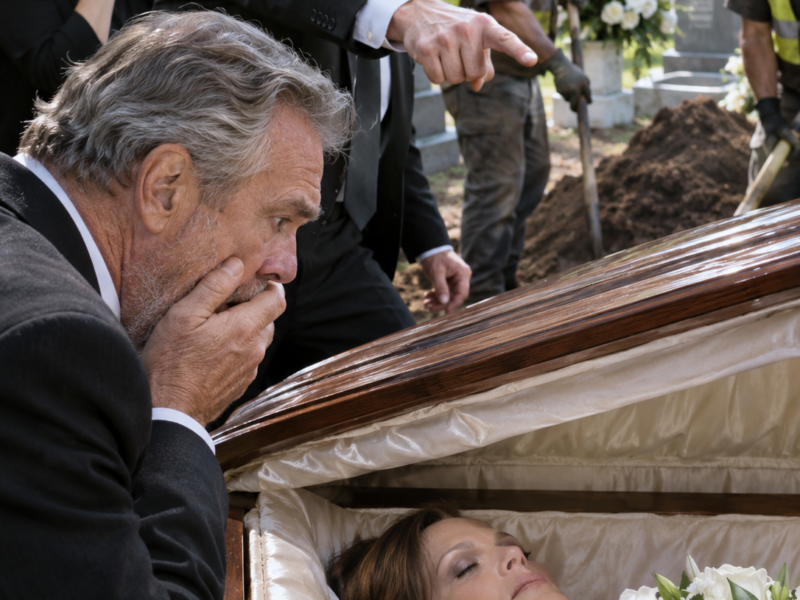
At 65, I Was Burying My Wife of 41 Years When My Son Suddenly Shouted, “Lower It Already! What’s Taking You So Damn Long?” As the Cemetery Workers Lowered Her Coffin, a Steel Cable Snapped, and the Lid Shifted Open. I Saw My Wife’s Fingers Move, but My Son Grabbed My Shoulder and Screamed, “Dad, Don’t Go Near It!” I Shoved Him Aside and Climbed Into the Grave—but Nothing Could Have Prepared Me for What I Discovered When I Pressed My Fingers Against Her Neck…
At 65, I Was Burying My Wife of 41 Years When My Son Suddenly Shouted, “Lower It Already! What’s Taking You So Damn Long?” As the Cemetery Workers Lowered Her Coffin, a Steel Cable Snapped, and the Lid Shifted Open. I Saw My Wife’s Fingers Move, but My Son Grabbed My Shoulder and Screamed, “Dad, Don’t Go Near It!” I Shoved Him Aside and Climbed Into the Grave—but Nothing Could Have Prepared Me for What I Discovered When I Pressed My Fingers Against Her Neck…
The last thing I expected to hear at my wife’s funeral was my own son screaming at the men responsible for burying her.
“Lower it already!” Brandon shouted, pointing impatiently toward the open grave. “We’ve been standing here long enough. What’s taking you so damn long?”
Several people turned toward him. My sister-in-law stopped crying. The elderly minister lowered his prayer book, visibly disturbed by the outburst.
I stared at Brandon, unable to understand how the little boy Eleanor and I had raised could behave so coldly on the day we were supposed to say goodbye to his mother.
“Brandon,” I said, struggling to keep my voice steady. “Please. This is your mother’s funeral.”
He adjusted the sleeve of his expensive black suit and glanced at his watch.
“I’m sorry, Dad. I just want this to be over.”
At the time, I wanted to believe that grief had made him impatient. People reacted differently to loss, and perhaps my son was simply trying to escape a situation he could no longer emotionally endure.
But there was something in his expression that troubled me.
He wasn’t looking at his mother’s coffin with sadness.
He was looking at it as though it contained something dangerous.
Something he desperately needed to disappear.
My name is Walter Mercer. I was sixty-five years old that summer, and until the afternoon of August 16, I believed I understood the people closest to me.
I had been married to Eleanor for forty-one years. Together, we had raised a son, built a successful industrial engineering company, survived financial difficulties, and created a comfortable life in Columbus, Ohio.
We weren’t perfect, but I had always believed our family was fundamentally good.
Standing beside that grave, I was about to discover how terribly mistaken I had been.
The cemetery workers began operating the lowering mechanism. Eleanor’s polished oak coffin slowly descended toward the bottom of the grave.
I removed my glasses and wiped my eyes.
“Goodbye, sweetheart,” I whispered.
Then came a sound that would haunt me for the rest of my life.
A violent metallic snap.
One of the supporting cables broke without warning.
The coffin dropped several inches, swung sideways, and struck the dirt wall with a sickening crash. Women screamed. One of the workers shouted for everyone to move backward.
I stepped forward instinctively.
The impact had shifted the coffin lid.
Through the narrow opening, I could see the sleeve of Eleanor’s blue cardigan and part of her right hand.
Then her fingers moved.
I froze.
For a moment, I wondered whether my grief had finally overwhelmed my senses.
But then they moved again.
“Stop!” I screamed.
Brandon immediately grabbed my shoulder.
“Dad, don’t go near it!”
I tried to pull away.
“Her hand moved!”
His grip tightened.
“What are you talking about? That’s impossible!”
“I saw her fingers move!”
“Dad, you’re imagining things. You’re upset!”
There was something almost desperate in his voice.
He wasn’t trying to comfort me.
He was trying to restrain me.
I shoved him aside and approached the grave.
“Get that coffin open!”
One of the cemetery workers stared at me.
“Sir, the equipment isn’t safe right now.”
“My wife is moving!”
Brandon stepped between us.
“Don’t listen to him! He’s been under tremendous stress!”
I looked directly into my son’s eyes.
For the first time in my life, I felt afraid of him.
“Move.”
“Dad—”
“MOVE!”
He stepped aside.
I climbed down into the grave, scraping my hands against the dirt wall and landing painfully on my knees.
The coffin was tilted against one side. I forced my fingers beneath the loosened lid and pushed upward.
Eleanor lay inside, her face pale and unnaturally still.
She looked exactly as she had when I kissed her forehead for the last time that morning.
But when I pressed two fingers against her neck, I felt something.
A faint pulse.
I held my breath.
There it was again.
Weak, irregular, but unmistakably real.
My wife was alive.
“Oh, my God.”
I looked up at the people gathered around the grave.
“CALL AN AMBULANCE!”
Nobody moved for several seconds.
“She’s alive! My wife is alive!”
Brandon shook his head violently.
“No. That’s not possible. The doctor said—”
“I CAN FEEL HER HEARTBEAT!”
A funeral home employee named Marcus Webb immediately pulled out his phone and called emergency services.
I remained inside the grave, holding Eleanor’s hand, begging her to stay with me.
“I’m here, sweetheart. I’m right here. Don’t leave me.”
I could hear Brandon arguing with someone above us, insisting that there had been a misunderstanding.
But I no longer cared what he said.
The woman I had spent three days mourning was lying in a coffin with a heartbeat.
And somewhere beneath my terror, another realization was beginning to take shape.
Someone had been about to bury my wife alive.
Three days earlier, my life had seemed ordinary.
I had been sitting in my office reviewing maintenance contracts when Brandon called at precisely 5:07 in the afternoon.
“Dad, you need to come home immediately.”
His voice sounded strained.
“What’s wrong?”
“It’s Mom.”
I stood up so quickly that my chair rolled backward.
“What happened to her?”
There was a long silence.
Then he said the words that shattered my world.
“She’s gone, Dad.”
I don’t remember the drive home. I don’t remember parking my car or opening the front door.
I remember Vanessa, my daughter-in-law, meeting me in the hallway with tears running down her cheeks.
She wrapped her arms around me.
“I’m so sorry, Walter.”
I pushed past her.
Eleanor was lying on our bed beneath a white sheet.
A physician I had never met stood beside her, holding a clipboard.
He introduced himself as Dr. Calvin Ross and explained that my wife had suffered a sudden cardiac event.
“There was nothing we could do,” he said.
I stared at him.
“Nothing? Did you call an ambulance? Did you try to resuscitate her?”
He gave me a practiced expression of sympathy.
“I’m afraid it was already too late when I arrived.”
I turned toward Brandon.
“Why didn’t you call Dr. Evans?”
Dr. Evans had been Eleanor’s physician for nearly twenty years.
“He wasn’t available,” Brandon answered. “Dr. Ross was the closest doctor we could reach.”
I believed him.
That was the worst part.
I believed every word.
Over the following days, Brandon and Vanessa took complete control of the funeral arrangements.
They contacted the funeral home, selected the coffin, organized the burial, and discouraged relatives from requesting an extended viewing.
Vanessa explained that Eleanor had always wanted a simple funeral.
Brandon said there was no reason to prolong everyone’s suffering.
When they suggested burial without embalming, I barely questioned them.
I was exhausted, confused, and devastated.
Every room in our house reminded me of Eleanor.
Her reading glasses were still beside the kitchen sink. Her gardening gloves lay on the back porch. A half-finished crossword puzzle sat on the dining room table.
I couldn’t understand how someone could disappear so suddenly while leaving so much of herself behind.
When Brandon told me he would handle everything, I thanked him.
I actually thanked him.
Now, sitting inside an ambulance as paramedics fought to stabilize my wife’s dangerously weak heartbeat, I wondered how much of his kindness had been an act.
At Riverside General Hospital, Eleanor was rushed into intensive care.
I sat in the waiting area with dirt on my trousers and blood drying on my scraped hands.
A nurse offered to clean my injuries.
I refused.
All I wanted was to know whether Eleanor would survive.
Nearly an hour later, a physician named Dr. Gareth Pullman approached me.
“Mr. Mercer?”
I stood immediately.
“Is she alive?”
“Yes.”
I covered my face with both hands.
For the first time since the cemetery, I allowed myself to cry.
“But her condition remains extremely serious,” he continued. “Her breathing and heart function were profoundly suppressed. We’re conducting additional tests to determine why.”
“Can you tell me how a doctor could declare her dead?”
Pullman’s expression changed.
“That’s something we’re going to investigate.”
He asked for the name of the physician who had certified her death.
When I told him, he wrote it down carefully.
Then he asked another question.
“Was your wife working around construction materials recently?”
I frowned.
“No. Why?”
He explained that the medical team had discovered a fine gray residue on Eleanor’s cardigan.
He showed me a photograph.
I recognized the material immediately.
Concrete dust.
I had spent almost four decades working around industrial facilities. I knew what powdered concrete looked like, particularly the residue left behind by drilling and cutting operations.
Our house contained nothing that could explain it.
“Where was she before she collapsed?” Pullman asked.
“At home.”
“Are you absolutely certain?”
I opened my mouth to answer.
Then I stopped.
I wasn’t certain.
I only knew what Brandon had told me.
When my son arrived at the hospital, I was waiting for him.
He hurried toward me with his arms extended.
“Dad! How is she?”
I stepped backward.
“Where was your mother on Thursday afternoon?”
He blinked.
“What?”
“Before you found her. Where was she?”
“At home, obviously.”
“Did you see her arrive?”
“No. I told you, I found her in the bedroom.”
“What time?”
“Around five.”
“And you called Dr. Ross?”
“Yes.”
“Before calling me?”
“Of course. Dad, why are you interrogating me?”
I studied his face.
“Because your mother was inside a coffin an hour ago, Brandon. And now she’s in intensive care.”
His expression hardened.
“You can’t possibly think I had something to do with that.”
“I haven’t said what I think.”
He looked away.
That small movement told me more than his words.
I waited until he left before calling my oldest friend, Frank Delaney.
Frank had spent thirty-two years investigating insurance fraud, suspicious accidents, and financial crimes.
If anyone could help me understand what had happened, it was him.
He answered on the second ring.
“Walter? How are you holding up?”
“Eleanor’s alive.”
Silence.
“What did you say?”
I explained everything.
The broken cable.
The movement inside the coffin.
The ambulance.
The doctor’s questions.
Brandon’s strange behavior.
When I finished, Frank said, “Don’t discuss this with anyone else. I’m coming.”
He arrived forty-five minutes later.
After listening to the entire story again, he asked whether I still had the security system installed at my house.
I nodded.
“Then that’s where we start.”
We drove home that evening.
I had installed twelve security cameras around our property several years earlier. The system recorded entrances, common areas, and the driveway, with independent backup power and detailed access logs.
Frank stood behind me as I opened Thursday’s recordings.
At 7:45 a.m., Eleanor appeared in the kitchen making coffee.
At 9:18, she was sitting in the living room reading something on her tablet.
At 11:23, she picked up her purse, collected her car keys, and left through the garage.
I watched her drive away.
There was nothing unusual about her behavior.
She looked healthy.
Alert.
Perfectly normal.
Then, at 4:18 p.m., every camera stopped recording.
The next available footage began at 5:05.
Forty-seven minutes were missing.
Exactly two minutes later, Brandon called me to announce his mother’s death.
“He said there was a power outage that afternoon,” I remembered.
Frank examined the system logs.
“No, there wasn’t.”
He pointed toward the screen.
“Your power supply was functioning normally. Somebody manually disabled the cameras.”
We checked the administrator access history.
At 4:17, someone had entered the system using my credentials.
The login came from an unfamiliar device.
I felt a growing pressure in my chest.
Someone had deliberately erased the visual record of what happened inside my house before Eleanor was declared dead.
And that person knew my security password.
Frank copied the logs and told me to preserve everything.
Then my phone rang.
The caller introduced herself as Rachel Holt, a forensic accountant.
“Mr. Mercer, I worked with your wife recently.”
“With Eleanor?”
“Yes. She contacted me three weeks ago regarding financial irregularities at Mercer Industrial Systems.”
I stared at Frank.
“What kind of irregularities?”
“I don’t think we should discuss this over the telephone.”
We arranged to meet at a coffee shop near the hospital.
Rachel arrived carrying a laptop and a thick folder.
She looked nervous.
“Your wife was investigating payments made to several outside contractors,” she explained. “She believed someone inside your company was transferring money to businesses that didn’t provide any actual services.”
She opened a spreadsheet.
There were dozens of transactions.
Some were for fifteen thousand dollars. Others exceeded fifty thousand.
All had been categorized as transportation, consulting, or logistics expenses.
Rachel had traced the recipient companies.
Several were registered in Nevada.
They had no employees, no operational facilities, and no legitimate business activity that she could identify.
They were shell companies.
“How much money are we talking about?” I asked.
“At least eight hundred thousand dollars.”
My stomach turned.
Mercer Industrial Systems had taken me thirty-eight years to build.
I had started with borrowed equipment, a rented warehouse, and a wife who worked evenings to help us pay our bills.
Now someone was stealing from the company we had sacrificed so much to create.
“Who authorized the payments?”
Rachel turned her laptop toward me.
The name on the screen was Brandon Mercer.
My son.
I stared at it for so long that Rachel eventually closed the laptop.
“I’m sorry,” she said.
I shook my head.
“There has to be another explanation.”
“There may be more people involved. But the transactions were approved using his administrative account.”
Frank leaned forward.
“When did the payments begin?”
“Fourteen months ago.”
I immediately thought of Vanessa.
She had joined the company’s senior administrative department sixteen months earlier.
At the time, I had been delighted.
She was intelligent, ambitious, and exceptionally organized. I thought bringing her into the business would strengthen the family.
Rachel opened another document.
“Your wife also discovered that Brandon had been negotiating with an investment firm called Apex Capital Group.”
I knew the name.
Apex had expressed interest in purchasing a controlling stake in Mercer Industrial.
Eleanor and I had rejected the proposal.
We didn’t want outsiders controlling the business or making decisions that could threaten the livelihoods of our employees.
But Rachel explained that the financial losses created by the suspicious payments were making Mercer Industrial appear increasingly unstable.
The company’s declining financial position could justify a much lower acquisition price.
Someone was deliberately weakening our business before selling it.
And Eleanor had discovered the scheme.
Rachel then showed me an unfinished message recovered from Eleanor’s tablet backup.
It was addressed to me.
“Walter, if I’m not home before eight, don’t call Brandon. Call Frank.”
My hands began trembling.
She had known.
My wife had known she was in danger.
And she had tried to warn me.
“Why didn’t she tell me what was happening?” I whispered.
Rachel lowered her eyes.
“She wasn’t certain how much Brandon knew. She was afraid that confronting him before she had enough evidence would destroy your relationship with him.”
I closed my eyes.
Even while investigating someone who might have been stealing from us, Eleanor had been thinking about my feelings.
Rachel explained that Eleanor had arranged to meet a warehouse employee named Danny Briggs on Thursday afternoon.
Danny had reported seeing unusual activity at one of our older industrial facilities on the north side of Columbus.
The building was scheduled to be emptied and sold.
It had been largely abandoned for months.
Suddenly, I remembered the concrete dust on Eleanor’s cardigan.
She had gone to that warehouse.
Something had happened there.
And afterward, someone had brought her home, disabled our security cameras, and placed her unconscious body in our bedroom.
Frank looked at me.
“We need to get the police involved.”
Before I could respond, Rachel added something that made the situation even more disturbing.
Dr. Calvin Ross had financial connections to a healthcare company partially funded by Apex Capital.
The physician who had declared my wife dead was connected to the same investment group trying to acquire our business.
I could no longer pretend these events were unrelated.
Someone had planned this.
When Frank and I returned to the hospital, Vanessa was standing outside Eleanor’s room.
She wore a cream-colored sweater and held a bouquet of white roses.
“Walter,” she said softly. “Thank goodness you’re here.”
She approached me with an expression of concern.
“How are you feeling?”
I looked at her.
“My wife was nearly buried alive. How do you think I’m feeling?”
Her smile disappeared.
“I know. It’s horrifying.”
“Isn’t it?”
For a moment, neither of us spoke.
Then Vanessa placed the flowers on a nearby table.
“I brought a family photograph for Eleanor. I thought seeing something familiar might help when she wakes up.”
“When she wakes up?”
Vanessa hesitated.
“Yes. Of course.”
I watched her leave.
Frank waited until she disappeared around the corner.
“Has she been alone with Eleanor?”
I thought about it.
Earlier that afternoon, Vanessa had spent several minutes inside the room while I spoke with Dr. Pullman.
“Yes.”
Frank glanced toward the framed photograph beside Eleanor’s bed.
With permission from hospital staff, we examined it the following morning.
The photograph showed the four of us standing beside our Christmas tree.
Eleanor was laughing. Brandon had his arm around Vanessa. I was holding a ridiculous coffee mug our son had given me.
We looked like a happy family.
Frank turned the frame over.
Beneath its cardboard backing was a small black electronic device.
He examined it without disturbing it further.
Then he looked at me.
“Walter, this appears to be a listening device.”
I stared at the photograph.
Vanessa hadn’t brought it to comfort Eleanor.
She had brought it to monitor us.
She wanted to know what the doctors discovered, what Eleanor remembered, and what I intended to do.
Hospital security was notified immediately.
Detective Lina Ortiz arrived later that morning.
She listened to our account, examined the available evidence, and arranged for the device to be collected.
“Mr. Mercer,” she told me, “your wife’s safety is our priority. I need you to stop confronting the people you suspect.”
I nodded reluctantly.
She arranged additional security around Eleanor’s room and began coordinating the investigation.
For the first time since the funeral, I felt that someone was taking control of the situation.
But the people responsible weren’t finished.
That afternoon, Rachel called me in a panic.
“Someone is deleting company records.”
I rushed to her office.
On her computer, entire groups of financial documents were disappearing from Mercer Industrial’s central accounting system.
Invoices.
Vendor histories.
Payment authorizations.
Internal correspondence.
Someone with administrative access was trying to destroy the evidence.
“Can you recover everything?” I asked.
Rachel gave me a small, reassuring smile.
“Your wife anticipated this possibility.”
At Eleanor’s request, Rachel had created an independent backup of the suspicious financial records.
The original documents might disappear from the company’s system, but the evidence remained intact.
Rachel was also preserving the records of the deletion attempts.
Whoever was trying to erase the crime was creating additional evidence against themselves.
I felt an unexpected surge of pride.
Eleanor had been several steps ahead of the people who believed they could outsmart her.
The following morning, our longtime corporate attorney, Gerald Owens, asked me to visit his office.
He looked uncomfortable when I arrived.
“Walter, there’s something you need to see.”
He handed me a document.
It was a proxy authorization transferring my corporate voting rights to Brandon.
At the bottom was my signature.
Or something resembling it.
“I never signed this.”
“I suspected as much,” Gerald replied.
The document would have allowed Brandon to vote on my behalf regarding the proposed acquisition.
With Eleanor supposedly dead and my voting rights transferred, Brandon could have helped approve the sale without my consent.
Gerald had refused to process the document.
“Who submitted it?” I asked.
“It came through the company’s administrative office.”
I thought of Vanessa.
Then I remembered something Rachel had mentioned.
“Did Eleanor speak to you about the suspicious payments?”
Gerald looked down.
“Yes.”
“When?”
“Approximately three weeks ago.”
“And what did you do?”
He didn’t answer.
“Gerald?”
He removed his glasses.
“She showed me several contracts. I told her I needed time to review them.”
“Did you investigate?”
“No.”
“Why not?”
His face tightened.
“I was concerned about the consequences of making accusations against members of your family. And I was afraid of damaging my relationship with the company.”
I stared at the man I had trusted for twenty-six years.
“You were afraid of losing a client?”
He nodded.
“My wife could have died because people like you decided their money was more important than speaking up.”
His eyes filled with tears.
“I’m sorry, Walter.”
I wanted to walk out.
Instead, I pushed the forged document back toward him.
“Then stop being sorry and start helping.”
He agreed to provide investigators with everything Eleanor had shown him.
That evening, Dr. Pullman received the results of Eleanor’s expanded toxicology screening.
He asked me to sit down.
“The laboratory detected a powerful synthetic sedative in your wife’s system.”
I felt my throat tighten.
“Someone drugged her?”
“The evidence strongly suggests that she was deliberately given a substance that profoundly suppressed her consciousness, breathing, and cardiovascular activity.”
“Could she have appeared dead?”
“Her condition could have made her vital signs extremely difficult to detect. But that does not excuse a false declaration of death.”
I thought of Dr. Ross standing beside our bed.
I remembered his calm voice.
His sympathetic expression.
The hand he had placed on my shoulder while telling me there was nothing anyone could do.
He had looked me in the eyes while my wife was still alive.
And I had thanked him.
I excused myself and went into the hospital restroom, where I stood over the sink until the nausea passed.
When I returned, Detective Ortiz was waiting.
“We’ve located Danny Briggs,” she said.
The warehouse employee Eleanor had intended to meet was staying with relatives in Dayton.
He had been frightened enough to leave Columbus shortly after her supposed death.
Now he was willing to cooperate.
Two days later, I sat across from him during a meeting coordinated with investigators.
Danny was twenty-eight years old. He looked exhausted, and his hands wouldn’t stop shaking.
“I didn’t know they were going to hurt her,” he said.
“Tell me what happened.”
He explained that Vanessa had been paying him eight hundred dollars a month to monitor the old warehouse and report anyone who visited.
He had accepted because he was struggling financially.
When Eleanor contacted him about suspicious activity, he agreed to meet her.
But before the meeting, he told Vanessa.
“She got angry,” Danny recalled. “She told me not to go inside the building. She said she’d make sure I never worked for another industrial company if I disobeyed.”
Danny became frightened.
Instead of meeting Eleanor, he parked his truck across the street.
He watched her arrive.
She entered the warehouse alone.
Approximately twelve minutes later, a gray sedan pulled into the parking lot.
Vanessa stepped out.
An older man carrying a medical bag accompanied her.
Danny recognized him from photographs investigators later showed him.
Dr. Calvin Ross.
They entered the warehouse together.
Twenty minutes later, Vanessa came outside and made a telephone call.
Danny had been suspicious enough to record what he could hear from his truck.
He handed his phone to the detective.
The recording was faint, but Vanessa’s voice was recognizable.
“It’s done. Ross handled it cleanly. She’ll be back at the house within the hour.”
There was a pause.
Then came the sentence that made my entire body go cold.
“After Sunday, Eleanor won’t be a problem anymore.”
Another pause.
“Make sure Brandon stays home tonight. I’ll handle the rest.”
The recording ended.
Danny lowered his head.
“I should’ve called someone. I should’ve gone inside.”
I couldn’t look at him.
I was thinking about Eleanor walking into that warehouse, believing she was about to uncover evidence that would protect our business.
Instead, she had walked into a trap.
Vanessa had been waiting for her.
The woman we had welcomed into our family had calmly discussed Eleanor’s disappearance as though she were arranging the removal of unwanted furniture.
“I’m sorry,” Danny whispered.
I finally looked at him.
“Tell the investigators everything. Don’t leave anything out.”
He nodded.
The recording became a crucial piece of evidence.
But another unexpected witness was about to reveal just how close the conspiracy had come to succeeding.
Marcus Webb, the funeral home employee who had called the ambulance, contacted Detective Ortiz.
He wanted to explain something that had troubled him since the funeral.
During preparations, Marcus had heard an unusual sound coming from Eleanor’s coffin.
It was faint and rhythmic.
He couldn’t identify it, but he intended to examine the casket more carefully.
Before he could finish, Brandon arrived.
“He was angry,” Marcus told me later. “He kept saying the funeral was behind schedule and demanding that we finish immediately.”
Under pressure, Marcus had been interrupted before completing his final inspection.
One of the coffin’s securing latches had not been properly fastened.
When the lowering cable snapped, the impact against the grave wall caused the unsecured lid to shift.
That was how I had seen Eleanor’s hand.
I sat in stunned silence.
Brandon’s impatience had nearly ensured his mother’s death.
Instead, it had accidentally helped save her.
Marcus also revealed that Vanessa had approached him after the funeral.
She offered him an envelope containing cash.
All she wanted, she said, was for him to keep his observations private and avoid creating unnecessary problems for the family.
He refused.
Then he contacted investigators.
I reached across the table and shook his hand.
“Thank you.”
Marcus looked uncomfortable.
“I wish I’d done more before the funeral.”
“You called the ambulance when nobody else would. I’ll never forget that.”
That night, I sat beside Eleanor’s hospital bed.
The room was quiet except for the steady sounds of medical equipment.
I held her hand and told her about the first apartment we had rented after getting married.
It had been small, cold in winter, and unbearably hot in summer.
We had owned two chairs, a secondhand mattress, and a television that only worked when someone struck its side.
But we had been happy.
I told her about Brandon’s first birthday, the terrible cake I had attempted to bake, and the way she had laughed when our son covered himself in frosting.
I told her how much I missed hearing her complain about my coffee cups.
Then I felt her fingers tighten around mine.
“Eleanor?”
Her eyelids moved.
I stood and leaned closer.
“Sweetheart, can you hear me?”
She opened her eyes.
For several seconds, she seemed unable to focus.
Then she recognized me.
Her lips moved.
I lowered my ear toward her mouth.
“Not Brandon alone.”
Those were the first words my wife spoke after nearly being buried alive.
Before I could ask what she meant, her eyes closed again.
I called for a nurse.
Dr. Pullman examined her and explained that her brief return to consciousness was encouraging, although she still required considerable medical care.
I remained beside her until morning.
When she woke again, she tried to speak, but her voice was too weak.
A nurse gave her a small notepad.
Eleanor struggled to hold the pen.
Eventually, she wrote three letters.
USB.
Then she looked at me with an intensity that told me those letters mattered more than anything else.
“Where is it?” I asked.
She couldn’t answer.
Instead, she made a weak circular movement with her hand.
I stared at her.
Then I remembered something.
An old industrial flashlight.
Nineteen years earlier, I had purchased an oversized flashlight for inspecting machinery and poorly illuminated industrial facilities.
Eleanor had always hated it.
She said it was heavy, ugly, and completely unnecessary.
When I stopped conducting regular site inspections, I left it at our old north-side warehouse.
The flashlight had a large battery compartment.
It was the perfect place to conceal something small.
And Eleanor knew exactly how to open it.
I contacted Frank and Detective Ortiz immediately.
Unfortunately, the warehouse had already been emptied.
Its remaining equipment had been transported to a salvage yard.
For several terrible hours, I feared the flashlight had been destroyed.
But investigators discovered that the shipment had not yet been processed.
We traveled to the salvage yard, where several large containers held the discarded contents of the warehouse.
I searched through broken tools, old electrical components, damaged equipment, and rusted metal.
My hands were filthy.
My back ached.
But I refused to stop.
Finally, beneath a pile of protective equipment, I recognized a familiar black rubber handle.
“There!”
I lifted the flashlight.
Its aluminum casing was scratched, and the grip was worn from years of use.
I unscrewed the battery compartment.
Inside was a small object wrapped in electrical tape.
A USB drive.
For several seconds, I couldn’t speak.
Eleanor had hidden her evidence inside the one piece of equipment she had spent nearly two decades telling me to throw away.
I handed the drive to Detective Ortiz.
When investigators examined its contents, they discovered that Eleanor’s findings went far beyond the missing eight hundred thousand dollars.
The drive contained contracts, internal correspondence, transaction records, and documents connecting several shell companies to the proposed acquisition.
The financial deterioration of Mercer Industrial had been deliberately manufactured.
Money had been siphoned away.
Expenses had been manipulated.
The company’s apparent value had been reduced.
Apex Capital was positioned to purchase a controlling interest at a substantial discount.
But there was something even more disturbing.
Eleanor had investigated Vanessa’s employment history.
Five years earlier, Vanessa had worked for a manufacturing company in Indianapolis.
That company had experienced unexplained financial difficulties before being acquired by an investment group connected to Apex.
Vanessa had held an administrative position that gave her access to sensitive financial information.
The similarities were impossible to ignore.
My daughter-in-law had been involved in a remarkably similar situation before she met Brandon.
Investigators now had reason to examine whether the earlier acquisition had involved the same pattern of misconduct.
I remembered the evening Brandon introduced Vanessa to us.
She had arrived carrying flowers for Eleanor and a bottle of wine for me.
She asked thoughtful questions about our company.
She seemed interested in its history, its ownership structure, and its future.
At the time, I thought she was simply trying to make a good impression.
Now those memories looked entirely different.
Had she genuinely loved my son?
Had she married him because she wanted access to our business?
Had every smile, every family dinner, and every expression of affection been part of something larger?
I didn’t know.
And that uncertainty was almost as painful as the answers I already had.
The USB drive also contained a scanned handwritten note from Eleanor.
“Walter, if you’re reading this, then that ridiculous flashlight finally proved useful. Everything you need is here. I’m sorry I couldn’t tell you sooner. I love you. Finish it.”
I read those words until my vision blurred.
My wife had been fighting alone because she believed she was protecting me.
She had risked everything to preserve the truth.
And now she was asking me to finish what she started.
I intended to honor that request.
Several days later, an attorney representing Apex Capital approached me.
He was impeccably dressed and spoke with the polished confidence of someone accustomed to resolving expensive problems.
“Mr. Mercer, our organization deeply regrets the distress your family has experienced.”
I said nothing.
He explained that Apex was prepared to abandon its proposed acquisition.
Furthermore, the firm was willing to discuss a substantial financial settlement.
There would be confidentiality provisions.
The matter could be resolved privately.
My family could avoid the embarrassment and emotional exhaustion of prolonged public proceedings.
“How much?” I asked.
He showed me a figure.
It was an extraordinary amount of money.
Enough to guarantee financial security for generations.
I looked at the number.
Then I remembered Eleanor lying inside that coffin.
I remembered the dirt beneath my knees and the faint heartbeat under my fingers.
“Do you have a wife?” I asked.
The attorney looked surprised.
“Yes.”
“Imagine someone putting her inside a coffin while she’s still alive. Then imagine being offered money to stop asking questions.”
His expression changed.
“Mr. Mercer, that’s not what we’re suggesting.”
“Then you won’t object when I refuse.”
I stood.
“My wife’s life isn’t something you can purchase.”
I reported the conversation to investigators through the appropriate legal channels.
The settlement offer did not establish who within Apex knew about the attack on Eleanor, but investigators continued examining the firm’s connections to the financial scheme.
Soon afterward, Dr. Calvin Ross was arrested.
He began cooperating with investigators.
Financial accounts connected to the suspected fraud became the subject of court orders.
The acquisition was suspended.
Documents were secured.
More witnesses came forward.
Then Vanessa attempted to leave Columbus on a one-way flight to Miami.
She never boarded.
Investigators detained her at the airport.
When Detective Ortiz called to inform me, I was sitting beside Eleanor’s hospital bed.
“We have her,” she said.
I closed my eyes.
For the first time in weeks, I felt that Eleanor might finally be safe.
But there was still Brandon.
My son had participated in the financial misconduct.
He had supported the acquisition.
He had pressured the funeral home to complete the burial.
And when I saw Eleanor’s hand move, he had tried to stop me from reaching her.
Whatever Vanessa had concealed from him, Brandon had made choices of his own.
Eventually, he agreed to cooperate with investigators.
His attorneys negotiated terms under which he would provide testimony and evidence in exchange for consideration during prosecution.
That did not make him innocent.
It simply meant his responsibility would be evaluated separately from Vanessa’s and Dr. Ross’s.
People sometimes imagine that discovering a family member’s betrayal produces a clean, uncomplicated hatred.
It doesn’t.
I hated what Brandon had done.
But I couldn’t erase the memory of him as a little boy.
I remembered teaching him to ride a bicycle.
I remembered carrying him into the emergency room when he broke his arm at nine years old.
I remembered Eleanor crying at his college graduation.
I remembered the pride I felt when he joined the family business.
Those memories didn’t disappear when I learned the truth.
They simply became painful.
Three weeks after the funeral, Eleanor was strong enough to have a meaningful conversation.
I told her everything.
The money.
The recordings.
The forged authorization.
The USB drive.
Vanessa’s arrest.
Brandon’s cooperation.
She listened without interrupting.
When I finished, she stared through the hospital window.
“Does he want to see me?”
“Yes.”
“Then let him come.”
Brandon arrived that afternoon.
He looked thinner.
His clothes were wrinkled, his face unshaven, and his eyes swollen.
When he saw Eleanor sitting upright, he stopped in the doorway.
“Mom?”
She looked at him.
He approached the bed and dropped to his knees.
“I’m sorry,” he sobbed. “I’m so sorry.”
Eleanor remained silent.
“I never wanted you dead. I swear. Vanessa said the company was in trouble. She said we needed the sale. Everything got out of control.”
My wife looked down at him.
“Did you know money was being stolen?”
Brandon hesitated.
“Yes.”
“Did you know the company was being deliberately weakened?”
He nodded.
“And when you believed I was dead, did you think my death would make the sale easier?”
Brandon began crying harder.
“Mom, please.”
“Answer me.”
He lowered his head.
“Yes.”
The word seemed to drain the warmth from the room.
Eleanor’s eyes filled with tears.
“You were my little boy,” she whispered. “I would have given everything I owned to help you if you had come to me honestly.”
“I know.”
“Then why?”
Brandon covered his face.
“I was scared. I owed money. Vanessa kept telling me we’d lose everything if the sale didn’t happen.”
Eleanor gently withdrew her hand from his.
“You were afraid of losing money, Brandon. And because of that, you were willing to lose your mother.”
He couldn’t answer.
I stood near the window, struggling to control my emotions.
Eleanor continued.
“I believe you when you say you didn’t plan every part of what happened to me. But you stood beside my grave and demanded that they bury me faster.”
Brandon shook his head.
“I didn’t know you were alive.”
“Would it have changed anything if you had?”
He looked at her.
For a long time, he said nothing.
That silence was more devastating than any confession.
Finally, he whispered, “I don’t know what happened to me.”
Eleanor began crying.
“I don’t know either.”
Brandon reached for her hand again.
This time, she allowed him to hold it briefly.
“I love you,” she said. “But you need to understand that loving you doesn’t mean protecting you from the consequences of what you’ve done.”
He nodded.
“Can you ever forgive me?”
Eleanor looked toward the window.
“I don’t know.”
It was the most truthful answer she could give him.
When Brandon finally stood to leave, he turned toward me.
“Dad?”
I looked at him.
I wanted to tell him that everything would eventually be all right.
It was what I had always told him when he was frightened.
But he was no longer a little boy.
And I could no longer protect him from the truth.
“Tell the investigators everything,” I said. “Whatever happens next, don’t lie again.”
He nodded and walked out.
Eleanor cried for nearly an hour after he left.
I held her hand.
Neither of us tried to pretend that our family could return to what it had been before.
The legal proceedings continued for months.
Investigators followed the money, examined communications, interviewed witnesses, and reconstructed the events that had led to Eleanor’s false death certification.
Rachel provided the financial records.
Gerald supplied the contracts and forged authorization.
Danny testified about the warehouse.
Marcus described the pressure placed on the funeral home.
The evidence preserved on Eleanor’s USB drive helped connect events that might otherwise have appeared unrelated.
I attended the proceedings when I could.
But eventually, I realized that justice and healing were two different things.
Watching the people responsible face consequences mattered.
However, it couldn’t restore the months Eleanor and I had lost.
It couldn’t erase her nightmares.
It couldn’t give us back the son we thought we knew.
And it couldn’t make me forget the sound of that cable snapping.
By November, Eleanor was finally able to return home.
I spent the morning preparing the house.
I cleaned the kitchen, washed her favorite blanket, bought fresh flowers, and placed her reading glasses beside the armchair where she usually sat.
When our car stopped in the driveway, Eleanor looked at the house for a long time.
“Ready?” I asked.
She nodded.
I helped her walk to the front door.
She paused beneath the wind chime she had purchased years earlier.
“It’s strange,” she said.
“What is?”
“Everything looks exactly the same.”
I looked around.
The same oak tree stood in the front yard.
The same porch light hung above us.
The same flowerpots lined the steps.
But nothing felt the same.
“Everything except us,” I replied.
She took my hand.
“Maybe that’s all right.”
We entered the house together.
For the next several weeks, Eleanor gradually regained her strength.
Some days were difficult.
She became exhausted after walking short distances.
Occasionally, she woke during the night frightened and confused.
I would turn on the bedside lamp and remind her where she was.
“You’re home, sweetheart.”
She would reach for my hand.
And eventually, her breathing would settle.
I had nightmares too.
Sometimes I dreamed that the cable never broke.
I watched the coffin descend while Brandon stood beside me, checking his watch.
Then the workers began filling the grave.
I tried to scream, but no sound came out.
I would wake drenched in sweat and immediately reach across the bed.
Every time, Eleanor was there.
One afternoon, I was making coffee when a neighbor dropped a metal tool in his driveway.
The sharp clang made me freeze.
Eleanor noticed.
“The cable?” she asked.
I nodded.
She approached me and placed her hand against my chest.
“We’re home, Walter.”
I took a deep breath.
“Yes.”
“And I’m here.”
I wrapped my arms around her.
For several minutes, we stood in the kitchen without speaking.
That was how recovery happened for us.
Not through one extraordinary moment, but through hundreds of ordinary ones.
Coffee in the morning.
A short walk around the garden.
Dinner together.
An evening spent watching television.
Each small experience reminded us that we had survived.
One Saturday, Eleanor found me in the garage examining the old flashlight.
She smiled.
“You’re never going to throw that thing away now, are you?”
“Absolutely not.”
“I knew it.”
I turned the flashlight over in my hands.
“Why did you hide the drive inside it?”
“Because I knew you’d remember it.”
“After all those years?”
She laughed softly.
“Walter, you’ve spent forty-one years explaining to me why old equipment is worth keeping. Of course I knew you’d remember.”
I smiled.
Then I asked the question that had been bothering me since she regained consciousness.
“Were you frightened when you went to the warehouse?”
Her expression changed.
“Yes.”
“Then why did you go alone?”
She looked down.
“I thought I could collect the evidence and leave. I didn’t realize how dangerous Vanessa had become.”
“You should have told me.”
“I know.”
“I would have gone with you.”
“I know that too.”
She reached for my hand.
“I was trying to protect you from discovering what Brandon had done.”
I felt tears forming.
“And I was supposed to protect you.”
Eleanor shook her head.
“We both made mistakes. But we’re still here.”
She rested her head against my shoulder.
I held her carefully.
For the first time, I understood that surviving something terrible didn’t mean we had to spend the rest of our lives defined by it.
We could still laugh.
We could still love each other.
We could still build something meaningful from the time we had left.
I often think about that afternoon at Riverside Memorial Cemetery.
I think about Brandon demanding that the workers hurry.
I think about the broken cable.
I think about the coffin striking the wall of the grave.
And I think about the tiny movement of Eleanor’s fingers.
If the cable had held for another minute, my wife might have disappeared beneath the earth.
If the coffin lid had remained secured, I might never have seen her hand.
If I had listened to Brandon when he told me I was imagining things, I might have stood there while the workers finished burying her.
The possibilities still frighten me.
But they also remind me of something important.
For thirty-eight years, I worked as a safety engineer.
I taught employees that disasters rarely occur without warning.
There are usually signs.
An unusual sound.
An unexplained irregularity.
A small failure that someone decides isn’t worth investigating.
I spent my career teaching people to recognize those warnings.
Yet when the danger appeared inside my own family, I almost failed to recognize it.
I trusted Brandon because he was my son.
I trusted Vanessa because she was his wife.
I trusted Dr. Ross because he wore the clothes and carried the credentials of a physician.
I confused familiarity with honesty.
I confused authority with truth.
And I nearly lost the most important person in my life because of it.
Today, Eleanor and I live more quietly.
We spend less time discussing the business and more time enjoying the life we worked so hard to create.
Some evenings, we sit on the porch and watch the sunset.
Sometimes we talk about Brandon.
Sometimes we don’t.
We hope he eventually becomes a better man, but we no longer allow that hope to blind us to what he did.
Forgiveness, if it comes, will come in its own time.
As for Vanessa, Dr. Ross, and the others involved, their actions remain matters for the justice system.
I have stopped allowing their greed to occupy every moment of my thoughts.
They have already taken enough from us.
Last week, Eleanor and I celebrated another wedding anniversary.
There was no expensive restaurant.
No elaborate party.
Just the two of us sitting at our dining room table with a homemade dinner and a small vase of flowers.
Afterward, Eleanor brought out an old photograph from our wedding.
We looked impossibly young.
I had thick brown hair and a suit that didn’t fit properly.
She wore a simple ivory dress and the brightest smile I had ever seen.
“Would you do it all again?” she asked.
I looked at the photograph.
Then I looked at the woman sitting beside me.
“Every single day.”
She smiled.
I took her hand.
It was warm.
And beneath my fingers, I could feel her pulse.
Strong.
Steady.
Alive.
I thought about the people who had believed they could bury their secrets with her.
They had manipulated financial records, forged documents, arranged a medical deception, and attempted to destroy evidence.
They had calculated the value of our company.
They had calculated how much money they could steal.
They had calculated how quickly they could complete the funeral.
But they had failed to calculate one thing.
How far a husband would go to save the woman he loved.
They believed Eleanor’s coffin would become the final resting place of their secrets.
Instead, it became the place where their entire conspiracy began to unravel.
My son had shouted for the cemetery workers to hurry.
My daughter-in-law had believed she was only hours away from securing everything she wanted.
And the doctor had assured them that my wife would never expose what they had done.
But the cable broke.
The coffin opened.
Eleanor moved her fingers.
And I refused to look away.
That was the moment their carefully constructed world began collapsing.
And it was the moment mine came back to life.