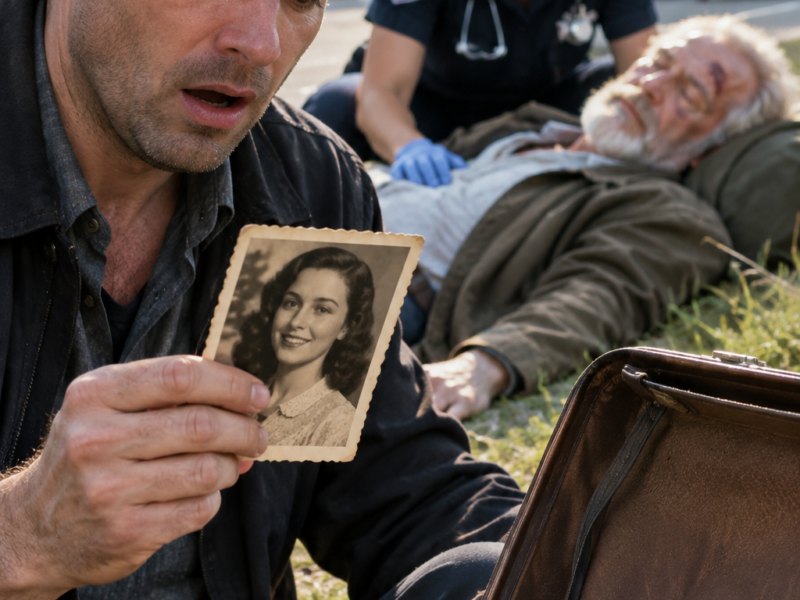
At 65, I Found an Unconscious Old Man Beside an Abandoned Railroad Station, Clutching a Suitcase Containing a Photo of My Wife Who Died 23 Years Ago. Before Passing Out, He Whispered, “Don’t Let Harlow Take the Suitcase”—But Harlow Was My Best Friend, the Man Who Stood Beside Me at Her Funeral. Minutes Later, My Son Called in a Panic, Saying Harlow Wanted to Know What the Old Man Had Told Me. Then Police Opened a Sealed Envelope Inside the Suitcase, and Everything Changed…
At 65, I Found an Unconscious Old Man Beside an Abandoned Railroad Station, Clutching a Suitcase Containing a Photo of My Wife Who Died 23 Years Ago. Before Passing Out, He Whispered, “Don’t Let Harlow Take the Suitcase”—But Harlow Was My Best Friend, the Man Who Stood Beside Me at Her Funeral. Minutes Later, My Son Called in a Panic, Saying Harlow Wanted to Know What the Old Man Had Told Me. Then Police Opened a Sealed Envelope Inside the Suitcase, and Everything Changed…
PART 1: THE DYING MAN WHO KNEW MY WIFE’S SECRET
At 65 years old, I thought the darkest chapter of my life had ended when my wife, Lenora, died in 2001. For more than two decades, I had lived quietly in Blair County, Pennsylvania, carrying the grief of losing her and trusting the people who had stood beside me through it all. Among them was Desmond Harlow, a wealthy developer and longtime family friend who had attended her funeral and continued treating me like someone he wanted to protect.
Then one morning, everything changed.
Near an abandoned railroad station, I discovered an elderly man named Amos Treadwell lying unconscious beside a battered leather suitcase. Before he lost consciousness, he desperately warned me not to let Harlow get his hands on it.
I couldn’t understand why a dying stranger would mention my closest friend. But when I examined the belongings Amos had been protecting, I found old photographs, suspicious industrial records, and evidence connected to Lenora’s death.
My wife had apparently uncovered something dangerous before she died: forged inspection documents concealing a leaking chemical storage tank at Keystone, the industrial facility where I had once worked as an inspector.
The records pointed toward Harlow.
As I struggled to comprehend the discovery, my son Heath began acting strangely. He seemed frightened, evasive, and unusually interested in what Amos had told me. Soon I learned that Heath was drowning in a $212,000 debt—and Harlow knew exactly how to exploit it.
For twenty-three years, I had believed my wife was gone because of a terrible tragedy. Now I was beginning to suspect that someone had spent those years making certain I never discovered what really happened.
And the most frightening question was no longer what Lenora had uncovered.
It was why Harlow was suddenly so desperate to take everything I owned.
PART 2: MY BEST FRIEND TRIED TO STEAL MY LIFE
The more I investigated, the more I realized Harlow wasn’t simply trying to hide an old industrial scandal. He was preparing to destroy my credibility and seize control of my property before I could expose him.
With Heath trapped by his enormous debt, Harlow began manipulating my own family against me. My daughter-in-law, Delaney, was also caught in the pressure surrounding the scheme. Even my grandson Linus, an innocent child who had nothing to do with any of it, was placed in danger.
Then came the betrayal I never imagined.
Harlow’s associates produced forged documents and attempted to have me declared mentally incompetent. A doctor named Merritt Sayles had been brought into the scheme to support a fraudulent guardianship petition. If it succeeded, I could lose the right to make my own decisions—and control of the land Harlow desperately wanted.
Suddenly, every warning I gave about Lenora’s death could be dismissed as the confusion of an elderly man.
But Harlow underestimated me.
With help from attorney Prudence Whitlock, Detective Sloane, and my observant neighbor Gertie Pruitt, I began piecing together the conspiracy. Amos’s suitcase and a bank deposit box revealed more photographs, letters, and records linking the hidden chemical leak to the falsification of inspection reports.
I also discovered that Harlow’s men, including Rudd Garrity and Carl Deets, were involved in the effort to silence anyone who might expose the truth.
The situation turned terrifying when someone impersonated Heath and a fire was set at my home. What had begun as an attempt to discredit me was becoming a direct threat to my life.
Yet the most devastating discovery was still ahead.
Among the evidence was something Lenora had left behind—a recording that might finally explain what she knew before she died.
And Harlow appeared willing to do almost anything to keep me from hearing it.
PART 3: THE COURTROOM BETRAYAL THAT EXPOSED EVERYTHING
By the time the guardianship hearing approached, my entire world had been turned upside down.
My closest friend was working to take my property. My son had been manipulated into helping him. My wife’s death was surrounded by unanswered questions, and the people responsible for hiding the truth were still trying to silence me.
Harlow believed the courtroom would be his final victory.
He expected a judge to see an aging widower who was confused, paranoid, and incapable of managing his own affairs. With forged paperwork and a compromised medical opinion, he hoped to make his version of events appear legitimate.
But Prudence Whitlock had been preparing for that moment.
As the hearing unfolded, the documents Harlow relied upon began to fall apart under scrutiny. The supposed evidence of my incompetence revealed inconsistencies, and the connections between the doctor, the forged records, and Harlow’s financial interests became increasingly difficult to explain.
Meanwhile, Detective Sloane and environmental investigator Sandra Tuttle were following another trail: the industrial records Lenora had tried to expose years earlier.
On October 24, Judge Audrey Colvin dismissed the guardianship petition with prejudice.
Harlow’s attempt to take control of my life had failed.
But the confrontation did not end when the judge delivered her decision.
Outside the courtroom, Harlow was arrested in connection with forgery, evidence tampering, bribery, and conspiracy.
For the first time, the man who had spent years controlling everyone around him could no longer simply buy his way out of the consequences.
Yet even as I watched him being taken away, I knew the greatest question remained unanswered.
Had my wife truly died because she discovered his secret?
And what would her final recording reveal about the man I had trusted for decades?
PART 4: THE VOICE MY WIFE LEFT BEHIND
Harlow’s arrest opened the door to an investigation that should have happened more than twenty years earlier.
Environmental investigators examined the industrial site connected to the old Keystone records. Beneath the ground, they uncovered evidence of chemical contamination, including a Keystone drum and trichloroethylene. The discovery supported the warnings Lenora had raised about the leaking storage tank and the efforts to conceal the danger.
The photographs, letters, inspection documents, and testimony from those connected to the case began fitting together.
The conspiracy had not been a misunderstanding. The records had been falsified, the danger had been hidden, and the people who knew too much had been threatened or manipulated.
Then I finally heard Lenora’s recording.
After twenty-three years of silence, her voice filled the room.
She spoke about the wrongdoing she had discovered, identified Harlow, and made clear that she understood the danger surrounding the evidence. But what broke me wasn’t simply hearing her describe the conspiracy.
It was hearing her tell me that she loved me.
For decades, I had carried questions I couldn’t answer and regrets I couldn’t put to rest. Now I understood that Lenora had tried to protect the truth, even when doing so placed her in danger.
The recording did not give me back the years we had lost. It could not undo her death or erase the betrayal of someone I had once considered family. But it finally gave her the voice that powerful people had tried to silence.
Heath also had to confront what his desperation had allowed Harlow to do. His $212,000 debt had become a weapon against his own father, and repairing our relationship would take more than an apology. Still, I refused to let Harlow’s cruelty destroy what remained of my family.
In the weeks that followed, our home slowly began to feel like a home again.
One day, I stood in the kitchen with Heath, Delaney, and little Linus as we prepared Lenora’s apple pie. Her handwritten recipe contained a familiar instruction:
“Watch the oven, not the clock. Lyle watches the clock.”
I smiled through tears because I could almost hear her teasing me.
For twenty-three years, I had measured my life by everything that had been taken away. Now, surrounded by the people I still loved, I understood that exposing the past was only part of surviving it.
Harlow had tried to steal my land, my reputation, my freedom, and the truth about my wife. He had nearly succeeded because I trusted him.
But the evidence Lenora left behind had survived, and so had I.
As Linus waited impatiently for the pie to finish baking, I looked at the clock out of habit, then turned back toward my family.
For once, I wasn’t worried about how much time had passed.
I was thinking about how much time we still had together.