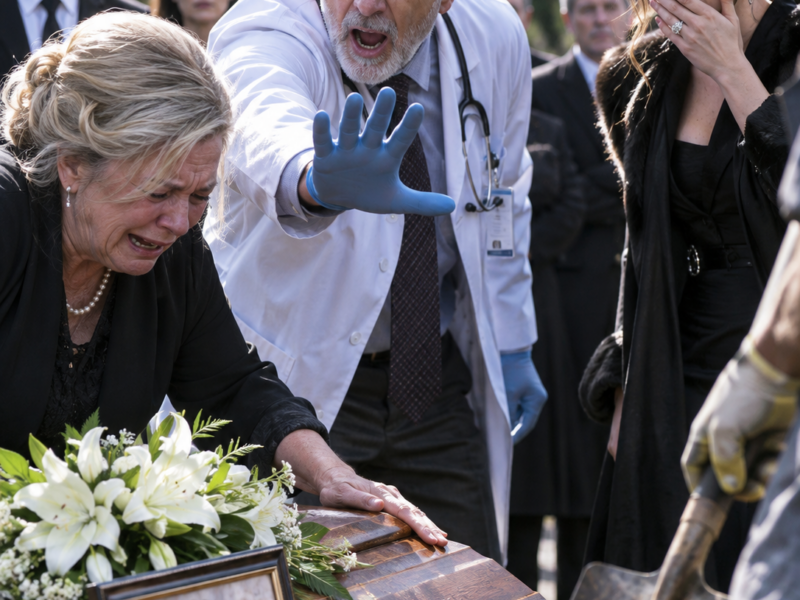
At 63, I Was Burying My Only Son After a Devastating Warehouse Fire When Three Desperate Knocks Suddenly Came From Inside His Coffin. My Daughter-in-Law Grabbed the Cemetery Worker and Screamed, “I’ll Pay You Whatever You Want—Just Finish the Burial!” Horrified, I Demanded They Open the Casket, but Nothing Could Have Prepared Me for What Was Inside. Then, Just Hours Later, My Phone Lit Up With a Message From My Dead Son’s Number: “Dad, Don’t Come Looking for Me…”
At 63, I Was Burying My Only Son After a Devastating Warehouse Fire When Three Desperate Knocks Suddenly Came From Inside His Coffin. My Daughter-in-Law Grabbed the Cemetery Worker and Screamed, “I’ll Pay You Whatever You Want—Just Finish the Burial!” Horrified, I Demanded They Open the Casket, but Nothing Could Have Prepared Me for What Was Inside. Then, Just Hours Later, My Phone Lit Up With a Message From My Dead Son’s Number: “Dad, Don’t Come Looking for Me…”
Part 1
The first time I heard my dead son scream, his coffin was already halfway into the ground.
I was sixty-three years old, standing in the cold September rain, watching the walnut casket descend into a grave that had been dug for my only child. Three days earlier, someone had told me that Garrick Teague, my thirty-eight-year-old son, had died in a warehouse fire. His body had supposedly been burned beyond recognition.
His wife, Rosalyn, had identified him by his wedding ring.
I had spent those three days crying until my eyes burned. I had barely eaten, barely slept, and repeatedly dialed Garrick’s number just to hear his voicemail.
But Rosalyn hadn’t cried once.
She stood beside me in an expensive black dress, her hair perfectly arranged, her hands folded neatly in front of her. While I struggled to remain standing, she kept checking the time.
“Dad, you’re shaking,” she whispered.
“I’m burying my son.”
“I understand. But the cemetery has another service scheduled. We really should finish.”
I turned toward her.
“Rosalyn, that boy was my entire world.”
Her expression barely changed.
“You’ve already said goodbye.”
Before I could answer, she nodded toward the cemetery worker.
“Go ahead.”
The machinery began humming.
I watched my son’s coffin sink into the earth.
Then someone shouted from behind us.
“STOP THE BURIAL!”
A man in a gray coat came running across the wet grass. He pushed through the mourners, grabbed my arm, and nearly pulled me off my feet.
“Mr. Teague? I’m Dr. Ansel Garrity from the county coroner’s office. That coffin cannot be buried!”
“What are you talking about?”
“There’s been a serious mistake.”
Rosalyn immediately stepped forward.
“This is a private funeral. You’re upsetting my father-in-law.”
The doctor ignored her.
“Stop the lowering equipment!”
The motor stopped.
For one terrible second, everything went silent.
Then came a sound I will remember until the day I die.
A muffled scream.
It came from inside the coffin.
Three desperate knocks followed.
Someone behind me screamed. A woman collapsed onto the grass. The minister dropped his Bible.
I couldn’t move.
Then I heard another faint удар against the wood.
“Garrick?”
My voice sounded like it belonged to someone else.
“GARRICK!”
I stumbled toward the grave.
“Open it! Somebody open that coffin!”
But before anyone could move, Rosalyn lunged at the cemetery worker.
“DON’T TOUCH IT!”
Everyone froze.
Her face had changed completely. The calm, composed widow was gone. Her eyes were wide with terror.
“Keep lowering it!” she screamed. “Finish the burial!”
The worker stared at her.
“Ma’am, there’s somebody alive inside.”
“You’re imagining things! It’s the machinery!”
“We all heard it,” someone shouted.
Rosalyn grabbed the worker’s sleeve.
“I’ll pay you! Whatever you want! Just finish!”
I stepped between them.
“Rosalyn, what the hell is wrong with you?”
For a moment, she looked directly into my eyes.
And I saw something worse than cruelty.
I saw recognition.
She knew there was someone inside that coffin.
She had known before the first scream.
Dr. Garrity ordered the workers to raise it immediately.
The machinery groaned as the coffin slowly emerged from the grave.
Two men rushed forward and fought with the latches.
I was praying out loud.
“Please, God. Let my boy be alive. Please.”
The lid finally opened.
And my heart stopped.
The man inside wasn’t Garrick.
A stranger lay against the white satin lining, his wrists and ankles bound with plastic restraints. His face was pale, his lips cracked, and a terrible bruise covered one side of his head.
He was breathing.
Barely.
The name on his security uniform read KENDRICK PRUITT.
Dr. Garrity checked his pulse.
“Call an ambulance. Immediately!”
I stared at the uniform.
“Ashford Industrial,” I whispered.
The doctor looked up.
“What?”
“That badge. That’s where Garrick supposedly died.”
The ambulance arrived minutes later.
While paramedics worked to stabilize Kendrick, I turned toward Rosalyn.
“Where is my son?”
She stepped backward.
“Dad, he’s dead.”
“Then whose body was in that fire?”
“I don’t know.”
“Why did you try to bury this man alive?”
Her lips trembled.
“I was confused.”
“No. You were frightened.”
She turned away.
“I’m leaving.”
Dr. Garrity stepped between her and the parking lot.
“Mrs. Teague, the police will want to speak with you.”
She stared at him coldly.
“Then they can contact my attorney.”
A few minutes later, she disappeared into the gathering crowd.
And somehow, despite almost ninety witnesses, she managed to leave before the police arrived.
I sat outside the cemetery office with a blanket around my shoulders.
Dr. Garrity joined me carrying two cups of coffee.
“Mr. Teague,” he said quietly, “there’s something I need to explain.”
I gripped the blanket.
“Tell me where my son is.”
“I don’t know. But I’m certain the man recovered from the warehouse fire wasn’t Garrick.”
My hands began trembling.
“How can you be certain?”
“The remains contained a steel surgical rod in the left thigh. Your son never had that operation.”
I shook my head.
“Only a broken wrist when he was twelve.”
“Exactly.”
The doctor explained that the original identification had been provisional. A wallet, a wedding ring, and Rosalyn’s statement had been enough for the funeral arrangements to proceed while further examination remained unfinished.
That morning, the X-rays had reached his desk.
The surgical implant had exposed the mistake.
“So Garrick could still be alive?”
Dr. Garrity looked at me.
“I can’t promise that.”
“But he could?”
“Yes.”
I began crying again.
Only this time, something unfamiliar was mixed with the grief.
Hope.
Police Chief Tamsen Dockery arrived shortly afterward.
She was a tall woman with cropped gray hair and the kind of eyes that seemed to notice everything.
She listened while I described Rosalyn’s behavior.
Then she asked about my son’s final days.
I remembered our last Sunday together.
Garrick had come to my house for coffee, as he had almost every Sunday since leaving home.
He looked exhausted.
“Something’s wrong with the company, Dad,” he’d said.
Garrick owned seventy percent of Teague Commercial Restoration. His longtime friend and business partner, Thaddius Ror, owned the remaining thirty percent.
“What kind of trouble?” I’d asked.
“Money disappearing. Payments that don’t make sense. Thaddius keeps avoiding my questions.”
“Then confront him.”
“I already did.”
“And?”
Garrick had stared into his coffee.
“Give me a week, Dad. I’ll know everything.”
That was the last conversation we’d had.
When I told Chief Dockery, she immediately wrote down Thaddius’s name.
Then she asked whether Garrick had left anything with me.
I remembered a red toolbox in my garage.
He had brought it over a week earlier.
“Keep this safe, Dad,” he’d said.
“What’s inside?”
“Nothing dangerous. Just don’t open it unless I ask.”
He’d smiled.
“I’ll explain next Sunday.”
Next Sunday never came.
The chief promised to examine the warehouse, the funeral home, and Garrick’s business.
Before leaving, she told me that Kendrick Pruitt was alive at Riverside Memorial Hospital, although doctors couldn’t question him yet.
“He may know what happened to your son,” she said.
Then she showed me a phone record.
At 11:18 on the night of the fire, Garrick’s phone had called Rosalyn.
The conversation lasted forty-one seconds.
Rosalyn had told investigators they spoke for several minutes while Garrick drove home.
But his phone never left the warehouse’s cell tower area.
And immediately after that call, it went dead.
“She lied,” I whispered.
“We know her account doesn’t match the records,” the chief replied.
I looked toward the cemetery gates.
A few hours earlier, I had believed my son was beneath the earth.
Now I knew someone had planted another man’s belongings on a burned body, placed a living security guard inside my son’s coffin, and tried desperately to prevent anyone from opening it.
I was still sitting there when my phone vibrated.
The screen displayed a name I hadn’t seen since Tuesday.
Garrick.
A message appeared.
Dad, don’t come looking for me.
I read it again.
Then again.
My hands went numb.
Chief Dockery took one look at my face.
“Who sent that?”
I showed her.
She immediately reached for her radio.
But I barely heard her speaking.
Because one terrible question was already forming inside my head.
If my son was alive, why would he tell his father not to find him?
And if someone else had written that message, how close were they to killing him?
Part 2
The following morning, Thaddius appeared at my door carrying homemade chicken casserole.
He hugged me, called Garrick his brother, and pretended to cry.
Then he started asking questions.
“What exactly did the coroner discover?”
“Something about bones,” I answered.
“Did Garrick leave any business documents with you?”
“Not that I remember.”
“Perhaps in your garage?”
I watched him carefully.
“Why?”
He explained that a company called Meridian Crest Holdings was preparing to purchase Garrick’s business for $2.6 million.
The closing was scheduled for October 4.
According to Thaddius, Garrick had already agreed to the sale.
That made no sense.
My son had spent twelve years building that company. He’d never mentioned selling it.
Then Thaddius said something that chilled me.
“That poor security guard. Imagine spending three days trapped in a coffin.”
I lowered my coffee.
“How do you know how long he was inside?”
His expression changed.
“The news, probably.”
“The news never mentioned that.”
He quickly stood.
“I should go.”
After he left, I called Chief Dockery.
Then I went into my garage and opened Garrick’s red toolbox.
There were ordinary tools inside.
Nothing else.
At least, that was what I believed.
I didn’t know that somebody would soon burn my garage to the ground to destroy what was hidden beneath its lining.
Part 3
By Saturday afternoon, I had learned something that made my own home feel like enemy territory.
Rosalyn wasn’t simply grieving strangely.
She was trying to take everything my son owned.
My attorney, Adelaide Fenwick, had spent the previous day examining papers filed in Garrick’s estate.
When she spread them across her desk, I recognized my son’s name immediately.
But I didn’t recognize his signature.
A will dated September 9 left everything to Rosalyn.
A separate amendment transferred Garrick’s voting rights in the company to his wife upon his death.
Another document gave Rosalyn sweeping power of attorney over his finances while he was alive.
All three carried notarized signatures.
“Orin,” Adelaide said, “someone prepared for both possibilities.”
“What possibilities?”
“If Garrick died, Rosalyn would inherit his controlling interest. If he survived, she could attempt to use the power of attorney to control his business.”
My mouth went dry.
“Who witnessed these papers?”
She turned the page.
“Thaddius Ror.”
I remembered the man sitting in my kitchen that morning, asking about my garage.
Adelaide showed me the signature.
Garrick always made the letter G with a small loop at the bottom. His mother, Lorraine, had taught him that when he was a child.
The signature on the document was perfectly straight.
“That isn’t his,” I whispered.
“We’ll have an expert examine it.”
Fern Abernathy, Garrick’s longtime office manager, sat beside us.
She had been fired that morning and locked out of the company building.
When Adelaide mentioned the document’s date, Fern looked up.
“September ninth? Garrick was in Allentown all day. I scheduled the trip myself.”
Adelaide immediately asked her to write a statement.
Then my attorney received another call.
An insurance company had discovered that the beneficiary on Garrick’s $500,000 life insurance policy had been changed from me to Rosalyn several months earlier.
Rosalyn had already submitted a claim.
I sat speechless.
For years, that woman had eaten Sunday dinner in my kitchen. She had brought flowers to Lorraine’s grave. She had called me Dad.
And while she was smiling across my dinner table, someone had been preparing paperwork to profit from my son’s death.
But the insurance money was only the beginning.
Fern opened her purse and removed a small green notebook.
“I think this is why Garrick was frightened,” she whispered.
Inside were eighteen suspicious company payments totaling $420,000.
Some went to Bright Haven Foundation, Rosalyn’s charity.
Others went to Northline Asset Services, a company with a rented office in Camp Hill.
Every payment had been approved by Thaddius.
Every payment was carefully kept below the amount requiring Garrick’s approval.
I stared at the numbers.
“My son was being robbed.”
Fern wiped her eyes.
“He discovered the payments in July. He asked me to make copies. I thought he was investigating financial mistakes.”
“Did Thaddius know?”
“I don’t think so.”
Adelaide closed the notebook.
“Now we know why someone wanted those company records.”
Before we could discuss it further, Chief Dockery called.
Kendrick Pruitt had regained consciousness.
And he was demanding to speak to me.
At Riverside Memorial, I found him lying beneath white sheets, his face badly bruised.
When he saw me, his eyes filled with tears.
“Mr. Teague.”
I sat beside his bed.
“How do you know me, son?”
“Your picture. Garrick kept it on his desk. You were fishing together.”
My throat tightened.
It was a photograph from our annual trip to the lake.
Garrick had been six years old when we began that tradition.
“Where is my boy?” I whispered.
Kendrick looked toward the police chief.
“He didn’t die in that fire.”
Then he told us what happened.
On Tuesday night, Garrick arrived at the Ashford warehouse shortly before ten.
He seemed frightened and asked Kendrick to record his arrival time.
Around 10:40, Kendrick heard shouting from a back office.
When he ran toward the noise, two men were dragging Garrick through a doorway.
“He was fighting,” Kendrick whispered. “He kept shouting for them to let go.”
“What happened next?”
“Someone came up behind me.”
Kendrick remembered the sound of a dragging foot.
Then a blow to his head.
When he woke, his wrists were restrained and everything was dark.
He had no idea where he was.
He screamed until his throat burned.
At some point, he heard men carrying him, then smelled fresh wood and funeral flowers.
Someone had placed him inside the coffin.
“I kept knocking,” he whispered. “Sometimes I heard people outside.”
My stomach twisted.
The previous evening, I had stood beside that coffin at the funeral home.
I remembered hearing a dull thump.
I’d dismissed it as wood settling.
Kendrick gripped my hand.
“Someone spoke through the lid. A man with a friendly voice.”
“What did he say?”
“He told me to hold on until Friday.”
I closed my eyes.
Friday was the burial.
Someone had planned to murder Kendrick by lowering him into the ground alive.
And Rosalyn had tried to make certain the plan succeeded.
That evening, I stayed at the hospital.
Chief Dockery assigned an officer to guard Kendrick’s room.
Around nine, the nurse warned us that no sedatives were authorized because Kendrick needed to remain alert for further questioning.
Forty minutes later, the officer was called downstairs to receive an urgent package.
A man wearing hospital scrubs entered the room.
His face was hidden behind a surgical mask.
He carried a syringe.
“Medication for Mr. Pruitt,” he said.
I stood.
“The doctor ordered no sedatives.”
“Orders changed.”
“Where’s your medication scanner?”
He hesitated.
“It’s broken.”
“Then get another.”
His voice changed.
“Move aside, old man.”
I planted myself between him and the bed.
“No.”
He shoved me so hard that I crashed against an intravenous pole.
Pain exploded through my shoulder.
I grabbed his clothing as he tried to reach Kendrick.
He struck me across the jaw.
I fell, but managed to pull the identification badge from his neck.
Then I screamed for help.
The man fled just as hospital staff rushed inside.
The badge belonged to a respiratory therapist who was supposedly vacationing in Florida.
Kendrick was shaking uncontrollably.
When Chief Dockery arrived, he whispered something that silenced the entire room.
“That voice.”
She leaned closer.
“What about it?”
Kendrick swallowed.
“That’s the man who talked to me through the coffin.”
Someone was eliminating witnesses.
And they knew exactly where to find them.
On Sunday, Chief Dockery took me to the burned warehouse.
I had worked in fire protection for thirty-one years, and something about the destruction immediately bothered me.
The sprinkler system should have contained the flames.
Instead, the main water valve had been deliberately closed and secured.
The alarm wire had been cut.
A maintenance tag carried the name Lyall Hargrove.
But Lyall had been missing since before the fire.
His mother told us he had complained about orders from Thaddius to leave the sprinkler system disabled.
The more we investigated, the clearer the picture became.
The missing money.
The forged papers.
The suspicious fire.
The disappearance of Garrick.
The attempted burial of Kendrick.
None of it was accidental.
Then Rosalyn held a public memorial event for my son.
She stood beneath a huge photograph of Garrick and announced a scholarship in his name.
Television cameras recorded her tears.
Thaddius stood beside her, promising that the $2.6 million company sale would proceed.
I couldn’t remain silent.
I stood in the back row.
“Where is my son, Rosalyn?”
Every camera turned toward me.
She clutched her chest.
“Dad, you’re frightening me.”
“Then tell me where he is!”
She began crying.
She accused me of threatening her.
Within minutes, a deputy served me with a temporary protective order prohibiting contact with her.
I left that building humiliated, furious, and legally forbidden from approaching the woman who might know where Garrick was being held.
That night, I sat alone in my kitchen, looking at Lorraine’s photograph.
“What would you do, sweetheart?” I whispered.
My phone rang.
Chief Dockery sounded terrified.
“Orin, get out of your house. Now!”
“What’s happening?”
“Your garage is on fire.”
Part 4
I stood barefoot on my front lawn and watched flames consume the place where my son had spent half his childhood.
My garage contained Lorraine’s gardening tools, Garrick’s old baseball trophies, and thirty years of photographs, Christmas decorations, and ordinary things that become priceless after the people connected to them are gone.
Now everything was burning.
Firefighters arrived within minutes.
They contained the fire before it spread to the house.
But the damage was terrible.
My neighbor, Iris Callaway, had seen a man leaving the alley shortly before the flames appeared.
He carried a gasoline container.
He wore a dark jacket and a baseball cap.
And he dragged his left foot.
When she mentioned the limp, I remembered a man who had fled through the back door of the funeral home during our investigation.
The same strange gait.
The same gray van.
Chief Dockery arrived and immediately recognized the connection.
“Someone wanted something from your garage,” she said.
“Garrick’s toolbox,” I whispered.
We entered the blackened building after firefighters declared it safe.
The toolbox lay beneath a collapsed shelf.
Its paint was blistered and its plastic lining had melted.
I lifted it carefully.
Something looked different.
Beneath the destroyed foam was a thin steel plate fastened with two screws.
A firefighter removed them.
Inside the hidden compartment lay a small fire-resistant pouch.
My hands trembled as I opened it.
There was a black encrypted drive.
And a note.
Dad, if you’re reading this, something has happened to me. Give this drive to Chief Dockery. Do not trust Rosalyn or Thaddius. The password will find you. I love you.
I pressed the note against my chest and cried.
A minute later, my phone received an email from an unfamiliar address.
The subject line read:
Dad, open.
The message explained that Garrick had created a dead man’s switch, an automated system that would send the email if he failed to check in for seven days.
He had discovered that company funds were being stolen.
He had found documents bearing forged signatures, including paperwork falsely suggesting that my original business loan had been repaid.
In 2014, I had lent Garrick $240,000 to start his company.
Someone had attempted to erase my claim against the company’s equipment before the sale.
The drive contained bank statements, emails, and copies of suspicious filings.
But it was password protected.
Garrick had left one clue.
Remember the little fish at the lake.
I began laughing through tears.
When Garrick was six, he’d caught a fish barely larger than my thumb.
He wanted to keep it.
I’d told him it was too small.
He cried all the way home.
And for thirty years, whenever something wasn’t worth fighting over, we’d joked about that little fish.
I told Chief Dockery the phrase.
She entered it into the encrypted drive using a forensic copy.
It opened.
Inside were financial records proving that Garrick had been investigating Rosalyn and Thaddius for months.
The forged company sale documents were there.
So were emails discussing transfers through Northline Asset Services.
And a record showing the attempted termination of my loan.
The drive didn’t reveal Garrick’s location, but it gave police something they desperately needed.
Evidence.
Adelaide immediately began challenging the fraudulent documents and notifying Meridian Crest’s attorneys.
Meanwhile, investigators traced the burned body’s surgical implant to a missing man named Curtis Vane.
Curtis had been forty-one.
He had a family waiting for him in Lancaster.
The realization nearly destroyed me.
My son hadn’t been buried.
But somebody else’s son had been killed and used to create the illusion of his death.
The following day, the funeral home director finally agreed to speak.
Her name was Hester Gaskell.
She admitted accepting $18,000 in cash from a stranger who arrived in a gray van with a replacement body bag.
He told her the family had authorized a private examination of the remains.
She allowed him to exchange the contents without checking.
Then she locked the coffin.
“Was the bag heavy?” Chief Dockery asked.
Hester nodded.
“Was it warm?”
She began crying.
“Yes.”
I nearly stood up.
“You knew someone might be alive!”
“I was afraid!”
“You heard him knocking!”
She covered her face.
“I know.”
After several minutes, she gave us the driver’s name.
Boyd Tacket.
I knew Boyd.
Years earlier, he’d worked for Garrick before suffering a terrible construction accident that permanently damaged his leg.
Garrick had helped pay his medical bills.
Boyd had attended Lorraine’s funeral.
He’d stood at the back of the church, crying.
I remembered shaking his hand.
And now he was the man who had transported a living person into a coffin.
Police traced him to a house in York.
But when they arrived, Boyd was gone.
Inside, they found evidence that he had fled in a hurry.
They also discovered Lorraine’s funeral remembrance card beside his bedroom mirror.
I sat on the bare mattress and stared at it.
“He kept her picture,” I whispered.
Chief Dockery stood beside me.
“Maybe he’s not doing this willingly.”
“Then who is controlling him?”
She didn’t answer.
Because she had begun suspecting something even more frightening.
Someone inside her own police department was leaking information.
The criminals had known about Kendrick’s hospital room.
They had known when police patrols passed my property.
And now Boyd had disappeared almost immediately after investigators obtained his address.
Chief Dockery devised a trap.
She privately told three officers that a second copy of Garrick’s evidence drive would be stored overnight at three different locations.
Each officer received a different location.
Detective Lucian Straoud was told the drive would be in Adelaide’s office.
Sergeant Baird was told Iris’s house.
Officer Reigns was told my burned garage.
Only one story was true to each listener.
None of the drives existed.
We waited.
At nearly two in the morning, a gray van stopped outside Adelaide’s office.
Boyd Tacket climbed out carrying a gasoline container.
State police officers intercepted him near the back entrance.
He fell to his knees and began sobbing.
“I didn’t want any of this!”
His confession exposed the traitor.
Detective Lucian Straoud.
The same detective who had comforted me at the cemetery.
The man who had wrapped a blanket around my shoulders and asked where I would be staying.
He had been accepting payments through Northline.
Boyd said Straoud had threatened him with prosecution over past disability fraud and pressured him into transporting people, moving evidence, and destroying property.
Finally, Boyd told us what he knew about the night Garrick disappeared.
He had driven the van to the warehouse.
He watched two men carry Garrick outside.
My son was alive.
Bound, gagged, and struggling.
Boyd transported them to another location but wasn’t allowed to see exactly where Garrick was taken.
“He was breathing when I last saw him,” Boyd whispered.
I pressed my hands against the interrogation-room window.
For the first time, I had a living witness who had seen my son after his supposed death.
But Boyd couldn’t tell us where the kidnappers had taken him.
Then, after investigators arrested Straoud, a new piece of evidence emerged.
A photograph taken on a hidden phone.
It showed Garrick sitting in a wooden chair.
His wrists were tied.
His face was bruised.
A chain ran from one ankle toward the floor.
He held a sheet of paper.
On it were five words.
Dad, please do what they say.
Beneath the photograph was a demand.
Hand over the evidence drive.
Withdraw the legal challenges.
Allow the company sale to proceed.
Or Garrick would die.
I stared at the photograph until my vision blurred.
Then I turned toward Chief Dockery.
“I’ll do whatever they want.”
She gripped my arm.
“Orin, we can use this.”
“That’s my son!”
“I know.”
“No, you don’t understand. I’ve already watched them put a coffin into the ground with his name on it. I will not let them put his body in another one.”
The chief’s voice softened.
“Then help me bring him home.”
Part 5
The hardest thing I ever did was pretend to surrender to the people who had stolen my son.
Police arranged for me to speak with the kidnappers while investigators monitored the call.
The voice on the other end was disguised.
He demanded the drive, the withdrawal of the lawsuits, and my cooperation with the company sale.
I told him I needed several days.
“You’re running out of time, old man.”
“Please,” I whispered. “He’s my only son.”
There was a pause.
Then the voice said something that made my blood run cold.
“Rosalyn says you’re a stubborn bastard.”
I closed my eyes.
So there it was.
My daughter-in-law hadn’t merely taken advantage of Garrick’s disappearance.
She was directing the people holding him.
For twelve years, she had called me Dad.
Now she was using my son as leverage to steal the company he had built.
While I maintained contact with the kidnappers, Adelaide fought Rosalyn in court.
The temporary protective order against me was dismissed after recordings and hospital records contradicted her allegations.
The evidence drive exposed the suspicious payments.
The false documents were challenged.
Meridian Crest’s attorneys began cooperating with investigators once they realized the sale could involve forged signatures and an unlawfully claimed ownership interest.
Then Thaddius finally broke.
Facing the possibility of serious criminal charges, he agreed to speak.
He admitted approving the payments to Rosalyn’s foundation and Northline.
He confirmed that she had organized the falsified documents.
And he admitted that Detective Straoud had received regular payments.
But when Chief Dockery asked where Garrick was being held, Thaddius began trembling.
“I never wanted him hurt.”
“Then where is he?”
“I don’t know.”
I leaned across the table.
“You brought casserole into my kitchen.”
He covered his face.
“Orin, please.”
“You hugged me while you knew my son had been kidnapped.”
“I didn’t know they’d keep him this long.”
“You knew he was alive?”
He couldn’t answer.
I stood.
“You sat across from a father who thought he’d buried his child. And you asked about business papers.”
Thaddius began crying.
“I thought Rosalyn would release him after the sale.”
I looked at Chief Dockery.
“Get me out of here before I do something I’ll regret.”
Outside the interrogation room, Adelaide took my hand.
“Orin, every confession brings us closer.”
“Closer isn’t enough.”
“I know.”
But I could see from her expression that she was frightened too.
October 4 was approaching.
The kidnappers were becoming desperate.
And the longer Garrick remained hidden, the less likely it seemed that they intended to let him walk away.
Then investigators discovered something important.
Boyd had been ordered to travel to Lemoyne, across the river from Harrisburg.
Phone records and surveillance connected several suspicious vehicles to an old residential property.
The building belonged to an individual associated with Northline.
Neighbors said its basement lights remained on at strange hours.
Police obtained access to nearby surveillance footage.
One recording showed two men carrying heavy bags inside.
Another showed a vehicle arriving with a restrained-looking passenger several days earlier.
The images were unclear.
But one man appeared to be wearing Garrick’s distinctive work jacket.
Chief Dockery showed me the footage.
“Is that your son?”
I leaned closer.
The man was bent forward.
His face was hidden.
But I recognized the broad shoulders and the way he moved his head.
My heart began pounding.
“That’s him.”
“Are you certain?”
“I’ve watched him walk away from my porch thousands of times.”
She nodded.
“Then we prepare carefully.”
The police couldn’t simply rush inside.
Investigators believed the captors had prepared the basement with gasoline.
If officers approached carelessly, the kidnappers might ignite the building.
They needed to prevent the suspects from harming Garrick and stop a possible fire before it started.
While tactical officers studied the property, I waited in a nearby church with Adelaide.
It was shortly after three in the morning when Chief Dockery received an update.
Two men were inside the house.
A third person appeared to be confined in the basement.
The chief turned toward me.
“Orin, I need you to stay here.”
I shook my head.
“Please don’t ask me to wait.”
“I have to.”
I wanted to argue.
But I remembered the coffin.
The screams.
The three knocks.
And how close we had come to burying a living man.
I sat down.
Adelaide rested her hand over mine.
The church clock ticked above us.
Minutes passed.
Then a radio crackled.
Officers had reached the rear basement entrance.
A thermal camera suggested three people were below.
Two standing.
One seated.
My heart began pounding so hard that I could barely hear.
“That’s him,” I whispered.
Chief Dockery raised her radio.
“Teams, move.”
The next seconds unfolded like a nightmare.
A crash.
Shouting.
Heavy footsteps.
Then a voice over the radio screamed:
“He’s got a lighter!”
I stopped breathing.
Someone shouted for the suspect to drop it.
Another officer reported gasoline across the basement floor.
There was a struggle.
Then silence.
I gripped Adelaide’s hand until she winced.
“Please, God.”
The radio crackled again.
“Lighter secured. Suspect restrained.”
Another voice followed.
“Second suspect in custody.”
Then:
“We have the hostage. He’s conscious.”
I couldn’t speak.
Chief Dockery leaned toward the radio.
“Repeat that.”
“Male hostage. Alive. Dehydrated. Restrained to a pipe. Medical team moving in.”
I covered my mouth.
Then a faint voice came through the speaker.
A voice I knew better than my own.
“Is my dad here?”
I made a sound that seemed to come from somewhere deep inside my chest.
Chief Dockery turned toward me.
Her eyes were filled with tears.
“Orin. We have him.”
I stared at her.
“Alive?”
She nodded.
“Your boy is alive.”
I don’t remember leaving the church.
I remember running down the pavement despite my aching knees.
I remember cold air against my face.
I remember an ambulance waiting beside a narrow alley.
Then two paramedics appeared, pushing a stretcher.
The man lying beneath the blanket was painfully thin.
His hair was matted.
His face was covered with bruises.
For one awful second, I almost didn’t recognize him.
Then he turned his head.
“Dad?”
I fell to my knees beside the stretcher.
“Garrick.”
He tried to smile.
“Hey, Dad.”
I took his hand.
It felt like bone wrapped in cold paper.
“I’ve got you, son.”
His eyes filled with tears.
“They told me you gave up.”
I shook my head.
“Never.”
“They said you signed everything over. That you didn’t care anymore.”
I pressed his hand against my cheek.
“Listen to me. There isn’t enough money in this world to make me stop looking for you.”
He began crying.
“I thought I was going to die in that basement.”
I leaned closer.
“You’re coming home.”
He squeezed my fingers.
“Did you find the toolbox?”
I laughed through tears.
“Yes.”
“The password?”
“Too small to keep.”
His face crumpled.
“I knew you’d remember.”
I kissed his forehead.
“I remember everything about you, son.”
For several minutes, I couldn’t let go.
The paramedics finally told me they needed to transport him.
Chief Dockery arranged for me to ride in the ambulance.
I sat beside Garrick while the vehicle carried us toward the hospital.
He kept his eyes on me, as though afraid I might disappear if he looked away.
“Dad?”
“I’m here.”
“Don’t let Rosalyn near me.”
My throat tightened.
“She won’t touch you.”
He closed his eyes.
Then whispered:
“She was there.”
I leaned forward.
“Where?”
“In the basement. She came to see me.”
My hands went cold.
“What did she say?”
His breathing grew uneven.
“She told me the company would be sold whether I signed or not. She said I should be grateful they were keeping me alive.”
I stared at him.
“Your own wife said that?”
He nodded.
“Dad, I begged her to let me call you.”
“What did she do?”
He turned his face toward the ambulance wall.
“She laughed.”
I felt something inside me harden.
But when Garrick reached for my hand again, all I wanted was to hold him.
The following morning, Chief Dockery arrived at the hospital with important news.
The two men in the basement had been arrested.
The recovered evidence tied them to the kidnapping.
Investigators also had the financial records, witness statements, and communications connecting Rosalyn to the conspiracy.
The company sale was still scheduled for that afternoon.
Although the transaction had already been challenged, Rosalyn apparently believed her lawyers could force it through before the full situation became public.
Chief Dockery wanted to confront her at the closing.
Garrick insisted on going.
“Son, you’re barely strong enough to sit up.”
“Then put me in a wheelchair.”
I looked at the doctor.
After some discussion, medical staff agreed to a brief, closely supervised appearance.
We reached the conference room shortly before two.
Rosalyn sat at the head of a long polished table, wearing a black dress and pearls.
Thaddius wasn’t there.
Several attorneys sat around her.
She was signing paperwork when I entered.
Her expression hardened.
“Orin, what are you doing here?”
“I came to see the closing.”
“You have no authority over this company.”
“Neither do you,” I answered.
She started to protest.
Then the conference-room door opened again.
A wheelchair rolled inside.
Garrick lifted his head.
“Hello, Rosalyn.”
Her pen fell from her hand.
For several seconds, nobody moved.
She stared at him.
Then whispered:
“No.”
Garrick looked directly at her.
“Surprised?”
She stepped backward.
“You’re supposed to be—”
She stopped herself.
But everyone heard it.
Garrick’s voice was weak.
“Dead?”
Rosalyn’s face turned white.
Chief Dockery stepped forward with officers and informed her that she was under arrest on charges connected to the kidnapping, attempted murder, forgery, and criminal conspiracy.
Rosalyn looked from the officers to Garrick.
Then to me.
For the first time since the funeral, tears genuinely filled her eyes.
Not because she had nearly lost her husband.
Because she had lost control.
As an officer approached, she grabbed the edge of the table.
“Garrick, listen to me.”
He shook his head.
“I listened to you for twelve years.”
“Please.”
“You watched them take me.”
Her lips trembled.
“You don’t understand.”
“You came into that basement and told me nobody was coming.”
She began crying harder.
Garrick looked at me.
“Dad came.”
I couldn’t stop my own tears.
Rosalyn suddenly turned toward me.
“This is your fault! He always cared more about you than me!”
I stood perfectly still.
“No, Rosalyn. This happened because you cared more about money than the man who loved you.”
Officers led her toward the door.
Before leaving, she twisted around one last time.
“You still don’t know everything!”
Chief Dockery stopped her.
“What do you mean?”
Rosalyn smiled bitterly.
“Ask your precious witnesses what happened to the other people.”
I felt Garrick’s hand tighten around mine.
The investigation continued long after that afternoon.
The burned remains were formally identified as Curtis Vane, allowing his family to begin mourning him properly.
Lyall Hargrove, the missing sprinkler technician, was eventually found alive after being held captive in a storage unit.
Kendrick recovered from his injuries, although he struggled for months with nightmares about darkness and enclosed spaces.
Boyd Tacket cooperated with investigators, but that didn’t erase his responsibility.
Detective Straoud faced criminal proceedings for betraying his position.
Thaddius’s confession helped investigators follow the stolen money through the companies and forged transactions.
And Rosalyn finally had to answer for what she had done in a courtroom rather than behind a carefully arranged television camera.
The legal process took time.
I learned that evidence, testimony, and patience mattered more than the satisfaction of watching someone arrested.
Garrick had a much longer recovery.
Some nights, he woke screaming.
Sometimes he couldn’t tolerate a closed bedroom door.
For weeks, I sat beside his hospital bed while he slept.
When he finally came home, I converted my downstairs study into a bedroom so he wouldn’t have to climb stairs.
One Sunday morning, I found him sitting at my kitchen table.
Two cups of coffee waited between us.
He looked up.
“Dad?”
“Yes, son?”
“Do you think I’ll ever feel normal again?”
I sat opposite him.
“I don’t know exactly what normal will look like.”
He stared into his cup.
“I keep thinking I should’ve noticed what Rosalyn was doing.”
“Garrick, look at me.”
He raised his eyes.
“You trusted your wife. You trusted your friend. That doesn’t make you foolish. Their choices belong to them.”
He was silent for a while.
Then he said:
“I almost lost everything.”
I reached across the table.
“Not everything.”
He looked at my hand.
Then he took it.
Months later, when he was strong enough, we drove to the lake where we’d spent so many summers.
I carried the fishing equipment.
Garrick brought two folding chairs.
The morning was bright, and the water was perfectly still.
We sat together without saying much.
Eventually, he caught a small fish.
Barely longer than my thumb.
He held it up.
“Dad, look.”
I started laughing.
He smiled.
“Think we should keep it?”
I shook my head.
“Too small.”
He looked at the fish for a long moment.
Then carefully returned it to the water.
We watched it disappear beneath the surface.
Afterward, Garrick leaned back in his chair.
“You know what I remember most about that coffin story?”
“What?”
“The three knocks.”
I turned toward him.
“Kendrick was almost buried alive,” he continued. “And if nobody had listened, he would’ve died.”
I nodded.
He stared across the lake.
“But you listened, Dad. You kept listening when everyone told you the story was over.”
I thought about the funeral.
About Rosalyn’s dry eyes.
About the coffin descending into the earth.
And about that terrible moment when a stranger’s desperate knocks changed everything.
“I nearly gave up that morning,” I admitted.
Garrick looked at me.
“But you didn’t.”
I put my arm around his shoulders.
“No, son. I didn’t.”
For years, I had believed that the greatest pain a father could endure was burying his child.
Now I understood something else.
Sometimes the people who betray us are the very people we welcome into our homes, trust with our secrets, and love without hesitation.
Rosalyn had sat at my table for twelve years.
Thaddius had been almost like a second son.
Both had smiled while preparing to destroy my family.
But their betrayal didn’t get the final word.
A frightened security guard kept knocking.
A determined coroner refused to ignore the evidence.
A brave police chief kept asking questions.
And a father who had already said goodbye refused to believe that goodbye was the end.
I looked at Garrick sitting beside me, alive beneath the September sunshine.
Then I glanced at the old fishing photograph he had placed between our chairs.
Lorraine was smiling in the background.
For the first time in months, I could look at that picture without crying.
My son had come home.
And no amount of money, no forged signature, and no carefully planned betrayal could change what mattered most.
I had almost buried my child.
Instead, I was sitting beside him, watching the water, grateful for another ordinary Sunday.
And I knew I would never take one for granted again.