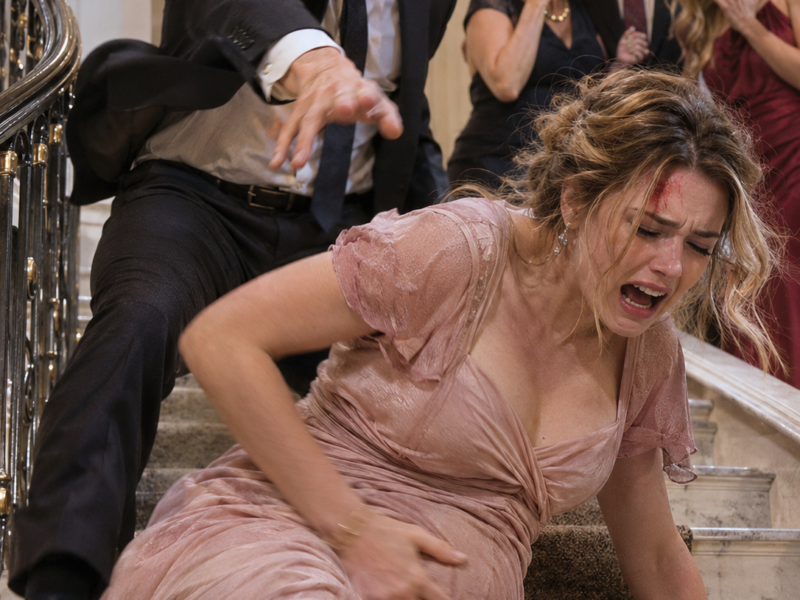
At 61, I attended an $8.6 million charity gala after eight months of silence from my daughter. In front of 300 guests, her wealthy ex-husband sneered, “Even an ugly pig like her has the nerve to show up here,” before shoving her eight-months-pregnant body down a marble staircase. After calling 911, I grabbed the microphone, and his mother screamed for someone to cut the sound. But when I noticed a private medical van that had arrived nearly two hours before the attack, I realized my daughter’s fall might not have been an impulsive act of cruelty…
At 61, I attended an $8.6 million charity gala after eight months of silence from my daughter. In front of 300 guests, her wealthy ex-husband sneered, “Even an ugly pig like her has the nerve to show up here,” before shoving her eight-months-pregnant body down a marble staircase. After calling 911, I grabbed the microphone, and his mother screamed for someone to cut the sound. But when I noticed a private medical van that had arrived nearly two hours before the attack, I realized my daughter’s fall might not have been an impulsive act of cruelty…
Part 1
The night my daughter’s wealthy ex-husband pushed her down a marble staircase, I discovered that there were things far more dangerous than a father’s anger.
There were secrets worth millions of dollars, powerful people willing to destroy innocent lives, and a woman who had spent eight months convincing my daughter that I no longer loved her.
But at the time, all I knew was that my little girl was lying motionless on the floor, eight months pregnant, with blood spreading beneath her head.
My name is Harlan Whitcomb. I was sixty-one years old and had spent thirty-six years inspecting electrical systems and flood pumps for the city of Charleston. I lived in a modest house, drove an aging pickup truck, and had never possessed anything more valuable than my relationship with my daughter, Tamsin.
And for eight months, I believed I had lost her.
It began with an email telling me she was ashamed of my interference in her marriage. She wanted me to respect her husband’s family and stop contacting her.
I called repeatedly. Her number eventually stopped working. I mailed six letters, most of which came back unopened.
Then, one September afternoon, a handwritten card appeared in my mailbox.
“Dad, if you still believe in me, please come to the Harbor Promise charity gala before eight thirty. I need you. I have something very important to tell you.”
I recognized her handwriting immediately.
But on the evening of the gala, just as I parked outside the luxurious Marlowe Hotel, another email arrived.
“Dad, don’t come. I don’t want to see you anymore.”
I stared at those words for several minutes.
Something wasn’t right.
Thirty-six years of inspecting machinery had taught me that when two readings contradicted each other, you went directly to the source.
So I straightened my old gray suit, climbed out of my truck, and entered the hotel.
Nearly three hundred guests had gathered beneath enormous chandeliers. Champagne flowed freely, expensive jewelry glittered, and Charleston’s wealthiest residents congratulated themselves on raising $8.6 million for a flood protection project.
The woman responsible for the fundraiser was Cordelia Ashcroft, my daughter’s former mother-in-law.
Her son, Lyle, owned the company contracted to perform the construction.
I had never trusted Cordelia. She possessed the remarkable ability to insult someone while making everyone around her believe she had offered a compliment.
At the registration desk, a young woman looked up my name.
Her expression changed.
She touched her earpiece and whispered, “He’s here. Right now.”
“Is something wrong?” I asked.
“Not at all, sir. Table forty.”
Her smile was too rehearsed.
I continued into the ballroom, searching every face until a familiar laugh made me stop.
Lyle.
He stood at the top of the grand staircase in a perfectly tailored tuxedo, holding a glass of bourbon.
And standing opposite him was my daughter.
I barely recognized her.
Tamsin wore a dark green dress stretched across an enormous pregnant belly. One hand rested protectively over her unborn child, while the other clutched a black leather bag.
Eight months pregnant.
My own daughter was eight months pregnant, and I hadn’t known.
Before I could call her name, Lyle raised his voice.
“Well, look at this, Mother. Even an ugly pig like her has the nerve to show up here.”
Several guests laughed.
Tamsin’s face went pale, but she refused to lower her head.
“I have an invitation, Lyle. I’m here to meet someone about some documents.”
“Documents?” He laughed. “You can’t even afford the tablecloth.”
“That’s none of your business.”
Cordelia touched her son’s sleeve.
“Darling, people are watching.”
She wasn’t defending Tamsin. She was worried about appearances.
I began pushing through the crowd.
“Excuse me. Please. That’s my daughter.”
A security guard blocked the staircase.
“Sir, nobody goes upstairs without authorization.”
“My daughter is up there.”
“Mrs. Ashcroft instructed us to keep the stairs clear.”
I looked past him. Lyle had moved closer to Tamsin.
“You should have stayed home,” he told her.
“I don’t have to hide anymore.”
“You think carrying that baby makes you important?”
“No,” Tamsin replied. “But it gives me a reason to stop being afraid of you.”
Lyle’s expression changed.
He reached toward her leather bag.
She pulled it against her chest.
“Don’t touch that.”
“Give it to me.”
“No.”
I shoved past the security guard.
“Tamsin!”
She turned toward my voice.
For one beautiful, heartbreaking second, our eyes met.
“Dad?”
Then Lyle placed his hands against her and shoved.
Her heel caught the edge of the step.
The bag flew from her grasp.
Her body fell backward, striking the marble staircase again and again.
The sound of her head hitting the stone silenced the entire ballroom.
I don’t remember crossing the remaining distance. I remember dropping to my knees beside her, calling her name, and seeing blood beneath her hair.
“Tamsin! Baby, open your eyes!”
She didn’t move.
I placed trembling fingers against her neck.
There was a pulse.
Weak, but there.
Above us, Lyle shouted, “She slipped! Everybody saw it!”
I looked up at him.
Every instinct in my body told me to climb those stairs and make him suffer.
Instead, I pulled out my phone and called 911.
“My daughter has been pushed down a staircase. She’s thirty-four weeks pregnant. She’s unconscious. Please hurry.”
A waiter knelt beside me with a napkin. A woman who identified herself as a nurse checked Tamsin’s breathing.
I followed the dispatcher’s instructions, keeping my daughter’s head still while speaking softly into her ear.
“Daddy’s here, sweetheart. I got your card. I came.”
Her fingers twitched.
I began crying.
Then I heard the clicking of expensive heels approaching.
Cordelia bent over us, wearing the same sympathetic expression she used during charity speeches.
“Harlan, I’m terribly sorry. We’ll take care of everything.”
“Your son pushed her.”
“She’s had a difficult pregnancy. Perhaps she became dizzy.”
“I watched him do it.”
“You’re understandably emotional.”
A young man nearby raised his phone.
“I recorded it,” he said. “He definitely pushed her.”
Cordelia turned toward him.
“Young man, this is a private family matter.”
That was when I understood what she intended to do.
She wasn’t going to help my daughter.
She was going to control the story.
After the nurse assured me she would remain beside Tamsin, I walked toward the stage and took the microphone.
Cordelia’s expression hardened.
“Ladies and gentlemen,” I said, my voice echoing throughout the ballroom. “My name is Harlan Whitcomb. The woman lying at the bottom of those stairs is my daughter. She is thirty-four weeks pregnant.”
Nobody moved.
“I watched Lyle Ashcroft push her. If any of you recorded what happened, please preserve every second of that footage. And to the hotel management, do not erase your security recordings. They are evidence.”
“Cut the microphone!” Cordelia snapped.
The speakers went silent.
But it was too late.
Phones rose throughout the ballroom. People began talking. The young man who had recorded the assault approached a security guard.
For the first time that evening, Cordelia looked frightened.
When the paramedics arrived, they stabilized Tamsin and rushed her toward the ambulance.
As I followed them outside, something caught my attention.
A private medical transport van was parked near the service entrance. Two men stood beside an empty stretcher.
A card on the dashboard read:
“Gala Staging — 6:30 P.M.”
My daughter had fallen shortly after eight fifteen.
Why had a private medical vehicle been waiting nearly two hours before the assault?
I memorized its license plate.
At Palmetto Harbor Medical Center, an obstetrician explained that Tamsin had suffered a concussion, a fractured wrist, and a dangerous placental abruption.
The baby’s oxygen supply was compromised.
“We need to deliver immediately,” he said.
“Then please save them.”
I sat alone outside the operating room, praying harder than I had ever prayed.
Eventually, the doctor returned.
“Your daughter is stable. And you have a granddaughter.”
I covered my face with both hands.
“Is she alive?”
“Yes. She’s premature, and she’ll need intensive care. But she’s fighting.”
Several hours later, Tamsin finally opened her eyes.
When she recognized me, tears rolled down her cheeks.
“Dad?”
“I’m here.”
“Why did you come? I thought you hated me.”
I stared at her.
“Sweetheart, I could never hate you.”
“But your messages…”
“What messages?”
Her breathing quickened.
Then she grabbed my sleeve.
“Dad, my bag. You have to find my bag.”
“The police have it.”
“There are documents inside. Inspection reports, invoices, equipment records.”
“Why?”
She swallowed painfully.
“Because the Ashcrofts stole money from the flood protection project. And someone signed your name on inspections you never performed.”
My entire body went cold.
“How much money?”
“Millions, Dad.”
She glanced toward the hospital door.
“And there’s something else. If they find page seven before you do, they’ll destroy the evidence.”
At that moment, I realized the assault at the hotel had been about far more than a bitter divorce.
My daughter had discovered something powerful people desperately needed to keep hidden.
And they had nearly killed her to protect it.
Part 2
The following afternoon, attorney Imogen Calloway joined Detective Lorna Strand and me in the hospital cafeteria to examine Tamsin’s recovered leather bag.
We counted the documents carefully.
Page one. Page two. Page three.
Everything appeared untouched until we reached page six.
The next sheet was page eight.
Someone had torn out page seven.
Tamsin explained that the missing document compared the serial numbers of equipment installed at a flood pumping station with the equipment listed on invoices worth hundreds of thousands of dollars.
Without it, proving the fraud would become considerably harder.
Then Detective Strand showed me an inspection certificate bearing my signature.
It was dated months after my retirement.
“I never signed this,” I said.
“We suspected that.”
Before I could ask another question, my phone rang.
A hospital nurse sounded alarmed.
“Mr. Whitcomb, someone claiming to represent your granddaughter’s father just tried entering the neonatal unit.”
Lyle’s attorney had arrived with legal paperwork.
The same man who had pushed my pregnant daughter down a staircase was now demanding custody of the premature baby he had nearly killed.
But when Imogen examined the documents, she noticed something even more disturbing.
Someone had prepared paperwork concerning the baby before the night of the gala.
And suddenly, that waiting medical van made terrifying sense.
Part 3
Imogen advised me to stop thinking of the Ashcrofts as a wealthy family involved in an ugly divorce.
“Think of them as people protecting a business operation,” she said. “Your daughter became a threat to that operation. Everything they’ve done since then needs to be examined in that context.”
She was right.
The hospital paperwork was an authorization supposedly signed by Tamsin, granting permission for a private medical transfer. However, the signature wasn’t hers.
Someone had anticipated the need to move her.
Whether they intended to intimidate her, isolate her, or prevent her from speaking to investigators, we couldn’t yet establish.
But the documents were suspicious enough for Detective Strand to launch a separate investigation.
Meanwhile, Lyle was arrested for the assault.
At his bond hearing, his attorney, Ambrose Keating, described the incident as an unfortunate confrontation between former spouses.
The prosecutor played the video.
The courtroom watched Lyle insult Tamsin, advance toward her, and deliberately push her backward.
The judge set his bond at $75,000, ordered electronic monitoring, and prohibited him from contacting Tamsin.
Cordelia paid the bond that afternoon.
Before leaving the courthouse, she approached me.
“You were very moving in there, Mr. Whitcomb. I almost wept.”
I said nothing.
She adjusted one of her expensive gloves.
“A good story told too loudly eventually becomes noise.”
“This isn’t a story.”
“Everything is. The only question is who tells it last.”
She walked away.
Hours later, her son’s emergency custody application arrived.
I couldn’t comprehend how someone who had nearly killed his unborn daughter could claim to be concerned about her welfare.
But Imogen explained that because Tamsin had conceived during their marriage, the divorce decree had left certain questions concerning the child unresolved.
Lyle was exploiting that opening.
On Sunday afternoon, I held my granddaughter for the first time.
Tamsin had named her Opal.
She was impossibly small, with delicate fingers that curled around mine.
“Hello, little one,” I whispered.
Tamsin smiled weakly from her hospital bed.
“She knows your voice, Dad.”
I had spent hours talking to Opal through the glass of her incubator. I told her about thunderstorms, fishing boats, and the little garden behind my house.
I promised her that someday, when she was big enough, I would teach her how to grow tomatoes.
Now, holding her against my chest, I made another promise.
Nobody would use this child as leverage.
The following morning, Imogen presented the assault footage, medical records, and criminal court restrictions to the family court.
Lyle’s attorney argued that his client had substantial financial resources and could provide a superior upbringing.
Imogen stood.
“Financial resources do not make a violent parent safe.”
The judge agreed that Opal’s immediate safety came first.
Tamsin retained custody, and Lyle’s access to the baby was restricted.
Outside the courtroom, Keating asked to speak privately.
He offered a settlement.
Two million dollars.
Lifetime medical care for Opal, educational expenses, and enough money for Tamsin to purchase a comfortable home.
In exchange, she would stop cooperating with the investigation, surrender her documents, and agree never to discuss the foundation’s finances.
When I told Tamsin, she stared at me.
“Two million dollars?”
“Yes.”
She looked toward Opal’s incubator.
“Dad, how many people live behind those flood pumps?”
“Thousands.”
“And what happens when the pumps fail?”
“Their homes could be destroyed. People could die.”
She shook her head.
“Then tell them no.”
I had never been prouder of her.
With the assistance of Dr. Hollis Vane, a state official overseeing the investigation, I joined an authorized inspection team examining the equipment purchased through the Harbor Promise Foundation.
A young inspector named Linus Garrity accompanied me to Pump Station Four.
I knew the station intimately. I had inspected its generators for years before retirement.
The moment we opened the equipment housing, I noticed something wrong.
“Where’s the turbocharger?”
Linus looked at the maintenance records.
“It says the generator was upgraded.”
“Then the person who wrote that report never opened this machine.”
We discovered aging components where expensive new ones should have been installed. Serial numbers didn’t match invoices. Replacement equipment listed as operational was either missing or inadequate.
And there, at the bottom of several inspection certificates, was my signature.
My forged signature.
Someone had used my professional reputation to approve fraudulent payments.
I examined the paperwork until a familiar name appeared.
Gideon Tolliver.
For twenty years, Gideon had been my colleague and friend. We had shared lunches, worked through hurricanes, and attended each other’s family celebrations.
I had trusted him completely.
When investigators confronted him, he initially denied everything.
Eventually, he broke down.
Ashcroft Coastal Systems had needed someone familiar with the inspection process. Gideon had access to historical records, including my signature.
They paid him.
Over time, the payments totaled $240,000.
“I was in trouble financially,” he told me. “I thought nobody would get hurt.”
“You signed certificates for equipment that doesn’t exist.”
“I know.”
“You put families in danger.”
“I know, Harlan.”
“And you let them use my name.”
He lowered his head.
I walked away before my anger overcame me.
The financial investigation uncovered an even uglier picture.
Of the $8.6 million raised for flood protection, $6.2 million had already been released to Ashcroft Coastal Systems. The remaining $2.4 million was frozen.
Approximately $2.1 million had been transferred to Marsh Bay Consulting, a company that appeared to provide no legitimate services.
Its registered address was a mailbox.
Its ownership led through another company, Baypoint Ventures, directly to Cordelia Ashcroft.
An investigator named Fenn displayed a map of Southbank, one of Charleston’s most flood-prone neighborhoods.
Eleven properties were marked in red.
“About $1.5 million was used to purchase real estate,” she explained.
I recognized those streets.
They were the first places to flood during heavy storms.
Then the horrifying possibility became clear.
If the flood protection project failed, residents would become desperate to sell their homes. Cordelia’s companies could acquire those properties cheaply, using money originally donated to protect them.
The same woman promising to save an entire neighborhood was positioned to profit from its destruction.
One afternoon, a frightened young woman named Marnie Haskins came forward.
She had worked as an event coordinator at the gala.
She described suspicious instructions concerning Tamsin’s arrival, the staircase, and the private medical transport vehicle.
She also remembered being deliberately redirected away from the area where the confrontation occurred.
Her testimony supported our suspicion that the events surrounding the assault had been carefully arranged.
Then Detective Strand received another breakthrough.
Investigators had traced communications connected to the Ashcrofts’ consulting companies.
They discovered forged emails.
Messages supposedly sent by Tamsin to me had never originated from her.
Messages supposedly sent by me to Tamsin had never originated from me.
Even my letters had been intercepted through a fraudulent mail-forwarding request.
I sat beside my daughter as investigators explained how it had happened.
“They collected my letters?” I asked.
“Yes.”
“And sent them back?”
“Most of them.”
Tamsin began crying.
“Dad, I thought you’d abandoned me.”
I pulled her against my chest.
“I thought you didn’t want me anymore.”
For eight months, we had been mourning a relationship neither of us had chosen to end.
Imogen explained why.
“Tamsin understood the financial paperwork. Harlan understood the machinery. Separately, you each knew part of the truth. Together, you could expose everything.”
Cordelia had understood that before either of us did.
So she had separated us.
But my daughter had one final surprise.
The day before the gala, fearing Lyle might steal her documents, she had mailed copies to the state’s oversight board.
They had been received, scanned, and preserved.
The missing annotated page wasn’t among them, but almost everything else was.
I looked at Tamsin in disbelief.
“You did that before you went to the hotel?”
She nodded.
“I was scared, Dad.”
I kissed her forehead.
“You were brave, sweetheart. Braver than any of us.”
And for the first time since the night of the gala, I believed we might actually win.
Then, late one rainy evening, my phone rang.
It was Linus.
“Mr. Whitcomb, there’s a truck outside Pump Station Four. They say they’re delivering replacement equipment.”
I sat upright.
“Linus, that equipment is under a preservation order.”
“I know, sir. But they’ve brought three men, and they’re insisting I let them inside.”
I grabbed my keys.
“Call Detective Strand. Don’t open that gate.”
The Ashcrofts weren’t finished.
Someone was attempting to replace the very machinery that could prove their crimes.
And they were willing to do it in the middle of the night.
Part 4
By the time I reached Pump Station Four, police lights were flashing against the rain-soaked pavement.
Linus stood inside the gate, holding a clipboard and arguing with a man wearing a yellow raincoat.
Behind him was a white truck bearing the Ashcroft Coastal Systems logo.
“We’re delivering scheduled replacement parts,” the driver insisted.
“Nothing can be installed without written approval from the state,” Linus replied.
“Nobody said anything about installing them.”
“Your work order says otherwise.”
Detective Strand examined the documents while officers secured the vehicle.
Inside the truck were replacement components intended for the very generators investigators had identified as fraudulent.
Had those parts been installed, the equipment would have appeared to match the invoices.
The Ashcrofts could then claim that the inspectors had made a mistake.
But Linus had stopped them.
I watched the young man through the fence, remembering how often experienced workers dismissed younger inspectors for being overly cautious.
That night, his caution had protected an entire investigation.
The delivery records led investigators to Dalton Ames, a manager associated with Baypoint Ventures.
More importantly, the attempted replacement established that someone connected to Cordelia’s companies knew exactly which components were missing.
The financial fraud was becoming increasingly difficult to explain away.
Cordelia responded with a press conference.
Standing before television cameras, she described herself as the victim of a politically motivated investigation.
She expressed sympathy for Tamsin, insisted her son’s actions were unrelated to the foundation, and promised that the Ashcroft family would be vindicated.
Watching from my living room, I felt my blood pressure rise.
Tamsin reached for the remote and switched off the television.
“Dad, she’s talking because she knows we’re listening.”
I looked at her.
“Let the investigators do their work,” she continued. “She doesn’t get to live inside our house anymore.”
My daughter was learning to reclaim her life.
I needed to learn the same lesson.
On October fifteenth, twenty-four days after her emergency delivery, Opal was finally discharged from the hospital.
I spent an embarrassing amount of time installing her car seat.
A nurse watched me consult the instruction manual for the third time.
“Mr. Whitcomb, she’s a baby, not a generator.”
“Generators are considerably easier,” I replied.
Tamsin laughed.
It was the first time in months that I heard her laugh without fear hiding somewhere underneath it.
When we brought Opal home, my little house suddenly felt enormous.
There were bottles beside the kitchen sink, tiny socks drying near the window, and a crib where my old reading chair had stood.
At night, I sometimes woke simply to listen to the baby breathing.
After everything that had happened, ordinary sounds felt miraculous.
But our peace was interrupted by another breakthrough.
Cordelia’s longtime assistant, Lucinda Rhodes, contacted Detective Strand.
She had worked for Cordelia for twenty-two years, handling appointments, correspondence, and confidential paperwork.
Now she wanted to talk.
Investigators gathered in a conference room and played a voicemail Cordelia had left the morning after the gala.
“Order the parts today. Pay the rush fee. I’ll initial the purchase order myself. And whatever is in the folder marked Blue, it does not exist by Monday.”
The recording ended.
Nobody spoke for several seconds.
Then Solicitor Vance leaned forward.
“That’s an instruction to destroy evidence.”
Lucinda entered the room with her attorney.
She looked exhausted.
When she saw Tamsin, she began crying.
“I didn’t understand what was happening until that night,” she said. “I kept telling myself I was only following instructions.”
“Why did you save the voicemail?” Imogen asked.
Lucinda looked directly at my daughter.
“Years ago, you complimented my scarf at a luncheon. Nobody there ever spoke to me unless they wanted something. But you stopped and told me it was beautiful.”
Tamsin’s eyes filled with tears.
“When I heard you were in the hospital, I remembered that. And I couldn’t bring myself to delete what she’d told me to delete.”
Lucinda had preserved confidential records that Cordelia believed were gone.
Her testimony, the financial records, and the physical evidence gave prosecutors the foundation they needed.
Cordelia and Dalton Ames were charged.
I wanted to believe the worst was behind us.
Then, near the end of October, Dr. Vane called.
A hurricane was developing, and forecasts suggested it would reach our region in approximately two weeks.
Pump Station Four still needed a critical replacement component.
The manufacturer estimated delivery would take six to eight weeks.
We had fifteen days.
I knew exactly what that meant.
Without a functioning generator, a power outage could disable the pumps. If the pumps stopped during the storm, water would overwhelm the lowest neighborhoods.
One of those neighborhoods was Southbank.
I thought about Birdie Dunmore, a seventy-six-year-old widow who lived on Calhoun Street. Her late husband had worked his entire life to pay for their little house.
Cordelia’s companies had been acquiring properties around her.
People like Birdie were not wealthy enough to abandon their homes and start again somewhere else.
They depended on the machinery that my forged signature had falsely certified.
Then Gideon Tolliver contacted investigators.
He had something to confess.
The original turbocharger removed from Station Four had never been destroyed.
He had been paid to dispose of it, but instead, he had hidden it inside a rented storage unit.
“Why didn’t you tell us earlier?” I demanded.
Gideon stared at the floor.
“Because I was ashamed.”
“And now?”
“My wife saw the hurricane forecast. She told me there were families living below those pumps.”
His voice cracked.
“She told me to stop protecting myself.”
Investigators recovered the original component from the storage facility. It was examined, documented, and cleared for restoration.
For the first time in days, we had a workable solution.
Crews worked relentlessly to repair the station before the storm arrived.
Then something happened that made every previous problem seem manageable.
During testing, the generator refused to respond properly.
The equipment itself was functional, but its electronic controller was preventing it from operating.
It wasn’t a mechanical failure.
Someone had interfered with the control system.
Investigators traced the interference to Dalton Ames.
When they confronted him, he confessed that Cordelia had instructed him to sabotage the station.
“She said if it failed during the hurricane, people would blame the city,” he explained.
“And the properties?” Vance asked.
Ames swallowed.
“She said people always sell after a flood.”
I stared at him.
I had spent thirty-six years protecting Charleston from disasters.
Cordelia had spent months preparing to profit from one.
Then Ames revealed something worse.
The sabotage wasn’t limited to Station Four.
He had interfered with Stations Five and Six as well.
The systems were designed to disable the emergency generators when the electrical grid failed.
And the approaching hurricane was almost certain to cause widespread power outages.
Dr. Vane immediately organized an emergency response.
Ames cooperated with investigators to reverse the electronic sabotage. Teams checked the stations, verified the equipment, and prepared for the storm.
But we couldn’t know whether every hidden alteration had been discovered.
The hurricane arrived on November fourteenth.
Rain hammered the windows before dawn. Wind tore branches from trees, and the streets began disappearing beneath dark, rising water.
I kissed Opal goodbye and told Tamsin I needed to join the emergency crews.
“Dad, you’re retired.”
“I know.”
“You’ve already done enough.”
I looked toward the window.
“Not if those pumps stop.”
She hugged me tightly.
“Then promise you’ll come home.”
“I promise.”
For several hours, the stations performed as expected.
Then the electrical grid began failing.
Emergency generators activated.
At Station Six, however, the controller locked up.
The pump stopped.
Reports came in that water was rising rapidly across Southbank.
A hidden relay, physically installed inside the station, was preventing the system from functioning.
The electronic repairs hadn’t removed it.
Dr. Vane authorized an emergency team to investigate, and I accompanied a younger technician named Brannon into the station.
Water was already entering the building.
We located the unauthorized component and began restoring the controller under emergency procedures.
Outside, the storm screamed.
Inside, water climbed steadily around us.
When we attempted to restart the system, a surge knocked me against the equipment cabinet.
For a moment, I thought we had lost our chance.
Brannon shouted that we needed to leave.
But I could hear the machinery trying to respond.
It was so close.
I steadied myself and completed the final reset while Brannon counted down the remaining seconds.
Then the controller cleared.
A deep mechanical thud shook the building.
The pump roared to life.
Water began swirling toward the drainage system.
Brannon shouted into his radio.
“Station Six! We have flow!”
Dr. Vane’s voice came back through the static.
“Confirmed. Water levels are dropping across the district.”
I sank onto the stairs, soaked, exhausted, and trembling.
“Calhoun Street?” I asked. “What about Mrs. Dunmore’s house?”
There was a brief pause.
Then Dr. Vane answered.
“Her porch is dry, Harlan.”
I covered my face.
For the first time that day, I allowed myself to cry.
Cordelia had wanted an entire neighborhood to drown beneath the weight of her greed.
Instead, the pumps kept running.
And the people she had intended to exploit were going home.
Part 5
When I finally returned home after the hurricane, Tamsin opened the front door before I reached the porch.
She stared at my soaked clothes, muddy boots, and exhausted face.
Then she threw her arms around me.
“You promised,” she whispered.
“And I kept it.”
She held me for a long time.
Inside, Opal was sleeping peacefully beneath a yellow blanket, unaware that her grandfather had spent the night fighting to keep an entire neighborhood above water.
I stood beside her crib.
All the anger I had carried since September suddenly seemed less important than the quiet little sound of her breathing.
We had survived.
But the people responsible still needed to answer for what they had done.
In the months following the hurricane, prosecutors assembled an overwhelming case against the Ashcrofts.
They had financial records, fraudulent inspection certificates, intercepted communications, witness statements, the preserved documents from the foundation, and evidence of deliberate sabotage.
They also had the video of Lyle pushing Tamsin down the staircase.
The Ashcrofts could no longer explain everything as a misunderstanding.
Their attorneys began discussing plea agreements.
Lyle was the first to surrender.
His new lawyer contacted the prosecutor and announced that Lyle intended to plead guilty to the assault and cooperate in the case against his mother.
When Imogen told us, Tamsin sat quietly for several minutes.
“Does that mean I have to see him again?”
“You have the right to speak at his sentencing,” Imogen explained. “But nobody can force you to.”
Tamsin looked toward Opal.
“I want to speak.”
On the morning of the hearing, she wore a simple dress and carried a folded sheet of paper.
I sat beside her while Lyle entered the courtroom.
He looked nothing like the man who had stood above us at the gala.
His expensive tuxedo had been replaced by prison clothing. His hair was untidy, his face pale, and his shoulders seemed permanently bent.
When the judge asked how he pleaded, his voice cracked.
“Guilty.”
The prosecutor described the assault, Tamsin’s injuries, the emergency delivery, and the twenty-four days Opal had spent in neonatal intensive care.
Then Tamsin walked to the lectern.
Her hands shook as she unfolded her statement.
“Lyle, I remember the sound of my body hitting those stairs. I remember hearing my father’s voice when I couldn’t open my eyes. And I remember believing my baby was going to die.”
Lyle lowered his head.
“For three years, I loved you. I defended you when people warned me about your behavior. I apologized for things that weren’t my fault. I let your mother tell me who I could speak to and what I was allowed to believe.”
She took a breath.
“You made me feel ashamed of my own father. And then, when I finally decided to stop being afraid of you, you tried to take everything away from me.”
Lyle began crying.
“Tamsin, I’m sorry.”
She raised her eyes.
“I’m not finished.”
The courtroom became completely still.
“I’m not here for revenge. I’m here because my daughter deserves to grow up knowing that nobody has the right to hurt her. I’m here because I deserve to walk down a staircase without remembering your hands against my back.”
She folded the paper.
“I forgive nothing. But I’m done being your victim.”
When she returned to her seat, I wrapped my arm around her.
The judge invited me to speak.
I stood slowly.
“Lyle, when you married my daughter, I shook your hand. I welcomed you into my family. I trusted you to protect her.”
He wiped his face.
“I’m sorry, sir.”
“Do you know what it feels like to kneel beside your child and wonder whether her heart is going to stop?”
He shook his head.
“I hope you never do.”
He turned toward Tamsin.
“I was afraid of my mother. She said your father would destroy everything we’d built.”
Tamsin stared at him.
“And you believed her?”
“I believed her over everyone.”
“That was your choice, Lyle.”
He nodded.
For the first time, he had no excuse left.
The judge sentenced him to twelve years in prison under the plea agreement, with restrictions prohibiting contact with Tamsin and Opal.
Then his attorney announced that Lyle would relinquish his parental rights and would not contest the related family court proceedings.
Tamsin squeezed my hand so tightly that my fingers hurt.
It was over.
The man who had once controlled every aspect of her life would no longer be able to use their daughter to control her future.
Cordelia’s sentencing came several weeks later.
On March fourth, she entered the courtroom wearing a plain navy suit.
There were no diamonds, no expensive gloves, and no carefully arranged photographers.
The woman who had once commanded an entire ballroom now stood before a judge and pleaded guilty to criminal conspiracy, fraudulent breach of trust, forgery, and obstruction of justice.
Her agreement called for fifteen years in prison, restitution of $6.2 million, forfeiture of properties connected to the fraudulent scheme, and a lifetime prohibition against serving on nonprofit boards.
The eleven affected properties would be addressed through restitution arrangements intended to restore the homeowners’ losses.
Cordelia listened without interrupting.
When the judge allowed me to speak, I rose.
I had prepared no statement.
“Mrs. Ashcroft, you spent months teaching my daughter to doubt her father. You used my name to steal money intended to protect innocent people. And when you were afraid of being exposed, you were willing to let an entire neighborhood flood.”
She stared at me.
“I have only one question,” I continued.
“Was it worth it?”
Her lips trembled.
For several seconds, she said nothing.
Then she answered.
“No.”
I nodded.
As I turned to sit down, she spoke again.
“Mr. Whitcomb.”
I looked back.
“I didn’t think your daughter’s baby would live.”
Beside me, Tamsin stiffened.
Imogen began to rise, but I lifted my hand.
I looked directly at Cordelia.
“She lived.”
My voice was steady.
“And her name is Opal.”
The judge brought down the gavel.
Cordelia Ashcroft was led away.
The woman who had once believed she could purchase silence, loyalty, and even the truth had finally encountered something her money couldn’t buy.
Freedom.
Outside the courthouse, I expected to feel triumphant.
Instead, I felt tired.
Tamsin slipped her hand into mine.
“Dad, are you all right?”
“I think so.”
“It’s finished.”
I looked at her.
“Yes, sweetheart. It is.”
Gideon received three years of probation and eight hundred hours of community service after his cooperation was considered.
His betrayal had hurt me deeply, but I acknowledged that recovering the original equipment had helped protect Southbank.
I wasn’t ready to call him my friend again.
Perhaps I never would.
But I was no longer interested in spending the remaining years of my life carrying hatred.
The other people involved faced the consequences of their actions, and Charleston began repairing both its flood protection infrastructure and the public trust that had been damaged.
One afternoon, Birdie Dunmore approached me carrying a bag of homemade pecan cookies.
Her property rights had finally been restored.
“I got the deed in the mail,” she announced proudly. “My name is on it again.”
“That’s wonderful, ma’am.”
She smiled.
“Seventy-six years old, and I danced around my kitchen.”
I laughed.
She handed me the cookies.
“You make sure that granddaughter of yours learns how to bake.”
“I’ll do my best.”
Nearly one year after the gala, the city held a ceremony beside Pump Station Four to recognize the completion of the repairs.
I wore the white shirt my late wife had bought me years earlier.
Tamsin straightened my collar while Opal sat in her stroller, waving a tiny paper flag.
She was one day away from her first birthday.
The mayor thanked the engineers, emergency crews, inspectors, and investigators who had helped restore the system.
When he called my name, I hesitated.
Dr. Vane motioned toward the stage.
“Come on, Harlan.”
“I’d rather stay with my daughter.”
“Then bring her.”
So I walked forward with Tamsin beside me and Opal in my arms.
The crowd applauded.
Behind us, the repaired pumps hummed steadily.
It was a sound I had heard thousands of times throughout my career.
But never had it sounded so beautiful.
After the ceremony, Tamsin and I stood beside the fence.
“Do you remember that night?” she asked.
“I’ll never forget it.”
She looked down at the faint scar on her wrist.
“I used to remember the staircase first. Now I remember waking up in the hospital and seeing you.”
I swallowed.
“For eight months, I thought you’d chosen money over me,” she continued. “I thought you were ashamed of me.”
“Never.”
“I know that now.”
Opal reached toward my collar with her little hand.
Tamsin laughed.
“She likes your shirt.”
“She’s got excellent taste.”
That evening, after we celebrated Opal’s birthday a little early, Tamsin stood beside the living room window.
“Dad?”
“Yes, sweetheart?”
“If something happens again, will you still come?”
I crossed the room and placed my hands on her shoulders.
“That night, I received a message telling me to stay away. I came anyway. Not because I knew what was happening. Not because I thought I could win.”
I kissed her forehead.
“I came because I’m your father.”
She hugged me.
Behind us, Opal stirred in her crib, and the soft yellow nightlight illuminated the little room that had once been painfully quiet.
The Ashcrofts had stolen eight months from us.
They had stolen letters, forged signatures, manufactured lies, and nearly stolen my daughter’s life.
But they hadn’t managed to steal our future.
Looking back, I sometimes wonder what would have happened if I had believed that final email and driven home instead of entering the hotel.
Perhaps I would never have known why my daughter disappeared from my life.
Perhaps the truth would have remained buried beneath layers of expensive paperwork.
Perhaps Southbank would have flooded.
And perhaps I would never have held my granddaughter.
I learned that betrayal doesn’t always arrive shouting.
Sometimes it wears an elegant dress, speaks politely, and tells you that someone you love no longer wants you.
Sometimes it hides behind a familiar signature or a message on your phone.
And sometimes the most important thing you can do is refuse to accept the lie without hearing the truth from the person who matters.
I wish I had knocked on Tamsin’s door sooner.
I wish I had questioned those messages instead of allowing pride and heartbreak to keep us apart.
I couldn’t recover those eight months.
But I could make sure we never lost another day to someone else’s deception.
Today, my daughter is rebuilding her life.
My granddaughter is growing stronger, louder, and more curious every day.
And whenever thunderstorms roll across Charleston, I listen to the rain against my roof without fear.
Somewhere beyond those windows, the flood pumps are running.
Families are sleeping safely in their homes.
And down the hallway, a little girl named Opal is dreaming.
Cordelia Ashcroft once told me that everything was a story, and the only question was who would tell it last.
She was wrong.
The most important question was never who told the story.
It was whether the truth survived long enough to be heard.
And ours did.
The End.