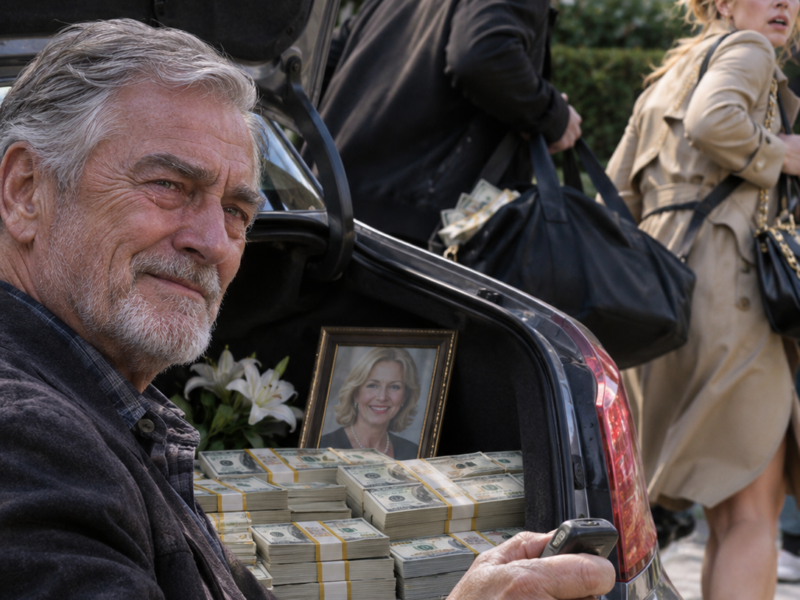
At 56, Three Years After Losing My Wife, I Discovered That My Only Son and His Wife Had Stolen My $6 Million Retirement Fund While I Slept. He Even Sent Me a Photo of Them Drinking Champagne, With the Message, “Thanks for the Retirement Fund, Old Man. Enjoy Whatever Years You Have Left.” But Instead of Begging Him to Return My Money, I Calmly Opened an App on My Phone—Because Neither of Them Knew What I Had Hidden Inside My Late Wife’s Cedar Chest…
At 56, Three Years After Losing My Wife, I Discovered That My Only Son and His Wife Had Stolen My $6 Million Retirement Fund While I Slept. He Even Sent Me a Photo of Them Drinking Champagne, With the Message, “Thanks for the Retirement Fund, Old Man. Enjoy Whatever Years You Have Left.” But Instead of Begging Him to Return My Money, I Calmly Opened an App on My Phone—Because Neither of Them Knew What I Had Hidden Inside My Late Wife’s Cedar Chest…
Part 1
The night my son stole six million dollars from my house, he sent me a photograph of himself drinking champagne with his wife.
Underneath it was a message I will remember until the day I die.
“Thanks for the retirement fund, old man. Enjoy whatever years you have left.”
I was standing barefoot in my bedroom, staring at the empty space where my late wife’s cedar chest had stood for thirty years. My hands were trembling, but not because of the money.
It was because the man who had taken it was the same little boy I had once carried through a hospital corridor at three in the morning, praying that his fever would break.
His name was Lucien Hartwell. He was thirty-two years old.
And I was his father.
My name is Silvanus Hartwell. I was fifty-six when I discovered that the greatest mistake of my life wasn’t trusting my son. It was spending years teaching him that my love meant he would never have to face the consequences of his actions.
Three years earlier, I had buried my wife, Evangeline, after a long illness. We had been married for thirty years. She had stood beside me when I had nothing but a struggling business, a secondhand truck, and enough ambition to keep us awake at night.
Together, we built a comfortable life in Pennsylvania.
There was one thing we never managed to do.
Buy our dream house beside a lake.
Evangeline used to keep photographs of waterfront properties inside an old cedar chest. On difficult evenings, she would spread them across our kitchen table and tell me about the garden she wanted, the grandchildren she hoped would visit, and the mornings we would spend drinking coffee beside the water.
“We’ll get there someday, Silvanus,” she always said.
But someday came too late for her.
When I finally decided to retire and purchase the lake house we had dreamed about, I had approximately six million dollars available from the wealth I had accumulated throughout my working life.
I thought my son would be happy for me.
Instead, he began calculating how much of it he could take.
On August 18, 2025, Lucien and his wife, Mirabel, came over for dinner. I prepared Evangeline’s favorite roast chicken, opened a bottle of wine, and told them about my retirement plans.
Lucien stopped chewing.
“Six million?” he asked.
“Approximately.”
Mirabel put down her fork.
“And you’re planning to spend that on yourself?”
I looked at her.
“I’m planning to enjoy my retirement.”
She exchanged a glance with Lucien.
Then my son leaned forward.
“Dad, Mom’s been gone for three years. You don’t need a big house all to yourself. What are you going to do with all that money?”
The question offended me, but I tried not to show it.
For two years, I had been helping Lucien financially. I had covered expenses when his business struggled, given him access to a credit card, and provided monthly assistance that had gradually become something he expected rather than appreciated.
He lived in a beautiful house. He drove an expensive sports car. Mirabel wore designer clothes and regularly posted photographs from luxury resorts.
Meanwhile, I still drove the same truck I had owned before Evangeline died.
“I’ve worked for forty years,” I told him. “I think I’ve earned the right to decide how I spend my money.”
Lucien smiled, but his eyes remained cold.
“Of course, Dad. We’re just looking out for you.”
Three days later, he returned carrying a folder.
Inside was a durable financial power of attorney.
He explained that signing it would allow him to handle the paperwork associated with my retirement and the purchase of my lake house.
“You won’t have to worry about anything,” he promised. “I’ll take care of the banks, the lawyers, everything.”
I began reading.
The document gave him authority over my bank accounts, investments, property, and financial transactions. There was no expiration date. It wasn’t limited to the purchase of a house.
It was practically an invitation to take control of my entire financial life.
“Who prepared this?” I asked.
“A lawyer. It’s standard.”
“Then why does it give you access to everything I own?”
His smile disappeared.
“Because I’m your son!”
“And that makes you entitled to everything?”
He stood so abruptly that his chair scraped against the floor.
“You know what? Forget it. I try to help you, and you treat me like some criminal.”
He left without taking the folder.
The following morning, I brought it to my attorney, Obadiah Fenwick.
Obadiah had known me for nearly twenty years. He read every page, removed his glasses, and looked at me across his desk.
“Silvanus, if you sign this, your son could acquire an extraordinary amount of control over your affairs.”
“Could he take my money?”
“Depending on what he does with that authority, you could find yourself fighting to recover it.”
I felt physically sick.
Obadiah advised me to protect my accounts, reconsider my financial arrangements, and establish boundaries with Lucien.
I agreed.
But I still hoped my son had simply made a foolish decision.
That hope lasted until September 1.
Lucien arrived at my house looking exhausted. His expensive shirt was wrinkled, his eyes were bloodshot, and for the first time in months, he looked frightened.
“Dad, I’m in trouble.”
He confessed that his business was drowning in debt. He owed a private lender named Roderick Pemberly hundreds of thousands of dollars, and a $120,000 installment was due at the end of September.
The outstanding balance was $480,000.
“I just need you to cover it,” he said.
“Where did all that money go?”
He wouldn’t give me a straight answer.
Instead, he talked about delayed contracts, bad investments, difficult clients, and temporary cash-flow problems.
I offered to have my attorney and an accountant examine his business records. If there was a legitimate way to save the company, I would consider helping under carefully controlled conditions.
He refused.
“I don’t need an investigation. I need money.”
“Then show me what I’m paying for.”
He slammed his fist against the table.
“You have six million dollars! What’s four hundred and eighty thousand to you?”
I looked at him for a long time.
“It’s forty years of my life.”
He called me selfish.
Then he said something that finally broke through every excuse I had ever made for him.
“Mom would be ashamed of you.”
I stood up.
“Don’t you dare use your mother to get money from me.”
He stormed out.
That afternoon, I canceled his access to my credit card and ended the monthly payments.
I thought that would force him to confront reality.
Instead, it convinced him to find another way.
Several days later, I made a decision concerning my money that I would eventually regret. A substantial financial transaction left me temporarily holding six million dollars in cash, which I secured inside Evangeline’s cedar chest.
It was not a sensible long-term arrangement. I knew that. I intended to resolve it shortly.
Before placing the money inside, I transferred Evangeline’s photographs and love letters into a fireproof cabinet in my study.
I also had security cameras installed around my property.
Lucien didn’t know about them.
On the evening of September 12, I went to bed shortly after ten.
Sometime around three the following morning, my son and daughter-in-law arrived in a truck.
They entered my house using a copied key.
While I slept upstairs, they loaded Evangeline’s chest onto a ramp and secured it inside the vehicle.
Then they drove away.
When I discovered the theft, I could barely breathe.
And when Lucien’s message arrived, I realized he wasn’t even planning to deny what he had done.
He believed he had won.
I sat down at my kitchen table, opened the security application on my phone, and watched the recording.
There was my son.
There was his wife.
There was the chest containing six million dollars.
I watched them laughing as they closed the truck.
Then I opened another application.
Because there was one more thing inside Evangeline’s chest that neither Lucien nor Mirabel knew existed.
And it was about to destroy everything they had planned.
Part 2
Hidden inside the cedar chest was a tracking device.
I had installed it as an additional precaution, never imagining that I would need it to locate property stolen by my own child.
The signal showed that the chest was traveling south.
I called Obadiah.
“Don’t confront him,” he instructed. “Preserve everything. The recordings, the messages, the tracking information. Let the police handle this.”
Within hours, officers were sitting at my kitchen table.
Then Lucien called.
“What’s wrong, Dad? You didn’t like my message?”
“You stole six million dollars from me.”
He laughed.
“Prove it.”
I looked at the officer sitting opposite me.
“I already have.”
Silence.
Then Lucien began threatening to tell everyone that I had given him the money and forgotten about it because I was becoming senile.
“You can’t do anything to me,” he insisted. “I’m your son.”
“That won’t change what you did.”
I ended the call.
The following morning, police in Virginia located the truck outside a hotel where Lucien and Mirabel were staying.
My son walked into the parking lot carrying a coffee, apparently unaware that officers were waiting nearby.
When they asked him to open the truck, he smiled.
But when they mentioned his mother’s cedar chest, his face went white.
Part 3
I wasn’t there when the officers approached my son in that Virginia parking lot.
Everything I know about what happened next came from the police reports, the statements of the people involved, and the conversations I later had with Officer Delia Ramsay.
Lucien had apparently booked a luxurious hotel room for himself and Mirabel. They had ordered champagne, enjoyed an expensive dinner, and begun discussing how they would spend the money.
They hadn’t even opened the chest properly.
According to the officers, Lucien initially acted as though the entire situation was a misunderstanding.
“That’s my father’s property,” he explained. “I’m transporting it for him.”
Officer Ramsay asked where his father lived.
He gave her my address.
She asked whether he had written permission to transport the chest.
He said that wasn’t necessary.
“We’re family.”
She asked whether he knew what was inside.
That was when his story began to change.
He claimed that the chest contained family belongings. Then he said there might be some money inside. Finally, when confronted with information from the Pennsylvania investigators, he insisted that I had promised him the money years earlier.
Mirabel stood beside him, gripping her handbag so tightly that her knuckles turned white.
“His father is confused,” she interrupted. “He’s been having problems since his wife died.”
Officer Ramsay asked whether I had been diagnosed with any condition affecting my mental capacity.
Mirabel couldn’t answer.
“Have you witnessed a doctor making such a diagnosis?”
“No, but—”
“Then what you’re telling me is your personal opinion?”
Mirabel stopped talking.
The officers proceeded according to the legal requirements for securing and examining the vehicle. When the chest was eventually opened, the money was discovered inside.
Six million dollars.
Lucien stared at the officers as they documented what they had found.
Then he lost control.
“That’s my money!” he shouted. “I was never supposed to have to ask that old man for another cent!”
Officer Ramsay remembered those words.
They went into her report.
When I heard them later, I had to sit down.
For thirty-two years, I had believed that whatever mistakes my son made, somewhere underneath his selfishness was the little boy Evangeline and I had raised.
But standing over his mother’s chest, surrounded by police officers, he had finally said what he really thought of me.
I was an obstacle between him and his inheritance.
The money and the chest were taken into official custody as evidence. Lucien and Mirabel were confronted with the consequences of a criminal investigation, and the matter began moving through the legal system.
Obadiah warned me that recovering the money would take time.
“It has to be documented, counted, secured, and eventually released through the appropriate process,” he explained. “We cannot simply walk into a police facility and carry it home.”
I understood.
What I didn’t understand was how my son could have believed that stealing from me was an acceptable solution to his problems.
That evening, my telephone rang.
It was Lucien.
His voice was no longer confident.
“Dad, you’ve got to fix this.”
I closed my eyes.
“Fix what?”
“Everything. Tell them it was a misunderstanding. Tell them I was taking the chest somewhere for you.”
“Is that what happened?”
“Come on, Dad!”
“Answer me.”
He began crying.
For a moment, I heard the voice of the little boy who used to run into my bedroom whenever a thunderstorm frightened him.
My instinct was to comfort him.
Then I remembered the champagne photograph.
“You need to speak with your lawyer,” I said.
“I’m your son!”
“I know.”
“You’re going to let them ruin my life?”
“No, Lucien. I’m going to stop protecting you from the decisions you’ve made.”
He called me a terrible father.
Then he hung up.
The following morning, I had every lock in my house replaced.
My old friend Phineas came over while the locksmith was working. He found me standing in the hallway, looking at the marks left on the floor where the chest had been dragged.
He didn’t ask me how I was feeling.
Instead, he fetched a broom and helped me clean.
When we finished, he made coffee.
“Do you think Evangeline would have wanted me to report him?” I asked.
Phineas took his time answering.
“Your wife loved that boy,” he said. “But she also loved you. I don’t think she’d have wanted one of you destroyed just to protect the other.”
I looked toward her photograph on the mantel.
For the first time since her death, I wished she were there not simply because I missed her, but because I needed someone who understood what it meant to love our son.
The investigation continued.
Obadiah’s assistant, Cordelia Bramble, organized the evidence. Every recording, message, financial document, and handwritten note was preserved.
My notebook became particularly important.
Inside it were dates and details of conversations with Lucien, including his attempts to obtain financial authority over my accounts and his demands for money.
There was also the matter of the copied key.
Lucien had given me conflicting explanations about how he had obtained access to my house. Those inconsistencies were now part of the record.
The bank’s documentation established the source and ownership of the money. Its employees could also testify about my conduct during the financial transactions.
I had understood what I was doing.
I had reviewed the figures.
I had made my own decisions.
My son’s claim that I was mentally incapable of managing my affairs had no credible foundation.
Obadiah leaned back in his chair after reviewing the documents.
“Your son appears to have mistaken your patience for incompetence,” he said.
“Can he really claim that I gave him the money?”
“He can claim whatever he wants. Proving it is another matter.”
I nodded.
Then Obadiah asked me a question I wasn’t prepared for.
“Do you want him to escape responsibility?”
I stared at the floor.
“I want him to be my son again.”
“He is your son. That’s not the question.”
I didn’t answer immediately.
Outside his office window, people were walking along the pavement, carrying shopping bags, talking on telephones, living ordinary lives.
I envied them.
Finally, I said, “No. I don’t want him to escape responsibility.”
It was one of the hardest sentences I had ever spoken.
September 30 arrived.
The $120,000 installment Lucien owed Roderick Pemberly was due.
Without my money, Lucien had no easy way to pay it.
He sold his sports car.
Then his expensive watches.
Then other possessions he had accumulated during the years when he believed his father’s wallet would always be available.
He managed to cover part of the installment, but not all of it.
His lender issued a formal default notice and demanded a credible repayment plan.
For the first time, Lucien was being asked to solve his financial problems without using my money.
I knew how much he was suffering.
I also knew that if I rescued him again, everything would return to the way it had been before.
On the evening of September 30, I sat alone at my kitchen table.
The calendar was open in front of me.
I remembered Lucien’s first day of school, his graduation, and the afternoon he had announced that he was starting his own business.
I remembered how proud I had been.
Then I remembered his fist hitting that same kitchen table when I refused to pay his debts.
My telephone remained silent.
I didn’t call him.
What I didn’t know was that Lucien had already made promises to his lender involving my fortune.
And when Roderick Pemberly finally demanded proof of those promises, my son discovered that the stolen money wasn’t the only thing he was about to lose.
Part 4
October began with a telephone call that revealed just how far my son’s deception had gone.
I was washing breakfast dishes when a man called my house and introduced himself as a representative of Roderick Pemberly’s lending operation.
He spoke politely, explaining that Lucien’s account was overdue and that they wanted to discuss repayment options with me.
“Why are you calling me?” I asked.
There was a brief pause.
“Because you’re listed as the guarantor of his financial obligations.”
I turned off the water.
“I’m listed as what?”
“The guarantor, Mr. Hartwell.”
I felt a cold sensation spread through my chest.
I had never guaranteed Lucien’s debts. I had never signed an agreement, promised to repay his lender, or authorized anyone to represent me in connection with his business.
“Who told you I was responsible?”
“Your son indicated that he had your financial backing.”
“Then my son misrepresented the situation.”
The man became noticeably less confident.
I gave him Obadiah’s contact information and instructed him to direct all further communications through my attorney.
After hanging up, I stood beside the sink for several minutes.
Suddenly, the power of attorney made even more sense.
Lucien hadn’t simply wanted access to my fortune.
He had apparently been telling people that my wealth was available to him long before he had any legal right to touch it.
If I had signed those papers, he might have been able to turn his promises into reality.
Obadiah sent a formal letter stating that I had never guaranteed, co-signed, or undertaken responsibility for any of Lucien’s obligations.
The lender’s representatives demanded that Lucien produce documentary evidence of my commitment.
He couldn’t.
During a renegotiation meeting, Pemberly’s attorney, Augustus Feldmore, reportedly asked him a simple question.
“Where is your father’s signature?”
Lucien had no answer.
He tried explaining that I had always helped him financially.
He talked about our relationship, the monthly assistance I had provided, and the money I intended to spend on a lake house.
But none of those things constituted a guarantee.
Pemberly made it clear that any revised repayment schedule would have to rely on Lucien’s own assets, income, business contracts, and ability to work.
My fortune was no longer part of the conversation.
That evening, Lucien called me.
“You humiliated me.”
I was sitting in the living room, reading a newspaper.
“How?”
“Your lawyer sent that letter. Now Pemberly thinks I lied to him.”
“Did you?”
“Dad, you don’t understand how business works.”
“I built a business before you were born.”
“You could have backed me up. You didn’t even need to give them money. You just needed to tell them you were supporting me.”
“And what would happen if you couldn’t pay?”
He didn’t answer.
“Lucien, you cannot promise other people my money.”
“You’re supposed to help your family.”
“I have helped you for years.”
“Then why are you stopping now?”
“Because you stopped asking and started taking.”
He hung up.
Over the following weeks, the expensive lifestyle he and Mirabel had constructed began collapsing.
The sports car was gone. The credit card I had once provided was useless. His business was struggling, and the investigation was hanging over both of them.
Phineas told me that neighbors had heard arguments coming from their house almost every evening.
I didn’t ask for details.
I didn’t need them.
One Thursday night, Lucien called shortly after nine.
He sounded devastated.
“She left, Dad.”
“Who?”
“Mirabel.”
I put down my book.
He told me she had packed two suitcases, collected her expensive coat, and arranged for a friend to take her to Harrisburg.
He had begged her to stay.
She refused.
Then, standing in the doorway, she said something that apparently hurt him more than anything the police or his lender had said.
“I married your future, Lucien. Your future is sitting in a police warehouse in Virginia. I’m done paying rent on it.”
And she walked out.
Lucien repeated those words to me, his voice cracking.
“After everything I did for her,” he said. “After everything I sacrificed.”
I thought about the security footage showing Mirabel helping him load the chest.
I thought about the champagne photograph.
They had both been smiling.
“I’m sorry your marriage is falling apart,” I told him.
“She betrayed me!”
I let the silence settle between us.
Then I asked, “How does it feel?”
He stopped crying.
“What?”
“How does it feel when someone you love decides you’re only valuable because of what you can give them?”
He didn’t respond.
“That’s how I’ve felt for a long time, son.”
“Dad…”
“I hope you learn something from it.”
He began asking whether he could come and stay with me.
I refused.
He asked whether I could help him cover his household expenses until he got back on his feet.
Again, I refused.
I told him that if he needed practical advice about finding work, reducing expenses, or arranging legitimate financial assistance, I would speak with him.
But I would not become his financial safety net again.
Three days later, an envelope arrived in the mail.
Mirabel’s handwriting was on the front.
Inside was a spare key to my house and a handwritten note.
“This is yours. I never needed it. Ask your son about the plan. It was always his.”
I read the note twice.
Even now, she was trying to distance herself from what had happened.
She apparently believed that leaving Lucien and returning a key would somehow erase her involvement.
But the security recordings showed her holding the loading ramp, helping secure the chest, and participating in the theft.
Her decision to leave her husband didn’t change those facts.
I delivered the envelope to Obadiah.
He examined the note and shook his head.
“She’s trying to establish her version of events.”
“Will it help her?”
“That’s for the legal process to determine. But a note written after the fact doesn’t make the earlier evidence disappear.”
He added everything to the case file.
Meanwhile, I continued pursuing the lake house.
The purchase had been complicated by the fact that much of my money remained in official custody. Obadiah helped me arrange matters using other available resources while the recovery process continued.
The seller agreed to give us additional time.
Every evening, I looked at photographs of the property.
It had a stone fireplace, large windows facing the water, and a wooden dock extending into the lake.
Evangeline would have loved it.
Some nights, looking at those photographs was the only thing that kept me from calling Lucien and offering to make everything go away.
I knew I could afford to pay his debts.
I knew I could probably make his immediate financial problems disappear.
But I could no longer pretend that money would repair what had happened between us.
In November, Obadiah finally called with encouraging news.
The authorities had completed enough of their procedures for the recovery of my property to move forward.
There were still legal matters to address, and the criminal proceedings involving Lucien and Mirabel were separate from the return of my belongings.
But the money had been accounted for.
My ownership had been established.
And Evangeline’s chest would eventually come home.
I thanked him and hung up.
Then I went into my study, opened the fireproof cabinet, and took out a photograph of my wife.
It showed her standing beside a lake during a vacation we had taken years earlier.
She was laughing, her hair blowing across her face.
I sat down and cried.
Not because I had recovered my fortune.
Because I had finally understood that the dream we had shared didn’t have to die simply because our son had tried to steal it.
Several days later, I signed the final paperwork for the lake house.
The real estate agent met me at the property and placed the keys in my hand.
“Congratulations, Mr. Hartwell.”
I walked through the empty rooms slowly.
The sunlight reflected off the lake and moved across the living room ceiling.
I placed our wedding photograph above the fireplace.
Then I stood there, looking at Evangeline’s smiling face.
“I got us here, sweetheart,” I whispered.
For the first time in three years, the silence around me didn’t feel entirely like loneliness.
I thought the most difficult part of my story was behind me.
But in early December, Obadiah received another document from Lucien’s attorney.
When he called me into his office, I expected another demand for money.
Instead, he handed me something that made me question whether my son might finally be changing.
Part 5
“Read the second page,” Obadiah said.
I adjusted my glasses and examined the document.
It was Lucien’s revised repayment schedule.
After weeks of negotiations, Roderick Pemberly had agreed to a new arrangement based entirely on my son’s own financial resources.
There were no references to my accounts.
No promises involving my property.
No expectations of an inheritance.
Lucien had sold additional possessions, disposed of some business equipment, and renegotiated contracts to generate income.
His November installment had been paid in full.
I looked up.
“Where did he get the money?”
“From his own work and assets.”
“Nothing borrowed against my name?”
“Nothing involving you.”
I returned my attention to the document.
For years, I had celebrated Lucien’s birthdays, business achievements, and expensive purchases.
But none of those things had made me feel quite what I felt while reading that simple repayment statement.
My son had finally taken responsibility for something.
It didn’t erase the theft.
It didn’t excuse his lies.
It didn’t mean the legal consequences would disappear.
But it was the first indication that he might be learning how to live without treating his father as a permanent source of money.
“Do you think I should call him?” I asked.
Obadiah folded his hands.
“That depends on what you intend to say.”
“I don’t know.”
“Then perhaps wait until you do.”
I took a copy of the document home.
A week later, Lucien called.
I was sitting beside the lake, wearing Evangeline’s favorite old sweater.
“Dad?”
“Hello, son.”
There was a long silence.
Then he said, “I made the payment.”
“I heard.”
“I didn’t ask anybody for money.”
“That’s good.”
Another silence.
I could hear traffic in the background.
“I’m working more,” he continued. “Taking smaller contracts. Jobs I used to think weren’t worth my time.”
“Work is work, Lucien.”
“Yeah.”
He sounded tired.
Not angry.
Not demanding.
Just tired.
Then he said something I hadn’t heard from him in years.
“I’m sorry.”
I waited.
He continued.
“I’m sorry about Mom’s chest. And the message. And everything I said about you losing your mind.”
I closed my eyes.
For months, I had imagined what I would say if he ever apologized.
Sometimes I imagined shouting at him.
Sometimes I imagined forgiving him immediately and telling him that everything would be all right.
But now that the moment had arrived, neither response felt appropriate.
“Why did you do it?” I asked.
He breathed heavily.
“I thought I was running out of options.”
“You had options.”
“I know.”
“You could have sold the car. You could have shown me your business records. You could have asked for professional help.”
“I know, Dad.”
“Instead, you decided my money belonged to you.”
He didn’t argue.
“I thought you’d eventually give it to me anyway,” he admitted.
There it was.
The truth, stripped of every excuse.
He had believed that because he was my only son, everything I owned was already his.
“Lucien, an inheritance is something a person chooses to leave behind. It’s not something you collect while they’re still alive.”
“I understand.”
“I hope you do.”
He asked whether I hated him.
That question hurt more than I expected.
“No,” I said. “I don’t hate you.”
“Then can we start over?”
I looked across the water.
A flock of birds was moving toward the far shore.
“We can’t start over,” I told him. “We can start from where we are.”
“What does that mean?”
“It means you continue taking responsibility. You cooperate with your lawyer. You deal with the consequences of what happened. You pay your debts. And you stop expecting me to rescue you.”
He was quiet.
“And maybe,” I continued, “over time, we can build something that resembles trust again.”
He thanked me.
Before hanging up, he asked whether I had purchased the lake house.
“Yes.”
“Mom would’ve liked that.”
“She would have loved it.”
For a moment, neither of us spoke.
Then he said goodbye.
He didn’t ask me for money.
After the call ended, I remained outside until the sun disappeared behind the trees.
I wanted to believe that my son had changed.
But I also understood that one apology couldn’t undo years of behavior.
Real change would have to reveal itself through actions, repeated over months and years.
I wasn’t going to purchase that change for him.
The following week, I met with Obadiah to review my estate arrangements.
I wanted my future protected, regardless of what happened between Lucien and me.
We discussed financial safeguards, my wishes regarding the lake house, and the importance of ensuring that no one could obtain control of my property simply by pressuring me.
I also made certain that any future decisions about my estate would remain mine.
“Are you trying to punish him?” Obadiah asked.
“No.”
“Then what are you trying to accomplish?”
“I’m trying to live the rest of my life without being afraid of my own family.”
He nodded.
We completed the necessary arrangements.
For the first time in years, I felt that my future belonged entirely to me.
By Christmas, Evangeline’s cedar chest had been returned.
When it arrived at the lake house, I ran my hand across the scratches on its surface.
There were marks where it had been handled roughly, and the lock had suffered damage during everything that happened.
But it was still her chest.
I hired someone to repair the lock and restore the damaged wood.
Then I placed it beside the fireplace.
On Christmas Eve, snow began falling shortly before sunset.
I prepared a small dinner, lit the fire, and put on the Christmas music Evangeline used to play while decorating our house.
Her wedding photograph stood on the mantel.
I opened the fireproof cabinet where I had kept her letters and photographs safe throughout the ordeal.
One by one, I returned them to the cedar chest.
There was a photograph of us on our honeymoon.
A birthday card she had given me when I turned forty.
A letter she wrote during the early years of our marriage, when my business was struggling and I was convinced I had failed her.
I unfolded it.
“Silvanus,” she had written, “I didn’t marry you because of what you could give me. I married you because of who you were when you had nothing.”
I read that sentence until the words blurred.
Thirty years of marriage had taught me what love was.
Three years of widowhood had nearly made me forget.
I had been so afraid of losing the only immediate family I had left that I had allowed Lucien to attach a price to our relationship.
Every time he asked for money, I gave it to him.
Every time he made a mistake, I softened the consequences.
Every time he treated me badly, I reminded myself that he was grieving his mother.
Eventually, I had become afraid that saying no would mean losing him.
And because I was afraid, I had helped create the very man who would eventually steal from me.
That realization was painful.
But it was also freeing.
My telephone rang while I was preparing dinner.
Lucien’s name appeared on the screen.
“Merry Christmas, Dad.”
“Merry Christmas, son.”
He asked whether I was enjoying the lake house.
I told him about the snowfall, the fireplace, and the view from the living room.
He told me he had been working and was continuing to follow his repayment schedule.
The legal proceedings were still matters he and Mirabel would have to face through their respective attorneys. Nothing about our conversation changed that.
But for once, we talked without arguing.
Before hanging up, he said, “I hope you’re happy there.”
“Thank you.”
“And Dad?”
“Yes?”
“I wish I’d done things differently.”
“So do I, son.”
We said goodbye.
I carried my dinner into the living room and sat beside the fire.
There was an empty chair across from me, but I didn’t feel entirely alone.
Evangeline was present in the photographs, the letters, the house we had dreamed about, and the memories no one could steal.
Outside, snow settled on the wooden dock.
Inside, the cedar chest held the things that had always mattered most.
Not six million dollars.
Not bank statements.
Not evidence of financial success.
It held the story of a woman who had loved me before I had anything to offer except myself.
I thought about Lucien and Mirabel.
I didn’t know whether their marriage would survive.
I didn’t know what the final outcome of the legal proceedings would be.
I didn’t know whether my son would ever become the man I had once hoped he would be.
But I no longer believed those uncertainties were mine to resolve.
I had spent too many years trying to control the outcome of his life by paying for it.
Now, he would have to build his own future.
And I would finally be allowed to enjoy mine.
After dinner, I opened the cedar chest one last time.
At the bottom was a photograph of Lucien when he was five years old.
He was sitting on my shoulders at a county fair, holding a balloon and laughing.
Evangeline had taken the picture.
I remembered that afternoon perfectly.
He had been frightened of losing his balloon, so I tied its string around his wrist.
“Now it can’t get away,” I told him.
He had smiled and wrapped his arms around my head.
Looking at that photograph, I realized that some part of me had been trying to hold on to that little boy ever since.
But children grow up.
They make choices.
And sometimes the most loving thing a parent can do is stop protecting them from the consequences of those choices.
I returned the photograph to the chest.
Then I closed the lid and turned the repaired lock.
The sound was small, but it carried an enormous meaning.
My money was protected.
My home was protected.
My memories were protected.
And so was the dignity I had nearly surrendered in exchange for my son’s affection.
Lucien had once believed that stealing six million dollars would guarantee his freedom.
Instead, it had cost him his marriage, his comfortable lifestyle, his reputation, and the unconditional financial support he had taken for granted.
But the greatest thing he had lost wasn’t something that could be counted.
It was the trust of a father who would once have given him almost anything.
Whether he would earn that trust again remained to be seen.
As for me, I was fifty-six years old.
I had a beautiful home beside a lake, enough money to live comfortably, and a lifetime of memories with a woman who had never measured my worth in dollars.
I was not an inheritance waiting to be collected.
I was not a bank account with a heartbeat.
I was a human being who deserved to be loved without having to pay for it.
That Christmas, sitting beside the fireplace with snow falling outside, I finally understood something Evangeline had known all along.
Love does not require surrendering everything you have.
Forgiveness does not require pretending nothing happened.
And being a good father does not mean allowing your child to destroy you.
Sometimes, the most important word a parent can say is the one they have spent years being afraid to speak.
No.
I wish I had learned that lesson sooner.
It nearly cost me six million dollars.
More importantly, it nearly cost me myself.
But as I looked at my wife’s photograph above the fireplace and listened to the quiet sounds of the lake house settling for the night, I knew that whatever happened next, I would never again confuse being needed with being loved.
And for the first time in a very long time, I was at peace.