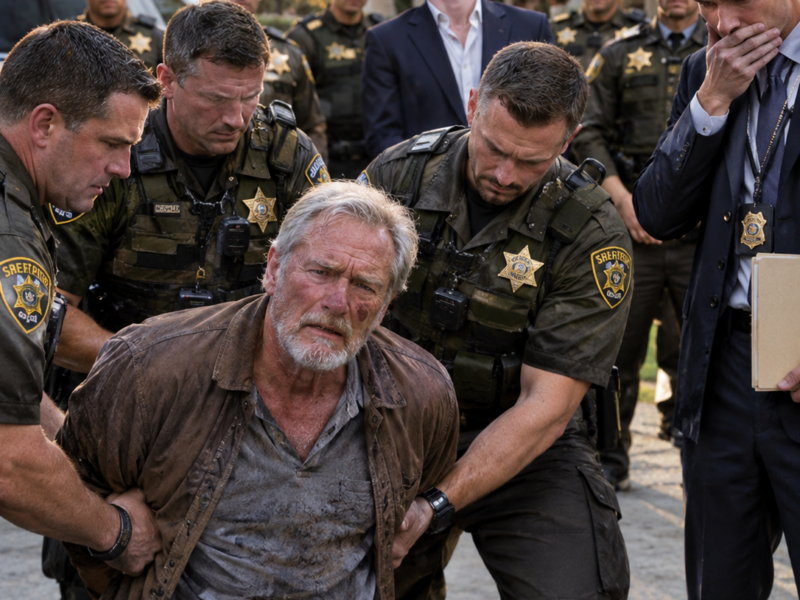
At 5:40 AM, Eight Armed Deputies Dragged Me Out of My Own Home While My Son Laughed and Filmed My Arrest for a $1.8 Million Medicare Fraud I Never Committed. My Daughter-in-Law Shouted, “Smile for the Camera, Grandpa Fraud!” as They Handcuffed Me in My Pajamas. But When an FBI Agent Opened My File, Her Face Turned White and She Ordered, “Take Those Cuffs Off Him NOW!” My Family Had No Idea Who I Really Was—or What the FBI Had Been Investigating for Six Months…
At 5:40 AM, Eight Armed Deputies Dragged Me Out of My Own Home While My Son Laughed and Filmed My Arrest for a $1.8 Million Medicare Fraud I Never Committed. My Daughter-in-Law Shouted, “Smile for the Camera, Grandpa Fraud!” as They Handcuffed Me in My Pajamas. But When an FBI Agent Opened My File, Her Face Turned White and She Ordered, “Take Those Cuffs Off Him NOW!” My Family Had No Idea Who I Really Was—or What the FBI Had Been Investigating for Six Months…
Part 1
At 5:40 in the morning, eight sheriff’s deputies surrounded my home, forced me against a wall, and locked handcuffs around my wrists. Across the backyard, my thirty-nine-year-old son was laughing.
He wasn’t nervous. He wasn’t confused. He was filming.
Beside him, my daughter-in-law raised her phone and shouted, “Smile for the camera, Grandpa Fraud!”
I was sixty-eight years old, standing in my pajamas, accused of stealing $1.8 million from Medicare. And the two people I had welcomed into my home were celebrating my arrest.
What they didn’t know was that I had spent twenty-eight years investigating financial crimes for the federal government.
And I already knew exactly who had stolen that money.
My name is Everett Dunore. I lived in Tucson, Arizona, in a house my late wife Lorraine and I had paid off in 1997. Two years earlier, my son Brock and his wife Kenzie had convinced me to move into the small guesthouse behind it.
They claimed they needed more room for their fifteen-year-old daughter, Ava.
I agreed because I believed family came first.
That morning, as deputies escorted me across my backyard, I spotted Ava crying behind the kitchen window. I gave her a small wink, hoping she would understand that everything would eventually be okay.
My son kept recording.
At the sheriff’s headquarters, an investigator named Norin Talbot presented what appeared to be overwhelming evidence. A healthcare company called Pinnacle Desert Home Services had billed Medicare for $1.8 million in nonexistent medical visits.
My name appeared on its business registration, bank accounts, and official documents.
Instead of arguing, I made one request.
“Run my name through the federal database. Read every flag.”
Twenty-two minutes later, FBI Supervisory Special Agent Karen Abernathy rushed into the building.
When she saw me sitting in handcuffs, her face turned white.
She opened my file, read several pages, and slammed it onto the counter.
“Take those cuffs off him. Now.”
The entire room went silent.
Karen explained that I was a retired IRS Criminal Investigation special agent who had trained federal investigators, including her. More importantly, I was the primary cooperating witness in an ongoing FBI investigation into the very fraud they were accusing me of committing.
Six months earlier, I had discovered forty-six nonexistent nursing visits on my Medicare statement.
The company billing for them was registered at my address.
While recovering from hip surgery in 2023, I had unknowingly allowed Kenzie access to my mail and personal documents. She had used that opportunity to steal my identity.
Working with her father, Rex Callender, who owned a home healthcare agency, she had created a network of fraudulent companies.
I reported everything to federal investigators, then continued living behind my own house while they followed the money.
But Kenzie suspected an investigation was approaching.
Her solution was simple: frame me before anyone discovered the truth.
The FBI needed several more weeks to finish the case. Karen asked me to return home and pretend my release was merely a paperwork mistake.
I agreed.
When I walked into my kitchen that morning, Kenzie’s phone fell from her hand.
“How are you here?” Brock demanded.
“Paperwork problem,” I answered, pouring myself coffee.
Kenzie stared at me.
“They can’t just release you! You stole $1.8 million!”
I looked directly into her eyes.
“Did I?”
She immediately looked away.
Over the following days, Kenzie’s arrest video received more than two million views. My church removed me as treasurer. My barber refused to serve me. Even longtime neighbors avoided speaking to me.
Then Brock suggested I move into assisted living.
He wanted me to pay $5,200 monthly to leave a house I owned outright.
When I refused, his expression hardened.
“Kenzie says she’ll make you leave.”
That was when I learned something even worse.
My son had signed a sworn statement claiming I threatened his wife with a firearm. His lies had helped bring eight armed deputies to my door.
Soon afterward, Ava secretly brought me eleven envelopes she had discovered hidden inside her mother’s car. They contained Medicare correspondence and billing records linking Kenzie to the fraudulent business.
Federal investigators discovered that she had been collecting an additional fourteen percent of the stolen payments through another company.
They also found that Brock had been receiving $2,400 monthly from a fraudulent business account.
At first, I feared my son was involved.
Then I discovered Rex had convinced him he was being paid for delivering medical supplies.
Brock was being used, too.
But his ignorance didn’t excuse his cruelty.
The following week, Kenzie presented two documents: a deed transferring my house into her name and a confession accepting responsibility for the Medicare fraud.
“Sign these,” she told me, “or you’ll spend fifteen years in prison.”
I lowered my head and pretended to consider her offer.
What she didn’t know was that my phone had recorded every word.
Meanwhile, she and Rex attempted to plant $40,000 in cash and forged documents beneath my guesthouse.
Unfortunately for them, my neighbor’s doorbell camera captured Kenzie carrying the evidence into my backyard.
The FBI now had everything it needed.
I told Kenzie I was ready to sign.
But I insisted her father, his lawyer, and a notary attend the meeting.
She eagerly agreed.
We scheduled it for Thursday morning at ten.
And while she prepared to take my house, federal agents prepared something entirely different.
Part 2
That Thursday, five people crowded into my tiny guesthouse.
Kenzie stood near the door, clutching her phone. Rex occupied the best chair. Their lawyer arranged the documents across my late wife’s table.
Brock stood silently in the corner.
I looked down at the confession.
“Before I sign, there’s something you should know.”
I reached into my cardigan and placed my retired federal badge on the table.
Rex stopped smiling.
“For twenty-eight years, I investigated people who committed crimes exactly like yours.”
Kenzie laughed nervously.
“You’re just an old tax auditor.”
“No,” I replied. “I’m the man who’s been helping the FBI investigate you since April.”
Then I played an enhanced recording from her own arrest video.
Her voice filled the room.
“Once he’s booked, you sign the listing with the power of attorney. Daddy’s buyer closes in fourteen days. By the time anybody figures out the old man didn’t do it, the house is gone.”
Brock turned toward his wife.
“What do you mean he didn’t do it?”
Before she could answer, the guesthouse door opened.
Karen Abernathy entered with four federal agents.
“Rex Callender. McKenzie Dunore. You’re under arrest.”
Kenzie screamed that I was responsible.
Karen calmly described the forged documents, stolen identities, fraudulent accounts, and security footage proving who had planted the money.
Within minutes, handcuffs clicked around my daughter-in-law’s wrists.
Two weeks earlier, she had filmed my humiliation.
Now she was being escorted from my property while my son watched in stunned silence.
Part 3
The investigation ultimately uncovered more than $4.6 million in fraudulent Medicare claims involving over ninety victims.
Rex received a ninety-seven-month prison sentence. Kenzie received seventy-eight months.
My name was publicly cleared, and the video announcing my innocence reached millions of viewers.
But repairing my family proved harder than clearing my reputation.
Brock admitted he hadn’t known about the healthcare fraud. He also admitted something I will never forget.
“The morning they arrested you, I laughed because, for once, I thought you were the one who had failed.”
He began crying.
I couldn’t forgive him immediately.
He had betrayed me when I needed him most.
Yet I also recognized a man finally confronting the truth about himself.
Brock accepted responsibility for his false statement, found honest work, and slowly began rebuilding our relationship.
Ava stayed close to me throughout everything.
Eventually, I moved back into my bedroom. Lorraine’s photographs returned to the hallway, and the guesthouse became a quiet place where Ava could study.
One Sunday, Brock and I visited Lorraine’s grave together.
He placed sunflowers beside the yellow roses I had brought.
For a long time, neither of us spoke.
Then he asked whether I wanted to have breakfast with him.
I said yes.
It wasn’t forgiveness. Not completely.
But it was a beginning.
I learned that the deepest betrayals sometimes come from those we love most. And the strongest response isn’t always revenge.
Sometimes, it’s having the patience to let the truth reveal everything.