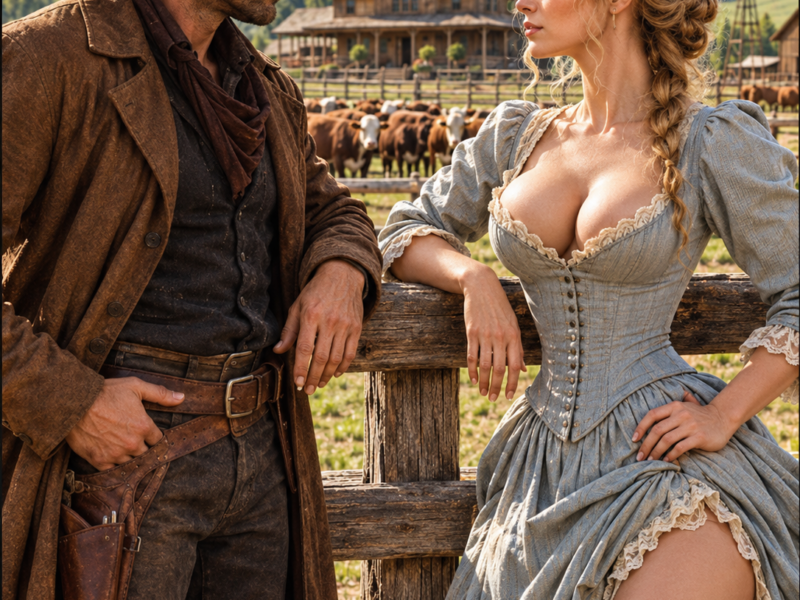
At 45, I Was Forced to Marry a 26-Year-Old Boston Heiress I’d Never Met Just to Save My Montana Ranch From Her Father’s 22-Year-Old Debt Claim. The Town Laughed, “Give Her a Month—She’ll Destroy Everything You’ve Built!” But on Her First Day, She Spotted a Broken Fence and Demanded My Financial Records, Uncovering Over $900 in Wasted Money Within Hours. I Thought She Was Just a Spoiled Rich Girl—Until She Took Control During a Ranch Emergency, and I Realized Something Nobody Had Seen Coming…
At 45, I Was Forced to Marry a 26-Year-Old Boston Heiress I’d Never Met Just to Save My Montana Ranch From Her Father’s 22-Year-Old Debt Claim. The Town Laughed, “Give Her a Month—She’ll Destroy Everything You’ve Built!” But on Her First Day, She Spotted a Broken Fence and Demanded My Financial Records, Uncovering Over $900 in Wasted Money Within Hours. I Thought She Was Just a Spoiled Rich Girl—Until She Took Control During a Ranch Emergency, and I Realized Something Nobody Had Seen Coming…
PART 1
The day I married a wealthy Boston woman I had never met, I thought I was signing away the last piece of freedom I had left. I was forty-five years old, had spent fifteen brutal years building a cattle ranch in Montana, and had survived just about everything the frontier could throw at a man. But nothing frightened me quite like the thought of a stranger walking into my home with the legal right to call herself my wife.
Her name was Eleanor Whitmore. She was twenty-six, the only daughter of Reginald Whitmore, a powerful businessman who owned three textile factories in Boston.
According to the people who knew her family, Eleanor had grown up surrounded by servants, expensive dresses, and the kind of luxury most Montana ranchers couldn’t imagine.
When word of our marriage reached Millhaven, the nearest town, the laughter started immediately.
“A Boston princess on Iron Ridge?” one man said at the general store. “Give her a month. She’ll be crying for the first train east.”
Another man laughed even harder.
“She’ll destroy everything Carson Hale has built.”
I heard those comments, but I didn’t argue. The truth was, I wasn’t entirely sure they were wrong.
What nobody in Millhaven understood was that this marriage wasn’t about love. It wasn’t even about companionship.
It was about a debt my father had left behind.
In August of 1883, an attorney in Helena sent me a letter explaining that my father had borrowed money from the Whitmore family in 1861. The original loan was secured against part of our land, and decades of accumulated interest had given the Whitmores a legitimate claim to the eastern third of Iron Ridge Ranch.
That portion included our most reliable water source.
Without it, the ranch would eventually collapse.
The letter offered one alternative.
I could marry Eleanor Whitmore, and her family would release the claim.
I read those terms three times, hoping I had misunderstood.
I hadn’t.
My father had left me forty starving cattle, an aging farmhouse, and a mountain of problems when I inherited Iron Ridge at twenty-eight. For fifteen years, I had worked through blizzards, droughts, livestock disease, and financial disasters to turn that miserable inheritance into a ranch with nearly a thousand cattle.
I had sacrificed my youth to that land.
Now someone wanted to take a third of it because of a debt I hadn’t even known existed.
So I agreed to the marriage.
The ceremony took place by proxy, with attorneys handling the paperwork. Eleanor remained in Boston while I stayed in Montana.
Technically, I became a married man without ever seeing my bride.
Three weeks later, she boarded a westbound train.
On the morning she arrived, I couldn’t bring myself to meet her at the station.
Instead, I sent my foreman, Hank Briggs.
Hank had worked for me for eleven years. He was a quiet, dependable man who understood cattle better than people and rarely questioned my decisions.
He knew exactly why I wasn’t going.
Fortunately, he had enough sense not to mention it.
I spent that morning inspecting fences that didn’t need inspecting and counting cattle I had already counted twice.
Around noon, I heard the familiar sound of wagon wheels coming through the front gate.
I turned toward the yard.
Hank was driving the buckboard, and beside him sat a young woman wearing a gray traveling coat.
What struck me first was her luggage.
One small leather suitcase.
That was all.
I had expected trunks, hatboxes, and enough expensive clothing to fill an entire bedroom.
Instead, she had brought one bag.
What struck me second was that she wasn’t looking at the farmhouse.
She was studying my fence.
As Hank brought the wagon to a stop, the woman turned toward me.
“Mr. Hale?”
I nodded.
“Miss Whitmore.”
Then I corrected myself.
“Mrs. Hale.”
Something resembling amusement crossed her face.
“I imagine that will take some getting used to.”
Before Hank could offer assistance, she climbed down from the wagon.
She stood in the yard for several seconds, studying the barn, the house, and the surrounding fields.
Then she looked toward the eastern fence.
“Your fourth fence post from the gate is sinking,” she said.
I stared at her.
“Excuse me?”
“The drainage is washing away the soil underneath it. If you don’t repair it before winter, the fence will probably collapse when the ground freezes.”
I looked toward the fence.
She was right.
I’d noticed the problem weeks earlier but hadn’t considered it urgent.
“How did you see that?”
“From the wagon.”
She answered as though the question were ridiculous.
Then she picked up her suitcase.
“Would someone please show me my room? I’d like to wash up.”
“Of course.”
“And afterward, I’d like to examine your account books.”
For a moment, I thought I’d misheard her.
“My what?”
“Your financial records. Purchasing contracts, livestock expenses, bank correspondence. Whatever you have available.”
I folded my arms.
“Why?”
She stopped walking.
“Because I would prefer to understand the financial condition of the ranch I’ve just married into.”
I felt irritation rising in my chest.
“Miss Whitmore—”
“Mrs. Hale,” she corrected gently.
I took a breath.
“Mrs. Hale, I’ve managed this ranch for fifteen years.”
“And I’m sure you’ve worked extremely hard.”
“Then perhaps you should allow me to continue managing it.”
She looked at me for a long moment.
When she spoke again, her voice was calm.
“Mr. Hale, I traveled two thousand miles to marry a stranger because my father decided it was financially convenient. You married me because the alternative was losing your land. Neither of us chose this arrangement.”
I said nothing.
“But now we’re here. I don’t intend to spend the rest of my life sitting in a bedroom pretending to be useless. If I’m going to live here, I intend to contribute.”
There was something in her expression I couldn’t explain.
She wasn’t asking permission.
She was offering a partnership.
And somehow, that made me even more uncomfortable.
I told Hank to show her the east bedroom.
That evening, before supper, I placed five years of financial ledgers on the dining room table.
I told myself it was only to satisfy her curiosity.
Eleanor came downstairs wearing a simple blue dress, her dark hair tied neatly behind her head.
May, our cook, served beef stew and cornbread.
Eleanor ate without complaint.
During supper, I explained the ranch’s operations. I told her about our cattle, suppliers, employees, and the ongoing water-rights dispute with the neighboring Dawson family.
She listened carefully, asking questions that became increasingly specific.
“How much have your hay expenses increased over the last three years?”
“Some.”
“Have your cattle prices increased at the same rate?”
“Not exactly.”
“Then your profit margin is shrinking.”
I looked up from my plate.
“Probably.”
She nodded, as though storing the answer away.
After supper, she opened the ledgers.
I retreated to my office.
For almost two hours, I listened to pages turning in the next room.
Finally, curiosity got the better of me.
I walked back into the dining room.
Three ledgers were open in front of her. She had made calculations on a separate sheet of paper.
Without looking up, she spoke.
“Your hay supplier is overcharging you.”
I stopped.
“Tom Barker?”
“Yes.”
“Tom has supplied this ranch for twelve years.”
“Then he’s been overcharging you for a considerable portion of that relationship.”
I felt my jaw tighten.
“Tom is a friend.”
“Friendship doesn’t change arithmetic, Mr. Hale.”
She turned the ledger toward me.
Then she pointed out similar problems with our harness supplier and veterinary expenses.
She had compared old invoices, calculated price increases, and identified costs I hadn’t questioned in years.
“How much money are we talking about?” I finally asked.
“Between nine hundred and twelve hundred dollars over the last three years.”
My stomach tightened.
Last year’s net profit had been barely over four thousand dollars.
That meant I’d wasted nearly a third of an annual profit without realizing it.
“How do you know how to do this?”
She paused.
“My father discussed business constantly at home. He never imagined I might actually learn anything useful.”
There was bitterness behind those words.
I noticed it, but I didn’t ask.
Instead, I sat down across from her.
For the first time since agreeing to the marriage, I looked at my new wife with genuine curiosity.
“All right,” I said. “Show me what else you’ve found.”
She smiled slightly.
And that was the moment I made my first serious mistake about Eleanor Whitmore.
I thought I was allowing her to help me.
I had no idea she was about to change everything.
PART 2
By the end of Eleanor’s first week, everyone at Iron Ridge had an opinion about her.
Most weren’t kind.
Pete Garza, one of my experienced ranch hands, laughed openly whenever she appeared.
“Careful, boys,” he joked. “The Boston princess might get dirt on her fancy boots.”
Eleanor ignored him.
Instead, she spent her mornings inspecting the ranch and her evenings studying our records.
She discovered that an aging breeding bull was causing recurring losses in one pasture. She reorganized kitchen deliveries, negotiated better supply prices, and identified drainage problems we’d overlooked for years.
Hank, who had initially dismissed her as another wealthy city woman, eventually admitted something remarkable.
“Boss, she’s seeing problems we’ve been walking past for a decade.”
Then, in late October, disaster struck.
Nearly sixty cattle escaped through the southern boundary fence onto Dawson property.
The Dawsons had been fighting us over water rights for years. One complaint could cost us thousands.
I rode south expecting the worst.
Instead, I found Eleanor repairing the fence with May, our cook.
Fifty-eight cattle were already accounted for.
Eleanor looked up, her hands scratched and muddy.
“Don’t just stand there, Carson. Help me finish.”
That afternoon, I realized the woman everyone had mocked might be the only reason we kept our ranch.
PART 3
I still remember the expression on Pete Garza’s face when he arrived at the southern fence that afternoon.
There stood my Boston-born wife, covered in mud, tightening wire with bleeding fingers while May held a post steady.
Pete stared at her as though he’d discovered a mountain lion wearing an apron.
Eleanor barely acknowledged him.
“Pete, take Billy and move those last four cattle away from the creek. We need them back before the Dawson foreman comes through.”
For once, Pete didn’t argue.
He simply nodded and got to work.
By sunset, every animal was safely back on our side of the boundary.
On the ride home, I asked Eleanor why she had come out herself instead of waiting for the ranch hands.
“Because waiting would have made the problem worse.”
“You could have gotten hurt.”
“So could you.”
I couldn’t argue with that.
She looked toward the mountains.
“Besides, Carson, this is my home now. I don’t intend to watch it disappear.”
Those words stayed with me.
For months, I’d thought of Eleanor as a woman trapped in my circumstances.
For the first time, I wondered whether she was beginning to consider Iron Ridge something worth fighting for.
Winter arrived early that year.
The temperature dropped brutally, freezing the ground and covering the pastures in thick snow.
Everyone expected Eleanor to struggle.
Instead, she became even more determined.
May found an old wool coat that had belonged to my mother and gave it to her.
Eleanor wore it every morning while riding the ranch.
She inspected feed supplies, adjusted cattle rotations, and reorganized storage areas so our men could reach essential materials without wasting hours digging through snow.
Some of the changes seemed insignificant.
But insignificant changes accumulated.
By December, our feed waste had fallen fifteen percent.
Our purchasing costs were down.
Our cattle were healthier than they’d been the previous winter.
And the men who had once laughed at Eleanor were beginning to listen.
Everyone except Pete.
One morning, I learned that he’d been mocking her Boston accent in the barn.
Billy Crane, our youngest ranch hand, told me what happened when Eleanor caught him.
She hadn’t shouted.
She hadn’t demanded an apology.
She simply waited until Pete finished his performance.
Then she said, “When you’re done entertaining everyone, there are three frozen water troughs that need clearing. I could use your help.”
Pete went with her.
Later, I spoke to him privately.
“I don’t care whether you like my wife,” I told him. “But you’ll respect her.”
He lowered his head.
“Yes, sir.”
Something changed after that.
Pete started helping Eleanor without being asked.
I eventually learned she’d spoken to him about his concerns over losing his place on the ranch.
She hadn’t tried to humiliate him.
She’d reminded him how valuable his experience was.
That was Eleanor’s gift.
She understood that people rarely changed because someone defeated them.
They changed when someone gave them a reason to become better.
But despite our improving fortunes, one danger remained.
The Dawson family.
For four years, we’d fought over access to the creek along our southern boundary.
Their attorney, Thomas Pratt, was a clever and relentless man who seemed determined to exhaust me financially.
In February, he finally made his move.
A legal notice arrived claiming that the Dawsons had exclusive historical rights to the creek.
If their claim succeeded, we would lose access to nearly a third of our usable water.
Our southern herd contained four hundred cattle.
Without that water, keeping them would become impossible.
I read the notice twice.
Then I slammed it onto the kitchen table.
“They’re trying to destroy us.”
Eleanor picked up the document.
She read it carefully.
“Not necessarily.”
I stared at her.
“They’re claiming our water.”
“They’re claiming something they may not be entitled to.”
“Pratt has lawyers working on this.”
“Then we need better evidence.”
She asked whether I’d personally examined the original 1861 land registration.
I admitted I hadn’t.
My father had handled those documents. I’d inherited summaries, copies, and legal interpretations, but I’d never seen the original.
“Then that’s where we start,” she said.
The following week, we traveled to Helena.
I expected the trip to be an expensive waste of time.
Instead, it changed the future of Iron Ridge.
At the territorial land office, we examined the original deed.
Eleanor studied every line, paying special attention to the dates and signatures.
Then she pointed toward a paragraph near the bottom.
“Carson, read this.”
The document clearly established shared access to the creek.
Not exclusive Dawson access.
Shared access.
The language was part of the original registration, not a later amendment as Pratt had claimed.
I stared at the page.
“He’s been lying.”
“Or deliberately presenting an interpretation he knows is unsupported.”
I looked at her.
“Why?”
“Because he expects fighting him to cost more than surrendering.”
The realization made me sick.
For four years, I’d paid attorneys, negotiated compromises, and worried over a dispute that might never have had a legitimate foundation.
Eleanor had already prepared our next move.
She’d researched lawyers throughout the territory and found a woman named Margaret Foss, known for successfully handling land disputes.
We visited her office that afternoon.
Margaret examined the evidence and agreed that the Dawson claim was vulnerable.
Then she outlined a strategy that might end the dispute permanently.
The legal fees were substantial.
I approved them anyway.
On the train home, Eleanor showed me another document.
It contained a detailed proposal for improving our cattle-breeding program.
She believed we could identify our best breeding animals, separate them into a premium herd, improve their nutrition, and eventually sell higher-quality cattle at better prices.
It was ambitious.
It was expensive.
And it was unlike anything I’d considered before.
“Where would we find the money?” I asked.
“From the savings we’re already making. And if Margaret settles the Dawson matter, we can redirect the money we’ve been spending on legal disputes.”
I studied her projections.
“You’ve been planning this for months.”
“Since October.”
“Why didn’t you tell me?”
She gave me a familiar look.
“Would you have listened in October?”
I opened my mouth.
Then closed it.
She smiled.
“That’s what I thought.”
But before we could implement her plan, another crisis struck.
Two valuable breeding animals became sick with a respiratory infection.
Within hours, three more showed symptoms.
Doc Healan warned that if the illness spread through the herd, our losses could be catastrophic.
Eleanor immediately began reviewing the movement records.
She identified fourteen animals that might have been exposed and recommended isolating them.
Hank and Pete built temporary partitions in the barn while I arranged additional veterinary care.
For five days, we barely slept.
We checked temperatures, moved feed, cleaned stalls, and watched every animal for signs of illness.
Two animals died.
The others survived.
Doc Healan told me afterward that the rapid isolation had likely prevented a much larger outbreak.
When I told Eleanor, she simply nodded.
“I’m glad we acted quickly.”
That night, I found her sitting alone in the kitchen, staring at the financial projections.
I sat beside her.
“You saved us a great deal of money.”
“I helped.”
“No, Eleanor. You did more than help.”
She looked uncomfortable.
I reached across the table and covered her hand with mine.
It was the first time I’d touched her without necessity since our marriage.
She didn’t pull away.
For several moments, neither of us spoke.
Then she whispered something I hadn’t expected.
“My father always said I would be happiest if I married a man who could provide everything for me.”
I waited.
“He never considered that providing something for myself might make me happier.”
I thought of the marriage contract.
The debt.
The way her father had sent her west like a bargaining piece.
“He’s wrong about you,” I said.
She looked at me.
“Perhaps.”
“No. He is.”
Her eyes glistened.
But before either of us could say anything more, someone knocked urgently on the kitchen door.
It was Hank.
He held an envelope bearing the Whitmore family seal.
“Carson, this arrived from Boston.”
My stomach tightened.
Eleanor recognized the handwriting immediately.
Her father’s.
She opened it.
As she read, the color slowly drained from her face.
When she finished, she folded the letter with trembling hands.
“Carson,” she whispered, “my father hasn’t told us everything about the marriage agreement.”
PART 4
I will never forget the silence that followed Eleanor’s words.
The kitchen fire crackled behind us, and outside, February snow pressed against the windows.
“What do you mean?” I asked.
She handed me the letter.
Reginald Whitmore had written to explain that the marriage arrangement had been intended to resolve the old land debt permanently, but additional paperwork still needed to be completed to prevent future disputes over the original promissory note.
He had instructed his attorneys to send confirmation.
At the bottom, he added something that disturbed me far more than the legal details.
He described Eleanor as a woman who had been educated for a comfortable life, not the hardships of Montana.
He hoped I wouldn’t expect her to perform duties beyond her abilities.
I read that paragraph twice.
Then I looked toward the woman who had repaired fences, contained a cattle disease, exposed fraudulent legal arguments, and saved us thousands of dollars.
“Your father doesn’t know you,” I said.
Eleanor looked away.
“He knows the daughter he wanted.”
“And that’s different?”
“Very.”
I set down the letter.
“Then perhaps one day he’ll meet the woman you’ve become.”
She gave a sad little smile.
“I wouldn’t count on it.”
Spring arrived slowly.
By April, the snow had retreated into the mountains, and the creek was running clear again.
Then one morning, a letter arrived from Margaret Foss.
The Dawson family had withdrawn its water-rights claim.
Our original boundary was confirmed.
And the Dawsons had agreed to pay part of the legal costs.
I stood in the yard holding the letter, unable to speak.
Four years of threats, expenses, and sleepless nights had ended.
Eleanor came outside carrying her riding gloves.
“Good news?”
I handed her the letter.
She read it carefully.
Then she looked toward the southern fields.
“We should inspect that fence.”
I started laughing.
She looked genuinely puzzled.
“What?”
“We’ve just won the biggest legal battle this ranch has ever faced, and you’re already thinking about fence repairs.”
“The fence is still old.”
I laughed harder.
And then, without thinking, I pulled her into my arms.
For a moment, she stood completely still.
Then she embraced me.
I had spent most of my life believing love arrived like lightning, sudden and unmistakable.
What I felt that morning was different.
It had grown quietly through months of arguments, calculations, shared work, and ordinary mornings.
I didn’t know when it had begun.
I only knew I no longer wanted to imagine life without her.
That May, we launched Eleanor’s premium breeding program.
We fenced off a portion of the southeast pasture and selected twenty-two breeding pairs from our strongest cattle.
Hank oversaw the animals.
Eleanor designed the selection standards, feeding schedules, and financial projections.
I handled the fencing, labor, and purchasing agreements.
For the first time, Iron Ridge felt like an enterprise directed by three people who genuinely understood one another.
But success didn’t arrive immediately.
The summer was hot and dry.
Rainfall dropped.
Grass became scarce.
Cattle prices fluctuated.
And every evening, Eleanor reviewed our contingency plans while I worried about whether we’d made a terrible mistake.
One night, I found her sitting on the porch after midnight.
She held a cup of coffee that had long since gone cold.
“Can’t sleep?” I asked.
“No.”
“Neither can I.”
She looked toward the dark fields.
“What if the program fails?”
It was the first time I’d heard her speak those words aloud.
I sat beside her.
“Then we’ll figure out what went wrong.”
“And if it costs us everything?”
“It won’t.”
“You don’t know that.”
“No,” I admitted. “But I know something else.”
She turned toward me.
“Before you came here, I spent fifteen years trying to solve every problem alone. I thought being strong meant never needing anyone.”
I took her hand.
“Now I know strength sometimes means trusting someone else to carry part of the weight.”
She remained silent for several seconds.
Then she leaned against my shoulder.
“I’ve never been very good at trusting people.”
“Neither have I.”
We stayed on that porch until the eastern sky began to brighten.
The rains finally came in August.
They weren’t heavy, but they were enough to save the pastures.
The breeding program survived its first difficult season.
The following spring, the first improved calves were born.
Not every animal survived.
We lost three young calves during the first week.
Hank took the losses hard, and Eleanor spent several evenings reviewing the records to determine whether anything might have prevented them.
But the surviving calves were larger, healthier, and more consistent in quality than anything Iron Ridge had produced before.
In June, I brought the first group to the buyers in Great Falls.
When the buyer announced his price, I thought I’d misunderstood.
He repeated it.
Our premium cattle commanded significantly more money than our traditional herd.
I rode home calculating the figures again and again.
When I finally told Eleanor, she didn’t react immediately.
She opened the ledger.
Wrote down the numbers.
Checked her calculations.
Then she put down her pencil.
“It worked.”
I nodded.
“It worked.”
She covered her mouth with one hand.
For a moment, I saw the frightened young woman who had boarded a train in Boston, uncertain whether her abilities would matter in the life she’d been forced to accept.
Then she started crying.
Not loudly.
Just a few tears that slipped down her cheeks before she could stop them.
I moved around the table and held her.
“You did this,” I whispered.
She shook her head.
“We did.”
That evening, May prepared a celebration dinner.
Hank joined us.
Even Pete appeared at the kitchen doorway carrying a bottle he’d been saving for a special occasion.
He raised it toward Eleanor.
“To the Boston princess,” he said.
Everyone grew quiet.
Pete smiled.
“The smartest rancher I’ve ever worked for.”
Eleanor laughed.
It was the kind of laughter that came from somewhere deep inside her.
And I realized that the people who had predicted her failure had become the very people celebrating her success.
Over the next several years, Iron Ridge’s reputation spread throughout Montana.
Buyers began requesting our cattle specifically.
Other ranchers visited to learn about our breeding methods.
Our debts decreased.
Our land increased.
But Eleanor wasn’t satisfied with simply becoming wealthy.
She believed our knowledge could help struggling ranchers survive.
One September morning, a young man named Caleb Mercer arrived at our gate.
He was twenty-six, exhausted, and visibly ashamed.
His family’s 160-acre ranch was failing.
Three generations had worked that land.
Now the bank was threatening foreclosure.
He asked to speak to me.
I brought him into the kitchen.
Then I introduced him to Eleanor.
“This is my wife,” I said. “She manages the business side of Iron Ridge. If there’s a way to save your ranch, she’ll help us find it.”
Caleb looked surprised.
But desperation overcame his hesitation.
For nearly an hour, Eleanor questioned him about his cattle, debts, breeding records, and expenses.
Finally, she closed her notebook.
“Your problem isn’t simply that you owe too much money,” she explained. “Your herd has been producing less valuable cattle for years. Even if the bank lowers your payments, you’ll eventually end up in the same trouble.”
Caleb lowered his head.
“I know.”
“Then we need to change the herd before we change the debt.”
“The bank won’t wait.”
“Perhaps it will if we show them a credible recovery plan.”
For three days, Eleanor worked on Caleb’s records.
She produced a detailed strategy covering breeding improvements, expense reductions, and a three-year recovery schedule.
I wrote a letter supporting his application to restructure the loan.
When Caleb returned to collect the documents, he stared at the pages in disbelief.
“Why would you do this for me?” he asked. “I can’t afford to pay you.”
Eleanor smiled.
“Then come back in three years and tell me your ranch survived.”
He left with tears in his eyes.
I watched his wagon disappear down the road.
Then I turned to my wife.
“Do you realize what you’ve become?”
She looked puzzled.
“A woman with too much paperwork?”
I laughed.
“No. You’ve become the person people come to when they’ve run out of hope.”
She grew quiet.
Then she said something I’ve never forgotten.
“Hope is useful, Carson. But it’s even better when someone gives you a plan.”
Three years later, Caleb Mercer returned.
His ranch was profitable again.
His debts were current.
And his elderly father had lived long enough to see the family property recover.
When Caleb finished telling us, Eleanor reached across the table and squeezed his hand.
“You did the hard part.”
He shook his head.
“You gave me a reason to believe the hard part was worth doing.”
News of his recovery traveled far beyond Millhaven.
Soon, more ranchers were asking for help.
Then bankers began requesting Eleanor’s assessments of struggling agricultural businesses.
Eventually, the Montana Stockgrowers Association invited her to advise ranchers across the territory.
The woman who had arrived with one suitcase had become one of the most respected business minds in Montana ranching.
And then, eight years after our marriage, another letter arrived from Boston.
This one changed everything between Eleanor and her father.
PART 5
Reginald Whitmore was dying.
That was what Eleanor told me after reading his letter.
He hadn’t written those exact words.
Instead, he’d described his failing health, his growing exhaustion, and the doctor’s warning that his condition was unlikely to improve.
But we both understood.
He was running out of time.
The letter was different from anything he’d sent before.
He wrote about the newspaper articles he’d read describing Iron Ridge’s success.
He mentioned Eleanor’s consulting work.
He admitted that he’d never imagined she could build something so significant.
Then came the sentence that made her hands tremble.
“I believe I failed to recognize the extraordinary woman my daughter was becoming.”
Eleanor read those words again.
Then she folded the letter.
For several minutes, she said nothing.
Finally, she whispered, “He never said anything like that before.”
I sat beside her.
“What are you going to do?”
She looked toward the window.
“I’m going to invite him here.”
Reginald arrived the following May.
I drove to the station to meet him.
He was smaller and frailer than I’d imagined, with silver hair, a carefully trimmed beard, and the stiff posture of a man who had spent his life being obeyed.
During the six-mile ride to Iron Ridge, we spoke very little.
He asked about the weather.
I asked about his journey.
Neither of us mentioned the marriage arrangement.
But when the ranch came into view, he leaned forward.
I watched his expression change.
The land stretching beyond the road was no longer the struggling property described in his old financial documents.
We had expanded our pastures, rebuilt the main barn, improved our irrigation, and developed one of the strongest cattle herds in the region.
Workers moved confidently through the yard.
Wagons carried supplies between buildings.
Everything had a purpose.
Everything was organized.
Reginald stared.
“This is Iron Ridge?”
I nodded.
“Yes, sir.”
He looked toward the southeast pasture.
“And Eleanor manages all this?”
“She manages a great deal of it.”
He said nothing more.
When we entered the yard, Eleanor was waiting outside.
For a moment, father and daughter simply looked at each other.
Then Reginald stepped down from the wagon.
“Eleanor.”
“Father.”
She crossed the yard.
He opened his arms.
And the woman who had faced blizzards, financial ruin, and courtroom battles without flinching began to cry against her father’s shoulder.
I quietly took the horses to the barn.
Some reunions don’t need an audience.
Later that afternoon, I returned to the house and found them sitting at the kitchen table.
Eleanor had spread out years of financial records.
She was showing him the history of Iron Ridge’s transformation.
“This is where we reorganized the supply contracts,” she explained.
She turned a page.
“Here we separated the premium breeding herd. And this shows the increased returns after the first successful season.”
Reginald listened with the concentration of a businessman examining an extraordinary investment.
But there was something else in his expression.
Something I’d never expected to see.
Regret.
After nearly an hour, he placed his hand over the ledger.
“Eleanor.”
She stopped.
He looked at her for a long time.
“I spent your childhood preparing you to marry a successful man.”
She waited.
“I never considered that you might become more capable than many of the men I wanted you to marry.”
Her eyes filled.
He swallowed.
“I thought sending you here was a sensible arrangement. I told myself you would be provided for.”
His voice broke slightly.
“But I sent you away without understanding what you needed.”
Eleanor looked down at the table.
Reginald continued.
“I was wrong about you.”
Those five words seemed to cost him more than all the money he’d ever earned.
For years, Eleanor had waited to hear them.
Now that they had finally arrived, she didn’t seem to know what to say.
After a moment, she reached across the table.
“You taught me to understand business, Father.”
He gave a sad smile.
“I never meant to teach you quite so much.”
“I know.”
He looked at her.
“And you built all this anyway.”
She shook her head.
“Carson and I built it together.”
Reginald stayed for two weeks.
During that time, he walked the property, spoke with our employees, and watched Eleanor work.
I think he finally understood something important.
His daughter hadn’t become successful because Montana had somehow transformed her into a different person.
She had always possessed that intelligence, determination, and courage.
She’d simply needed somewhere to use them.
On the morning he departed, he embraced her beside the wagon.
Then he whispered, “Your mother would have been so proud.”
Eleanor closed her eyes.
Her mother had died when she was young, and I knew those words carried a weight Reginald could barely imagine.
After his wagon disappeared down the road, Eleanor remained standing beside the gate.
I joined her.
“Are you all right?”
She nodded.
“He’s proud of me.”
“He should be.”
She smiled through tears.
“I spent so many years trying to become someone he’d approve of. And all I needed was to become myself.”
I took her hand.
“You were always enough, Eleanor.”
She squeezed my fingers.
For a long moment, we stood together watching the road.
Then she turned toward the house.
“We should get back. The cattle won’t manage themselves.”
I laughed.
And we went back to work.
The years that followed were the happiest of my life.
Not because everything became easy.
It didn’t.
There were droughts, harsh winters, disappointing markets, and occasional failures that cost us money.
Eleanor made mistakes.
So did I.
We disagreed about investments, hiring decisions, and how much risk we should take.
But we had learned something during those first difficult years.
Neither of us needed to win every argument.
We needed to make the right decision for the ranch.
Sometimes that meant she changed her mind.
Sometimes it meant I changed mine.
And sometimes it meant sitting across the kitchen table for three hours until we discovered a better answer than either of us had started with.
Our family grew, too.
In the tenth year of our marriage, Eleanor gave birth to our daughter, Clara.
Three years later, our son James arrived.
Clara inherited her mother’s talent for noticing details and my unfortunate stubbornness.
By twelve, she was helping organize the breeding records.
James was different.
He wanted to understand how everything worked, usually by taking it apart.
I once found him dismantling a piece of equipment in the barn.
When I demanded an explanation, he looked at me with complete innocence.
“I wanted to see why it worked.”
Eleanor laughed so hard she had to sit down.
“That sounds familiar,” she said.
I looked at her.
“Don’t encourage him.”
She smiled.
“Then stop building such interesting things.”
Iron Ridge continued expanding.
Our premium breeding operation grew from one pasture to three.
We hired additional workers and built new storage facilities.
Eleanor’s consulting work became a formal partnership with the Stockgrowers Association.
Twice a year, she traveled to Helena to help ranchers develop plans for improving their operations.
Some people still questioned why a woman should be advising experienced cattlemen.
But the questions usually stopped when they saw her results.
Hank eventually retired after years of loyal service.
We held a dinner in his honor.
Pete Garza, who had once mocked Eleanor as a spoiled Boston princess, stood up and delivered a toast.
“I’ve worked for plenty of ranch bosses,” he said. “Some good, some bad. But I’ve never worked for anyone who made me think harder about what I was doing than Mrs. Hale.”
Eleanor looked genuinely surprised.
Pete raised his glass.
“And I reckon that’s why this place is what it is.”
Hank nodded.
“She’s something special, Carson.”
I looked toward my wife.
“Yes,” I said. “She is.”
But the greatest change wasn’t visible in the barns or bank accounts.
It was visible in the people around us.
Workers began speaking openly about problems before they became disasters.
Young ranchers came to us without shame when they needed guidance.
Our children grew up understanding that intelligence and responsibility mattered more than whether someone was born male or female, wealthy or poor.
Eleanor had helped create a culture where good ideas were respected regardless of who offered them.
And I knew that would outlast both of us.
Fifteen years after Eleanor first arrived at Iron Ridge, a journalist from Helena came to interview her.
He was writing about women who had transformed Montana’s agricultural economy.
I stayed in my office while they talked at the kitchen table.
I could hear their conversation through the open doorway.
“When did you first know Iron Ridge would succeed?” he asked.
Eleanor was silent for a moment.
“I didn’t.”
The journalist seemed surprised.
“Surely you believed in your abilities.”
“Believing you can do something isn’t the same as knowing you’ll succeed.”
“Then weren’t you frightened?”
She laughed softly.
“Terribly.”
I looked up from my desk.
In all our years together, Eleanor had rarely spoken about that first journey.
“I was frightened on the train,” she continued. “Not because Montana seemed dangerous, but because I was afraid I had overestimated myself.”
“What changed?”
“When I arrived, I noticed a fence post sinking near the yard. I pointed it out to Carson.”
The journalist chuckled.
“A fence post?”
“Yes.”
“And that made you less afraid?”
“Not immediately. But it gave me something useful to do. Then I found another problem, and another.”
She paused.
“Eventually, I became too busy solving problems to spend all my time being frightened of them.”
The journalist made a note.
“Would you say your greatest achievement was turning Iron Ridge into one of Montana’s most prosperous ranches?”
Eleanor considered the question.
“No.”
I stopped writing.
The journalist sounded surprised.
“Then what was it?”
She answered quietly.
“Learning that I didn’t have to become the person someone else expected me to be.”
For several moments, the room was silent.
Then she added, “And finding a man who eventually understood that.”
I sat back in my chair.
Outside, I could hear workers calling to one another near the barn.
Horses moved through the yard.
Somewhere beyond the house, our children were laughing.
I thought about the morning Hank had brought Eleanor through the gate.
I remembered her single suitcase, her gray coat, and the strange way she’d looked at the fence before she looked at me.
I remembered my resentment.
My fear.
The humiliating marriage contract.
And the certainty that I’d been forced into a terrible bargain.
For fifteen years before meeting Eleanor, I’d believed my greatest accomplishment was building Iron Ridge Ranch.
Now I understood how small that thinking had been.
I’d built fences, barns, and a profitable herd.
Eleanor had helped build something far more lasting.
A home where people were allowed to become more than anyone expected.
When the journalist’s article appeared that November, its headline described Eleanor Hale as one of the most influential women in Montana ranching.
She read the article over breakfast.
Then she frowned.
“They’ve spelled Doc Healan’s name incorrectly.”
I smiled.
“Anything else?”
“The financial figures for our seventh year are wrong by about forty dollars.”
“Eleanor.”
She looked at me.
“It’s a wonderful article.”
She glanced down at it again.
A small smile appeared.
“Yes,” she admitted. “I suppose it is.”
Then she folded the newspaper and placed it beside the ledger.
I watched her return to work.
She was older now, with silver beginning to appear in her dark hair.
There were lines around her eyes that hadn’t existed when she arrived.
Her hands showed the marks of years spent working in a world her father had once insisted she couldn’t survive.
But when she looked up from the pages, I saw the same expression I’d noticed on our very first day.
That alertness.
That curiosity.
That determination to understand whatever stood in front of her.
“Eleanor,” I said.
“Yes?”
“Do you ever regret coming here?”
She set down her pencil.
“Sometimes I regret how it happened.”
I nodded.
“So do I.”
“But coming here?”
She looked toward the window.
Outside, the Montana sky stretched endlessly above the land we’d spent our lives building.
“No,” she said. “Not for a single moment.”
Then she looked back at me.
“Do you?”
I crossed the room and kissed her forehead.
“Marrying you was the best thing that ever happened to me.”
She smiled.
“Even though I rearranged your entire ranch?”
“Especially because you rearranged my entire ranch.”
She laughed and took my hand.
And in that quiet kitchen, at the same table where she’d opened my financial ledgers fifteen years earlier, I finally understood the truth about our marriage.
The Whitmore family had thought they were settling a debt.
The townspeople had thought they were watching a disaster unfold.
I had thought I was sacrificing my freedom to save my father’s land.
But none of us had understood what Eleanor Whitmore was capable of.
She hadn’t come west to become a helpless rancher’s wife.
She hadn’t come to enjoy my money or live comfortably behind the walls of my farmhouse.
She had come with one suitcase, a brilliant mind, and a determination that no one had bothered to recognize.
And she had turned a marriage neither of us wanted into a life neither of us would ever willingly surrender.
Iron Ridge became one of the richest ranching operations in our part of Montana.
But the money was never what made us rich.
It was the people we’d helped.
The family we’d raised.
The trust we’d built.
And the quiet certainty that whatever the next winter brought, we would face it together.
Years earlier, the men at the general store had laughed and said, “Give her a month.”
They were right about one thing.
A month was all Eleanor needed to begin changing Iron Ridge.
They just hadn’t realized that the person she would change most profoundly was me.
And every time I looked across our kitchen table at the woman I’d once been afraid to meet, I felt grateful for the debt that had brought us together.
Not because the arrangement had been fair.
It hadn’t.
Not because the road had been easy.
It certainly hadn’t.
But because two strangers, forced into the same life by circumstances neither could control, had discovered something neither of them had expected.
A partnership.
A family.
A love built not from grand promises, but from thousands of ordinary acts of trust.
And that, I came to believe, was the greatest fortune Iron Ridge Ranch would ever produce.