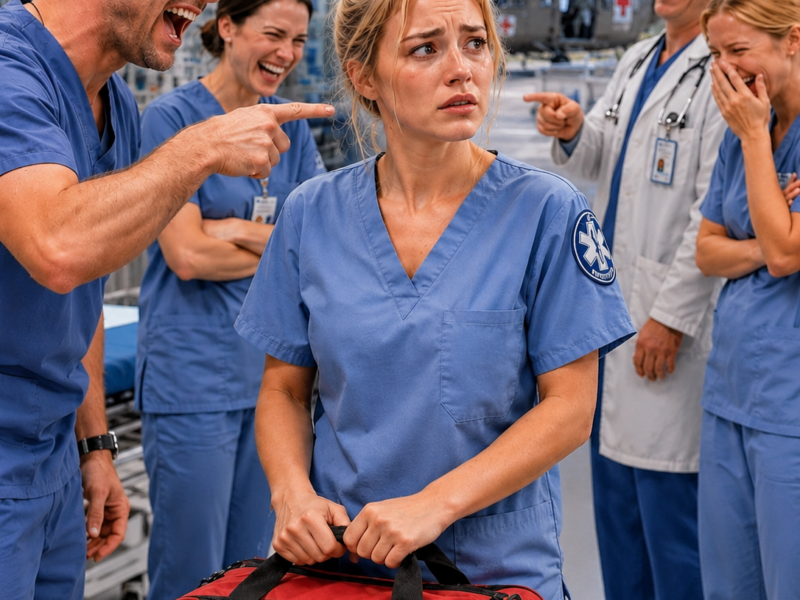
At 4:47 a.m., I Was Fired From a Montana Hospital for Disobeying a Surgeon—even Though My Emergency Procedure Had Just Saved a Dying Patient. As Security Escorted Me Into the Pouring Rain, the Doctor Sneered, “You’re Done Here,” But Minutes Later, a Military Black Hawk Landed on the Roof and a General Demanded to Know Where I Was. Then the Wounded Man Whispered, “Mosul. You Remember,” and I Realized This Was No Ordinary Trauma Case—Until a Message Revealed Someone Inside the Hospital Was Hiding Something Far Bigger.
At 4:47 a.m., I Was Fired From a Montana Hospital for Disobeying a Surgeon—even Though My Emergency Procedure Had Just Saved a Dying Patient. As Security Escorted Me Into the Pouring Rain, the Doctor Sneered, “You’re Done Here,” But Minutes Later, a Military Black Hawk Landed on the Roof and a General Demanded to Know Where I Was. Then the Wounded Man Whispered, “Mosul. You Remember,” and I Realized This Was No Ordinary Trauma Case—Until a Message Revealed Someone Inside the Hospital Was Hiding Something Far Bigger.
Part 1
At 4:47 in the morning, Emily Carter was fired from Pine Crest Medical Center.
Her badge was taken from her scrubs, her employment terminated without warning, and a security guard escorted her through the emergency department as though she were a criminal who had just been caught stealing medication. Rain was falling outside, cold and relentless, soaking through her jacket before she had even made it past the ambulance bay.
Behind her, a man lay dying.
Not because his injuries were beyond treatment. Not because the hospital lacked the equipment to save him. He was dying because the attending surgeon had made the wrong diagnosis, and when Emily tried to correct him, he had chosen to protect his authority instead of listening.
Twenty minutes later, a military Black Hawk helicopter would land on the roof of that same hospital.
And the first question its commanding officer would ask would not be about the condition of the patient.
He would ask, “Where is the nurse?”
To understand why an entire military operation had suddenly arrived at a small hospital in Montana looking for an ordinary emergency room nurse, it is necessary to go back to the beginning.
Pine Crest Medical Center sat in Redstone, Montana, a town of approximately 40,000 people surrounded by mountains, forests, and long stretches of highway. It had one major trauma center, a handful of restaurants, two traffic lights on its main street, and a population that generally knew when something unusual was happening before the local police did.
The hospital was the tallest building in town, although that distinction was not particularly difficult to achieve.
Its emergency department operated with a skeleton crew during overnight shifts. Administrators had repeatedly reduced staffing budgets under the assumption that serious emergencies were less likely to happen in a small Montana community.
They had been proven wrong more than once.
Emily Carter had worked there for eight months.
At thirty-two, she was the kind of employee most people described as reliable. She arrived on time, completed her assignments, rarely complained, and never seemed interested in drawing attention to herself.
Her brown hair was usually pulled into a tight bun. Her scrubs were clean, her equipment organized, and her locker contained three spare uniforms, a paperback she had been trying to finish for four months, and a protein bar that had survived several changes of season.
She did not decorate her locker with photographs or inspirational messages.
There was very little about her that suggested anything remarkable.
Her colleagues knew she was a good nurse. A few residents privately believed she was considerably better than that.
Nobody knew why.
Emily had deliberately kept her past out of conversations. She had not come to Redstone to build a reputation or climb the hospital’s administrative ladder. She had come because she wanted ordinary work, ordinary surroundings, and a chance to live somewhere that did not constantly remind her of the life she had left behind.
She had spent four years in the United States Army, completed two deployments, and worked in field medical units under circumstances that made the worst emergency room shift seem almost comfortable.
She had learned to recognize injuries in darkness, make decisions under gunfire, and distinguish between the treatment a patient needed and the treatment that merely looked appropriate on a report.
But that chapter of her life was over.
At least, that was what she had been trying to convince herself.
On a Tuesday night at the end of October, Pine Crest was experiencing a relatively ordinary overnight shift.
A drunk man had walked through a window on Carver Street. Two children had arrived following a minor traffic accident. A seventy-year-old woman was being evaluated for chest pain, although Emily had already suspected that her symptoms were more closely connected to anxiety than a cardiac emergency.
She had spent eleven minutes sitting beside the woman, holding her hand while completing other tasks.
Nobody had asked her to do that.
She had simply noticed the woman’s trembling fingers and understood that someone needed to stay.
Then the ambulance radio crackled.
The atmosphere changed immediately.
“Incoming trauma. ETA four minutes. Gunshot wound, multiple lacerations. Blood pressure seventy over palpation and dropping. Male patient, approximately mid-thirties. No identification. Dropped at the highway junction by an unidentified vehicle. No witnesses.”
Deborah Hale, the sixty-year-old charge nurse, looked up from the patient board.
“Carter. Trauma Bay One. Let’s go.”
Emily was already moving.
The ambulance arrived at 4:09 a.m.
The patient was a large man in his late thirties. Even before Emily examined him, his physical condition suggested military experience. His body carried the unmistakable marks of someone accustomed to wearing tactical equipment for extended periods.
His clothing had been cut away by the paramedics.
Emily immediately identified a gunshot wound through his left shoulder, two deep lacerations on his right arm, another wound across his chest, and extensive bruising around his ribs.
But something else bothered her.
His breathing.
It was fast, shallow, and uneven. More importantly, the sounds coming from his lungs were not symmetrical.
She moved to his side.
“Tell me what happened.”
The paramedic gave her the information while transferring the patient.
“He was unresponsive when we found him. Came around in the ambulance. Blood pressure has been dropping since pickup. We packed the shoulder wound and started fluids, but it hasn’t helped much.”
“Has his breathing changed?”
“Got worse about eight minutes ago. He tried to say something, but we couldn’t understand him.”
Emily placed her stethoscope against the patient’s chest.
She listened to the left side.
Then the right.
She checked his neck and immediately recognized the warning signs.
Her expression barely changed, but her jaw tightened.
“Deborah, I need a fourteen-gauge needle. We need to decompress the right side. His trachea is deviating.”
Deborah did not hesitate.
She had worked in emergency medicine for more than thirty years. She knew the difference between a nurse making an educated suggestion and a nurse recognizing something dangerous.
But before the equipment could be prepared, another voice interrupted.
“Hold on.”
Dr. Nathan Cross entered the trauma bay.
At forty-four, Cross was a respected attending surgeon with an impressive academic background and an equally impressive opinion of himself. He had trained at Johns Hopkins and made certain that everyone who worked beneath him knew it.
He looked at the patient, glanced at the chart, and announced his diagnosis.
“Massive hemothorax. He’s bleeding internally. Prepare for a chest tube. We’ll stabilize him enough to get him upstairs.”
Emily stepped forward.
“Dr. Cross, I’m concerned about a tension pneumothorax. His breath sounds are absent on the right, and his trachea is shifting.”
Cross barely looked at her.
“I can read breath sounds, Carter.”
“The patient won’t survive the elevator without decompression.”
Cross finally raised his eyes.
“Are you questioning my diagnosis?”
“I’m telling you what I’m hearing.”
“Step away from my patient.”
Emily looked at the man on the gurney.
His eyes were barely open, but he was looking directly at her. His lips moved, and she leaned closer.
She heard one broken word.
“Can’t.”
He could not survive the journey upstairs.
Emily knew it.
She had seen the same pattern in military field hospitals, where a patient could look deceptively stable while his body was rapidly approaching irreversible collapse.
“Dr. Cross, we need to decompress him now.”
“I said step back.”
For three seconds, nobody moved.
Then Emily made her decision.
She reached for the fourteen-gauge needle Deborah had prepared, located the appropriate insertion point, and performed the emergency decompression.
A sharp hiss escaped.
The patient took a deep breath.
His oxygen saturation stopped falling. His color began returning, and the monitor gradually settled into a more stable rhythm.
Six seconds had changed everything.
Emily withdrew the needle and placed it on the tray.
The patient was alive.
Across the gurney, Nathan Cross stared at her.
His expression was not gratitude or even relief.
It was humiliation.
“Get her out of my ER,” he said.
Deborah froze.
Nobody spoke.
“Now.”
Security guard Tony Reeves approached. He was twenty-six, and Emily knew he had always treated her fairly. He looked deeply uncomfortable.
She removed her gloves, unclipped her badge, and placed it on the supply cart.
“You’re done here,” Cross announced. “I’ll have HR process your termination by morning. Insubordination. You’re lucky I don’t report you to the medical board.”
Emily looked at him for a moment.
She did not shout. She did not beg.
She simply memorized his face.
Then she followed Tony toward the locker room.
She collected her jacket, phone, and paperback. She left the protein bar behind.
Tony handed her a plastic bag for her belongings.
“I’m sorry, Emily.”
“You’re doing your job,” she replied.
She knew he had no authority to change what had happened.
Outside, October rain struck her face immediately.
She walked toward the parking structure, then realized she was not actually heading anywhere.
She was simply moving.
That was something she had learned in the Army. Sometimes standing still meant allowing everything you had been holding together to collapse at once.
She found an empty bus shelter and sat down.
Her right hand trembled slightly. It had been doing that for years, ever since shrapnel had damaged the nerves in her forearm during her final deployment.
She pressed her palm against her thigh until the movement settled.
Then her phone rang.
The number was unfamiliar.
“Carter,” she answered automatically.
A man’s voice came through.
“Captain Carter?”
Emily went completely still.
She had not been called that in three years.
“Who is this?”
“I’ll be on the ground in seventeen minutes. I need you to stay where you are.”
“I don’t work at that hospital anymore.”
“I know what happened.”
The man paused.
“Stay where you are.”
The call ended.
Emily stared at her phone.
Behind her, inside Pine Crest Medical Center, the man she had saved was beginning to regain consciousness.
And he remembered her.
Part 2
At 4:41 a.m., the sound of helicopter blades shook Pine Crest Medical Center.
A military Black Hawk descended onto the rooftop helipad, and several men in civilian clothes entered the building with the organized precision of people accustomed to operating under pressure.
One approached the security desk. Another moved toward the emergency department.
A fourth walked directly through the ambulance bay and into the rain.
He found Emily sitting in the bus shelter.
“Captain Carter?”
“I’m not a captain anymore.”
“The general would like to speak with you.”
“Is the patient stable?”
“Yes, ma’am. Thanks to you.”
Emily picked up the plastic bag containing her belongings and followed him.
When she entered the emergency department, every head turned.
Brigadier General Harlan Voss was waiting near Trauma Bay One.
He looked at her, then nodded.
“Good to see you again, Captain.”
Emily recognized him immediately.
“General Voss.”
“I need to see the patient first.”
Behind the curtain, the wounded man was awake.
The moment he saw Emily, his expression changed.
“She did it,” he told Voss. “She saved me.”
Then he looked directly at her.
“Same as Mosul.”
And Emily understood that the past she had spent eight months trying to escape had just found her.
Part 3
Brigadier General Harlan Voss did not immediately explain why he had arrived at Pine Crest Medical Center.
Instead, he walked into Trauma Bay One and approached the patient.
“Sergeant Major Harlow,” he said quietly.
The man on the bed nodded.
His breathing was considerably better than it had been when the ambulance arrived, although his injuries were still serious. A chest tube had been inserted, fluids were running, and the medical team was monitoring his condition.
Harlow looked at Emily.
“She recognized it immediately. Cross didn’t.”
Voss nodded.
“I know. I’ve seen the footage.”
Emily turned toward him.
“What footage?”
“The trauma bay cameras. Pine Crest records every emergency intervention for liability purposes. My people obtained the recording.”
He paused.
“We have everything from the moment that ambulance arrived.”
Emily understood what that meant.
Cross’s diagnosis, her warnings, his refusal to listen, the emergency intervention, and the patient’s immediate improvement had all been captured.
There would be no argument about what had happened.
“He’s going to claim I was insubordinate,” she said.
“He already has.”
Voss explained that Cross had contacted the hospital’s chief of medicine shortly after Emily was escorted out. He had apparently intended to establish his version of events before anyone questioned his clinical judgment.
But the general had arrived with information Cross could not control.
He had reviewed the paramedic handoff report, the hospital recording, and Harlow’s account.
Then he looked directly at the surgeon.
“Doctor Cross, the patient had a tension pneumothorax. Nurse Carter identified it within forty seconds. You did not.”
Cross attempted to defend himself.
He insisted that his diagnosis had been based on the available evidence and that his treatment plan had been appropriate.
Voss listened without interrupting.
Then he delivered the sentence that changed the atmosphere in the corridor.
“Your decision would have killed that man.”
Cross’s expression tightened.
Before he could respond, Emily heard something unusual coming from the monitor.
She turned toward Harlow.
His blood pressure was falling again.
Not as dramatically as before, but enough to indicate that something had changed.
Emily moved immediately.
“Marcus, check the chest tube.”
Dr. Marcus Price, a young resident, approached the equipment.
Emily examined the output.
“The color has changed. This isn’t residual blood. He’s still bleeding.”
Price looked again and recognized the problem.
He reached for the phone to contact the operating room.
Harlow’s eyes were open.
“Again,” he whispered.
Emily leaned closer.
“You’re going to be fine.”
“Not what I meant.”
He struggled to speak.
“Mosul. Two-eleven. You remember?”
Emily kept working.
“I remember.”
He nodded slightly.
“Told Voss about you two years ago. Tried to find you.”
She did not answer.
The immediate priority was getting him upstairs.
Within four minutes, the medical team had transferred him toward the operating room.
The surgeon would eventually discover an injured intercostal vessel responsible for the continuing blood loss. Emily had recognized the pattern before the deterioration became catastrophic.
As the elevator doors closed, Voss turned toward her.
“Now we need to talk.”
They entered Conference Room B.
The room contained a long table, eight chairs, a whiteboard covered with outdated staff schedules, and a window overlooking the hospital’s ambulance bay.
Voss placed his phone on the table.
“Tell me about Mosul.”
Emily looked outside.
For a moment, she seemed to be somewhere else.
“March, three years ago,” she began. “We were attached to a unit conducting an extraction in a hostile district. The convoy took fire approximately two kilometers from the objective.”
There had been two casualties.
Harlow had been the critical one.
He suffered a sucking chest wound and an arterial injury to his left leg. Emily had packed the wound, managed his airway, applied a tourniquet, and maintained his condition while the team attempted to reach the forward operating base.
They had limited equipment, poor visibility, and active hostile contact.
There had been no comfortable operating room and no opportunity to wait for someone more senior to arrive.
She had done what was necessary.
Harlow survived and spent six weeks recovering in Landstuhl.
Emily, meanwhile, had continued serving until her own injury and the accumulated strain of deployment forced her to reconsider what she wanted from life.
“Your right hand,” Voss said.
She glanced down.
“Shrapnel injury. Nerve damage. It happened three weeks before the Mosul operation.”
“Your medical file says you never fully reported it.”
“I didn’t want to be removed from the unit.”
Voss nodded.
“I know.”
Emily looked at him.
“Then why are we discussing it?”
“Because your file tells me the outcome. It doesn’t tell me what it cost you.”
He leaned back.
“You’ve been at Pine Crest eight months. You wanted to run away from the military.”
“I wanted to find out whether I could have a life that wasn’t defined by it.”
“And have you?”
She considered the question.
“I’m still trying.”
Voss accepted that answer.
Then he explained why the Black Hawk had landed.
Harlow had been part of a four-person team conducting a domestic counterintelligence operation. The team had been tracking a network moving classified technical information across state lines through a chain of intermediaries.
Several members of that network operated behind legitimate professional identities.
They had discovered that certain facilities could be exploited because their ordinary administrative procedures provided opportunities to move information, equipment, and personnel without attracting attention.
Pine Crest had become one of those facilities.
Its trauma designation, helicopter pad, and access to regional transportation routes made it particularly useful.
Harlow’s team had been operating in Montana for seventy-two hours when their situation deteriorated.
Harlow was separated from the others and seriously injured.
An unidentified vehicle dropped him at the highway junction, where emergency services found him.
Someone had known where he would be taken.
Someone had also known that Pine Crest was the likely destination.
That person was Nathan Cross.
Voss explained that Cross had been approached through an intermediary connected to the network.
The arrangement was originally financial.
Four years earlier, Cross had accumulated substantial debts. Someone had discovered his vulnerability and offered him a way to resolve his financial difficulties in exchange for access and cooperation.
Over time, the relationship expanded.
Cross provided information about the hospital, its staffing, its security procedures, and its administrative operations.
Then, on the night Harlow arrived, he received instructions to create a medical delay.
He had been told not to kill the patient.
The intention was to keep Harlow in critical condition long enough for certain information and equipment to be moved without triggering the response that an immediate death would produce.
Cross had been told the delay would appear consistent with ordinary trauma protocol.
He had believed the hemothorax diagnosis, Voss explained, but his actions had been influenced by instructions from someone outside the hospital.
Emily looked toward the emergency department.
“So he wasn’t simply wrong.”
“No. He was also compromised.”
“Does that make any difference?”
“Not to the fact that he endangered a patient’s life.”
Voss explained that the investigation was expanding.
Cross was the primary operational contact, but investigators were examining whether other members of the hospital administration had been involved.
One name had already appeared in the financial records.
Dr. Felix Hargrove, Pine Crest’s medical director.
Emily knew him.
He was sixty-one, had worked at the hospital for six years, and was generally regarded as an administrative presence rather than someone who involved himself in everyday clinical decisions.
She had passed him in the corridors countless times.
Nothing about him had seemed unusual.
Voss reassured her that she was not expected to have identified an intelligence operation while working ordinary nursing shifts.
But Emily was already reviewing the previous eight months in her mind.
She had learned to observe buildings, people, routines, and irregularities without consciously thinking about it.
She remembered things that other people overlooked.
And something about Hargrove had recently caught her attention.
Before she could fully examine the thought, another message arrived.
It was from Major Lena Okafor, her former commanding officer.
Emily had not heard from her in eleven months.
Okafor was in Denver.
She informed Emily that three members of Harlow’s team had made contact, but the fourth, a man named Richie, had disappeared.
His tracker had stopped transmitting at 3:47 a.m.
His last confirmed location was twelve miles east of Redstone, near the Caldwell grain elevator.
There was no distress signal.
No confirmed explanation.
Then Okafor added something else.
The network was larger than they had initially believed.
And one of its members was still inside Redstone.
More specifically, someone connected to Pine Crest was coordinating information between the network and Cross.
Emily immediately understood that the investigation was not finished.
“Voss knows about this?” she asked.
“He knows there’s a secondary contact. He doesn’t have the identity yet.”
“Who is it?”
“We’re still confirming.”
The financial records suggested that the final shell account was connected to a staff credential at Pine Crest.
Emily ended the call.
She stood beside the conference room door for several seconds.
Then she remembered something she had noticed approximately two weeks earlier.
She went to the nurses’ station and asked Deborah for access to the controlled-substance records.
Deborah looked at her but did not ask why.
The electronic log showed twelve controlled-substance transactions over the previous forty-eight hours.
Most were ordinary.
Three were different.
They had been authorized through a senior administrative credential during hours when the credential’s owner was not physically present in the hospital.
The building access records confirmed it.
Someone had been using the pharmacy override system remotely.
Emily examined the authorization information.
“Who has this level of access?”
Deborah listed the senior medical staff and department heads.
Then she stopped.
“The medical director.”
Emily looked at her.
“Dr. Hargrove?”
Deborah nodded.
His access credential had been used, and his building entry record showed something even more interesting.
He had badged into Pine Crest at 4:52 a.m.
Three minutes after Emily had been escorted outside.
Five minutes before the Black Hawk landed.
Emily found Voss in the administrative corridor.
“Hargrove is here,” she said. “His credential has been used remotely, and he entered the building at 4:52.”
Voss immediately called his team.
“Where would he be?”
Emily thought about the building.
She knew its corridors, its stairwells, its sightlines, and the places where someone could observe the emergency department without being noticed.
“The fourth-floor family waiting area,” she said. “The corner window overlooks the ambulance bay, the front entrance, and the rooftop.”
Voss looked at her.
“Let’s go.”
They climbed the stairs with two members of his security team.
When they entered the fourth-floor waiting area, they found Hargrove standing beside the window.
He was watching the Black Hawk on the roof.
He turned when he heard them.
He looked at Voss, then at Emily.
“Captain Carter,” he said.
That was the moment Emily realized something important.
Hargrove knew exactly who she was.
He had known before that morning.
And whatever he had been doing inside Pine Crest, it was no longer possible for him to pretend he was simply an innocent hospital administrator caught in an unfortunate situation.
Part 4
Hargrove did not attempt to escape.
He stood beside the window, wearing a jacket over a sweater, his hands loosely clasped in front of him.
“I’d like to cooperate,” he said.
Voss studied him.
“That’s an interesting place to begin.”
The next forty minutes were spent in a formal interview room with a federal investigator recording every answer.
What emerged was different from what Emily had expected.
Hargrove was not an ideological supporter of the network. He had been compromised through financial arrangements connected to a failed business investment.
The people behind the operation had discovered his financial vulnerabilities and used them to gain access.
His responsibilities had involved information management rather than direct medical decisions.
He provided staff schedules, facility layouts, access information, and administrative credentials.
He had convinced himself that maintaining a separation between administrative access and clinical treatment meant he was not responsible for the consequences.
But that separation had been an illusion.
Pine Crest had been used as a passage point for materials and information.
Its helicopter pad and emergency designation made it valuable.
The people operating the network had carefully cultivated relationships with individuals who could provide legitimate-looking access.
Hargrove had helped them.
Cross had helped them.
And the hospital’s chief financial officer, Gerald Pruitt, was also under investigation.
Hargrove admitted that he had been standing at the fourth-floor window trying to decide whether he could leave the hospital without being noticed.
He had eventually decided that it was too late.
Emily listened to the first part of his interview, then returned to the emergency department.
It was 6:20 a.m.
The rain had finally stopped.
The sky over the Montana mountains was beginning to change from black to dark blue.
The emergency department was still operating.
The drunk man from Carver Street had been discharged. The elderly woman with chest pain had been moved to observation. Two new patients had arrived during the investigation.
Deborah was at the nurses’ station.
She looked up when Emily returned.
“Hargrove?”
“He’s cooperating.”
Deborah absorbed the information.
Then she returned to her work.
That was how experienced emergency nurses handled extraordinary situations. They acknowledged what had happened, understood its significance, and continued treating the next patient.
A few minutes later, someone informed Emily that Harlow was in recovery.
She went upstairs.
He was awake, although the medication still made him look exhausted.
Emily sat beside his bed.
“How bad?” he asked.
“The bleeding came from an intercostal vessel. They found it and closed it. Your shoulder will probably require another surgery.”
He listened.
“Will I be operational?”
“Eventually. I can’t give you a timeline.”
He nodded.
“Cross?”
“Being investigated.”
“Hargrove?”
“Too.”
He looked toward the ceiling.
“I didn’t know about Hargrove.”
“Nobody did.”
“That’s the point,” Harlow said. “The useful ones are always the ones you don’t know about.”
They were quiet for a moment.
Then Harlow asked about Mosul.
Emily remembered the night immediately.
She remembered the vehicle, the darkness, the sound of incoming fire, and the blood soaking through her gloves.
She also remembered what she had said to him while trying to keep him conscious.
“Stay angry,” she reminded him.
He looked at her.
“Because unconscious people stop being angry.”
He gave a weak smile.
“I’ve thought about that a lot.”
Then he asked why she had disappeared afterward.
Emily considered the question.
“I needed to stop being the person who could do those things for a while. I wanted to find out if there was another version of me that could exist without carrying all of it.”
“And did you find one?”
She looked through the window.
“I’m still trying.”
Harlow did not push.
He understood that some answers could not be demanded.
Before she left, he thanked her.
Not just for what she had done that morning.
For Mosul, too.
This time Emily did not dismiss the gratitude or hide behind professional language.
“You’re welcome,” she said.
Meanwhile, the investigation continued.
Cross was eventually brought into a separate room and questioned about his relationship with the network.
Emily was later given an opportunity to speak with him privately.
He admitted that he had known his actions were connected to an outside operation.
He had told himself that the delay would be harmless.
He had also told himself that the medical diagnosis was correct.
When Emily asked how many of those explanations he had genuinely believed, he struggled to answer.
Finally, he admitted that he had known what the phone call meant.
He had constructed arguments to justify his involvement.
He had convinced himself that he could control the consequences.
Emily listened.
She did not forgive him.
But she also understood that the purpose of the conversation was not to make him feel better.
“You should go,” she told him. “The investigators have more important questions than mine.”
Cross nodded and left.
A little later, Major Okafor contacted Emily again.
The missing team member, Richie, had been found.
He had suffered an ankle injury after losing contact with the others and had gone to ground near his last known position.
He was alive.
Emily felt the tension in her shoulders ease.
One more person had made it through the night.
But there was another problem.
The financial investigation had identified a second physician at Pine Crest who appeared to be connected to the network.
Not Cross.
Someone who had been coordinating information between the hospital and the people directing the operation.
The investigators were still confirming the identity.
Emily knew the hospital well enough to recognize that the pharmacy credential information might provide the answer.
She returned to the nurses’ station and reviewed the records with Deborah.
The unusual transactions had been authorized under Hargrove’s credentials, but the access pattern suggested that someone else had been using the system.
That meant the credential itself had become a tool.
The investigation expanded into the administrative offices.
Four servers were seized. Twelve boxes of documents were removed. Federal investigators interviewed employees and examined financial records.
Gerald Pruitt, the CFO, arrived at seven in the morning expecting an ordinary workday.
Instead, two federal agents were waiting for him at the entrance.
He said very little.
His attorney would later describe that decision as the wisest one he had made in years.
Cross, meanwhile, was placed under closer investigation.
His financial records revealed that his relationship with the network had lasted four years.
He had not simply accepted one payment in exchange for one favor.
He had maintained access for an extended period.
The investigators still needed to establish precisely how much damage his cooperation had caused.
At 8:14 a.m., the Montana Medical Board issued an emergency suspension of his medical license.
The suspension was immediate.
Hargrove resigned from his position as medical director at nine.
The hospital board accepted his resignation during an emergency meeting.
Emily watched the institutional consequences unfold without taking satisfaction in any of them.
A hospital was supposed to be a place where people could trust that the person treating them was acting in their best interests.
The fact that Pine Crest had been used for something else was more disturbing than the downfall of any individual.
At approximately 11:30 a.m., Dr. Patricia Wembley, the chief of medicine, called Emily into her office.
Wembley had arrived at the hospital in a coat thrown over her pajama pants after receiving an emergency call during the night.
She had barely taken the coat off since.
“Your termination was never processed,” she explained.
Emily listened.
“Cross initiated it, but the paperwork was not filed before everything changed. Legally, you were never terminated.”
She paused.
“But even if it had been processed, I would have rescinded it this morning.”
Emily looked at her.
“What happened in Trauma Bay One saved a man’s life. It also exposed something that could have continued damaging this institution for years.”
Wembley folded her hands.
“You should never have been removed from that room.”
Emily remained quiet.
Then she made a request.
“Deborah should receive formal recognition. She trusted my assessment when she had no institutional reason to do so.”
Wembley nodded.
“I’ll make that happen.”
She then offered Emily something else.
A more significant clinical role at Pine Crest.
She explained that Emily’s patient outcomes had been exceptional since the day she joined the hospital.
Wembley had noticed her abilities during the second month of employment.
She had wondered why someone with Emily’s apparent experience was working ordinary overnight shifts in a small Montana emergency department.
But she had chosen not to ask.
“It wasn’t my business,” she explained. “But I want you to know that I saw what you were doing.”
Emily thanked her.
She was beginning to understand that being recognized did not always have to involve dramatic gestures.
Sometimes it meant someone quietly acknowledging the work you had been doing when nobody else was paying attention.
Later that afternoon, Emily returned to Harlow’s room.
He was sitting upright, arguing with a nurse about when he could have his phone back.
The nurse, Adeaze, clearly had experience with difficult patients.
“Tell him the phone stays off until six,” she instructed Emily.
Emily looked at Harlow.
“The phone stays off until six.”
He gave her a look of complete disappointment.
But when she sat beside him, he became serious.
He told her that he wanted her to accept the posting Voss had offered.
The military was developing a new medical response component, combining civilian clinical authority with military coordination.
It needed someone who could understand both environments.
Harlow believed Emily was uniquely suited to it.
“You don’t just have the medical skills,” he explained. “You understand how to read a situation. You notice things other people miss. You spent eight months watching a hospital and recognized something the investigators hadn’t connected.”
Emily looked at her right hand.
“The tremor isn’t going away.”
“I know.”
“On a bad day, it affects fine motor control.”
“I know that too.”
She reminded him that the nerve damage was documented.
Harlow did not dismiss her concerns.
But he pointed out that she had performed a life-saving emergency intervention that morning despite the injury, the exhaustion, and the interference from Cross.
“Take the weekend,” he said. “Think about it.”
Emily gave him the same answer she had given Voss.
She needed time.
And for the first time in a long while, she allowed herself to consider that returning to the work she had left behind might not mean losing the life she had tried to build.
Part 5
The weekend gave Emily the opportunity to think without the noise of the emergency department surrounding her.
But before she left Pine Crest, something unexpected happened.
Nathan Cross sent her a message.
It contained an apology, an acknowledgment of his actions, and one additional sentence that immediately caught her attention.
There was a third file.
It contained information about someone above Hargrove.
Cross claimed he had kept a copy as insurance, intending to use it if the network ever turned against him.
He wanted to give it to Emily directly.
She called Voss.
He admitted that he had approved the message and allowed the meeting because he believed Cross might possess information that could help complete the investigation.
Emily asked where he was.
“Room 114. There’s an agent outside.”
She walked down the administrative corridor.
Cross was sitting at a small conference table with a cup of water in front of him.
He looked considerably older than he had earlier that morning.
Emily sat opposite him.
“What’s in the third file?”
Cross reached into his jacket and produced an envelope.
He slid it across the table.
Inside were three pages of printed communications with handwritten annotations in the margins.
Emily recognized Cross’s handwriting immediately.
The documents contained a series of communications between Hargrove and a man named Warren Stills.
Stills was not simply another intermediary.
The financial records connected him directly to the originating shell account.
The communications described Pine Crest as a geographic asset.
The hospital’s helicopter pad, trauma designation, transportation access, and administrative structure had all been identified as useful components of the operation.
They had not been using the hospital merely because it was convenient.
They had deliberately developed it into a passage point for materials and information.
The people behind the network had spent years cultivating access.
Emily looked up.
“Where is Stills?”
Cross shook his head.
“I never met him directly. Everything went through Hargrove.”
Then Emily noticed the timestamp on the final communication.
It had been sent four hours earlier.
Before the Black Hawk landed.
Before Cross’s actions were exposed.
Before anyone inside Pine Crest understood how much of the operation had already begun to collapse.
She stood.
“Why did you keep this?”
Cross hesitated.
“Because I thought I’d find a way out without losing everything. I wanted evidence that I wasn’t the only one involved. I thought I could use it to negotiate if things ever came apart.”
He looked down at his hands.
“They came apart faster than I expected.”
Emily took the envelope.
Before leaving, she looked at him one final time.
“Whatever you decide to do next, do it with the same clarity you just used to give me this.”
She walked out and found Voss.
Within minutes, the general had reviewed the documents and contacted his investigators.
Stills was already on their list.
The third file connected two separate investigative threads that had not previously been linked.
Voss looked at Emily.
“This is significant.”
“I know.”
The next six hours were spent processing evidence, coordinating with federal investigators, and expanding the operation beyond Pine Crest.
Emily was no longer the center of what was happening.
And that was appropriate.
Four servers and twelve boxes of documents were removed from the hospital.
Gerald Pruitt’s financial involvement was examined in greater detail.
The Montana Medical Board formalized Cross’s suspension, while investigators prepared additional charges.
Hargrove’s cooperation helped establish how the hospital had been compromised.
And Warren Stills became the subject of a wider federal operation.
At 11:30 a.m., Wembley formally confirmed that Emily’s employment had never been terminated.
The hospital also began reviewing its internal procedures and the circumstances surrounding Cross’s actions.
Deborah received the formal acknowledgment Emily had requested.
But for Emily, the most important part of that morning had been something much smaller.
When she returned to the nurses’ station, Deborah had placed her badge on the counter.
It was the same badge Emily had left behind when Tony escorted her out.
She picked it up and turned it over.
The photograph showed the same quiet woman who had walked into Pine Crest eight months earlier, hoping nobody would ask too many questions.
Deborah watched her.
“Coffee?”
Emily almost smiled.
“I know where the good machine is.”
She went to the break room.
Voss joined her a few minutes later.
He poured himself a cup, tasted it, and made a face.
Then he returned to the subject of the folder.
He explained that the new medical response unit had been in development for two years.
Six people had already been selected.
All were capable.
But none possessed the specific combination of clinical judgment, operational experience, and environmental awareness that Emily brought to the table.
He reminded her that when his team had gone through the trauma bay recording, they had immediately recognized the quality of her work.
He had reviewed military medical decisions for seventeen years.
What Emily had done that morning was exceptional.
He was not saying it to persuade her.
He was saying it because nobody at Pine Crest had said it during the eight months she had worked there.
Emily looked through the window.
The mountains were beginning to turn gold.
“Give me the weekend,” she said.
Voss nodded.
“Take whatever you need.”
She eventually went home.
The drive took eleven minutes.
She retrieved her car from the hospital parking structure, fed the neighbor’s cat she had been looking after, showered, and ate something that wasn’t a protein bar.
Then she sat at her kitchen table with a cup of coffee.
Her right hand rested flat on the wood.
The tremor was almost invisible.
She thought about the night.
About Cross.
About Hargrove.
About the man who had survived Mosul and somehow found himself on her trauma bed three years later.
She thought about the hospital and the life she had built there.
And she thought about the possibility that she had been trying to become someone she was never meant to be.
The following weeks brought the consequences of the investigation.
Nathan Cross’s medical license was permanently revoked after a four-hour hearing before the Montana Medical Board.
The decision was unanimous.
Criminal negligence charges were filed, and federal charges connected to his relationship with the network increased his legal exposure.
His attorney eventually negotiated a cooperation agreement.
Cross was convicted on two counts and sentenced to thirty-eight months in prison, followed by five years of mandatory community medical service in public clinics after his release.
He never practiced surgery again.
Hargrove pleaded guilty to federal charges involving conspiracy and obstruction.
His cooperation was extensive, and the court considered it when determining his sentence.
He received a suspended sentence and five years of supervised release.
The civil liability case against Pine Crest Medical Center resulted in a substantial settlement.
Gerald Pruitt received a harsher outcome.
The financial investigation revealed that his involvement was considerably more extensive than initially suspected.
He was convicted on four counts of conspiracy and sentenced to seven years in prison.
Warren Stills was arrested in Seattle eleven days after the night at Pine Crest.
He faced seventeen charges across multiple federal jurisdictions.
The investigation continued, but Emily eventually stopped following every development.
She had learned that there was a difference between remaining informed and allowing the past to consume all available attention.
In November, she accepted the posting.
The paperwork took three weeks.
The modified active-status structure was exactly what Voss had described. It allowed her to work under civilian authority while coordinating with military personnel.
She understood the operational concept because she had helped develop something similar in 2019.
The work would be difficult.
It would also be meaningful.
She did not leave Pine Crest dramatically.
She gave Wembley four weeks’ notice and continued working her regular shifts.
She trained the new overnight nurse on the emergency protocols she had developed during her time there.
She helped organize the department’s equipment and updated several procedures that had been neglected for years.
On her final day, she finally ate the protein bar that had been sitting in her locker.
It had expired, but she decided it was probably still edible.
Deborah brought in a grocery store cake.
The frosting was blue, and the words GOOD LUCK, EMILY had been written across the top.
The blue had bled slightly into the white icing.
It was not an elaborate farewell.
It was exactly right.
Before leaving Redstone, Emily visited Harlow twice more.
The second visit took place at a rehabilitation facility two hours north of the city.
He was walking again, although not particularly well.
His shoulder would require additional treatment, and his recovery would take months.
They talked about the new unit and its structure.
They discussed the people who would be involved, the responsibilities, and the practical difficulties of establishing a new medical response capability.
Toward the end of their conversation, Harlow asked her something unexpected.
“Do you still tell people to stay angry?”
Emily considered the question.
She remembered the words she had spoken in Mosul.
Stay angry, because unconscious people stop being angry.
For years, that sentence had represented something important to her.
It had been an instruction to remain conscious, remain present, and refuse to surrender when everything around her suggested that surrender would be easier.
But she had changed.
“I tell them to stay present,” she answered.
“Same idea. Different word.”
Harlow nodded.
He seemed satisfied.
The day Emily officially reported to her new posting was a Tuesday in December.
The city was gray and cold.
She arrived wearing civilian clothes, carrying a folder containing her orders and the operational brief.
Outside the building, she briefly pressed her right hand against her thigh.
The tremor was there.
It was always going to be there.
She had stopped expecting it to disappear.
What mattered was understanding its limits and working within them.
She entered the building.
Six people were waiting for her.
They were talented, difficult, experienced, and human.
She began by introducing herself, then reviewed the first operational brief.
Within the first hour, she asked three questions that Voss later admitted nobody else had thought to ask.
She accepted the observation without comment.
She did not think of herself as a hero.
She had never liked the word.
What she had done in Trauma Bay One was the work she had been trained to do. The circumstances had simply made her actions visible.
But the important work had never been about being recognized.
It had happened in dark vehicles, temporary medical facilities, and unfamiliar places where nobody was recording the decisions she made.
It had happened when she had been injured herself and continued working because someone else needed her.
It had happened during eight quiet months in Redstone, when she had sat beside frightened patients, covered difficult shifts, and noticed things other people overlooked.
And it had happened at 4:09 a.m. when a surgeon told her to step away from a dying man and she refused.
Nathan Cross had looked at her and seen an ordinary nurse who could be dismissed without consequence.
He had mistaken her quietness for weakness and her lack of ambition for a lack of ability.
He had believed his position protected him from being challenged.
By the time the morning was over, he had lost his medical license, his career, and his freedom.
Emily had lost her job for approximately twenty minutes.
Then she had walked back through the same hospital doors.
Not because she wanted revenge.
Not because she needed to prove something to the people who had underestimated her.
She returned because the patient was still alive, because there was work to do, and because the responsibility had never been about her reputation.
It had always been about the person lying on the other side of the trauma bay curtain.
She had spent eight months trying to become invisible.
But some kinds of competence cannot remain hidden forever.
Sometimes the person everyone overlooks is the only one who recognizes the danger.
Sometimes the quietest person in the room is the one who understands exactly what needs to happen.
And sometimes the most important moment in someone’s life arrives when they have already been told they are no longer needed.
Emily Carter had walked out of Pine Crest Medical Center in the rain believing she had lost everything she had worked to build.
She had returned carrying the same plastic bag, wearing the same scrubs, and holding the same steady determination that had kept a dying man alive.
The hospital had changed.
The people responsible had been exposed.
And Emily had finally stopped pretending that the best version of herself was the one who stayed small enough for everyone else to feel comfortable.
On a Tuesday morning in December, she drove toward her new office with a cup of bad coffee in the holder, an operational briefing waiting on the passenger seat, and the Montana mountains somewhere behind her.
For the first time in years, she was not trying to escape the person she had once been.
She was ready to decide what that person could become next.