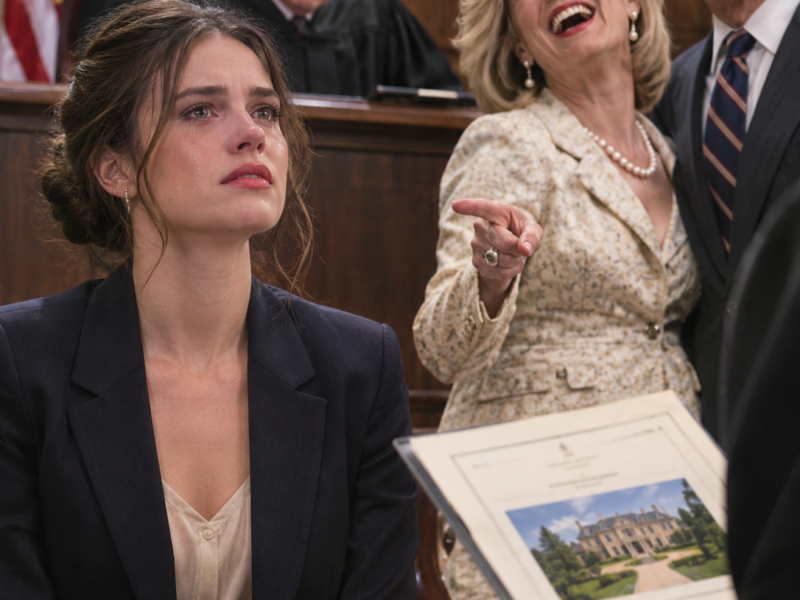
At 32, My Father Kicked Me Out of My Apartment to Impress My Sister’s Wealthy Husband, Then Sued Me for $500,000, Claiming I Owed Him for Raising Me. In Court, He Smirked and Declared, “Without Me, She Would Be Homeless,” While My Family Laughed Behind Him. But He Had No Idea I Had Uncovered a Forged $150,000 Loan and a Secret Involving His $2.4 Million Estate. When My Lawyer Handed the Judge One Document, She Looked at Me in Disbelief and Asked, “They Really Don’t Know?”
At 32, My Father Kicked Me Out of My Apartment to Impress My Sister’s Wealthy Husband, Then Sued Me for $500,000, Claiming I Owed Him for Raising Me. In Court, He Smirked and Declared, “Without Me, She Would Be Homeless,” While My Family Laughed Behind Him. But He Had No Idea I Had Uncovered a Forged $150,000 Loan and a Secret Involving His $2.4 Million Estate. When My Lawyer Handed the Judge One Document, She Looked at Me in Disbelief and Asked, “They Really Don’t Know?”
PART 1
“Without me, my daughter would be homeless.”
Those were the words my father confidently declared in a Chicago courtroom, smiling as though he had already won. He had no idea that I secretly controlled the debt on his $2.4 million estate, held financial claims against his favorite son-in-law’s business, and possessed evidence connecting them to a $150,000 fraudulent loan.
My name is Cassidy. I’m thirty-two years old, and for most of my life, my family treated me like a failure.
I worked as a commercial real estate acquisitions director, negotiating multimillion-dollar transactions and quietly building my investment portfolio. But because I drove an ordinary sedan and lived in a modest apartment, my wealthy-looking parents assumed I was struggling financially.
My younger sister, Sydney, was their golden child. She had married Malcolm, an Atlanta luxury car dealer who impressed my parents with expensive watches, exotic vehicles, and endless stories about successful investments.
Everything changed during my parents’ thirty-fifth wedding anniversary.
Two hundred wealthy guests filled their enormous Chicago mansion. Sydney wore a glittering designer gown while my mother ordered me to supervise the catering staff.
During his speech, my father, Harrison, proudly praised Sydney and Malcolm.
Then he noticed me standing near the kitchen.
“And Cassidy,” he announced with a cruel smile, “is still trying to figure out her life.”
Several guests laughed awkwardly.
I remained silent.
After the celebration, Harrison entered the kitchen and handed me a document.
It was a three-day notice to vacate my apartment.
Ten years earlier, he had insisted on becoming the primary leaseholder when helping me secure the property. Although I had paid every month’s rent, he had now arranged to terminate the lease.
“Malcolm has important investors visiting Chicago,” he explained. “They need somewhere comfortable downtown.”
I stared at him.
“You’re throwing me out of my home for Malcolm’s investors?”
“Don’t be dramatic,” he replied. “Sleep in your car or find a cheap motel. Family supports family.”
I left without another word.
That night, while packing my belongings, I remembered that my birth certificate and Social Security card were still locked inside my father’s office.
At three in the morning, I returned to the mansion.
While opening his filing cabinet, I accidentally knocked a leather binder onto the floor.
Bank documents scattered across the carpet.
One letter caught my attention.
FINAL NOTICE OF DEFAULT.
I discovered that Harrison had missed five consecutive mortgage payments, exhausted the property’s equity, and accumulated enormous debts. The mansion was scheduled for foreclosure auction in fourteen days.
My father wasn’t the wealthy businessman he pretended to be.
He was drowning financially.
The next morning, my mother called demanding that I borrow $50,000 to rescue Malcolm’s dealership.
I refused.
Then I contacted Donovan, my private attorney.
Together, we established a holding company called Vanguard Equities and negotiated the purchase of the distressed debt secured against my parents’ estate.
The transaction was completed quietly.
My family had no idea their supposedly unsuccessful daughter now controlled the mortgage threatening their luxurious home.
But something even more disturbing happened that afternoon.
Malcolm arrived at my office, demanding money and threatening to destroy my professional reputation.
After security escorted him away, I checked my credit report.
A new commercial loan had appeared.
The amount was $150,000.
The borrower was Malcolm’s dealership.
And the primary guarantor was me.
Except I had never applied for any loan.
My father and brother-in-law had forged my signature and stolen my identity to finance Malcolm’s collapsing business.
When Donovan examined the documents, he immediately recognized the seriousness of the fraud.
We preserved the evidence and prepared our legal response.
Days later, a foreclosure notice arrived during Sydney’s extravagant baby shower.
Harrison turned pale as he discovered that Vanguard Equities demanded repayment of $2.4 million.
My family desperately requested more time.
Through Donovan, I offered a thirty-day extension in exchange for additional collateral, including Malcolm’s dealership and its luxury vehicle inventory.
They signed the agreement.
Believing they had outsmarted their creditors, my family celebrated at an expensive steakhouse.
They deliberately ordered extravagant meals and forced me to pay the $2,470 bill.
But during dinner, Malcolm drunkenly revealed something extraordinary.
He planned to move his luxury cars into a secret warehouse and falsify dealership records to prevent creditors from seizing them.
I quietly recorded his confession.
That recording became another crucial piece of evidence.
Soon afterward, their luxury vehicles were repossessed, and their financial empire began collapsing.
Instead of accepting responsibility, Harrison blamed me.
He filed a lawsuit demanding $500,000, claiming that raising me had been a financial sacrifice I was obligated to repay.
He believed a courtroom would finally force me into submission.
And when the hearing began, he still had absolutely no idea who owned Vanguard Equities.
PART 2
My father entered the courtroom wearing an expensive navy suit, smiling confidently at the judge.
He claimed I was an ungrateful daughter who had abandoned her struggling parents.
“Without me,” he declared, “Cassidy would be homeless.”
Donovan calmly approached the witness stand.
He presented the fraudulent $150,000 loan documents and evidence connecting Harrison and Malcolm to the forged signatures.
My father’s confidence immediately vanished.
Then Donovan produced Vanguard Equities’ ownership records.
“Your Honor,” he announced, “my client founded Vanguard Equities. Her company acquired the mortgage debt secured against her father’s estate and holds the collateral agreements involving Malcolm’s dealership.”
The courtroom fell silent.
Harrison stared at me, his face turning ghostly white.
My mother covered her mouth.
Sydney looked as though she had seen a stranger.
For thirty-two years, they had called me worthless.
Now they understood that the daughter they had thrown away possessed the financial power they had spent their lives pretending to have.
The judge dismissed Harrison’s lawsuit, while the fraud allegations proceeded through the appropriate legal channels.
Then federal agents appeared.
They arrested Malcolm in connection with the financial investigation.
Terrified, Malcolm immediately accused Harrison of organizing the fraudulent loan.
Outside the courtroom, my mother approached me crying.
“Cassidy, please. We’re family.”
I looked directly into her eyes.
“You only remembered that when you needed something from me.”
Then I walked away.
PART 3
Over the following months, my family’s manufactured empire disappeared.
Harrison faced federal prosecution and imprisonment. Malcolm’s dealership collapsed, and he eventually received a lengthy sentence for his financial crimes.
My mother lost her mansion and began working at a discount grocery store.
Sydney, abandoned by her wealthy social circle, returned demanding that I give her childhood bedroom back.
Instead, I offered her legitimate employment and an opportunity to rebuild her life.
She refused.
“I’d rather struggle than work for you,” she shouted.
I let her leave.
The mansion itself became my final project.
I demolished the extravagant property where I had endured decades of humiliation and replaced it with the Vanguard Innovation Hub.
It became a modern business center helping women entrepreneurs who lacked financial support, professional connections, or encouragement from their families.
Within its first year, dozens of women received funding and opportunities to pursue their dreams.
One afternoon, I stood beside Donovan, watching ambitious young women enter the beautiful glass building.
For the first time, the land represented something meaningful.
My greatest victory wasn’t destroying my father’s reputation or gaining control of his estate.
It was realizing I no longer needed his approval.
I had spent thirty-two years trying to earn love from people who only respected money and appearances.
Now I understood the truth.
Blood doesn’t make someone family. Love, respect, and loyalty do.
My father once told a courtroom that without him, I would be homeless.
But I had built my own future.
And nobody could ever take it away.