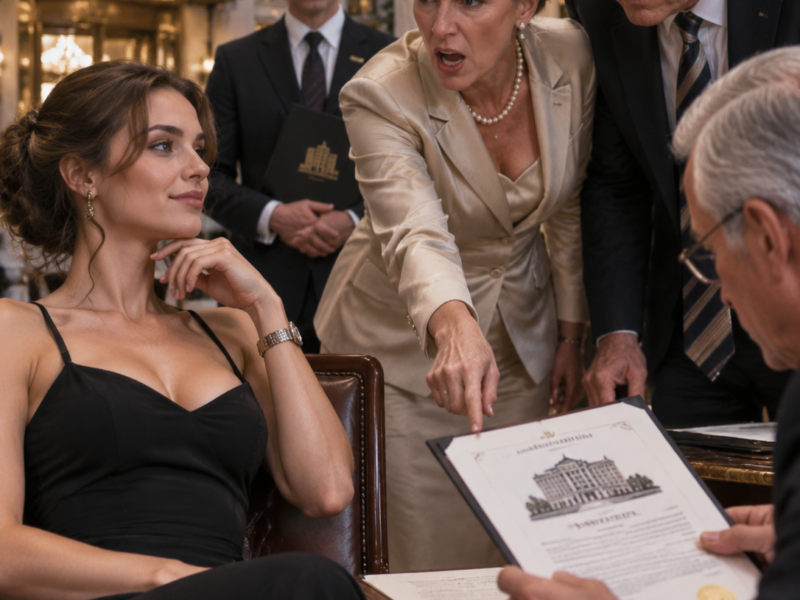
At 31, My Parents Invited Me to Watch Them Sell Our Family’s $70 Million Chicago Hotel, Then My Father Handed Me $200 and Told Me, “That’s More Than You’d Make at the Front Desk.” My Brother Smirked as He Prepared to Claim His New Fortune, While I Sat Quietly Against the Conference Room Wall. But When the Closing Lawyer Asked the Legal Owner to Sign, I Stood Up, Picked Up the Pen, and My Father Suddenly Realized He Had No Idea Who Really Owned the Hotel…
At 31, My Parents Invited Me to Watch Them Sell Our Family’s $70 Million Chicago Hotel, Then My Father Handed Me $200 and Told Me, “That’s More Than You’d Make at the Front Desk.” My Brother Smirked as He Prepared to Claim His New Fortune, While I Sat Quietly Against the Conference Room Wall. But When the Closing Lawyer Asked the Legal Owner to Sign, I Stood Up, Picked Up the Pen, and My Father Suddenly Realized He Had No Idea Who Really Owned the Hotel…
PART 1
My name is Sophia Wright, and I was thirty-one years old when my father tried to sell a $70 million hotel that had legally belonged to me for eighteen years.
I remember the morning clearly. The conference room overlooked the Chicago River, sunlight reflected off the glass buildings outside, and a long mahogany table separated my family from the people who had come to purchase what my parents proudly called their greatest achievement.
My father, Robert Wright, sat at the head of the table. My mother, Patricia, sat beside him, wearing a diamond necklace she had purchased only three months earlier. Across from them was my younger brother, Alexander, who had recently been appointed president of our family’s hospitality company.
He looked confident. Almost untouchable.
I sat quietly against the wall, wearing a simple gray dress and holding a slim black folder on my lap.
To everyone in that room, I was nothing more than the disappointing older daughter who worked at the hotel’s front desk.
They had no idea I was worth approximately $50 million.
They had no idea I controlled the trust that owned the entire hotel.
And they certainly had no idea that the company purchasing the property had spent the previous six weeks negotiating directly with my legal representatives.
My family believed they were about to become extraordinarily wealthy.
They were about to discover that they had been celebrating the sale of something they had never owned.
But before I explain what happened in that conference room, you need to understand how I became the invisible daughter in a family that had spent decades worshipping appearances.
Eleven weeks before the closing, I was standing behind the reception desk of the Lakehurst Hotel when my mother walked into the lobby with a group of potential investors.
The Lakehurst was a beautiful 214-room landmark in downtown Chicago. Its marble entrance, enormous crystal chandeliers, and carefully restored architectural details made it one of the most recognizable independent hotels in the area.
My parents had managed the property for twenty-six years through a company called Wright Hospitality Group.
They frequently referred to it as our hotel.
They said it so confidently that even the employees who had worked there for decades believed the Wright family owned the building.
But there was a difference between managing a property and owning it.
My parents had never bothered to understand that difference.
That afternoon, they were hosting potential buyers in the ballroom. I had received a message from my mother asking me to attend because she wanted the family together for an important presentation.
I thought she meant I would be there as her daughter.
I was wrong.
I had just changed out of my guest services uniform when she intercepted me near the ballroom entrance.
She looked me up and down, frowned at my simple black dress, and handed me a white catering jacket.
“The investors are arriving,” she whispered. “Help the servers.”
I stared at the jacket.
“Mom, you asked me to come as family.”
She gave me a look that had followed me throughout my childhood.
“Please don’t make this emotional, Sophia. Your brother is trying to protect all of us. The last thing we need is you creating an uncomfortable situation.”
Behind her, my father was discussing financial projections with Alexander.
My brother was thirty-four and had been president of Wright Hospitality Group for six months. He had never independently managed a full hotel budget, but my father treated him like a business genius.
Alexander wore an expensive navy suit and a luxury watch with a blue ceramic bezel.
I recognized the watch immediately.
Three days earlier, an invoice had crossed my desk while I was reviewing hotel expenses.
The watch had cost $845,600.
It had been charged to the hotel management company under the description “executive client development.”
I looked at my brother.
He noticed my attention and deliberately pulled back his cuff.
“Good turnout today,” he said with a smile. “Try not to drop anything near the buyers.”
My mother was already walking away.
I put on the catering jacket.
Not because she had won, but because I had a reason to remain invisible a little longer.
For eighteen months, I had worked at the Lakehurst as a guest services employee. I checked guests in, handled complaints, coordinated room changes, and occasionally helped the housekeeping department during particularly busy weekends.
It was real work.
I knew the names of employees who had been there for twenty years. I knew which elevators malfunctioned during humid weather, which rooms received complaints about street noise, and which suppliers consistently delivered late.
I also knew things my brother didn’t.
While Alexander spent his days attending business lunches and posing for photographs, I had learned how the hotel actually operated.
And there was another reason I had chosen that position.
My grandmother, Eleanor Wright, had left me an inheritance that changed my life.
Seven years earlier, when I was twenty-four, her attorney had invited me to his office.
He placed a gray binder and a sealed envelope on the desk.
“Your grandmother wanted you to receive these personally,” he explained.
I opened the envelope.
Inside was a letter written in Eleanor’s familiar handwriting.
She had always been the one person in my family who treated me as though my opinions mattered.
While my parents praised Alexander for every minor achievement, my grandmother encouraged me to ask questions, challenge assumptions, and learn how things worked.
She had built a considerable fortune through investments and commercial real estate.
According to the documents, she had left me approximately $50 million in investments and property.
But that wasn’t the most important part.
She had also established the Eleanor Wright Legacy Trust.
The trust held legal ownership of the Lakehurst Hotel, including its land, building, furniture, trademarks, and the company holding its liquor license.
The hotel had been placed in the trust in 2008.
My parents had been appointed managers under a long-term management agreement.
They were responsible for operating the property, paying employees, maintaining the building, and reporting financial performance.
They were not owners.
The trust initially had a corporate trustee. When I turned thirty, I would become its sole acting trustee and gain authority over major decisions, including selling the hotel, refinancing it, or replacing its management company.
My grandmother had planned everything carefully.
Her letter contained one sentence I would never forget.
“Your parents admire the appearance of ownership more than the responsibility that comes with it. Do not reveal what you hold until you know whether they value you without it.”
I read that sentence several times.
Then I closed the letter and made a decision.
I would keep the inheritance private.
I rented a modest apartment in a building I already owned through one of my holding companies. I drove a used Honda and continued working ordinary jobs.
My investment team managed my assets through a company called Harbor Ridge Capital.
My parents never asked how I managed my finances.
They assumed I was struggling.
Sometimes they even offered unsolicited advice about finding a better career.
Alexander, meanwhile, received everything.
My father paid for his business school education, financed his first company, and eventually gave him the presidency of Wright Hospitality Group.
Whenever Alexander made a mistake, my parents called it experience.
Whenever I succeeded at something, they called it luck.
I learned to stop expecting fairness from them.
When I turned thirty, I formally accepted the trusteeship and began reviewing the Lakehurst’s financial records.
What I discovered was considerably worse than I had expected.
The management agreement prohibited personal expenses from being disguised as business costs. It also restricted undisclosed transactions involving related parties and prohibited the company from borrowing against management fees without notifying the trust.
The agreement gave the trust the right to inspect the company’s books and terminate the management arrangement for cause.
Alexander had apparently treated those provisions as suggestions.
Luxury car leases had been recorded as transportation partnerships.
Country club memberships appeared under market research.
Private weekends had been classified as executive retreats.
Consulting payments were being directed to a company registered at Alexander’s apartment.
My parents had approved many of these expenses.
Meanwhile, Wright Hospitality Group had accumulated $16.8 million in loans and personal guarantees.
The company had built debt around the right to manage the hotel.
It had not built equity in the property itself.
That afternoon, while I carried glasses of water through the ballroom, I listened to my father introduce Alexander as the future of the Lakehurst.
My mother told one investor that I had never developed the commercial instincts necessary to participate in the family business.
Then Alexander stood beneath the chandelier and raised his glass.
“To the next chapter of the Lakehurst,” he announced. “Under my leadership, this hotel will become one of the most successful hospitality properties in the country.”
Everyone applauded.
I stood near the service entrance holding an empty tray.
For a moment, I wondered whether they had ever considered how humiliating it was to be treated like a stranger in a business that my grandmother had deliberately entrusted to me.
When the last investor left, my father approached me.
He reached into his wallet and handed me two hundred dollars.
“For helping today,” he said. “More than you would have made at the desk.”
I looked at the money.
Then I looked at him.
“Thank you.”
I placed the bills beside his champagne glass and walked away.
Inside the elevator, I removed the catering jacket.
I took out my phone and called my trust attorney.
“Open a formal audit,” I said. “And accept the buyer meetings. But don’t disclose my name yet.”
There was a brief silence.
“Are you certain?”
I watched the ballroom floor disappear above me.
“Yes. I want to know exactly what they have done before I decide what happens next.”
For the first time, I wasn’t simply watching my family spend money they didn’t own.
I was preparing to hold them accountable.
PART 2
Six months before the closing, Wright Hospitality’s lender refused to extend its $6.2 million credit line without audited financial statements and a serious reduction in debt.
My father responded by hiring a broker to sell the Lakehurst.
He advertised the hotel as a family-owned property worth approximately $70 million.
The proposal attracted Meridian Crown Hotels, a national hospitality group interested in acquiring and renovating historic properties.
Meridian offered $70 million for the real estate, hotel assets, and operating rights, provided the existing management agreement could be terminated cleanly.
My family immediately began spending the imaginary fortune.
My mother discussed buying a condominium in Palm Beach. My father promised friends he would establish an investment fund. Alexander ordered architectural renderings for a luxurious corporate headquarters.
They knew the property was held under an Eleanor Wright entity, but my father dismissed it as outdated estate paperwork.
Meanwhile, Meridian’s lawyers discovered the trust’s ownership and contacted my representatives.
I agreed to negotiate, but only under three conditions: employees would be protected, the hotel would receive the renovations it desperately needed, and my family’s debt would remain separate from the property’s sale proceeds.
Meridian accepted.
For six weeks, we negotiated quietly.
My parents continued celebrating.
They had no idea that the final decision was sitting in the apartment of the daughter they considered unsuccessful.
PART 3
Nine days before the closing, Alexander called a meeting with the hotel’s department heads.
I was standing near the back of the ballroom with the housekeeping director and chief engineer when he stepped onto the stage.
A large screen behind him displayed a photograph of the Lakehurst followed by a slide titled “The Right Legacy Continues.”
Alexander’s portrait occupied almost half the screen.
He looked like someone who had just been elected president of an important country.
“Everyone,” he began, “I want to share some exciting news about the future of our hotel.”
I folded my arms and listened.
“As you know, Meridian Crown has recognized the work we’ve accomplished here. They’ve expressed considerable interest in retaining our current leadership structure after the acquisition.”
The housekeeping director glanced at me.
I knew something she didn’t.
Meridian had never offered Alexander a position.
He continued.
“I will be taking responsibility for the regional hospitality division. This will give us an incredible opportunity to expand our influence.”
The next slide displayed several performance statistics.
One claimed that Alexander had increased occupancy by twelve percent.
The truth was that two revenue managers had developed a pricing strategy that improved bookings and increased room revenue. Alexander had excluded both of them from the presentation.
After the meeting, I approached him near the service corridor.
“Has Meridian approved that announcement?”
He turned slowly.
For a moment, he seemed genuinely confused that I had spoken.
“Front desk questions go through your supervisor.”
“I’m asking because you just announced something that hasn’t been confirmed.”
His expression hardened.
“Don’t confuse your access to the building with authority over the business.”
Several employees nearby suddenly became very interested in their phones.
Alexander stepped closer.
“You’re lucky Mom insisted you attend the closing. At least you’ll get one family photograph before we stop pretending your job is part of the company’s success story.”
“Why would you want me there?”
He smiled.
“Perspective. You should see what ambition looks like when it finally pays off.”
Then he lowered his voice.
“And don’t tell anyone you’re my sister until after the photographs. Meridian thinks we have a strong leadership team.”
I watched him walk away.
That evening, my mother arrived at my apartment without calling.
She looked around my modest living room and examined the secondhand furniture.
She noticed my used Honda keys on the table and the stack of hotel uniforms near the bedroom.
Everything about my apartment confirmed the story she had created about me.
She had no idea that the building belonged to one of my holding companies.
She didn’t recognize the original architectural drawing hanging near my desk.
She certainly didn’t notice the property reports addressed to Harbor Ridge Capital.
“I brought you something,” she announced.
She handed me a gray dress.
“For the closing. Wear this. Nothing too dramatic.”
I examined it.
“Thank you.”
Then she took a document from her handbag.
“This is a confidentiality agreement. Everyone connected to the transaction needs to sign it.”
I began reading.
The document contained a $500,000 penalty for unauthorized disclosure of information relating to the sale.
That wasn’t unusual by itself.
But halfway through the agreement, I found something much more concerning.
It identified Wright Hospitality Group as the beneficial owner of the Lakehurst Hotel.
I read the sentence twice.
“Who prepared this?”
“Our lawyers.”
“Your lawyers are describing the management company as the beneficial owner?”
My mother sighed.
“Sophia, please don’t start.”
“I’m simply asking.”
“People become jealous when someone succeeds. We need to protect your brother from unnecessary problems.”
I placed the document on the table.
“I’ll have someone review it.”
Her expression changed immediately.
“You’re making this unnecessarily difficult.”
“I’m allowed to have an attorney review a document before signing it.”
She crossed her arms.
“Your father and I have worked for years to build this company. The sale is going to change everything. Afterward, we may be able to help you. Perhaps we can pay a year of your rent so you can finally find a better apartment.”
I almost laughed.
She was offering to pay the rent of a property I owned.
Instead, I simply nodded.
She stood up and adjusted her handbag.
“Don’t embarrass us at the closing. Your brother deserves this moment.”
After she left, I forwarded the agreement to my legal team.
Within an hour, they discovered that the same false ownership representation had appeared in two lender presentations and an industry award application submitted by Alexander.
The following morning, the audit team delivered another report.
They had identified $842,000 in personal expenses and unsupported consulting payments.
The watch alone accounted for a substantial portion of the questionable executive spending.
There were luxury vehicle leases, private travel, club expenses, and payments to an entity that had no documented business activity.
My father had approved several transactions.
My mother had signed personal guarantees securing the company’s loans.
The company had also breached three loan covenants.
The trust now had sufficient grounds to terminate the management agreement.
I sat in my office for a long time, reviewing the findings.
I could have stopped the sale immediately.
I could have informed Meridian that the management company had breached its contract and allowed the transaction to collapse.
But the Lakehurst needed approximately $22 million in modernization.
Its employees deserved better than becoming collateral damage in a family dispute.
Meridian had demonstrated that it was prepared to invest in the property and preserve the staff.
So I authorized the closing.
I instructed my lawyers to prepare two separate document packages.
The first would complete the $70 million transaction.
It would include employee retention protections, a renovation commitment, and a clean transfer of the hotel.
The second would terminate Wright Hospitality Group for cause, release the audit to the appropriate lenders, and activate the consequences of the guarantees my parents had signed.
My family would have a choice.
They could accept a carefully structured exit and take responsibility for their actions.
Or they could reject it and face the full consequences of the financial arrangements they had created.
Two days before closing, my father summoned me to his office.
He didn’t offer me a chair.
“At the meeting, you will speak only if someone addresses you,” he said.
I stood across from his desk.
“Understood.”
“This is Alexander’s moment. Don’t turn it into something about yourself.”
On his desk was a photograph of my brother beneath a framed title:
PRESIDENT. OWNER. VISIONARY.
I looked at it briefly.
Nothing on the desk acknowledged the employees who kept the hotel running.
Nothing suggested my father understood the title report waiting downtown.
“When the money clears,” he continued, “we’ll decide what is fair for you.”
I nodded and walked out.
He thought I was going to the closing to receive whatever kindness remained after his victory.
He had no idea that I was going to decide whether his company would survive the morning.
PART 4
The closing took place in a glass conference room overlooking the Chicago River.
Meridian’s acquisition team sat opposite my parents, Alexander, their broker, and two attorneys.
I arrived wearing the gray dress my mother had given me.
I carried a slim black folder.
My father pointed toward a chair against the wall.
“Family observers sit there.”
Alexander leaned toward Meridian’s acquisition director.
“My sister works in guest services. She wanted to watch a real business transaction.”
The director glanced at me.
She already knew exactly who I was.
So did the attorneys sitting beside her.
Neither corrected my brother.
For forty minutes, the lawyers reviewed payoff statements, transfer schedules, and closing conditions.
My father spoke repeatedly about preserving his family’s legacy.
Alexander asked twice about his supposed regional appointment.
The acquisition director answered politely.
“All leadership appointments will be addressed after the ownership documents are executed.”
My brother interpreted that as encouragement.
My mother sent me a text from across the table.
“Sit straight. Try to look happy for him.”
I placed my phone face down.
At 10:17 a.m., Daniel Cho, Meridian’s closing attorney, placed a blue-tabbed signature packet in the center of the table.
“Before we release the funds, we need the deed, the assignment of hotel assets, and the owner’s closing certificate.”
He looked around the room.
“Will the legal owner please sign?”
Alexander immediately reached for the silver pen.
Daniel covered it with his hand.
“Not you, Mr. Wright.”
My father frowned.
“The family company is signing the documents.”
Daniel remained calm.
“The family company owns no real estate or hotel assets. It is the outgoing management company.”
The room became silent.
I stood up.
I walked toward the center of the table and picked up the pen.
“Put that down!” my father shouted.
His chair struck the wall behind him.
Daniel didn’t even look in his direction.
“Mr. Wright, your daughter is the sole acting trustee of the Eleanor Wright Legacy Trust and the only person in this room authorized to sell the Lakehurst Hotel.”
My mother’s face lost its color.
Alexander froze halfway through a smile.
I looked directly at my father.
For the first time in my life, he seemed unable to recognize the daughter standing in front of him.
“She works at the front desk,” Alexander said.
Daniel replied, “She chose to work at the front desk. We have been negotiating with Ms. Wright’s legal representatives for six weeks.”
My father grabbed the title summary.
His eyes moved across the document.
The Eleanor Wright Legacy Trust was listed as the legal owner.
My name appeared beneath it.
Sole acting trustee.
“Your grandmother left you the hotel?” my mother whispered.
“She placed it in trust years before she died.”
“But we’ve managed it for twenty-six years,” my father protested.
“Yes,” I said. “You managed it. You were paid management fees. You were never the owners.”
Alexander stood.
“This is ridiculous. Dad built this place. I’m the president.”
I opened my black folder.
“You are the president of Wright Hospitality Group, an operating company currently in default under its management agreement.”
I placed his employment agreement beside the title report.
“You have no equity in the property, the furniture, the trademarks, or the sale proceeds.”
“Sit down, Sophia,” my father ordered.
It was the same tone he had used when I was twelve years old.
The same tone that had always made me feel as though my opinions were a nuisance.
But this time, I didn’t move.
“Your company has misrepresented its ownership position to lenders, investors, and industry organizations. We need to discuss that before the closing proceeds.”
Daniel paused the transaction.
Meridian’s acquisition director folded her hands.
“We will allow thirty minutes for the parties to review the documents. But I want to be clear. Meridian is purchasing the property from its legal owner. We have relied on Ms. Wright’s authority throughout this process.”
My father turned toward his attorney.
“Why wasn’t I told?”
His attorney hesitated.
“You were informed that trust consent was required. You instructed us that the bank trustee would provide it.”
“The bank?”
“The bank’s authority ended more than a year ago.”
My mother stared at me.
“You knew we were selling the hotel.”
“I knew you were trying to sell it.”
“And you let us plan our lives around the money?”
I opened the second packet.
“You planned your lives around money that was never yours.”
Alexander’s expression changed when he saw the audit tab.
“What is that?”
“The results of an independent financial review.”
“That’s private company information.”
“The management agreement gives the trust inspection rights. Your signature is on the amendment.”
I opened the report.
“The watch. The vehicle leases. Private travel. Club expenses. Consulting payments to an entity registered at your apartment. Eight hundred forty-two thousand dollars in unsupported expenses.”
My brother looked toward my father.
“Tell her she can’t do this.”
My father didn’t answer.
“The company’s lenders relied on financial statements that omitted these related-party payments,” I continued. “This is no longer just a family disagreement.”
My mother began crying.
I remembered the catering jacket.
I remembered the two hundred dollars.
I remembered my brother telling me not to embarrass him.
But I wasn’t interested in humiliating them.
I was interested in protecting the hotel, its employees, and the assets my grandmother had entrusted to me.
My father finally lowered himself into his chair.
“What do you want?”
I placed two folders in front of him.
One was white.
The other was red.
“The white folder completes the $70 million sale. Meridian retains every employee in good standing, funds the renovation plan, and recognizes the trust as the seller.”
I paused.
“Wright Hospitality gives up its management contract. A limited transition payment goes directly to its secured creditors. Harbor Ridge Capital will restructure the remaining guaranteed debt under strict conditions.”
I touched the red folder.
“This terminates your company for cause today. Meridian walks away. The audit goes to the lenders entitled to receive it. The trust pursues repayment of misused funds, and the creditors exercise their existing rights against the guarantees.”
Alexander pushed the white folder away.
“You set us up!”
“No,” I replied. “I didn’t approve your expenses. I didn’t sign your guarantees. And I didn’t describe you as the owner in lender presentations.”
My father looked toward the door.
“Give us the room.”
Meridian’s acquisition director stood.
“Thirty minutes. After that, our offer expires.”
When the door closed, my father turned toward me.
His expression was no longer confused.
It was hatred.
I had imagined this moment many times.
I expected to feel powerful.
Instead, I felt something much quieter.
It felt like a lock finally turning.
My father looked at the two folders.
“Read the conditions,” I said. “Then decide how expensive your pride is.”
The first condition required my parents to resign as officers of Wright Hospitality Group.
Alexander would surrender his presidency, waive severance, and lose access to every hotel system.
He would also sign a corrected public statement explaining that he had been president of the management company, not the owner of the Lakehurst.
“You want me to humiliate myself online?” he demanded.
“I want the public record to match the legal record.”
“You’ve destroyed my reputation.”
“You created the difference between your reputation and the truth.”
The second condition addressed the family’s financial obligations.
The transition payment would go directly to secured creditors.
The luxury vehicles, pledged jewelry, and country club deposit would be surrendered under the existing security agreements.
My parents’ mansion would be listed for sale within fourteen days.
The proceeds would reduce their guaranteed debt.
They would be allowed to retain protected accounts and enough money for a reasonable move.
I wasn’t trying to leave them homeless.
But I wasn’t going to let them protect their lifestyle while employees and vendors carried the losses.
My mother wiped her face.
“My jewelry came from your father.”
“Most of it was pledged as collateral for the credit line.”
She turned toward him.
He looked away.
For the first time, she seemed to understand that the expensive objects she had used to demonstrate their success were actually evidence of their financial problems.
The third condition required Alexander to acknowledge the unsupported expenses and enter a five-year repayment agreement.
The final audit would be shared with the appropriate lenders and tax authorities.
I could not control whether regulators would investigate.
I could, however, agree not to pursue a separate civil claim if Alexander fully disclosed the accounts, cooperated with the review, and repaid the money.
“I can’t repay that,” he whispered.
“Then you shouldn’t have spent it.”
The fourth condition placed the remaining guarantees under an independent financial administrator for five years.
My parents would disclose their finances, obtain approval before taking on new secured debt, and live within their actual income.
Harbor Ridge would extend the repayment period and reduce the interest rate.
It would not forgive the principal.
My father suddenly stopped turning pages.
“Harbor Ridge Capital,” he said slowly. “That’s yours, isn’t it?”
“Yes.”
“So you bought our debt while pretending to earn wages downstairs.”
“I acquired the senior loan after a documented default. An independent committee reviewed the price and allocation.”
“You controlled all of this.”
“I controlled my investments and my responsibilities as trustee. Your company made its own decisions.”
He stared at me.
“You expect us to call you for permission every time we spend money?”
“No. The administrator isn’t me. You wanted a business solution. You’re receiving one.”
My mother moved her chair closer.
“Sophia, please. End the trust arrangement. We can sign something privately. We can divide the sale proceeds and put this behind us.”
I looked at her.
“Grandmother created the trust because she knew exactly how you handled money. Dividing its assets for your comfort would violate my responsibilities.”
“We are your parents.”
“That gave you a chance to know me. It didn’t give you ownership of the hotel.”
My father brought up the cost of raising me and paying for my education.
I reminded him that scholarships and student loans had covered most of my tuition while he financed Alexander’s business ventures.
He responded with the same explanation I had heard throughout my childhood.
“Your brother had greater potential.”
Even then, he couldn’t stop ranking us.
I slid the red folder closer.
“Then choose him again. Reject the restructuring. Protect his title. Let the creditors enforce the agreements you signed.”
Alexander finally stopped arguing.
His attorney explained what the alternative would mean.
Termination of the management agreement.
Enforcement of personal guarantees.
Potential foreclosure.
A civil claim.
The possibility of years of financial and legal consequences.
The white folder wasn’t a reward.
It was the narrowest possible path through the consequences they had created.
At 10:46, Meridian’s team returned.
My father asked for five more minutes.
The acquisition director looked at me.
I shook my head.
“We accept,” my father finally said.
The signatures began.
My parents resigned.
Alexander signed his corrected statement.
My mother surrendered the jewelry pledged as collateral.
My father signed the debt modification.
When Alexander reached the public statement, he stared at it for nearly a minute.
“Once this is published, nobody in the industry will take me seriously.”
I looked at him.
“The employees had to take you seriously while you charged an $845,600 watch to their workplace.”
He lowered his head.
Then he signed.
Daniel returned the sale documents to me.
I carefully reviewed the employee retention clause, renovation commitment, and proceeds schedule.
After adjustments, the trust would receive approximately $66 million.
Four million dollars would cover creditor and transition obligations.
My parents would receive no personal windfall.
Their company would leave with less debt, not a fortune.
I looked at each member of my family.
My brother’s anger had collapsed into disbelief.
My mother seemed smaller without the future she had already spent in her imagination.
My father watched my hand.
He finally understood that the daughter he had placed against the wall controlled whether everyone at that table would leave with a completed transaction.
I picked up the pen.
And I signed.
PART 5
Meridian confirmed the wire transfer shortly afterward.
At 11:08 a.m., the Lakehurst officially changed hands.
The acquisition director shook my hand and thanked me for protecting the hotel’s employees throughout the negotiations.
My father said nothing.
My mother stared at the table.
Alexander was already looking at his phone.
Meridian’s public announcement appeared less than an hour later.
It thanked the Eleanor Wright Legacy Trust, identified me as the sole acting trustee, and praised the Lakehurst’s employees for their years of service.
It also announced a renovation plan and the appointment of an experienced general manager.
My family was nowhere in the announcement.
Alexander’s corrected statement appeared beneath it.
Within minutes, his phone began vibrating.
A hospitality publication withdrew a profile that had described him as a second-generation hotel owner. The association responsible for his leadership award opened a review of the application he had submitted.
He looked at me as though I had personally arranged every consequence.
I hadn’t.
I had simply stopped protecting him from the truth.
Ten days later, Meridian held a staff meeting in the same ballroom where my mother had once handed me a catering jacket.
One hundred ninety-three employees were retained under the new ownership agreement.
Maintenance funding was restored.
The two revenue managers whose work Alexander had claimed received promotions and additional responsibilities.
I stood before the employees and explained the transition.
I thanked them for keeping the Lakehurst running through difficult years.
I didn’t mention my family.
I didn’t need to.
Their names had disappeared from the organizational chart.
The final audit eventually increased Alexander’s unsupported spending total to $917,400.
He avoided a separate civil lawsuit by disclosing the accounts, cooperating with the investigation, and beginning repayment under the five-year agreement.
The hospitality association revoked his award.
Meridian rejected him for any leadership position.
Two interview opportunities disappeared after prospective employers reviewed the corrected ownership statement.
Friends who had once surrounded him at expensive restaurants gradually stopped answering his calls.
Eventually, Alexander accepted an operations position with a commercial laundry supplier.
It was honest work.
He had to follow schedules, coordinate deliveries, answer to supervisors, and account for every expense.
There were no luxury vehicles waiting outside his office.
No corporate credit card for private dinners.
No impressive title to introduce himself with.
My parents had a different adjustment to make.
They sold their mansion after two reductions in the asking price.
The proceeds, along with the surrendered vehicles, club deposit, and pledged valuables, reduced their personal guarantees.
They still owed money.
They moved into a rented two-bedroom condominium in Evanston and began attending quarterly meetings with the independent financial administrator.
My mother told acquaintances they were simplifying their lives.
Most people understood what had happened.
The invitations that once arrived every week became increasingly rare.
The people who had praised my parents’ success discovered that their relationships had been attached to a building they had never owned.
Six months after the closing, my family asked to meet me at a small coffee shop near my office.
I arrived first and chose a table away from the window.
My father wore a suit without a tie.
My mother carried a simple leather handbag.
Alexander arrived directly from work wearing a company polo shirt.
For the first time in years, none of them looked particularly important.
But they didn’t look destroyed either.
That mattered to me.
The consequences of their decisions had reduced their choices.
They had not removed their ability to build different lives.
My father started the conversation.
“Your mother and I have completed two quarters under the administrator. We have made every payment on time.”
“I know.”
“Would you consider forgiving half the remaining guarantee?”
I looked at him.
“The agreement already gives you a lower interest rate and more time than the original lenders required.”
“But we’re your parents.”
I took a sip of coffee.
“That doesn’t change the financial agreement.”
Alexander leaned forward.
“I want you to write a letter explaining that the audit found no intentional misconduct.”
I stared at him.
“The audit made no such conclusion.”
“I’ve been cooperating.”
“And I can truthfully confirm that you’ve made six payments and cooperated since the closing.”
“That’s not enough.”
“It’s what happened.”
My mother finally spoke.
“The corrected ownership statement is still appearing when people search his name. Can you have it removed?”
“Why?”
“Because it’s humiliating. Everyone sees it.”
“Because it’s accurate.”
She looked down at her handbag.
“So this is forever?”
I waited.
“You’re always going to see us as people who used you?”
I wrapped both hands around my coffee cup.
“I still see you as my parents. But I’m no longer the person you use to protect your image.”
My father looked down.
“Trust doesn’t return because you completed six months of a five-year agreement. If it returns, it will be built from what you do when there is nothing left to gain from me.”
For once, he didn’t tell me Alexander’s future was more important.
My brother spoke quietly.
“I’ve been thinking about the revenue managers.”
I looked at him.
He continued.
“I didn’t even know their names when I presented their work as mine.”
He told me he had written to both of them.
One had responded with two sentences.
The other hadn’t answered.
I believed that he felt ashamed.
But I also understood something important.
Feeling ashamed wasn’t the same as repairing the damage.
I paid for my coffee and stood.
As I walked toward the door, my mother called after me.
“Are you ever coming to dinner again?”
I turned around.
“Invite me without needing money, a signature, or a photograph. Then I’ll decide.”
Three weeks later, an invitation arrived.
It was for Sunday dinner at their condominium.
There was no dress code, no guest list, and no request hidden inside the message.
I went for one hour.
The food was ordinary.
The conversation was awkward.
My father asked about my work without turning the discussion toward money.
My mother asked whether I liked my apartment.
Alexander spoke about his new job.
Nobody introduced him by a title.
Nobody asked me to disappear.
It wasn’t reconciliation.
But it was the first family gathering I could remember where I didn’t feel like an unwanted guest.
Eighteen months after the sale, Meridian nominated me to speak at a national hospitality governance conference.
The subject was legacy assets, responsible ownership, and the importance of understanding the difference between controlling a business and actually owning it.
I accepted.
My parents weren’t in the audience.
Alexander watched the recording later from his apartment.
I never mentioned their names.
I described a hotel whose managers had confused access with ownership and status with competence.
I spoke about employees whose work had been overlooked because someone more powerful wanted the recognition.
Then I shared a sentence that had taken me years to understand.
“Sometimes people recognize your value only after you stop asking for their recognition.”
The room became quiet.
But this silence was different from the one in the closing conference room.
That silence had been filled with disbelief and fear.
This one made space for my voice.
The Lakehurst reopened after its first renovation phase with the original employee memorial wall preserved.
Near the lobby, Meridian installed a small plaque honoring Eleanor Wright’s years of stewardship and the employee retention commitment attached to the sale.
I asked that my own name remain in the legal archive rather than above the entrance.
I had spent too many years watching my family turn buildings into monuments to themselves.
I didn’t need another monument.
My parents continued making payments and living within the financial plan.
Alexander completed his first full year at the laundry supplier without charging a personal expense to anyone else.
Our relationship remained limited, but it had become honest enough to breathe.
I occasionally visited the Lakehurst.
Sometimes I walked through the lobby and watched guests check in.
I remembered standing behind that same reception desk while my mother told investors I lacked commercial instincts.
I remembered carrying water through the ballroom while Alexander celebrated a business he didn’t own.
I remembered the catering jacket, the two hundred dollars, and the gray dress.
For a long time, I thought the inheritance had changed my life because it gave me money.
But that wasn’t entirely true.
The money gave me choices.
The trust gave me authority.
Neither gave me worth.
I had possessed that before the inheritance, before the closing, and even when my family called me a failure.
My grandmother understood something my parents never did.
Real ownership isn’t about having your name printed on a business card or standing in front of a building while people applaud.
It’s about responsibility.
It’s about protecting what has been entrusted to you.
And sometimes, it’s about having the courage to say no to the people who believe your love means they can take whatever they want.
I still loved my family.
But I no longer confused love with obedience.
I could forgive them without returning the keys.
I could wish them well without paying their debts.
And I could give them another opportunity without pretending the past had never happened.
One evening, I stood near the Lakehurst entrance and watched the lobby lights reflect against the marble floor.
A young receptionist greeted a guest with a warm smile.
She reminded me of myself several years earlier.
I wondered whether anyone had ever told her how important her work was.
I hoped they had.
Because the people who keep a business alive are not always the ones standing on the stage.
Sometimes they’re the people carrying water through the ballroom.
Sometimes they’re the ones answering the phone at midnight, fixing a broken elevator, or finding a solution when a guest has nowhere else to go.
And sometimes, they’re the people everyone has overlooked.
My grandmother had left me a fortune, but her greatest gift wasn’t the $50 million or the hotel.
It was the opportunity to discover that I didn’t need my family’s approval to know who I was.
The daughter they had dismissed had become the person who protected the business they had spent years claiming as their own.
And when I finally walked away from that conference room, I didn’t feel the need to prove anything to them.
I had already made my decision.
Forgiveness, I learned, wasn’t about handing the keys back to people who had misused them.
It was about releasing the need to watch them suffer while keeping the boundaries that protected my own life.
I sometimes think about the last sentence in my grandmother’s letter.
She had warned me not to reveal what I held until I knew whether my parents valued me without it.
I eventually discovered the answer.
They valued what they believed I could give them.
But I also discovered something more important.
I could value myself without waiting for them to change.
And that was worth more than any building, any company, or any amount of money.
Have you ever been judged by your own family because your life didn’t look successful enough from the outside? Have you ever had to choose between protecting your peace and keeping people happy?
I’d love to hear your story.