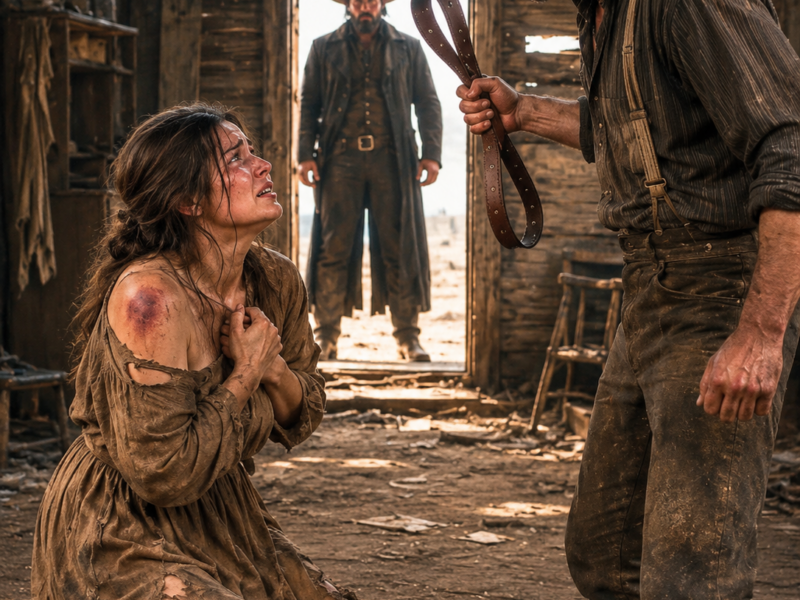
At 31, I Had Been Trapped on a Wealthy Rancher’s Mountain Property for Three Years, Working Without Pay, When He Grabbed My Arm and Whispered, “You Owe Me, and You’ll Never Leave Until I Say So.” He Claimed I Owed Him $112, but My Secret Records Proved He Actually Owed Me $418. Then a Mysterious Mountain Man Knocked on Our Door, Fixed My Broken Water Pump, and Asked One Question Nobody Had Asked in Years. But When My Employer Found a Hidden Letter in the Stranger’s Saddlebag, Everything Changed…
At 31, I Had Been Trapped on a Wealthy Rancher’s Mountain Property for Three Years, Working Without Pay, When He Grabbed My Arm and Whispered, “You Owe Me, and You’ll Never Leave Until I Say So.” He Claimed I Owed Him $112, but My Secret Records Proved He Actually Owed Me $418. Then a Mysterious Mountain Man Knocked on Our Door, Fixed My Broken Water Pump, and Asked One Question Nobody Had Asked in Years. But When My Employer Found a Hidden Letter in the Stranger’s Saddlebag, Everything Changed…
Part 1
The night I finally realized I might die on Caleb Whitlock’s ranch, I was standing with my back against a freezing wooden wall, listening to his boots move slowly across the kitchen floor.
I was thirty-one years old. I had been trapped on that Colorado mountain for three years. And the most frightening part was that nobody even knew I needed saving.
Caleb stopped a few feet away from me.
“You seem to have forgotten who you belong to, Maggie.”
I kept my eyes on the floor.
“I haven’t forgotten anything, Mr. Whitlock.”
He laughed softly.
“Then you remember what happens to women who don’t pay their debts.”
My hands were shaking, but I forced them to remain at my sides. I knew better than to argue. I knew better than to cry. Tears only seemed to entertain him, and arguing gave him another excuse to remind me how powerless I was.
Three years earlier, I had been a completely different woman.
My name is Margaret Caldwell, although my father always called me Maggie. I grew up on a small farm in eastern Colorado, where my parents taught me that honest work could build an honest life.
My father was a bookkeeper. He could examine a page of figures and recognize a mistake faster than most men could read a sentence.
He taught me everything he knew.
“Numbers don’t lie, Maggie,” he used to say. “But people certainly do. Learn to recognize the difference.”
I never imagined those words would one day save my life.
After my parents died, the farm was swallowed by debts I couldn’t afford to settle. By the spring of 1877, I owned little more than two dresses, a leather satchel, my father’s journal, and a photograph of the three of us standing outside our old farmhouse.
I needed employment desperately.
That was how I found Caleb Whitlock.
He owned one of the largest ranches in the upper valley, and his advertisement promised respectable wages, lodging, meals, and steady employment.
The contract was written clearly. I would manage the household, maintain the accounts, cook, mend clothing, and assist with ranch administration.
In exchange, I would receive regular wages.
It seemed like a blessing.
Caleb was forty-five, wealthy, well-connected, and charming when he wanted to be. When I first arrived, he welcomed me with a smile and showed me a small room upstairs.
“You’ll find I’m a fair man, Miss Caldwell.”
I believed him.
That was my first mistake.
Within a month, strange charges began appearing in the household accounts.
Five cents for lamp oil.
Twenty cents for flour.
Additional charges for firewood, laundry supplies, and the room he had promised as part of my employment.
Every time I questioned one of those deductions, Caleb had an explanation.
Eventually, the amount he claimed I owed became larger than the wages I had earned.
I remember sitting at the kitchen table one evening, reviewing the figures for the sixth time.
“Mr. Whitlock, something isn’t right.”
He looked at me over his whiskey.
“Are you accusing me of dishonesty?”
“No, sir. I’m saying the deductions aren’t included in our agreement.”
He smiled.
“Your agreement was to work here and repay what you consume.”
“The contract says otherwise.”
His smile disappeared.
“Then perhaps you should take that contract into town and explain why you’ve been stealing from my household.”
I stared at him.
“I haven’t stolen anything.”
“That’s your word against mine. Who do you think the sheriff will believe?”
He leaned forward.
“A wealthy landowner who has lived here for twenty years? Or a penniless woman who arrived with nothing?”
I said nothing.
He didn’t need an answer.
Over the following months, Caleb quietly destroyed my reputation.
He told visiting merchants that I was dishonest. He told neighboring ranchers that I was difficult, ungrateful, and mentally unstable.
Whenever someone arrived, he made certain I remained in the kitchen.
If I spoke too much, he corrected me.
If I spoke too little, he called me unfriendly.
Eventually, people stopped speaking to me altogether.
I tried once to reach an old neighbor named Ruth, who had moved to Denver. I wrote a letter explaining what was happening and concealed it inside a supply order.
The delivery man promised to mail it.
I never received a reply.
Later, I discovered that he worked directly for Caleb.
After that, I stopped asking for help.
I learned which floorboards creaked and which ones remained silent. I learned exactly how Caleb liked his coffee, how much salt he expected in his supper, and how to recognize his mood by the way he set down a whiskey bottle.
The worst evenings were the quiet ones.
When Caleb shouted, at least I knew where the danger was.
When he spoke softly, I knew he was planning something.
By my third year, I had become almost invisible.
I rose before sunrise, prepared breakfast, managed the accounts, mended clothing, cleaned the house, and went to bed long after everyone else.
The water pump outside the kitchen had been broken for months. Caleb refused to repair it, so I carried buckets uphill from a spring every morning.
During winter, my hands cracked and bled.
When I became ill, Caleb added the cost of medicine to my debt.
When I worked longer hours, he claimed I had consumed more household supplies.
Nothing I did was ever enough.
According to his ledger, I still owed him $112.
But I knew the truth.
I had secretly calculated my wages sixty-three times.
According to the original contract, Caleb owed me $418.
That amount represented more than money.
It represented three years of my stolen life.
I kept those calculations in a tiny notebook hidden beneath a loose board in my room.
I also kept the original contract inside my father’s journal.
I didn’t know whether those papers would ever help me.
But I couldn’t bear to destroy the last proof that I had once entered that house as a free woman.
Then, one evening, everything changed.
Caleb had been drinking since afternoon.
I was preparing supper when he entered the kitchen and accused me of wasting salt pork.
“I measured it exactly as you instructed,” I said.
He approached me slowly.
“Are you correcting me?”
“No, sir.”
“Because lately I’ve noticed something about you.”
I remained silent.
“You’ve started looking at me as though you’re better than this place.”
He grabbed my arm.
“You are here because I allow you to be here. Don’t forget that.”
I pressed my back against the wall.
His fingers tightened.
Then someone knocked at the front door.
Three heavy, deliberate knocks.
Caleb released me.
“Who the devil is that?”
He straightened his shirt and opened the door.
A broad-shouldered stranger stood outside, holding his hat in both hands. His coat was weathered, his boots were covered with mountain mud, and his face looked as though it had endured a lifetime of harsh winters.
“Evening,” he said. “Name’s Silas Boone.”
Caleb looked him over.
“What do you want?”
“Rockslide took out the southern trail. My horse and I need shelter until the road is passable. I’ll pay for a night in your barn.”
Caleb considered the offer.
Finally, he stepped aside.
“One night. No more.”
Silas entered.
His gaze moved across the room, passing over the table, the stove, and finally settling on me.
He noticed my trembling hands.
He noticed the way I stood against the wall.
Most importantly, he noticed Caleb watching me.
But he didn’t immediately say anything.
Instead, he removed his hat completely and nodded.
“Evening, ma’am.”
I don’t know why those two words affected me so deeply.
Perhaps because he sounded respectful.
Perhaps because he looked directly into my eyes instead of past me.
Or perhaps because I had forgotten what it felt like to be treated like a human being.
Caleb pointed toward the kitchen.
“My housekeeper will feed you. Then you can sleep in the barn.”
I prepared a small plate of stew and bread.
Silas thanked me and sat quietly at the table.
Caleb returned to his whiskey in the adjoining room.
For several minutes, neither of us spoke.
Then Silas glanced toward the doorway and lowered his voice.
“Ma’am, may I ask you something?”
I nodded.
“Are you all right?”
My throat tightened.
Nobody had asked me that question in three years.
“I’m fine,” I whispered.
Silas studied my face.
He didn’t argue.
He didn’t demand an explanation.
He simply nodded.
“All right.”
Then he added something so quietly that I almost missed it.
“If that answer ever changes, I’ll listen.”
I turned away before he could see the tears gathering in my eyes.
That night, after he went to the barn, I lay awake staring through my tiny bedroom window.
I told myself Silas Boone was only a stranger.
By morning, he would leave, and my life would continue exactly as before.
But just before dawn, I heard a sound outside my window that I hadn’t heard in eight months.
The broken water pump was working.
I hurried downstairs and opened the kitchen door.
Silas was kneeling beside the pump, his sleeves rolled up, carefully tightening a metal fitting.
“What are you doing?” I asked.
“Fixing this.”
“Caleb didn’t ask you to repair it.”
Silas looked up.
“I know.”
He stood, worked the handle, and clear water poured into the bucket beneath it.
Then he looked at my cracked hands.
“I’m not fixing it for Caleb, Maggie.”
I froze.
He had remembered my name.
“I’m fixing it because nobody should have to carry water half a mile when there’s a pump beside her kitchen.”
I stared at the flowing water.
For the first time in three years, somebody had done something kind for me without demanding payment.
But what I didn’t know was that Silas Boone hadn’t come into that valley entirely by accident.
And before the week ended, I would discover that the stranger sleeping in Caleb’s barn knew far more about my employer than he had admitted.
Part 2
The next morning, Silas asked me a question that made my blood run cold.
“Do you keep the ranch accounts?”
“Yes.”
“Then you know whether Whitlock’s figures are honest.”
I stopped washing the breakfast dishes.
“Why would you ask that?”
“Because I’ve seen enough dishonest arrangements to recognize one.”
For a moment, I couldn’t speak.
Then I told him everything.
The deductions. The threats. The unpaid wages. The contract hidden in my father’s journal.
When I finally said Caleb owed me $418, Silas didn’t laugh.
He asked to see my calculations.
We spent that afternoon studying the ledger while Caleb inspected his cattle.
Silas examined every entry.
Finally, he said, “Maggie, these figures could prove what he’s done.”
I shook my head.
“He knows everyone in town.”
“Then we’ll find someone he doesn’t control.”
He told me about Gerald Foss, the notary who had witnessed my employment contract, and suggested sending him a secret letter.
For the first time, escape seemed possible.
But as Silas returned to the barn, he stopped at the doorway.
“One more thing,” he said.
“What?”
“I’ve been asking questions about Caleb Whitlock.”
My stomach tightened.
“Why?”
He looked toward the ranch house.
“Because you’re not the first woman he’s done this to.”
Part 3
I remember staring at Silas after he said those words.
Not the first woman.
For three years, I had believed Caleb had chosen me because I was alone, poor, and vulnerable. I thought my circumstances had made me an easy target.
Now Silas was telling me there were others.
“How many?” I whispered.
“At least two women before you. Possibly more.”
“Where are they?”
“One lives in Denver. The other disappeared from the valley years ago.”
I felt suddenly sick.
“Did they escape?”
“They left the ranch. But neither received the wages she earned.”
I sat down slowly.
All those years, Caleb had made me feel ashamed of my situation. He had convinced me that my inability to escape proved I was weak.
But this wasn’t a misunderstanding.
It was a method.
Silas told me he had spoken with people in neighboring settlements. Caleb’s reputation among wealthy merchants was excellent, but workers who had dealt with him privately told a very different story.
There were complaints about unpaid wages, mysterious debts, and property acquired through questionable agreements.
“Why are you investigating him?” I asked.
Silas was silent for a moment.
Then he told me about his wife.
Her name had been Eleanor.
Before their marriage, she had worked for a man who controlled her wages and threatened to destroy her reputation if she left. She eventually escaped, but the experience had haunted her for years.
Eleanor died of fever less than two years earlier.
“When I met her,” Silas said, “she was still learning that kindness wasn’t a debt she had to repay.”
His voice remained steady, but I saw the grief in his eyes.
“She used to tell me that someone only needs one person to believe them before they can begin believing themselves again.”
I looked down at my hands.
“I’m sorry about your wife.”
“So am I.”
He gave me a small smile.
“But she’d be disappointed if I saw someone in trouble and rode away.”
That afternoon, we examined Caleb’s account book together.
I showed Silas where the false charges began, how they increased each month, and how Caleb had systematically erased everything I earned.
He listened carefully.
Then I told him about the second ledger.
Caleb kept another account book locked inside his desk.
I had seen it only once, when he accidentally left the drawer open.
Unlike the kitchen ledger, that one contained the actual ranch transactions.
Silas leaned forward.
“You’re certain?”
“I remember every figure.”
“Even though you only saw it briefly?”
“My father trained me to remember numbers.”
I opened my notebook.
“I’ve checked these calculations sixty-three times.”
Silas studied the pages.
“Then we need someone who can testify to the original contract.”
I knew exactly who he meant.
Gerald Foss.
But there was a problem.
Caleb controlled the supply deliveries, and every letter leaving the ranch passed through people who reported to him.
Silas had anticipated that.
Four miles east lived a family named Henderson. Their sixteen-year-old son regularly carried errands into Glenwood Springs.
Silas had already spoken to him.
“You’ve planned all this?” I asked.
“I’ve planned what I can. The decisions are yours.”
I looked at the blank sheet of paper he placed before me.
For three years, I had been afraid to write a letter.
Now, with a stranger sitting across from me, I began writing one that might destroy Caleb Whitlock.
I described the original employment terms, the unauthorized deductions, and the discrepancy between the contract and the accounts.
I asked Gerald Foss whether he still possessed his notarized copy.
When I finished, Silas read the letter.
“Good,” he said. “Clear and factual.”
Two days later, I handed it to the Henderson boy near the back gate.
I gave him a dollar from the small amount of money I had secretly saved.
“Please don’t mention this to anyone.”
He nodded.
“Yes, ma’am.”
I watched him disappear down the road.
I hadn’t felt so frightened in years.
For the next several days, Silas remained on the ranch.
The mountain road was still damaged, and Caleb had discovered that Silas knew how to repair fences and treat sick cattle.
Caleb offered to pay him for additional work.
Silas accepted.
At breakfast, Caleb even praised him.
“Boone’s useful. Doesn’t talk more than necessary.”
I almost laughed.
If Caleb had known what Silas and I discussed while he was away, he would have thrown him off the property immediately.
Instead, he unknowingly gave us more time.
Each evening, while Caleb drank in the sitting room, Silas and I reviewed another section of the accounts.
We worked quietly, sometimes stopping mid-sentence when footsteps approached.
I began sleeping better.
I even caught myself smiling.
That was when Caleb became suspicious.
One morning, he remained at the kitchen table after Silas went outside.
“You’ve changed,” he said.
I continued cutting bread.
“I don’t know what you mean.”
“You’ve been acting differently since that man arrived.”
“Mr. Boone has been helping with the cattle.”
“I wasn’t asking about the cattle.”
He stood.
I felt my old fear returning.
“You’ve forgotten what happens when you get ideas above your station.”
“I haven’t forgotten anything.”
Caleb approached me.
“Good. Because I checked the ledger yesterday, and it wasn’t where it belonged.”
My heart began hammering.
I had been showing it to Silas.
“I was reconciling the quarterly figures,” I replied. “I returned it before supper.”
Caleb stared at me.
“Are you lying?”
“No.”
He waited for me to lower my eyes.
I didn’t.
Finally, he stepped away.
“Make certain it stays where I can find it.”
That afternoon, I warned Silas.
“He knows something is happening.”
“Does he know what?”
“No. But he’ll keep looking.”
Silas considered this.
“Then we need the reply from Foss before he discovers the letter.”
The reply arrived a day earlier than expected.
The Henderson boy met me behind the storage shed and handed me a sealed envelope.
I recognized Gerald Foss’s careful handwriting immediately.
I wanted to tear it open.
Instead, I concealed it beneath my apron and returned to the kitchen.
I served supper.
I cleaned the dishes.
I endured Caleb’s complaints about the bread.
Then, after the house was silent, I climbed upstairs and opened the envelope beside my tiny lamp.
Gerald remembered me.
More importantly, he still possessed the contract.
He wrote that two months after I began working for Caleb, a man had visited his office requesting that the original document be withdrawn and replaced.
The man claimed there had been errors in the employment agreement.
Gerald refused.
He had been suspicious enough to preserve his copy carefully.
Now, three years later, he was willing to testify.
At the bottom of his letter, he had added a sentence that made me cry.
I regret that nobody thought to ask sooner.
I pressed the paper against my chest.
For three years, I had believed there was no one outside that ranch who would listen.
Yet one simple letter had brought an answer.
I slept with my father’s journal beneath my pillow.
The following morning, Caleb was waiting for me in the kitchen.
He hadn’t prepared his coffee.
He hadn’t opened the curtains.
He was sitting perfectly still with a folded letter on the table.
“Sit down, Maggie.”
Something in his voice warned me that the danger I had feared had finally arrived.
I sat.
He unfolded the paper.
“Do you know a man named Thomas Aldrich?”
I shook my head.
“No.”
“Interesting. Because your friend Boone certainly does.”
He pushed the letter toward me.
It had been taken from Silas’s saddlebag.
The message was brief.
It referred to an investigation of Caleb’s business dealings and instructed Silas to continue gathering documentation.
I felt the blood drain from my face.
Caleb leaned forward.
“That man didn’t come here because of a rockslide.”
I said nothing.
“He came here to destroy me. And you’ve been helping him.”
For the first time, I understood that Silas had been keeping something from me.
I looked again at the letter.
Thomas Aldrich. Denver. Investigation.
Then I raised my eyes.
“Perhaps,” I said quietly, “the more important question is why someone in Denver is investigating you.”
Caleb froze.
I had never spoken to him that way.
For several seconds, neither of us moved.
Then he folded the letter.
“Go get Boone.”
I stood.
My legs were trembling, but my voice remained steady.
“I’ll tell him you’d like to speak with him.”
I walked outside, crossed the yard, and entered the barn.
Silas was preparing his horse.
He looked up immediately.
“What happened?”
“Caleb found a letter in your saddlebag.”
Silas stopped moving.
“From Thomas Aldrich,” I continued.
His expression changed.
I stepped closer.
“Tell me the truth, Silas. Who are you?”
He looked at me for a long moment.
Then he said something I hadn’t expected.
“I’m a man who came into this valley because somebody has been stealing land and wages for seven years.”
My mouth went dry.
“And I believe Caleb Whitlock is responsible.”
Part 4
Silas finally told me everything.
Thomas Aldrich was a Denver lawyer investigating fraudulent property transactions across the Colorado mountain settlements.
For eighteen months, he had been examining records showing how certain landowners acquired property by creating debts their workers and tenants could never repay.
Caleb Whitlock’s name appeared repeatedly.
Silas had been helping Aldrich gather information because he knew the territory, understood ranch operations, and had contacts among families who rarely trusted lawyers from the city.
He hadn’t known my name before arriving.
But he had been traveling through the valley specifically to investigate Caleb.
“The rockslide was real,” he explained. “I needed shelter. But I already knew Whitlock deserved a closer look.”
I studied him.
“Why didn’t you tell me?”
“Because I didn’t know whether you could trust me. And I didn’t want to make decisions for you before you understood your own situation.”
I considered his explanation.
For three years, Caleb had controlled every detail of my life.
Silas had done the opposite.
He had asked questions, offered help, and allowed me to decide what happened next.
I believed him.
“Caleb wants you in the kitchen,” I said.
Silas nodded.
“I expected that.”
When we returned to the house, Caleb was waiting beside the table.
He held Aldrich’s letter between two fingers.
“Boone, I believe you’ve overstayed your welcome.”
Silas remained near the doorway.
“If that’s your decision, I’ll leave.”
“Immediately.”
“All right.”
Caleb looked toward me.
“And Miss Caldwell will remain here until her debt is settled.”
Silas didn’t move.
Instead, he asked me something simple.
“Maggie, do you want to leave?”
I felt the room become strangely quiet.
Caleb laughed.
“She doesn’t have that option.”
Silas ignored him.
He looked only at me.
“Do you want to leave?”
I thought about the three winters I had endured.
The buckets of water.
The unpaid wages.
The letters that never received answers.
The countless nights when I had prayed merely to survive until morning.
Then I said the word I had been too frightened to say for three years.
“Yes.”
Caleb’s expression hardened.
“She owes me $112.”
“No,” I replied.
He stared at me.
I continued before fear could stop me.
“According to the original contract, you owe me $418.”
His face changed.
“Don’t be ridiculous.”
“I’ve calculated the amount sixty-three times.”
“You don’t know what you’re talking about.”
“I know about the second ledger in your locked desk drawer. I know about the unauthorized deductions. And I know Gerald Foss still has the original employment contract.”
Caleb went pale.
I had never seen him look afraid.
“You’ve been stealing information from my office?”
“I’ve been keeping the accounts you hired me to keep.”
He stepped toward me.
Silas moved slightly, placing himself between us without touching either of us.
Caleb stopped.
“You’ll regret this,” he whispered.
I looked directly into his eyes.
“I already regret trusting you. I won’t regret leaving.”
Then I walked upstairs.
I packed my father’s journal, my notebook, two dresses, my winter coat, and the photograph of my parents.
There was almost nothing else worth taking.
For a moment, I stood beside the narrow bed where I had spent so many nights listening for footsteps.
Then I walked downstairs.
For the first time in three years, I stepped directly on the third stair.
It creaked loudly.
I didn’t care.
Silas had arranged for a second horse through one of the ranch hands.
We left before noon.
Caleb stood near the barn watching us ride away.
He didn’t shout.
He didn’t try to stop us.
Perhaps he knew that doing so would make his situation worse.
Or perhaps he was still trying to understand how a woman he had frightened into silence had suddenly found the courage to walk away.
I didn’t look back.
The journey to Glenwood Springs took several hours.
As the ranch disappeared behind the trees, I began to notice things I had forgotten.
The smell of pine.
The sunlight on the mountain peaks.
The sound of wind moving through the branches.
For three years, I had looked at those mountains as prison walls.
Now they seemed to be opening around me.
We arrived in town before sunset.
Our first stop was Gerald Foss’s office.
He was a small, elderly man with neatly combed hair and spectacles that rested low on his nose.
When I introduced myself, his expression softened.
“Miss Caldwell. I’m very glad you’ve come.”
He brought out a file and placed two documents on his desk.
One was the copy I had carried.
The other was his original notarized record.
They matched perfectly.
He looked at me.
“Mr. Whitlock attempted to have this document altered shortly after your employment began. I refused.”
“Will you testify?”
“Without hesitation.”
I nearly cried.
Not because he had promised to help.
Because he had answered without making me beg.
Later that evening, we met Franklin Cooper, an associate working with Thomas Aldrich.
Cooper listened to my story for almost two hours.
I showed him my private notebook.
He studied the calculations, asked questions, and compared them with the public commercial records Aldrich’s team had already collected.
Finally, he closed the notebook.
“Miss Caldwell, your records may be the missing piece of this investigation.”
I stared at him.
“What do you mean?”
“We’ve identified several cases involving manufactured debts and property transfers connected to Whitlock. But proving the deliberate manipulation has been difficult.”
He tapped my notebook.
“These calculations establish a detailed pattern.”
Silas remained silent beside the window.
Cooper continued.
“There’s another woman willing to testify. Her name is Clara Voss. She worked for Whitlock before you.”
I felt my chest tighten.
“She’s alive?”
“Very much so. She lives in Denver.”
“Does she know about me?”
“She does now.”
Within days, I was staying at Mrs. Alcott’s boarding house.
She was a kind widow who offered me a small room overlooking the street.
Silas paid for the first several nights, but I quickly arranged to help Mrs. Alcott with her accounts in exchange for reduced lodging.
I needed to work.
Not because anyone demanded it.
Because I wanted to prove to myself that my skills belonged to me.
For the first time in years, I earned something without having it immediately taken away.
The hearing was scheduled for six weeks later.
During those weeks, I worked with Cooper and a determined legal advocate named Helen Park.
Helen was sharp, practical, and impossible to intimidate.
At our first meeting, she examined my notebook and raised an eyebrow.
“You’ve recorded every disputed charge?”
“Yes.”
“For three years?”
“Yes.”
“And checked the total sixty-three times?”
“Yes.”
She looked at me.
“Mr. Whitlock has made a serious mistake.”
“What mistake?”
“He chose to cheat a woman who understands accounting better than he does.”
I smiled.
It felt strange.
But wonderful.
We prepared my testimony carefully.
Helen explained that Caleb would likely accuse me of misunderstanding the contract, inventing figures, or exaggerating because I resented him.
I knew that argument well.
He had been using it against me for three years.
But now I had evidence.
Every figure in my notebook corresponded to an actual transaction.
The merchants’ supply records confirmed the prices.
The cattle auction records confirmed the sales.
The contract confirmed what I should have earned.
I had nothing to invent.
Two weeks before the hearing, Clara Voss arrived from Denver.
She was younger than I expected, with dark hair and a serious expression.
She entered Cooper’s office carrying a leather case full of documents.
The first thing she said was, “Did he tell you that you owed him money?”
I nodded.
She laughed bitterly.
“He told me exactly the same thing.”
We spent the afternoon comparing our experiences.
The same charges.
The same threats.
The same accusations.
Even the same phrases.
Clara had worked for Caleb for two years before escaping with the help of relatives.
She never recovered her wages.
But she kept her records.
“I thought nobody would ever believe me,” she admitted.
“So did I.”
We looked at each other.
For a long moment, neither of us needed to speak.
We had both survived the same man.
And now we were going to face him together.
That evening, I sat outside the boarding house with Silas.
The mountains were dark against the setting sun.
“Are you frightened?” he asked.
“Yes.”
“Of Caleb?”
I considered that.
“Not exactly. I’m afraid they’ll believe him.”
Silas remained quiet.
Then he said, “You know what’s true. You have the documents. You have people willing to stand beside you.”
I looked at him.
“And if that isn’t enough?”
“Then we keep telling the truth until someone listens.”
I smiled faintly.
“You make everything sound simple.”
“Most things aren’t simple,” he said. “But that doesn’t mean we stop trying.”
We sat together for a while.
Then he told me he owned a small piece of land north of town.
He hoped to establish another cattle ranch one day.
“It needs work,” he admitted. “And someone who understands proper accounts.”
I glanced at him.
“That sounds suspiciously like an employment offer.”
He smiled.
“It might be.”
“Then I’ll require a written contract.”
“Of course.”
“And fair wages.”
“Naturally.”
“And the freedom to leave whenever I choose.”
His expression softened.
“I wouldn’t offer you anything less.”
For the first time, I allowed myself to imagine a future beyond the hearing.
But three days before we appeared in court, Helen arrived at the boarding house carrying troubling news.
Caleb had hired Marcus Webb, one of the most feared defense lawyers in the territory.
Webb specialized in destroying the credibility of witnesses.
“He’ll try to make you contradict yourself,” Helen warned.
“He’ll question your memory, your character, and your motives.”
I opened my notebook.
“Then he’d better bring a better set of numbers.”
Helen smiled.
But when she left, I couldn’t sleep.
Because I knew Caleb Whitlock.
And I knew he would do everything in his power to make the courtroom believe I was the dishonest one.
Part 5
On the morning of the hearing, I woke before sunrise.
For a moment, I forgot where I was.
I expected to hear Caleb’s boots moving across the floorboards.
I expected the familiar dread of another day on his ranch.
Instead, I heard a wagon passing outside the boarding house and Mrs. Alcott preparing breakfast downstairs.
I lay still, allowing myself to remember.
I was free.
But by the end of that day, I would learn whether freedom came with justice.
I dressed carefully in my best blue dress.
My mother had sewn it years earlier, and I had repaired it so many times that almost every seam carried a memory.
I braided my hair, fastened my coat, and placed my father’s journal inside my satchel.
Then I opened the notebook one final time.
Sixty-three calculations.
Every one ending with the same figure.
$418.
I closed it.
“The numbers don’t get nervous,” I whispered.
It was something my father used to tell me whenever I feared making a mistake.
Now I understood what he meant.
The courthouse stood near the center of Glenwood Springs, a sturdy brick building that seemed much larger when I approached it than it had from across the street.
Silas walked beside me.
Clara followed with Cooper.
Helen met us at the entrance.
“You’re ready,” she said.
I nodded.
“I am.”
Inside, Caleb Whitlock was already seated beside Marcus Webb.
He wore a fine dark suit.
His hair was neatly arranged, and his expression carried the familiar confidence of a man accustomed to getting what he wanted.
When he noticed me, he smiled.
Not kindly.
It was the same thin smile he used whenever he believed he had already won.
For a moment, my stomach tightened.
Then I remembered the night I had walked away from his ranch.
I lifted my chin and passed him without speaking.
Judge Hartley entered shortly afterward.
The courtroom stood.
When everyone sat again, Helen began presenting our case.
She showed the original contract.
Gerald Foss’s notarized copy.
The household ledger.
My private notebook.
The supply merchants’ records.
The cattle auction receipts.
Each document supported the next.
I watched the judge carefully.
He made notes as Helen spoke, occasionally asking questions about dates or amounts.
He seemed particularly interested in the unauthorized deductions.
Then Helen called me to testify.
I walked toward the witness chair feeling every eye in the room following me.
I swore to tell the truth.
And I began.
I described arriving at Caleb’s ranch in 1877.
I explained the promised wages and the deductions that appeared almost immediately.
I described the threats that prevented me from leaving.
I told the judge about the letters I had tried to send, the lies Caleb spread throughout the valley, and the two different account books.
I spoke calmly.
I didn’t exaggerate.
I didn’t hide what had happened.
When Helen asked about the unpaid wages, I opened my notebook.
“According to the original agreement, Mr. Whitlock owes me $418.”
“Are you certain?”
“Yes.”
“How many times have you checked that amount?”
“Sixty-three.”
Someone in the courtroom shifted.
Helen smiled slightly.
“Would you explain your method?”
I did.
I went through the monthly wages, permissible deductions, disputed charges, and payments that had been recorded incorrectly.
I explained how I compared the figures against public commercial records.
By the time I finished, Judge Hartley had filled several pages with notes.
Then Marcus Webb stood.
He approached with a pleasant expression.
“Miss Caldwell, you arrived at Mr. Whitlock’s ranch in difficult financial circumstances, correct?”
“Yes.”
“You were desperate for employment?”
“I needed work.”
“Isn’t it possible that your desperation caused you to misunderstand the terms of your agreement?”
“No.”
He raised an eyebrow.
“Not possible at all?”
“The contract was written clearly. I read it before signing, and I kept a copy.”
Webb walked slowly before the witness chair.
“You claim Mr. Whitlock maintained a second ledger.”
“Yes.”
“But you only saw this supposed ledger once?”
“Correct.”
“For approximately three minutes?”
“Yes.”
“And we’re expected to believe that you memorized detailed financial information from a document you barely examined?”
I looked directly at him.
“My father taught me bookkeeping when I was a child. I’ve spent most of my life working with numbers.”
“That doesn’t answer my question.”
“Then the answer is yes.”
A few people in the gallery exchanged glances.
Webb continued.
“You disliked Mr. Whitlock, didn’t you?”
“Eventually.”
“You resented him?”
“Yes.”
“You were angry with him?”
“Yes.”
He turned toward the judge.
“So you admit your feelings toward my client were hostile.”
I waited until he looked back at me.
“Mr. Webb, being angry about unpaid wages doesn’t change the amount owed.”
The courtroom became very quiet.
He pressed his lips together.
“Your feelings could have affected your memory.”
“My figures match independent records.”
“You’ve said that repeatedly.”
“Because it’s true.”
He paused.
I continued.
“If Mr. Whitlock disputes the figures, perhaps he could produce the ledger from his locked desk drawer. Then the court could compare them.”
Webb stopped moving.
For the first time, I saw uncertainty cross his face.
He glanced toward Caleb.
Caleb stared straight ahead.
Webb cleared his throat.
“No further questions at this time.”
I returned to my seat.
Helen leaned toward me.
“Well done.”
I wanted to cry.
Instead, I placed my hands flat on the table and waited.
Clara testified next.
She described working on Caleb’s ranch before I arrived.
Her story was almost identical to mine.
The promises.
The deductions.
The threats.
When Webb suggested that Clara and I had coordinated our stories, she answered firmly.
“We met only two weeks ago. The reason our experiences sound alike is because Mr. Whitlock treated us alike.”
Then Gerald Foss testified.
He confirmed the original contract and explained Caleb’s attempt to replace it after my employment had begun.
Cooper presented the broader investigation, showing suspicious property transactions linked to manufactured debts.
As the evidence accumulated, Caleb’s confident expression slowly disappeared.
By the second day, he barely looked in my direction.
His defense relied on merchants and neighboring landowners who described him as a respectable businessman.
Several testified that he had always treated them fairly.
I didn’t doubt their experiences.
Caleb understood exactly whom he could afford to treat well.
He had been generous to wealthy merchants because their friendship protected him.
He had cheated powerless workers because he believed nobody would defend them.
That was the difference.
When both sides finished, Judge Hartley withdrew to consider the evidence.
We waited in a small room outside the courtroom.
Clara sat beside me.
Silas stood near the window.
Helen reviewed her notes.
I stared at the floor, remembering the long nights when I had wondered whether I would ever escape Caleb’s ranch.
I thought about my father.
The kitchen table where he taught me arithmetic.
His patient voice.
The way he smiled whenever I discovered an error he had deliberately hidden in a column of figures.
He used to tell me I had a gift.
For three years, Caleb had tried to convince me that gift was worthless.
Now it was the very thing that might defeat him.
After what felt like an eternity, Cooper appeared in the doorway.
“The judge is ready.”
My heart began pounding.
We returned to the courtroom.
Caleb was already seated.
Marcus Webb whispered something to him, but Caleb didn’t respond.
Judge Hartley arranged the documents on his desk.
Then he looked toward me.
“I have reviewed the evidence presented in this matter.”
I held my breath.
“The original employment contract is clear. The agreed wages and conditions are stated without ambiguity.”
He turned a page.
“The records presented by Miss Caldwell demonstrate a systematic pattern of unauthorized deductions.”
I felt Clara’s hand touch mine beneath the table.
“The defendant’s explanation that these additional charges were agreed to verbally is unsupported by the written evidence.”
The judge paused.
Then he spoke the words I had waited three years to hear.
“I find in favor of Margaret Caldwell.”
For several seconds, I couldn’t move.
Judge Hartley continued.
“Mr. Whitlock is ordered to pay $418 in unpaid wages, together with the applicable court costs.”
My eyes filled with tears.
Four hundred and eighteen dollars.
The exact amount I had calculated sixty-three times.
The judge had said it aloud.
In a courtroom.
In front of witnesses.
Caleb could no longer pretend I had invented it.
But the judge wasn’t finished.
He referred the evidence concerning Caleb’s property transactions to the territorial authorities for further investigation.
He ordered the finding entered into the public record.
Then he looked directly at Caleb.
“Mr. Whitlock, this proceeding concerns unpaid wages. The evidence regarding your other business practices raises separate questions that may require further legal action.”
Caleb’s face had turned gray.
He had spent years convincing the valley that I was a liar.
Now a judge had publicly recognized that his account of our agreement was unsupported.
The hearing ended.
People stood.
Cooper shook Helen’s hand.
Clara pressed a hand over her mouth and began crying.
I remained seated.
I had imagined this moment countless times.
Sometimes I imagined shouting at Caleb.
Sometimes I imagined watching him beg for forgiveness.
Sometimes I imagined telling him exactly how much he had taken from me.
But now that justice had finally arrived, I felt something unexpected.
Peace.
Not complete peace.
Three years of fear couldn’t disappear in one afternoon.
But something heavy inside me had finally begun to loosen.
I stood and turned toward the back of the courtroom.
Silas was waiting near the doors, holding his hat.
He looked at me with the same calm expression he had worn the night he first arrived at the ranch.
I walked toward him.
“Well,” I said.
“Well,” he replied.
“Four hundred and eighteen dollars.”
He nodded.
“You were right.”
“Sixty-three times.”
He smiled.
“Every single time.”
I laughed.
Then, without warning, I began crying.
Silas didn’t rush to comfort me.
He simply stood beside me until I was ready to speak.
“Thank you,” I whispered.
“For what?”
“For stopping.”
He shook his head.
“You’re the one who walked away, Maggie.”
“But you opened the door.”
He looked at me gently.
“No. I showed you where it was. You opened it yourself.”
Outside the courthouse, the afternoon sunlight fell across the street.
Clara embraced me before leaving with Cooper to complete the remaining paperwork.
She planned to return to Denver the following morning.
“We did it,” she whispered.
“Yes,” I said. “We did.”
I watched her walk away and felt grateful that I had finally met another woman who understood my story without needing it explained.
Then Silas and I stood alone on the courthouse steps.
“What will you do now?” he asked.
I looked toward the distant mountains.
“I haven’t decided.”
“For the first time, you can.”
He was right.
I could return to eastern Colorado.
I could find employment in Denver.
I could begin my own bookkeeping business.
For three years, every decision I made had been shaped by what Caleb would allow.
Now the possibilities seemed almost frightening.
I turned toward Silas.
“You mentioned some land north of here.”
“I did.”
“You said you needed help with the accounts.”
“I do.”
I studied him for a moment.
“Would that offer still be available?”
His expression softened.
“Of course.”
“I’ll require a proper contract.”
He smiled.
“I expected you would.”
“Signed and witnessed.”
“Naturally.”
“Fair wages. No unexpected deductions.”
“Agreed.”
“And my own room.”
“Absolutely.”
I hesitated.
“One more condition.”
“Name it.”
“If I decide to leave, you won’t try to stop me.”
Silas looked at me for a long moment.
Then he answered with the words I hadn’t known I needed to hear.
“Maggie, I would never ask you to stay anywhere you didn’t want to be.”
Something inside me finally settled.
I accepted his offer.
Not because I needed someone to rescue me.
Not because I owed him for his kindness.
But because I wanted to discover what a life built on respect might look like.
Over the following months, I helped Silas organize the finances for his small property.
We repaired fences, purchased cattle, improved the buildings, and planned carefully for the future.
He never asked me to work without compensation.
He never questioned my right to make decisions.
And whenever we disagreed, we discussed the problem until we reached an understanding.
It was such an ordinary way to live.
Yet after Caleb’s ranch, ordinary kindness felt extraordinary.
The investigation into Caleb’s other transactions continued.
I later learned that additional workers had come forward after hearing about the judgment.
Some had remained silent for years.
Others had believed their experiences were isolated.
The public record of my case helped them recognize that they were not alone.
I don’t know whether Caleb ever understood what he had done.
Perhaps he continued telling himself he was the victim.
Perhaps he blamed Silas, Clara, the judge, or everyone except himself.
Eventually, I stopped wondering.
His opinion no longer controlled my life.
One spring morning, nearly a year after leaving his ranch, I was standing outside Silas’s kitchen when I heard the water pump working.
I watched the clear water spill into a bucket.
For a moment, I was transported back to that freezing morning when I first found him repairing Caleb’s broken pump.
Silas came around the corner carrying a coil of rope.
“Everything all right?”
I looked at him.
“Yes.”
He smiled.
“Good.”
He started toward the barn.
“Silas?”
He turned.
“Thank you for fixing that pump.”
He looked puzzled.
“The one at Whitlock’s place?”
I nodded.
“That was a long time ago, Maggie.”
“I know.”
He studied my face.
Then he seemed to understand.
He set down the rope and walked toward me.
“You deserved water without having to suffer for it,” he said.
I looked at the mountains beyond the pasture.
For three years, I had believed survival was the best life could offer me.
I had been wrong.
There was dignity.
There was friendship.
There was meaningful work.
There was the freedom to laugh, to disagree, to make mistakes, and to choose what happened next.
And perhaps, somewhere between the quiet mornings and the evenings we spent reviewing accounts together, there was the beginning of something even more beautiful.
But I didn’t need to name it yet.
I had spent too many years having my future decided for me.
Now I wanted the pleasure of discovering it one day at a time.
I was thirty-two years old when I finally understood that being rescued and reclaiming your life were not the same thing.
Silas had stopped at a door.
He had noticed a woman everyone else overlooked.
He had offered kindness without demanding anything in return.
But I had preserved the contract.
I had kept the records.
I had spoken in court.
And I had walked away.
For three years, Caleb Whitlock had made me believe I was worth nothing.
In the end, the very skills he exploited became the evidence that exposed him.
I still keep my father’s journal.
Inside it rests the original contract, carefully folded beside a copy of Judge Hartley’s decision.
Sometimes I take them out and read them.
Not because I want to remember Caleb.
But because I never want to forget what I learned.
A person can spend years being told she is powerless and still possess more strength than she realizes.
A single act of kindness can remind someone that another kind of life exists.
THE END And the truth, even when buried beneath years of fear and silence, can still find its way into the light.
My name is Margaret Caldwell.
For three years, I was the woman nobody came looking for.
But I am not forgotten anymore.
And the most important thing is that I will never forget myself again.