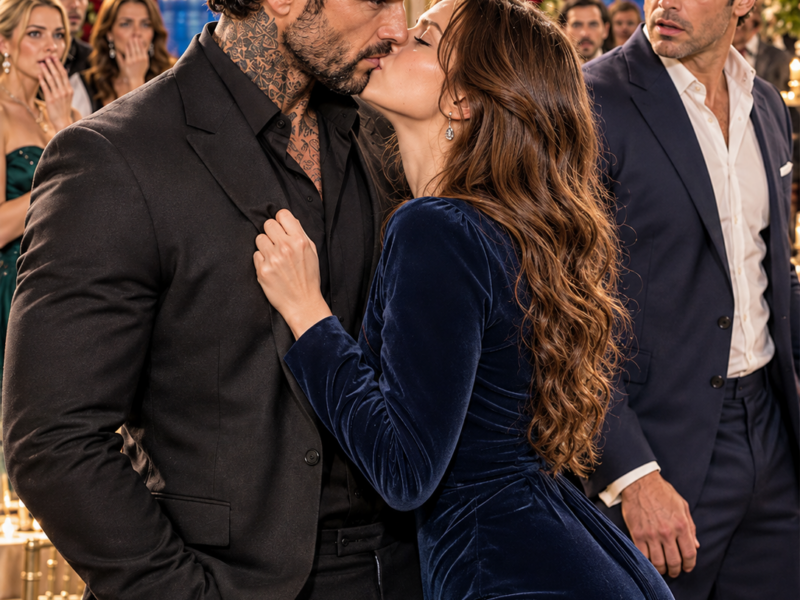
At 29, I Kissed Boston’s Most Feared Mafia Boss in Front of 500 Guests to Escape My Abusive Boyfriend, Who Had Broken My Ribs and Made My Protective Order Disappear. When My Boyfriend Tried to Drag Me Home, the Mafia Boss Noticed My Bruised Wrist and Quietly Said, “Walk Away.” I Thought I Was Finally Safe, Until I Discovered I Was Pregnant and My Ex Appeared at My Ultrasound Appointment Wearing Stolen Medical Scrubs. Then He Reached Into His Pocket—and My Blood Ran Cold…
At 29, I Kissed Boston’s Most Feared Mafia Boss in Front of 500 Guests to Escape My Abusive Boyfriend, Who Had Broken My Ribs and Made My Protective Order Disappear. When My Boyfriend Tried to Drag Me Home, the Mafia Boss Noticed My Bruised Wrist and Quietly Said, “Walk Away.” I Thought I Was Finally Safe, Until I Discovered I Was Pregnant and My Ex Appeared at My Ultrasound Appointment Wearing Stolen Medical Scrubs. Then He Reached Into His Pocket—and My Blood Ran Cold…
Part 1
The night I kissed a mafia boss in front of five hundred people, I wasn’t looking for love.
I was trying to stay alive.
My boyfriend, Preston Vardell, had his fingers wrapped around my wrist beneath the glittering chandeliers of a luxury hotel overlooking Boston Harbor. To anyone watching, it probably looked affectionate. A wealthy businessman gently guiding his girlfriend through a charity gala.
But I knew what that grip meant.
“We’re leaving in ten minutes,” he whispered, smiling at a passing senator.
My stomach tightened.
Ten minutes.
That was how long I had before Preston took me home and punished me for something I hadn’t even done.
I was twenty-nine years old, and for almost two years, I had lived like a prisoner in a beautiful apartment.
Preston controlled my money, my phone, my friendships, and eventually, every decision I made. He never needed to shout in public. His threats were delivered with a smile, his cruelty hidden behind expensive suits and generous donations.
Three times, I had tried to leave him.
The first time, he found me at my sister’s apartment within four hours.
The second time, he somehow learned about a private conversation I’d had while seeking help.
The third time ended with two cracked ribs and a hospital visit where I told everyone I’d fallen down the stairs.
I even tried filing for a protective order.
A week later, it had mysteriously disappeared from the system.
Preston knew powerful people. Police officers, attorneys, politicians, judges. Whenever I threatened to expose him, he reminded me that my word would never be stronger than his connections.
“Nobody believes a woman who can’t even manage her own life,” he once told me.
And after hearing that enough times, a terrible part of me had started believing it.
That evening, Preston had dressed me in a silver gown he selected himself. He criticized my makeup twice before we left, then instructed me to smile, stay quiet, and avoid embarrassing him.
The gala was supposed to secure an important political endorsement for his latest real estate development.
For weeks, he had been obsessed with Senator Allcott, whose support could help unlock a deal worth millions.
But something went wrong.
From across the ballroom, I watched Preston approach the senator with his usual confidence. Their conversation lasted less than five minutes.
When Allcott walked away, Preston’s smile remained.
His eyes, however, changed.
I recognized that expression immediately.
Someone had disappointed him.
And I knew who would pay for it.
He came toward me, took my wrist, and announced that we were leaving.
I looked around desperately.
Hundreds of people were laughing, drinking champagne, and making business connections. Not one of them knew that the woman standing in the silver dress was terrified of going home.
Then I noticed a man near the far end of the bar.
He was tall, broad-shouldered, perhaps forty years old, wearing a dark suit without a tie. Two men stood nearby, clearly watching the room on his behalf.
He wasn’t smiling.
He wasn’t trying to impress anyone.
Strangely, everyone seemed determined not to attract his attention.
I recognized him immediately.
Ronan Whitlock.
His name had appeared in business magazines, newspaper investigations, and whispered conversations about organized crime along Boston’s waterfront.
He owned shipping companies, restaurants, warehouses, and enough legitimate real estate to make his wealth difficult to measure.
But everyone knew there was another side to his empire.
A dangerous side.
Preston hated him.
More importantly, Preston feared him.
Fourteen months earlier, I’d watched Preston change direction at a business event simply to avoid walking near Ronan.
Suddenly, that memory became the only thing that mattered.
“Preston,” I said carefully, “I need to use the restroom.”
He glanced at his watch.
“Two minutes, Claire.”
I nodded and walked away.
But instead of entering the restroom, I turned into the hallway, circled the ballroom, and approached Ronan Whitlock.
My heartbeat was so loud I barely heard the orchestra.
One of his security men noticed me.
“Ma’am, can I help you?”
I ignored him.
The other stepped forward.
I kept walking.
And before either man could stop me, I reached Ronan.
He turned toward me with a look of mild surprise.
I placed my shaking hand against his chest.
“Please,” I whispered. “Help me.”
Then I did something so reckless that even now, remembering it makes my hands tremble.
I rose onto my toes, grabbed his jacket, and kissed him.
For half a second, he didn’t move.
I thought I had made the biggest mistake of my life.
Then his arm settled around my waist.
And he kissed me back.
The room seemed to stop breathing.
A few conversations died mid-sentence.
Someone dropped a glass.
I could feel people staring, but I didn’t care.
Because behind me, I heard Preston’s voice.
“Claire.”
I pulled away, expecting Ronan to push me aside.
Instead, he kept one arm around me and looked over my shoulder.
“Mr. Vardell,” he said quietly.
Preston stood several feet away, his face pale beneath his practiced smile.
“I’m sorry about this,” Preston said. “She’s had too much to drink. She’s been struggling lately.”
Ronan didn’t respond.
“Come on, sweetheart,” Preston continued. “Let’s get you home.”
His voice sounded loving.
I knew what waited beneath it.
Then Ronan asked a question nobody had asked me in nearly two years.
“Do you want to go with him?”
I looked up.
“What?”
“Do you want to leave with Preston?”
The answer rose from somewhere deep inside me.
“No.”
Preston’s smile tightened.
“Claire, don’t make a scene.”
I swallowed.
Then I said the words I’d been terrified to speak.
“He hurts me.”
The silence that followed was unbearable.
Preston opened his mouth, but Ronan’s attention had shifted to my wrist.
My sleeve had slipped down, exposing dark bruises shaped like fingers.
He examined them for a moment.
Then he looked directly at Preston.
“Walk away.”
Preston laughed nervously.
“Now, Ronan, there’s obviously been a misunderstanding.”
“I said walk away.”
The second warning was almost a whisper.
Somehow, that made it worse.
For the first time since I’d met him, Preston looked frightened.
He stared at me with hatred so intense I instinctively stepped backward.
Then he turned and disappeared into the crowd.
My knees nearly gave out.
Ronan steadied me without pulling me closer.
“Are you hurt tonight?” he asked.
“Not tonight.”
“Do you have somewhere safe to stay?”
I thought about my sister. Preston knew her address, her workplace, and her schedule.
“No.”
Ronan studied me.
“My car is outside. I can arrange a secure hotel, or you can stay in a guest room at my penthouse. Either way, the choice is yours.”
I couldn’t believe what I was hearing.
“Why would you help me? You don’t even know me.”
He glanced at my wrist.
“I know enough.”
I hesitated.
Then I asked the question that frightened me most.
“How do I know you’re not worse than him?”
For the first time, something like respect crossed his face.
“You don’t,” he answered. “And you shouldn’t trust a stranger just because he offers help.”
He explained that the guest room locked from the inside, that I could leave whenever I wanted, and that nobody would force me to stay.
There were no grand promises.
No demands.
Just options.
I looked back toward the ballroom entrance.
Somewhere inside, Preston was probably making phone calls, creating excuses, building another story in which I was the unstable woman and he was the innocent man.
“The penthouse,” I whispered.
Ronan nodded.
“All right.”
We left through a private entrance.
I expected him to hold my arm tightly, but he didn’t.
One of his security men opened the car door and stepped aside.
I climbed into the back seat.
For the first time in months, nobody told me how to sit, where to look, or what to say.
As Boston’s lights slipped past the window, I remembered something.
“My phone,” I said. “Preston tracks it.”
Ronan looked toward the front passenger seat.
“Dev.”
A moment later, a new phone appeared.
“Use this,” Ronan told me. “Leave the old one here.”
I stared at the device.
It had no contacts, no photographs, no messages.
Nothing from my previous life.
I should have felt devastated.
Instead, I almost cried with relief.
The penthouse occupied the upper floors of a waterfront building.
Inside, the furniture was dark and expensive, but the apartment felt strangely ordinary. Books were scattered across shelves. A half-finished cup of coffee sat beside the kitchen sink.
Ronan introduced me to Wade Merrick, his head of security.
Wade showed me the guest room.
“The door locks from inside,” he explained. “Nobody enters without your permission.”
I checked the lock twice.
Then Ronan called from the kitchen.
“Have you eaten?”
I shook my head.
He rolled up his sleeves.
“I’m making eggs. Fair warning, they’re about the only thing I know how to cook.”
I almost laughed.
The most feared man in Boston was standing in his kitchen making scrambled eggs for a stranger who had kissed him to escape her abusive boyfriend.
It was absurd.
And somehow, it was the first normal moment I’d experienced in years.
We ate quietly.
Afterward, Ronan asked whether Preston had access to my finances.
“Everything,” I admitted. “My accounts, my laptop, even my business email.”
“What business?”
“Graphic design. I started working independently eight months ago.”
He nodded thoughtfully.
“Then we’ll make sure you can keep working.”
I stared at him.
Preston had spent two years making me believe I couldn’t survive without him.
This stranger had known me for two hours and was already discussing how I could earn my own money.
That night, I locked the guest room door and lay on the bed fully dressed.
For the first time, I wasn’t listening for footsteps outside.
I slept.
But when morning came, I discovered that escaping Preston was only the beginning.
Because he wasn’t simply going to let me go.
And Ronan Whitlock had enemies of his own.
Enemies whose plans were already moving toward us.
Part 2
By nine the next morning, Preston had hired three attorneys and a private investigator.
By noon, he had contacted two of my former clients, telling them I was suffering from a serious emotional breakdown.
By evening, a reporter was asking questions about my relationship with Ronan Whitlock.
Preston wasn’t trying to bring me home anymore.
He was trying to destroy my credibility before I could expose him.
Ronan arranged a new laptop, secure accounts, and an attorney named Petra Vance.
When Petra asked whether I had evidence of Preston’s abuse, I told her about my photographs, hospital records, and three secret audio recordings.
“Where are the recordings?” she asked.
“In an old phone hidden inside my car.”
Her expression changed.
“Where’s the car?”
My blood ran cold.
Preston’s garage.
Within hours, Wade confirmed that someone had searched my vehicle.
The hidden phone was gone.
That evening, an anonymous envelope arrived.
Inside was a copy of my missing protective order.
At the bottom, Preston had written six words.
You know I always finish things.
I showed Ronan.
He stared at the message for a long moment.
Then he said something that frightened me more than the letter.
“Claire, I think Preston has been preparing for this longer than you realize.”
And when I asked him what he meant, he finally admitted that Preston’s latest development project was targeting property connected to Ronan’s business empire.
My escape had placed me directly in the middle of a war that had started months before I kissed him.
Part 3
The first time Ronan Whitlock lied to me, he did it by telling me most of the truth.
It happened eleven days after the gala.
I was sitting at his dining table, rebuilding a restaurant branding project from the files his technology specialist, Theo, had recovered.
For three hours, I’d almost forgotten Preston existed.
Then Ronan returned home looking unusually tired.
He removed his jacket, poured coffee, and sat across from me.
“There’s something you need to know.”
Those words immediately tightened my chest.
I closed my laptop.
“Tell me.”
He explained that Preston’s development deal involved waterfront property adjacent to several warehouses Ronan owned.
If Preston secured the necessary rezoning approvals, those warehouses would lose significant commercial value.
At first, I assumed it was another complicated business dispute.
Then Ronan told me Preston had deliberately structured the deal to hurt him.
“Why?” I asked.
“Because some men can’t tolerate another person having more influence than they do.”
I stared at him.
“You knew about this?”
“I knew the development existed. I didn’t know he was specifically targeting me until yesterday.”
“And you didn’t tell me?”
“I wanted to confirm it first.”
I felt that familiar anger rise inside me.
The same anger I’d felt when Preston decided which information I was allowed to know.
“Don’t do that.”
Ronan frowned.
“Do what?”
“Decide what I can handle.”
He was silent.
I stood and walked toward the windows.
Outside, the harbor looked peaceful. Cargo ships moved through the water, indifferent to the powerful men fighting over its shoreline.
“I spent two years with someone who controlled information to control me,” I said. “I’m not doing it again.”
When I turned around, Ronan was still sitting at the table.
“You’re right,” he said.
I almost didn’t know how to respond.
Preston had never apologized without attaching a condition.
Ronan simply accepted that he’d made a mistake.
“No more secrets,” I told him.
He nodded.
“No more secrets that affect your choices.”
I believed him.
Or maybe I wanted to.
That same evening, Preston published a statement through one of Boston’s newspapers.
He described me as emotionally unstable, claimed I’d been struggling with mental health problems, and accused me of illegally recording private conversations.
He expressed deep concern for my safety.
He never mentioned the bruises.
He never mentioned the cracked ribs.
And he certainly never mentioned the protective order that had disappeared.
Within hours, social media was filled with speculation.
Some people defended me.
Others called me a gold digger who had abandoned a successful boyfriend for a richer, more dangerous man.
One anonymous comment made me physically sick.
She kissed a mafia boss in public. That tells you everything about her character.
I stared at those words until they blurred.
Then I opened a blank document.
“What are you doing?” Ronan asked.
“Writing my side.”
“Petra should handle the response.”
“Petra can review it. But these are my words.”
He hesitated, then pulled out a chair.
“All right.”
I wrote about the isolation.
The monitored accounts.
The bruises I covered with makeup.
The hospital visit.
The protective order.
I didn’t include every detail. Some were too painful, and some belonged in court.
But I wrote enough.
At the bottom, I added:
I am not unstable. I am a woman who has spent two years being afraid. There is a difference.
Petra reviewed the statement, suggested a small addition about supporting documentation, and approved its release.
It went online just before ten.
By midnight, thousands of people had read it.
For the first time, Preston wasn’t the only person telling our story.
I should have felt victorious.
Instead, I sat at the table staring at the screen, thinking about a secret I’d been carrying for weeks.
“Ronan?”
He looked up.
“I need to tell you something.”
His expression sharpened.
I placed my hands against my stomach.
“I think I’m pregnant.”
He went completely still.
The silence lasted long enough that I heard the refrigerator humming.
“Are you sure?”
“I took another test this morning.”
“And?”
“Positive.”
He leaned back slowly.
“Does Preston know?”
“No.”
I swallowed hard.
“I don’t know exactly what I’m going to do yet. I know the timing is terrible. I know everything is complicated.”
Ronan interrupted gently.
“Claire, what do you want?”
I looked at him.
It was such a simple question.
But it was one I’d forgotten how to answer.
After a long moment, I whispered, “I want the baby.”
He nodded.
“Then we’ll help you find a way forward.”
Tears filled my eyes.
“You don’t even know whose baby it is.”
“I know.”
“And you don’t care?”
“I care about you being safe enough to make your own decisions.”
I covered my mouth.
For years, love had been presented to me as ownership.
Now someone was showing me that caring about another person could mean allowing them to choose.
But our moment of fragile peace lasted less than twelve hours.
The following morning, Petra called.
Preston had filed a civil claim against me.
He alleged harassment, illegal surveillance, and reputational damage.
He was using the stolen recordings to make me look like the aggressor.
Worse, Ronan’s legitimate businesses were suddenly receiving unexpected regulatory attention.
Two restaurant inspections.
A shipping contract audit.
Questions about waterfront permits.
All within twenty-four hours.
“He’s attacking you because of me,” I told Ronan.
“He’s attacking me because he already wanted to,” Ronan replied.
“But now he has an excuse.”
His silence answered me.
That afternoon, Petra filed a domestic assault complaint supported by hospital records, photographs, and my sworn statement.
The emergency room physician agreed to provide his medical observations.
For the first time, there was an official document Preston couldn’t quietly make disappear.
At five fifteen, Wade received an alert.
Preston was standing on a public street two blocks from our building.
Watching the penthouse.
I saw him through the window.
Even from that distance, I recognized his posture.
Hands in his coat pockets.
Shoulders relaxed.
Head slightly tilted.
He wasn’t trying to enter.
He wanted me to know he could still find me.
“He’s waiting for us to react,” I said.
Ronan looked toward Wade.
“Nobody approaches him.”
Preston stayed for twenty-two minutes.
Then he left.
That night, I couldn’t sleep.
I kept replaying his movements, his legal filings, the business pressure, and the newspaper statement.
Something about it didn’t fit.
Preston had always been cruel, but never careless.
He built traps so that other people appeared responsible for stepping into them.
And suddenly, I understood.
He wasn’t trying to defeat Ronan in a business dispute.
He was building a public history of hostility.
A history that would make Ronan look dangerous and vindictive.
If something violent happened, everyone would already have a suspect.
I went into the kitchen before sunrise.
Ronan was drinking coffee.
Wade was reviewing security reports.
“Preston is planning something physical,” I said.
Both men looked up.
I explained my theory.
The accusations.
The inspections.
The public appearances.
The effort to make Ronan appear increasingly aggressive.
Wade stopped typing.
“She’s right.”
Ronan slowly set down his cup.
“He wants me blamed for whatever happens next.”
I nodded.
“And he knows your reputation will make that easy.”
For the first time, Ronan looked genuinely worried.
Not about himself.
About the people around him.
Two days later, I had an ultrasound appointment at a private clinic in Brookline.
Ronan wanted to postpone it.
I refused.
“I need to know the baby is okay.”
He arranged security.
Dev and another guard, Carver, accompanied me.
The clinic was small and quiet.
A receptionist greeted us.
A technician led me into the examination room.
I lay back and watched her prepare the ultrasound equipment.
For a few moments, everything felt normal.
Then her pager sounded.
“Excuse me,” she said. “I’ll be right back.”
She stepped outside.
I heard muffled voices.
A door opened somewhere down the hallway.
Then the examination room door opened again.
I turned, expecting the technician.
Instead, Preston walked in.
He was wearing blue medical scrubs.
A stolen identification badge hung around his neck.
And when he saw the ultrasound machine beside me, his expression changed.
“You’re pregnant.”
My entire body went cold.
“Get out.”
He stepped closer.
“Whose baby is it?”
I sat upright.
“Preston, leave.”
He smiled.
But it wasn’t the charming smile I remembered.
It was something empty.
“You really thought you could replace me?”
He reached into his pocket.
And when his hand came out, he was holding a gun.
Part 4
For a moment, I couldn’t move.
I had spent almost two years imagining Preston hurting me again.
I’d imagined him finding my new address, appearing outside my workplace, or dragging me back into the life I’d escaped.
But I had never imagined him standing in an examination room, wearing stolen medical scrubs, holding a gun while I lay on a table carrying a child.
“Preston,” I whispered. “Please put that down.”
He tilted his head.
“You always do this.”
“Do what?”
“Act innocent after destroying everything.”
His voice was terrifyingly calm.
I’d heard that tone hundreds of times.
It was the sound of Preston convincing himself that whatever happened next would be my fault.
“You embarrassed me,” he said. “In front of everyone.”
“I was afraid to go home.”
“You kissed Whitlock.”
“Because I needed help.”
He shook his head slowly.
“That’s not what people believe.”
I looked toward the door.
No movement.
No voices.
Where were Dev and Carver?
Preston noticed.
“Don’t bother,” he said. “I’ve studied this clinic for almost a week.”
He explained how he’d learned the staff schedule and gained access through a service entrance.
He sounded proud.
As though breaking into a medical facility with a weapon was proof of his intelligence.
“Nobody knows you’re here,” I said.
He smiled.
“That’s where you’re wrong.”
My stomach tightened.
He glanced at the ultrasound equipment.
“Does Whitlock think that baby is his?”
I didn’t answer.
“Does he?”
“Put the gun away.”
His expression hardened.
“You don’t get to tell me what to do.”
He moved closer.
The weapon trembled slightly in his hand.
And that frightened me more than if he’d held it perfectly still.
Preston was losing control.
I had survived him for almost two years by learning how to recognize the moment just before violence.
I knew that moment now.
“Listen to me,” I said quietly. “You can still walk out.”
He laughed.
“You’re giving me permission?”
“I’m telling you this doesn’t have to get worse.”
His eyes narrowed.
“You think you’re better than me now?”
“No.”
“You think Whitlock makes you untouchable?”
“No.”
“Then why did you leave?”
I looked at him.
For the first time, I answered without trying to protect his feelings.
“Because you hurt me.”
His smile disappeared.
“You always exaggerate.”
“You broke my ribs.”
“That was an accident.”
“You took my money.”
“I supported you.”
“You isolated me from everyone I loved.”
“I protected you.”
“You made my protective order disappear.”
He stopped speaking.
And in that silence, I saw something I’d never fully understood before.
Preston didn’t merely lie to other people.
He had built an entire reality in which his cruelty was justified.
As long as he controlled the story, he never had to confront what he’d done.
“The woman in Atlanta,” I continued. “Miriam. You did it to her too.”
His face changed.
“Who told you about her?”
I realized I’d struck something important.
“She left because she was afraid of you.”
“She was unstable.”
“And now you’re saying the same thing about me.”
He raised the gun.
“Stop talking.”
I froze.
Then I heard footsteps.
Fast.
Approaching.
Preston turned his head.
The door handle moved.
Everything happened in a fraction of a second.
I grabbed the ultrasound transducer from its holder and threw it with every ounce of strength I had.
It struck Preston near his temple.
He staggered.
The gun fired.
The explosion was deafening.
Something shattered above the doorway.
Then the door burst open.
Wade Merrick came through it like a force of nature.
He drove Preston backward, pinned his arm, and forced him onto the floor.
The gun skidded beneath a cabinet.
Dev appeared behind Wade.
Then Carver.
Someone shouted for the police.
I remained sitting on the examination table.
My ears rang.
My hands shook violently.
And all I could think about was the baby.
“The baby,” I whispered.
Nobody heard me.
I said it again.
“Please. My baby.”
The ultrasound technician rushed back into the room.
She looked at Preston on the floor, the weapon near the cabinet, and the bullet hole above the door.
Then she looked at me.
“Are you injured?”
I shook my head.
“Can you check?”
My voice broke.
“Please check the baby.”
She moved immediately.
Another transducer was available.
She applied fresh gel, adjusted the machine, and carefully positioned the instrument against my abdomen.
I stared at the monitor.
A dark image appeared.
Then a small movement.
Then a sound.
Fast.
Steady.
Unmistakable.
A heartbeat.
I covered my mouth as tears poured down my face.
The baby was alive.
Behind me, Preston was still struggling beneath Wade’s grip.
But for the first time in my life, his anger no longer filled the entire room.
There was something more important.
Something stronger than his threats.
A tiny heartbeat that kept going.
Ronan arrived minutes later.
I heard him in the hallway before he appeared.
“Where is she?”
His voice was unlike anything I’d heard from him.
Urgent.
Rough.
Almost desperate.
When he entered the room, he stopped.
His eyes moved from Preston on the floor to the gun, the damaged wall, and finally to me.
Then he crossed the room.
“Claire.”
I tried to speak.
Nothing came out.
He wrapped his arms around me.
I felt him trembling.
Only once.
But enough to tell me how frightened he’d been.
“The baby,” I whispered.
He pulled back.
I pointed toward the screen.
“Listen.”
He turned.
The heartbeat filled the room.
Ronan stared at the monitor.
Slowly, he reached out and placed two fingers against its edge.
His eyes glistened.
“You’re both okay?”
I nodded.
“Yes.”
He closed his eyes.
And for a brief moment, the most feared man in Boston looked like someone whose entire world had almost disappeared.
Police arrived shortly afterward.
Preston was handcuffed.
He tried to explain that I had provoked him, that Ronan’s men had attacked him, that the weapon had discharged accidentally.
But the clinic had security cameras.
The stolen badge was still hanging around his neck.
The bullet hole was in the wall.
And several people had witnessed the aftermath.
For once, Preston couldn’t control the evidence.
A detective named Caruso questioned me.
I told him everything.
Not just the gun.
The abuse.
The threats.
The recordings.
The protective order.
The strange disappearance of my original complaint.
Caruso listened carefully.
Then he said something unexpected.
“We’ve been looking into irregularities involving that protective order.”
I stared at him.
“What?”
“Some people noticed the filing was altered. We didn’t have enough evidence to establish who was responsible.”
“And now?”
He glanced toward the hallway where officers had taken Preston.
“Now we may have more than enough to investigate.”
That evening, Preston faced multiple charges connected to the clinic incident.
The investigation into my earlier abuse widened.
For the first time, his political connections couldn’t simply erase the damage.
Three days later, Petra called.
“Claire, someone wants to speak with us.”
“Who?”
“A woman named Miriam.”
The woman from Atlanta.
The one Preston had silenced years earlier.
She had seen my public statement.
Then she’d seen news of his arrest.
And she’d finally decided she was ready to tell her story.
Miriam had photographs, messages, financial documents, and details about the settlement Preston had pressured her to sign.
Her attorney agreed to cooperate with Petra.
Together, they began building a much stronger case.
Several weeks later, a handwritten card arrived through Petra’s office.
It contained only one sentence.
You made it easier for me to breathe.
I sat holding that card for a long time.
I’d spent years believing my suffering was proof that I was weak.
Now I understood something different.
Surviving Preston had taken strength I hadn’t known I possessed.
And speaking out had given another woman the courage to do the same.
But freedom wasn’t as simple as seeing Preston behind bars.
The legal battle had only begun.
And there was another difficult truth waiting for me.
Ronan Whitlock was still a dangerous man.
He had protected me.
He had shown me kindness.
He had never made me feel owned.
But his world contained secrets, criminal connections, and risks I couldn’t ignore.
Especially now that I was pregnant.
One evening, after learning that another of his businesses was under investigation, I confronted him.
“I need to know what kind of life I’m bringing this baby into.”
He looked at me.
“What do you want to know?”
“Everything that matters.”
He was quiet for a long time.
Then he said, “I’m changing things.”
I folded my arms.
“That isn’t an answer.”
“I know.”
He sat beside me.
“Some parts of my business shouldn’t exist. Some relationships should have ended years ago.”
I waited.
“I’m dismantling them,” he continued. “Slowly. Carefully. And legally wherever possible.”
“Why now?”
He looked toward my stomach.
“Because when Wade called me from that clinic, I spent forty minutes believing I might lose you.”
My throat tightened.
“And I realized I don’t want a child growing up afraid of the world I built.”
I searched his face.
“You’re doing this because of the baby?”
“Because I want him to have choices I never had.”
I rested a hand over my stomach.
“And what about me?”
Ronan turned toward me.
“Claire, you have a choice too.”
I looked at him.
“If you want to leave, I’ll make sure you have somewhere safe. Your business, your money, your life. None of it depends on staying with me.”
I stared at him for several seconds.
Then I asked quietly, “And if I want to stay?”
For the first time since I’d met him, Ronan seemed genuinely uncertain.
“Then I’ll spend the rest of my life trying to become someone you never have to fear.”
Part 5
Six months later, I stood outside a Boston courthouse wearing a dark blue dress I had bought with money I’d earned myself.
It wasn’t particularly expensive.
It wasn’t designed by anyone famous.
And Preston would have hated it.
That was partly why I loved it.
For the first time in years, I had chosen something simply because I wanted it.
My graphic design business had survived.
The restaurant branding project I’d rebuilt inside Ronan’s penthouse had led to two referrals. The technology startup founder I’d worked with, Sandra, had commissioned a complete identity package.
I wasn’t wealthy.
But I had clients.
I had a bank account Preston couldn’t access.
And I had an apartment two floors below Ronan’s penthouse, with my own furniture, my own office, and a door that locked from the inside.
I was also twenty-two weeks pregnant.
The baby had started moving.
Sometimes, when I was working late, I’d feel a small flutter beneath my ribs and stop typing.
Those moments reminded me why I had fought so hard.
The trial began on a cold Tuesday morning.
Preston arrived wearing an immaculate suit, walking between his attorneys with the same controlled expression he’d worn at charity events.
He looked exactly like the man I remembered.
Confident.
Respectable.
Almost wounded by the inconvenience of being accused.
When he saw me across the courtroom, his expression barely changed.
But I noticed his fingers tightening around his briefcase.
That tiny movement told me something.
He was afraid.
And for the first time, I wasn’t.
I testified on the third day.
Petra had prepared me carefully.
She warned me that Preston’s defense attorney would challenge my memory, question my motives, and use the secret recordings to portray me as deceptive.
“Answer honestly,” she said. “Don’t guess. Don’t try to make the story sound better than it was.”
So that was what I did.
I told the jury about the early days.
How Preston brought flowers to my office.
How he encouraged my career before gradually convincing me that my clients were exploiting me.
How he persuaded me to share my passwords because couples shouldn’t have secrets.
How those passwords eventually became tools of surveillance.
I described the first time he grabbed my arm.
The apology afterward.
The expensive bracelet he bought me the next morning.
The second incident.
The third.
The cracked ribs.
The hospital.
The protective order.
I didn’t cry.
Not because it didn’t hurt.
But because I’d already spent so many nights crying over those memories that I wanted the jury to hear the facts clearly.
Then Preston’s attorney began questioning me.
“Miss Holloway, you voluntarily kissed Mr. Whitlock at the charity gala, correct?”
“Yes.”
“And you knew his reputation?”
“Yes.”
“You knew he was associated with organized crime?”
“I knew the rumors.”
“And you specifically selected him because you believed he would intimidate Mr. Vardell?”
I looked directly at her.
“Yes.”
She paused, apparently surprised by my answer.
“So you deliberately used another man’s reputation to frighten your boyfriend?”
“I approached someone I believed Preston would be afraid to confront. I asked for help, and that person chose to give it.”
She studied me.
“You were willing to put yourself in the hands of a dangerous stranger?”
“I was already living with a dangerous man.”
The courtroom became silent.
She moved to another subject.
The recordings.
I acknowledged that I’d secretly recorded Preston without his consent and explained that my attorney had advised me about the legal problems this created.
“Why did you make them?” she asked.
“Because every time I told someone what happened, Preston said I was lying.”
“Did you understand that making those recordings could violate the law?”
“Not when I first made them.”
“And after you learned?”
“I told my attorney.”
She turned a page.
“Isn’t it true you concealed your pregnancy from Mr. Vardell?”
“Yes.”
“Why?”
“Because I was afraid of what he might do.”
“That’s speculation, isn’t it?”
I looked toward the jury.
“He came to my ultrasound appointment carrying a gun.”
Nobody spoke.
The attorney glanced down at her notes.
Then she changed the subject.
Over the following days, doctors testified about my injuries.
Investigators presented surveillance footage from the clinic.
The technician described the moment she returned to find Preston restrained on the floor.
Wade testified.
Dev testified.
Detective Caruso explained how the investigation into my missing protective order had uncovered troubling irregularities.
Miriam’s documentation helped establish a pattern of behavior.
And Preston’s own explanations began collapsing under the weight of evidence he couldn’t control.
On the sixth day, he took the witness stand.
His voice was measured.
His answers were polished.
He portrayed himself as a loving partner who had tried desperately to help a troubled woman.
Then the prosecutor asked him why he had entered a private medical clinic wearing another employee’s identification.
For the first time, Preston hesitated.
He claimed he wanted to talk to me.
Then he was asked about the weapon.
He claimed he had carried it for protection.
Protection from what?
He couldn’t provide a convincing answer.
The prosecutor showed photographs of the bullet hole.
Then the surveillance footage.
Then the stolen identification badge.
Watching him struggle, I realized something important.
Preston had spent years controlling private conversations.
But he couldn’t control a courtroom where every answer could be challenged and every contradiction preserved.
The jury deliberated for two days.
I spent most of that time working.
It probably sounded strange to other people.
But designing logos had become a way to remind myself that my life contained more than the trial.
On the second evening, Ronan visited my apartment.
He found me at the dining table with an unfinished sandwich and three different logo sketches spread across my laptop screen.
“You should eat,” he said.
I smiled faintly.
“You sound like Wade.”
“That’s a terrible accusation.”
He sat across from me.
“How are you?”
I looked down at my hands.
“Scared.”
“Of the verdict?”
I shook my head.
“Of what happens afterward.”
He waited.
“For two years, everything I did revolved around surviving Preston. Then everything revolved around fighting him. I don’t know who I’ll be when I don’t have to do either.”
Ronan studied me.
“You’re already finding out.”
“How?”
He nodded toward the laptop.
“You rebuilt your business. You chose your home. You made decisions about your pregnancy. Those things don’t belong to Preston.”
I looked at him.
Something inside me softened.
“You’ve been watching.”
“Of course.”
I hesitated.
Then I said the words I’d been holding back for weeks.
“I love you.”
He became very still.
For a moment, I thought I’d frightened him.
Then he reached across the table and took my hand.
“I love you too.”
There was no dramatic speech.
No promise that everything would be perfect.
Just two people who had survived something frightening, sitting across from each other in an apartment that belonged to one of them.
And somehow, it felt more meaningful than any grand declaration I’d ever heard.
The verdict arrived the following afternoon.
Guilty.
On the major charges connected to the clinic attack.
Guilty on the domestic assault charge.
Guilty on charges connected to the obstruction of my protective order.
I listened as the decisions were read.
I expected to cry.
Instead, I felt strangely quiet.
It was as though I’d spent years holding a heavy door shut against a storm, and someone had finally told me I could let go.
Six weeks later, Preston was sentenced to eleven years in prison, with the possibility of parole after seven.
His attorneys announced plans to appeal.
Petra reminded me that legal proceedings could continue.
But Preston was no longer standing between me and the rest of my life.
Outside the courthouse, Ronan waited beside the car.
He didn’t come inside because Petra believed keeping his presence separate from the proceedings was wiser.
When I reached him, he held out his hand.
I took it.
“What now?” he asked.
I looked toward the harbor.
“I want to build something.”
“You already have a business.”
“Something different.”
I explained that I wanted to establish an organization helping women rebuild their financial and professional independence after abusive relationships.
Not simply emergency shelter.
Practical independence.
Bank accounts.
Business registration.
Employment connections.
Technology support.
Legal referrals.
The things that had allowed me to reclaim my life.
Ronan listened without interrupting.
When I finished, he nodded.
“A foundation.”
“Eventually.”
“That takes money.”
“I know.”
“I’d like to help.”
I looked at him carefully.
“I want to raise the money myself.”
“I know.”
“You can donate.”
He smiled.
“How generous.”
“But your name won’t be at the top.”
“Third?”
“Fifth.”
“Fourth.”
I laughed.
“Fine.”
For the first time, imagining my future didn’t feel frightening.
It felt exciting.
Four months later, our son was born.
Everett Ronan Whitlock arrived on a snowy Thursday morning, weighing seven pounds and four ounces.
He came into the world screaming with such determination that the delivery nurse laughed.
Ronan stood beside the bed looking completely overwhelmed.
I’d seen him face angry businessmen, armed threats, and hostile investigators without visibly changing expression.
But when the nurse placed Everett in his arms, his hands trembled.
Our son wrapped his tiny fingers around Ronan’s thumb.
And the man everyone feared began to cry.
I laughed through my own tears.
“Careful,” I whispered. “He’s going to ruin your reputation.”
Ronan looked down at Everett.
“I think he already has.”
We didn’t become a perfect family overnight.
There were disagreements.
Difficult conversations.
Moments when my old fears returned unexpectedly.
Sometimes, if Ronan spoke too sharply during a business call, my body reacted before my mind could remind it that I was safe.
Sometimes, his instinct was still to solve problems before asking what I wanted.
We learned to recognize those moments.
We argued.
We apologized.
We tried again.
And slowly, the relationship became something neither of us had experienced before.
A place where disagreement didn’t mean danger.
Ronan continued separating himself from the criminal operations connected to his old business network.
It was complicated.
It required attorneys, financial restructuring, and decisions that weren’t always easy.
But his legitimate shipping, restaurant, and property businesses remained.
He wanted Everett to inherit something different from the empire he’d inherited from his father.
Meanwhile, my foundation began taking shape.
We rented a modest office in Boston’s South End.
Two desks.
A printer.
A small meeting room.
Nothing impressive.
Our first employee was a woman named Diane, who had survived an abusive marriage and understood exactly why the work mattered.
Sandra joined the board.
Petra volunteered legal assistance.
Wade, eventually stepping back from his security responsibilities, helped us evaluate safety concerns.
And Ronan’s name appeared fourth on our donor list.
Exactly as negotiated.
During our first year, we helped nineteen women.
One opened a small bakery.
Another regained access to her professional certifications.
A third started a bookkeeping service after years of being told she wasn’t intelligent enough to manage money.
Some simply needed help opening private bank accounts and finding work.
Their victories weren’t dramatic enough to make newspaper headlines.
But I understood how enormous they were.
Every new account, every signed employment contract, every apartment key represented a piece of freedom that someone had fought to reclaim.
By our second year, we were helping even more women.
And each time someone walked into our office uncertain and frightened, I remembered the woman I’d been at that charity gala.
The woman in the silver dress.
The woman counting down ten minutes before going home.
One spring evening, when Everett was fourteen months old, I stood on the terrace overlooking Boston Harbor.
The sun was setting.
A container ship moved slowly toward the Atlantic.
Behind me, Everett was laughing as he chased a toy across the living room.
Ronan joined me.
“You’re thinking about that night,” he said.
I smiled.
“How do you know?”
“You always look at the harbor when you’re remembering something important.”
I watched the water for a moment.
“I used to think you saved me.”
He didn’t answer.
“I thought that was the story. A frightened woman meets a powerful man, and he rescues her.”
Ronan rested his arms on the railing.
“And now?”
I turned toward him.
“Now I know that’s not what happened.”
He waited.
“You gave me a safe room. A locked door. A laptop. A chance to breathe.”
“And terrible scrambled eggs,” he added.
I laughed.
“Yes. Those too.”
Then I grew serious.
“But I was the one who walked across that ballroom. I was the one who told the truth. I testified. I rebuilt my business. I chose to keep going.”
Ronan looked at me.
“Yes, you did.”
I slipped my hand into his.
“You didn’t save me, Ronan.”
He squeezed my fingers.
“I know.”
“I saved myself.”
Behind us, Everett burst into laughter again.
I looked through the terrace doors toward our son, then back across the harbor.
For years, I’d believed courage meant being fearless.
Now I understood that courage sometimes meant being absolutely terrified and taking one more step anyway.
That night at the gala, I hadn’t known whether Ronan Whitlock would help me.
I hadn’t known whether Preston would ever face consequences.
I hadn’t known whether I’d survive the next twenty-four hours.
All I’d known was that I couldn’t go back.
So I’d walked toward the most dangerous-looking stranger in the room and asked for help.
That single decision changed everything.
But the life that followed wasn’t built by one kiss.
It was built by every decision I made afterward.
Every time I told the truth.
Every boundary I refused to surrender.
Every small piece of independence I reclaimed.
Ronan moved closer and gently kissed my forehead.
“Ready to go inside?” he asked.
I looked at the harbor one last time.
Then I smiled.
“Yes.”
And we walked back into our home, where our son was laughing, dinner was waiting, and tomorrow belonged to us.
For the first time in my life, I wasn’t afraid of what came next.
Because I finally understood something Preston had spent years trying to make me forget.
I had always been capable of opening my own door.
I just needed to believe I deserved to walk through it.