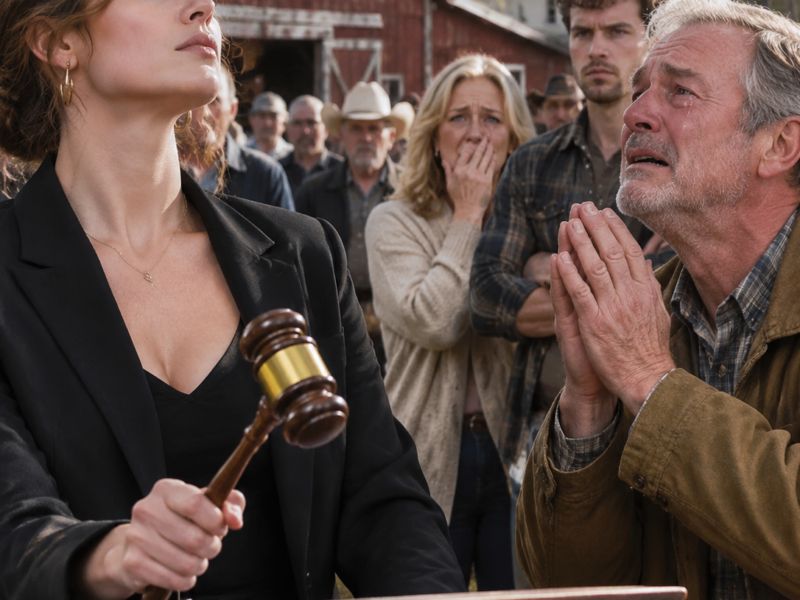
At 29, I Asked My Father to Let Me Auction My Grandfather’s 148-Acre Farm for Free, But He Humiliated Me in Front of Everyone: “We’re Not Having Some Gate Boy Hollering in Dad’s Yard!” Five Years Later, He Called an Auctioneer to Sell That Same Farm and Demanded a Family Discount—Until I Walked Into His Kitchen, Placed a Familiar Walnut Gavel on the Table, and Revealed Who Was Really Running the Sale.
At 29, I Asked My Father to Let Me Auction My Grandfather’s 148-Acre Farm for Free, But He Humiliated Me in Front of Everyone: “We’re Not Having Some Gate Boy Hollering in Dad’s Yard!” Five Years Later, He Called an Auctioneer to Sell That Same Farm and Demanded a Family Discount—Until I Walked Into His Kitchen, Placed a Familiar Walnut Gavel on the Table, and Revealed Who Was Really Running the Sale.
PART 1
“We’ll sell it all. We need the money. And we’re not having some gate boy hollering in Dad’s yard.”
My father said those words while standing over my grandfather’s casket, holding a paper plate piled with ham and funeral potatoes. He spoke loudly enough for half the room to hear, and he didn’t seem particularly concerned about who might be listening.
I was twenty-nine years old. My grandfather had been dead for five days, and I had just offered to organize a proper farm auction for him, free of charge.
My father, Delmont Blevins, looked at me as though I had suggested something ridiculous.
My mother lowered her eyes. My younger brother, Coleman, laughed through his nose.
I put my plate down, looked at my father, and said, “All right. Then I’ll go learn to do it right.”
Five years later, I would be standing on a hay wagon in that same grandfather’s yard, holding an auctioneer’s microphone while nearly 350 people watched.
My father would be sitting in the front row.
And this time, he would have to listen.
But before I tell you what happened that October morning, you need to understand why those words at the funeral hurt more than my father could possibly have imagined.
My name is Odis Blevins, although everybody calls me Odi. I grew up a few miles outside Jerome, Idaho, in the Magic Valley, where the ground is flat, the irrigation canals run through fields of hay and corn, and you can usually smell a dairy long before you see it.
My father drove a milk tanker for a cheese plant in Gooding for thirty years. He was good at his job. He could back a tanker into a milk room in the dark with barely two inches to spare.
He took pride in that.
Whenever Dad made up his mind about something, his right hand went into his front pocket and jingled his truck keys. It was never especially loud, but everybody in the family understood what it meant.
The conversation was over.
My mother, Estelle, worked in the front office at the middle school in Jerome for twenty-two years. She was organized, dependable, and careful about keeping the peace. If you asked her for something and she answered, “We’ll see,” you could usually assume the answer was no.
My younger brother, Coleman, was four years behind me.
Growing up, I noticed that his activities always seemed to receive more attention. His baseball games, school banquets, and travel tournaments went onto the family calendar in red ink. Mine were sometimes written in pencil, if they made it onto the calendar at all.
Coleman had one ambition that never changed.
He wanted to be rich.
Not simply successful or comfortable. Rich.
He started a new business almost every spring, usually around the time the irrigation water came on. One year, he planned to sell hay to Japan. Another year, he wanted to build fences. Then he wanted to haul feed.
Every business was going to make a fortune.
Every business was going to start on Monday.
And somehow, Monday always seemed to move.
Then there was my grandfather, Grover Blevins.
Grandpa owned 148 acres along Highway 25, a few miles outside Eden. He grew hay and corn, kept approximately forty cows, and owned shares in the North Side Canal. He talked about those water shares almost as affectionately as other men talked about their children.
He wore one brown felt hat to church, to the grocery store, and into the corrals. He didn’t believe in owning something for every occasion when one good thing could serve them all.
My grandmother died when I was twelve.
After that, I spent most of my summers at Grandpa’s farm. I learned to drive tractors there, repair irrigation lines, stack hay, feed cattle, and recognize the sound of a machine that was about to break.
But the most important thing he taught me had nothing to do with farming.
“You can tell everything about a man by how he shuts a gate,” he used to say.
“You shut it all the way. You check the chain. You don’t leave it for the next fellow.”
I was fifteen when I got my first job at the North Side Livestock Commission in Jerome.
They paid me seven dollars an hour to work the back pens and operate the gates on sale days. Wednesdays were for cattle. Saturdays were for horses and smaller livestock.
There were goats, pigs, the occasional llama, and sometimes animals that seemed to have arrived because somebody’s divorce had become particularly complicated.
The gate job was simple to explain but difficult to do properly.
Cattle came through the alley and into the sale ring. I opened the gate, let them through, waited for the auctioneer to finish, and moved them out when he called, “Sold!”
Then I did it again.
And again.
Four or five hundred times a day.
If I was slow, the sale dragged. If I was careless, an animal could injure somebody.
I loved every minute of it.
I loved the smell of wood shavings, the rows of farmers wearing feed-company caps, the auctioneer’s rapid chant, and the way an entire room could become quiet when a particularly valuable animal entered the ring.
By eighteen, I had moved up to ring man.
That meant standing inside the sale ring, facing the crowd, watching the bidders, and spotting their offers.
Some people raised their hands. Others touched their hats. One rancher from Shoshone bid by closing his left eye.
It took me an entire winter to recognize that particular habit.
I began to understand that an auction wasn’t just about selling something.
It was about knowing people.
Knowing when somebody was serious, when somebody was bluffing, and when somebody was holding back because the object being sold meant more to them than the money it might bring.
I learned that lesson the year a farmer named Mr. Farenholtz sold his last thirty-one Holstein cows.
He had milked cows outside Bliss for forty-four years. His knees were failing, his son had moved to Spokane, and there was nobody left to carry the operation forward.
He sat in the front row wearing his good coat, holding his hat in his lap.
Every time the auctioneer called, “Sold,” his face seemed to become a little smaller.
Those cows had paid for his house, his children’s braces, and his wife’s funeral.
When the last cow entered the ring, an old black-and-white animal with one bent horn, I did something a ring man wasn’t supposed to do.
I walked toward the auction block.
“Mr. Crisp,” I said to Delano Crisp, the owner of the barn, “would you let him say it on this one?”
Delano frowned.
Then he looked at Mr. Farenholtz.
He understood.
He finished the bidding, stopped the chant, and extended the microphone over the railing.
Mr. Farenholtz stood slowly and took the microphone in both hands.
His voice cracked when he said the word.
“Sold.”
Every man in that barn took off his hat.
That evening, I told Grandpa what had happened.
He sat on the porch with his boots off, listening without interrupting.
After a long silence, he said something I would remember for the rest of my life.
“A man ought to get the last word on his own life’s work.”
From then on, whenever a farmer sold out at our barn, I asked the auctioneer to let the seller have the final word.
At first, Delano complained.
Eventually, he stopped arguing.
Old farmers began requesting it themselves. Widows asked for it. One woman from Hagerman said the final word together with her granddaughter, their voices slightly out of rhythm, like a choir with only two members.
People at the barn started calling it “the last word.”
I never gave it a name.
It named itself.
My family, however, never understood why I cared so much about livestock auctions.
“How’s the gate boy?” Dad would ask whenever I came home with manure on my boots.
Coleman laughed.
Mom told me to leave my boots in the garage.
To them, it was a temporary job, something I would eventually grow out of.
At sixteen, I discovered another thing about my family.
Money I earned wasn’t necessarily considered mine.
That winter, I bought three day-old bull calves from a dairy for forty dollars apiece. I raised them in Grandpa’s calf hutches, feeding them from bottles and checking on them before school.
I wanted a used roping saddle I’d seen at a tack shop in Twin Falls.
It cost $450.
In April, Dad offered to haul the calves to Wednesday’s sale because I was scheduled to work the gates.
I even watched them enter the ring.
They sold for $640.
I was excited. I’d worked hard for that money, and I was already imagining the saddle sitting in the back of my truck.
But the check was written to whoever had signed the consignment slip.
That person was my father.
At supper, Mom casually explained that Coleman’s travel baseball team had an upcoming tournament in Utah. The fees were due, and Dad was short that month.
“Milk goes where the plant sends it,” Dad said. “Money in this house is the same.”
I didn’t argue.
I put down my fork, walked outside, and sat on the tailgate of my truck until dark.
The following Saturday, Grandpa drove me to the bank on Main Street in Jerome.
He stood beside me while I opened a savings account.
He made sure the account had only my name on it.
“Nobody else signs on this,” he told the bank employee.
He didn’t say anything about my father.
He didn’t need to.
From that day forward, every check went into my account, and every consignment slip carried my own signature.
By twenty-three, I had saved a little over $3,000 for auction school.
I wanted to become an auctioneer, not spend the rest of my life standing inside somebody else’s ring.
The school was in Mason City, Iowa. I had kept its brochure for two years.
Then, in February, Dad came to the sale barn looking for me.
Coleman had found a used three-quarter-ton diesel truck. He wanted it for a fence-building business he planned to start that spring.
The dealer wanted $3,000 down by Friday.
Dad explained that his credit was tied up.
“Coleman’s got fence jobs lined up from here to Shoshone,” he said. “That truck will pay for itself by Christmas.”
For the first time, I decided to help without pretending the arrangement was something it wasn’t.
I took a carbon receipt pad from my coat.
I wrote down the amount, the date, and the terms.
Three thousand dollars loaned to Delmont Blevins, due by December 31.
Then I handed it to my father.
He stared at the paper.
“You want me to sign that? I’m your father.”
“Then it shouldn’t matter that you sign it,” I replied.
He signed hard enough to press through two sheets.
I kept the yellow copy.
Coleman’s business lasted until August.
Not one dollar of the loan came back.
I eventually attended auction school, but a year later than planned. I paid for it with money I had to save twice.
Nine days in a motel near the highway. Tongue twisters, bid counting, livestock valuations, and hours of practicing the auction chant.
When I returned to Idaho with my certificate, Delano Crisp shook my hand and put me right back in the ring.
His son called the main sales.
I understood that.
It was Delano’s business, and I had no right to expect him to hand it over.
So I stayed.
I worked Saturdays at church auctions, estate sales, and small farm clearances around Hazelton and Gooding. Sometimes I made a hundred dollars. Sometimes I went home with a pie.
At home, I was still the gate boy.
But Grandpa never called me that.
And in 2019, he did something that would eventually change everything.
I bought eleven bred heifers for $14,300. They were good black baldies, and almost all my savings went into them.
I ran them on Grandpa’s pasture, paying him thirty dollars per head each month.
He insisted on the payment.
“A man ought to pay his way,” he said.
Then he sat with me at his kitchen table and helped me register my own livestock brand with the state.
It was an O with a bar underneath, placed on the left hip.
He even paid the registration fee.
“Your cows ought to have your name on them,” he said. “Not mine. Not anybody else’s.”
I thought he was simply teaching me another lesson about responsibility.
I didn’t understand that he was preparing me for something he knew might happen.
His heart began giving him trouble in 2020.
By the following year, he was frequently in and out of the hospital in Twin Falls.
My father had power of attorney. Grandpa’s will left the farm to him, and nobody questioned that arrangement.
I simply kept working.
Every morning, I went to the farm before five. I swathed the hay, raked it, baled it, stacked it, repaired irrigation equipment, and fed both Grandpa’s cows and mine.
There were three cuttings that summer.
Grandpa told me the hay money would be mine. He called it wages.
He told me in the hospital, with my mother sitting beside him and oxygen hissing through the tube beneath his nose.
The hay sold to a dairy for $38,000.
My father deposited the money.
When I asked about it, he jingled his keys.
“There are bills. Grandpa isn’t thinking straight. We’ll sort it out later.”
We never sorted it out.
Grandpa died at four in the morning on Monday, August 30.
I had been sitting beside his bed until two.
Once, he opened his eyes and asked whether the heifers had water.
I told him they did.
He closed his eyes again.
At his funeral on September 4, the chapel was full. Farmers from three counties came. Men from the sale barn came. Even the woman from the bank on Main Street came.
After the service, the Relief Society ladies prepared lunch in the cultural hall.
There was ham, salad, rolls, and the familiar funeral potatoes with cornflakes on top.
I knew what my father would do next.
He would sell the farm.
I didn’t blame him for not wanting to become a farmer. I wasn’t asking him to keep the land forever.
I only wanted Grandpa to receive the proper goodbye his life’s work deserved.
A public farm auction, held on the property, with machinery lined up in the yard, cattle sold in the open, and neighbors given the opportunity to bid.
And I wanted the last word for Grandpa.
I approached Dad near the dessert table.
“Let me call the sale,” I said. “I’ll organize everything. The machinery, the cattle, the advertisements. I’ll do the work for free.”
He didn’t even put down his plate.
“We’ll sell it all. We need the money. And we’re not having some gate boy hollering in Dad’s yard.”
Mom stared at the potatoes.
Coleman laughed.
I looked at my father for several seconds.
Then I put down my plate and walked away.
I didn’t know it yet, but five years later, that same man would sit across from me at Grandpa’s kitchen table, asking for a family discount.
And I would have the one thing he had never expected me to possess.
The gavel.
PART 2
The following Friday, Dad’s buyers arrived at Grandpa’s farm.
They were loading the cattle and machinery into trailers before I even knew the sale had been arranged.
When I saw them sorting my eleven heifers into the alley, I didn’t argue. I called the Idaho brand inspector.
He examined every animal and recognized my registered O-bar brand.
“These aren’t Grover’s,” he told the buyers. “They’re Odi’s.”
My father arrived just as the inspector refused to release my cattle without my authorization.
I had the registration certificate in my glove box, beside the yellow copy of Dad’s old $3,000 loan agreement.
The buyers suddenly realized they had been promised somebody else’s animals.
That afternoon, I borrowed a stock trailer and hauled all eleven heifers away in two loads.
They were the only things I took from Grandpa’s property.
I didn’t go back to the sale barn, either. I shook Delano Crisp’s hand, told him I was leaving, and asked him for advice.
He gave me one name.
Eldon Strohm.
I was about to meet the man who would teach me how to become an auctioneer in my own right.
And I had no idea that the lesson would eventually bring me back to the farm where my father had humiliated me.
PART 3
Eldon Strohm had been calling farm auctions in the Magic Valley since 1971.
His office was on Main Street in Jerome, a modest building with an old sale trailer parked outside and a walnut gavel displayed behind his desk.
The gavel had belonged to his father, who had turned it in 1952.
Eldon was seventy-four when I first walked through his door. He spoke slowly, had a voice like gravel rolling down a country road, and kept his right hand inside his vest pocket because of a tremor.
His wife, Myra, ran the office.
She handled contracts, sale bills, advertising, accounting, and just about everything else that kept the business operating.
Eldon looked at me over his glasses.
“You’re the ring man from North Side, aren’t you?”
“Yes, sir.”
“The one who makes the sellers say the last word?”
I nodded.
He leaned back in his chair.
“I watched you spot a bid from a man who only blinked. Took me thirty years to learn that.”
Then he asked the question I had been hoping to hear.
“You want a job?”
I told him I did.
He offered me eighteen dollars an hour and two percent of any auction I called myself.
Myra let me park a camper behind the office. Eldon allowed me to keep my eleven heifers on his pasture north of town.
I paid him the same thirty dollars per head that I had paid Grandpa.
He accepted without making a speech about it.
Some men understand the importance of letting another man pay his way.
That first winter was difficult.
I set up tents in frozen yards, walked through barns with owners, photographed machinery, checked serial numbers, prepared descriptions, and learned how much work went into an auction before the first bidder ever raised a hand.
Eldon taught me things nobody had covered at auction school.
“You walk every piece with the owner,” he said. “You don’t guess. You don’t tell people a machine is in good condition because it looks good from ten feet away.”
He showed me how to arrange machinery so the most valuable equipment came up while the crowd was still fresh.
He explained how to advertise livestock, how to handle reserve prices, and how to recognize when a buyer was reaching the end of his budget.
Most importantly, he taught me never to lie.
“One lie in this valley,” he told me, “and you’ll spend the rest of your career trying to buy back your name.”
I listened.
I had already learned what happened when people treated trust as something they could spend without permission.
In March, Eldon gave me my first farm auction.
The seller was a widow named Lavina Koons, whose husband had farmed sugar beets outside Hazelton for fifty years.
She had two tractors, a beet harvester, several pieces of older equipment, and a horse trailer that nobody had used since 1998.
It was thirty-one degrees that morning. Snow blew sideways across the yard.
Nearly two hundred people came.
I called the auction for five hours.
The crowd was cold, hungry, and occasionally impatient, but the sale went well.
At the end, only one lot remained.
It was an old Lincoln welder her husband had used to repair equipment for half the farmers in the valley.
I brought the bidding to $650 and stopped.
Then I walked over to Mrs. Koons, who was sitting in a folding chair wearing a thick winter coat and mittens.
I held out the microphone.
She knew what it meant.
She had been at the North Side sale barn years earlier when Mr. Farenholtz had said the final word on his last cow.
She took the microphone.
“Sold,” she said.
Then she handed it back and covered her face with her scarf.
Eldon watched from beside the clerk’s trailer.
When the crowd began leaving, he approached me.
“That’s yours now,” he said. “Whatever you call it. You do that at every sale we run.”
I told him what I called it.
“The last word.”
He nodded.
“Then give them the last word.”
Myra added a sentence to the bottom of every sale bill after that.
Seller’s family will close the sale.
It was a small line, but people noticed it.
Farmers began booking us because they knew their parents would have the opportunity to say goodbye to their equipment, their cattle, and the land they had worked for decades.
The first year, I cleared a little over $61,000.
For the first time in my life, I made enough money to stop worrying about every unexpected bill.
I bought a used Ford flatbed with a gooseneck hitch. My eleven heifers produced eleven calves that spring, and I began building a small herd.
I was finally becoming the person I had wanted to be since I was fifteen.
My family noticed, but not in the way I expected.
Mom texted me at Christmas.
“Dad says you’re working for that old man in Jerome now. Coleman’s doing Christmas Eve at his new place. Bring rolls.”
I replied that I would be spending Christmas with Eldon and Myra.
Myra made prime rib. Eldon fell asleep in his chair before seven.
Valeria Ortega, the sale clerk, came over, too.
She could settle three hundred bidders before sundown without making a single mistake. She also laughed at my jokes, which was something I hadn’t experienced much at home.
We started spending time together.
In March, Coleman texted me.
“Bro, can you spot me five grand? Truck payment. Dad can’t right now.”
I answered with one word.
“No.”
He replied almost immediately.
“Must be nice living off an old man’s gavel.”
I didn’t respond.
I had learned that lending Coleman money was like pouring water into a broken bucket. No matter how much you added, the bucket never filled.
By 2022, I was calling thirty-four sales a year.
By 2023, I called fifty-one, while Eldon handled only nine.
His hand was getting worse. His voice remained magnificent, but he couldn’t stand on a hay wagon for six hours anymore.
That spring, I obtained my real estate license so we could handle land auctions properly.
Myra made me study at her kitchen table every evening for a month.
She tested me on property descriptions, legal documents, acreage calculations, irrigation rights, and contracts.
If I gave her the wrong answer, she didn’t let me move on until I understood why it was wrong.
In June 2023, Valeria and I got married at Myra’s church in Jerome.
Eldon stood beside me.
Delano Crisp attended, wearing the same tie I remembered from my grandfather’s funeral.
My parents sat in the third row.
After the ceremony, Dad shook Eldon’s hand.
“So you’re the one paying him,” he said.
Eldon smiled.
“No, sir. Mostly he’s paying me.”
Dad didn’t have an answer.
His hand went into his pocket, and his keys jingled.
That was becoming a familiar sound.
Valeria and I rented a small house outside Jerome. We worked long hours, saved money, and started planning for a place of our own.
I continued to call auctions.
I also continued to think about Grandpa.
I still remembered the way he sat on the porch with his boots off, listening to me describe something that had happened at the sale barn.
I remembered the eleven heifers.
I remembered the hay money.
And I remembered my father’s words at the funeral.
I didn’t hate him.
But I had stopped expecting him to treat me fairly.
That distinction became important in April 2024.
I was calling a machinery sale outside Shoshone when I ran into Norbert Hawk, an implement dealer from Gooding.
Norbert had been one of the men involved in buying Grandpa’s equipment after the funeral.
He was standing beside the lunch wagon, eating chili from a foam bowl.
We talked about machinery prices, interest rates, and the unusually high demand for irrigation equipment.
Then he became quiet.
“I’ve been meaning to tell you something,” he said.
I waited.
“Your dad called me about Grover’s equipment in July that year.”
I looked at him.
“July?”
“Your grandpa was still in the hospital in Twin Falls.”
Norbert put his bowl down.
“Delmont wanted to know what I’d pay for the whole line. Cattle and machinery. He wanted cash, quick, and quiet. Said there wouldn’t be an auction.”
I felt something tighten in my chest.
“What did you pay?”
“For the iron, about $126,000. The cattle went to my cousin for $86,000. Two hundred and twelve thousand altogether.”
He looked at his boots.
“I’m telling you because I don’t think you know what happened.”
He explained that he had resold the New Holland swather alone for more than a third of what he had paid for the entire line.
At a public auction, he estimated the farm machinery and cattle could have brought considerably more.
Then he told me why my father had needed the money so quickly.
Coleman had taken out a $310,000 business loan for his hay-export venture.
My father had co-signed it.
The bank was calling the note.
The business had failed, and my father was responsible.
I put down my bowl.
Suddenly, the events of that summer made sense.
My father hadn’t sold Grandpa’s equipment because he wanted to simplify the estate.
He had sold it because he needed cash to cover Coleman’s debt.
He had started negotiating while Grandpa was still alive.
And while I was working in the fields, putting up three cuttings of hay, Dad had already arranged to sell the equipment.
The $38,000 from the hay had gone into the same financial disaster.
When I offered to conduct a public auction at the funeral, Dad knew exactly why he didn’t want one.
A public auction would take time.
It would attract buyers from across the valley.
It would establish what the property was actually worth.
And everybody would know what had happened.
He couldn’t allow that.
I drove home that evening along Canyon Road.
I didn’t call Dad.
I didn’t call Coleman.
I told Valeria what Norbert had said.
She listened without interrupting.
When I finished, she sat beside me on the porch steps.
“Are you going to tell him you know?”
“Not tonight,” I said.
She put her hand over mine.
For a long time, we sat there without speaking.
The land was the one thing Dad hadn’t been able to sell quickly.
Ground didn’t move like cattle or machinery.
He listed it at a high price, but interest rates increased and buyers became cautious.
Eventually, he rented it to Cinder Butte Dairy for silage.
Then he borrowed against the property.
Four hundred and eighty thousand dollars.
The money went toward Coleman’s next business, a custom feed-hauling operation with three semis.
You can probably guess how that worked out.
The semis were eventually repossessed.
And the debt remained.
Meanwhile, Eldon and Myra were beginning to think about retirement.
In January 2025, they invited Valeria and me to their kitchen table.
Eldon was seventy-eight.
He had stopped calling auctions altogether.
“I want you to buy the company,” he said.
I thought he was joking.
He wasn’t.
He offered to sell me the business for $240,000, payable over ten years, with a monthly payment designed to remain manageable even during a bad year.
The sale included the auction trailer, the mailing list of four thousand farmers, Myra’s office records, and the company name.
I asked him why he was offering me such favorable terms.
He looked at me for a long moment.
“Because you’ve been doing the work for three years already. And because I know what kind of man you are.”
Myra smiled.
“Also because I’d like to retire without worrying about who is going to answer the phone.”
I agreed.
We signed the papers.
I became the owner of the business.
The name remained the same.
Strohm Auction and Land.
The farmers already knew who was calling the sales. They had watched me work, watched me treat their families fairly, and watched me give sellers the last word.
I didn’t need to convince them I belonged.
I had spent years earning that right.
And my family still had no idea.
PART 4
By the time September 2026 arrived, I was calling approximately sixty auctions a year.
Valeria and I had built a steady business. Our eleven original heifers had grown into a respectable little herd, and we had started putting money aside for a permanent home with enough acreage to keep livestock.
I had also stopped checking my phone every time my parents sent a message.
If Mom asked about Christmas, I answered when I could.
If Coleman asked for money, I said no.
If Dad wanted to know whether I was still working for Eldon, I told him I was running auctions.
He never asked for details.
Then, one week before the second Tuesday in September, Myra received a phone call.
A man named Delmont Blevins wanted an auction company to sell a farm along Highway 25.
He specifically asked for Eldon Strohm.
Myra explained that Eldon had retired and that the business was now handled by another auctioneer.
She asked whether she should tell him who would be coming.
I said no.
“Let him meet the auctioneer.”
On Tuesday afternoon, I drove to Grandpa’s farm in a white pickup.
The magnet sign on the door read Strohm Auction and Land, Jerome, Idaho.
It was eighty-four degrees.
The cottonwoods beside the irrigation ditch had started turning yellow.
Grandpa’s old red shop still had the dent in its big door from the day I backed his stock trailer into it when I was sixteen.
Mom’s Buick was parked near the porch.
Coleman’s black Ram sat beside it.
A gray Tahoe with a Cinder Butte Dairy logo was parked in front of the shop.
I recognized the company.
Three cows arranged in a circle like a target.
They were all sitting at the kitchen table.
Mom, Dad, Coleman, and Sanford Hargrove.
Sanford owned Cinder Butte Dairy. He milked approximately four thousand cows south of Jerome and had been buying farmland across the county.
A Manila folder lay in the middle of the table.
Mom had a pen.
Dad had his keys in his pocket.
Coleman looked up when I entered.
“Odi?”
Dad turned.
“What are you doing here? We’re waiting on the auctioneer.”
I set my clipboard on Grandma’s old oilcloth.
“I know.”
I pulled out a chair and sat down.
Nobody at that table had any idea what I had been doing for the previous five years.
They hadn’t asked.
I reached into my shirt pocket and took out Eldon’s walnut gavel.
I placed it beside my clipboard.
Dad recognized it immediately.
“That’s Eldon Strohm’s gavel.”
“It was,” I said.
“I bought the company from him. I’m the auctioneer. Myra sent me.”
Mom put down her pen.
Coleman laughed.
It was the same short laugh I remembered from the funeral.
Sanford looked at me, then at Dad.
My father’s keys stopped jingling.
“You?” he asked.
“Me.”
For several seconds, nobody said anything.
Then Mom opened the Manila folder.
Inside was a letter from their bank in Twin Falls.
The $480,000 loan secured against the farm was due November 30.
The bank had refused another extension.
Coleman’s semis had been repossessed in the spring.
The real estate listing had expired twice.
“We need it sold by Thanksgiving,” Mom said. “The bank says an auction is the fastest way.”
She looked at me as though she expected me to reassure her.
“The bank is right,” I said. “I can sell it October tenth. That gives Myra four weeks to advertise. Sale bills can be out by Friday.”
Dad cleared his throat.
“Before we get into all that…”
I waited.
“Eldon’s contract says three percent,” he said. “On a place like this, that’s a lot of money.”
I nodded.
“It’s money we need,” he continued. “I’ve worked thirty years driving a tanker. You know that. You’re my son. I would think you could waive the commission.”
He leaned forward.
“Family rate.”
I looked at him.
For a moment, I remembered the three calves I had raised at sixteen.
The $640 check.
The $3,000 loan.
The $38,000 from Grandpa’s hay.
The eleven heifers being sorted into a trailer.
And the funeral lunch.
I turned the gavel a quarter turn on the oilcloth.
“Three percent,” I said.
“Same as Lavina Koons paid. Same as every widow in this valley pays.”
Dad frowned.
“I don’t have a family rate. If I had one, I’d have had to give it to Grandpa, and you didn’t want it.”
Mom flinched.
Dad’s jaw tightened.
Coleman leaned forward.
He had been waiting to speak.
“Okay, look. Here’s the thing. We don’t even need an auction.”
I looked at him.
“Sanford already wants the place. He’s ready to buy. Thirteen-fifty cash, closing in thirty days. All you have to do is write it up as a private sale.”
He pointed toward the folder.
“No tents. No advertising. No circus. You get paid for some paperwork, and everybody’s happy.”
Sanford nodded.
“That’s the number Coleman and I discussed.”
I looked at my brother.
“One million three hundred and fifty thousand?”
“That’s top dollar,” Coleman said.
“Did you check?”
He frowned.
“Sanford checked.”
I reached into my clipboard and pulled out a sheet of paper.
Myra had spent several days researching recent land sales in Jerome County.
We had examined irrigated properties, water shares, buildings, soil conditions, and comparable acreage.
“Ground with North Side Canal shares has been bringing between eleven and fourteen thousand dollars an acre at auction,” I said.
“This place has a house, a shop, corrals, and a pivot. I personally replaced the gearbox.”
I slid the paper toward Mom.
“At the low end, we’re already looking at more than $1.6 million.”
Coleman shook his head.
“Those are asking prices.”
“No. These are completed sales.”
I kept my voice calm.
“I’m not promising anybody a number. Nobody honest does that. But I’m not going to arrange a private sale at $1.35 million when I know what the property might bring in the open.”
I looked directly at Sanford.
“And I’m not going to arrange it for my brother’s buyer.”
Sanford shifted in his chair.
Coleman’s ears turned red.
“He’s calling me a liar.”
“I’m not calling anybody anything,” I replied.
Then I addressed Sanford.
“Mr. Hargrove, you’re welcome to bid on October tenth. Same terms as everybody else. Same coffee, same auctioneer.”
Sanford nodded slowly.
He understood business.
He also understood that I wasn’t going to be pushed into a private arrangement.
Then Mom did something I didn’t expect.
“You’ll see it anyway when you walk through the shop,” she said.
She stood, walked out the back door, and disappeared into Grandpa’s old workshop.
A few minutes later, she returned carrying a piece of plywood.
It was the door from a cabinet above Grandpa’s workbench.
That cabinet had always been locked, and Grandpa kept old sale bills inside it going back to the 1960s.
Mom placed the door on the kitchen table.
On its inside surface, written in Carpenter’s pencil, was a note.
It was dated May 2020.
The handwriting was unmistakable.
Grandpa’s.
It read:
When I’m gone, public sale on the place on a Saturday.
Odi calls it.
Last lot is the dinner bell.
I stared at the words.
I had been in that shop a thousand times.
I had repaired the workbench, replaced light bulbs, cleaned the shelves, and searched through old tools.
I had never opened that cabinet.
Mom looked at me.
“I found it when I was cleaning out in 2021.”
I turned toward her.
“Why didn’t you tell me?”
She swallowed.
“Your father said it didn’t mean anything. It’s not a will. It doesn’t hold up legally.”
She looked down at the plywood.
“I’m asking you not to make a thing out of it. Just let us do what we have to.”
There it was.
The third thing they wanted from me.
They wanted me to waive my commission.
They wanted me to sell the property privately to Coleman’s buyer.
And they wanted me to pretend I had never seen my grandfather’s handwriting.
I placed my palm flat against the plywood.
The pencil had smudged slightly around my name, as though someone had touched it repeatedly.
“Mom,” I said, “that one I’m keeping.”
Dad stood up.
“Then you’re fired.”
He spoke with the same authority he had used when I was sixteen and had asked about my calf money.
“I’ll get somebody from Boise. I’m not paying my own kid fifty thousand dollars to lecture me in my father’s kitchen.”
I nodded.
“That’s your right. You haven’t signed anything.”
I took a business card from my clipboard and placed it on the table.
“That’s one of the best land auction companies in Boise. Good people. Call them. Tell them I said hello.”
Dad picked up his phone.
He called the number on speaker.
A polite woman answered.
He explained that he needed an auctioneer for a 148-acre farm in Jerome County.
She asked a few questions.
Then she gave him the earliest Saturday they had available.
January sixteenth.
Four months away.
With the necessary closing process, the seller could expect the funds in late February.
Dad ended the call.
He stood with his phone in his hand.
Mom looked at the bank letter.
November thirtieth.
The refrigerator hummed.
Outside, a silage truck drove past on Highway 25, rattling the kitchen window.
Then Dad sat down.
He took the pen from Mom and signed the contract.
Three percent.
Public auction.
October tenth.
With a reserve price he could live with.
He slid the papers toward me without looking up.
“Fine. Do your show.”
I picked up the contract.
“It’s not my show,” I said.
“It’s Grandpa’s.”
The next morning, Myra started preparing the sale bills.
By Friday, they were posted in feed stores, cafés, and farm-supply shops from Twin Falls to Gooding.
The advertisement listed the Grover Blevins Farm.
One hundred forty-eight acres.
North Side Canal water.
House, shop, corrals, and outbuildings.
Offered in two tracts and as a whole.
Sale on the property, October tenth.
At the bottom, in Myra’s familiar small print, was the sentence that had become part of every auction we conducted.
Seller’s family will close the sale.
I didn’t tell Dad about the number of calls we received.
I didn’t tell Coleman that several large operations had requested the property information.
And I didn’t tell Sanford that the man who had first introduced us had already tried to sell the land for less than it was worth.
I simply did my job.
I walked every acre.
I checked the water shares.
I inspected the pivot.
I photographed the corrals and the house.
I prepared the legal descriptions and made sure every potential bidder had the same information.
I also visited Grandpa’s workshop one evening after everyone had left.
I stood in the doorway for a long time.
His old hat was gone.
His tools were mostly gone.
The workbench still had the marks from years of repairs.
I placed the cabinet door back against the wall and ran my fingers over the pencil writing.
For the first time since his death, I felt as though I was doing something he had asked me to do.
Not because I was angry with my father.
Not because I wanted to embarrass Coleman.
But because a man who had worked fifty-one years on the same ground deserved to have his life’s work sold properly.
And I intended to make sure it happened.
PART 5
October tenth arrived clear and cold.
At sunrise, the temperature was thirty-four degrees. Frost covered the stubble, and the grass along the irrigation ditches crunched beneath my boots.
I reached the farm before seven.
The hay wagon was already positioned near the shop.
Myra was checking paperwork in the auction trailer. Valeria was arranging bidder numbers and preparing the clerk’s station.
Eldon arrived with a blanket over his knees and a cane in his hand.
He was seventy-nine now.
Myra helped him into a lawn chair near the front of the crowd.
He insisted on sitting where he could see the entire sale.
By ten o’clock, cars were parked nearly half a mile down both sides of Highway 25.
The Eden Ward Relief Society ladies had brought a lunch wagon.
They had made funeral potatoes.
I don’t think anybody planned that detail. It’s simply what people in Idaho bring when there’s a gathering and somebody needs feeding.
Approximately 340 people showed up.
There were dairymen, potato farmers, equipment dealers, young couples hoping to purchase their first property, and old neighbors who had known Grandpa for decades.
Some people came to buy.
Others came because they remembered Grover Blevins.
My family sat together in folding chairs beside the shop.
Mom.
Dad.
Coleman.
And Coleman’s nine-year-old daughter, Casey.
I hadn’t seen her since she was four.
She had a ponytail and a curious expression. She watched everything happening around her.
At ten, I climbed onto the hay wagon.
I held Eldon’s walnut gavel in one hand and adjusted the wireless microphone clipped to my collar.
The crowd gradually quieted.
I welcomed everyone, explained the auction terms, and introduced the property.
Then I talked about Grandpa.
“Grover Blevins farmed this ground for fifty-one years,” I said. “He grew hay and corn, raised cattle, and took care of this property the way his father taught him.”
I paused.
“He shut every gate he ever opened.”
A few old farmers laughed.
They knew exactly what I meant.
I explained that the property would be offered in two tracts and then as a whole.
Tract One included the house, shop, corrals, and eighteen acres.
Tract Two included the remaining 130 acres, the pivot, and the associated canal shares.
I reviewed the terms carefully.
Nobody could later claim they hadn’t understood the conditions.
Then we began.
Tract One opened at $200,000.
The bidding moved quickly.
A couple from Hazelton raised the price. A man from Twin Falls joined in.
At $375,000, the Hazelton couple dropped out.
That left Ulysses Isabel and his wife, Katrina, against the Twin Falls buyer.
I knew Ulysses.
When he was sixteen, he had helped me put up Grandpa’s hay. I was twenty-two at the time.
He had spent years renting farmland and saving every dollar he could.
I watched his hand rise.
The Twin Falls buyer offered $410,000.
Ulysses looked at Katrina.
She nodded.
He raised his hand again.
“Four hundred and twelve!”
The Twin Falls buyer shook his head.
I brought down the gavel.
“Sold! Four hundred and twelve thousand dollars to bidder number 156.”
Ulysses stood there looking stunned.
“Welcome home,” I told him.
Katrina began crying.
Several women from the lunch wagon wiped their eyes.
Ulysses had worked hard for years to buy a farm of his own.
Now he was going to raise his family in the same house where Grandpa had lived.
I gave him a moment before moving to the next tract.
Then came the 130 acres.
The most valuable part of the property.
Sanford Hargrove stood near the front with his arms crossed.
He opened at $1.1 million.
That was a deliberate move.
He wanted everyone to understand that he had the money and intended to be taken seriously.
A potato operation from Rupert immediately bid higher.
A dairyman from Bliss joined in.
I watched the hands.
I watched the expressions.
I kept the chant moving at a steady pace.
At $1.3 million, the Bliss bidder dropped out.
At $1.4 million, Sanford and the Rupert buyer began competing in increments of $10,000.
Nobody in the yard seemed to be breathing.
I had conducted hundreds of auctions, but there was something different about this one.
I knew the ground.
I knew the irrigation system.
I knew which corner flooded when the canal ran high and which section produced the best hay.
I knew where Grandpa had parked his tractor every evening.
I wasn’t simply selling acreage.
I was selling the place where I had learned to become a man.
The bidding reached $1.48 million.
The Rupert buyer hesitated.
Sanford raised his number.
“One million five hundred and two thousand.”
It was an unusual amount.
He wanted the other bidder to know he was serious.
I looked toward Rupert.
The man shook his head.
I waited.
I gave him another chance.
Then another.
Nobody moved.
“Going once…”
I scanned the crowd.
“Going twice…”
Sanford stood perfectly still.
“Sold! One million five hundred and two thousand dollars to Cinder Butte Dairy!”
The clerk began recording the sale.
I then offered the property as a whole, as advertised.
Nobody was willing to bid more than the combined value of the two tracts.
So the final result stood.
Four hundred and twelve thousand dollars for Tract One.
One million five hundred and two thousand dollars for Tract Two.
A total of $1,914,000.
Five hundred and sixty-four thousand dollars more than the private offer Coleman had brought to Grandpa’s kitchen table.
The crowd began applauding.
Sanford walked directly to Valeria’s clerk window to sign the paperwork.
My father stood beside it holding the bank letter in his coat.
Coleman stood behind him.
Then Sanford turned toward my brother.
He didn’t shout.
He didn’t need to.
There were approximately thirty people waiting in line behind him.
“I want my fifteen thousand dollars back by the first of the year,” he said.
Coleman’s face went white.
Dad turned toward him.
“What fifteen thousand dollars?”
Sanford looked genuinely surprised.
“I paid your boy fifteen thousand in June. A finder’s fee.”
Coleman opened his mouth.
Sanford continued.
“He told me he could bring me this place privately at $1.35 million before anybody else got a look at it. Said you would sign whatever he put in front of you.”
He shrugged.
“I would have paid a lot less than I just did.”
Then he tipped his hat toward me and walked back to his Tahoe.
My father stared at Coleman.
For once, he had no immediate response.
His keys remained silent.
Coleman looked down at the ground.
Thirty people had heard the conversation.
By Monday, the entire valley would know.
My brother had accepted $15,000 to arrange a private sale that would have cost our family more than half a million dollars.
And the son they had called a gate boy had just brought the farm to public auction and made sure the bank could be paid.
But there was still one lot left.
Grandpa’s dinner bell.
It hung from a wooden post near the porch. It was cast iron, roughly the size of a mixing bowl, with a rope pull that had turned gray from years of weather.
When Grandma was alive, she rang it at noon to call Grandpa in from the fields.
After she died, Grandpa continued ringing it himself.
Every day.
Even when nobody else was home.
It was one of those small habits that made a farm feel like a home.
I opened the bidding at fifty dollars.
I thought it might reach a hundred.
It climbed to five hundred.
Then a thousand.
Then two thousand.
The bidder who wouldn’t quit was sitting in a lawn chair near the front.
Eldon.
He lifted his cane about two inches each time he wanted to bid.
At $2,600, I stopped the chant.
I looked at him.
He nodded.
I knew what he wanted.
But there was a rule I never broke.
The last lot belonged to the family.
The seller’s family got the final word.
Not for widows.
Not for wealthy dairy owners.
Not for anyone.
And certainly not for my father.
I climbed down from the hay wagon and walked across the yard.
The microphone was in my hand.
My father stood beside the clerk’s window.
I approached him and held it out.
His eyes moved from the microphone to the dinner bell.
His hand went into his pocket.
For the first time in my memory, his keys didn’t jingle.
His mouth opened.
Nothing came out.
He shook his head.
Then he placed one hand on Casey’s shoulder.
“Let her,” he said.
It was the only thing he said to me all day.
I knelt down and held the microphone toward my niece.
She looked up at me.
I nodded.
“Sold,” Casey said.
Her voice was clear and confident, like she was answering a question in class.
For a moment, the yard was silent.
Then everybody began clapping.
Eldon clapped his good hand against his knee.
Myra was smiling.
Mom covered her mouth.
I looked at Casey and smiled.
“You did good.”
Eldon eventually won the bell.
He paid $2,600 and refused to take it home.
He told me that a man who had paid that much for something could give it to whoever he wanted.
He handed it to me.
“You made it all the way to that bell with me,” he said. “That means a great deal.”
I didn’t know what to say.
I simply shook his hand.
The auction ended shortly afterward.
The paperwork was completed.
Sanford signed the purchase documents, and the bank would receive enough money to clear the $480,000 note with more than a million dollars remaining before the other applicable costs and obligations.
My commission came to $57,420.
Three percent.
Exactly the same rate I had charged Lavina Koons.
The bank was paid.
My father’s old $3,000 note was eventually settled, too.
My parents were financially secure.
They had more money than they had ever had before.
Coleman, meanwhile, was paying Sanford back at approximately $500 a month.
He was driving a truck for a feed company now.
Somebody else’s truck.
I heard he was good at the job.
I hope he is.
Ulysses and Katrina received the keys to Grandpa’s house on November second.
They moved into the same rooms where I had spent so many summers.
Ulysses texted me a photograph a few days later.
It showed the old cabinet door back on its hinges above Grandpa’s workbench.
The pencil writing was still there.
He told me he wasn’t ever going to paint over it.
I appreciated that.
My mother sent me a message the following week.
“Your father wants everyone together for Thanksgiving. He won’t say it himself, so I’m saying it. We would like you to come.”
I read it twice.
Then I replied.
“We have plans. Tell Casey hi.”
I meant both parts.
I wasn’t interested in punishing my parents.
I wasn’t trying to keep a family argument alive forever.
But I had finally learned that being someone’s son didn’t mean I had to keep handing them everything I worked for.
And being someone’s brother didn’t mean I had to rescue him from every business he started.
I could love my family without allowing them to decide what my work was worth.
Casey sent me a drawing through her grandmother.
It showed a hay wagon, a man with a very big mouth, a bell, and a little girl with a ponytail saying the word SOLD.
I put it on our refrigerator.
Not in pencil.
In a frame.
Valeria and I eventually bought twelve acres outside Jerome.
We built a modest house, a barn, and a set of corrals.
The dinner bell hangs beside our porch.
Our daughter, Cassie, is two years old.
Every evening at six, Valeria lifts her up so she can reach the rope.
She pulls it with both hands.
The bell rings across the yard.
And I come inside from the barn, whether I’m finished working or not.
I still call around sixty auctions a year.
At the end of every one, I stop the chant, climb down, and hand the microphone to the seller or a member of the family.
Sometimes they say the word immediately.
Sometimes they cry first.
Sometimes they need a minute.
I never rush them.
Because I remember what Grandpa taught me.
A man ought to get the last word on his own life’s work.
Grandpa didn’t get to say it in his own voice.
But he got it in his own handwriting, on the inside of a cabinet door above his workbench.
And that handwriting brought me back to the place where it all began.
Five years earlier, my father had stood at a funeral lunch and told me they would sell everything because they needed the money.
They did sell everything.
But they sold it in the open.
On a Saturday.
To the highest bidder.
And the gate boy called the sale.
The best part wasn’t the money.
It wasn’t the commission.
It wasn’t even watching my father finally realize that I had become the auctioneer he had always refused to see.
The best part was watching a young couple receive the keys to a home they had worked years to afford.
It was seeing Eldon sitting in the front row, smiling beneath his old hat.
It was hearing my niece say “Sold” into a microphone that had once seemed impossibly far away.
And every evening, when that old cast-iron bell rings outside our house, I remember a grandfather who taught me to shut every gate properly, to put my own name on what I earned, and to never let somebody else decide the value of my work.
Because sometimes the person everyone calls the gate boy is the only one who remembers how to open the right gate.
And sometimes, after years of standing quietly while everybody else walks through first, he finally gets his turn to hold the microphone.