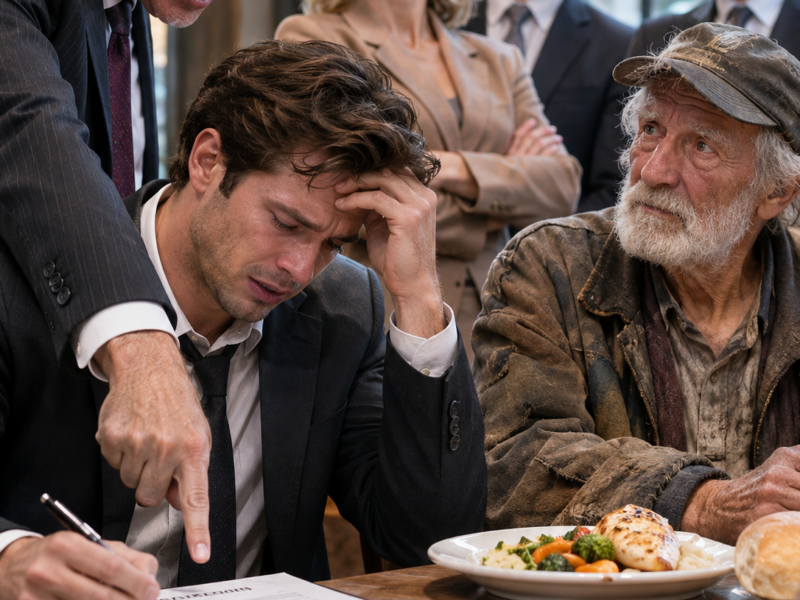
At 28, I Discovered My Younger Brother Had Stolen $450,000 From Our Family Business, but Instead of Punishing Him, My Father Fired Me and Threatened to Destroy My Career. With Only $24 Left in My Wallet, I Spent $20 Buying Lunch for an Elderly Stranger Who Was Being Humiliated Over Two Dollars. He Handed Me a Business Card and Told Me to Visit a Warehouse the Next Morning. When I Mentioned His Name to the Security Guard, the Man Immediately Straightened—and What Happened Next Would Change Everything.
At 28, I Discovered My Younger Brother Had Stolen $450,000 From Our Family Business, but Instead of Punishing Him, My Father Fired Me and Threatened to Destroy My Career. With Only $24 Left in My Wallet, I Spent $20 Buying Lunch for an Elderly Stranger Who Was Being Humiliated Over Two Dollars. He Handed Me a Business Card and Told Me to Visit a Warehouse the Next Morning. When I Mentioned His Name to the Security Guard, the Man Immediately Straightened—and What Happened Next Would Change Everything.
Part 1
“Sign your resignation, son. And if you ever breathe a word about that missing money, I’ll make sure nobody in Ohio hires you again.”
My father spoke those words without the slightest hesitation. My younger brother stood behind him, wearing a satisfied smile, as though watching six years of my life disappear was the most entertaining thing he had ever witnessed.
I looked down at the resignation letter on the mahogany desk.
Six years of seventy-hour workweeks. Six years of missed holidays, canceled vacations, and sacrifices nobody in my family had ever acknowledged. And now, because my brother had stolen $450,000 from our company, I was the one being thrown out.
My name is Mitchell Mercer. I was twenty-eight years old when my father taught me that sharing someone’s blood doesn’t guarantee their loyalty.
What neither of us knew that morning was that a twenty-dollar bill, a roadside diner, and an elderly stranger would change the course of our lives forever.
Until that Tuesday, I had served as the director of operations and data auditing at Mercer Retail Group, our family’s wholesale distribution business in Columbus, Ohio.
When I joined the company at twenty-two, we were drowning in debt. Our warehouses were disorganized, shipments regularly went missing, and suppliers were threatening to terminate their contracts.
I worked tirelessly to turn everything around.
Meanwhile, my younger brother, Derek, enjoyed the privileges of being the owner’s favorite son. He received expensive cars, generous bonuses, and executive positions he had never earned.
Whenever I questioned his decisions, my father dismissed my concerns.
“Your brother has a natural talent for business,” he would say. “You could learn something from him.”
Apparently, that natural talent included stealing from the company.
The previous evening, while reviewing our third-quarter financial records, I discovered dozens of suspicious vendor payments. At first, I assumed they were accounting errors.
But the deeper I investigated, the worse it became.
The vendors didn’t exist. The invoices were fabricated. Every payment had been authorized using Derek’s executive override credentials.
The total was $450,000.
I stayed at my desk until nearly midnight, documenting everything and preserving copies of the financial records.
Despite what I had discovered, part of me still wanted to protect my family. I believed my father would be furious with Derek, demand that the money be returned, and take immediate action to save the company.
I couldn’t have been more wrong.
At eight the following morning, I entered his office carrying a folder containing the evidence.
Derek was already there.
“Dad, we have a serious problem,” I began. “I’ve discovered fraudulent transactions going back three years.”
My father didn’t even open the folder.
Instead, he pushed a prepared resignation letter toward me.
“You’ve mishandled critical financial records,” he announced. “Your negligence has put this company at risk.”
I stared at him.
“What are you talking about? Derek authorized these payments. I have proof.”
Derek chuckled.
“You always did take those spreadsheets too seriously.”
I turned back to my father.
“Four hundred and fifty thousand dollars, Dad. This isn’t a mistake.”
His expression hardened.
“Sign the letter.”
That was when I understood.
He already knew.
Perhaps he had known for months. Perhaps Derek had confessed the moment he realized I was investigating the accounts. Either way, my father had made his decision before I entered the room.
He was going to protect his favorite son by destroying the other one.
“If you try to involve the authorities,” he continued, “I’ll tell everyone you were responsible for the missing records. Think carefully about your future, Mitchell.”
Something inside me went strangely quiet.
I picked up the pen.
“You know what hurts the most?” I asked.
My father remained silent.
“I actually believed you would do the right thing.”
I signed the resignation letter, placed the pen on his desk, and stood.
“I hope protecting Derek is worth $450,000.”
Neither of them followed me when I left.
I packed my coffee mug, a framed professional certificate, and a few personal belongings into a cardboard box. My coworkers watched through their office windows as I walked toward the elevator.
Nobody said goodbye.
Outside, I placed the box on the passenger seat of my aging pickup truck and drove without any particular destination.
My rent was due in ten days. After paying my utility bills, I had exactly twenty-four dollars in my wallet.
For the first time in my adult life, I had no job, no reliable income, and no idea what tomorrow would bring.
Eventually, hunger forced me to stop at a small roadside diner near West Broad Street.
The place smelled of burnt coffee, bacon grease, and fried potatoes. Truck drivers occupied most of the counter seats, and an impatient waitress named Brenda moved between customers.
I ordered scrambled eggs, toast, and black coffee.
While waiting, I opened my wallet and began calculating how long I could survive on what little money remained.
Then Brenda’s voice cut through the room.
“You’re two dollars short, old man!”
I looked up.
An elderly gentleman wearing a faded flannel jacket sat at the counter. His silver hair was neatly combed, but his hands trembled as he counted several quarters beside a crumpled ten-dollar bill.
“I’m terribly sorry,” he said. “I thought the special was twelve dollars.”
“Well, it’s fourteen. Prices went up months ago.”
“Perhaps I could bring the difference tomorrow?”
Brenda laughed harshly.
“Everybody has an excuse. If you can’t afford to eat here, don’t come in.”
Several customers turned to stare.
The elderly man’s face reddened.
He apologized again, slowly climbed off his stool, and began gathering his belongings.
“Get out,” Brenda snapped. “You’re holding up my customers.”
I felt something tighten inside my chest.
Only an hour earlier, my own father had made me feel worthless. Now I was watching another human being suffer the same humiliation over two dollars.
I knew I couldn’t afford to be generous.
But I also knew I couldn’t sit there and do nothing.
I walked to the register and placed my twenty-dollar bill on the counter.
“That should cover his meal and my breakfast.”
Brenda looked at me.
“Keep whatever’s left,” I added. “Maybe you can buy yourself a little patience.”
Someone at the counter laughed.
Brenda snatched the money without another word.
I turned toward the elderly man.
“Please don’t worry about it, sir.”
His eyes glistened.
“You didn’t have to do that, young man.”
“I know.”
He nodded gratefully and left.
I finished my breakfast, collected my cardboard box, and headed outside.
To my surprise, the elderly gentleman was waiting beside a lamppost.
“Are you waiting for someone?” I asked. “I can give you a ride if you need one.”
He smiled.
“My ride is coming. I wanted to speak with you.”
He glanced at the cardboard box in my arms.
“You lost your job today, didn’t you?”
I stopped.
“How did you know?”
“I’ve been around long enough to recognize a man who’s carrying more than what’s inside his box.”
For some reason, those words nearly broke me.
I looked away.
“It’s been a difficult morning.”
“And yet you helped me.”
He reached into his jacket and produced a thick, cream-colored business card.
“Go to this address tomorrow morning. Tell the security guard that Mr. Clifford sent you.”
I examined the card.
Buckeye Heartland Logistics.
I recognized the name immediately. It belonged to one of the largest freight and warehouse companies in Central Ohio.
Before I could ask what connection he had to the business, a gleaming black luxury SUV pulled beside us.
A uniformed driver stepped out and opened the rear passenger door.
The elderly man smiled at my stunned expression.
“Remember something, Mitchell. Good character is worth considerably more than money.”
Then he climbed inside.
I stood in the parking lot, watching the vehicle disappear into traffic.
The following morning, I arrived at Buckeye Heartland’s enormous industrial complex shortly before eight.
The security guard barely glanced at my card.
“We aren’t accepting walk-in applications.”
“Mr. Clifford told me to come.”
The change in his expression was immediate.
He straightened, grabbed his radio, and spoke urgently into it.
Within minutes, I was escorted through the security gates and taken directly to the executive floor.
A sharply dressed man sat behind an immaculate steel desk.
“Mitchell Mercer?”
“Yes, sir.”
“I’m Warren Albright, the CEO.”
He leaned back in his chair, studying me with undisguised suspicion.
“My father told me about your little performance at the diner yesterday.”
My stomach dropped.
His father?
The elderly man whose meal I had purchased was the founder of Buckeye Heartland Logistics.
And Buckeye Heartland was the company responsible for keeping my father’s entire distribution network alive.
Part 2
Warren opened his desk drawer and removed a checkbook.
“Let me guess. You discovered who my father was, helped him, and now you’re hoping for a reward.”
“You’re mistaken,” I replied.
He uncapped his pen.
“You spent twenty dollars. I’ll give you two thousand. Take the money and forget this address.”
Two thousand dollars would have solved my immediate problems. I could pay my rent, buy groceries, and survive while searching for another job.
But I pushed the checkbook back toward him.
“I didn’t come here for charity. My father fired me yesterday because I discovered financial fraud. If you have a job available, test my abilities. Otherwise, I’ll leave.”
Warren stared at me.
Then he slowly closed the checkbook.
“Warehouse Sector C. Minimum wage. Ninety-day probation. One serious mistake and you’re gone.”
“When do I start?”
For the first time, his expression changed.
“Tomorrow. Six forty-five.”
I thanked him and walked toward the door.
“Oh, Mitchell?”
I turned.
“Don’t mention my father to anyone downstairs.”
I nodded.
At that moment, I believed I had finally escaped my family’s corruption.
But less than three days later, my father would walk into that warehouse, threaten a three-million-dollar contract, and demand that Warren fire me.
When that failed, my brother would attempt something far worse.
This time, however, I wouldn’t walk away quietly.
Part 3
At six forty-five the following morning, I stood inside Warehouse Sector C wearing steel-toed boots and a navy utility shirt.
The warehouse was enormous. Forklifts moved between towering stacks of flour, sugar, cooking oil, and other wholesale groceries. Truck engines thundered outside the loading bays, and the air was thick with dust.
My new supervisor, Dale, was a broad-shouldered man with a gray mustache and absolutely no patience for corporate executives.
When I introduced myself, he pointed toward a mountain of shipping manifests.
“That’s a week’s worth of paperwork nobody bothered to finish. We’ve got twelve trucks leaving today. Think you can handle it?”
“I’ll have everything organized before five.”
He snorted.
“That’s what the last guy said.”
I spent the next several hours checking serial numbers, correcting mislabeled pallets, organizing delivery routes, and rebuilding the dispatch records.
By noon, six trucks had departed without a single discrepancy.
Dale was beginning to look impressed when a driver named Curtis stormed into the office.
“I need six extra cases of sugar loaded onto my truck.”
I checked his paperwork.
“Your order only authorizes fifty.”
“The customer called me directly. They’ll pay for the extras tomorrow.”
“Then the sales office needs to authorize the change.”
Curtis leaned over my desk.
“Listen, college boy. I’ve been working these docks longer than you’ve been shaving. Put the sugar on my truck.”
I picked up a red marker and held it above his dispatch clearance form.
“Remove the unauthorized cases, or your truck doesn’t leave.”
For several seconds, he stared at me.
Then he cursed and stormed outside.
Dale appeared in the doorway.
“Not bad, kid. Give that man an inch and he’ll steal the entire warehouse.”
I didn’t realize how prophetic those words would become.
By five, all twelve trucks had departed, and the paperwork backlog was cleared.
Warren visited unexpectedly, inspected my records, and struggled to find anything worth criticizing.
“Your handwriting could be better,” he finally said.
“I’ll work on that.”
He left without another word, but I caught the faintest hint of approval in his expression.
For the first time in days, I went home feeling hopeful.
That feeling lasted until my third morning.
At eight thirty, two white Mercer Retail Group trucks pulled into the loading area, followed by my father’s black luxury sedan.
My heart sank.
Douglas and Derek stepped out, dressed in expensive suits.
They had arrived to inspect a priority shipment of cooking oil and specialty grain.
Derek noticed me first.
His face lit up.
“Well, would you look at that?”
He approached me, examining my dusty uniform.
“From executive director to warehouse janitor. That’s quite a career move, big brother.”
I ignored him.
My father wasn’t amused.
“What are you doing here?”
“Working.”
“Did you take a job with my distributor to spy on me?”
“No, Mr. Mercer. I’m earning a living.”
His jaw tightened when I addressed him formally.
I gestured toward the loading bays.
“Your shipment is ready for inspection.”
Derek laughed.
“Careful, Dad. He might accidentally lose another four hundred thousand dollars.”
I wanted to remind him who had actually stolen the money.
Instead, I completed the inspection, obtained the required signatures, and returned to work.
Their shipment left our facility at ten fifteen.
Later that afternoon, Dale burst into my office.
“We’ve got a problem.”
He slammed his radio onto the desk.
“Truck eight was turned away at Mercer Central Distribution. They’re claiming Earl arrived hours late.”
“That doesn’t make sense.”
“Your father’s already filed a breach-of-contract complaint.”
Before I could respond, the telephone rang.
Warren wanted me upstairs immediately.
When I entered the boardroom, my father and brother appeared on a large video screen.
Warren sat at the head of the table, visibly irritated.
“Mitchell, explain why a priority shipment arrived two hours after the receiving deadline.”
My father interrupted.
“I warned you about him, Warren. He’s incompetent, vindictive, and determined to damage my business.”
Derek nodded enthusiastically.
“He couldn’t even manage basic accounting at our company.”
I waited until they finished.
Then I opened my dispatch folder.
“Truck eight completed loading at ten o’clock. Security recorded its departure at ten fifteen. The destination is approximately forty-five minutes away.”
My father scoffed.
“Anyone can falsify paperwork.”
“That’s true,” I replied. “Which is why we have satellite tracking.”
I placed my phone on the table.
“Earl also sent a message to our dispatch group at eleven ten.”
Warren leaned forward.
I read the message aloud.
“Arrived at Mercer receiving gate. Security refuses entry. Management instructed them to hold all Buckeye Heartland trucks outside until further notice.”
The room fell silent.
Warren turned toward the screen.
“Douglas, your receiving deadline was noon. My driver arrived fifty minutes early. Why was he denied entry?”
My father’s face changed.
Derek suddenly became very interested in something beneath the desk.
Rather than answer, my father raised his voice.
“I pay your company $250,000 every month!”
Warren remained silent.
“Fire him today,” Douglas demanded. “Or I’ll take my business elsewhere. Let’s see how long your company survives without its biggest customer.”
I felt my stomach tighten.
Three million dollars a year.
I had been working there for less than three days.
Nobody in their right mind would risk that kind of revenue for a probationary warehouse clerk.
At least, that was what I believed.
Warren folded his hands.
“Douglas, I appreciate your business. But I will not fire an employee whose records are accurate simply because you dislike him.”
My father stared at the camera.
“Are you serious?”
“Entirely.”
Warren continued.
“We’ll store your shipment overnight and redeliver it tomorrow morning. If you intend to terminate our contract without legitimate cause, have your attorneys contact mine.”
My father’s face turned crimson.
“Fine! But if one carton is damaged or missing, I’ll sue you into the ground.”
The screen went black.
I exhaled.
“Thank you, sir.”
Warren stood.
“Don’t thank me yet. I defended the integrity of my company’s records, not your family dispute.”
He walked toward the window.
“You’ll supervise the returned shipment tonight. Six in the evening until six tomorrow morning. I want every carton accounted for.”
“I understand.”
“If anything disappears, Mitchell, you’re finished.”
By five, Earl had returned with the rejected cargo.
Dale and I supervised the unloading of two hundred cases of premium cooking oil and one hundred sacks of specialty grain.
I inspected the seals personally and recorded every batch number.
Before leaving, Dale helped me surround the shipment with yellow caution tape.
“Watch yourself tonight,” he warned.
“What do you mean?”
“Men like your father don’t handle humiliation well.”
At six, the day shift departed.
The warehouse became eerily quiet.
I spent the first several hours entering records, checking inventory, and patrolling the building every thirty minutes.
Nothing unusual happened until approximately two in the morning.
I was pouring myself a cup of coffee when I heard a metallic squeak from the western end of the warehouse.
I grabbed my flashlight.
“Who’s there?”
A figure emerged from behind a stack of sugar pallets.
It was Curtis.
“Relax, Mitchell. It’s just me.”
“What are you doing here?”
“Lost my wallet earlier. Thought I’d come back and find it.”
“How did you get inside?”
He pointed toward the side door.
“The latch is broken. Been that way for weeks.”
I didn’t believe his story, but I wasn’t about to let him wander around unsupervised.
“Stay where I can see you.”
For fifteen minutes, I followed him through the western storage aisles until he finally retrieved a brown wallet from beneath a pallet.
“Found it!”
I escorted him to the front gate, watched him report to security, and returned to secure the side door.
Then I inspected the Mercer shipment again.
Everything appeared untouched.
I allowed myself a small sigh of relief.
What I didn’t know was that Curtis had never come back for his wallet.
He had come to keep my eyes focused on the wrong side of the warehouse.
And while I followed him through those darkened aisles, my brother was carrying out a plan designed to put me behind bars.
Part 4
Dale arrived shortly after six the following morning carrying two cups of coffee.
“You look terrible,” he remarked.
“Good morning to you too.”
I handed him the overnight inspection log and explained Curtis’s unexpected visit.
Dale frowned.
“That doesn’t sound right.”
“I thought the same thing. But I watched him the entire time.”
At eight, the Mercer trucks arrived.
Derek stepped out wearing a freshly pressed suit and an unusually cheerful expression.
“Sleep well, big brother?”
I ignored the question.
We began the final inventory inspection alongside a receiving supervisor from Mercer Retail Group.
The first pallets were counted without difficulty.
Then a loader shouted from behind the third row.
“Dale! Come look at this!”
We hurried over.
A section of heavy plastic strapping had been sliced cleanly through.
Behind it was an empty space where two cartons should have been.
My heart stopped.
Dale ordered an immediate recount.
A few minutes later, the loader delivered the news.
“Two cases missing. Ten gallons of the imported olive oil blend.”
Derek stepped forward.
“Well, isn’t that interesting?”
He turned toward the Mercer supervisor.
“Mitchell was alone here all night, wasn’t he?”
I looked directly at him.
“Don’t.”
He raised his voice.
“He stole them! He got fired from our company, and now he’s stealing our merchandise to get revenge!”
The loading dock fell silent.
Within minutes, Warren arrived with the head of corporate security.
He inspected the broken seal before turning toward me.
“Explain.”
“I didn’t take anything.”
“You were responsible for this shipment.”
“Curtis entered through the western door at two this morning. He distracted me for fifteen minutes. Someone else must have entered while I was watching him.”
“Then we’ll review the cameras.”
Dale groaned.
“The eastern cameras are down. Maintenance hasn’t repaired the damaged fiber line.”
I felt the blood drain from my face.
The thieves knew exactly where the surveillance blind spots were.
They knew I would be alone.
And they knew Warren had threatened to fire me if anything disappeared.
Derek smiled triumphantly.
“Call the police, Warren. Unless you’d prefer Mercer Retail Group to file charges against your entire management team.”
I looked around.
Some workers appeared sympathetic. Others avoided my eyes.
Even Warren seemed uncertain.
I had already lost one job because of my brother. Now he was trying to make me lose my freedom.
I wasn’t going to let that happen.
“Give me until noon.”
Warren frowned.
“What?”
“Lock down the warehouse yard. Don’t let any trucks leave. If I can’t recover those cartons and identify the person responsible before noon, you can call the police yourself.”
Derek laughed.
“This is ridiculous.”
Warren studied me for several seconds.
Then he turned toward his security chief.
“Secure the gates. Nobody leaves until noon.”
I immediately began working backward through the events of the previous night.
Two five-gallon cases of cooking oil weighed nearly ninety pounds. Whoever stole them couldn’t have carried them through the guarded front gate without attracting attention.
That meant the cartons were probably still somewhere inside the industrial compound.
I checked the overnight vehicle records.
Forty trailers had been parked in the yard.
Only one had remained beside the western loading area throughout the night.
Truck number twelve.
Assigned to Curtis.
But finding stolen merchandise in his trailer wouldn’t necessarily prove my innocence. Curtis could claim I had placed it there myself.
I needed something stronger.
As I stood beside the dispatch board, a memory suddenly surfaced.
On my first afternoon, I had noticed a tiny red light blinking above a steel storage rack near the western water pump.
At the time, I assumed it belonged to a piece of maintenance equipment.
Now I wondered.
I hurried to the maintenance workshop and found Roy, the lead technician.
“What’s that little red light above the west water pump?”
Roy looked surprised.
“You noticed that?”
“What is it?”
“A trail camera. Somebody’s been stealing our pneumatic tools. We installed it last week.”
My heart began pounding.
“Which direction does it face?”
“Across the western entrance and down the central aisle.”
I nearly grabbed him by the shoulders.
“Roy, I need that footage. From two o’clock this morning.”
He immediately contacted corporate security.
Together, we retrieved the camera and took its memory card to the information technology department.
An analyst opened the video files.
There I was, carrying my flashlight.
There was Curtis, emerging from behind the sugar pallets.
We watched ourselves disappear into the western aisle.
Then another figure appeared.
A man dressed in dark clothing slipped through the entrance, crouched behind several empty crates, and waited.
When he was certain Curtis had distracted me, he moved toward the Mercer shipment.
The camera recorded him cutting the plastic straps and removing two cartons.
As he turned beneath an overhead lamp, his face became visible.
Derek.
I closed my eyes briefly.
I had suspected him from the beginning, but seeing the footage was different.
This wasn’t simply another act of favoritism or financial dishonesty.
My own brother had deliberately committed a crime so I could be blamed for it.
And my father had probably helped him.
The security team preserved the original footage, and investigators began gathering additional records.
At eleven forty-five, I returned to the warehouse.
My father had arrived.
He stood beside Derek, glancing impatiently at his expensive wristwatch.
“Time’s almost up, Mitchell.”
I walked past him.
“Dale, I need you to open truck number twelve.”
Curtis immediately stepped forward.
“Hold on! That’s my trailer. You can’t just go through it.”
Warren turned toward him.
“It’s company property. Open it.”
Curtis’s face went pale.
Dale released the steel latch and swung the doors apart.
Rows of flour and sugar sacks filled the trailer.
At the back, beneath a dirty canvas tarp, were two brown cartons.
Dale pulled them into the light.
I checked the batch numbers against my inventory sheet.
They matched perfectly.
“These are the missing cases.”
The warehouse erupted in whispers.
Curtis began shaking.
“It wasn’t my idea!”
My father stiffened.
“Be quiet.”
Curtis looked toward Warren.
“They paid me twenty-five hundred dollars! All I had to do was distract Mitchell while Derek moved the boxes into my truck.”
Derek shouted.
“You’re lying!”
Douglas stepped forward angrily.
“This criminal is trying to protect himself by accusing respected businessmen. You have no proof we were involved.”
I held up my phone.
“Actually, Dad, we do.”
I played the recording.
Nobody spoke.
Everyone watched Curtis enter the warehouse.
Everyone watched me follow him toward the sugar racks.
And everyone watched Derek emerge from the shadows, cut the straps, and steal the cartons.
My brother stumbled backward.
“That doesn’t prove anything!”
Warren stared at him.
“It proves quite a lot.”
Curtis, realizing the situation was collapsing, offered to show the security chief his recent call records and messages.
There were communications involving Derek and my father that corresponded with the overnight incident.
Douglas’s expression changed from outrage to something I had never seen on his face before.
Fear.
For years, he had been accustomed to controlling every room he entered.
He could threaten employees, manipulate business partners, and silence anyone who challenged him.
But standing on that warehouse floor, surrounded by witnesses and confronted with evidence he couldn’t explain away, he had finally run out of options.
Warren turned toward him.
“You bribed one of my drivers, sabotaged my warehouse, and attempted to frame an innocent employee.”
“Warren, we can discuss this privately.”
“No.”
My father lowered his voice.
“Think about our business relationship.”
“I am.”
Warren’s next words echoed through the warehouse.
“Every distribution contract between Buckeye Heartland Logistics and Mercer Retail Group is terminated, effective immediately. Our attorneys will pursue damages for your deliberate sabotage.”
Douglas stared at him.
“You can’t do that.”
“You gave me the legal grounds yourself.”
My father turned toward me.
“Mitchell, tell him this has gone far enough.”
I almost laughed.
For the first time since firing me, he was speaking to me like his son.
Not because he regretted what he had done.
Because he needed something.
“You told me to think carefully about my future, Dad.”
He swallowed.
“I finally did.”
Police officers arrived shortly afterward.
Curtis was taken into custody.
Derek began pleading with our father as officers placed handcuffs around his wrists.
“Dad! Do something! Call our lawyer!”
Douglas stood helplessly.
As the officers escorted Derek outside, my father looked at me with an expression filled with hatred.
“You’ve destroyed this family.”
I shook my head.
“No. I just stopped protecting the people who were destroying it.”
He turned and walked away.
When his sedan disappeared beyond the security gates, Dale placed a heavy hand on my shoulder.
“Remind me never to get on your bad side, kid.”
Several workers began applauding.
Others cheered.
I should have felt victorious.
Instead, I felt exhausted.
I had spent years trying to earn my father’s respect. And in less than a week, he had shown me exactly how little my loyalty meant to him.
Warren approached me.
“Mitchell, upstairs. We need to talk.”
The cheering faded behind me as I followed him toward the administration building.
I had cleared my name.
But Buckeye Heartland had just lost a customer worth three million dollars annually.
I wondered whether my new career was about to end anyway.
When Warren closed his office door, he gestured toward the chair opposite his desk.
“Do you know what you cost me today?”
I nodded.
“Three million dollars a year.”
He sat down.
“That’s correct.”
I took a deep breath.
“If you’d prefer that I resign, I understand.”
Warren stared at me for a moment.
Then, unexpectedly, he smiled.
“Mitchell, you’re not going to like what I’m about to tell you.”
Part 5
“Your days as a warehouse clerk are officially over.”
Warren delivered those words with such seriousness that I initially believed I was being fired.
I nodded slowly.
“I understand, sir.”
“Do you?”
He opened a drawer and removed a thick black binder embossed with the Buckeye Heartland crest.
“Because I don’t think you do.”
Before he could continue, the office door opened.
Mr. Clifford walked inside carrying a stainless steel lunch pail.
“Warren, I brought you some pot roast. Your assistant says you’ve been skipping lunch again.”
Then he noticed me.
His entire face brightened.
“Mitchell! You came!”
I stood immediately.
“It’s wonderful to see you, sir.”
He shook my hand warmly before looking toward his son.
“I told you this young man was worth meeting.”
Warren sighed.
“You certainly did.”
“And you’ve treated him properly?”
Warren glanced at me.
“Well, I offered him two thousand dollars to leave. He refused. Then I gave him the hardest entry-level job in the warehouse.”
Mr. Clifford raised his eyebrows.
“Warren.”
“Before you lecture me, Dad, let me finish.”
He explained everything that had happened.
The paperwork backlog. Curtis’s attempted unauthorized shipment. My father’s false complaint. The overnight theft. The hidden camera.
When Warren finished, Mr. Clifford looked at me with unmistakable pride.
“I knew there was something special about you.”
“I was just doing my job.”
“No, Mitchell. Plenty of people do their jobs. Very few are willing to risk everything to do what’s right.”
Warren tapped the black binder.
“Which brings us back to business.”
Mr. Clifford smiled and carried his lunch pail into the adjoining lounge.
Warren opened the binder.
“Dale is an excellent floor supervisor. But this facility needs someone who understands inventory systems, operational auditing, and the realities of warehouse work.”
He turned the document toward me.
“Effective tomorrow, I’m appointing you director of warehouse operations across Sectors A, B, and C.”
I stared at him.
“Excuse me?”
“You’ll oversee all three warehouse sectors. The supervisors will report directly to you.”
I looked down at the employment agreement.
The salary was four times what I had been earning as a probationary clerk. There was an annual performance bonus, comprehensive benefits, and a company vehicle.
For several seconds, I couldn’t speak.
“Mr. Albright, I’ve only worked here for a few days.”
“And in those few days, you’ve exposed weaknesses my senior managers overlooked for months.”
“What about the other supervisors?”
“They saw what happened downstairs. You’ve already earned more respect from those workers than some executives earn in twenty years.”
He leaned forward.
“I’m not offering you this position because you bought my father lunch. I’m offering it because you’ve demonstrated exactly the qualities this company needs.”
My eyes returned to the contract.
Just days earlier, my father had forced me to sign a resignation letter.
Now another man was asking me to sign an agreement that would give me a future.
The difference between those two pieces of paper felt enormous.
I picked up the pen.
“Thank you for trusting me.”
“Don’t make me regret it.”
I signed.
When I returned to Sector C, Dale was standing beside my desk.
He noticed me gathering my belongings.
“Don’t tell me corporate’s getting rid of you.”
“Not exactly.”
“What does that mean?”
“I’ve been promoted.”
He smiled.
“Good for you. Where are they sending you?”
“Director of warehouse operations.”
His smile disappeared.
“All three sectors?”
I nodded.
For three seconds, he stared at me.
Then he burst into laughter.
“Well, I’ll be damned!”
He straightened and gave me an exaggerated military salute.
“Congratulations, boss.”
I laughed for the first time in what felt like weeks.
“I’m still going to need your help, Dale.”
“You’ve got it.”
Over the following days, I began addressing the operational weaknesses that had nearly destroyed my career.
We repaired damaged surveillance equipment, strengthened access controls, introduced more frequent inventory reconciliations, and improved communication between dispatchers and drivers.
Loading times dropped significantly.
Inventory discrepancies disappeared.
Employees who had previously been afraid to report suspicious activity began speaking openly.
I made it clear that nobody would be punished for identifying a problem simply because it embarrassed someone in management.
That was the kind of workplace I had always wanted to build.
Meanwhile, Mercer Retail Group was falling apart.
Without Buckeye Heartland’s distribution network, my father struggled to keep merchandise moving between his warehouses and retail customers.
Other logistics providers learned about the sabotage and refused to take on the risk.
Deliveries were canceled.
Customers complained.
Suppliers demanded immediate payment.
The company my father had spent decades building was beginning to collapse under the weight of his own decisions.
But the warehouse incident was only the beginning.
I still possessed the financial records documenting Derek’s original $450,000 theft.
For days, I had wrestled with what to do.
Part of me remembered childhood birthdays, family dinners, and the father I had once admired.
Another part remembered his expression as he pushed that resignation letter toward me.
He had known what Derek had done.
He had threatened my career to keep me silent.
Then, when I found another job, he had helped orchestrate a scheme that could have sent me to prison.
Protecting him would mean becoming exactly the kind of person I despised.
So I preserved the accounting records, organized the evidence, and submitted the documentation through the appropriate channels.
I included the fabricated vendor invoices, transaction histories, authorization records, and the timeline of suspicious payments.
Then I returned to work.
I wasn’t interested in threatening my father or negotiating some private settlement.
I wanted the truth investigated.
Exactly one week after the warehouse confrontation, Warren called me into his office.
“There’s something you should see.”
He turned on the television.
A local news reporter stood outside the downtown office building where I had spent six years of my life.
A banner appeared across the screen.
FEDERAL AGENTS ARREST LOCAL RETAIL EXECUTIVES IN $450,000 FRAUD INVESTIGATION.
The footage showed my father being escorted down the front steps in handcuffs.
His expensive suit was wrinkled.
His head was bowed.
The man who had once threatened to make sure I never worked in Ohio again was now surrounded by federal agents and television cameras.
Then Derek appeared.
He had recently been released on bail following the warehouse theft allegations.
Now he was being arrested again in connection with the financial investigation.
He tried to hide his face from the cameras.
Warren switched off the television.
“Investigators received a detailed package containing three years of financial records.”
I remained silent.
He studied me.
“Very thorough records, apparently.”
I looked toward the window.
“Nobody should be allowed to steal from a company and blame someone else for it.”
Warren nodded.
“No argument here.”
For a moment, neither of us spoke.
Then he opened another folder.
“We’re developing a new regional logistics hub in Toledo. I want you involved in the operational rollout.”
I looked at him.
“You’re serious?”
“Completely.”
That was when I realized how dramatically my life had changed.
My father had tried to convince me that I was nothing without the Mercer name.
Yet the moment I stopped allowing that name to define my future, opportunities began appearing that I had never imagined possible.
That Saturday, I decided to visit the roadside diner where everything had started.
I parked my new company SUV outside and walked through the familiar glass door.
The same smell of coffee and bacon filled the room.
Brenda stood behind the counter.
She recognized me immediately.
“Oh,” she said awkwardly. “It’s you.”
“Good afternoon.”
I ordered two meatloaf specials to go.
While she prepared them, I glanced toward the stool where Mr. Clifford had been sitting that day.
I could still remember the humiliation on his face.
When Brenda handed me the bags, I placed a hundred-dollar bill on the counter.
She stared at it.
“I don’t have change for this right now.”
“That’s all right. Keep the change.”
Her eyes widened.
“But I’d like you to do something for me.”
“What?”
“Put the remaining money aside. The next time someone comes in hungry and doesn’t have enough to pay, use it to cover their meal.”
Brenda looked down at the bill.
For a moment, I thought she might refuse.
Instead, her expression softened.
“I wasn’t having a very good day when you came in last time.”
“I figured.”
“That doesn’t excuse how I treated him.”
“No,” I agreed. “But you can treat the next person differently.”
She nodded.
“I will.”
I picked up the bags and left.
Twenty minutes later, I arrived at Mr. Clifford’s home, a modest brick house in a quiet, tree-lined neighborhood.
He opened the door before I finished ringing the bell.
“Mitchell!”
“I brought lunch.”
He looked at the takeout bags and laughed.
“Don’t tell me that’s meatloaf.”
“Two orders.”
He welcomed me inside and led me toward the sunny back patio.
We sat at a wooden picnic table overlooking a small garden.
For a man who had founded a multimillion-dollar logistics company, he lived remarkably simply.
As we unpacked our meals, he looked at me thoughtfully.
“There’s something I should probably tell you about that afternoon.”
“What is it?”
“I wasn’t really without money.”
I stopped opening my container.
He smiled sheepishly.
“I had left my main wallet in the car. Deliberately.”
“Deliberately?”
“Yes.”
He leaned back.
“After forty years in business, you begin to wonder whether people respect you or simply respect what you own. Sometimes I like going places where nobody recognizes me.”
He looked toward the garden.
“That day, I wanted to see how people treated an ordinary old man who couldn’t quite afford his lunch.”
I shook my head in disbelief.
“So it was a test?”
“Not one designed specifically for you. I didn’t know you existed.”
He smiled.
“But then you walked in carrying that cardboard box. You looked like a man who had just lost everything.”
I remembered counting my remaining money beneath the diner table.
“You were right.”
“And when Brenda humiliated me, you helped anyway.”
He paused.
“You didn’t ask my name. You didn’t expect anything in return. You even offered me a ride.”
I looked down at my meal.
“I couldn’t stand watching someone get treated like that.”
“Exactly.”
He reached across the table and placed a hand on my arm.
“Character isn’t what a person does when kindness is convenient. It’s what they choose when kindness costs them something.”
For a while, we ate in comfortable silence.
Then Mr. Clifford asked about my father.
“Have you spoken to him?”
“No.”
“Do you intend to?”
I considered the question.
“I don’t know.”
He nodded.
“You don’t have to decide today.”
I looked toward the trees beyond his garden.
“I spent my entire life trying to make him proud. I thought if I worked hard enough, sacrificed enough, and solved enough problems, eventually he’d look at me the way he looked at Derek.”
“And did he?”
“No.”
Mr. Clifford sighed.
“Then perhaps it’s time to stop measuring your worth through his eyes.”
Those words stayed with me.
My father and brother were facing serious criminal allegations. Their company was struggling to survive, and the future they had once taken for granted was disappearing.
I didn’t celebrate their suffering.
I didn’t need to.
The greatest satisfaction came from knowing that their decisions no longer controlled my life.
I had a career I was proud of, colleagues who respected me, and mentors who valued integrity more than family connections.
Most importantly, I could look at myself in the mirror without shame.
Months later, as preparations for the Toledo facility progressed, I kept my old coffee mug on my new office desk.
It was the same mug I had carried out of Mercer Retail Group in that cardboard box.
Sometimes visitors asked why I kept something so ordinary in an otherwise modern office.
I always gave them the same answer.
“It reminds me where I started.”
But the truth was more complicated.
It reminded me of the morning my father tried to destroy my future.
It reminded me of the twenty dollars I almost couldn’t afford to spend.
It reminded me of an elderly stranger who offered me an opportunity when my own family had turned its back on me.
And it reminded me that losing something doesn’t always mean your life is falling apart.
Sometimes, it means you’re finally being released from a life that was never good for you.
My father believed money gave him power over everyone around him.
My brother believed being the favorite son meant he would never face consequences.
They were both wrong.
In the end, the $450,000 Derek stole couldn’t buy his freedom. The $250,000 monthly contract my father threatened to cancel couldn’t buy Warren’s obedience.
And all the money in their company couldn’t purchase the one thing they had never understood.
Integrity.
I had walked out of my father’s office with a cardboard box, twenty-four dollars, and a broken heart.
Hours later, I gave away almost everything I had left.
At the time, it seemed like the smallest decision I could possibly make.
Looking back, it was the most important decision of my life.
Because the twenty dollars my father would have considered insignificant became the beginning of a future he could never take away from me.
And the elderly man everyone else had been willing to humiliate became the person who helped me discover something my own father had never taught me.
A man’s true worth isn’t measured by the money in his wallet, the title on his office door, or the family name he carries.
It’s measured by what he chooses to do when nobody important appears to be watching.
That afternoon, I thought I was simply buying a hungry stranger his lunch.
I never imagined I was opening the door to an entirely new life.