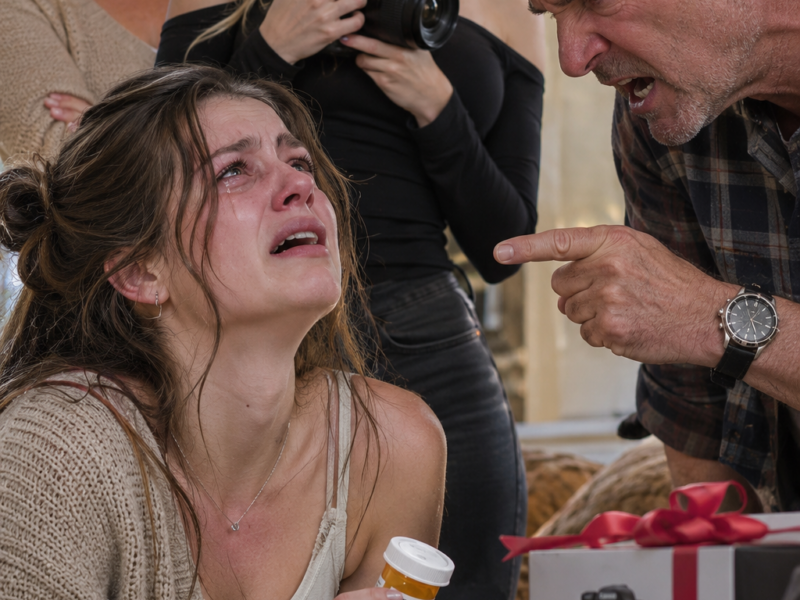
At 28, I Asked My Parents to Help Pay for Medication That Could Save My Brain After 12 Years of Untreated Illness, but My Father Spent $4,500 on My Sister’s New Camera Instead. “Her Future Matters More,” He Said, While My Mother Told Me to Wait Another Month. I Quietly Bought the Medication Myself, but When a Pharmacist Flagged My Medical History, My Father Suddenly Panicked. Then I Discovered an Email About a $5 Million Life Insurance Policy—and Realized Why He Was So Terrified…
At 28, I Asked My Parents to Help Pay for Medication That Could Save My Brain After 12 Years of Untreated Illness, but My Father Spent $4,500 on My Sister’s New Camera Instead. “Her Future Matters More,” He Said, While My Mother Told Me to Wait Another Month. I Quietly Bought the Medication Myself, but When a Pharmacist Flagged My Medical History, My Father Suddenly Panicked. Then I Discovered an Email About a $5 Million Life Insurance Policy—and Realized Why He Was So Terrified…
PART 1: MY PARENTS SPENT MY MEDICATION MONEY ON MY SISTER’S CAMERA
At 28 years old, I finally asked my parents a question I had been afraid to ask for twelve years: Why had they never paid for the medication I desperately needed?
My name is Camille Holloway, and when I was sixteen, doctors diagnosed me with a hereditary neurological disorder that slowly damaged the protective covering around my nerves. Without proper treatment, my condition could worsen, affecting my ability to walk, work, and live independently.
But my parents, Richard and Margaret Holloway, always insisted that treatment was too expensive. They lived in a beautiful mansion in Westport, Connecticut, yet somehow there was never enough money for my health.
Meanwhile, my younger sister Chloe had everything she wanted. Photography equipment, expensive trips, and opportunities to pursue her dreams were handed to her without hesitation.
For years, I believed my parents were simply struggling financially. I worked hard, became an accountant, moved into my own apartment in Hartford, and learned to endure the pain and exhaustion without complaining.
Then, during a Sunday family lunch, I discovered the truth.
When I asked about my medication, my father casually admitted that they had spent the money on Chloe’s new Canon camera.
A $4,500 camera.
Money that could have helped protect my nervous system had been used to support my sister’s photography career.
My mother didn’t even look ashamed. She suggested I could wait a little longer for treatment because Chloe’s future was important.
I stared at them, realizing they had watched me suffer for twelve years while repeatedly choosing my sister’s happiness over my health.
But instead of screaming or begging, I quietly left the table.
That afternoon, I made a decision that would eventually destroy everything my parents had spent their lives protecting.
I would stop asking them for permission to survive.
And when I finally tried to get my medication myself, I discovered that the missing treatment was only the beginning of a much darker story.
PART 2: THE PHARMACIST DISCOVERED SOMETHING THAT TERRIFIED MY FATHER
I began contacting doctors, insurance providers, and patient assistance programs, determined to take control of my medical care.
Eventually, I found a way to obtain the medication my parents had convinced me was financially impossible.
At CVS, a pharmacist named Linda Torres helped me navigate the process. But when she reviewed my prescription history, she noticed something deeply troubling.
For years, prescriptions connected to my neurological condition had gone unfilled.
This wasn’t simply a family forgetting an appointment or missing a payment. It was a documented pattern stretching across much of my adult life.
As questions about my medical history surfaced, I began examining everything my parents had told me.
That was when I learned about a $5 million life insurance policy connected to my father.
The more I investigated, the stranger the situation became. My father’s insurance paperwork raised questions about what he had disclosed regarding hereditary medical conditions in our family.
Suddenly, his behavior made sense in a terrifying new way.
He hadn’t just been careless about my illness. He had reasons to fear anyone examining our family’s medical history.
When he learned that I had begun receiving treatment and that my records were being reviewed, he became unusually anxious.
The man who had spent twelve years dismissing my suffering now desperately wanted to know whom I had spoken to and what information I had shared.
I contacted my aunt Evelyn, an attorney who had been estranged from my father for years.
Unlike my parents, she listened carefully.
As I told her about the unfilled prescriptions, Chloe’s expensive camera, and the insurance policy, her expression grew increasingly serious.
She helped me understand that I needed to preserve my records and let the appropriate professionals examine what had happened.
For the first time, I realized I wasn’t dealing with ordinary parental favoritism.
There were financial secrets buried beneath my family’s perfect reputation.
And when the insurance company began reviewing my father’s disclosures, the consequences threatened to reach far beyond my medical treatment.
PART 3: MY FAMILY’S PERFECT IMAGE COLLAPSED IN FRONT OF EVERYONE
My parents had always cared deeply about appearances.
Their Westport mansion, expensive furniture, polished dinner parties, and respectable social connections created the illusion of a successful, loving family.
But behind that image, I had spent twelve years fighting a neurological illness without the treatment I needed.
With Aunt Evelyn’s support, I began sharing the truth with people who had never known what was happening.
My maternal grandparents, Gerald and Helen, were devastated when they learned how my parents had treated me.
They had believed their daughter and son-in-law were providing for both grandchildren. Instead, they discovered that my health had been repeatedly sacrificed while Chloe enjoyed opportunities I could barely imagine.
During a tense family confrontation, my parents tried to justify their decisions.
My father insisted that Chloe had needed support to establish her career. My mother attempted to minimize my illness and portray my objections as resentment toward my sister.
But this time, I had medical records, years of unanswered questions, and people willing to listen.
My grandparents were furious.
Then another financial secret surfaced: my parents owed them $400,000.
Gerald and Helen demanded repayment and made it clear that my parents could no longer expect the same place in their estate plans.
Meanwhile, the insurance company’s review uncovered serious problems with my father’s disclosures about hereditary medical conditions, and the $5 million policy was ultimately voided.
The financial security and respectable image my father had worked so hard to maintain began collapsing.
But the most painful revelation was still waiting.
Chloe, the daughter my parents had spent years protecting, learned that she carried the same hereditary genetic risk connected to my condition.
For the first time, she understood that our parents’ choices had endangered more than just me.
She had grown up believing their favoritism meant they loved her more.
Now she was forced to confront a different possibility: perhaps they had been protecting their own ambitions and reputation all along.
When Chloe finally came to speak with me, she wasn’t the confident, carefree sister I remembered.
She was frightened, ashamed, and beginning to understand the cost of everything she had been given.
And while she struggled to accept the truth, my parents faced a future neither of them had ever imagined.
PART 4: MY FATHER CAME BACK WITH AN APOLOGY—BUT HIS REAL REASON CHANGED EVERYTHING
As the consequences mounted, my parents could no longer maintain their luxurious lifestyle.
They sold their Westport mansion and moved into a smaller home in Stamford.
The grand family gatherings disappeared. Their financial security weakened, and their relationships with my grandparents deteriorated.
For years, I had believed I was the family’s burden.
Now, without my silence protecting them, my parents were finally facing the consequences of their own decisions.
But my life was changing in the opposite direction.
With consistent medical care, I began managing my condition more effectively. Treatment couldn’t erase twelve years of suffering, but it gave me something I had almost stopped believing in: a future I could plan for.
I also started therapy, slowly confronting the emotional damage caused by growing up in a family where my needs were treated as inconveniences.
My grandparents became a source of support, and I began rebuilding my relationship with Chloe.
She returned from Paris, started working toward financial independence, and apologized for the ways she had benefited from our parents’ favoritism without questioning it.
I didn’t forgive everything overnight.
But for the first time, we were speaking honestly as sisters rather than competing for love that should never have been conditional.
Then one day, my father contacted me.
He wanted to apologize.
For a brief moment, I wondered whether he had finally understood what he had done.
But as our conversation continued, his real motivation became painfully clear.
He wanted me to speak to my grandparents and persuade them to reconsider their decisions about the money and inheritance.
Even after losing his mansion, his insurance policy, and much of his family’s trust, he was still thinking about what I could do for him.
I refused.
Not because I wanted revenge, but because I finally understood that loving my family did not require sacrificing myself.
I had spent twelve years waiting for my parents to choose me.
Now I was choosing myself.
Looking back, I realized that my parents had built their lives like a glass house—beautiful from the outside, carefully polished, and full of secrets nobody was supposed to see.
They treated me like the fragile child who might shatter at any moment.
But when the truth finally broke through, their perfect glass house was the thing that collapsed.
And for the first time in my life, I was strong enough to walk away.