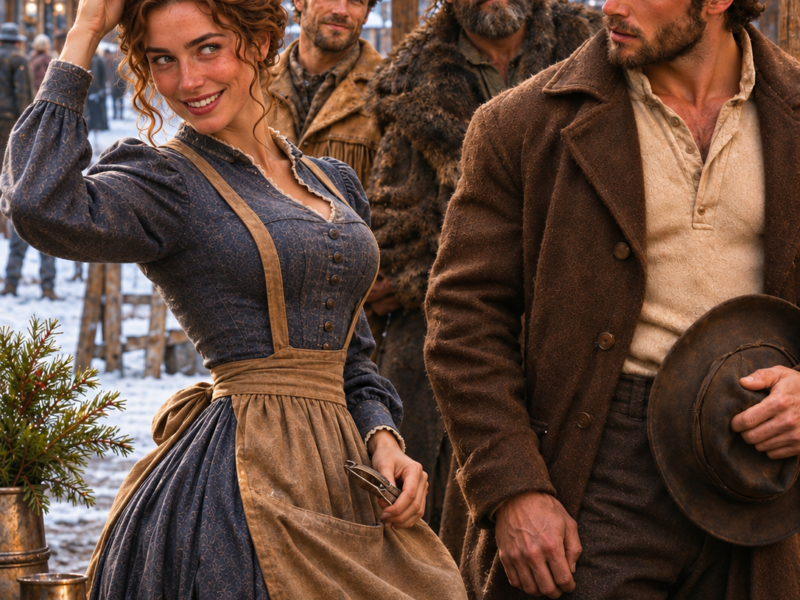
At 25, I Stood on a Stool at Our Christmas Market and Joked, “Someday I’m Going to Marry That Man!”—Pointing Straight at Ellis Winslow, the Feared Winter Wolf Who Hadn’t Smiled in Four Years. Three Days Later, He Appeared at My Silver Stall and Asked Me to Inspect Donations Meant to Support 13 Widows. What I Discovered Was Five Counterfeit Treasures Bearing My Dead Father’s Mark. But When I Followed the Records to His Family’s Mountain Home, I Uncovered a Secret That Could Destroy Everything…
At 25, I Stood on a Stool at Our Christmas Market and Joked, “Someday I’m Going to Marry That Man!”—Pointing Straight at Ellis Winslow, the Feared Winter Wolf Who Hadn’t Smiled in Four Years. Three Days Later, He Appeared at My Silver Stall and Asked Me to Inspect Donations Meant to Support 13 Widows. What I Discovered Was Five Counterfeit Treasures Bearing My Dead Father’s Mark. But When I Followed the Records to His Family’s Mountain Home, I Uncovered a Secret That Could Destroy Everything…
Part 1
The moment I announced that I was going to marry the most feared man in Hollow Pine, the entire Christmas market went silent.
I was standing on a wooden stool with a crooked silver star balanced on my head, holding a pair of pliers like a royal scepter. My cheeks were burning, my heart was racing, and the man I had just publicly claimed as my future husband was staring directly at me.
His name was Ellis Winslow.
He was twenty-eight years old, stood nearly a head taller than most men in our valley, and had not smiled at a woman in four years.
People called him the Winter Wolf.
And I, Imogen Clayborne, a twenty-five-year-old silversmith who could barely keep her father’s workshop running, had just told an entire town that someday he would be mine.
I had no idea that one foolish joke would uncover a terrible betrayal, threaten thirteen widows, and change both our lives forever.
But I should begin with the morning everything started.
December had arrived in Hollow Pine beneath a blanket of snow. Our little mountain town was the sort of place where everybody knew your business before you did, where smoke curled from stone chimneys and Christmas lanterns made even the poorest streets look beautiful.
I had been awake since four that morning, polishing silver lockets and repairing a broken hinge beneath the yellow glow of my father’s old lamp.
My father had died three years earlier, leaving me his workshop, his tools, and enough unpaid responsibilities to frighten a sensible woman into marriage.
But I had no intention of marrying simply to survive.
I loved my work.
I loved the satisfaction of turning a damaged piece of silver into something beautiful again. And perhaps more than anything, I loved knowing that every coin I earned belonged to the hands that had worked for it.
That Christmas, however, business mattered for a reason beyond my own survival.
Every December, Hollow Pine held a market to support the White Night Fund, a charity established after the Bell Hollow mine collapse of 1879. Thirteen widows still depended on its quarterly payments for coal, food, and winter supplies.
My father had always contributed generously.
I intended to continue that tradition.
By afternoon, my little stall beneath the tin-roofed arcade was decorated with evergreen branches, blue cloth, and rows of polished silver. Children raced between the tables while merchants shouted greetings over the smell of roasted chestnuts.
My closest friend, Hattie Buford, occupied the neighboring stall.
Hattie was forty-three, widowed, outspoken, and convinced that every problem in the world could be solved with hot tea, honest work, or a rolling pin.
Sometimes all three.
“You look exhausted,” she declared as I arranged my last pair of earrings.
“Good morning to you too.”
“It is nearly noon.”
“Then good noon.”
She examined my face with suspicious concern.
“Have you eaten?”
“Coffee.”
“Coffee is not breakfast.”
“It is when you cannot afford eggs.”
She muttered something about stubborn young women and disappeared behind her woolen blankets.
I was still smiling when I heard a child scream.
A little girl wearing a red cap had wandered beside a barrel of apples near the arcade’s large blanket shelf.
The barrel was leaning dangerously.
Worse, the rope holding it in place was frayed.
I recognized the problem instantly. Years of studying tiny cracks in silver had taught me to notice weaknesses before they became disasters.
I dropped my polishing cloth and ran.
The rope snapped just as I reached the child.
I grabbed her beneath the arms and pulled her backward.
An instant later, the barrel crashed through the exact spot where she had been standing.
Apples rolled across the wooden boards.
For several seconds, nobody moved.
Then the girl’s mother rushed forward, crying and thanking me so fiercely that I hardly knew what to say.
The little girl simply touched my cheek.
“You’re pretty,” she announced.
Everyone laughed.
I laughed too, although my hands were trembling.
Hattie placed a hand on my shoulder.
“You always see the broken thing before it breaks,” she whispered.
I remembered those words later.
I wished I had remembered them sooner.
That evening, the market committee brought out Hollow Pine’s ceremonial silver star.
It was a beautiful eight-pointed ornament, worn each Christmas Eve by the merchant who had contributed most to the widows’ fund.
For some reason, the committee had decided that I deserved it.
Hattie immediately insisted I try it on.
Then the children began chanting.
“Queen Imogen! Queen Imogen!”
Before I knew it, I was standing on my stool with the star crooked on my hair.
“Citizens of Hollow Pine!” I announced dramatically. “When I become queen, everyone shall dine at my table on Christmas Eve!”
The crowd cheered.
“And anyone wearing patched boots shall be served before anyone wearing polished ones!”
That earned another burst of laughter.
Then I noticed three men standing near the entrance.
The Winslow brothers.
Everyone knew them.
Boone, the eldest, was thirty-six, broad-shouldered and stern beneath his bearskin coat.
Gideon, thirty-three, managed the family’s trading accounts and possessed the sharpest eyes in the valley.
And Ellis…
Ellis was different.
He was taller than both his brothers, with dark hair, gray eyes, and the stillness of a man who had learned to keep every emotion buried.
At nineteen, he had rescued four miners from a grizzly bear near Cathedral Creek.
The bear had left him with a terrible scar.
Four years earlier, a winter storm had taken the woman he was supposed to marry.
Her name was Serene Marrowbone.
Ellis had found her frozen beneath a pine tree two days after she disappeared.
According to the town, he had never been the same.
He rarely visited Hollow Pine.
He spoke only when necessary.
And nobody remembered the last time he laughed.
Naturally, he was the last man any sensible woman would choose as the subject of a public joke.
Unfortunately, I have never been particularly sensible when embarrassed.
Hattie leaned toward me.
“Imogen,” she hissed, “the Winslow brothers heard your entire performance.”
My stomach dropped.
I should have climbed down quietly.
Instead, desperate to turn my embarrassment into confidence, I lifted my chin.
“Well,” I declared, looking straight at Ellis, “someday I’m going to marry that man!”
The market fell silent.
Then I added the words I would spend the next year remembering.
“Just you wait and see!”
Hattie burst into laughter.
Someone whistled.
A boy shouted, “Long live Queen Imogen!”
Ellis did not react.
He stood motionless, looking at me with an expression I could not read.
Then he turned and walked away.
I removed the star and climbed down, wishing I could disappear beneath my table.
“Well,” Hattie said cheerfully, “that was memorable.”
“I may have to leave town.”
“Don’t be ridiculous.”
“Perhaps move to another territory.”
“Imogen.”
“Or another country.”
Hattie laughed harder.
But three days later, Ellis Winslow returned.
Alone.
He appeared at my stall just before sunset, removing his hat as he approached.
“Miss Clayborne.”
His voice was deep, quiet, and unexpectedly gentle.
“Mr. Winslow.”
He studied the silver pieces on my table.
“I need your services.”
My heart began hammering.
“For what?”
“The Christmas auction.”
I frowned.
He explained that his family had safeguarded the auction donations for years. Recently, however, questions had arisen about the inventory.
He wanted me to inspect every piece.
Weight. Purity. Maker’s marks.
Everything.
“The report must be finished by December twenty-second,” he said.
“Why?”
“Because the auction cannot proceed if the silver isn’t genuine.”
Something about his answer troubled me.
“Has someone given you reason to doubt it?”
His expression remained unreadable.
“Trust is easier when nobody has given you a reason to count.”
I agreed to inspect the silver without payment, provided I could also repair any damaged donations free of charge.
He accepted immediately.
Then he turned to leave.
At the entrance, he stopped.
“Miss Clayborne?”
I closed my eyes.
“Please don’t mention what I said at the market.”
A long silence followed.
Then Ellis answered.
“I heard you.”
He walked away before I could respond.
I stood behind my stall, staring after him.
Those three words stayed with me all night.
The following morning, Frederica Teague delivered twenty-three donated silver pieces to my workshop.
I arranged them on black velvet, prepared my scales, and opened the little notebook my father had given me before he died.
For the first hour, everything appeared normal.
Then I examined a large silver star.
It was heavier than the ceremonial ornament and had been donated anonymously.
When I turned it over, my breath caught.
On the back was my father’s maker’s mark.
A tiny curved line beneath three stars.
I would have recognized it anywhere.
But something felt wrong.
The weight was slightly off.
I scraped an almost invisible fragment from the inner edge and tested it with acid.
The metal turned green.
My stomach tightened.
The star was not solid silver.
It was cheap alloy beneath a thin silver coating.
Someone had created a counterfeit using my dead father’s maker’s mark.
I tested the remaining pieces.
Four more failed.
A ring.
A candlestick.
A salt dish.
A pair of decorative hair combs.
Five counterfeit objects, all bearing my father’s mark.
I stared at them until the workshop seemed to grow cold around me.
If I exposed the fraud, the Christmas auction might collapse.
If I stayed silent, innocent people would pay real money for worthless silver, and thirteen widows would continue depending on a fund built partly on deception.
Then another thought struck me.
Ellis Winslow had specifically asked me to inspect the donations.
Why?
Had he suspected something?
Or was he trying to discover how much I knew?
For the first time since meeting him, I wondered whether the Winter Wolf was protecting the town…
Or protecting someone who had been stealing from it.
And the most frightening part was that every counterfeit piece carried the signature of the one man who could no longer defend himself.
My father.
Part 2
That night, I carried my discovery to Hattie Buford.
She opened her kitchen door holding a rolling pin.
“Who needs hitting?” she asked.
“Possibly someone very important.”
Her smile disappeared.
I showed her the counterfeit star and explained what I had found.
For the first time in my life, Hattie had nothing to say.
Then she asked one question.
“How many widows depend on that auction?”
“Thirteen.”
She looked toward the snowy window.
“Then we had better protect them before we expose the thief.”
The following morning, six women gathered secretly behind her stall.
I laid the false silver on the table and explained everything.
Edna Pritchard, a sixty-four-year-old widow who had depended on the fund for decades, listened without interrupting.
When I finished, she spoke quietly.
“We don’t need another committee deciding whether we deserve to survive. We need a seat at the table.”
And that was how our Christmas Table began.
The women pledged flour, beans, coal, wool, bread, and whatever else they could spare.
Edna agreed to organize distribution herself.
For the first time, those receiving help would also decide how it was given.
But the thief remained unidentified.
When I requested the auction’s delivery records, the committee clerk refused.
Only the Winslow family could see them.
The order had come from Ambrose Thaddeus, the trusted steward who had raised the three Winslow brothers after their father died.
And Ambrose held the only key to the family’s silver safe.
I knew then that I had to ride up the mountain.
Alone.
Part 3
I had lived in Hollow Pine my entire life, but until that December morning, I had never visited the Winslow homestead.
The journey took nearly three hours.
The road climbed through dense spruce trees and narrow mountain passages where snow covered the stones and frozen streams glittered beneath the pale sunlight.
I rode Hattie’s old sorrel mule, clutching my satchel beneath my coat.
Inside were my father’s notebook, my test results, and copies of the donation records.
I had deliberately left the five counterfeit pieces locked inside my workshop safe.
Something told me I should not carry every piece of evidence into a house where I did not yet know whom to trust.
The Winslow property finally appeared beyond a snowy meadow.
It was a large, sprawling log house with several additions, two smoking chimneys, a stable, and a long fence disappearing into the trees.
Boone Winslow was splitting firewood when I arrived.
He stopped working the moment he saw me.
“Miss Clayborne?”
“Mr. Winslow.”
His eyes traveled from my snow-covered coat to the exhausted mule.
“You rode up here alone?”
“I didn’t think the mountain would object.”
For the briefest moment, his mouth twitched.
Then he set down his ax.
“Come inside.”
The house surprised me.
I had imagined a dark, lonely place filled with hunting trophies and men who had forgotten how to speak.
Instead, warmth greeted me.
A large fireplace filled the main room with dancing light. Handwoven rugs covered the floors, and a long wooden table stood beneath the exposed beams.
Above the mantel hung an old painting of three young boys.
Beside it sat a silver baby cup.
I recognized my father’s work immediately.
Before I could ask about it, Gideon emerged from an adjoining office carrying a ledger.
He glanced at me.
“You’re here about the donation records.”
I froze.
“How did you know?”
Gideon looked toward Boone.
Neither brother answered immediately.
Then Boone crossed his arms.
“Show her.”
Gideon led me into his office.
There, spread across a desk, were several thick accounting books.
He opened one to a page marked with pencil.
“For eleven months,” he explained, “I’ve been trying to understand why certain pieces disappear from our inventory and reappear under different weights.”
My heart began racing.
“How many?”
“Originally fourteen. There may be more.”
I opened my father’s notebook and placed it beside his ledger.
We compared the records.
Each counterfeit piece had entered the committee’s storage system before being transferred to the Winslow property.
And in every suspicious transaction, there was a gap of two or three days.
A gap during which Ambrose Thaddeus controlled access to the donations.
“How long has he held the safe key?” I asked.
“Twenty-five years,” Gideon answered.
Boone stood very still.
“And nobody else has access?”
“Not without him.”
The room became painfully quiet.
Ambrose had been the brothers’ guardian after their father died in the Bell Hollow mine disaster.
He had taught Boone to manage the property.
He had helped Gideon learn bookkeeping.
He had raised Ellis when the youngest brother was barely old enough to remember his father’s face.
Accusing Ambrose meant accusing the man who had kept their family together.
Boone rubbed his forehead.
“This will destroy him.”
Gideon stared at the accounts.
“It may destroy us first.”
I looked between them.
“That isn’t why I came. I came because I needed the truth.”
At that moment, footsteps sounded behind us.
Ellis stood in the doorway.
Snow covered his dark hair and shoulders.
His gray eyes moved from the open ledgers to my notebook.
Then he looked at me.
“How long have you known?”
I swallowed.
“Four days.”
His jaw tightened.
“And you didn’t tell me?”
“I wasn’t certain who was involved.”
“Even me?”
I could not lie.
“Even you.”
For several seconds, he said nothing.
Then he nodded once.
“All right.”
He turned and walked outside without his coat.
I wanted to follow him.
Instead, I remained where I stood, feeling something inside me sink.
Boone watched his youngest brother disappear toward the northern trees.
“He’ll come back,” he said quietly.
I nodded, although I had not asked.
Then Boone looked at me.
“You did the right thing by being careful.”
“It doesn’t feel right.”
“Doing the right thing rarely feels pleasant.”
I spent another hour examining the ledgers.
Gideon agreed to secure the safe with a new lock and continue investigating.
We decided to confront Ambrose only when we had enough evidence to prevent him from denying what had happened.
Before I left, Boone offered to accompany me down the mountain.
He rode with me as far as the switchback.
There, while the winter sun disappeared behind the ridge, he stopped his horse.
“Miss Clayborne, there’s something you should know.”
I waited.
“Ellis hasn’t shown interest in any woman since Serene died.”
I looked down at my reins.
“I know what happened to her.”
“No,” Boone said gently. “You know the story people tell.”
He explained that Ellis had spent years blaming himself for Serene’s death.
He believed that if he had ridden out sooner, he might have saved her.
“He stopped living the day we buried her,” Boone said. “He worked. He hunted. He helped us. But he was never truly here.”
A cold wind moved through the pines.
“Then you climbed onto that stool.”
I looked up.
Boone’s expression softened.
“He came home that night and sat beside the fire until morning. Couldn’t eat. Couldn’t sleep.”
My throat tightened.
“Why are you telling me this?”
“Because I don’t think you understand what you woke up.”
He touched his hat and rode away.
I remained at the crossroads long after he disappeared.
For the first time, I began to understand that Ellis’s silence was not indifference.
It was fear.
And perhaps my distrust had wounded him more deeply than any accusation could have.
Over the next week, I worked almost constantly.
At the workshop, I inspected silver and documented every suspicious detail.
In the evenings, I helped Edna organize the Christmas Table.
What began with six women quickly became a community effort.
Nineteen households pledged supplies.
Then twenty-six.
People offered coal, flour, blankets, firewood, and repairs to damaged roofs.
Edna kept careful records, making certain every widow received what she actually needed rather than whatever happened to be donated.
Watching her work changed the way I thought about charity.
For years, she had been treated as someone who needed help.
Now, given responsibility, she became one of the most capable organizers Hollow Pine had ever seen.
Meanwhile, Ellis stayed away.
He sent one brief note regarding the auction inventory, but nothing personal.
I read that note several times.
Then I folded it and placed it inside my father’s desk.
I told myself his silence was deserved.
That did not make it hurt less.
On December nineteenth, a violent winter storm struck Hollow Pine.
The wind came screaming down from the mountains, rattling every window and lifting snow into the streets.
I was working at my market stall when I heard a familiar sound.
A sharp, dry crack.
I looked toward the blanket shelf.
The same shelf that had nearly crushed a child on opening day.
Its damaged anchor rope had finally snapped.
And Edna Pritchard was standing directly beneath it.
“EDNA!”
She turned.
The shelf began falling.
I ran harder than I had ever run.
There was no time to pull her away safely.
I threw myself against her shoulder, knocking us both sideways.
The shelf crashed down behind us.
A heavy bracket struck Edna’s foot.
She screamed.
Blankets scattered everywhere, and a barrel rolled across the boards, overturning a container of lamp oil.
People rushed toward us.
Edna’s foot was trapped.
Then the Winslow brothers appeared.
Boone took one look at the wreckage.
“What do you need?”
“Lift the shelf straight up!” I shouted. “Don’t drag it!”
He called to Gideon and Ellis.
Together, the three brothers lifted the enormous wooden structure.
I pulled Edna free.
Her foot was badly injured, but she was alive.
When the danger passed, I realized I was shaking uncontrollably.
I sat on the cold floor, unable to stand.
Someone placed a heavy wool coat around my shoulders.
I looked up.
Ellis.
He knelt in front of me.
Without saying a word, he took my trembling hands.
His palms were warm and rough from years of mountain work.
I tried to speak.
Nothing came out.
He waited.
Eventually, my breathing steadied.
Then he looked directly into my eyes.
“I’m not asking you to trust me today, Imogen.”
My heart seemed to stop.
It was the first time he had spoken my name.
“I’m only asking you to let me stand beside you until you can.”
He released my hands and returned to help his brothers.
I sat there, surrounded by broken wood and scattered blankets, with his coat around my shoulders.
And suddenly, I understood something that frightened me far more than the danger we had just survived.
I was falling in love with Ellis Winslow.
Not with the mysterious Winter Wolf.
Not with the man from my foolish Christmas joke.
But with the quiet, wounded person who had just offered me patience instead of demanding my trust.
And just when I thought the most difficult part of our story might finally be behind us, someone knocked on my workshop door.
It was two nights later.
December twenty-first.
And standing outside, beneath the falling snow, was Ambrose Thaddeus.
The man I had begun to believe was the thief.
He had come to ask me for silence.
Part 4
Ambrose Thaddeus looked nothing like the villain I had imagined.
He was fifty-eight, with silver hair, tired blue eyes, and shoulders bent beneath a dark winter coat.
I had known him since childhood.
He had attended my father’s funeral.
For weeks afterward, he had brought bread to my door, concerned that I might not be eating properly.
And now he stood outside that same door, asking permission to enter.
I refused.
“We can speak here.”
He glanced at my hand resting against the iron poker beside the stove.
Then he nodded.
“You’ve discovered the substitutions.”
I did not answer.
“Boone changed the safe lock,” he continued. “I knew something was wrong.”
Snow collected on his shoulders.
For a moment, he looked terribly old.
“Imogen, I’m asking you not to submit your report tomorrow.”
My chest tightened.
“Why?”
“Because those boys are the only family I have left.”
“The Winslow brothers?”
He nodded.
“They look at me like a father. When they discover what I’ve done, that will end.”
I stared at him.
“And the widows?”
His eyes dropped.
“Please. Let me explain it to the boys myself.”
“You’ve had two years to explain.”
“I know.”
“Two years while women waited for money that never arrived.”
His expression crumpled.
“Please understand.”
I stepped closer.
“Edna Pritchard is managing supplies for thirteen widows with an injured foot. Hattie is weaving blankets until her fingers bleed. Families who barely have enough food are sharing what they own.”
I could hear my voice shaking.
“And you’re standing here asking me to protect your reputation?”
He closed his eyes.
“Only until I can tell them.”
“No.”
The word came out quietly.
But it was final.
“Those women don’t belong to me, Ambrose. Their money isn’t mine to bargain with. And their suffering certainly isn’t yours to exchange for forgiveness.”
For a long moment, he said nothing.
Then he looked at me.
“Your father would be proud of you.”
I felt tears sting my eyes.
“My father would tell me to shut the door.”
And I did.
The next morning, Hattie accompanied me up the mountain.
I carried five sealed evidence packets, four pages of test results, copies of the committee’s records, and Ellis’s wool coat.
When we reached the Winslow homestead, Ambrose’s sleigh was already outside.
He had arrived before us.
Inside, the three brothers stood around their kitchen table.
Ambrose sat alone.
Nobody had touched breakfast.
Ellis stood beside the fireplace.
He glanced at me when I entered, then lowered his eyes.
Boone spoke first.
“Ambrose told us everything.”
I looked toward the older man.
“Everything?”
Ambrose nodded.
I placed my satchel on the table.
“Then tell me why.”
His hands trembled.
For several seconds, he struggled to speak.
Finally, he whispered, “My son.”
The room went silent.
Ambrose explained that, thirty-one years earlier, before coming west, he had known a woman in St. Louis.
He left without knowing she was pregnant.
Years later, he discovered he had a son named Cassidy.
He secretly supported the boy for decades, never revealing his existence to the Winslow family.
Then Cassidy grew older and began getting into trouble.
Three years earlier, he had been arrested in Baltimore for forgery.
Ambrose hired a lawyer.
The legal expenses consumed his savings.
Rather than confess his secret and ask for help, he began stealing genuine silver from the charity donations, replacing each piece with a plated imitation.
He believed he could eventually repay everything.
But the debts kept growing.
And so did the theft.
When Ambrose finished, Gideon looked at him with an expression I will never forget.
“You stole from widows because you were ashamed to tell us you had a son?”
Ambrose nodded.
Gideon’s voice broke.
“We would have welcomed him.”
Boone lowered himself into a chair.
“After everything we’ve survived together, you thought we wouldn’t help your own child?”
Ambrose covered his face.
“I was afraid.”
Ellis finally spoke.
“You let your fear hurt people who had already lost everything.”
Those words seemed to hurt Ambrose more than any shouted accusation.
I opened my satchel.
One by one, I arranged the counterfeit pieces beside the corresponding ledger entries.
I explained my tests, the suspicious handling dates, and the evidence Gideon had uncovered.
Twenty-three discrepancies stretched across nearly two years.
The five pieces I had tested were only the beginning.
Ambrose admitted there were more.
When I finished, nobody moved.
Then I explained the Christmas Table.
The thirteen widows would receive their supplies regardless of what happened to the auction.
Twenty-eight households were already contributing.
And Edna was coordinating everything.
Boone looked at me.
“You organized all that?”
“Not alone.”
Gideon shook his head slowly.
“We should have noticed what was happening.”
“Perhaps,” I answered. “But what matters now is what happens next.”
I turned to Ambrose.
“The sheriff and the women you stole from deserve the truth. There will be a public hearing tomorrow evening.”
He lifted his head.
“Will you be there?”
“Yes.”
He nodded.
“Then so will I.”
I gathered my papers.
Before leaving, I crossed the room and hung Ellis’s coat on its old wooden peg.
He watched me.
Neither of us spoke.
But returning that coat felt strangely like closing a door I wasn’t certain I wanted closed.
The following evening, the community hall was packed.
Every bench was occupied.
People stood along the walls and crowded the entrance.
Sheriff Osric Penhaligon presided over the hearing.
Frederica Teague brought the donation records.
An independent assayer from Fort Caldwell confirmed my findings.
Ambrose sat beneath the gaze of the entire town.
He did not deny anything.
When the sheriff invited me to speak, I explained how the fraud had been discovered.
I kept my voice steady.
I did not exaggerate.
I did not insult Ambrose.
The truth was terrible enough without embellishment.
Then Edna Pritchard rose from her chair.
Mabel Osterhout helped support her injured foot.
Edna stood before the town that had supported her for decades and spoke in a voice so calm that nobody dared interrupt.
“My husband went into the Bell Hollow mine in October of 1879. He never came home.”
A silence spread through the hall.
“For thirty-one years, this town has helped keep my stove burning. I am grateful.”
She paused.
“But gratitude is not the same as having a voice.”
She explained that widows had been placed on lists, questioned about their needs, and expected to accept decisions made by others.
They had never been invited to manage the charity that existed for them.
“Mr. Thaddeus stole our money,” Edna said. “But the system also denied us the right to protect it.”
Then she announced the changes the widows wanted.
The White Night Fund would continue.
But it would be governed by three women, including women who had depended on its support.
Its records would become publicly accessible.
Its valuables would be secured at the bank.
No single individual would control the money.
And Ambrose would face the law.
“We are not asking for cruelty,” Edna said. “And we are not promising forgiveness. We are asking for justice.”
The sheriff turned toward the Winslow brothers.
Boone stood.
“Our family will cover the immediate shortfall.”
He paused.
“And the women will have complete control of the fund.”
Edna inclined her head.
For the first time, I saw an entire town acknowledge that kindness without accountability could become another form of power.
Ambrose was taken into custody that evening.
As he passed me, he stopped.
“I’m sorry, Imogen.”
I looked into his exhausted eyes.
“I hope someday you’ll understand what you’ve done.”
He nodded and followed the sheriff outside.
Afterward, people began gathering their coats.
Hattie appeared with baskets of bread and apple butter, insisting nobody leave hungry.
I was helping Edna toward the door when Boone approached.
“Ellis wants to speak to you.”
My heart began pounding.
Then Ellis appeared beside him.
For several seconds, he simply stood before me.
Finally, he said, “I’m not asking you for anything tonight.”
I swallowed.
“Then what are you saying?”
“That I’ll be where you can find me.”
His gray eyes held mine.
“And if you don’t want me there, I’ll understand.”
I wanted to reach for him.
I wanted to tell him I had been thinking about him every night.
But the events of that month had taught me something important.
Trust could not be rushed.
Neither could love.
So I simply whispered, “Thank you.”
He nodded.
“Merry Christmas, Imogen.”
Then he walked away.
The next evening, Christmas Eve, Hollow Pine gathered around a long table beneath the market lanterns.
There was no silver auction.
Instead, every household brought what it could.
Beans, bread, stew, roasted goose, pies, cider, and more laughter than our little arcade had heard in years.
The widows sat beside the merchants.
The wealthy sat beside the poor.
Nobody was served according to the condition of their boots.
Looking across the table, I saw Ellis seated among his brothers.
He was speaking quietly with Mabel Osterhout.
And for one extraordinary moment, I saw something soften around his mouth.
Not quite a smile.
But close.
Later, I slipped away to my empty stall.
The old ceremonial silver star was resting on the blue cloth.
Beside it lay a folded note.
I recognized Ellis’s careful handwriting immediately.
I opened it.
And by the time I reached the final sentence, I was crying.
Because the Winter Wolf had just offered me something no man had ever given me before.
An entire year.
Without pressure.
Without promises I wasn’t ready to make.
Without asking me to surrender anything.
And somehow, that frightened me more than a marriage proposal ever could.
Part 5
I read Ellis’s letter three times beneath the flickering Christmas lantern.
It began by explaining that the market committee had chosen me as keeper of the ceremonial silver star for the coming year.
Then came the words that changed everything.
He would be working along the northern fence of the Winslow property on the first Sunday of every month.
From sunrise until sunset.
For one full year.
If I wished to see him, I could come.
If I did not, he would not question me.
If an entire year passed without my arrival, he would understand.
And whatever I decided, the star would remain mine.
I lowered the letter.
For several moments, I could barely breathe.
I had spent my life watching people confuse love with possession.
Men who believed providing a home entitled them to obedience.
Women who surrendered dreams because they feared being left alone.
Families that called obligation affection.
But Ellis was offering something different.
He was allowing me to choose.
I sat on the wooden stool where I had made my ridiculous announcement weeks earlier and began laughing through my tears.
Somewhere in the arcade, music played.
Children shouted.
Hattie called my name.
But I remained seated, holding the letter against my chest.
For the first time, I understood why my heart had recognized something in Ellis long before my mind could explain it.
He was not asking me to forget my fears.
He was willing to wait while I faced them.
The first Sunday of January arrived beneath heavy snow.
I did not go.
I wanted to.
I woke before dawn, dressed, and stood beside the workshop window watching pale light creep across the rooftops.
But I remained home.
There was too much I still needed to understand about myself.
I had loved my father deeply.
After his death, I had built my entire existence around keeping his workshop alive.
Somewhere along the way, independence had become more than a choice.
It had become a shield.
If I never needed anyone, nobody could leave me helpless.
Ellis had lost someone too.
I did not want either of us to mistake loneliness for love.
So I stayed.
The first Sunday of February was different.
The sky was clear, and the roads were passable.
I saddled Hattie’s sorrel mule, wrapped myself in my father’s coat, and rode toward the mountain.
As I reached the rise above the Winslow property, I saw Ellis working along the northern fence.
He was lifting heavy wooden rails into place, his movements steady and unhurried.
He did not keep looking toward the road.
He simply worked.
I watched him for several minutes.
Then I rode down.
He heard the mule approaching and turned.
When he saw me, something changed in his face.
It was so small that another person might have missed it.
But I saw.
“Miss Clayborne,” he said.
“Mr. Winslow.”
He glanced at the winter sun.
“It’s February.”
“I know.”
“You took your time.”
“I needed to.”
He nodded.
“I understand.”
I dismounted.
“I haven’t come to give you an answer.”
“I didn’t ask for one.”
I looked toward the unfinished fence.
“Can you teach me how to set a rail?”
He studied me.
Then he picked up another piece of timber.
“Of course.”
We worked for four hours.
I split my first rail.
Dropped my second.
And nearly fell into a snowbank carrying the third.
Ellis never laughed at my mistakes.
Instead, he showed me how to balance the weight and position the wood properly.
By afternoon, I had installed eleven rails.
My hands ached.
My back hurt.
And I felt happier than I had in years.
As I prepared to leave, Ellis stood beside my mule.
“Will you come again?”
I looked at him.
“First Sunday of March.”
He nodded.
“I’ll be here.”
And he was.
March brought cold rain and melting snow.
April brought muddy roads and the first green shoots beneath the pines.
I returned each month.
Sometimes we repaired fences.
Sometimes we walked along Cathedral Creek.
Sometimes we simply sat outside the old house, drinking coffee while the mountains changed colors around us.
Ellis slowly began telling me about his life.
He spoke about his brothers.
About their father’s death.
About growing up beneath the responsibility Boone had carried since boyhood.
And eventually, he spoke about Serene.
The first time he mentioned her, his voice trembled.
He told me about the storm.
About searching for two days.
About finding her beneath the pine tree.
Then he looked away.
“I keep thinking there must have been something I could have done.”
I sat beside him without interrupting.
Finally, I said, “You loved her.”
He nodded.
“And you couldn’t save her.”
His eyes closed.
“No.”
“Those two things can both be true, Ellis.”
For a long time, he said nothing.
Then he reached across the space between us.
Not to take my hand.
Only to rest his palm beside it.
I moved my hand until our fingers touched.
Neither of us spoke.
By May, I was staying for supper with the Winslow family.
Boone treated me with the quiet affection of an older brother.
Gideon teased me about the amount of time Ellis spent repairing a fence that should have been finished months earlier.
Oriana, the brothers’ aunt, insisted I take leftovers home after every visit.
Hattie pretended not to notice how carefully I dressed on the first Sunday of each month.
But she noticed everything.
“You could save yourself considerable trouble by admitting you’re in love,” she announced one afternoon.
I continued polishing a bracelet.
“I haven’t decided anything.”
“Of course not.”
“Hattie.”
“Some women take time choosing a husband. You seem determined to inspect his entire fence first.”
I threw a polishing cloth at her.
She laughed until her eyes watered.
Summer passed.
The Christmas Table continued operating long after the decorations disappeared.
Edna helped establish a permanent governing board for the White Night Fund.
Mabel Osterhout joined her, along with a young schoolteacher named Beatrice Petra.
The donation records were made public.
The charity’s valuables were secured at the bank in Fort Caldwell, with safeguards requiring more than one board member to authorize access.
Most importantly, the widows were no longer treated as silent recipients.
They helped determine how the town cared for its people.
As for Ambrose, he was eventually sentenced to four years in territorial prison, with the possibility of early release depending on restitution.
I heard that his son Cassidy had found honest work in Baltimore.
The two had begun exchanging letters.
I did not know whether forgiveness would ever come.
But I hoped Ambrose would eventually understand that hiding the truth had cost him far more than confessing it would have.
By September, Ellis and I had grown comfortable in a way I had never experienced with anyone before.
We did not need to fill every silence.
We could work together for hours without speaking.
One afternoon, as I prepared to ride home, he reached for the reins.
His fingers closed gently over mine.
“Imogen.”
I looked up.
“Yes?”
For a moment, he seemed to struggle with something.
Then he said, “I’m glad you came in February.”
I smiled.
“So am I.”
He did not kiss me.
Not then.
But I carried the warmth of his hand all the way down the mountain.
By November, the northern fence was finally complete.
Ellis and I stood together at the bottom of the meadow, admiring the long line of straight wooden rails.
“Looks good,” I said.
“It does.”
“You could have finished it months ago.”
He glanced at me.
“Probably.”
I laughed.
He almost smiled.
Then he turned serious.
“One Sunday left.”
I looked toward the distant mountains.
“December.”
He nodded.
“I’ll be here.”
I faced him.
“So will I.”
The first Sunday of December arrived cold and bright.
Exactly one year had passed since I had stood beneath the Christmas lanterns and publicly declared that I would marry the Winter Wolf.
This time, Hattie insisted on accompanying me up the mountain.
Halfway there, she asked, “Do you know what that man intends to ask you?”
“Yes.”
“And do you know your answer?”
I smiled.
“Yes.”
She studied me for several seconds.
Then she reached over and squeezed my hand.
“Good.”
When we reached the top of the rise, Ellis was waiting.
Not beside the fence.
He stood where the road opened toward the meadow, holding the ceremonial silver star.
I stopped the mule.
He walked toward me.
For a moment, neither of us spoke.
Then he looked up.
“A year ago, you climbed onto a stool with a silver star on your head.”
I laughed softly.
“Unfortunately.”
“And you told everyone you were going to marry me.”
“I remember.”
“I’ve thought about that every day since.”
My eyes filled.
He took a breath.
“Imogen Clayborne, will you marry me?”
For the first time in my life, I was not afraid of the answer.
“Yes,” I whispered.
Then I smiled.
“But I have three conditions.”
A familiar expression appeared at the corner of his mouth.
“Name them.”
“My father’s workshop stays open.”
“Of course.”
“Our first Christmas together, we invite the entire town to your family’s house. Everyone gets a place at the table, whether they can bring food or not.”
“Done.”
“And the silver star stays on the mantel where everyone can see it. Never locked away.”
Ellis looked down at the ornament.
Then back at me.
“All three.”
I climbed down from the mule.
He opened his arms.
And for the first time, I stepped willingly into them.
I placed my hands against his chest, rose onto my toes, and kissed him.
It was a gentle kiss.
Quiet.
Nothing like the dramatic declaration that had started everything.
When I pulled away, Ellis’s eyes were wet.
Then, unexpectedly, he smiled.
A real smile.
I had heard people describe miracles.
But until that moment, I had never seen one happen inches from my face.
From the porch, Boone shouted, “Finally!”
Hattie began laughing so hard that she nearly slipped from her mule.
Three weeks later, on Christmas Eve, Ellis and I were married beside the fireplace in the Winslow house.
The pastor conducted the ceremony.
Hattie stood beside me.
Boone stood beside Ellis.
Edna read a passage from the Book of Ruth.
And thirty-nine people crowded into the long room to celebrate.
The Christmas Table stretched from one end of the house to the other.
There were mismatched plates, enormous pots of stew, fresh bread, roasted goose, and enough laughter to fill every corner.
Rich and poor sat together.
The widows sat among the families who supported them.
Nobody asked who had given the most.
Nobody questioned who deserved to be there.
An empty chair was left for Ambrose.
A small candle burned beside it.
Not because his actions had been forgotten.
Not because forgiveness had already been granted.
But because I believed a person could be held accountable without being erased from every memory of the good they had once done.
Above the fireplace, the silver star caught the dancing light.
Ellis stood beside me, his arm around my shoulders.
He looked toward the ornament.
“Does it sit straight now?” he asked.
I laughed.
“Better than it did on my head.”
He lowered his voice.
“You know, I almost smiled that first night.”
I turned toward him.
“What?”
“At the market. When you said you were going to marry me.”
I stared.
“Ellis Winslow, are you telling me that after a year of embarrassment, you actually found it funny?”
He nodded solemnly.
“A little.”
I slapped his arm lightly.
He laughed.
Not an almost-smile.
Not a quiet breath.
An actual laugh.
Across the room, Boone turned toward us.
Then Gideon.
Then Hattie.
For one brief moment, everyone seemed to understand what they were witnessing.
The Winter Wolf was laughing.
And the woman who had once made a foolish promise before an entire Christmas market was standing beside him as his wife.
I leaned into his chest and closed my eyes.
For three years after losing my father, I had believed survival meant carrying everything alone.
Ellis had believed grief meant never allowing himself to love again.
Our town had believed charity meant giving without listening.
And somewhere between a crooked silver star, five counterfeit treasures, thirteen widows, and a year of patient Sundays, we had all discovered how wrong we were.
Love was not possession.
Strength was not silence.
And kindness was not truly kindness unless it allowed people their dignity.
Outside, snow fell softly over Hollow Pine.
Inside, the long table was crowded with people who had learned to care for one another differently.
Ellis kissed my forehead.
“Merry Christmas, Imogen.”
I looked up at the man everyone had once called the Winter Wolf.
“Merry Christmas, husband.”
And as the silver star reflected firelight across every face in the room, I finally understood something my father had tried to teach me all those years ago.
Even the most beautiful silver can tarnish.
Even the strongest metal can break.
But with patience, honesty, and loving hands, something damaged can become beautiful again.
I had spent years repairing broken silver.
I never imagined that one Christmas, beneath a crooked silver star, I would help repair an entire town.
And find the love of my life along the way.