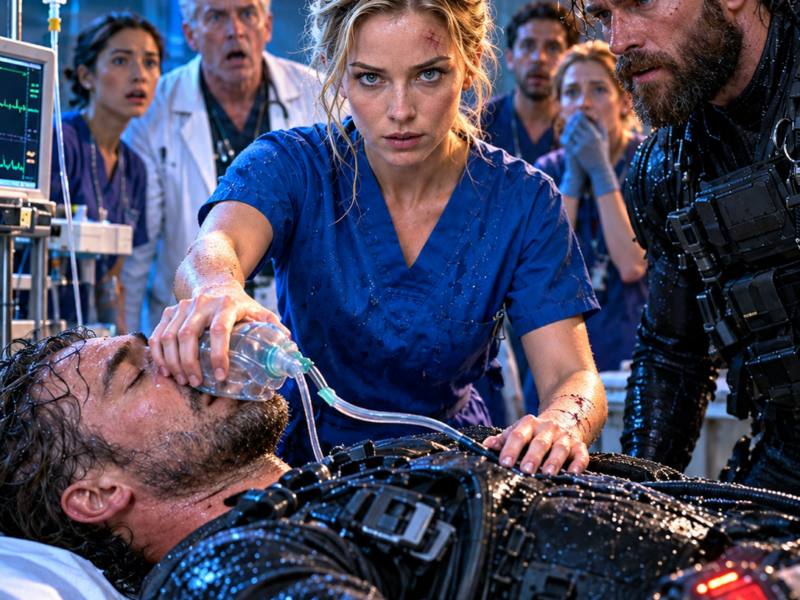
At 2:41 A.M., I Was the Nurse Everyone Mocked for My Shaking Hands When an Unconscious Navy SEAL Was Rushed Into Our Emergency Room After a Dangerous Dive. My Chief Doctor Snapped, “Get Out of My Trauma Bay!” Even as His Treatments Failed and the Patient Was Dying. I Finally Spoke Up, and the SEAL’s Commander Suddenly Stared at My Wrist, Whispering, “Angel… Lieutenant Commander Carly Ren?” My Blood Ran Cold—Because He Had Just Recognized the One Secret I’d Spent Six Years Trying to Bury…
At 2:41 A.M., I Was the Nurse Everyone Mocked for My Shaking Hands When an Unconscious Navy SEAL Was Rushed Into Our Emergency Room After a Dangerous Dive. My Chief Doctor Snapped, “Get Out of My Trauma Bay!” Even as His Treatments Failed and the Patient Was Dying. I Finally Spoke Up, and the SEAL’s Commander Suddenly Stared at My Wrist, Whispering, “Angel… Lieutenant Commander Carly Ren?” My Blood Ran Cold—Because He Had Just Recognized the One Secret I’d Spent Six Years Trying to Bury…
Part 1
At 2:17 in the morning, Nurse Carly Ren stood in the emergency department of Cascade Harbor Medical Center, staring at a coffee stain on the floor while the most respected doctor in Tacoma humiliated her in front of twelve people.
“Tell me something, Ren,” Dr. Colin Vaughn said, holding an empty coffee cup between two fingers. “Did they teach you how to operate a coffee machine in nursing school, or was that course too advanced for you?”
A few nurses laughed. One resident covered his mouth, pretending to cough.
Carly said nothing.
She was thirty-six years old, with dark hair pulled into a loose bun and pale blue scrubs that seemed permanently too large for her slender frame. A narrow scar crossed her left eyebrow, and several smaller scars marked her knuckles. Her hands trembled whenever she wasn’t concentrating on a task.
To the people working around her, those trembling hands told them everything they needed to know.
She was nervous. Weak. Unreliable.
At least, that was what they believed.
“I asked you a question,” Vaughn continued.
“I’ll refill it, Doctor.”
“Of course you will. Because that’s something you might actually manage without making somebody’s condition worse.”
The laughter grew louder.
Carly lowered her eyes and walked toward the break room.
Behind her, Vaughn turned to Francis Dole, the hospital’s administrator.
“I want her removed from trauma rotation,” he said. “She’s a liability. Every time an alarm sounds, she looks like she’s about to collapse.”
Dole glanced at Carly’s retreating figure.
“Document the incidents. I’ll handle the rest.”
Neither man noticed Carly stop briefly beside the doorway.
She had heard every word.
And still, she kept walking.
What nobody at Cascade Harbor understood was that Carly wasn’t afraid of medical emergencies.
She was afraid of remembering them.
Six years earlier, she had arrived at the hospital carrying two suitcases, a nursing license, and a personnel file that revealed almost nothing about her previous assignments.
She had requested night shifts, avoided staff gatherings, and declined every opportunity for promotion.
When colleagues asked about her past, she simply said she had worked overseas.
Most assumed she had volunteered at some small clinic.
Nobody imagined what those words actually meant.
Inside the supply room, Carly closed the door and leaned against it.
Her breathing became shallow.
For an instant, the fluorescent lights above her disappeared, replaced by flashes of lightning over a muddy road. She could almost hear men shouting through heavy rain.
Someone was calling for a medic.
Someone else was screaming her name.
She shut her eyes.
Four seconds in.
Four seconds out.
Again.
Slowly, the memory loosened its grip.
She opened her eyes and examined her reflection in a stainless-steel cabinet.
“Not there anymore,” she whispered.
But part of her knew that wasn’t true.
Some nights, she was still there.
And some nights, she wondered whether she would ever truly leave.
At 2:41 a.m., everything changed.
The ambulance bay doors burst open.
Four men wearing soaked black tactical clothing rushed inside, pushing a stretcher.
Their boots left muddy water across the polished floor.
The man leading them was enormous, with broad shoulders, a dark beard, and the unmistakable bearing of someone accustomed to command.
“Medical emergency!” he shouted. “We need a trauma team now!”
Dr. Vaughn hurried forward.
“I’m Dr. Colin Vaughn, chief of emergency medicine. What’s the situation?”
“Senior Chief Daniel DeLuca, Naval Special Warfare. This is Petty Officer Atlas Moreno. Thirty-two years old. Combat diver. He suffered an emergency ascent during a training operation.”
Vaughn glanced at the unconscious man.
“What happened after he surfaced?”
“He was conscious when we pulled him aboard. Complained of chest pain and dizziness. Then he started talking nonsense. Four minutes later, he collapsed. He had a seizure during transport.”
“How long was he underwater?”
“Approximately twenty-eight minutes.”
“What depth?”
“Maximum depth was around ninety feet.”
Vaughn nodded, but his attention had already shifted to the cardiac monitor.
“Trauma Bay One. Move.”
Within seconds, the room erupted into organized chaos.
A resident checked Atlas’s airway.
A respiratory therapist prepared emergency equipment.
Nurses attached monitoring leads and established intravenous access.
Atlas’s skin was pale, his breathing dangerously inadequate.
Vaughn studied the monitor.
“Possible acute coronary event. Get a twelve-lead ECG. Blood gases. Cardiac enzymes. Prepare for imaging when he’s stabilized.”
DeLuca stood near the foot of the bed, watching.
“Doctor, he was perfectly healthy an hour ago.”
“Senior Chief, please let us work.”
“He came up too fast. His equipment malfunctioned.”
“I understand.”
But Vaughn didn’t seem to understand.
Across the room, Carly was replacing supplies when she heard the words.
He came up too fast.
Her fingers stopped moving.
She looked toward the stretcher.
A black diving computer remained strapped around Atlas’s left wrist.
Its display flashed a red warning.
Then she noticed something else.
A faint, irregular pattern spread across the man’s upper chest, resembling pale marble beneath the skin.
Near his mouth was a trace of pink, frothy fluid.
Carly felt the world narrow.
She knew those signs.
Not from a textbook.
Not from a nursing seminar.
From a place where missing them had once cost someone his life.
She moved closer.
“Doctor,” she said quietly.
Vaughn didn’t acknowledge her.
“Doctor, may I ask—”
“Not now, Ren.”
“I think the dive history matters.”
He turned sharply.
“Of course it matters. The patient is being evaluated.”
“But his symptoms began immediately after an uncontrolled ascent.”
Vaughn gave an irritated sigh.
“Ren, we have specialists here. Please return to whatever you were doing.”
The resident beside him smirked.
Carly looked at Atlas.
His heart rhythm was deteriorating.
She could hear a machine sounding an alarm.
And suddenly she was remembering another monitor, another wounded man, another desperate voice.
Please don’t let him die.
She stepped backward.
For one terrible second, her hands began trembling violently.
Vaughn noticed.
“There. That’s exactly what I’m talking about,” he said. “You can’t even stand near a critical patient without falling apart.”
Carly pressed her fingers against her palms.
She wanted to leave.
Every instinct she had spent six years developing told her to disappear into the supply room and let somebody else take responsibility.
But Atlas was dying.
And the people responsible for saving him were looking in the wrong direction.
Twenty minutes passed.
Then thirty.
Atlas’s condition worsened.
His oxygen levels remained unstable despite advanced respiratory support.
The team reviewed his heart rhythm, considered a stroke, and investigated other possible causes.
Vaughn ordered additional medication.
Nothing explained the sudden neurological collapse as clearly as the history everyone kept overlooking.
DeLuca approached the physician.
“Doctor, we need another plan.”
“We’re following established emergency procedures.”
“He’s getting worse.”
“I can see that, Senior Chief.”
“Then why isn’t anything working?”
Vaughn’s expression hardened.
“Because medicine isn’t magic.”
From the doorway, Carly watched Atlas’s fingers twitch.
She remembered a training instructor speaking inside a naval diving medicine classroom years earlier.
The instructor had held up a battered dive computer and asked one simple question.
“What is the first thing you need to know when a diver collapses?”
Several trainees had offered complicated answers.
The instructor had shaken his head.
“The dive history. Understand the pressure exposure and what happened during ascent before you decide what you’re treating.”
That lesson had been followed by another, far darker one.
During the nineteenth century, workers building bridges inside pressurized underwater chambers had developed a mysterious illness.
Some emerged with terrible joint pain.
Others suffered paralysis.
Some died.
The condition became known as decompression sickness, or the bends.
Scientists eventually discovered that changes in pressure could cause dissolved gas to form bubbles inside the body.
But an uncontrolled ascent could produce another emergency.
As a diver rose, gas trapped inside the lungs expanded.
If that gas couldn’t escape normally, it could damage lung tissue and potentially enter the arterial circulation.
Those bubbles could then obstruct blood flow to vital organs, including the brain.
The resulting condition was called arterial gas embolism.
It could strike within minutes.
Confusion.
Collapse.
Seizures.
Neurological injury.
Even death.
Carly knew the distinction mattered. The skin discoloration and froth weren’t proof of an embolism by themselves, but the timing of Atlas’s collapse after a rapid ascent was an enormous warning.
She also knew that no ordinary medication would simply erase the underlying problem.
A suspected diving gas embolism demanded urgent specialized care, high-concentration oxygen, careful stabilization, and consultation with a hyperbaric medicine team.
And the closest appropriate facility was across the harbor.
She looked at the clock.
3:19 a.m.
Thirty-eight minutes had passed since Atlas entered the hospital.
She couldn’t remain silent another second.
Carly stepped into Trauma Bay One.
“Stop.”
The word wasn’t loud.
Yet something in her voice made the nearest nurse turn.
Vaughn looked up.
“What did you say?”
Carly approached the stretcher.
“I need you to look at his dive computer.”
“Ren, leave this room.”
She ignored him.
“His ascent rate exceeded the safety threshold. He became symptomatic almost immediately after reaching the surface. He has neurological involvement, respiratory distress, and evidence suggesting pulmonary injury.”
The respiratory therapist looked at her.
Carly continued.
“We need to treat this as a suspected arterial gas embolism until a diving medicine specialist tells us otherwise.”
Vaughn stared at her.
Then he laughed.
It was a short, disbelieving sound.
“Are you seriously trying to diagnose this patient?”
“No,” Carly replied. “I’m trying to keep him alive.”
The room went silent.
Her hands were no longer trembling.
Her shoulders straightened.
And when she looked directly into Vaughn’s eyes, there was something there that nobody in that hospital had ever seen before.
Command.
“Dr. Vaughn,” she said, her voice steady, “this man doesn’t have time for your pride.”
For the first time since Carly had arrived at Cascade Harbor, the chief physician didn’t immediately have an answer.
And the man standing beside Atlas’s stretcher was staring at her as though he had just heard a ghost speak.
Part 2
“What did you just say?” Dr. Vaughn demanded.
Carly didn’t move.
“I said he needs immediate treatment for a suspected arterial gas embolism. We need one hundred percent oxygen, stabilization, and emergency coordination with a hyperbaric facility.”
“You are overstepping your authority.”
“Then authorize the treatment.”
The respiratory therapist glanced between them.
Vaughn hesitated.
DeLuca stepped forward. “Doctor, is she right?”
Before Vaughn could answer, Atlas’s monitor sounded another warning.
Carly looked at the respiratory therapist.
“Please prepare maximum appropriate oxygen delivery through his ventilator and confirm the settings with the attending physician.”
The therapist immediately began working.
Vaughn protested, but the senior chief moved between him and Carly.
“If she knows something that could save my man,” DeLuca said, “you are going to listen.”
Carly contacted the receiving diving medicine team and relayed the depth, ascent history, neurological symptoms, and current condition.
As the transfer plan developed, DeLuca studied her face.
That scar above her eyebrow.
The way she positioned herself near the doorway.
And the unmistakable precision in her voice.
He had seen those habits before.
Years ago.
In a place he had spent most of his life trying to forget.
Part 3
The receiving physician answered Carly’s emergency call on the second ring.
“This is Commander Evelyn Mercer, Naval Diving Medicine. Who am I speaking with?”
“Nurse Carly Ren, Cascade Harbor Medical Center. We have a thirty-two-year-old military diver following an uncontrolled ascent from approximately ninety feet. Acute neurological deterioration within minutes of surfacing. Seizure activity, respiratory compromise, possible pulmonary barotrauma, and suspected arterial gas embolism.”
Mercer immediately became serious.
“Is he receiving one hundred percent oxygen?”
“We’re arranging it through his ventilator now.”
“Keep the airway supported. Continue careful monitoring. We need him transferred to a facility capable of recompression treatment as rapidly and safely as possible.”
Carly glanced toward the window.
Heavy fog drifted through the ambulance bay.
“Helicopter conditions are poor,” she said.
“We’ve grounded our aircraft because of visibility.”
“Understood. I’ll coordinate a maritime transfer with the senior chief if it’s safe and available.”
There was a brief silence.
Then Mercer asked, “Nurse Ren, where did you learn to recognize this presentation?”
Carly looked at DeLuca, who stood watching her from across the room.
“Previous training, Commander.”
“What kind?”
“Military diving medicine.”
Mercer paused.
“That’s uncommon experience for an emergency room nurse.”
“I know.”
Carly ended the call before the conversation could become more personal.
Behind her, Vaughn was furious.
“You had no authorization to contact another facility.”
“I notified a specialist about a time-critical medical emergency.”
“You went around me.”
“Atlas Moreno is deteriorating while we’re arguing.”
Vaughn stepped closer.
“Do you understand what happens when a nurse starts making independent medical decisions?”
Carly met his stare.
“Yes. That’s why I’m asking you to make the right one.”
The remark landed harder than shouting would have.
Francis Dole entered the trauma bay moments later, followed by two security officers.
He carried a folder containing documents that had been prepared long before this emergency.
“Nurse Ren,” he announced, “your repeated insubordination has left us no choice. You’re suspended pending an administrative review.”
Carly barely looked at him.
“Not now.”
“Excuse me?”
“There’s a critically injured patient who needs urgent transfer. We can discuss paperwork afterward.”
Dole’s face reddened.
“You don’t decide when hospital policy applies.”
DeLuca moved toward him.
“Administrator, my teammate may die if this transfer is delayed.”
“This is a civilian hospital, Senior Chief. We have procedures.”
“So does the Navy,” DeLuca answered. “And one of them is getting wounded personnel to definitive care.”
Dole pointed toward Carly.
“Security, escort her out.”
Neither guard moved.
Their hesitation was enough to make Dole angrier.
“Did you hear me?”
One of them, a middle-aged man named Marcus, looked toward Atlas.
He had worked at Cascade Harbor for eleven years.
His daughter had once broken her arm during a school performance, and Carly had stayed beside the frightened child until she stopped crying.
Marcus remembered that.
He also remembered how often the other staff members mocked the quiet nurse.
“Sir,” he said carefully, “maybe we should let the medical team finish.”
Dole turned on him.
“You can join her suspension if you want.”
Before Marcus could answer, the heart monitor alarmed.
Atlas’s condition had worsened again.
The conversation stopped.
For the next several minutes, the trauma team worked to stabilize him under physician supervision. Carly supplied the relevant dive history, watched the monitoring equipment, and coordinated with the receiving facility.
When Atlas was stable enough to move, the transport team confirmed the equipment required to maintain his airway, oxygen delivery, and monitoring during the journey.
DeLuca contacted a naval patrol crew operating near the harbor.
A vessel with a medical evacuation capability was available.
The crossing would take approximately twenty-five minutes if conditions permitted.
Carly knew the hospital layout better than most senior administrators.
She had studied its emergency evacuation plans during her first week.
Three main exits.
Two stairwells.
One service tunnel.
And one restricted corridor connecting the ambulance level to a dockside access road.
“There’s a shorter route to the harbor,” she told DeLuca.
He looked at her.
“How do you know?”
“I studied the building.”
“Why?”
Carly hesitated.
“Habit.”
DeLuca didn’t ask anything else.
Not yet.
Within fifteen minutes, they had assembled a transport team, secured Atlas to a monitored stretcher, and coordinated a handoff with the boat’s medical personnel.
Vaughn stood near the door.
“You’re making a serious mistake,” he told Carly.
She turned.
“I sincerely hope you’re right about one thing, Doctor.”
“What?”
“That this man survives long enough for us to argue about it tomorrow.”
Then she walked past him.
The stretcher rolled through the restricted corridor.
The fluorescent lights flickered overhead.
Rainwater tapped against the exposed ventilation pipes.
Carly followed beside the medical team, watching Atlas’s monitor and listening to every change in his breathing.
Marcus unlocked the security gate.
As the group passed, he looked at her.
“Good luck, Nurse Ren.”
She gave him a small nod.
“Thank you.”
Outside, cold air struck their faces.
The harbor was almost invisible beneath the fog.
The patrol vessel waited beside the dock, its navigation lights glowing faintly through the mist.
The crew secured the stretcher and confirmed medical equipment was operating before departure.
DeLuca climbed aboard.
Carly followed.
The engines accelerated, carrying them into the darkness.
For several minutes, nobody spoke.
Only the sound of waves against the hull and the steady rhythm of medical equipment disturbed the silence.
Then Atlas suffered another seizure.
The attending transport medic immediately intervened, protecting him from injury while the team maintained his airway and followed the agreed emergency protocol.
Carly assisted with monitoring.
DeLuca stood beside them, his face drained of color.
“Come on, Atlas,” he whispered. “You survived worse than this.”
The seizure eventually stopped.
Carly checked the monitor and looked toward the horizon.
“Stay with us,” she murmured. “We’re getting you there.”
She reached across the stretcher to adjust a monitoring cable.
As she did, her sleeve slipped backward.
A small tattoo appeared on the inside of her wrist.
A winged anchor.
Beneath it were two tiny letters.
A.R.
DeLuca looked down.
At first, he simply stared.
Then his expression changed.
The color disappeared from his face.
He looked at Carly’s wrist again, then at the scar above her eyebrow.
The years seemed to fall away.
Rain.
Mud.
Explosions.
A medic kneeling in a drainage ditch.
A woman shouting orders through the sound of gunfire while wounded men begged for help.
DeLuca took a step backward.
“No,” he whispered.
Carly didn’t look up.
He leaned closer.
“Angel?”
Her hand froze.
The name seemed to cut through every wall she had spent six years building.
She closed her eyes.
“Don’t,” she said quietly.
DeLuca’s voice trembled.
“Lieutenant Commander Carly Ren?”
She slowly turned toward him.
“Senior Chief, this is not the time.”
He shook his head.
“Oh, my God.”
The transport medic looked between them.
“You two know each other?”
DeLuca couldn’t answer immediately.
He was staring at Carly as though he had just discovered a missing piece of his own life.
“Six years ago,” he finally said, “I was part of a team ambushed during an operation overseas.”
Carly looked away.
“Daniel.”
“We were trapped for hours. Six wounded men. No extraction. Enemy fire from three directions.”
“Please stop.”
“And there was one Navy nurse who refused to leave us.”
The medic looked at Carly.
DeLuca continued.
“We called her Angel because she kept appearing wherever somebody was about to die.”
Carly’s eyes filled with tears.
“Daniel, please.”
He lowered his voice.
“She held me together for four hours after I was hit. I remember her hands. I remember her telling me that my daughter still needed her father.”
He swallowed.
“I remember everything.”
The medic stared at the quiet woman in blue scrubs.
DeLuca shook his head slowly.
“We searched for you after the operation. Everyone did.”
Carly looked toward the water.
“I didn’t want to be found.”
“Why?”
She said nothing.
DeLuca’s expression softened.
“Angel, what happened after they evacuated us?”
For several seconds, Carly remained motionless.
Then she answered with words so quiet he almost didn’t hear them.
“The men you rescued weren’t the only men I was responsible for that night.”
And suddenly, DeLuca understood that the greatest secret Carly carried wasn’t the military career she had hidden.
It was what happened after he had been carried to safety.
Six years earlier, Carly Ren had been a lieutenant commander in the United States Navy Nurse Corps, assigned to a forward medical support team operating in a remote conflict zone.
She was known for her calm decisions under pressure.
She had earned the trust of surgeons, corpsmen, pilots, and combat personnel who rarely trusted anyone outside their own teams.
But she had never sought recognition.
She considered every successful rescue an obligation fulfilled, not an accomplishment deserving praise.
Then came the operation that ended her career.
A special warfare unit had been moving through a mountainous region when an improvised explosive device struck the lead vehicle.
The explosion tore through the convoy.
Gunfire followed.
Within minutes, several men were injured, communications were disrupted, and the surviving personnel were forced into a narrow drainage ditch.
Carly’s medical team had been nearby.
She could have remained at the staging point.
Instead, she moved toward the wounded.
For four hours, she worked under appalling conditions.
Her hands remained steady while she controlled bleeding, protected airways, reassessed injuries, and organized the limited medical supplies.
She used her own body to shield injured men from flying debris.
She kept talking even when the men stopped responding.
One of those men was Daniel DeLuca.
He had suffered a severe leg injury and significant blood loss.
His breathing had become shallow.
At one point, he grabbed Carly’s sleeve.
“Tell my daughter I tried,” he whispered.
Carly leaned over him.
“You can tell her yourself.”
“I don’t think I’m going home.”
“That’s not your decision tonight.”
He remembered her eyes.
Not because they showed no fear.
But because they showed fear and determination at the same time.
“Listen to me,” she had said. “Your little girl is waiting. You are not leaving her without a fight.”
When evacuation aircraft finally arrived, six injured men were transported to safety.
DeLuca believed that was where Carly’s story ended.
It wasn’t.
After the evacuation, Carly received a message over the radio.
Another medical vehicle was missing.
Three members of her own support team had been separated during the fighting.
They needed help.
Despite the danger, Carly went back.
What happened afterward would haunt her for the rest of her life.
The rescue attempt came too late.
Two of her closest colleagues were dead when she arrived.
The third died before she could get him to safety.
One of them was Chief Hospital Corpsman Nathan Brooks, a man who had served beside her through three deployments.
He had been her closest friend.
The person who reminded her to eat when she worked too long.
The person who called her “Commander” when he wanted to annoy her.
The person who had once joked that her hands were the safest place in the world.
Carly had held him as he died.
Afterward, she couldn’t stop looking at her hands.
The same hands that had saved six lives had failed to save three others.
The military investigation found no misconduct on her part.
Her supervisors told her she had done everything possible.
Her colleagues called her a hero.
She hated that word.
Because every time someone said it, she remembered the men who hadn’t come home.
When her deployment ended, she took medical leave.
Eventually, she left active service.
She moved to Tacoma, accepted a position at Cascade Harbor, and tried to become someone ordinary.
Someone invisible.
Someone who never again had to make a decision that determined whether another human being lived or died.
But now, aboard a patrol boat cutting through the darkness, her past had found her.
And the man who recognized her was one of the six reasons she had once been called a hero.
Part 4
For several minutes after DeLuca’s revelation, Carly couldn’t bring herself to speak.
The patrol boat moved through the fog, its hull rising and falling against the dark water.
Atlas remained unconscious on the stretcher, his condition serious but being closely monitored by the transport team.
DeLuca sat beside Carly.
He had imagined meeting her again countless times.
In his mind, the reunion had always happened somewhere peaceful.
Perhaps at a veterans’ gathering.
Perhaps at a Navy ceremony.
He imagined shaking her hand, introducing her to his daughter, and thanking her properly.
He had never imagined finding her in a civilian hospital where she was treated like an incompetent employee.
“You disappeared,” he finally said.
Carly stared at the water.
“I left.”
“Without telling anyone.”
“I needed a different life.”
“We thought something had happened to you.”
“Something did.”
The answer silenced him.
For a while, they listened to the engines.
Then DeLuca spoke again.
“My daughter is thirteen now.”
Carly turned slightly.
“Emma?”
He looked surprised.
“You remember her name?”
“You showed me a photograph. She was seven. Missing her front teeth.”
DeLuca laughed softly.
“She’s got braces now. And she argues about absolutely everything.”
Carly smiled for the first time that night.
“She sounds like you.”
“She knows about you.”
Carly looked at him.
“What?”
“I told her about the woman who saved my life. Not every detail, but enough. I wanted her to understand that courage doesn’t always look like a soldier carrying a weapon.”
He paused.
“She wrote a school essay about you once.”
Carly lowered her head.
“Daniel, you don’t have to do this.”
“Do what?”
“Make me into something I’m not.”
DeLuca’s expression changed.
“You kept me alive when I was certain I was dying.”
“I was doing my job.”
“You were doing your job when everyone else thought there was nothing left to do.”
Carly shook her head.
“And I couldn’t save Nathan.”
The name came out painfully.
DeLuca looked at her.
“I heard about Brooks.”
“He was right there.”
“I know.”
“I thought I could save him. I kept telling him to hold on. I promised him we’d get out.”
Her voice broke.
“And then he stopped breathing.”
DeLuca didn’t interrupt.
Carly rubbed her hands together.
“For years, every time somebody told me I was brave, all I could think about was Nathan. And Luis. And Michael. They were my team.”
She looked directly at him.
“Do you understand what it’s like to save strangers and lose the people who trusted you most?”
DeLuca’s eyes grew wet.
“Yes,” he answered. “I do.”
Carly looked away.
He continued gently.
“But you didn’t kill them, Angel.”
“I couldn’t save them.”
“Those are not the same thing.”
She didn’t respond.
DeLuca knew better than to demand agreement.
Some wounds weren’t healed by a single conversation, no matter how true the words might be.
Instead, he placed one hand on the bench between them.
Close enough that she could reach it.
Far enough that she didn’t feel trapped.
After a moment, Carly rested her fingers against his.
They remained there until the vessel approached the opposite shore.
The naval diving medicine facility had prepared for their arrival.
A medical team waited at the dock with a specialized transport stretcher.
Commander Mercer greeted them at the entrance.
“Petty Officer Moreno?”
Carly nodded.
“Thirty-two, emergency ascent following a dive to approximately ninety feet. Acute neurological symptoms after surfacing, seizure activity, respiratory compromise, and suspected arterial gas embolism. His records and diving computer are here.”
Mercer listened carefully.
“Good work getting the information to us.”
Carly handed over the dive computer.
Its screen remained damaged, but the recorded dive profile was accessible.
The receiving team continued its assessment.
Treatment planning involved checking Atlas’s airway, circulation, neurological status, and possible complications from pulmonary injury.
Following the specialist evaluation, the team prepared him for hyperbaric oxygen therapy.
Carly watched through the corridor window as the staff moved around him.
She remembered the earliest history of recompression medicine.
Long before electronic dive computers existed, engineers and scientists had struggled to understand why workers became ill after leaving pressurized environments.
By the late nineteenth century, researchers had established the importance of dissolved gas and changes in ambient pressure.
In 1908, physiologist John Scott Haldane helped develop decompression tables that shaped modern diving practices.
Those early discoveries eventually led to increasingly sophisticated methods of preventing and treating pressure-related diving injuries.
Carly had studied that history years earlier.
But now it wasn’t history.
It was a young man lying on a stretcher.
A man whose teammates were waiting for him.
A man who had a family somewhere, unaware that his life had nearly ended in the water.
As the hyperbaric team began treatment, Carly stepped into the corridor.
The adrenaline that had sustained her since the emergency began finally disappeared.
Her hands started shaking again.
She sat on a bench.
The trembling became so intense that she tucked both hands beneath her knees.
DeLuca approached quietly.
“Can I sit?”
She nodded.
He sat beside her without speaking.
Minutes passed.
Then an hour.
Carly watched nurses walk past the corridor.
She heard equipment moving behind closed doors.
Each distant alarm made her heart race.
Each time footsteps approached, she expected bad news.
DeLuca remained beside her.
Eventually, he said, “Something’s been bothering me.”
Carly looked at him.
“What?”
“That doctor.”
She sighed.
“Vaughn?”
“He humiliated you in front of everyone.”
“He does that.”
“And you let him?”
Carly’s expression closed.
“I didn’t want trouble.”
“You were an officer. You commanded medical personnel in combat zones.”
“That was another life.”
“You don’t stop being capable because you take off a uniform.”
She stared at the floor.
“I know.”
“Then why let those people convince you otherwise?”
Carly took a long breath.
“Because being underestimated was easier.”
DeLuca waited.
“If people expected nothing from me, I couldn’t disappoint them. If they didn’t trust me with important decisions, I wouldn’t have to carry the consequences.”
She rubbed the scar above her eyebrow.
“I thought I was protecting myself.”
“And were you?”
Carly looked through the glass toward the treatment area.
“No,” she whispered.
For the first time, she could see how much of her life had been built around avoiding pain rather than pursuing peace.
She had taken a job beneath her experience.
She had accepted ridicule without defending herself.
She had hidden her accomplishments because remembering them meant remembering her losses.
But the past had followed her anyway.
And tonight, when a stranger desperately needed her knowledge, the person she had tried to bury had returned.
Not because she wanted recognition.
Because somebody needed help.
Hours later, Commander Mercer entered the corridor.
Carly stood so quickly that her chair scraped against the wall.
“How is he?”
Mercer smiled.
“His condition has improved significantly during treatment. He’s responding to commands, and his neurological examination is encouraging. We’ll continue observation and follow-up because recovery can be complicated, but these are very good signs.”
DeLuca covered his face with both hands.
Carly leaned against the wall.
Mercer continued.
“He woke briefly and asked whether his diving computer survived.”
DeLuca laughed.
“Of course he did.”
“Then he asked whether somebody could get him coffee.”
Carly started laughing too.
At first, it was a small sound.
Then her shoulders began shaking.
The laughter dissolved into tears.
She covered her mouth.
For years, she had carried the belief that every emergency would end the way Nathan’s had.
Tonight, a man had survived.
She had recognized the danger.
She had spoken up.
And she had helped get him to the care he needed.
It didn’t erase the people she’d lost.
But it reminded her that loss wasn’t the only possible ending.
DeLuca wrapped his arms around her.
Carly cried against his shoulder.
Neither cared who saw.
By morning, news of the incident had reached senior naval medical personnel.
A preliminary review confirmed that Carly’s recognition of the diving emergency and the coordinated transfer had contributed to the rapid delivery of appropriate care.
Commander Mercer personally contacted Cascade Harbor’s medical director to request an incident review.
That call created a problem for Dr. Vaughn.
Because while Atlas Moreno was recovering across the harbor, Vaughn and Francis Dole were preparing paperwork that described Carly Ren as an insubordinate employee who had endangered a patient.
They had no idea that the patient was alive.
They had no idea that senior naval personnel knew Carly.
And they certainly had no idea what would happen when the medical team returned to Tacoma.
At 8:45 a.m., Carly walked back into Cascade Harbor Medical Center.
She was still wearing the same blue scrubs.
Her hair was loose.
Her eyes were red from exhaustion.
Beside her walked Senior Chief Daniel DeLuca.
Behind them came Commander Mercer and a naval medical liaison.
The receptionist looked up.
Then she noticed the uniforms.
Within minutes, word spread through the hospital.
The quiet nurse had returned.
And this time, she wasn’t alone.
Part 5
Francis Dole was sitting at the head of the conference table when the door opened.
He had spent the early morning preparing a suspension report, convinced that Nurse Carly Ren had finally given him enough justification to remove her from Cascade Harbor Medical Center.
Dr. Colin Vaughn sat beside him.
Two members of the hospital’s medical leadership team occupied the opposite seats.
The documents were arranged neatly.
A pen waited beside the signature line.
Dole looked up when Carly entered.
His expression darkened.
“Miss Ren, you’re not authorized to be in this building.”
DeLuca stepped through the doorway behind her.
“Then you’re going to have to explain why.”
Dole straightened.
“Senior Chief, this is an internal employment matter.”
Commander Mercer entered.
“Not entirely.”
Vaughn looked at her uniform.
“And you are?”
“Commander Evelyn Mercer, Naval Diving Medicine. I supervised the receiving team for Petty Officer Atlas Moreno.”
Vaughn shifted in his chair.
Dole attempted a professional smile.
“Commander, we’re glad you could join us. Unfortunately, Nurse Ren interfered with treatment and initiated an unauthorized transfer.”
Mercer looked at Carly.
Then back at Dole.
“Petty Officer Moreno is alive, showing encouraging neurological recovery, and receiving the specialized care indicated by his diving emergency.”
Nobody spoke.
Mercer placed a copy of the medical transfer summary on the table.
“The working diagnosis was suspected arterial gas embolism following pulmonary barotrauma during an uncontrolled ascent. The dive history and sudden neurological deterioration were critical indicators.”
Vaughn’s face had gone pale.
DeLuca placed Atlas’s damaged dive computer beside the report.
A crack ran across its screen.
“This belonged to my teammate,” he said. “He was wearing it when he entered your emergency department.”
Vaughn glanced at it.
DeLuca continued.
“It contained information about his dive profile. Information your team had available from the beginning.”
“We considered multiple possibilities,” Vaughn said defensively.
“Did you consider what happened underwater?”
Vaughn said nothing.
“Because I told you he surfaced too quickly,” DeLuca continued. “I told you his symptoms started minutes afterward.”
“We were treating a critically unstable patient.”
“And Nurse Ren identified the significance of those facts.”
Dole leaned forward.
“Regardless of her reasoning, hospital employees cannot simply disregard their superiors.”
Mercer folded her hands.
“Professional responsibility includes raising urgent patient safety concerns. Whether each action complied with policy will be determined through a fair review, not by ignoring the clinical outcome.”
Carly stood near the door.
She hadn’t come to celebrate Vaughn’s embarrassment.
She hadn’t come looking for revenge.
In fact, the attention made her uncomfortable.
But she had spent six years remaining silent while people dismissed her.
And now, she understood that silence had consequences beyond her own feelings.
Vaughn finally turned toward her.
“How did you know?”
Carly frowned.
“Know what?”
“The diagnosis. You recognized it immediately. I’ve been practicing emergency medicine for twenty years, and you identified something most physicians rarely encounter.”
She took a breath.
“Because I was trained to.”
“Where?”
She looked toward DeLuca.
He nodded gently.
Carly turned back toward the table.
“I served in the United States Navy Nurse Corps.”
Dole’s eyebrows rose.
“You were a military nurse?”
“Yes.”
“For how long?”
“Long enough.”
DeLuca stepped closer.
“Lieutenant Commander Carly Ren served with forward medical units supporting special operations. She has experience in trauma care, military evacuation medicine, and diving-related emergencies.”
Vaughn stared at her.
DeLuca continued.
“Six years ago, she saved my life during an ambush. Five other men survived that night because she refused to abandon them.”
The room fell silent.
“She earned the call sign Angel,” he said. “Not because she wanted it. Because that’s what wounded men called her when she reached them.”
Dole slowly lowered his pen.
Vaughn looked at Carly’s hands.
Those same hands he had mocked.
Those same hands he had declared unfit for emergency medicine.
He remembered every joke.
Every insult.
Every time he had dismissed her suggestions without listening.
DeLuca’s voice grew colder.
“While you were making jokes about her inability to handle a coffee machine, you were speaking to someone who had spent hours keeping wounded service members alive under enemy fire.”
Carly looked down.
“Daniel.”
He stopped.
She moved toward the table.
“I didn’t come here to discuss my military history.”
“Then why did you come?” Dole asked.
Carly looked directly at Vaughn.
“Because I need you to understand what happened.”
Vaughn remained silent.
“You saw a nurse whose hands shook,” she said. “You decided that meant I was incompetent. You never asked about my training. You never asked why I struggled with certain sounds. You never asked whether there were things I knew that you didn’t.”
She paused.
“And last night, when a man was dying, you almost made the same mistake with him.”
Vaughn flinched.
“You saw his abnormal heart rhythm and neurological symptoms. Those observations mattered, but you focused on individual findings without giving enough weight to what happened immediately before he collapsed.”
She pointed toward the diving computer.
“The answers weren’t hidden. They were in his history.”
Vaughn studied the device.
Carly continued.
“I didn’t need you to believe I was special. I needed you to listen long enough to consider that I might be right.”
Dole looked toward the medical director.
“We should probably discuss this privately.”
“No,” Carly said.
Everyone turned.
Her voice remained calm.
“This happened publicly. You humiliated me publicly. You tried to remove me from a patient emergency publicly.”
She swallowed.
“I don’t want anyone else to experience that here.”
For a moment, she feared the old trembling would return.
But her hands remained steady.
The hospital’s medical director, Dr. Helen Brooks, had listened without interrupting.
Now she spoke.
“We will conduct a formal patient safety review. We will examine the initial assessment, the communication between staff, the escalation decisions, and the treatment timeline.”
She looked toward Dole.
“And any employment action taken against Nurse Ren will be suspended until that review is completed.”
Dole opened his mouth.
Brooks raised a hand.
“That’s not negotiable.”
The meeting ended shortly afterward.
Carly left the room without celebrating.
In the hallway, she found several nurses waiting.
Some looked embarrassed.
Others looked curious.
One of them, a young resident named Peter Walsh, stepped forward.
He had laughed louder than anyone when Vaughn mocked her earlier that night.
“Nurse Ren?”
Carly stopped.
Peter swallowed.
“I owe you an apology.”
She looked at him.
He continued.
“I laughed when Dr. Vaughn made those comments. I knew it was wrong. I did it anyway.”
Carly said nothing.
“I didn’t know your background.”
She gave him a tired smile.
“You shouldn’t need to know someone’s background to treat them with respect.”
Peter lowered his eyes.
“You’re right.”
Carly nodded and walked away.
The following week brought changes nobody at Cascade Harbor had expected.
The patient safety review identified important failures in recognizing and escalating a diving-related emergency.
It also examined how authority and workplace culture had discouraged staff from raising concerns.
Vaughn was removed from his position as chief of emergency medicine pending additional training and leadership review.
Dole withdrew the suspension paperwork.
Soon afterward, he resigned.
But the most surprising development came during a mandatory staff meeting.
Vaughn stood in front of the emergency department team.
He looked older than he had a week earlier.
His confidence had been replaced by something more uncomfortable.
Humility.
“I owe Nurse Ren an apology,” he began.
The room became quiet.
“I made assumptions about her abilities based on behavior I didn’t understand. I allowed those assumptions to influence how I treated her.”
He glanced toward Carly, who stood near the back wall.
“More importantly, I allowed my pride to interfere with listening to a colleague who recognized a medical emergency.”
He paused.
“That’s unacceptable. And I’m sorry.”
Nobody applauded.
Nobody laughed.
For once, silence felt appropriate.
Carly accepted the apology, but she didn’t pretend it erased six years of humiliation.
Trust, she understood, required more than words.
It required changed behavior.
Over the next several months, the hospital introduced stronger procedures for communicating patient safety concerns.
Nurses and other clinicians were encouraged to escalate urgent observations without fear of retaliation.
Divers with possible pressure-related injuries were included in new simulation exercises.
And Carly was invited to help develop a community education program.
At first, she hesitated.
Standing in front of an audience meant allowing people to look at her.
Really look at her.
That was something she had avoided for years.
Then Atlas Moreno visited the hospital.
He walked into the emergency department carrying a small paper bag and an old diving computer.
His recovery had required careful medical follow-up and rehabilitation, but he was progressing well.
Carly looked up from the nursing station.
“Atlas?”
He smiled.
“That’s what they call me.”
She came around the desk.
“How are you feeling?”
“Better than I have any right to.”
He held out the bag.
“Coffee.”
Carly laughed.
“Coffee?”
“Senior Chief told me about your boss. Thought you deserved to receive one instead of being ordered to make it.”
She laughed again.
Then he handed her the dive computer.
Its screen was cracked.
The wrist strap had been replaced.
“Keep it,” he said.
Carly looked at him.
“Atlas, this is important equipment.”
“Not anymore. I’m getting a new one. But I want you to have this.”
“Why?”
“Because somebody might look at it someday and learn something that saves another diver.”
She turned the device over in her hands.
Atlas’s smile faded into something more serious.
“Senior Chief told me who you are.”
Carly looked away.
“He talks too much.”
“He told me about that operation.”
She didn’t answer.
“And he told me what happened to your team.”
Her fingers tightened around the computer.
Atlas spoke gently.
“I know you probably don’t want another person calling you a hero.”
“Not really.”
“Then I won’t.”
He extended his hand.
“I’ll just say thank you for helping me get home.”
Carly shook his hand.
It was a simple gesture.
No medal.
No ceremony.
No speech.
And somehow, it meant more to her than any recognition she had received before.
Three months later, Cascade Harbor opened its first community diving emergency awareness program.
The classes welcomed recreational divers, boat operators, lifeguards, instructors, parents, and anyone interested in learning how to respond when someone became ill after diving.
Carly helped explain the warning signs.
A diver who suddenly became confused, weak, unconscious, or severely unwell after surfacing needed urgent medical attention.
A rapid ascent could cause serious injury even when a person initially appeared normal.
Witnesses should immediately contact emergency services, clearly report the diving history, follow dispatcher instructions, and provide basic life support if necessary and trained to do so.
High-concentration oxygen could be important when administered by trained responders with appropriate equipment.
The person should be kept as still as practical while maintaining breathing and circulation, and transport to a suitable medical facility should not be delayed.
Carly emphasized that emergency responders and diving medicine specialists needed accurate information about the dive depth, duration, ascent, symptoms, and equipment.
And she explained that recompression treatment might be necessary for certain serious diving injuries.
But she didn’t teach these things as an instructor reciting facts from a manual.
She told stories.
She described how quickly an ordinary recreational dive could turn into an emergency.
She explained why people sometimes missed dangerous symptoms.
And she reminded every audience that the person who noticed the first warning might not be the most senior or impressive person in the room.
At the front of the classroom hung Atlas’s cracked diving computer.
Beneath it was a small plaque.
It read:
One question can change everything.
On the program’s opening night, the lecture hall was filled beyond capacity.
DeLuca sat in the front row with his daughter, Emma.
Atlas sat beside them.
Marcus, the security guard, attended with his family.
Several nurses from Cascade Harbor occupied seats near the back.
And near the entrance stood Dr. Vaughn.
Carly noticed him before the session began.
For a moment, their eyes met.
He gave a small, respectful nod.
She returned it.
Then she stepped toward the podium.
Her heart was racing.
Her palms were damp.
She could hear the audience whispering.
For a brief moment, she wondered whether she could do it.
Then she looked at DeLuca.
He smiled.
Emma waved enthusiastically.
Atlas raised his coffee cup.
Carly laughed.
And suddenly, the room didn’t seem so frightening.
She placed both hands on the podium.
“Good evening,” she began. “My name is Carly Ren. I’m a nurse, and tonight I want to tell you about a mistake that can happen when we think we’ve already understood everything.”
The audience became quiet.
“Six years ago, I believed that if I worked hard enough, trained long enough, and made the right decisions, I could save everyone.”
She paused.
“I learned that wasn’t true.”
DeLuca lowered his eyes.
Carly continued.
“For a long time, I thought the people I couldn’t save were proof that I had failed. I stopped trusting myself. I became afraid to be responsible for another person’s life.”
She looked around the room.
“But I learned something else recently.”
Her voice grew stronger.
“We cannot control every outcome. We cannot undo every tragedy. But we can keep learning. We can listen to each other. And when someone needs help, we can choose not to look away.”
A quiet stillness settled over the audience.
Carly pointed toward the computer hanging on the wall.
“That device belonged to a man who nearly died because of a diving emergency. It reminds me that sometimes the most important information is the detail everyone else overlooks.”
She smiled gently.
“And sometimes the person who notices that detail is somebody nobody expected to speak.”
When the class ended, people approached her with questions.
Some wanted information about diving safety.
Others thanked her for her service.
A few spoke about their own experiences with grief, fear, and starting over.
Carly listened.
She didn’t hide her hands.
She didn’t turn away when someone praised her.
She simply accepted their words with quiet gratitude.
As the room emptied, Emma approached.
“Are you really the nurse who saved my dad?”
Carly knelt slightly so their eyes were level.
“I helped him when he was hurt.”
Emma studied her.
“Dad says you wouldn’t let him give up.”
Carly smiled.
“He was pretty stubborn.”
Emma laughed.
“He still is.”
Then the girl threw her arms around Carly.
“Thank you for giving him back to me.”
Carly closed her eyes.
For one heartbeat, she was back in the rain, holding DeLuca’s hand while he whispered about his daughter.
But this time, the memory didn’t end with gunfire.
It ended with a thirteen-year-old girl hugging her.
And something inside Carly finally began to heal.
Later that evening, after everyone had gone, Carly stood alone in the empty classroom.
She looked at the cracked diving computer.
Then at the photograph DeLuca had given her.
It showed six men standing together during a reunion, all of them older now, all of them alive.
On the back, someone had written:
For Angel. We made it home.
Carly traced the words with her fingers.
She thought about Nathan Brooks.
About Luis and Michael.
About the friends she would never see again.
She knew she would always miss them.
Their deaths would never become easy memories.
But she was beginning to understand that honoring them didn’t mean punishing herself forever.
It meant living.
It meant using the knowledge they had shared.
It meant helping people when she could, while accepting that even the best medical professionals couldn’t save everyone.
And it meant allowing herself to be seen.
The following morning, Carly returned to the emergency department for her regular shift.
The hospital smelled of disinfectant and freshly brewed coffee.
A new resident stood nervously beside the nursing station, struggling to organize a pile of patient charts.
Carly noticed his trembling hands.
“First night?” she asked.
He nodded.
“I’m trying not to mess anything up.”
She smiled.
“You’ll make mistakes. Everyone does.”
He looked embarrassed.
“That’s reassuring.”
“What matters is learning, asking questions, and speaking up when something doesn’t seem right.”
The resident glanced toward the trauma bay.
“Were you ever scared when you started?”
Carly considered the question.
Then she answered.
“I’m still scared sometimes.”
He looked surprised.
“Really?”
“Of course.”
“How do you work through it?”
She looked down at her hands.
They were trembling slightly.
For years, she had hated that.
Now, she understood they were simply part of her.
A reminder of everything she’d survived.
She looked back at the young resident.
“Courage doesn’t mean your hands never shake,” she said. “It means you keep doing what matters, even when they do.”
The resident smiled.
Then a monitor sounded from the hallway.
Both of them turned.
Carly straightened her shoulders.
“Come on,” she said. “Someone needs us.”
And together, they walked toward the sound.
Because Carly Ren had never truly lost the person she had once been.
She had only forgotten that being wounded didn’t make her weak.
And the people who once laughed at her trembling hands eventually learned something they would never forget.
Sometimes the strongest person in the room is the one who speaks the least.
Sometimes the person who seems most afraid has already survived things others cannot imagine.
And sometimes a life is saved not by the loudest voice, the highest title, or the most impressive reputation, but by someone willing to notice what everyone else has missed.
Carly would never again need a uniform to prove her courage.
She would never need applause to believe she mattered.
She had found something more valuable than recognition.
She had found her purpose again.
And whenever her hands began to tremble, she remembered the injured man who came home, the daughter who hugged her, and the friends whose memories she continued to honor.
Then she took one breath.
And another.
And kept going.